Curated collectionAnswer keys includedPrint-ready PDFs
Summer Learning Grammar Worksheets
Maintain selected skills through a light spaced schedule, learner choice and short review loops rather than recreating a school day.
Start with a real resource
Browse this worksheet collection
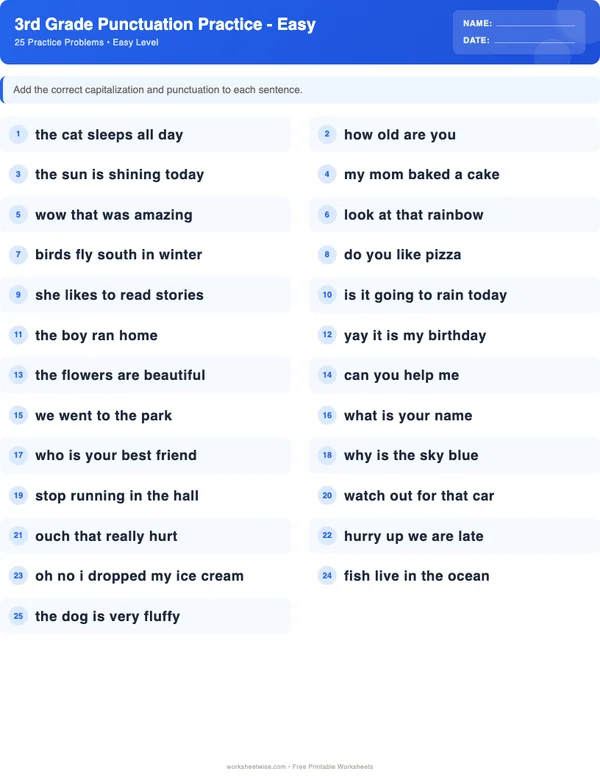
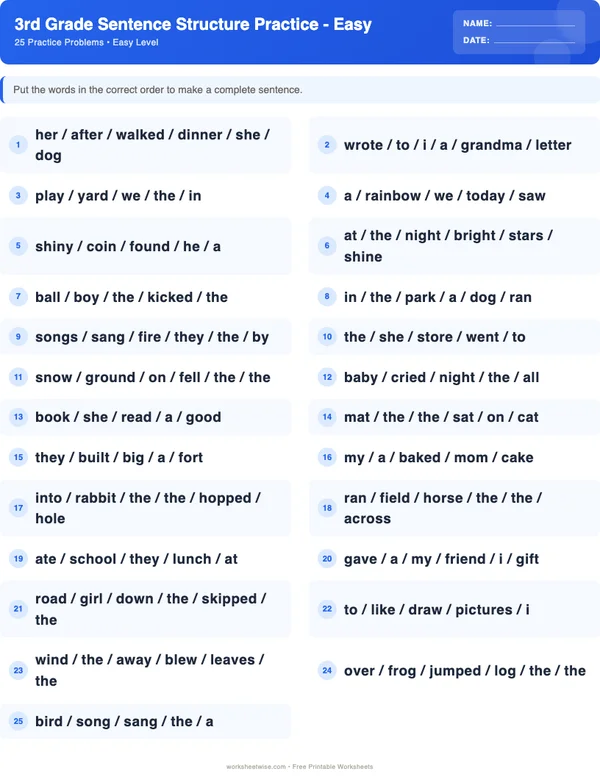
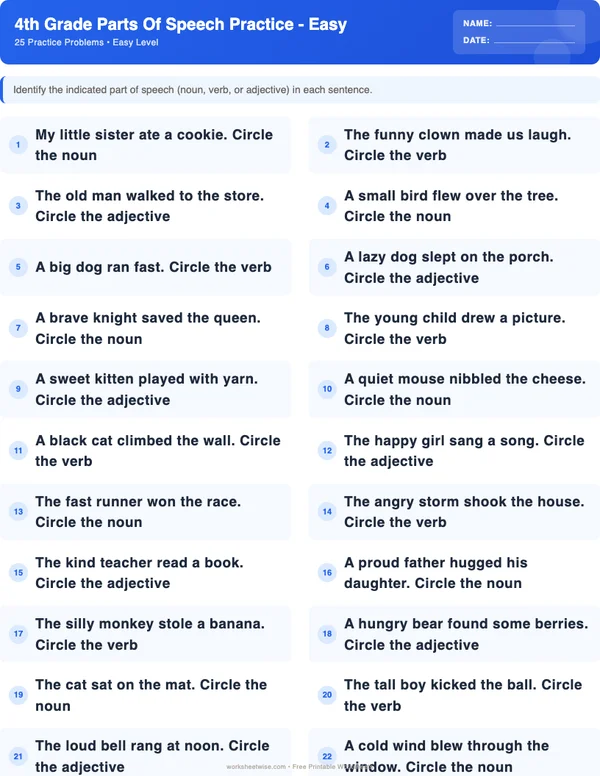
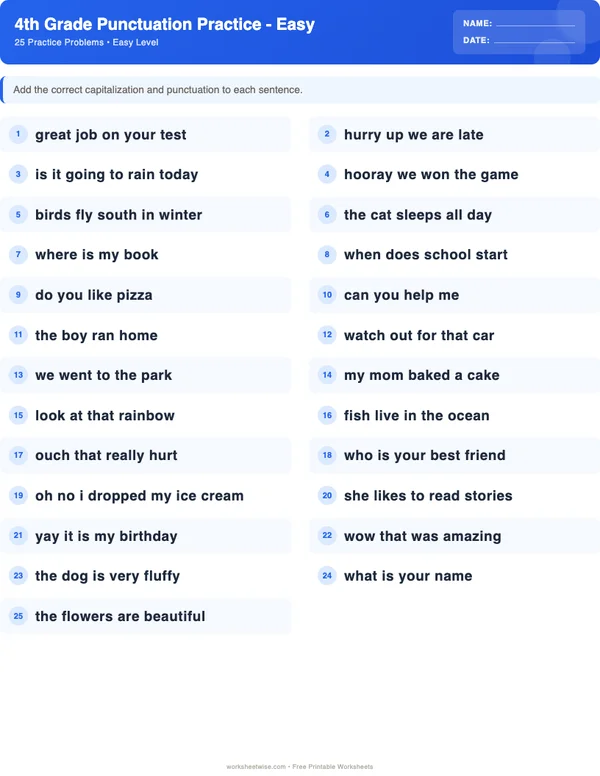
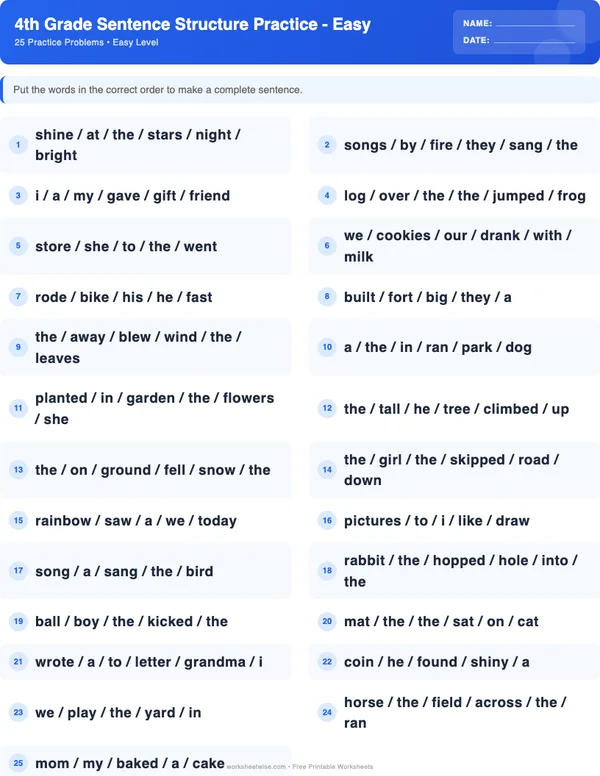
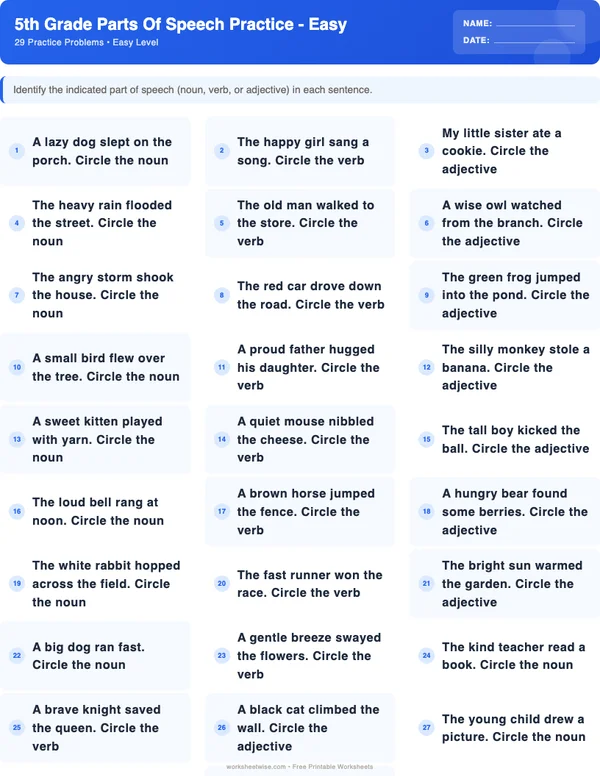
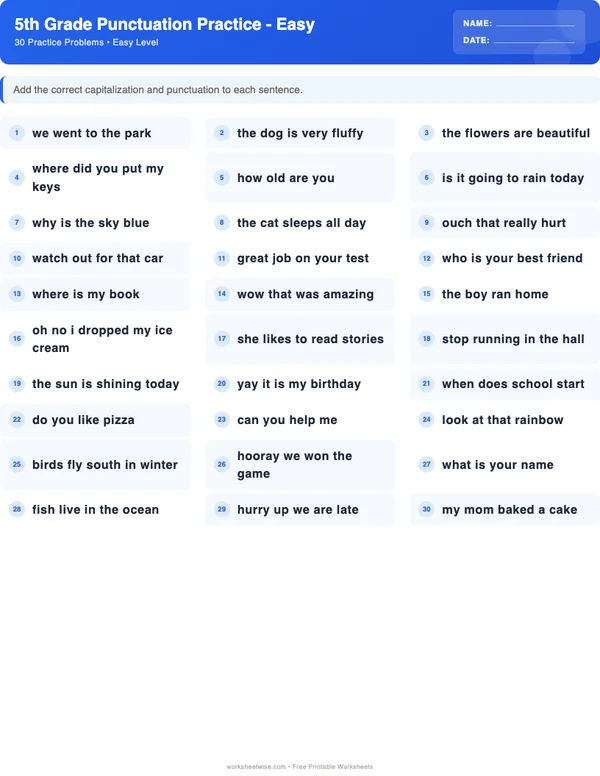
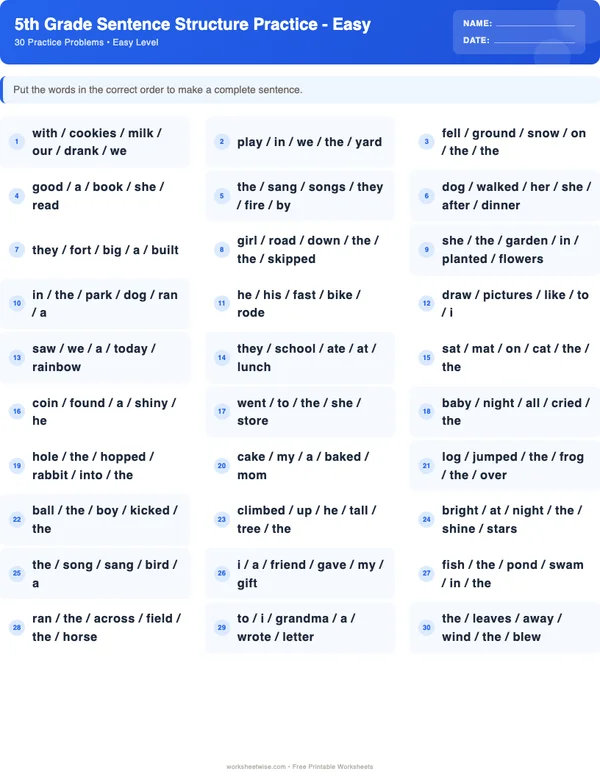
19 relevant free entry points are available. Each one includes a printable learner PDF and separate answer key.
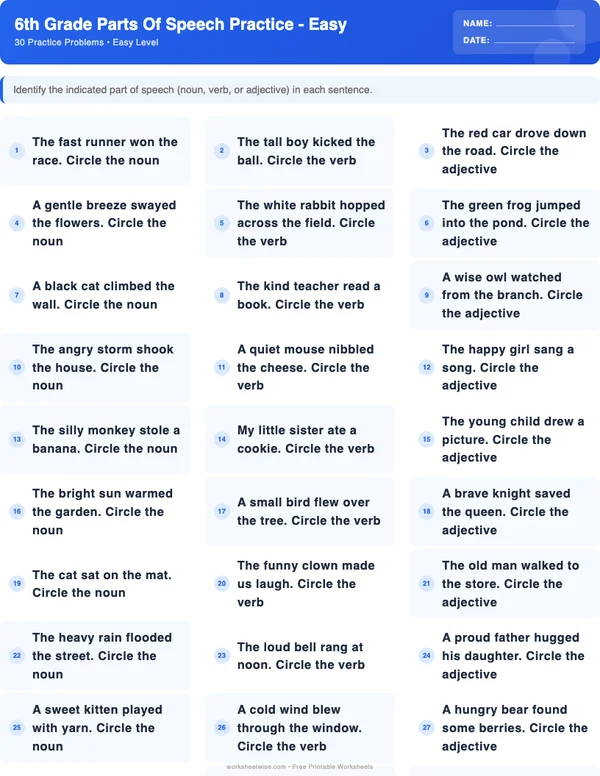
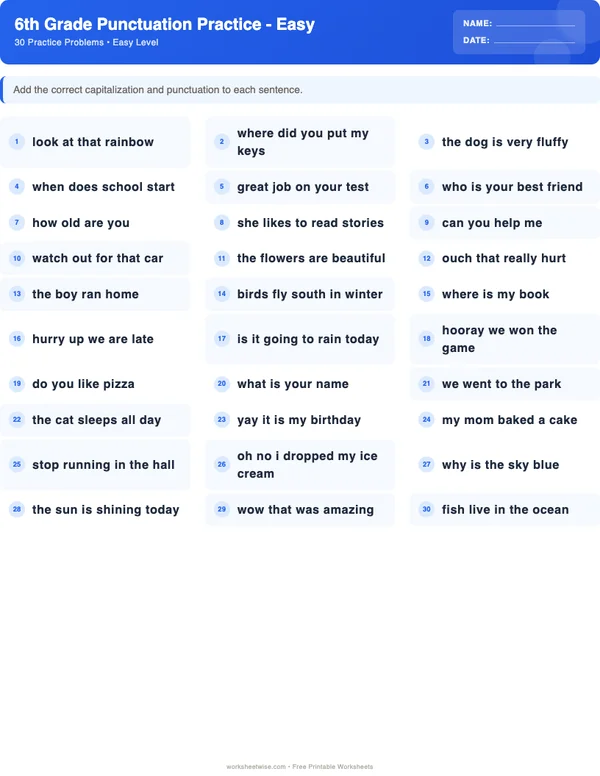
A useful practice loop
Print less. Observe more.
- Choose one skill and model the first item aloud.
- Use a short set and notice the learner’s strategy.
- Change the next task from the work you can see.
Need more than the free sheet?
Plus includes all 342 matching catalogue variations where available, plus saved deterministic generators and the worksheet designer.
See Plus membershipComplete guide
How to teach and practise summer-learning grammar worksheets
3,580 words Updated 6 instructional visuals
Keep grammar active without turning summer into school
Use summer grammar worksheets in short, spaced sessions: one clearly chosen skill, one adult model, a small set of responses, and a two-minute review several days later. A practical starting rhythm is 10–15 minutes twice a week, with the learner choosing between two appropriate tasks. Stop before attention collapses. The purpose is to maintain selected grammar skills and reveal what needs another look—not to complete every page or reproduce a classroom schedule.
WorksheetWise’s live catalogue currently includes 342 grammar variants across seven grade labels, three topics, and 19 free entry points. That breadth is useful only when selection is disciplined. Choose among punctuation, parts of speech, and sentence structure according to evidence from the learner’s last few responses. Grade labels describe the intended practice level, but local curriculum sequences differ. Age is a discovery aid rather than a placement decision.
A strong summer loop looks like this:
- Review one example from the previous session.
- Model today’s decision aloud.
- Let the learner complete three to six items.
- Discuss one correct response and one error.
- End with a fresh oral or written example.
- Use the error pattern—not the page title—to choose the next sheet.
This light structure leaves room for reading, play, conversation, and ordinary summer activities. It also keeps grammar connected to meaning: punctuation changes how a sentence sounds, parts of speech perform jobs in context, and sentence structure organizes complete thoughts.
Choose one grammar decision, not a broad grade-level review
A page becomes useful when its items ask the learner to make the decision you intend to observe. “Practice grammar” is too broad. “Choose a period, question mark, or exclamation point from the sentence’s meaning” is observable. So are “find the noun and verb,” “decide whether a group of words is a complete sentence,” and “combine two related sentences without changing their meaning.”
Before printing, examine five features:
- Target: Does the page concentrate on one rule or mix several?
- Response format: Must the learner point, circle, match, supply a mark, rewrite, or compose?
- Language load: Can the learner read the directions and sentences without the reading itself masking the grammar skill?
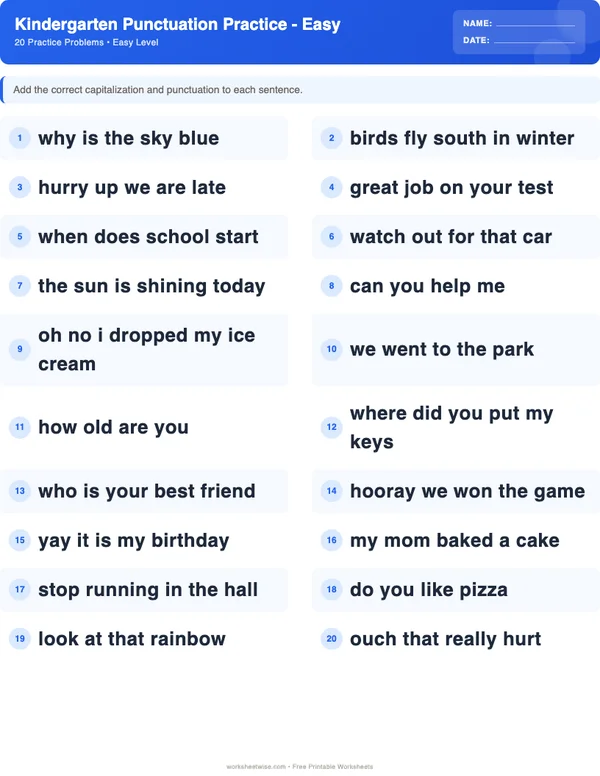
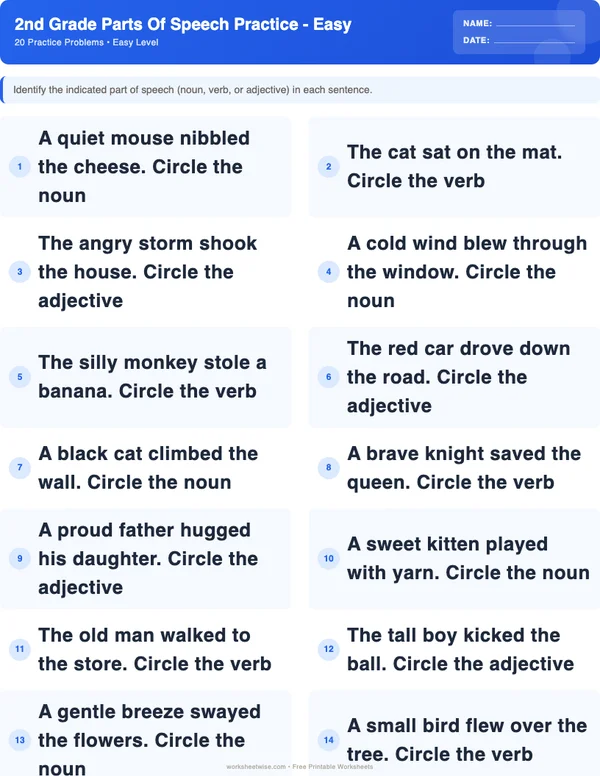
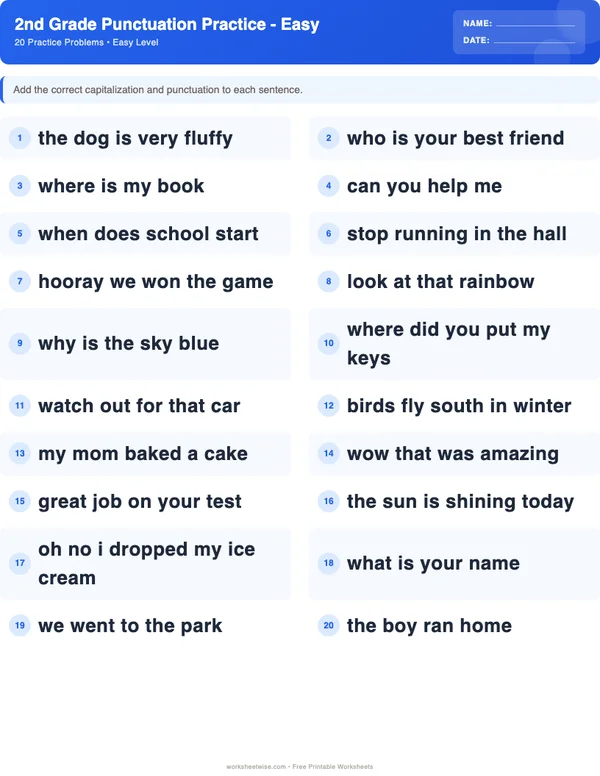
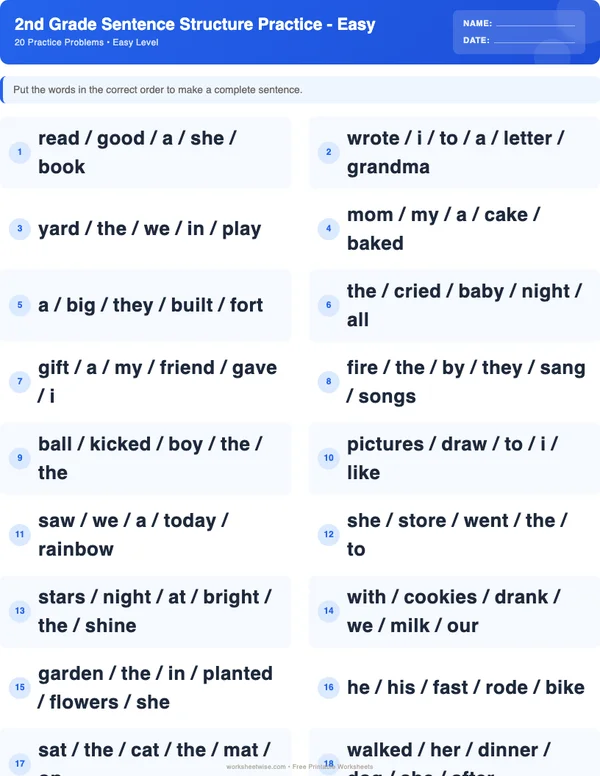
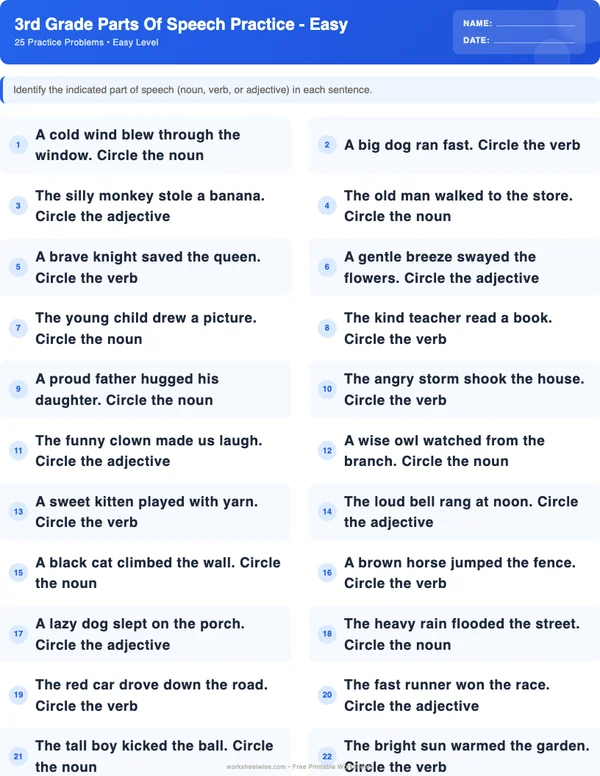
- Number of decisions: Kindergarten through second-grade representative free sheets contain 12 problems; third- and fourth-grade examples contain 14; the listed fifth-grade parts-of-speech sheet contains 29. A problem count is not a required sitting length.
- Transfer demand: Is the learner recognizing an answer, correcting one, or producing an original sentence?
The catalogue’s “easy” label should be interpreted through observable task features, not attached to a learner. In practice, a lower-demand task may use short sentences, familiar vocabulary, one rule, visible choices, and recognition or matching. Demand rises when choices disappear, sentences become syntactically denser, rules are mixed, or the learner must explain and independently revise. Never describe a child as “easy,” “developing,” or “advanced.”
Compare the three live topic families
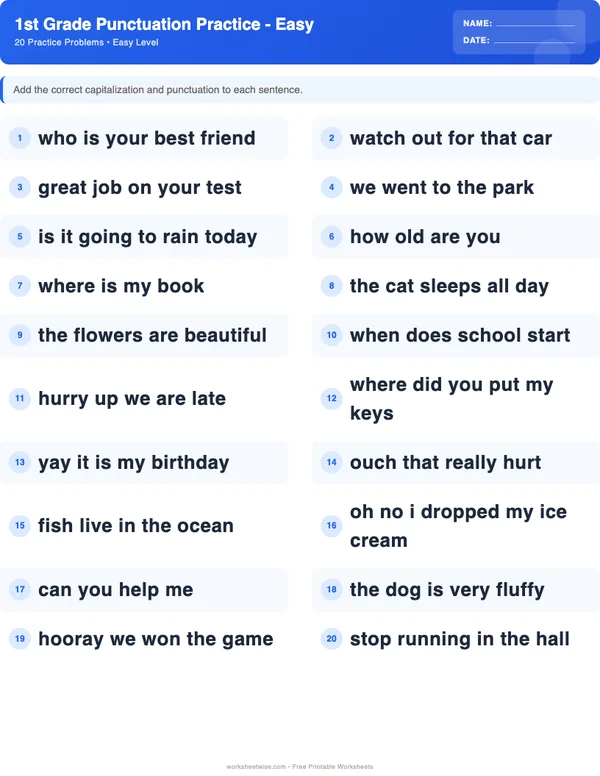
Punctuation is the best choice when the learner’s uncertainty concerns marks that signal sentence endings, lists, dates, possession, contractions, dialogue, or relationships between clauses. A response may range from selecting one of three end marks to editing an unpunctuated paragraph.
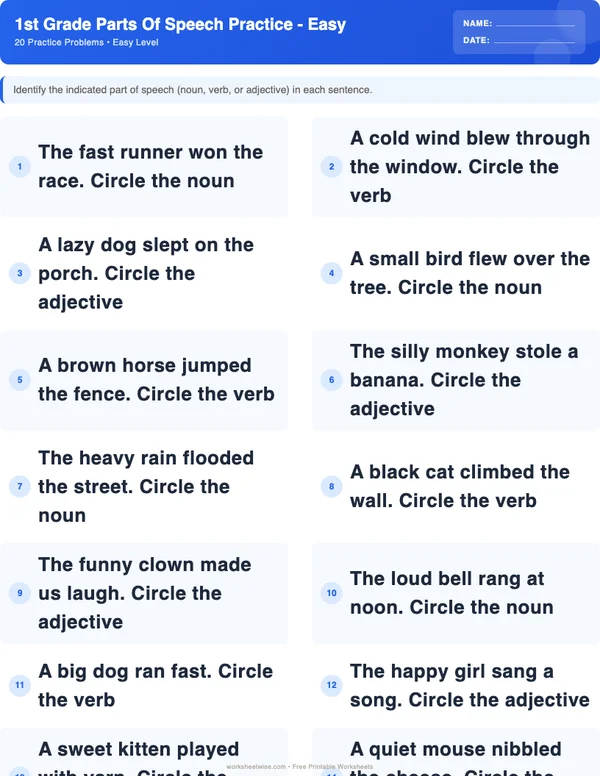
Parts of speech fits errors involving word jobs: noun, verb, adjective, adverb, pronoun, preposition, conjunction, or interjection. Identification alone is a limited goal. A stronger sequence moves from naming a word’s function in a sentence to replacing or adding words for a clear purpose.
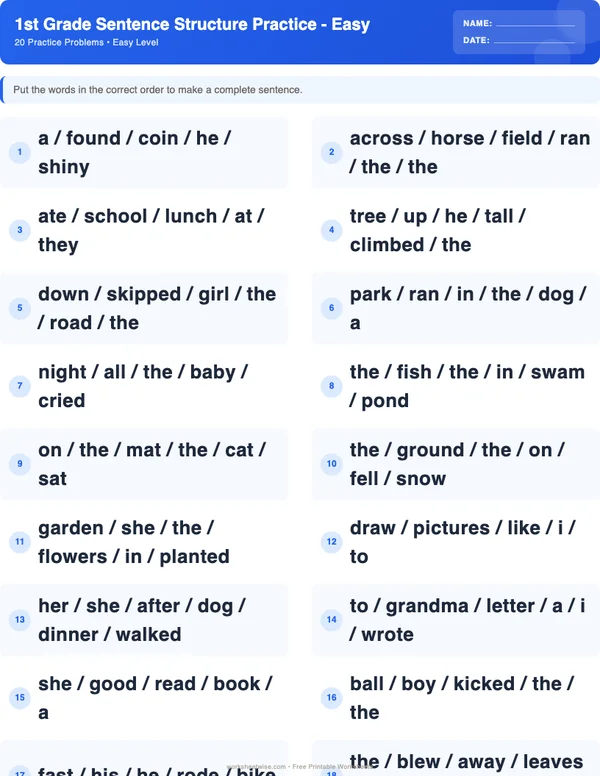
Sentence structure belongs when the learner is sorting complete sentences from fragments and run-ons, locating subjects and predicates, expanding a simple sentence, or combining ideas. It is not interchangeable with punctuation. A learner may place periods accurately yet still produce fragments.
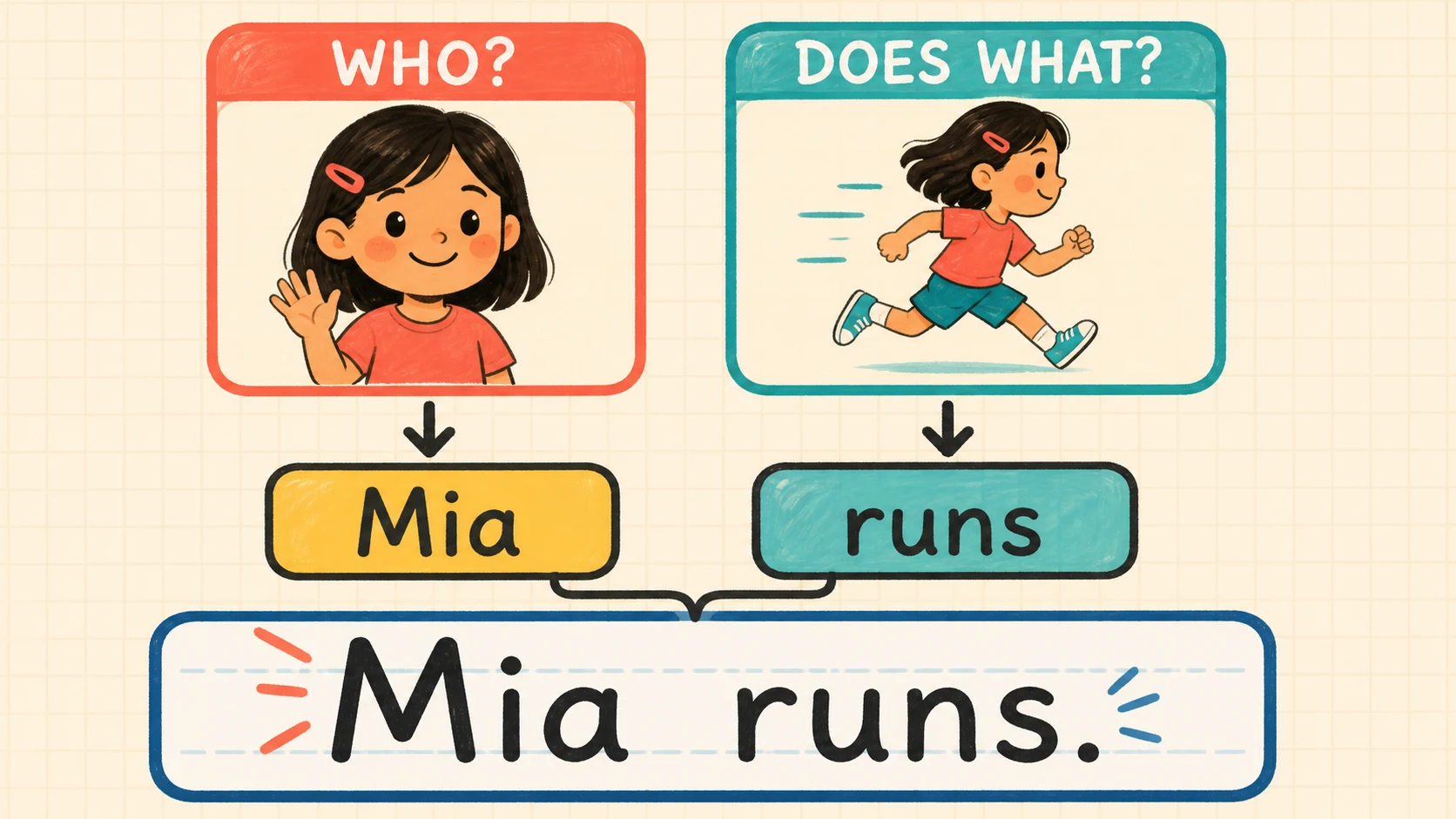
Use this map to keep an early sentence lesson centered on complete thoughts, subjects and predicates, and manageable sentence building.
Do not rotate topics merely for variety. Stay with one target long enough to see whether the learner can use it in a new example, then revisit it after a gap.
Use a two-session weekly rhythm with a short review loop
Spacing does not require an elaborate calendar. It requires returning to a selected skill after some time has passed. A repeatable week can contain one teach-and-try session and one retrieve-and-apply session.
Session A: model, try, and explain
Allow 10–15 minutes:
- Reconnect for two minutes. Show one item from the last session without displaying the old answer. Ask, “What would you notice first?”
- Model for two or three minutes. Work one new example aloud. Name the clue, compare plausible answers, and state why one fits.
- Practice for five minutes. Ask the learner to complete three to six items. Have them mark any uncertain one with a star instead of guessing silently.
- Review for three minutes. Discuss one success and one informative error.
- Close orally. Give a new sentence requiring the same decision.
For end punctuation, an adult might say: “The sentence asks where the towels are. It expects an answer, so I hear it as a question and choose a question mark.” This models the decision without supplying every answer.
Session B: retrieve, apply, and choose
Return to the same skill two or three days later:
- Ask for the rule or decision in the learner’s own words.
- Present one familiar-looking item and one new item.
- Complete a short section from the sheet or revise two original sentences.
- Let the learner choose the next context: picnic, animals, a game, a trip, or a book.
- Record the next action in one line.
Learner choice should alter the context or response route without abandoning the target. A child can choose whether to punctuate questions about insects or soccer; the adult still controls that the task requires distinguishing questions from statements.
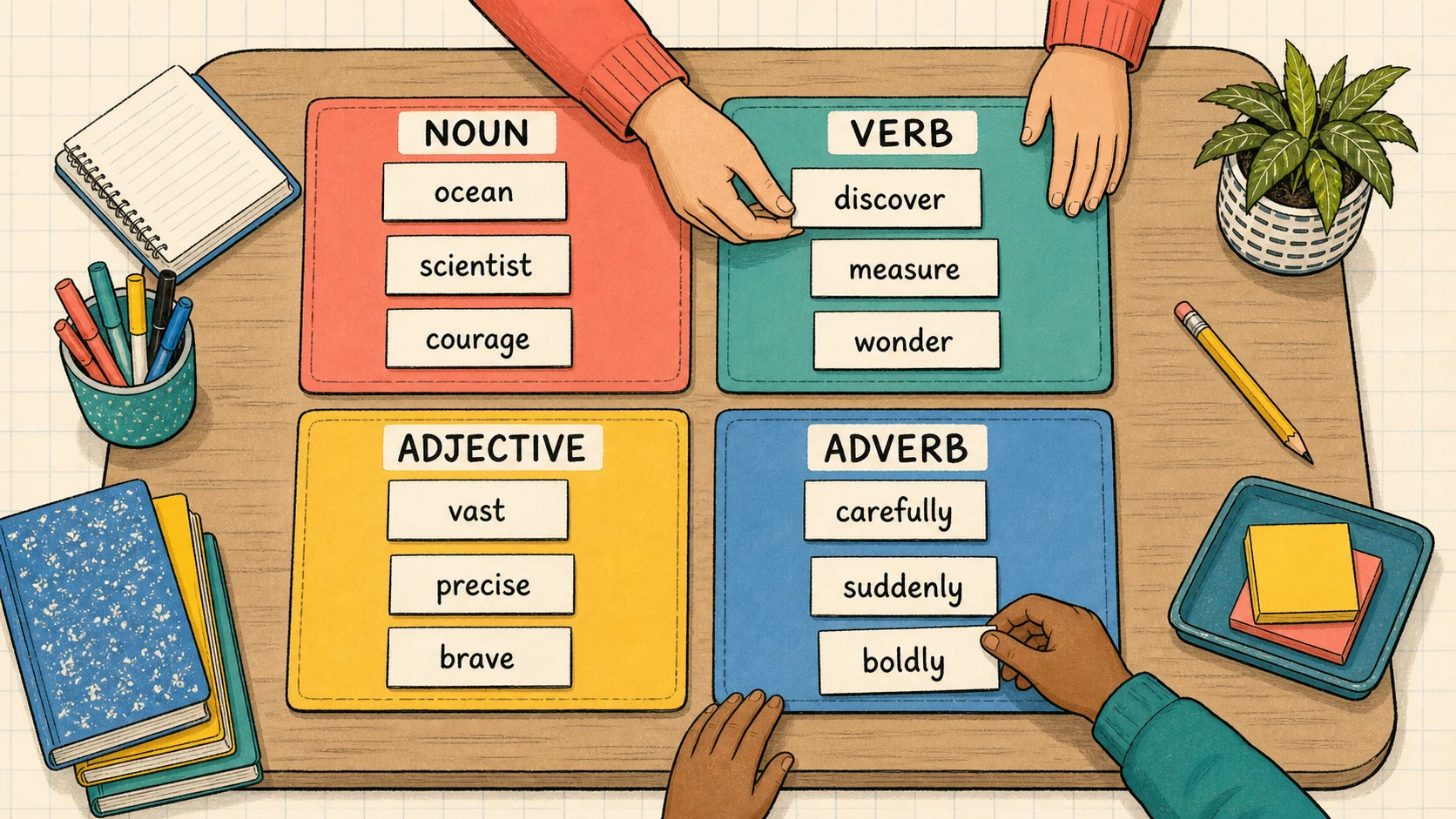
For an older elementary learner, keep the routine predictable while changing the sentence context and the part-of-speech decision.
The IES guide on teaching elementary students to be effective writers recommends explicit strategy instruction, modeling, guided practice, feedback, and opportunities to write. That guidance did not evaluate WorksheetWise. Here it supports a modest design decision: a worksheet should sit inside a model–practice–feedback loop rather than function as an unattended packet.
Model grammar as a decision about meaning
A correct model exposes the reasoning the learner will later need. It does not simply announce a definition.
Example 1: early end punctuation
Consider these checked sentences:
The kite is red.Is the kite red?What a bright red kite!
Each sentence is complete, and each ending matches its communicative purpose: the first states, the second asks, and the third exclaims. Read all three aloud, but do not reduce the rule to “your voice always rises for a question.” Instead ask what the sentence is doing and whether it expects an answer.
This example belongs on the summer grammar page because the live Kindergarten and first-grade punctuation resources include early work with periods, question marks, and exclamation points. It also supports a brief, adult-led oral response before writing. Use the Kindergarten Punctuation guide and free sheet when those three marks are the selected maintenance target.
For ages three and four, prioritize brief adult-led oral, matching, manipulative, and movement work over desk work. Put three large punctuation cards on the floor, read a sentence, and let the child step toward the matching mark. Two or three turns are enough. Age remains a discovery aid rather than a placement decision; whether the child can make the decision with meaningful language is more useful than a birthday alone.
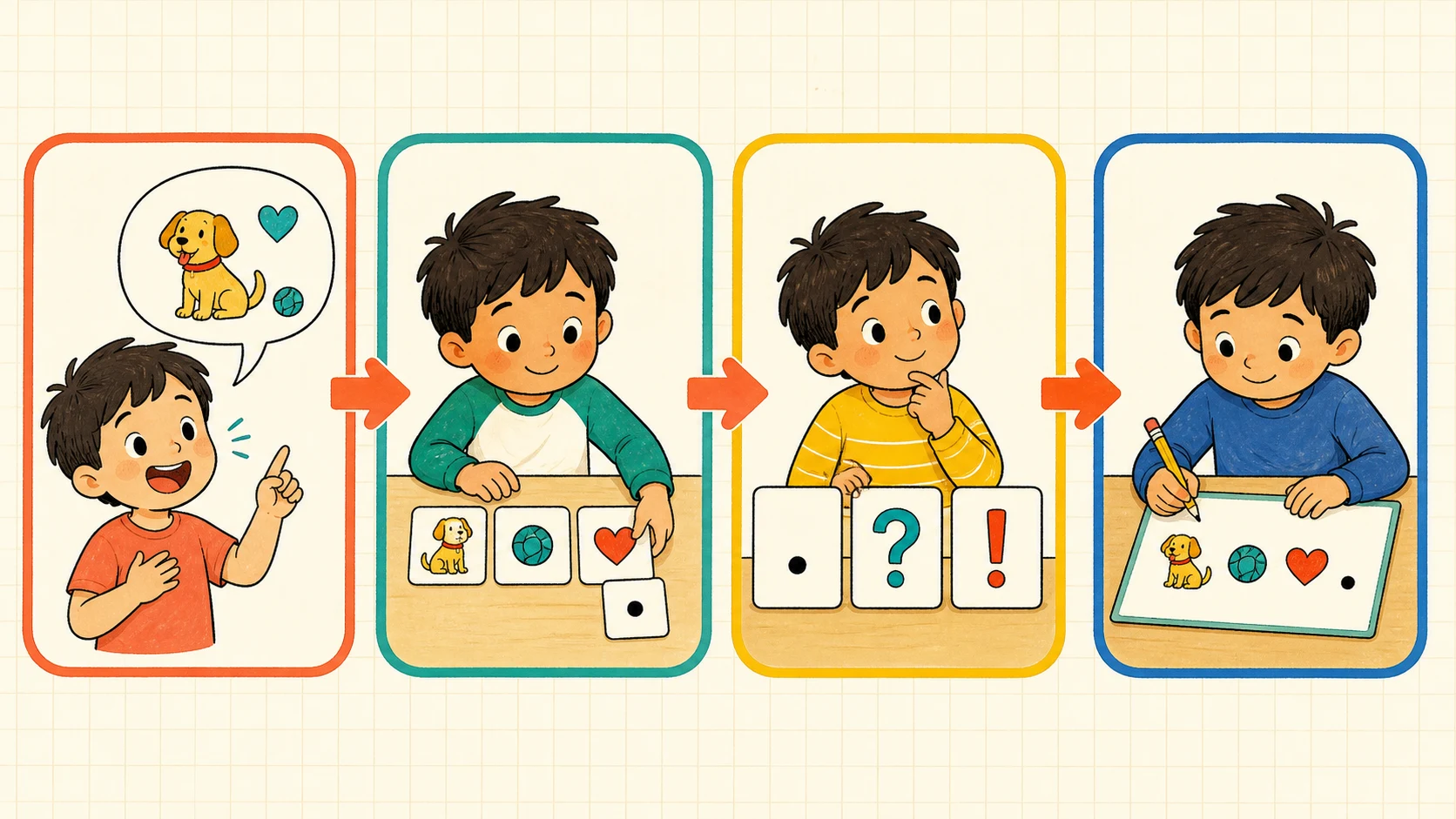
Move from hearing and matching sentence purposes to supplying an end mark, then to punctuating the learner’s own sentence.
Example 2: noun and verb in a complete sentence
Use: The otter splashes.
“Otter” names the animal, so it functions as a noun. “Splashes” tells what the otter does, so it functions as a verb. Both words contribute to a complete thought: someone or something plus what it does.
Now contrast it with The splash surprised us. Here “splash” names the thing that caused surprise, so it is a noun. This pair is checked for function in context; it prevents the false rule that a word permanently belongs to one category regardless of use.
The example belongs here because the representative first- and second-grade parts-of-speech resources begin with concrete nouns and verbs and recommend teaching them in sentences. Have the learner act out “splashes,” point to a toy otter, and then sort the written words. The 1st Grade Parts of Speech guide and free sheet is a suitable live entry point for this target.
The IES foundational reading skills practice guide addresses instruction supporting reading development, including explicit teaching and supported practice. It did not assess these worksheets. Its relevance here is limited but practical: keep explanations direct, model the language task, and avoid allowing decoding difficulty to obscure the grammar decision.
Match the response format to what you need to learn
A correct multiple-choice response shows less independence than an accurate rewrite. That does not make multiple choice useless; it makes the evidence different.
Use a deliberate response ladder:
- Hear or notice: The learner signals whether an oral phrase is complete.
- Match: The learner pairs a sentence with a punctuation mark or word category.
- Select: The learner circles one answer among visible choices.
- Supply: The learner writes a missing mark or word without choices.
- Correct: The learner revises a provided error.
- Compose: The learner creates a sentence meeting a stated condition.
- Explain: The learner identifies the clue that controlled the answer.
If selection is accurate but supplying is not, the next task should reduce recognition support gradually. Do not jump straight to a paragraph containing six different rules.
Example 3: fragment, sentence, and repair
Check these three forms:
Under the picnic table.— a fragment in isolation; it names a location but does not state who or what is there or what happens.The puppy slept under the picnic table.— a complete sentence with subject “puppy” and predicate “slept under the picnic table.”Under the picnic table, the puppy slept.— also complete; moving the opening phrase changes emphasis but retains the subject and predicate.
Ask the learner to sort the three, repair the fragment, and explain what was added. This example belongs because live first- through fourth-grade sentence-structure descriptions include complete sentences, fragments, subjects, predicates, and varied beginnings. It also reveals more than asking for a definition of “fragment.”
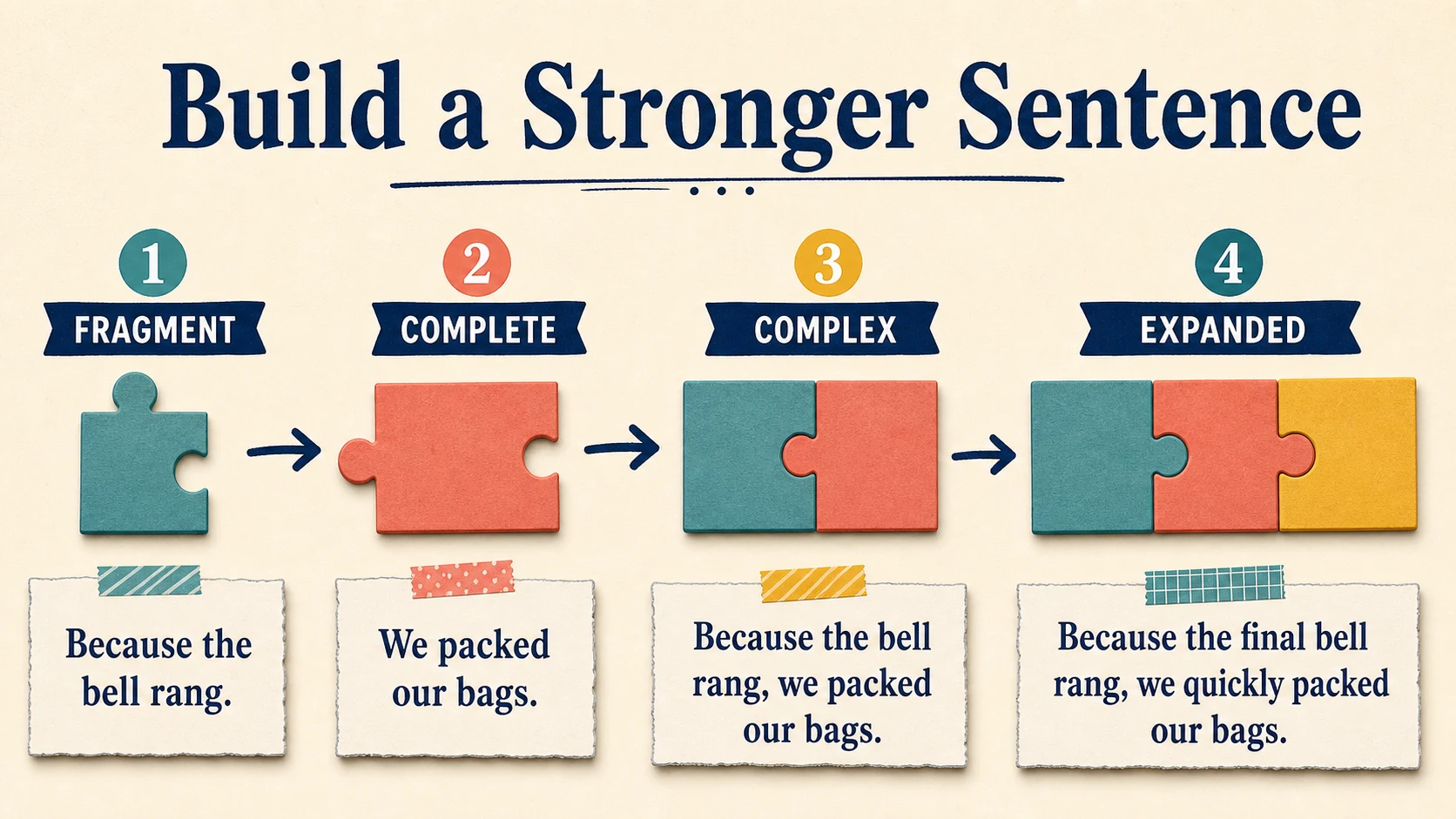
For a learner ready for denser sentences, fade visible choices and require an independent repair or combination while preserving the original meaning.
The Common Core English Language Arts standards organize language expectations by grade, but local curriculum sequences differ. Treat grade labels in this catalogue as intended practice levels, not proof that every child has been taught the same convention at the same time.
Compare punctuation rules one at a time before mixing them
A mixed editing page is useful only after the learner can distinguish the component rules. If every comma is treated as a generic pause, errors become difficult to interpret. Select one function first: a list, a date, a compound sentence, or an introductory element.
Example 4: commas in a list versus a compound sentence
Check the punctuation in these examples:
We packed towels, apples, and sunscreen.We packed the towels, but we forgot the sunscreen.
In the first sentence, commas separate three listed items. In the second, the comma comes before “but,” which joins two complete thoughts: “We packed the towels” and “we forgot the sunscreen.” The same mark performs different jobs.
This comparison belongs here because the live punctuation guidance lists commas in lists and compound sentences as distinct teaching targets. It also demonstrates why summer maintenance should not mean circling every comma on a mixed page. First ask the learner to identify which structure is present.
If the learner inserts We packed the towels but, we forgot the sunscreen, do not merely mark the comma wrong. Box each complete thought, circle the joining word, and model the placement before the conjunction. Then give one near-transfer sentence: The pool was crowded, but we found two chairs.
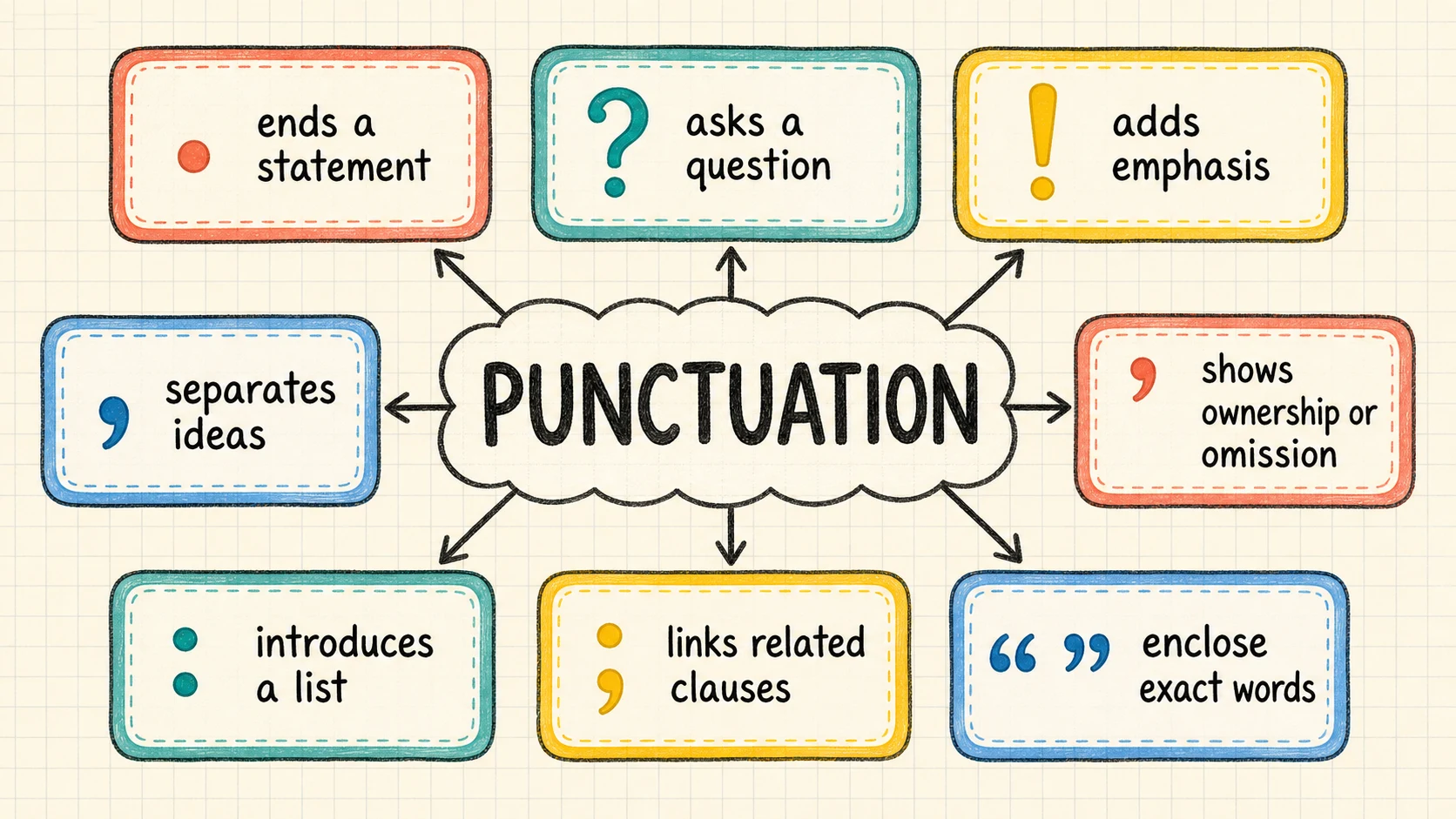
Use the map to separate punctuation functions before asking an older learner to edit a passage containing several conventions.
Example 5: apostrophe purpose, not apostrophe spotting
Compare:
The dog's bowl is blue.— the bowl belongs to one dog.The dogs run outside.— more than one dog; no possession is expressed.The dog can't reach the bowl.— “can’t” contracts “cannot.”
All three are checked: the first uses a possessive apostrophe, the second is a regular plural, and the third uses a contraction. This set belongs because apostrophes for contractions and possessives appear in the live punctuation description and teaching guidance. Ask, “Is the apostrophe showing missing letters or belonging?” That question produces more useful evidence than “Where does the apostrophe go?”
If possession remains uncertain, continue with matched pairs such as the cat’s toy/the cats play. If contractions are the only difficulty, switch to expand-and-contract pairs rather than repeating possessives.
Read errors as evidence for the next sheet
An error matters when it repeats or when the learner’s explanation reveals a fragile rule. One crossed-out answer may reflect haste, handwriting, reading, or a misunderstood direction. Do not diagnose a learning condition from worksheet performance.
Use a compact error record with four columns:
| Item | Observed response | Likely instructional question | Next action |
|---|---|---|---|
Where is my hat |
Adds a period | Does the learner recognize that the sentence asks for information? | Read three statements and three questions aloud; then supply end marks on four written items. |
The small turtle crawled. |
Labels “small” as a noun | Is the learner labeling by position or noticing which word is described? | Compare turtle with small turtle; ask what “small” tells about. |
After lunch we swam. |
Omits the comma | Has the learner been taught the introductory-element convention? | Model two sentences beginning with short introductory elements before independent correction. |
Beside the cooler. |
Marks it complete | Is the learner treating capitalization and a period as sufficient? | Return to “Who or what? Did what?” and repair three oral fragments. |
Maya ran Leo jumped. |
Inserts only a comma | Can the learner locate two complete thoughts? | Mark both subject-predicate units; choose a period or a conjunction with appropriate punctuation. |
These interpretations are hypotheses for instruction, not conclusions about the learner. Ask a follow-up question before choosing another page: “Tell me how you decided.” A clear explanation may show that a wrong answer was accidental. An unexplained correct answer may show that the learner guessed.
Use a simple next-sheet rule
Choose the next task according to the pattern:
- Accurate with explanation and without choices: revisit the skill briefly next week and move to a modestly less supported format.
- Accurate only with visible choices: keep the same rule but shift from selecting to supplying.
- One repeated misconception: choose a short page or page section isolating that contrast.
- Errors across several rules: narrow the next session to one foundational decision.
- Reading obscures grammar: shorten or read the sentence aloud while preserving the grammar response.
- Writing mechanics obscure knowledge: allow pointing, movable word cards, oral answers, or dictation, then include one brief independent written response.
- Fatigue appears late: stop earlier next time; do not interpret the final items as equivalent evidence.
Observable next actions prevent vague plans such as “needs more grammar.” Write: “On Thursday, present four sentence/fragment pairs orally, then complete items 1–4 from a sentence-structure sheet.”
Adapt access while preserving the grammar target
An adaptation is sound when it removes an irrelevant barrier but leaves the target decision intact.
If the target is choosing end punctuation, an adult may read the sentence aloud because decoding is not the selected skill. The learner must still determine whether it states, asks, or exclaims. If the target is independently punctuating written dialogue, however, reading every cue and pointing to every location would remove too much of the task.
Useful adaptations include:
- Covering the rest of a 12-, 14-, or 29-problem page and revealing only one item at a time.
- Enlarging print or increasing spacing.
- Cutting items into cards for sorting.
- Letting the learner answer orally while the adult records an exact response.
- Offering a pencil, marker, letter tiles, punctuation cards, or keyboard.
- Replacing unfamiliar names or summer contexts while preserving the sentence structure.
- Reading directions aloud.
- Reducing the number of items while retaining a final independent check.
- Allowing a short movement break between the model and practice.
Do not “adapt” a noun-and-verb task by telling the learner which words are nouns and asking only for coloring. Do not turn sentence combining into copying an adult’s completed sentence. Do not correct spelling, capitalization, handwriting, and grammar simultaneously when only one feature is the session’s target.
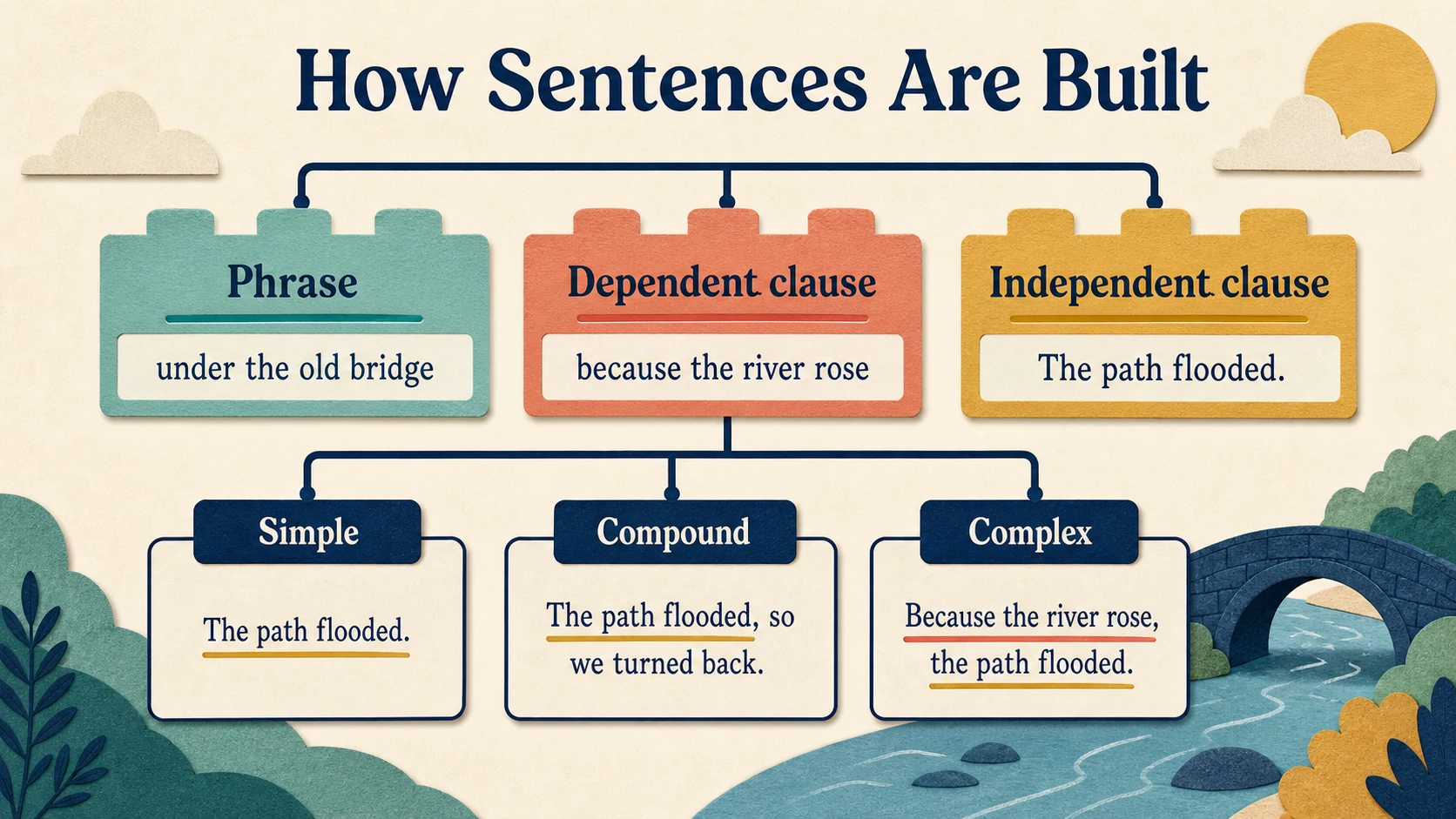
Select one branch of sentence structure for the session; the map is not a demand to teach every branch at once.
For families also maintaining decoding or encoding skills, keep those decisions distinct. A learner may use the Summer learning Phonics Worksheets or Summer learning Spelling Worksheets in separate short sessions rather than having every grammar correction become a spelling lesson.
Give feedback that makes the next attempt possible
Useful feedback is timely, narrow, and tied to the decision. “Wrong” provides no route forward, while a full lecture often replaces the learner’s thinking.
Try this four-part response:
- Name what worked: “You noticed that the sentence contains two complete thoughts.”
- Point to the exact decision: “Now look at how those thoughts are joined.”
- Prompt rather than supply: “Could they stand as two sentences? If so, what can come before ‘but’?”
- Check with a new example: “Try:
I wanted to swim but the pool was closed.”
For a parts-of-speech error, say, “You chose ‘light.’ What job does it do in The light shines?” Then contrast it with The light bag is easy to carry. In the first, “light” is a noun; in the second, it describes “bag” and functions as an adjective. The learner should use the sentence, not a memorized one-word label, to decide.
Feedback should also preserve learner agency. Invite a correction in a different color, let the learner explain an alternative sentence, or ask them to create a “trick example” for the adult. Yet keep the target stable: choice concerns how to respond, not whether the grammar evidence matters.
End review after one or two patterns. Recopying every incorrect item is rarely necessary. Instead, select one representative error, model or prompt the correction, and require a fresh near-transfer response. At the following session, retrieve that same decision before introducing another rule.
Know what a summer worksheet cannot establish
A worksheet sample can show how a learner responded to those particular items under those conditions. It cannot establish a diagnosis, guarantee retention, prove curriculum mastery, or determine an enduring grade placement. It also cannot reveal whether an unfamiliar convention has ever been taught.
The catalogue facts themselves have boundaries:
- The 342 variants describe available grammar resources, not a recommended completion target.
- The 19 free resources are entry points, not a complete summer sequence for every learner.
- The three topics organize content but do not mean each should receive equal time.
- Problem counts describe page length, not an appropriate daily dose.
- Grade labels indicate intended practice levels; local curriculum sequences differ.
- The listed “easy” difficulty must be read through the page’s observable supports and demands, not as a learner characteristic.
Worksheet responses should be considered alongside oral explanations and original language. A child who selects verbs accurately may still need help choosing precise verbs while writing. Another may punctuate isolated sentences but omit marks in a paragraph because the response format has changed. That is a reason to adjust practice, not to make a diagnosis.
If errors are persistent across contexts or the learner becomes distressed, pause the packet and consult the learner’s teacher about what has been taught and which supports are already effective. Summer practice should remain proportionate.
Build the next week from one real response
At the end of each session, write only three notes:
- Target: “Complete sentence versus fragment.”
- Evidence: “Sorted four of five correctly; called
Near the gate.complete because it had a period.” - Next action: “Remove punctuation cues, repair two oral fragments, then supply one written subject and predicate.”
That record is enough to drive a light schedule. On the next visit, begin with Behind the beach bag. Ask whether it communicates a complete thought and what is missing. If the learner supplies The crab hid behind the beach bag, check that it has the subject “crab” and the predicate “hid behind the beach bag.” Then choose a sentence-structure task rather than an unrelated punctuation review.
Start now with the free deterministic worksheet generators: choose one grammar target reflected in the learner’s most recent work, generate or select a short set, and plan to use only the first three to six items before reviewing one error and recording the next sheet decision.
Put it into practice
Use the guide with a real printable
Move from explanation to a short, observable practice task. Check the first item together, then adjust the next session from the learner's actual work.
Open the first free worksheetExplore a neighboring collection