Curated collectionAnswer keys includedPrint-ready PDFs
Summer Learning Spelling Worksheets
Maintain selected skills through a light spaced schedule, learner choice and short review loops rather than recreating a school day.
Start with a real resource
Browse this worksheet collection
5 relevant free entry points are available. Each one includes a printable learner PDF and separate answer key.
A useful practice loop
Print less. Observe more.
- Choose one skill and model the first item aloud.
- Use a short set and notice the learner’s strategy.
- Change the next task from the work you can see.
Need more than the free sheet?
Plus includes all 90 matching catalogue variations where available, plus saved deterministic generators and the worksheet designer.
See Plus membershipComplete guide
How to teach and practise summer-learning spelling worksheets
3,567 words Updated 6 instructional visuals
Keep spelling active without turning summer into school
Use summer learning spelling worksheets in short, spaced sessions: choose one spelling pattern, model how to notice it, complete a small set of responses, check the work together, and revisit missed words several days later. Two or three 10–15-minute sessions across a week are more useful for this purpose than assigning a full packet in one sitting.
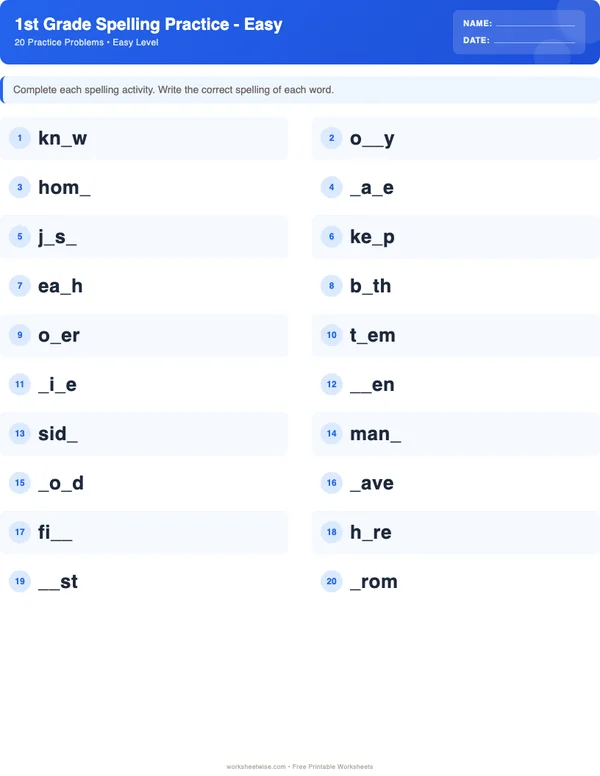
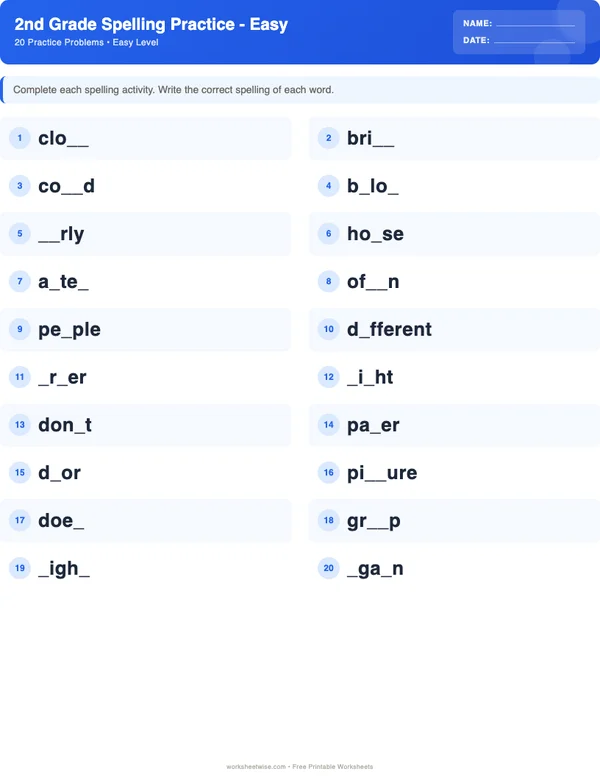
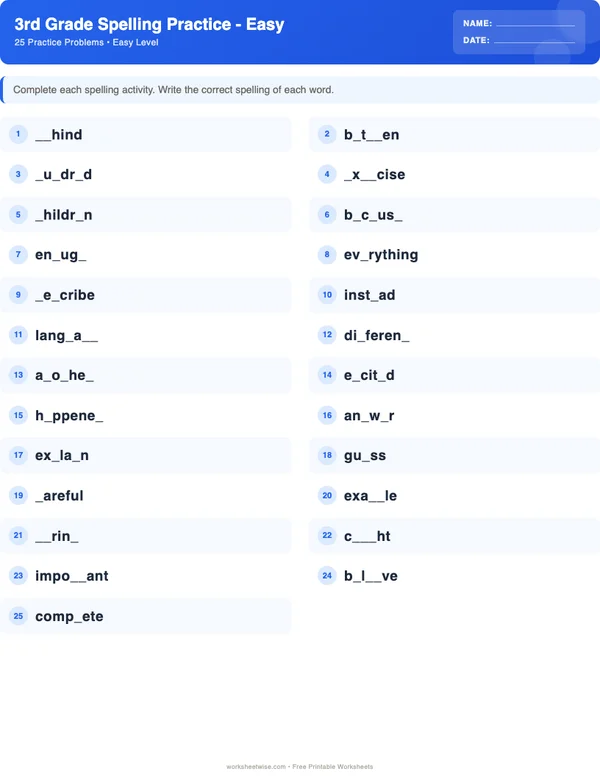
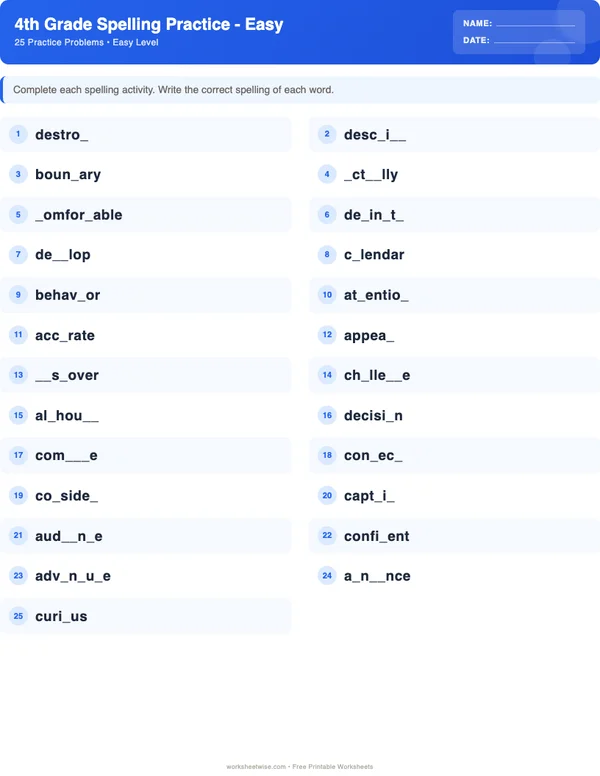
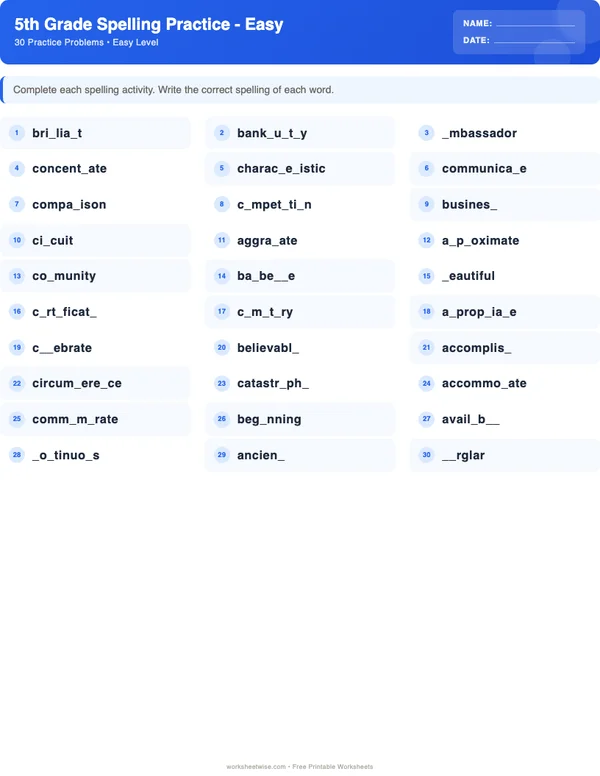
The live WorksheetWise catalogue contains 90 spelling worksheet variants across five intended grade levels, with one free entry point for each level. The free sheets contain 20 problems in 1st and 2nd grade, 25 in 3rd and 4th grade, and 30 in 5th grade. Those totals describe the sheets, not the amount a learner must finish at once. Divide a page into workable sections whenever attention, handwriting effort, or summer plans make the whole sheet impractical.
The core routine is:
- Select one pattern the learner has previously encountered.
- Read and compare two or three model words.
- Let the learner choose an appropriate response format.
- Complete only enough items to reveal whether the pattern is understood.
- Discuss one or two errors immediately.
- Recheck those spellings after a gap.
- Use the error pattern—not the printed grade—to select the next sheet.
This is maintenance and review, not a compressed school day. Grade labels describe an intended practice level, and local curriculum sequences differ. Age can help adults discover likely resources, but it is not a placement decision. Select work from what the learner can show in reading and writing now.
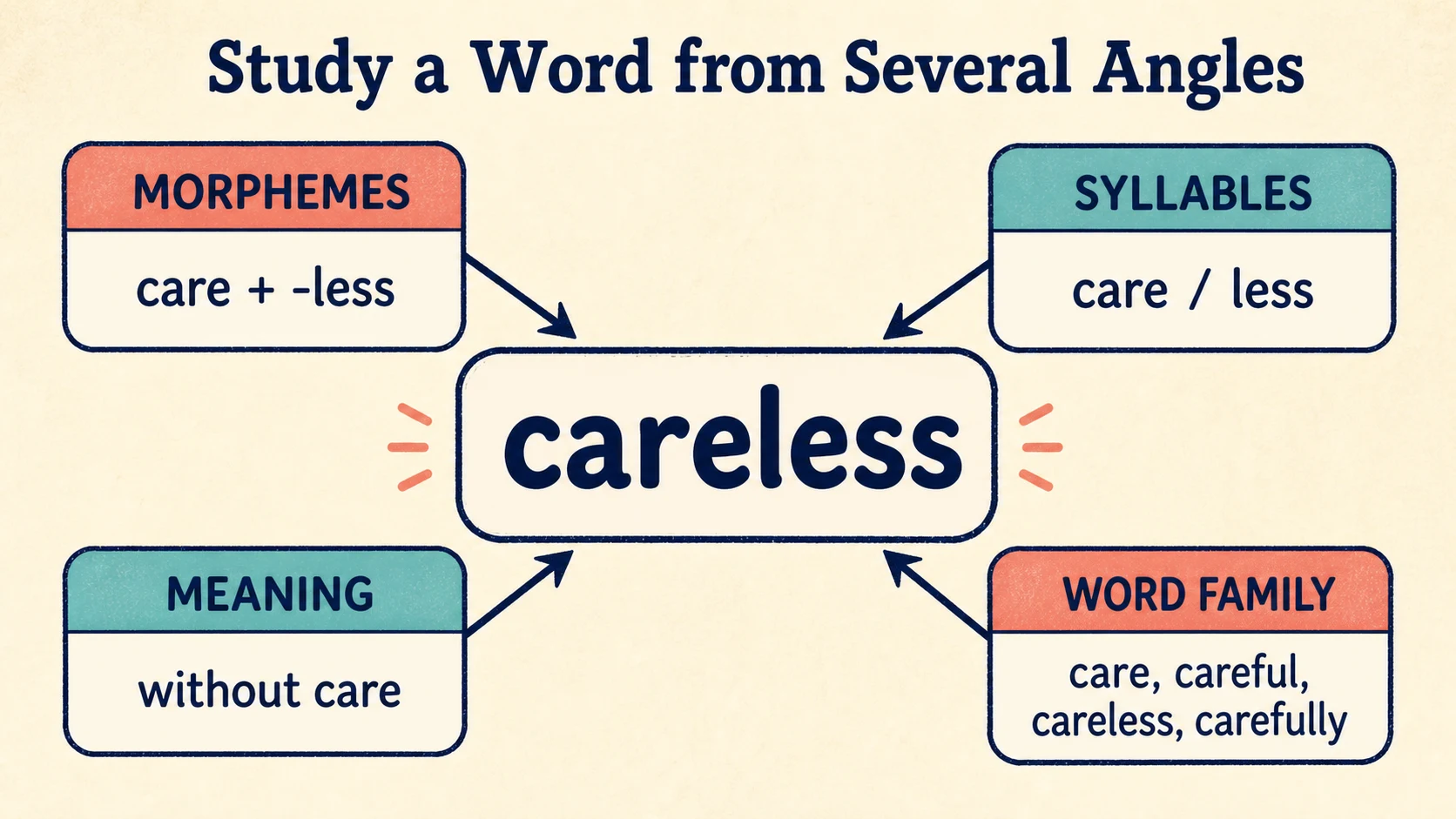
The useful path is pattern recognition, supported spelling, independent recall, checking, and a later transfer attempt—not simply completing more words.
Choose a sheet by the spelling work it requires
The catalogue’s representative resources all concern spelling words, but the expected volume changes by intended grade. The listed topics may include short vowels, long-vowel spellings, consonant doubling, r-controlled vowels, silent letters, prefixes, suffixes, and multisyllabic words. The activity formats may include look-cover-write-check, pattern sorting, sentence use, rainbow writing, and identifying misspelled words.
Do not choose from the topic name alone. Inspect several observable features:
- Does the learner need to recognize a correct form, copy it, recall it, or generate it in a sentence?
- Is one sound represented consistently, or must the learner choose among spellings?
- Are words mostly one syllable, or must the learner coordinate several syllables?
- Does the task expose a model throughout, hide it before writing, or supply no model?
- Is handwriting load likely to obscure what the learner knows about spelling?
- Does the page mix several patterns, or keep one comparison visible?
- Can the learner explain why two words belong together?
The catalogue labels each representative free sheet “easy.” Treat that as a description of the resource tier, never as a label for a child. Define the task through what is visible: whether models remain on the page, how many words must be produced, how similar the patterns are, and whether the learner selects, copies, recalls, or applies a spelling. A 20-problem page with familiar words can still be tiring; a five-word multisyllabic comparison can still demand careful reasoning.
Compare the five free entry points
The 1st Grade Spelling Words guide and free sheet and the 2nd Grade Spelling Words guide and free sheet each contain 20 problems. That smaller count makes them sensible catalogue entry points when an adult wants to sample a few items and observe how a learner handles a model, but it does not establish that every early elementary learner should complete all 20.
The 3rd Grade Spelling Words guide and free sheet and the 4th-grade resource each contain 25 problems. The 5th-grade free resource contains 30. These larger totals make sectioning particularly important. For example, an adult might mark off five items for Monday, five for Wednesday, and a mixed five-word review for Saturday. That schedule is a suggestion based on the catalogue’s page sizes, not a research finding or a required sequence.
Across levels, the more informative distinction is the response demand. Recognizing that rain is spelled correctly is not the same task as recalling rain after it is covered. Recalling rain is not the same as deciding whether an unfamiliar long-a word is likely to use a_e, ai, ay, or another spelling. Select the demand that reveals the skill you actually want to maintain.
Build each session around one visible spelling decision
A summer spelling session needs a small instructional center. “Do the next six” is a quantity instruction; “decide which part represents the vowel sound” gives the learner something to think about.
Use a six-part routine
- Reconnect for one minute. Show two previously studied words and ask what they have in common.
- Model one decision. Say the word, stretch or segment the relevant sounds, point to the spelling, and explain only the feature under review.
- Invite a choice. Offer two response formats that preserve the same target, such as writing from memory or building the word with letter tiles.
- Complete three to eight items. Stop earlier if a stable error pattern appears.
- Check by comparing parts. Ask what matches, what differs, and where the change begins.
- Set aside one review word. Revisit it after at least one intervening day, preferably in a different format.
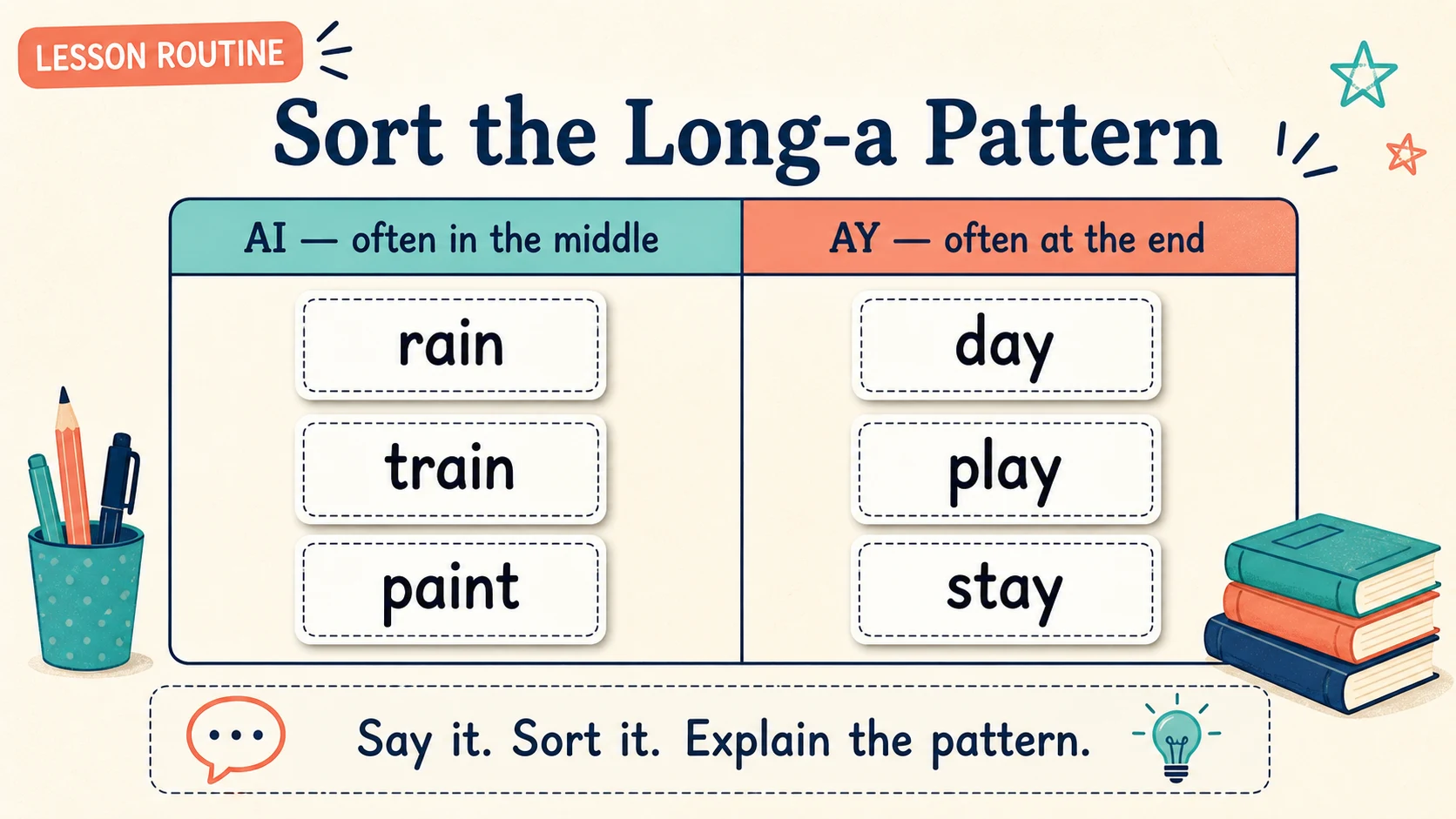
For a 3rd-grade-intended sheet, the adult’s most important move is to keep modeling, response, checking, and next-step selection inside one brief loop.
The catalogue recommends grouping words by a common pattern and using look-cover-write-check. Those are catalogue teaching suggestions, not claims that WorksheetWise has independently tested an intervention. The Institute of Education Sciences’ foundational reading guide recommends explicit work connecting sounds with letters and asks educators to help children decode and recognize words; that broader sourced guidance supports making the sound–spelling relationship visible during review. It does not constitute an assessment of these worksheets. See the IES foundational skills practice guide.
Model without giving away every answer
A useful model exposes the decision process once and then reduces support.
Suppose the focus is long-a spellings and the comparison set is cake, rain, play, break, which appears in the catalogue teaching guidance. Check the examples before presenting them:
- cake uses final silent e with a_e.
- rain uses ai within the word.
- play uses ay at the end.
- break contains ea representing the long-a sound and is a less predictable member of the set.
Do not teach these four as though one rule generates all four spellings. Say, “These words share a vowel sound, but the spelling is not identical. We can sort them by how that sound is written.” Then model cake, jointly sort rain, and ask the learner to place play. Keep break as a word to inspect and remember rather than pretending its spelling follows the most common position pattern.
This example belongs on this page because the exact word set comes from the live spelling catalogue and demonstrates the page’s central summer decision: review a known sound while comparing spellings, rather than memorizing an undifferentiated list.
The model should make the relevant letter pattern inspectable, then leave the learner responsible for the next comparison.
Spread practice across two light weeks
Spacing is useful here as a scheduling principle: return to selected spellings after a gap instead of completing every encounter on one day. The schedule below is a practical suggestion, not a guaranteed formula.
A two-week plan for an early spelling sheet
Day 1: notice and sort. Read six words together. Sort them by the target spelling or sound. Write only two.
Day 3: cover and recall. Use look-cover-write-check with four of the same words. Circle only the exact part that changed in a misspelling.
Day 5: choose and use. The learner selects three words and either completes a short sentence orally before writing it or matches each word to a prepared sentence.
Day 8: retrieve after a gap. Dictate three reviewed words in a new order and add one closely related word only if the underlying pattern is sufficiently predictable.
Day 11: edit. Present two correct forms and two deliberately misspelled forms. Ask the learner to identify and repair the incorrect part.
Day 14: transfer and decide. Ask for one short sentence that naturally uses a reviewed word. Compare the result with earlier work and choose the next sheet from the error evidence.
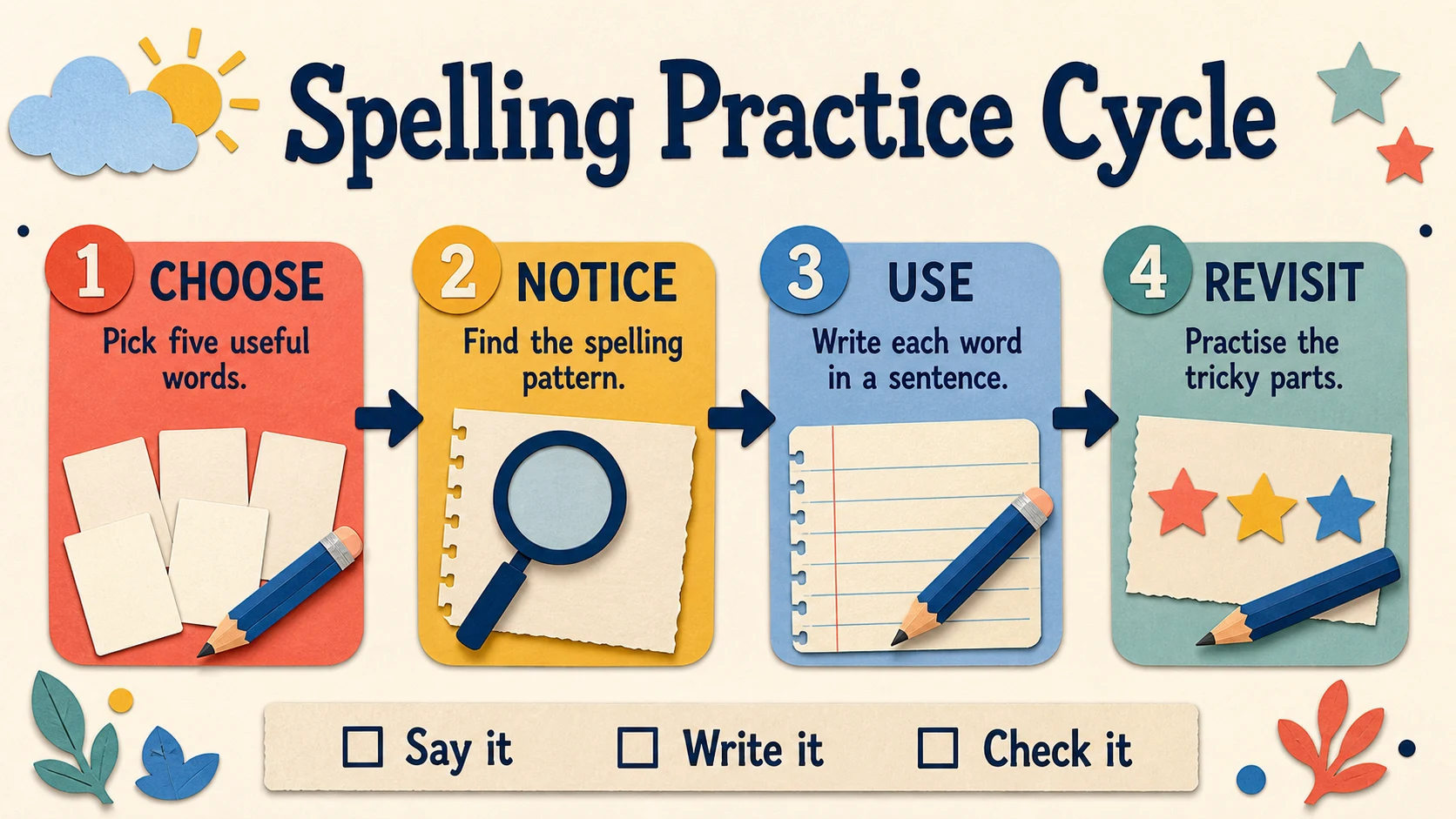
An early-grade summer plan revisits a small word set through sorting, recall, editing, and sentence use instead of repeating the same full worksheet.
For learners using an early-grade resource, read directions aloud and reduce copying. For ages three and four, prioritize brief adult-led oral, matching, manipulative, and movement work over desk work. A child might carry letter cards to the matching picture, step once for each sound, or place two spoken words beside the same vowel card. That adaptation is appropriate only when it preserves the selected oral or sound–letter target; it should not be used to infer a grade placement.
Offer choice without changing the spelling target
Learner choice can keep summer work cooperative, but some choices accidentally remove the skill being observed. Offer choice about format, order, tool, or context—not whether the learner must make the spelling decision.
Equivalent response options
If the target is recalling a word after seeing a model, the learner could:
- Write it with pencil.
- Arrange letter tiles without viewing the model.
- Type it with spellcheck turned off.
- Say the letters while an adult records them, when handwriting is the barrier being adapted.
- Trace the word once, cover it, and then build or write it from memory.
These formats retain recall. By contrast, copying while the answer remains visible measures visual copying more than spelling recall.
If the target is identifying a pattern, equivalent choices include highlighting the relevant letters, sorting word cards, or naming the common part orally. If the target is applying spelling in connected writing, selecting the correct word from two printed options does not preserve the full demand; the learner needs to produce or repair the spelling within a sentence.
Checked example: consonant doubling
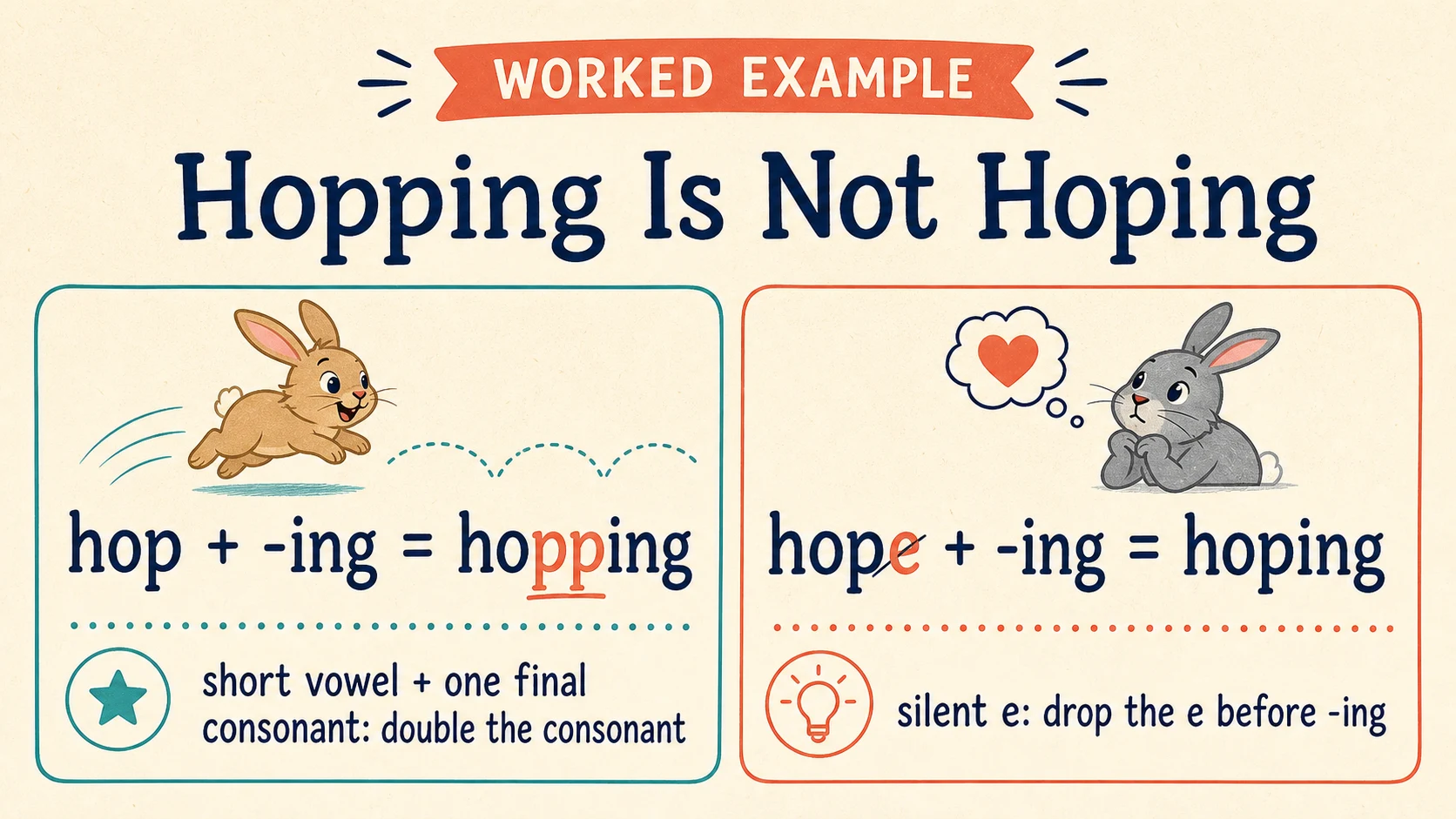
Use hop → hopping and hope → hoping as a comparison:
- hop becomes hopping, with p doubled before -ing.
- hope becomes hoping, with final silent e removed and no doubled p.
- The vowel sounds differ: the first word has the short vowel in hop; the second retains the long vowel relationship from hope.
Ask the learner to build the base word first, then add -ing. If the learner writes hoping for the action of making small jumps, the useful feedback is not merely “Add a p.” Return to hop, contrast it with hope, and ask which base word carries the intended meaning and vowel sound.
This example belongs because consonant doubling is one of the spelling patterns explicitly represented in the catalogue, and it shows why manipulating a base word can reveal more than copying the finished answer.
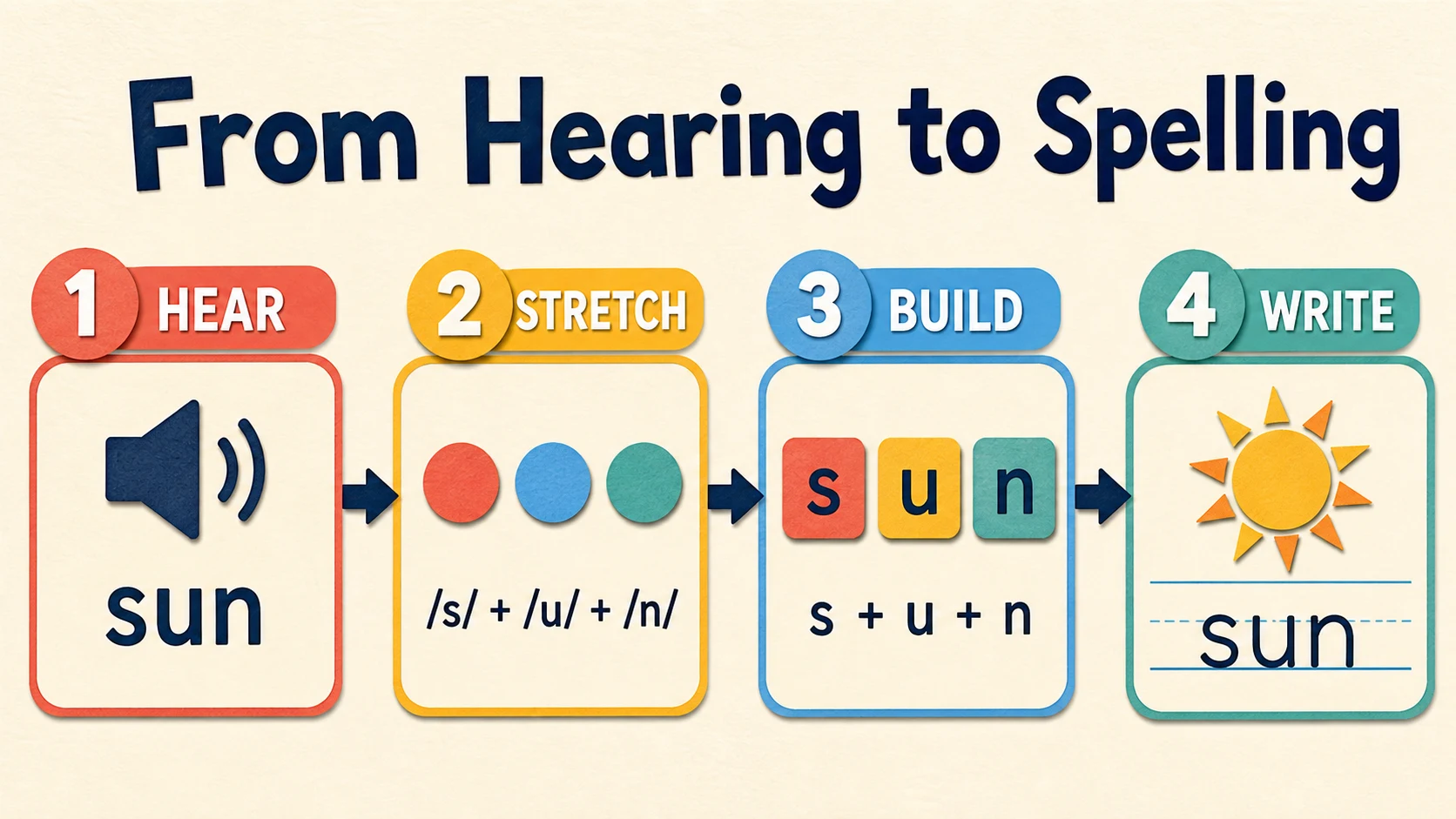
Support can move from building and comparing a base word to recalling the changed form, while keeping the spelling decision constant.
Turn errors into information, not a score
A wrong answer does not automatically identify one cause. The adult should inspect where the spelling diverged, ask the learner to read what was written, and compare similar attempts before selecting more work.
Read the location and consistency of the error
One letter omitted in several consonant clusters: If stop becomes sop and plant becomes pant, the common issue is within the cluster. The next task should use a small oral segmentation and letter-building set with initial clusters, not a large mixed list.
The same sound represented inconsistently: If rain becomes rane, but cake is correct, the learner may be extending a_e to another long-a word. That is a reasonable generalization, not random carelessness. Choose a sorting sheet contrasting a_e, ai, and ay, with models visible first.
An ending added incorrectly: If jumped becomes jumpt, the learner has represented the pronunciation but not the conventional suffix spelling. The next practice should compare the stable written ending -ed across words, while acknowledging that the ending is not always pronounced the same way.
A multisyllabic word loses an unstressed vowel: If family becomes famly, have the learner say the word naturally, then more deliberately, and compare it with the printed form. The next sheet should offer supported syllable inspection rather than simply a longer list.
Words are correct in isolation but wrong in a sentence: Move toward brief dictation or self-editing because the transfer demand, not isolated recall, is now the useful focus.
Do not interpret a few worksheet errors as a diagnosis. Fatigue, an unclear direction, unfamiliar vocabulary, motor demands, or rushing may affect the page. Confirm a pattern through another short response before changing course.
Checked example: an r-controlled vowel
Compare car, star, and care:
- car and star share the ar spelling and a similar r-influenced vowel pattern.
- care should not be placed in the same spelling group merely because it contains the letters a and r; final e changes the word’s spelling structure and pronunciation.
- star also adds an initial consonant cluster, increasing the segmentation demand.
If a learner sorts care with car, ask the learner to read both words and identify everything that differs. The next sheet should maintain a contrast between ar words and visually similar words ending in are, rather than presenting more uncontrasted ar copying.
This example belongs because r-controlled vowels are named in the live catalogue, and the checked contrast demonstrates how a visually plausible sort can still conceal a pronunciation and pattern misconception.
Give feedback that leads to a second attempt
Effective summer feedback is brief enough that the learner can act on it immediately. Avoid covering the page with corrections or requiring every missed word to be copied repeatedly without first identifying what went wrong.
Use this sequence:
- Ask the learner to read the intended word and the written attempt.
- Mark the smallest relevant part, not the whole word.
- Compare it with one known word containing the same pattern.
- Have the learner repair the word from the base or sound sequence.
- Hide the correction and request one fresh attempt.
- Save that word for a later review rather than demanding many consecutive copies.
The catalogue teaching tip suggests identifying the incorrect part and writing the corrected spelling three times. Adults may use that suggestion selectively, but three copies should not replace analysis and later retrieval. If the first corrected form is still misunderstood, repeated copying may reproduce the same confusion.
The IES writing practice guide recommends teaching students strategies for writing and helping them develop fluency with foundational writing skills. In this context, a short cycle of spelling, checking, and applying a word in meaningful writing can support the mechanics needed for composing. The source does not say that a particular WorksheetWise sheet will improve writing, and a worksheet should not replace actual opportunities to compose.
Checked example: prefix boundaries
Compare happy, unhappy, and unhelpful:
- unhappy is formed by adding un- to happy; the base spelling remains visible.
- unhelpful contains the prefix un-, base help, and suffix -ful.
- The suffix is spelled -ful, with one l, even though the independent word full has two.
If the learner writes unhapy, ask them to box the known base happy before adding the prefix. If the learner writes unhelpfull, compare the suffix -ful in another known word rather than treating the whole word as one memory unit.
This example belongs because prefixes and suffixes are both named catalogue skills. It also demonstrates a good next-sheet decision: errors at a meaningful word-part boundary call for morpheme building and sorting, not another unrelated vowel sheet.
Move from support to transfer only when the evidence fits
A sensible progression changes one demand at a time:
- Hear and identify the target feature.
- Match or sort with models visible.
- Complete a word with partial support.
- Build or write the full word from memory.
- Distinguish the word from a plausible misspelling.
- Use it in a dictated or self-created sentence.
- Find and correct the same pattern in ordinary writing.
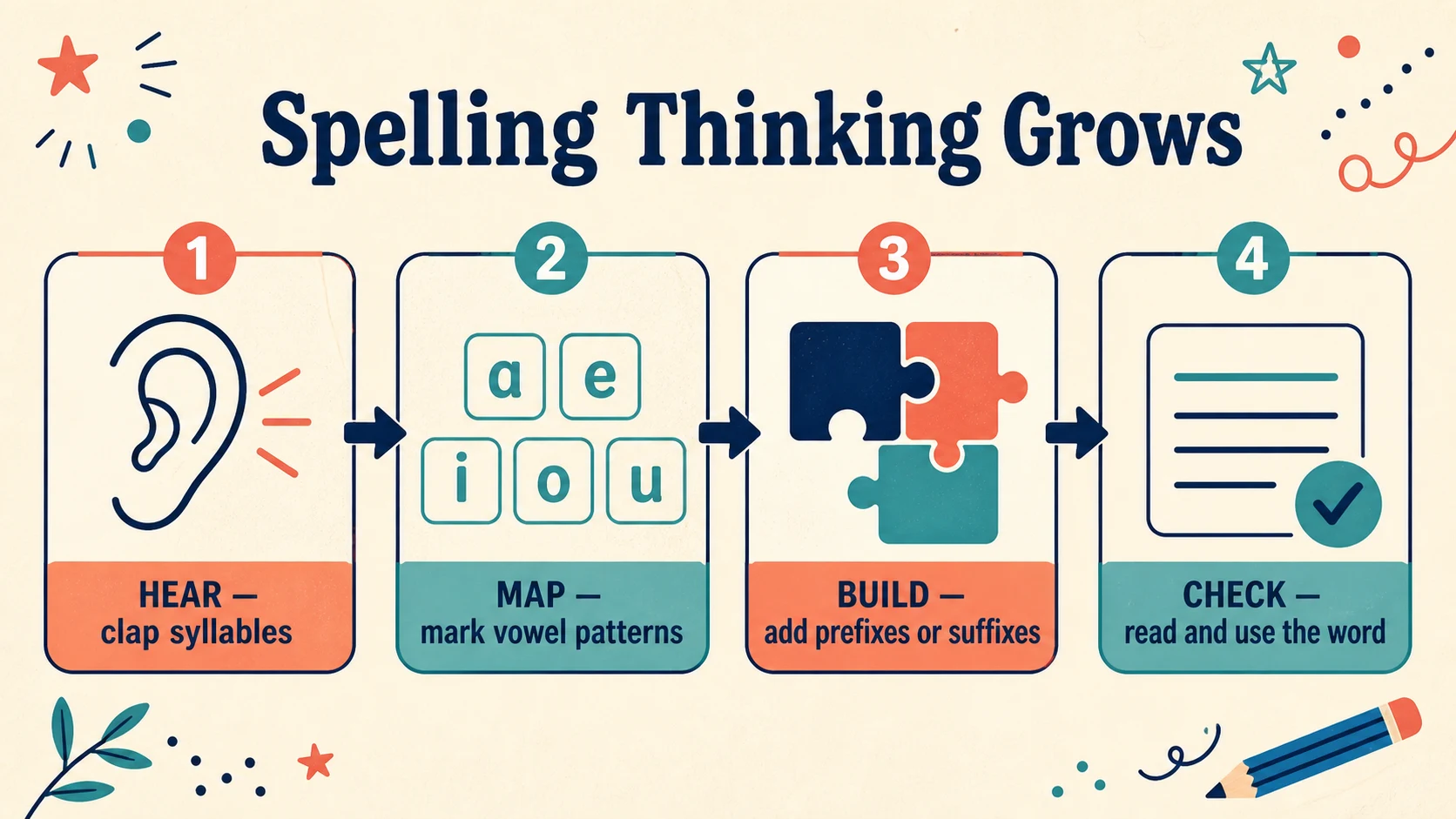
Independent work is appropriate after the learner can explain and recall the pattern, not merely after a supported page has been completed.
The Common Core English Language Arts standards include grade-specific language expectations involving conventional spelling and the use of spelling patterns and reference materials. Use those standards only as a broad point of comparison. They do not prove that a catalogue grade matches a particular school’s sequence, and they do not establish alignment for an individual worksheet unless that alignment has been separately documented.
Checked example: transfer beyond the studied list
After reviewing rain and train, ask the learner to spell snail:
- All three use ai within a one-syllable word.
- snail was not one of the original two models, so it tests whether the learner can extend the pattern.
- It is still a controlled extension because the target spelling is present in a comparable position.
If the learner writes snale, do not immediately advance to mixed long-vowel spellings. Return to a contrast such as snail/snake and ask what spelling appears inside each word. If snail is correct but a sentence later contains rane, schedule mixed retrieval of known ai and a_e words because the issue may be selecting among alternatives during writing.
This example belongs because it tests the catalogue’s suggested emphasis on patterns rather than isolated memorization while keeping the inference modest: one response informs the next activity but does not establish mastery.
Match the next sheet to the observed error
Use the completed work as a routing tool.
| What you observe | What it may mean | Observable next action |
|---|---|---|
| Correct sorting, weak covered recall | The pattern is recognized with visual support but not yet recalled reliably | Repeat four words with look-cover-write-check after a gap |
| Correct copying, incorrect word building | The model may be doing most of the work | Choose a reduced set that hides the model before the response |
| One spelling used for every long vowel | The learner is generalizing one familiar representation | Sort contrasting spellings before asking for recall |
| Correct base, incorrect prefix or suffix | The word boundary or affix spelling needs attention | Build words from separate base and affix cards |
| Correct isolated words, errors in sentences | Attention must shift toward transfer and editing | Use one short dictated sentence plus self-checking |
| Many unrelated omissions late on the page | Volume, attention, or handwriting may be confounding the sample | Stop, shorten the next session, and recheck two earlier items |
| Accurate work with a clear explanation | Current support may be more than necessary | Remove one support or add one controlled transfer word |
A next sheet should answer a question created by the previous response. “Can the learner distinguish ai from a_e when both are available?” is useful. “Can the learner survive a harder page?” is not.
For additional pattern-focused practice, move between the 2nd Grade Spelling Words guide and free sheet and the 4th Grade Spelling Words guide and free sheet according to task features, not as a promotion or demotion. If the learner’s errors concern hearing and mapping sounds rather than retaining conventional spellings, the Summer learning Phonics Worksheets may offer a more appropriate adjacent focus.
Know what a summer spelling worksheet cannot establish
A worksheet can provide a sample of performance under particular conditions. It cannot, by itself:
- Diagnose a reading, language, attention, or learning condition.
- Establish that a learner has mastered a grade-level curriculum.
- Show whether an error persists in everyday writing.
- Replace oral language, reading, or authentic composition.
- Determine why a child made an error without follow-up observation.
- Guarantee maintenance, transfer, or later academic outcomes.
- Resolve differences among local spelling sequences.
Vocabulary matters too. A learner cannot make a fair spelling attempt if the dictated word is unfamiliar or misunderstood. Say the word naturally, use it in a sentence, and ask the learner to repeat it. Do not distort pronunciation into a letter-by-letter code. When handwriting is a substantial competing demand, allow tiles, magnetic letters, or typing while preserving the spelling decision, then sample handwriting separately if that is also relevant.
Keep a simple record with four fields: date, target pattern, one observed response, and next action. Avoid percentage scores when only a handful of selected items were attempted. “Sorted ai and ay correctly; wrote play but wrote rane; next time contrast ai and a_e” is more actionable than “three out of four.”
Start with one small, evidence-producing review
Choose one free sheet from the full worksheet library, inspect its response demands, and mark only the first three to six items that address a previously taught spelling pattern. During the session, model one example, let the learner choose between two equivalent response formats, and record the exact part of any misspelling.
Then make one concrete decision: repeat the pattern with less visual support, contrast it with a competing spelling, move it into a sentence, or shorten the workload and recheck. For a practical first step, open the 3rd Grade Spelling Words guide and free sheet, select five relevant items rather than assigning all 25, and let those five responses determine the next summer review.
Put it into practice
Use the guide with a real printable
Move from explanation to a short, observable practice task. Check the first item together, then adjust the next session from the learner's actual work.
Open the first free worksheetExplore a neighboring collection