What 1st Grade Punctuation Includes
The direct answer: A first-grade learner should practice recognizing and using a period, question mark, and exclamation point at the end of a complete sentence. The learner should also capitalize the first word of the sentence and use commas to separate words in a simple list or parts of a date. Instruction should begin with spoken meaning, move into supported sentence correction, and end with short independent writing and editing.
Punctuation shows readers how a sentence is meant to work. A period closes a statement. A question mark signals a question. An exclamation point shows strong feeling or emphasis. A comma separates particular sentence parts, such as items in a list.
At this level, punctuation should not be treated as a page of symbols to memorize. Each mark has a job:
. tells the reader that a statement is complete.? tells the reader that the sentence asks something.! tells the reader to read with strong feeling or emphasis., can separate items in a list or parts of a date.
Capitalization and punctuation are closely connected in first-grade work. A learner may be asked to change the dog can run into The dog can run. That task checks three decisions: where the sentence begins, what the sentence means, and how it ends.
Grade labels describe the intended practice level, not a universal timetable. Local school sequences differ, and individual learners may need earlier review or later extension. Use the learner’s observed work—not the label alone—to decide the next step.
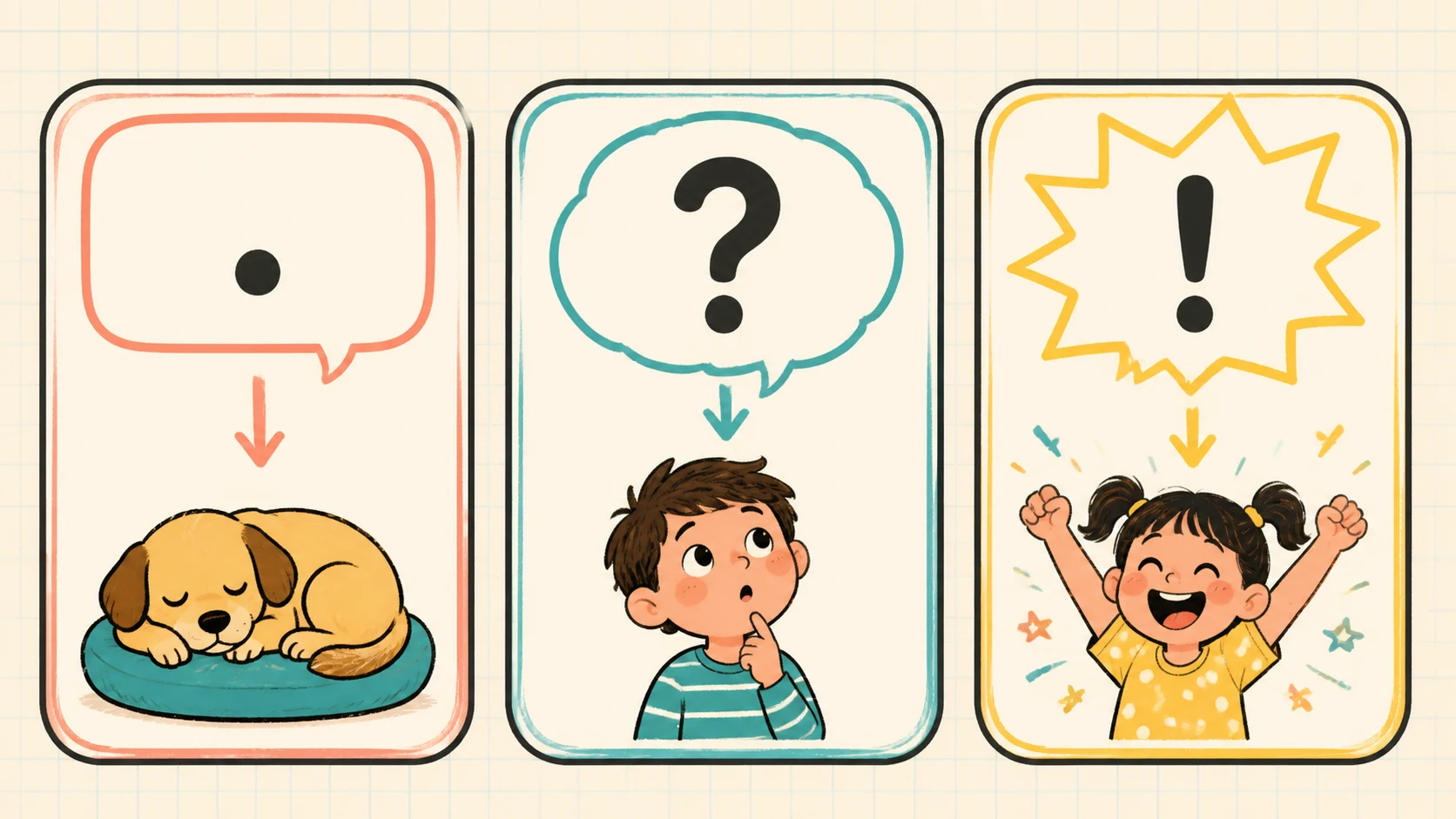
The central skill is choosing punctuation from sentence meaning and then applying it accurately.
Prerequisites to Check Before Teaching Punctuation
A learner does not need perfect reading or spelling before studying punctuation. However, several underlying skills make the work more understandable.
Hearing a complete thought
Read these aloud:
- The rabbit is in the box.
- In the box.
The first group of words communicates a complete thought. The second may name a location, but it leaves the listener waiting to hear what is in the box. A first grader does not need advanced grammar terminology to notice that difference.
Ask, “Does that sound finished?” If the learner cannot yet tell, use very short oral examples before presenting written punctuation tasks.
Distinguishing statements from questions
A learner should hear the difference between telling and asking:
- The gate is open.
- Is the gate open?
Do not rely only on voice rising at the end. A speaker’s pitch can vary, while sentence meaning remains more dependable. Ask:
- Is the speaker telling us something?
- Is the speaker asking for information?
The catalogue teaching guidance suggests connecting end marks to voice and expression. That is a useful instructional model, but meaning should confirm the choice.
Tracking print from beginning to end
Before editing, check whether the learner can point to the first and last word of a printed sentence. If not, sentence boundaries may be the real difficulty. Place each word on a separate card, arrange the cards in order, and leave a space for the ending mark.
Recognizing the relevant symbols
The learner should be able to match the names period, question mark, exclamation point, and comma to their printed forms. Recognition is not the same as correct use. If a learner can name ? but adds it after statements, the teaching need concerns meaning rather than symbol identification.
For broader language practice around these skills, the 1st Grade Grammar collection provides the relevant subject context.
A Grade-Appropriate Progression
Teach one decision at a time, then combine decisions only after the learner can explain them. The following sequence is an instructional suggestion based on the supplied catalogue scope. It is not a claim that every school uses the same order.
| Stage |
Teaching focus |
Supported task |
Evidence of readiness |
| 1 |
Identify where a sentence begins and ends |
Point to the first and last word |
Finds both boundaries consistently |
| 2 |
Recognize a statement |
Choose a period from two marks |
Explains that the sentence tells something |
| 3 |
Recognize a question |
Sort spoken and written examples |
Explains that the sentence asks something |
| 4 |
Recognize strong feeling or emphasis |
Compare neutral and emphatic versions |
Chooses ! from meaning, not merely volume |
| 5 |
Capitalize and punctuate one sentence |
Correct a sentence with missing mechanics |
Fixes the beginning and ending |
| 6 |
Separate three items in a list |
Mark where one item ends and another begins |
Places commas between listed items |
| 7 |
Punctuate a date |
Build and copy a modeled date |
Places the comma between day and year |
| 8 |
Edit mixed sentences |
Correct several sentence types |
Chooses marks independently and explains choices |
| 9 |
Apply punctuation in original writing |
Write two to four connected sentences |
Reviews beginnings and endings after writing |
The Common Core State Standards for English Language Arts include first-grade conventions involving sentence beginnings, end punctuation, and commas in dates and words in a series. This source provides broad standards context; it does not establish a required daily sequence or evaluate WorksheetWise materials.
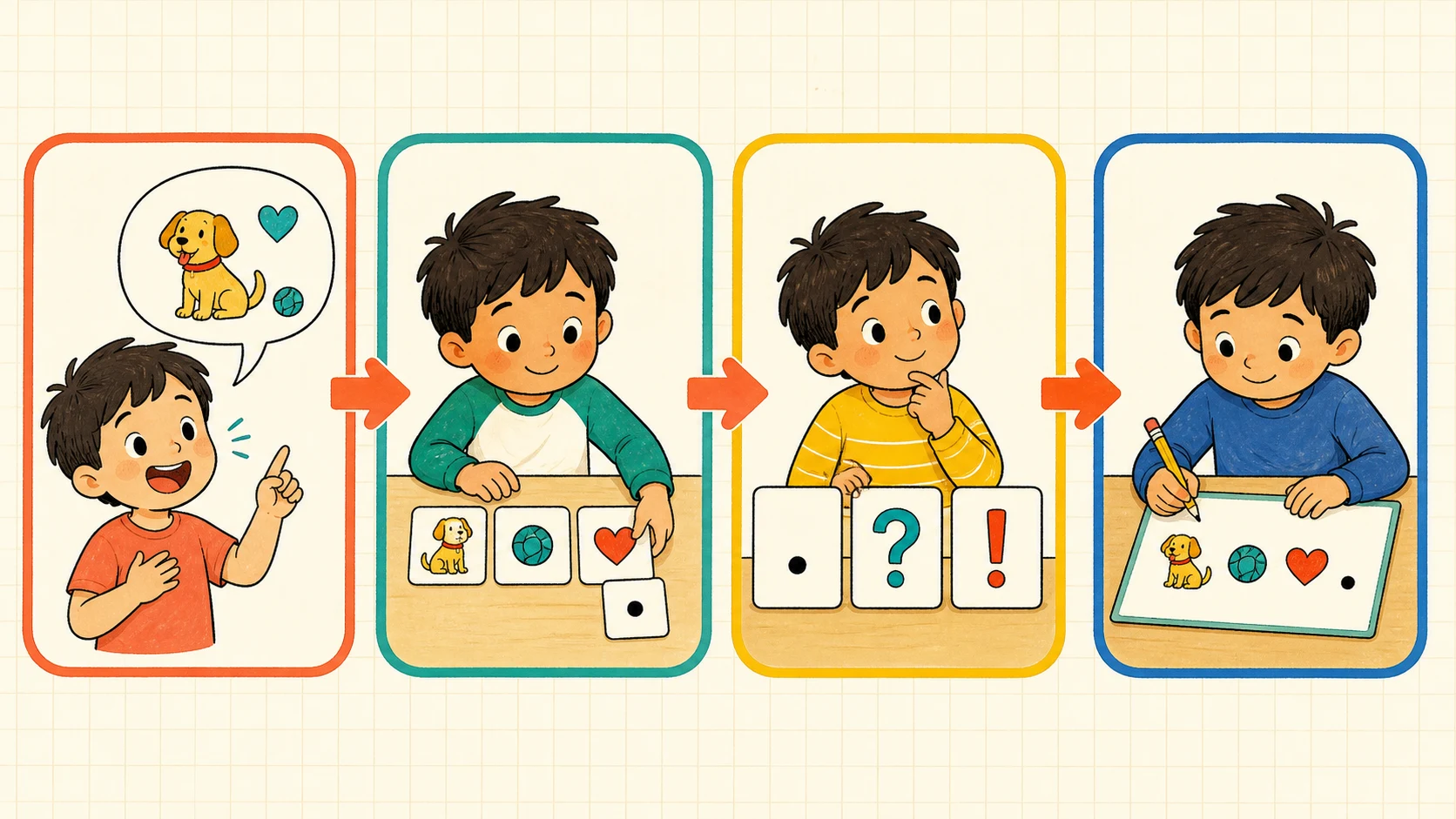
Support can fade from oral sorting to correction, editing, and independent sentence writing.
Concrete and Visual Models
Young learners often benefit when an invisible language decision becomes something they can point to or move.
The sentence road
Draw a horizontal road. Place a capital letter at the entrance and an end mark at the stop line:
Capital letter → words carrying the thought → end mark
Build a sentence with word cards:
My | cat | naps | .
Then replace the first card and ending:
Does | my | cat | nap | ?
Ask what changed. The second sentence is not a question merely because it has a question mark; it needs a question mark because it asks something.
Three ending-mark cards
Make cards showing ., ?, and !. Read one sentence at a time and have the learner hold up the matching card. After every choice, require a brief reason:
- “It tells something.”
- “It asks something.”
- “It shows strong feeling.”
This adds reasoning without requiring a long explanation.
Comma boxes for a list
Draw three boxes and place one item in each:
apples | pears | plums
Explain that commas separate the written items:
I packed apples, pears, and plums.
The commas do not replace the words. They show where one listed item ends and the next begins.
Date frame
Use a fixed visual:
Month + day, + year
For example:
March 6, 2026
Have the learner point to the day and then place the comma after it. Keep this model visible until the pattern is secure.
Fully Checked Worked Examples
The examples below show the decision process, not just the final mark.
Example 1: A statement
Unpunctuated text:
the frog is green
Step 1: Find the beginning. The first word is the, so its first letter needs a capital.
Step 2: Identify the sentence type. The words tell something about the frog. They do not ask for information or express a strong reaction.
Step 3: Choose the ending. A statement takes a period.
Checked answer:
The frog is green.
The capital letter begins the sentence, every word remains in the correct order, and the period closes the statement.
Example 2: A question
Unpunctuated text:
can you see the moon
Step 1: Capitalize the first word. Change can to Can.
Step 2: Test the meaning. The speaker wants to know whether the listener can see the moon.
Step 3: Add a question mark.
Checked answer:
Can you see the moon?
A period would make the punctuation conflict with the sentence’s asking function. An exclamation point could add force, but it would not clearly mark the sentence as a question in this introductory exercise.
Example 3: An exclamation
Unpunctuated text:
what a huge pumpkin
Step 1: Capitalize the opening word. Change what to What.
Step 2: Read for meaning. The sentence expresses a strong reaction to the pumpkin’s size.
Step 3: Add an exclamation point.
Checked answer:
What a huge pumpkin!
This example does not ask for the pumpkin’s size. The word what does not automatically make a question. Meaning controls the punctuation.
Example 4: A list
Unpunctuated text:
I drew a sun a tree and a bird.
Step 1: Find the listed items. They are a sun, a tree, and a bird.
Step 2: Separate the items. Place a comma after the first and second items.
Step 3: Preserve the period. The complete sentence is a statement.
Checked answer:
I drew a sun, a tree, and a bird.
This guide uses a comma before and in a three-item list, matching the supplied catalogue example.
Example 5: A date
Unpunctuated text:
School starts on August 12 2026.
Step 1: Locate the date. The month is August, the day is 12, and the year is 2026.
Step 2: Apply the displayed date pattern. Put a comma between the day and year.
Checked answer:
School starts on August 12, 2026.
The period still belongs at the end of the complete sentence. The comma has a separate job inside the date.
Example 6: Editing two sentences
Unpunctuated text:
we found the ball where was it hiding
Step 1: Separate the complete thoughts.
we found the ballwhere was it hiding
Step 2: Capitalize both beginnings.
Step 3: Choose each end mark. The first tells something; the second asks something.
Checked answer:
We found the ball. Where was it hiding?
This example checks sentence boundaries as well as mark selection.
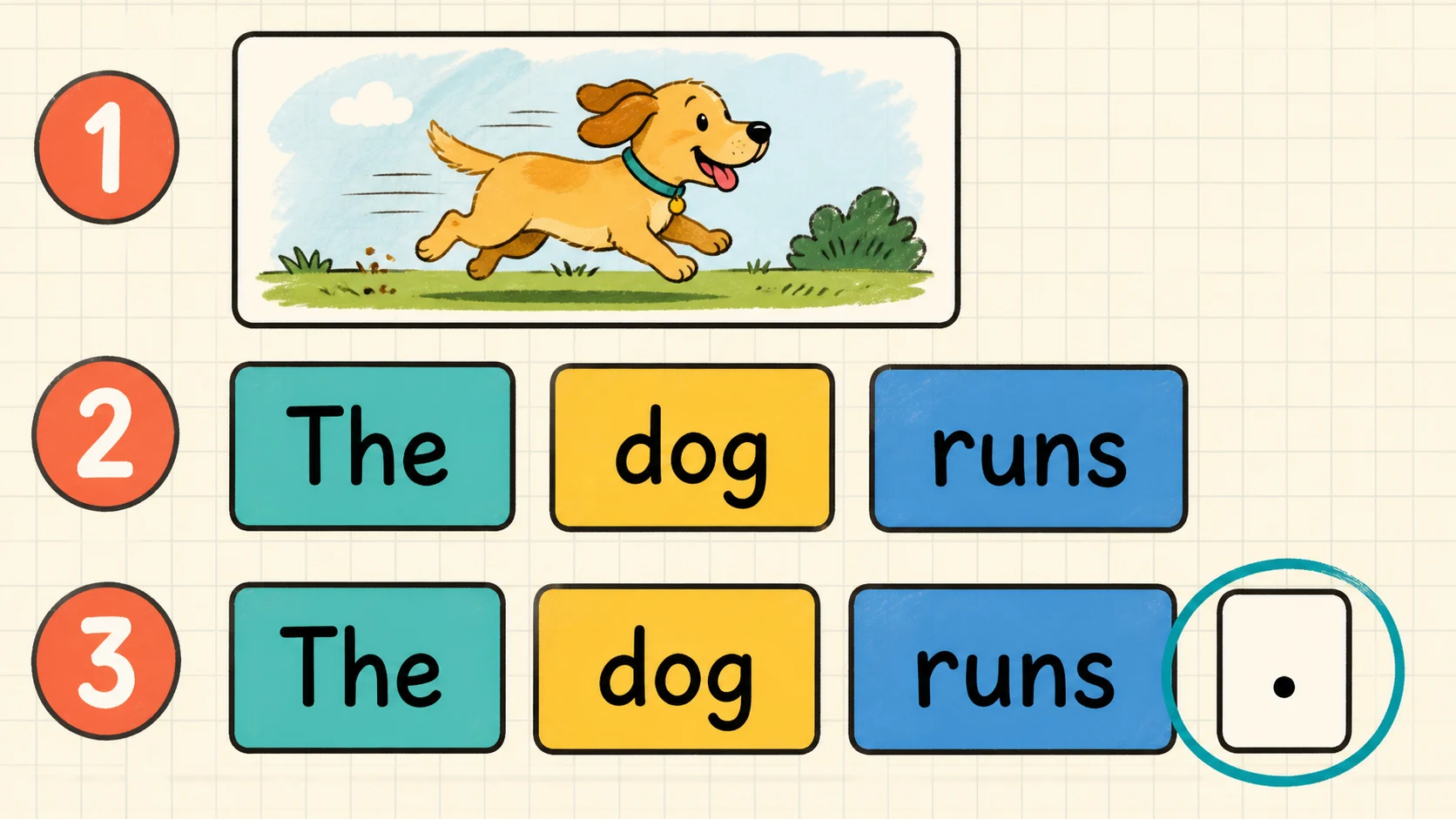
Model the meaning decision before asking the learner to write the final punctuation.
Boundary Cases That Need Care
Some sentences can take different punctuation depending on the intended meaning. First graders should know that punctuation is meaningful, but early practice should avoid unnecessary ambiguity.
A command can take a period
Please close the gate.
This is a calm request or command, not a question. The word please does not require a question mark.
A forceful version might be:
Close the gate!
Both forms can be correct in an appropriate context. When checking a learner’s work, ask what tone was intended before treating one choice as automatically wrong.
A question can show excitement
Did we really win?
This remains a question because it asks for confirmation, even if the speaker feels excited. In beginning practice, use a question mark rather than combining punctuation marks.
Not every sentence containing “what” is a question
Compare:
What is in the box?What a funny hat!
The first asks for information. The second expresses a reaction. A learner who chooses punctuation from the first word alone needs contrasting examples like these.
Volume does not determine the mark by itself
A sentence spoken loudly is not automatically an exclamation. Someone may call out a question across a playground: Where are you? Meaning remains the primary test.
Short word groups may not be sentences
Under the chair does not communicate a complete thought by itself. Adding a period would not make it complete. Expand it:
The shoe is under the chair.
This distinction helps prevent punctuation practice from becoming symbol attachment without sentence understanding.
A Short, Repeatable Lesson Routine
A useful session can be brief. Stop or simplify when attention drops or errors become less thoughtful. The learner’s responses should determine pacing.
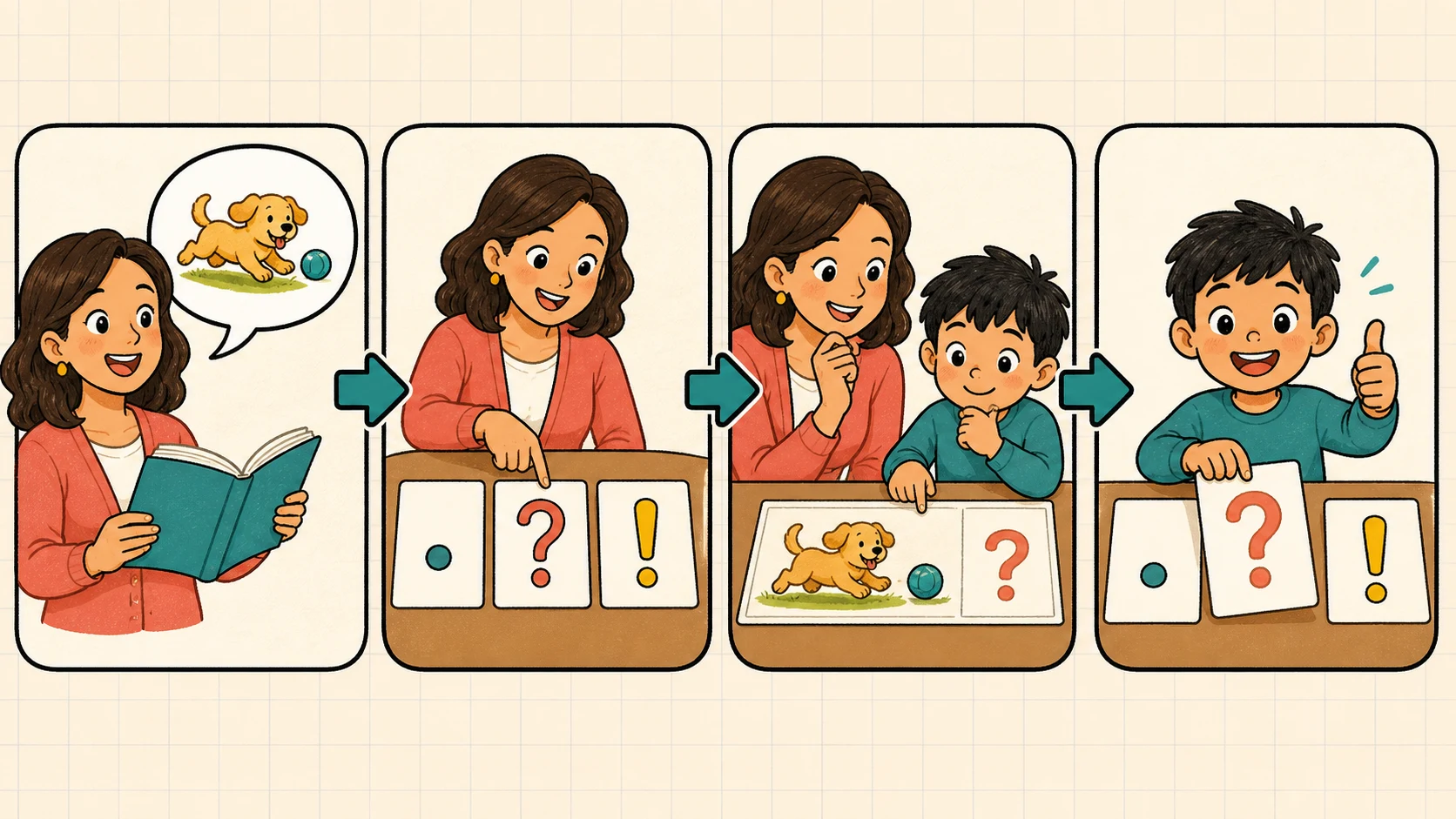
Each lesson moves from hearing meaning to applying and checking punctuation.
1. Hear and classify
Say two or three sentences without showing the print. Ask whether each one tells, asks, or shows strong feeling. Use clear examples at first.
2. Model one decision
Write one sentence without its ending mark. Think aloud in simple language:
Can the duck swim
“This sentence asks something. I need a question mark.”
Then add capitalization if needed:
Can the duck swim?
3. Practice together
Offer two or three sentences. Let the learner point to a punctuation card before writing the mark. Ask for a short reason after each choice.
4. Apply independently
Have the learner correct two to four sentences or write one original sentence of a specified type. Keep the independent amount small enough that every response can be reviewed.
5. Read and check
The learner reads the completed sentence aloud and checks:
- Does it begin with a capital?
- Does it make a complete thought?
- Does the end mark match the meaning?
- If it contains a list or date, is a comma needed?
The IES foundational reading practice guide offers broad instructional framing for foundational literacy in kindergarten through grade 3. The IES elementary writing practice guide addresses explicit writing instruction and opportunities to write. These sources support the high-level choice to combine clear teaching with application; they do not prescribe this exact routine or assess this worksheet.
Choosing Appropriate Practice
Choose material according to the learner’s current error pattern.
When the learner is beginning
Use oral sorting, punctuation cards, and single sentences with two possible choices. Start with periods and question marks if three marks create guessing. Add exclamation points after the learner can explain the difference between telling and asking.
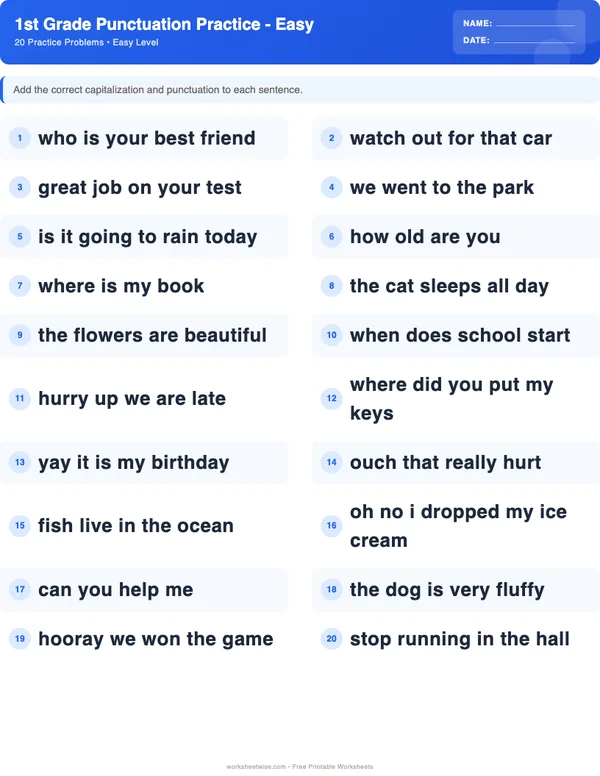
The free easy punctuation worksheet contains 12 exercises asking learners to add correct capitalization and punctuation. Its stated skills are capitalization, periods, question marks, and exclamation marks, and it includes a separate answer key.
When the learner recognizes marks but applies them inconsistently
Use mixed sentence correction. Ask for the reason before the learner writes the mark. This reveals whether a correct response came from sentence meaning or chance.
Also mix capitalization into the task. If the learner fixes the end but overlooks the beginning, reduce the number of sentences and use a two-part check: “Beginning? Ending?”
When the learner succeeds on isolated sentences
Move to two or three connected sentences with all punctuation removed. Next, ask the learner to compose a tiny message, caption, or description and edit it afterward.
The supplied catalogue guidance recommends editing already-written text as an important form of punctuation practice. Treat editing and original writing as related but distinct tasks: one requires finding existing errors, while the other requires generating content and managing mechanics together.
When more variety is needed
The 1st Grade Punctuation Worksheet Pack contains 18 worksheets. Select pages by the skill actually needed rather than assigning every page in order. For customized practice, the free worksheet generators can help vary wording while keeping the targeted decision narrow.
Differentiation Without Lowering the Purpose
Differentiation should change the support, amount, or response method while preserving the underlying punctuation decision.
For a learner who needs more support
- Read the sentence aloud while the learner follows the print.
- Offer two ending marks instead of three.
- Underline the first word and box the final word.
- Let the learner place a punctuation card before writing.
- Use one sentence type for several items before mixing types.
- Reduce handwriting by allowing pointing, circling, or movable cards.
If spelling or handwriting obscures punctuation knowledge, provide the words and ask only for capitalization and marks. This isolates the intended skill.
For a learner ready for extension
- Mix statements, questions, and exclamations without labels.
- Include lists and dates alongside end punctuation.
- Ask the learner to explain why an alternative mark changes the meaning.
- Provide two run-together sentences to separate and punctuate.
- Have the learner write one statement, one question, and one exclamation about the same picture.
- Ask for a final editing pass on a short original paragraph.
Extension should deepen reasoning rather than introduce advanced comma, apostrophe, or quotation-mark rules prematurely. The broader 1st Grade worksheet hub can support related reading and writing practice when the learner is ready.
Common Errors and Diagnostic Responses
An error is most useful when it reveals the decision the learner is making.
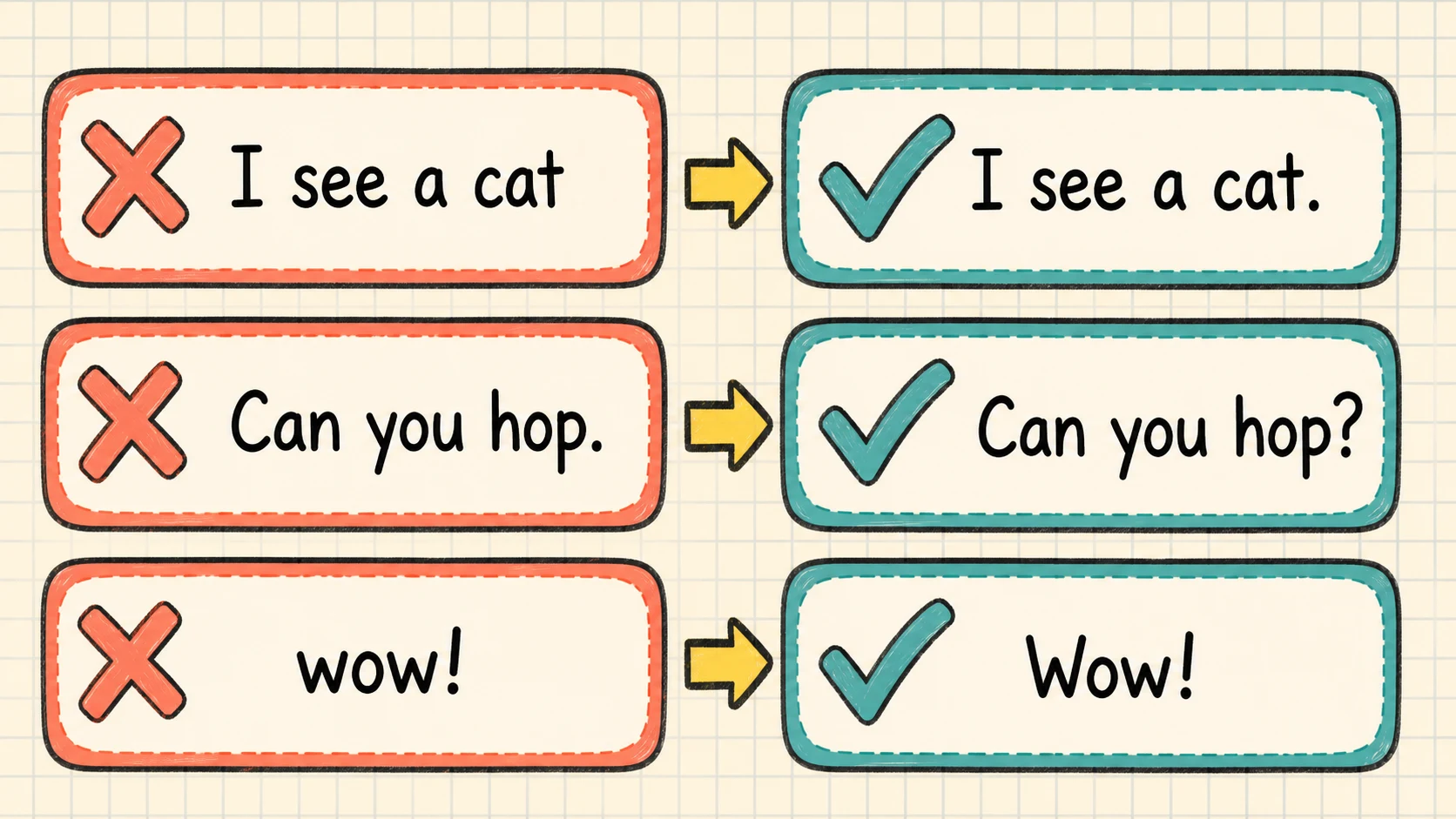
Match the teaching response to the cause suggested by the learner’s work.
| Observed error |
Possible interpretation |
Instructional response |
| A period appears after every sentence |
The learner may be using the most familiar mark |
Sort oral examples into “tells” and “asks” before writing |
| A question mark follows every sentence beginning with can or what |
The learner may be using a first-word shortcut |
Contrast Can birds fly? with Can birds fly fast? only if both are genuine questions; use What is that? beside What a tall tree! for a clearer contrast |
| An exclamation point follows anything read loudly |
Volume is being confused with meaning |
Read one question loudly and one exclamation quietly; discuss what each sentence does |
| The correct end mark is added, but the first word remains lowercase |
The learner is checking only the ending |
Use a visible “beginning and ending” checklist |
| Two sentences run together |
Sentence boundaries are not secure |
Cut the words into cards and group each complete thought |
| Commas appear after every word |
The learner knows a comma separates but not what it separates |
Box each complete list item before inserting commas |
| No comma appears in a date |
The date pattern is not remembered |
Rebuild the month day, year frame with several dates |
| Correct answers occur only when options are provided |
Recognition may be stronger than recall |
Remove choices gradually: three choices, two choices, then a blank |
| Punctuation is correct in exercises but absent in original writing |
Editing may not transfer automatically during composition |
Separate drafting from a short punctuation check afterward |
Do not diagnose a broad learning difficulty from a few worksheet errors. This guide offers instructional responses, not medical, developmental, or individualized clinical advice.
Monitoring Progress and Deciding What Comes Next
Keep monitoring simple enough to use consistently. Save one brief sample every few sessions and record the type of support given.
A sample record might include:
| Date |
Task |
Result |
Support |
Next decision |
| Day 1 |
Six statement/question choices |
4 correct |
Sentences read aloud |
Continue oral classification |
| Day 4 |
Six mixed end marks |
5 correct |
No choices; one reminder |
Add capitalization check |
| Day 8 |
Three edited sentences |
All correct |
Independent |
Try two original sentences |
Raw totals alone can hide important differences. Six correct answers chosen from two marks do not show the same independence as six marks supplied without options. Note whether the learner:
- identified the sentence type;
- selected the matching mark;
- capitalized the beginning;
- found separate sentence boundaries;
- used a comma in a taught list or date pattern;
- checked work without being prompted.
Move forward when the learner is accurate across more than one session and can usually explain the choice. If performance drops sharply when support is removed, restore the last useful support and fade it more slowly. If one error persists while the other skills are secure, narrow practice to that decision rather than repeating an entire mixed page.
A Two-Week Practice Plan
This plan is an adaptable instructional suggestion, not a universal timetable. Ten short sessions may be spread across more than two calendar weeks when needed.

The plan alternates explicit teaching, supported practice, application, and review.
| Day |
Focus |
Suggested activity |
Quick check |
| 1 |
Sentence boundaries |
Build three sentences with word cards |
Point to each beginning and ending |
| 2 |
Periods |
Sort complete statements and add periods |
Explain, “It tells something” |
| 3 |
Question marks |
Sort telling and asking sentences |
Write ? without a choice |
| 4 |
Mixed periods and question marks |
Correct four short sentences |
Read each sentence after editing |
| 5 |
Exclamation points |
Compare neutral statements with strong reactions |
Explain why ! fits |
| 6 |
Three end marks |
Use punctuation cards, then write the choices |
Note which contrast causes errors |
| 7 |
Capitals and end marks |
Complete part of a mixed correction worksheet |
Apply the beginning-and-ending check |
| 8 |
Commas in lists |
Build and punctuate three-item lists |
Name each separated item |
| 9 |
Commas in dates and mixed review |
Complete modeled dates, then edit sentences |
Point to the day and year |
| 10 |
Independent application |
Write three related sentences and edit them |
Record independent strengths and one next focus |
If Day 4 shows continued confusion between statements and questions, repeat that contrast before introducing exclamation points. If Day 8 overloads the learner, keep commas separate from mixed end-mark work for a few sessions. If the learner completes Day 10 accurately and can explain the choices, continue with short editing passages and original writing rather than simply increasing page length.
Limits of This Guide
This guide covers the supplied first-grade scope: capitalization at sentence beginnings, periods, question marks, exclamation points, and introductory comma use in dates and lists. It does not provide comprehensive standards alignment, certify mastery, or guarantee a particular outcome.
The wider punctuation catalogue includes later work with commas in other settings, apostrophes, quotation marks, colons, and semicolons. Those rules should not be assumed to belong in every first-grade lesson. Local curricula may arrange conventions differently, and the learner’s writing should determine whether review, continued practice, or extension is appropriate.
A printable page can provide useful repetition, but it cannot by itself show why a learner chose an answer. Brief discussion, oral reading, and a small original-writing task supply evidence that answer checking alone may miss.
The Next Useful Action
Begin with a six-sentence check: two statements, two questions, and two exclamations. Ask the learner to capitalize and punctuate each sentence, then explain every ending mark. Use the results to choose one focus rather than reteaching everything.
For immediate practice, open the free 1st Grade Punctuation worksheet. Assign only enough of its 12 easy-level exercises to confirm the current need, review the work with the included answer key, and use the learner’s explanations to select the next lesson.