3rd Grade Punctuation: The Direct Answer
Third-grade learners should use punctuation to make complete sentences clear to a reader. A practical sequence begins with periods, question marks, and exclamation points; moves to commas in lists, dates, addresses, and dialogue; and then develops apostrophes for contractions and possessives. Learners should also begin applying quotation marks and dialogue punctuation in short, controlled examples.
The most useful teaching cycle is simple: model one punctuation decision, complete a few examples together, ask the learner to explain the rule, and then check whether the learner can apply it in a new sentence or a short piece of writing. Move forward according to the learner’s observed work. A learner who still confuses statements and questions needs more end-punctuation practice before a page of dialogue editing.
Grade labels describe an intended practice level, not a universal timetable. Local curricula and instructional sequences differ. The Common Core English Language Arts standards provide one useful reference point for grade-level language conventions, but schools, states, and homeschool programs may organize those conventions differently.
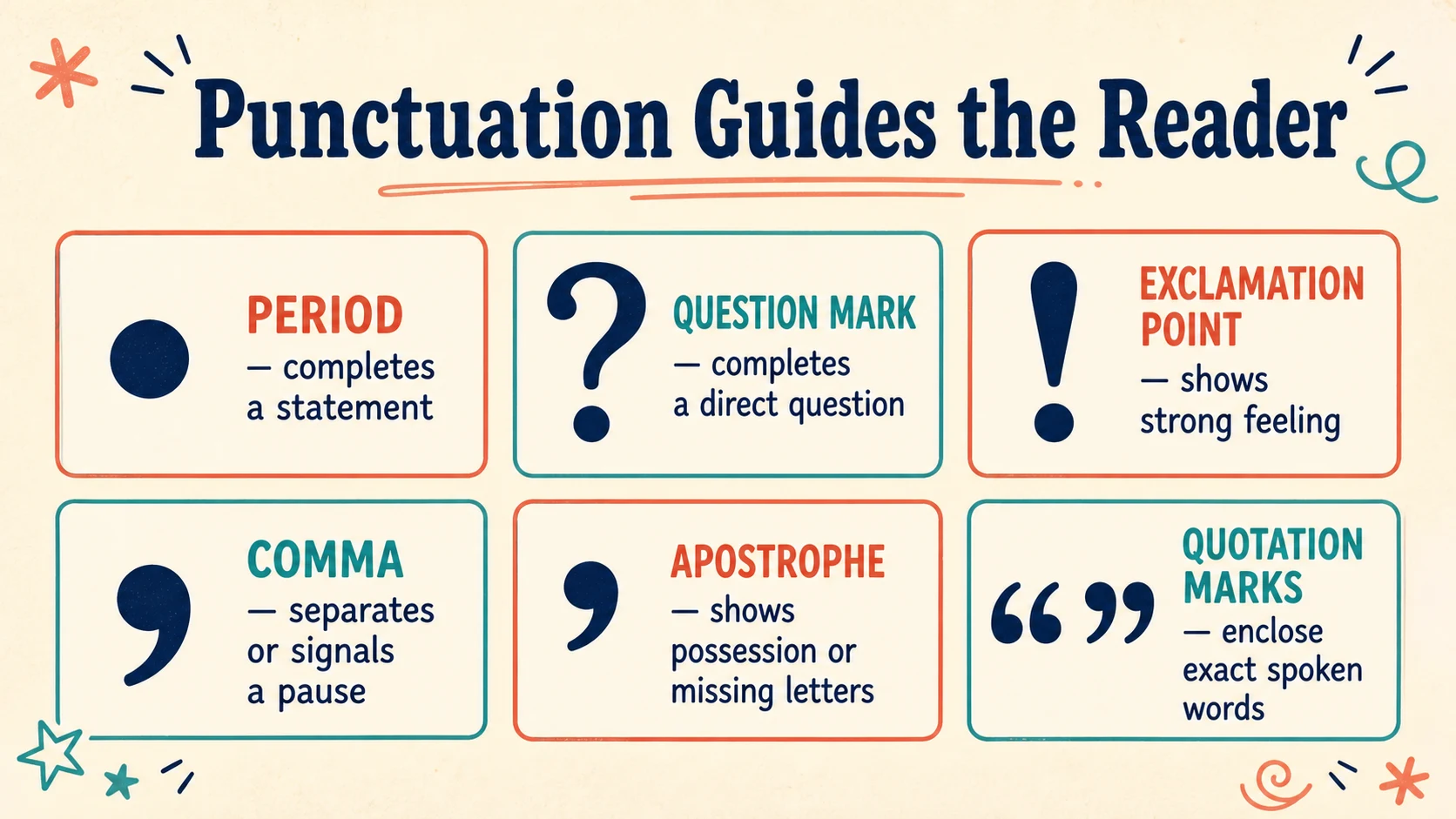
The skill map connects sentence meaning, punctuation rules, reading, editing, and original writing.
What a Learner Needs Before Beginning
Punctuation instruction works best when the learner can recognize a sentence as a complete unit of meaning. Before introducing several punctuation rules, check whether the learner can:
- Identify where a sentence begins and ends.
- Distinguish a statement from a direct question.
- Recognize names, dates, and common contractions.
- Read a short sentence and explain what it means.
- Copy or write a complete sentence with readable spacing.
- Notice that punctuation can change how a sentence is read.
These are readiness checks, not entrance requirements. A learner may understand questions while still forgetting question marks in writing. That is an application problem rather than proof that the learner lacks the concept.
Reading and writing also support each other. The IES foundational reading practice guide offers high-level guidance about building foundational reading skills through systematic instruction and supported practice. It does not evaluate WorksheetWise materials or prescribe this particular punctuation sequence. For punctuation lessons, an instructional application is to combine visual marks with oral reading: the learner sees the mark, reads the sentence, and explains how the mark fits its meaning.
A brief readiness check
Write these three sentences without end marks:
The bus is here
Is the bus here
Watch out
Ask the learner to read each one and select an end mark. Then ask for a reason.
Expected answers:
The bus is here.
Is the bus here?
Watch out!
The third answer has a boundary case: Watch out. is grammatically possible when the warning is calm. Watch out! better communicates urgency in the isolated example. Accepting a defensible alternative teaches that punctuation sometimes communicates tone, not just sentence type.
A Grade-Appropriate Teaching Progression
A sound progression controls how many decisions the learner must make at once. The table below is an instructional sequence based on the supplied topic scope. It is not a claim that every curriculum follows the same order.
| Stage |
Main focus |
Supported task |
Independent evidence |
| 1 |
Periods, question marks, exclamation points |
Choose an end mark from two or three options |
Add end punctuation and explain the choice |
| 2 |
Capital letters with end punctuation |
Repair one sentence at a time |
Edit a short group of sentences |
| 3 |
Commas in a series |
Sort list items and insert commas |
Write and punctuate an original list |
| 4 |
Commas in dates and addresses |
Mark the parts before inserting commas |
Punctuate unfamiliar dates and addresses |
| 5 |
Apostrophes in contractions |
Join two words and mark omitted letters |
Form and use common contractions |
| 6 |
Apostrophes in singular possessives |
Identify the owner and the owned item |
Rewrite “the ___ belonging to ___” |
| 7 |
Quotation marks and commas in dialogue |
Punctuate already-written speech |
Edit or write a short exchange |
| 8 |
Mixed editing |
Name the rule needed in each sentence |
Edit a paragraph and justify changes |
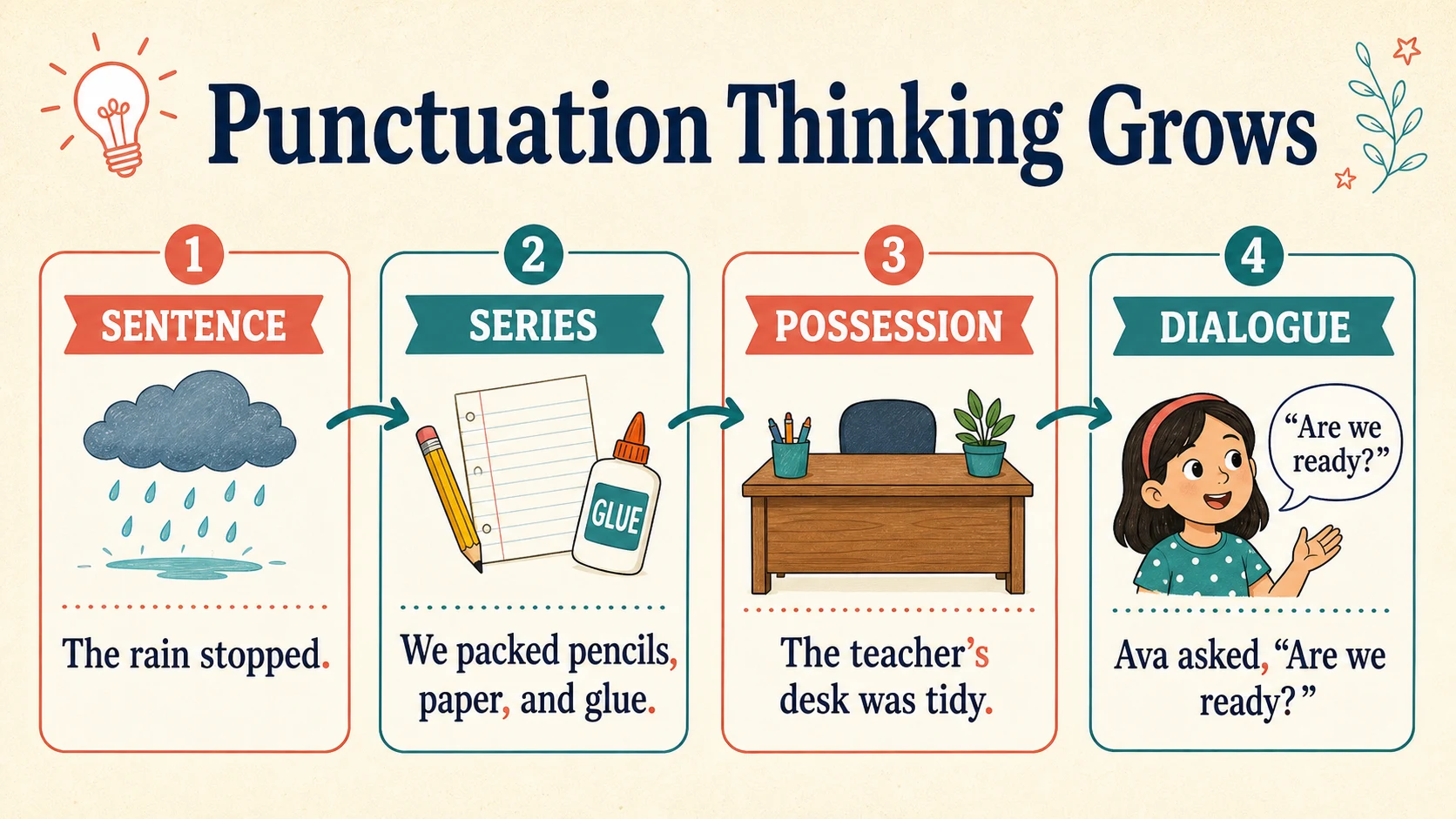
Support decreases as the learner moves from identifying a mark to applying it in connected writing.
Do not treat completion of one worksheet as automatic mastery. A learner may score well when every item asks for a question mark but struggle when periods, question marks, and exclamation points appear together. Mixed practice reveals whether the learner is choosing from meaning or merely repeating the same response.
The 3rd Grade Grammar hub can help an adult place punctuation beside related work on sentence structure and other language conventions. Keep the immediate lesson narrow even when the larger curriculum is broad.
Concrete and Visual Models for the Main Marks
End punctuation as a meaning signal
Use a three-column model:
| Sentence purpose |
Typical mark |
Example |
| Tells or states |
. |
The gate is open. |
| Asks directly |
? |
Is the gate open? |
| Shows strong feeling or urgency |
! |
Close the gate! |
Reading with expression can make the contrast visible and audible. However, avoid teaching that every question must have a dramatically rising voice or that every exclamation must be shouted. Meaning and sentence structure are more dependable clues than performance alone.
A useful concrete routine is to write the same words on cards and change the punctuation:
You found the map.
You found the map?
You found the map!
The first reports information. The second expresses a question, perhaps surprise or uncertainty. The third emphasizes excitement or astonishment. This boundary case demonstrates that the words alone do not always determine the writer’s intended meaning.
Commas as separators
For a series, draw boxes around the items:
We packed [apples], [crackers], and [water].
The commas separate the items. The final and signals the last item. Keep early examples concrete so the learner can count the things being listed.
For a date, separate its named parts:
April 12, 2026
For an address within a sentence, commas divide parts of the location:
My aunt lives at 18 Oak Road, Denver, Colorado.
Do not generalize that a comma belongs wherever a reader pauses. Pauses vary, but punctuation rules are more stable. Teach the function by name: comma in a series, comma in a date, or comma in an address.
Apostrophes as omission or ownership markers
Use two distinct visual models.
Contraction:
do + not → don't
The apostrophe marks omitted letters.
Possession:
the collar belonging to the dog → the dog's collar
The apostrophe helps show ownership or belonging.
Keeping the models separate prevents the vague rule that an apostrophe means “more than one” or simply belongs before every final s.
Quotation marks as speech boundaries
Frame the exact words spoken:
Maya said, “I found the key.”
The quotation marks surround Maya’s spoken words. The comma separates the speaker tag from the quotation, and the period belongs inside the closing quotation mark.
For a question spoken by the character:
Maya asked, “Does this key fit?”
The question mark belongs inside because the quoted words form the question.
Fully Checked Worked Examples
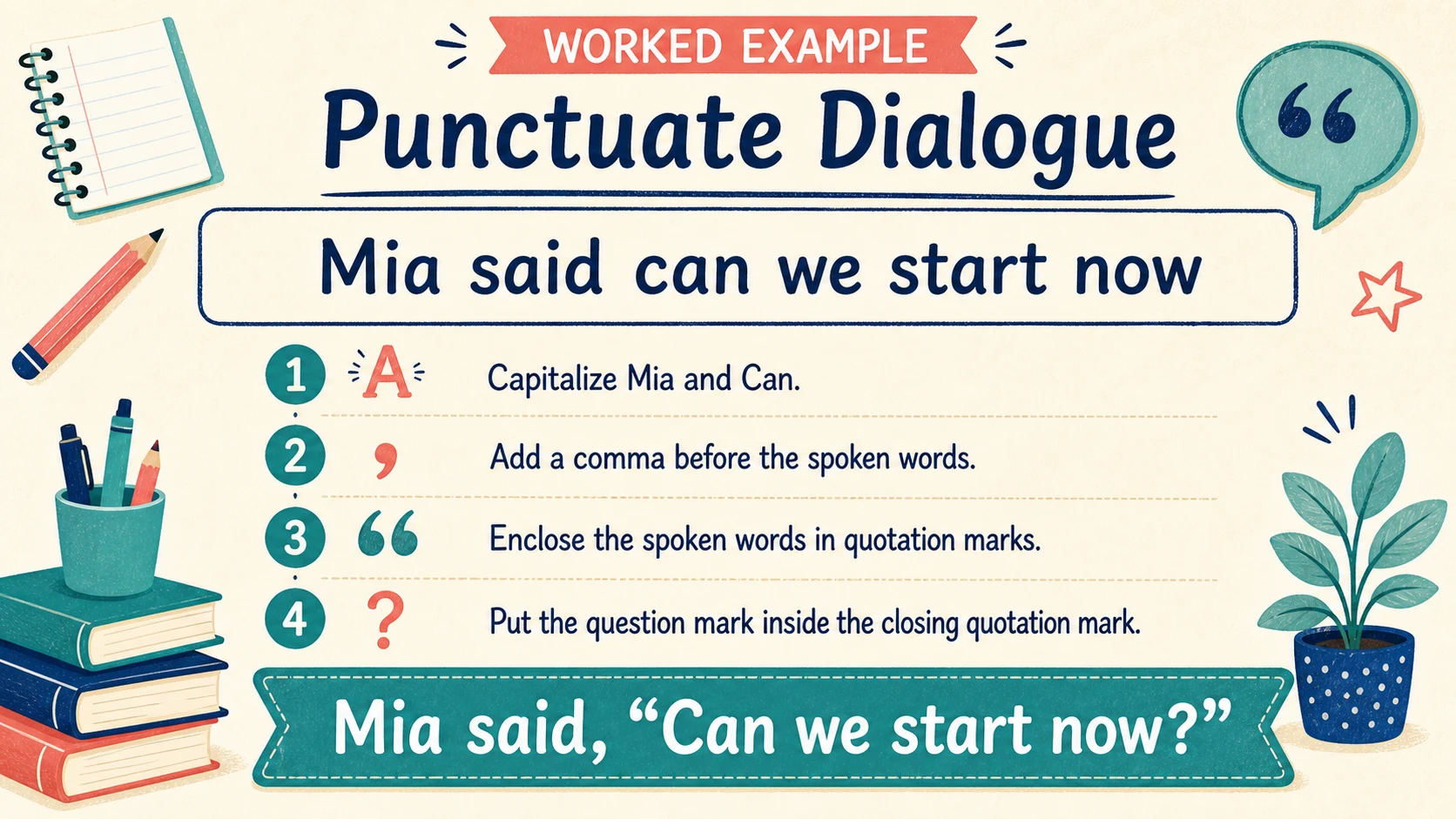
Each worked example identifies meaning, selects a rule, applies the mark, and checks the completed sentence.
Worked example 1: End punctuation and capitalization
Unedited sentence:
where did you put my blue notebook
Reasoning:
- The sentence asks directly for information.
- A direct question ends with a question mark.
- The first word of the sentence needs a capital letter.
Corrected sentence:
Where did you put my blue notebook?
Check: Where begins with a capital, and ? matches the sentence’s purpose. No comma is needed.
Worked example 2: A comma-separated series
Unedited sentence:
We planted beans carrots and peas.
Reasoning:
- The sentence names three items:
beans, carrots, and peas.
- Commas separate items in the series.
- The period remains because the sentence is a statement.
Corrected sentence:
We planted beans, carrots, and peas.
Check: all three items remain intact, commas show their boundaries, and the sentence ends with a period.
For third-grade practice, use the displayed final comma consistently. Learners may encounter published styles that omit it, but switching conventions during introductory practice adds an unnecessary variable.
Worked example 3: A contraction
Original words:
I cannot find the lid.
Task: Replace cannot with a contraction.
Reasoning:
Cannot can be shortened to can't.- The contraction omits letters from
not.
- The apostrophe marks the omission.
Corrected sentence:
I can't find the lid.
Check: cant would be incorrect for this meaning because it lacks the apostrophe. The period is still appropriate because the sentence states information.
Worked example 4: Singular possession
Unedited phrase:
the rabbits cage
Intended meaning: one rabbit owns or uses the cage.
Reasoning:
- The owner is one
rabbit.
- For this singular possessive, add an apostrophe and
s.
- Keep the owned item,
cage, after the owner.
Corrected phrase:
the rabbit's cage
In a sentence:
We cleaned the rabbit's cage.
Check: rabbits without an apostrophe would ordinarily indicate more than one rabbit, not possession. The intended meaning confirms the singular possessive form.
Worked example 5: Dialogue punctuation
Unedited sentence:
Lena said I finished the puzzle.
Reasoning:
- Lena’s exact spoken words are
I finished the puzzle.
- Quotation marks surround those spoken words.
- A comma follows the speaker tag
Lena said.
- The quoted statement ends with a period inside the closing quotation mark.
Corrected sentence:
Lena said, “I finished the puzzle.”
Check: the capital I begins the quotation, both quotation marks are present, and the sentence has only the punctuation it needs.
Worked example 6: Dialogue containing a question
Unedited sentence:
Omar asked Are we leaving now
Reasoning:
Are we leaving now is the exact speech.- It is a direct question, so it needs a question mark.
- A comma separates
Omar asked from the spoken words.
- Quotation marks enclose the speech.
Corrected sentence:
Omar asked, “Are we leaving now?”
Check: no extra period follows the closing quotation mark. The question mark already completes the sentence.
A Short, Repeatable Lesson Routine
The IES elementary writing practice guide supports high-level practices such as teaching writing processes and strategies explicitly and providing opportunities to write. It does not set a universal punctuation timetable or review this worksheet. The following routine is an instructional suggestion that applies explicit modeling and supported practice to a narrow punctuation target.
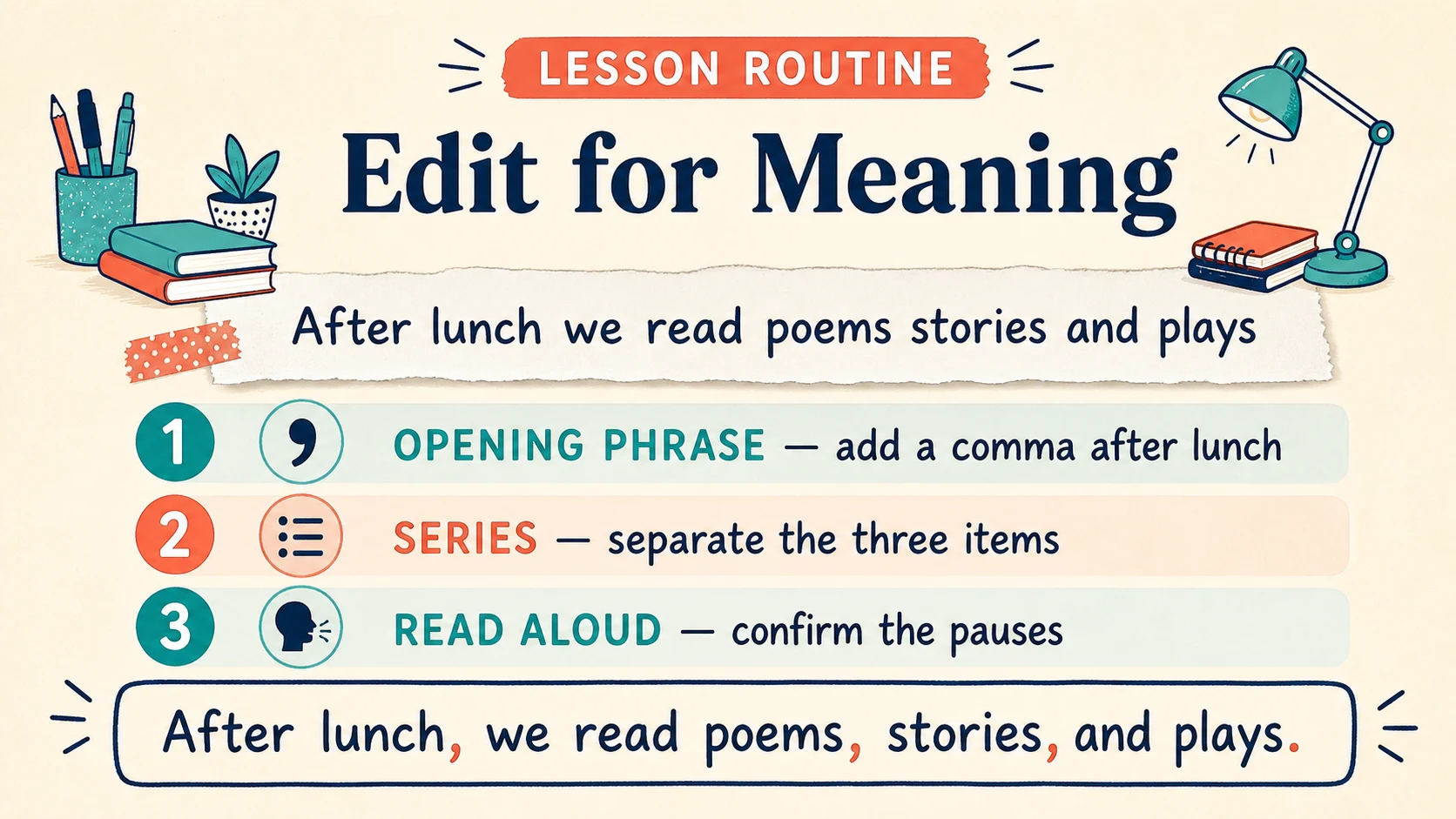
One brief cycle moves from noticing and explanation to guided correction and independent application.
1. Notice the mark
Show one correct sentence. Ask the learner to locate the punctuation and say what job it performs.
Did Sam bring paper, pencils, and glue?
The question mark ends a direct question. The commas separate three listed items.
2. Model one decision
Think aloud briefly:
The sentence asks something, so I will end it with a question mark.
Keep the explanation tied to meaning or a named rule. Avoid modeling several new rules at once.
3. Correct together
Present one nearly identical example:
Did Ava bring tape scissors and string
Have the learner identify the list, add commas, and choose the end mark. If needed, underline the three list items before inserting punctuation.
4. Try independently
Give two or three new sentences without cues. Ask the learner to complete each one and state the rule used.
5. Transfer to writing
Ask for one original sentence using the same pattern. A learner practicing commas in a series might write:
I need soap, water, and a towel.
6. Review one earlier skill
End with a previously learned item. This quick retrieval check helps distinguish durable learning from success caused by repetition within a single page.
Choosing Useful Practice
Select practice according to the type of error the learner is making.
| Observed need |
Suitable practice |
Delay for now |
| Omits marks but explains sentence types correctly |
Short editing tasks with mixed end marks |
Long paragraphs with several rule types |
| Confuses questions and statements |
Oral sorting followed by end-mark choices |
Dialogue punctuation |
| Inserts commas randomly |
One comma function at a time |
Fully mixed comma review |
Writes dont or cant |
Build-and-break contraction models |
Mixed possessive and contraction pages |
| Confuses plurals and possessives |
Ownership phrases with one clear owner |
Ambiguous or plural possessive examples |
| Understands rules but misses errors in writing |
A short editing checklist |
More isolated identification alone |
| Completes isolated items accurately |
Sentence creation and paragraph editing |
Repeating another identical recognition page |
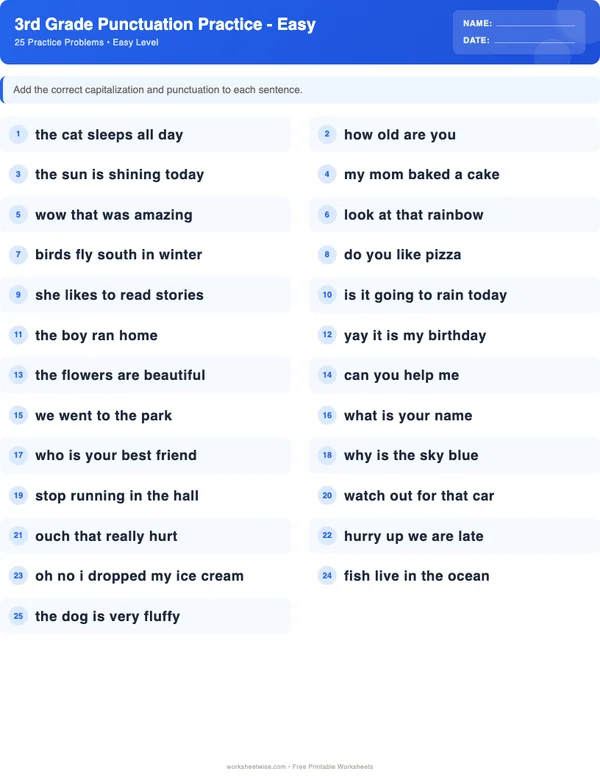
The free easy punctuation worksheet contains 14 exercises on capitalization, periods, question marks, and exclamation marks, with a separate answer key. It is a sensible choice for a learner beginning punctuation review or needing reinforcement of those foundational mechanics. It does not, by itself, practice all comma, apostrophe, or dialogue skills described in this guide.
For broader repeated work, the 3rd Grade Punctuation Worksheet Pack contains 18 worksheets. Choose pages by the learner’s current need rather than assigning the entire pack automatically.
Differentiation Without Changing the Core Goal
When the learner needs more support
Reduce the number of simultaneous choices:
- Offer only a period and a question mark before adding exclamation points.
- Read the sentence aloud while the learner follows the print.
- Underline list items before adding commas.
- Provide the expanded words beside a contraction.
- Label
owner and owned item in possessive phrases.
- Supply quotation marks and ask the learner to add only the comma and end mark.
- Use one sentence per line with generous writing space.
Support should clarify the decision, not make it disappear. If the correct mark is already highlighted, ask the learner to explain why it belongs there.
When the learner is ready for more challenge
Increase transfer rather than merely increasing length:
- Mix two familiar punctuation rules in one sentence.
- Ask the learner to correct and explain an error.
- Compare two punctuated versions and describe the change in meaning.
- Edit three connected sentences.
- Write a short exchange between two speakers.
- Revisit the writing later and use a punctuation checklist.
An advanced third-grade learner can study commas in compound sentences or after introductory elements if those skills fit the local sequence and the learner’s observed readiness. These are possible extensions from the supplied topic progression, not requirements for every learner at the same time.
Common Errors and Diagnostic Responses
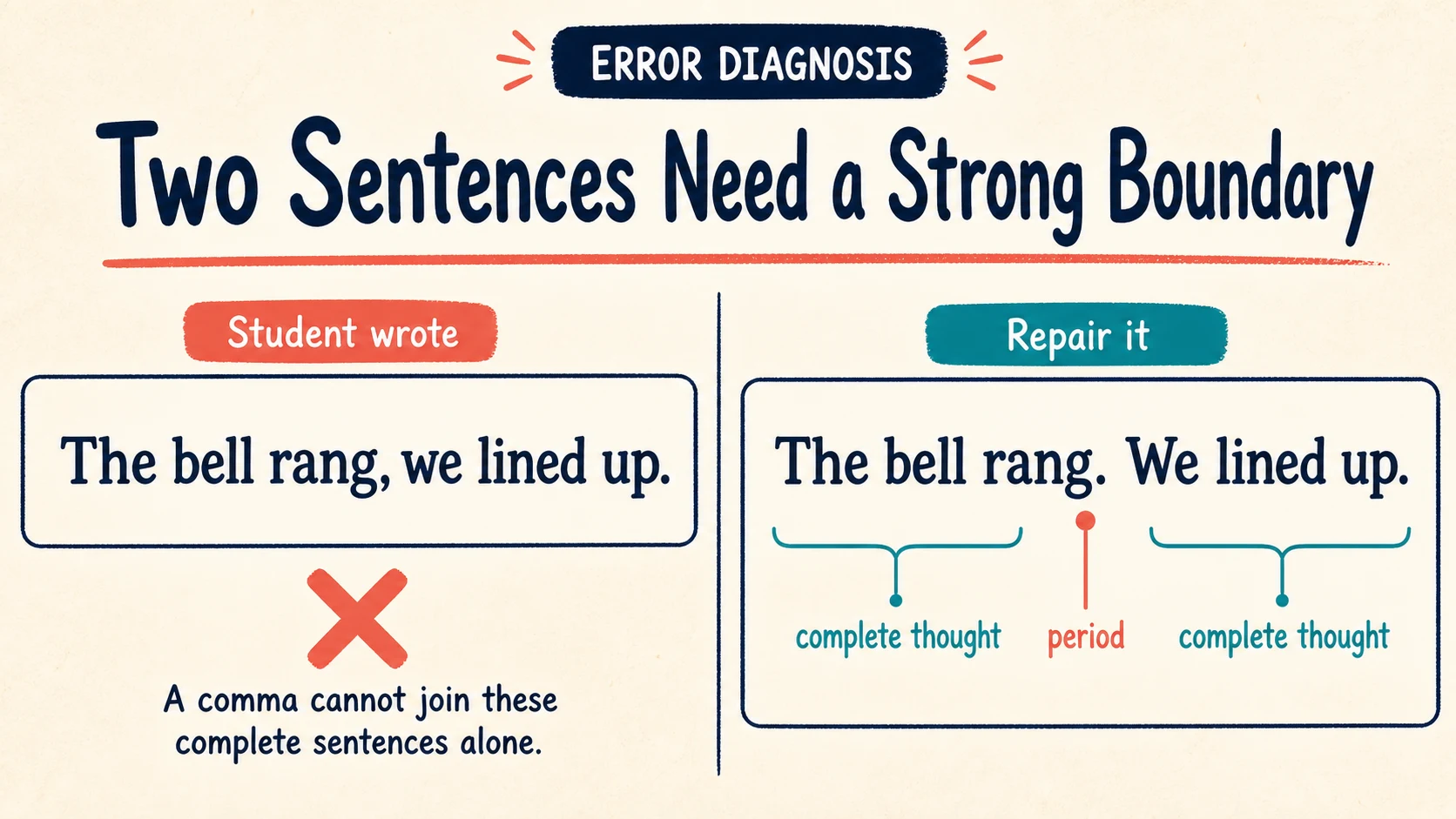
The correction should respond to the reason for an error, not only replace the wrong mark.
Every sentence ends with a period
Possible cause: the learner knows that sentences need an end mark but is not attending to purpose.
Response: sort statements and direct questions orally before writing. Ask, “Is the writer telling, asking, or showing strong feeling?” Then choose the mark.
Every exciting event receives an exclamation point
Possible cause: the learner treats excitement as a property of the event rather than a tone chosen by the writer.
Response: compare We won the game. with We won the game! Discuss how both can be correct while the second adds emphasis.
Commas appear wherever the learner pauses
Possible cause: instruction has relied too heavily on the phrase “put a comma where you pause.”
Response: name and model one comma function. Have the learner box the items in a series or label the parts of a date before adding commas.
Apostrophes are added to plurals
Example error:
Three dog's ran outside.
Possible cause: the learner associates apostrophes with any word ending in s.
Response: contrast quantity and ownership:
three dogs
one dog's leash
Ask whether the sentence means “more than one” or “belongs to.”
Closing quotation marks are missing
Possible cause: the learner recognizes where speech begins but loses track of where it ends.
Response: highlight only the spoken words first. Draw a boundary at both ends, then replace the boundaries with quotation marks.
Correct editing does not transfer to original writing
Possible cause: choosing marks in prepared items requires less planning than generating ideas, spelling, handwriting, and punctuating at the same time.
Response: after isolated practice, require one original sentence. Later, use a short editing pass devoted only to punctuation. Do not interpret a transfer error as carelessness without checking the learner’s explanation.
Monitoring Progress and Deciding When to Move On
Use a small record rather than relying on a general impression. Once or twice a week, sample four kinds of evidence:
- One item asking the learner to identify a mark.
- One item asking the learner to correct a sentence.
- One new sentence the learner must punctuate independently.
- One original sentence using the target form.
Record the error type, not only the score. For example:
| Date |
Skill |
Result |
What the response shows |
Next step |
| Day 3 |
End marks |
4 of 4 |
Selects by sentence purpose |
Mix with capitalization |
| Day 5 |
Series commas |
2 of 4 |
Finds items but misses first comma |
Return to boxed-item model |
| Day 8 |
Contractions |
4 of 4 isolated; 1 of 2 in writing |
Rule understood; transfer developing |
Add one writing check |
| Day 10 |
Dialogue |
2 of 3 |
Omits closing quotation mark |
Mark speech boundaries first |
A reasonable instructional decision is to move forward when the learner is accurate across more than one format and can explain the choice. This is not a universal mastery threshold. If performance falls when supports are removed, restore the smallest useful support and collect another sample.
A Two-Week Practice Plan
This plan assumes brief, regular sessions and can be shortened, repeated, or reordered. Local schedules differ, and the learner’s work should determine pacing.
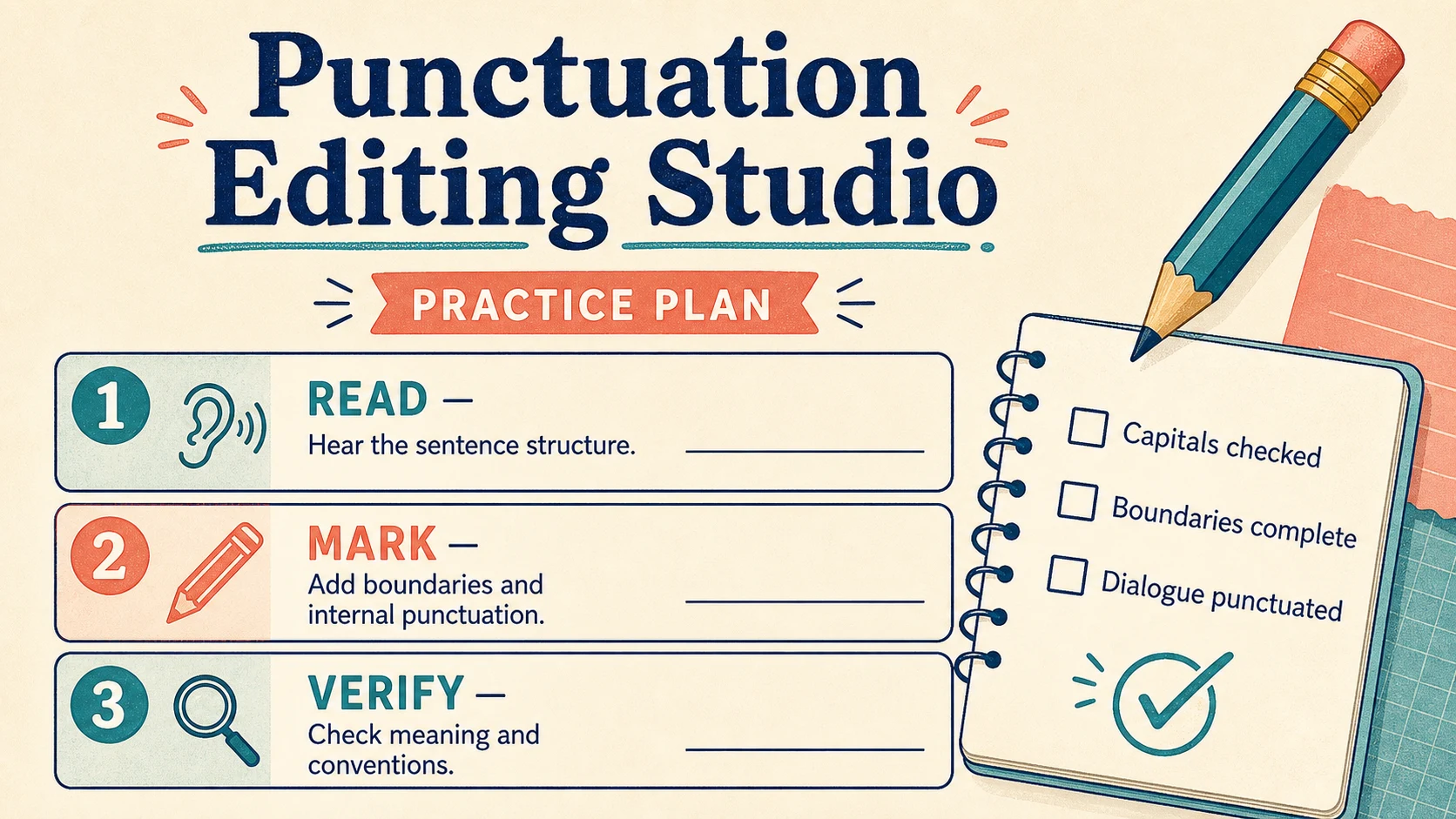
New instruction alternates with mixed review, explanation, and transfer into original writing.
| Day |
Focus |
Short activity |
Evidence to keep |
| 1 |
Readiness and end marks |
Sort statements, questions, and exclamations; punctuate six sentences |
Which sentence types cause errors |
| 2 |
Capitals and end marks |
Correct four sentences, then write two |
Independent corrections |
| 3 |
Mixed end punctuation |
Compare sentences whose meaning changes with the mark |
Oral explanations |
| 4 |
Commas in a series |
Box list items, add commas, create one list sentence |
Original sentence |
| 5 |
Review |
Mix end marks and series commas in a short edit |
Rule-specific errors |
| 6 |
Commas in dates and addresses |
Label parts, then punctuate controlled examples |
Accuracy by comma function |
| 7 |
Contractions |
Build contractions from two words and mark omitted letters |
Contractions formed without cues |
| 8 |
Singular possessives |
Convert belonging phrases into possessive phrases |
Plural-versus-possessive choices |
| 9 |
Quotation marks |
Mark exact speech in already-written dialogue |
Both speech boundaries |
| 10 |
Dialogue and cumulative review |
Edit a short exchange, then write one line of dialogue |
Transfer and explanation |
Keep each session focused. A practical pattern is one model, three guided items, three independent items, and one original sentence. That pattern is a teaching option rather than a research-backed universal dosage.
If Day 5 reveals continued confusion about end punctuation, pause the planned comma work and revisit sentence purpose. If contractions are secure but possession remains unclear, separate those two apostrophe uses for several sessions. The plan serves the learner; the learner does not have to keep pace with the chart.
Boundaries and Limitations
Punctuation conventions include cases more complex than an introductory third-grade guide can cover. Published writing may contain stylistic fragments, unusual dialogue structures, omitted final commas in series, or advanced apostrophe patterns. Those examples do not make the foundational models useless, but they do require context.
This guide does not establish comprehensive standards alignment, certify mastery, guarantee an outcome, or replace a local curriculum. It also does not provide child-specific, diagnostic, or medical guidance. The Common Core link is a reference for one standards framework, while the IES links support broad instructional framing. None of those sources evaluated WorksheetWise, this guide, the named worksheet, or the punctuation pack.
The supplied free worksheet is deliberately limited to capitalization and the three common end marks. Its 14 easy-level exercises can reveal whether a learner applies those foundational conventions, but they cannot demonstrate control of commas, apostrophes, quotation marks, or punctuation in sustained original writing.
The Honest Next Step
Start with a six-sentence sample containing statements, questions, and exclamations. Ask the learner to add capitals and end punctuation and explain each mark. If the learner needs support with those foundations, use the free 3rd Grade Punctuation worksheet, check it with the included answer key, and record the error pattern. If the learner is already accurate, choose the next rule from the progression and create targeted practice with the free worksheet generators.