What 2nd Grade Sentence Structure Means
Second-grade sentence structure instruction helps a learner arrange words into complete, understandable thoughts. The central idea is simple: a complete sentence names someone or something and tells what that subject does, has, or is. At this level, learners should also begin expanding sentences, joining closely related ideas, rearranging words without losing meaning, and choosing suitable capitalization and end punctuation.
A useful starting frame is:
Who or what? + Did what or is what? = Complete sentence
In “The rabbit hops,” the rabbit answers “Who or what?” and hops answers “Did what?” In “The rabbit is quiet,” the rabbit names the subject and is quiet tells what it is like.
The goal is not to have a child memorize definitions before writing. The goal is to help the learner hear, build, read, and revise sentences that communicate complete thoughts. Oral practice, movable word cards, sentence strips, and short written tasks can make the structure visible.
Grade labels describe the intended practice level, not a universal timetable. Local curricula and instructional sequences differ. Move forward according to the learner’s observed work: what the child can explain, construct, and correct with decreasing support.
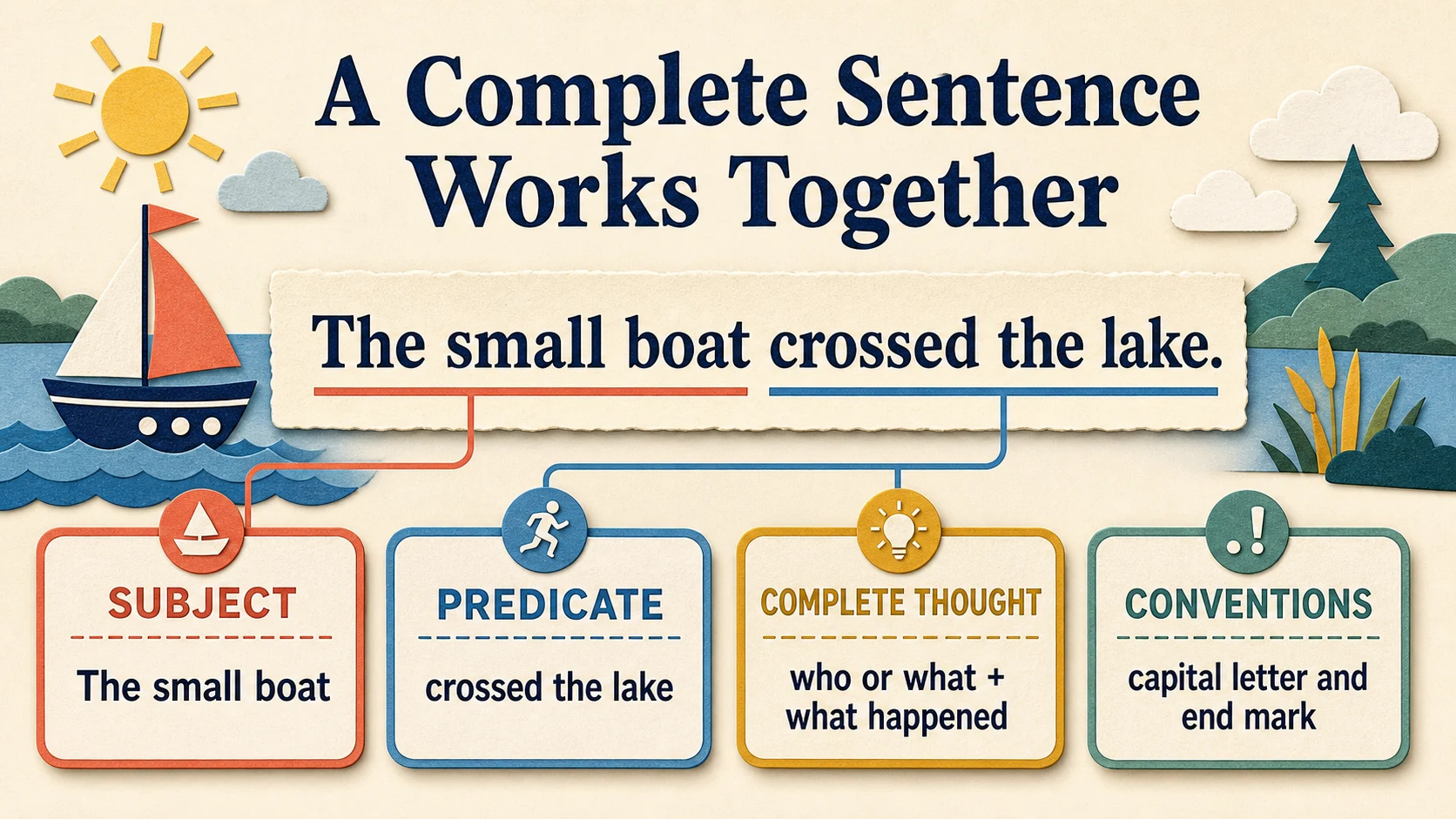
The skill develops from recognizing complete thoughts to building, expanding, combining, and checking sentences.
The broader 2nd Grade worksheet collection provides practice across subjects. For related language work, use the 2nd Grade Grammar hub.
Prerequisites to Check Before Teaching
Sentence work becomes much easier when several supporting skills are reasonably secure. A learner does not need perfect mastery, but persistent difficulty with a prerequisite may explain errors that appear to be about sentence structure.
Oral sentence awareness
Say a complete sentence such as “The small boat floated.” Then say a phrase such as “Near the small boat.” Ask the learner to tell which one gives a complete thought.
A child who cannot hear the difference may need more oral examples before working on printed fragments. Avoid relying only on “Does it sound right?” Some incomplete groups of words sound familiar because they occur inside longer sentences. Ask instead:
- Who or what is the message about?
- What are we told about that person, animal, place, or thing?
- Does the listener receive a complete message?
Basic word reading and spacing
The learner should be able to read the words in the activity or receive help reading them. If decoding consumes all available attention, sentence ordering may measure reading difficulty rather than syntax.
The child also needs to recognize that spaces separate written words. When using word cards, give each word its own card. This turns an abstract spacing convention into a visible model.
Capitals and end marks
Before expecting independent editing, check whether the learner recognizes a capital at the beginning and a period, question mark, or exclamation point at the end. Sentence formation and punctuation are connected, but they can be taught separately when necessary.
For example, a child may build “Where is my coat” in correct order yet omit the question mark. That response shows successful word ordering and an unresolved punctuation need. Record both observations instead of marking the entire attempt simply wrong.
Familiar subject and action language
The child should understand common nouns, pronouns, and action words in practical terms, even if formal labels are still developing. “Who or what?” and “What happened?” are often more accessible than beginning with subject and predicate. Introduce the formal terms after the underlying relationship is clear.
The IES foundational reading practice guide addresses foundational reading instruction through the early grades. It can inform the high-level decision to coordinate reading and language work, but it does not prescribe this particular sentence lesson or evaluate WorksheetWise materials.
A Grade-Appropriate Teaching Progression
The sequence below moves from highly supported recognition to independent construction and revision. It is a teaching pathway, not a fixed calendar.
| Stage |
Main task |
Helpful support |
Evidence of readiness to continue |
| 1. Hear complete thoughts |
Compare an oral sentence with an incomplete phrase |
Say each example slowly; ask “Who or what?” and “What about it?” |
Correctly explains what is missing |
| 2. Build short sentences |
Arrange three to six word cards |
Capital and punctuation remain attached to the appropriate cards |
Builds familiar statements consistently |
| 3. Identify two functional parts |
Separate who-or-what from what-is-told |
Use two colors or a vertical divider |
Finds both parts without guessing by position alone |
| 4. Check sentence boundaries |
Distinguish one complete thought from two thoughts run together |
Read aloud and mark where each message ends |
Separates clear run-ons into two sentences |
| 5. Expand sentences |
Add where, when, how, or descriptive details |
Begin with a complete sentence kernel |
Adds details while preserving the core thought |
| 6. Combine related ideas |
Join repeated or closely connected information |
Offer and, but, or a shared subject as options |
Produces a clear combined sentence |
| 7. Rearrange and revise |
Change word placement while retaining meaning |
Compare two correct versions |
Explains which version is clearer or more natural |
| 8. Apply in writing |
Edit sentences in a short original passage |
Use a brief checklist |
Transfers the skill beyond isolated items |
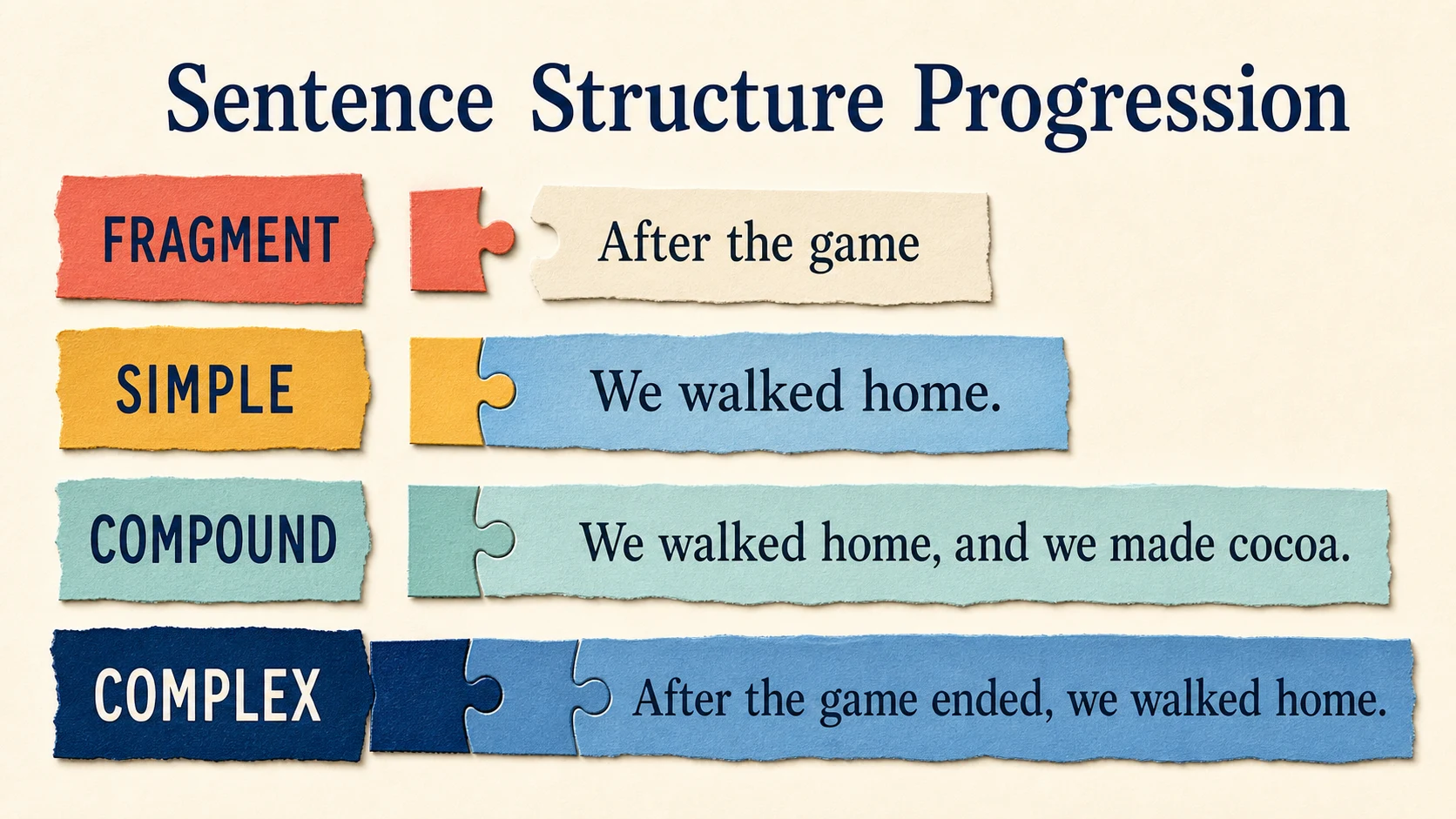
Support should fade only after the learner can explain and apply the current step.
This progression is compatible with the Grade 2 language expectation to produce, expand, and rearrange complete simple and compound sentences. The Common Core English Language Arts standards provide the authoritative standards context. That connection should not be read as a claim of comprehensive standards alignment for every activity or local program.
Concrete and Visual Models
The two-part sentence frame
Draw two boxes:
| Who or what? |
What did the subject do, have, or seem like? |
| The bird |
sang. |
| Our books |
are heavy. |
| Maya and Luis |
planted seeds. |
This model emphasizes meaning rather than word count. “Birds fly” has two words and can be complete. “The bright yellow bird in the tree” has seven words but does not tell what the bird did or was.
After several examples, replace the questions with the terms subject and predicate. Keep the meaning questions visible until the learner can use the terms accurately.
Word-card construction
Write one word on each card:
the | puppy | chased | the | ball
Ask the learner to:
- Find the word that could begin the sentence.
- Build a message that makes sense.
- Read it aloud.
- Add a capital and an end mark.
One verified result is “The puppy chased the ball.” If the learner produces “The ball chased the puppy,” the structure is grammatically complete, but the meaning has changed. That is a useful boundary case: correct syntax does not guarantee the intended message.
Color-coded expansion
Start with a complete core in two colors:
The fox | ran.
Add removable detail cards:
- red
- quickly
- across the field
- after sunset
Possible expansion:
“The red fox ran quickly across the field after sunset.”
Remove every detail card and confirm that “The fox ran” remains complete. This helps distinguish required sentence parts from optional details.
A practical instructional suggestion is to add only one kind of detail at a time. That pacing choice is not a sourced universal rule; it is a way to make the learner’s response easier to interpret.
Fully Checked Worked Examples
Example 1: Put words in sentence order
Words: nest / the / bird / a / built
First locate the likely subject: the bird. Then find what the bird did: built. The remaining words name what was built: a nest.
Checked answer: The bird built a nest.
Verification:
- Who or what? The bird
- Did what? built a nest
- Complete thought? Yes
- Beginning capital? Yes
- End punctuation? Period
“A nest built the bird” also follows a visible noun–verb–noun pattern, but its meaning does not fit the intended relationship. The learner must use both grammar and meaning.
Example 2: Decide whether the words form a sentence
Words: under the kitchen table
This group answers where, but it does not identify what happened there.
Checked judgment: It is a fragment, not a complete sentence.
One possible repair is:
“The kitten sleeps under the kitchen table.”
Verification:
- Who or what? The kitten
- What are we told? sleeps under the kitchen table
- Complete thought? Yes
Another valid repair is “We found the keys under the kitchen table.” There is not always one correct completion. Accept a different answer when it is grammatical, complete, and sensible.
Example 3: Expand a complete sentence
Starting sentence: The children laughed.
Add an answer to when: during the puppet show.
Checked answer: The children laughed during the puppet show.
Verification:
- Original complete thought preserved? Yes
- Added information clear? Yes: it tells when
- Agreement correct? Yes: plural “children” works with “laughed”
- Capital and end mark present? Yes
The expanded version is more informative, but the shorter sentence was already correct. Expansion should improve meaning, not imply that every short sentence is defective.
Example 4: Combine repeated information
Sentences:
The blanket is soft.
The blanket is warm.
The subject repeats, so the descriptions can share it.
Checked answer: The blanket is soft and warm.
Verification:
- Repeated subject removed? Yes
- Both original ideas retained? Yes
- Joining word appropriate? Yes
- Complete thought? Yes
“The soft and warm blanket” is not a complete sentence by itself. It names a blanket but does not tell what it does or is. This is an important contrast because the same descriptive words can occur inside a sentence or inside a fragment.
Example 5: Repair a run-on
Original: The rain stopped we went outside.
There are two complete thoughts:
- The rain stopped.
- We went outside.
Two checked repairs are:
“The rain stopped. We went outside.”
“The rain stopped, and we went outside.”
In the second version, the comma and and join two complete thoughts. A response such as “The rain stopped and.” does not work because and promises another connected idea.
Example 6: Rearrange without changing the main event
Starting sentence: The class read quietly after lunch.
Possible rearrangement:
“After lunch, the class read quietly.”
Both versions say that the class read quietly and that the reading occurred after lunch. The second version places the time information first. The comma makes the opening easier to read.
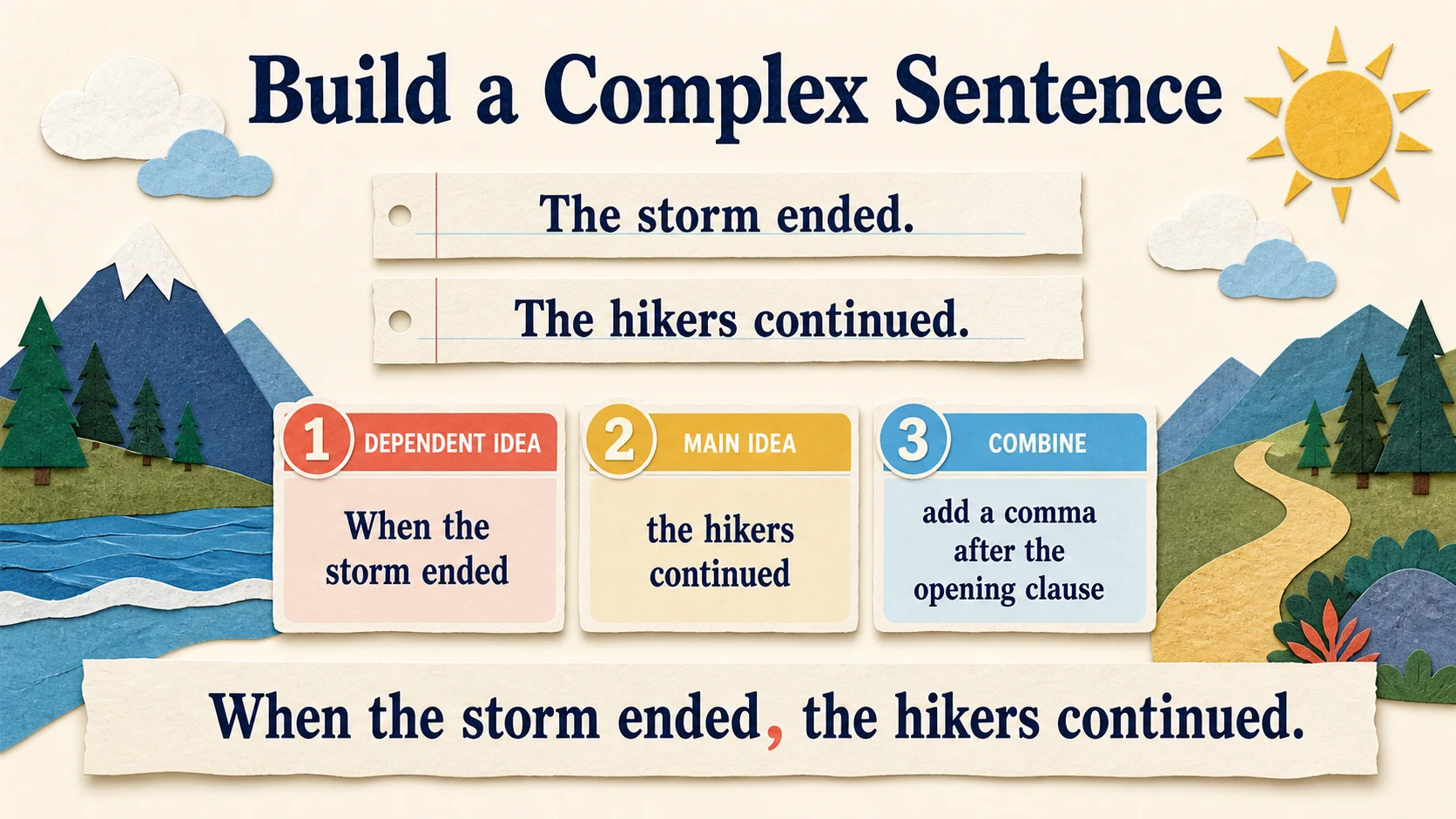
Each answer is checked for meaning, completeness, order, capitalization, and punctuation.
Boundary Cases and Important Misconceptions
A long group of words is not necessarily complete
“The noisy truck with the broken light” is long, but it only names something. Compare it with “The noisy truck has a broken light.” The verb has completes the message.
Conversely, “I agree.” is short and complete. Word count is not a reliable test.
Every sentence does not need an action verb
Learners may be told that a sentence needs someone and an action. That frame is useful at first but incomplete. “The soup is hot” is a sentence even though is does not name a visible action. Ask what the sentence tells about the soup.
A capital and period cannot repair an incomplete thought
Writing “Under the old bridge.” does not make the fragment complete. Surface punctuation cannot supply missing meaning.
Any sensible order is not necessarily the intended answer
With word cards such as “The cat watched the bird,” more than one grammatical order may be possible. “The bird watched the cat” is also a sentence, but it reverses who watched whom. When the exercise has a picture or context, use it to determine the intended meaning. Without context, acknowledge valid alternatives.
“And” does not automatically make a compound sentence
“Lena washed and dried the cups” has one stated subject and two actions. “Lena washed the cups, and Omar dried them” joins two complete thoughts. Both are useful sentence forms, but they are structured differently.
Longer is not always better
Details should serve meaning. “The very small, nice, furry, little, happy dog ran very quickly fast” contains unnecessary or repeated wording. A clearer version is “The small, happy dog ran quickly.”
The IES guide to teaching elementary students to be effective writers offers high-level guidance for writing instruction, including explicit teaching and opportunities to write. It supports the general practice of modeling and guided application; it does not establish a required timetable for this topic or endorse a specific WorksheetWise resource.
A Short, Repeatable Lesson Routine
A focused routine can fit into approximately 10 to 15 minutes, but that duration is an instructional suggestion rather than a universal recommendation. Shorten, extend, or repeat a stage according to the learner’s work.
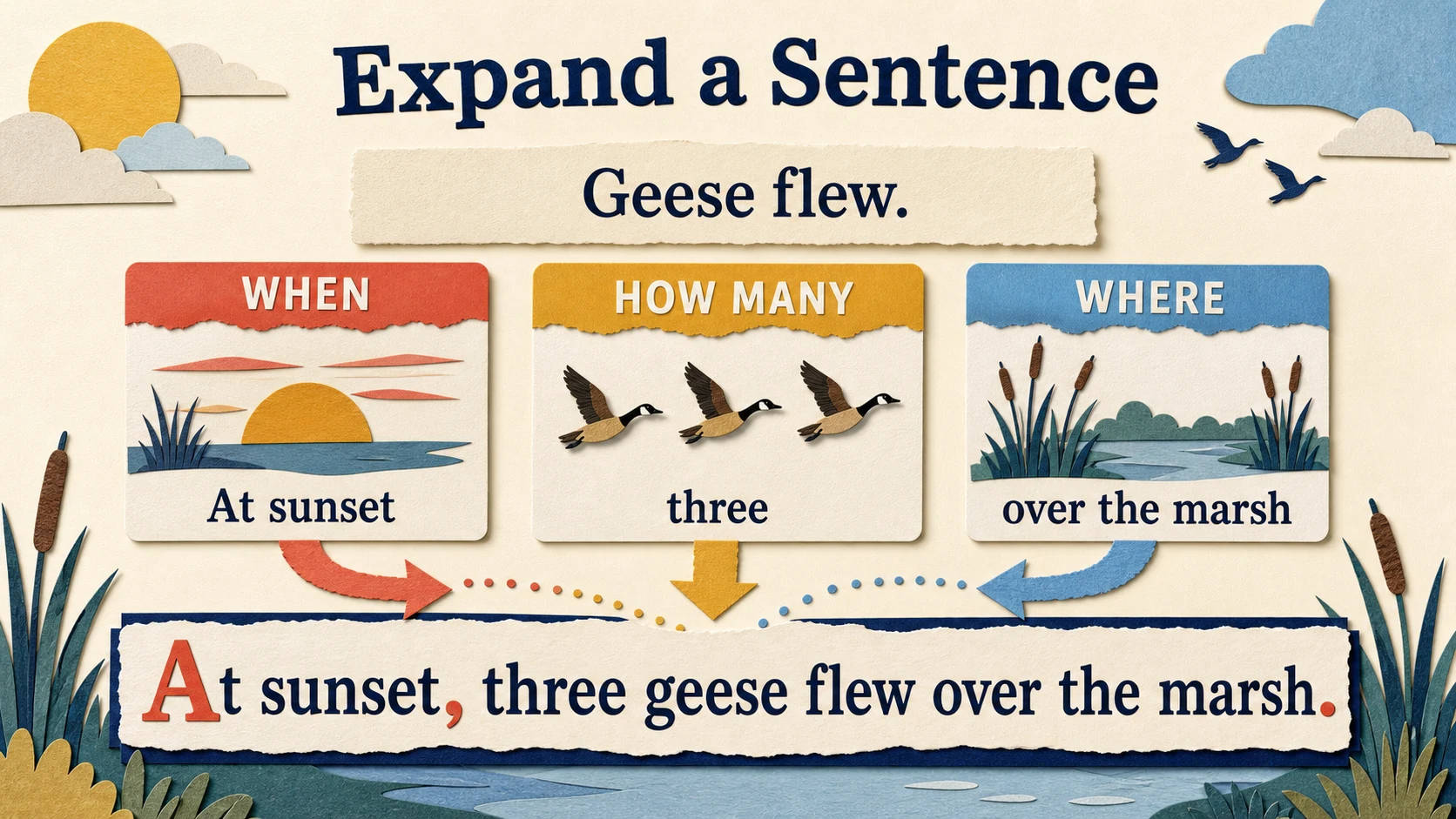
The routine moves from hearing a sentence to constructing, explaining, and applying one.
1. Hear and compare
Say one sentence and one fragment:
- “The frog jumped.”
- “Beside the pond.”
Ask which one gives a complete message and what the other needs.
2. Model one decision
Think aloud while arranging four or five word cards. Keep the explanation precise:
I found who the sentence is about: the frog. Now I need what the frog did: jumped into the pond.
Do not turn the model into a long lecture. Show the decision the learner will make next.
3. Build together
Arrange a second example collaboratively. Ask the learner to move the cards while explaining the order. If needed, return to “Who or what?” and “What about it?”
4. Try independently
Give two to four items at the same difficulty. Watch how the learner begins. The method matters: random rearranging, silent rereading, and purposeful grouping reveal different levels of understanding.
5. Apply and check
Ask for one original sentence related to a familiar picture, object, or recent shared activity. Finish with a five-point check:
- Does it name who or what?
- Does it tell something about that subject?
- Do the words make sense in this order?
- Does it begin with a capital?
- Does it end correctly?
Choosing Appropriate Practice
Choose the next activity based on the error pattern, not merely the learner’s age or the number printed on a worksheet.
| Observed performance |
Suitable next practice |
Avoid for now |
| Cannot distinguish phrases from complete thoughts |
Oral sentence-or-fragment sorting |
Dense editing pages |
| Understands orally but scrambles written order |
Three- to six-word card arrangements |
Long sentences with several modifiers |
| Builds statements but misses capitals or periods |
Separate punctuation check after construction |
Re-teaching all sentence structure from the beginning |
| Writes complete but repetitive sentences |
Expansion by where, when, or how |
Forcing every sentence to become long |
| Joins all ideas with and |
Compare two sentences, one combined sentence, and one run-on |
Introducing several conjunctions at once |
| Corrects isolated items but not personal writing |
One-sentence editing in the learner’s own draft |
More disconnected drill only |
| Produces inconsistent answers |
Mixed review with oral explanation |
Advancing solely because a page was completed |
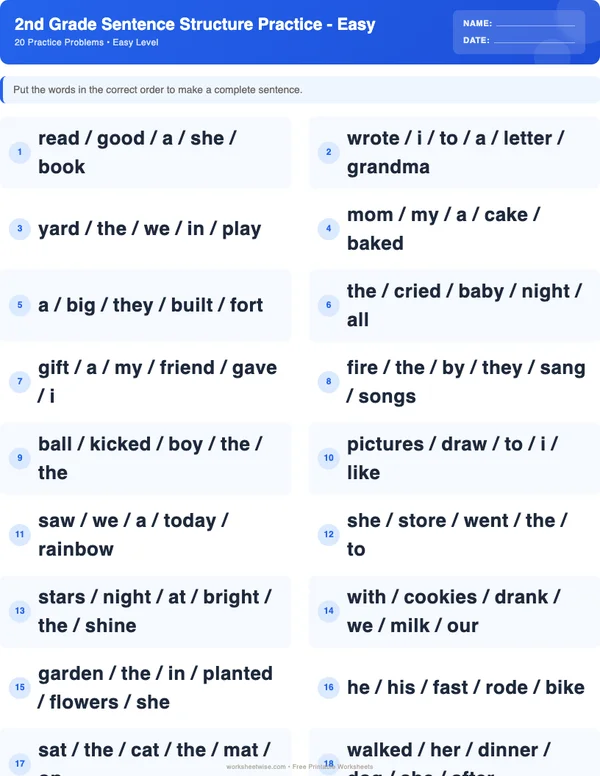
The free easy sentence-order worksheet contains 12 exercises in which learners arrange words to make complete sentences. It targets word order, sentence formation, syntax, and grammar, and includes a separate answer key. It is an appropriate option when a learner is beginning written sentence construction or needs reinforcement with ordering.
The 2nd Grade Sentence Structure pack contains 18 worksheets. A pack may be useful when repeated or varied practice is needed, but more pages should not replace diagnosis, oral explanation, or application in authentic writing.
Differentiation Without Lowering the Goal
When the learner needs more support
Keep the complete-sentence goal while reducing unnecessary demands:
- Read the words aloud when decoding is the barrier.
- Use fewer cards and familiar vocabulary.
- Attach punctuation to the final word at first.
- Color the subject and predicate differently.
- Provide two possible orders and ask the learner to select and explain.
- Let the learner construct orally before writing.
- Return to one contrast at a time, such as sentence versus fragment.
Do not silently complete the key reasoning step. A prompt such as “Who is this about?” preserves more learner thinking than placing the subject card yourself.
When the learner is ready for more challenge
Increase the reasoning demand rather than simply adding more items:
- Ask for two different correct arrangements.
- Remove an important word and ask what is missing.
- Compare a grammatical sentence with one that changes the intended meaning.
- Expand a sentence in two ways: once with where and once with when.
- Combine two related sentences without losing information.
- Find and repair a run-on in a short paragraph.
- Revise repeated sentence openings in original writing.
Advanced work should remain understandable. Complex sentence terminology is less valuable than being able to explain how a revision changes meaning.
Diagnosing Common Errors
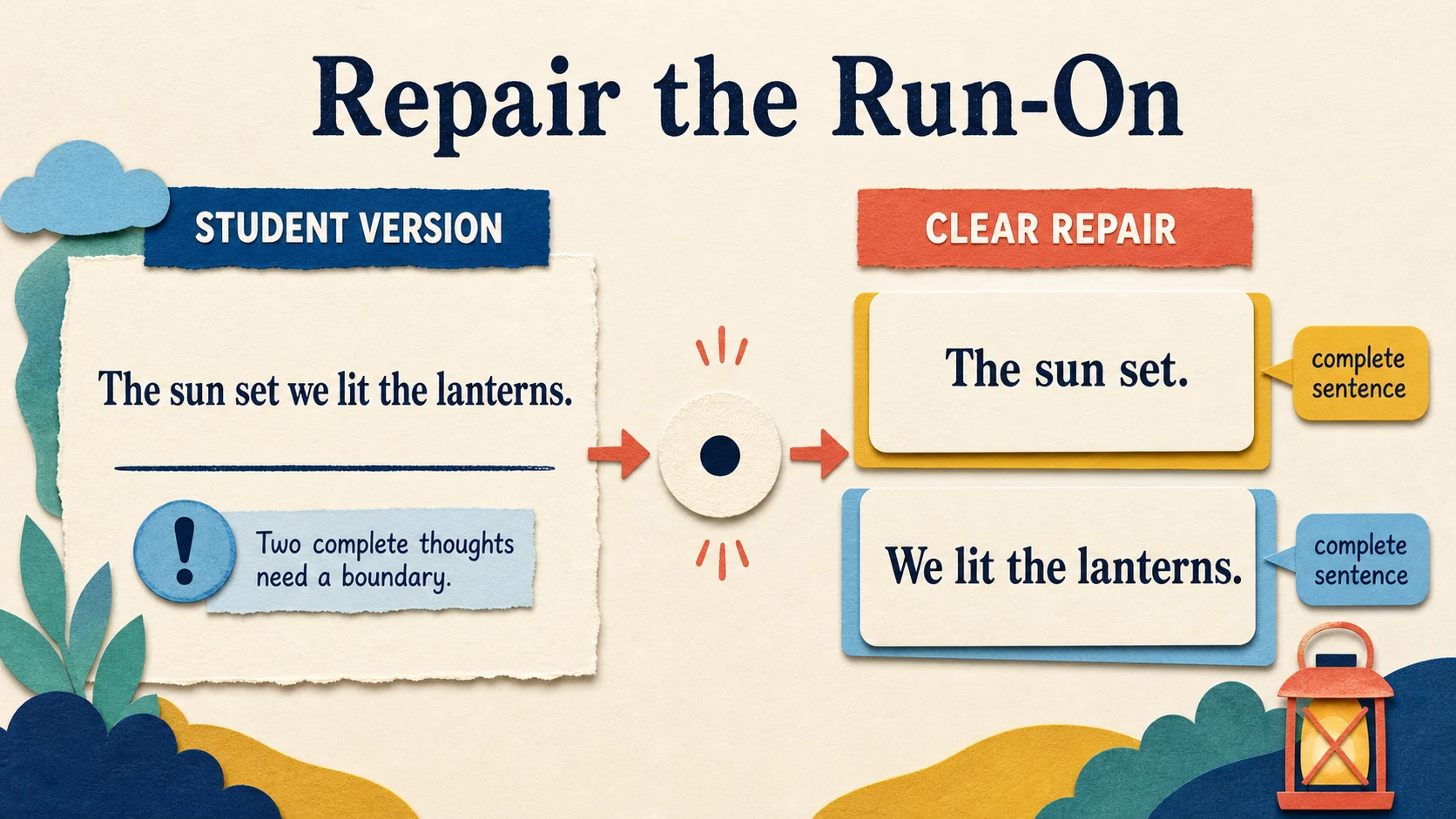
An error is most useful when it points to the next teaching decision.
Words remain in prompt order
If the learner copies “park / we / the / visited” without rearranging it, confirm that the directions are understood. Model physically moving cards, then ask the child to identify the person or thing before locating the action.
The learner chooses by capitalization alone
Capitalization is a useful clue, but it can hide weak understanding. Present all-lowercase cards orally and ask the learner to build the message first. Add the capital afterward.
Fragments receive punctuation
If the learner writes “Across the street.”, ask both meaning questions. Do not focus first on removing the period; help the child supply the missing subject and predicate: “The children walked across the street.”
Sentences contain reversed meaning
For “The mouse chased the cat,” the structure may be complete even if a picture shows the cat as the chaser. Separate the judgments:
- Is it a complete sentence? Yes.
- Does it match the picture or intended idea? No.
Then revise the word order.
Every idea is connected with “and”
Write a long oral chain as separate clauses. Have the learner tap once for each complete thought. Decide whether to use periods or combine only the ideas that belong closely together.
Corrections disappear during original writing
This does not necessarily mean isolated practice failed. Independent composition asks the learner to manage ideas, spelling, handwriting, and conventions together. Reduce the editing target to one or two sentences and use the same checklist from guided practice.
Monitoring Progress and Knowing When to Advance
Monitor a small sample over time rather than treating one completed page as mastery. A simple record can include the date, task type, number attempted, number correct, kind of prompt used, and one representative error.
For each response, consider four dimensions:
- Completeness: Does it express a full thought?
- Order and meaning: Are the words arranged clearly, and does the sentence say what was intended?
- Conventions: Are capitalization and end punctuation appropriate?
- Independence: Was the answer produced alone, after a general reminder, or after direct help?
A learner may score four correct answers after repeated prompting and still need guided practice. Another learner may make one punctuation error while independently constructing every sentence correctly. Those results call for different next steps.
A practical advancement rule is to look for stable performance across more than one task type—for example, arranging words, explaining completeness, and writing an original sentence. This is an instructional suggestion, not a sourced threshold or formal assessment rule.
If performance drops, identify the smallest failing step. Return from written editing to card construction, from card construction to oral comparison, or from sentence combining to simple sentence boundaries. Moving backward briefly is responsive teaching, not a failure.
A Two-Week Practice Plan
This plan assumes brief sessions on ten practice days. It is adjustable, not universal. Repeat a day when the learner needs more modeling, and skip a step that is already secure.
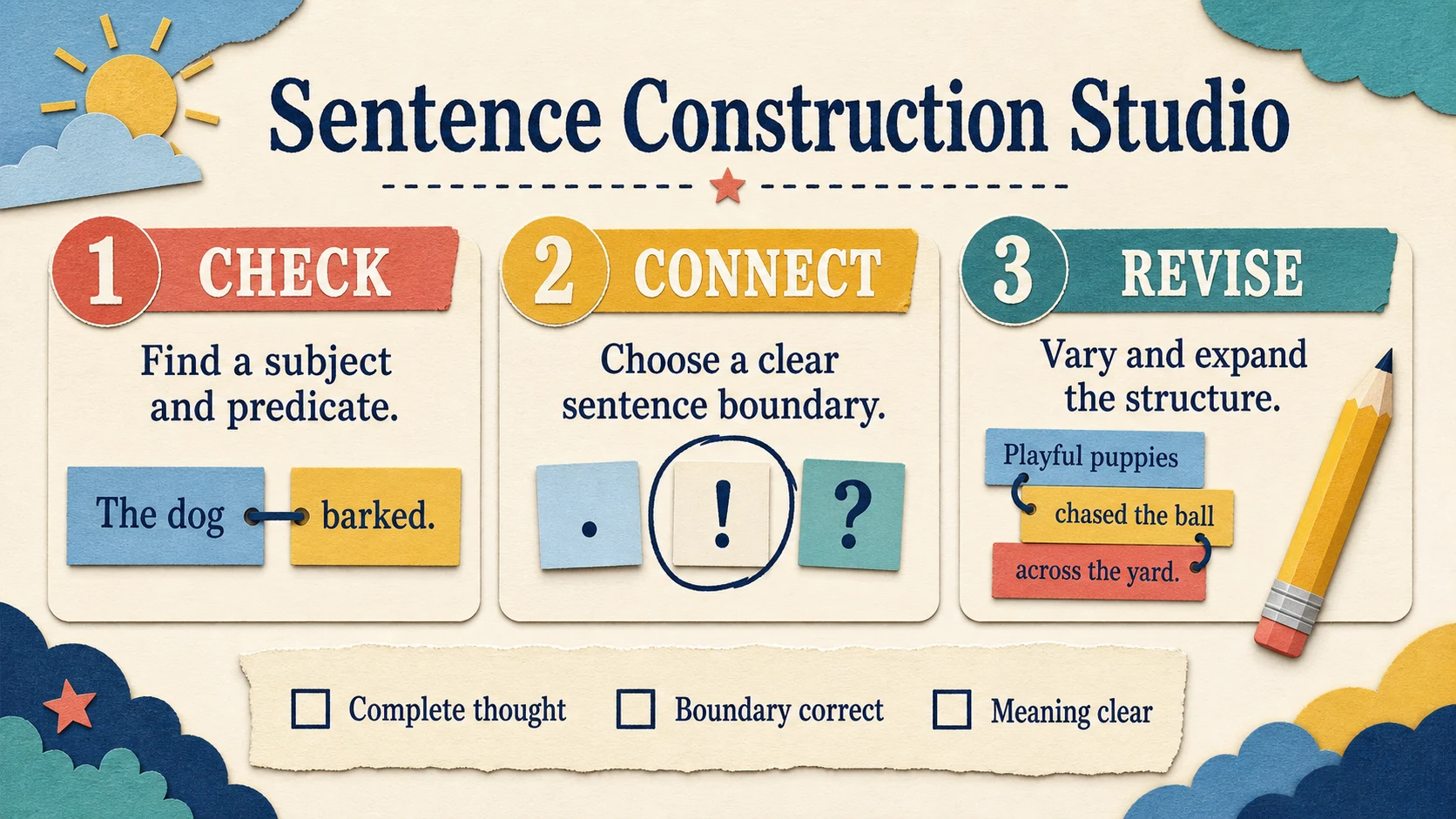
The plan alternates instruction, guided practice, review, and application.
| Day |
Focus |
Suggested activity |
What to observe |
| 1 |
Complete thought |
Sort six oral examples into sentences and fragments |
Can the learner explain what is missing? |
| 2 |
Word order |
Build four short statements with word cards |
Does the learner group the subject before guessing? |
| 3 |
Two sentence parts |
Divide sentences into who-or-what and what-is-told |
Can both parts be identified accurately? |
| 4 |
Written ordering |
Complete a small set of sentence-order exercises |
Are errors caused by reading, order, or meaning? |
| 5 |
Review and transfer |
Write two original sentences from a picture |
Does the skill transfer beyond cards? |
| 6 |
Expansion |
Add one where, when, or how detail |
Does the core sentence remain complete? |
| 7 |
Sentence boundaries |
Separate clear run-ons into two sentences |
Can the learner hear both complete thoughts? |
| 8 |
Combining |
Combine repeated subjects or descriptions with and |
Is all original information retained? |
| 9 |
Rearranging |
Move a time or place phrase while preserving meaning |
Can the learner explain what stayed the same? |
| 10 |
Mixed check |
Sort, build, expand, repair, and write |
Which task is independent, prompted, or not yet secure? |
On Days 4 and 10, use only enough items to reveal a pattern. If the first three answers show the same misconception, pause and teach it rather than requiring the learner to repeat the error through the entire page.
Limits and the Honest Next Step
A sentence-structure worksheet can provide focused practice, visible examples, and an efficient answer check. It cannot by itself show how well a learner understands spoken language, reads unfamiliar words, or transfers grammar into longer writing. An answer key can confirm an expected arrangement, but an adult may still need to recognize an alternative sentence that is grammatically valid yet expresses a different meaning.
This guide also cannot determine a child-specific intervention, diagnose a learning difficulty, guarantee progress, or replace local curriculum requirements. When difficulty persists across oral language, reading, and writing tasks, document the actual responses and consult the learner’s teacher or another appropriately qualified education professional.
For the next session, begin with three oral sentence-or-fragment examples. If the learner explains them accurately, move to the free 2nd Grade sentence-order worksheet and complete four of its 12 exercises. Check each answer for subject, predicate, meaning, capitalization, and punctuation before deciding whether to continue. For customized follow-up practice, use the free worksheet generators to match the next task to the error pattern you observed.