What 2nd Grade Punctuation Includes
Second-grade punctuation instruction helps a learner recognize a sentence’s purpose, choose an appropriate ending mark, and apply a small set of comma and apostrophe conventions in meaningful writing.
In practical terms, teach the learner to:
- Begin sentences and proper names with capital letters.
- End statements with periods.
- End direct questions with question marks.
- Use exclamation points for genuinely strong feeling or emphasis.
- Place commas between items in a list.
- Place commas in letter greetings and closings.
- Use apostrophes in familiar contractions and possessive nouns.
- Reread and edit sentences for missing or incorrect marks.
The Common Core State Standards for English Language Arts place capitalization, end punctuation, commas, and apostrophes within an elementary progression. For second grade specifically, the supplied catalogue identifies capitalization of holidays, product names, and geographic names; commas in greetings and closings; and apostrophes in contractions and possessives.
Grade labels describe the intended practice level, not a fixed timetable for every learner. Local curricula and teaching sequences differ. Begin with the learner’s observed work, then move forward when the learner can explain and apply a convention—not simply when a calendar says to do so.
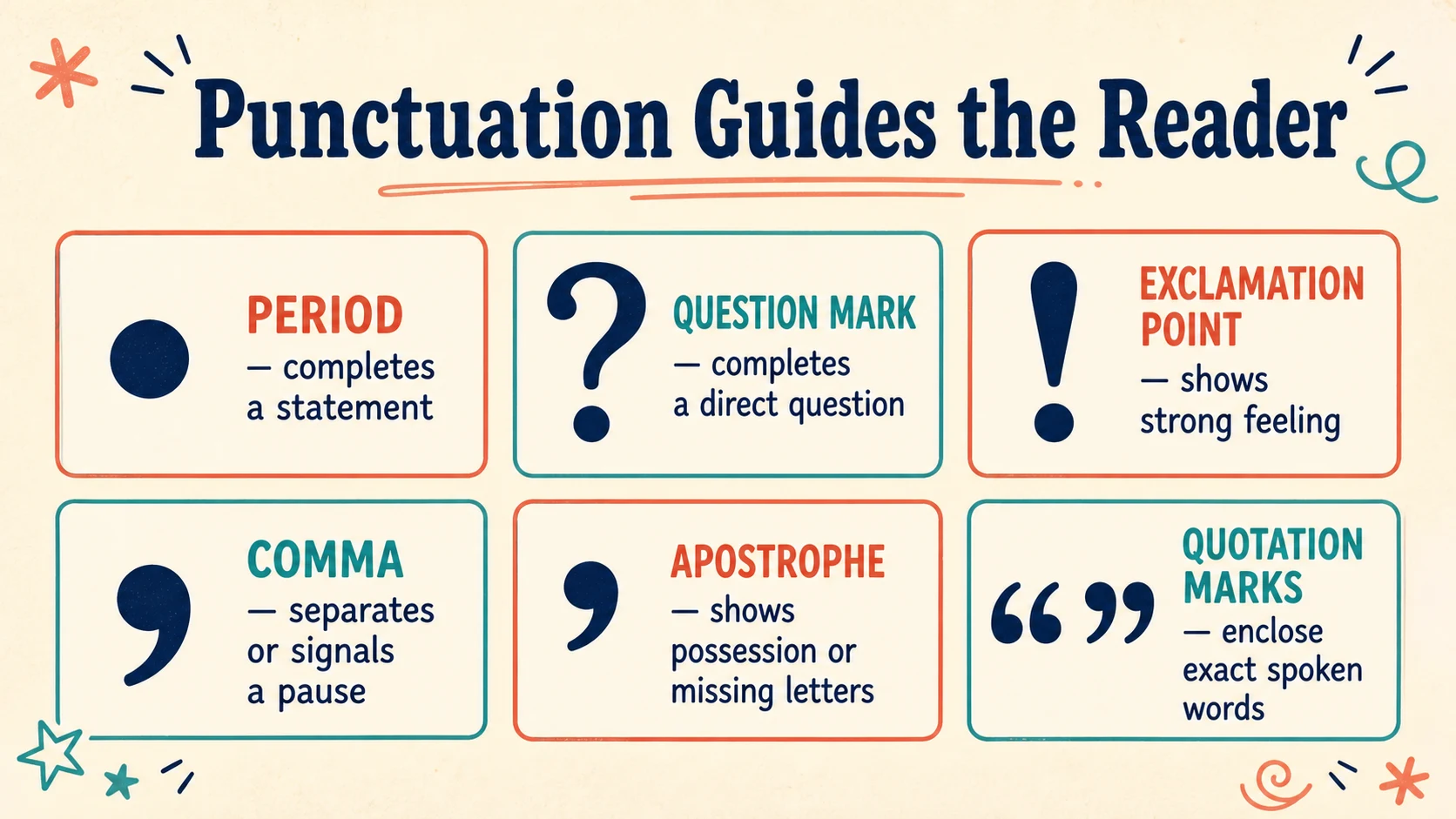
The central goal is readable meaning: capitals begin ideas, ending marks signal sentence purpose, and internal marks clarify relationships between words.
Why Punctuation Depends on Meaning
Punctuation is sometimes presented as a collection of marks to memorize. That is incomplete. A learner must first understand what a sentence is doing.
Compare these sentences:
- The dog is under the table.
- Is the dog under the table?
- Look at that enormous dog!
The words point to related ideas, but the purposes differ. The first sentence tells. The second asks. The third expresses strong feeling or emphasis. The ending mark helps the reader interpret the writer’s intention.
Reading sentences aloud can make this distinction easier to notice. A statement often sounds settled, a question sounds like a request for information, and an exclamation sounds emphatic. Voice is a useful model, but meaning should make the final decision. Some spoken questions do not rise noticeably, and a loud voice does not automatically justify an exclamation point.
Punctuation also supports fluent reading. The IES guide on foundational reading skills provides broad instructional guidance for supporting reading through the primary grades. Within a punctuation lesson, an adult can apply that high-level principle by asking the learner to read a correctly punctuated sentence and attend to how the marks organize the message. This is an instructional application, not a claim that the guide evaluated WorksheetWise materials or prescribed this exact activity.
Prerequisites to Check Before Teaching New Marks
A punctuation error does not always mean the learner has forgotten a rule. Check the underlying language task first.
Recognizing a complete sentence
The learner should be able to hear or identify a complete thought in a simple example:
- The rabbit hops.
- My red backpack is heavy.
- We played after lunch.
A fragment such as “under the tall tree” does not express a complete thought by itself. Asking for an ending mark will not repair the missing subject or action.
Distinguishing telling, asking, and exclaiming
Give three oral examples without showing punctuation:
- “The bus is here.”
- “Is the bus here?”
- “The bus is finally here!”
Ask what each speaker is doing. If the learner cannot distinguish a statement from a direct question, more oral sorting is appropriate before a page of written exercises.
Finding sentence boundaries
Use two short sentences without marks:
the rain stopped we went outside
Ask the learner to identify where one complete idea ends and the next begins. The corrected version is:
The rain stopped. We went outside.
If the learner inserts a period after nearly every word or leaves the entire line unbroken, work on sentence boundaries before introducing more comma rules.
Understanding basic ownership and word combinations
Apostrophes become easier when the learner can explain two underlying relationships:
- In a contraction, two words are shortened:
do not becomes don't.
- In a possessive, something belongs to someone or something:
the dog's leash.
Keep those meanings separate. The apostrophe has a different job in each construction.
A Grade-Appropriate Teaching Progression
Teach one purpose at a time, but keep previously learned marks in short review. The following progression is a practical instructional suggestion based on the supplied topic sequence. It is not a universal timetable.
| Stage |
Instructional focus |
Supported task |
Evidence for moving on |
| 1 |
Capitals and sentence boundaries |
Divide two spoken or written ideas into sentences |
Finds where each complete thought begins and ends |
| 2 |
Periods and question marks |
Sort statements and direct questions |
Explains whether each sentence tells or asks |
| 3 |
Exclamation points |
Compare ordinary statements with emphatic sentences |
Uses exclamation points selectively |
| 4 |
Mixed end punctuation |
Choose among ., ?, and ! without a visual cue |
Selects a mark from meaning and rereads the result |
| 5 |
Commas in lists |
Build and punctuate three-item lists |
Separates items without placing commas randomly |
| 6 |
Commas in letter parts |
Punctuate greetings and closings |
Recognizes the greeting and closing as units |
| 7 |
Apostrophes in contractions |
Expand and rebuild familiar contractions |
Identifies omitted letters |
| 8 |
Apostrophes in possessives |
Identify the owner and the owned item |
Places the apostrophe on the possessive noun |
| 9 |
Editing connected writing |
Repair a short passage, then explain changes |
Finds errors without being told which mark is missing |
| 10 |
Independent application |
Edit the learner’s own short writing |
Transfers conventions beyond isolated exercises |
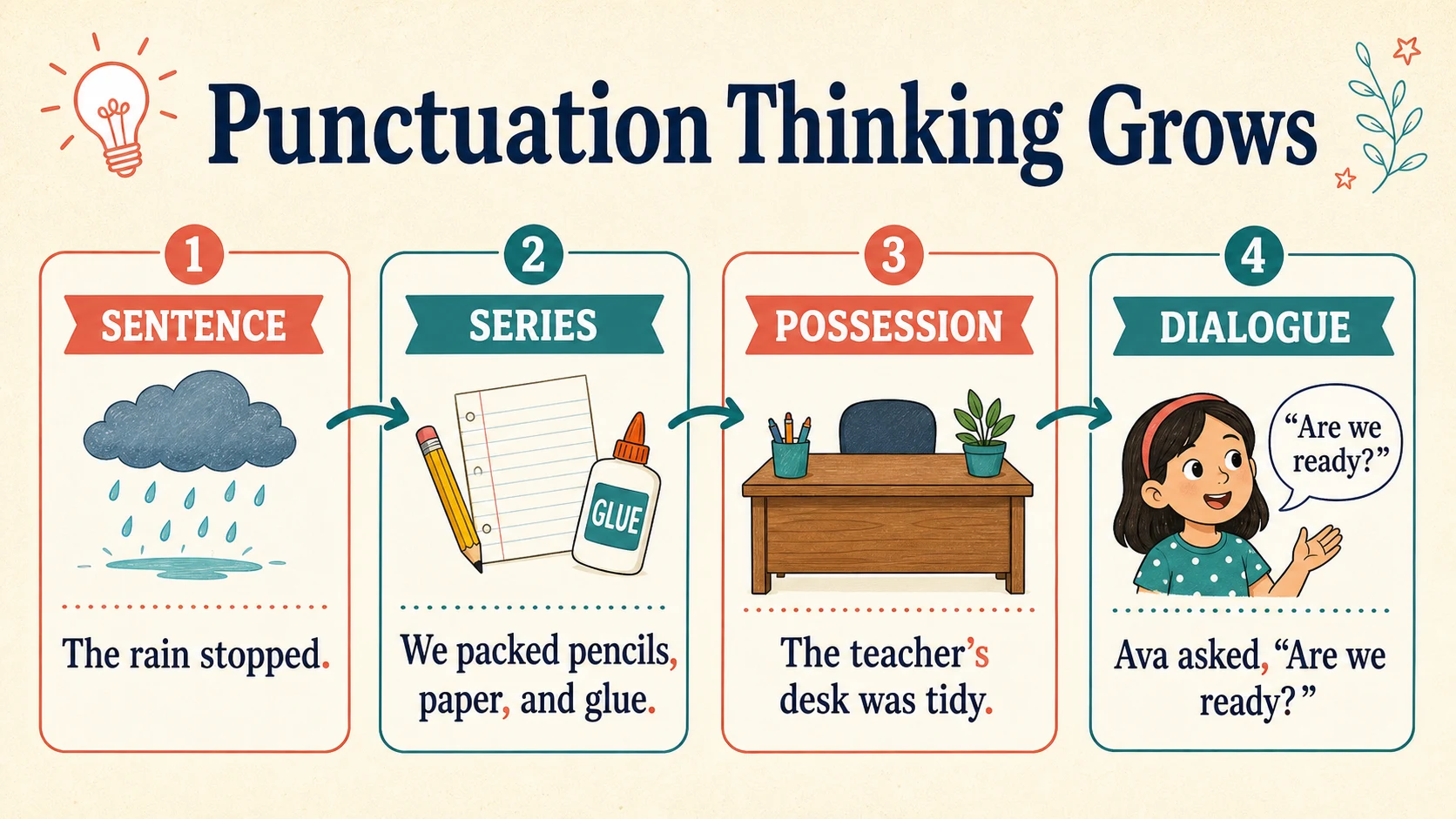
Move from visible choices and oral reasoning to mixed editing and independent writing.
Do not require perfection at one stage before any later concept appears. Instead, look for stable understanding. A learner who explains eight straightforward sentence endings correctly but misses one unusual example may be ready for mixed practice. A learner who guesses correctly but cannot explain whether a sentence tells or asks probably needs more modeling.
The IES guide to teaching elementary students to write effectively offers high-level guidance about writing instruction, including teaching the writing process and foundational writing skills. A brief cycle of writing, rereading, and editing is consistent with that broad framing. The source does not evaluate this guide, guarantee an outcome, or establish one required lesson schedule.
Concrete and Visual Models
A three-sign ending model
Place three cards on the table:
| Mark |
Meaning cue |
Example |
. |
tells or states |
The gate is open. |
? |
asks directly |
Is the gate open? |
! |
shows strong feeling or force |
Stop at the gate! |
Read a sentence stem and let the learner point to the sign before writing the mark. Then ask for a reason: “I chose a question mark because the speaker is asking whether the gate is open.”
This spoken explanation matters more than speed. It reveals whether the choice came from meaning or guessing.
A comma-as-separator model
Write three items on separate cards:
pencils paper crayons
Arrange them in a row and slide comma cards into the gaps:
We packed pencils, paper, and crayons.
The commas separate items that have the same role in the sentence. They do not replace the final ending mark.
For an initial second-grade lesson, keep the final comma before and consistent with the supplied model. If a local curriculum uses a different house style, follow that curriculum.
An apostrophe replacement model
Start with two complete words:
did not
Cross out the omitted letter and close the gap:
didn't
The apostrophe marks the location of omitted material. Have the learner expand the contraction again to check it. This two-way process is more informative than memorizing a list without seeing the relationship.
For possession, draw an arrow:
Maya → backpack
Maya's backpack
Ask, “Who owns the backpack?” The answer identifies the possessive noun.
Fully Checked Worked Examples
Example 1: A direct question
Unedited sentence:
where is my blue hat
Step 1: The first word begins the sentence, so capitalize where.
Step 2: The sentence directly asks for the location of the hat.
Step 3: A direct question ends with a question mark.
Corrected sentence:
Where is my blue hat?
Check: Where begins with a capital, the wording forms a question, and ? closes the sentence. No comma or apostrophe is needed.
Example 2: A statement with a proper name
Unedited sentence:
lena carried the box
Step 1: Capitalize Lena because it is a name and begins the sentence.
Step 2: The sentence tells what Lena did. It does not ask for information or express strong emotion.
Step 3: End the statement with a period.
Corrected sentence:
Lena carried the box.
Check: There is one complete thought, one opening capital, and one ending period.
Example 3: A list
Unedited sentence:
We saw ducks frogs and turtles at the pond
Step 1: Identify the listed animals: ducks, frogs, and turtles.
Step 2: Add commas to separate the three items.
Step 3: The sentence is a statement, so add a period.
Corrected sentence:
We saw ducks, frogs, and turtles at the pond.
Check: The commas separate the list items. The period, not a comma, closes the sentence.
Example 4: A contraction
Unedited sentence:
I cant find my mitten.
Step 1: Decide what cant is meant to represent. Here it means cannot or can not, not an unrelated word.
Step 2: In the contraction can't, the apostrophe shows where letters have been omitted.
Corrected sentence:
I can't find my mitten.
Check by expanding it:
I cannot find my mitten.
The expanded sentence keeps the intended meaning, so the apostrophe is appropriate.
Example 5: Singular possession
Unedited sentence:
The cats bowl is empty.
Step 1: Ask what is empty: the bowl.
Step 2: Ask who owns the bowl: one cat.
Step 3: Add apostrophe plus s to the singular owner.
Corrected sentence:
The cat's bowl is empty.
Check: cat's means “belonging to the cat.” By contrast, cats without an apostrophe normally indicates more than one cat.
Example 6: A letter greeting and closing
Unedited note:
Dear Grandpa
Thank you for the book.
Love
Nora
Add commas to the greeting and closing:
Dear Grandpa,
Thank you for the book.
Love,
Nora
Check: The comma follows the greeting Dear Grandpa and the closing Love. The complete statement in the middle still ends with a period.
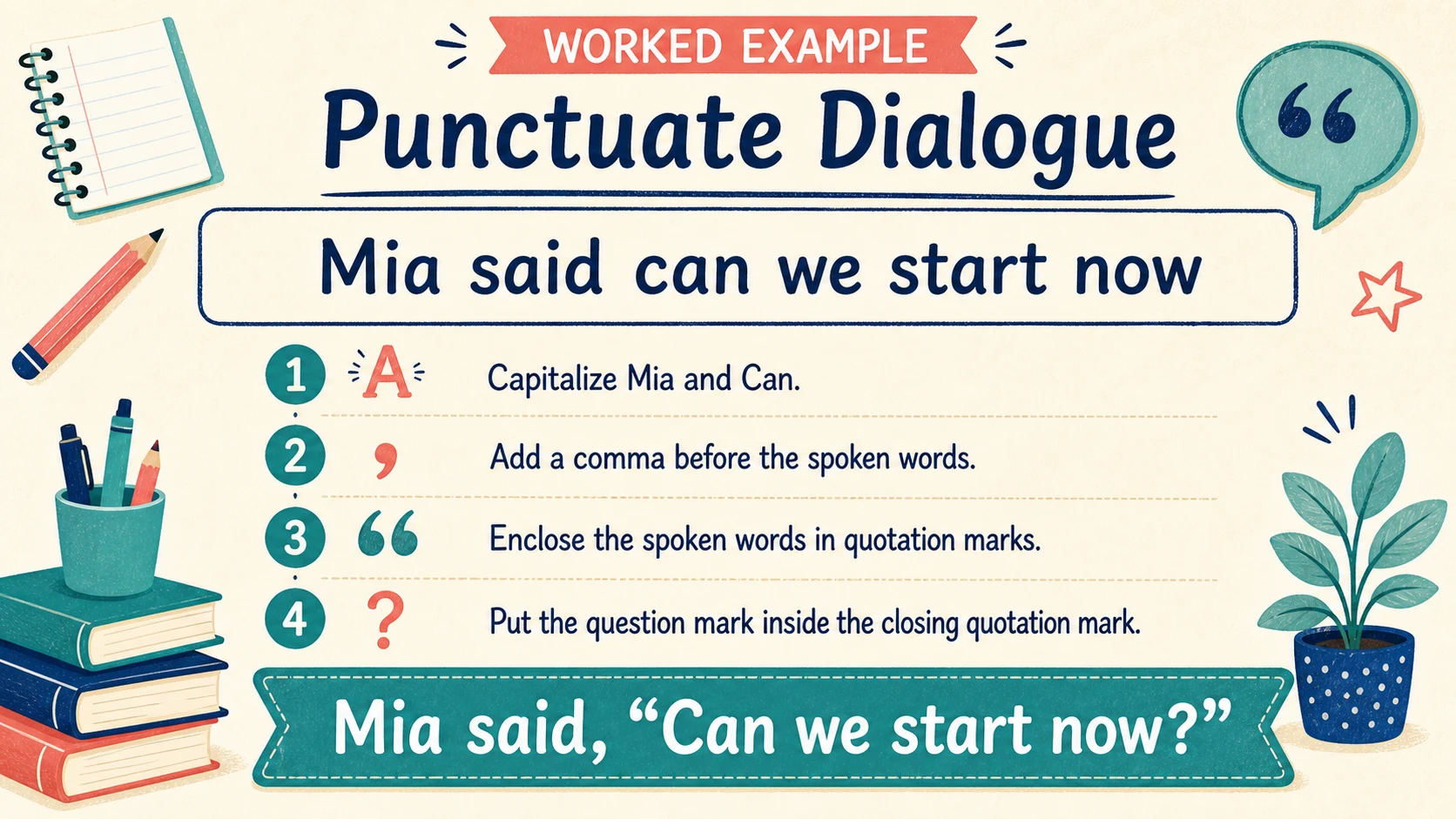
The reliable sequence is meaning first, mark second, and rereading last.
Boundary Cases That Need Careful Teaching
Questions versus sentences about questions
Compare:
Where is the library?
I wonder where the library is.
The first sentence asks directly and takes a question mark. The second tells what the speaker wonders and takes a period. Do not teach the shortcut that a sentence containing where, what, or why must always end with ?.
Excitement versus ordinary information
Both sentences can be correct:
We won the game.
We won the game!
The period presents the event as information. The exclamation point adds strong emphasis. A learner may justify either choice if the intended voice is clear. What should be corrected is indiscriminate use, such as ending every sentence in a paragraph with !.
Plurals versus possessives
Compare:
The dogs are barking.
The dog's collar is red.
Dogs means more than one dog. Dog's shows that something belongs to one dog. An apostrophe is not a general signal that a word ends in s.
Plural possession can become more complex and may appear in later sequences. If the immediate goal is singular possession, avoid turning one lesson into a complete treatment of every apostrophe pattern.
Commas and natural pauses
A spoken pause may help a learner hear some commas, but it is not a dependable rule by itself. Use the grammatical purpose: separating list items or marking the greeting and closing of a letter. Otherwise, learners may insert commas wherever they happen to pause while reading.
A Short, Repeatable Lesson Routine
A focused lesson can be brief. Let attention and accuracy determine the length.
- Retrieve: Review two previously learned examples.
- Model: Think aloud through one new sentence.
- Choose: Let the learner select a mark from visible options.
- Explain: Ask what the sentence means and why the mark fits.
- Write: Have the learner correct two to four examples.
- Apply: Add the convention to one original sentence.
- Check: Reread and inspect the beginning, middle, and end.
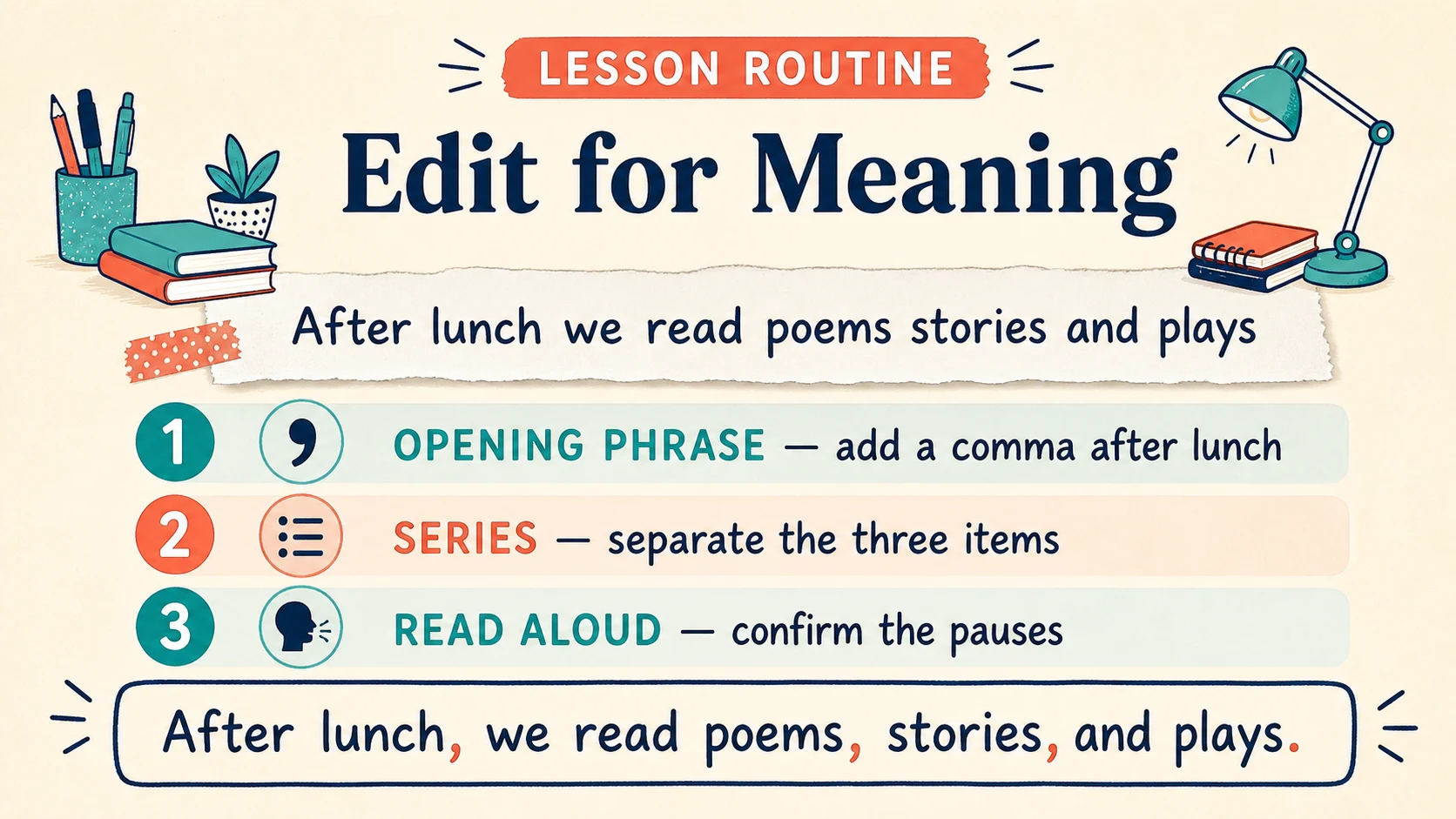
Each cycle connects recognition, explanation, written correction, and independent application.
For example, a lesson on question marks might begin with one statement and one question from yesterday. The adult then models a new direct question, verbalizing, “The speaker wants information, so I will use a question mark.” The learner sorts three examples, explains one choice, writes one question, and rereads it aloud.
Keep correction specific. “Look again” gives little information. “Decide whether this sentence tells or asks” directs attention to the underlying decision without supplying the answer.
Choosing Useful Practice
Practice should match the learner’s next decision, not merely the grade printed on the page.
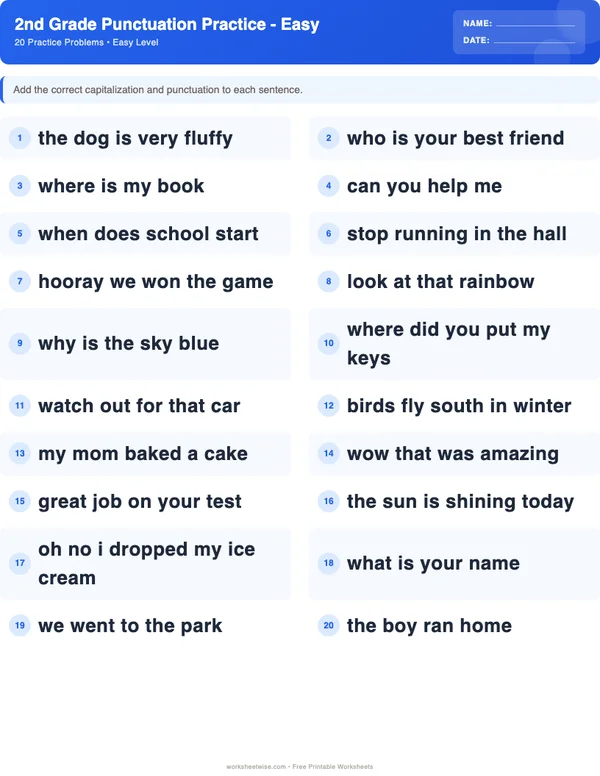
The free 2nd Grade Punctuation worksheet contains 12 easy-level exercises. Its stated task is to add correct capitalization and punctuation to sentences. It covers capitalization, periods, question marks, and exclamation marks and includes a separate printable answer key. That makes it suitable for a learner beginning mixed end-punctuation practice or needing reinforcement in those listed skills.
It does not, based on the supplied catalogue description, provide targeted practice with commas or apostrophes. Choose another task when those are the instructional goal. The broader punctuation topic guide and 2nd Grade grammar collection can help adults locate practice by topic.
Use the following selection test:
| Observed work |
Better next practice |
| Cannot find where sentences end |
Sentence-boundary marking with two short ideas |
| Confuses statements and questions |
Oral sorting, then period/question-mark choices |
Uses ! for almost every sentence |
Compare neutral and emphatic versions |
| Handles isolated endings but misses capitals |
Mixed capitalization and end-mark editing |
| Knows list commas but not letter commas |
Greetings and closings only |
Inserts apostrophes before every s |
Sort plural, contraction, and possessive examples |
| Corrects worksheets but not own writing |
Edit a two- or three-sentence original passage |
| Explains rules accurately and edits independently |
Less frequent review with varied writing |
The catalogue also lists a focused 2nd Grade Punctuation pack containing 18 worksheets for $4.79. Select it only if the available practice matches the learner’s observed needs. Quantity alone does not determine instructional fit.
Differentiation Without Changing the Core Skill
When the learner needs more support
Reduce the number of decisions in each item. Offer a period and a question mark first, leaving out the exclamation point until the statement-question distinction is stable.
Other useful adjustments include:
- Read the sentence aloud before asking for a mark.
- Use one sentence per line.
- Circle the first word and box the final position.
- Let the learner point to a mark before writing it.
- Keep vocabulary familiar so word meaning does not hide punctuation understanding.
- Correct one convention at a time.
These are instructional suggestions, not individualized clinical or medical guidance.
When the learner is ready for greater independence
Remove visual choices and mix conventions. Ask the learner to edit a short passage in which some sentences are already correct. This prevents the assumption that every line must be changed.
The learner can also compose:
- One statement and one question about the same picture.
- A sentence containing a three-item list.
- A short note with a greeting and closing.
- Two sentences using contractions, followed by their expanded forms.
- A sentence showing one person or animal owning an object.
For additional custom practice, the free worksheet generators may be useful when an adult needs a different amount or arrangement of work.
Common Errors and Diagnostic Responses
An incorrect answer is most useful when it identifies the decision the learner has not yet understood.
| Error |
Possible source of confusion |
Diagnostic prompt |
Teaching response |
| Uses a period after every sentence |
Treats the period as the default ending |
“Is the speaker telling or asking?” |
Sort oral statements and questions before writing |
Uses ? whenever a sentence contains who or where |
Relies on a keyword |
“Does this sentence ask the reader directly?” |
Compare direct questions with statements about wondering |
Uses ! for all interesting sentences |
Equates interest with exclamation |
“Is the voice ordinary or strongly emphatic?” |
Read neutral and emphatic versions |
| Leaves sentences lowercase |
Focuses only on the final blank |
“What must a reader see at the beginning?” |
Use a two-point check: beginning and ending |
Places a comma before and in every sentence |
Overgeneralizes the list pattern |
“What items are being listed?” |
Underline the parallel list items first |
Writes dont or cant |
Does not connect contraction to omitted letters |
“Which two words were joined?” |
Expand, cross out omitted letters, and rebuild |
Writes apple's to mean several apples |
Confuses plural s with possession |
“Does this mean more than one, or belonging to?” |
Sort plural and ownership examples |
| Corrects isolated items but not a paragraph |
Has not transferred the checking routine |
“Where does each complete thought end?” |
Mark boundaries before editing individual punctuation |
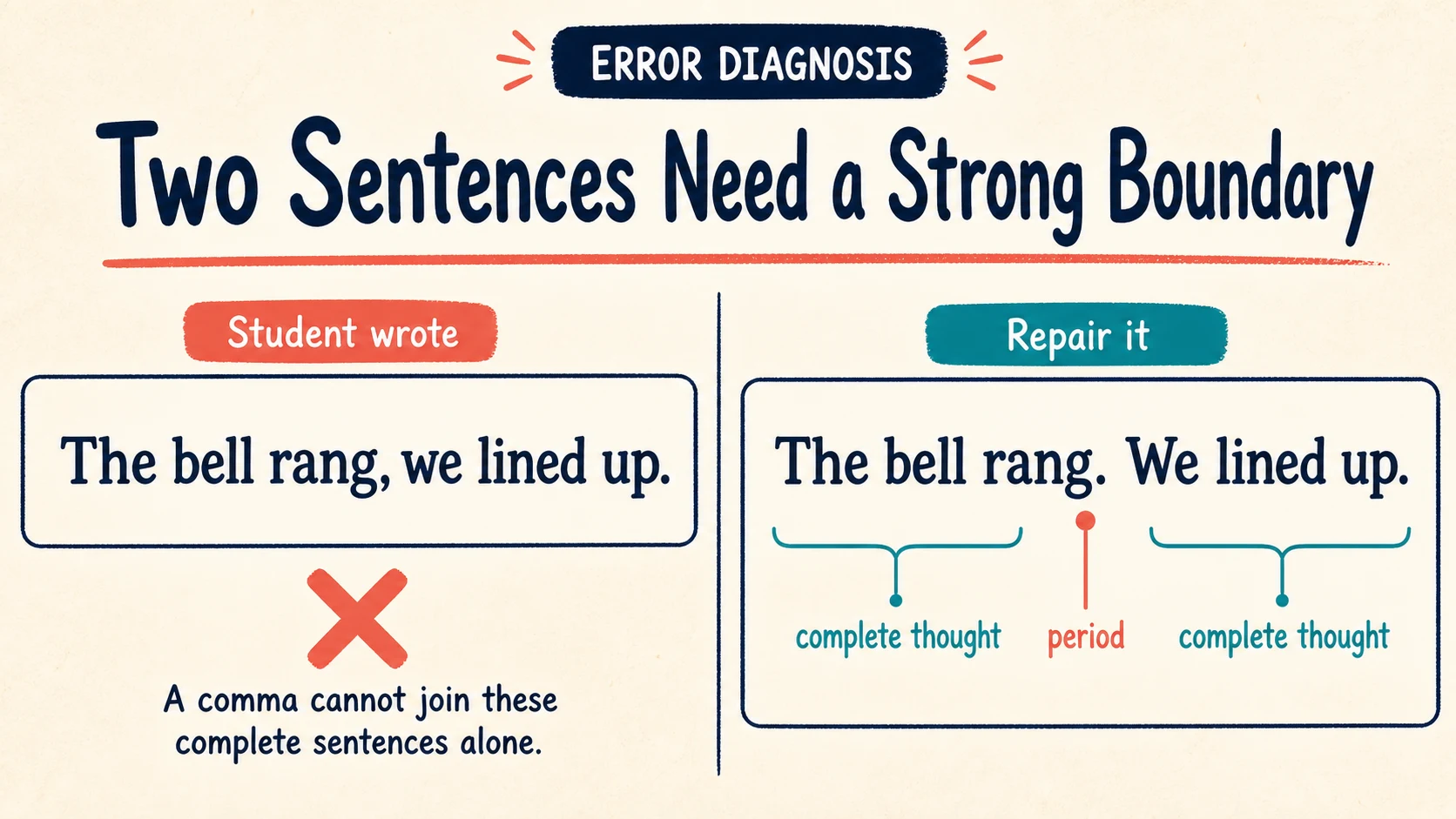
Diagnose the language decision behind an error before assigning more of the same exercise.
Do not infer too much from one mistake. A rushed omission, an unclear sentence, and a persistent misconception can look identical on paper. Ask for an explanation and collect several examples before changing the teaching plan.
Monitoring Progress
Monitor three kinds of evidence:
- Recognition: Can the learner identify the needed mark in a prepared sentence?
- Explanation: Can the learner state why the mark belongs there?
- Application: Can the learner use and edit the convention in original writing?
A simple record can show each convention as supported, mostly independent, or independent in short writing. Date the entry and attach one example. Avoid turning every error into a percentage when the sample is tiny.
Once or twice each week, use a short mixed check:
- One statement
- One direct question
- One emphatic sentence
- One sentence that is already correct
- One current comma or apostrophe item
Record the error type rather than only the total correct. Four correct answers out of five tell less than “question marks are stable; capitals are still omitted.” Move ahead, remain at the same level, or temporarily simplify according to the pattern in the learner’s work.
A Two-Week Practice Plan
This plan assumes short sessions on ten instructional days. It is a flexible example, not a universal schedule. Shorten, repeat, or skip steps based on observed performance.
| Day |
Main focus |
Suggested activity |
Quick evidence |
| 1 |
Sentence boundaries |
Divide four unpunctuated ideas into sentences |
Marks beginnings and endings |
| 2 |
Periods and questions |
Sort, punctuate, and read six sentences |
Explains tells versus asks |
| 3 |
Exclamation points |
Compare neutral and emphatic pairs |
Uses ! selectively |
| 4 |
Mixed endings |
Correct a short set with ., ?, and ! |
Chooses from meaning |
| 5 |
Review and writing |
Write one of each sentence type |
Applies capitals and endings |
| 6 |
Commas in lists |
Build lists with word cards, then write two |
Separates three items |
| 7 |
Letter punctuation |
Write a brief note with greeting and closing |
Places both commas |
| 8 |
Contractions |
Expand and rebuild four familiar contractions |
Identifies omitted letters |
| 9 |
Possession |
Match owners to objects and write sentences |
Distinguishes ownership from plurals |
| 10 |
Mixed editing |
Edit a short passage and one original sentence |
Explains corrections independently |
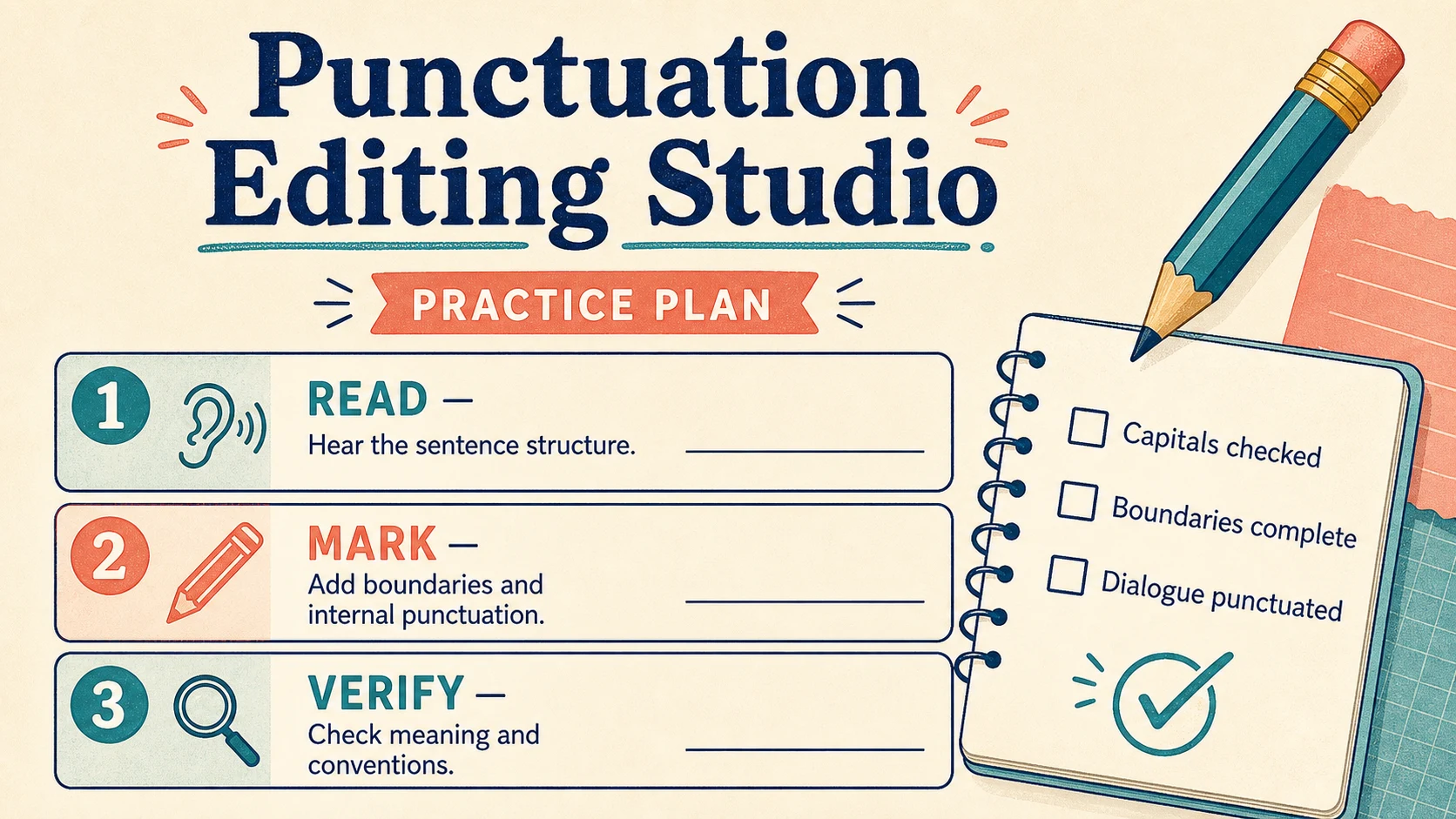
Use the sequence as a planning frame; repeat or compress days when the learner’s work supports that decision.
If a learner struggles on Day 4, return to a two-choice contrast rather than continuing automatically. If the learner independently edits mixed endings on Day 2, proceed to application or comma work. Pacing should follow evidence, not the table.
Limits and the Honest Next Step
Punctuation practice cannot by itself repair every writing difficulty. A learner may also need help forming complete sentences, spelling words, organizing ideas, reading the task, or sustaining attention. A worksheet sample cannot establish why a child is struggling, and this guide does not provide medical guidance or guarantee a particular outcome.
The catalogue spans punctuation conventions across multiple grades, but this guide intentionally concentrates on foundational second-grade work. Commas in addresses and dialogue, full dialogue formatting, compound-sentence commas, colons, and semicolons may belong in later or local sequences. The listed standards provide a useful reference point, not a claim of comprehensive standards alignment for every activity.
For the next lesson, choose one observed need. If the learner is ready to practice capitalization with periods, question marks, and exclamation points, use the free 12-question easy punctuation worksheet. Review the answer key together, ask the learner to explain two choices, and use those explanations to select the following practice.