What 5th Grade Parts of Speech Instruction Should Accomplish
A fifth grader should learn to identify and use the eight major parts of speech by examining what each word does in a sentence. The goal is not simply to memorize labels. The learner should be able to explain why a word is a noun, verb, adjective, adverb, pronoun, preposition, conjunction, or interjection; recognize that one word can serve different functions in different sentences; and apply that knowledge when revising writing.
Effective instruction usually moves through four stages:
- Find the sentence’s core noun or pronoun and verb.
- identify words that describe, replace, connect, or show relationships.
- Analyze words whose function changes with context.
- Use grammatical choices to make sentences clearer and more precise.
Grade labels describe the intended practice level, not a universal timetable. Local curricula and instructional sequences differ. A learner’s observed work should determine whether to review earlier material, continue with grade-level practice, or introduce greater complexity.
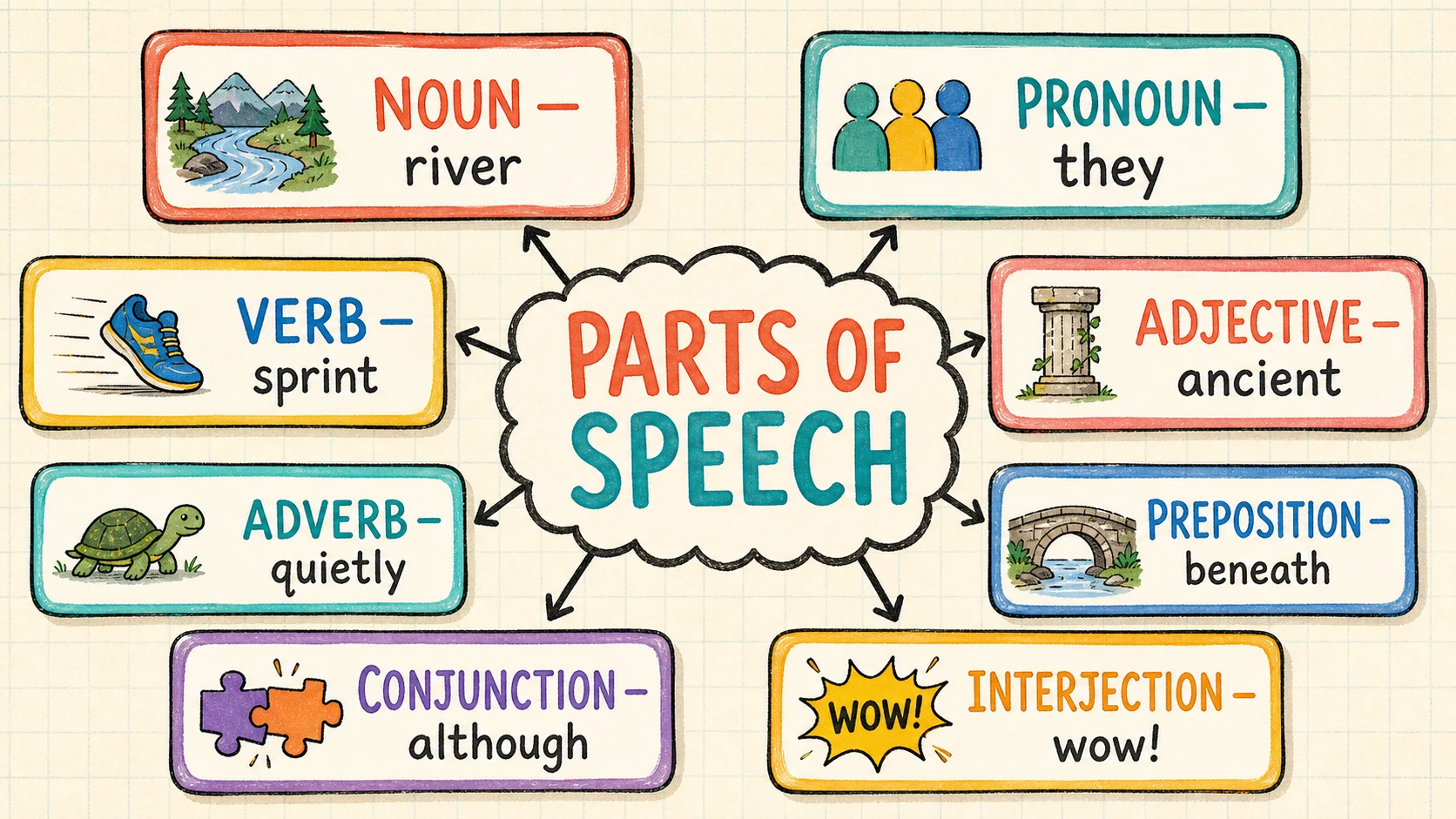
The eight categories become more useful when learners connect each label to a job within a sentence.
The Eight Parts of Speech as Sentence Jobs
Definitions provide a starting point, but sentence function determines the correct classification.
| Part of speech |
Main job |
Example |
| Noun |
Names a person, place, thing, or idea |
The musician practiced. |
| Pronoun |
Takes the place of a noun or noun phrase |
She practiced. |
| Verb |
Expresses action or links the subject to a description or identity |
She practiced. The room was quiet. |
| Adjective |
Describes or limits a noun or pronoun |
The patient musician practiced. |
| Adverb |
Modifies a verb, adjective, or another adverb |
She practiced patiently. |
| Preposition |
Begins a phrase showing a relationship |
She practiced after dinner. |
| Conjunction |
Connects words, phrases, or clauses |
She practiced because the concert was near. |
| Interjection |
Expresses a reaction and is often grammatically separate |
Wow, she improved quickly! |
These descriptions are deliberately functional. A learner who says that an adjective is “a describing word” has only part of the idea. The learner must also know what it describes. In a bright lamp, bright describes the noun lamp and is an adjective. In the lamp shines brightly, brightly modifies the verb shines and is an adverb.
Nouns and pronouns
Nouns may name concrete things, such as bridge and pencil, or ideas, such as patience and freedom. They may also be common, proper, singular, plural, collective, or possessive. These distinctions matter, but the first question remains: “What person, place, thing, or idea does this word name?”
Pronouns replace nouns or noun phrases. In Maya carried Maya’s notebook because Maya needed it, repetition makes the sentence awkward. A clearer version is Maya carried her notebook because she needed it. The words her, she, and it are pronouns, but their references must remain clear.
Action, linking, and helping verbs
An action verb tells what the subject does: The fox leaped. A linking verb connects the subject to a description or identity: The fox seemed alert. A helping verb works with a main verb: The fox has crossed the creek.
When identifying a complete verb phrase, include the helping verb. In They will have finished, the complete verb phrase is will have finished, although finished carries the central meaning.
Adjectives and adverbs
Adjectives modify nouns or pronouns. They can answer which one?, what kind?, or how many? In those three enormous pumpkins, those, three, and enormous all limit or describe pumpkins.
Adverbs commonly modify verbs, adjectives, or other adverbs. They may tell how, when, where, how often, or to what extent:
- The team worked carefully. The adverb modifies worked.
- The puzzle was extremely difficult. It modifies the adjective difficult.
- He moved very slowly. It modifies the adverb slowly.
Not every adverb ends in -ly, and not every -ly word is an adverb. Soon, often, and very are adverbs. Friendly is usually an adjective.
Prepositions, conjunctions, and interjections
A preposition begins a prepositional phrase and shows how its object relates to another part of the sentence: under the table, during lunch, beside Jordan, or through the tunnel. The final noun or pronoun is the object of the preposition.
Conjunctions connect grammatical units. Coordinating conjunctions such as and, but, and or can connect words, phrases, or clauses. Subordinating conjunctions such as because, although, and when introduce dependent clauses. Correlative conjunctions work in pairs, as in either/or and both/and.
Interjections express a reaction: Oh, ouch, hooray, or well. Their punctuation depends on the strength and placement of the reaction. Learners should recognize them without assuming that every opening word followed by a comma is an interjection.
Prerequisites and a Grade-Appropriate Progression
Before classifying all eight parts of speech, check whether the learner can:
- distinguish a complete sentence from a fragment;
- locate the subject and predicate in a straightforward sentence;
- identify basic nouns and action verbs;
- understand that words work together in phrases;
- read the practice sentences accurately enough to discuss their meaning.
If these foundations are unsteady, start with nouns and verbs in short sentences. This is an instructional suggestion based on the structure of the skill and the supplied catalogue guidance. It is not a claim that every fifth grader must follow one fixed order.
The IES foundational reading guide concerns kindergarten through third grade, so it should not be presented as a fifth-grade grammar program. Its broader attention to academic language, vocabulary, word analysis, and connected text does help explain why grammar practice should include meaningful sentences rather than disconnected labels.
| Stage |
Instructional focus |
Useful task |
Evidence for moving on |
| 1. Sentence core |
Nouns, pronouns, action verbs, linking verbs |
Underline the subject once and the complete verb twice |
Learner finds the core accurately in varied sentences |
| 2. Modifiers |
Adjectives and adverbs |
Draw an arrow from each modifier to the word it modifies |
Learner explains the target relationship |
| 3. Relationships |
Prepositions and prepositional phrases |
Bracket each phrase and circle its object |
Learner separates the phrase from the sentence core |
| 4. Connections |
Coordinating, subordinating, and correlative conjunctions |
Box the connector and name the units it joins |
Learner identifies both connected elements |
| 5. Full classification |
All eight parts of speech |
Label words in complete sentences or short passages |
Learner uses sentence evidence, not word appearance alone |
| 6. Application |
Revision and sentence combining |
Replace vague words, combine ideas, or adjust modifiers |
Learner improves clarity without changing the intended meaning |
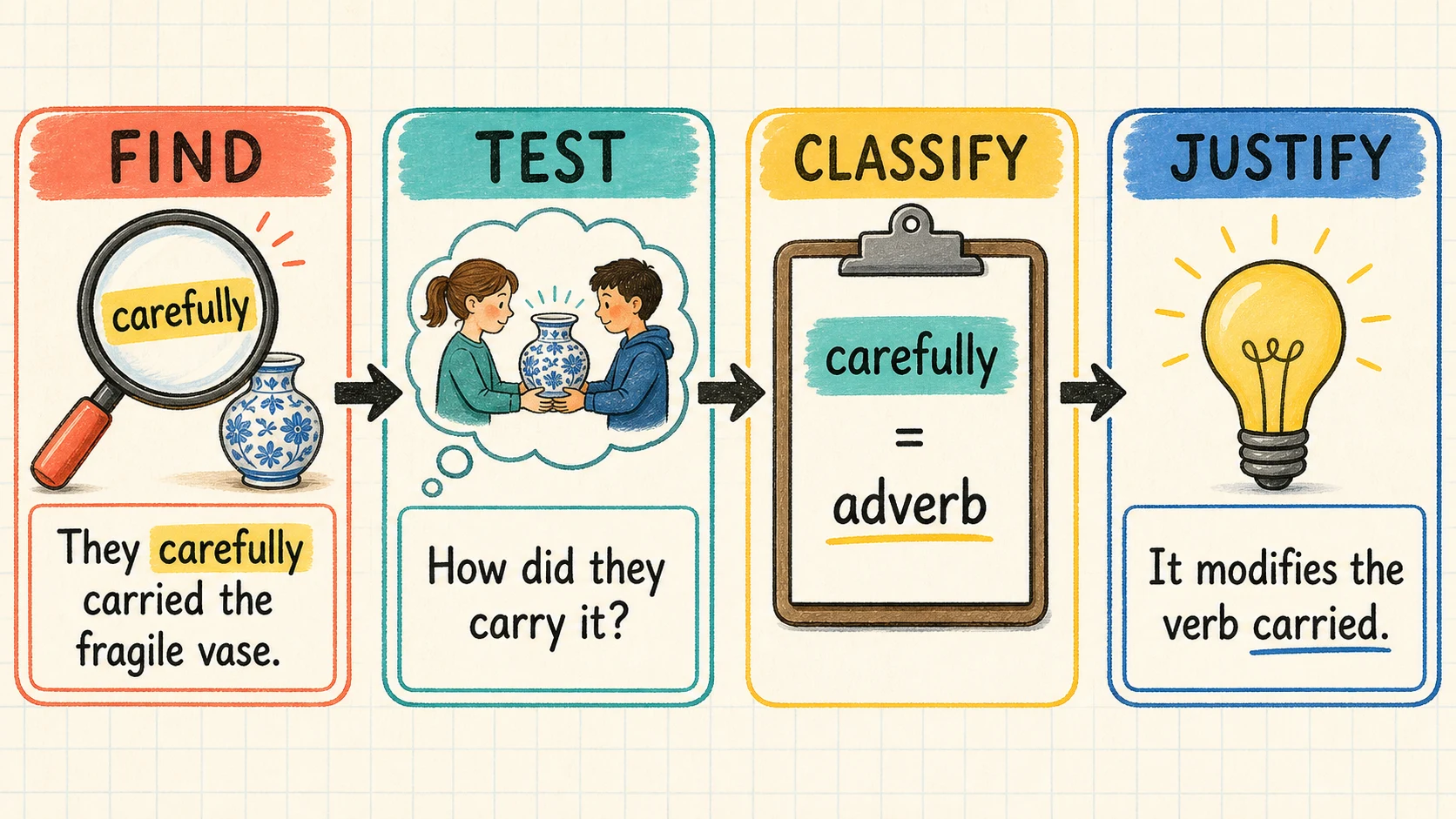
Progress should depend on demonstrated accuracy and explanation, not simply the number of pages completed.
The Common Core English Language Arts standards organize literacy expectations through grade-specific standards built on broader anchor standards. Within the supplied catalogue scope, fifth-grade language work includes explaining the functions of conjunctions, prepositions, and interjections. Earlier knowledge of nouns, pronouns, verbs, adjectives, and adverbs remains necessary. Local standards and curriculum documents should determine any formal alignment claim.
Concrete and Visual Models That Make Function Visible
Build the sentence around its core
Write a sentence on separate cards:
The | curious | puppy | eagerly | searched | under | the | porch.
First, locate puppy and searched. Those words form the subject–verb core. Then place curious beside puppy because it describes the noun. Place eagerly beside searched because it tells how the puppy searched. Group under the porch as a prepositional phrase, with under as the preposition and porch as its object.
This model prevents the learner from treating every word as an isolated vocabulary item.
Use arrows and brackets
A consistent marking system reduces unnecessary memory demands:
- underline nouns and pronouns;
- double-underline verbs;
- draw modifier arrows from adjectives and adverbs;
- bracket prepositional phrases;
- box conjunctions;
- circle interjections.
The precise marks are less important than consistency. Ask the learner to explain each connection orally before writing every label.
Test a word by changing the sentence
When a word is ambiguous, place it in contrasting frames:
- We watch birds. Here, watch expresses an action and is a verb.
- My watch stopped. Here, watch names a thing and is a noun.
The spelling has not changed; the job has. This substitution approach is especially useful for words such as light, fast, before, round, play, and clean.
Fully Checked Worked Examples
Example 1: Finding a sentence core and its modifiers
Sentence:
The three energetic puppies chased the red ball quickly.
Classification:
- The — adjective because it limits puppies.
- three — adjective because it tells how many puppies.
- energetic — adjective because it describes puppies.
- puppies — noun; it names the animals performing the action.
- chased — verb; it states the action.
- the — adjective because it limits ball.
- red — adjective because it describes ball.
- ball — noun; it names the thing being chased.
- quickly — adverb because it tells how the puppies chased.
Check the result by asking what quickly modifies. It changes the meaning of chased, not ball, so it is an adverb.
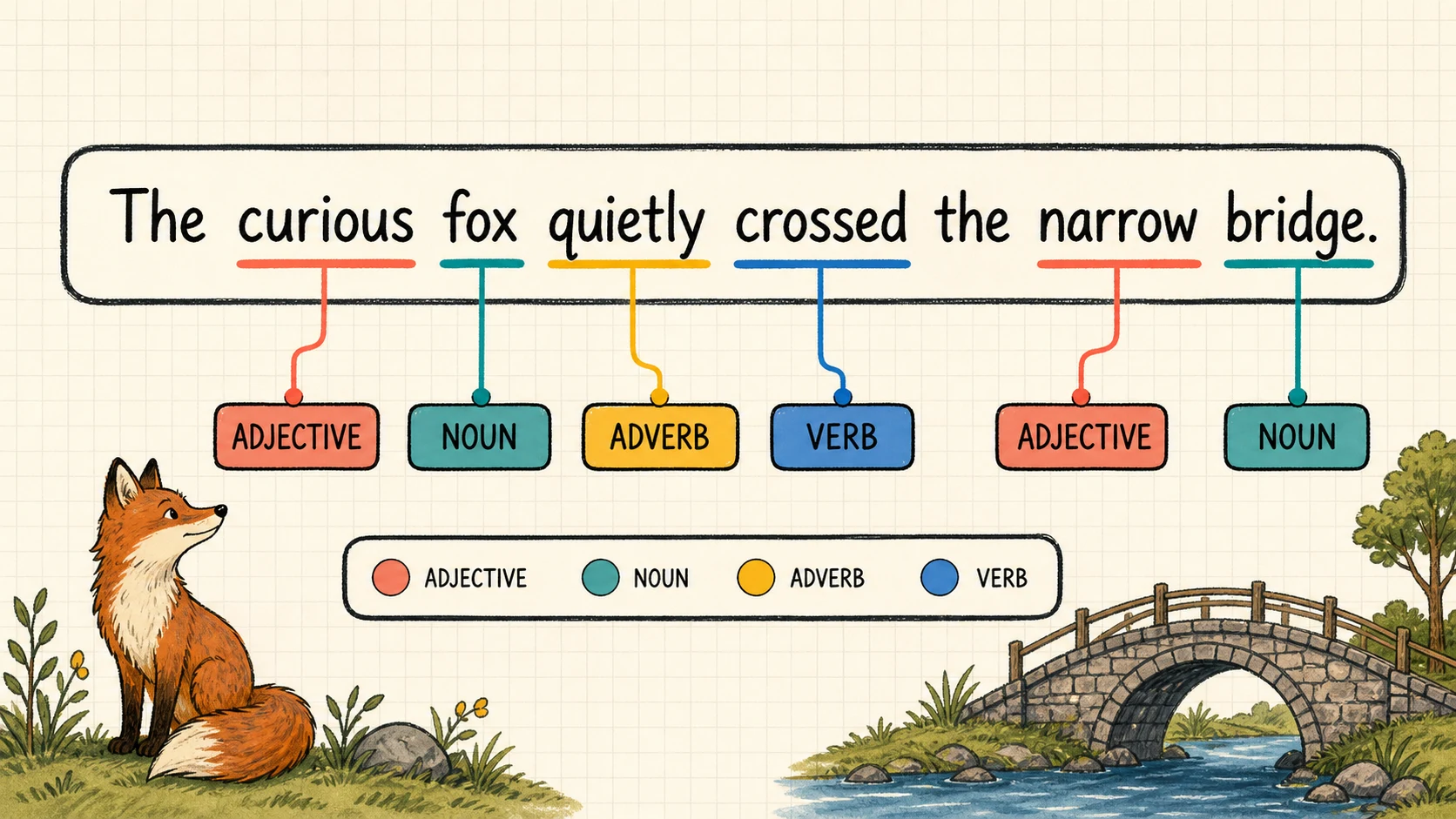
Start with the subject–verb core, then attach modifiers and phrases to the words they affect.
Example 2: Linking and helping verbs
Sentence:
The hikers have been extremely cautious near the icy bridge.
Classification:
- The — adjective limiting hikers.
- hikers — noun and subject.
- have been — verb phrase; have helps been, and been links the subject to cautious.
- extremely — adverb modifying cautious.
- cautious — adjective describing hikers.
- near — preposition beginning near the icy bridge.
- the and icy — adjectives modifying bridge.
- bridge — noun and object of the preposition.
A common incorrect answer is to call cautious an adverb because it follows a verb. That test is unreliable. Cautious describes the hikers, so it is an adjective.
Example 3: Pronoun reference and conjunctions
Sentence:
Lena returned the library book because she had finished it.
Classification:
- Lena, library, and book — nouns. Library functions as a noun used to modify book.
- returned — verb in the independent clause.
- the — adjective limiting book.
- because — subordinating conjunction introducing the dependent clause.
- she — pronoun referring to Lena.
- had finished — complete verb phrase.
- it — pronoun referring to the library book.
The antecedents are clear because she matches a person and it matches the book. If the sentence were Lena gave Ava the book because she had finished it, the reference of she could be unclear. Grammar analysis should therefore include meaning, not only labeling.
Example 4: One word, two possible functions
Compare:
We walked before dinner.
We walked before the rain began.
In the first sentence, before is a preposition. It begins the phrase before dinner, and dinner is its object.
In the second sentence, before is a subordinating conjunction. It introduces the clause before the rain began, which contains its own subject rain and verb began.
The boundary test is concrete: a preposition is followed by an object, while a subordinating conjunction introduces a clause containing a subject and verb.
Example 5: Coordinating and correlative conjunctions
Sentence:
Both Elena and Marcus planned carefully, but they changed the route.
- Both…and — correlative conjunction pair connecting Elena and Marcus.
- Elena and Marcus — proper nouns.
- planned and changed — verbs.
- carefully — adverb modifying planned.
- but — coordinating conjunction connecting two complete clauses.
- they — pronoun referring to Elena and Marcus.
- the — adjective limiting route.
- route — noun.
The comma before but is appropriate because but joins two clauses that can each stand as a sentence.
Example 6: Interjection or ordinary sentence word?
Compare:
Well, I did not expect that ending.
The injured bird did not fly well.
In the first sentence, well is an interjection expressing the speaker’s reaction. It is set off by a comma and is not required by the sentence grammar.
In the second, well is an adverb modifying fly. Removing it would remove information about how the bird flew. Punctuation offers a clue, but function supplies the answer.
Boundary Cases Worth Teaching Directly
English words do not carry permanent part-of-speech labels outside context. Several fifth-grade errors disappear once learners compare complete sentences.
Noun or verb
- Our play begins at seven. Play is a noun.
- We play after lunch. Play is a verb.
Adjective or adverb
- The train is fast. Fast is an adjective describing train through the linking verb is.
- The train moves fast. Fast is an adverb modifying moves.
Adjective or noun used as a modifier
In school project, school remains a noun used attributively to modify project. Some elementary materials may simplify such constructions differently. When a worksheet expects one predetermined category, inspect its model and answer key before assigning similar boundary cases.
Preposition or adverb
- The children went inside the cabin. Inside is a preposition with the object cabin.
- The children went inside. Inside functions as an adverb because no object follows it.
Articles and determiners
Many elementary resources classify a, an, and the as adjectives because they limit nouns. Other grammar frameworks call them articles or determiners. Use the terminology expected by the learner’s curriculum, and explain the difference when needed. Do not mark a well-reasoned answer wrong merely because two materials use different naming systems.
A Short, Repeatable Lesson Routine
The following routine is an instructional suggestion, not a universal schedule. Ten to twenty focused minutes may be appropriate in many settings, but observed attention, accuracy, and explanation should control the pace.
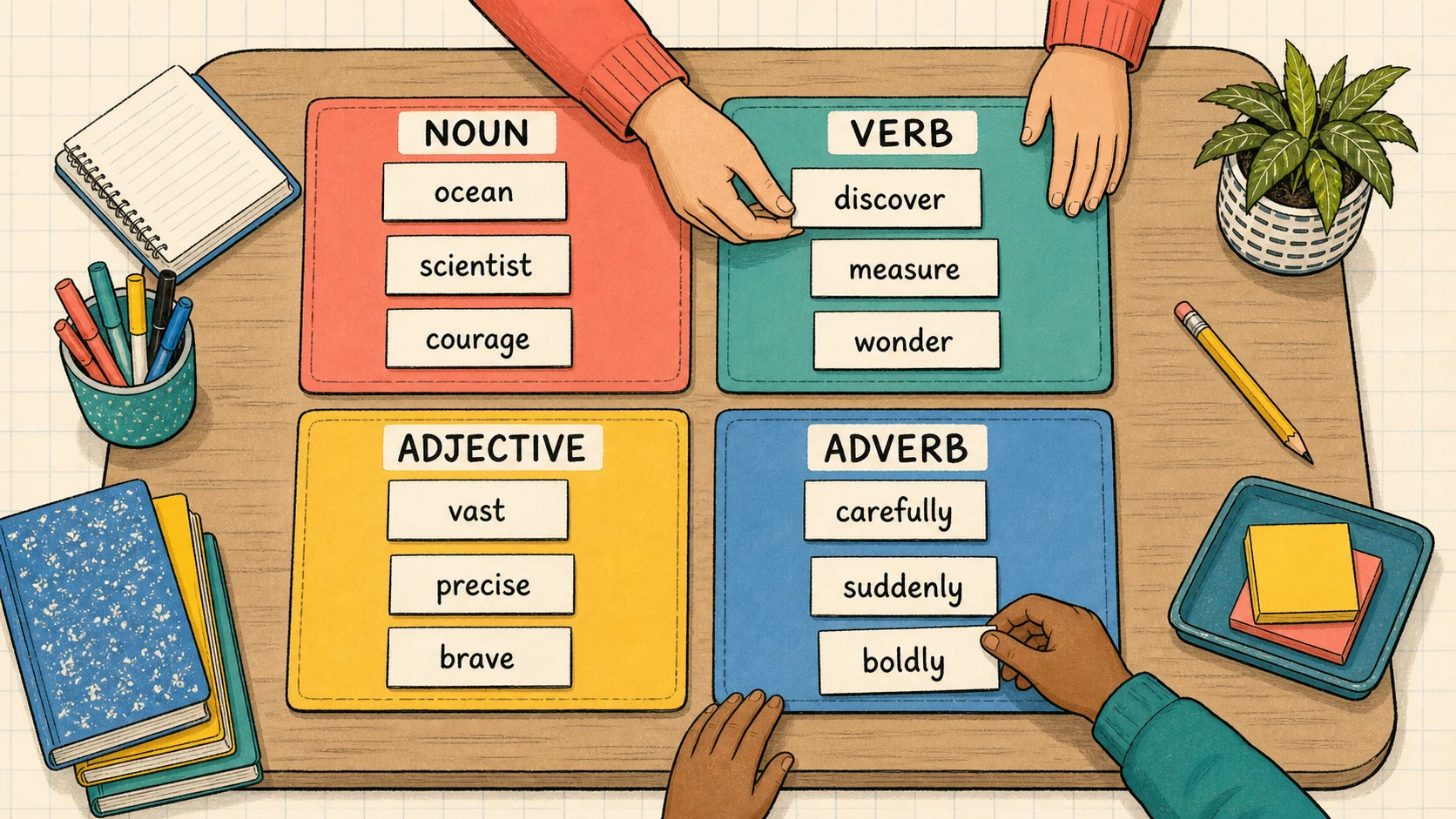
A stable routine leaves more attention available for analyzing how words function.
1. Retrieve one idea
Ask for a definition and an example: “What does an adverb modify?” Follow with a contrasting example rather than accepting a memorized phrase alone.
2. Model one sentence
Think aloud briefly:
The unusually calm dog waited beside the gate.
Locate dog and waited first. Then explain that calm describes dog, unusually modifies calm, and beside the gate is a prepositional phrase.
3. Analyze together
Use a new sentence. Ask questions in a stable order:
- What is the sentence about?
- What is the subject doing, or what links it to a description?
- Which words modify nouns?
- Which words modify verbs, adjectives, or adverbs?
- Are there phrases or clauses showing relationships?
- What connects the sentence’s parts?
4. Complete a small independent set
Assign three to six carefully selected items. A short set exposes the learner’s reasoning more clearly than a long page completed through guessing.
5. Apply the idea in writing
Have the learner revise one sentence by replacing a vague noun, choosing a stronger verb, adding a precise modifier, or combining related ideas. The IES elementary writing guide recommends regular writing opportunities, explicit attention to the writing process, and development of sentence-construction fluency. It does not evaluate WorksheetWise materials, but it supports keeping grammar connected to actual writing.
Choosing Practice From the Learner’s Work
The correct practice is the least complex task that reveals and addresses the current error.
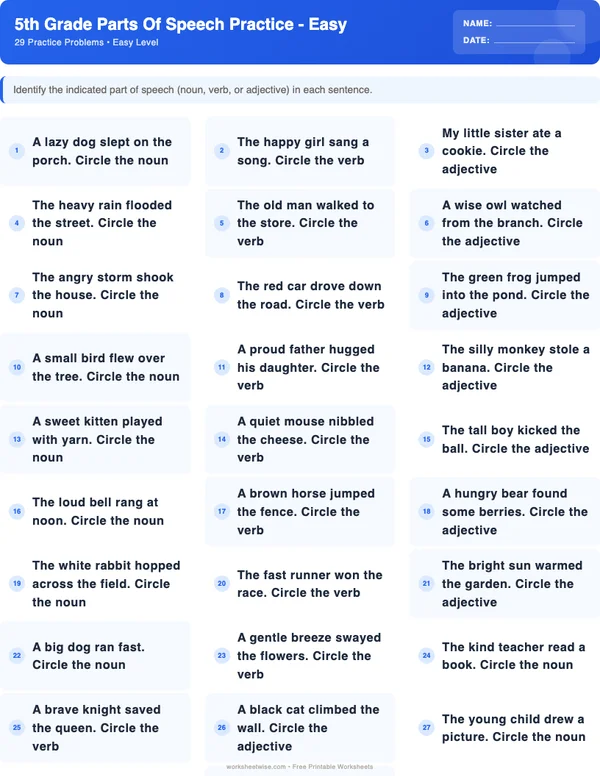
Start with the free foundational worksheet when the learner needs direct practice identifying nouns, verbs, and adjectives. It contains 29 easy-level exercises, uses straightforward sentences, and includes a separate answer key. It is suited to initial checking or reinforcement, not proof that the learner has mastered all eight categories.
Use broader materials from the 5th Grade Grammar hub when parts-of-speech knowledge needs to connect with sentence structure, agreement, tense, or punctuation. The focused parts-of-speech pack contains 18 worksheets and may be useful when varied or repeated practice is needed. Select individual pages according to demonstrated need rather than assigning the whole pack automatically.
Match the task to the error
| Observed work |
Better next practice |
| Finds action verbs but misses linking or helping verbs |
Contrast action, linking, and complete verb phrases |
| Labels every -ly word an adverb |
Sort words by the elements they modify |
| Confuses adjectives and adverbs |
Draw modifier arrows before naming categories |
| Includes nouns inside prepositional phrases as sentence subjects |
Bracket prepositional phrases before locating the subject |
| Identifies words accurately in lists but not sentences |
Use short connected sentences and explain each word’s job |
| Succeeds in identification but writes vague sentences |
Revise nouns, verbs, modifiers, and connectors in original writing |
| Guesses when words have multiple functions |
Compare the same word in two sentence frames |
For custom review, the free worksheet generators can help create additional practice. Check generated items before use, particularly when words could have more than one defensible classification.
Differentiation Without Lowering the Thinking Demand
When the learner needs more support
Reduce the number of categories presented at one time, not the expectation to explain. Begin with nouns and verbs, add adjectives and adverbs, and then introduce phrases and connectors.
Other useful supports include:
- reading each sentence aloud before labeling it;
- color-coding the sentence core and modifiers;
- supplying a category bank;
- covering all but one sentence at a time;
- using physical objects to model on, under, between, and behind;
- letting the learner explain orally before writing;
- revisiting a missed item with a contrasting sentence.
When the learner is ready for extension
Increase ambiguity and application rather than merely adding more items. Ask the learner to:
- use one word as two different parts of speech;
- explain whether before introduces a phrase or a clause;
- replace an unclear pronoun with a precise noun;
- combine two sentences with an appropriate conjunction;
- compare a weak and a precise verb;
- annotate a short passage from current reading;
- revise a paragraph and justify three grammatical choices.
Extension work should still be checked for meaning. A complicated sentence is not necessarily a clear one.
Common Errors and Diagnostic Responses
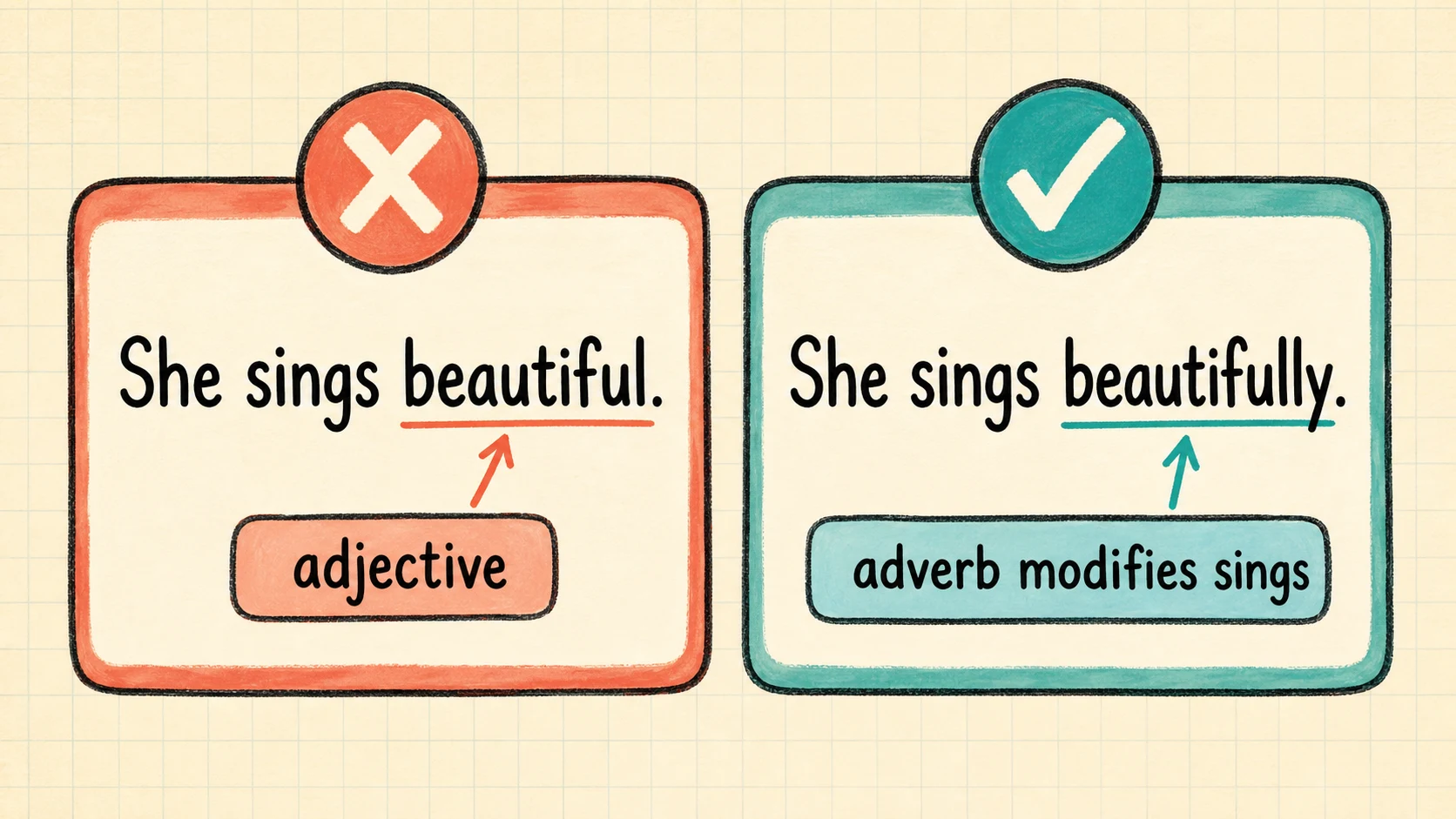
The correction should address the learner’s reasoning, not merely supply the missing label.
“A word is always the same part of speech”
Diagnosis: The learner has memorized word lists without attending to context.
Response: Present paired sentences such as Please light the candle and The light flickered. Ask what job light performs in each sentence.
“Every word ending in -ly is an adverb”
Diagnosis: The learner is using spelling as the complete test.
Response: Compare quickly, friendly, and lovely in full sentences. Require the learner to identify the modified word.
“The noun nearest the verb must be the subject”
Diagnosis: A noun inside a prepositional phrase is distracting the learner.
Response: In The box of crayons belongs to Mia, bracket of crayons first. The remaining core, box belongs, makes subject–verb relationships visible.
“Any word after a linking verb is an adverb”
Diagnosis: The learner is treating position as function.
Response: Ask whether the word describes the action or the subject. In The soup smells delicious, delicious describes soup, so it is an adjective.
“A conjunction is any short connecting word”
Diagnosis: The learner recognizes a vague sense of connection but cannot name what is joined.
Response: Have the learner put brackets around the two connected units. In red and blue, and connects words. In We stayed because it rained, because introduces a dependent clause.
“Correct labels mean the skill is finished”
Diagnosis: Recognition has not yet transferred to use.
Response: Ask for one revision. The learner might change The animal went there to The startled rabbit darted beneath the fence. Then discuss how the specific noun, stronger verb, adjective, and prepositional phrase change the sentence.
Monitoring Progress and Deciding When to Move On
Use a brief record rather than relying on a total score alone. For each session, note:
- category or contrast practiced;
- number correct without prompting;
- whether explanations were accurate;
- recurring error type;
- performance in a new sentence;
- performance in the learner’s own writing.
A practical check might contain eight items: two straightforward identifications, two modifier relationships, one prepositional phrase, one conjunction, one context-dependent word, and one revision. Keep the structure similar across checks while changing the sentences.
A learner may be ready for more complex work when accuracy holds across unfamiliar sentences and explanations refer to function. If the learner can circle an adverb but cannot say what it modifies, continue with supported analysis. If classification is accurate but written sentences remain unclear, shift some time from labeling to revision.
Avoid interpreting a single weak session as a stable problem. Fatigue, unfamiliar vocabulary, or a confusing item can affect performance. Look for patterns across several short samples. This guide provides educational practice guidance, not a diagnosis or child-specific clinical recommendation.
A Two-Week Practice Plan
This plan is adaptable. Sessions do not have to occur on consecutive school days, and missed material should be revisited before complexity increases.
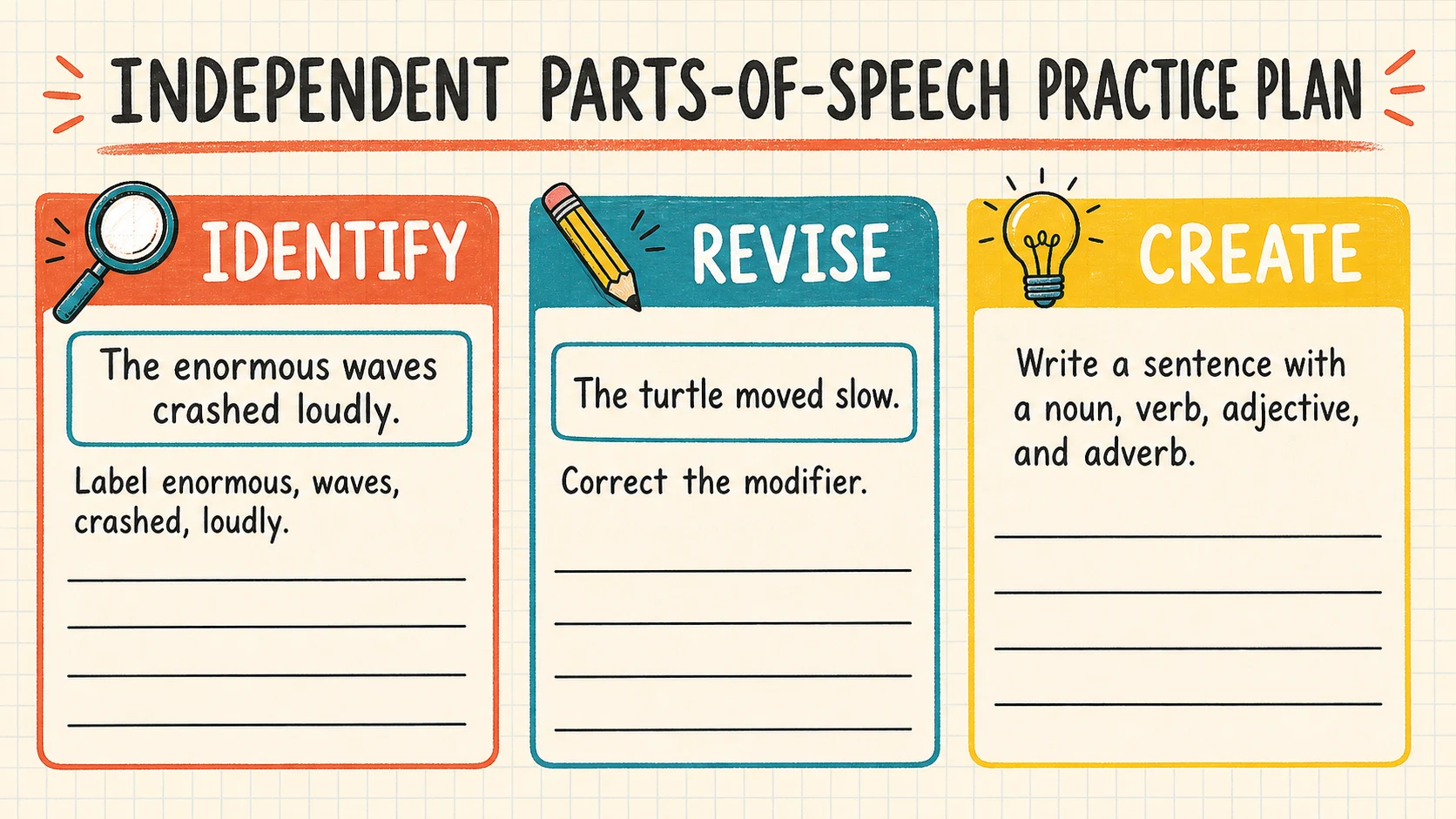
Across two weeks, move from sentence cores to full analysis, revision, and an independent check.
| Day |
Focus |
Suggested practice |
Evidence to collect |
| 1 |
Baseline |
Classify nouns, verbs, and adjectives in six sentences |
Record category-specific errors |
| 2 |
Sentence core |
Find subjects and complete verb phrases |
Note action, linking, or helping-verb confusion |
| 3 |
Modifiers |
Connect adjectives and adverbs to their targets |
Require a spoken explanation |
| 4 |
Prepositions |
Model relationships with objects, then bracket phrases |
Check preposition and object together |
| 5 |
Review and writing |
Analyze four mixed sentences; revise one vague sentence |
Compare identification with application |
| 6 |
Pronouns |
Match pronouns to clear antecedents |
Note unclear or mismatched references |
| 7 |
Conjunctions |
Connect words, phrases, and clauses |
Ask what each conjunction joins |
| 8 |
Boundary cases |
Compare fast, before, inside, light, or play in context |
Listen for function-based reasoning |
| 9 |
Full classification |
Annotate a short passage or mixed worksheet set |
Record independent accuracy and explanations |
| 10 |
Transfer check |
Analyze unfamiliar sentences and revise a short paragraph |
Choose review or extension from the results |
If Day 4 reveals that prepositional phrases are still obscuring the sentence subject, repeat that contrast before moving to full classification. If Day 8 is easy and explanations are secure, use Day 9 for a passage from science or social studies rather than another isolated set.
Limitations and the Next Useful Step
Parts-of-speech labels are tools for examining language, not a complete writing curriculum. Classification alone does not teach organization, evidence, voice, paragraph development, spelling, or punctuation. Grammar frameworks may also classify boundary cases differently, especially articles, noun modifiers, infinitive markers, and words that can act as either prepositions or adverbs. Follow the learner’s curriculum terminology when an assignment requires a specific convention.
This guide does not establish comprehensive standards alignment or guarantee an outcome. The supplied catalogue connects the topic with several language standards across grades, while the relevant fifth-grade emphasis includes the functions of conjunctions, prepositions, and interjections. Consult local requirements before making formal alignment decisions.
For the next session, use the free 5th Grade Parts of Speech worksheet as a short diagnostic. Review the answer key, select six to ten items, and ask the learner to explain each choice. Let those explanations—not the grade label or page count—determine what to teach next.