What 1st Grade Sentence Structure Means
A first grader is learning to turn an idea into an ordered, complete sentence that another person can understand. At this level, the central questions are:
- Who or what is the sentence about?
- What does that person, animal, place, or thing do—or what is true about it?
- Do the words appear in an order that makes sense?
- Does the written sentence begin with a capital letter and end with suitable punctuation?
A concise working definition is: A complete sentence expresses a complete thought, names or implies who or what it is about, and tells what happens or what is true.
For example:
The rabbit hops.
“The rabbit” tells who the sentence is about. “Hops” tells what the rabbit does. The capital T and the period mark the boundaries of the written sentence.
The aim is not to make a young learner memorize advanced grammatical terms. The aim is to help the learner hear, build, read, and write clear sentences. Oral rehearsal should usually come before or accompany written work, especially when handwriting, spelling, or decoding demands would otherwise hide what the learner understands about sentence structure.
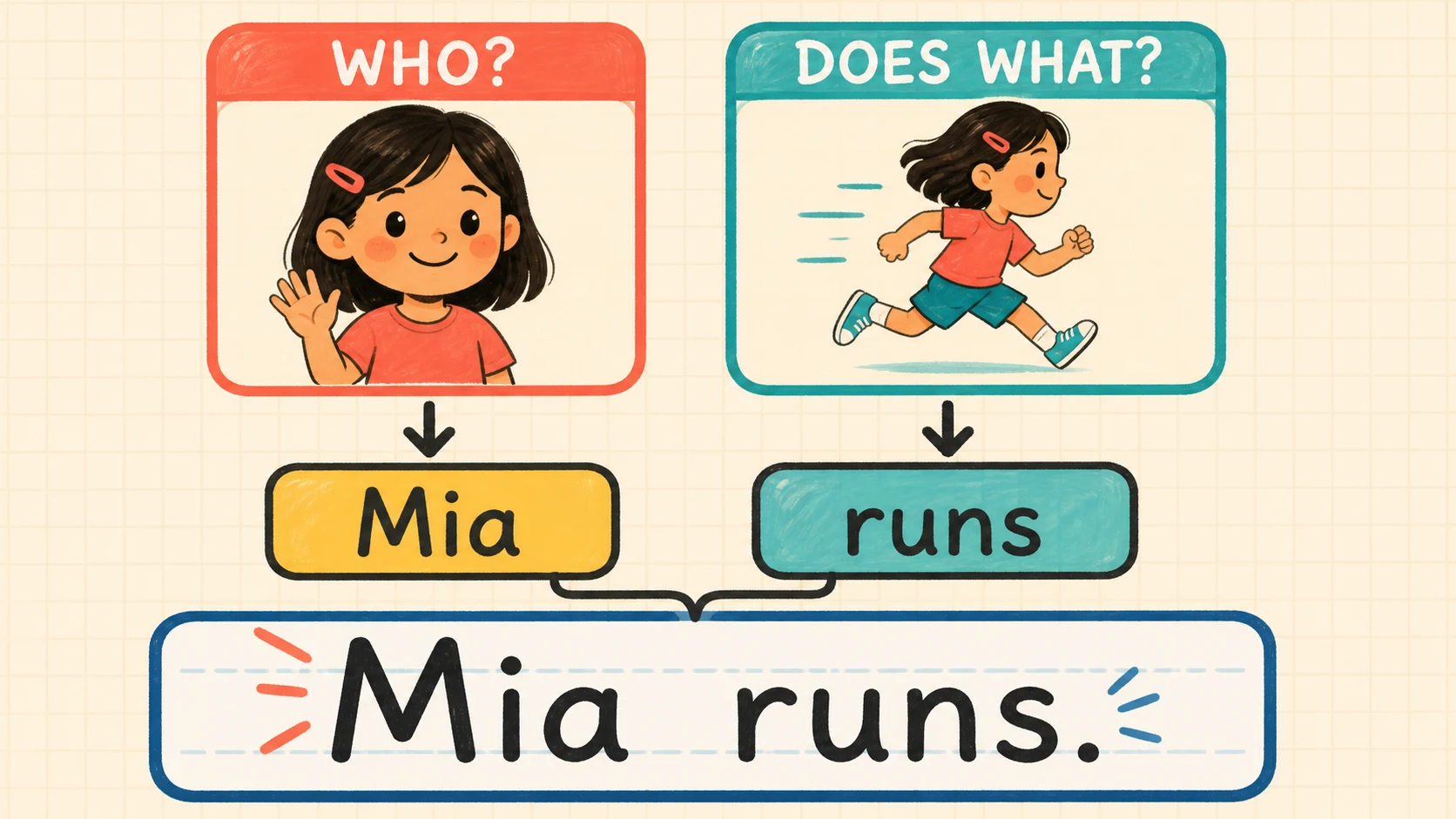
Sentence work connects complete thoughts, meaningful word order, sentence boundaries, and clear written expression.
Grade labels describe the intended practice level, not a fixed timetable for every child. Local curriculum sequences differ, and learners may show uneven development across speaking, reading, spelling, handwriting, and grammar. Use observed work—not the grade label alone—to decide the next teaching step.
The Common Core English Language Arts standards provide one useful point of reference: first-grade language work includes producing and expanding complete simple and compound sentences and using end punctuation. This guide stays focused on practical first-grade sentence building rather than claiming comprehensive standards alignment.
Prerequisites to Check First
Sentence practice becomes much more productive when the learner can handle its smaller parts. Before increasing difficulty, check the following foundations.
Oral sentence awareness
Say a complete sentence and a phrase:
- “The bird sings.”
- “In the tall tree.”
Ask the learner which one sounds complete. If the learner chooses “The bird sings,” ask why. A useful answer might be, “It tells who and what the bird does.” The learner does not need formal terminology to show understanding.
Then complete the phrase together:
The bird sits in the tall tree.
If the learner cannot reliably distinguish an oral sentence from an incomplete phrase, stay with speaking, picture description, and sentence completion before expecting independent written correction.
Basic word knowledge
A learner should recognize that sentences are built from separate words. Check whether the learner can:
- Point to each word while reading a short sentence.
- Leave a visible space between written words.
- Identify a naming word in a concrete example, such as dog or Mia.
- Identify an action or being word, such as runs, is, or are.
- Read or decode enough of the task vocabulary to understand the sentence.
A child may understand sentence structure but struggle to read the words on a worksheet. Read the words aloud when the goal is grammar rather than decoding.
Sentence-boundary knowledge
The learner should be developing awareness that a written sentence starts and stops. Check for:
- A capital letter at the beginning.
- Lowercase letters in ordinary positions unless a proper name requires a capital.
- A period, question mark, or exclamation point at the end.
- No extra words after the ending mark unless a new sentence begins.
Capitalization and punctuation do not create meaning by themselves, but they make sentence boundaries visible.
For broader literacy context, the IES guide on foundational skills for reading in kindergarten through third grade can help adults place sentence work alongside early reading development. It should not be treated as an evaluation of this guide or any WorksheetWise resource.
A Grade-Appropriate Teaching Progression
Teach one decision at a time, then combine decisions as the learner becomes accurate. The following sequence is practical, but it is not a universal timetable.
| Stage |
Learner’s task |
Helpful support |
Evidence of readiness to continue |
| 1. Hear a complete thought |
Decide whether spoken words make a complete sentence |
Pictures, oral choices, “Who? Did what?” prompts |
Explains what is missing from simple fragments |
| 2. Complete a sentence |
Add a missing who/what part or action/description part |
Two oral choices or word cards |
Completes several examples without guessing |
| 3. Order words |
Rearrange three to six words into a sensible sentence |
Capitalization, punctuation, and picture clues |
Reads the finished sentence and explains the order |
| 4. Mark boundaries |
Add a capital letter and ending punctuation |
Sentence-type choices and oral rehearsal |
Marks ordinary statements and questions accurately |
| 5. Write a simple sentence |
Produce a sentence from a picture or spoken idea |
Oral rehearsal, sentence frame, word bank |
Writes a complete, understandable thought |
| 6. Expand meaning |
Add where, when, how, size, color, or number details |
Expansion questions |
Adds details without losing the basic sentence |
| 7. Combine related ideas |
Join two closely related thoughts with and |
Color coding and teacher modeling |
Avoids unnecessary repetition and preserves meaning |
| 8. Apply in short writing |
Review sentences in a two- or three-sentence response |
Checklist and read-aloud review |
Finds and repairs some errors independently |
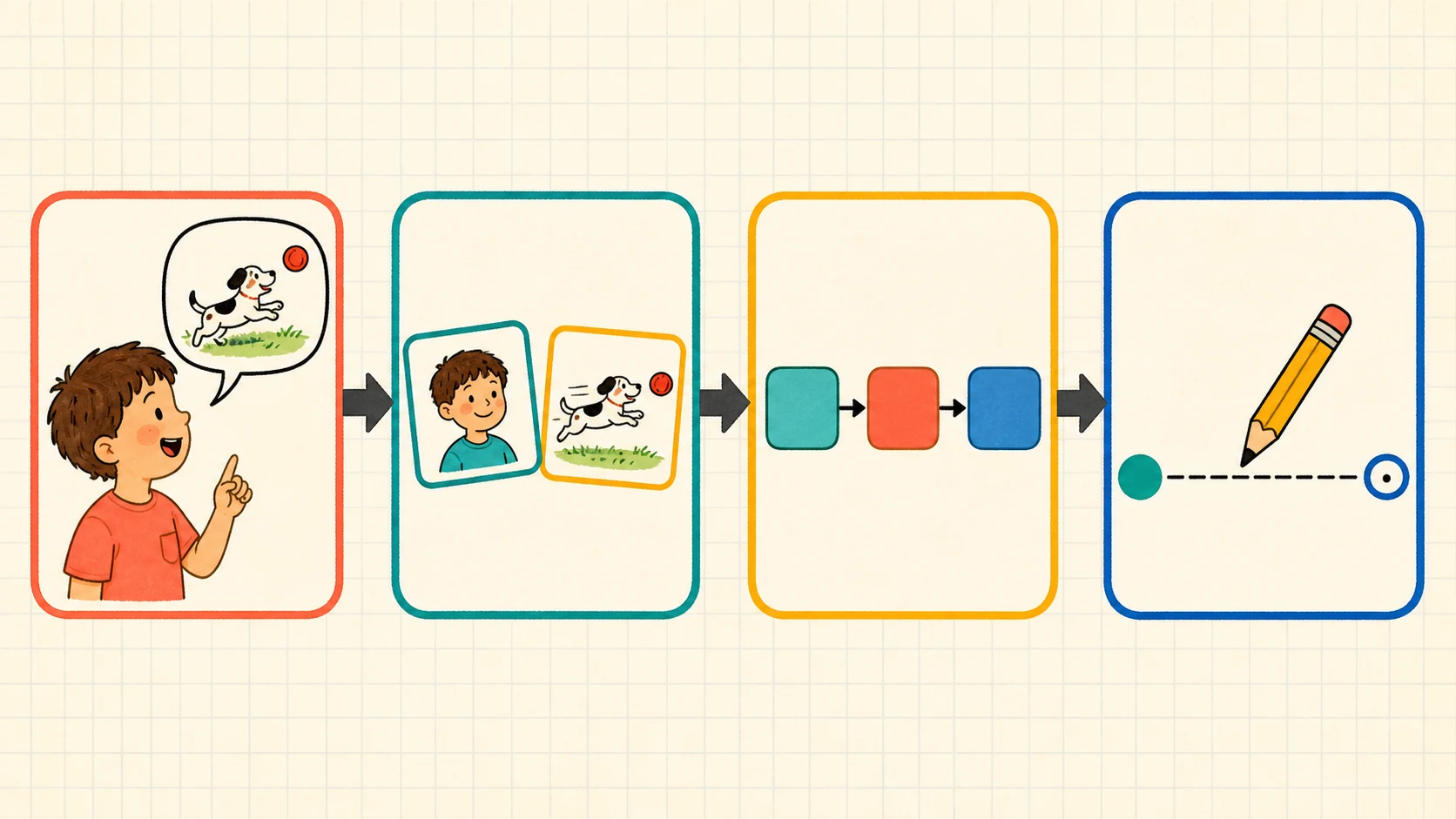
Support can be reduced gradually as the learner shows accurate, explainable work.
Do not rush from word ordering to paragraph writing. A learner may need repeated practice at stages three through five while spelling and handwriting become more automatic. Conversely, a learner who already writes complete simple sentences may benefit more from expansion, combining, and editing than from additional basic sorting.
Concrete and Visual Models
The two-part sentence frame
Use two boxes, cards, or columns:
| Who or what? |
Did what? / Is what? |
| The ducks |
swim. |
| My backpack |
is heavy. |
| Ava and Leo |
laugh. |
Read across each row. Then cover one side and ask what information is missing.
This model is intentionally simple. It captures many first-grade sentences, but not every valid English sentence. A command such as “Sit down.” has an understood subject: the person being addressed. Introduce that as a boundary case after the learner is secure with visible who/what parts.
A sentence train
Write each word on a separate card. Arrange the cards like train cars:
The | small | dog | runs | home | .
The capitalized word often signals the beginning, and the punctuation card signals the end. Meaning determines the middle order. Ask the learner to read every proposed arrangement aloud. “Dog small the runs home” contains the right words but not an acceptable order for this sentence.
Do not teach that every sentence must begin with the or that every sentence must have exactly four or five words. Those patterns may appear frequently in beginning practice, but they are scaffolds rather than rules.
Color coding
Use one color for the who/what part and another for what happens or is true:
The red kite | flies.
Then add optional detail in a third color:
The red kite | flies | above the trees.
Color should clarify relationships, not become a task the learner must remember forever. Fade it once the learner can identify the parts without it.
Fully Checked Worked Examples
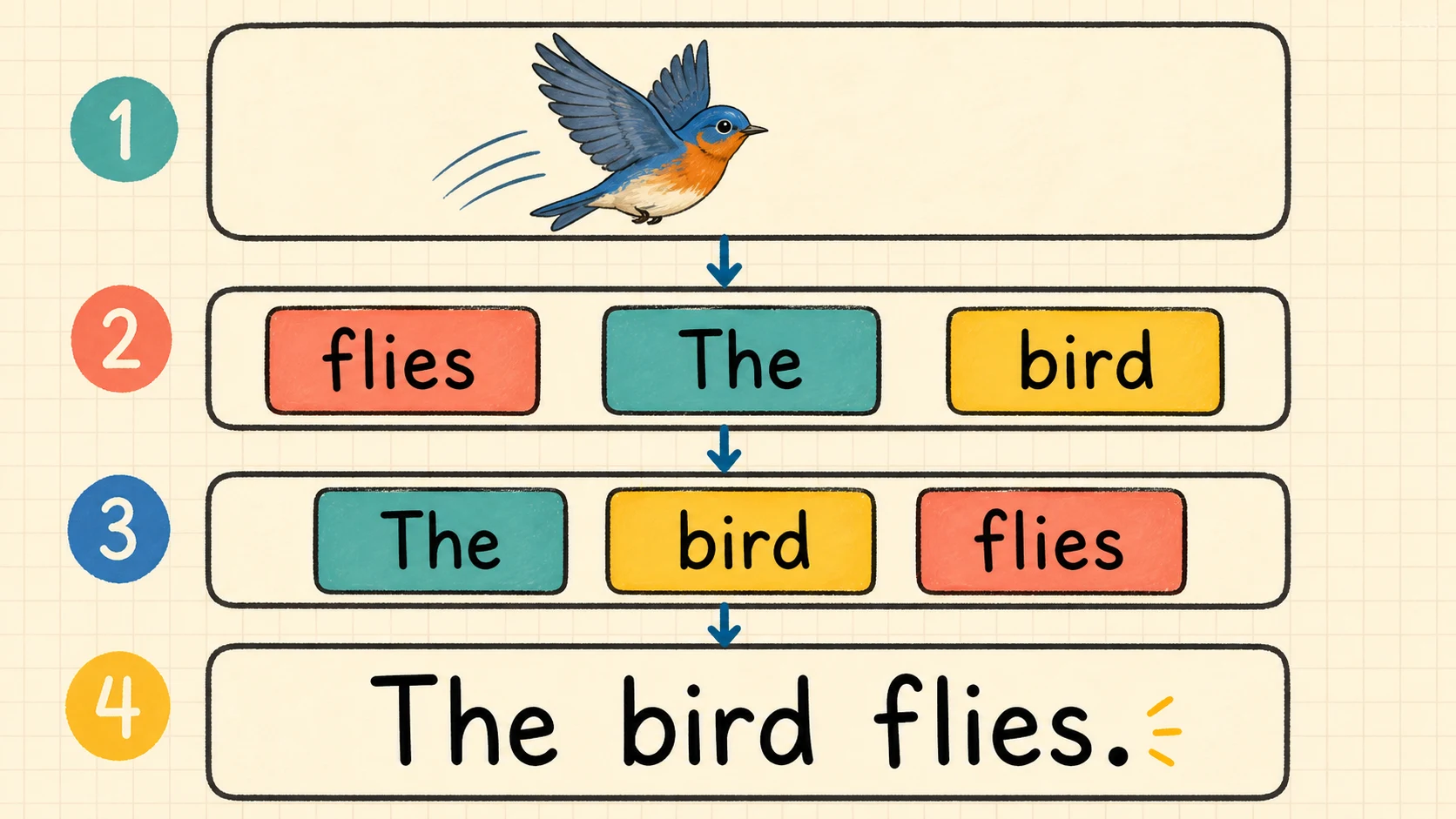
The learner can move from objects or word cards to oral rehearsal and then to written form.
Example 1: Put words in order
Words:
sleeps / the / cat
Reasoning:
- The cat names who the sentence is about.
- Sleeps tells what the cat does.
- The statement should begin with a capital and end with a period.
Correct sentence:
The cat sleeps.
Check: It has three words in meaningful order, expresses a complete thought, begins with a capital, and ends with a period.
Example 2: Repair an incomplete thought
Words:
Under the bed.
This group tells where, but it does not tell who or what is under the bed. Add a who/what part:
My shoes are under the bed.
Check: My shoes names what the sentence is about. Are under the bed tells what is true about the shoes. The repaired sentence expresses a complete thought.
A different valid repair is:
The puppy sleeps under the bed.
There can be more than one correct completion when the prompt does not restrict the meaning.
Example 3: Choose ending punctuation
Sentence:
Where is my hat
The word where asks for information, so the sentence is a question.
Correct sentence:
Where is my hat?
Check: The sentence starts with a capital W and ends with a question mark.
Compare it with:
My hat is on the chair.
That sentence gives information, so it ends with a period. Punctuation follows the sentence’s purpose; it should not be chosen only from the reader’s volume or excitement.
Example 4: Expand a simple sentence
Starting sentence:
Birds sing.
Ask concrete expansion questions:
- What kind of birds?
- When do they sing?
- Where do they sing?
One expanded result is:
The little birds sing in the morning.
Check: The added words give size and time details. The basic relationship remains clear: birds sing. The expansion does not require every possible detail.
Example 5: Combine repeated information
Starting sentences:
The frog is small.
The frog is green.
Both sentences describe the same frog. Combine the repeated subject:
The frog is small and green.
Check: The new sentence keeps both facts, uses and to join the descriptions, and removes the second occurrence of The frog.
Another possible combination is:
The small green frog hops.
That version adds an action not stated in the original pair. It is grammatical, but it is not an exact combination of only the supplied facts. This distinction helps learners separate sentence construction from inventing new information.
Example 6: Separate two complete thoughts
Unpunctuated words:
The rain stopped we went outside
There are two complete thoughts:
- The rain stopped.
- We went outside.
A first-grade repair is:
The rain stopped. We went outside.
A supported combining option is:
The rain stopped, and we went outside.
Check: Both versions preserve the two events. The first uses two simple sentences. The second joins the thoughts with and. At this level, splitting the ideas is often the clearest first repair.
A Short, Repeatable Lesson Routine
Keep a focused lesson brief enough that the learner can remain attentive and produce careful work. Ten to fifteen minutes may be practical for many settings, but the observed response should determine the actual length.
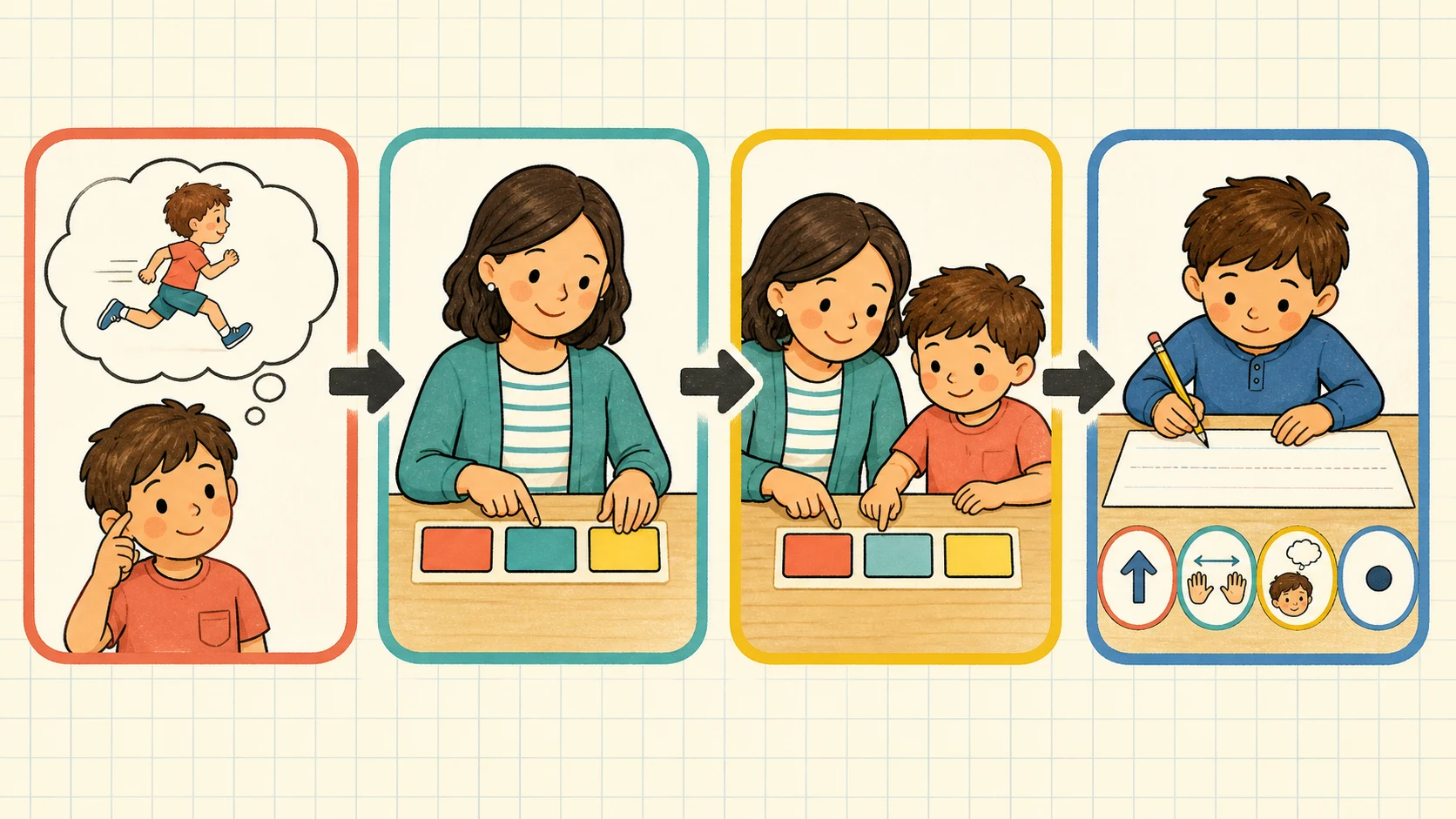
A stable routine leaves more attention available for the sentence decision itself.
1. Hear it
Say one complete sentence and one fragment. The learner identifies the complete thought and explains what the other group lacks.
2. Build it
Use word cards, magnetic words, or movable paper slips. Have the learner arrange a short sentence. Ask for an oral read-through before anything is copied.
3. Write it
The learner copies the built sentence or writes a similar one. If handwriting is consuming all available attention, let the learner dictate while the adult records the sentence, then ask the learner to add the capital and punctuation.
4. Change it
Make one purposeful change:
- Add a detail.
- Change the person or animal.
- Turn a statement into a question.
- Combine two related descriptions.
- Remove a word and discuss what changes.
5. Check it
Use a short checklist:
- Does it make sense?
- Can I tell who or what?
- Can I tell what happens or is true?
- Is the word order clear?
- Did I mark the beginning and end?
The IES guide to teaching elementary students to be effective writers offers authoritative high-level framing for writing instruction. Consult it for broader instructional context, not as evidence that one routine or worksheet guarantees a particular result.
Choosing the Right Practice
Match the activity to the error you actually observe.
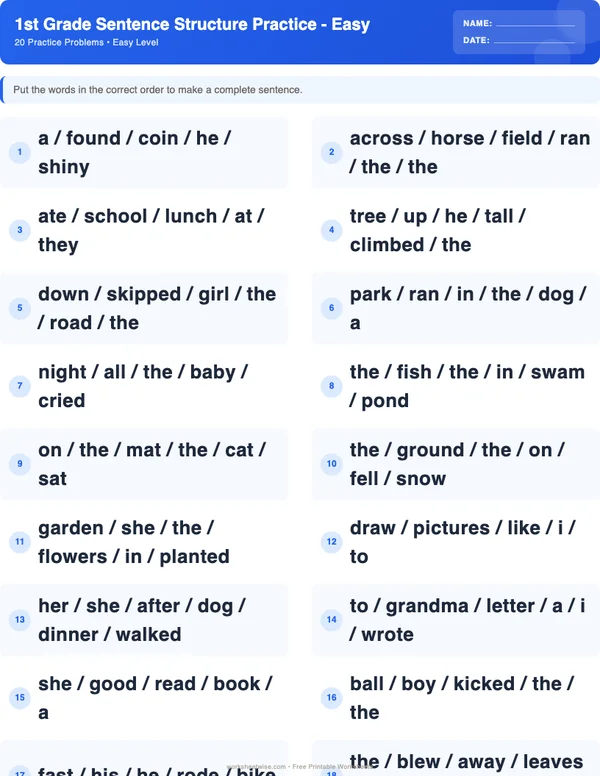
Use word-order practice when the learner understands an idea orally but scrambles its written sequence. The free 1st Grade Sentence Structure worksheet provides 12 easy exercises in which learners put words in order to make complete sentences. It includes a separate answer key. It is suitable for practice, homework, or homeschool use when that exact skill is needed.
Use oral sentence completion when the learner cannot yet explain what makes a thought complete. Use punctuation choices when sentence purpose is clear but the ending mark is inconsistent. Use picture-based writing when the learner can build supplied sentences but struggles to generate one. Use sentence expansion when simple sentences are accurate but sparse.
The broader first-grade grammar collection can help when sentence difficulty is connected to nouns, verbs, adjectives, or singular and plural forms. The first-grade worksheet hub provides practice across subjects, but more pages are not automatically better. Choose a small number that address the current need.
The focused sentence-structure pack contains 18 worksheets and is priced at $4.79. Consider a larger set only when varied, repeated sentence practice is useful. A learner who is confused by the concept needs modeling and feedback before a larger practice volume.
Differentiation Without Changing the Goal
When the learner needs more support
Reduce demands without removing the sentence decision:
- Read all words aloud.
- Limit arrangements to three or four word cards.
- Pair the words with a picture.
- Mark the beginning word with a capital.
- Supply the punctuation card.
- Offer two possible missing parts.
- Let the learner say the sentence before writing.
- Ask the learner to copy only after arranging and reading correctly.
If spelling is the obstacle, provide a word bank or act as the scribe. If handwriting is the obstacle, use movable cards or oral responses. These adaptations help reveal whether the learner understands structure.
When the learner is ready for more
Increase one feature at a time:
- Add an adjective: “The fox runs” becomes “The quick fox runs.”
- Add where: “The fox runs through the grass.”
- Add when: “At sunset, the fox runs.”
- Join related ideas with and.
- Ask for a statement, question, command, or exclamation about the same picture.
- Give a sentence with an error and ask the learner to explain the repair.
Do not move immediately into dependent clauses or stylistic sentence variety merely because a learner finishes a basic page quickly. First check transfer: Can the learner produce and edit complete sentences in original writing?
Common Errors and Diagnostic Responses
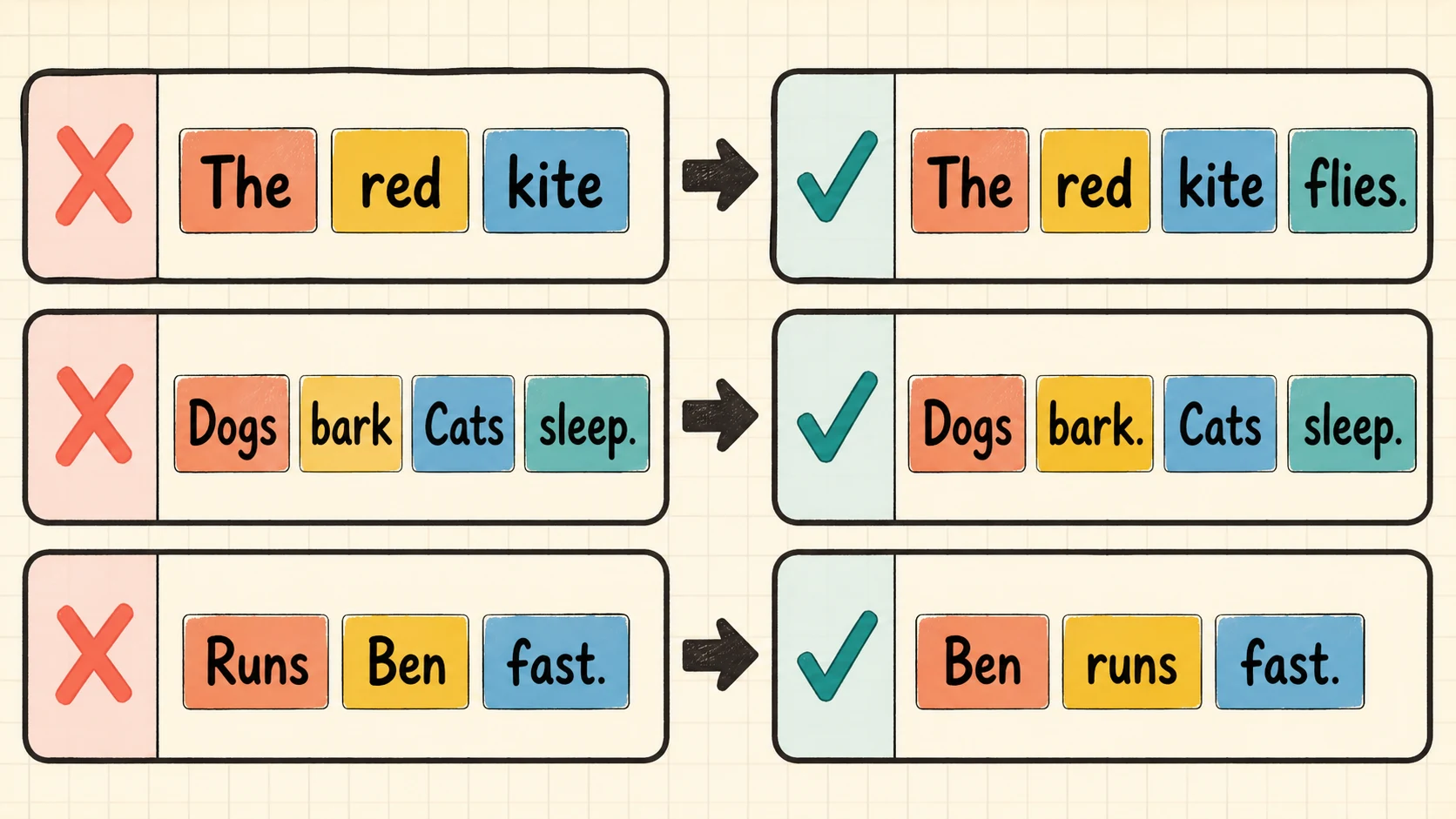
An error is most useful when it points to the next teaching move.
| Observed work |
Likely instructional need |
Teaching response |
| “The big dog.” |
The learner has named who or what but has not completed the thought |
Ask, “What does the dog do?” Add and act out a verb |
| “Runs to school.” |
The learner may be missing an explicit who/what part |
Ask, “Who runs?” Build several possible completions |
| “Dog the fast runs.” |
Word-order control is not secure |
Use word cards; compare arrangements by reading them aloud |
| “the dog runs” |
Sentence meaning is intact, but boundaries are not marked |
Have the learner circle the first letter and point to where the thought ends |
| “The dog runs?” |
Sentence purpose and punctuation are mismatched |
Contrast a statement with “Does the dog run?” |
| “The dog runs the cat sleeps.” |
Two complete thoughts have been placed together without a boundary |
Draw a line where the first thought ends; form two sentences |
| “The dog is big and.” |
The learner has used a joining word without adding the joined information |
Ask, “Big and what?” Remove and if no second idea is intended |
| Every answer copies the same frame |
The learner may know one pattern without flexible control |
Change the subject, action, sentence purpose, or beginning one at a time |
Several misconceptions deserve direct correction.
A long group of words is not necessarily a sentence, and a short group can be complete. “Birds fly.” is complete; “The very bright yellow bird in the tree” is not a complete statement by itself.
A sentence does not need an action such as running or jumping. “The soup is hot.” is complete because it tells what is true about the soup.
Capitalization and punctuation matter, but fixing them does not repair missing meaning. “Under the chair.” is still incomplete in the ordinary first-grade exercise even after it receives a capital and period.
Not every unusual sentence is wrong. “Stop!” is a complete command with an understood subject. Teach this as a boundary case rather than allowing it to weaken the useful beginner model of “Who or what? Did what or is what?”
Monitoring Progress
Use a small weekly sample rather than judging progress from one page. Give four or five items that include:
- One oral sentence-or-fragment choice.
- One word-order task.
- One sentence completion.
- One independently produced sentence.
- One editing task involving capitalization or punctuation.
Record the type of support used: independent, oral prompt, visual cue, two choices, or full model. Accuracy matters, but decreasing support matters too.
Also inspect authentic writing. A learner may score well when all words are supplied yet omit verbs or punctuation during independent composition. The reverse can occur when difficult decoding makes a worksheet look harder than the grammar concept really is.
Look for stable evidence across more than one session:
- The learner can explain why a sentence is complete.
- Word order remains clear with unfamiliar content.
- Capitals and ending marks appear without repeated reminders.
- The learner can add a detail without breaking the sentence.
- The learner notices and repairs at least some errors when reading aloud.
If performance suddenly declines, first check vocabulary, reading load, fatigue, handwriting demands, and unfamiliar directions before assuming the concept has been lost.
A Two-Week Practice Plan
This plan uses short sessions and deliberate review. Adjust the pace, repeat days, or pause the sequence according to the learner’s work.
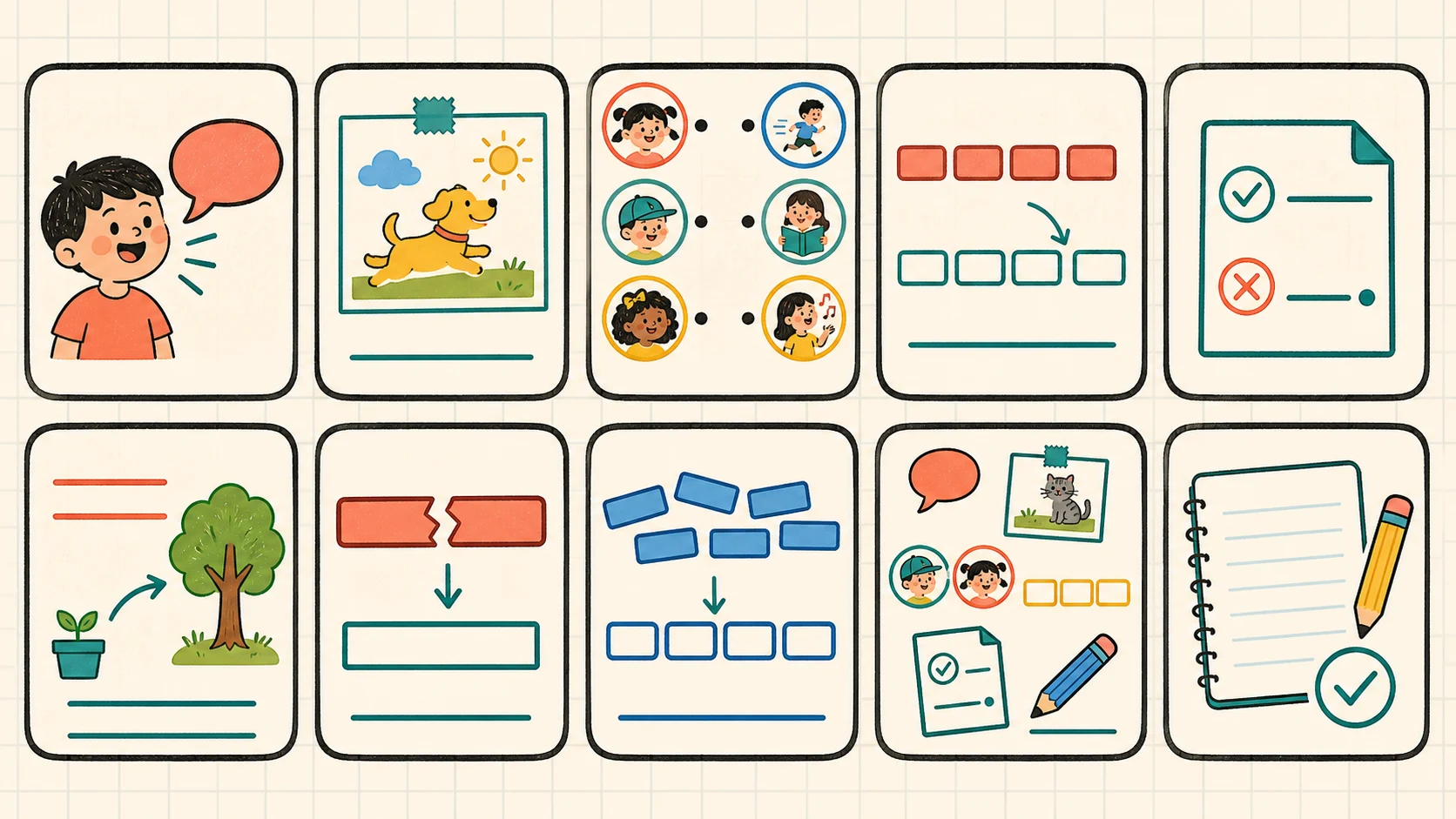
The plan alternates modeling, focused practice, application, and review.
| Day |
Focus |
Suggested activity |
Quick check |
| 1 |
Complete thoughts |
Sort six spoken examples into sentences and incomplete groups |
Learner explains what is missing |
| 2 |
Who or what? |
Match three subjects to sensible predicates |
Learner reads each match aloud |
| 3 |
What happens or is true? |
Complete oral frames such as “The baby ___” |
Responses form complete thoughts |
| 4 |
Word order |
Arrange four short sentences with movable cards |
Learner justifies the first and last word |
| 5 |
Review and transfer |
Write one sentence about a picture; edit it together |
Note the least intrusive prompt needed |
| 6 |
Capital letters and periods |
Correct five short statements |
Meaning and boundaries are both checked |
| 7 |
Questions |
Compare statements and questions; add periods or question marks |
Learner explains punctuation choices |
| 8 |
Expansion |
Add one useful detail to four simple sentences |
Basic meaning remains intact |
| 9 |
Combining |
Combine two pairs that repeat the same subject or description |
Both original facts remain |
| 10 |
Independent application |
Write two or three connected sentences, then use the checklist |
Choose the next practice from observed errors |
On Days 4 or 5, selected items from the free easy worksheet can provide focused word-order practice. Do not require all 12 exercises in one sitting if accuracy or attention declines. A smaller set completed thoughtfully provides clearer information than a full page completed through guessing.
After Day 10, compare the final sample with the first sample. Identify one strength and one next target. If the learner now forms complete thoughts but still omits punctuation, move the emphasis to sentence boundaries. If supplied-word tasks are easy but original writing remains incomplete, use oral rehearsal and picture-based sentence generation.
Limits and the Next Teaching Decision
Sentence-structure practice cannot by itself resolve every writing difficulty. Performance may also be affected by decoding, vocabulary, spelling, handwriting, attention, familiarity with the topic, or understanding of directions. A worksheet result should therefore be treated as one piece of instructional evidence.
This guide does not provide medical guidance, diagnose a learning difficulty, promise outcomes, or establish a universal timetable. It also does not claim that every learner must follow the same sequence. When concerns extend beyond ordinary instructional adjustment, families and educators should use the appropriate local school or professional support process.
The honest next step is to select one task that matches the learner’s current evidence. If word order is the clearest need, begin with four to six items from the free easy sentence-structure worksheet, ask the learner to read each completed sentence aloud, and record which prompts were necessary. If a different format is needed, explore the free worksheet generators and create a short practice set around the exact sentence feature you are teaching.