What 1st Grade Parts of Speech Instruction Should Cover
For most first graders, parts-of-speech instruction should begin with three useful categories:
- A noun names a person, place, thing, or idea.
- A verb tells what someone or something does or helps tell what it is.
- An adjective describes a noun.
The immediate goal is not to memorize all eight traditional parts of speech. It is to help a learner find and use nouns, verbs, and frequently occurring adjectives in short, understandable sentences. Pronouns and simple conjunctions can follow when the learner is secure with that foundation. More abstract categories—such as adverbs, prepositions, and interjections—may be introduced informally, but they do not need equal instructional time at this stage.
A useful sequence is concrete experience, oral language, visual sorting, sentence analysis, and independent writing. For example, a child can hold a shell, act out jump, describe a smooth shell, and then find those words in a sentence.
Grade labels describe the intended practice level, not a fixed timetable for every child. Local curricula and instructional sequences differ. Use the learner’s observed work—especially the explanations behind correct and incorrect answers—to decide when to repeat, simplify, or extend a lesson.
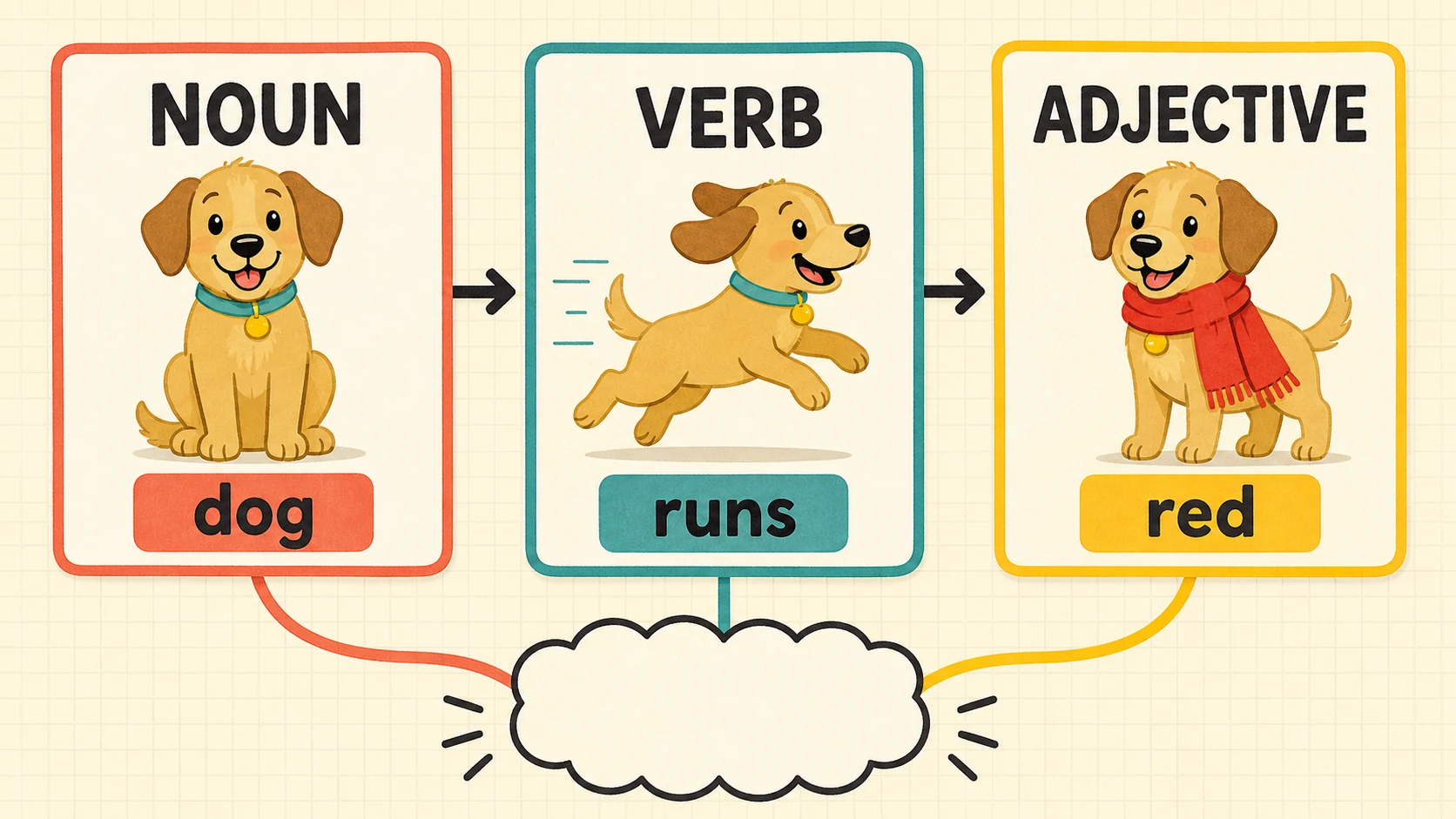
Begin with concrete nouns and observable actions, then connect describing words to the nouns they modify.
Why Parts of Speech Matter in First Grade
Parts of speech give adults and children a shared way to discuss how sentences work. A child who can identify the noun and verb in “Birds sing” can begin to answer practical questions:
- Who or what is the sentence about?
- What is happening?
- Which word could make the meaning more exact?
- Is the sentence complete enough to understand?
This knowledge supports both reading and writing. During reading, a learner can use sentence structure to anticipate the kind of word that belongs in a blank or to clarify who performed an action. During writing, the learner can check whether a sentence has a clear subject and action, replace a vague noun, or add a useful adjective.
The IES foundational reading practice guide provides broad instructional framing for building foundational literacy through explicit teaching, modeling, guided practice, and attention to students’ responses. It does not evaluate this WorksheetWise topic or prescribe a particular parts-of-speech worksheet. Its value here is the high-level principle that instruction should be clear, systematic, and responsive.
The IES elementary writing practice guide similarly supports explicit teaching of writing processes and skills, regular opportunities to write, and a supportive writing environment. Parts-of-speech work should therefore lead back to meaningful sentences rather than remain an exercise in labeling words.
The Common Core English Language Arts standards include first-grade language expectations involving nouns, pronouns, verbs, adjectives, and conjunctions. Consult the applicable local curriculum before treating any single resource as a complete standards plan.
Prerequisites to Check Before Formal Classification
A learner does not need advanced reading ability before beginning grammar, but several underlying skills make the work more productive.
Oral sentence awareness
Ask the child to repeat a short sentence such as “The dog runs.” Then change one part:
- “The puppy runs.”
- “The dog sleeps.”
- “The spotted dog runs.”
If the learner notices what changed, the child is already attending to word functions even without knowing the labels.
Basic word and sentence concepts
Check whether the learner can distinguish a word from a sentence and recognize that spaces separate written words. It also helps if the child can identify the beginning and end of a simple sentence.
A learner who treats “the red ball” as one word may need word-boundary practice before being asked to circle only the adjective. Finger spaces, word cards, or separate counters can make the boundaries visible.
Access to the sentence’s meaning
The child must understand the vocabulary in a sentence before classifying its words. In “The otter dives,” unfamiliarity with otter may look like a grammar error. Replace an unfamiliar sentence with “The dog jumps.” If the child succeeds, vocabulary—not the noun concept—was probably the barrier.
Ability to answer concrete prompts
Before requiring terminology, ask:
- Who or what is named?
- What is happening?
- What kind is it?
- Which one?
- How many?
These prompts reveal whether the learner understands the underlying relationship. A child who can say that blue tells what kind of kite it is has the concept needed to learn the word adjective.
A Grade-Appropriate Teaching Progression
The progression below is instructional guidance, not a universal schedule. Move ahead when the learner can classify familiar words in sentences and explain the choice. Return to an earlier phase when accuracy depends on guessing, position, or memorized word lists.
| Phase |
Main focus |
Useful model |
Evidence that the learner is ready to continue |
| 1. Name and act |
Concrete nouns and action verbs |
Hold up an object; perform an action |
Names an object and tells the action |
| 2. Sort words |
Nouns versus verbs |
Two labeled boxes or hoops |
Sorts familiar words and explains the categories |
| 3. Read sentences |
Nouns and verbs in context |
“Cats nap.” |
Finds who or what and what happens |
| 4. Add detail |
Frequently occurring adjectives |
“a small cat” |
Connects the adjective to the noun it describes |
| 5. Handle boundaries |
Words with more than one possible job |
“I can run” and “We went for a run” |
Uses the sentence, not the word alone, to decide |
| 6. Apply in writing |
Choose and revise nouns, verbs, and adjectives |
“The bird flew” → “The red bird soared” |
Makes a change and explains its effect |
| 7. Extend carefully |
Pronouns and simple conjunctions |
“Mia runs, and she jumps” |
Tracks what a pronoun replaces and what a conjunction joins |
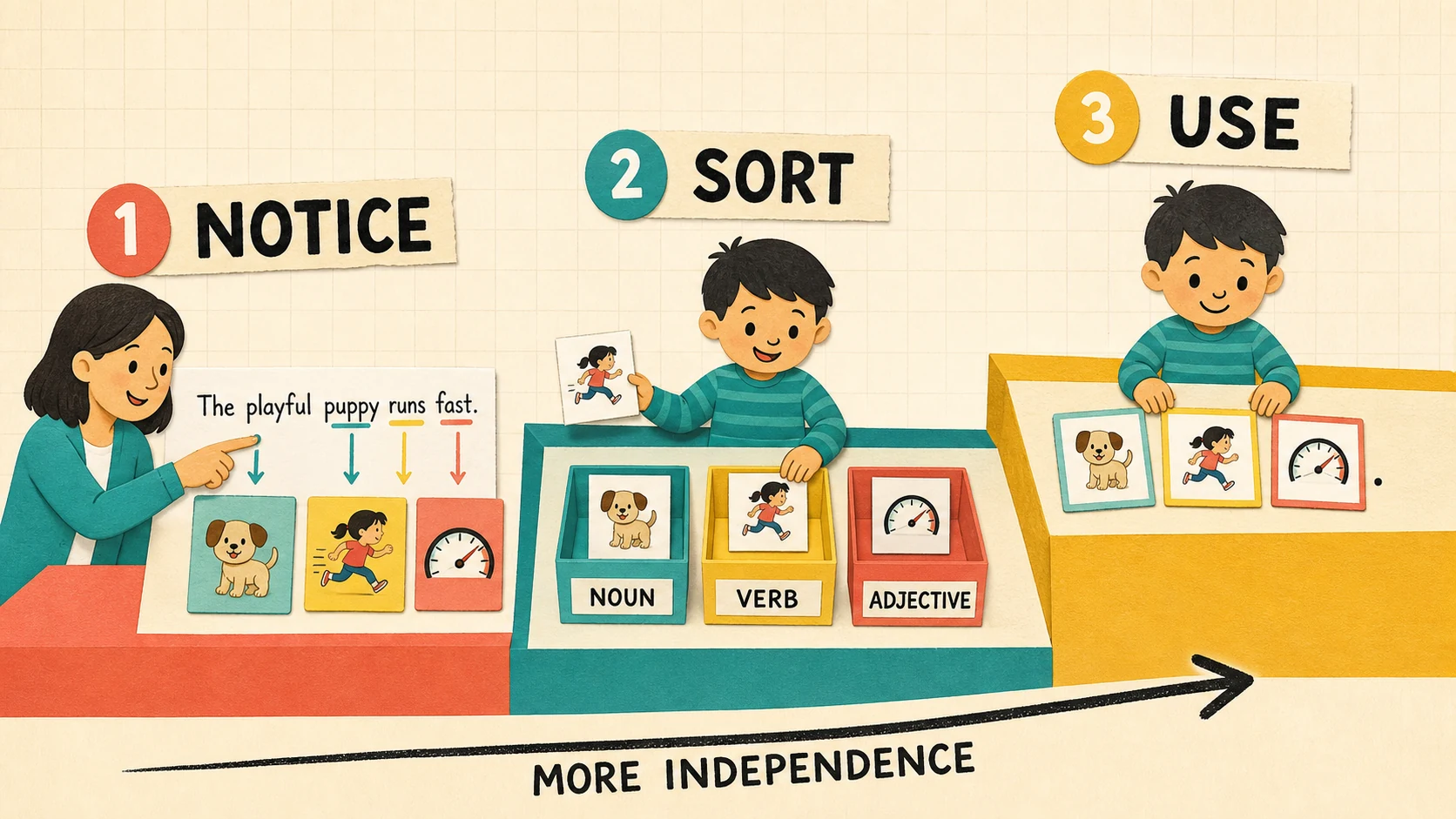
Reduce prompts gradually: model first, solve together, then ask the learner to explain an independent answer.
The broader 1st Grade worksheet hub can help families coordinate grammar practice with other first-grade work. For a narrower view, use the 1st Grade Grammar collection.
Concrete and Visual Models That Clarify the Skill
Person, place, and thing cards for nouns
Place a picture of a teacher, a park, and a spoon on the table. Say each word and sort it beneath the headings person, place, and thing. These are all nouns even though they belong to different meaning groups.
Ideas are also nouns, but words such as hope and joy are less concrete. They can be acknowledged when they arise in a book or conversation without becoming the starting point for classification.
Movement for verbs
Invite the learner to clap, hop, whisper, read, or think. State the connection explicitly: “Hop is the action. In this sentence, it is the verb.”
Physical movement is especially helpful when a child confuses the doer with the action. Write The rabbit hops on two cards or strips. Let one card represent the rabbit and the other represent what it does.
Not every verb is an obvious movement. Forms of be can help tell what something is: “The soup is hot.” Begin with observable actions, then introduce linking uses in familiar sentences when the learner is ready.
Noun-and-adjective picture pairs
Show the same object in two versions: a red cup and a blue cup, or a small leaf and a large leaf. Ask which word identifies the object and which word tells more about it.
Keep the relationship visible:
red → cup
The arrow matters. It shows that red is not merely a “describing word” somewhere in the sentence; it describes the noun cup.
Color coding with a verbal explanation
A consistent scheme can lower visual load:
- Blue underline for nouns
- Red underline for verbs
- Green underline for adjectives
Color is a support, not the concept itself. Always pair it with an explanation: “I underlined tiny in green because it describes the noun ant.” A learner who remembers colors but cannot explain the relationship needs more oral modeling.
Fully Checked Worked Examples
These examples use meaning and sentence function together. That prevents a common mistake: assigning a permanent label to a word without considering its job in the sentence.
Example 1: Identify the noun
Sentence: The frog jumps.
Prompt: Which word is the noun?
- Ask, “Who or what is named?”
- Frog names an animal.
- Jumps tells what the frog does.
- The points to the noun but does not name the animal.
Answer: frog is the noun.
Check: Replace frog with another animal: “The rabbit jumps.” The sentence still has a named doer followed by an action.
Example 2: Identify the verb
Sentence: Birds build nests.
Prompt: Which word is the verb?
- Ask, “What do the birds do?”
- They build.
- Birds names the animals.
- Nests names the things they build.
Answer: build is the verb.
Check: Act out or describe the action. “Build” tells what the birds do. Notice that two nouns appear in the sentence, but there is one action verb.
Example 3: Identify the adjective and its noun
Sentence: The yellow bus stops.
Prompt: Which word is the adjective?
- Find the naming word: bus.
- Ask, “What kind of bus?”
- The answer is yellow.
- Stops tells what the bus does.
Answer: yellow is the adjective. It describes bus.
Check: Remove the adjective: “The bus stops.” The sentence remains grammatical, but it contains less detail about the bus.
Example 4: Classify more than one target
Sentence: Three playful kittens tumble.
- kittens is a noun because it names the animals.
- tumble is a verb because it tells what the kittens do.
- three is an adjective here because it tells how many kittens.
- playful is an adjective because it tells what kind of kittens.
Checked answer: noun—kittens; verb—tumble; adjectives—three, playful.
This example is more demanding because the noun has two modifiers. If the learner finds playful but misses three, return to the adjective prompts “what kind?” and “how many?”
Example 5: A word whose job changes
Sentence A: We play outside.
Sentence B: The school play was funny.
In Sentence A, play tells what we do, so it is a verb.
In Sentence B, play names a thing—an event performed at school—so it is a noun.
Checked answer: play is a verb in Sentence A and a noun in Sentence B.
The spelling does not decide the part of speech. The word’s job in its sentence does.
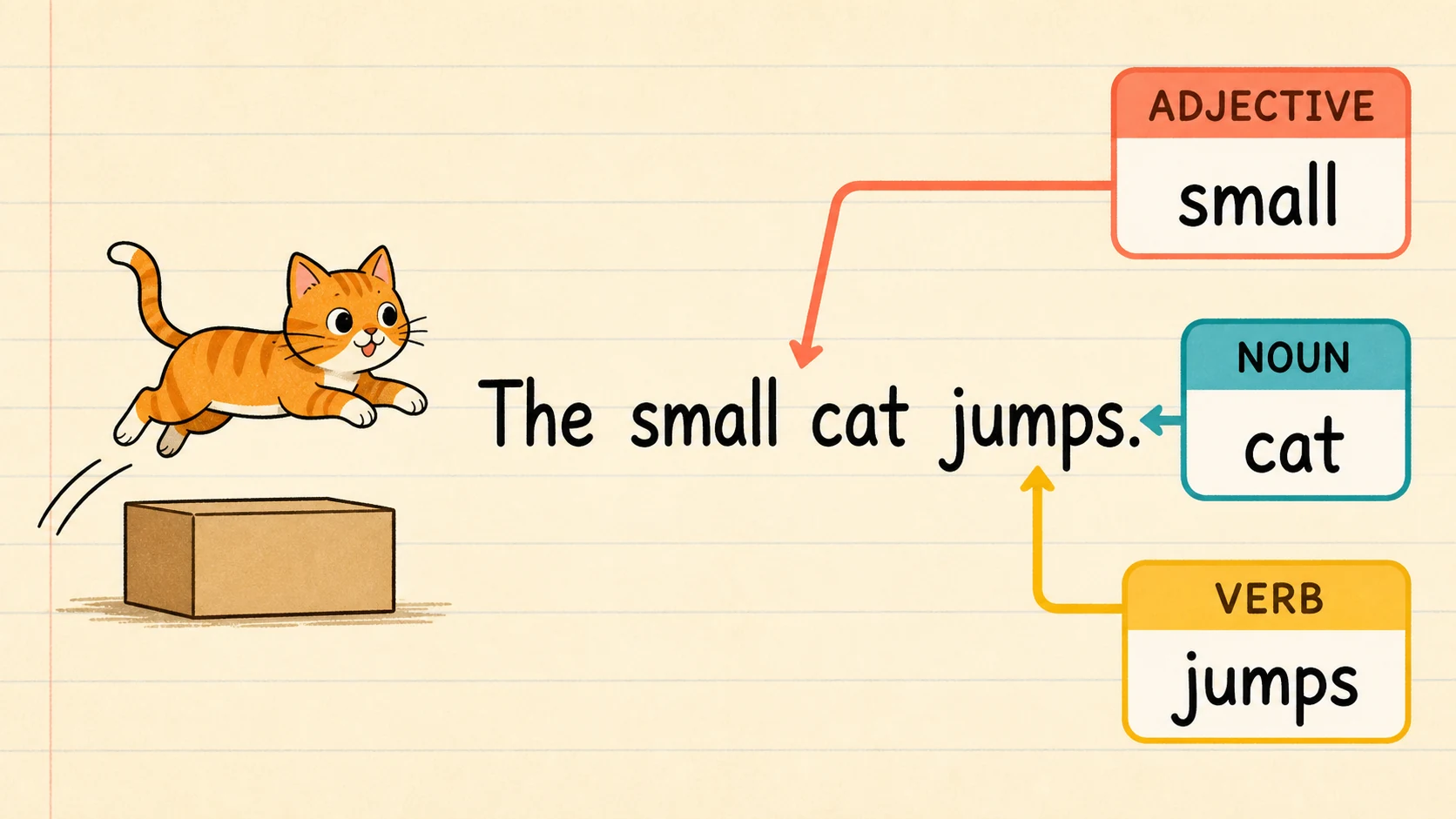
Move from an object, action, or picture to a sentence, and require a reason for the final label.
Boundary Cases and Misconceptions
“A noun is something you can touch”
That shortcut works for many early examples, but it is incomplete. A noun may name a person, place, thing, or idea. Even within first-grade language, a place such as school remains a noun when no one is touching it. Teach naming as the central feature and use touch only as an initial concrete support.
“Every action-like word is a verb”
Context controls the answer. Run is a verb in “I run,” but it is a noun in “We went for a run.” First graders do not need an exhaustive account of flexible word classes, but they should learn to inspect the sentence before labeling a familiar word.
“The first word is always the noun”
This guess appears to work in sentences such as “Dogs bark,” then fails in “The dogs bark” or “At noon, dogs nap.” Vary sentence openings and ask the child to locate the naming word rather than depend on position.
“Every describing word is an adjective”
For the target level, connect adjectives directly to nouns. In “The fast rabbit hops,” fast describes rabbit. In more advanced analysis, similar words may modify actions, but that distinction can wait until the learner’s current noun-verb-adjective framework is stable.
“A sentence has only one noun”
“The girl carries a basket” contains two nouns: girl and basket. One names the doer, and one names the thing carried. Practice should include both single-noun sentences and sentences with multiple nouns.
“Correct circling proves understanding”
A child may copy a visual pattern or guess from word position. Ask, “How do you know?” A short answer—“Soft tells what kind of blanket”—offers stronger evidence than an unaccompanied circle.
A Short, Repeatable Lesson Routine
Keep a focused lesson brief enough that the learner can remain attentive. Adjust the duration to the child’s response rather than treating the suggested structure as a mandatory timetable.
1. Retrieve
Review two familiar words or one familiar sentence. Ask the learner to identify a noun and a verb without introducing new material immediately.
2. Model
Think aloud through one example:
“Fox names the animal, so it is a noun. Dashes tells what the fox does, so it is a verb.”
Point to each word as you explain it.
3. Solve together
Use a second sentence. Let the learner answer one prompt while you supply another. If the sentence is “The furry fox dashes,” the child might locate fox while you model how furry describes it.
4. Check independently
Give two to four carefully chosen items. Ask for a reason on at least one, rather than extending the set merely to fill time.
5. Apply
Have the learner say or write a new sentence with one required feature, such as an adjective that describes a chosen noun.
6. Record one observation
Note the smallest useful finding: “Finds action verbs independently; still circles the with the noun.” That note should shape the next lesson.
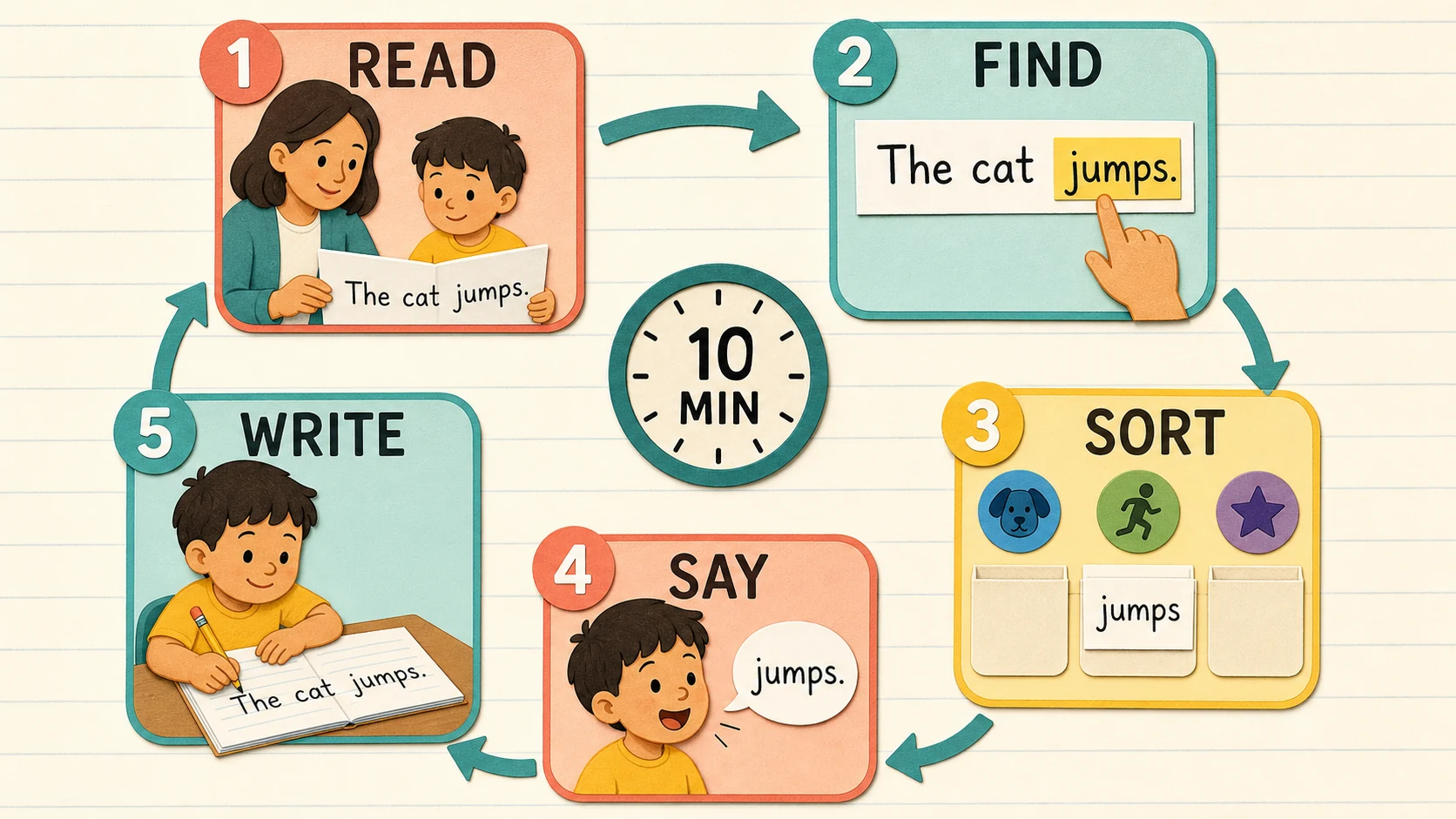
Use a model-together-independent cycle, then finish with one sentence the learner creates or revises.
Choosing Practice That Matches the Learner
Choose practice according to the error pattern, not simply the learner’s age or the number printed on a page.
For a beginner, select items with:
- Familiar vocabulary
- Short sentences
- Concrete nouns
- Observable action verbs
- One clearly linked adjective
- One direction at a time
For a learner gaining accuracy, include sentences with two nouns, plural nouns, adjectives showing color or size, and verbs that are not always physical. Ask the child to underline the target and explain its job.
For a learner who is accurate but dependent on prompts, reduce supports. Mix noun, verb, and adjective questions instead of presenting a whole page of one type. Add a short writing task so the learner must produce the category rather than recognize it.
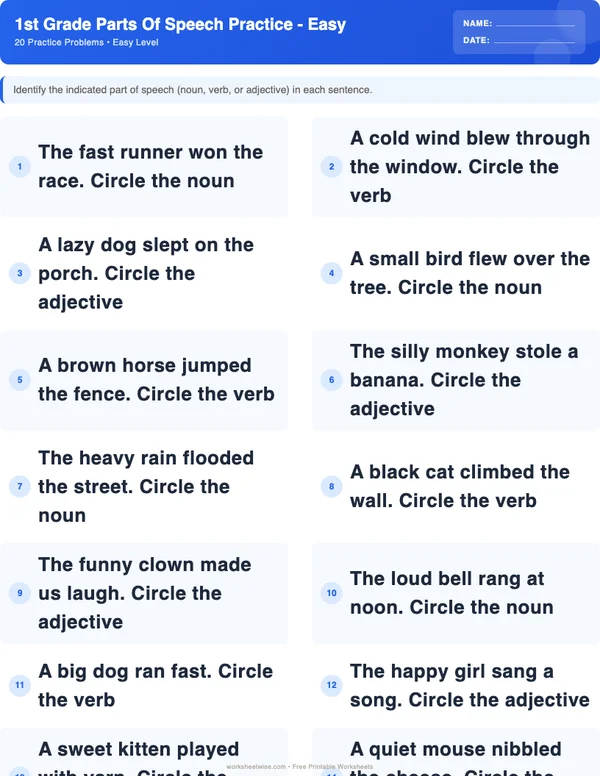
The free easy Parts of Speech worksheet contains 12 exercises focused on identifying nouns, verbs, and adjectives in sentences. It includes a separate answer key. Preview a few items orally before assigning the page, especially if reading effort might interfere with grammar analysis.
The focused 1st Grade Parts of Speech pack contains 18 worksheets and may be useful when repeated practice is needed across multiple sessions. More pages are not automatically better: select only the amount that produces informative, attentive work.
Differentiation Without Changing the Core Goal
When reading is the main obstacle
Read the sentence aloud while the learner follows the print. Confirm unfamiliar vocabulary before discussing grammar. You can assess parts-of-speech understanding without turning every grammar item into a decoding test.
When working memory is overloaded
Cover the rest of the page and show one sentence at a time. Use only two categories initially, such as noun and verb. Keep a small reference card visible:
- Noun: names
- Verb: tells an action or state
- Adjective: describes a noun
When handwriting is effortful
Allow pointing, movable word cards, oral answers, or colored counters. The instructional goal is classification and use, not handwriting endurance.
When the learner needs more challenge
Ask for revision rather than additional labeling:
“The dog ran.”
Possible revision: “The shaggy dog raced.”
Then discuss what changed. Shaggy gives information about the dog, and raced gives a more specific action than ran. Avoid suggesting that every sentence needs an adjective; clear writing sometimes benefits from a simple noun and strong verb.
When the learner speaks another language
Use familiar pictures and objects, establish sentence meaning, and compare examples carefully. Do not treat limited English vocabulary as proof of weak grammatical reasoning. Keep the category goal stable while lowering unnecessary vocabulary demands.
Diagnosing Errors and Monitoring Progress
A wrong answer is useful when it reveals the learner’s rule. Ask the child to explain before correcting.
| Observed response |
Possible interpretation |
Teaching response |
| Circles the dog when asked for the noun |
Treats the whole noun phrase as one unit |
Use separate word cards; identify which word actually names the animal |
| Labels dog as the verb in “The dog runs” |
Confuses the doer with what the doer does |
Act out runs and contrast “who?” with “does what?” |
| Calls every colorful word an adjective |
Relies on topic rather than sentence function |
Draw an arrow from each adjective to the noun it describes |
| Labels play the same way in every sentence |
Treats word class as a permanent property |
Compare “We play” with “The play began” |
| Performs well orally but poorly on the page |
Reading, visual load, or directions may interfere |
Read aloud, reveal one item at a time, and shorten directions |
| Answers correctly but cannot explain |
May be guessing or following position patterns |
Require a brief reason and vary word order |
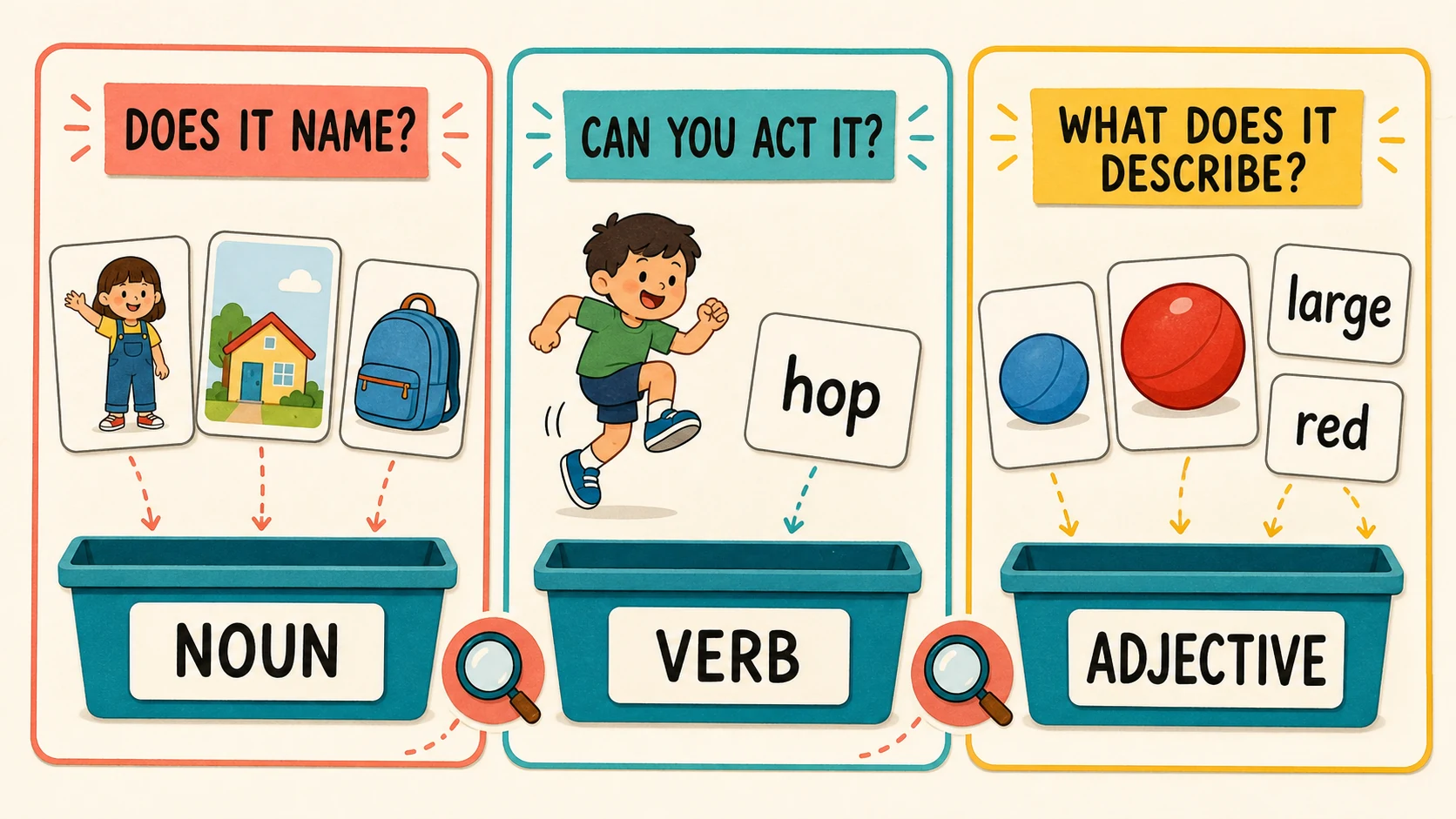
Record the learner’s apparent rule, then choose the smallest contrast that makes the correct relationship visible.
Monitor with a small recurring sample rather than a long test. Once or twice a week, use three sentences:
- One familiar noun-and-verb sentence
- One sentence containing an adjective
- One transfer sentence with a changed word order or a word that could have another job elsewhere
Record accuracy, independence, and explanation separately. “Three correct with two prompts” is different from “three correct independently with reasons.” Advance when performance is stable across more than one sitting and transfers to a new sentence. If errors cluster around reading or vocabulary, adjust those demands before reteaching the grammar category.
A Two-Week Practice Plan
This plan assumes short sessions across ten instructional days. It is an adaptable example, not a universal timetable. Pause, repeat, or combine days according to the learner’s work.
| Day |
Focus |
Suggested activity |
Quick evidence |
| 1 |
Concrete nouns |
Sort pictures into person, place, and thing |
Explains why each word names something |
| 2 |
Action verbs |
Act out five verbs; use each in a sentence |
Identifies the action word |
| 3 |
Noun plus verb |
Build sentences with two word-card groups |
Finds who or what and what happens |
| 4 |
Nouns and verbs in print |
Analyze four short sentences |
Explains at least two answers |
| 5 |
Review and transfer |
Mix oral, card, and written examples |
Maintains accuracy in a new format |
| 6 |
Adjectives |
Describe familiar objects by color, size, or number |
Links each adjective to a noun |
| 7 |
Three categories |
Sort nouns, verbs, and adjectives |
Uses meaning rather than card position |
| 8 |
Sentence analysis |
Find targets in sentences with two nouns or two adjectives |
Identifies every requested target |
| 9 |
Boundary cases and revision |
Compare play as noun and verb; improve one sentence |
Uses context and explains a revision |
| 10 |
Independent check and writing |
Complete a short mixed set; write two sentences |
Classifies and applies the categories |
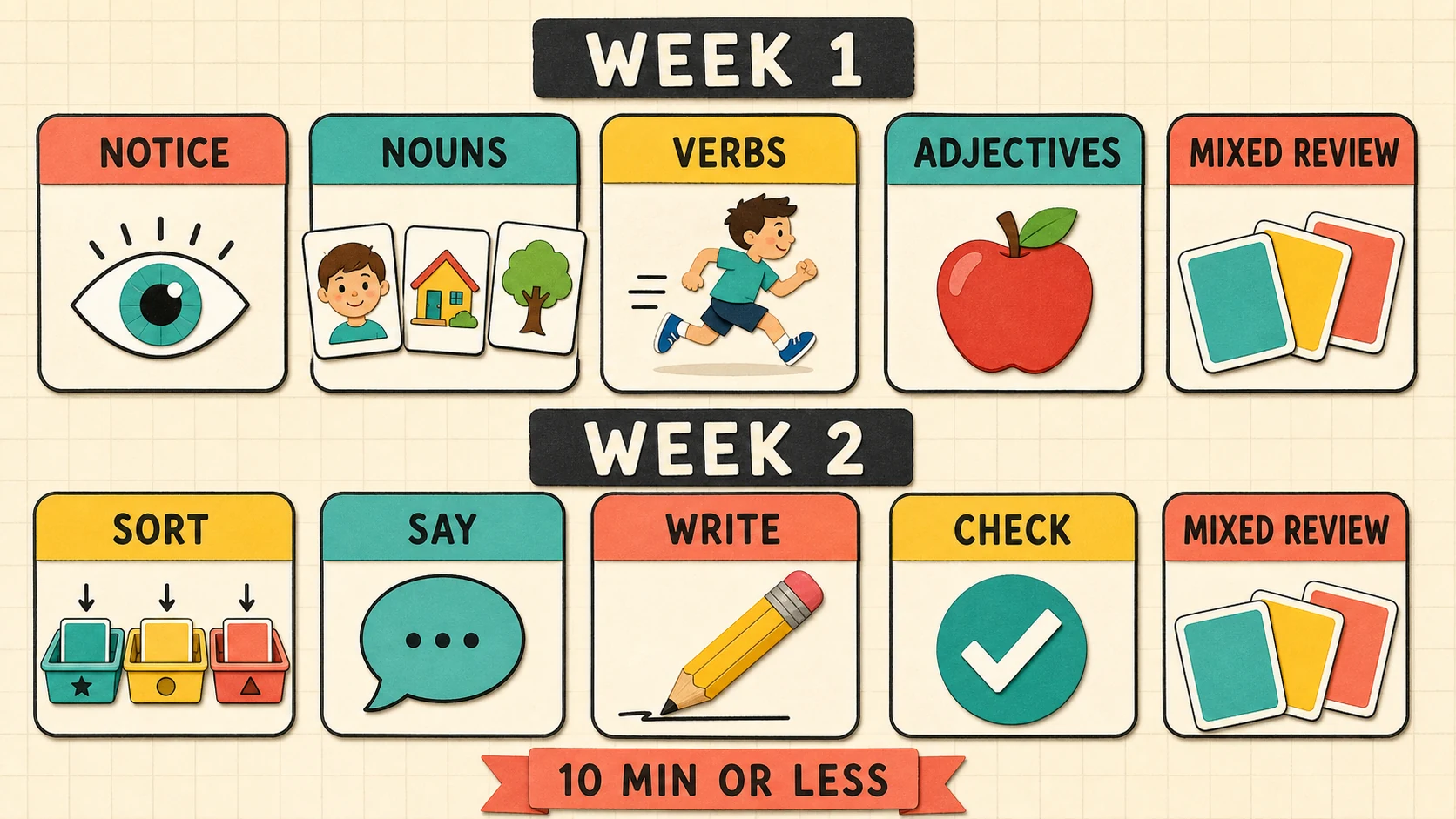
Treat the plan as a decision framework: repeat a day when explanations remain uncertain, and move on when the skill transfers.
During the plan, alternate recognition with production. Circling nouns is recognition; naming three nouns in the room is production. Underlining a verb is recognition; finishing “The rabbit ___” with a fitting action is production. Both forms matter.
Limits, Sound Expectations, and the Next Step
A parts-of-speech worksheet provides a sample of performance, not a complete picture of language development. It cannot by itself show whether an error came from grammar knowledge, decoding, vocabulary, attention, directions, or visual load. Classification also does not automatically produce clear writing. Learners need opportunities to discuss, compose, reread, and revise real sentences.
Do not rush through all eight traditional parts of speech simply to complete a list. For first-grade practice, secure understanding of nouns, verbs, and frequently occurring adjectives is a more useful foundation. Add pronouns and simple conjunctions through meaningful sentences when the learner is ready. Revisit singular and plural forms, verb meaning, and sentence construction within the sequence required by the local curriculum.
The honest next step is to collect a small piece of evidence. Give the learner three oral examples, then try the free 1st Grade Parts of Speech worksheet. Note which answers are independent, which require prompts, and how the learner explains one choice. Use that record—not the grade label alone—to select the next lesson or create a more targeted activity with the free worksheet generators.