What 5th Grade Sentence Structure Includes
The direct answer: 5th Grade Sentence Structure instruction should help a learner recognize, build, expand, combine, and revise complete sentences. Begin with subjects and predicates, confirm that the learner can distinguish sentences from fragments and run-ons, and then progress through sentence expansion, compound and complex structures, purposeful sentence beginnings, and sentence variety.
The learner’s observed work should determine the pace. A child who cannot reliably identify a complete thought needs different practice from one who writes complete but repetitive sentences.
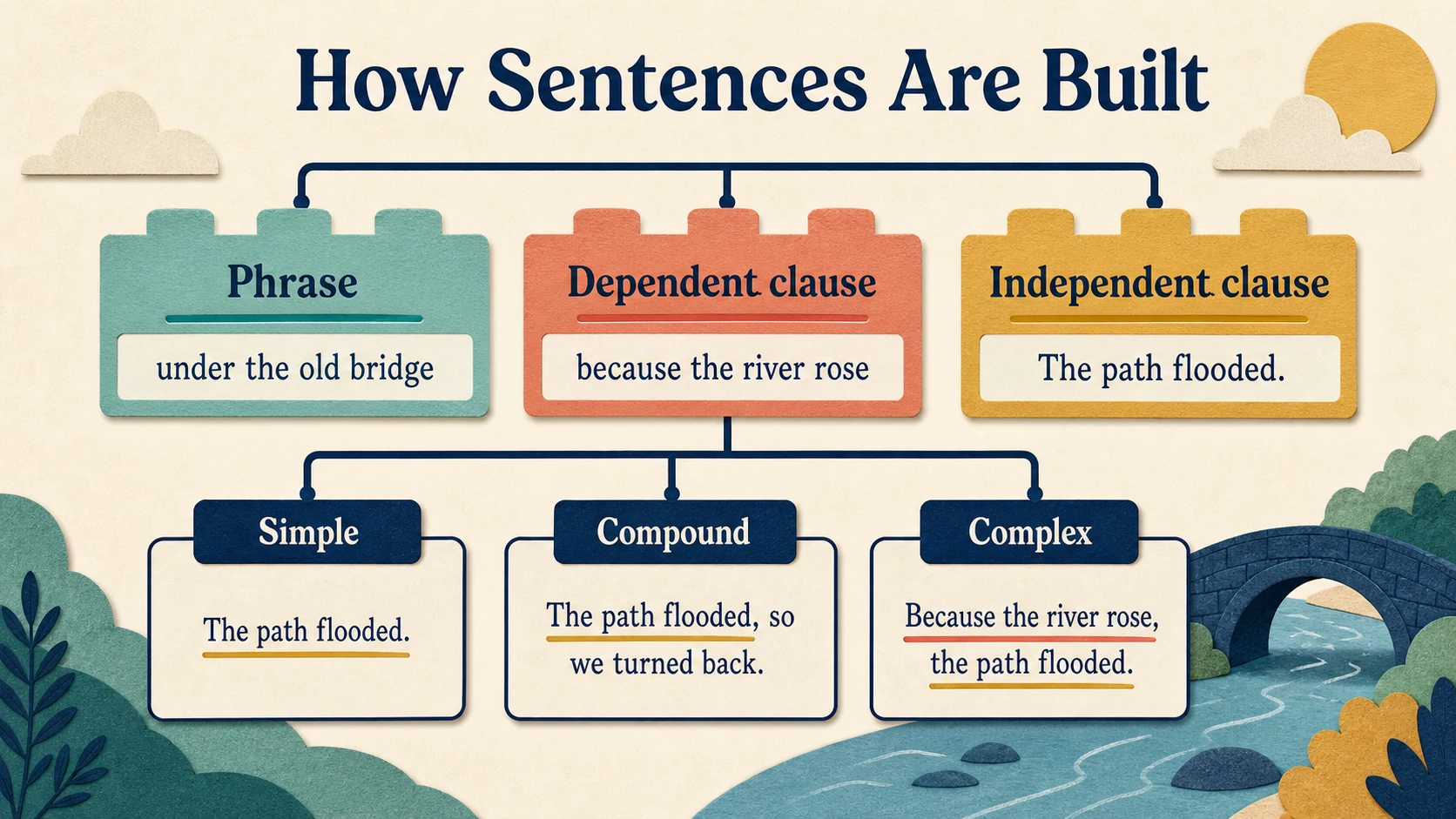
The skill develops from sentence completeness toward clear, controlled sentence variety.
A useful fifth-grade target is not “make every sentence longer.” It is “choose a structure that expresses the intended relationship clearly.” A short sentence can emphasize a point. A longer sentence can connect ideas or add detail. Both can be effective.
Sentence-level work also belongs inside real writing. The IES elementary writing practice guide recommends teaching sentence construction as part of writing development, alongside regular opportunities to write and use the writing process. That source provides high-level instructional framing; it did not evaluate WorksheetWise or any worksheet named here.
Grade labels describe the intended practice level, not a universal timetable. Local curricula and instructional sequences differ. Use the 5th Grade Grammar hub to see related work, but select the next activity according to what the learner can currently explain and produce.
Prerequisites and the Best Starting Point
Before asking a learner to manipulate compound or complex sentences, check four foundations.
Complete thoughts
A complete sentence communicates a complete thought. It ordinarily has a subject and a predicate:
- The lantern glowed.
- Our neighbors planted tomatoes.
- The last bus of the evening arrived late.
Ask the learner to identify who or what the sentence is about, then what that subject does or is. The catalogue’s “Who? Did what?” or “What? Did what?” framework makes this relationship visible.
Be careful with commands. In “Close the gate,” the subject you is understood rather than written. The sentence is still complete.
Subjects, predicates, and verbs
The learner should be able to separate a complete subject from a complete predicate:
The small gray rabbit | hid behind the shed.
The simple subject is rabbit. The simple predicate, or verb, is hid. The complete subject and predicate include their attached details.
A learner who circles every noun as the subject may need focused identification practice. A learner who calls a prepositional phrase the predicate may need to locate the verb first.
Logical word order
Fifth-grade sentence work assumes that a learner can arrange familiar words into a conventional English sentence:
library / after lunch / visited / our class / the
A clear arrangement is:
Our class visited the library after lunch.
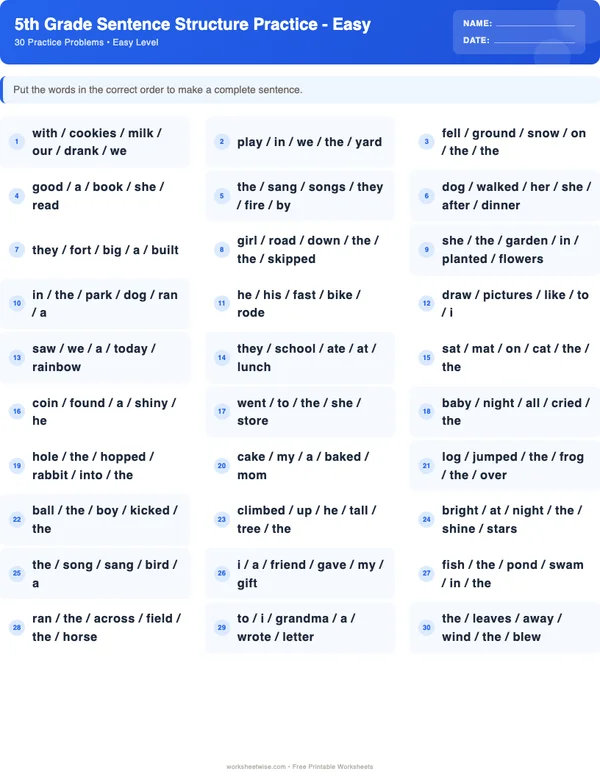
This checks syntax and sentence formation without yet requiring the learner to invent content. The available easy sentence-structure worksheet provides 30 exercises of this kind and includes a separate answer key.
Basic punctuation
The learner should recognize that a written sentence begins with a capital letter and closes with appropriate end punctuation. Internal punctuation becomes increasingly important when clauses are combined, but missing capitals and periods can obscure whether the learner understands the underlying structure.
Use a short diagnostic rather than guessing. Ask the learner to:
- Sort three sentences, two fragments, and one run-on.
- mark the subject and predicate in two complete sentences;
- arrange one scrambled sentence;
- combine two related sentences;
- revise a paragraph containing repetitive sentence beginnings.
Record the kind of help needed. An accurate response after a small prompt is different from an independent response.
A Grade-Appropriate Teaching Progression
The following progression moves from recognition to deliberate use. It is an instructional sequence, not a required calendar.
| Stage |
Learner’s task |
Example |
Move forward when |
| 1. Establish completeness |
Distinguish sentences from fragments and run-ons |
“Across the empty field” is incomplete |
The learner explains what is missing |
| 2. Identify sentence parts |
Find subjects, predicates, and verbs |
“The bright kite / rose quickly” |
Identification is accurate in varied examples |
| 3. Restore word order |
Arrange words into a complete sentence |
“Maya carried the boxes upstairs” |
Order is logical and punctuation is present |
| 4. Expand sentences |
Add precise details without losing the core |
“The fox waited” becomes “The red fox waited beside the fence” |
Added details remain grammatically attached |
| 5. Combine related ideas |
Use a conjunction or shared element |
“The trail was steep, but we continued” |
The connection matches the intended meaning |
| 6. Build complex sentences |
Join a dependent idea to an independent clause |
“Because rain fell, the game ended early” |
The learner can identify the complete thought |
| 7. Vary structure |
Change beginnings, lengths, and patterns |
“After lunch, we rehearsed” |
Variation improves rather than obscures meaning |
| 8. Apply in writing |
Revise authentic sentences and paragraphs |
Replace repetition or repair boundaries |
The learner transfers the skill independently |
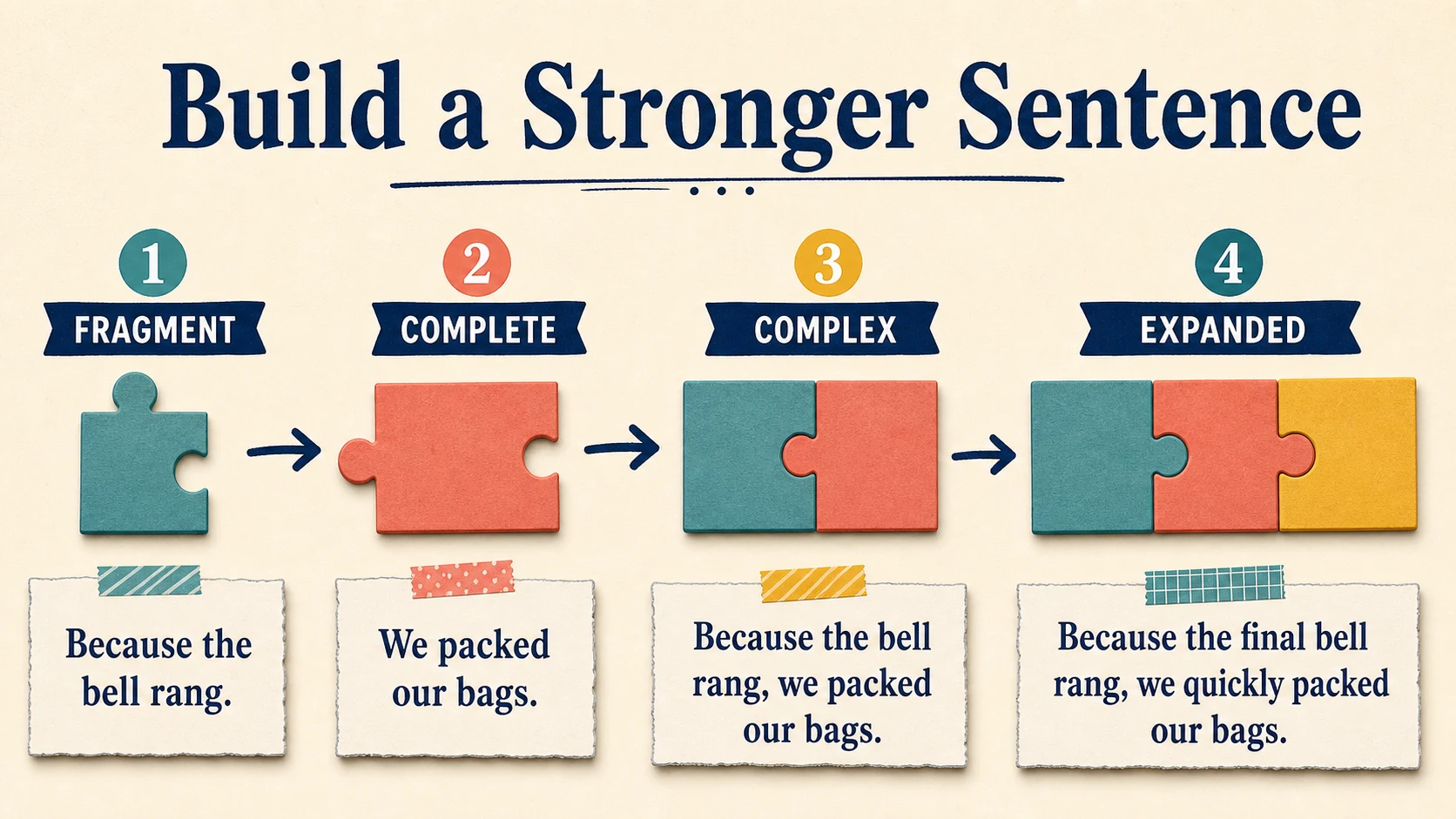
Support should decrease as the learner explains choices and transfers them into original writing.
When to stay at a stage
Do not move ahead merely because a page is finished. Stay when the learner:
- guesses whether a group of words is complete;
- cannot locate the main verb;
- joins unrelated ideas because a conjunction is available;
- creates new errors while expanding a sentence;
- succeeds only when an adult identifies the clause boundary.
Move ahead when the learner can explain the decision, complete several varied items, and use the skill in a sentence that was not copied from the model.
The Common Core ELA framework organizes literacy through grade-specific expectations and language use across subject areas. The supplied catalogue places fifth-grade sentence work around expanding, combining, and reducing sentences for meaning, interest, and style. This guide does not claim comprehensive standards alignment, and local requirements should be checked separately.
Concrete and Visual Models
Grammar becomes easier to discuss when sentences are represented as parts that can be moved and tested.
The subject-predicate frame
Use two boxes:
| Who or what? |
Did what, is what, or was what? |
| The tired hikers |
rested beside the stream. |
| Our science project |
is nearly complete. |
Then add optional detail cards:
| When? |
Who or what? |
Did what? |
Where or how? |
| Before sunset, |
the tired hikers |
rested |
beside the stream. |
The core remains “hikers rested.” Details answer additional questions, but they do not replace the subject or verb.
Clause blocks
Represent each independent clause with a complete rectangular block:
[The wind strengthened.]
[The boats returned to shore.]
A coordinating conjunction can connect the blocks:
[The wind strengthened], so [the boats returned to shore.]
Represent a dependent clause with an open block because it cannot stand by itself:
<When the wind strengthened, [the boats returned to shore.]
This model helps distinguish a compound sentence, which joins complete thoughts, from a complex sentence, which includes a dependent relationship.
Oral rehearsal before writing
Say a phrase such as “beneath the wooden stairs.” Ask the learner to decide whether it expresses a complete thought. Then supply different completions:
- The kitten slept beneath the wooden stairs.
- Beneath the wooden stairs, we found the missing glove.
Oral rehearsal reduces the number of demands competing on the page. It is an instructional suggestion from the supplied teaching guidance, not a child-specific or medical recommendation.
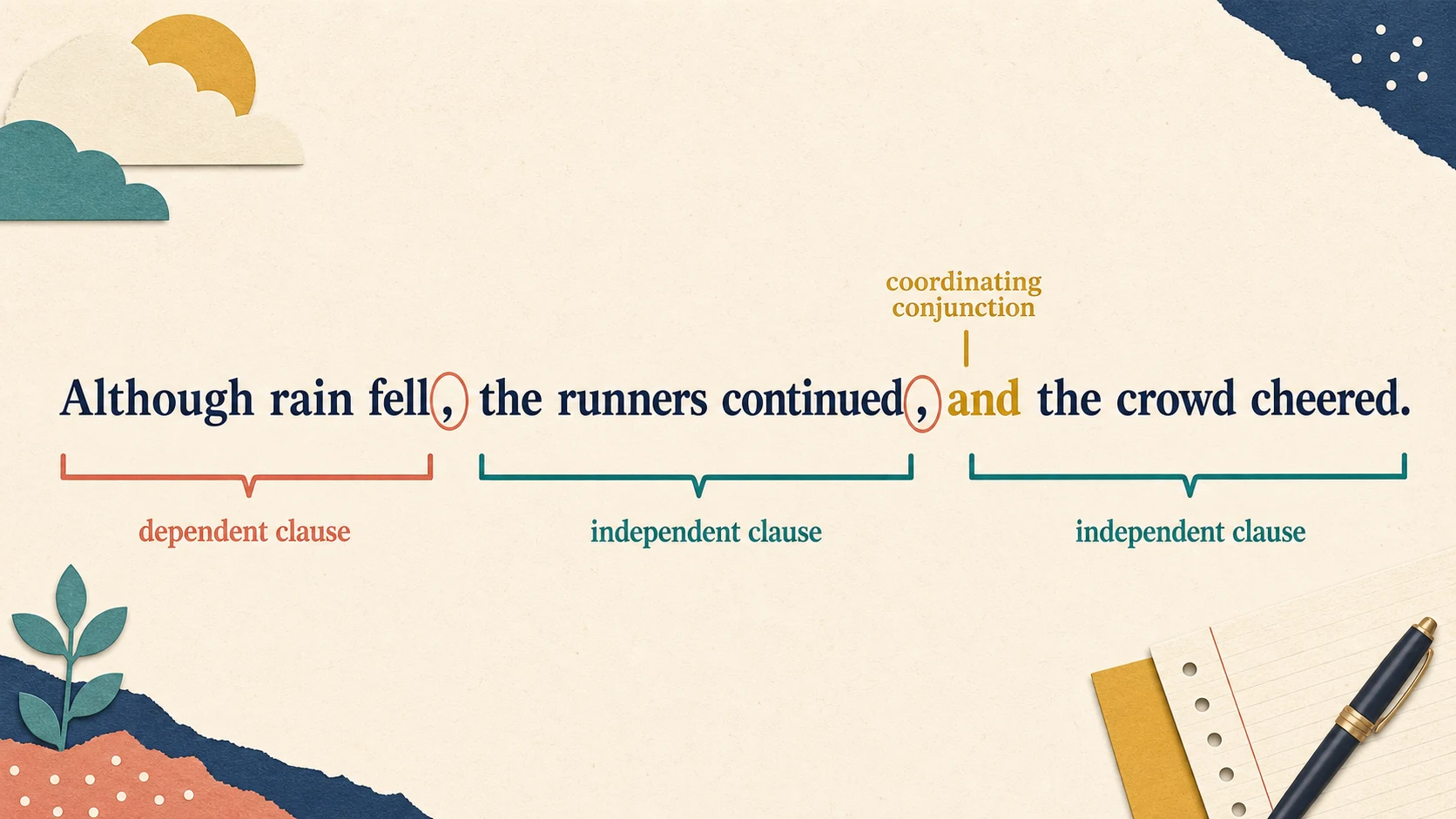
Separate the sentence core from movable details before asking for independent revision.
Fully Checked Worked Examples
Example 1: Arrange words into a complete sentence
Words: carefully / the glass model / carried / Jordan / across the room
First find the likely subject: Jordan. Find the verb: carried. Ask what Jordan carried: the glass model. Place the adverb and location where their meaning is clear.
Answer: Jordan carefully carried the glass model across the room.
Check:
- Subject: Jordan
- Predicate: carefully carried the glass model across the room
- Main verb: carried
- Complete thought: yes
- Capital and period: yes
“Carefully, Jordan carried the glass model across the room” is also grammatical. Word-order exercises can sometimes permit more than one sound arrangement, so judge both grammar and meaning rather than matching mechanically.
Example 2: Diagnose and repair a fragment
Original: Because the sidewalk was icy.
The word because makes the idea dependent. The reader is left waiting to learn what happened because the sidewalk was icy.
Repair: Because the sidewalk was icy, Lena walked slowly.
Check:
- Dependent clause: Because the sidewalk was icy
- Independent clause: Lena walked slowly
- Subject of independent clause: Lena
- Verb of independent clause: walked
- Complete thought: yes
- Comma after the opening dependent clause: present
Boundary case: “The sidewalk was icy” is complete because removing because restores an independent clause. “Because the sidewalk was icy” is not complete in this context.
Example 3: Repair a run-on
Original: The museum closed at five we arrived ten minutes too late.
There are two independent clauses:
- The museum closed at five.
- We arrived ten minutes too late.
One correct repair uses a period:
The museum closed at five. We arrived ten minutes too late.
Another uses a semicolon:
The museum closed at five; we arrived ten minutes too late.
A third makes the relationship explicit:
The museum closed at five, so we arrived ten minutes too late to enter.
The third version adds to enter so the meaning is precise. It does not claim that arriving late caused the museum to close.
Check: Each side of the period or semicolon can stand alone. In the third version, a comma and coordinating conjunction connect the two independent clauses.
Example 4: Combine repeated information
Original sentences:
The dog is large.
The dog is brown.
The dog waits beside the gate.
Combined answer: The large brown dog waits beside the gate.
Check:
- Repeated subject reduced to one noun phrase: The large brown dog
- Predicate retained: waits beside the gate
- Meaning retained: large, brown, dog, waiting, gate
- New sentence is complete: yes
A second valid answer is “The dog is large and brown, and it waits beside the gate.” That version emphasizes the dog’s qualities before its action. Combining is not merely deleting repeated words; the writer chooses the relationship and emphasis.
Example 5: Choose a conjunction by meaning
Ideas:
Priya practiced the solo.
Priya still felt nervous.
Because the second idea contrasts with what practice might lead a reader to expect, but is more precise than and.
Answer: Priya practiced the solo, but she still felt nervous.
Check:
- Independent clause 1: Priya practiced the solo
- Independent clause 2: she still felt nervous
- Relationship: contrast
- Comma before the coordinating conjunction: present
“And” would produce a grammatical sentence, but it would express addition rather than highlighting contrast. Grammar and meaning both matter.
Example 6: Vary a repetitive beginning
Original:
We reached the campsite. We unpacked the food. We built a small fire.
Revision: After we reached the campsite, we unpacked the food and built a small fire.
Check:
- Opening dependent clause: After we reached the campsite
- Main clause: we unpacked the food and built a small fire
- Shared subject correctly controls both verbs: unpacked and built
- Sequence remains logical
- Comma after the opening clause: present
A shorter alternative is “We reached the campsite, unpacked the food, and built a small fire.” That version presents a direct sequence. The first revision makes the timing relationship more explicit.
A Short, Repeatable Lesson Routine
A compact routine can be used for a warm-up, tutoring session, or homeschool lesson. Adjust the amount of practice according to the learner’s work rather than forcing a fixed duration.
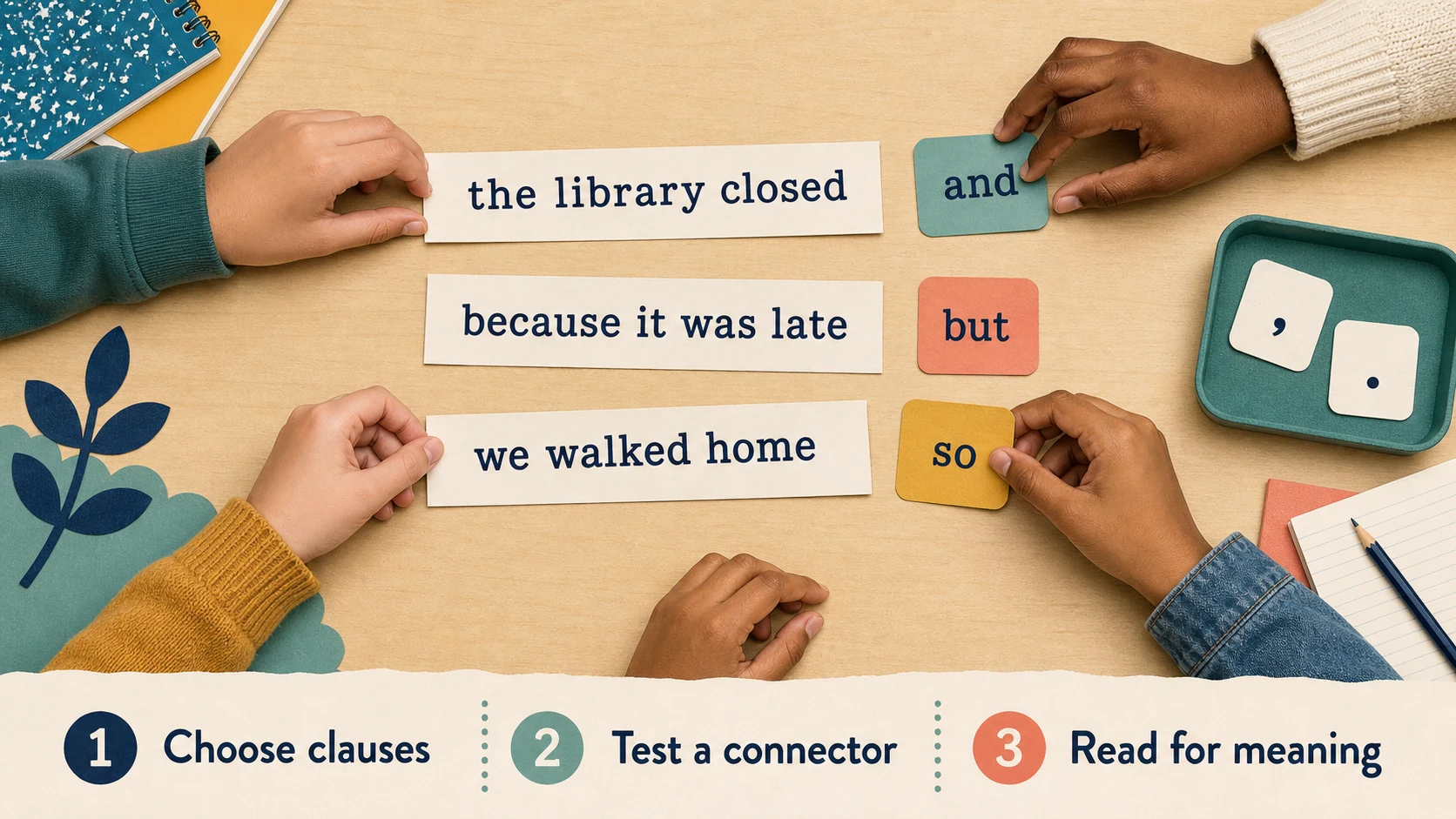
Model one decision, practice it together, and then check whether the learner can make it independently.
Step 1: Notice
Display one sentence or nonexample. Read it aloud. Ask the learner to mark the subject, verb, and any clause boundary.
Example:
Although the clouds gathered, the teams continued practicing.
Do not begin with a long terminology review. Begin with what the sentence is doing.
Step 2: Explain
Model one decision aloud:
“Although the clouds gathered” cannot stand alone here. The sentence needs the complete thought “the teams continued practicing.”
Keep the explanation tied to the visible words.
Step 3: Practice together
Change one element:
Although the wind strengthened, ________.
Invite two possible independent clauses and compare them. Check completeness before discussing style.
Step 4: Try independently
Give two or three items that require the same decision in slightly different forms: identification, repair, and original construction.
Step 5: Transfer
Ask the learner to find or write one sentence using the pattern. A sentence from science notes, a reading response, or a personal narrative is more revealing than another copied model.
Step 6: Record
Note whether the learner worked independently, used a prompt, or needed a model. Record the error type, not simply the score.
The IES writing guide recommends regular writing opportunities as well as explicit attention to sentence construction. Therefore, isolated exercises should lead back into meaningful writing. This is a sourced high-level recommendation; the exact routine above is an instructional suggestion based on the supplied catalogue guidance.
Choosing Practice and Differentiating Support
Practice should match the obstacle visible in the learner’s work.
Match the task to the need
| Observed need |
Suitable practice |
Avoid starting with |
| Words are placed in confusing order |
Scrambled-sentence reconstruction |
Open-ended paragraph revision |
| Subjects or verbs are missing |
Sentence-versus-fragment sorting |
Stylistic variation |
| Ideas run together |
Marking complete thoughts and repairing boundaries |
Longer sentence expansion |
| Sentences are complete but bare |
Adding when, where, how, or which details |
More completeness drills |
| Writing repeats nouns or ideas |
Sentence combining and reduction |
Random conjunction worksheets |
| Every sentence starts alike |
Rearranging beginnings and imitating patterns |
Demanding longer sentences |
| Skills appear in exercises but not writing |
Editing the learner’s own short passage |
Additional isolated identification only |
The free worksheet’s scrambled-word format is appropriate for learners who need controlled practice with word order, sentence formation, and syntax. It is not a complete assessment of fragments, run-ons, clause relationships, or stylistic variation.
For broader practice, the Sentence Structure topic guide can serve as the central route. The focused sentence-structure pack contains 18 worksheets and may suit learners who need repeated practice across the topic. More pages are useful only when the selected task addresses the actual error.
Adjust support without changing the core skill
For a learner who needs more support:
- read the sentence aloud;
- underline the verb before locating the subject;
- place each clause on a separate card;
- offer two conjunctions and compare their meanings;
- provide a sentence frame;
- reduce the number of items while preserving careful explanation.
For a learner ready for greater challenge:
- ask for two valid revisions with different emphasis;
- require an explanation of the punctuation;
- combine three ideas without losing meaning;
- compare a concise sentence with an expanded version;
- revise a real paragraph for sentence variety;
- imitate the structure of a well-crafted sentence using new content.
Difficulty should come from the reasoning demanded, not from unnecessarily obscure vocabulary.
Common Errors and Diagnostic Responses
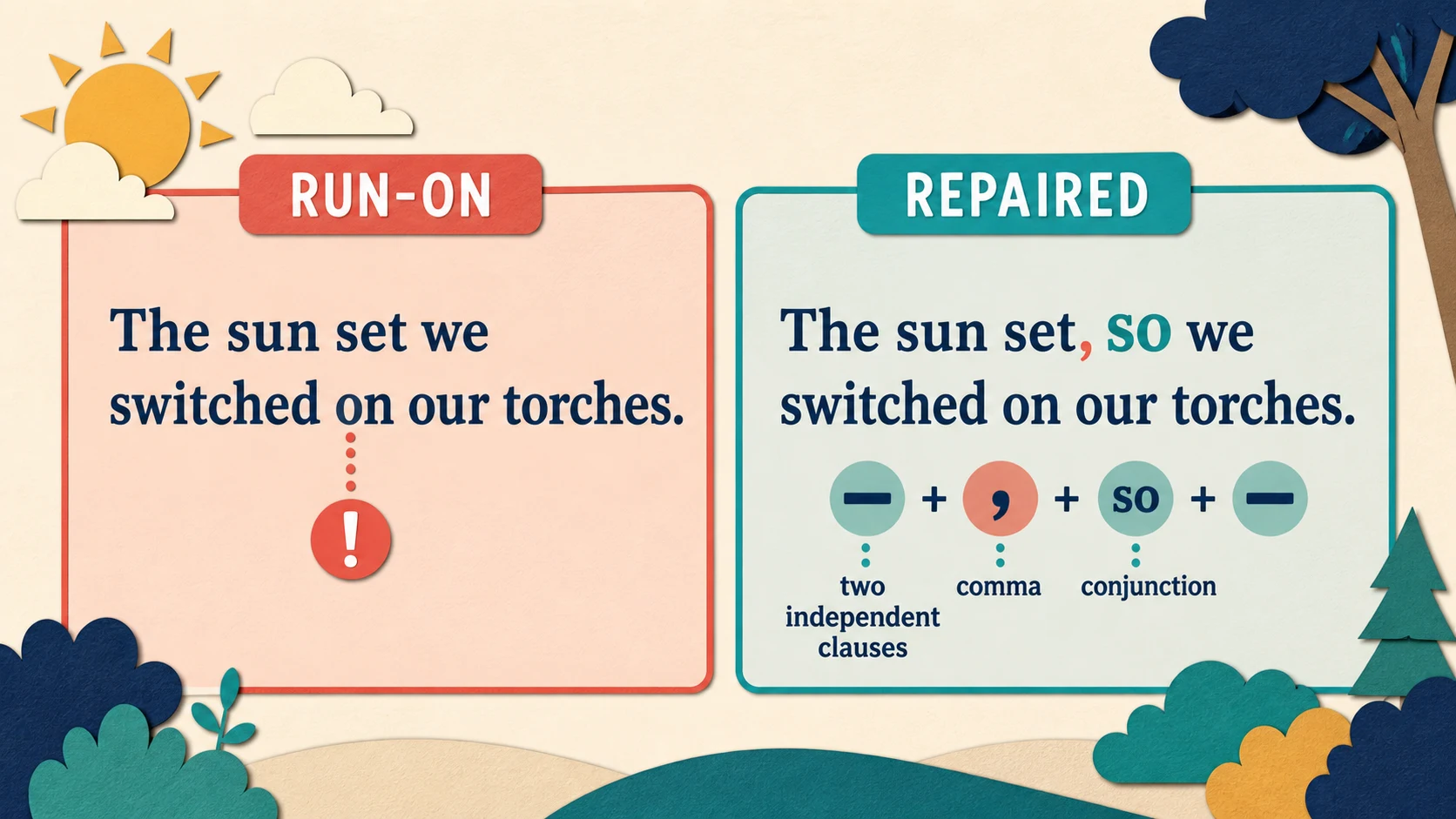
Treat an error as evidence about the next teaching move, not merely something to mark wrong.
| Error pattern |
Likely instructional issue |
Diagnostic prompt |
Teaching response |
| “Under the table near the door.” |
A phrase is mistaken for a complete sentence |
“Who or what is under the table?” |
Add a subject and verb |
| “When the final bell rang.” |
A dependent clause is treated as independent |
“What happened when it rang?” |
Attach a complete thought |
| “The rain stopped we left.” |
The learner does not mark the boundary between complete thoughts |
“Where could the first sentence end?” |
Separate clauses, then choose punctuation or a conjunction |
| “The rain stopped, we left.” |
A comma is being asked to join two independent clauses by itself |
“Can each side stand alone?” |
Use a period, semicolon, or suitable conjunction |
| “The rabbit with long ears.” |
A noun phrase is mistaken for a sentence |
“What did the rabbit do?” |
Supply a predicate |
| “Mia opened the map and the trail was unclear.” |
Clause structure is not yet visible |
“Who is doing each action?” |
Mark both subjects and verbs before punctuating |
| Every sentence begins with “I” or “The” |
Structure is correct but repetitive |
“Can a time or place phrase move first?” |
Rearrange selected beginnings |
| Very long sentences with many conjunctions |
Length is being confused with sophistication |
“How many complete ideas are here?” |
Divide ideas and preserve only useful connections |
Important boundary cases
Commands: “Please place the notebooks on the shelf.” This is complete; the subject you is understood.
Short sentences: “The lights failed.” This is complete even though it has only three words. Length does not determine completeness.
Opening phrases: “After the long rehearsal, the actors rested.” The opening words add time information; the main subject and verb are actors rested.
Compound predicates: “The actors rested and reviewed their notes.” This has one subject with two verbs. It is not necessarily two independent clauses.
Compound sentences: “The actors rested, and the director reviewed her notes.” Each side has its own subject and verb, so the comma-plus-conjunction boundary is appropriate.
Sentence fragments in creative writing: Published writing may sometimes use deliberate fragments for effect. Before treating that as a fifth-grade revision choice, confirm that the learner can produce and identify complete sentences reliably. Deliberate effect and accidental omission are not the same.
Monitoring Progress Without Overtesting
Use a small, repeatable sample once or twice a week:
- identify one complete sentence and one fragment;
- repair one run-on;
- combine two related ideas;
- write one sentence using a given structure;
- revise one sentence from current writing.
Track the result in three categories:
| Level |
Evidence |
| Independent |
Correct response and a clear explanation without prompting |
| Prompted |
Correct after a cue such as “Find the verb” |
| Modeled |
Requires an example or adult-led reconstruction |
Look for patterns across several samples. One incorrect comma does not establish that the learner lacks all clause knowledge. Likewise, a perfect identification page does not prove transfer into writing.
A useful monitoring note is specific: “Identifies independent clauses but joins them with a comma alone.” “Needs more grammar” is too broad to guide practice.
The IES foundational reading practice guide concerns kindergarten through third grade, so it is not direct fifth-grade sentence-structure guidance. Its attention to academic language and connected text offers background for literacy instruction, but it should not be presented as evidence for this exact sequence or worksheet.
A Two-Week Practice Plan
This plan assumes short, recurring sessions. It is a flexible example, not a universal timetable. Shorten, repeat, or replace a day according to the learner’s observed work.
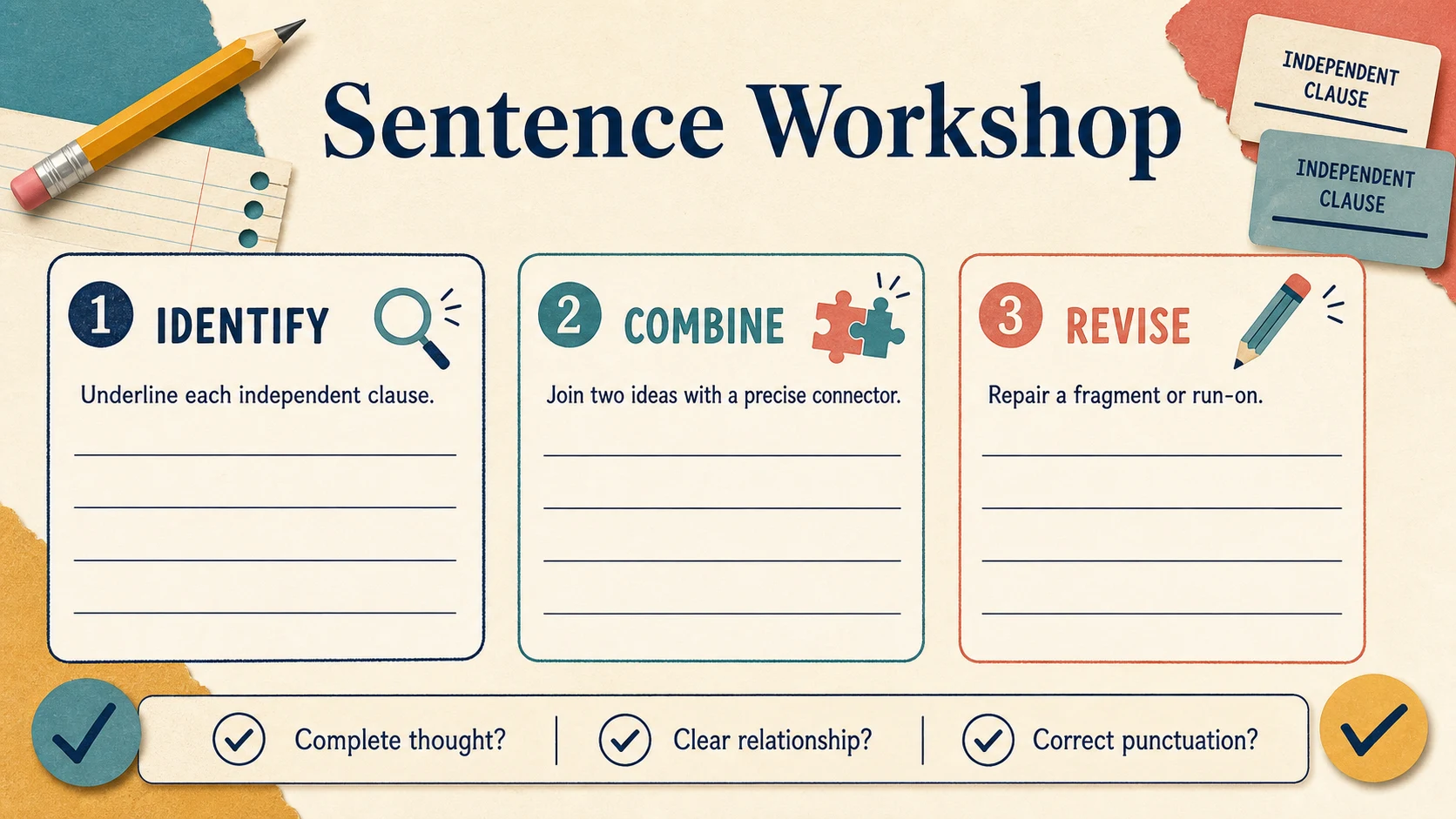
The plan alternates focused instruction, retrieval, and transfer into authentic writing.
| Day |
Focus |
Suggested activity |
Evidence to collect |
| 1 |
Starting sample |
Sort sentences, fragments, and run-ons; mark subjects and verbs |
Error types and prompt level |
| 2 |
Word order |
Reconstruct scrambled sentences and discuss alternate valid arrangements |
Logical order and punctuation |
| 3 |
Subjects and predicates |
Divide sentences into complete subjects and predicates |
Accurate identification |
| 4 |
Fragments |
Complete phrases and dependent clauses in more than one way |
Explanation of what was missing |
| 5 |
Review and transfer |
Find one complete sentence and one problem sentence in a short draft |
Use outside a drill |
| 6 |
Run-ons |
Mark clause boundaries; repair with periods or conjunctions |
Boundary recognition |
| 7 |
Sentence combining |
Combine repeated subjects, actions, or details |
Meaning preserved |
| 8 |
Complex sentences |
Join a dependent clause to an independent clause |
Complete main thought and punctuation |
| 9 |
Variety and style |
Revise repetitive beginnings; compare short and long versions |
Purposeful structural choice |
| 10 |
Final sample |
Repeat the Day 1 task with new examples, then revise a short paragraph |
Independence, explanation, and transfer |
If the Day 5 transfer task breaks down, return to the relevant foundation rather than continuing because the schedule says to proceed. If the learner performs accurately and explains the structures, skip redundant items and move to paragraph-level revision.
Limitations and an Honest Next Step
Sentence-structure exercises show only part of writing development. They do not by themselves measure idea quality, organization, spelling, vocabulary, handwriting, typing, reading comprehension, or the learner’s ability to sustain a longer piece. A scrambled-word task can reveal syntax knowledge, but it cannot show whether the learner independently chooses varied structures in a paragraph.
This guide also does not provide medical guidance, certify mastery, guarantee an outcome, or establish comprehensive alignment with every local standard. The authoritative sources above support broad literacy and writing principles; they did not review WorksheetWise materials.
The honest next step is to collect a brief sample, identify the first unresolved skill in the progression, and choose one matching activity. If word order and basic sentence formation are the current need, begin with the free 5th Grade Sentence Structure worksheet, check the included answer key, and then ask the learner to use one corrected structure in an original sentence.