Curated collectionAnswer keys includedPrint-ready PDFs
Homeschool Grammar Worksheets
Turn a printable library into a flexible weekly rhythm with explicit teaching, short independent practice, answer-key feedback and mixed-age planning.
Start with a real resource
Browse this worksheet collection
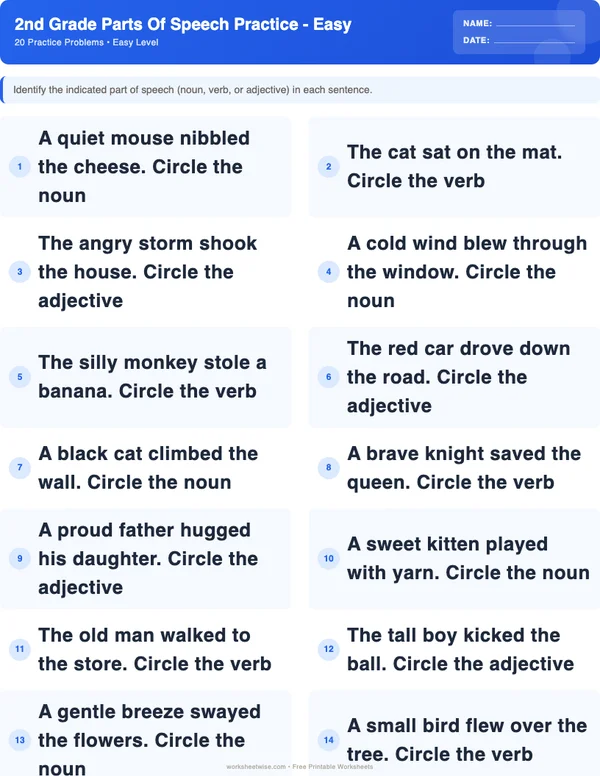
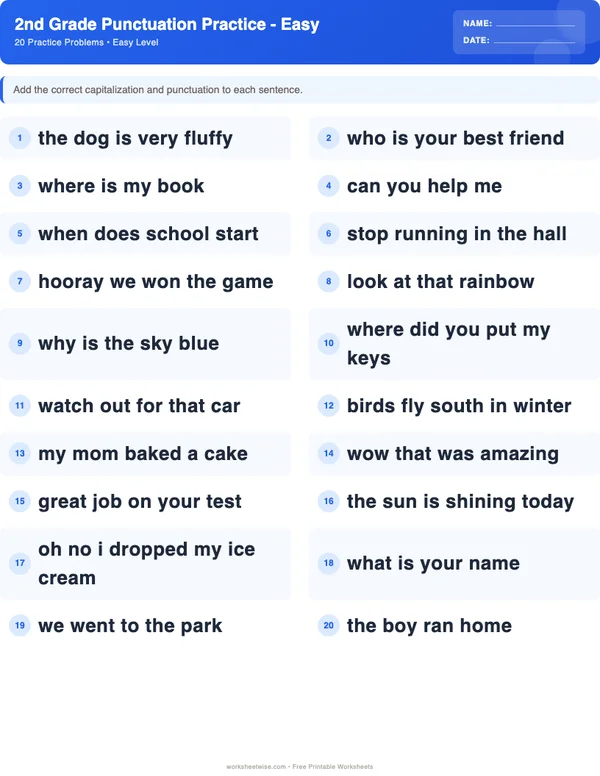
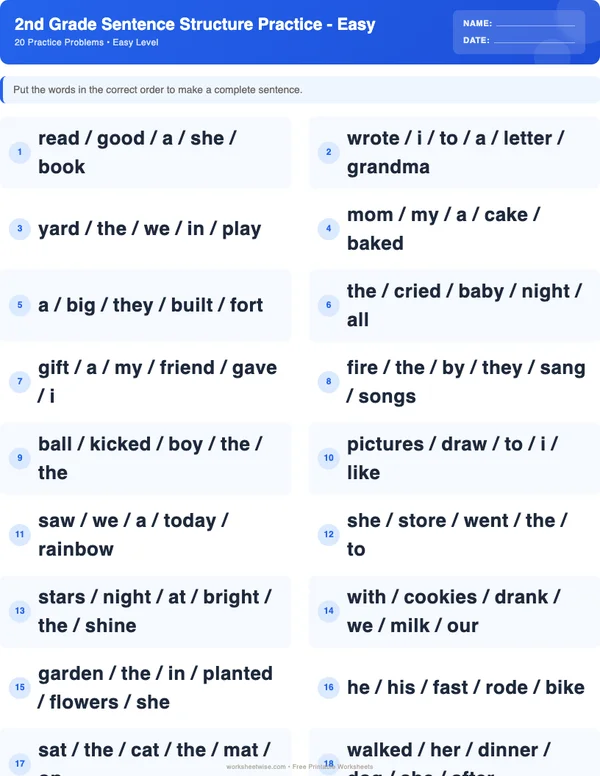
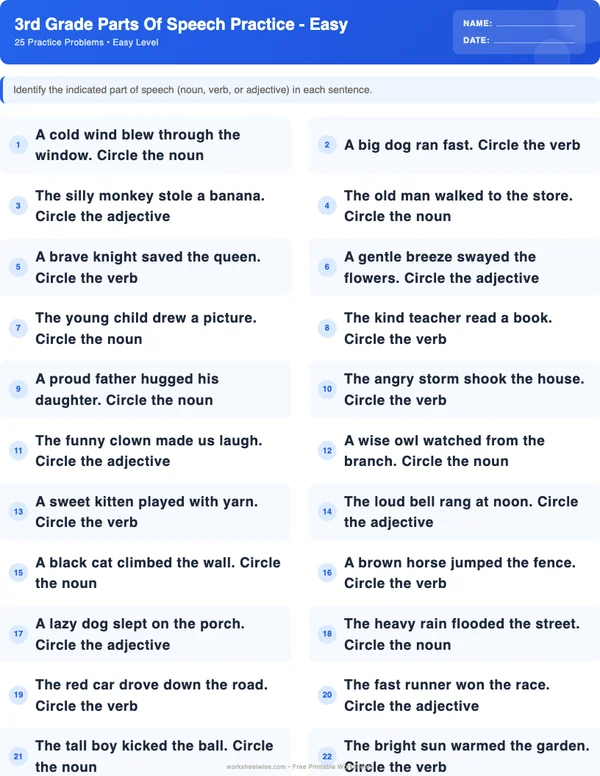
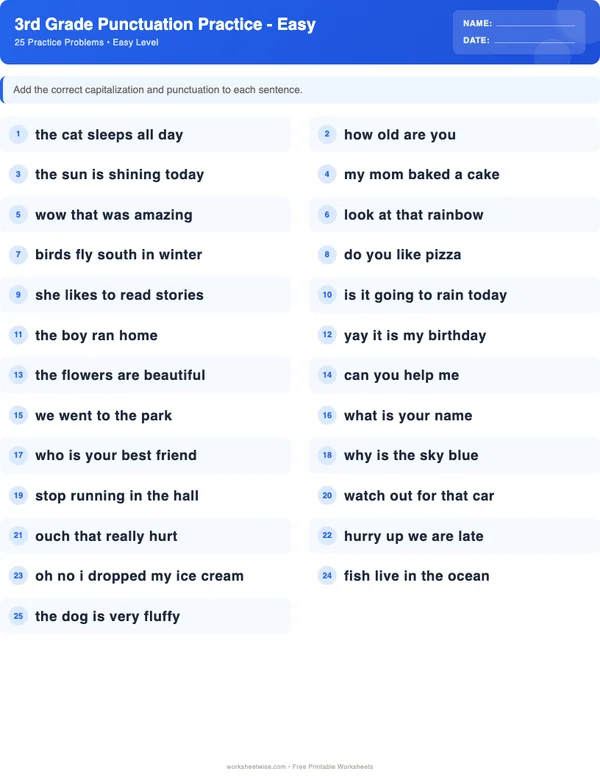
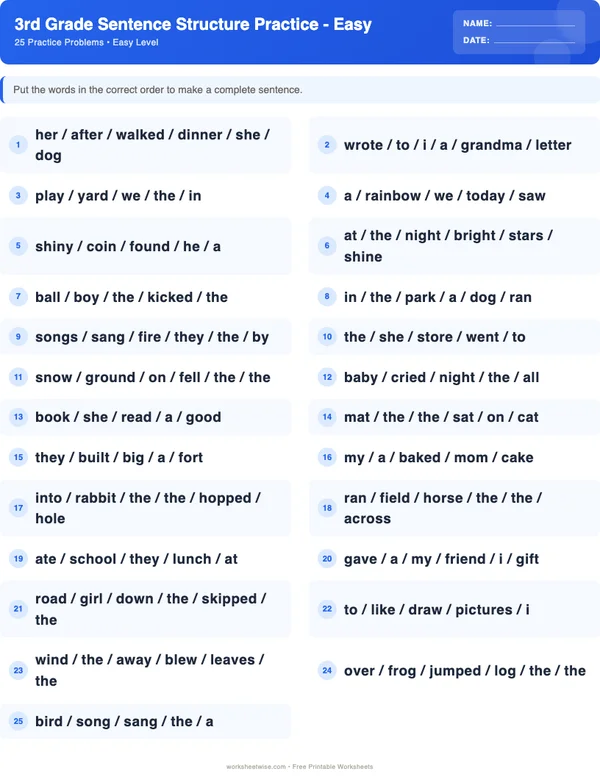
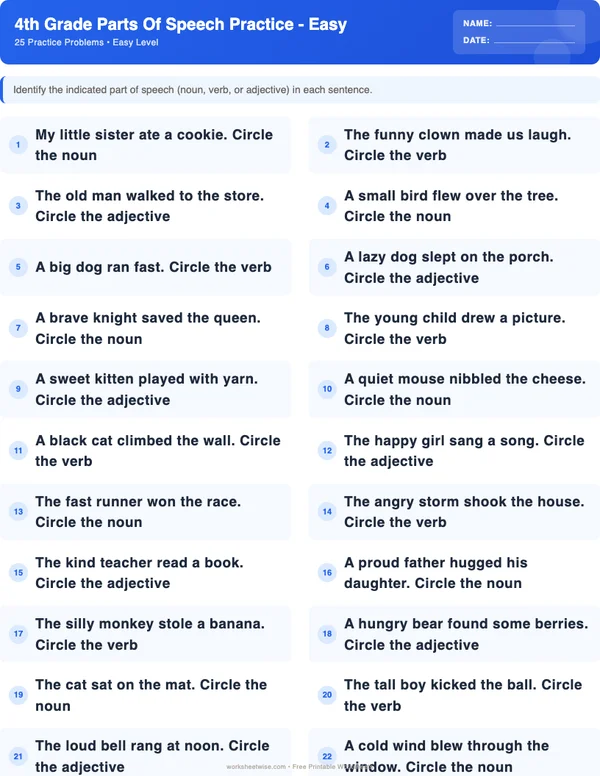
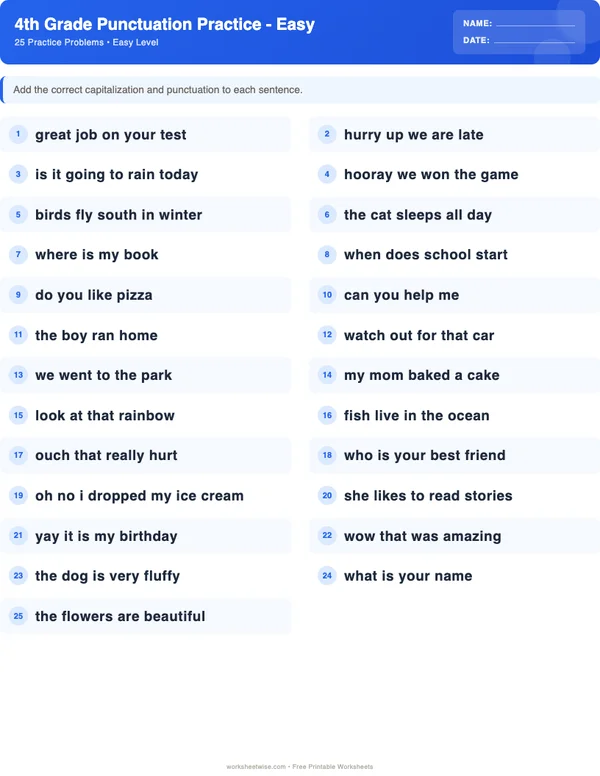
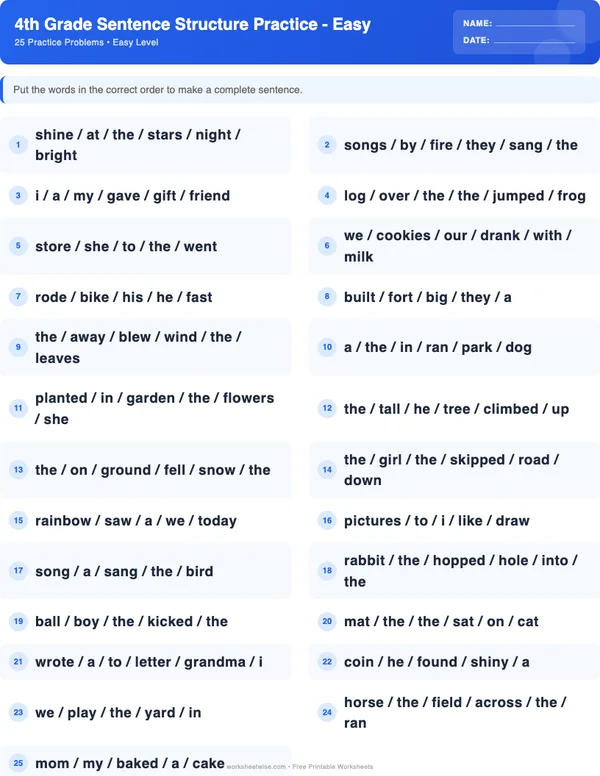
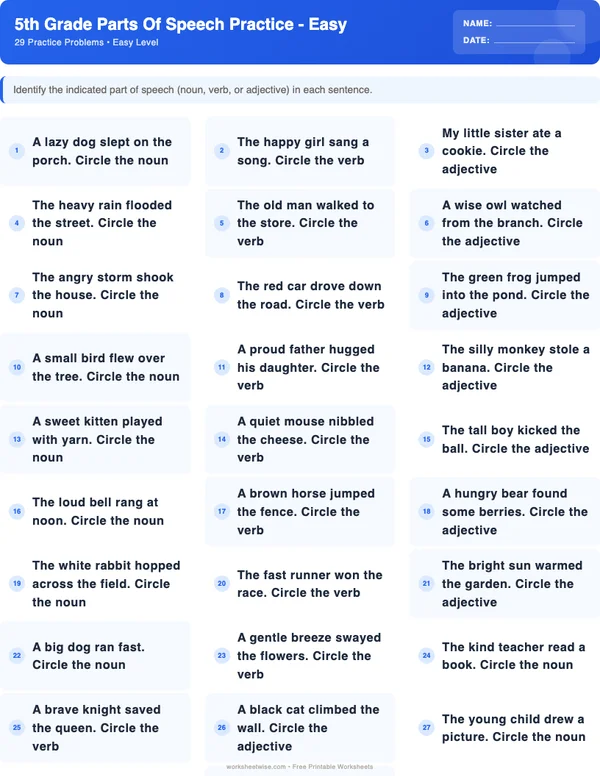
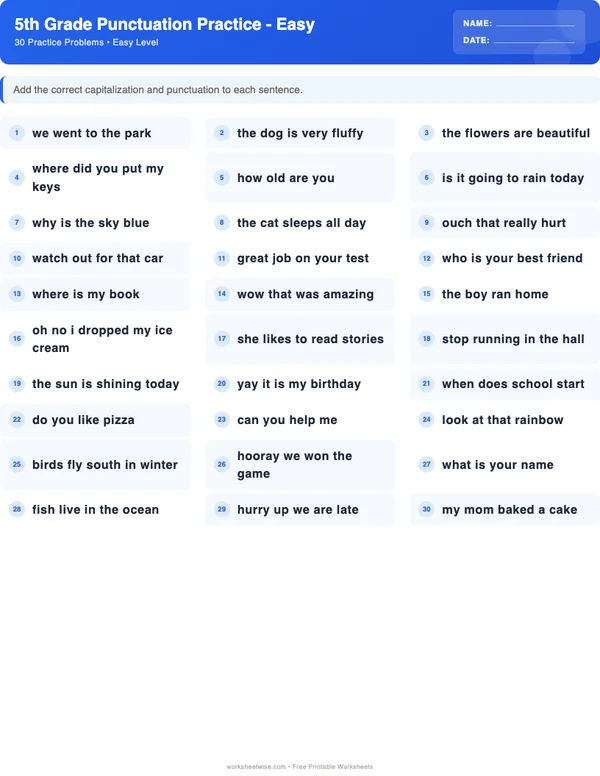
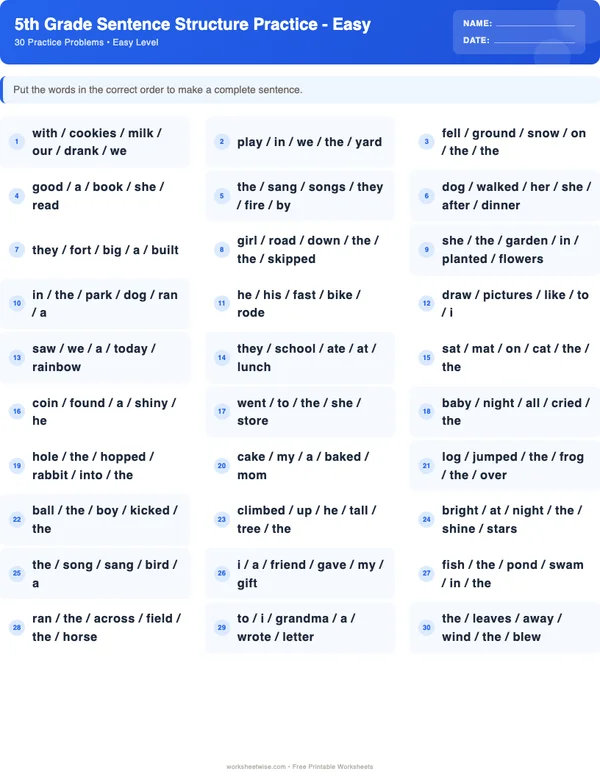
19 relevant free entry points are available. Each one includes a printable learner PDF and separate answer key.
A useful practice loop
Print less. Observe more.
- Choose one skill and model the first item aloud.
- Use a short set and notice the learner’s strategy.
- Change the next task from the work you can see.
Need more than the free sheet?
Plus includes all 342 matching catalogue variations where available, plus saved deterministic generators and the worksheet designer.
See Plus membershipComplete guide
How to teach and practise homeschool grammar worksheets
3,620 words Updated 6 instructional visuals
Build the week around one grammar decision
Use homeschool grammar worksheets as short practice inside a teaching cycle, not as the entire grammar lesson. A workable weekly rhythm is:
- Model one grammatical decision aloud.
- Complete two examples together.
- Assign a short set independently.
- Check with the answer key while asking for reasons.
- Choose the next sheet from the learner’s error pattern.
This turns the catalogue’s 342 grammar variants, 19 free resources, seven grade filters, and three topics—parts of speech, punctuation, and sentence structure—into a manageable sequence. The objective is not to finish the largest number of pages. It is to find out whether a learner can recognize a feature, explain it, use it in a sentence, and later notice it while writing.
Keep most sessions brief enough that handwriting and attention do not bury the grammar target. A younger learner might discuss six of a 12-item sheet and finish the rest later. A fifth grader facing a representative 29-item sheet might complete selected items rather than the whole page at once. Those are teaching suggestions, not rules reported by the catalogue.
Grade and age are discovery aids rather than placement decisions. Grade labels describe the intended practice level, but local curriculum sequences differ. Select from the evidence in front of you: the language in each item, the response required, and what the learner can already explain without guessing.
Choose a sheet by task, not by label
A worksheet fits when its grammar demand is clear and its response format will reveal the thinking you need to see. Before printing, inspect four features.
Identify the exact decision
“Punctuation” is too broad for a single lesson. Decide whether the learner must distinguish periods from question marks, insert commas in a list, separate complete thoughts, or punctuate dialogue. Likewise, “parts of speech” could mean finding concrete nouns, distinguishing adjectives from nouns, or identifying a word’s function in context.
Choose one main decision for initial practice. Mixed review is more useful after the learner can handle the component decisions separately.
Check the linguistic load
Look beyond the number of items. A page with 12 short sentences and one missing end mark demands less reading than 12 sentences containing dialogue, introductory phrases, and several possible punctuation positions. A 29-item sheet may still be accessible when directions and sentence patterns repeat, but its length changes the stamina demand.
The catalogue calls the representative free sheets “easy.” Here, treat that word as a description of observable task features, not a label for a learner. Such a sheet may use familiar vocabulary, short directions, a repeated response pattern, limited choices, or one conspicuous feature per item. Verify those features on the actual page before assigning it.
Match the response to the teaching question
Different response formats expose different knowledge:
- Circling a noun checks recognition.
- Sorting words checks category boundaries.
- Underlining a subject and boxing a predicate checks sentence analysis.
- Adding punctuation checks application to supplied text.
- Correcting a flawed sentence checks editing.
- Writing an original sentence checks transfer, but also adds spelling, idea generation, and handwriting demands.
If a learner can select a question mark but cannot punctuate a self-written question, the two performances are not contradictory. Recognition and production are different tasks. Move deliberately between them.
Decide how much evidence you need
You rarely need every item to discover that one rule has not settled. Use the first few responses as a checkpoint. If the learner gives the same sound explanation three or four times, finish a small sample independently and reserve the rest for later review. If the answers vary unpredictably, stop and model rather than allowing more uncertain repetitions.
The full worksheet library is most useful when treated as a bank of possible evidence, not a queue that must be completed in order.
Use a repeatable four-day grammar rhythm
The same routine can support several children without making every learner do the same sheet. Keep the shared opening short, then vary examples and responses.
Day 1: model and notice
State the decision in plain language. Write one correct example and one carefully chosen nonexample. Think aloud while comparing them.
For sentence completeness, say: “A complete sentence tells who or what and what that person or thing does or is.” Compare:
The rabbit hid.Under the porch.
Ask, “Who or what is the second group about? What happened?” The phrase may convey useful information, but it does not yet express the complete thought intended here. Add a subject and verb: The rabbit hid under the porch.
The IES writing practice guide recommends explicit instruction in writing processes and foundational writing skills, alongside frequent opportunities to write. It did not evaluate WorksheetWise. Applied here, that guidance supports modeling the grammatical choice and then having the learner use it in actual sentences rather than relying only on labels.
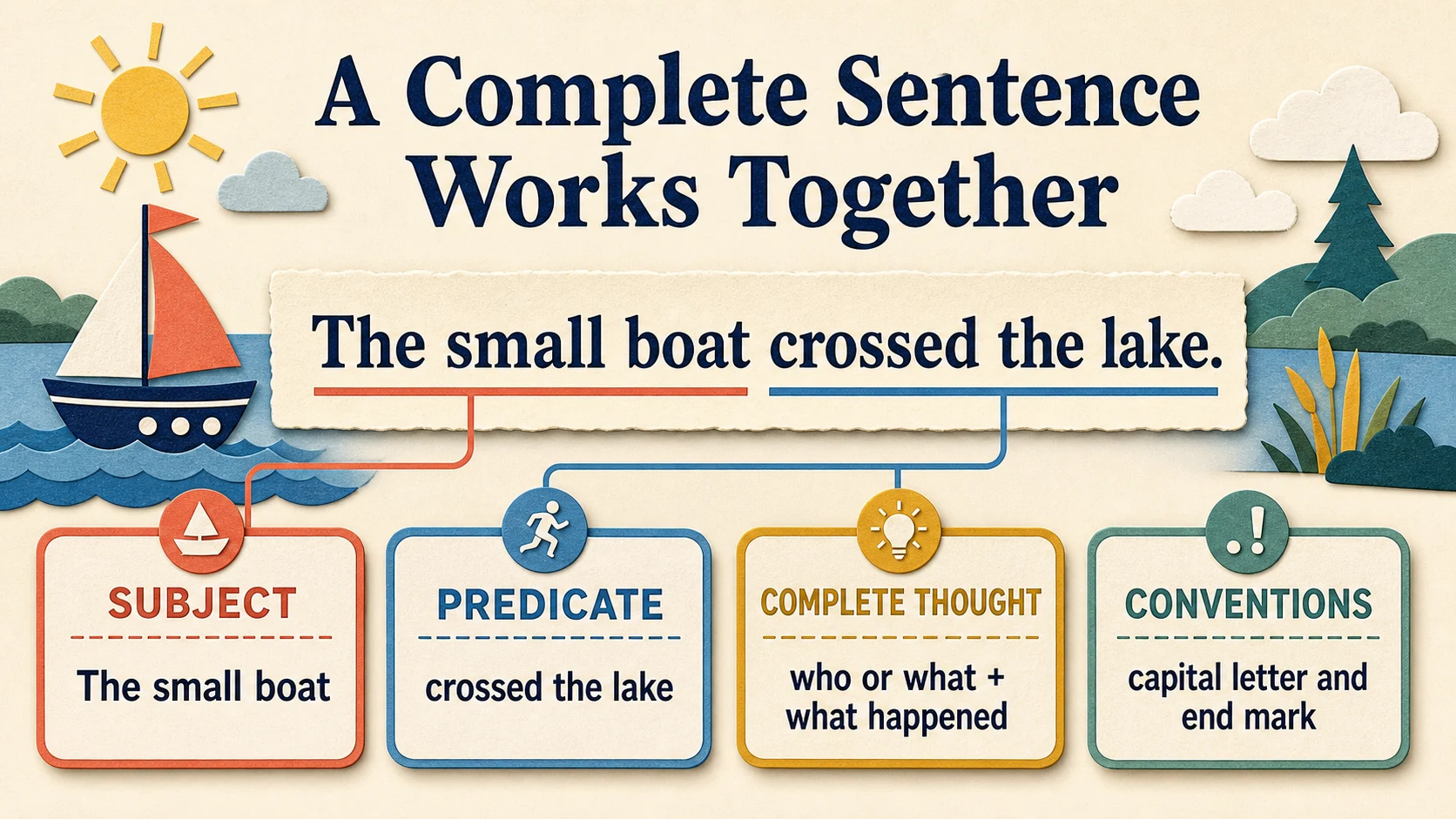
Use this map to locate a third-grade sentence task within a progression from recognizing complete thoughts to expanding and combining them.
Day 2: guided practice, then a short independent set
Begin with two oral or written examples. Prompt only as much as necessary:
- “Read it aloud.”
- “What job is this word doing?”
- “Where does the first complete thought end?”
- “Which words belong together?”
Then assign a small, uninterrupted set. Avoid coaching through every answer; that would measure your prompting more than the learner’s independent control. Mark the item where help began so you can distinguish independent responses from assisted ones.
For ages three and four, prioritize brief adult-led oral, matching, manipulative, and movement work over desk work. A child can place a toy under, beside, or behind a box, act out a verb, or match spoken statements and questions to punctuation cards. That preserves the grammar idea while reducing reading and handwriting demands.
Day 3: answer-key feedback and repair
Check soon enough that the learner remembers the choice. The answer key establishes the expected response, but it does not explain why the error occurred. Ask the learner to repair one or two missed items:
- Read the whole sentence.
- Name the clue.
- Explain the rule in everyday language.
- Correct the response.
- Make a new example with the same structure.
Use neutral feedback: “This mark does not match the sentence’s purpose yet. Read it as a question.” Avoid turning a wrong answer into a judgment about ability.
Day 4: transfer and mixed retrieval
Return to the target in a different format. If Day 2 involved selecting punctuation, Day 4 might involve editing two sentences and writing one. If the learner sorted nouns and verbs, ask for a sentence containing both and have the learner label their jobs.
Add one previously learned feature, not an entire page of unrelated review. For example, combine sentence completeness with end punctuation: Can the puppy reach the ball? The learner checks that the thought is complete and chooses a mark that matches its purpose.
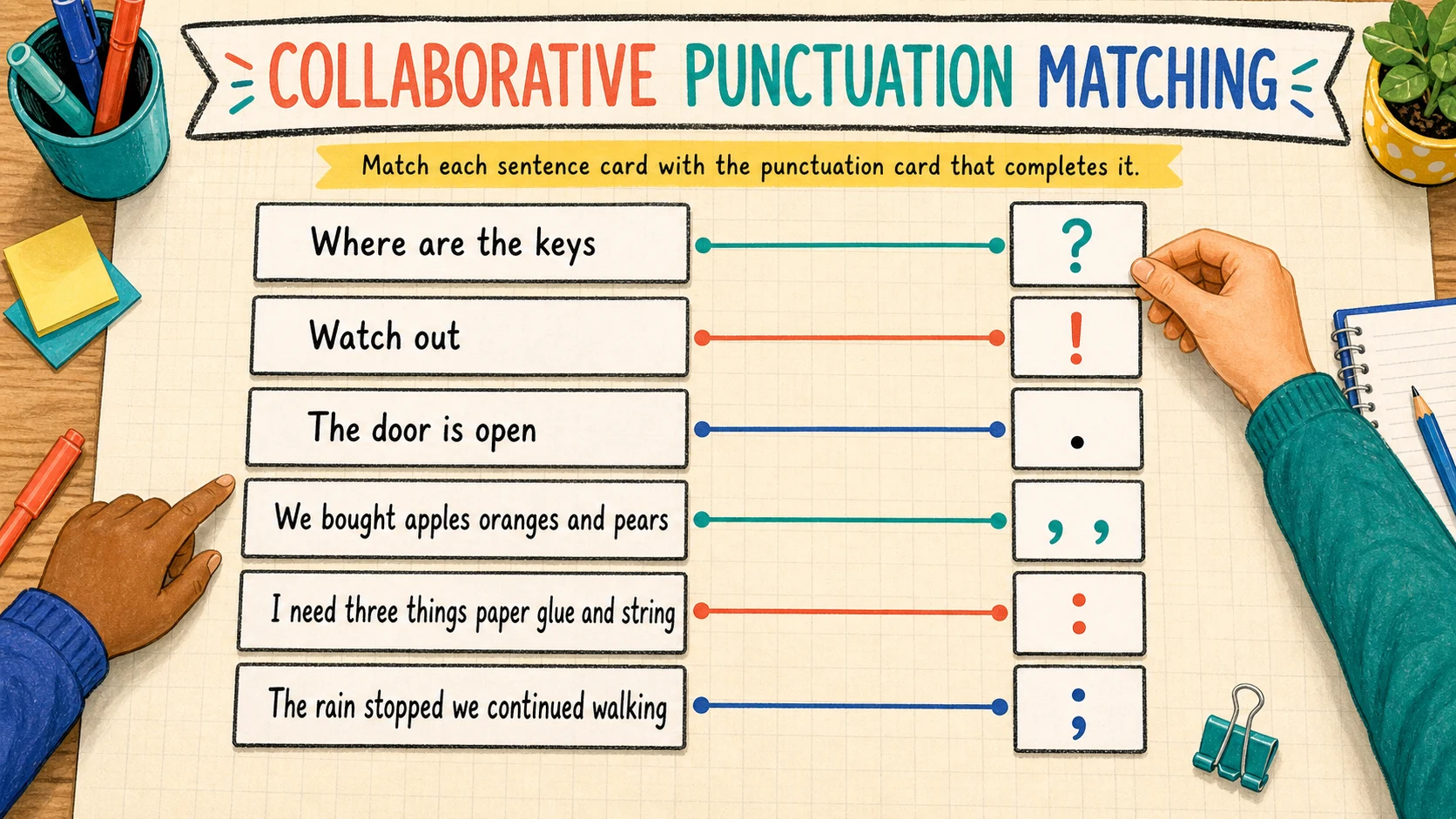
For sixth-grade punctuation practice, use the visual as a compact cycle: model the rule, edit a small set, justify corrections, and transfer the rule into original writing.
Teach early grammar through meaning and movement
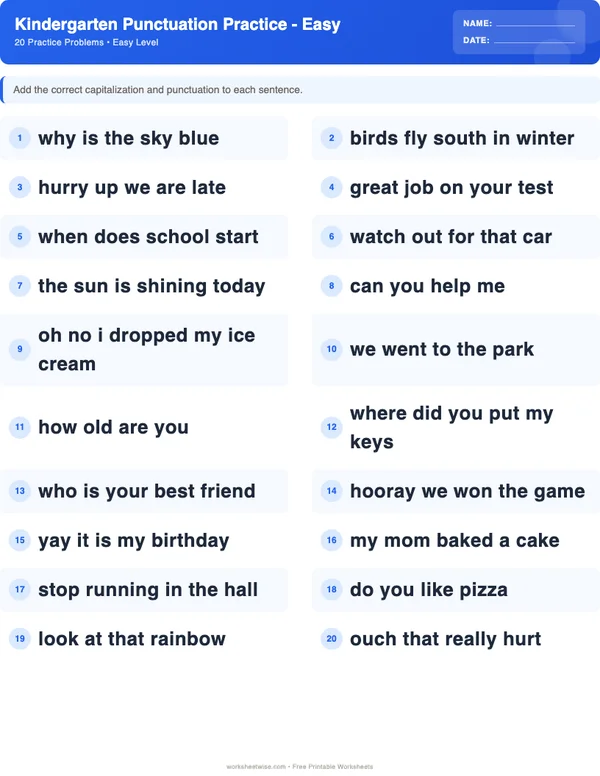
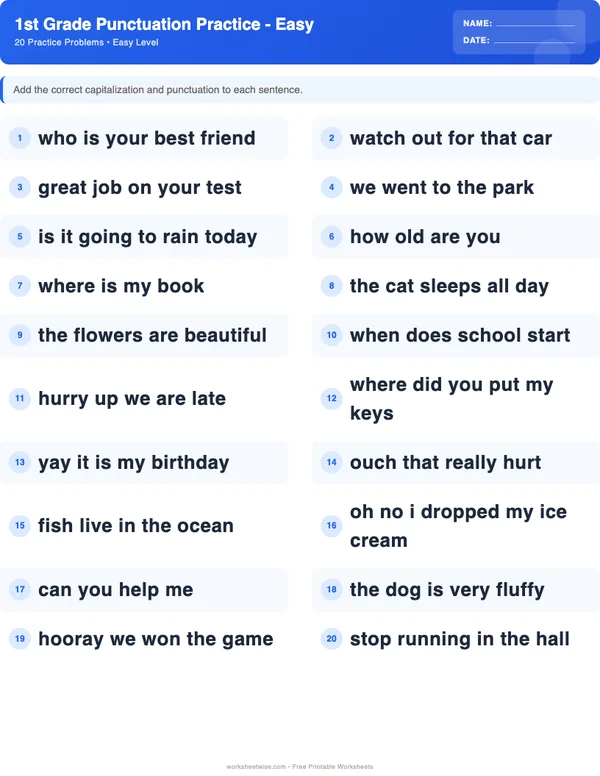
Young learners need to connect grammar terminology to something they can hear, see, or do. The representative kindergarten and first-grade free sheets each contain 12 problems, but that does not mean 12 must be completed in one sitting.
Checked example: end punctuation follows sentence purpose
Read these aloud:
The turtle is sleeping.Is the turtle sleeping?What a sleepy turtle!
The words overlap, but the communicative purpose changes. The first tells, the second asks, and the third expresses strong feeling. The marks are therefore not interchangeable.
This example belongs with the representative kindergarten and first-grade punctuation resources because those catalogue descriptions begin with periods, question marks, and exclamation points. It also follows the supplied teaching guidance to connect end marks with voice and expression. Do not teach “a rising voice always means a question” as an absolute rule of speech. Instead, use vocal contrast as an entry point and confirm the sentence’s purpose.
If a learner selects ! for every lively sentence, do not immediately assign harder punctuation. Contrast a calm question with an excited statement: Did we win? and We won! The next sheet should continue to isolate sentence purpose and end marks.
The Kindergarten Punctuation guide and free sheet is a sensible starting point when a learner needs short, early practice with these distinctions.
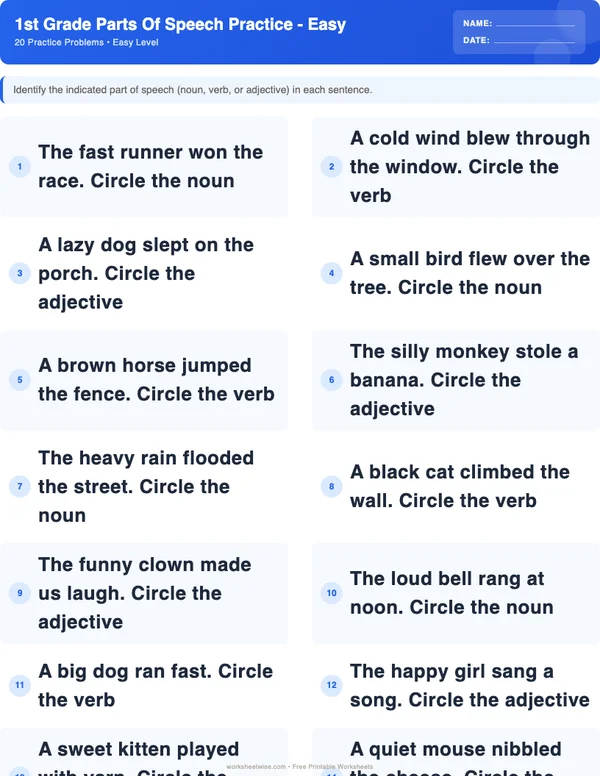
Checked example: noun and verb roles are visible in a sentence
Use: The rabbit hops.
Ask the learner to hold a toy rabbit when naming the noun and hop when naming the verb. Then change the sentence: The rabbits rest. The learner can see that rabbits names who or what the sentence is about, while rest tells what they do.
This example belongs with the representative first-grade parts-of-speech resource because the supplied catalogue guidance begins with concrete nouns and verbs and recommends movement. It also prevents a common shortcut: defining every verb as a dramatic action. In The rabbit is quiet, is does not show a visible action, yet it functions as a verb.
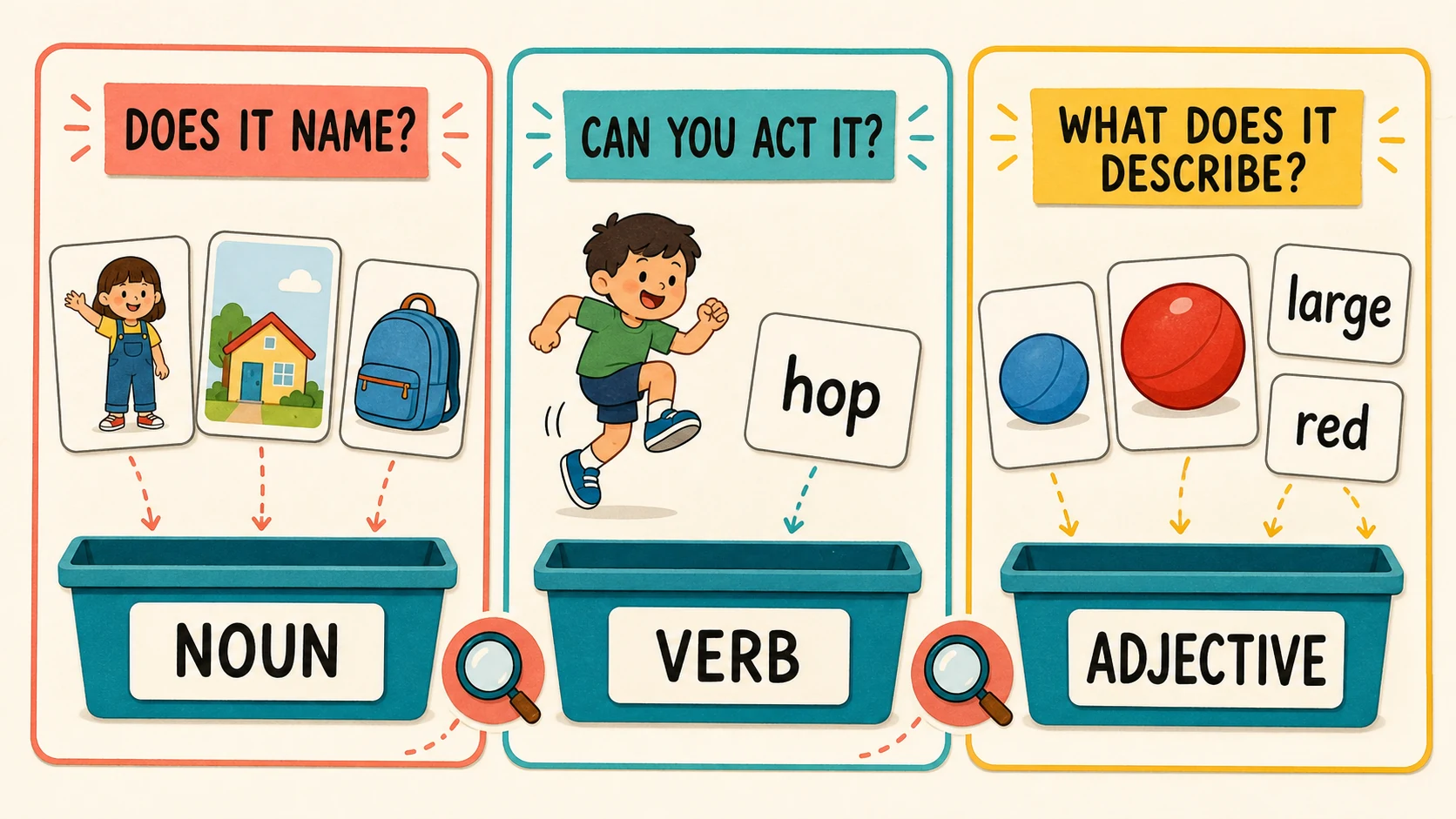
Use the first-grade error patterns to decide whether to reteach the noun–verb distinction orally, add sentence context, or change the response format.
When a learner labels rabbit correctly in isolation but misses it inside a sentence, the issue may be scanning or sentence context rather than the noun concept itself. Use the 1st Grade Parts of Speech guide and free sheet, then ask for a verbal reason after selected items.
Build sentence structure from complete thoughts
Sentence structure practice should move between hearing, analyzing, combining, and writing. Merely memorizing “subject plus predicate” is insufficient if the learner cannot use that idea to repair a fragment.
Checked example: distinguish a fragment from a complete sentence
Compare:
The noisy dog.The noisy dog barked.
The first group names something but does not tell what the dog did or was. The second supplies barked, completing the thought. A useful repair question is, “The noisy dog did what?”
Now compare:
Ran across the wet grass.The noisy dog ran across the wet grass.
Here the action is present, but the runner is missing. Ask, “Who or what ran?”
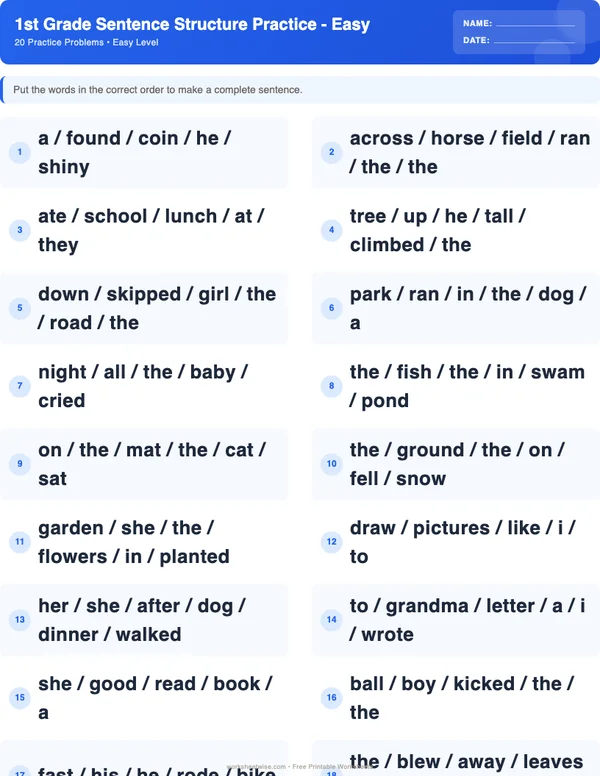
These examples belong with the representative first-grade sentence-structure sheet because its catalogue description includes complete sentences, fragments, subjects, and predicates. They also check two different fragment patterns; a learner who repairs one may not repair the other.
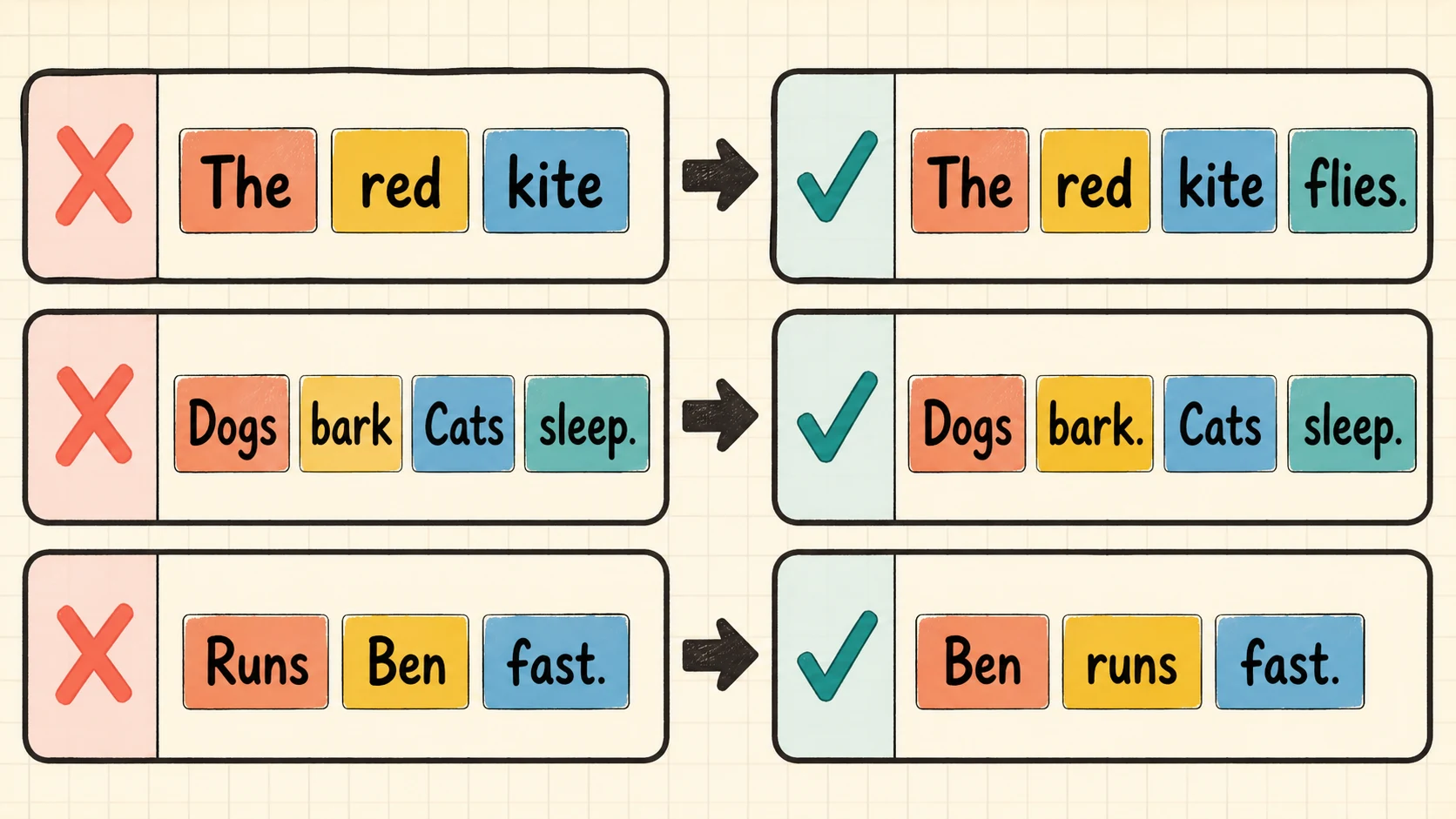
This first-grade visual supports a specific choice: identify whether a fragment lacks the naming part, the telling part, or both before selecting another sheet.
The 1st Grade Sentence Structure guide and free sheet provides the relevant free entry point. If the learner succeeds orally but writing is slow, let the learner arrange word cards, dictate the repair, or choose between two completions. These adaptations preserve the complete-thought target.
Checked example: combine without changing meaning
Start with:
The dog is big.The dog is brown.
Two valid combinations are:
The dog is big and brown.The big, brown dog barked.
The second version needs barked or another predicate; The big, brown dog alone is still a fragment. That is precisely why the example is useful in this homeschool sequence: it connects sentence combining with the earlier complete-sentence decision rather than treating combining as a trick for deleting repeated words.
Ask the learner what changed. The first combined sentence preserves the two descriptions as a complete statement. The second turns big and brown into modifiers inside a new sentence and therefore needs a new predicate.
The IES writing guide includes sentence construction among the skills educators can teach explicitly. A practical application is to model more than one valid combination and discuss meaning, not demand one mechanically preferred answer.
Move from naming words to analyzing their jobs
Parts-of-speech practice becomes more revealing when the same word appears in different contexts. A learner may know a definition but still classify by appearance rather than function.
Checked example: the word changes jobs with context
Compare:
We run each morning.Our morning run was short.
In the first sentence, run tells what we do, so it is a verb. In the second, run names an activity and follows the possessive determiner our, so it is a noun.
Now check light:
Please light the candle.— verbThe light is bright.— nounCarry the light bag.— adjective
These classifications have been checked against each word’s function in its sentence. The example belongs in this guide because the supplied catalogue guidance explicitly warns that English words such as run and light can serve different parts of speech. It is more appropriate after a learner can reliably recognize straightforward nouns and verbs.
A missed context-dependent item does not necessarily call for a longer list of definitions. Ask, “What job is the word doing here?” Then contrast two sentences side by side. Follow with a sheet containing words in full sentences, not an isolated word sort.
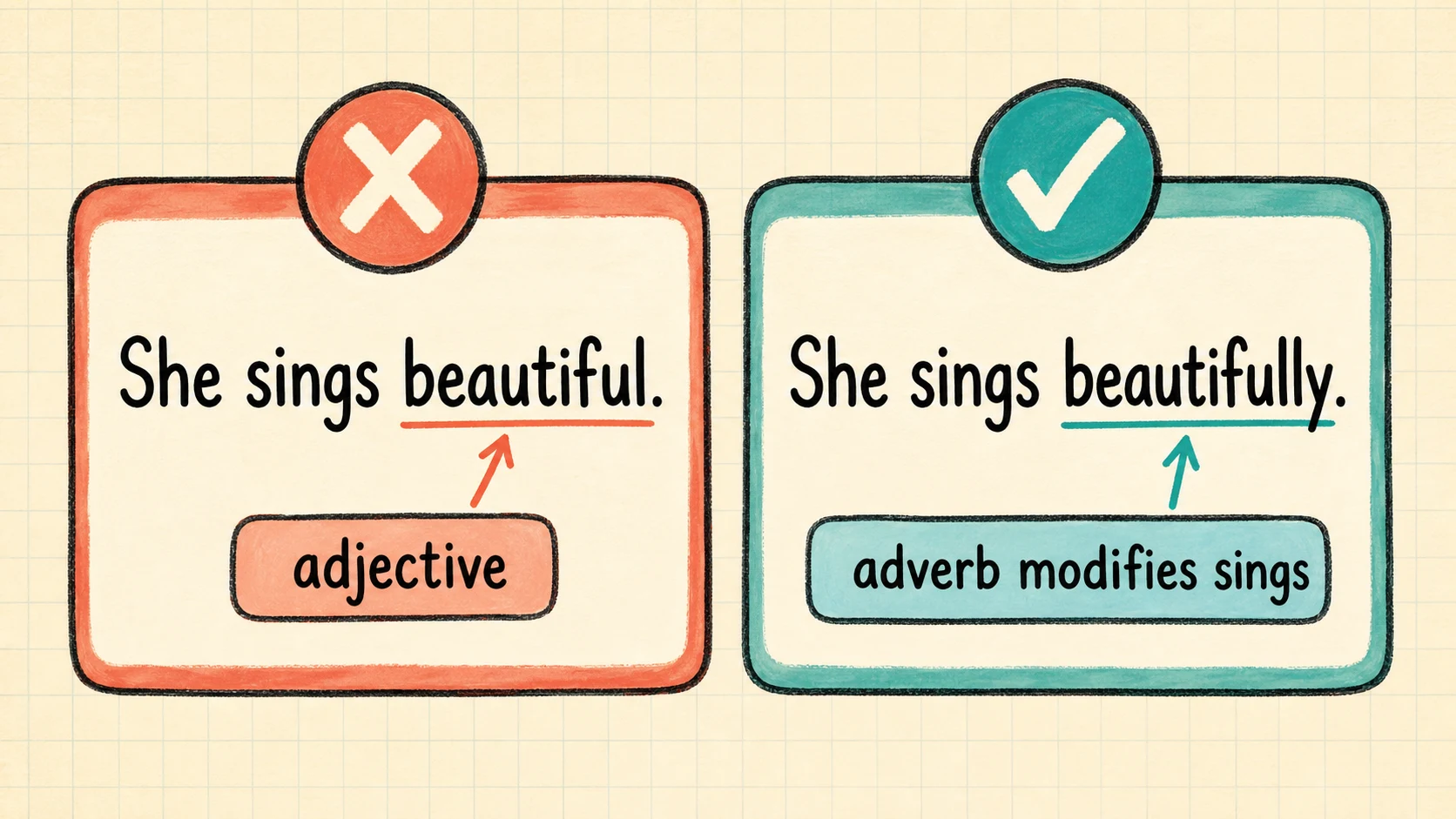
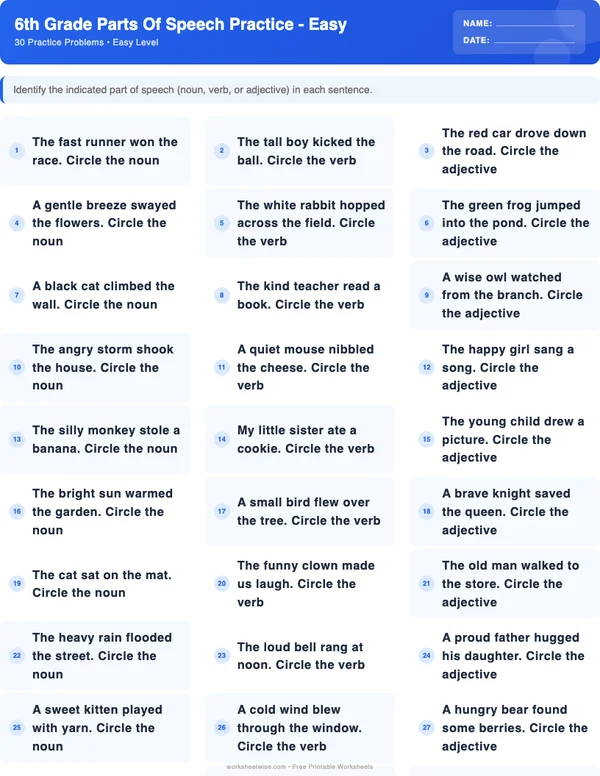
For sixth-grade work, use errors to separate forgotten terminology from the more important problem of determining a word’s function in context.
The IES foundational reading guide focuses on foundational skills that support reading for understanding, including explicit attention to language and reading development. It did not review these worksheets. For homeschool planning, the relevant boundary is that grammar sheets should complement—not replace—reading connected text, discussing meaning, and writing.
Increase punctuation complexity one rule at a time
Upper-elementary punctuation pages can become visually dense because several marks may be plausible. Control the task by stating which decision is under review.
Checked example: commas mark different structures
Consider:
I packed a shirt, pants, and socks.After dinner, we played games.I ran fast, but she was faster.
All three contain commas, but the reason differs. The first separates items in a series. The second sets off an introductory element. The third comes before but when it joins two complete thoughts.
Check the last sentence by testing each side: I ran fast and she was faster can each stand as a complete sentence. By contrast, I ran fast, but tired does not contain two complete thoughts; tired does not have its own subject and verb. A learner who inserts a comma before every and or but is responding to a trigger word instead of sentence structure.
This example belongs with the catalogue’s punctuation progression, which lists commas in series, dates, compound sentences, and after introductory elements. Teach and practice one use before mixing them. The sequence itself is a catalogue teaching suggestion, not a claim that every curriculum follows the same order.
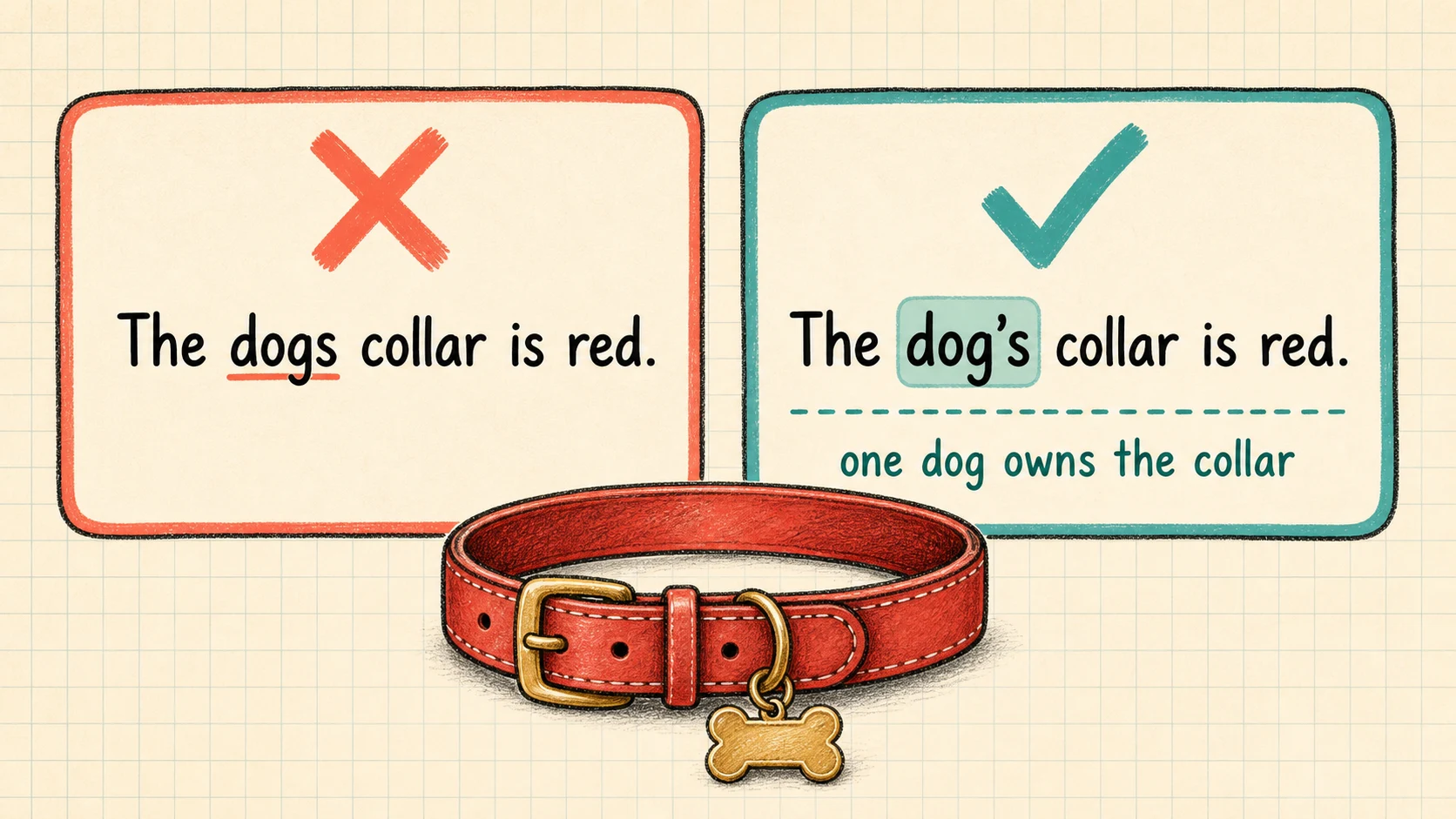
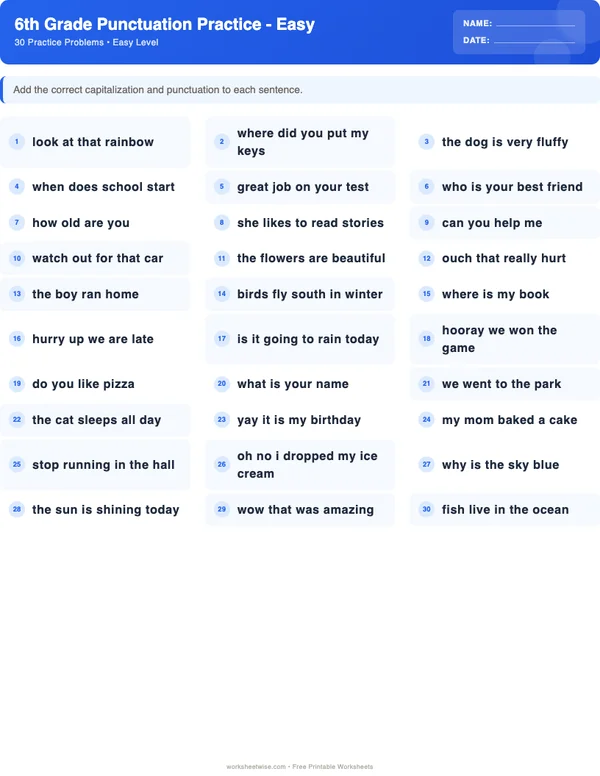
Use the sixth-grade error map to identify the rule behind a misplaced comma instead of assigning undifferentiated punctuation review.
For dialogue, model the entire convention before independent writing: a new speaker begins a new paragraph; punctuation belongs with the quoted words; and the surrounding sentence determines whether a comma, period, question mark, or exclamation point is needed. First let the learner punctuate supplied dialogue. Original dialogue adds planning and paragraphing demands, so it should come later.
The Common Core English Language Arts standards describe grade-specific expectations for conventions and writing, but a grade label on this catalogue is not proof of standards alignment. Use the standards only as one reference point alongside your local curriculum and the learner’s observed work.
Read errors as clues, not scores alone
A total such as 9 out of 12 tells you how many expected answers matched. It does not tell you what to teach tomorrow. Group errors by the decision that produced them.
When the rule is not yet understood
Signs include the same misconception across several items or an explanation that reveals a false rule: “Every sentence with who gets a question mark,” or “A verb is always something you can see.”
Next action: return to two contrasting examples, have the learner state the difference, and choose another focused sheet at the same level of linguistic complexity.
When the response format causes trouble
A learner may explain nouns correctly but overlook instructions to “circle the noun and underline the verb.” Another may edit aloud but struggle to copy a full corrected sentence.
Next action: preserve the grammar target while changing access. Highlight the target sentence, cover unused items, let the learner use two colored pencils, accept pointing before writing, or divide copying from editing. Do not quietly answer the grammar question while providing support.
When knowledge does not transfer
A learner may score well on isolated end marks and omit punctuation in a journal entry. That suggests the rule is available when prompted but not yet used consistently during composition.
Next action: do not simply repeat the identical selection sheet. Give a three-sentence editing task, then ask the learner to write two sentences and complete a single-purpose check: “I checked the end of every sentence.”
When the page mixes too much
If commas in lists are accurate but commas in compound sentences are not, a mixed score hides a precise need.
Next action: select a sheet isolating compound sentences. Before assigning it, test whether the learner can locate the two complete thoughts. If not, return briefly to sentence structure; comma practice alone will not repair that prerequisite.
Answer-key feedback should end with a decision recorded in a few words: “questions versus excited statements,” “missing predicate,” “word function changes in context,” or “comma before conjunction only with two complete thoughts.” That note is more useful for planning than a percentage by itself.
Coordinate mixed-age grammar without forcing one level
A shared family lesson works when everyone studies a common idea at a different response depth.
For a sentence lesson, read one interesting sentence from a current family read-aloud. A young learner can identify whether it tells or asks. A first grader can find who or what the sentence is about and what happened. A third grader can expand it with a precise modifier or combine it with a related sentence. An older elementary learner can analyze an introductory phrase, conjunction, pronoun reference, or punctuation choice.
Then assign separate sheets. The shared conversation provides community; the sheet provides targeted evidence. Do not give an older child a long page merely to keep that child occupied, and do not require a younger child to copy the older learner’s terminology.
You can also stagger independent work:
- Teach the youngest learner orally while an older learner completes a familiar review.
- Begin the older learner’s new model while the younger learner sorts word or punctuation cards.
- Check answer keys separately so each child must explain a personal correction.
When grammar errors are entangled with decoding, coordinate the work with Homeschool Phonics Worksheets. When the issue is spelling a word rather than choosing its grammatical role, use Homeschool Spelling Worksheets. Keep the targets distinct even when one sentence reveals all three.
Preserve the grammar target when adapting a page
An adaptation is sound when it removes an irrelevant barrier without supplying the grammatical answer.
Useful adjustments include reading directions aloud, reducing the visible number of items, enlarging the print, allowing oral responses before written ones, using movable word cards, or splitting a long sheet across sessions. For a representative fifth-grade page with 29 problems, assigning 10 carefully selected items may provide clearer independent evidence than requiring all 29 after attention has faded.
Be cautious with changes that alter the skill. Reading a sentence aloud may be appropriate when the target is punctuation rather than decoding. Exaggerating the exact vocal cue on every independent item may disclose the answer. Giving a word bank can reduce spelling load in a sentence-writing task, but a bank sorted into “noun,” “verb,” and “adjective” categories would answer a classification task.
Worksheets also have limits. They cannot establish a diagnosis, explain every dialect difference, or show by themselves whether a learner uses grammar during authentic reading and writing. A correct answer may reflect understanding, guessing, memory of the page pattern, or adult prompting. Confirm important decisions with conversation and a fresh example.
Do not promise that completing a sequence will produce a particular writing outcome. Use the pages for bounded practice and observation. If persistent difficulties affect reading, writing, communication, or participation across settings, document concrete examples and consult an appropriate educator or qualified professional rather than attaching a label yourself.
Choose tomorrow’s sheet before ending today
Finish each session with one observable next action. Ask the learner to complete a fresh item without help and explain the choice. Then use this decision:
- Correct answer plus a sound reason: change the response format or add one related feature.
- Correct answer with guessing or an inaccurate reason: keep the same rule and use contrasting examples.
- Repeated error of one type: select a focused sheet isolating that misconception.
- Errors spread across reading, copying, and grammar: reduce the non-grammar demands and recheck the target.
- Accurate worksheet responses but errors in original writing: move to editing and self-written sentences.
For the next session, open the free deterministic worksheet generators and create or select a short set aimed at the error you recorded—not merely the next grade-labeled page. If today’s note says “confuses fragments that lack a subject,” tomorrow’s first task should contain that exact contrast: Ran to the gate beside Maya ran to the gate. Model one, solve one together, and let the learner explain the next one independently.
Put it into practice
Use the guide with a real printable
Move from explanation to a short, observable practice task. Check the first item together, then adjust the next session from the learner's actual work.
Open the first free worksheetExplore a neighboring collection