What 4th Grade Parts of Speech Instruction Should Accomplish
A fourth-grade learner should be able to identify and use nouns, pronouns, verbs, adjectives, adverbs, prepositions, conjunctions, and interjections in meaningful sentences. More importantly, the learner should explain how a word functions in a particular sentence. The same word can serve different roles in different contexts, so successful instruction moves beyond memorized word lists.
Begin by confirming reliable control of nouns, verbs, and adjectives. Then add pronouns and adverbs, followed by prepositions, conjunctions, and interjections. Revisit all eight categories through sentence analysis and writing revision. Let the learner’s observed work determine when to add complexity.
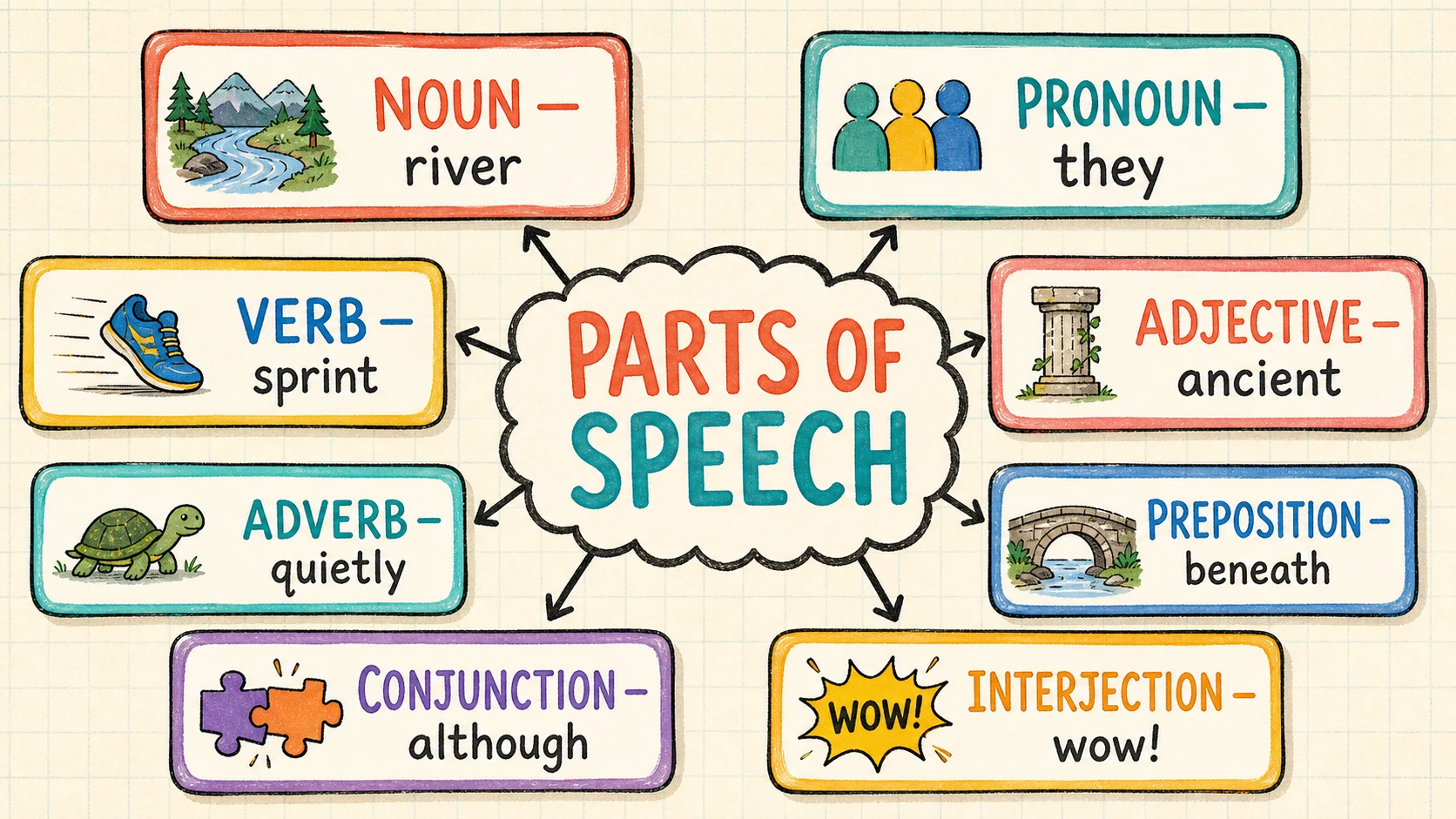
The categories connect through their functions inside complete sentences.
Grade labels describe an intended practice level, not a universal timetable. Local curricula and teaching sequences differ. The Common Core English Language Arts standards provide one useful reference point: fourth-grade language work includes relative pronouns and progressive verb tenses, while knowledge of other parts of speech develops across several grades. This guide therefore treats earlier categories as prerequisites to strengthen and later distinctions as extensions to approach carefully.
The Eight Parts of Speech and Their Jobs
A part of speech describes the job a word performs in context. Definitions are useful starting points, but questions about function are more dependable than questions about appearance.
| Part of speech |
Main job |
Example |
Useful test |
| Noun |
Names a person, place, thing, or idea |
river, Maya, courage |
Who or what is involved? |
| Pronoun |
Takes the place of or refers to a noun |
she, it, they, which |
Which noun does it refer to? |
| Verb |
Expresses action or links the subject to information |
runs, became, is |
What happens, or what links the subject to a description? |
| Adjective |
Describes or limits a noun |
three, wooden, bright |
Which one, what kind, or how many? |
| Adverb |
Modifies a verb, adjective, or another adverb |
slowly, very, almost |
How, when, where, or to what degree? |
| Preposition |
Shows a relationship between its object and another word |
under, after, beside |
What relationship does the phrase show? |
| Conjunction |
Connects words, phrases, or clauses |
and, but, because |
What does it join? |
| Interjection |
Expresses a brief reaction or emotion |
Wow! Oops! |
Does it stand apart as a reaction? |
These tests are guides rather than mechanical rules. For example, not every word ending in -ly is an adverb, and many adverbs do not end in -ly. The learner must check the word’s actual job.
Nouns, pronouns, and antecedents
A noun can name something concrete, such as basket, or an idea, such as patience. A pronoun points to a noun or noun phrase:
Lena placed the model on the shelf because she wanted it to dry.
Here, she refers to Lena, and it refers to the model. The word or phrase to which a pronoun refers is its antecedent. Identifying the antecedent helps prevent unclear references.
Relative pronouns introduce information about a noun:
The model that Lena painted is dry.
In this sentence, that introduces the clause that Lena painted and connects it to model.
Action, linking, and progressive verbs
An action verb tells what the subject does: The rabbit leaped. A linking verb connects the subject to a description or identity: The rabbit seems alert.
Progressive tenses use a form of be plus a verb ending in -ing:
- is reading expresses ongoing action in the present;
- was reading expresses ongoing action in the past;
- will be reading expresses ongoing action in the future.
The entire verb phrase performs the verb job. In Nora is reading, identifying only reading misses part of the grammatical structure.
Adjectives and adverbs
Adjectives modify nouns or pronouns:
The two hikers carried heavy packs.
Adverbs can modify verbs, adjectives, or other adverbs:
The hikers walked slowly.
The packs were extremely heavy.
They walked very carefully.
In the first sentence, slowly modifies walked. In the second, extremely modifies the adjective heavy. In the third, very modifies the adverb carefully.
Prepositions, conjunctions, and interjections
A preposition begins a phrase that usually includes an object:
The keys are under the cushion.
Under shows the relationship between keys and cushion. The entire prepositional phrase is under the cushion.
A conjunction connects:
- words: pencils and markers;
- phrases: before lunch or after recess;
- clauses: We stayed inside because it rained.
An interjection is more independent:
Oops! I dropped the ruler.
The interjection expresses a reaction but does not perform the central grammatical work of the sentence.
Prerequisites to Check Before Expanding the Lesson
Parts-of-speech instruction becomes frustrating when a learner is still unsure where a sentence begins and ends. Before asking for all eight categories, check whether the learner can:
- recognize a complete sentence in a short set;
- locate the subject and the main verb in a simple sentence;
- distinguish a person, place, thing, or idea from an action;
- read the practice sentences accurately;
- explain whom a basic pronoun such as he, she, it, or they refers to;
- compare two sentences and notice a changed word.
The IES foundational reading practice guide addresses instruction through third grade rather than fourth-grade grammar specifically. It is relevant here only as broad background: accurate word reading and understanding spoken and written language support later sentence analysis. It does not establish a fixed parts-of-speech sequence or evaluate WorksheetWise materials.
A quick prerequisite check
Use these three sentences:
- Birds build nests.
- The tiny bird builds carefully.
- It rests beside the nest.
Ask the learner to underline who or what each sentence is about and circle the action or linking word. Then ask what it refers to in sentence 3. If these tasks are difficult, spend more time on nouns, verbs, sentence boundaries, and pronoun reference before introducing all eight labels.
A Grade-Appropriate Teaching Progression
A practical progression moves from concrete contrasts to contextual classification and then to purposeful writing. Advancement should depend on evidence from the learner’s work, not the number of days spent on a category.
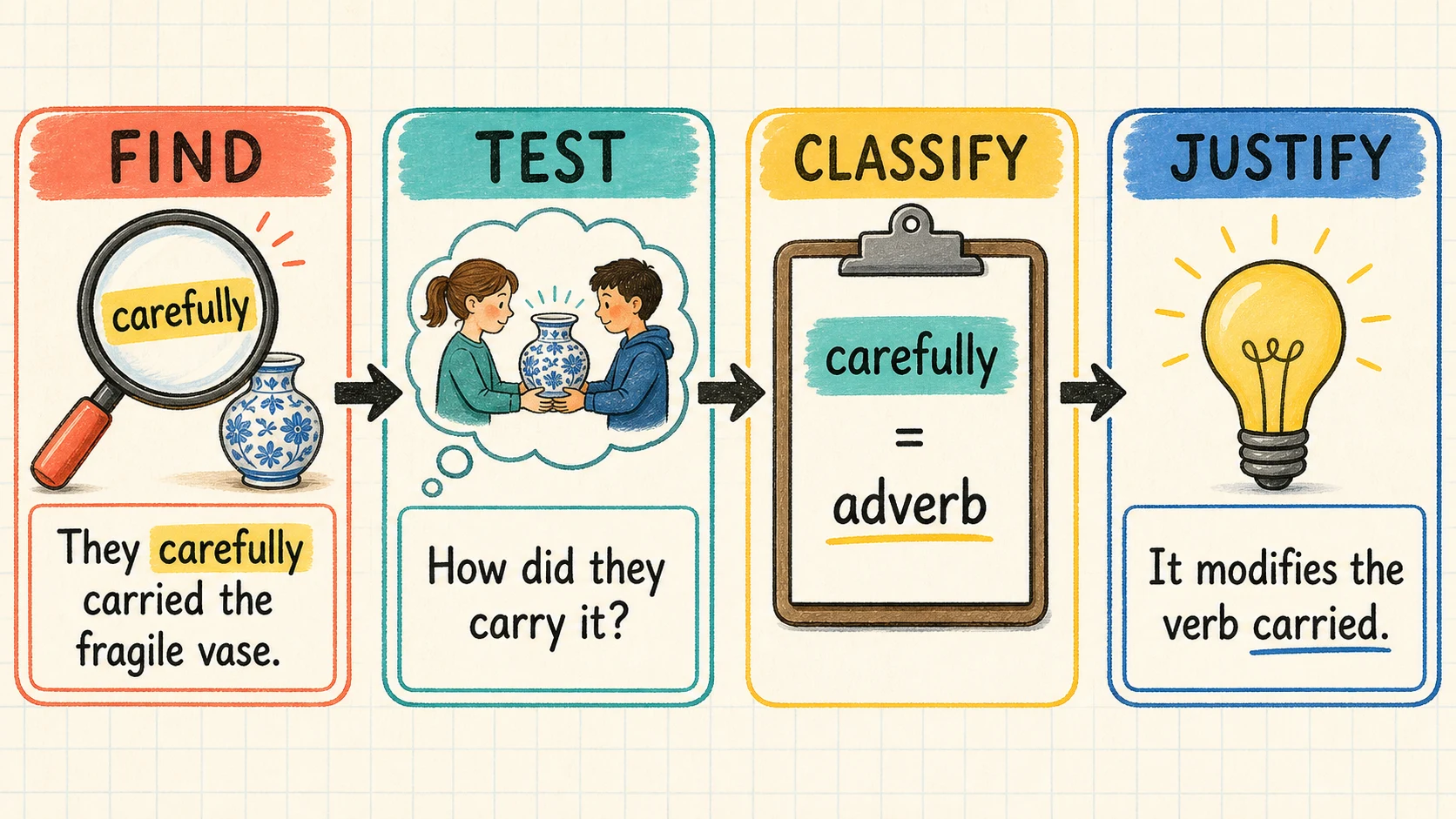
Support can be reduced as explanations become accurate and independent.
| Stage |
Instructional focus |
Suitable task |
Evidence for moving on |
| 1. Rebuild the core |
Nouns and action verbs |
Sort or mark words in short sentences |
Learner identifies both and explains their jobs |
| 2. Add description |
Adjectives and adverbs modifying verbs |
Compare plain and expanded sentences |
Learner links each modifier to the correct word |
| 3. Strengthen reference |
Pronouns and antecedents |
Draw arrows from pronouns to antecedents |
References are clear in identification and writing |
| 4. Show relationships |
Prepositions and prepositional phrases |
Model positions with objects; mark complete phrases |
Learner finds the preposition and its object |
| 5. Connect ideas |
Conjunctions |
Combine words or clauses |
Learner identifies what the conjunction connects |
| 6. Add reactions |
Interjections |
Separate reactions from sentence structure |
Learner recognizes the interjection without confusing it with a noun or verb |
| 7. Handle flexible words |
Context-dependent classification |
Compare one word in two sentences |
Learner justifies each label from sentence function |
| 8. Apply in writing |
Revision and sentence construction |
Replace vague words and explain revisions |
Changes improve precision without distorting meaning |
The 4th Grade grammar hub can support category-by-category review. The broader 4th Grade worksheet hub is useful when grammar practice needs to sit beside reading, writing, or other subject work.
Concrete and Visual Models That Make Function Visible
Build a sentence frame
Write each sentence part on a separate card:
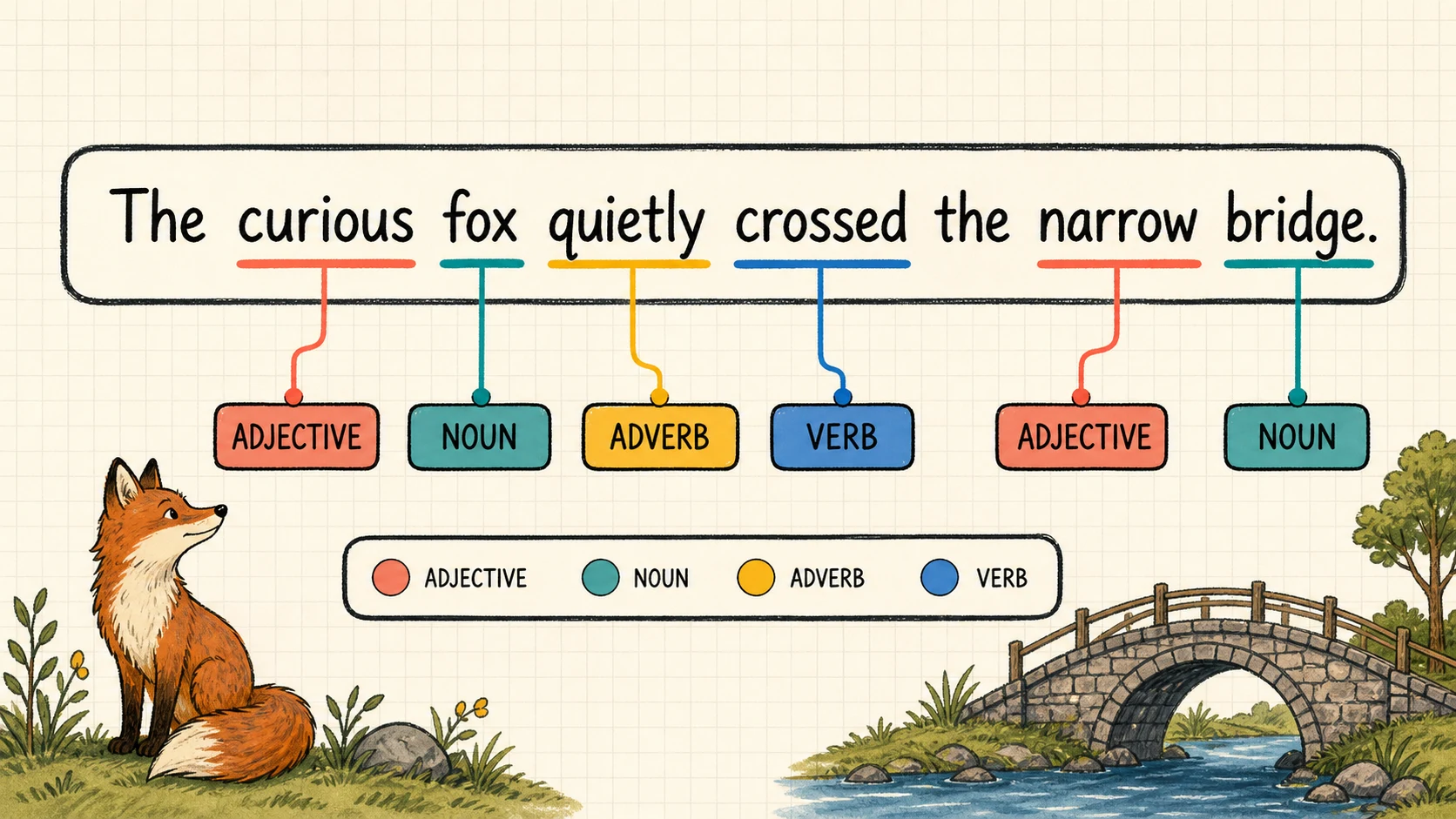
The | curious | fox | moved | quietly | through | the grass.
Arrange the cards in a row. Label the jobs:
- fox: noun;
- curious: adjective modifying fox;
- moved: verb;
- quietly: adverb modifying moved;
- through: preposition;
- the grass: object portion of the prepositional phrase.
Remove curious and compare the meaning. Replace moved with crept. Move quietly to the beginning: Quietly, the curious fox moved through the grass. The sentence still works because quietly continues to modify moved.
This model makes an important distinction visible: position can change without changing function, and changing one word can alter both meaning and grammatical role.
Use arrows and brackets
Arrows show modification and reference:
- adjective → noun;
- adverb → verb, adjective, or adverb;
- pronoun → antecedent.
Brackets show phrases:
The puppy slept [under the warm blanket].
Within the bracket, under is the preposition, blanket is a noun, and warm is an adjective modifying blanket. The phrase as a whole supplies information about where the puppy slept.
Demonstrate relationships physically
Place a pencil on, under, beside, behind, and between objects. Say and write a sentence for each position. This is an instructional suggestion based on the supplied teaching guidance, not a sourced universal recommendation. It gives the learner a visible relationship before asking for an abstract label.
Fully Checked Worked Examples
Each answer is checked by asking what the word does in its sentence.
Example 1: Identify a noun, verb, and adjective
Sentence:
The cheerful musician played a melody.
Find one noun, the verb, and one adjective.
- Ask who or what the sentence discusses. Musician names a person, so it is a noun. Melody also names a thing and is another noun.
- Ask what happened. The musician played, so played is the verb.
- Ask which word describes a noun. Cheerful tells what kind of musician, so it is an adjective.
Checked answer: nouns—musician, melody; verb—played; adjective—cheerful.
The word the is not an adjective required by this task, and a is not one of the requested answers. The cleanest response is to identify the clearly descriptive word cheerful.
Example 2: Separate an adjective from an adverb
Sentence:
The careful painter worked slowly.
Classify careful and slowly.
- Careful describes the noun painter. It answers “what kind of painter?” Therefore, it is an adjective.
- Slowly describes how the painter worked. Because it modifies the verb, it is an adverb.
Checked answer: careful is an adjective; slowly is an adverb.
A learner who labels both as describing words has noticed a shared feature but has not yet identified what each word modifies.
Example 3: Analyze a pronoun and verb phrase
Sentence:
Elena is carrying the boxes because she needs them upstairs.
- Elena is a proper noun naming a person.
- Is carrying is a progressive verb phrase. Is helps form the ongoing action expressed by carrying.
- Boxes is a plural noun.
- Because connects the clause Elena is carrying the boxes to the reason clause she needs them upstairs, so it is a conjunction.
- She is a pronoun referring to Elena.
- Needs is the verb in the second clause.
- Them is a pronoun referring to the boxes.
- Upstairs tells where the boxes are needed, so it functions as an adverb here.
Checked answer: noun—Elena, boxes; pronouns—she, them; verbs—is carrying, needs; conjunction—because; adverb—upstairs.
Example 4: Find a prepositional phrase
Sentence:
The striped cat waited beside the wooden gate.
- Cat and gate are nouns.
- Striped modifies cat, and wooden modifies gate. Both are adjectives.
- Waited tells what the cat did, so it is the verb.
- Beside shows a spatial relationship.
- The object of beside is gate. The full prepositional phrase is beside the wooden gate.
Checked answer: preposition—beside; prepositional phrase—beside the wooden gate; object noun—gate.
Example 5: Classify the same word in two contexts
A. We watched the light fade.
B. Please light the candle.
C. Mara carried a light backpack.
- In A, light names the thing being watched, so it is a noun.
- In B, light expresses the requested action, so it is a verb.
- In C, light describes the noun backpack, so it is an adjective.
Checked answer: noun in A, verb in B, adjective in C.
This example demonstrates why a word should not be classified without its sentence.
Boundary Cases Worth Teaching Explicitly
Linking verbs do not show visible action
In The soup smells delicious, smells links soup to the description delicious. It does not mean that the soup performs the action of smelling something. Delicious is an adjective describing soup, not an adverb describing how the soup smells.
Compare:
- The dog smells the sandwich. Here, smells expresses an action.
- The sandwich smells fresh. Here, smells acts as a linking verb.
An adverb need not end in “-ly”
In Come here soon, both here and soon function as adverbs: one tells where, and the other tells when. Conversely, friendly ends in -ly but functions as an adjective in a friendly neighbor.
A preposition belongs to a phrase
In after dinner, after is a preposition with the object dinner. In We ate, and afterward we walked, afterward tells when the walking occurred and functions as an adverb. Teach the learner to inspect what follows the relationship word.
A conjunction must connect something
In Tea and juice are available, and joins two nouns. In I wanted tea, but I chose water, but joins two clauses and signals contrast. Naming the joined elements is a stronger explanation than merely recalling a conjunction list.
A Short, Repeatable Lesson Routine
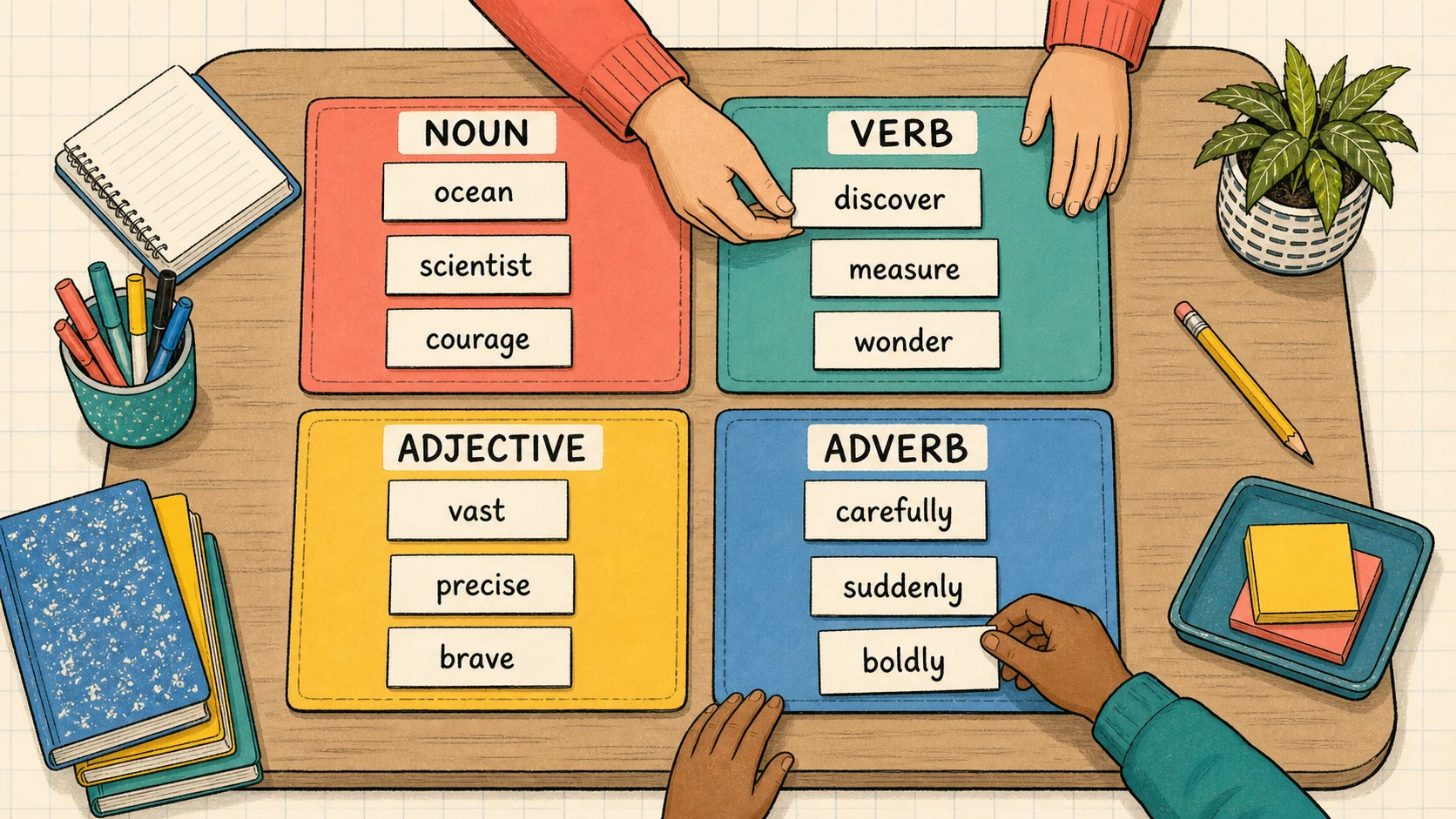
Brief modeling, explanation, practice, and review can be repeated with new sentences.
Use this routine for approximately one small set of sentences at a time; the learner’s attention and accuracy should determine the amount.
1. Retrieve
Present one familiar sentence and ask for previously taught categories. Keep this review brief. If yesterday’s errors recur, retain the same level of support.
2. Model
Think aloud through one target word:
“Bright tells what kind of light, so it modifies the noun light. In this sentence, bright is an adjective.”
The explanation matters because it reveals the decision process.
3. Practice together
Analyze two or three sentences. Ask the learner to point to the modified word, antecedent, connected elements, or preposition’s object.
4. Practice independently
Assign a small number of items that match the modeled format. Avoid introducing multiple new distinctions in the independent portion.
5. Apply and check
Have the learner write or revise one sentence using the target category. End with one explanation: “How did you know?”
The IES elementary writing practice guide offers high-level guidance for writing instruction. It is appropriate background for connecting grammar to purposeful sentence construction and revision, but it does not prescribe this exact routine or evaluate the linked worksheets.
Choosing Practice That Matches the Evidence
The best practice is not necessarily the worksheet with the most categories. Choose the smallest task that directly addresses the observed error.
| Observed performance |
Appropriate next practice |
| Confuses nouns and verbs |
Short sentences with one clear subject and action |
| Finds nouns and verbs but misses modifiers |
Noun–adjective and verb–adverb comparisons |
| Labels every “-ly” word as an adverb |
Mixed examples such as quickly, friendly, and adverbs without -ly |
| Identifies pronouns but not antecedents |
Pronoun-to-antecedent arrows |
| Circles a preposition but omits its phrase |
Bracket the preposition, object, and modifiers |
| Knows definitions but fails in passages |
Sentence-by-sentence contextual classification |
| Identifies categories accurately |
Sentence combining and revision for precision |
| Makes errors only in longer sentences |
Reduce clause complexity, then rebuild it gradually |
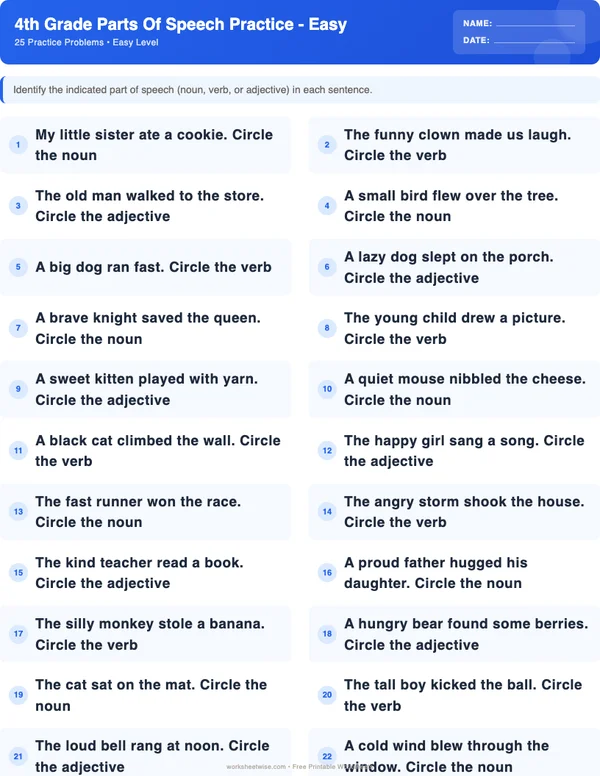
The free easy 4th Grade Parts of Speech worksheet contains 14 exercises focused on nouns, verbs, adjectives, and sentence analysis. It includes a separate answer key. That makes it suitable for a learner beginning the topic or needing reinforcement in the three foundational categories. It is not, by itself, practice in all eight parts of speech.
The focused Parts of Speech pack contains 18 worksheets and costs $4.79. Consider a larger pack only when repeated practice across several sessions is useful. When the learner needs a narrowly defined format or fresh sentence sets, the free worksheet generators may be a better next choice.
Differentiation Without Lowering the Thinking
Differentiation should change the amount of support, sentence complexity, or response format while preserving the central question: what job does this word perform here?
When more support is needed
- Limit choices to two categories at first.
- Use one-clause sentences with concrete nouns and action verbs.
- Color-code the target word and the word it modifies.
- Let the learner point or sort before writing labels.
- Read the sentence aloud if decoding is interfering with grammar analysis.
- Keep a visible reference card with the category, job, and one example.
- Ask for one reason rather than several labels at once.
When the core task is secure
- Use sentences containing two clauses.
- Include linking verbs and progressive verb phrases.
- Ask for complete prepositional phrases, not just prepositions.
- Compare flexible words such as light, run, or clean across sentences.
- Ask the learner to revise a vague noun or weak verb and explain the effect.
- Include plausible distractors, such as an adjective ending in -ly.
These are instructional options, not prescriptions for a particular learner. Use the work produced during the lesson to decide whether to maintain, add, or remove support.
Common Errors and Diagnostic Responses
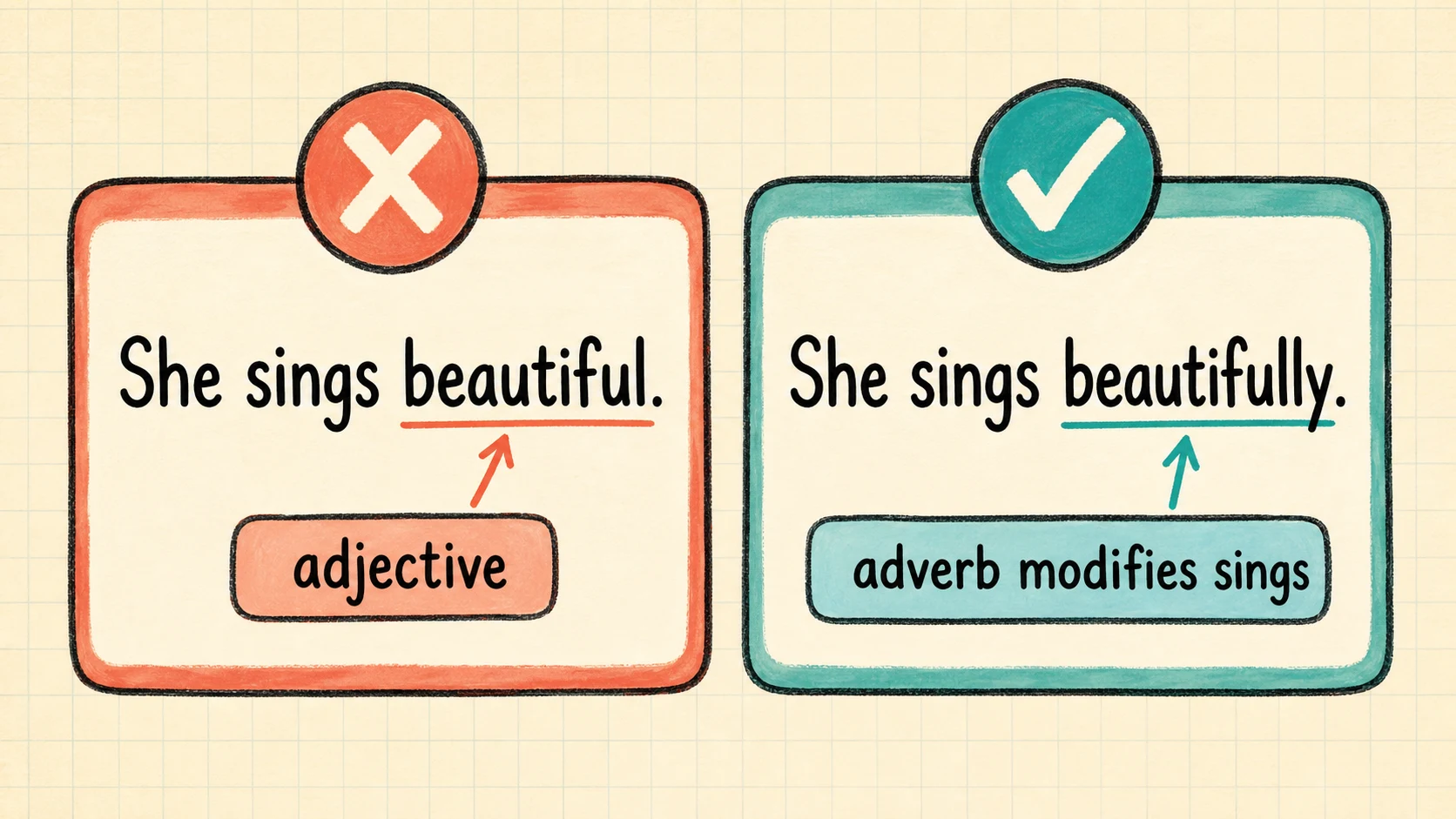
An error pattern is most useful when it leads to a specific teaching response.
| Error |
Likely reasoning gap |
Diagnostic prompt |
Teaching response |
| Calls every person or animal the subject |
Confuses noun with sentence role |
“Is this word a name, and what is it doing in this sentence?” |
Separate part of speech from subject position |
| Calls every action-like word a verb |
Ignores context |
“What job does the word perform here?” |
Compare a run with we run |
| Calls all describing words adjectives |
Does not track the modified word |
“What word does it describe?” |
Draw arrows from modifiers |
| Marks only the -ing word in a progressive verb |
Misses helping verbs |
“Which words work together to express the action?” |
Box the whole phrase, such as was singing |
| Treats an adjective after a linking verb as an adverb |
Applies “after a verb” mechanically |
“Does it describe the action or the subject?” |
Compare action and linking uses |
| Identifies a pronoun without its antecedent |
Recognizes form but not reference |
“Who or what does this pronoun mean?” |
Draw a pronoun-to-antecedent arrow |
| Includes only the preposition |
Does not see phrase structure |
“What noun completes the relationship?” |
Bracket the entire prepositional phrase |
| Labels a word from memory rather than context |
Assumes one permanent category |
“Can this word do another job in a new sentence?” |
Use paired boundary examples |
Do not treat one mistake as proof of a broad misconception. Look for a repeated pattern across different sentences. A correction followed by an accurate explanation provides more information than a corrected label alone.
Monitoring Progress and Deciding When to Move On
Use a simple record with four measures:
- Identification: Was the label correct?
- Evidence: Could the learner explain the word’s function?
- Transfer: Could the learner use the category in an original or revised sentence?
- Independence: What prompt or visual support was required?
A compact entry might read:
Adverbs: 4 of 5 identified; explanations accurate for 3; confused adjective after linking verb; needed one modifier arrow.
Numbers alone can hide the type of error, while notes alone can make change hard to see. Record both briefly. Compare performance on a taught sentence format with performance on a new format. If accuracy drops only when sentences contain two clauses, clause complexity may be the obstacle rather than the category definition.
Move forward when the learner can classify the target in several varied sentences, justify the decisions, and apply the category in writing with little support. Revisit earlier material through mixed review. If explanations remain uncertain, reduce complexity and reteach the functional test instead of simply assigning more items.
A Two-Week Practice Plan
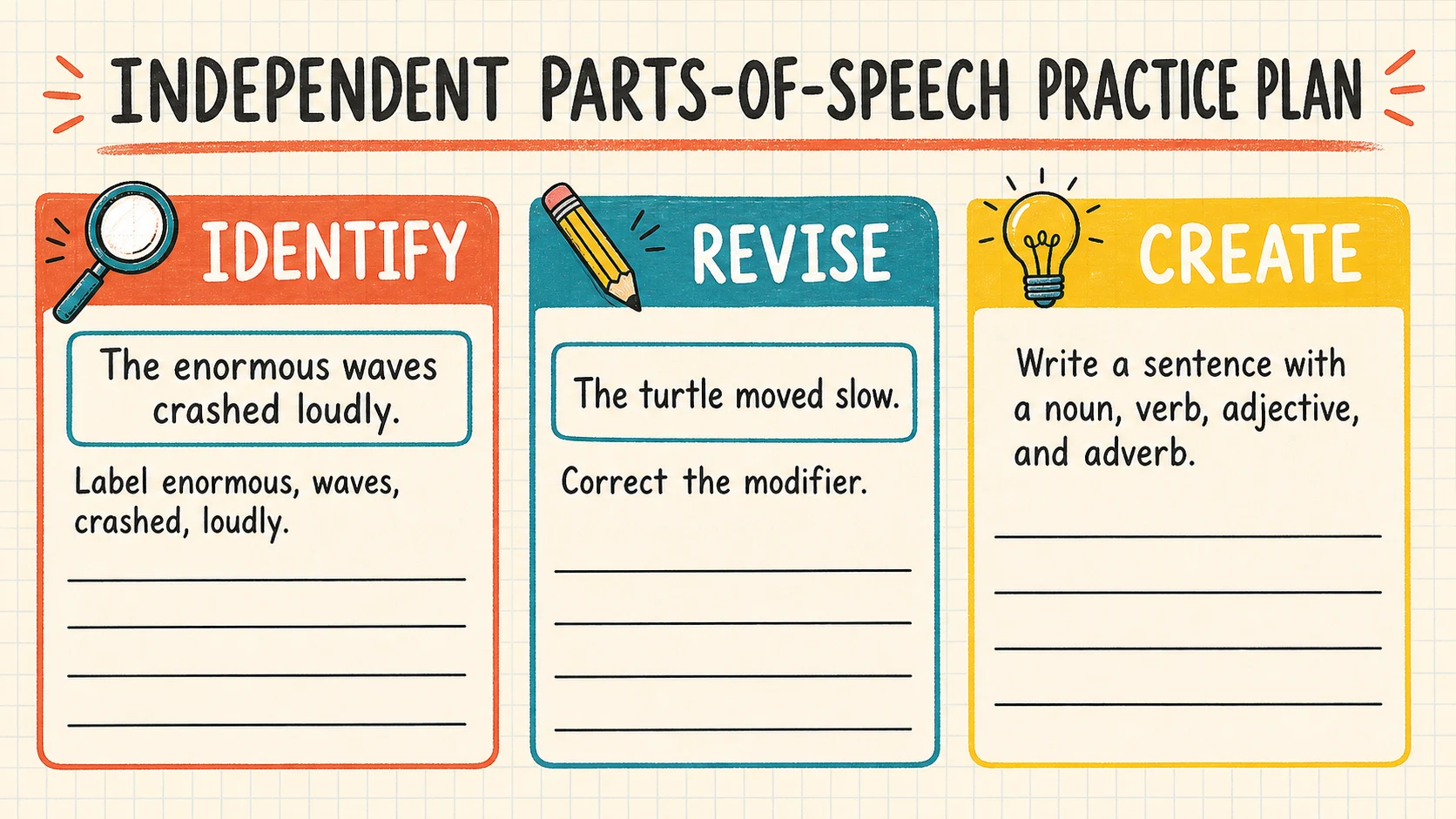
The sequence is adjustable; observed work should determine pacing and review.
This plan is a practical option, not a universal timetable. Each day uses a short model, a small practice set, one application sentence, and an explanation check.
| Day |
Focus |
Suggested practice |
Check |
| 1 |
Baseline: nouns, verbs, adjectives |
Analyze five short sentences |
Record category and explanation errors |
| 2 |
Nouns and action verbs |
Sort words, then classify them in sentences |
Ask why context matters |
| 3 |
Adjectives |
Link each adjective to its noun |
Revise one noun phrase |
| 4 |
Adverbs modifying verbs |
Compare how actions occur |
Contrast adjective and adverb |
| 5 |
Mixed core review |
Use the 14-item easy worksheet or a smaller selection |
Note recurring patterns |
| 6 |
Pronouns and antecedents |
Draw reference arrows |
Repair one unclear pronoun |
| 7 |
Action, linking, and progressive verbs |
Compare verb functions |
Mark complete verb phrases |
| 8 |
Prepositions and phrases |
Model positions and bracket phrases |
Identify each object noun |
| 9 |
Conjunctions and interjections |
Connect words and clauses; separate reactions |
Name what each conjunction joins |
| 10 |
All categories in context |
Analyze a short passage and revise two sentences |
Compare with Day 1 evidence |
If Day 5 reveals continued confusion among nouns, verbs, and adjectives, repeat or vary those categories before moving to Day 6. If core categories are secure, later days can include more boundary cases. Save one unfamiliar sentence from each session for delayed review.
Limitations and a Responsible Next Step
Parts-of-speech labels are tools for understanding and shaping sentences; they are not a complete writing curriculum. Identification exercises do not by themselves teach paragraph organization, evidence, narrative sequence, spelling, punctuation, or reading comprehension. A worksheet also cannot reveal every reason for an error. Reading difficulty, unfamiliar vocabulary, sentence complexity, and unclear directions can all affect the response.
This guide offers instructional suggestions and verified sentence examples within the supplied topic scope. It does not provide medical guidance, guarantee outcomes, set a universal schedule, or claim comprehensive standards alignment. The cited sources support broad instructional context; they did not evaluate WorksheetWise, this guide, or its downloadable materials.
For the next session, use the free 14-exercise Parts of Speech worksheet as a brief check of nouns, verbs, adjectives, and sentence analysis. Review the answer key, group errors by type, and choose the next lesson from the specific pattern you observe.