What 4th Grade Punctuation Includes
Fourth-grade punctuation instruction should help a learner choose marks for meaning, not simply insert marks wherever a pause seems natural. A useful sequence begins with secure sentence boundaries and capitalization, then moves through commas, apostrophes, quotation marks, and editing in connected writing.
In practical terms, a fourth grader should be developing control of:
- Periods, question marks, and exclamation points
- Capital letters at sentence beginnings
- Commas in lists, dates, addresses, and introductory elements
- Commas in selected compound sentences
- Apostrophes in contractions and possessives
- Quotation marks and related punctuation in dialogue
- Editing sentences and short paragraphs for several kinds of errors
The learner’s observed work should determine the pace. A child who still joins three sentences with commas needs sentence-boundary practice before a long dialogue lesson. A child who punctuates sentences accurately in isolation may be ready to edit paragraphs or apply the same conventions in original writing.
Grade labels describe the intended practice level, not a universal timetable. Local curricula and instructional sequences differ. The 4th Grade worksheet hub and 4th Grade Grammar collection can help adults compare nearby skills without assuming that every learner must complete them in one fixed order.
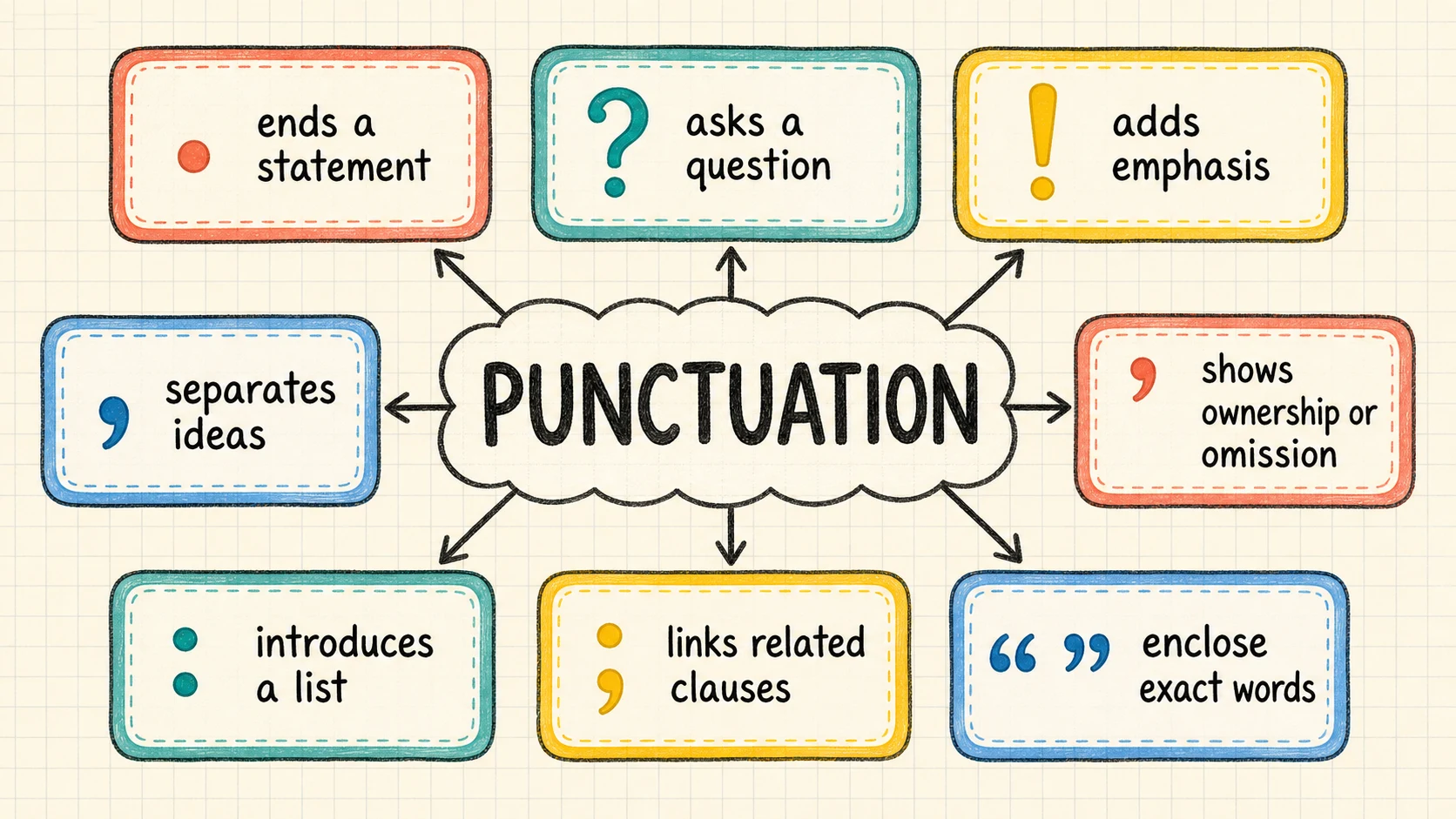
Sentence boundaries support later work with commas, apostrophes, quotations, and paragraph editing.
Prerequisites to Check Before Teaching New Marks
Punctuation depends on more than remembering symbols. Before selecting practice, ask the learner to write or repair several short sentences. Look for the underlying knowledge described below.
Recognizing a complete sentence
The learner should be able to identify who or what a sentence is about and what happens or is stated about it. Formal grammatical labels can help, but the immediate goal is recognizing a complete thought.
Compare:
The bright red kite. This names something but does not tell what it did.The bright red kite rose above the trees. This expresses a complete thought.
If a learner cannot reliably find sentence boundaries, more advanced comma work is likely to become guesswork.
Distinguishing statements, questions, and exclamations
Read three sentences aloud without showing their final marks:
The library closes at fiveWhen does the library closeWatch out for that puddle
Ask what each sentence is doing. The first gives information, the second asks for information, and the third expresses a strong warning. Voice can support the discussion, but meaning should decide the punctuation. Not every sentence spoken loudly needs an exclamation point.
Using basic capitalization
Check whether the learner capitalizes the first word of a sentence. The catalogue worksheet combines capitalization with periods, question marks, and exclamation points, so uncertainty about capitals can make the punctuation task appear harder than it is.
Reading sentences fluently enough to discuss meaning
Punctuation supports how readers group and interpret written language. The IES foundational reading practice guide addresses earlier reading foundations through Grade 3. In a fourth-grade lesson, earlier reading difficulty may still affect how readily a learner notices sentence boundaries. This source provides broad instructional context; it does not evaluate WorksheetWise materials or prescribe a punctuation sequence for every fourth grader.
A practical prerequisite check should be short. Five or six items usually reveal more when the adult asks, “How did you decide?” than when the adult records only right or wrong answers.
A Grade-Appropriate Teaching Progression
Teach one punctuation decision at a time, and revisit earlier decisions as the text becomes more complex. The following progression is an instructional suggestion based on the supplied catalogue sequence. It is not a claim that every district teaches the marks in precisely this order.
| Stage |
Main decision |
Supported practice |
Ready-to-advance evidence |
| 1. Sentence boundaries |
Is this a statement, question, or exclamation? |
Add capitals and end marks to single sentences |
The learner explains the sentence purpose and selects the mark consistently |
| 2. Commas in fixed patterns |
Where are items, date parts, or address parts separated? |
Mark one pattern at a time |
The learner can name the pattern instead of saying only, “It needs a pause” |
| 3. Introductory elements |
Does an opening word or phrase lead into the main sentence? |
Bracket the opening element, then add a comma |
The learner identifies the main sentence that follows |
| 4. Compound sentences |
Are two complete thoughts joined by a coordinating conjunction? |
Test each side for completeness |
The learner avoids inserting the comma when the second part is not a complete thought |
| 5. Apostrophes |
Are letters omitted, or is ownership shown? |
Expand contractions and restate possessives |
The learner states which apostrophe job applies |
| 6. Direct speech |
Which exact words are spoken? |
Punctuate already-written dialogue |
The learner places quotation marks around spoken words and handles nearby commas and end marks |
| 7. Connected editing |
Which rule applies at each location? |
Edit two to five sentences, then explain changes |
The learner finds mixed errors without being told which mark is missing |
| 8. Original writing |
Can conventions transfer to new sentences? |
Write, reread, and edit a short passage |
The learner applies taught marks beyond a worksheet format |
The Common Core English Language Arts standards provide one authoritative reference for grade-by-grade language expectations. The supplied catalogue identifies fourth-grade work with capitalization, commas, and quotation marks in direct speech and quotations, while some related conventions appear before or after Grade 4. Use local requirements when formal standards alignment matters.
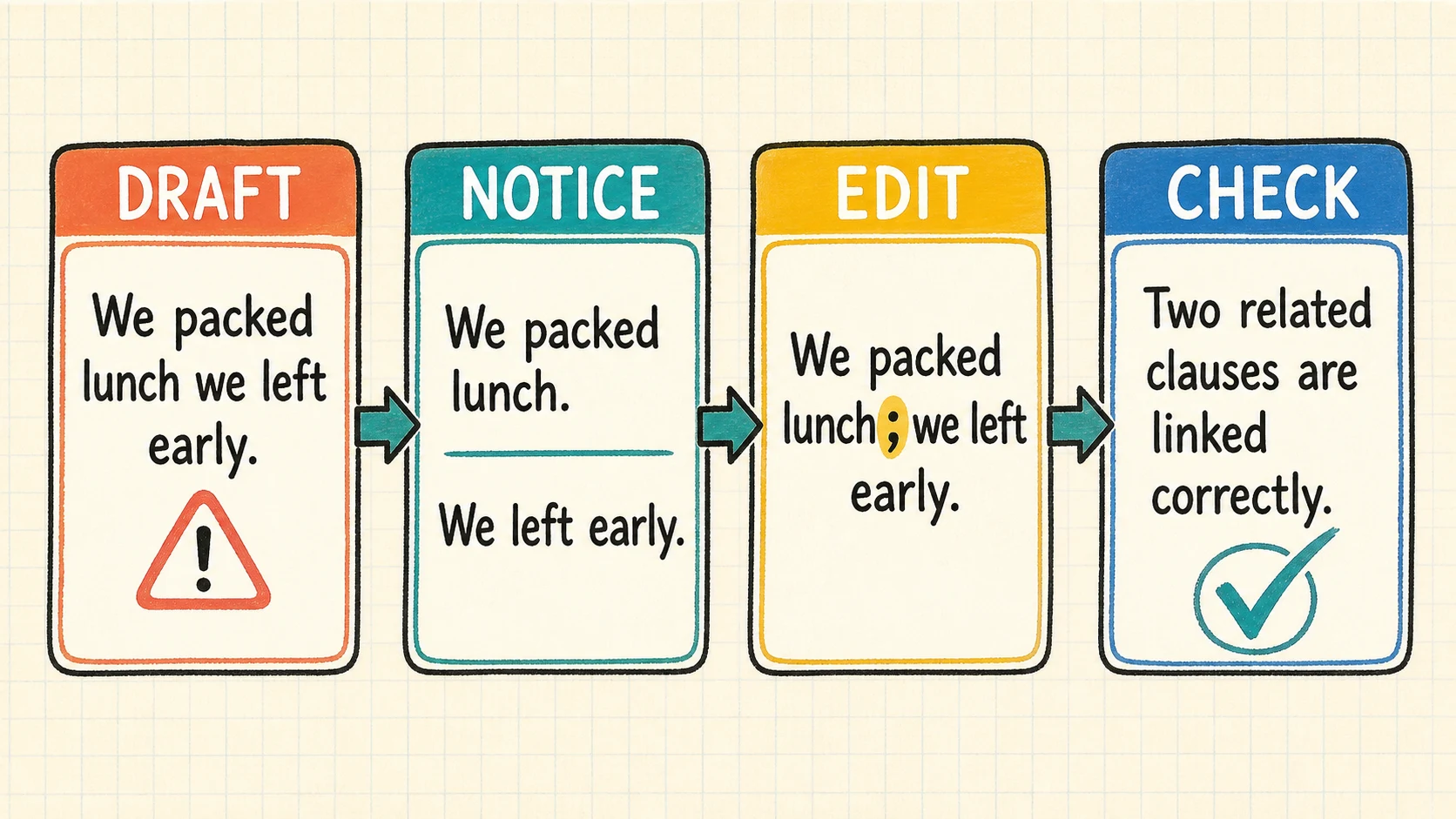
Move forward when the learner’s explanations and independent work show readiness, not simply when a worksheet is finished.
Concrete and Visual Models for Punctuation
Abstract rules become easier to discuss when the learner can see the structure that a mark represents.
Sentence boxes
Place each complete sentence in a box:
[Maya planted the seeds.] [Will they grow by Friday?]
The boxes make two boundaries visible. Remove the marks and capitals, then ask the learner to rebuild them:
maya planted the seeds will they grow by friday
This model is particularly helpful when a learner reads through the boundary without noticing that one idea has ended and another has begun.
List slots
Represent each list item as a separate slot:
We packed [sandwiches], [apples], and [water].
The commas separate the listed items. The final comma before and is shown in the catalogue example and creates a consistent three-item pattern. If local style guidance differs, follow that guidance.
A two-item phrase does not use the same list pattern:
We packed sandwiches and water.
Introductory-element brackets
Bracket the opening element and underline the main sentence:
[After lunch], we visited the museum.
The words we visited the museum can stand as the main sentence. After lunch introduces when the action happened, so the comma marks the transition.
Do not add a comma merely because a sentence begins with a time reference:
Yesterday was rainy.
Here, Yesterday is part of the main statement rather than an introductory phrase followed by another complete structure.
Contraction and possession tests
Use two different verbal tests for apostrophes:
- Contraction:
didn't expands to did not.
- Possession:
the dog's leash can be restated as the leash belonging to the dog.
The mark looks the same, but its job is different. Saying the expanded or restated form makes the choice observable.
Speech bubbles and quotation frames
Write spoken words inside a drawn speech bubble. Then transfer only those words into quotation marks:
Speech bubble: I found the missing key.
Written dialogue: Nora said, “I found the missing key.”
This separates the speaker label from the exact spoken words. Once that distinction is secure, add new-speaker paragraphs and more varied dialogue positions.
Fully Worked and Checked Examples
Each example below identifies the structure, applies one or more rules, and checks the final result.
Example 1: Sentence boundaries
Unpunctuated text:
where did you put my blue notebook
Step 1: Identify the sentence’s job. It asks for information.
Step 2: Capitalize the first word: Where.
Step 3: Add a question mark because the sentence is a direct question.
Corrected sentence:
Where did you put my blue notebook?
Check: The sentence begins with a capital, contains one complete question, and ends with the corresponding mark.
Boundary case:
I wonder where you put my blue notebook.
This sentence mentions a question but does not directly ask one. It functions as a statement, so it ends with a period.
Example 2: Commas in a series
Unpunctuated sentence:
For the project we need cardboard string markers and glue.
Step 1: Find the introductory words: For the project.
Step 2: Add a comma after that opening phrase.
Step 3: Identify the listed materials: cardboard, string, markers, and glue.
Step 4: Place commas between the list items.
Corrected sentence:
For the project, we need cardboard, string, markers, and glue.
Check: Removing the introductory phrase leaves the complete sentence We need cardboard, string, markers, and glue. Each of the four materials remains distinct.
Boundary case:
For the project, we need markers and glue.
Only two materials are joined by and, so no list comma belongs between them.
Example 3: A comma before a conjunction
Unpunctuated sentence:
Lena wanted to finish the model but the paint was still wet.
Step 1: Examine the words before but: Lena wanted to finish the model. This is a complete thought.
Step 2: Examine the words after but: The paint was still wet. This is also a complete thought.
Step 3: Because the conjunction joins two complete thoughts in this example, place a comma before but.
Corrected sentence:
Lena wanted to finish the model, but the paint was still wet.
Check: Both sides can stand as sentences, and the comma appears immediately before the conjunction.
Boundary case:
Lena wanted to finish the model but waited until morning.
The words after but do not form a separate sentence because they do not name a new subject. Do not insert the same compound-sentence comma.
The supplied catalogue places comma work in a progression spanning several grades, and its standards summary lists the comma-before-conjunction convention at Grade 5. A fourth grader may encounter this form during sentence study, but adults should follow the learner’s local sequence rather than present it as a universal fourth-grade requirement.
Example 4: Apostrophes with two different jobs
Unpunctuated sentence:
The dogs bowl isnt beside the door.
Step 1: Decide whose bowl it is. The bowl belongs to one dog, so write the singular possessive dog's.
Step 2: Expand isnt to is not. Because letters are omitted in the shortened form, write isn't.
Corrected sentence:
The dog's bowl isn't beside the door.
Check: The first apostrophe shows ownership. The second marks omitted letters.
Boundary case:
The dogs are waiting beside the door.
Here, dogs means more than one dog and does not show possession. It needs no apostrophe.
Example 5: Dialogue punctuation
Unpunctuated dialogue:
Dad said please place the glasses on the table
Step 1: Identify the speaker label: Dad said.
Step 2: Identify the exact spoken words: Please place the glasses on the table.
Step 3: Capitalize the first spoken word.
Step 4: Place a comma after said to introduce the spoken words.
Step 5: Put quotation marks around the exact speech. Place the period inside the closing quotation mark.
Corrected sentence:
Dad said, “Please place the glasses on the table.”
Check: The quotation marks contain only Dad’s spoken words. The speaker label remains outside.
When another person speaks, begin a new paragraph:
“I will carry the plates,” Dad said.
“I can bring the napkins,” Ava replied.
The catalogue’s dialogue guidance uses a new line for a new speaker and places dialogue punctuation inside the quotation marks.
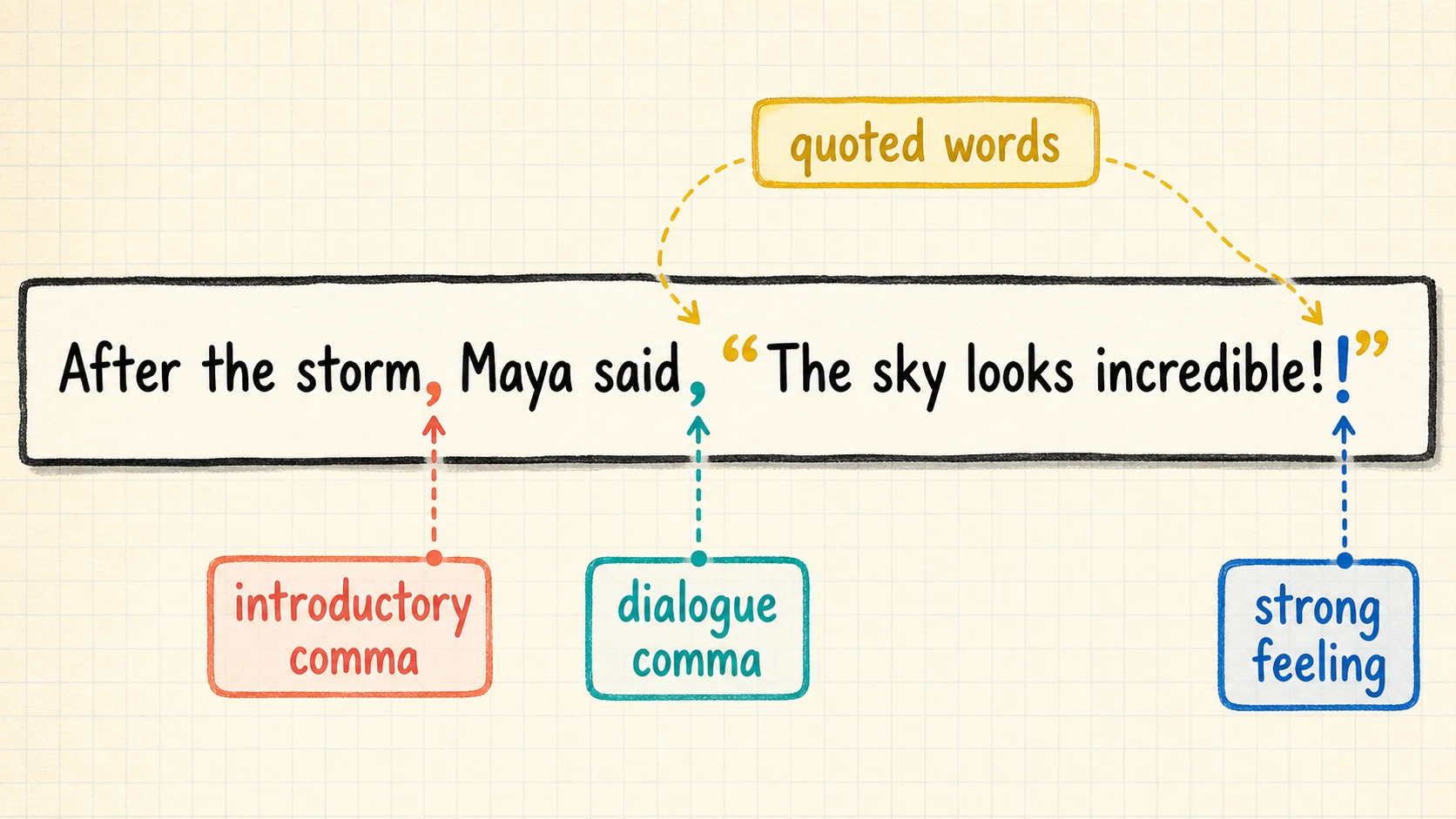
The strongest worked examples show the decision, the rule, and a final check—not only the corrected sentence.
A Short, Repeatable Lesson Routine
A punctuation lesson can be brief while still including explanation, guided practice, and transfer. The IES elementary writing practice guide offers high-level guidance for teaching writing processes and foundational writing skills. The routine below is an instructional application, not a timetable prescribed by IES.
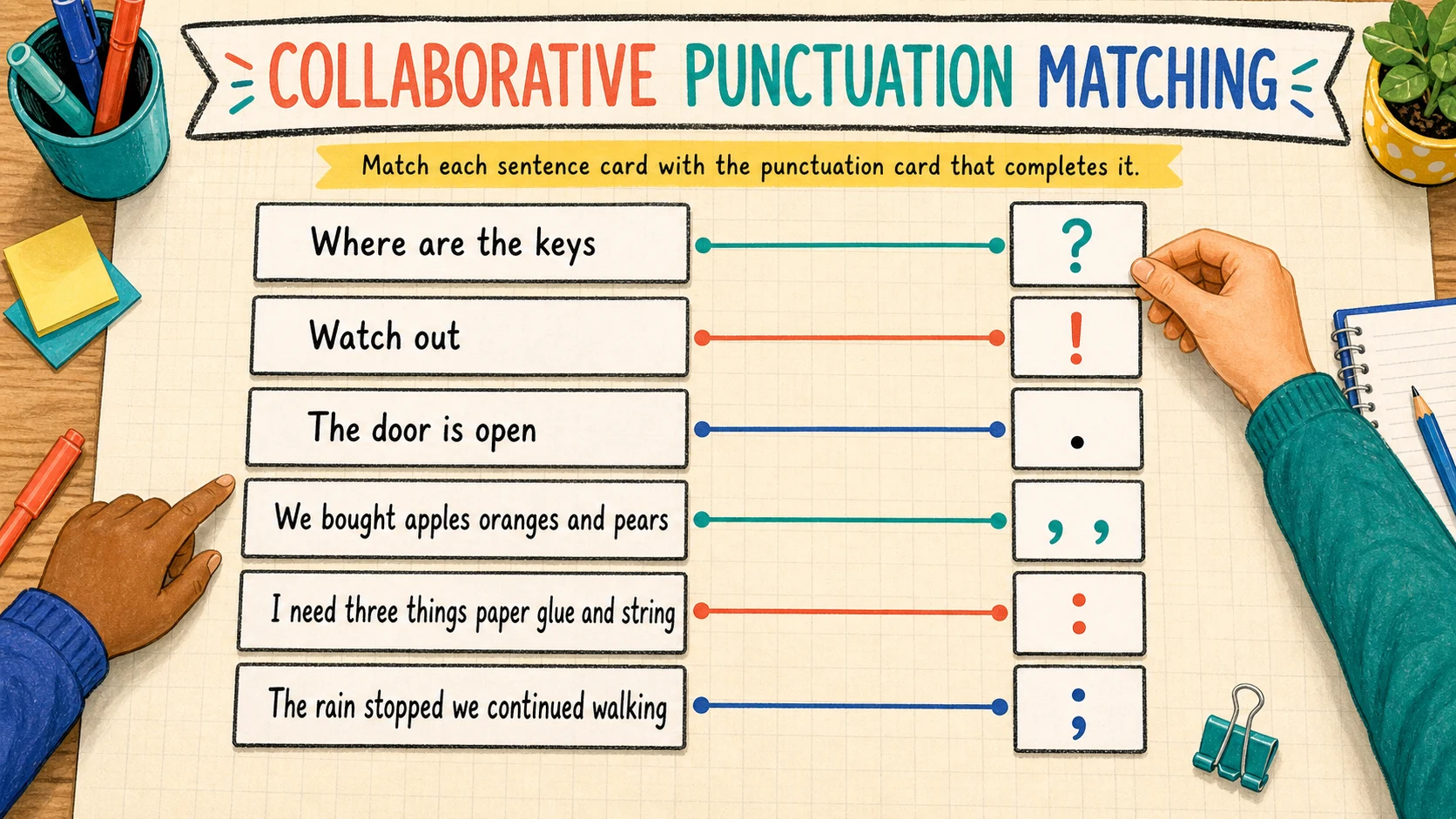
Use the same lesson shape while changing the target rule and text complexity.
1. Review one known contrast
Show two sentences and ask what changed:
Did Eli bring the map.
Did Eli bring the map?
The learner explains why the second ending matches the sentence’s purpose.
2. Model one decision
Think aloud through a single item. For a comma in a list, name the items before adding any marks. For an apostrophe, perform the contraction or ownership test. Keep the model focused on one rule.
3. Solve two items together
Ask the learner to identify the structure while the adult records or points. Prompt with questions such as:
- What is the sentence doing?
- What are the listed items?
- Can both sides stand as complete sentences?
- Which words were actually spoken?
- Does this apostrophe replace letters or show ownership?
4. Try three or four independently
Choose items that match the modeled structure. Avoid introducing several new rules in the independent portion.
5. Explain and transfer
Have the learner justify one answer, then write one original sentence using the same convention. End by checking capitals, the target mark, and the final punctuation.
If accuracy falls apart during the independent items, return to a more visible model. That is pacing information, not evidence that the learner needs a larger worksheet.
Choosing Practice That Matches the Need
The best practice is the smallest set that reveals whether the learner understands the decision.
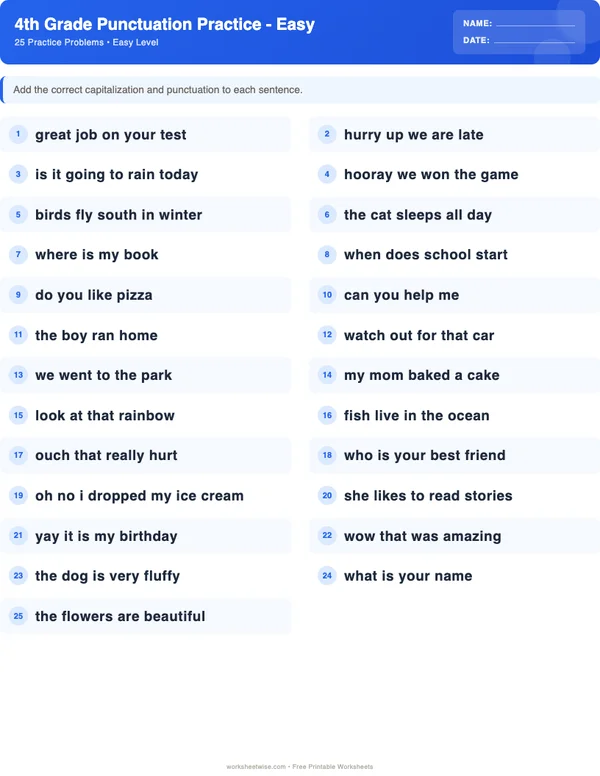
For initial sentence-boundary review, the free easy punctuation worksheet provides 14 exercises on capitalization, periods, question marks, and exclamation points, with a separate printable answer key. It is suitable when the learner is beginning this level of punctuation or needs reinforcement of those specific foundations.
Do not use that worksheet to judge comma, apostrophe, or dialogue control; those skills are outside its listed scope.
For broader practice, the 4th Grade Punctuation topic guide can serve as a return point for choosing related materials. The focused punctuation pack contains 18 worksheets and may be useful when repeated or varied practice is needed. More pages are not automatically better. Select a small group, examine the learner’s errors, and then decide whether to repeat, simplify, or increase complexity.
Match the format to the instructional goal:
| Observed need |
Useful practice |
Avoid at first |
| Confuses statements and questions |
Sort sentences by purpose; add end marks |
Mixed paragraphs with several rule types |
| Misses sentence beginnings |
Restore capitals and end marks together |
Dialogue with multiple speakers |
| Inserts commas by sound alone |
Mark list items or bracket introductory phrases |
Editing without a named comma rule |
| Confuses contractions and possessives |
Expand and restate forms orally |
Long lists of unrelated apostrophe words |
| Misplaces quotation marks |
Mark exact spoken words in prepared dialogue |
Writing a full original conversation |
| Succeeds on isolated items but not paragraphs |
Edit two connected sentences, then four |
Repeating more isolated items indefinitely |
Differentiation Without Changing the Core Skill
Differentiation should change support, text load, or response method while preserving the punctuation decision.
When the learner needs more support
Use shorter sentences and highlight the relevant structure. Let the learner place punctuation cards before writing the marks. Read the sentence aloud, then ask what it means. Cover all but one line to reduce visual load.
For dialogue, underline the speaker label and circle the spoken words. For possessives, use one owner before introducing plural ownership forms. For commas, teach lists separately from dates or introductory elements.
When the learner is nearly secure
Remove visual cues but keep the rule named. Mix two familiar forms, such as end punctuation and commas in lists. Ask for a brief explanation after every second or third item rather than after every answer.
When the learner is ready for extension
Use paragraph editing, dialogue with speaker labels in different positions, and original writing. Ask the learner to create a boundary case, such as a sentence containing and that does not need a comma before it. This checks whether the learner understands the structure instead of copying a surface pattern.
Extension should increase reasoning, not merely add length. Continue to monitor whether punctuation transfers into ordinary writing.
Common Errors and Diagnostic Responses
An error becomes useful when it points to the next teaching move.
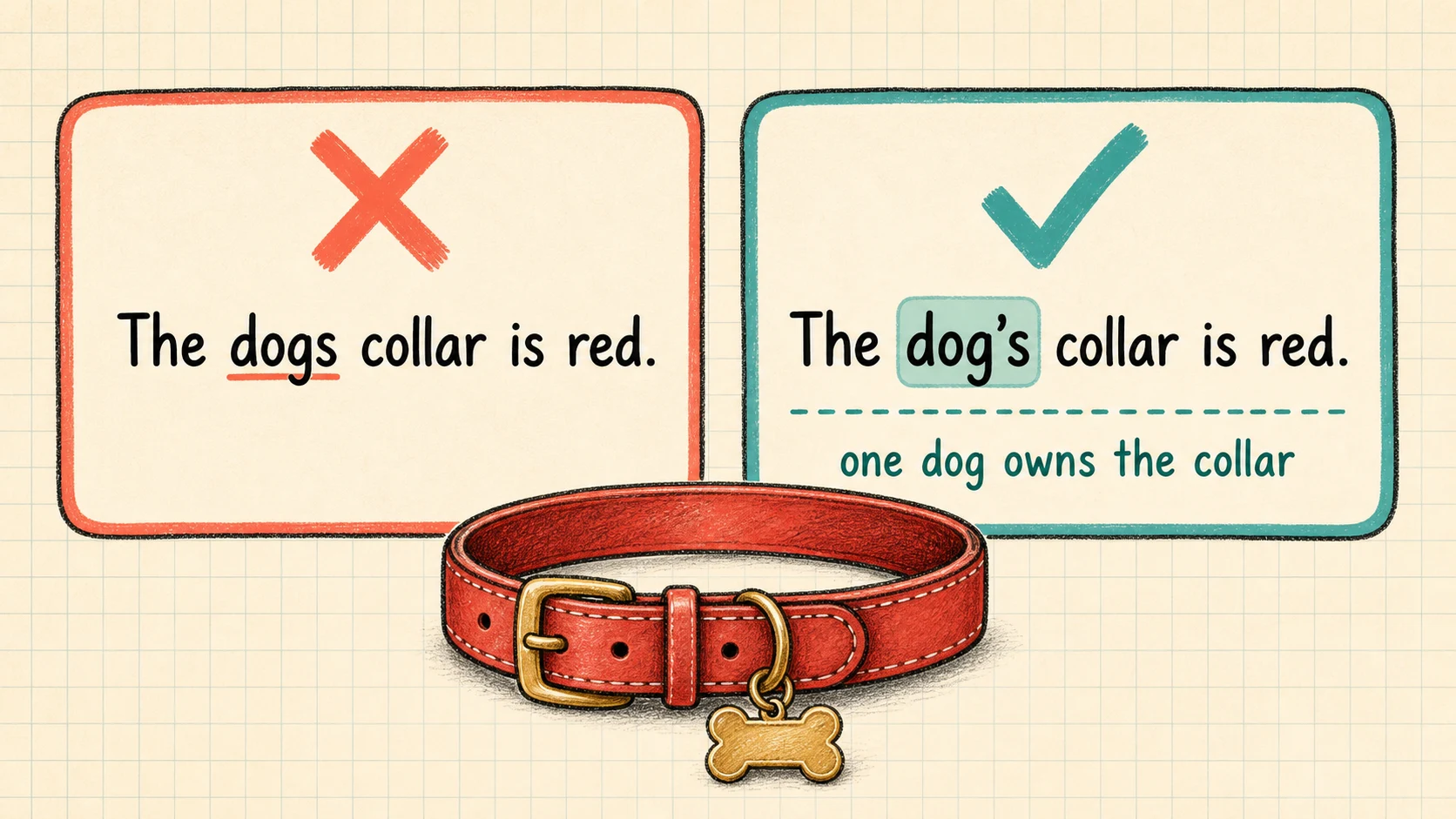
Diagnose the reason for the mark before assigning more examples of the same type.
“Put a comma wherever you pause”
Natural pauses vary by speaker and reading speed. Ask the learner to name the grammatical pattern: a list, a date, an address, an introductory element, or two complete thoughts joined in the taught form. If no pattern is present, a pause alone is insufficient evidence.
Every forceful sentence gets an exclamation point
Compare a strong statement with an exclamation:
The storm damaged three trees.
Watch out for the falling branch!
The first sentence can report dramatic information while remaining a statement. Discuss purpose rather than loudness alone.
Every word ending in “s” gets an apostrophe
Use the ownership test. Three cats slept is plural. The cat's bed belongs to one cat. Have the learner say the meaning before writing the mark.
Quotation marks surround the whole sentence
Return to the speech-bubble model. Only the exact spoken words go inside quotation marks; a speaker label such as Mina said stays outside.
A correct worksheet means the skill is mastered
Recognition and prompted correction may not transfer immediately to original writing. Check the same convention in an unannounced editing task and in a short piece the learner composed. A learner may understand a rule but fail to notice where it applies without a prompt.
Correction without explanation
A learner may guess correctly. Ask, “What job is this mark doing?” Accept a plain-language explanation. The goal is a defensible decision, not memorized terminology.
Monitoring Progress and Deciding What Comes Next
Keep monitoring narrow enough to interpret. Once or twice a week, collect a short sample containing:
- Two isolated items using the current rule
- One boundary case where a tempting mark should not be added
- Two connected sentences to edit
- One original sentence
Record errors by rule rather than using only a total score. “Three apostrophe errors” is more actionable when separated into “contractions” and “possession.”
Look for three kinds of evidence:
- Accuracy: Is the mark placed correctly?
- Explanation: Can the learner state why it belongs there?
- Transfer: Does the learner use it in connected or original writing?
Advance when these forms of evidence are reasonably consistent. If prompted items are correct but transfer is weak, retain the same rule and change the task format. If explanations reveal confusion, return to a concrete model. If mistakes are scattered across capitalization and sentence endings, narrow the lesson before adding commas or quotations.
Do not treat one tired session, one unfamiliar vocabulary word, or one unusually complex sentence as a stable pattern. Review several recent examples. This guide provides educational practice suggestions, not medical, diagnostic, or child-specific guidance.
A Two-Week Practice Plan
This plan is adjustable. It is not a universal timetable. Sessions can be shortened, repeated, or separated by rest days according to the learner’s observed work.
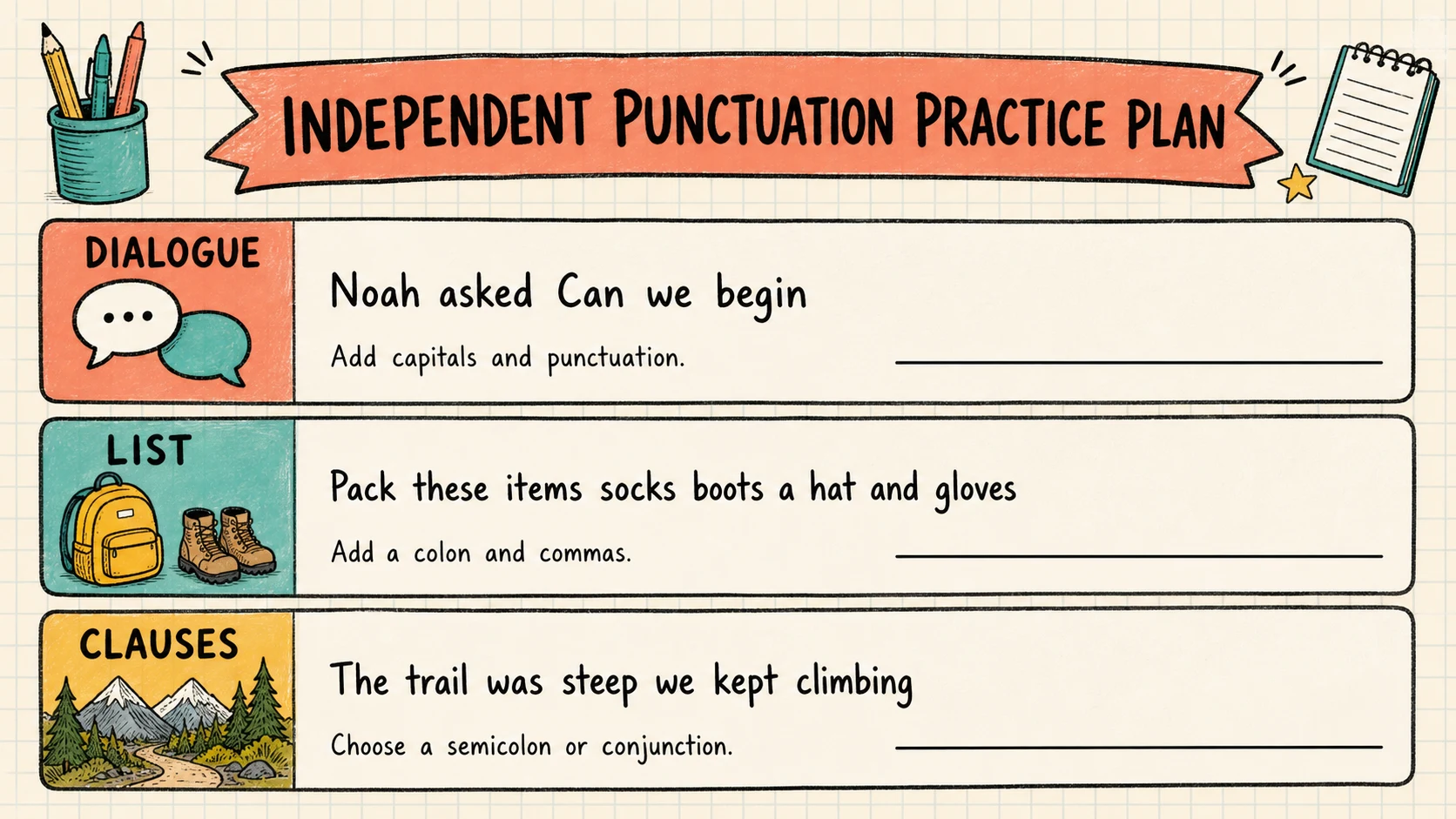
Each session moves from one visible decision toward mixed editing and original use.
| Day |
Focus |
Suggested activity |
Evidence to collect |
| 1 |
Baseline |
Correct six sentences with capitals and end marks |
Note which sentence purposes cause errors |
| 2 |
End punctuation |
Sort statements, questions, and exclamations; write one of each |
Explanation for each final mark |
| 3 |
Commas in lists |
Use list slots, then punctuate five sentences |
Correct separation of three or more items |
| 4 |
Dates or addresses |
Practice one selected fixed pattern |
Ability to name the parts being separated |
| 5 |
Review |
Mix end marks and the taught comma patterns |
Errors grouped by rule |
| 6 |
Introductory elements |
Bracket openings and underline main sentences |
Correct comma placement after the opening |
| 7 |
Compound-sentence contrast |
Test whether both sides are complete |
Correct handling of one boundary case |
| 8 |
Apostrophes |
Sort contractions and possessives; apply the two verbal tests |
Accurate statement of each apostrophe’s job |
| 9 |
Dialogue |
Transfer speech-bubble text into quotation marks |
Exact spoken words correctly enclosed |
| 10 |
Transfer and review |
Edit a short paragraph, then write three original sentences |
Accuracy, explanation, and independent use |
If Day 1 reveals uncertainty with basic capitals and end marks, spend several sessions there. The free worksheet is specifically designed for that foundation. If the learner demonstrates immediate control, sample only a few items and move to the first rule that produces unstable explanations or inconsistent transfer.
Limitations and an Honest Next Step
No single topic guide or worksheet can demonstrate complete punctuation control. The catalogue’s free worksheet covers capitalization, periods, question marks, and exclamation points; it does not assess the full progression described here. Even a correct answer key comparison cannot show whether the learner understood the rule, guessed, followed a visual pattern, or can apply the convention in original writing.
This guide also does not claim comprehensive standards alignment, certification, guaranteed outcomes, or one sequence appropriate for every school. Use local curriculum documents when a specific instructional requirement must be confirmed.
The most useful next action is to give the learner a short, appropriately scoped sample and listen to the reasoning. Begin with the free 4th Grade Punctuation worksheet, review only a few items at first, and use the resulting error pattern to choose the next lesson.