What 6th Grade Parts of Speech Instruction Should Accomplish
Sixth-grade learners should be able to identify and use eight parts of speech—nouns, pronouns, verbs, adjectives, adverbs, prepositions, conjunctions, and interjections—in complete sentences. The central idea is that a word’s job in a particular sentence determines its part of speech. A word cannot always be classified correctly when it appears by itself.
Effective instruction should move beyond memorizing definitions. Learners need to:
- locate the subject and verb that form a sentence’s core;
- classify other words by asking what they do in that sentence;
- handle words such as light, run, and before that can perform different jobs;
- explain classifications with grammatical evidence;
- apply the categories while revising and interpreting sentences.
The learner’s observed work should determine the pace. A student who cannot consistently locate a sentence’s noun or verb needs focused practice there before attempting an entire paragraph containing all eight categories. A student who classifies accurately but writes vague sentences needs application through revision rather than more identification drills.
Grade labels describe the intended practice level, not a universal timetable or a guarantee that every local curriculum follows the same sequence. Local sequences differ, and earlier skills may need review before sixth-grade work is productive.
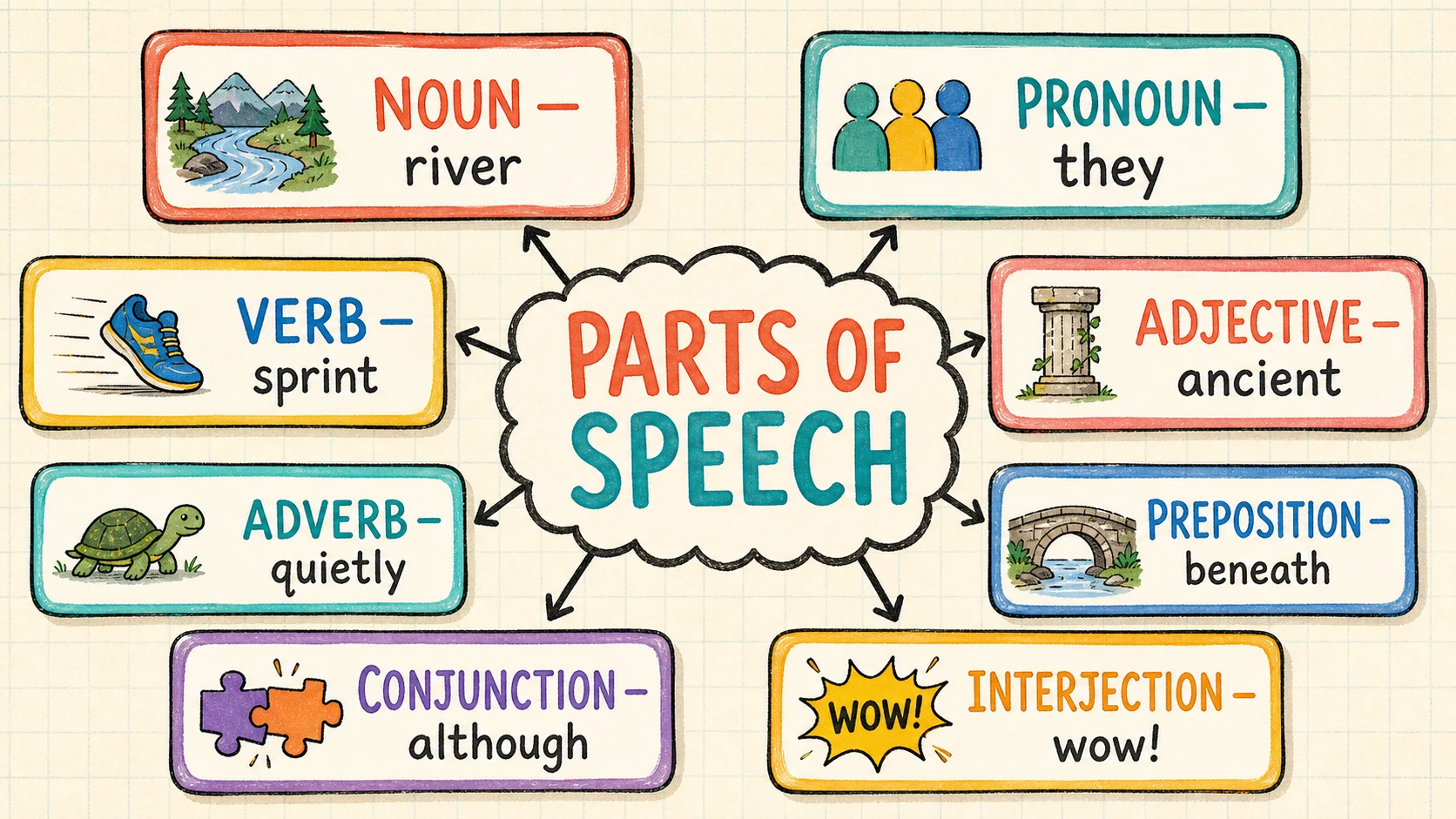
The categories become useful when learners connect identification, explanation, and sentence construction.
The Eight Parts of Speech in Context
A compact reference chart helps, but each definition should be tested in a sentence.
| Part of speech |
Main job |
Example in context |
Useful test |
| Noun |
Names a person, place, thing, or idea |
The committee reached a decision. |
What is being named? |
| Pronoun |
Replaces or refers to a noun |
Maya found the key, and she returned it. |
Which noun does the word refer to? |
| Verb |
Expresses action or links the subject to a description or identity |
The soup smells spicy. |
What happens, or what links the subject to more information? |
| Adjective |
Describes or limits a noun or pronoun |
Three careful hikers checked the map. |
Which one, what kind, or how many? |
| Adverb |
Describes a verb and may also modify an adjective or another adverb |
The hikers moved quite slowly. |
How, when, where, or to what degree? |
| Preposition |
Shows a relationship between its object and another part of the sentence |
The map lay under the notebook. |
Does it begin a relationship phrase such as under the notebook? |
| Conjunction |
Connects words, phrases, or clauses |
We packed water and fruit. |
What does the word join? |
| Interjection |
Expresses a reaction or emotion |
Wow, that trail is steep! |
Is it grammatically separate from the main sentence? |
These questions are diagnostic tools, not mechanical rules. For example, many adverbs answer how, but how alone cannot settle every classification. The learner must examine the word’s relationship to the rest of the sentence.
Nouns, pronouns, and clear reference
Nouns can be concrete, such as bridge, or abstract, such as patience. Pronouns reduce repetition, but they must point clearly to an antecedent—the noun or noun phrase to which they refer.
In “Lena handed Priya the folder because she had finished,” the pronoun she is grammatically a pronoun, but its reference is unclear. Either Lena or Priya may have finished. Classification is only the first step; revision is needed for clarity:
- “Because Lena had finished, she handed Priya the folder.”
- “Lena handed Priya the folder that Priya had finished.”
The intended meaning determines the appropriate revision.
Action, linking, and helping verbs
A verb may express a visible action, a mental action, or a state. In “Darius considered the evidence,” considered is an action verb even though the action cannot be watched in the same way as jumped.
A linking verb connects the subject with a description or identity: “The hallway became quiet.” A helping verb works with a main verb: “The students have completed the survey.” Here, have completed forms the complete verb phrase.
Adjectives and adverbs
Adjectives modify nouns or pronouns. Adverbs commonly modify verbs, adjectives, or other adverbs:
- “The quiet audience listened.” Quiet describes the noun audience.
- “The audience listened quietly.” Quietly describes how the audience listened.
- “The puzzle was surprisingly difficult.” Surprisingly modifies the adjective difficult.
- “The team worked very efficiently.” Very modifies the adverb efficiently.
The -ly ending is a clue, not a definition. Friendly is usually an adjective, while words such as soon and often can be adverbs without ending in -ly.
Prepositions, conjunctions, and interjections
A preposition begins a phrase containing an object: beneath the table, after lunch, or through the tunnel. The full phrase usually supplies information about place, time, direction, or another relationship.
Conjunctions join grammatical units. In “Sam sketched and painted,” and joins two verbs. In “Sam sketched, but Lee painted,” but joins two clauses.
An interjection stands somewhat apart from the sentence’s grammatical structure. In “Oh, I left the notebook upstairs,” oh expresses a reaction. The remaining words still form the central sentence.
Prerequisites and a Grade-Appropriate Progression
Before working with all eight categories, check whether the learner can distinguish a complete sentence from a fragment, locate a likely subject, and identify the main verb or verb phrase. It also helps if the learner understands that a phrase is a group of related words and that a clause contains a subject-verb relationship.
The IES foundational reading practice guide addresses instruction in kindergarten through third grade rather than sixth-grade grammar. It is relevant here only as high-level background: accurate word reading, vocabulary, and comprehension support later work with increasingly complex sentences. It does not prescribe this sixth-grade sequence.
A practical progression is:
| Stage |
Instructional focus |
Suitable task |
Evidence for moving forward |
| 1. Sentence core |
Nouns, pronouns, and verbs |
Mark the subject and complete verb |
Correctly explains who or what the sentence is about and what is stated about it |
| 2. Description |
Adjectives and adverbs |
Draw arrows from modifiers to the words they modify |
Distinguishes noun modifiers from verb modifiers |
| 3. Relationships |
Prepositions and their objects |
Bracket complete prepositional phrases |
Does not label the object alone as the whole phrase |
| 4. Connections |
Conjunctions |
Underline the exact units being joined |
Identifies whether words, phrases, or clauses are connected |
| 5. Full classification |
All eight parts |
Annotate increasingly complex sentences |
Uses context rather than a memorized word list |
| 6. Application |
Revision and sentence combining |
Replace vague words, clarify pronouns, or combine ideas |
Improves clarity without changing the intended meaning |
| 7. Transfer |
Authentic reading and writing |
Analyze one sentence from current reading or a draft |
Explains how grammatical choices affect meaning |
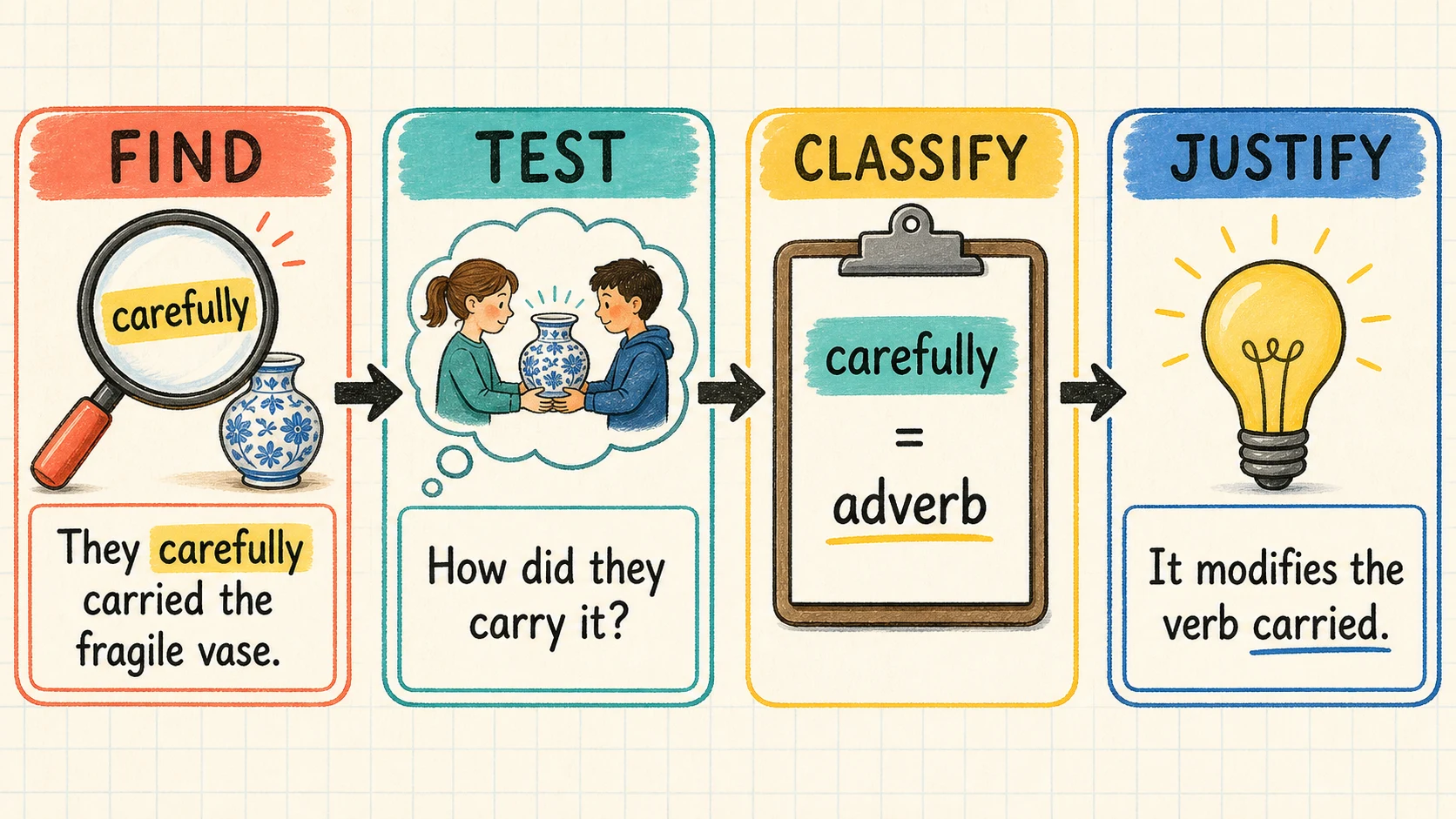
Support can be reduced as the learner’s explanations become accurate and independent.
The Common Core English Language Arts standards provide a broad reference for language development across grades. The supplied catalogue traces relevant foundations through earlier grades, including nouns, pronouns, verbs, adjectives, adverbs, conjunctions, prepositions, and interjections. That background can inform review, but it should not be described as comprehensive alignment for this guide or for every local program.
Concrete and Visual Models
Build a sentence in layers
Write a minimal sentence on a strip:
Birds migrate.
Add one layer at a time:
Many birds migrate south before winter.
Use color or shapes to show each relationship:
- Box the noun birds.
- Double-underline the verb migrate.
- Draw an arrow from the adjective many to birds.
- Draw an arrow from the adverb south to migrate.
- Bracket the prepositional phrase before winter.
This model shows that modifiers and phrases expand a sentence core. It also prevents the activity from becoming an exercise in assigning colors without understanding relationships.
Use a word-job matrix
When a flexible word causes confusion, place several sentences side by side:
| Sentence |
Word under study |
Job in this sentence |
| We saw a bright light. |
light |
Noun: names a thing |
| Please light the candle. |
light |
Verb: expresses an action |
| She carried a light backpack. |
light |
Adjective: describes backpack |
Ask the learner to justify each answer. The spelling remains unchanged, but the grammatical job changes.
Model prepositions with objects
Place a pencil on, under, beside, behind, and between other objects. Then convert each physical relationship into a sentence. This is an instructional suggestion drawn from the supplied teaching tips, not a sourced universal recommendation. It is especially useful when a learner memorizes preposition lists but cannot find a complete prepositional phrase.
Fully Checked Worked Examples
Example 1: Classifying the sentence core and modifiers
Sentence:
The curious fox silently approached the narrow stream.
- Ask who or what the sentence is about: fox. It names an animal, so it is a noun.
- Ask what the fox did: approached. It expresses an action, so it is a verb.
- Ask what kind of fox: curious. It modifies fox, so it is an adjective.
- Ask how the fox approached: silently. It modifies approached, so it is an adverb.
- Ask which stream: the narrow stream. Stream is a noun, and narrow is an adjective describing it.
- Both appearances of the limit which nouns are meant. In school grammar, they are commonly treated as adjectives or determiners. The supplied eight-category framework places such noun modifiers with adjectives.
Checked answer: fox, stream—nouns; approached—verb; curious, narrow—adjectives; silently—adverb.
Example 2: A linking verb and a prepositional phrase
Sentence:
After the storm, the streets became unusually quiet.
- After the storm shows a time relationship. After is a preposition, and storm is its noun object.
- Streets names what the sentence is about, so it is a noun.
- Became connects streets with the description quiet. It is a linking verb, not an action verb here.
- Quiet describes streets, so it is an adjective.
- Unusually tells the degree to which the streets were quiet. It modifies the adjective quiet, so it is an adverb.
Checked answer: after—preposition; storm, streets—nouns; became—linking verb; quiet—adjective; unusually—adverb.
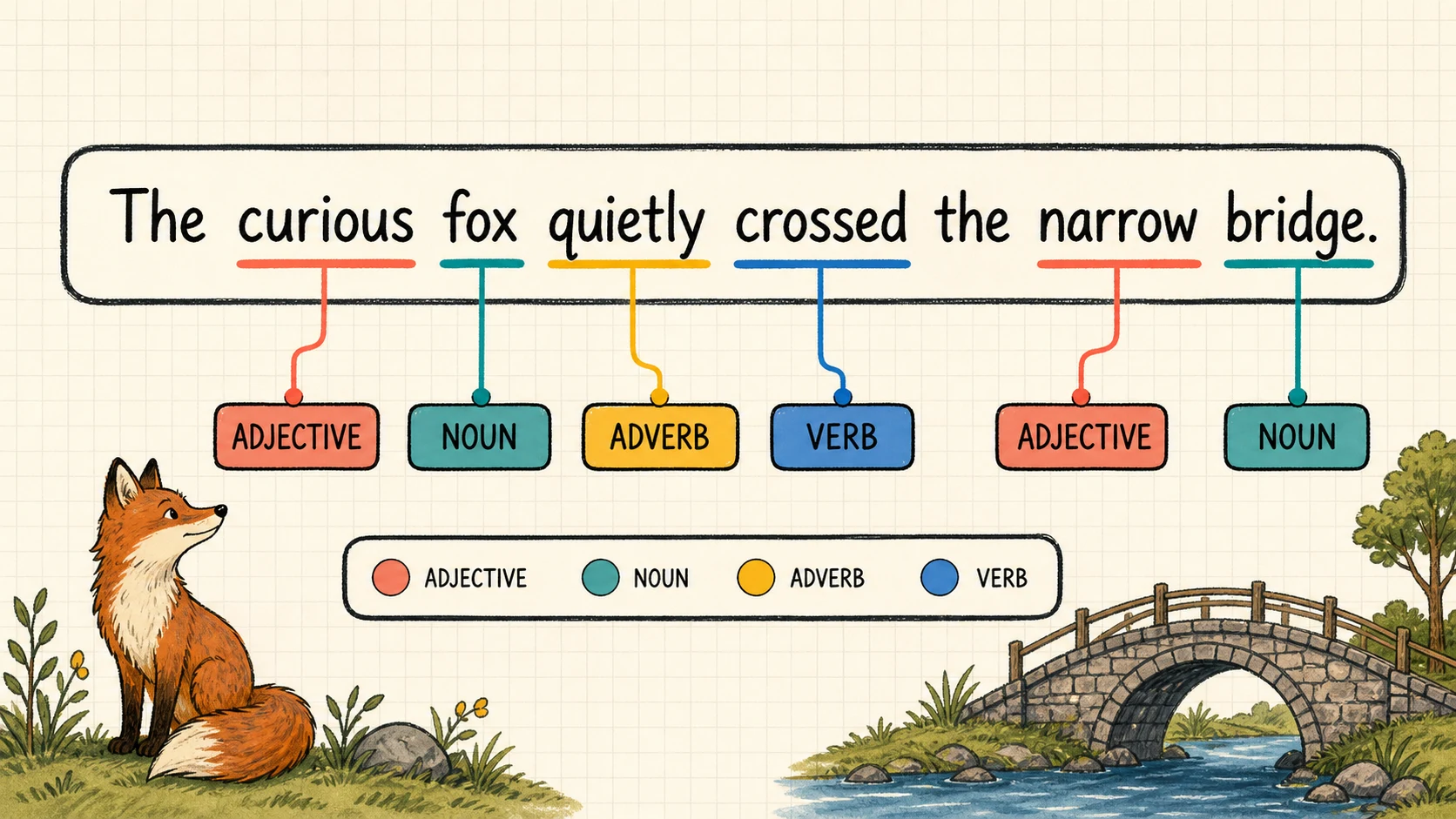
The explanation should name both the category and the evidence supplied by the sentence.
Example 3: Pronouns and conjunctions
Sentence:
Amira packed the lunches, but she forgot them on the counter.
- The comma and but separate two related clauses: “Amira packed the lunches” and “she forgot them on the counter.” But is a conjunction.
- Amira, lunches, and counter name a person or things, so they are nouns.
- She refers to Amira, and them refers to the lunches. Both are pronouns.
- Packed and forgot express actions, so they are verbs.
- On begins the phrase on the counter, so it is a preposition.
Checked answer: Amira, lunches, counter—nouns; she, them—pronouns; packed, forgot—verbs; but—conjunction; on—preposition.
Example 4: One word performing two jobs
Sentence pair:
The runners train before sunrise.
The train arrived before noon.
In the first sentence, train tells what the runners do. It is a verb. In the second, train names what arrived. It is a noun.
Now check before. In both sentences, it introduces a time relationship and has a noun object: before sunrise and before noon. It is a preposition in each.
The correct conclusion is not “train is sometimes confusing.” It is that grammatical classification depends on the word’s function in its sentence.
Example 5: An interjection and a verb phrase
Sentence:
Wow, the final group has already completed the difficult course!
- Wow expresses a reaction and stands apart from the clause. It is an interjection.
- Group and course name things, so they are nouns.
- Has completed is the complete verb phrase: has helps the main verb completed.
- Already modifies the verb phrase by indicating when completion occurred. It is an adverb.
- Final describes group, and difficult describes course. Both are adjectives.
Checked answer: wow—interjection; group, course—nouns; has completed—verb phrase; already—adverb; final, difficult—adjectives.
Boundary Cases Worth Teaching Explicitly
Some examples do not fit a quick “one word, one category” habit.
The same word can change categories
Consider fast:
- “The fast cyclist passed us.” It describes cyclist: adjective.
- “The cyclist pedaled fast.” It modifies pedaled: adverb.
Do not require an -ly ending before accepting an adverb. Instead, ask what the word modifies.
Consider before:
- “We ate before the concert.” With the object concert, before is a preposition.
- “We ate before.” Without an expressed object, before functions as an adverb.
- “We ate before the concert began.” Here, before introduces a clause and functions as a conjunction.
These distinctions are appropriate once the learner can reliably recognize ordinary prepositional phrases and clauses.
A word may belong to a phrase
In “The dog has been barking,” all three bold words work together as a verb phrase. Labeling only barking misses the helping verbs.
In “The package under the desk is mine,” under is the preposition, desk is its noun object, and the entire phrase modifies package. The phrase itself is not a ninth part of speech; it is a group built from individual words that performs a larger job.
Labels do not settle every grammatical question
Different grammar systems may use terms such as determiner, particle, or subordinating conjunction more precisely than an eight-part school framework. If a local textbook classifies a boundary word differently, use its stated system consistently and keep attention on the word’s function. The eight categories are a useful instructional model, not a complete description of every English construction.
A Short, Repeatable Lesson Routine
The IES elementary writing practice guide supports high-level practices such as teaching writing processes and strategies, gradually releasing responsibility, and giving learners frequent opportunities to write. It does not evaluate WorksheetWise or prescribe this exact grammar routine.
For a focused lesson, use this suggested 15- to 20-minute sequence and adjust it from observed work:
- Retrieve for two minutes. Ask the learner to define or demonstrate two previously studied categories.
- Model one sentence for four minutes. Think aloud while locating the sentence core and testing one difficult word in context.
- Analyze together for five minutes. Let the learner make each decision. Prompt with “What does this word modify?” or “What units does it connect?”
- Practice independently for five minutes. Use three to five sentences concentrated on the day’s distinction.
- Explain and revise for three minutes. Ask for one written justification and one sentence improvement.
- Record the result. Note the type of error, not merely the number wrong.
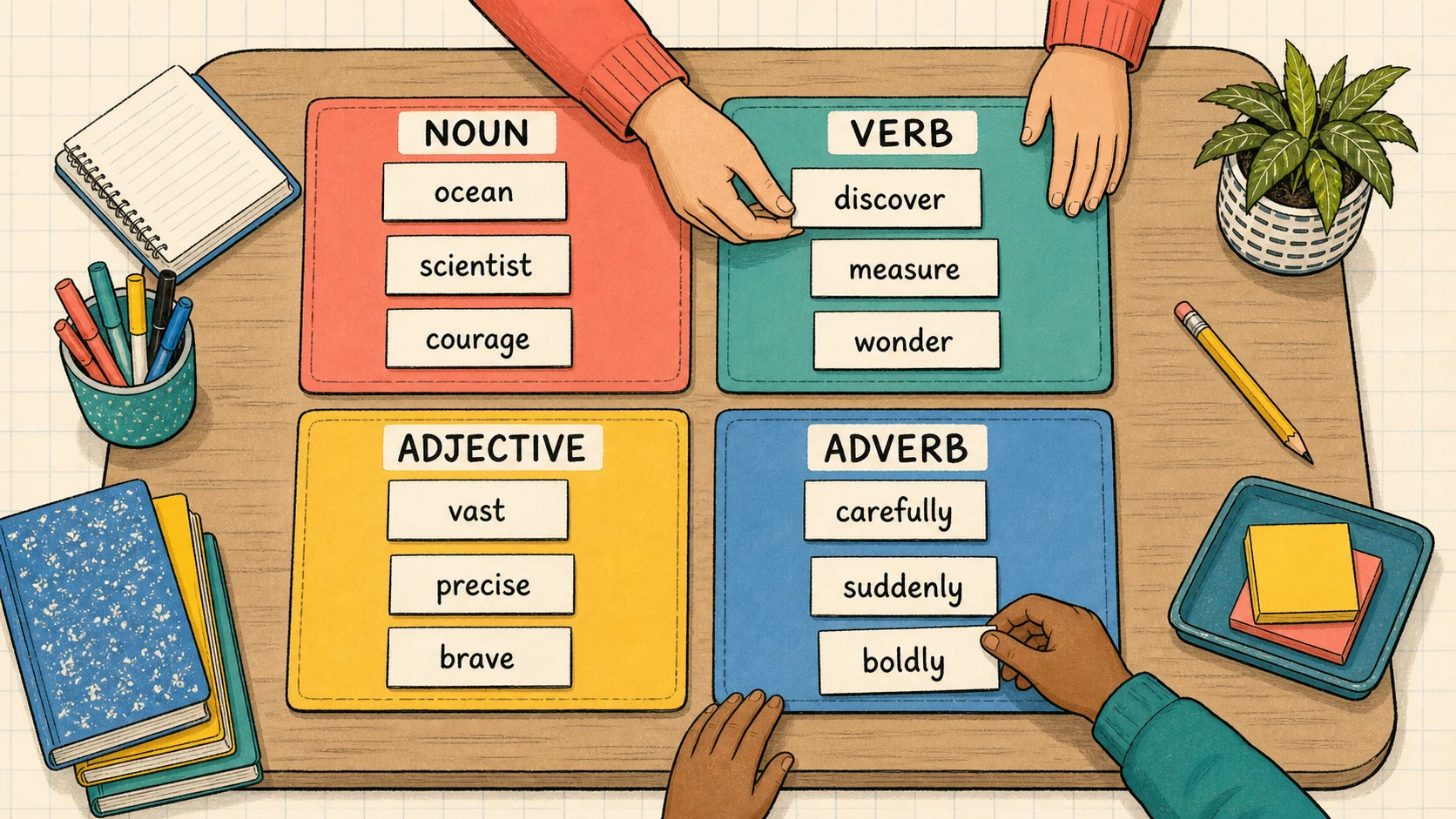
Brief cycles of retrieval, modeling, guided analysis, application, and checking keep the lesson focused.
If the learner is accurate but slow, repeat the same task type with fresh sentences. If the learner answers quickly but cannot explain why, retain the explanation step. If errors cluster around one distinction, narrow the next lesson instead of advancing automatically.
Choosing Practice That Matches the Need
The 6th Grade Grammar hub can help adults compare this topic with other grammar work. Choose a task by its actual skill coverage, not by grade label alone.
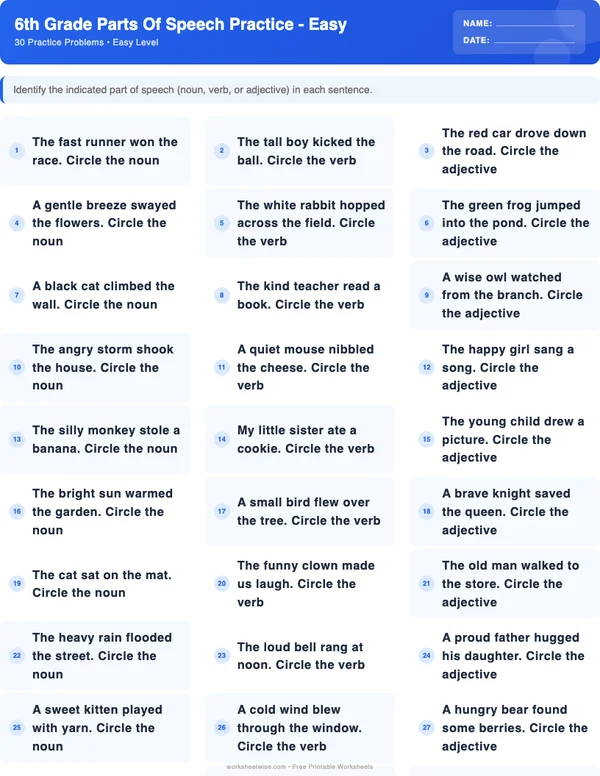
The free 6th Grade Parts of Speech worksheet contains 30 easy-level exercises focused on identifying nouns, verbs, and adjectives in sentences. It includes a separate printable answer key. It is a sensible choice when a learner:
- is beginning this topic;
- confuses sentence subjects with verbs;
- needs reinforcement of the three foundational categories;
- can manage straightforward identification but is not ready for all eight categories.
It is not, by itself, practice in pronouns, adverbs, prepositions, conjunctions, interjections, ambiguous word functions, or extended writing. Do not treat completion of its 30 items as proof of mastery of the whole topic.
For broader repetition, the focused Parts of Speech pack contains 18 worksheets and is listed at $4.79 in the supplied catalogue. Check the specific worksheet focus before assigning work; quantity should not replace diagnosis.
A useful practice ladder is:
- identify one requested category;
- contrast two easily confused categories;
- classify several categories in one sentence;
- explain the evidence for each label;
- edit an unclear or weak sentence;
- locate and explain examples in current reading;
- apply the choice in original writing.
Differentiation Without Lowering the Thinking
When the learner needs more support
Reduce the number of categories visible at once. Begin with noun-versus-verb decisions, use short complete sentences, and provide a question card: “What is named?” “What happens?” “What describes a noun?” Let the learner act out verbs or position objects to demonstrate prepositions.
Do not make every sentence unnaturally simple. Once the core distinction is secure, add one modifier or phrase at a time.
When the learner is ready for more challenge
Use sentences in which a familiar word changes function. Ask the learner to defend two possible interpretations, examine a verb phrase, or revise a vague sentence using a more precise noun and stronger verb. Mentor sentences from current reading can provide authentic application, as suggested in the supplied catalogue teaching tips.
An advanced response should still be checkable. “It sounds right” is weaker than “Fast modifies the verb moved, so it functions as an adverb.”
For homeschool and tutoring settings
Keep a small collection of the learner’s own sentences. Select one sentence for analysis and one for revision rather than correcting every feature at once. In a classroom, the same approach can use anonymous sentences or teacher-created examples. The instructional aim is to connect grammar with meaning without turning every writing task into a full grammar assessment.
Common Errors and Diagnostic Responses
| Observed error |
Likely reasoning problem |
Teaching response |
| Labels every person or thing mentioned as the subject |
Confuses “noun” with “subject” |
Separate word category from sentence role; find all nouns, then identify which noun performs the subject role |
| Calls every action-related word a verb |
Uses meaning without checking function |
Compare “We run” with “a long run” |
| Calls every -ly word an adverb |
Relies on spelling alone |
Ask what the word modifies; contrast slowly with friendly |
| Labels a linking verb as an action verb |
Expects all verbs to show action |
Test whether the verb connects the subject to a description |
| Marks only the main verb |
Does not recognize helping verbs |
Bracket the complete verb phrase before labeling individual words |
| Treats the object as the preposition |
Has memorized a phrase without its structure |
Mark the preposition, then ask “preposition plus what?” |
| Calls every connector a conjunction |
Confuses meaning with grammatical function |
Underline the exact words, phrases, or clauses being joined |
| Chooses a category from a word list |
Assumes each spelling has one permanent label |
Put the word into two sentences with different jobs |
| Identifies a pronoun but cannot name its antecedent |
Classification is detached from reference |
Draw an arrow from pronoun to antecedent and check for ambiguity |
| Scores well on identification but writes vague sentences |
Skill has not transferred to composition |
Assign short revision tasks using precise nouns and strong verbs |
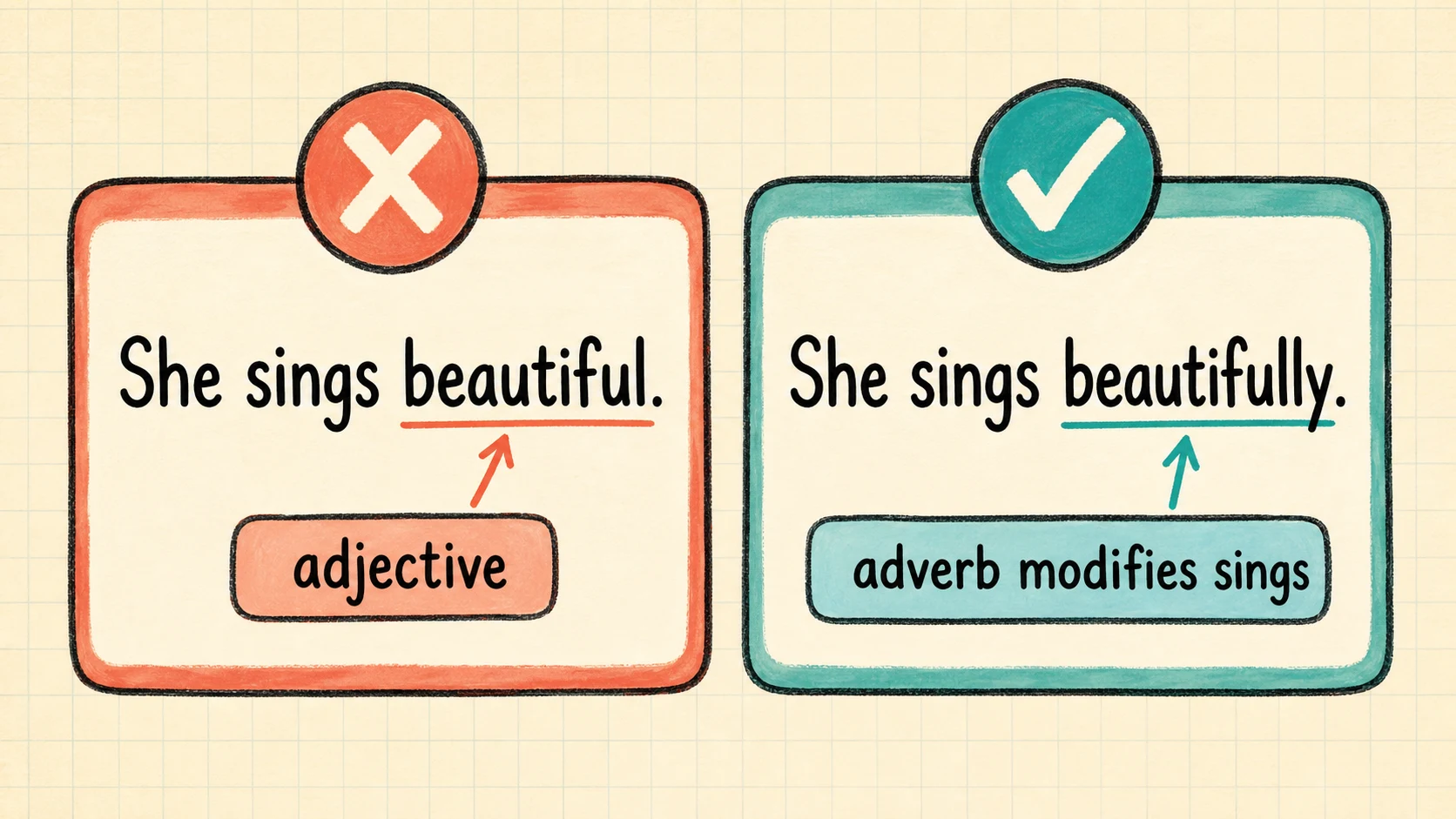
An error pattern is more useful than a total score because it points toward the next teaching move.
Monitoring Progress Responsibly
Use a simple record with four columns: date, task type, accuracy, and explanation quality. Add a brief error code such as adjective/adverb, verb phrase, preposition object, or context shift.
Monitor at three levels:
- Identification: Can the learner label the word?
- Reasoning: Can the learner explain its job using the sentence?
- Application: Can the learner use or revise the form appropriately?
A practical instructional threshold might be four correct, independently explained responses out of five across two short sessions. That is a suggested decision rule, not a researched universal benchmark. If performance drops when sentences become longer, check whether the obstacle is the grammatical category, sentence structure, vocabulary, or the amount of text on the page.
Recheck older categories after several days. Immediate success may reflect the model that was just shown; delayed review provides better evidence that the learner can retrieve and apply the distinction.
A Flexible Two-Week Practice Plan
This plan assumes ten brief sessions, but it is not a universal timetable. Shorten, repeat, or reorder sessions according to the learner’s work.
| Day |
Focus |
Suggested activity |
Quick evidence |
| 1 |
Baseline |
Classify selected words in eight varied sentences |
Record error patterns |
| 2 |
Nouns and verbs |
Locate subjects and complete verb phrases |
Explain each sentence core |
| 3 |
Adjectives and adverbs |
Draw modifier arrows |
Name what each modifier changes |
| 4 |
Pronouns |
Link pronouns to antecedents |
Revise one unclear reference |
| 5 |
Review |
Mixed five-sentence check and one revision |
Decide what requires reteaching |
| 6 |
Prepositions |
Build and bracket relationship phrases |
Identify each object |
| 7 |
Conjunctions |
Join words, phrases, and clauses |
Underline the connected units |
| 8 |
Interjections and mixed review |
Separate reactions from sentence cores |
Classify all eight categories |
| 9 |
Boundary cases |
Analyze light, run, fast, and before in context |
Defend each classification |
| 10 |
Transfer |
Analyze a sentence from reading and revise a sentence from writing |
Compare with Day 1 evidence |
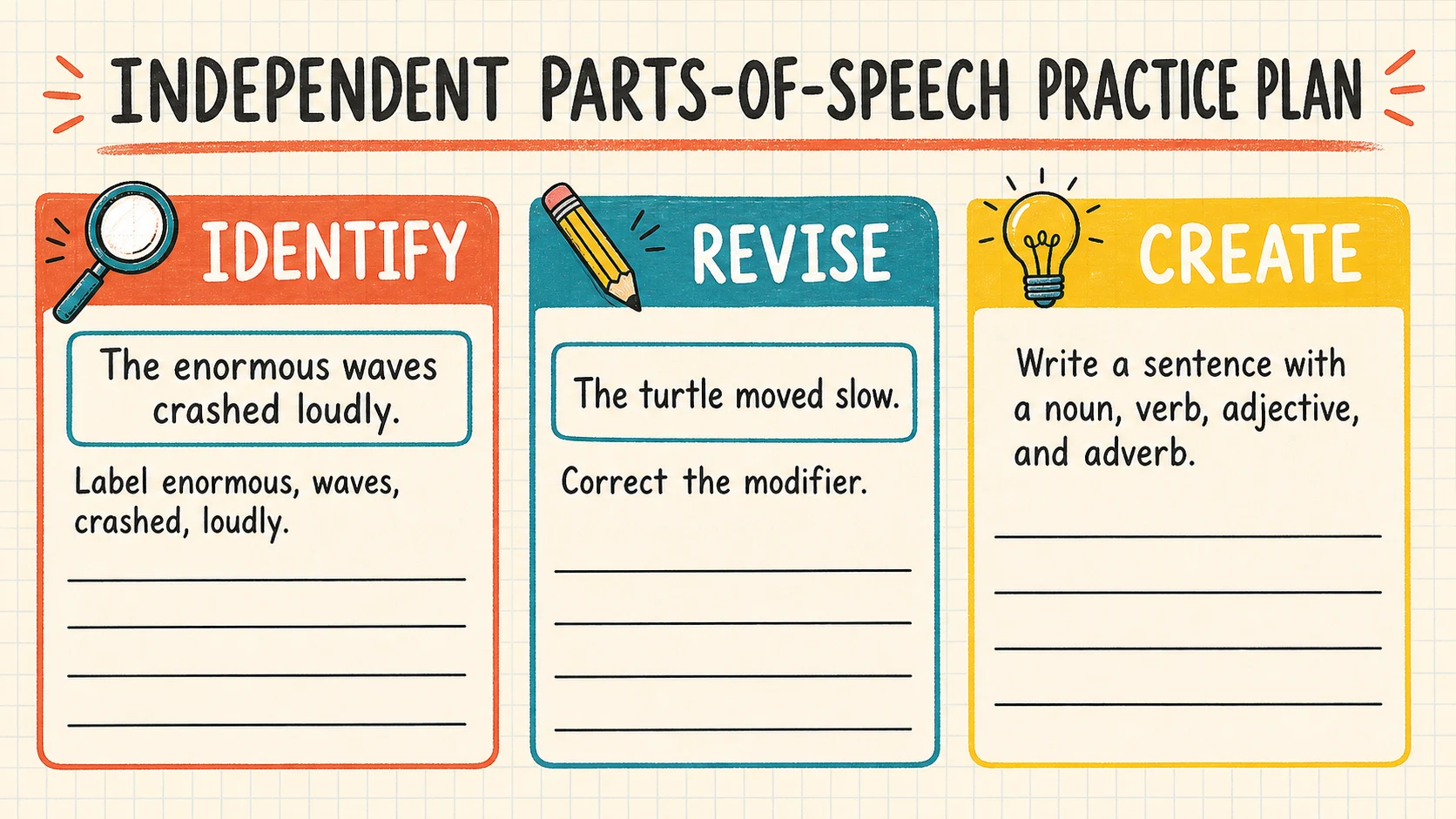
The plan is a starting structure; observed accuracy and explanations determine when to repeat or advance.
Limitations and the Next Useful Step
Parts-of-speech classification supports sentence analysis, but it does not cover every aspect of grammar or writing. A learner may accurately identify nouns and verbs while still needing separate instruction in sentence boundaries, agreement, punctuation, paragraph organization, evidence, or revision. Conversely, a capable writer may use grammatical structures effectively before being able to name every category.
The eight-part framework also simplifies some boundary cases. Use the terminology expected by the learner’s school or curriculum when classifications differ. No single worksheet can establish comprehensive standards alignment, guarantee writing improvement, or determine an individual learner’s entire instructional program.
Start with the free easy Parts of Speech worksheet. Review the answer key, sort mistakes into nouns, verbs, adjectives, or sentence-analysis errors, and use that pattern—not the grade label or total score—to choose the next lesson.