Curated collectionAnswer keys includedPrint-ready PDFs
Homework Grammar Worksheets
Select short, already-taught practice that a learner can understand at home and convert the returned work into next-day feedback.
Start with a real resource
Browse this worksheet collection
19 relevant free entry points are available. Each one includes a printable learner PDF and separate answer key.
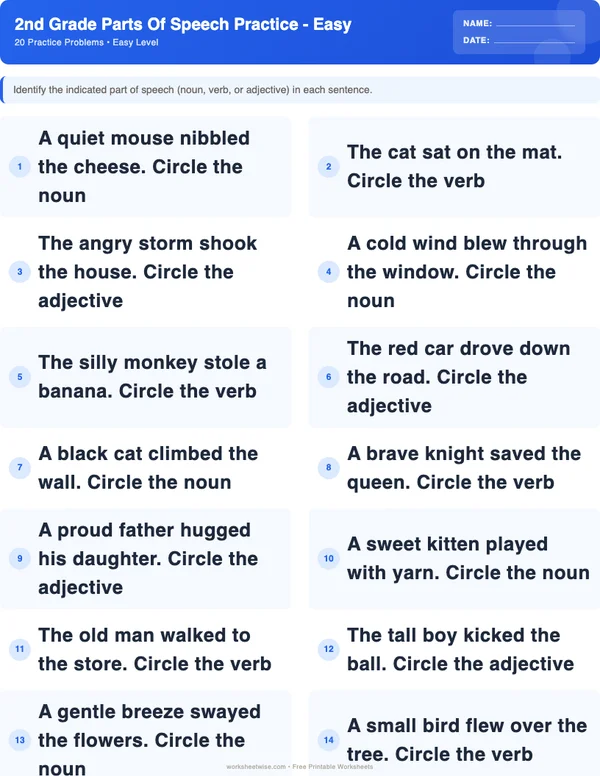
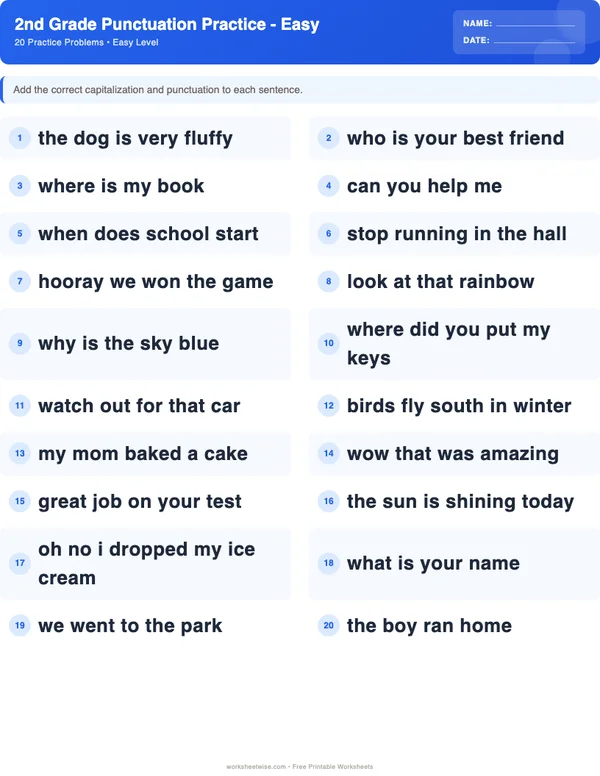
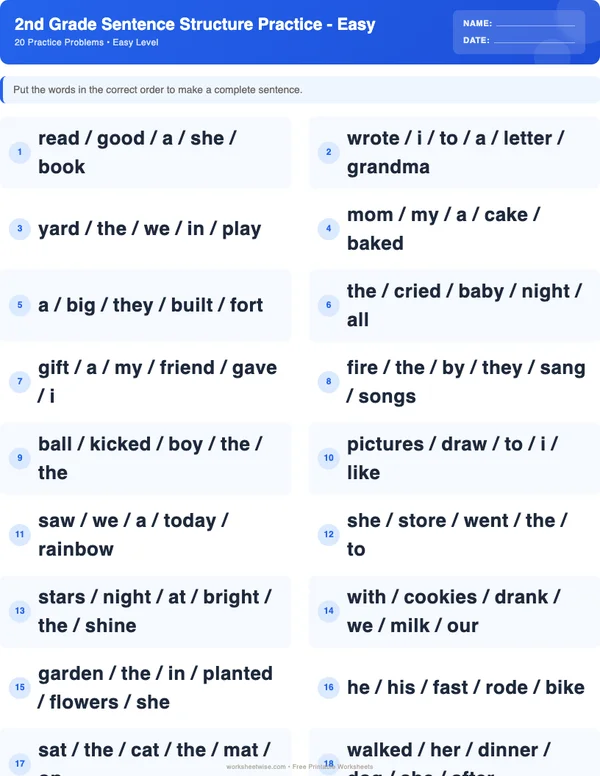
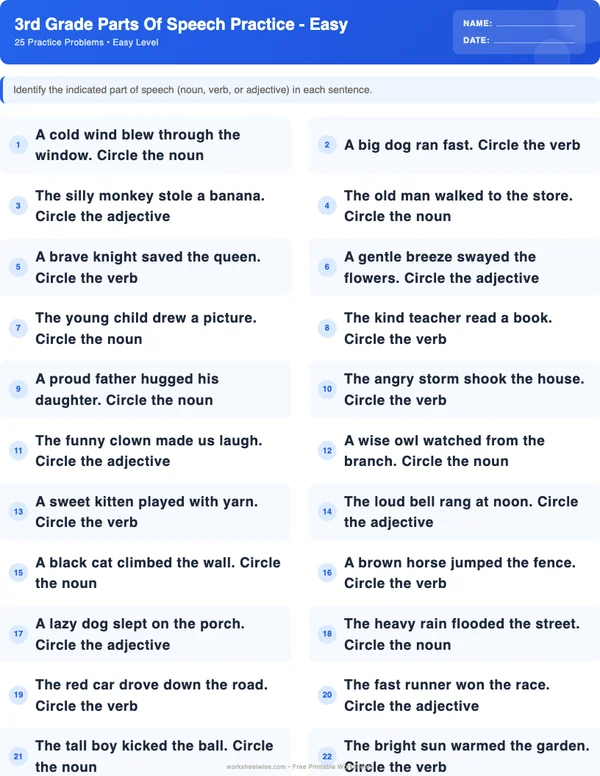
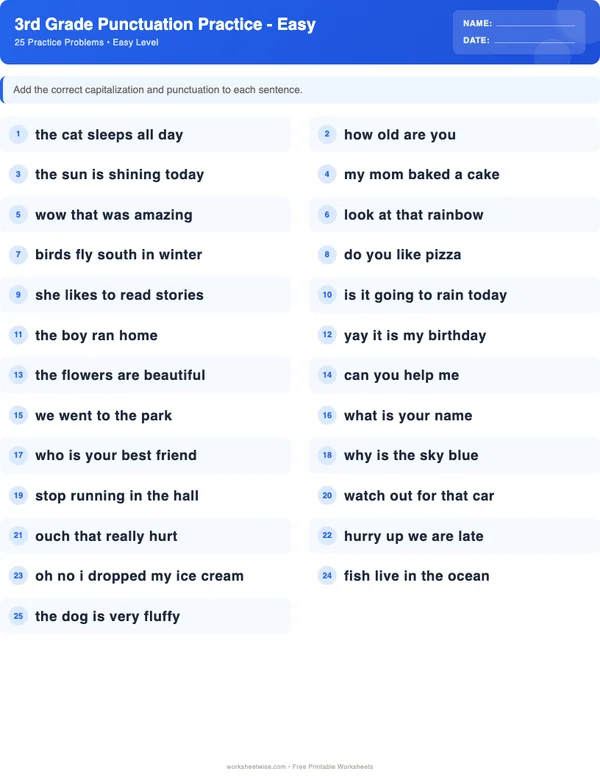
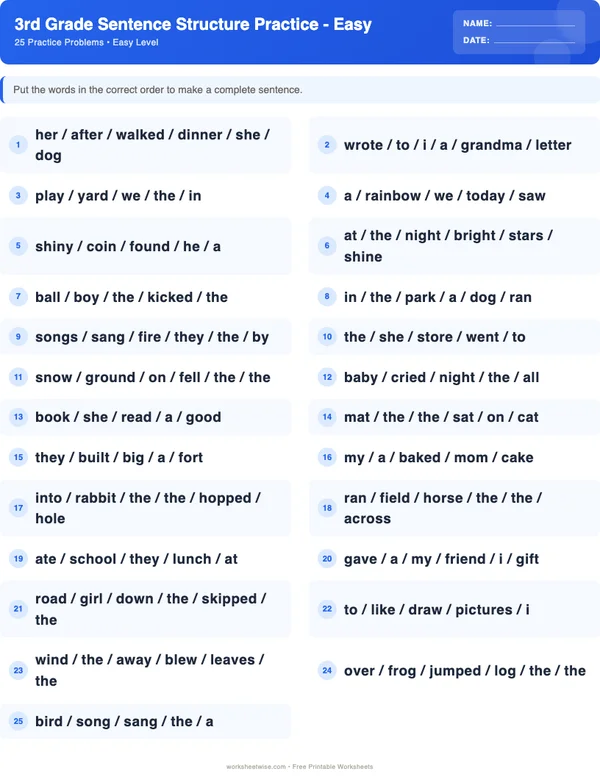
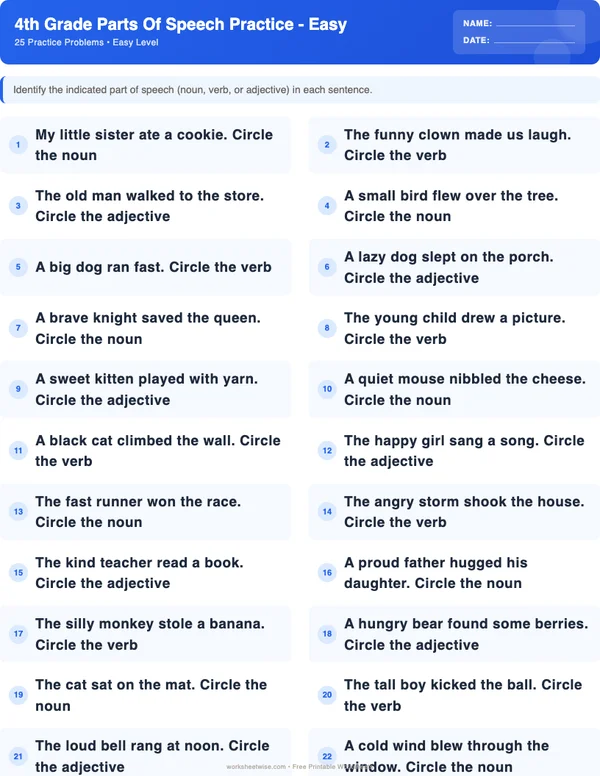
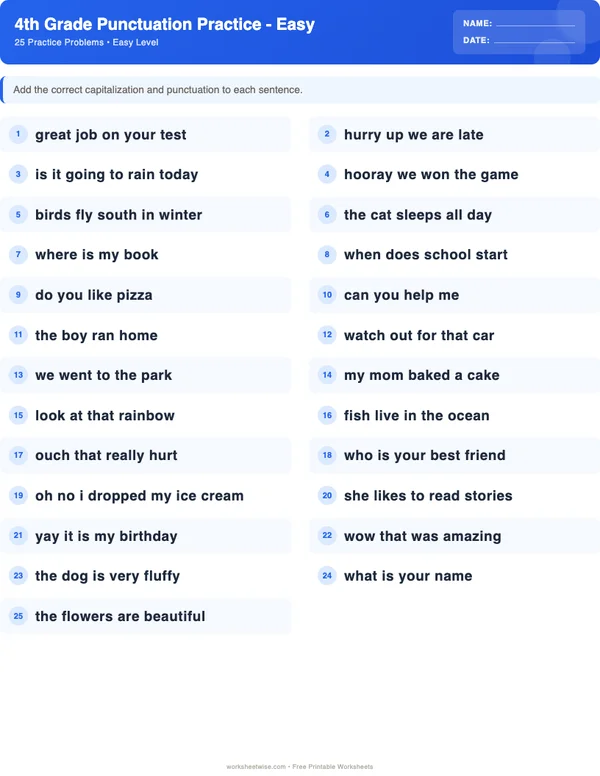
A useful practice loop
Print less. Observe more.
- Choose one skill and model the first item aloud.
- Use a short set and notice the learner’s strategy.
- Change the next task from the work you can see.
Need more than the free sheet?
Plus includes all 342 matching catalogue variations where available, plus saved deterministic generators and the worksheet designer.
See Plus membershipComplete guide
How to teach and practise homework grammar worksheets
3,395 words Updated 6 instructional visuals
Choose homework that rehearses one taught grammar decision
The best homework grammar worksheet is short, familiar, and narrow enough that a learner can explain what each answer requires without receiving a new lesson at home. Select one already-taught decision—such as choosing an end mark, locating a verb, or completing a sentence—model one item before dismissal, and review the returned work the next day. The review should determine whether to repeat the same skill with different support, change the response format, or move to a connected skill.
WorksheetWise’s live homework grammar catalogue contains 342 variants across seven grade labels and three topics: punctuation, parts of speech, and sentence structure. Nineteen resources provide free entry points. Those counts describe available choices, not a sequence that every learner should follow.
Grade labels describe the intended practice level; local curriculum sequences differ. Use age or grade as a discovery aid, not as a placement decision. Inspect the actual language, directions, number of items, and required response before assigning anything. For ages three and four, prioritize brief adult-led oral, matching, manipulative, and movement activities over desk work: match a spoken question to a question-mark card, move a toy under or beside a box, or act out a verb. A full worksheet is generally not the starting format for that age group.
The catalogue calls the representative free sheets “easy,” but that label becomes useful only when translated into observable task features. Look for one familiar rule, short sentences, a consistent response pattern, limited writing, and a worked or orally rehearsed example. A sheet is harder when it mixes several rules, requires substantial reading, changes directions mid-page, or asks the learner to generate and edit original sentences.
Match the sheet to the grammar thinking you need to see
Before choosing a page, finish this sentence: “Tomorrow I need to know whether the learner can _____.” The blank should name an observable action, not a broad topic.
- “Choose a period or question mark after reading a complete sentence” is observable.
- “Understand punctuation” is not.
- “Identify the verb in a sentence and explain what action or state it expresses” is observable.
- “Know parts of speech” is not.
- “Tell whether a word group has both a subject and a predicate” is observable.
- “Improve sentence structure” is not.
Then inspect four features.
- Rule load: Does every item test the same rule, or does the page unexpectedly mix commas, apostrophes, and quotation marks?
- Reading load: Could a reading difficulty hide the grammar knowledge you intend to check?
- Response load: Must the learner circle, match, insert a mark, rewrite, or compose? Those formats reveal different information.
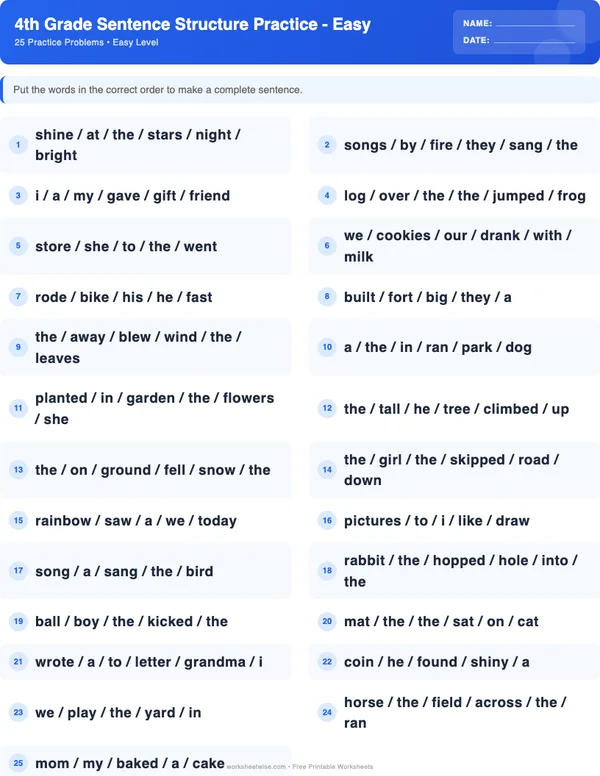
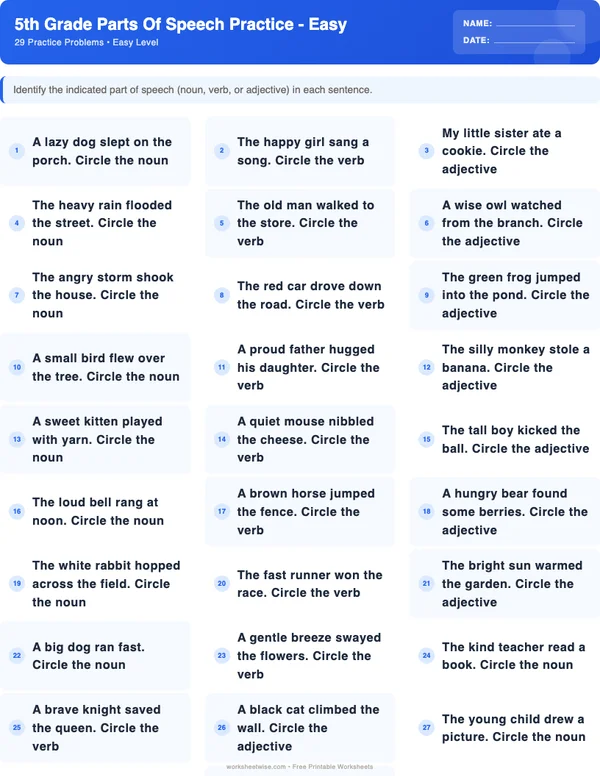
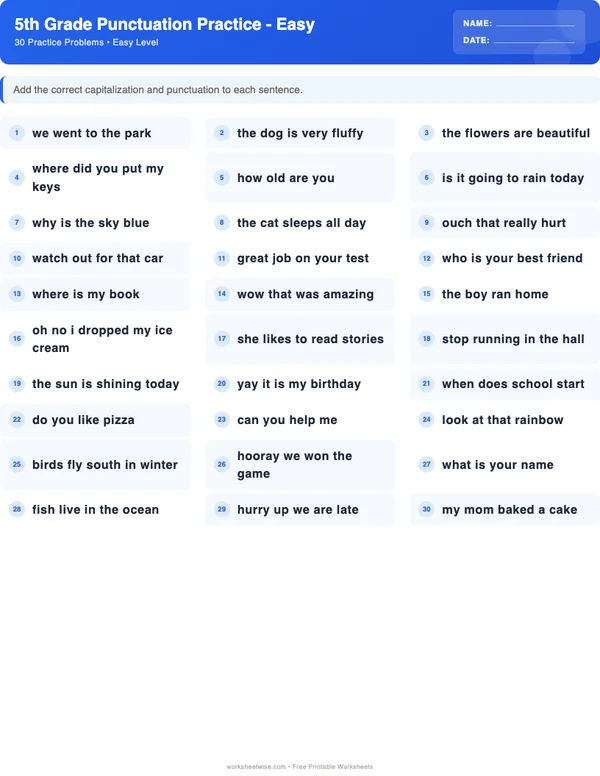
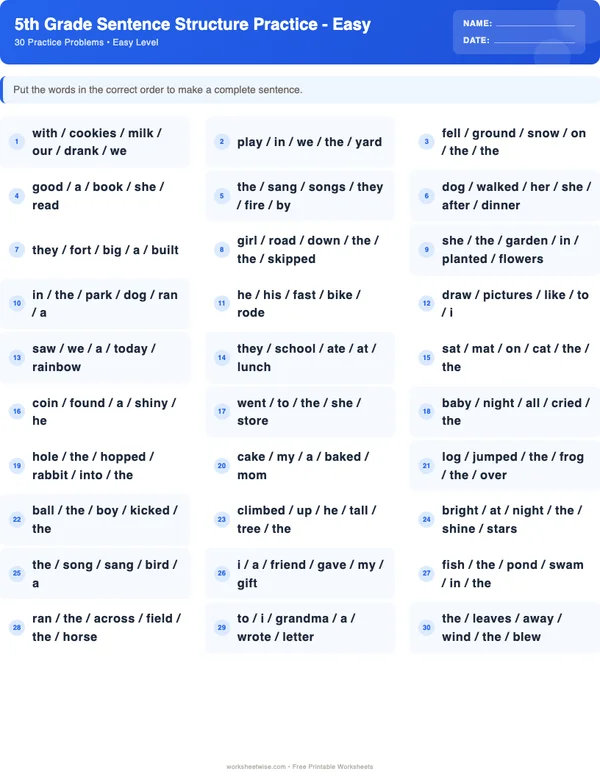
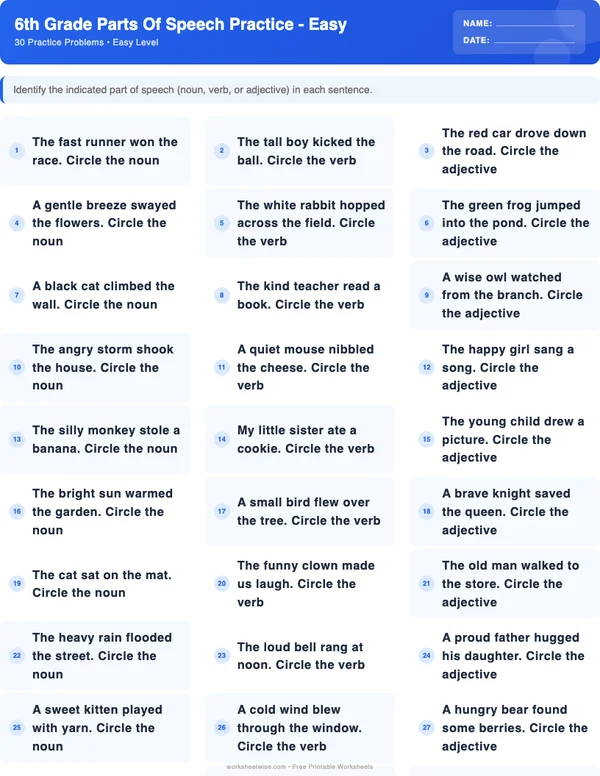
- Item count: The representative Kindergarten through second-grade free sheets contain 12 problems; third- and fourth-grade examples contain 14; the listed fifth-grade parts-of-speech sheet contains 29. A published count is not a requirement to assign every item.
For homework, fewer well-chosen items often produce clearer evidence. A teacher might assign six of 14 third-grade punctuation items if six are enough to sample the taught comma rule. That is an editorial suggestion for managing practice, not a finding attributed to the catalogue or an external source.
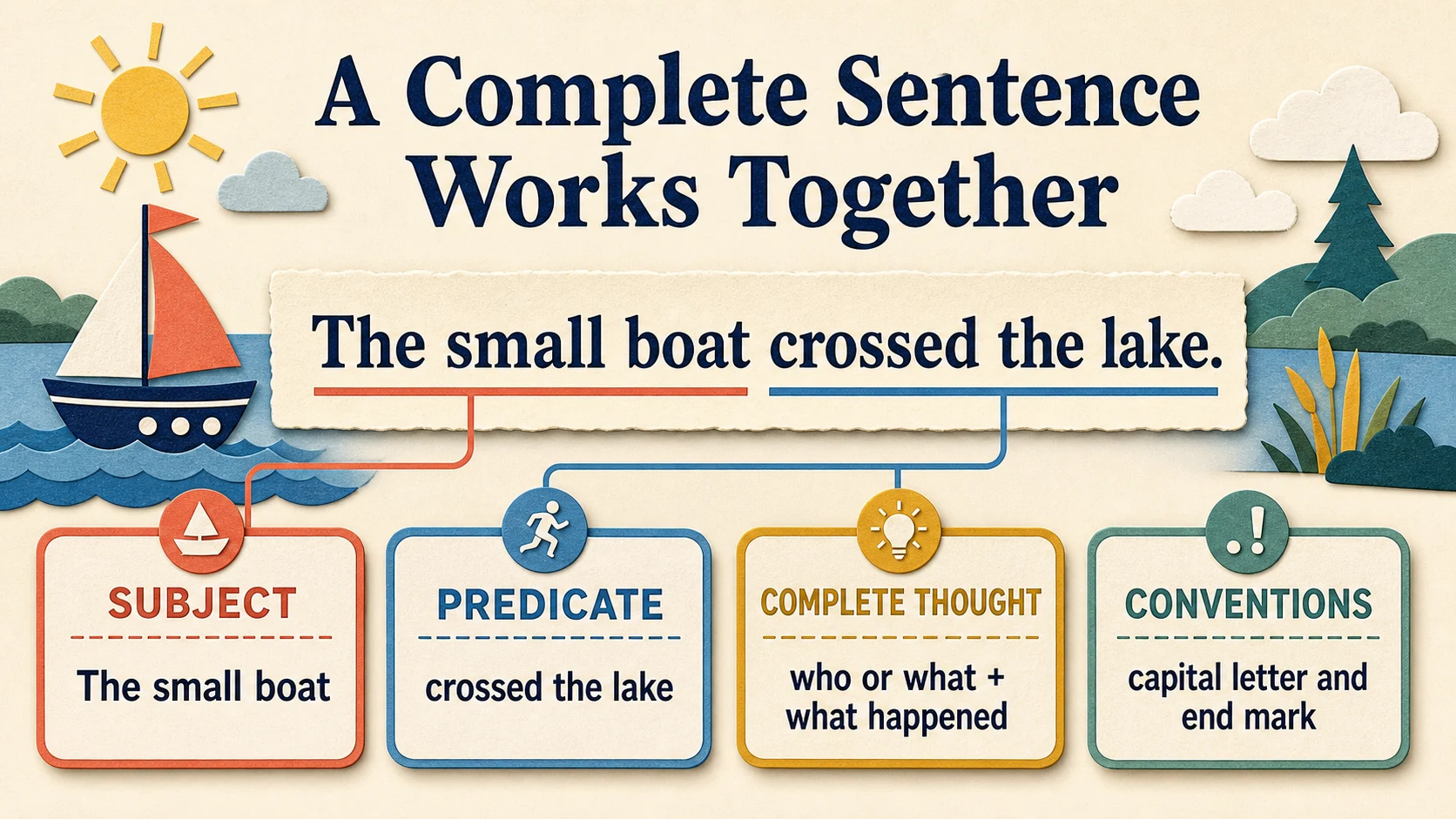
Use the map to identify the exact third-grade sentence decision being rehearsed—completeness, subject and predicate, combining, expansion, or variation—before selecting a page.
Compare the three live grammar pathways
The catalogue’s three topics are related, but they do not produce interchangeable evidence. A learner can identify a noun yet still write a fragment. Another can speak in complete sentences but omit punctuation in writing. Choose the pathway that matches the most recent instruction and the error you need to investigate.
Punctuation: connect meaning, voice, and marks
Punctuation homework should ask the learner to use a known mark for a known purpose. Early practice can distinguish statements, questions, and exclamations. Later work can isolate one comma use, contractions versus possessives, or the conventions of dialogue.
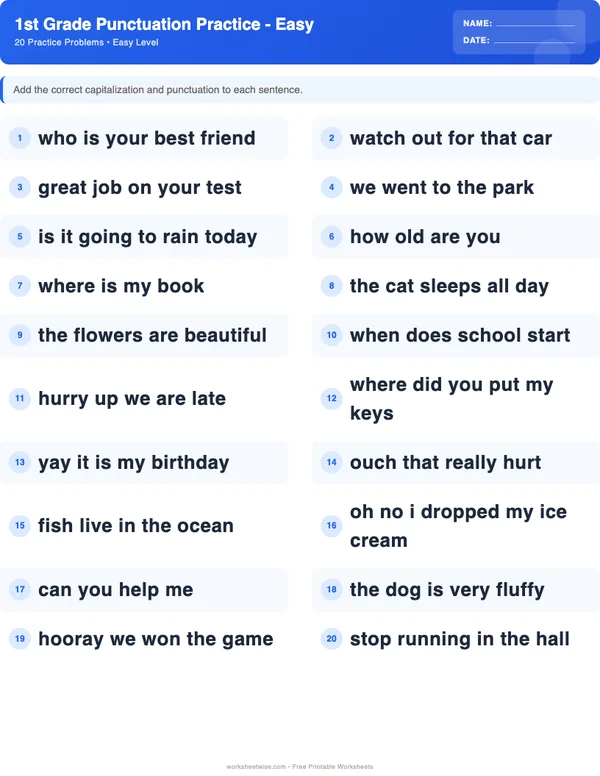
A representative first-grade punctuation sheet contains 12 problems. It belongs in a homework routine after the class has connected sentence purpose with end marks. Consider these checked examples:
The bus is here.is a statement and takes a period.Is the bus here?asks a direct question and takes a question mark.Watch out!expresses a forceful warning and takes an exclamation point.
These examples belong here because they hold vocabulary nearly constant while changing communicative purpose. The learner must attend to the sentence, not merely hunt for a particular word.
A useful model is: “I read the whole sentence. It asks me something, so I place a question mark.” Avoid teaching that every sentence containing who, what, or where automatically takes a question mark; a sentence such as I know where the bus stops. is a statement.
The catalogue’s punctuation guidance recommends teaching one comma rule at a time. That is especially important for homework. I packed a shirt, pants, and socks. practices commas in a list. It should not share a short introductory assignment with dialogue punctuation unless both have already been taught and intentional mixed review is the goal.
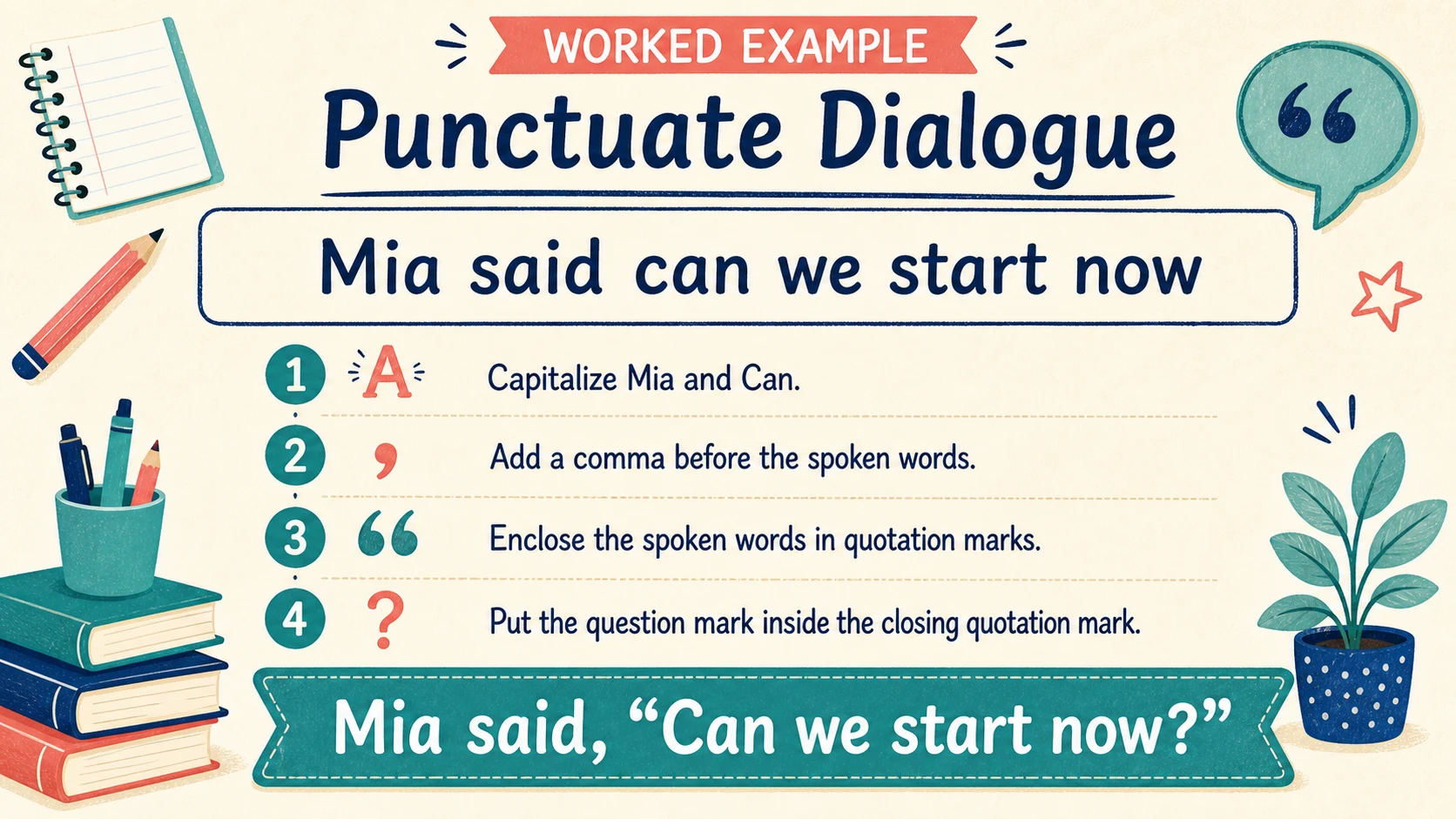
The third-grade model makes the decision visible: read for meaning, name the relevant punctuation rule, and then enter the mark.
Parts of speech: identify a word’s job in its sentence
Parts-of-speech homework should use complete sentences whenever a word could perform more than one job. A word list can support an initial sort, but it cannot always show grammatical function.
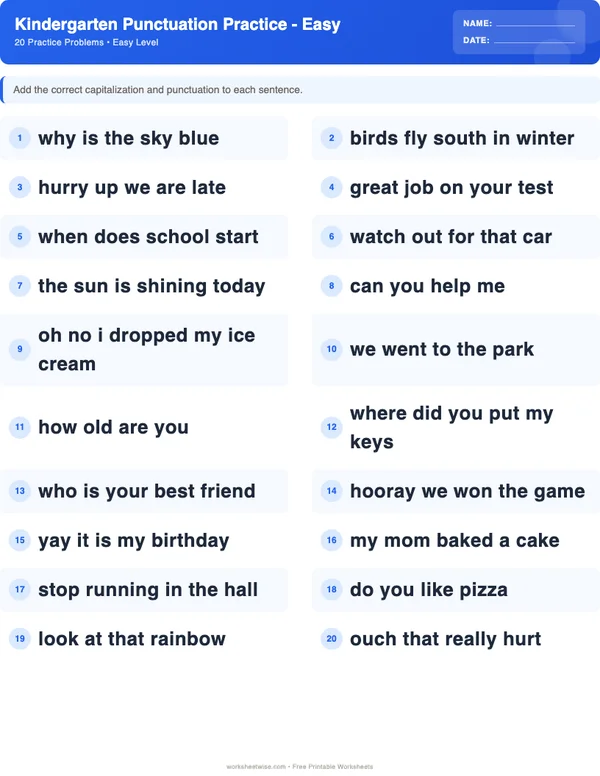
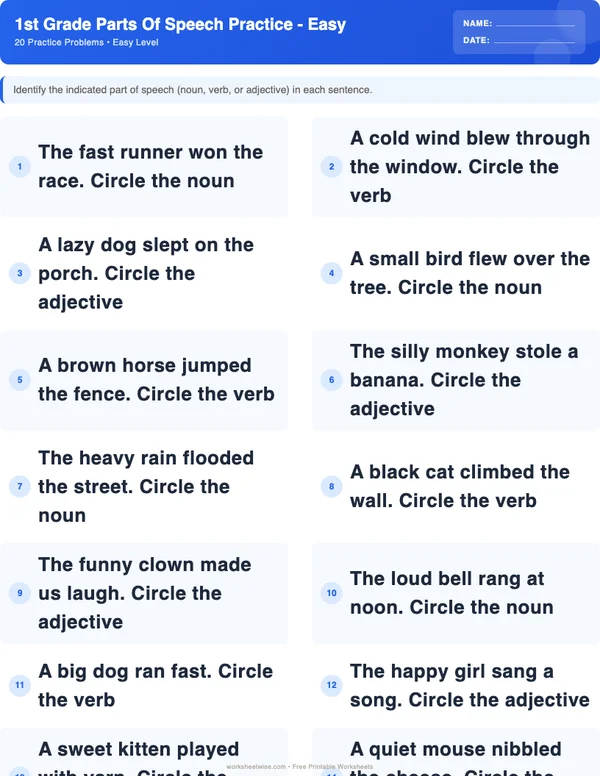
The live first- and second-grade parts-of-speech entry points each contain 12 problems; the third- and fourth-grade examples contain 14. The catalogue guidance begins with concrete nouns and verbs, then broadens to other word classes. The 1st Grade Parts of Speech guide and free sheet is a sensible place to inspect that early response demand.
Check this pair:
- In
We run every morning,run is a verb because it tells what we do. - In
The run was long,run is a noun because it names the event.
This example belongs in parts-of-speech homework because it prevents a fragile shortcut: memorizing that a word always has one label. The correct question is “What job is the word doing here?”
For a learner who has just studied nouns and verbs, assign sentences containing those two categories rather than a page requiring all eight traditional parts of speech. A home adult can ask, “Who or what is this about?” and “What happens or is true?” That preserves the grammatical target while reducing terminology demands.
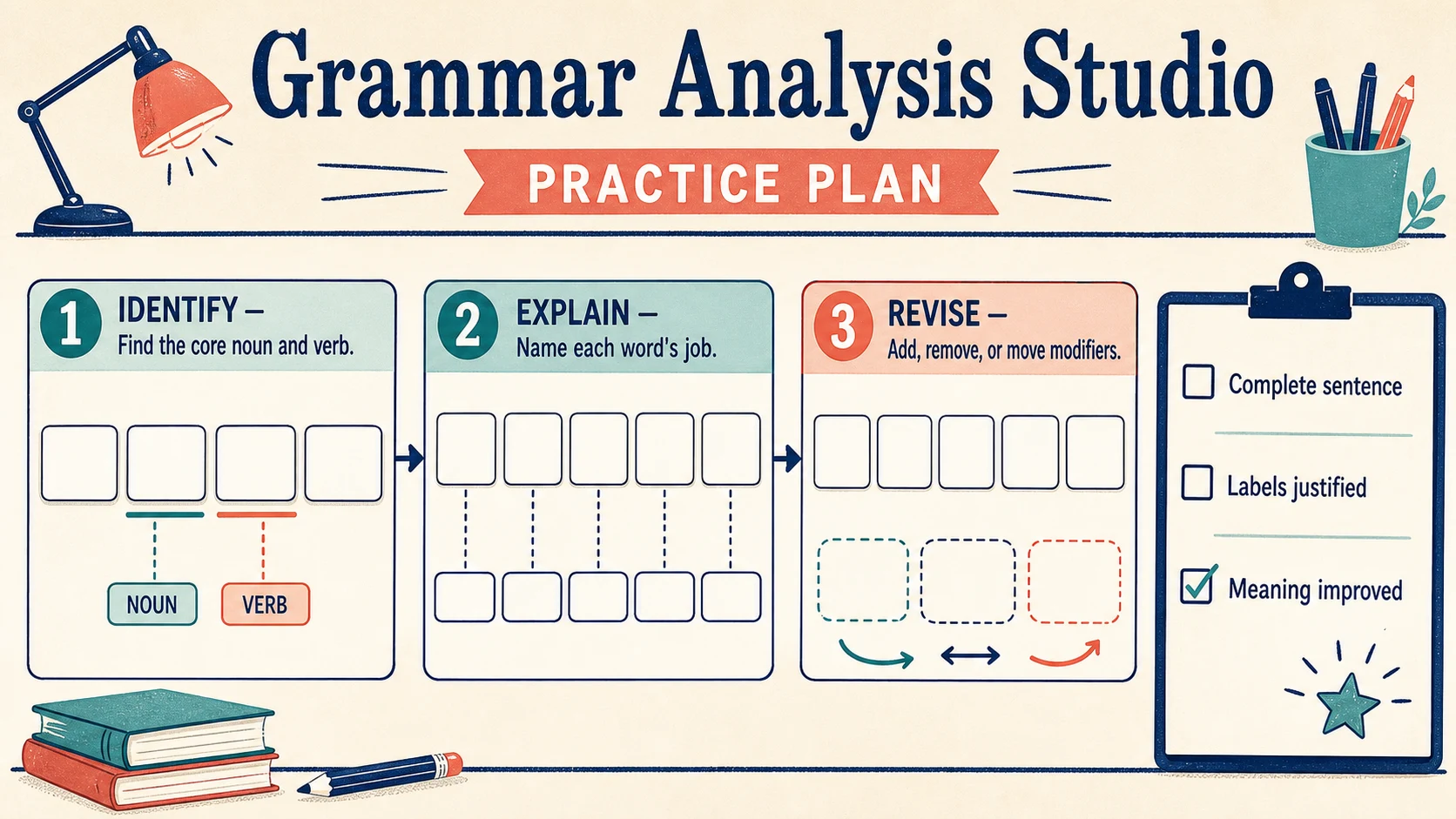
Across two weeks, alternate identification with short sentence use so third-grade work reveals whether labels transfer into writing.
Sentence structure: test completeness before variety
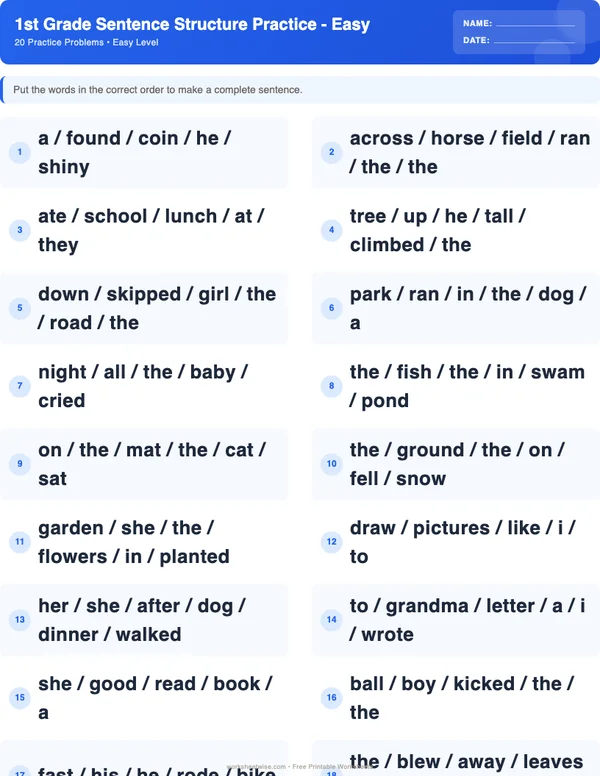
Sentence-structure practice asks whether words form a complete thought and how clauses or details can be combined. The representative first- and second-grade sheets contain 12 problems; the third- and fourth-grade sheets contain 14.
Start with the catalogue’s concrete frame: “Who or what?” plus “did what?” or “is what?” Compare:
The puppy slept.has a subject, the puppy, and a predicate, slept. It is complete.Under the kitchen table.tells where but does not say who or what is there or what happened. It is a fragment.The puppy slept under the kitchen table.repairs the fragment by attaching it to a complete subject-predicate unit.
This checked set belongs here because the learner must distinguish a complete sentence from a phrase that begins with a capital letter and ends with punctuation. Surface appearance alone is insufficient.
The 1st Grade Sentence Structure guide and free sheet can serve as an early entry point when the learner is working on completeness rather than clause variety.
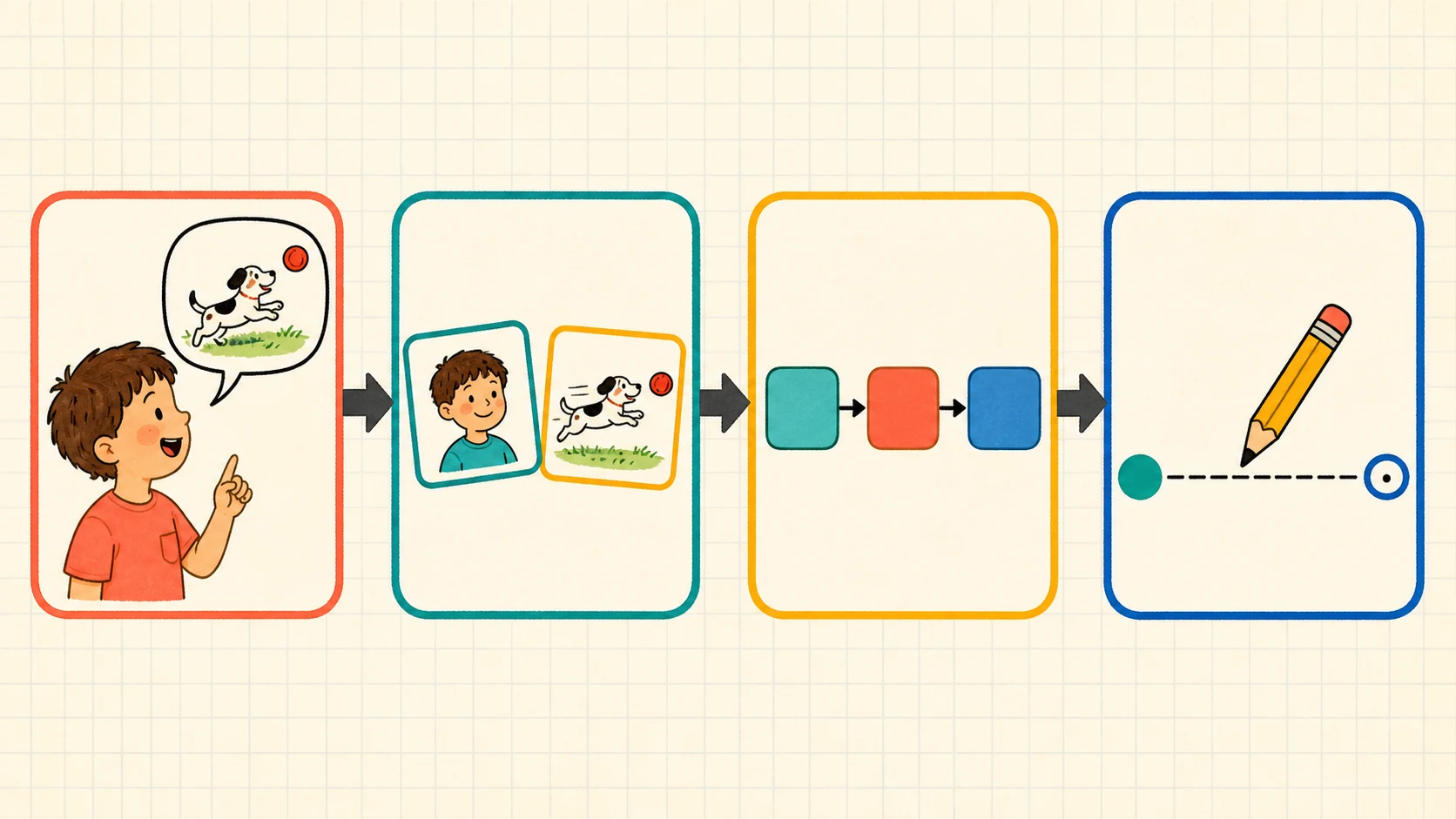
The first-grade progression keeps the concept stable while support changes: hear the sentence, complete it with help, classify it, and then write one.
Model the response format before the sheet goes home
A learner may know the rule but misunderstand whether to circle, underline, insert, rewrite, or compose. Model the exact motor and language response, not only the grammar definition.
Use an “I notice, I decide, I mark” model
For a punctuation item such as Did you feed the cat, say:
- “I notice that the sentence asks a question.”
- “I decide that a direct question needs a question mark.”
- “I mark
Did you feed the cat?”
For parts of speech, model the word in context: “In Birds fly, fly tells what birds do, so I underline it as the verb.” For sentence structure, verbalize both required parts: “The noisy birds names who, but it does not tell what they did. I mark it as incomplete.”
Then ask the learner to complete one parallel item aloud. If the learner cannot explain the decision with the model still visible, the page is not ready for independent homework.
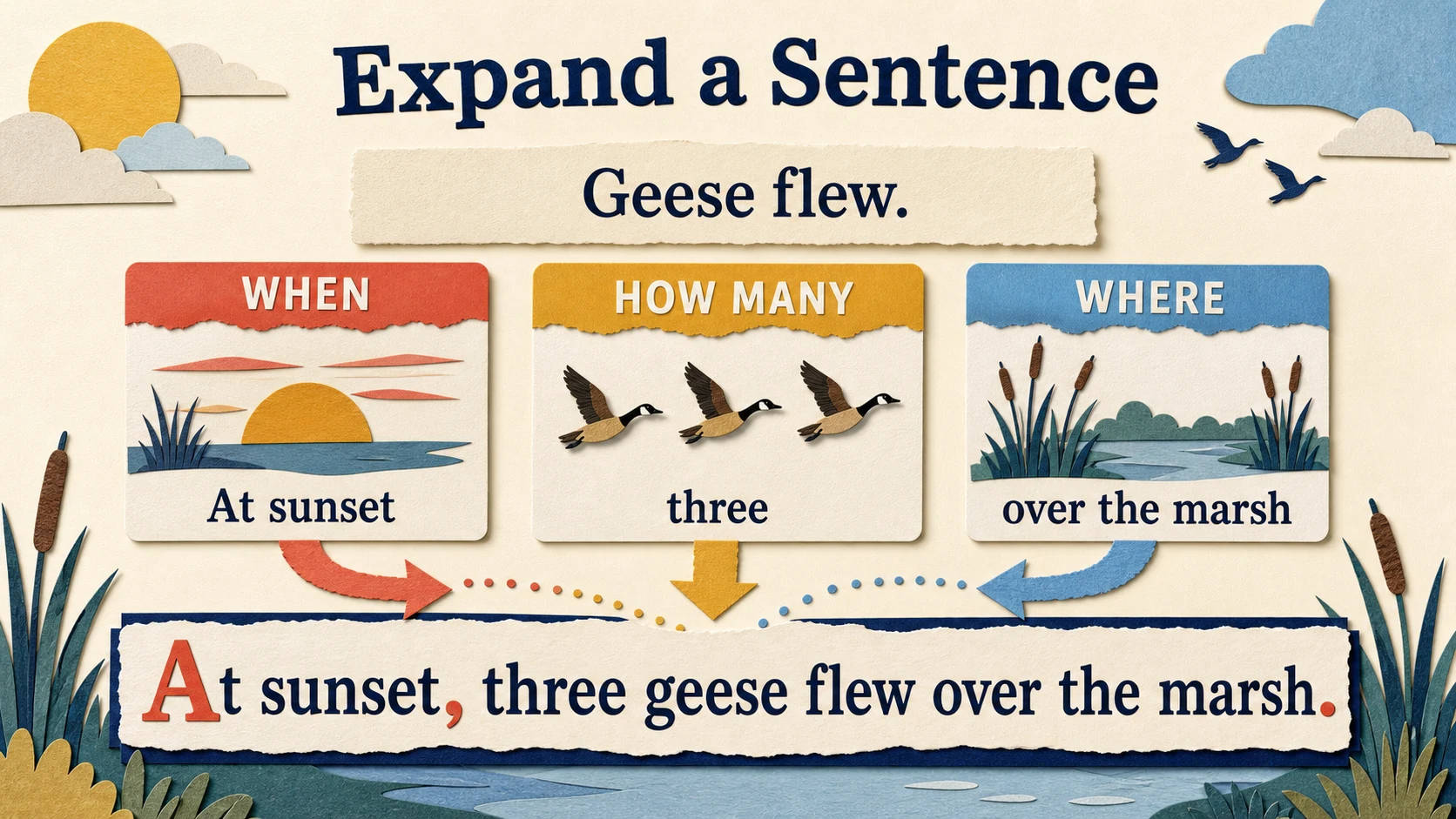
For third-grade sentence work, keep the launch repeatable: revisit one model, think through one item together, assign a short set, and reserve the return for feedback.
Separate recognition, correction, and generation
These response types are not equivalent:
- Recognition: Circle the complete sentence.
- Correction: Rewrite a fragment as a complete sentence.
- Generation: Write an original sentence with a subject and predicate.
Recognition reduces writing demand and is useful for checking whether the learner can discriminate examples. Correction reveals whether the learner can supply what is missing. Generation asks the learner to manage grammar, vocabulary, spelling, handwriting, and ideas simultaneously.
If classroom instruction stopped at recognition, original-sentence homework introduces a new demand. Select the same format used in class, or include a complete model and a word bank. Move to generation only after the learner can explain and correct the pattern with reasonable independence.
The IES guide on teaching elementary students to be effective writers recommends explicit instruction and gradual release, including modeling strategies, guided practice, and independent use. That source offers general writing guidance; it did not evaluate WorksheetWise or any worksheet in this catalogue.
Run a homework loop that ends in next-day teaching
A grammar sheet becomes useful when its return changes what happens next. Use a simple prepare–practice–review loop.
Before dismissal: prepare in three minutes
State the target in learner-friendly language: “Tonight you will decide whether each group of words is a complete sentence.” Review one example and one non-example. Have the learner explain the difference. Mark only the assigned items if the sheet is longer than needed.
Give the home adult a narrow role: “Please ask the learner to read the directions and explain the first answer. You may read an item aloud, but please do not supply the grammar answer.” This makes assistance visible without turning home time into a substitute lesson.
At home: keep help informative
The learner should try independently after the modeled first item. If stuck, the adult can use a neutral prompt:
- Punctuation: “Read it aloud. What is the sentence doing?”
- Parts of speech: “What job does that word do in this sentence?”
- Sentence structure: “Who or what? What did they do or what are they?”
- Any task: “Show me the model that is most like this item.”
Ask the adult to place a small dot beside any item that required help. A correct answer with a dot means something different from a correct answer reached independently. This notation is a suggested workflow, not a capability claimed for the worksheets.
Stop if the directions remain unclear after the model, the learner becomes distressed, or the task requires teaching an unfamiliar convention. Send the unfinished work back with a brief note. Completion is less informative than knowing where independence ended.
The next day: sample explanations, not just scores
Sort the return into three evidence groups:
- correct and independently explained;
- correct but dependent on a model, prompt, or guess;
- incorrect, incomplete, or based on a recurring rule confusion.
Ask for explanations from two items: one correct and one incorrect or helped item. “Why did you choose this mark?” is more diagnostic than “Are you sure?” Record the error pattern in a few words, such as “uses voice alone,” “labels words without context,” or “accepts predicate-less fragments.”
The IES foundational reading guide emphasizes systematic instruction, modeling, feedback, and opportunities to practice foundational skills. Its scope is foundational reading rather than a review of these grammar sheets, so use it as broad instructional guidance, not product validation.
Read errors as evidence about the next task
Do not respond to every wrong answer with another page on the same broad topic. Determine what the error suggests, confirm the pattern with a quick oral item, and choose the next sheet accordingly.
When punctuation follows voice but not sentence purpose
Suppose a learner gives Can you believe it! a question mark because it begins with can, or gives every excited reading an exclamation point. The issue may be an overused cue, not carelessness.
Next action: contrast two or three sentences and ask what each one does. Use Can you help me? for a genuine request and I cannot believe it! for an exclamation. Then assign a short end-mark set containing both purposes. Do not jump to commas.
For earlier work, inspect the Kindergarten Punctuation guide and free sheet; for a learner already separating end marks reliably, the 2nd Grade Punctuation guide and free sheet offers another intended practice level. Choose by task features, not by the learner’s age alone.
When parts-of-speech labels ignore context
If a learner calls light an adjective everywhere because it described a noun in the model, test:
The light is bright.Here light is a noun.Carry the light bag.Here light is an adjective describing bag.
If the learner explains both after discussion, the next assignment should contrast repeated words in different sentences. If not, return to concrete noun-and-verb identification before adding more categories. A movement adaptation can preserve the target: the adult reads a sentence, and the learner performs the verb or points to the named noun before marking the word on paper.
When fragments are mistaken for sentences
A learner may accept After the rain because it begins with a capital and sounds meaningful. Ask, “What happened after the rain?” If the learner supplies we played outside, the missing predicate or complete thought has become visible.
Next action: use a sorting sheet with complete sentences and fragments, then require the learner to repair only two fragments. Do not assign a full original paragraph yet. The next response format should add one demand—correction—while retaining the same completeness target.
When a correct answer may be a response-format accident
A learner circles the noun correctly but cannot explain the word’s job, or adds punctuation only because every blank appears at the end. Change the format before changing the skill. Ask the learner to underline nouns within full sentences, explain one selection orally, or edit sentences in which errors appear in different locations.
This is why two sheets carrying the same topic label may not be interchangeable. A changed format can reveal whether knowledge transfers beyond the visual pattern of the first page.
Adapt access without replacing the grammar target
An adaptation should remove an incidental barrier while leaving the decision being assessed intact.
If reading load is the barrier, an adult may read each sentence aloud while the learner selects the punctuation mark. That still assesses the connection between sentence purpose and punctuation, but it does not show independent reading. Note the support.
If handwriting is the barrier, let the learner point to a noun/verb card, dictate a repaired sentence, use movable word cards, or mark only the changed portion. Do not demand a full rewrite when the target is choosing an apostrophe.
If working memory is overloaded, cover all but one item, provide a one-rule reminder card, or split 12 items into two short sittings. Keep the examples and rule constant.
If English is being learned in addition to another language, preview unfamiliar vocabulary and use sentences with transparent meanings. Do not treat language difference as a diagnosis. Ask whether an error persists when the sentence is understood orally.
For ages three and four, preserve the target through adult-led action: hold up ., ?, and ! cards after hearing sentences; sort picture cards into “person/place/thing” and “action”; or arrange two cards representing “who” and “did what.” Keep the exchange brief and conversational rather than converting it into extended desk work.
What should not be adapted away? If the target is choosing punctuation from meaning, telling the learner the sentence type supplies the answer. If the target is constructing a complete sentence, giving both the subject and predicate replaces the target. Support access; do not perform the grammatical decision for the learner.
Plan review over days without accumulating worksheets
Repeated practice should revisit evidence, not merely add pages. A two-week plan can alternate narrow practice, correction, application, and review while keeping the total daily assignment short.
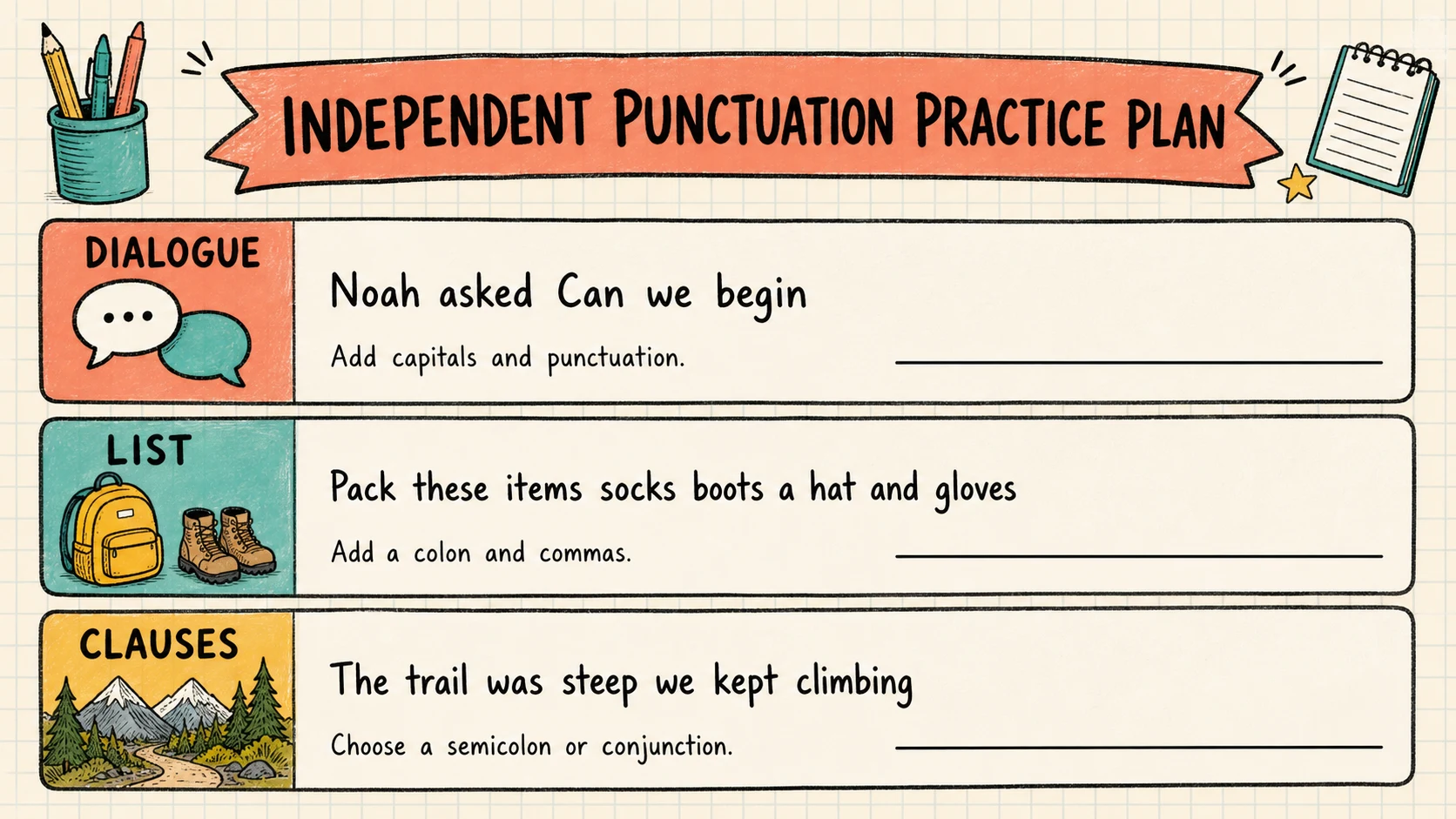
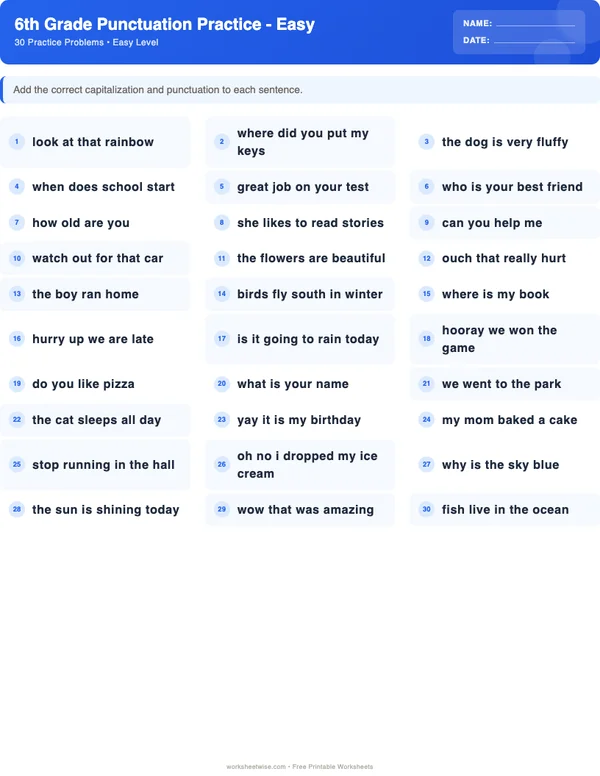
The sixth-grade punctuation plan illustrates spacing and review, but the exact conventions assigned should come from prior teaching and the learner’s returned work.
A practical sequence might look like this:
- Day 1: model one rule and assign five or six recognition items.
- Day 2: discuss one correct and one incorrect response; assign four correction items.
- Day 3: use two original sentences containing the same convention.
- Day 4: mix the target with one previously secure rule.
- Day 5: pause worksheets and edit a short authentic sentence from current classroom writing.
- The following week: revisit only if explanations or transfer remain uncertain.
For a third-grade parts-of-speech sequence, Day 1 might identify verbs in context. Day 2 contrasts one flexible word, such as run, across two sentences. Day 3 replaces a vague verb in a sentence. Day 4 reviews nouns and verbs together. This sequence remains within the catalogue’s stated parts-of-speech pathway while moving from labeling toward use.
The Common Core English Language Arts standards include grade-organized expectations for language conventions and writing. They can help educators check whether a convention appears in a broad grade-band framework, but they do not establish a universal local teaching order, assess WorksheetWise materials, or determine an individual learner’s placement.
Keep homework evidence within honest limits
A worksheet shows performance on particular items under particular conditions. It does not by itself establish mastery, explain why an error occurred, diagnose a learning condition, or predict performance in independent writing.
Treat a high score cautiously if the learner received extensive prompting, copied a visible pattern, or cannot explain a sample answer. Treat a low score cautiously if the vocabulary was unfamiliar, directions changed unexpectedly, reading demand obscured the grammar skill, or the learner was tired or rushed.
Do not infer standards alignment from a grade label. Do not promise that completing more pages will produce a particular outcome. Do not use the catalogue’s “easy” label to characterize a learner. Describe what you observed instead: “selected end punctuation correctly in five of six short sentences,” “needed each sentence read aloud,” or “identified nouns but confused verbs with adjectives in context.”
Homework should also have a stopping boundary. Stop and return the page when the learner cannot understand the modeled direction, when adult support is becoming answer-giving, or when repeated errors show that teaching is needed. The next-day response is a brief model or guided contrast, not a penalty or a longer sheet.
Make the returned page choose tomorrow’s page
Tomorrow, take one returned grammar sheet and classify its errors by rule, response format, and support received. Then make one observable decision:
- If the learner explains nearly all answers independently, choose a short sheet using the same skill in a slightly less supported format.
- If answers are correct only with prompts, retain the skill and repeat the format with a visible model.
- If one misconception repeats, teach a contrast pair and choose a sheet containing only that distinction.
- If reading or writing demand obscures the grammar decision, adapt access and document the support.
- If errors are scattered and explanations are uncertain, do not advance; use two oral check items first.
Use the free deterministic worksheet generators to create that specific next practice set—for example, a short end-punctuation contrast, a noun-and-verb identification set, or a complete-sentence check—based on what the returned work actually revealed.
Put it into practice
Use the guide with a real printable
Move from explanation to a short, observable practice task. Check the first item together, then adjust the next session from the learner's actual work.
Open the first free worksheetExplore a neighboring collection