What 5th Grade Punctuation Should Cover
Fifth-grade punctuation instruction should help a learner choose marks that make sentence structure and meaning clear. The immediate priorities are usually:
- Secure end punctuation and capitalization.
- Apply one comma rule at a time.
- Distinguish contractions from possessives.
- Punctuate quoted speech accurately.
- Edit punctuation in connected writing, not only isolated sentences.
- Explain why each mark is needed.
A learner does not need to study every punctuation mark at once. Begin with observed work: collect a short writing sample, identify the error pattern that most affects clarity, teach that pattern directly, and then check whether the learner can apply it in a new sentence or paragraph.
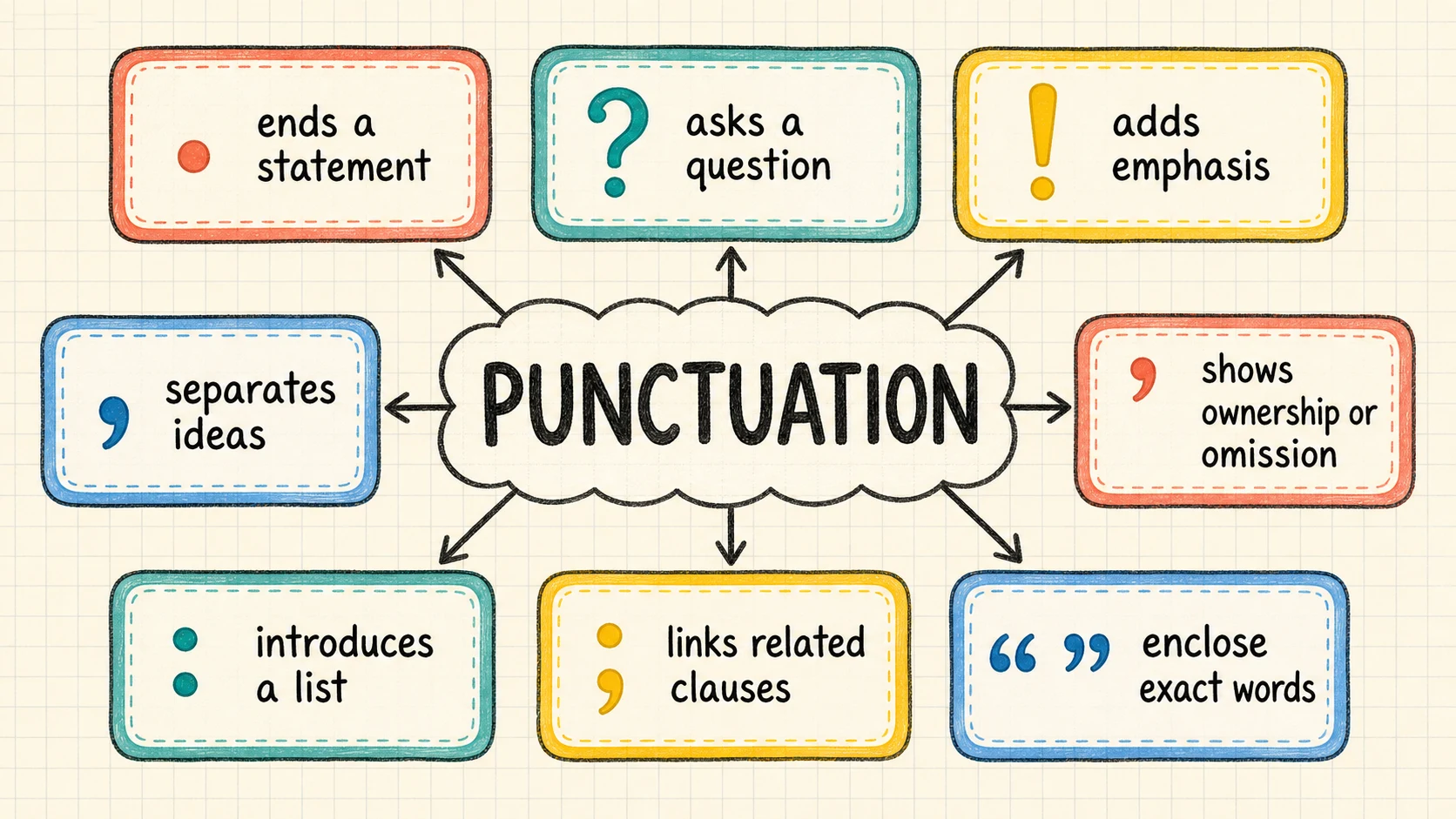
The skill map connects sentence endings, commas, apostrophes, quotation marks, and editing.
Grade labels describe an intended practice level, not a guarantee that every learner has the same starting point. Local curricula and instructional sequences differ. A fifth grader who confuses periods and question marks needs different practice from one who punctuates sentences correctly but omits commas around introductory elements.
The Common Core English Language Arts standards provide one useful reference point for grade-level language conventions. The supplied catalogue highlights punctuation in a series and commas connected with sentence structure at this level. Treat that information as a benchmark, not as a claim that one guide or worksheet provides comprehensive standards alignment.
Prerequisites to Check Before Teaching New Rules
Advanced punctuation practice will not solve an underlying sentence-boundary problem. Before beginning a fifth-grade sequence, examine whether the learner can do the following.
Recognize a complete sentence
The learner should be able to find the subject and understand what the subject does, has, is, or experiences.
The puppy under the table. is a fragment because it does not tell what the puppy does.The puppy slept under the table. expresses a complete thought.Because the puppy was tired. begins a dependent idea but does not complete it.Because the puppy was tired, it slept under the table. completes the relationship.
A learner does not need advanced grammar terminology to begin punctuation work, but the learner must notice where a thought is complete.
Identify sentence purpose
Check whether the learner can distinguish a statement, question, command, and exclamation.
| Purpose |
Example |
Likely end mark |
| Statement |
The museum closes at five. |
Period |
| Direct question |
When does the museum close? |
Question mark |
| Command |
Please close the door. |
Period |
| Strong exclamation |
What an enormous kite! |
Exclamation point |
Voice can be a useful first clue, but meaning is the stronger test. Not every sentence spoken with excitement needs an exclamation point, and a polite request phrased as a question still needs a question mark: Could you close the door?
Read common sentence structures
The learner should recognize lists, introductory words or phrases, and two complete thoughts joined by a coordinating conjunction. These structures give commas a job to do.
Earlier reading instruction also matters. The IES foundational reading guide addresses instruction through third grade, so it is not a fifth-grade punctuation sequence. It is relevant only as background: accurate word reading, fluent reading, and attention to meaning support later work with sentence boundaries. If reading the sentence consumes nearly all of a learner’s effort, use short, accessible sentences during punctuation instruction.
A Grade-Appropriate Teaching Progression
Move from visible, easily explained boundaries toward punctuation that depends on sentence structure. The following order is practical, but it is not universal.
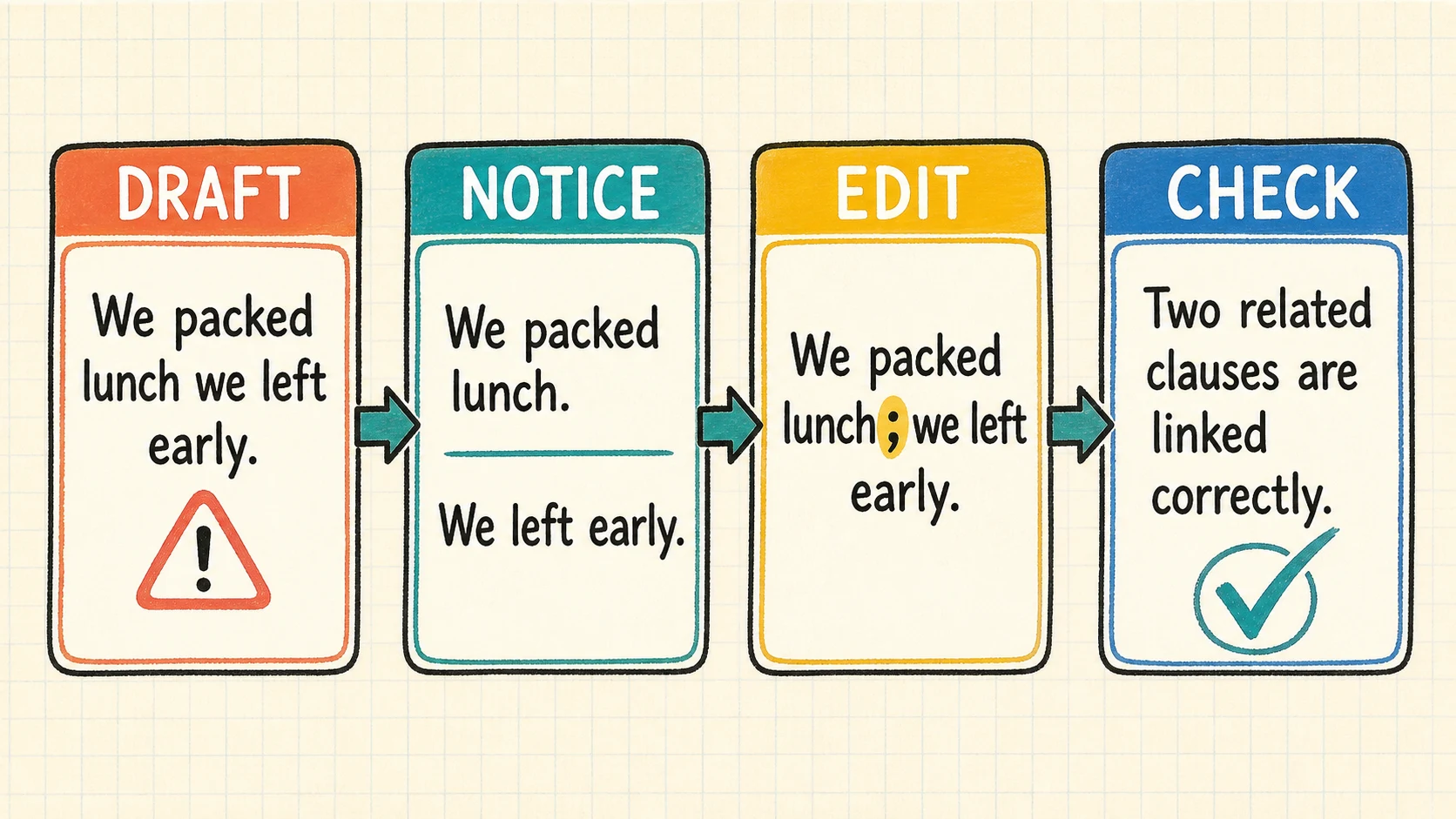
Support should decrease only after the learner can explain and apply the current rule.
| Stage |
Instructional focus |
Supported practice |
Evidence for moving on |
| 1 |
Capitals and end marks |
Choose among a period, question mark, and exclamation point |
Accurate choices with a reason based on sentence purpose |
| 2 |
Commas in a series |
Mark each listed item, then place separators |
Accurate punctuation in lists of three or more items |
| 3 |
Commas in dates and addresses |
Label the parts before adding commas |
Correct punctuation without relying on visual copying |
| 4 |
Compound sentences |
Test both sides of the conjunction for completeness |
Comma added only when two complete thoughts are joined |
| 5 |
Introductory elements |
Draw a boundary after the opening element |
Correct comma placement in varied sentence openings |
| 6 |
Apostrophes |
Sort examples into contractions and possession |
Can expand contractions and name the owner |
| 7 |
Dialogue |
Identify speaker, spoken words, and dialogue tag |
Correct quotation marks, commas, end marks, and paragraphing |
| 8 |
Editing and original writing |
Correct a paragraph and explain revisions |
Transfers punctuation to a new writing task |
Do not move forward merely because a page has been completed. A useful transition check includes three demands:
- Correct a familiar example.
- Explain the reason for the correction.
- Apply the same rule in an unfamiliar sentence.
If the learner succeeds only when every item has the same pattern, mix in previously learned forms before increasing difficulty.
Concrete and Visual Models for Major Punctuation Patterns
Punctuation becomes easier to reason about when marks are connected to sentence parts rather than memorized as decorations.
End punctuation: classify before choosing
Use a simple decision path:
What is the sentence doing? → telling, asking, directing, or exclaiming → choose the end mark
Compare these forms:
You finished the model. tells something.Did you finish the model? asks directly.Finish the model before lunch. gives a direction.What a detailed model you made! expresses strong feeling.
Have the learner read the sentence, name its purpose, and then select the mark. This prevents guessing based only on a single word such as what or how.
Commas in a series: identify the items
Start by bracketing each item:
We packed [water] [sandwiches] [maps] and [sunscreen].
Then insert punctuation:
We packed water, sandwiches, maps, and sunscreen.
The catalogue model uses a comma before the final conjunction. Local style expectations can differ in some contexts, so follow the learner’s assigned convention when it is explicit. The essential instructional point is that commas separate the items clearly.
Boundary case: two items do not form a series requiring a separating comma.
- Correct:
We packed maps and sunscreen.
- Incorrect:
We packed maps, and sunscreen.
Compound sentences: test both sides
Use a vertical divider before discussing the comma:
Maya wanted to ride her bike | but rain covered the path.
Ask whether each side can stand as a sentence.
Maya wanted to ride her bike. Yes.Rain covered the path. Yes.
The complete version is:
Maya wanted to ride her bike, but rain covered the path.
Now compare:
Maya wanted to ride her bike and explore the park.
The words after and do not form a complete sentence because no new subject is stated. In this structure, no comma is needed.
Introductory elements: mark the entry point
Draw a slash where the main part begins:
After the final rehearsal / the actors rested.
Then replace the slash with a comma:
After the final rehearsal, the actors rested.
Other useful models include:
First, measure the paper.Before sunrise, the hikers filled their bottles.Yes, I returned the library book.
Teach the learner to locate the main statement rather than to add a comma automatically after the first word.
Apostrophes: expansion or ownership
Use two separate tests.
For a contraction, expand the shortened form:
didn't → did not
The apostrophe marks omitted letters.
For possession, name the owner and the owned item:
the artist's brush → the brush belonging to the artist
Do not teach apostrophes as marks added whenever a word ends in s. In The artists painted murals, artists is simply plural. No ownership is expressed.
Dialogue: map the parts
Label the spoken words and the dialogue tag:
[Spoken words] [tag]
"I found the missing piece," Lena said.
The quotation marks enclose the spoken words. The comma separates the quotation from the following tag, and it appears inside the closing quotation mark in this pattern.
When the quotation itself is a question, retain the question mark:
"Where does this piece belong?" Lena asked.
A new speaker begins a new paragraph. Teach that layout explicitly after the learner can punctuate a single line of dialogue.
Fully Checked Worked Examples
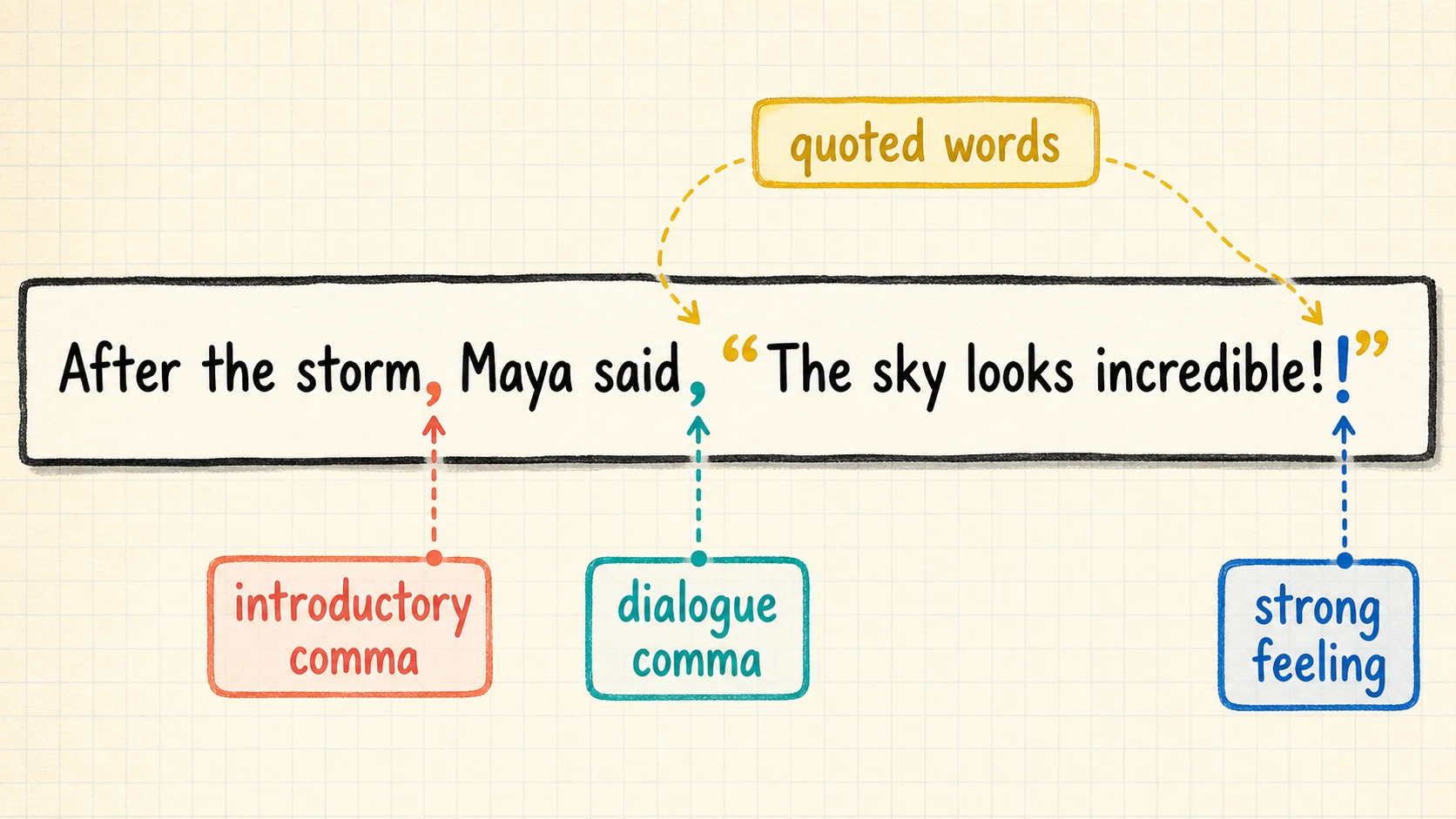
Each example is solved by identifying sentence structure before inserting marks.
Worked example 1: capitalization and end punctuation
Unedited sentence:
where did you put the blue folder
Reasoning:
- The first word begins a sentence, so where becomes
Where.
- The sentence asks a direct question.
- A direct question ends with a question mark.
Corrected sentence:
Where did you put the blue folder?
Check: The sentence begins with a capital and its purpose matches its end mark.
Worked example 2: commas in a series
Unedited sentence:
For the experiment we need a jar water oil and food coloring.
Reasoning:
For the experiment is an introductory phrase, so place a comma after it.- The listed materials are
a jar, water, oil, and food coloring.
- Separate the four items with commas.
Corrected sentence:
For the experiment, we need a jar, water, oil, and food coloring.
Check: Removing the introductory phrase leaves the complete statement We need a jar, water, oil, and food coloring. Each item in the series remains clear.
Boundary note: The first comma and the list commas perform different jobs. Asking the learner to name each job is more informative than asking only for the final sentence.
Worked example 3: compound sentence
Unedited sentence:
Eli checked the weather but he forgot his umbrella.
Reasoning:
- The conjunction is
but.
- Before it,
Eli checked the weather is a complete sentence.
- After it,
he forgot his umbrella is also complete.
- The comma goes before the conjunction joining the two complete thoughts.
Corrected sentence:
Eli checked the weather, but he forgot his umbrella.
Check: Both sides can stand alone and have their own subjects and predicates.
Compare the boundary case:
Eli checked the weather but forgot his umbrella.
No comma is required in this model because forgot his umbrella does not have a separate stated subject. Both verbs belong to Eli.
Worked example 4: contraction and possession
Unedited sentence:
The dogs collar isnt in the basket.
Reasoning:
- The collar belongs to one dog, so
dogs becomes the possessive dog's.
isnt means is not; the apostrophe replaces the omitted letter o.- The sentence is a statement, so it ends with a period.
Corrected sentence:
The dog's collar isn't in the basket.
Check: dog's answers “whose collar?” while isn't expands to is not. The two apostrophes have different functions.
Boundary case:
The dogs aren't in the basket.
Here, dogs names more than one dog and shows no ownership, so it has no apostrophe. aren't remains a contraction.
Worked example 5: dialogue with a statement
Unedited sentence:
I finished the first chapter Nia said
Reasoning:
- Nia’s exact spoken words are
I finished the first chapter.
- Enclose those words in quotation marks.
- Because the following words identify the speaker, use a comma before the closing quotation mark.
- Capitalize
I and end the full sentence with a period.
Corrected sentence:
"I finished the first chapter," Nia said.
Check: Only the spoken words are inside quotation marks. The dialogue tag is outside.
Worked example 6: dialogue with a question
Unedited sentence:
Can we read the next chapter Nia asked
Reasoning:
- The spoken words form a direct question.
- Enclose them in quotation marks.
- Use a question mark for the quotation’s meaning.
- Do not add a comma beside the question mark.
Corrected sentence:
"Can we read the next chapter?" Nia asked.
Check: The question mark belongs to the spoken question and appears inside the closing quotation mark.
A Short, Repeatable Lesson Routine
A compact lesson can be more useful than a long mixed worksheet when it keeps attention on one decision.
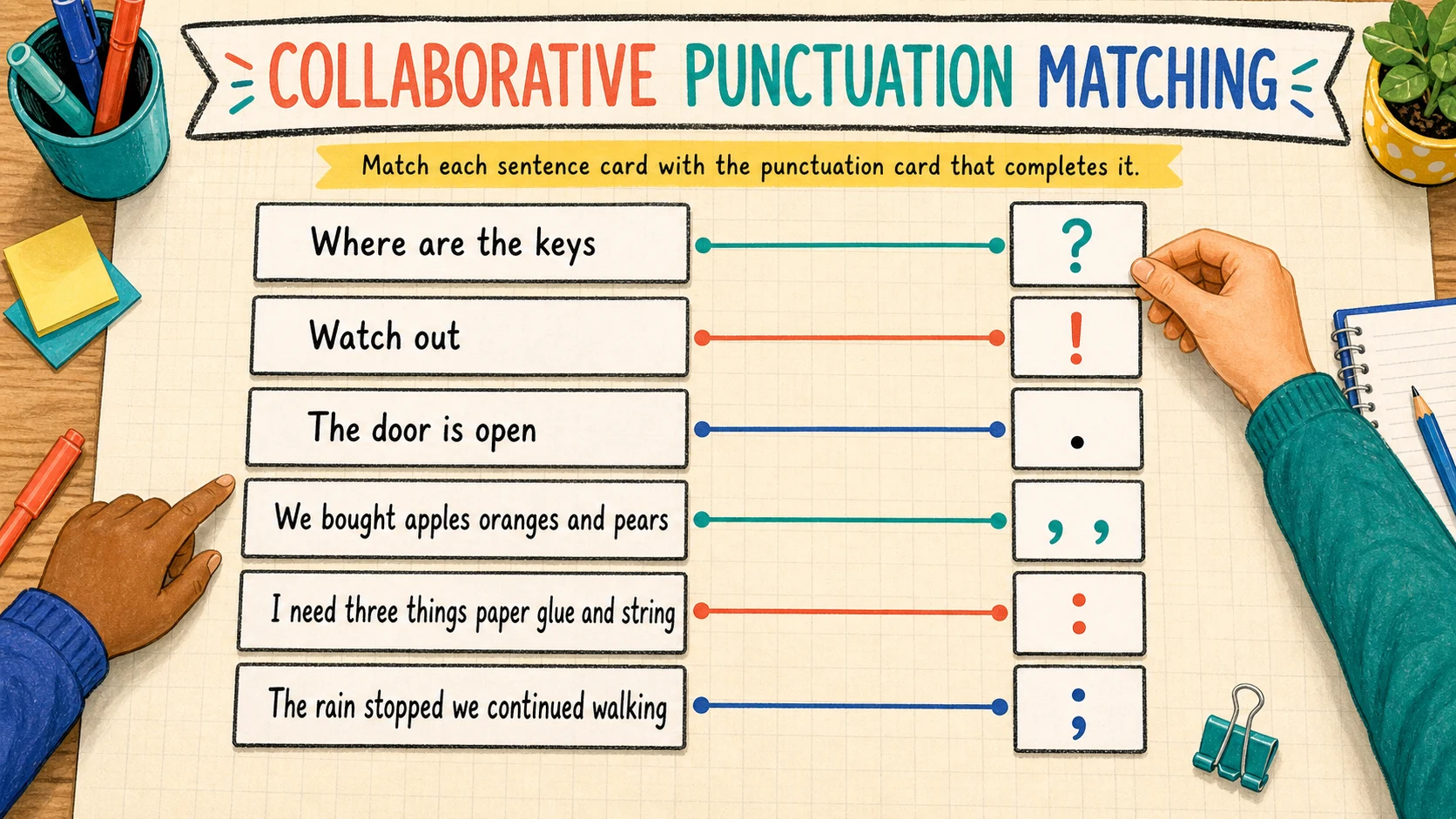
Model, explain, practice, apply, and review in a consistent cycle.
1. Retrieve
Show two previously taught sentences. Ask the learner to correct them and explain one choice. This checks retention before new instruction.
2. Model
Display one sentence and think through its structure aloud. For a compound sentence, test both sides of the conjunction. For possession, identify the owner. Keep the explanation tied to a visible test.
3. Practice together
Correct two or three examples. Ask questions such as:
- What job does this comma perform?
- Can both sides stand alone?
- Which letters are missing from the contraction?
- Which exact words did the speaker say?
Give less help on each item.
4. Apply independently
Use three to five new sentences or a short paragraph. Include one boundary case where the tempting mark is not needed.
5. Transfer to writing
Ask the learner to write one original example using the target pattern. Then have the learner underline the relevant sentence parts and explain the punctuation.
The IES elementary writing guide provides high-level support for explicit writing instruction, opportunities to write, and instruction in the writing process. It did not evaluate WorksheetWise or this lesson routine. Here, the practical implication is to connect punctuation study with composing and revising, rather than leaving it entirely in correction exercises.
Choosing Practice That Matches the Learner
The best practice is not necessarily the worksheet with the highest grade label or the largest number of items. Choose by error pattern and level of support.
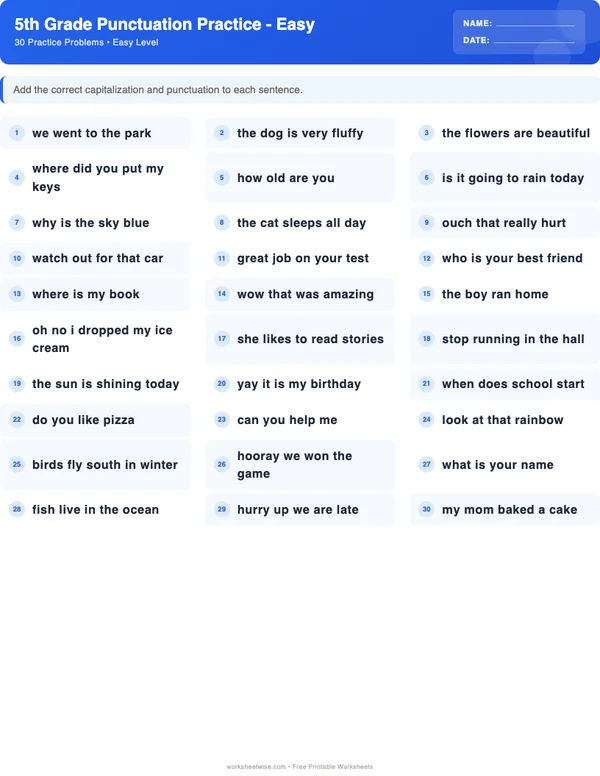
The free easy punctuation worksheet contains 30 exercises focused on capitalization, periods, question marks, and exclamation points. It is appropriate when a learner is beginning this topic, needs reinforcement of sentence endings, or produces inconsistent capitals and end marks. It does not, by itself, cover the wider set of comma, apostrophe, and dialogue decisions described in this guide.
Use different formats for different instructional purposes:
| Observed need |
Useful practice format |
| Learner guesses among end marks |
Sort sentences by purpose, then punctuate |
| Learner knows a rule but misses it in writing |
Edit a short paragraph and explain changes |
| Learner adds too many commas |
Include examples that need no comma |
| Learner confuses plural and possessive forms |
Sort, label ownership, and rewrite phrases |
| Learner struggles with dialogue layout |
Punctuate prepared dialogue before composing it |
| Learner succeeds only in blocked exercises |
Mix old and new sentence patterns |
| Learner works accurately but slowly |
Use short untimed retrieval sets before considering speed |
For broader exploration, use the 5th Grade Grammar hub to place punctuation beside related sentence and language work. The focused punctuation pack contains 18 worksheets and may be useful when repeated practice across the topic is needed. Its size does not mean every learner should complete every page; select only work that matches the current instructional target.
Differentiation Without Lowering the Thinking Demand
Differentiation should adjust access, amount, and support while preserving the central punctuation decision.
When the learner needs more support
- Read the sentence aloud before asking for punctuation.
- Present one rule at a time.
- Color-code complete thoughts on either side of a conjunction.
- Bracket items in a series before adding commas.
- Provide contraction expansions in a matching bank.
- Limit copying by supplying printed sentences.
- Use three carefully chosen items instead of a long mixed set.
- Ask for an oral explanation when writing the explanation creates an unrelated barrier.
If the learner cannot explain the rule, return to a concrete test. Repeating the same directions more loudly or assigning more identical items does not clarify the underlying structure.
When the learner is ready for more complexity
- Mix examples that require a mark with examples that do not.
- Move from isolated sentences to paragraphs.
- Use sentences containing two punctuation decisions.
- Ask the learner to compare two possible versions.
- Have the learner write dialogue between two speakers.
- Ask for an edit followed by a written justification.
- Revisit the same rule several days later without advance notice.
Complexity should come from sentence structure and transfer, not merely from longer vocabulary.
Common Errors and Diagnostic Teaching Responses
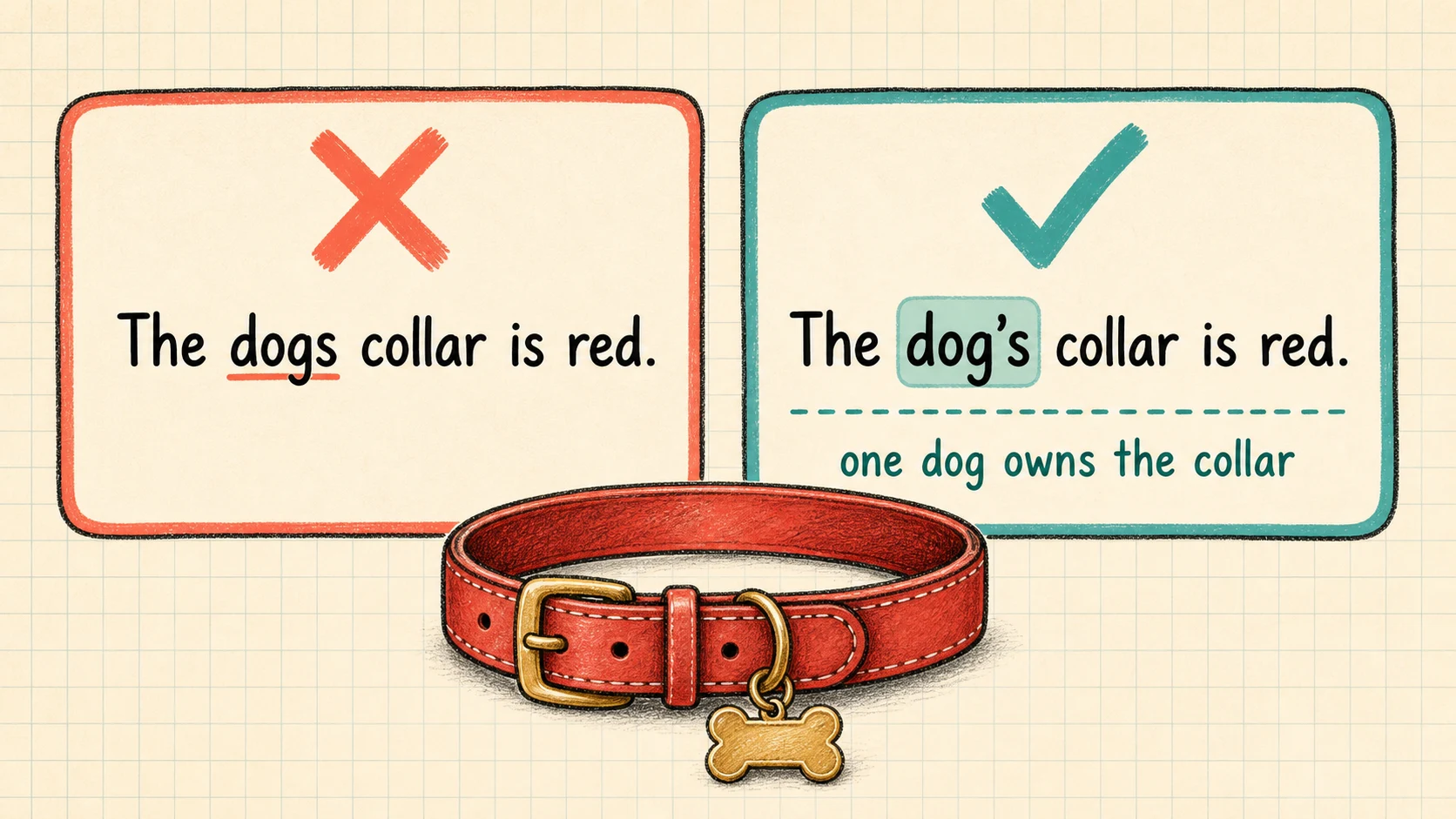
An error pattern suggests the next teaching move; it does not define the learner.
| Observed error |
Possible instructional issue |
Diagnostic check |
Teaching response |
| Every sentence receives a period |
Sentence purpose is not being considered |
Ask the learner to sort statements and direct questions |
Classify purpose before selecting a mark |
| Frequent exclamation points |
Exclamation is being treated as a default for interesting sentences |
Compare calm statements with strong exclamations |
Discuss meaning and degree of emphasis |
Comma before every and |
A word-based rule has replaced structural reasoning |
Test whether both sides are complete sentences |
Mark subjects and predicates before punctuating |
| No comma after an opening phrase |
Main-clause boundary is not visible |
Ask where the central statement begins |
Draw a slash at the boundary, then replace it with a comma |
| Apostrophe in ordinary plurals |
Apostrophe is associated with final s |
Ask whether anything belongs to anyone |
Sort plural, possessive, and contraction examples |
| Missing quotation marks |
Spoken words are not separated from narration |
Ask the learner to point to the exact words spoken |
Box the spoken words before adding marks |
| Period before a following dialogue tag |
Dialogue punctuation is being treated as ordinary end punctuation |
Ask whether the sentence continues with who spoke |
Practice statement quotations followed by tags |
| Accurate worksheet, inaccurate paragraph |
The rule has not transferred to authentic writing |
Compare blocked items with a short edit |
Use brief paragraph editing and original sentences |
| Random corrections after prompting |
Learner may not have a usable decision rule |
Ask for the reason before accepting the edit |
Teach a repeatable test and require explanation |
These diagnoses are hypotheses, not medical or child-specific conclusions. Confirm them with additional examples. A single mistake may reflect haste, copying difficulty, or an unfamiliar sentence rather than a stable misunderstanding.
Monitoring Progress and Deciding When to Move On
Track patterns rather than relying only on a total score. A simple record can include:
- Date and target rule.
- Number correct out of the number attempted.
- Whether prompts were needed.
- Whether the learner explained the rule.
- Whether the learner applied it in original writing.
- The most frequent error type.
- The next instructional step.
For example:
| Date |
Target |
Sentence practice |
Paragraph transfer |
Explanation |
Next step |
| Day 3 |
Commas in a series |
5/5 |
2/3 |
Clear |
Review once, then mix with end marks |
| Day 6 |
Compound sentences |
3/5 |
1/3 |
Inconsistent |
Retest both sides for completeness |
| Day 9 |
Possessives |
4/5 |
3/3 |
Clear |
Contrast with plural nouns after a delay |
Do not interpret one score in isolation. Look for accuracy across more than one occasion, reduced prompting, and successful transfer to an unfamiliar context. If performance declines sharply in a paragraph, reduce the amount of text while keeping the same punctuation target.
A useful mastery check contains:
- Two familiar examples.
- Two unfamiliar examples.
- One example where no new mark is needed.
- One original sentence.
- A brief explanation of one choice.
The learner’s observed work should determine pacing. There is no universal timetable for mastering these conventions.
A Two-Week Practice Plan
This plan is an instructional suggestion, not a sourced requirement. Sessions can be shortened, repeated, or rearranged. Ten focused sessions are often easier to interpret than one large mixed assignment because each day produces evidence about a specific decision.
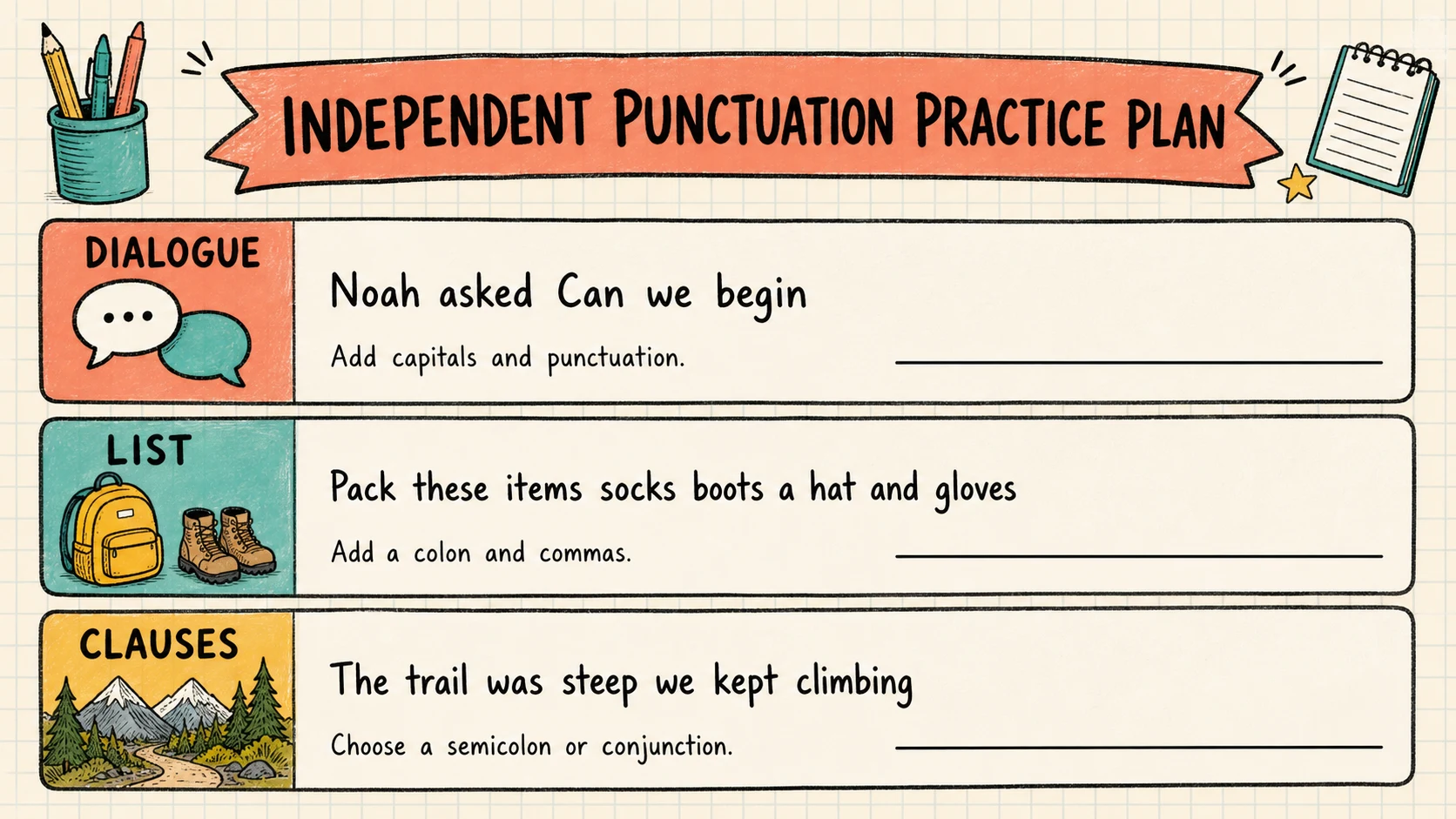
The plan alternates direct teaching, mixed review, editing, and transfer.
| Day |
Main focus |
Suggested activity |
Quick evidence |
| 1 |
Baseline |
Correct six sentences and one short paragraph |
Record error types and prompts |
| 2 |
End marks |
Sort by purpose, then correct and compose |
Explain three end-mark choices |
| 3 |
Series |
Bracket listed items and add commas |
Complete one list that has only two items as a boundary case |
| 4 |
Compound sentences |
Test both sides of and, but, or another given conjunction |
Distinguish a compound sentence from a shared-subject sentence |
| 5 |
Mixed review |
Combine end marks, series, and compound sentences |
Correct unfamiliar examples without rule labels |
| 6 |
Introductory elements |
Mark where the main statement begins |
Write two sentences with different openings |
| 7 |
Apostrophes |
Sort contractions, possessives, and plurals |
Expand contractions and identify owners |
| 8 |
Dialogue |
Punctuate prepared statements and questions |
Explain why one quotation uses a comma and another a question mark |
| 9 |
Paragraph editing |
Correct a short unpunctuated passage |
Name the job of each inserted mark |
| 10 |
Transfer and review |
Revise a brief original paragraph |
Compare with Day 1 and select the next target |
On each day, begin with one or two delayed-review examples from earlier sessions. If a learner misses the same pattern twice, pause the schedule and reteach it with a visual model. If the learner is consistently accurate and can explain the rule, replace repetitive items with paragraph editing or original writing.
The plan should not become a race through punctuation categories. Its purpose is to expose what the learner can do independently and what still requires support.
Limitations and the Next Instructional Step
No single worksheet can establish complete punctuation control. Isolated exercises may reveal whether a learner recognizes a pattern, but they do not fully show whether that learner can punctuate original writing, revise a paragraph, or maintain accuracy while concentrating on ideas.
This guide also does not establish comprehensive standards alignment, guarantee an outcome, prescribe medical guidance, or replace local curriculum expectations. Fifth-grade writers may encounter punctuation beyond the central patterns covered here, including colons and semicolons, but those marks should not displace more immediate needs found in the learner’s work. Teach them when the local sequence or the learner’s writing gives them a clear purpose.
An honest next step is to collect a short baseline before choosing more material. Begin with the free 5th Grade Punctuation worksheet, but use only enough items to see whether capitalization and end punctuation are secure. Then ask the learner to edit a short paragraph and write three original sentences. If those foundations are accurate, move to focused practice with commas, apostrophes, or dialogue according to the first recurring error you observe.