What 3rd Grade Parts of Speech Instruction Should Cover
A third-grade learner should first become secure at finding and using nouns, verbs, and adjectives in complete sentences. From that foundation, instruction can extend to pronouns and adverbs, followed by concrete introductions to prepositions and conjunctions. Interjections and more difficult cases can come later.
The central idea is simple: a part of speech describes the job a word performs in a particular sentence. It does not permanently label the word. In “We walk home,” walk is a verb. In “We took a walk,” it is a noun.
Effective practice should help a learner do three things:
- Identify a word’s job in a sentence.
- Explain the evidence for that classification.
- Use or revise the word purposefully in writing.
Grade labels describe an intended practice level, not a universal timetable. Local curricula and instructional sequences differ. The Common Core State Standards for English Language Arts can provide broad grade-level context, but educators should use their local requirements when deciding exactly when each category is introduced.
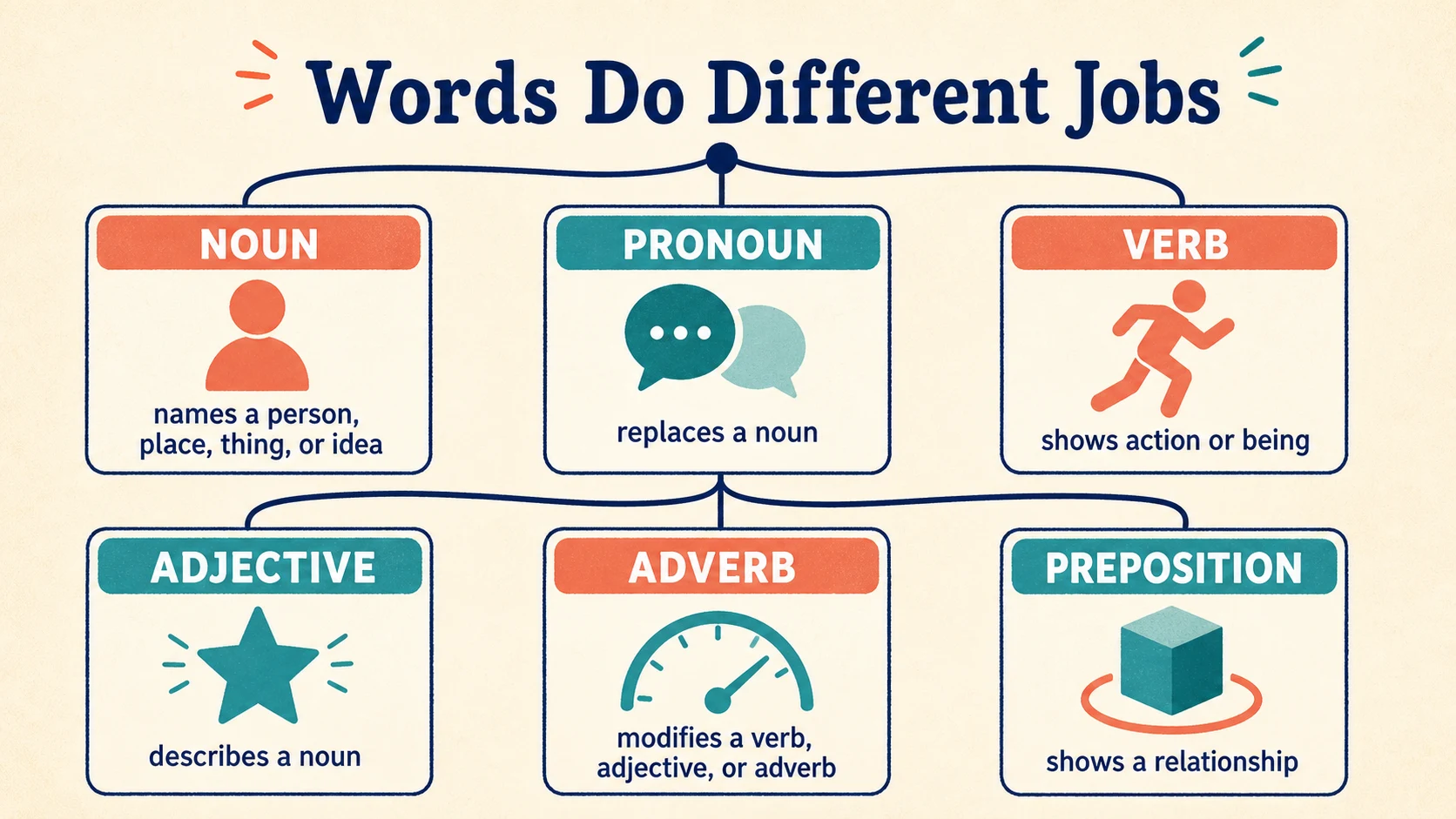
The skill develops from recognizing sentence jobs to explaining and applying them.
Prerequisites to Check Before Teaching
Parts-of-speech work becomes much easier when the learner can recognize a complete simple sentence. Before beginning a mixed worksheet, check whether the learner can locate whom or what the sentence is about and what happens or is true.
Use a sentence such as:
The small rabbit hops.
Ask:
- What is this sentence about? The rabbit.
- What does the rabbit do? Hops.
- Which word tells more about the rabbit? Small.
A learner does not need formal mastery of subjects and predicates before starting. However, the learner should understand that words work together to communicate a complete idea.
Sentence boundaries and meaning
Check whether the learner can distinguish a sentence from a word list:
- dog, noisy, runs — related words, but not yet a sentence
- The noisy dog runs. — a complete statement
This distinction matters because context determines a word’s function. Sorting isolated words can introduce categories, but it cannot show reliably how every word functions.
Basic noun and action language
The learner should be comfortable naming familiar people, places, things, and actions. Ideas such as hope and freedom are nouns too, but concrete examples are usually easier starting points.
If the learner struggles to name the action in “The horse gallops,” pause mixed classification. Practice orally with short sentences and physical actions before adding several labels.
Reading the practice sentences
A grammar response may be wrong because the learner misread a word rather than misunderstood its part of speech. Read a difficult sentence aloud when necessary. Grammar practice should not become an accidental test of unsupported decoding.
The IES guide on foundational reading skills provides a broader instructional context for supporting reading through the early grades. It does not prescribe this particular parts-of-speech sequence, but its scope is a useful reminder to consider word reading and sentence reading when interpreting grammar errors.
The Eight Parts of Speech at an Appropriate Level
Third-grade instruction does not have to demand equal mastery of all eight categories at once. Nouns, verbs, and adjectives are the most suitable core for an introductory practice set. The remaining categories can be introduced gradually in meaningful sentences.
Nouns, verbs, and adjectives
A noun names a person, place, thing, or idea:
- person: pilot
- place: library
- thing: pencil
- idea: kindness
A verb shows an action or helps state what the subject is or is like:
- action: The bird sings.
- linking use: The bird is quiet.
An adjective describes a noun or pronoun. It can answer questions such as Which one? What kind? How many?
- that book
- heavy book
- three books
Learners often recognize action verbs before linking verbs. Treat linking constructions as a planned extension rather than assuming that the definition “a verb is an action word” covers every case.
Pronouns and adverbs
A pronoun takes the place of a noun or refers back to one:
Maya carried the box because she wanted to help.
She refers to Maya. Ask learners to draw an arrow from the pronoun to the noun it represents. This makes unclear reference easier to notice.
An adverb can describe a verb:
The turtle moved slowly.
Slowly tells how the turtle moved. Do not teach that every word ending in -ly is automatically an adverb. In “a friendly dog,” friendly describes the noun dog, so it is an adjective.
Prepositions, conjunctions, and interjections
A preposition can show a relationship such as location or direction:
- under the table
- beside the chair
- through the gate
Demonstrate these relationships with an object and a box. Place the object in, on, under, behind, and beside the box. Keep the words in phrases so learners see the relationship.
A conjunction connects words or groups of words:
We packed apples and crackers.
I wanted to play, but it began to rain.
An interjection expresses a reaction or emotion:
Wow! That tower is tall.
Recognition is a reasonable first goal. A learner who is still confusing nouns and verbs does not need a large interjection exercise merely because interjections appear on an eight-part list.
A Grade-Appropriate Teaching Progression
Teach fewer categories with stronger reasoning before asking for all-category classification. The following progression is adjustable. Observed work, not a fixed calendar, should determine when the learner moves forward.
| Stage |
Instructional focus |
Supported task |
Evidence of readiness |
| 1 |
Concrete nouns and action verbs |
Act out verbs and point to named objects |
Correctly separates nouns and verbs in short sentences |
| 2 |
Nouns, verbs, and adjectives |
Mark one requested category at a time |
Explains what an adjective describes |
| 3 |
Pronouns and antecedents |
Draw arrows from pronouns to nouns |
Identifies a clear referent |
| 4 |
Adverbs describing verbs |
Ask how an action occurs |
Distinguishes common adjectives from adverbs in context |
| 5 |
Prepositions and conjunctions |
Model spatial relationships and joined ideas |
Explains what is related or connected |
| 6 |
Mixed classification |
Label selected words in varied sentences |
Uses sentence evidence instead of word shape alone |
| 7 |
Application in writing |
Revise vague or repetitive sentences |
Chooses words that make meaning clearer |
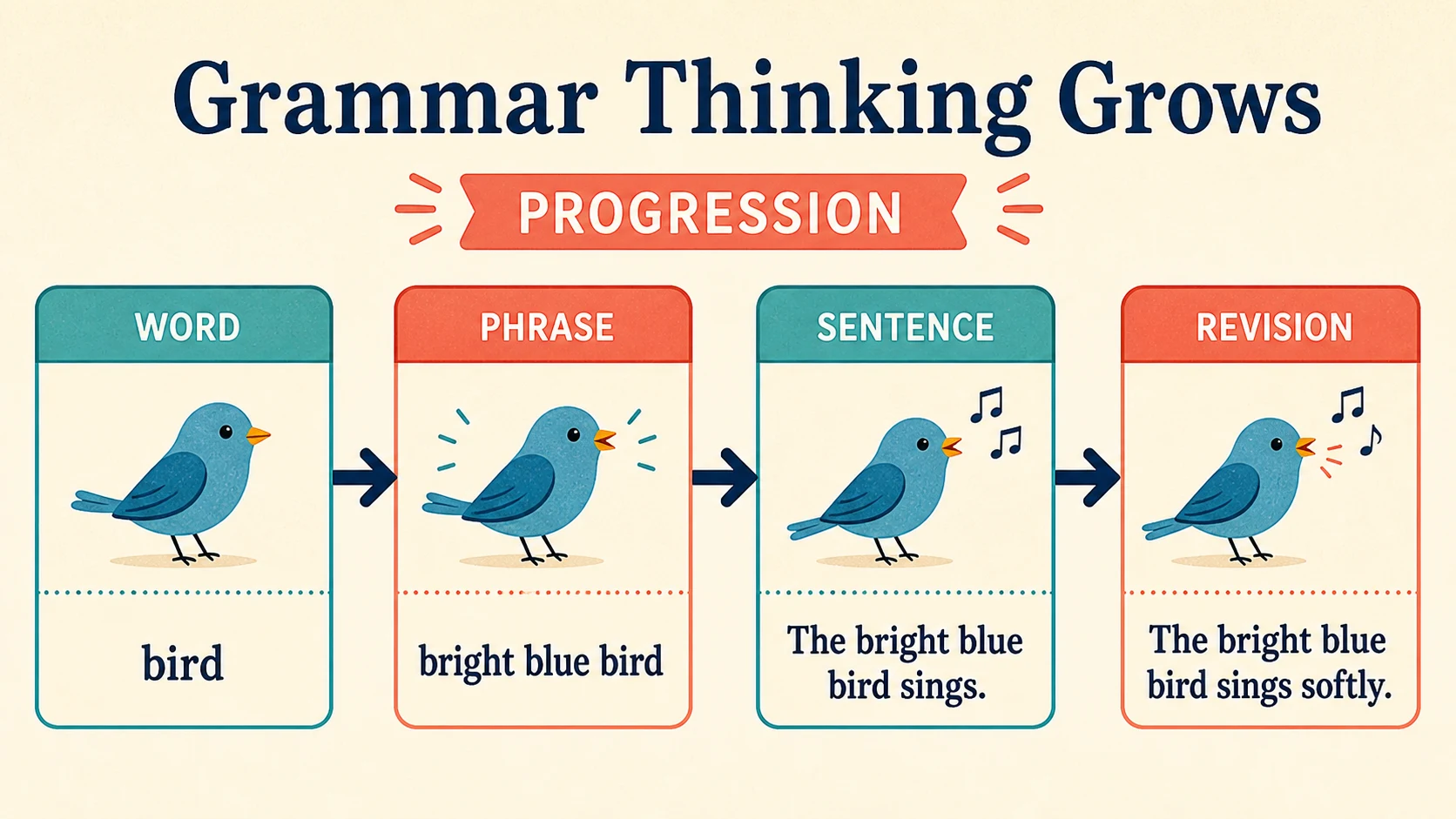
Support decreases as the learner becomes able to explain each word’s sentence job.
A useful progression within any stage is:
- hear and discuss;
- manipulate or act out;
- identify in a sentence;
- explain the classification;
- use the category in writing.
For example, a learner might first act out stomp, find it in “The giant stomps,” explain that it tells what the giant does, and then write a new sentence with a precise action verb.
The WorksheetWise 3rd Grade Grammar hub can help adults compare nearby grammar topics, while the 3rd Grade worksheet hub provides broader grade-level practice choices.
Concrete and Visual Models That Clarify Word Jobs
Visual models should reveal relationships, not merely assign decorative colors. Use the same model repeatedly until the learner can reproduce the reasoning independently.
The sentence-frame model
Write:
The ___ noun ___ verb ___.
Add words one at a time:
The fox waited.
The red fox waited.
The red fox waited quietly.
Discuss what each addition changes:
- fox names the animal;
- waited tells what it did;
- red describes the fox;
- quietly describes how it waited.
This model shows that parts of speech contribute different kinds of information.
The question-arrow model
Draw arrows to show which words affect other words:
- adjective → noun: bright → lantern
- adverb → verb: glowed ← softly
- pronoun → antecedent: Lina ← she
Questions then become more precise:
- What does bright describe?
- What action does softly tell more about?
- Whom does she represent?
The movement-and-object model
Use one familiar object, such as a book:
- noun: “This is a book.”
- verb: “I lift the book.”
- adjective: “It is a heavy book.”
- adverb: “I lift it carefully.”
- preposition: “The book is under the chair.”
- conjunction: “I lift the book and open it.”
- pronoun: “It has a blue cover.”
- interjection: “Oh! The page is torn.”
This demonstration creates one coherent context instead of eight unrelated definitions.
Fully Checked Worked Examples
The most useful worked examples include the answer and the reason. A learner who guesses correctly still needs to explain the word’s function.
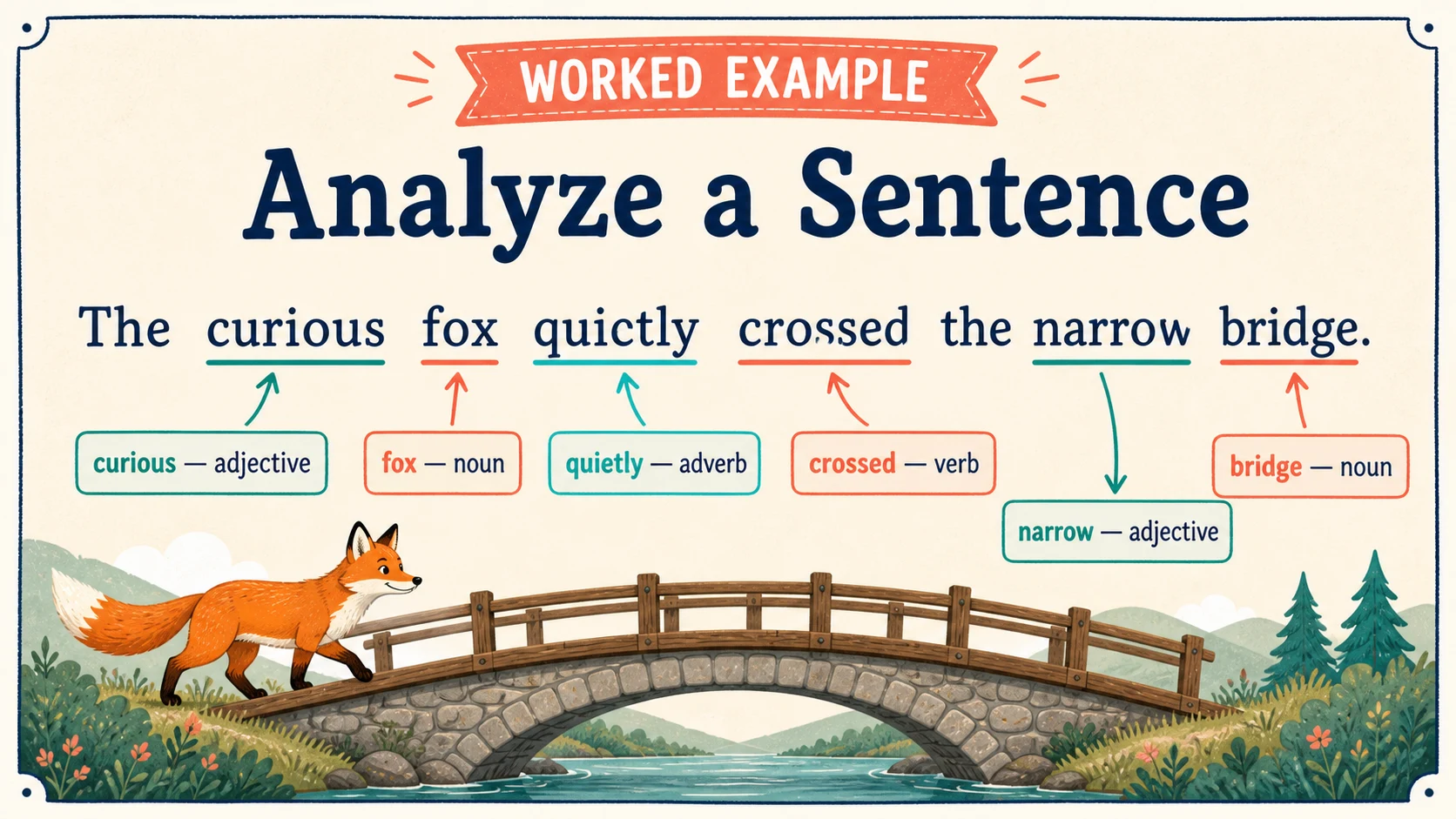
The answer comes from the word’s relationship to the rest of the sentence.
Example 1: Core categories
The playful puppy chased the red ball.
Classify puppy, chased, and red.
- The sentence is about a puppy. It names an animal, so puppy is a noun.
- The puppy chased something. The word tells what the puppy did, so chased is a verb.
- Red tells which kind of ball appears in the sentence. It describes the noun ball, so red is an adjective.
Checked answer: puppy—noun; chased—verb; red—adjective.
Example 2: Pronoun and antecedent
Elena found the keys, and she placed them on the desk.
Classify she and identify its antecedent.
- She stands in place of a person’s name, so it is a pronoun.
- The sentence first names Elena.
- Replacing she with Elena preserves the meaning: “Elena placed them on the desk.”
Checked answer: she—pronoun; antecedent—Elena.
The word them is also a pronoun. It refers to keys. This is useful extension work once the first relationship is clear.
Example 3: Adjective or adverb
The careful painter worked carefully.
Classify both highlighted forms.
- Careful appears before painter and tells what kind of painter. Because it describes a noun, careful is an adjective.
- Carefully tells how the painter worked. Because it describes the verb worked, carefully is an adverb.
Checked answer: careful—adjective; carefully—adverb.
The spelling offers a clue, but the deciding evidence is what each word describes.
Example 4: Preposition and conjunction
The kitten hid under the bed, but its tail remained visible.
Classify under and but.
- Under begins the phrase under the bed. The phrase shows the kitten’s relationship to the bed, so under is a preposition.
- But connects two contrasting ideas: the kitten hid, yet its tail could still be seen. It is a conjunction.
Checked answer: under—preposition; but—conjunction.
Example 5: A word with two possible jobs
Compare:
We water the plants.
Please bring the water.
In the first sentence, water tells what “we” do. It is a verb.
In the second, water names what should be brought. It is a noun.
Checked answer: water—verb in the first sentence; noun in the second. The word’s location alone does not decide its category; its function does.
Example 6: Linking verb boundary case
The soup smells delicious.
A learner may label smells as an action because people can smell flowers. Here, however, the sentence describes the soup’s condition. Smells links soup with delicious.
Checked answer: smells—verb; delicious—adjective. Delicious describes the noun soup, not the manner in which the soup performs an action.
A Short, Repeatable Lesson Routine
Keep a focused lesson brief enough that the learner still has attention for explanation and application. The following sequence is an instructional suggestion, not a sourced universal timetable.
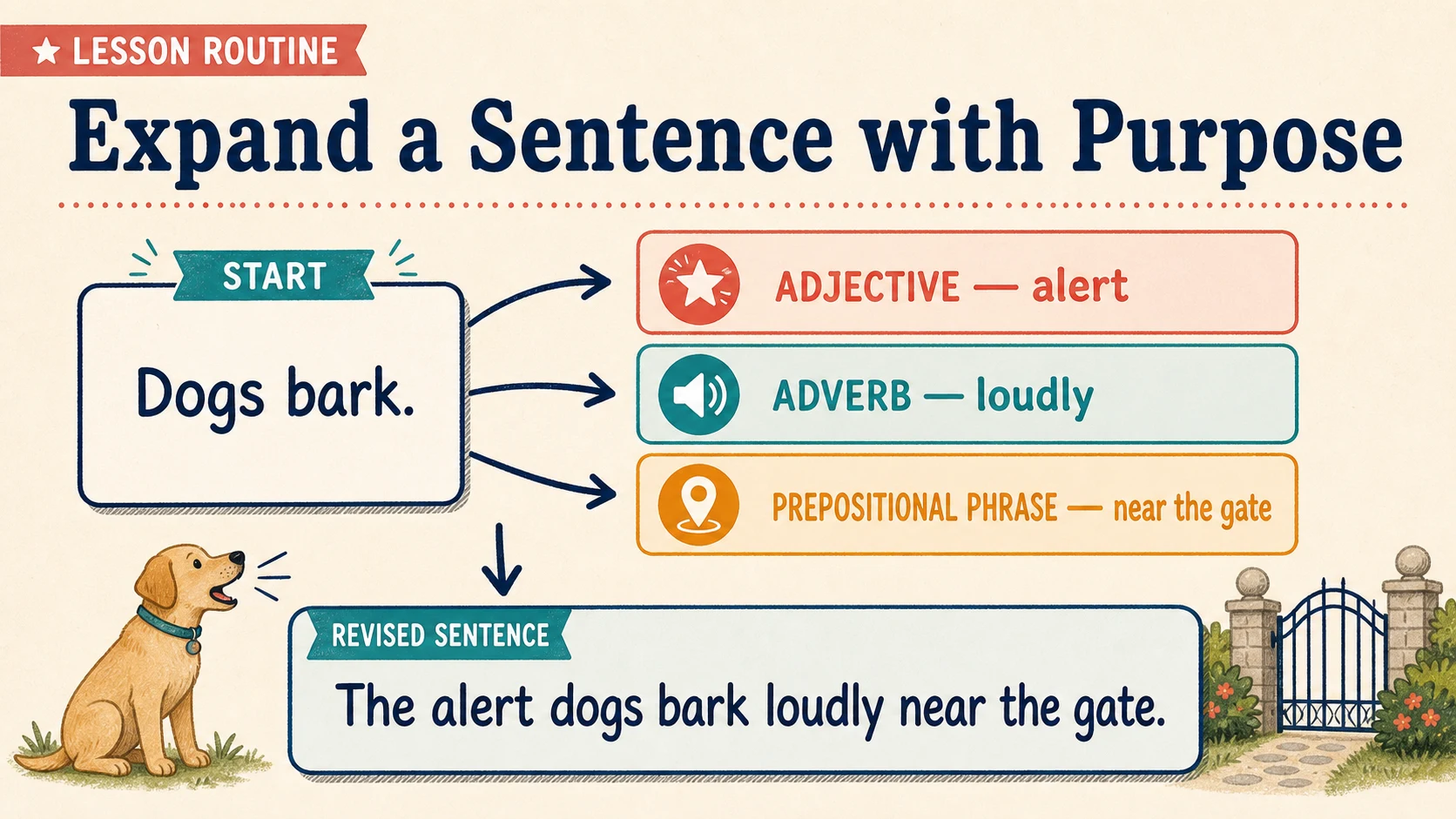
A consistent cycle makes the learner’s reasoning visible at every step.
1. Retrieve one known idea
Ask for a definition and an example:
“What job does a noun do? Name one noun in this room.”
If recall is weak, supply two choices rather than extending the quiz.
2. Model one sentence
Think aloud while marking a sentence:
“Glides tells what the swan does, so I will mark it as the verb.”
Keep the explanation tied to evidence.
3. Solve two examples together
Ask the learner to identify a word, name its category, and complete the statement:
“I know ___ is a ___ because ___.”
Prompt only as much as needed.
4. Assign a short independent set
Choose a small number of items that test the same distinction. Stop and reteach if errors reveal a consistent misunderstanding. Completing more items is not helpful when the decision rule is unclear.
5. Apply the skill in writing
Ask for one sentence using the target category. For adjectives, the learner might improve “The bird flew” by adding a precise noun description. For verbs, the learner might replace went with hurried, strolled, or marched when the meaning fits.
The IES guide on teaching elementary students to be effective writers offers high-level guidance about elementary writing instruction. It does not evaluate WorksheetWise materials or establish this exact routine. Here, writing application is suggested so grammar labels remain connected to composing meaningful sentences.
Choosing Practice and Differentiating Support
Choose practice according to the categories the learner can already distinguish, not merely the learner’s age or the number printed on a worksheet.
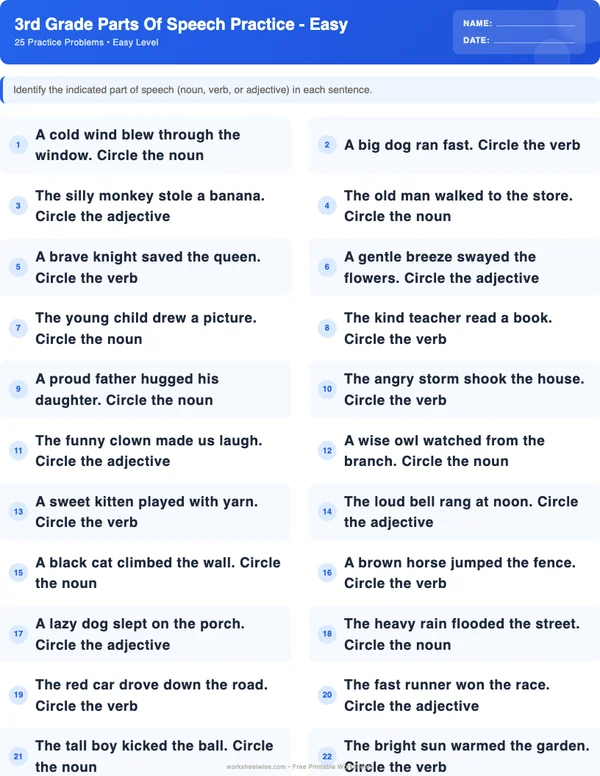
The free easy parts-of-speech worksheet contains 14 exercises focused on identifying nouns, verbs, and adjectives through sentence analysis. It is an appropriate choice for a learner beginning those three categories or needing reinforcement. A separate printable answer key is available.
The 3rd Grade Parts of Speech pack contains 18 worksheets and provides a larger practice collection. More pages are useful only when the tasks match the learner’s current needs.
When the learner needs more support
Reduce the number of categories presented at once. Use short sentences, underline the target word, and offer two possible labels. Let the learner act out verbs or handle objects while demonstrating prepositions.
Read the sentence aloud if decoding is interfering. Ask one evidence question rather than requesting a full formal explanation immediately.
When the core skill is secure
Increase complexity by:
- mixing categories without naming the target in advance;
- including linking verbs;
- comparing adjective and adverb forms;
- using words such as light, walk, or paint in different roles;
- asking the learner to revise a sentence;
- requesting an explanation for every answer.
Avoid advancing solely because a learner completes one error-free page. Check the same concept later with new sentences and without visual prompts.
Common Errors and Diagnostic Responses
An incorrect answer is useful when it shows the learner’s decision rule. Ask, “What made you choose that label?” before correcting it.
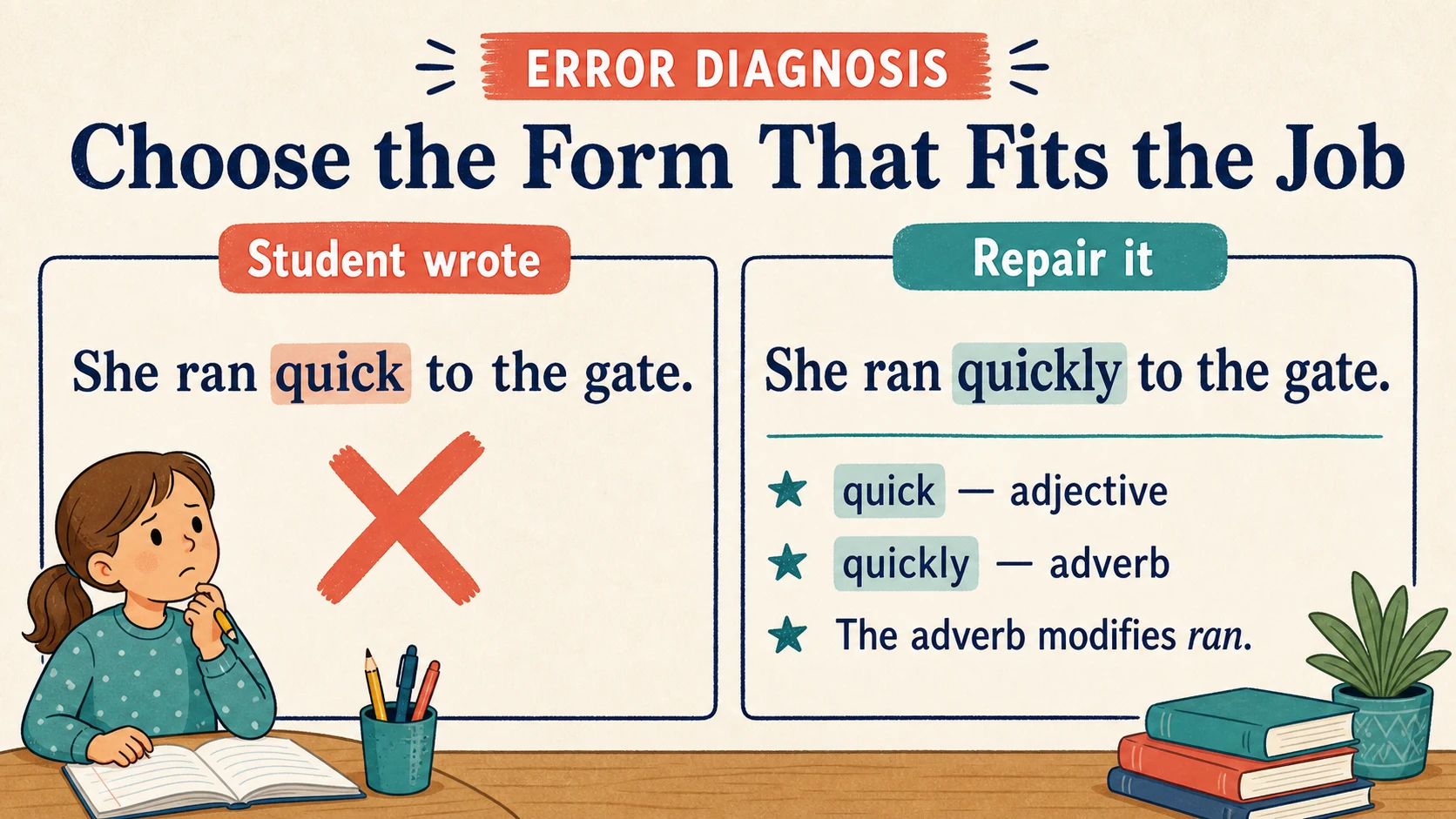
Diagnosis connects each repeated error to a focused teaching response.
| Observed error |
Likely reasoning to check |
Teaching response |
| Labels every person or animal word as the sentence’s noun but misses objects |
Noun means “person or animal” |
Sort people, places, things, and ideas; then find each in sentences |
| Finds only physical action verbs |
Verb means visible movement |
Contrast jumps with linking examples such as is and seems |
| Labels every describing word as an adjective |
“Describing” is treated as one category |
Draw an arrow to what the word describes: noun or verb |
| Labels every -ly word as an adverb |
Word ending replaces sentence evidence |
Compare quickly with friendly in complete sentences |
| Classifies a word from memory rather than context |
A word has one permanent category |
Compare paired uses such as paint the wall and wet paint |
| Cannot identify a pronoun’s antecedent |
Pronoun is recognized only as a substitute label |
Replace the pronoun with candidate nouns and check the meaning |
| Calls every short connecting word a preposition |
Categories are memorized as word lists |
Ask whether the word shows a relationship or joins words or ideas |
| Performs well orally but poorly on paper |
Reading or task directions may be interfering |
Read directions and sentences aloud, then reassess the grammar decision |
Two misconceptions deserve particular attention. First, a noun is not simply “a naming word” without context; a familiar word may perform another job. Second, an adjective does not describe any nearby word. It specifically describes a noun or pronoun.
Monitoring Progress Without Over-Testing
Monitor explanation, transfer, and retention—not just the percentage correct on one page.
Keep a simple record with four columns:
| Date |
Category contrast |
Independent result |
Next response |
| Monday |
noun or verb |
7 of 8, clear explanations |
Add adjectives |
| Thursday |
adjective or adverb |
4 of 8, guessed from endings |
Reteach with arrows |
| Next Monday |
adjective or adverb |
7 of 8 in new sentences |
Begin mixed review |
Look for these signs of growing control:
- The learner identifies the requested category in unfamiliar sentences.
- The learner explains the classification using meaning and relationships.
- The learner handles a familiar word used in a new role.
- The learner applies the category in an original sentence.
- The learner retains the distinction after a delay.
A single error may be a lapse. A repeated pattern across several examples suggests a teaching need. If performance drops when categories are mixed, return temporarily to a two-category contrast, then rebuild the mix.
Do not use grammar worksheets to make medical, developmental, or diagnostic conclusions. Persistent difficulties can be documented clearly and discussed with the learner’s classroom teacher or another appropriate educational professional.
A Two-Week Practice Plan
This plan assumes short practice sessions and can be adjusted. It is not a universal schedule. Repeat, shorten, or pause a stage according to the learner’s observed work.
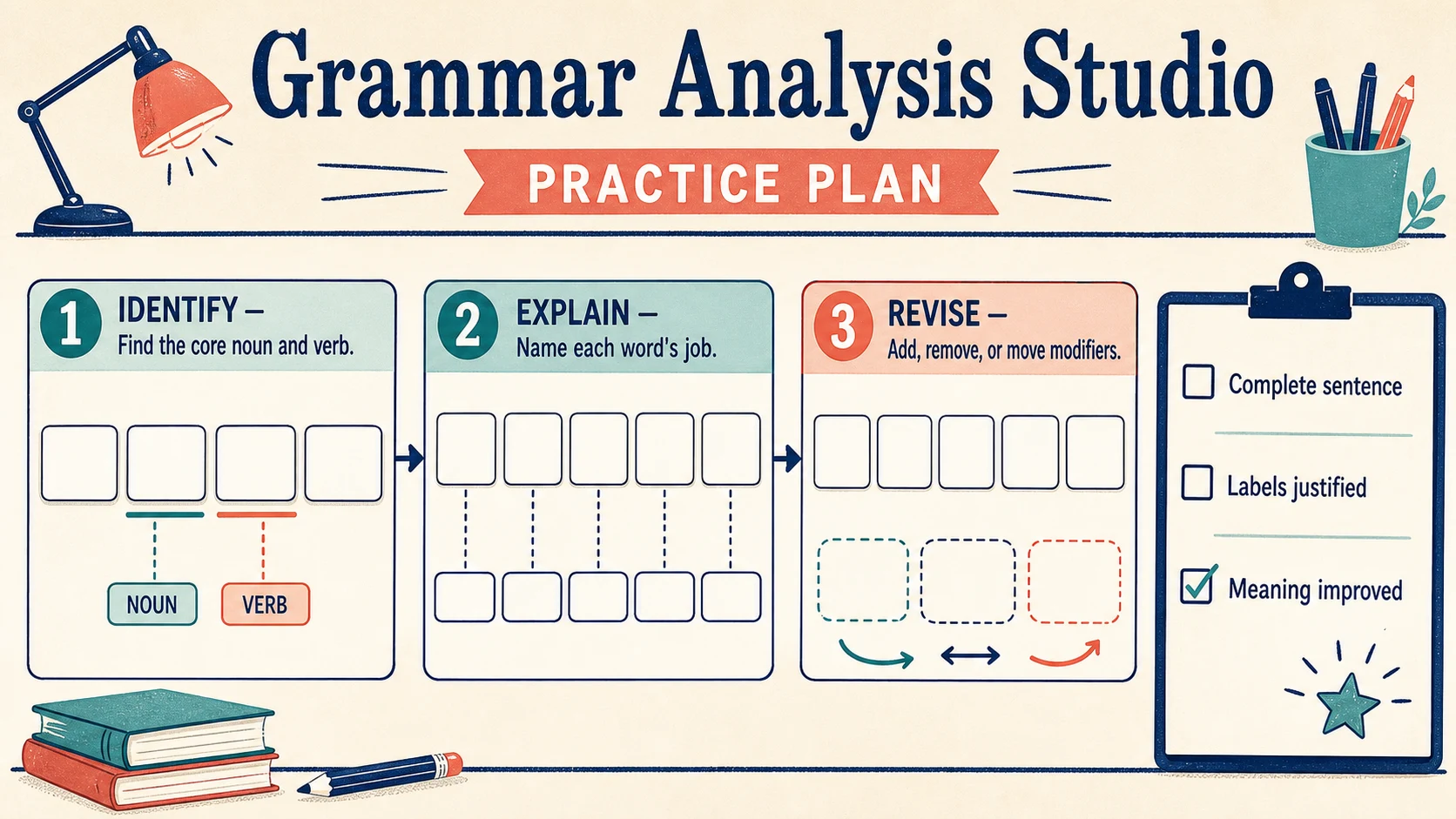
New learning alternates with retrieval, explanation, and sentence-level application.
| Day |
Focus |
Suggested activity |
Check |
| 1 |
Nouns and verbs |
Act out actions; identify nouns and verbs in six sentences |
Can the learner explain both jobs? |
| 2 |
Adjectives |
Describe familiar objects; mark adjective-to-noun arrows |
Does each adjective point to a noun? |
| 3 |
Three-category review |
Complete a short noun, verb, and adjective set |
Which contrast causes errors? |
| 4 |
Sentence revision |
Replace vague nouns or verbs and add useful adjectives |
Do changes preserve the intended meaning? |
| 5 |
Delayed check |
Classify selected words in new sentences |
Is the skill retained without prompts? |
| 6 |
Pronouns |
Link pronouns to antecedents with arrows |
Is each reference clear? |
| 7 |
Adverbs |
Compare adjective and adverb pairs in context |
Can the learner say what each word describes? |
| 8 |
Prepositions and conjunctions |
Model locations, then join words and ideas |
Relationship or connection? |
| 9 |
Boundary cases |
Compare run, light, or paint in two sentence roles |
Does context drive the answer? |
| 10 |
Mixed application |
Analyze a short passage and write two revised sentences |
Can the learner identify, explain, and use the categories? |
If Day 3 reveals continuing noun–verb confusion, do not add pronouns merely to keep pace with the table. Repeat Days 1–3 with new examples. If the learner is secure, combine Days 6–8 and spend more time on mixed writing application.
Limitations and the Next Instructional Step
A parts-of-speech label does not by itself teach a learner to write a clear paragraph, comprehend a difficult passage, or edit every grammar error. Classification is most useful when it supports sentence meaning, revision, and discussion of how language works.
The catalogue topic extends across all eight parts of speech, but the current easy worksheet is deliberately narrower: it practices nouns, verbs, adjectives, and sentence analysis. It should not be presented as a complete assessment of grammar knowledge or comprehensive proof of standards alignment.
The honest next step is to begin with the free 3rd Grade Parts of Speech worksheet. Review not only which answers are wrong, but why. If the learner can classify nouns, verbs, and adjectives accurately in new sentences and explain the evidence, continue to the broader Parts of Speech topic guide or create targeted follow-up material with the free worksheet generators.