Curated collectionAnswer keys includedPrint-ready PDFs
Independent Practice Grammar Worksheets
Make directions, examples, response space and answer-key timing support honest independence after a skill has been taught.
Start with a real resource
Browse this worksheet collection
19 relevant free entry points are available. Each one includes a printable learner PDF and separate answer key.
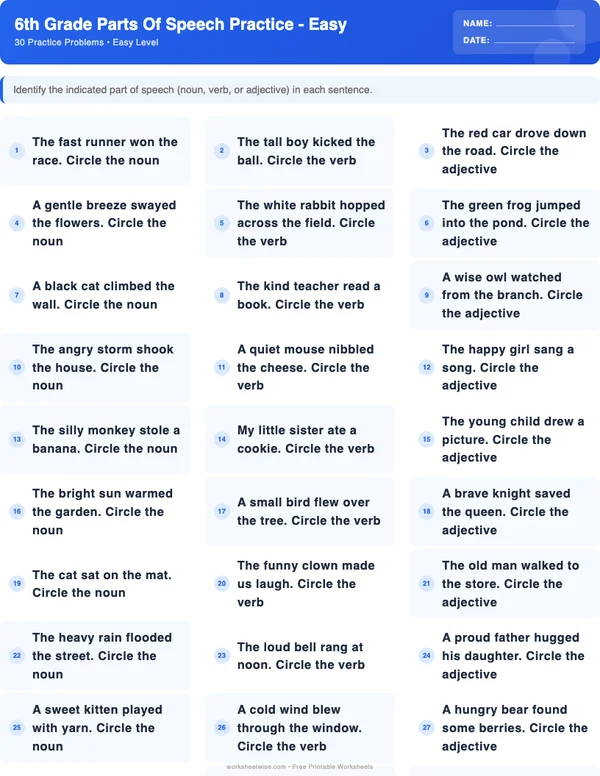
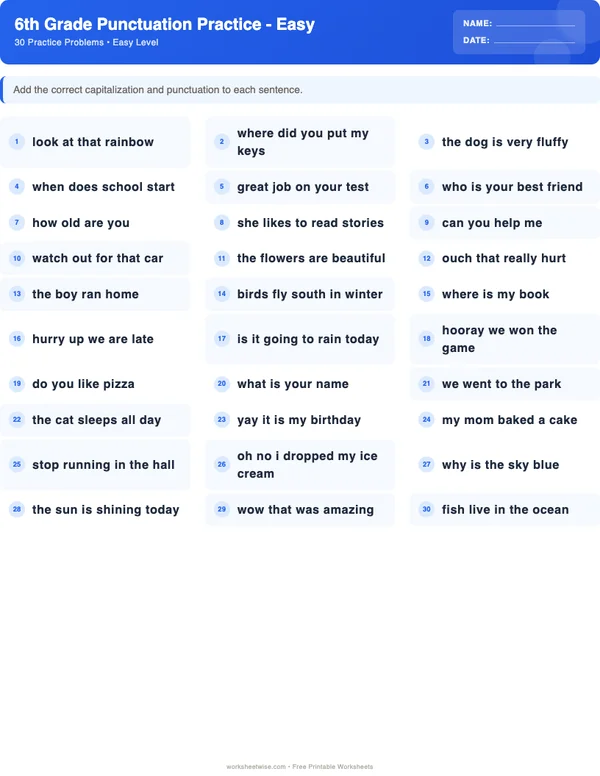
A useful practice loop
Print less. Observe more.
- Choose one skill and model the first item aloud.
- Use a short set and notice the learner’s strategy.
- Change the next task from the work you can see.
Need more than the free sheet?
Plus includes all 342 matching catalogue variations where available, plus saved deterministic generators and the worksheet designer.
See Plus membershipComplete guide
How to teach and practise independent-practice grammar worksheets
3,324 words Updated 6 instructional visuals
Build independence after the grammar skill has been taught
Independent grammar practice should answer a narrow question: can the learner apply a previously modeled grammar decision without hints from an adult, an example that gives away the answer, or premature access to the key?
Choose a worksheet only after teaching the target. Before handing it over, check four things:
- Directions: Can the learner explain what to do after reading them once?
- Example: Does it demonstrate the decision process without duplicating the first item?
- Response format: Does the learner have enough space to mark, rewrite, combine, or compose the required answer?
- Answer-key timing: Can the learner finish a meaningful group of items before checking?
The live WorksheetWise grammar catalogue contains 342 variants across seven grade labels and three topics: parts of speech, punctuation, and sentence structure. Nineteen resources are free entry points. Those counts describe available choices, not a recommended sequence. Grade labels describe intended practice levels, and local curriculum sequences differ. Age and grade are discovery aids rather than placement decisions; the learner’s demonstrated command of the taught skill should decide where practice begins.
The central rule is simple: do not use independent work to introduce an unfamiliar grammar convention. Model the decision, complete a few supported examples, remove the prompts, and then observe what the learner can do alone.
Select the sheet by the grammar decision it requires
The topic name is only the first filter. “Punctuation” could mean selecting an end mark, inserting commas in a list, punctuating dialogue, or editing a paragraph. These are not interchangeable tasks. Match the sheet to the exact decision modeled in the lesson.
Parts of speech: require decisions in sentences
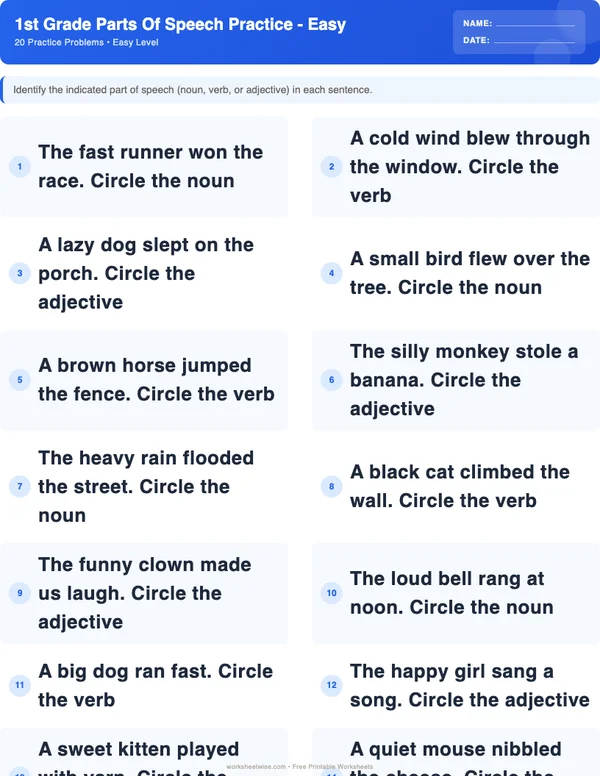
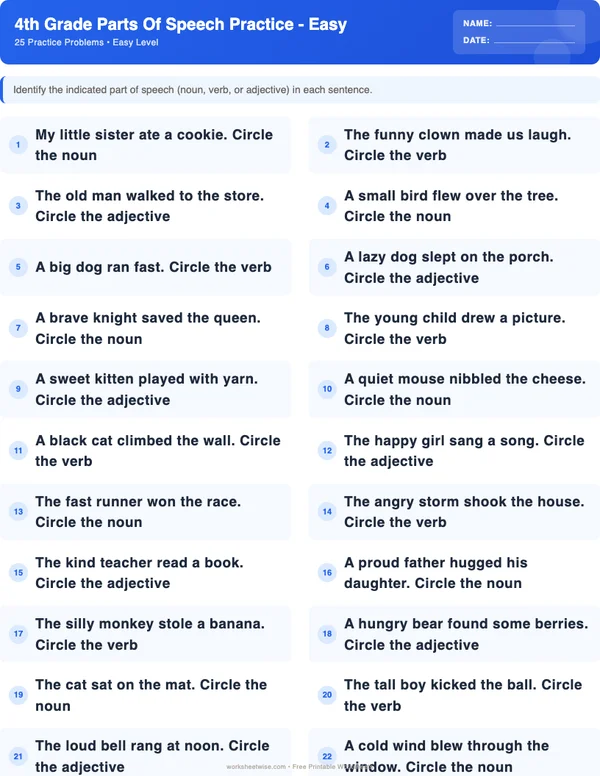
The representative catalogue resources progress from identifying nouns and verbs in simple sentences toward classifying more parts of speech in complex passages. For independent practice, begin with the smallest contrast that the learner has already studied.
Consider this checked example:
The rabbits hop.
If the task is to underline the noun once and the verb twice, rabbits is the noun and hop is the verb. This example belongs in early independent parts-of-speech practice because both words have clear roles in a complete sentence. It tests the noun–verb distinction without adding an adjective, helping verb, or word with multiple possible functions.
Now compare:
We went for a run.
Here, run is a noun because it names the outing after the article a. In “We run home,” run is a verb because it states what we do. This pair belongs after the learner can identify obvious nouns and verbs. It checks whether the learner uses sentence context rather than assuming that every familiar action word is always a verb.
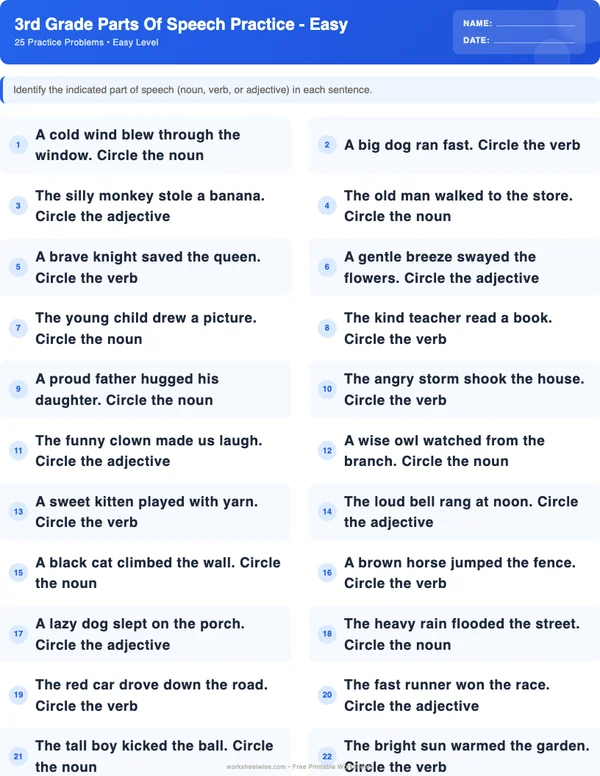
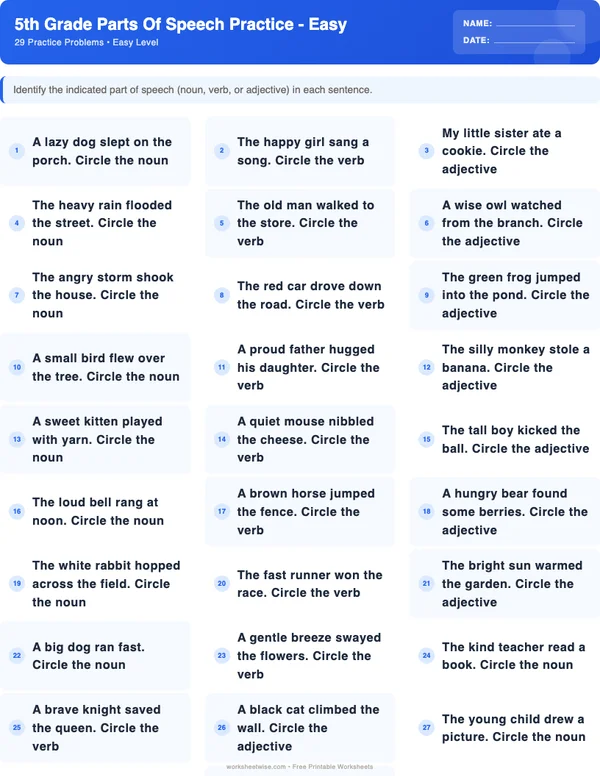
A suitable first-grade resource may ask for 12 responses, while the representative third- and fourth-grade resources contain 14. The fifth-grade representative parts-of-speech sheet contains 29 problems. More items do not automatically make a sheet better or harder. Ask whether the number of decisions is reasonable after accounting for sentence length, the number of categories, and the writing required.
The catalogue guidance suggests movement and object demonstrations when nouns, verbs, or prepositions are still being learned. That is sourced catalogue guidance, not a claim about a particular learner. An adult might act out jump, hold up a cup, or move the cup under a chair before assigning written classification.
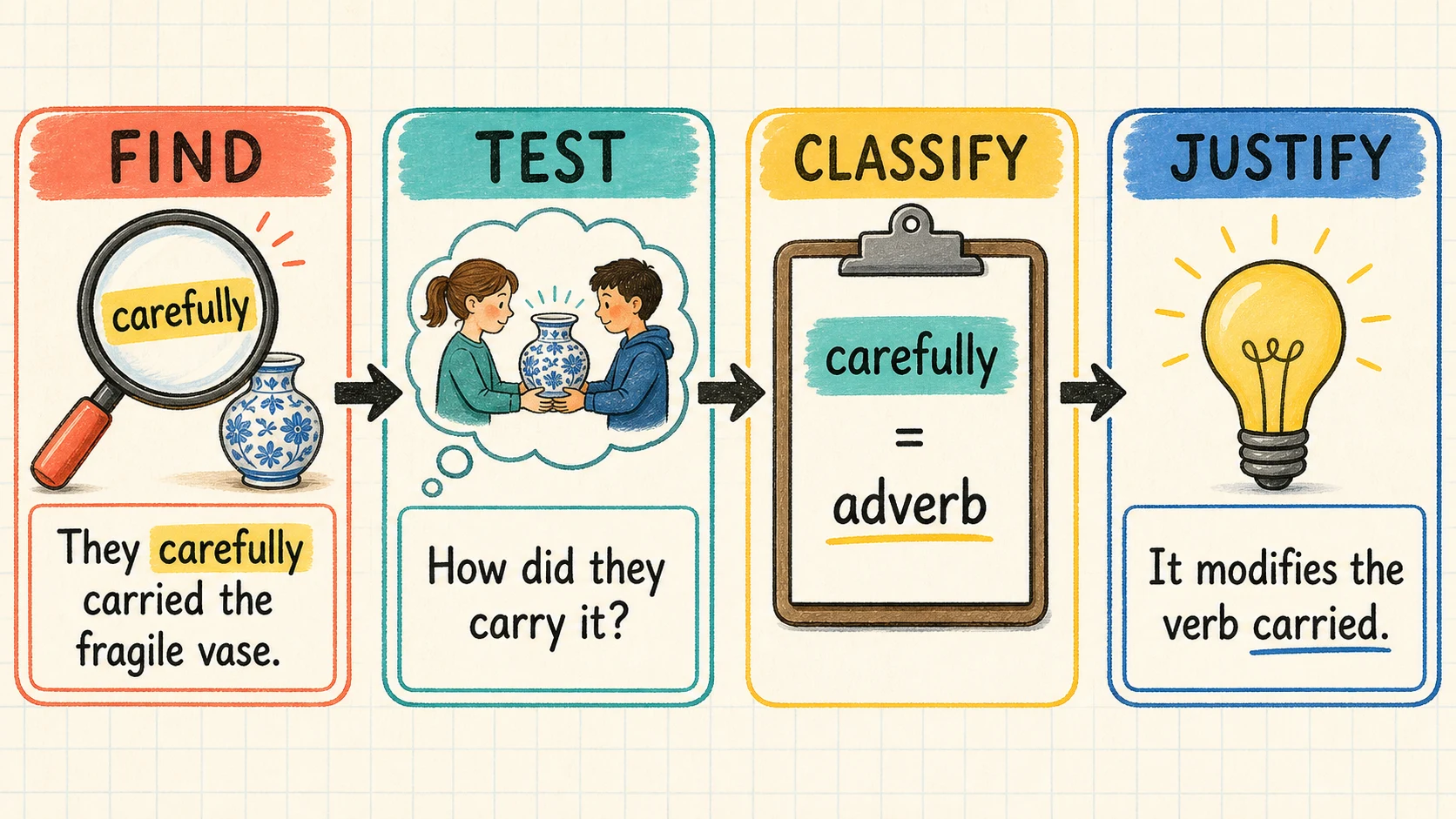
Use this progression to decide which supports can be removed before an upper-elementary learner classifies words independently.
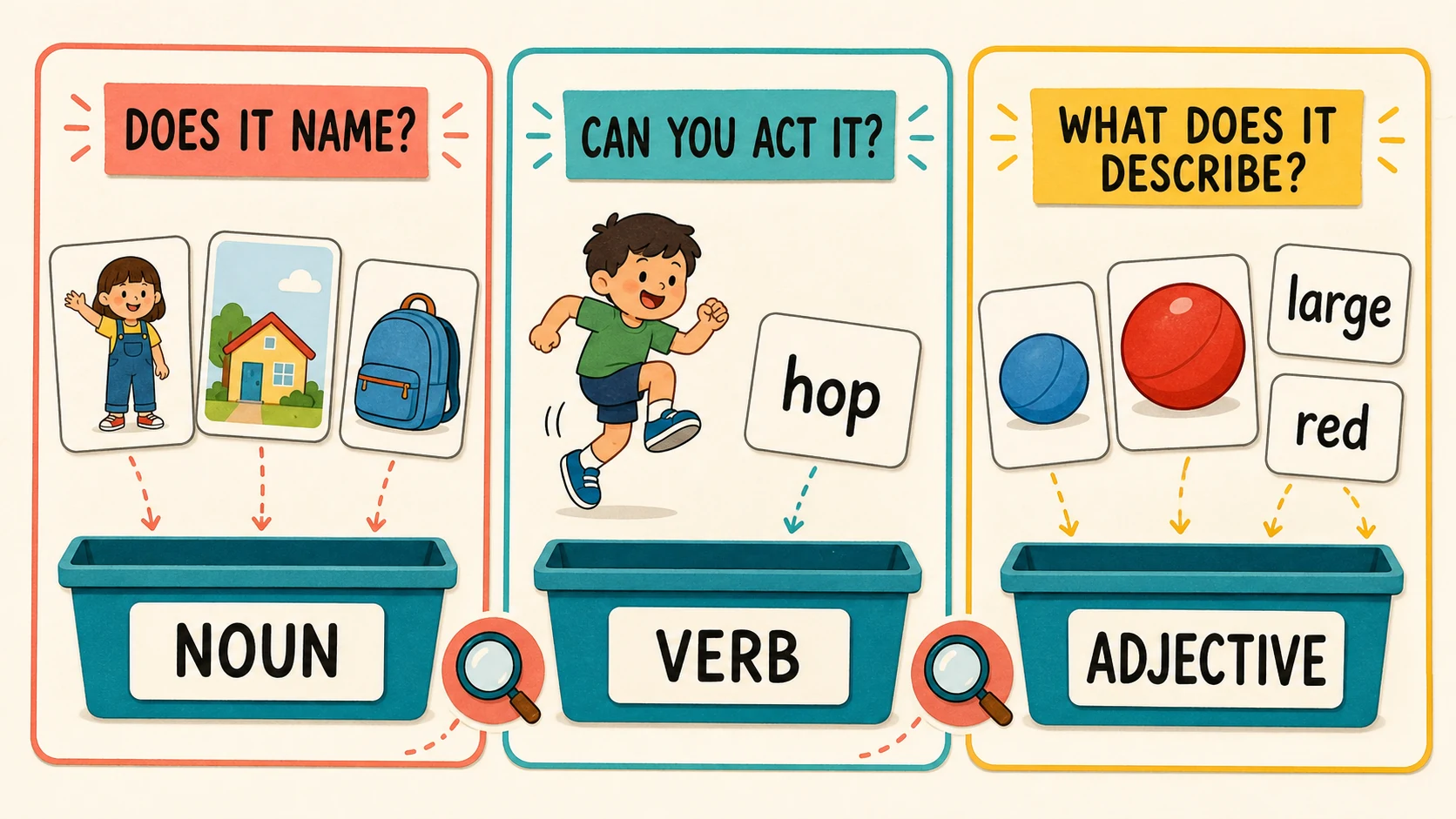
Treat a first-grade error pattern as information about the next model or response format, not as a label for the learner.
Punctuation: isolate one convention before mixing them
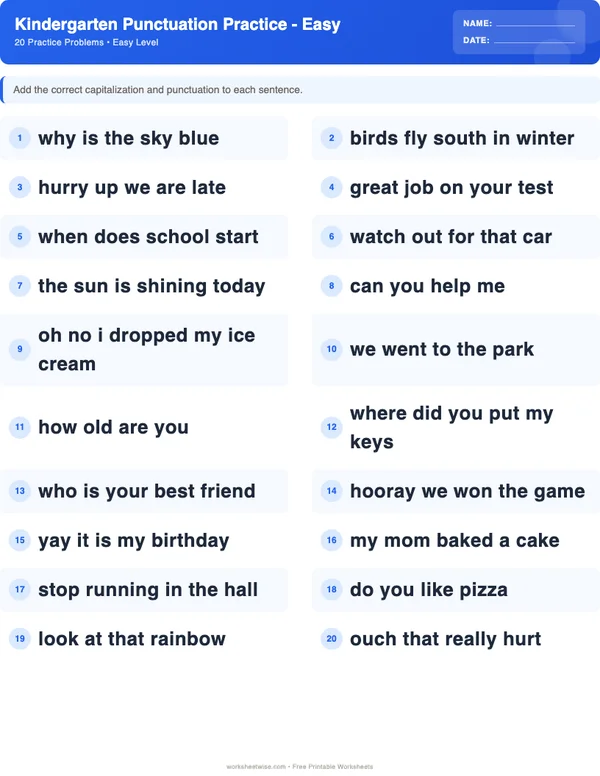
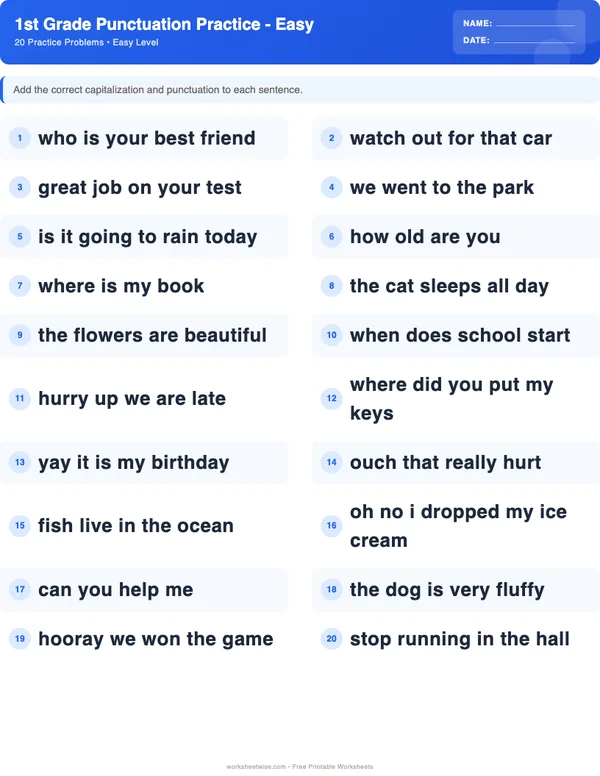
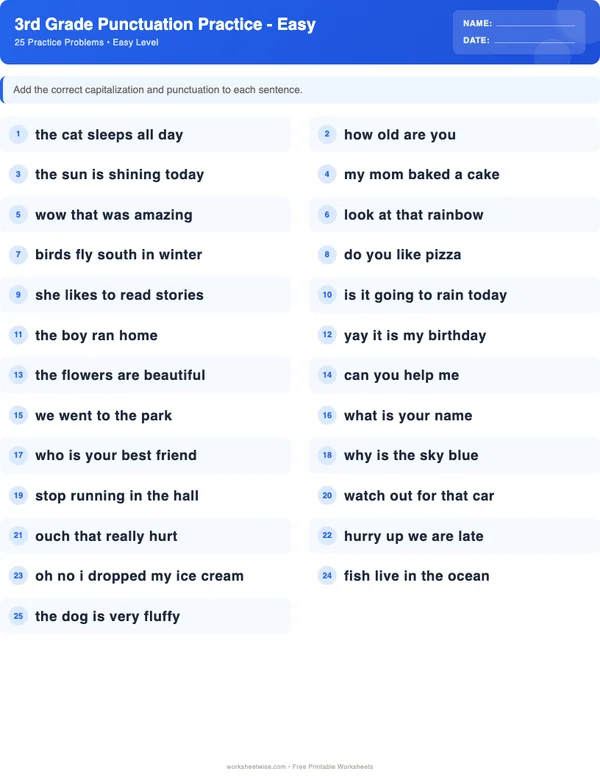
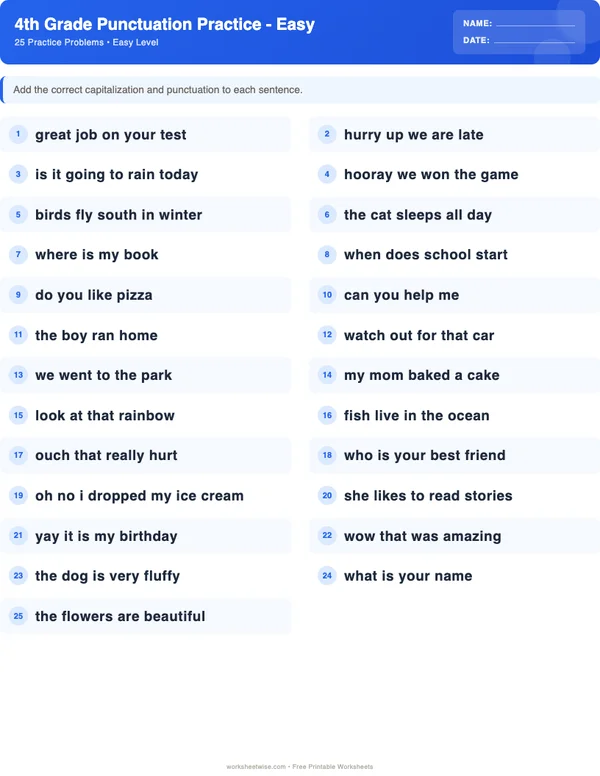
The representative kindergarten, first-grade, and second-grade punctuation sheets each contain 12 problems; the third- and fourth-grade representatives contain 14. Early practice should make the intended punctuation decision visible.
Checked example:
Where is my blue hat?
The question mark is correct because the sentence asks a direct question. This belongs in early end-punctuation practice because the sentence form supplies evidence for the mark. The learner is not expected to infer dialogue rules, comma placement, or an unusual rhetorical effect.
Compare it with:
Look at that enormous kite!
The exclamation point marks strong feeling or emphasis. A learner who puts an exclamation point after every sentence containing an exciting object may be choosing by topic rather than by sentence purpose or intended voice. The next sheet should therefore contrast statements, direct questions, and genuine exclamations—not simply provide more exclamation-point items.
Read-aloud modeling can make the distinction concrete: a statement typically closes with a steady voice, a direct question may rise, and an exclamation is emphatic. This is catalogue guidance. It is useful as an instructional bridge, but intonation is not a complete punctuation rule in every context. The independent item should still be interpreted as a written sentence.
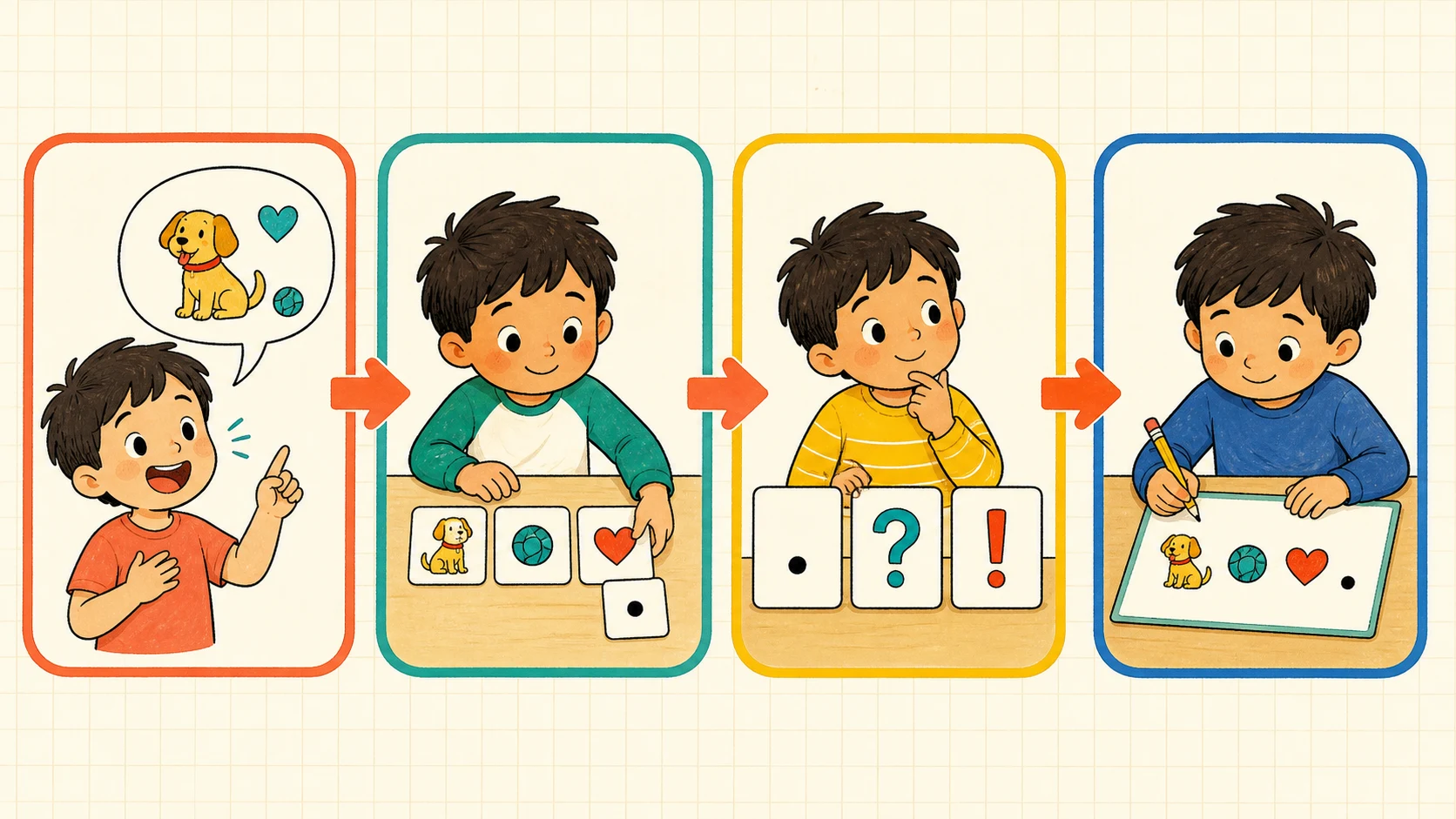
Move from hearing and choosing an end mark to editing written sentences only after the learner can explain the difference among the marks.
Sentence structure: make the response show the reasoning
A circle-the-answer format can reveal whether a learner recognizes a complete sentence. It cannot show whether the learner can repair a fragment or combine ideas. Select the response format that matches the taught action.
Checked example:
Under the old bridge.
This is a fragment in isolation. It tells where, but it does not state who or what is under the bridge or what happens there. A valid repair is:
The fox slept under the old bridge.
The revision supplies a subject, the fox, and a predicate, slept under the old bridge. This example belongs in sentence-structure practice because the repair exposes the missing element. Merely adding a capital letter and period—“Under the old bridge.”—would not make the thought complete in this context.
For an early model, the adult can ask, “Who or what?” and “Did what?” Those prompts should disappear during independent practice if answering without them is the goal.
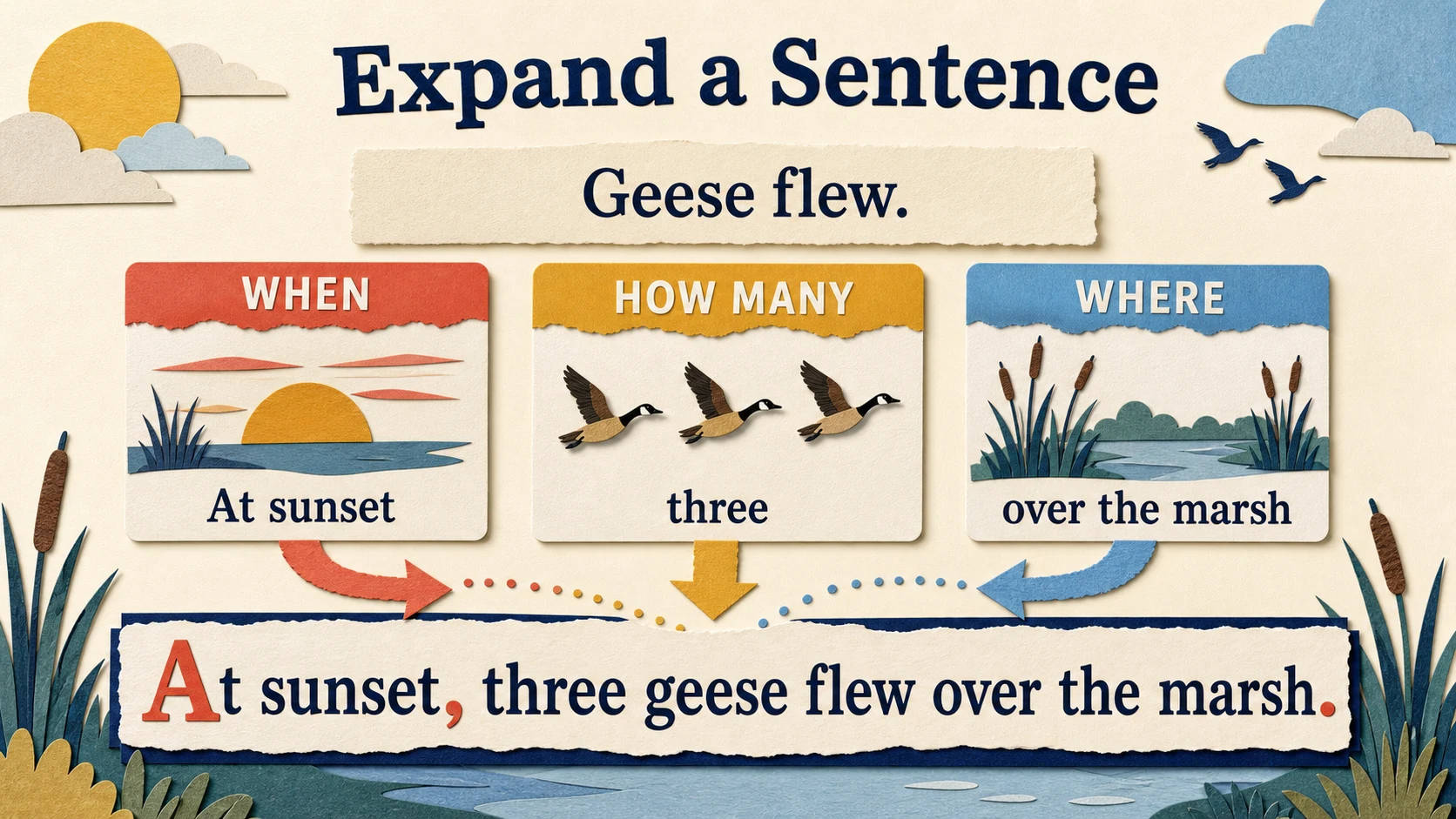
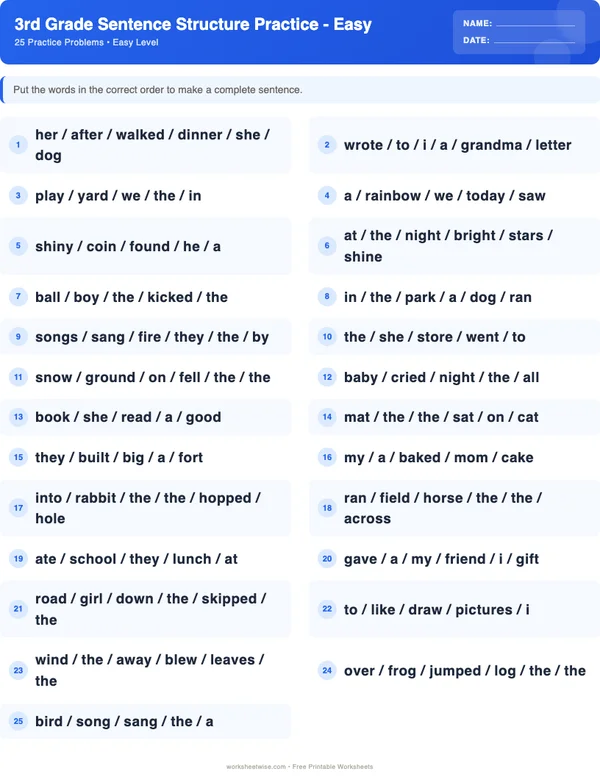
Use the third-grade routine to separate explicit modeling, a brief supported attempt, and the items the learner completes without prompts.
Define worksheet difficulty through observable features
The representative free resources are catalogued as “easy,” but that label should not be applied to a learner. Define the task instead. An easier-to-enter grammar sheet may have:
- one familiar rule throughout;
- short sentences with common vocabulary;
- two clearly different answer choices;
- one mark or word to identify per item;
- a completed example using the same response action;
- generous spacing and no copying requirement.
A more demanding sheet may ask the learner to:
- distinguish several grammar categories;
- use context to classify a flexible word such as light or run;
- edit sentences containing more than one possible error;
- explain a correction;
- rewrite a whole sentence;
- combine ideas while preserving meaning;
- apply a convention in original writing.
This feature-based description makes selection defensible. A 12-item rewriting sheet may demand more sustained language production than a 14-item recognition sheet. A 29-item sheet may be manageable when each response is a quick underline, but burdensome when every item requires copying a sentence.
Before assigning a whole page, ask the learner to complete two unseen sample items. Do not coach during this check. If directions, vocabulary, or the marking system cause difficulty, adjust those access features before deciding whether the underlying grammar skill is secure.
Use a model–rehearse–release routine
Independent practice works best as one stage in a short teaching cycle, not as a stand-alone packet.
Model one decision aloud
Display one item that is not on the independent sheet. Name the evidence, make the choice, and verify it.
For a sentence-combining lesson:
The dog is brown. The dog is playful.
A checked combination is:
The dog is brown and playful.
The combined sentence retains both original ideas, avoids repeating the dog, and uses and to join the two predicate adjectives. “The brown and playful” is not a complete sentence because it lacks a noun for the adjectives to describe. “The dog is brown, playful” is not the clearest expected solution for this introductory task.
This example belongs after learners understand complete simple sentences. It asks them to preserve meaning while changing structure, not merely locate a label. The IES writing practice guide recommends explicit instruction in the writing process and teaching students to become fluent with foundational writing skills. It also discusses sentence construction within broader writing instruction. That guidance supports deliberate modeling and practice; it does not constitute an evaluation of WorksheetWise.
Rehearse with diminishing prompts
Complete one item together. On a second item, ask only for the evidence: “What tells you that this is a question?” or “Where does the second complete thought begin?” On a third, let the learner respond and explain afterward.
If the adult still has to point to the subject, read every sentence aloud, or restate each direction, the work remains supported practice. That may be exactly what is needed, but it should not be counted as evidence of independence.
Release a short set
Assign three to five items first. The adult steps away or attends silently. The learner may reread the printed directions and inspect the worked example, but should not receive correctness cues.
A sixth-grade sentence-structure routine can use the same architecture with more complex material: model how to locate clause boundaries, rehearse one correction, and then release a short set of fragments, run-ons, or sentence-combining items.
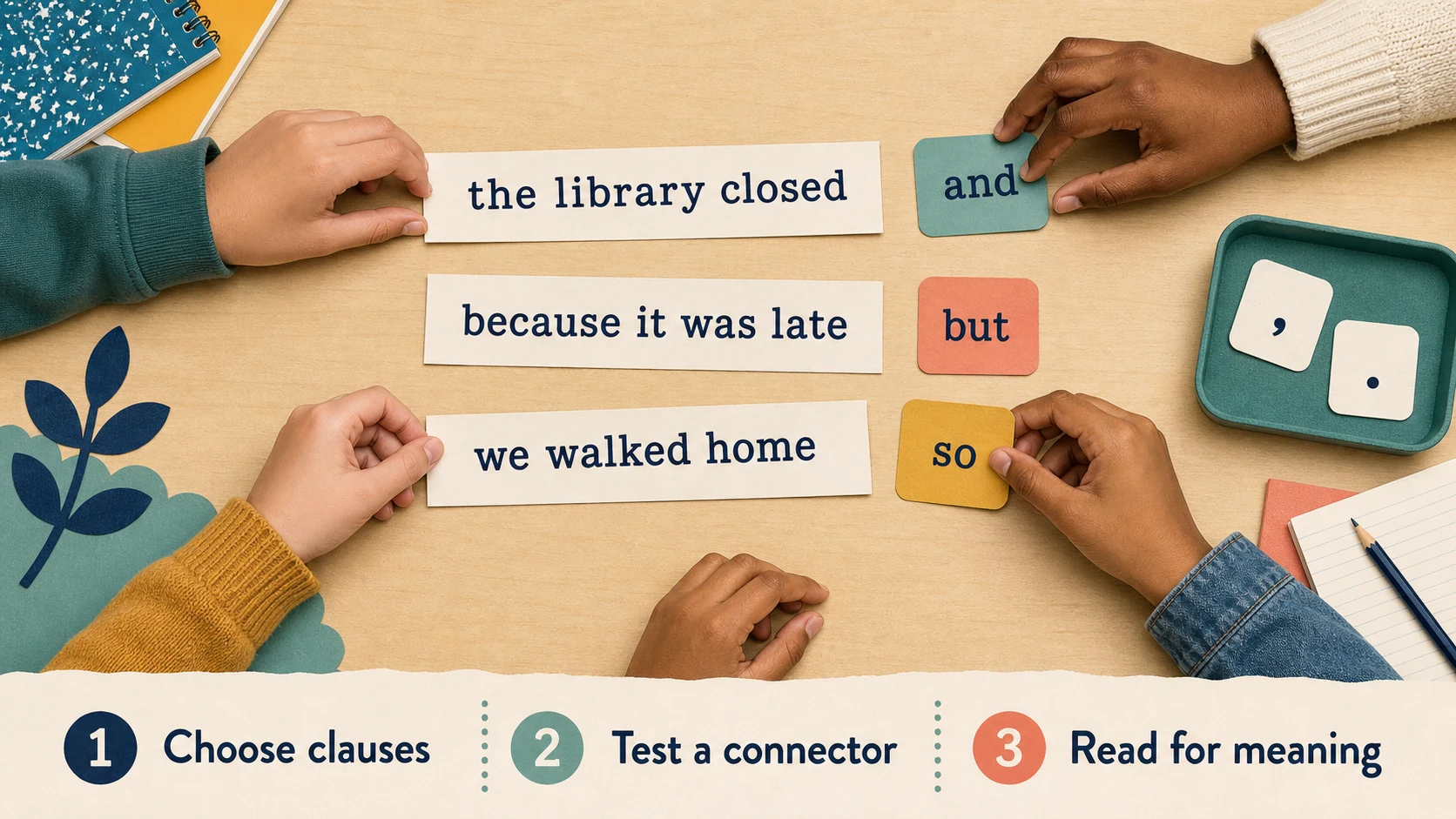
The upper-elementary routine keeps the release process brief while raising the complexity of the sentence decision.
Check for transfer
Finish with one item in a different format. After selecting end marks, ask the learner to write one statement and one direct question. After identifying adjectives, ask for a revision of “The bird sang” that adds a precise adjective without changing the verb. Transfer items should remain tightly connected to the taught skill; they are not a surprise test of spelling, handwriting, or topic knowledge.
Make directions and response space protect honest work
Directions should specify the target, action, and output. “Fix the sentences” is too broad when the intended target is end punctuation. “Add a period, question mark, or exclamation point to each sentence” limits the decision appropriately.
Ask the learner to paraphrase the direction before starting. A correct paraphrase is stronger evidence of access than a nod. If the learner cannot explain the task, rewrite or orally clarify the direction once, then use a fresh item to see whether the grammar work can proceed independently.
Response space should fit the required action:
- Use a small box for one punctuation mark.
- Leave room beneath a fragment if a complete rewrite is required.
- Give separate columns for noun and verb sorting.
- Provide editing symbols only if they were previously taught.
- Avoid demanding a full copied sentence when inserting one mark would assess the same convention.
Suppose the target is choosing punctuation for “Can we visit the pond.” Requiring the learner to recopy the entire sentence adds handwriting and copying demands. If those are not part of the objective, a box around the final mark or a one-character replacement better preserves the grammar target.
The IES foundational reading guide focuses on foundational skills that support reading for understanding, including explicit, systematic teaching and connected text work. It should not be cited as proof that a particular grammar worksheet causes reading gains. Its relevance here is narrower: directions and examples should not introduce avoidable decoding obstacles that hide the grammar decision.
Delay the answer key until a useful attempt exists
An answer key can support self-correction, but its timing matters. If it remains visible beside every item, the activity may measure copying or answer matching rather than independent application.
For a 12-item sheet, try three groups of four:
- Complete four items without the key.
- Check those four using a different-colored pencil.
- Mark each response as correct, corrected, or still uncertain.
- Explain one correction before beginning the next group.
This is a suggested routine, not sourced research. It keeps the delay short enough for useful feedback while preserving an unassisted sample. For a 14-item sheet, use groups such as 5–5–4. For a 29-item sheet, do not assume the learner should finish all items in one sitting; divide it according to response effort and attention.
Do not equate self-marking with comprehension. If a learner changes “.” to “?” after seeing the key but cannot explain that the sentence asks a direct question, the corrected page does not yet show command of the rule. Return to a brief contrast and then use an unseen item.

Space first-grade punctuation checks across short attempts so that corrections inform the next practice rather than ending the conversation.
Read errors by pattern, not by total score
The total correct can tell you whether to inspect the work. The pattern tells you what to do next.
Parts-of-speech errors
If the learner marks every action-associated word as a verb, compare the same word in different sentence roles:
I paint pictures.
The paint is wet.
In the first sentence, paint is a verb. In the second, it is a noun. The next sheet should use paired contextual examples and require the learner to identify the word’s job in each sentence.
If nouns and adjectives are confused, check whether the learner is identifying the thing or the word describing it:
The noisy geese crossed the road.
Geese is the noun; noisy describes the geese and is an adjective. Choose the next practice with one adjective directly before a concrete noun before introducing multiple modifiers.
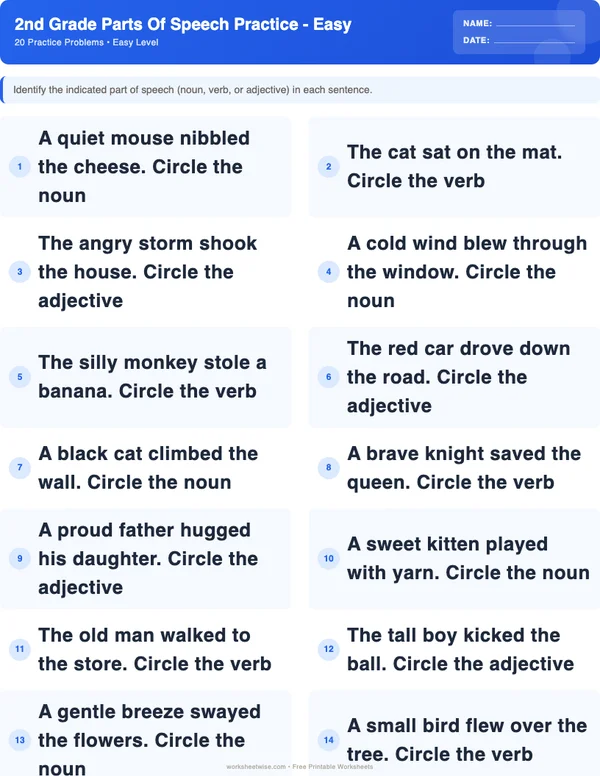
The 1st Grade Parts of Speech guide and free sheet offers an appropriate catalogue entry point for noun-and-verb work. The 2nd Grade Parts of Speech guide and free sheet is another discovery option, but the grade label alone should not decide placement.
Punctuation errors
If question marks are accurate but periods and exclamation points are confused, do not reteach all punctuation. Model the difference between a neutral statement and emphatic expression, then assign a mixed set containing both.
If every comma is placed where the learner pauses while reading, return to the specific comma rule that was taught. For a list:
We packed apples, crackers, and water.
The commas separate three items: apples, crackers, and water. “We packed, apples crackers and water” is not correct merely because a speaker might pause after packed. The next sheet should focus on commas in lists rather than mixing lists, dates, dialogue, and compound sentences.
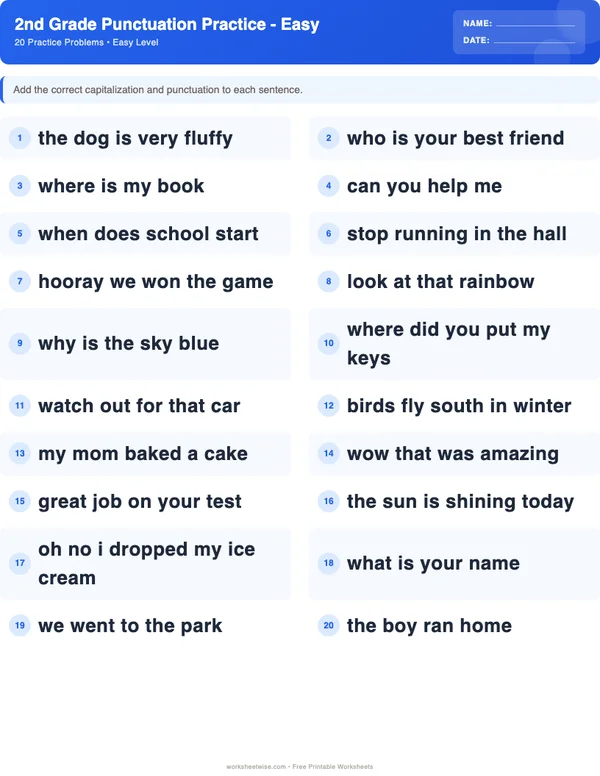
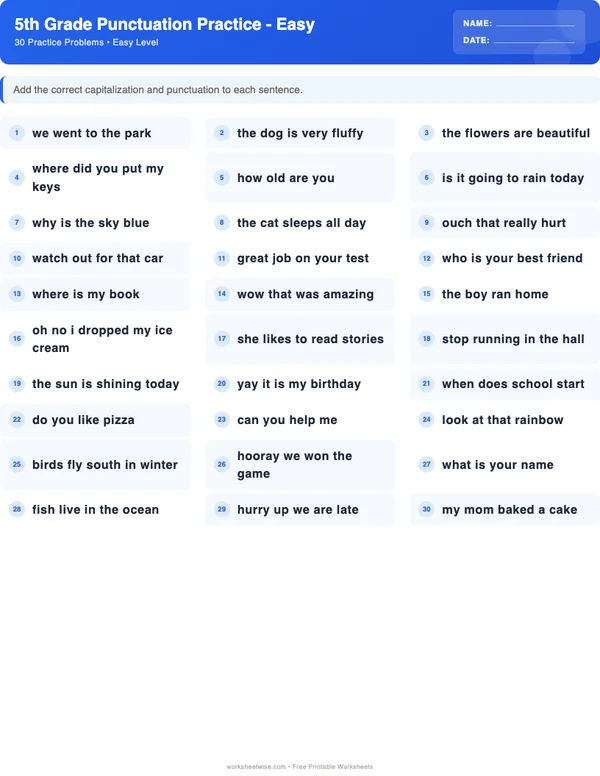
The 1st Grade Punctuation guide and free sheet provides a 12-problem free entry point. The 2nd Grade Punctuation guide and free sheet is useful when its sentence and response features match what has already been taught.
Sentence-structure errors
If fragments are accepted as complete sentences, ask the learner to identify the subject and predicate in each answer. Choose the next sheet with short, obvious contrasts:
- The puppy barked. Complete: subject the puppy, predicate barked.
- After the loud noise. Fragment: it does not state what happened after the noise.
- The children in the garden. Fragment in isolation: it names the children but does not say what they did or were.
If the learner recognizes fragments but cannot repair them, the next sheet should require adding only the missing subject or predicate before moving to unrestricted rewriting.
If two complete thoughts are joined only with a comma—“The rain stopped, we went outside”—model the boundary. Two possible corrections are “The rain stopped. We went outside.” and “The rain stopped, so we went outside.” The next practice should contrast a period with a comma plus an appropriate coordinating conjunction.
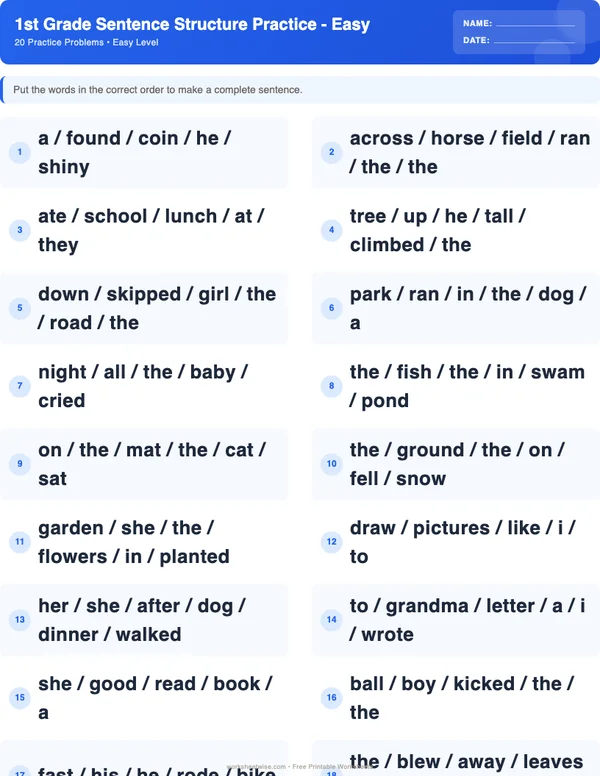
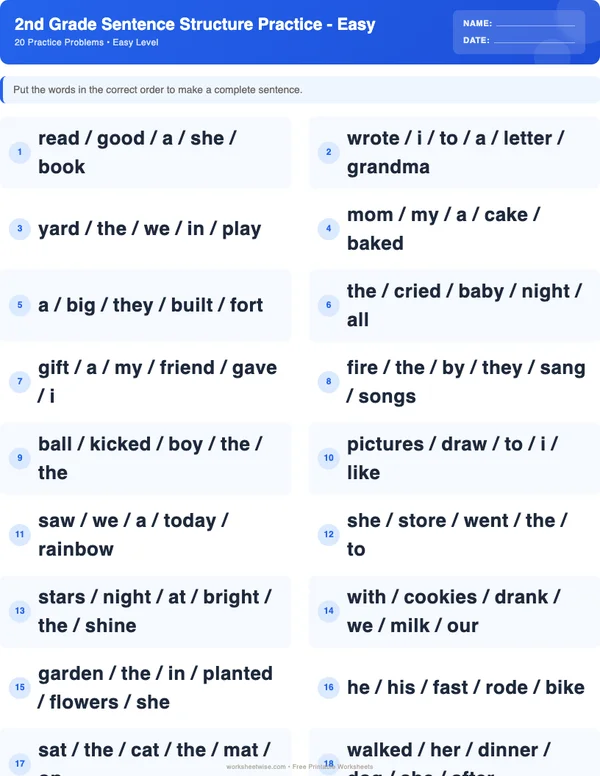
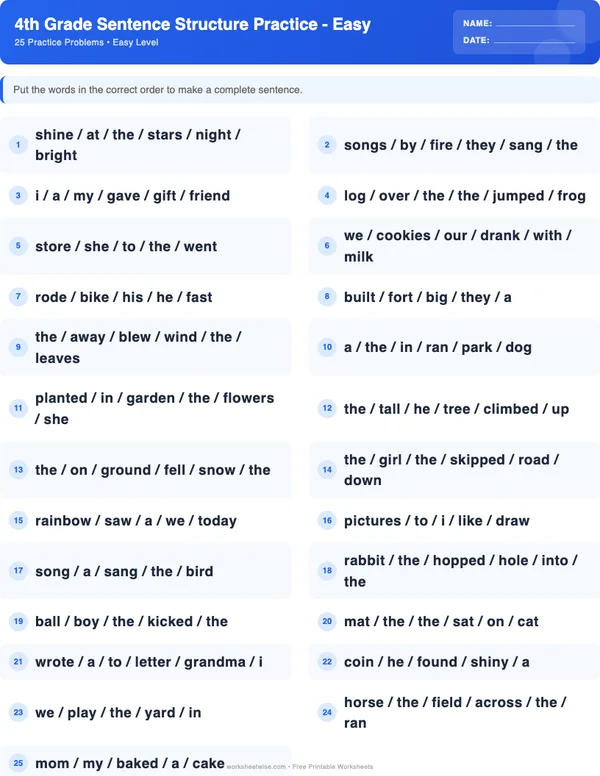
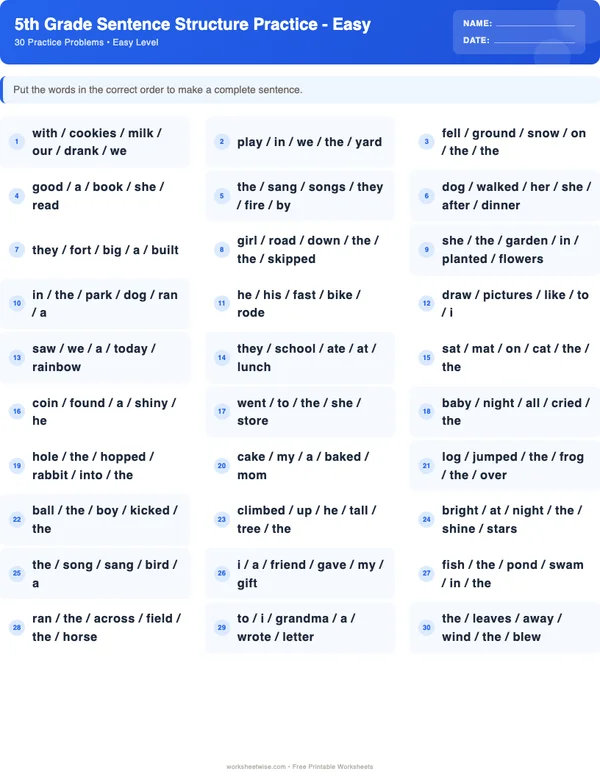
The 1st Grade Sentence Structure guide and free sheet is a relevant starting resource when complete-sentence recognition has been taught.
Adapt access without changing the grammar target
An adaptation preserves the intended decision. A substitution changes what is being assessed. Use that distinction when the page is visually crowded, handwriting is effortful, or directions contain unfamiliar vocabulary.
Reasonable access adaptations include:
- covering all but one row with a blank sheet;
- enlarging the page;
- reading directions aloud once;
- letting the learner point to an answer instead of copying it;
- supplying punctuation tiles to place in boxes;
- allowing oral sentence generation while an adult records the exact words;
- reducing the number of items while keeping the same item types;
- adding more writing space without adding prompts.
If the target is choosing among a period, question mark, and exclamation point, offering those three movable marks preserves the decision. Telling the learner, “Your voice went up, so use a question mark,” supplies the answer cue and changes the evidence.
For ages three and four, prioritize brief adult-led oral, matching, manipulative, and movement work over desk work. A child might match a question-mark card to an adult’s spoken question or act out verbs such as hop and wave. Do not infer readiness for a printed grammar sequence from age alone.
The Common Core English Language Arts standards include grade-specific language conventions, but they are not a universal pacing schedule and do not show that any WorksheetWise page is aligned. Consult the learner’s local curriculum when formal alignment matters.
Keep independent worksheets within their limits
A completed worksheet is a sample of performance under particular conditions. It does not diagnose a learning condition, prove long-term mastery, or show that the learner can apply the convention in original writing.
Independent grammar sheets are most useful when:
- the skill has been explicitly taught;
- the directions and response format are familiar;
- the vocabulary does not obscure the grammar;
- the answer key is delayed;
- errors are inspected by type;
- a later item checks the same decision in a new sentence.
They are less informative when several unfamiliar conventions appear at once, an adult supplies repeated hints, the learner copies from an example, or correct answers can be guessed from a visible pattern.
Original writing adds further variables: idea generation, organization, spelling, handwriting, and working memory. A learner may correctly add question marks on a focused page yet omit them while drafting a story. That difference calls for supported transfer and editing practice, not a diagnosis or an assumption that the focused practice was worthless.
Similarly, a learner may write expressive sentences but perform poorly on unfamiliar grammatical labels. Decide whether the immediate goal is to name a category, edit a sentence, or use the convention. Those goals can support one another, but one response format does not measure them all.
Turn today’s evidence into tomorrow’s sheet
After practice, record one observable statement rather than a broad judgment:
- “Chose question marks correctly in four direct questions but used exclamation points for three neutral statements.”
- “Identified concrete nouns but labeled run as a verb in both sentence contexts.”
- “Recognized two fragments but repaired them by adding punctuation instead of a missing subject or predicate.”
- “Combined repeated subjects successfully with and, but changed the original meaning in two items.”
Then choose the next action:
- Accurate and explainable: use a mixed or transfer format.
- Accurate but not explainable: discuss one contrast and try two unseen items.
- One repeated misconception: select a narrower sheet targeting that contrast.
- Errors caused by directions or layout: preserve the skill and change the access features.
- Errors spread across untaught conventions: stop independent practice and teach one convention explicitly.
For the next session, open the free deterministic worksheet generators and create a short set that isolates the single error pattern you observed—for example, direct questions versus statements, nouns versus verbs in context, or complete sentences versus fragments. Model one fresh item, release three to five without prompts, delay the key, and let those responses determine the following sheet.
Put it into practice
Use the guide with a real printable
Move from explanation to a short, observable practice task. Check the first item together, then adjust the next session from the learner's actual work.
Open the first free worksheetExplore a neighboring collection