What 4th Grade Sentence Structure Includes
4th Grade Sentence Structure instruction should help a learner recognize, build, expand, combine, and revise complete sentences. Begin with a secure understanding of subjects and predicates. Then address fragments and run-ons, expand sentences with meaningful details, combine related ideas, and introduce simple, compound, and complex structures. Sentence variety comes after completeness and clarity.
The central test is straightforward:
- Who or what is the sentence about?
- What does that person, place, thing, or idea do or have? What is it like?
- Does the wording express a complete thought?
For example, The curious fox waited beside the fence contains a subject, the curious fox, and a predicate, waited beside the fence. It communicates a complete thought. By contrast, Beside the fence gives a location but leaves the reader waiting to learn what happened there.
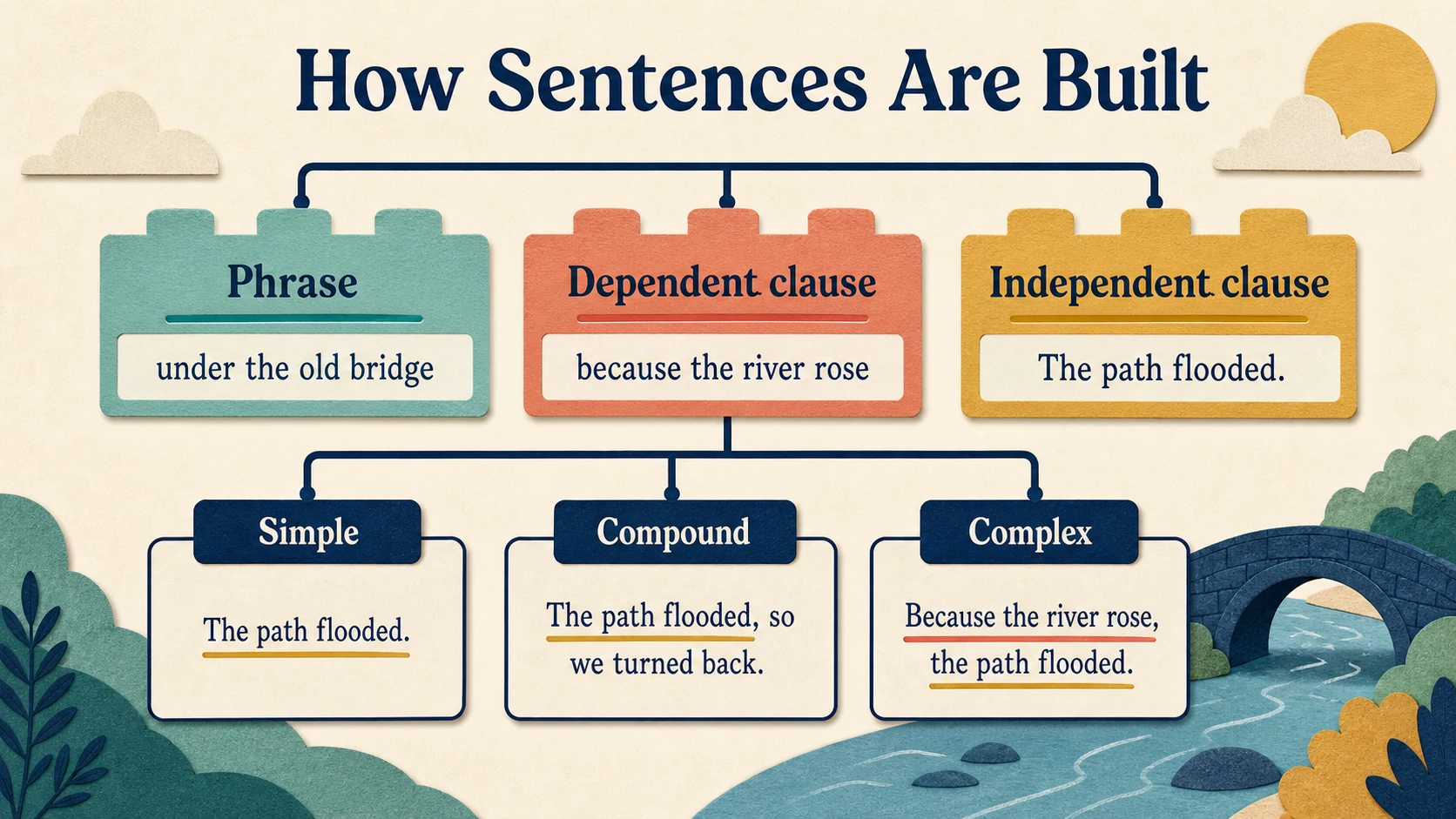
Sentence work moves from complete thoughts toward purposeful expansion, combination, and variety.
Grade labels describe an intended practice level, not a guarantee that every learner follows the same sequence. Local curricula and instructional sequences differ. Use the learner’s observed writing to decide whether to move forward, review an earlier skill, or provide a more demanding application.
The Common Core State Standards for English Language Arts offer one broad reference point for grade-level language expectations. They should be considered alongside local requirements rather than treated as proof that a particular worksheet provides comprehensive standards coverage.
Prerequisites to Check Before Teaching Sentence Variety
A learner will have difficulty combining or varying sentences if sentence completeness is still uncertain. Check the foundations through oral examples and brief written tasks before assigning a full page of practice.
Complete thoughts in oral language
Say each group of words aloud:
- The bright red kite
- Flew above the field
- The bright red kite flew above the field.
Ask the learner which example communicates a complete thought. The first names something but does not say what happened. The second says what happened but does not identify what flew. The third supplies both parts.
Oral work reduces the demands of spelling and handwriting while the learner attends to sentence meaning. The IES foundational reading practice guide concerns instruction through third grade, so it does not prescribe a fourth-grade sentence curriculum. It is still useful background for adults checking whether earlier word-reading and language foundations are interfering with written work.
Basic subject and verb recognition
The learner does not need to label every grammatical feature before composing sentences. However, the learner should usually be able to find the main subject and verb in a direct example:
The tiny frogs leaped.
- Complete subject: The tiny frogs
- Main noun in the subject: frogs
- Complete predicate: leaped
- Verb: leaped
If the learner circles tiny as the subject or cannot locate leaped, pause for short identification practice. Do not introduce several clause types at the same time.
Word order, capitalization, and punctuation
Check whether the learner can arrange familiar words into a conventional English sentence:
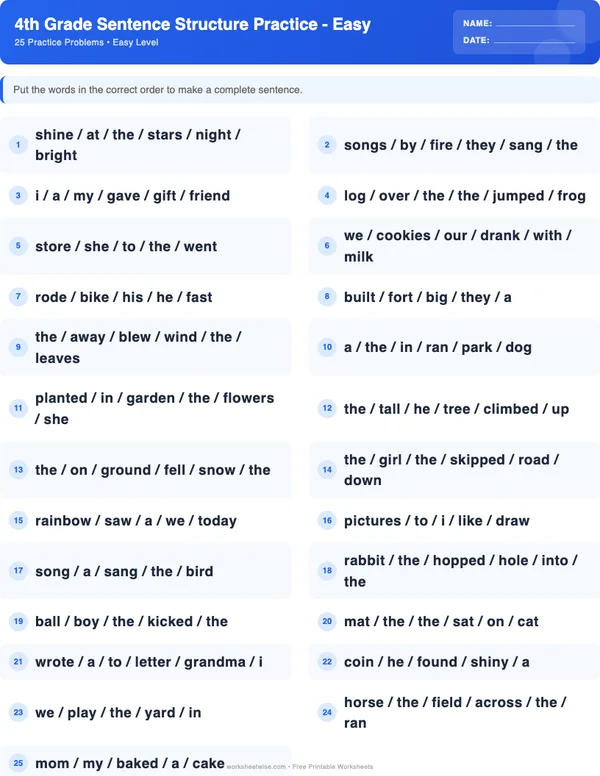
library / the / Maya / visited
Correct arrangement:
Maya visited the library.
The sentence begins with a capital letter, follows understandable word order, and ends with punctuation. The free standard easy sentence-structure worksheet provides 14 exercises of this kind and includes a separate answer key. It is suitable when word order and sentence formation need reinforcement, but it does not by itself assess every skill covered in this guide.
A Grade-Appropriate Teaching Progression
Teach one contrast at a time. A learner who can identify a skill in isolated examples may still need support applying it during original writing.
| Stage |
Main instructional focus |
Supported task |
Evidence for moving on |
| 1 |
Complete sentence versus fragment |
Add the missing subject or predicate |
Explains what is missing and repairs it |
| 2 |
Subject and predicate |
Divide a sentence into its two main parts |
Identifies both parts in varied examples |
| 3 |
Conventional word order |
Rearrange word groups into sentences |
Produces clear order without guessing from capitalization alone |
| 4 |
Sentence expansion |
Add where, when, how, or descriptive details |
Adds information without losing the main thought |
| 5 |
Run-ons and sentence boundaries |
Mark where one complete thought ends |
Repairs boundaries with punctuation or a conjunction |
| 6 |
Sentence combining |
Join related short sentences |
Preserves the original meaning without needless repetition |
| 7 |
Simple, compound, and complex structures |
Sort, complete, and imitate patterns |
Uses each form accurately in context |
| 8 |
Purposeful variety |
Revise beginnings and lengths |
Improves flow while keeping sentences clear |
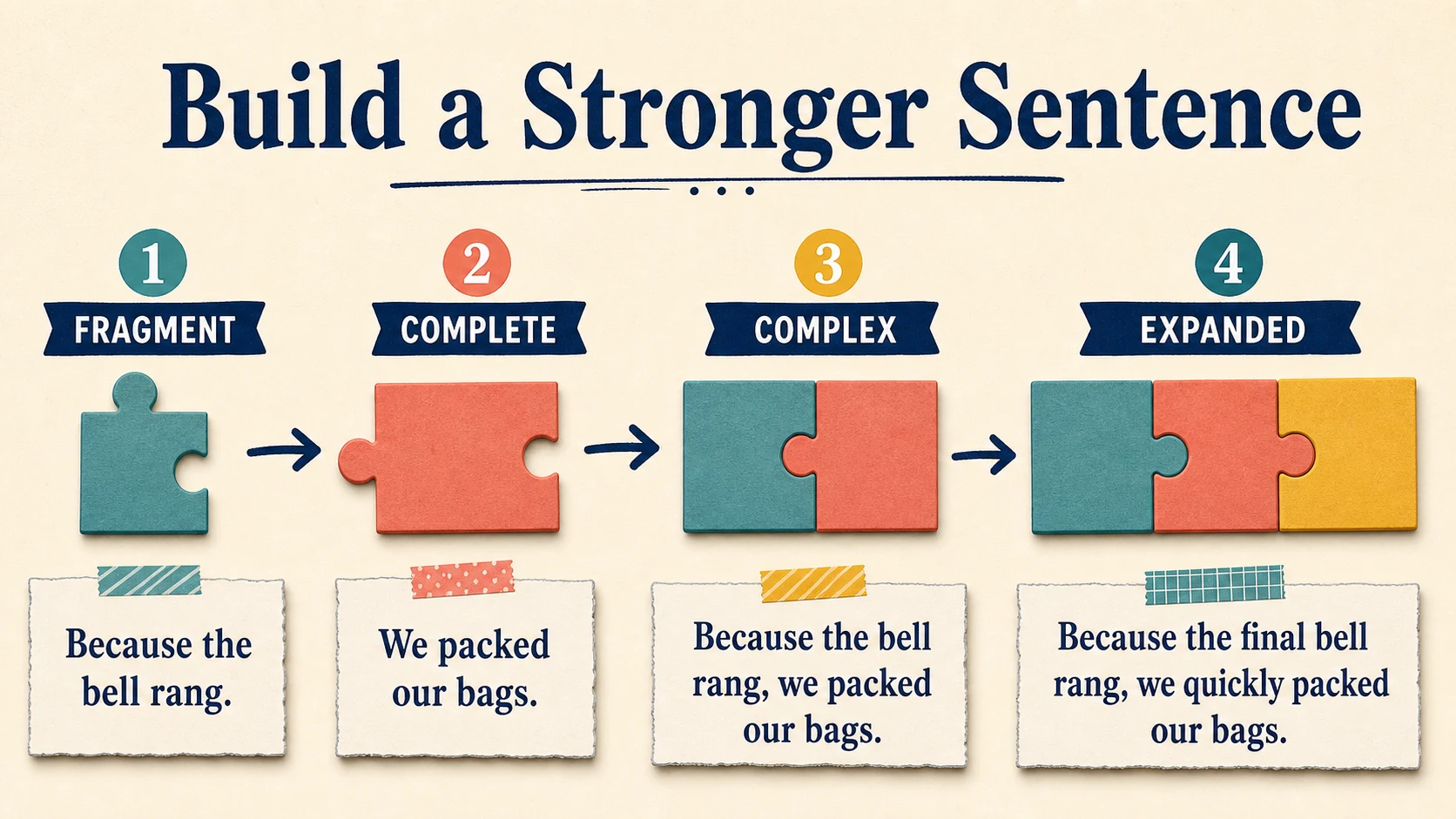
Progress depends on demonstrated control, not on completing a fixed number of pages.
This progression is a teaching suggestion based on the supplied topic sequence. It is not a universal timetable. Some learners will revisit fragments while already writing compound sentences. Others may understand sentence boundaries but need focused practice with word order or conjunctions.
Concrete and Visual Models
The subject-predicate frame
Draw two boxes:
| Who or what? |
Did what? Is what? |
| The class |
planted seeds. |
| Our new seedlings |
are fragile. |
| Two green shoots |
appeared this morning. |
Have the learner combine one entry from each column and test whether the result makes sense. Then expand either side:
The class planted seeds.
The fourth-grade class planted sunflower seeds in small pots.
The expanded sentence still has the same central frame: class planted.
The complete-thought boundary test
Use a vertical line to mark the boundary between complete thoughts:
The rain stopped | we returned to the field.
Each side can stand alone:
The rain stopped.
We returned to the field.
That means the original wording is a run-on. The writer needs a period, a semicolon if it has been taught locally, or an appropriate comma-and-conjunction structure:
The rain stopped, so we returned to the field.
The line is a diagnostic model, not punctuation that belongs in the final sentence.
Color-coding clauses
Assign colors or underline patterns rather than relying only on terminology:
- Underline an independent clause once.
- Underline a dependent clause twice.
- Circle the joining word.
Apply the model to this sentence:
When the rain stopped, we returned to the field.
When the rain stopped cannot stand alone in this form. We returned to the field can. The comma makes the boundary visible when the dependent clause comes first.
Physical sentence strips can serve the same purpose. Move the clause strips, read each arrangement aloud, and discuss which version is complete and correctly punctuated.
Fully Checked Worked Examples
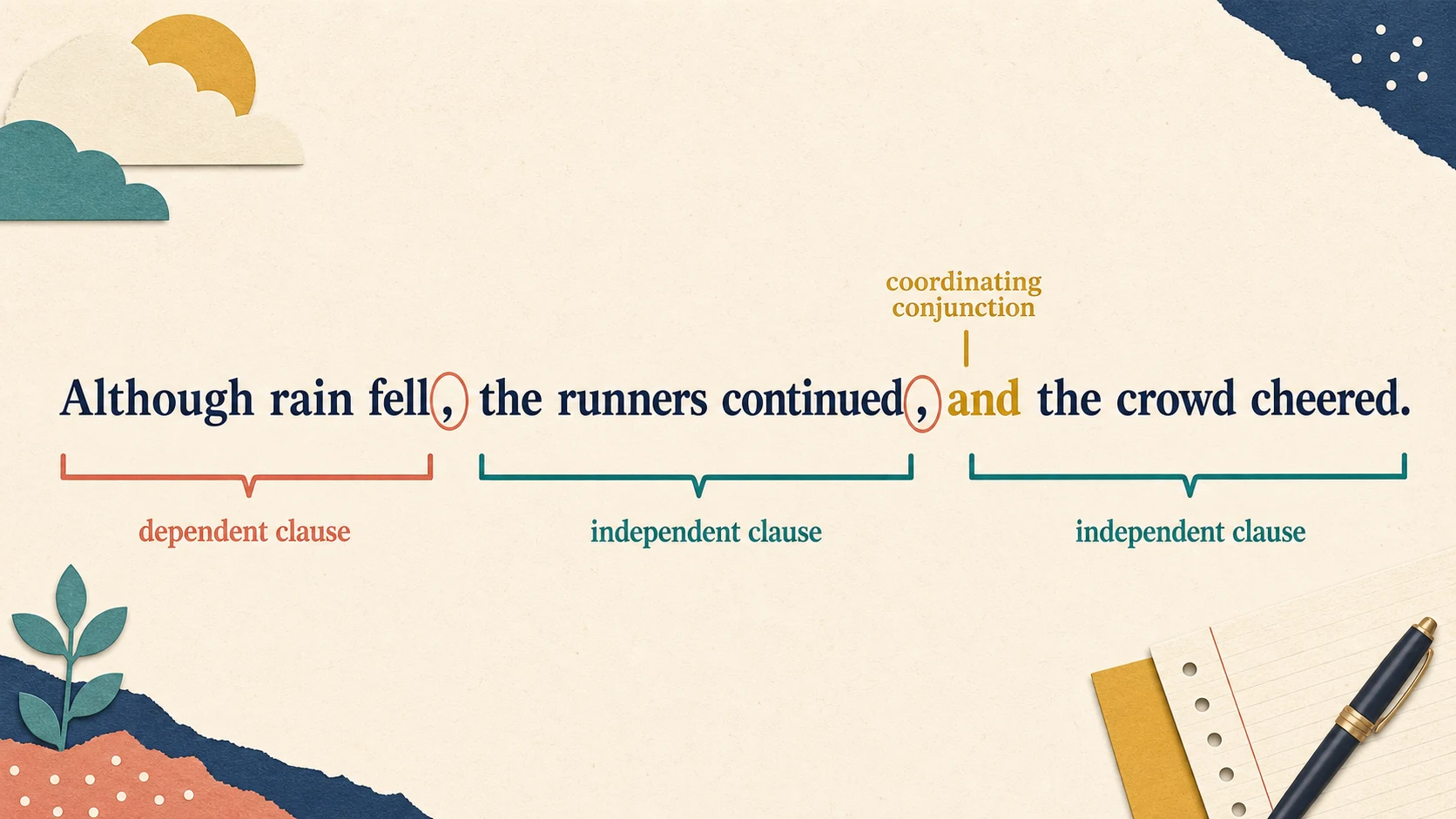
Each answer is checked for completeness, meaning, word order, capitalization, and punctuation.
Example 1: Rearranging words
Arrange these words into a complete sentence:
carefully / the / measured / student / water / the
Step 1: Find a likely subject.
The student answers “Who?”
Step 2: Find the action.
Measured tells what the student did.
Step 3: Place the object and detail.
The student measured the water and did so carefully.
Answer:
The student carefully measured the water.
Check: The subject is the student. The predicate is carefully measured the water. The wording expresses a complete thought, begins with a capital, and ends with a period.
A second correct arrangement is possible:
Carefully, the student measured the water.
The meaning is nearly the same, but the second version emphasizes how the action was performed and uses a comma after the opening adverb.
Example 2: Repairing a fragment
Repair this word group:
After the final bell rang.
Diagnosis: The group begins with after, which makes the reader expect another idea. What happened after the bell rang?
One correct repair:
After the final bell rang, the students packed their bags.
Check: After the final bell rang is a dependent clause. The students packed their bags is an independent clause. Together they express a complete thought. The introductory dependent clause is followed by a comma.
Another possible repair is:
The students packed their bags after the final bell rang.
This version is also complete. It places the independent clause first and does not require the same introductory comma.
Example 3: Correcting a run-on
Correct this sentence:
Eli opened the window the room felt cooler.
Diagnosis: There are two complete thoughts:
- Eli opened the window.
- The room felt cooler.
Correct repair with a conjunction:
Eli opened the window, and the room felt cooler.
Check: Both sides of and can stand as complete sentences. A comma precedes the coordinating conjunction.
A period also works:
Eli opened the window. The room felt cooler.
The two repairs are grammatically complete, but they create different rhythms. The conjunction presents the ideas as closely connected; the period gives each thought more separation.
Example 4: Combining repeated information
Combine these sentences without repeating the rabbit:
The rabbit crossed the yard.
The rabbit disappeared under the gate.
Answer:
The rabbit crossed the yard and disappeared under the gate.
Check: Both actions share the same subject, so the second the rabbit can be removed. A comma is not needed between the two verb phrases crossed the yard and disappeared under the gate.
Compare that structure with:
The rabbit crossed the yard, and it disappeared under the gate.
This version has two independent clauses, so the comma before and is appropriate. It is correct, though less concise.
Example 5: Expanding without changing the core
Expand this sentence with information about when, where, and how:
The birds gathered.
Answer:
Before sunrise, the noisy birds gathered quietly beside the pond.
Check: The subject-predicate core remains birds gathered. Before sunrise tells when, noisy describes the birds, quietly tells how, and beside the pond tells where. Every added detail connects logically to the original sentence.
Notice a meaning issue: noisy birds gathered quietly is possible because noisy can describe the birds generally while quietly describes this action. If the intended meaning is that the gathering itself was noisy, revise the sentence:
Before sunrise, the birds gathered noisily beside the pond.
Grammar and meaning must both be checked.
Example 6: Forming a complex sentence
Combine the ideas using because:
The path was muddy.
We walked slowly.
Answer:
We walked slowly because the path was muddy.
Check: We walked slowly can stand alone. Because the path was muddy cannot stand alone in this form. The dependent clause supplies a reason for the main idea.
Reversing the order gives:
Because the path was muddy, we walked slowly.
This is also correct. A comma follows the opening dependent clause.
Boundary Cases That Require Careful Reading
A sentence is not complete merely because it is long:
Across the playground near the tall fence after lunch.
This word group contains several details but no complete subject-predicate relationship. Length does not repair a fragment.
A short sentence can be complete:
Birds flew.
It contains a subject and predicate and expresses a complete thought.
Commands form another useful boundary case:
Close the door.
The subject you is understood even though it is not written. Do not label every command a fragment because the visible subject is absent.
Questions may reverse familiar word order:
Did the team finish the project?
The subject is the team, not did. The helping verb appears before the subject because the sentence is a question.
Finally, a sentence with and is not automatically compound:
Lena washed and dried the dishes.
This is a simple sentence with one subject and a compound predicate. Compare it with:
Lena washed the dishes, and Marco dried them.
The second version contains two independent clauses and is compound.
A Short, Repeatable Lesson Routine
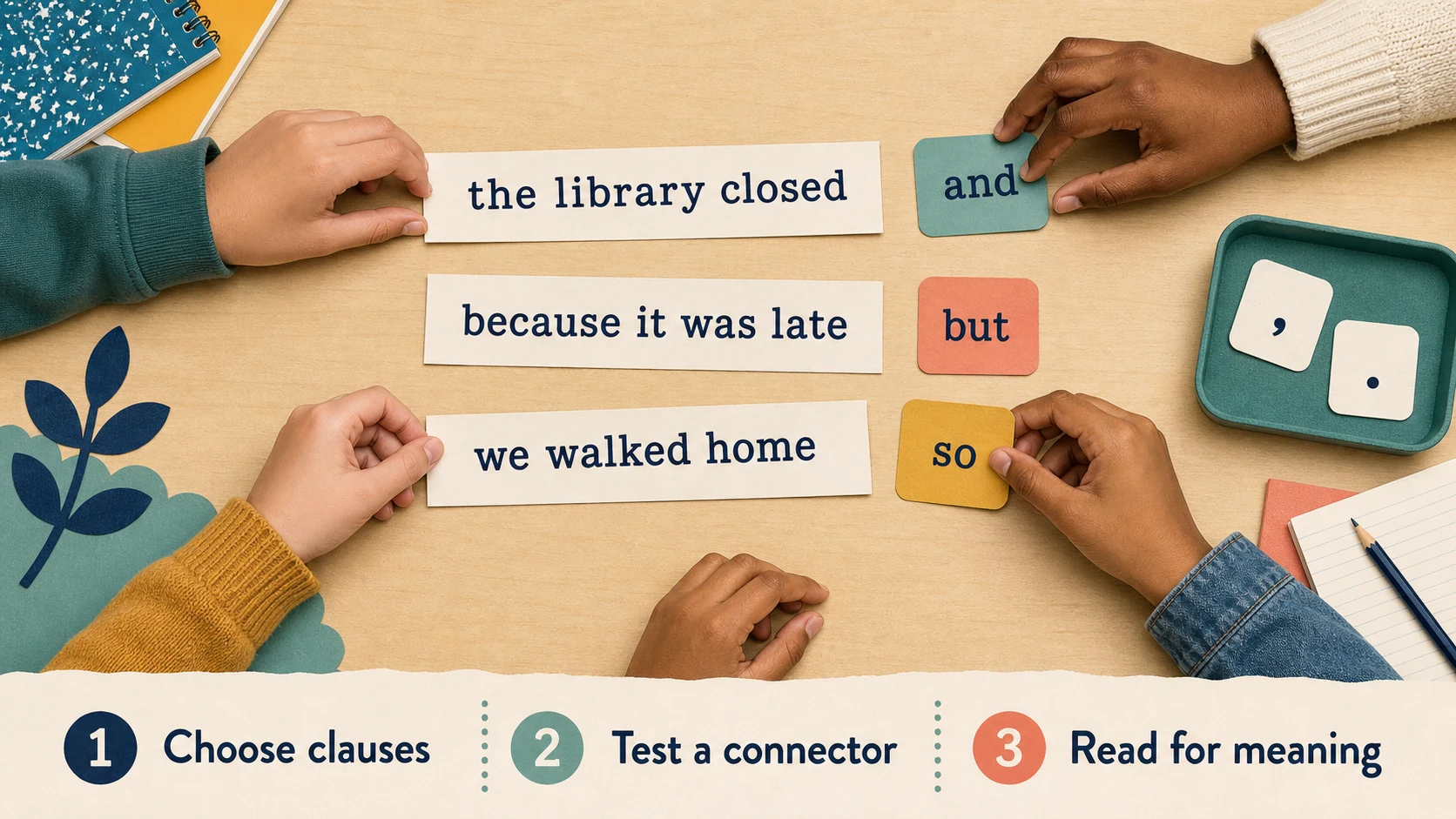
A compact routine makes the learner’s reasoning visible before independent practice begins.
Use a 12- to 20-minute routine as a flexible instructional suggestion:
- Retrieve for two minutes. Present one sentence and one fragment. Ask the learner to identify each and explain the decision.
- Model for three minutes. Think aloud through one new example. Mark the subject, predicate, and thought boundary.
- Complete two examples together. Prompt with “Who or what?” and “What happened?” rather than supplying the answer immediately.
- Assign three to five independent items. Keep the set short enough to inspect the reasoning closely.
- Revise one sentence from real writing. Choose a sentence from the learner’s paragraph, journal entry, or response.
- Close with an explanation. Ask the learner to state what changed and why.
The IES elementary writing practice guide provides high-level instructional framing for regular writing opportunities, explicit teaching, and attention to foundational writing skills. It does not evaluate WorksheetWise or prescribe this exact routine.
Choosing Practice That Matches the Need
Use the error pattern—not the worksheet title alone—to select practice.
| Observed work |
Best next practice |
| Words appear in confusing order |
Rearranging words into complete sentences |
| Subjects or predicates are missing |
Oral completion and subject-predicate matching |
| Dependent clauses stand alone |
Fragment sorting and repair |
| Several thoughts run together |
Boundary marking and run-on correction |
| Writing contains repeated short sentences |
Sentence combining |
| Sentences are complete but bare |
Expansion with when, where, how, and descriptive details |
| Every sentence begins the same way |
Beginning imitation and sentence rearrangement |
| Skills appear correct in exercises but not paragraphs |
Editing a short piece of authentic writing |
The 4th Grade Grammar hub can help adults place sentence work beside related grammar practice. The broader 4th Grade worksheet hub is useful when planning across subjects.
Avoid assigning difficult sentence-combining work simply because a learner completed an easy page quickly. First inspect accuracy and explanation. Fast guessing is different from secure understanding.
Differentiation Without Lowering the Thinking
When the learner needs more support
Reduce the number of decisions in each item:
- Provide the subject and ask for a predicate.
- Offer two possible conjunctions and discuss which meaning fits.
- Cut a run-on into clause strips before adding punctuation.
- Let the learner rehearse the sentence aloud before writing.
- Keep vocabulary familiar while teaching a new structure.
- Ask for one successful revision rather than many rushed answers.
If handwriting or spelling obscures sentence knowledge, allow oral responses or shared writing for part of the lesson. Record what the learner can explain separately from what the learner can independently write.
When the learner is ready for greater challenge
Increase the reasoning demand rather than merely adding more items:
- Require two correct revisions with different rhythms.
- Ask the learner to explain why a comma is or is not needed.
- Combine three related sentences while preserving every important detail.
- Imitate the structure of a well-formed sentence using new content.
- Revise a paragraph containing fragments, run-ons, and repetitive beginnings.
- Compare two grammatical versions and explain the difference in emphasis.
A mentor sentence can be studied for its pattern and then imitated. Keep the focus on structure: what comes first, where the main clause appears, and how details attach to the core idea.
Diagnosing Common Errors and Misconceptions
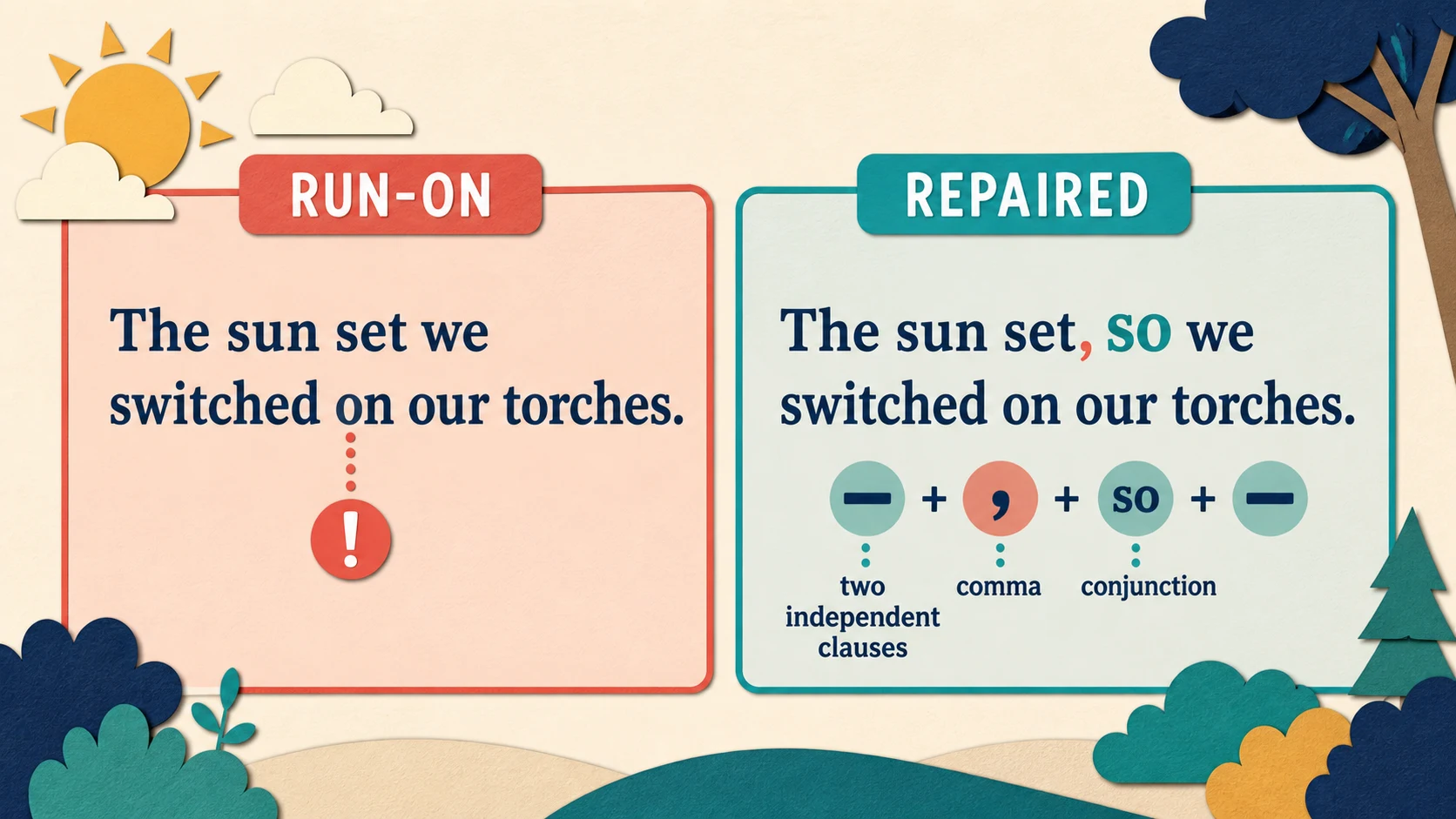
Correction is most useful when it identifies the learner’s reasoning, not just the wrong answer.
| Error or statement |
Likely misconception |
Teaching response |
| “It has a period, so it is a sentence.” |
Punctuation alone creates completeness |
Remove the period and test for subject, predicate, and complete thought |
| “A long group of words must be a sentence.” |
Length equals completeness |
Contrast a long fragment with a two-word complete sentence |
| A comma is inserted between every subject and predicate |
Pauses always require commas |
Rebuild the subject-predicate core without interruption |
| Because the storm ended. is accepted as complete |
Any subject and verb guarantee a full sentence |
Show how because makes the idea depend on another clause |
| Two complete thoughts are joined with only a comma |
A comma can join any ideas |
Mark both complete thoughts and choose a period or suitable conjunction |
| A comma appears in Mia sang, and danced |
Every and needs a comma |
Compare two verbs sharing one subject with two independent clauses |
| Details are added randomly |
Expansion means making a sentence longer |
Require every addition to answer a useful question |
| Every sentence begins with an opening phrase |
Variety means using one new pattern repeatedly |
Compare several beginnings and choose based on clarity and emphasis |
Do not correct every feature at once. If the lesson target is sentence boundaries, note spelling separately unless it prevents understanding. A page covered with unrelated corrections makes it harder to see whether the target skill improved.
Monitoring Progress Through Observable Evidence
Track a small number of indicators once or twice a week:
- complete sentences identified correctly;
- fragments repaired with a logical missing part;
- run-ons divided at the correct thought boundary;
- related sentences combined without lost meaning;
- sentence expansions that add relevant details;
- correct structures transferred into a short paragraph;
- explanations that use evidence from the sentence.
A simple record might read:
Tuesday: Correctly repaired 4 of 5 fragments. Needed a prompt to notice because.
Friday: Repaired 5 of 5 and explained why the dependent clause needed a main clause.
Do not rely only on a total score. Record the type of error and whether the learner worked independently, used a prompt, or copied a model. Three accurate independent examples may reveal more than a long mixed page completed with extensive help.
Use delayed review as well. A learner who succeeds immediately after modeling should encounter the structure again several days later and in connected writing.
A Two-Week Practice Plan
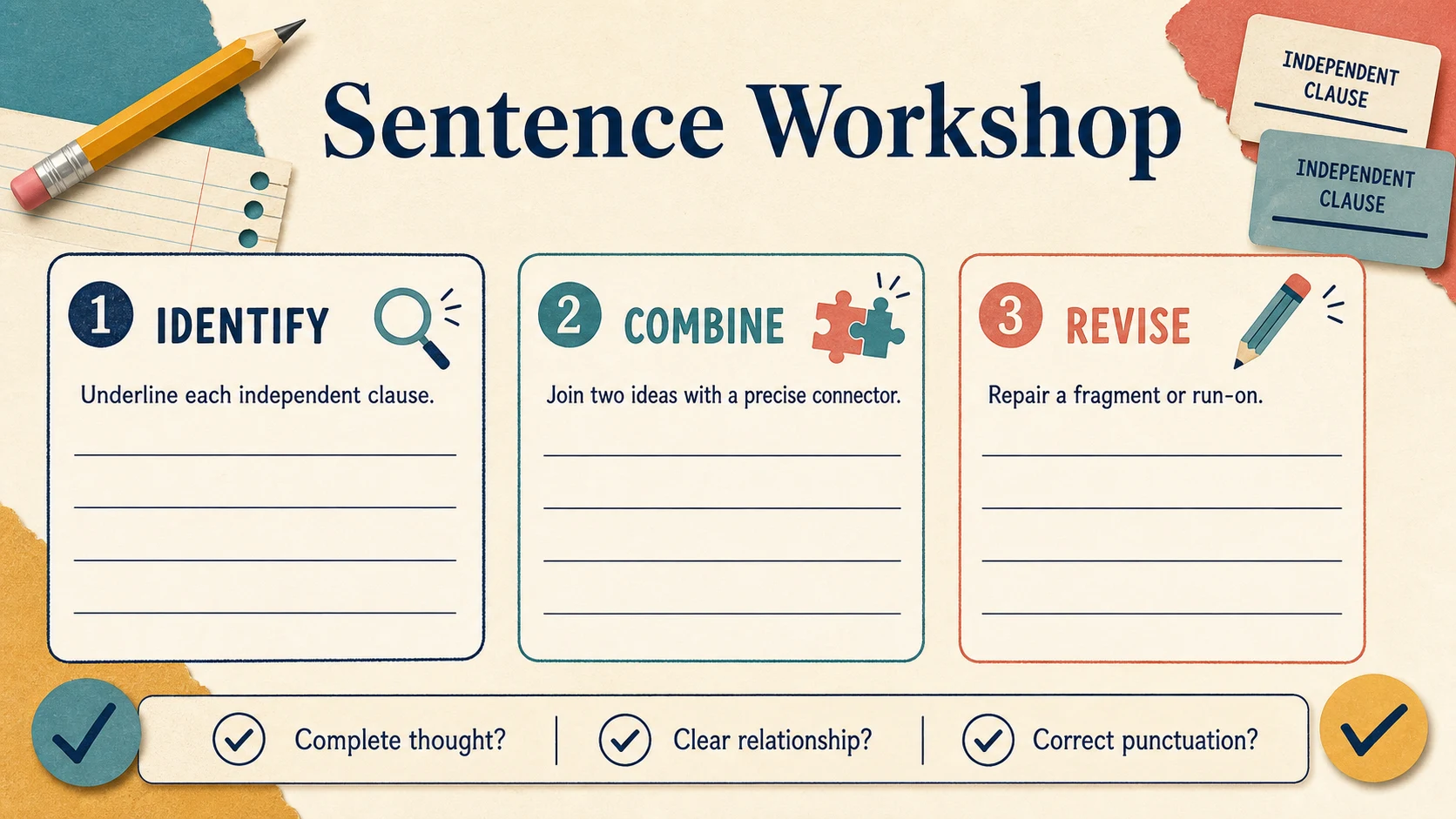
The plan alternates explicit practice, application, and review; adjust it from observed work.
| Day |
Focus |
Suggested activity |
Quick evidence |
| 1 |
Baseline |
Sort sentences and fragments; arrange two word-order items |
Note which distinctions require prompts |
| 2 |
Subject and predicate |
Mark each part in five sentences; build two orally |
Explain the subject-predicate core |
| 3 |
Fragment repair |
Complete missing-subject, missing-predicate, and dependent-clause fragments |
Repair three different fragment types |
| 4 |
Expansion |
Add when, where, and how to short sentences |
Preserve the original core meaning |
| 5 |
Review and writing |
Write four connected sentences; inspect completeness |
Find and revise one weak sentence |
| 6 |
Run-ons |
Mark complete-thought boundaries before correcting punctuation |
Explain where each thought ends |
| 7 |
Sentence combining |
Combine repeated subjects and related independent clauses |
Retain all essential information |
| 8 |
Complex structures |
Build sentences with because, when, and after |
Identify dependent and independent parts |
| 9 |
Variety |
Revise repetitive beginnings in a short paragraph |
Produce at least two clear patterns |
| 10 |
Independent check |
Complete a mixed set and revise a fresh paragraph |
Compare with Day 1 evidence |
This plan is not universal. Repeat a day, reduce the item count, or return to oral work when errors remain unstable. If the learner shows secure control early, move sooner into paragraph revision rather than assigning extra repetition.
Limitations and an Honest Next Step
Sentence exercises isolate patterns so that adults and learners can examine them closely. They do not show the whole of writing ability. A learner may correct every run-on on a worksheet yet still produce run-ons while managing ideas, spelling, and organization in a paragraph. Conversely, an awkward original sentence may reflect vocabulary or planning difficulty rather than a missing grammar rule.
The catalogue’s easy worksheet specifically practices word order, sentence formation, syntax, and grammar through 14 rearrangement exercises. It does not independently cover all fragments, run-ons, clause relationships, sentence combining, or stylistic choices discussed here. The focused sentence-structure pack contains 18 worksheets, but practice volume should still follow diagnosed need.
As a practical next action, give the learner three oral word-order items and one short paragraph to inspect. If word order is the clear obstacle, use the free 4th Grade Sentence Structure worksheet, check the included answer key, and record which errors remain before choosing the next lesson.