What 6th Grade Punctuation Instruction Should Accomplish
Sixth-grade punctuation instruction should help a learner choose marks for meaning, not merely insert marks by habit. A useful sequence begins with sentence boundaries and capitalization, then moves through commas, apostrophes, quotation marks, colons, and semicolons. The learner should see a rule modeled, explain why it applies, correct prepared sentences, and finally use the same convention in original writing.
Teach one punctuation function at a time. Move forward when the learner can apply it accurately in both isolated sentences and a short paragraph. If errors reappear in writing, return to a smaller contrast rather than adding more rules.
Grade labels describe the intended practice level, not a universal timetable. Local curricula and instructional sequences differ. The learner’s observed work should determine the starting point, pace, and amount of review.
The Skill Map: Marks, Meaning, and Sentence Structure
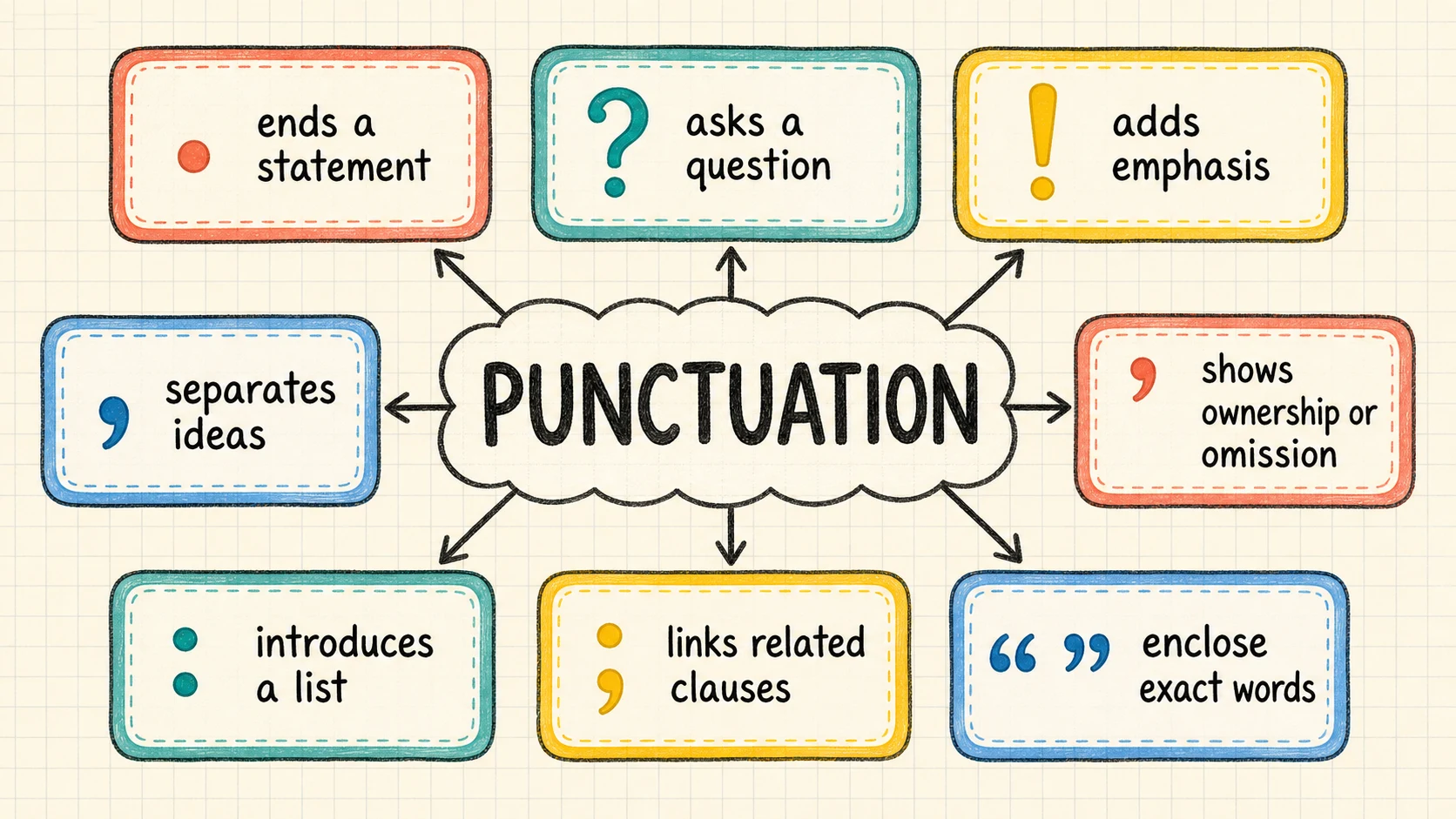
Punctuation choices connect sentence structure, intended meaning, and readable presentation.
Punctuation is often described as a system of signals for readers. That description is useful as long as instruction goes beyond “pause here.” A comma, colon, or semicolon depends on how words and clauses relate, not simply on how long a reader pauses.
Core punctuation functions
A sixth-grade learner may need to consolidate or extend these areas:
- Periods, question marks, and exclamation points: Mark the purpose and boundary of a complete sentence.
- Commas in a series: Separate three or more items, as in We packed water, fruit, and maps.
- Commas in dates and addresses: Separate conventional parts, as in March 6, 2026.
- Commas with introductory elements: Mark the end of an opening word, phrase, or clause, as in After lunch, we revised the report.
- Commas in compound sentences: Separate two complete thoughts joined by a coordinating conjunction, as in I finished the diagram, but Ana checked the labels.
- Apostrophes: Mark omitted letters in contractions or possession.
- Quotation marks: Enclose a speaker’s exact words and work with commas and end punctuation in dialogue.
- Colons: Introduce an explanation, example, or list after a complete statement.
- Semicolons: Join closely related complete sentences or help organize list items that already contain commas.
The WorksheetWise 6th Grade grammar collection places punctuation within broader language work. That matters because a learner who cannot identify a complete sentence will have difficulty deciding whether a semicolon is possible or whether a comma is creating a splice.
Prerequisites to check first
Before assigning mixed punctuation practice, ask the learner to:
- Identify the beginning and end of a complete sentence.
- distinguish a statement from a direct question and an exclamation;
- recognize a list and its individual items;
- locate the subject and verb in a short clause;
- tell whether each side of and, but, or so can stand alone;
- explain the difference between omitted letters and ownership; and
- identify the exact words spoken in a line of dialogue.
These are diagnostic checks, not a separate course. If the learner misses one, teach the needed idea immediately and then return to punctuation.
The Common Core English Language Arts overview frames language as part of reading, writing, speaking, and listening across subjects. It also notes that grade-specific expectations add detail to broader literacy goals and that, beginning in grade 6, literacy extends into subjects such as history and science. This supports practicing punctuation in real explanations, arguments, and notes, but it does not establish that every local curriculum follows one identical sequence.
A Grade-Appropriate Teaching Progression
A sensible progression moves from visible sentence boundaries to choices that require clause analysis. The stages below are an instructional suggestion based on the supplied topic sequence. They are not a mandated calendar.
| Stage |
Main focus |
Supported practice |
Evidence for moving on |
| 1 |
Capitals and end marks |
Sort statements, questions, and exclamations; repair unpunctuated sentences |
Learner consistently marks sentence beginnings and endings |
| 2 |
Commas in lists, dates, and addresses |
Label the parts before inserting commas |
Learner states which convention the comma is serving |
| 3 |
Apostrophes |
Expand contractions; identify the owner and what is owned |
Learner distinguishes omission from possession |
| 4 |
Introductory elements |
Box the opening element and underline the main clause |
Learner places the boundary without relying only on a spoken pause |
| 5 |
Compound sentences |
Test both sides for a subject, verb, and complete thought |
Learner avoids both missing commas and unnecessary commas |
| 6 |
Dialogue |
Mark spoken words, speaker tags, punctuation, and paragraph changes |
Learner punctuates prepared dialogue before composing it |
| 7 |
Colons and semicolons |
Verify a complete clause before the mark; compare possible revisions |
Learner can explain why a comma alone would not work |
| 8 |
Mixed editing and original writing |
Edit short paragraphs and explain selected corrections |
Learner transfers conventions beyond single-rule exercises |
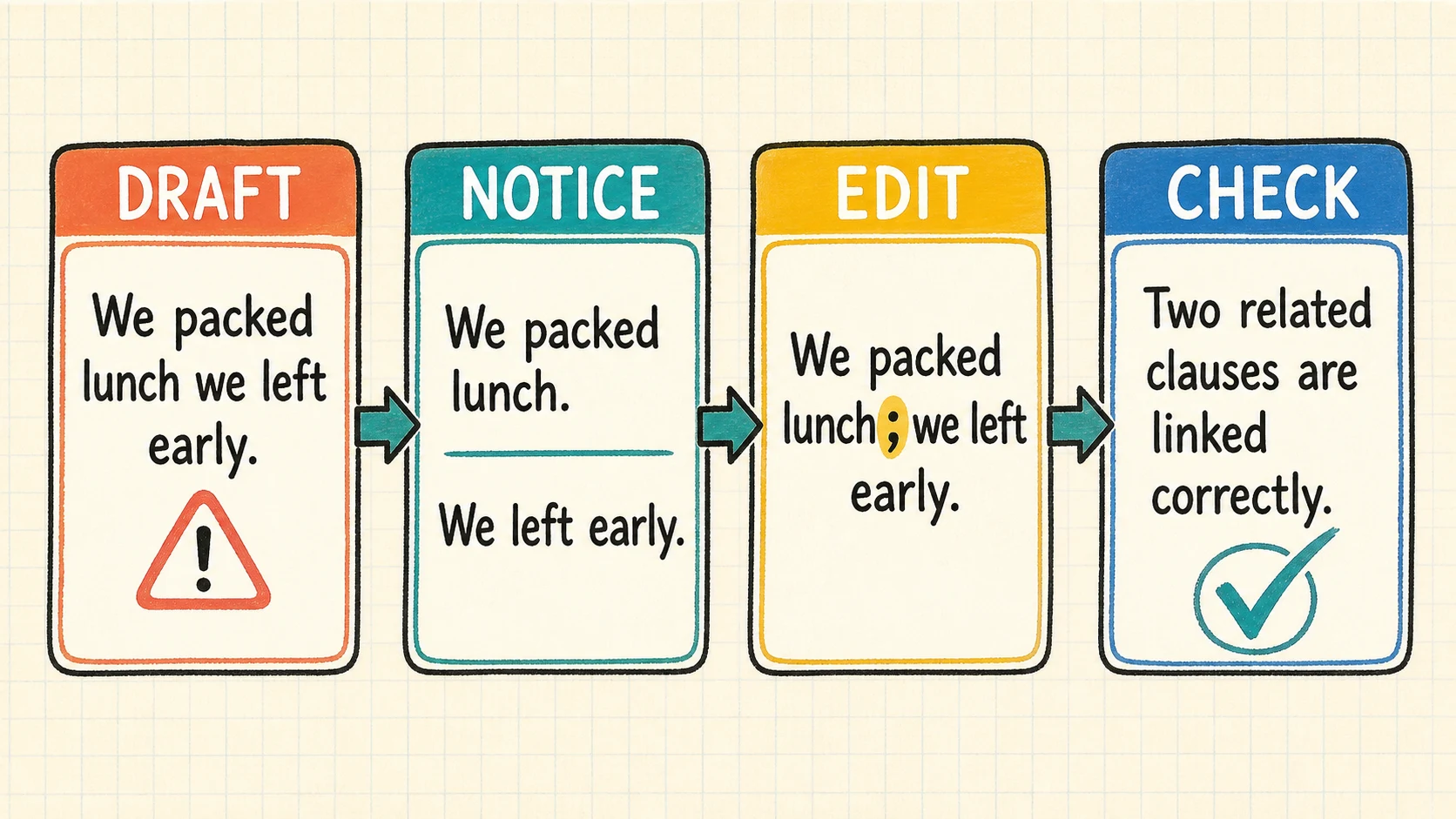
Support can fade from labeled sentence parts to independent editing and writing.
How to decide whether to advance
Do not advance because a worksheet is finished. Look at the reasoning behind the answers. A learner who places commas correctly but says, “It sounded like a pause,” may not yet have a dependable method for compound sentences.
Use three checks:
- Accuracy: Is the chosen mark correct?
- Explanation: Can the learner name the relationship or convention?
- Transfer: Can the learner apply it in a new sentence or in personal writing?
A mistake during transfer is useful evidence. It shows that recognition has developed further than independent use. Continue with the same skill, but change the task from selecting an answer to editing and composing.
Concrete and Visual Models That Make Decisions Visible
Abstract definitions become more usable when the learner can mark the sentence before selecting punctuation.
The clause-box model
Draw a box around each group that may be a complete sentence:
[The rain stopped] but [the field remained muddy].
Both boxes contain complete thoughts. Add the comma before the coordinating conjunction:
The rain stopped, but the field remained muddy.
Now compare:
[The rain stopped] and flooded the path.
The words flooded the path do not form a second complete sentence because they do not name their own subject. No comma is needed:
The rain stopped and flooded the path.
This visual test is more reliable than adding a comma before every and or but.
The contraction-and-possession test
For an apostrophe, ask which job the mark performs.
| Question |
Test |
Example |
| Are letters missing? |
Expand the word |
isn’t → is not |
| Does something belong to someone or something? |
Say “the ___ belonging to ___” |
the student’s notes → the notes belonging to the student |
| Is the word only plural? |
Count the items |
three students needs no apostrophe |
This comparison prevents the common assumption that every final s needs an apostrophe.
The dialogue-frame model
Separate spoken words from the speaker tag:
Spoken words: We should begin now.
Speaker tag: Maya said.
When the tag follows a statement, the period inside the original spoken sentence becomes a comma:
“We should begin now,” Maya said.
When the spoken words form a question, retain the question mark:
“Should we begin now?” Maya asked.
The catalogue’s teaching guidance recommends practicing already-written dialogue before asking learners to compose it. It also specifies the presentation pattern new speaker = new line. Both steps reduce the number of decisions a learner must manage at once.
Fully Checked Worked Examples
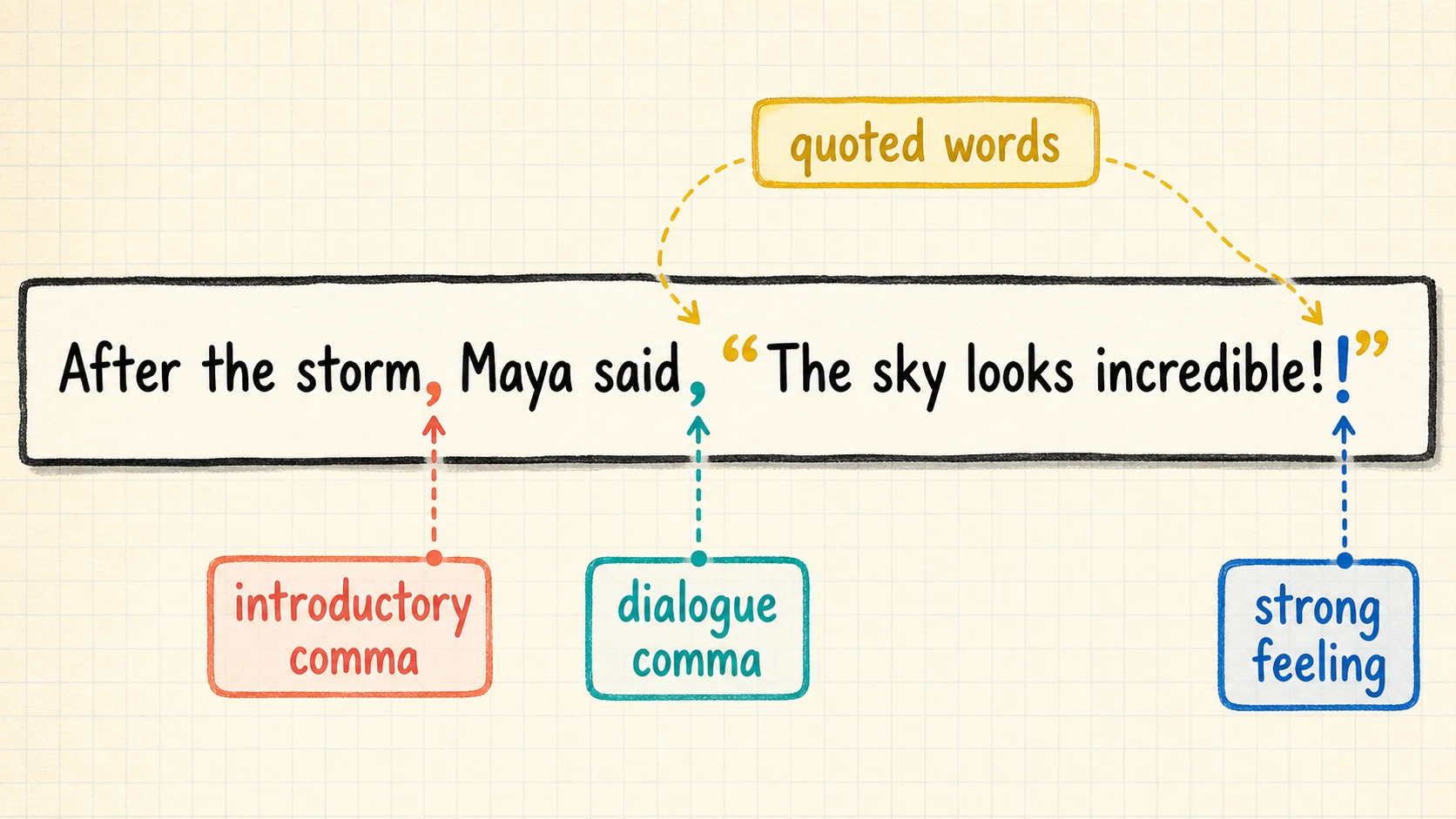
Each correction should follow an identifiable test rather than guesswork.
Example 1: Capitalization and end punctuation
Unpunctuated sentence
why did jordan leave the telescope outside
Reasoning
- The first word begins the sentence, so why becomes Why.
- Jordan is a name, so it begins with a capital letter.
- The sentence asks a direct question, so it ends with a question mark.
Corrected sentence
Why did Jordan leave the telescope outside?
Check: The sentence begins with a capital, the proper name is capitalized, and the end mark matches the direct question.
Example 2: Comma in a compound sentence
Original
The instructions looked simple but the experiment required patience.
Reasoning
- Before but: The instructions looked simple has a subject, a verb, and a complete thought.
- After but: the experiment required patience also has a subject, a verb, and a complete thought.
- The conjunction but joins two complete sentences, so a comma belongs before it.
Corrected sentence
The instructions looked simple, but the experiment required patience.
Check: Either side could stand alone. The comma and conjunction correctly join the two clauses.
Example 3: Introductory element and series
Original
Before the storm we carried blankets flashlights water and batteries downstairs.
Reasoning
- Before the storm introduces when the action occurred. Place a comma after that opening phrase.
- The sentence names four separate objects: blankets, flashlights, water, and batteries.
- Separate the listed items with commas.
Corrected sentence
Before the storm, we carried blankets, flashlights, water, and batteries downstairs.
Check: The first comma marks the end of the introductory phrase. The remaining commas organize the four-item series.
Example 4: Contraction versus possession
Original
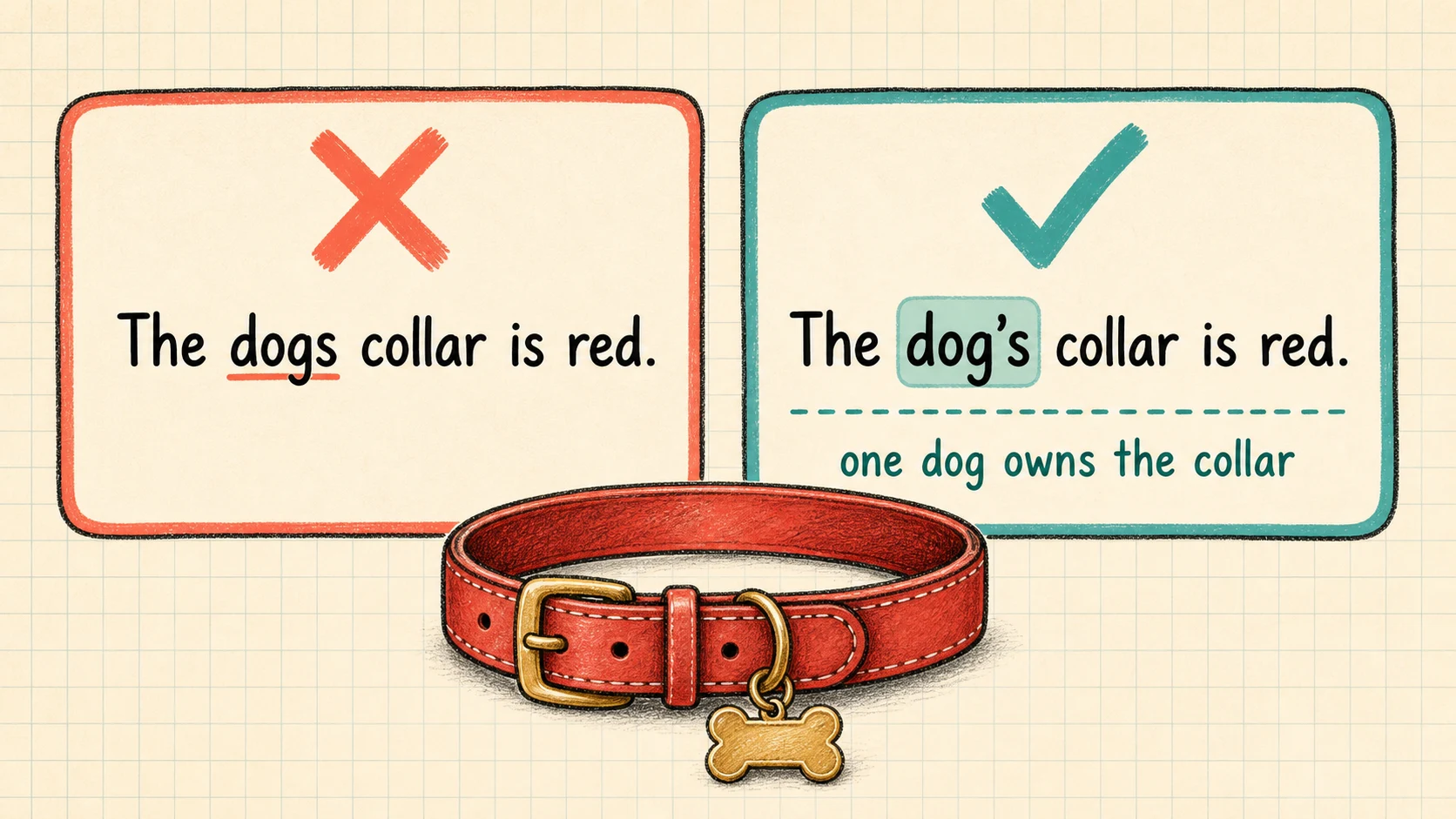
The dogs collar isnt attached to its leash.
Reasoning
- The collar belongs to one dog, so dogs becomes the singular possessive dog’s.
- Isnt combines is and not. The apostrophe replaces the omitted o, producing isn’t.
- Its means “belonging to it.” That possessive form does not take an apostrophe.
Corrected sentence
The dog’s collar isn’t attached to its leash.
Check: Dog’s shows ownership, isn’t shows omitted letters, and its is the possessive form.
Example 5: Dialogue punctuation
Original
lena asked can we compare our answers
Reasoning
- Lena is a name and begins the sentence.
- Lena asked is the speaker tag; Can we compare our answers? gives her exact words.
- Place quotation marks around the exact words.
- Capitalize the first word of the quotation.
- Because the spoken words form a direct question, put the question mark inside the closing quotation mark.
Corrected sentence
Lena asked, “Can we compare our answers?”
Check: The comma separates the opening speaker tag from the quotation, and the question mark belongs to the quoted question.
Example 6: Colon and semicolon
Original
We needed three materials cardboard tape and string the store had already closed.
Reasoning
- We needed three materials is a complete sentence that announces a list. A colon can introduce that list.
- The store had already closed is another complete sentence.
- A comma alone cannot correctly join the two complete sentences. Because their meanings are closely related, a semicolon can connect them.
Corrected sentence
We needed three materials: cardboard, tape, and string; the store had already closed.
Check: The words before the colon form a complete statement. The semicolon has a complete sentence on each side.
A clearer revision could instead use two sentences:
We needed three materials: cardboard, tape, and string. The store had already closed.
That alternative demonstrates an important editing principle: punctuation is sometimes a choice among several grammatically sound structures.
Boundary Cases and Misconceptions
Rules are easiest to misuse at their edges. Teach the contrast, not only the correct example.
A comma does not belong before every conjunction
Compare:
Mira sketched the design and labeled each part.
There is one stated subject, Mira, performing two actions. No comma is required before and.
Mira sketched the design, and Caleb labeled each part.
Each side has its own subject and verb and expresses a complete thought. The comma is appropriate.
The useful question is not “Do I see and?” It is “Does the conjunction join two complete sentences?”
A spoken pause does not automatically require a comma
A reader may pause for emphasis, breath, or performance. Those pauses do not prove that a comma belongs. Ask what structure the mark would separate: list items, an introductory element, clauses, dialogue, or parts of a conventional date or address.
Reading aloud still has value. The supplied teaching guidance connects voice with end punctuation: statements often close steadily, questions may rise, and exclamations sound emphatic. Treat that as an initial listening model, then confirm the sentence’s purpose.
Plurals are not possessives
The teachers met after school.
This means more than one teacher. There is no possession, so there is no apostrophe.
The teacher’s desk was near the window.
One desk belongs to one teacher, so the apostrophe comes before s.
The teachers’ desks were near the window.
The desks belong to multiple teachers, so the apostrophe follows the plural s.
Do not ask only, “Does the word end in s?” Ask how many owners there are and what belongs to them.
Colons and semicolons are not decorative
Incorrect:
My favorite supplies are: pencils, markers, and paper.
The words before the colon do not form a complete sentence because are still needs its complement.
Correct:
I brought my favorite supplies: pencils, markers, and paper.
A semicolon also requires structural justification. It can join two related independent clauses:
The first route was shorter; the second route was safer.
It should not separate a dependent fragment from the clause it depends on:
Although the first route was shorter; we chose the second.
A comma fits that structure:
Although the first route was shorter, we chose the second.
A Short, Repeatable Lesson Routine
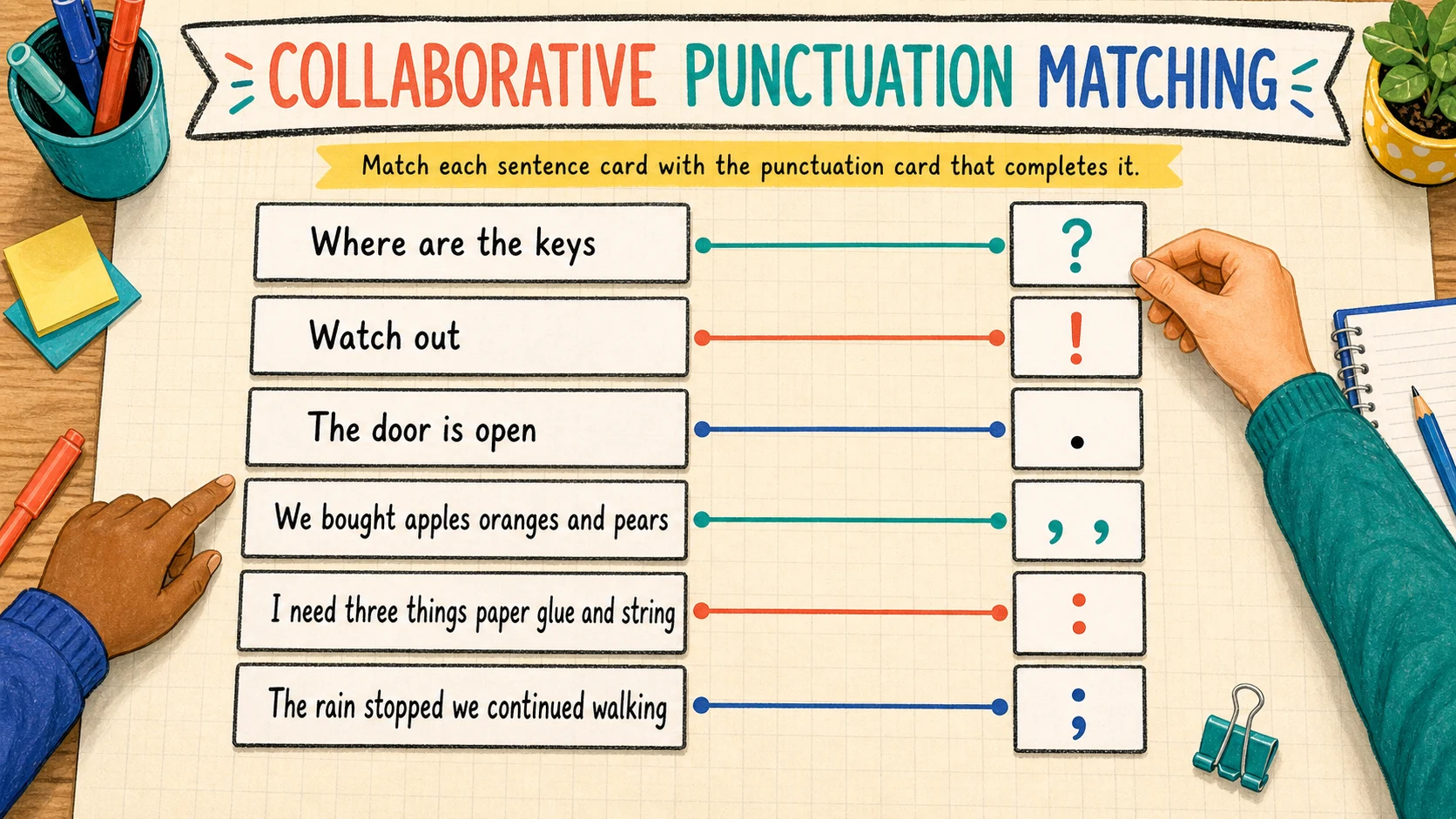
Brief instruction can still include modeling, explanation, practice, and transfer.
A 12–15 minute routine
- Retrieve for two minutes. Present one previously learned sentence. Ask the learner to correct it and name the rule.
- Model for three minutes. Think aloud through one new example. Mark clauses, list items, ownership, or spoken words before inserting punctuation.
- Practice together for four minutes. Complete two examples. Let the learner make each decision, but prompt with the appropriate test.
- Practice independently for three minutes. Give two or three new items without prompts.
- Transfer for three minutes. Ask the learner to write or revise one sentence using the target convention.
- Record one result. Note the type of task, accuracy, explanation, and whether a prompt was needed.
This routine is an instructional suggestion, not a sourced universal schedule. Shorten or extend it according to the learner’s work.
The IES guide to teaching elementary students to be effective writers recommends providing time to write, teaching the writing process for varied purposes, and developing fluency with sentence construction and related transcription skills. It includes grade 6 in its stated grade range. The routine above applies that broad framing by ending punctuation practice with actual writing; the source did not evaluate this WorksheetWise routine or worksheet.
The separate IES foundational reading guide addresses kindergarten through grade 3, not sixth-grade punctuation. Its recommendation that learners read connected text every day can provide high-level context for using sentences and paragraphs rather than only disconnected marks. It should not be presented as direct evidence for a particular grade 6 punctuation sequence.
Choosing Practice That Matches the Learner
Start with the error pattern, then select the format. A page labeled “punctuation” may be too broad or too narrow for the observed need.
Match the practice format to the decision
- Choose sentence sorting when the learner confuses statements, questions, and exclamations.
- Choose single-rule insertion when the learner is first learning commas in a series or after introductory elements.
- Choose paired contrasts when the learner overgeneralizes, such as inserting a comma before every and.
- Choose error correction when the learner knows a rule but overlooks it while reading.
- Choose unpunctuated paragraphs when individual sentences are accurate but sustained editing is weak.
- Choose original sentence writing when the learner can correct prepared material and needs to transfer the convention.
- Choose mixed review only after several individual conventions are reasonably stable.
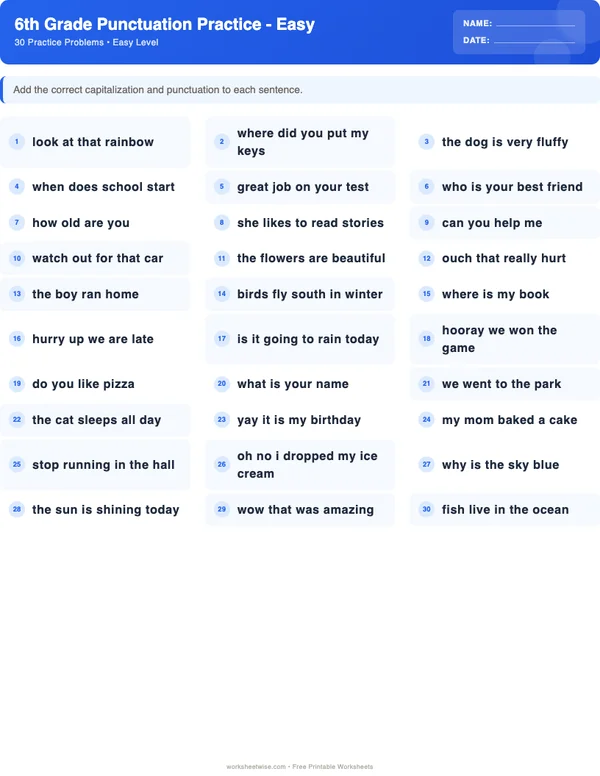
The free standard easy punctuation worksheet contains 30 exercises on capitalization, periods, question marks, and exclamation marks. It is a suitable choice when screening or reinforcing those foundations. It does not, by itself, cover the full progression described in this guide.
Differentiate support without changing the underlying rule
For a learner who needs more support:
- reduce the number of marks under consideration;
- read the sentence aloud and identify its purpose;
- color-code subjects and verbs;
- box complete clauses;
- provide an expansion line for contractions;
- label “speaker tag” and “spoken words” before punctuating dialogue; and
- allow the learner to correct one sentence at a time.
For a learner ready for greater challenge:
- remove rule labels;
- combine two sentences in more than one correct way;
- ask for a written explanation of each change;
- include sentences containing two punctuation decisions;
- edit a short science or social studies explanation; and
- compare a semicolon revision with a two-sentence revision.
Difficulty should come from reasoning and transfer, not merely from adding more sentences.
Diagnosing Common Errors
An error pattern points toward the next teaching move.
| Observed error |
Likely unfinished understanding |
Diagnostic prompt |
Teaching response |
| Missing end marks |
Sentence boundaries or purposes are unclear |
“Where does one complete thought end?” |
Separate a paragraph into sentences before choosing marks |
| Comma before every and |
Rule memorized without clause analysis |
“Can both sides stand alone?” |
Box clauses and compare one-subject and two-subject examples |
| Comma splice |
Learner recognizes two thoughts but not valid joining choices |
“What joins these complete sentences?” |
Compare period, semicolon, and comma-plus-conjunction revisions |
| Apostrophe in a plural |
Final s mistaken for possession |
“Is this counting or belonging?” |
Sort plural, contraction, and possession examples |
| It’s/its confusion |
Omission and possession are not distinguished |
“Can you replace it with it is?” |
Use the expansion test before selecting the spelling |
| Period outside a dialogue quotation |
Spoken sentence and surrounding sentence are not coordinated |
“Which mark ends the spoken words?” |
Label quotation, speaker tag, and end mark separately |
| Colon after an incomplete lead-in |
Colon treated as a signal for any list |
“Can the words before the colon stand alone?” |
Complete the announcing clause before adding the colon |
| Correct answers but weak explanations |
Pattern recognition without a stable rule |
“Why is that mark needed?” |
Require a clause, list, ownership, or dialogue explanation |
| Accurate exercises but errors in writing |
Limited transfer |
“Can you find the same structure in your paragraph?” |
Add a focused editing pass immediately after composition |
Do not infer a permanent weakness from one incorrect response. Check the same convention in a fresh sentence, then in connected writing. A repeated pattern is more useful for planning than a single miss.
Monitoring Progress Without Over-Testing
Track a small amount of information consistently:
| Date |
Convention |
Task type |
Correct/attempted |
Explained rule? |
Prompt needed? |
Transfer sentence correct? |
| Example |
Compound sentence comma |
Correction |
4/5 |
Yes |
Once |
Yes |
Review the record every few sessions. Look for changes across task types.
- High accuracy in insertion but low accuracy in writing suggests that the learner needs transfer practice.
- Accurate choices with frequent prompts suggest that support should fade gradually.
- Repeated errors in one convention suggest focused practice rather than a larger mixed set.
- Errors across several marks may point back to sentence boundaries or clause recognition.
A practical advancement check is to present four new sentences: one familiar structure, two varied examples of the same rule, and one sentence that looks similar but does not require the mark. The boundary case reveals whether the learner understands the condition for using the punctuation.
A Two-Week Practice Plan
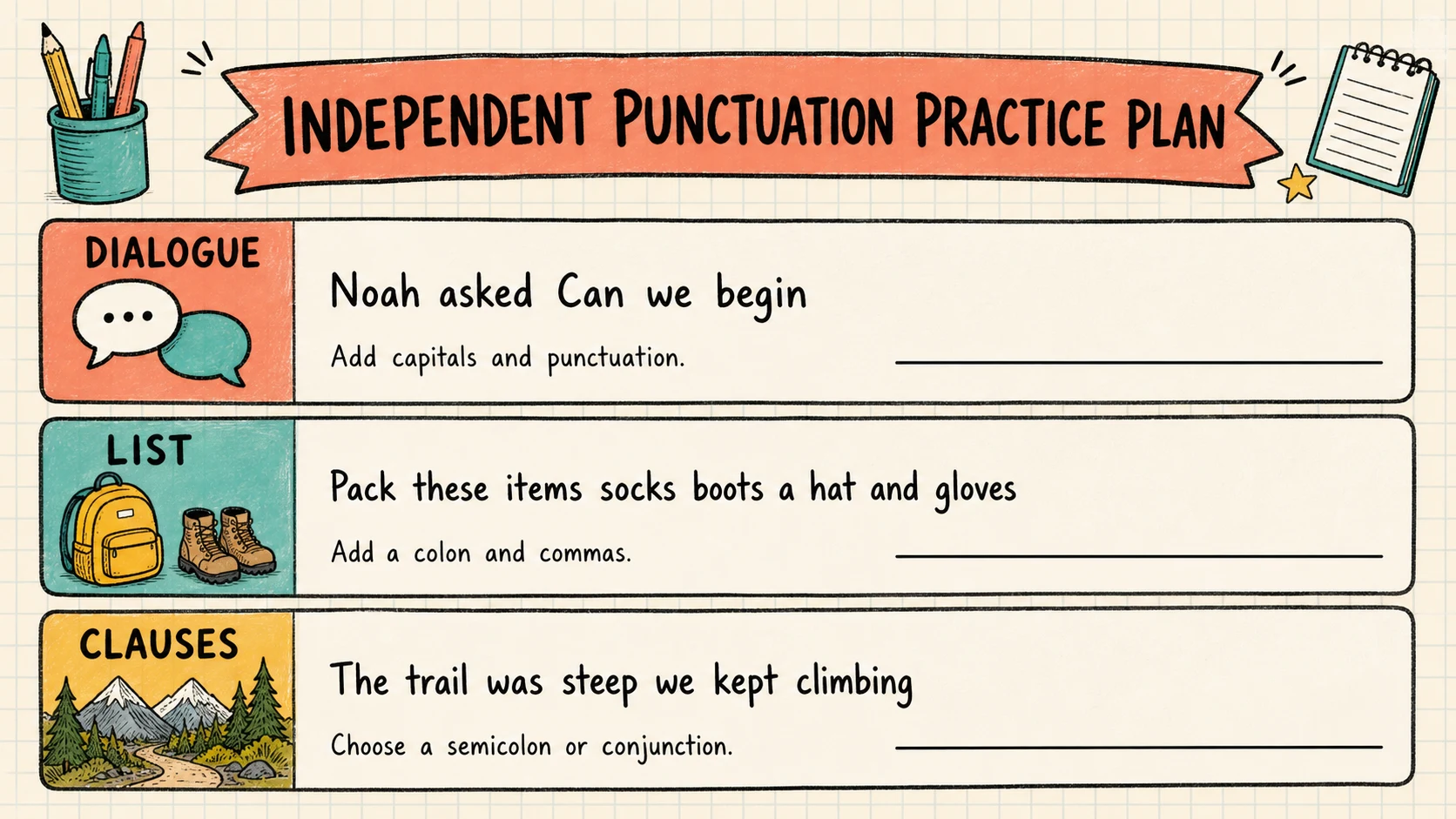
The plan alternates focused instruction, cumulative review, editing, and writing.
This plan uses ten short sessions. It is a starting structure, not a universal timetable. Repeat, combine, or postpone sessions according to observed work.
| Day |
Focus |
Suggested activity |
Quick evidence |
| 1 |
Baseline: capitals and end marks |
Correct eight unpunctuated sentences, including statements, questions, and exclamations |
Record error types, not only total correct |
| 2 |
Lists, dates, and introductory elements |
Label each comma’s job in six sentences |
Learner explains which words each comma separates |
| 3 |
Compound sentences |
Box clauses and compare comma/no-comma pairs |
Learner tests both sides of the conjunction |
| 4 |
Apostrophes |
Sort contractions, singular possessives, plural possessives, and ordinary plurals |
Learner uses expansion and ownership tests |
| 5 |
Review and transfer |
Edit a short paragraph, then write three sentences using the week’s conventions |
Compare prepared editing with original writing |
| 6 |
Dialogue |
Mark speaker tags and spoken words before adding punctuation |
Learner retains question or exclamation marks inside quotations |
| 7 |
Colons |
Separate complete announcing clauses from incomplete lead-ins |
Learner accepts and rejects colon examples correctly |
| 8 |
Semicolons |
Join related complete sentences; compare with period revisions |
Learner verifies an independent clause on each side |
| 9 |
Mixed editing |
Correct a paragraph containing several error types and explain four changes |
Note which conventions remain prompt-dependent |
| 10 |
Review and next decision |
Recheck initial error patterns with new examples and one original paragraph |
Continue, narrow, or advance based on current evidence |
If Day 3 shows persistent difficulty identifying complete thoughts, do not proceed automatically to semicolons on Day 8. Replace that session with clause work. If apostrophes are secure on Day 4, keep them in brief review rather than assigning another full lesson.
What This Guide and the Materials Do Not Establish
This guide offers a teachable progression and checked examples, but it cannot determine an individual learner’s complete instructional program. A worksheet score alone does not reveal whether an error came from misunderstanding, haste, reading difficulty, or an unfamiliar sentence.
The catalogue describes the practice level, topics, directions, and included answer key. It does not provide research findings about outcomes, named evaluations, or guarantees. The authoritative sources cited above offer broad literacy and writing guidance; they did not review WorksheetWise or this specific punctuation material.
The supplied standards information spans punctuation expectations developed across earlier grades, including end punctuation, commas, apostrophes, possessives, and dialogue. It can help identify prerequisite conventions. It should not be interpreted as comprehensive alignment with every state, district, school, or homeschool sequence.
The Most Useful Next Step
Begin with a brief sample rather than the entire progression. Ask the learner to complete ten items from the free 6th Grade Punctuation worksheet, explain three answers, and revise one original sentence. Use the resulting errors to choose the next lesson: sentence boundaries first, then the specific punctuation convention that the learner’s work shows is ready for attention.