What 3rd Grade Sentence Structure Includes
3rd Grade Sentence Structure instruction helps a learner arrange words in a sensible order, produce complete thoughts, identify subjects and predicates, repair fragments and run-ons, add useful details, and combine related ideas. The immediate goal is not longer writing. It is clearer writing: every word should contribute to a sentence the reader can follow.
A practical teaching sequence is:
- Establish correct word order.
- Check whether a sentence expresses a complete thought.
- Locate the subject and predicate.
- Expand a basic sentence with relevant details.
- Join closely related ideas.
- apply these skills in original writing.
Move forward according to the learner’s observed work. A child who can label a subject but still writes fragments needs more work on completeness, not harder terminology. A child who consistently writes complete sentences may be ready for sentence combining even if occasional spelling errors remain.
Grade labels describe the intended practice level, not a fixed developmental timetable. Local curricula and instructional sequences differ. The Common Core State Standards for English Language Arts include third-grade work with simple, compound, and complex sentences, but that reference should be used for broad planning rather than as a claim that every activity or worksheet covers every applicable standard.
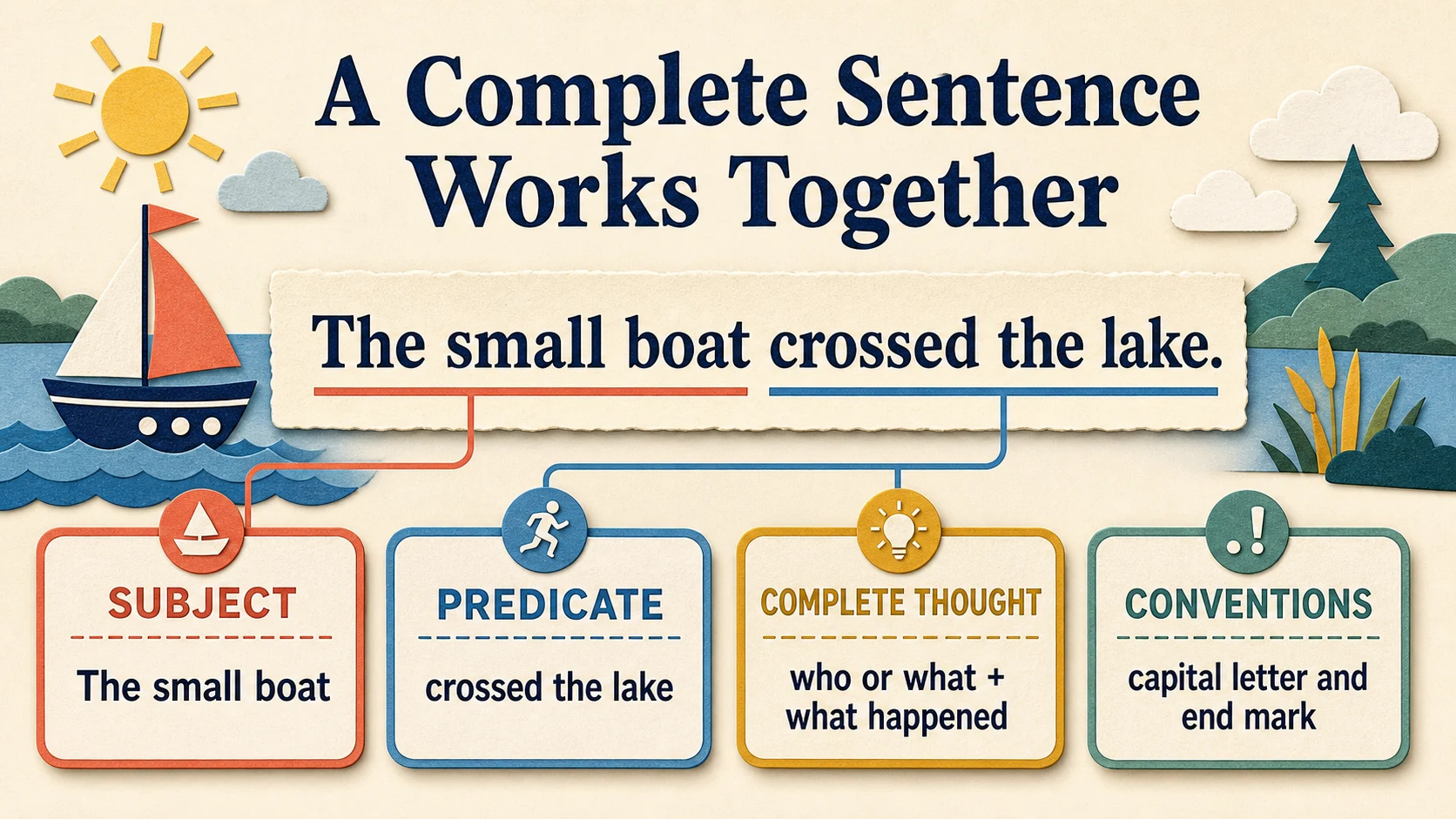
The skill develops from orderly, complete sentences toward expanded and combined ideas.
Prerequisites to Check Before Teaching
Sentence-structure difficulties do not always begin with sentence structure. Before assigning a page of written exercises, check whether the learner can say the intended sentence, read the words in the task, and identify the action or state being described.
Oral sentence awareness
Say a complete sentence and a phrase:
- “The puppy slept beside the chair.”
- “Beside the chair.”
Ask the learner to repeat each one and explain which sounds complete. If the learner recognizes that the second group leaves the listener waiting, oral work can support the move into print.
When the distinction is unclear, use the topic’s simple framework:
- Who or what?
- Did what, is what, or was what?
For “The puppy slept,” the answers are “the puppy” and “slept.” For “The blanket is warm,” they are “the blanket” and “is warm.”
This framework is instructional language, not a complete grammatical definition. It gives a third grader a concrete starting point.
Basic word roles and print conventions
Check whether the learner can usually:
- Recognize a naming part and an action or state.
- Read a short sentence from left to right.
- Leave spaces between written words.
- Begin a sentence with a capital letter.
- Select suitable end punctuation.
- Keep a verb connected to the intended subject.
These skills may be taught alongside sentence structure, but a task should not hide the target under too many simultaneous demands. If handwriting, decoding, spelling, and punctuation all require substantial effort, let the learner arrange printed word cards or dictate a response before copying it.
The IES guide on foundational skills that support reading through third grade provides high-level instructional framing for connecting spoken language, word reading, and meaning. It does not evaluate WorksheetWise materials or prescribe this exact sequence.
A Grade-Appropriate Teaching Progression
The following progression moves from visible, constrained tasks to independent construction. It is a planning guide rather than a universal timetable.
| Stage |
Main instructional target |
Supported task |
Evidence of readiness to continue |
| 1. Order |
Arrange words into conventional sentence order |
Rebuild a sentence from word cards |
The learner orders several sentences and reads them naturally |
| 2. Completeness |
Distinguish sentences from fragments |
Match a subject with a predicate |
The learner explains what a fragment is missing |
| 3. Core parts |
Identify the complete subject and predicate |
Mark who or what, then what is said about it |
The learner identifies both parts without relying only on position |
| 4. Expansion |
Add precise details without losing the sentence core |
Add where, when, or how information |
The expanded sentence remains complete and logical |
| 5. Combining |
Join related ideas without creating a run-on |
Combine repeated subjects or use a conjunction |
The learner can explain how the ideas are connected |
| 6. Application |
Use varied complete sentences in writing |
Revise a short paragraph |
The learner detects and repairs errors with decreasing support |
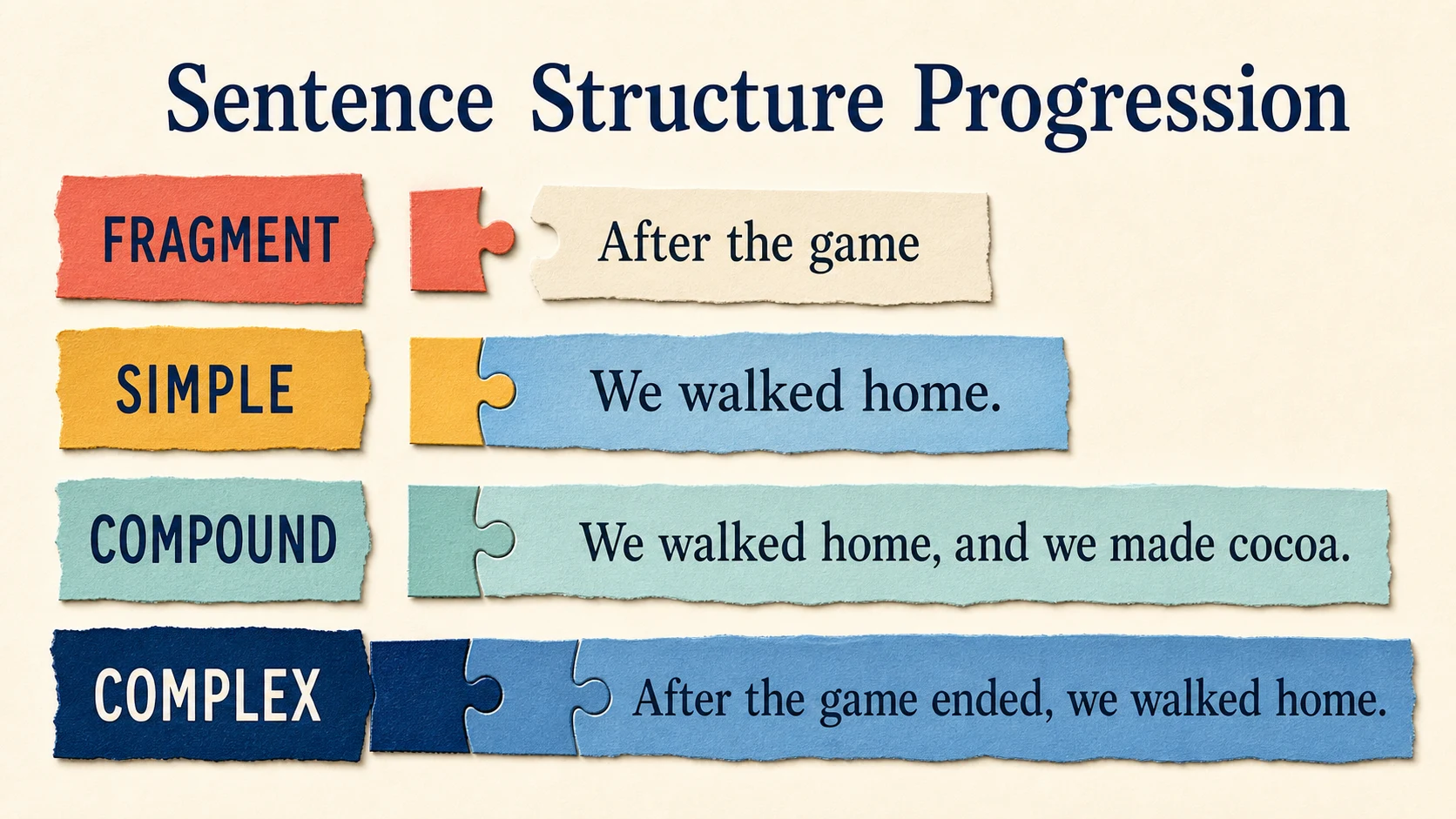
Support can be reduced as the learner demonstrates accurate, explainable decisions.
Do not interpret one correct response as mastery. Change the wording and task format. A learner might rearrange familiar words successfully but still write fragments during an original paragraph. Conversely, a child may write clear sentences while finding grammar labels difficult. Record these as different observations.
The 3rd Grade Grammar collection can help adults compare sentence-structure practice with related grammar work. Keep the main lesson focused on one decision at a time.
Concrete and Visual Models
Sentence structure becomes easier to discuss when the learner can see what each part contributes.
The two-part sentence frame
Use two cards or boxes:
| Who or what? |
What about it? |
| The red fox |
waited near the fence. |
| Our new seedlings |
are growing quickly. |
| Jamal and Priya |
carried the box. |
Cover one side. Read what remains. The incomplete message makes the role of the missing part noticeable.
The left box represents the complete subject, and the right box represents the complete predicate. A one-word subject or verb can be identified later, but beginning with complete parts preserves meaning. In “The red fox waited near the fence,” the complete subject is “The red fox,” not only “fox.”
The sentence train
Write one meaningful unit on each connected card:
After lunch, → the class → reads → quietly.
The sentence core is “the class reads.” The other units add when and how. Remove one unit at a time:
- “The class reads.” remains complete.
- “After lunch, reads quietly.” lacks a stated subject.
- “After lunch, the class.” does not say what the class does or is.
This model distinguishes essential structure from optional detail. It also prevents the misconception that a long word group must be a sentence.
Color and movement
Use one consistent color for subjects and another for predicates. A third color can show added details. Have the learner physically move cards to compare:
- “The squirrel quickly climbed.”
- “Quickly, the squirrel climbed.”
- “The squirrel climbed quickly.”
All three arrangements can communicate the same central event, although their emphasis and punctuation may differ. The purpose is to explore workable arrangements, not to suggest that words can be moved anywhere.
Fully Checked Worked Examples
Worked example 1: Restoring word order
Arrange these words:
quickly / the small rabbit / hops
- Find the subject: “the small rabbit.”
- Find what the rabbit does: “hops.”
- Place the manner word where it reads naturally: “quickly.”
- Add capitalization and punctuation.
Answer: “The small rabbit hops quickly.”
Check:
- Who or what? The small rabbit.
- Does what? Hops quickly.
- Complete thought? Yes.
- Conventional order? Yes.
“The small rabbit quickly hops” is also grammatical. If a task expects one answer, choose the most natural elementary model, but acknowledge another correct arrangement when it preserves meaning and grammar.
Worked example 2: Finding complete sentence parts
Sentence: “The birds in the tall tree sing at dawn.”
- Complete subject: The birds in the tall tree
- Complete predicate: sing at dawn
- Simple subject: birds
- Verb: sing
Check by reducing the sentence to its core: “Birds sing.” The added phrases specify which birds and when they sing.
A common incorrect division is “The birds / in the tall tree sing at dawn.” That split treats part of the subject’s description as though it belonged only to the predicate. Ask which words identify the birds. “In the tall tree” helps identify them in this sentence.
Worked example 3: Repairing a fragment
Fragment: “After the heavy storm.”
The group provides a time relationship, but it does not state what happened after the storm.
Possible repair: “After the heavy storm, the neighbors checked the yard.”
Check:
- Introductory information: After the heavy storm.
- Subject: the neighbors.
- Predicate: checked the yard.
- Complete thought? Yes.
Another possible repair is “The sun appeared after the heavy storm.” More than one answer can be correct because the missing information may be supplied in different ways.
Worked example 4: Repairing a run-on
Run-on: “Mia opened the book she found a map.”
The string contains two complete thoughts:
- Mia opened the book.
- She found a map.
Two checked repairs are:
- “Mia opened the book. She found a map.”
- “Mia opened the book, and she found a map.”
The first uses a period. The second uses a comma and the conjunction “and” to connect two complete clauses. A comma alone—“Mia opened the book, she found a map”—does not make this model correct.
Worked example 5: Combining a repeated subject
Original sentences:
- “The kite rose.”
- “The kite dipped.”
Both sentences have the same subject. Keep it once and join the predicates:
Answer: “The kite rose and dipped.”
Check:
- Subject: the kite.
- Combined predicate: rose and dipped.
- Meaning preserved? Yes.
- Unnecessary repetition removed? Yes.
A comma is not needed between the two verbs in this sentence.
Worked example 6: Building a complex sentence
Ideas:
- The bell rang.
- The students packed their bags.
Show the time relationship:
Answer: “When the bell rang, the students packed their bags.”
“When the bell rang” cannot stand alone here. It prepares the reader for the main clause, “the students packed their bags.” The completed sentence expresses the relationship clearly.
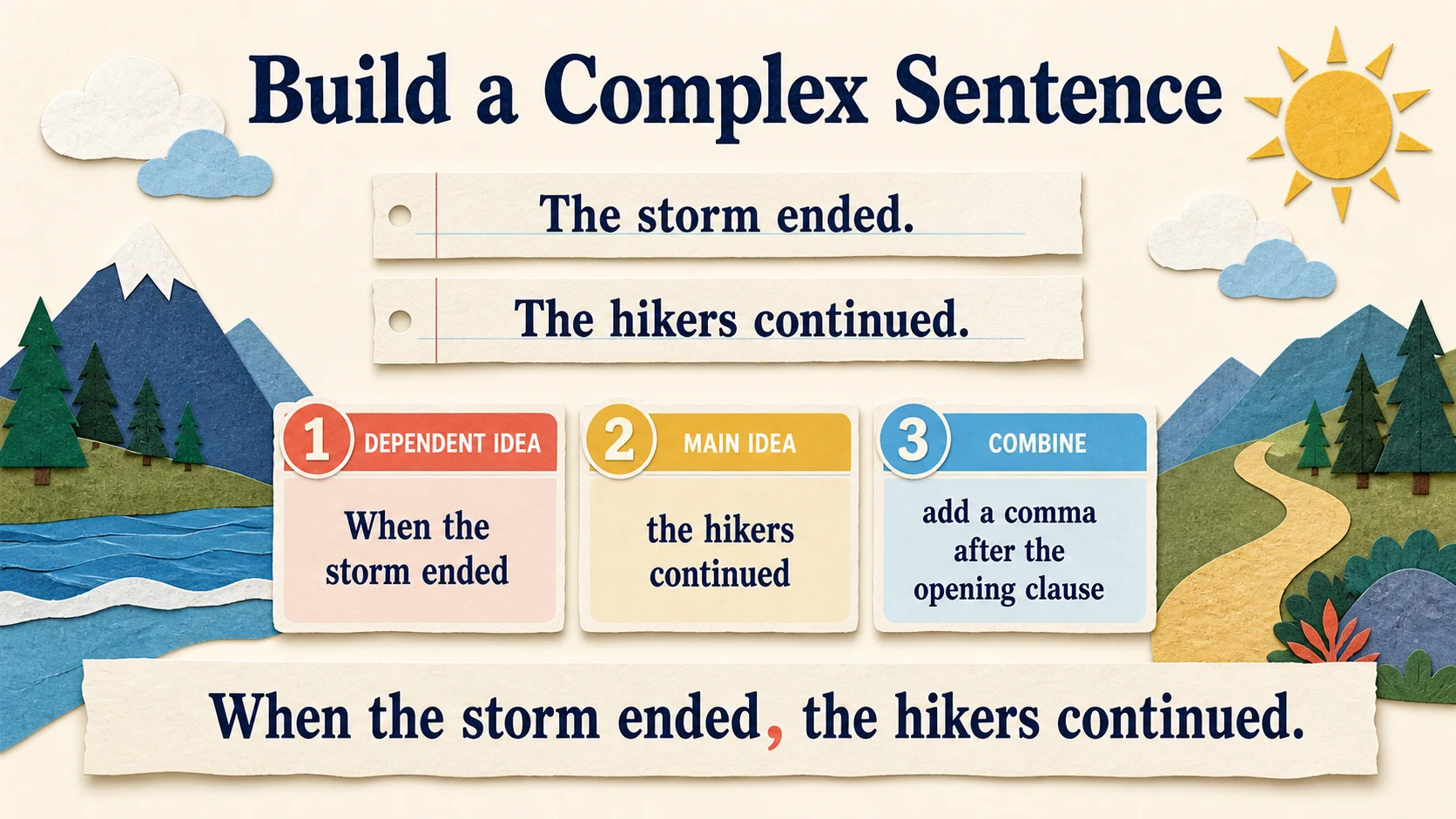
Each solution is checked for order, completeness, meaning, capitalization, and punctuation.
Boundary Cases That Need Careful Explanation
Simple rules are useful, but learners also need examples that prevent those rules from becoming misconceptions.
Commands have an understood subject
“Close the gate.” is a complete sentence. The subject “you” is understood even though it is not written. Do not teach that every complete sentence visibly begins with a naming word.
Use a contrast:
- “Close the gate.” Complete command.
- “Near the gate.” Fragment.
The first tells the listener to do something. The second supplies only a location.
Questions may reverse familiar order
“The dog is sleeping.” follows a familiar subject-then-verb pattern. In “Is the dog sleeping?” part of the verb appears before the subject. The question is still complete.
Word-order work should therefore include declarative sentences first, followed by clearly modeled questions, commands, and exclamations. The catalogue progression includes these sentence purposes, but learners do not need to master every form at once.
A sentence can be short
“Birds fly.” is complete. “The colorful birds near our window” is longer but remains a fragment because it does not say what the birds do or are.
Length, a capital letter, and a period are clues, not proof of completeness. The words must form a complete thought.
“And” does not automatically fix a run-on
“The rain stopped and the team returned to the field” contains two complete clauses joined by “and.” In edited writing, a comma before the conjunction makes the boundary clearer:
“The rain stopped, and the team returned to the field.”
By contrast, “The team returned and finished the game” has one subject with two predicates. It does not need a comma between “returned” and “finished.”
At this level, prioritize recognizing the number of complete thoughts. Terminology should support the decision rather than replace it.
A Short, Repeatable Lesson Routine
A focused routine can fit into a brief grammar lesson, tutoring session, or homeschool block. Ten to fifteen minutes is a practical starting suggestion, not a sourced or universal requirement.
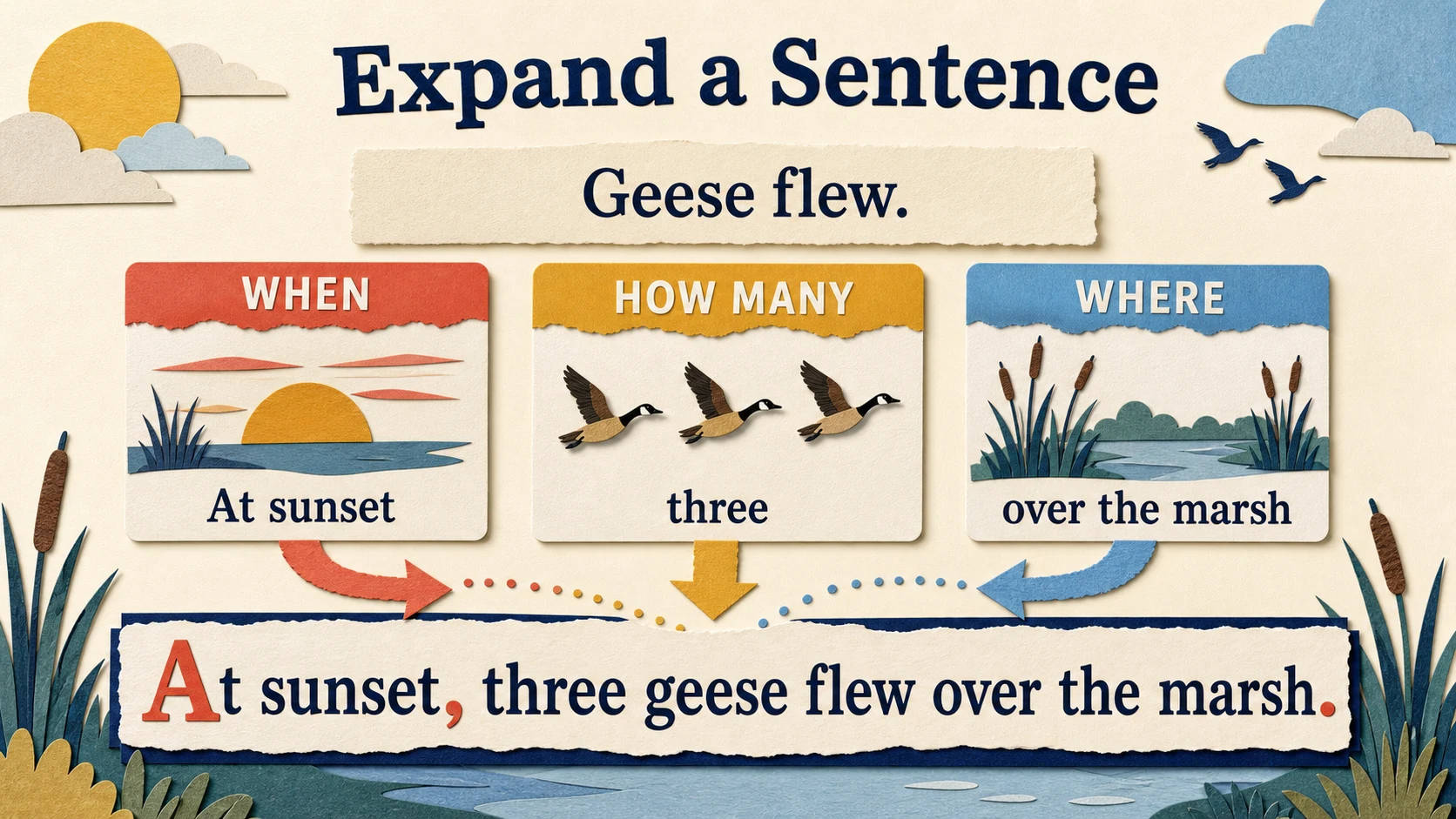
The routine moves from oral noticing to supported construction and independent use.
1. Hear the structure
Read one complete sentence and one fragment aloud. Ask the learner to identify the complete message and explain what the other group needs.
2. See the parts
Write the day’s model sentence. Mark the complete subject and predicate. If the lesson target is combining, draw a line under each complete thought instead.
3. Build together
Complete two examples collaboratively. Ask the learner to make each choice:
- Which words name who or what?
- What is being said about that subject?
- Where does one complete thought end?
- Which detail improves meaning?
4. Try independently
Give two to four short items with the same target. Avoid changing the task type while also removing all support.
5. Apply and check
Ask the learner to write or revise one original sentence. End with a five-part check:
- Does it make sense?
- Is it complete?
- Are the words in a workable order?
- Does the punctuation match the structure?
- Can the learner read it aloud smoothly?
The IES guide on teaching elementary students to be effective writers supports high-level planning around explicit instruction, writing practice, and the writing process. This routine is an instructional application, not a quotation from the guide or a claim that the guide tested this worksheet.
Choosing the Right Practice
Practice should match the next observable need. More difficult pages are not automatically more useful.
| Observed work |
Best next practice |
Reduce or postpone |
| Words appear in an unusual or confusing order |
Rebuild short sentences from cards or scrambled words |
Open-ended paragraph writing |
| Sentences omit a subject or predicate |
Complete two-part frames and sort sentences from fragments |
Sentence-style variation |
| Core sentences are complete but bare |
Add one relevant where, when, or how detail |
Multi-clause combinations |
| Writing repeats the same subject |
Combine predicates with “and” |
Unrelated complex-sentence drills |
| Two complete thoughts run together |
Mark clause boundaries; repair with a period or modeled conjunction |
Longer free writing without revision |
| Worksheet answers are accurate but original writing is not |
Edit the learner’s own two- or three-sentence passage |
More recognition-only items |
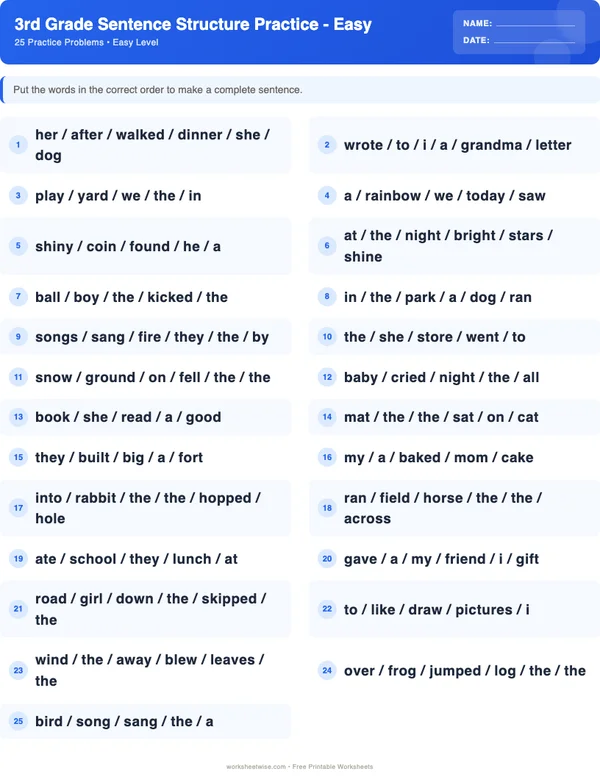
The free easy sentence-structure worksheet contains 14 exercises in which learners arrange words to make complete sentences. It specifically practices word order, sentence formation, syntax, and grammar. A separate printable answer key is available. Select it when scrambled-word work matches the learner’s need, not merely because it carries a third-grade label.
For broader repeated practice, the focused Sentence Structure Pack contains 18 worksheets. Review a sample of the learner’s work before choosing additional pages so that volume does not replace diagnosis.
Differentiation Without Changing the Core Goal
Increase support
For a learner who is not yet successful:
- Say the sentence before asking for writing.
- Limit a scramble to four or five word groups.
- Print the subject on one color and the predicate on another.
- Provide two possible conjunctions and compare their meanings.
- Let the learner move cards before copying.
- Use familiar vocabulary so decoding does not obscure syntax.
- Check one sentence immediately before assigning the next.
If the learner can build the sentence orally but not in writing, preserve oral construction as evidence while separately supporting transcription.
Extend the work
For a learner who is consistently accurate:
- Ask for two correct arrangements and discuss emphasis.
- Replace vague details with more precise ones.
- Combine three related short sentences without losing information.
- Change a statement into a question or command.
- Write one simple, one compound, and one complex sentence about the same event.
- Revise a paragraph that begins every sentence in the same way.
Extension should deepen control, not reward accuracy with excessive repetition.
Separate structure from mechanics when necessary
A learner may produce a well-structured sentence with a spelling error. Another may copy capitalization perfectly while leaving out a predicate. Mark the structural target separately from spelling, handwriting, and punctuation. Then decide whether a mechanics error needs immediate teaching or a later lesson.
This separation is an instructional suggestion. It does not mean mechanics are unimportant; it keeps the evidence interpretable.
Common Errors and Diagnostic Responses
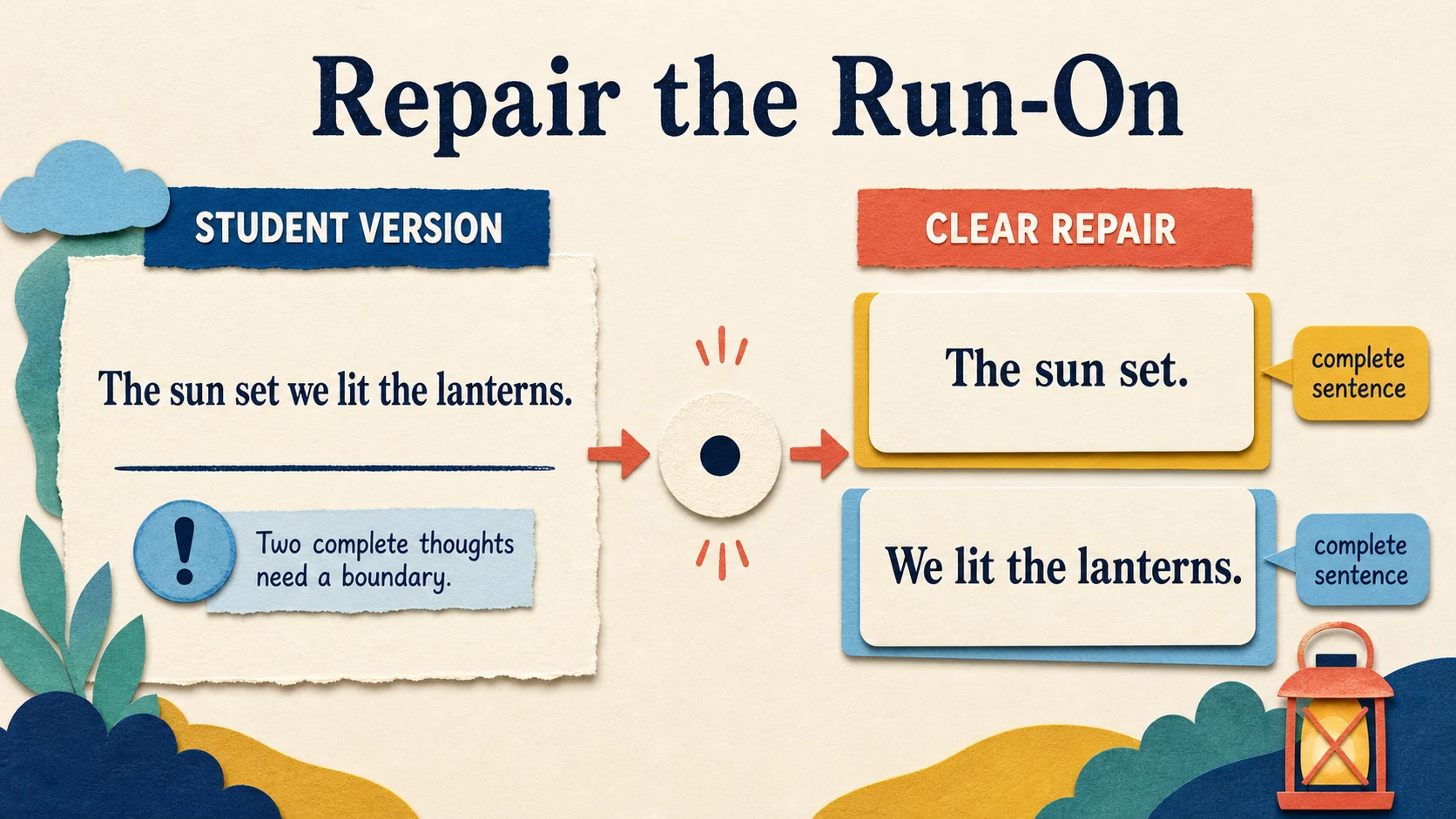
The correction should respond to the cause visible in the learner’s work.
The learner calls every long group a sentence
Likely issue: sentence length is being used as the test for completeness.
Response: compare “Owls hunt” with “The large brown owl in the old tree.” Identify what the longer group still needs.
The learner identifies the first word as the subject
Likely issue: position has replaced meaning.
Response: use “After lunch, Maya reads.” Ask who reads. Move “After lunch” to the end and ask again. The subject remains Maya.
The learner joins every idea with “and”
Likely issue: the learner knows one combining tool but is not checking the relationship or sentence boundary.
Response: sort examples into three choices: keep separate, combine repeated predicates, or join two complete related thoughts. Require an oral explanation before punctuation is added.
The learner inserts a comma wherever there is a pause
Likely issue: speech rhythm is being treated as a complete punctuation rule.
Response: first underline complete thoughts. Then decide whether the sentence contains an introductory unit, a combined predicate, or two clauses joined by a conjunction.
The learner fixes fragments by adding a period
Likely issue: visible sentence markers are being confused with structural completeness.
Response: remove capitalization and punctuation temporarily. Ask the learner to supply the missing who, what, action, or state. Restore mechanics only after the thought is complete.
The learner succeeds on worksheets but not in paragraphs
Likely issue: the learner recognizes structure in constrained exercises but does not yet monitor it while generating ideas.
Response: shorten the writing task. Have the learner draft two sentences, pause, underline each subject once and predicate twice, repair as needed, and then continue.
Monitoring Progress From Actual Work
Use a small, repeatable sample rather than relying on a general impression. Once or twice a week, collect:
- One arranged sentence.
- One fragment or run-on repair.
- One sentence combination.
- Two original sentences about a familiar topic.
For each item, record whether the learner:
- Preserved the intended meaning.
- Produced a complete thought.
- Used workable word order.
- Marked sentence boundaries.
- Explained the choice.
- Corrected an error after a prompt.
- Corrected an error independently.
Explanations matter because a lucky answer does not reveal a dependable strategy. At the same time, do not require elaborate grammar vocabulary when the learner can make and explain the correct structural decision in plain language.
A useful pacing rule is to continue the present level when errors are frequent or explanations are uncertain, reduce support when performance is accurate across different examples, and return briefly to an earlier model when the skill disappears in original writing. This is an instructional decision rule, not a guaranteed schedule.
Keep dated samples. Compare the learner with their own earlier work rather than with an invented norm.
A Two-Week Practice Plan
This ten-session plan assumes short, regular practice. Adapt the number and length of sessions to the learner’s work, local sequence, and available time.
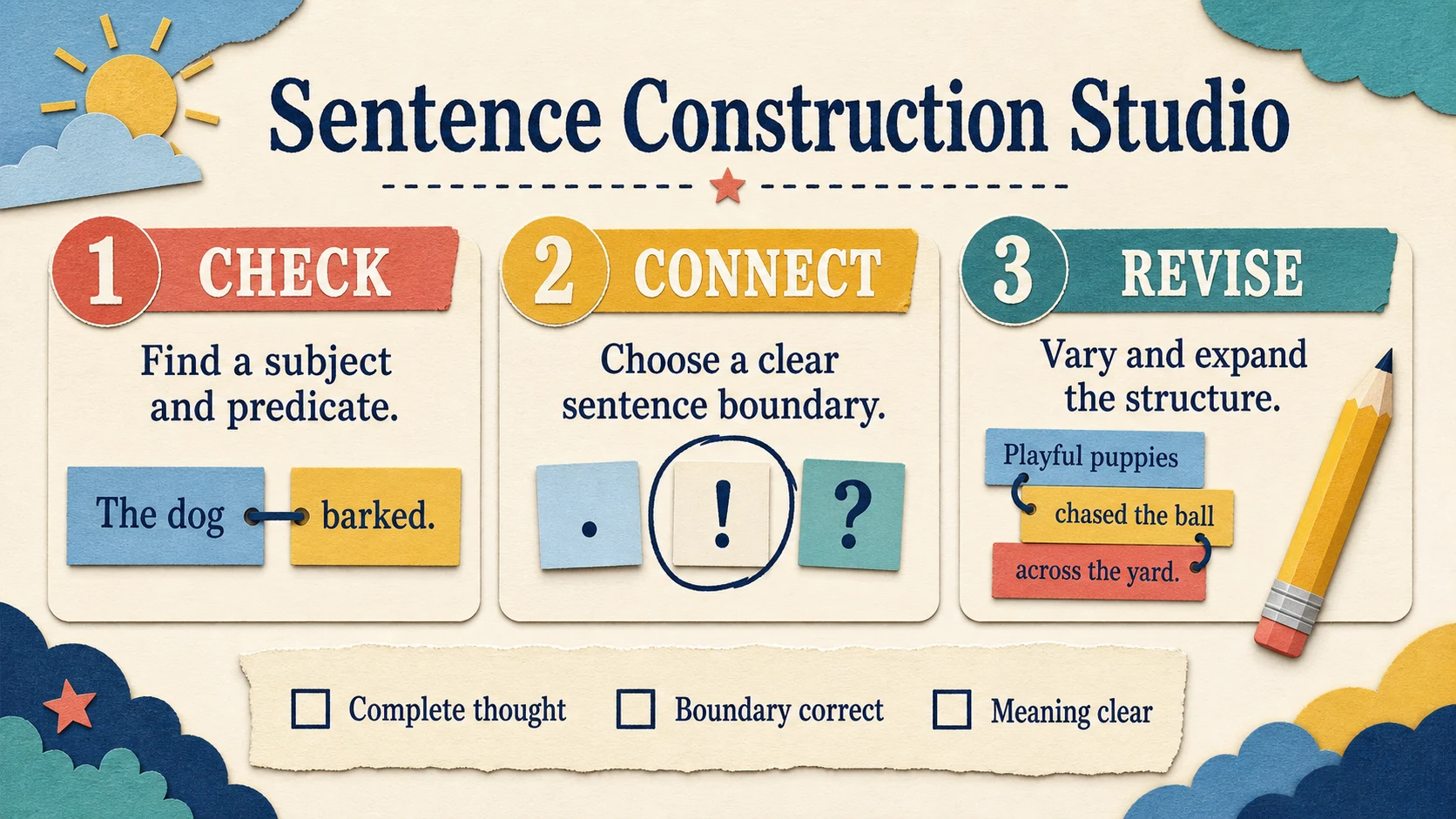
The plan alternates modeling, focused practice, application, and review.
| Day |
Focus |
Suggested activity |
Quick evidence |
| 1 |
Baseline |
Arrange one sentence, repair one fragment, and write two original sentences |
Note the first point of difficulty |
| 2 |
Word order |
Build four short sentences from cards; read each aloud |
Learner explains why the order works |
| 3 |
Complete thoughts |
Sort sentences and fragments; complete three fragments |
Learner names the missing part |
| 4 |
Subjects and predicates |
Mark complete subjects and predicates in five sentences |
Accuracy holds when details come first |
| 5 |
Review and application |
Write three sentences, including one with an opening detail |
Learner checks completeness independently |
| 6 |
Sentence expansion |
Add one useful where, when, or how detail to four core sentences |
Added details remain logical |
| 7 |
Shared-subject combining |
Combine pairs such as “The dog ran. The dog jumped.” |
Repetition is removed without changing meaning |
| 8 |
Clause boundaries |
Repair two run-ons with periods and two with modeled conjunctions |
Learner identifies both complete thoughts |
| 9 |
Complex-sentence model |
Build sentences beginning with “when” or “after” |
Each dependent opening is completed |
| 10 |
Review sample |
Repeat the Day 1 task with new content |
Compare independence, accuracy, and explanation |
If Day 4 reveals uncertain subject identification, do not force the plan forward. Repeat the two-part model with different sentences. If Day 8 is easy and accurately explained, move sooner into paragraph revision. The learner’s observed work controls pacing.
Scope, Limitations, and the Next Instructional Step
Sentence-structure practice can make sentence decisions visible, but it cannot by itself show every reason a learner finds writing difficult. A short exercise does not fully measure idea development, vocabulary, spelling, handwriting, reading fluency, attention, or organization. This guide does not provide medical guidance, certification, guaranteed outcomes, or comprehensive standards alignment.
It also does not establish one mandatory third-grade timetable. “3rd Grade” describes the intended practice level. Schools, states, curricula, and homeschool programs may introduce or revisit these skills in different sequences.
The honest next step is to gather a small work sample and choose the narrowest useful target. If word order is the current need, begin with the free 3rd Grade Sentence Structure worksheet. Check a few responses immediately, then ask the learner to write one new sentence using the same pattern. Use that transfer attempt—not the worksheet score alone—to decide whether to repeat, reduce support, or move into sentence expansion and combining.