What 2nd Grade Parts of Speech Instruction Should Cover
Second-grade learners should first become secure at finding and using nouns, verbs, and adjectives in complete, understandable sentences. Once those three categories are reasonably stable, instruction can extend to pronouns and frequently occurring adverbs and conjunctions. Prepositions can be introduced concretely through location words such as under, beside, and between. The learner does not need to classify all eight traditional parts of speech at once.
The practical goal is not memorizing a list of labels. It is noticing what a word does in a particular sentence and then using that knowledge to understand, expand, revise, or create sentences. A learner who can explain that rabbit names something, hops tells what it does, and small describes it has a useful foundation for later grammar work.
Grade labels describe the intended practice level, not a universal timetable. Local curricula and instructional sequences differ. The learner’s observed work should determine whether to move forward, review an earlier category, or reduce the number of choices.
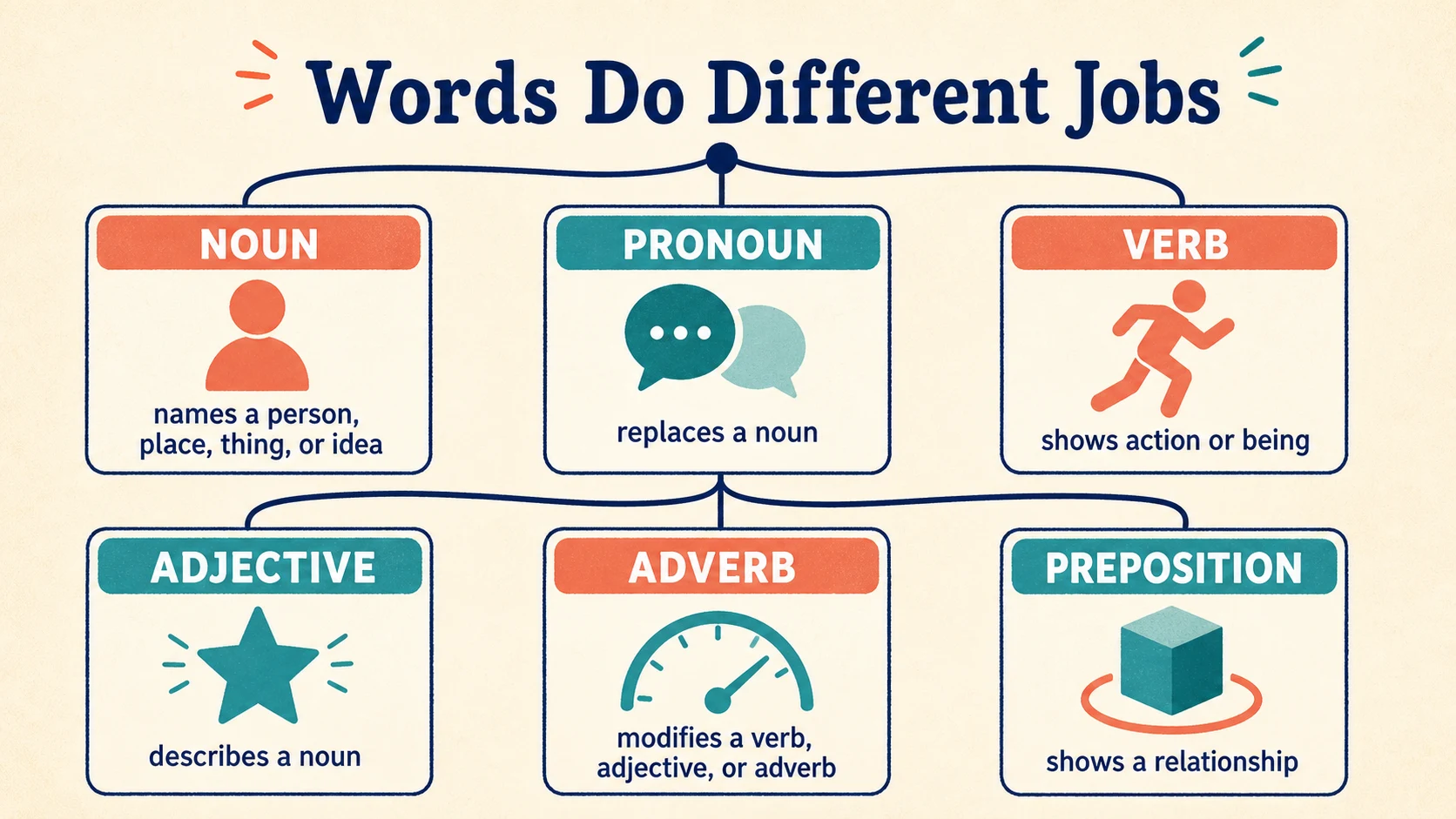
Begin with the sentence roles that are easiest to demonstrate, then add categories in manageable layers.
The 2nd Grade Grammar collection provides practice across the subject. Within it, parts-of-speech work is most useful when adults choose exercises according to the learner’s current errors rather than simply completing pages in order.
Why Parts of Speech Matter in Reading and Writing
Parts of speech give adults and learners a shared vocabulary for discussing sentences. Instead of saying, “Make this better,” an adult can say, “Can you replace the general noun thing with a more specific noun?” or “Which verb shows exactly what the dog did?”
The IES foundational reading practice guide emphasizes systematic instruction in foundational reading skills and the importance of helping learners connect words with meaning in text. Parts-of-speech instruction can contribute to that larger purpose when words are examined in meaningful sentences. The source does not evaluate WorksheetWise or prescribe this particular lesson sequence.
The IES elementary writing practice guide recommends regular writing opportunities and instruction in the writing process. A short grammar lesson can support that work when learners apply a category to an actual sentence—for example, choosing a more precise verb while revising. Merely circling words on a page does not by itself show that the learner can use them effectively in writing.
The Common Core English Language Arts standards provide one widely used reference point. Their grade-two language expectations include work with collective and irregular plural nouns, regular and irregular verbs, adjectives, and adverbs. They also build on earlier work with frequently occurring nouns, verbs, pronouns, adjectives, and conjunctions. This guide uses that source only for broad instructional context; it does not claim comprehensive standards alignment for every activity or worksheet mentioned here.
Prerequisites to Check Before Teaching Labels
A learner does not need formal grammar mastery before beginning parts of speech, but several underlying abilities make the work more manageable.
Recognizing a complete thought
Check whether the learner can hear the difference between a complete statement and an incomplete group of words:
- The blue kite sailed. expresses a complete thought.
- The blue kite names something but does not tell what happened.
- Sailed over the trees tells an action but leaves the doer unstated in this form.
Do not turn this check into a long sentence-fragment unit. Its purpose is to make sure the learner has enough sentence context to decide what each word is doing.
Understanding naming and action words
Ask the learner to name a person, place, or thing in the room and demonstrate an action. Concrete prompts might produce teacher, desk, door, clap, turn, and write. Ideas are also nouns, but abstract nouns such as kindness are less convenient starting examples than visible people, places, and objects.
Reading the practice sentences accurately
If decoding the words consumes most of the learner’s attention, read the sentence aloud while pointing to each word. The grammar target can remain the same. This support separates a reading difficulty from a parts-of-speech difficulty.
Using oral sentences
Give a noun such as bird and ask for a complete oral sentence. If the learner says, “The bird flies,” the sentence already provides a noun and a verb to examine. If the learner gives only “blue bird,” model a complete sentence before asking for classification.
A Grade-Appropriate Teaching Progression
The following progression is an instructional suggestion, not a required schedule. Move ahead when the learner can identify the current category in varied sentences and explain the choice in simple language.
| Stage |
Main focus |
Supported task |
Evidence that suggests readiness to continue |
| 1 |
Concrete nouns and action verbs |
Sort familiar words, act out verbs, and locate each category in short sentences |
The learner usually explains “names” versus “shows an action” without relying on word position |
| 2 |
Adjectives |
Describe a familiar object, then find the describing word in a sentence |
The learner connects the adjective to the noun it describes |
| 3 |
Nouns, verbs, and adjectives together |
Mark each category with a different symbol or color |
The learner classifies the target words and can justify the choices |
| 4 |
Pronouns |
Replace a repeated noun with he, she, it, we, or they where the meaning stays clear |
The learner can identify what the pronoun stands for |
| 5 |
Frequently occurring adverbs and conjunctions |
Compare walked with walked slowly; join words or ideas with and, but, or or |
The learner explains what the added word changes or connects |
| 6 |
Concrete prepositions |
Move an object on, under, beside, behind, or between other objects |
The learner describes the relationship shown |
| 7 |
Context-dependent words |
Compare the same word in two sentences |
The learner checks the whole sentence instead of assigning a permanent label |
| 8 |
Application in writing |
Expand, combine, or revise one sentence |
The learner uses categories purposefully, not only in identification exercises |
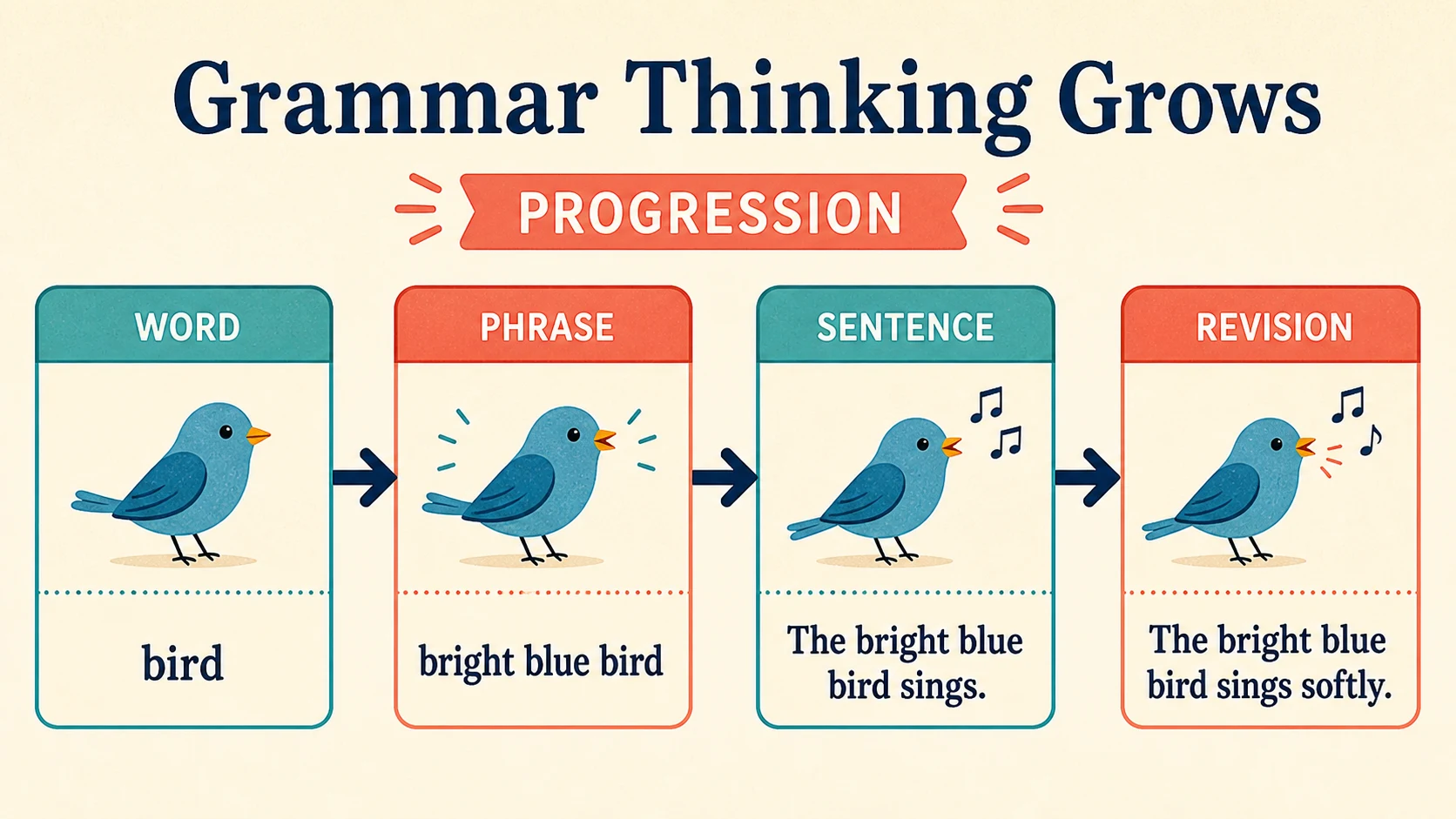
Support can be reduced gradually as the learner explains more of the reasoning independently.
A learner may be ready for adjectives but not yet for mixed noun-verb-adjective classification. Another may classify accurately but struggle to use stronger words in original writing. Those learners need different practice even if they are the same age.
Concrete and Visual Models
Grammar becomes easier to discuss when each label is attached to a visible action or relationship.
A sentence frame
Write:
The _____ _____.
Place a picture or object in view. If it is a toy horse, the learner might produce:
The horse gallops.
Put a box around horse and underline gallops. Say, “The box marks who or what the sentence is about. The underline marks what happens.” Then add a describing slot:
The spotted horse gallops.
Draw an arrow from spotted to horse. The arrow shows that the adjective describes the noun rather than merely appearing near it.
The model is deliberately simple. Later examples should vary the word order and sentence length so the learner does not conclude that the noun is always the second word or the verb is always the final word.
A three-column word sort
Use headings that include both a label and a meaning:
| Noun: names |
Verb: shows action or state |
Adjective: describes a noun |
| frog |
leaps |
green |
| garden |
grows |
sunny |
| Ava |
notices |
tiny |
After sorting, require one sentence using a word from each column: Ava notices a tiny frog. Then classify the words again in their sentence. This second step matters because English words must be interpreted in context.
A physical preposition model
Place a pencil and a book on a table. Move the pencil:
- The pencil is on the book.
- The pencil is under the book.
- The pencil is beside the book.
The movement makes the relationship visible. At this level, it is enough to identify the location word and explain the relationship it shows. A fuller analysis of phrases can wait.
Fully Checked Worked Examples
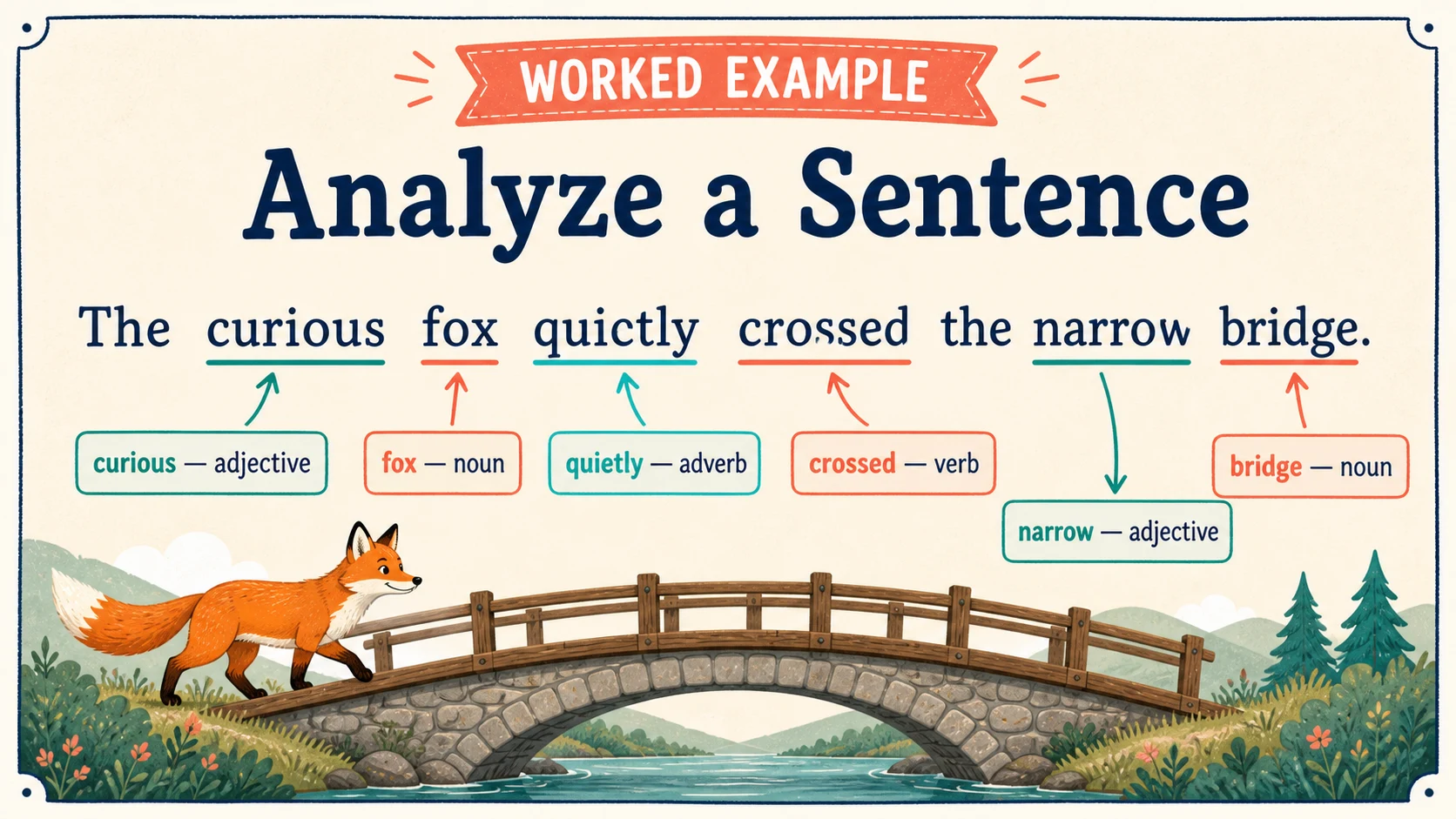
The safest method is to read the whole sentence, locate its basic meaning, and classify each target word by its job.
Example 1: Noun, verb, and adjective
Sentence:
The small rabbit hops.
- Ask who or what the sentence is about: rabbit.
- Rabbit names an animal, so it is a noun.
- Ask what the rabbit does: it hops.
- Hops shows the action, so it is a verb.
- Ask which word describes the rabbit: small.
- Small tells what kind of rabbit, so it is an adjective.
Checked answer: small—adjective; rabbit—noun; hops—verb.
The word the is not one of the three requested targets. It helps point to the noun, but the learner need not force it into the noun, verb, or adjective categories.
Example 2: More than one noun
Sentence:
Maya carries a basket.
- Maya names a particular person, so it is a proper noun.
- Carries tells what Maya does, so it is a verb.
- Basket names a thing, so it is a common noun.
Checked answer: Maya—proper noun; carries—verb; basket—common noun.
A learner who circles only basket may understand that objects are nouns but overlook names of people. Respond by returning to the full definition: a noun can name a person, place, thing, or idea. For current practice, emphasize concrete people, places, and things before expecting confident work with abstract ideas.
Example 3: Pronoun and adverb
Sentences:
Lena found the gate. She quickly opened it.
- She replaces the noun Lena, so she is a pronoun.
- Opened tells the action, so it is a verb.
- Quickly tells how the opening happened, so it is an adverb modifying opened.
- It replaces gate, so it is also a pronoun.
Checked answer: She—pronoun; quickly—adverb; opened—verb; it—pronoun.
The first sentence supplies the nouns that the pronouns stand for. Without that context, she and it would not tell the reader exactly which person and object were meant.
Example 4: Adjective versus adverb
Compare:
The quiet dog waited.
The dog waited quietly.
In the first sentence:
- Dog is a noun.
- Quiet describes the dog, so it is an adjective.
- Waited is a verb.
In the second sentence:
- Dog remains a noun.
- Waited remains a verb.
- Quietly tells how the dog waited, so it is an adverb.
Checked distinction: quiet describes a noun; quietly describes the action. The -ly ending is helpful in this example, but learners should still ask what the word modifies instead of using an ending as the only test.
Example 5: Preposition and conjunction
Sentence:
The puppy slept under the table, and the kitten rested nearby.
- Puppy, table, and kitten name things, so they are nouns.
- Slept and rested tell what happened, so they are verbs.
- Under shows the puppy’s relationship to the table, so it is a preposition.
- And connects the two related sentence parts, so it is a conjunction.
- Nearby tells where the kitten rested, so it functions as an adverb here.
Checked answer: puppy/table/kitten—nouns; slept/rested—verbs; under—preposition; and—conjunction; nearby—adverb.
This example is appropriate as an extension after nouns, verbs, and adjectives are stable. It is not a sensible first classification task for a beginner.
Boundary Cases: The Sentence Decides
A word does not always belong to the same category. Teach this as a reason to examine context, not as a trick.
Consider run:
- I run after school. Here, run tells an action, so it is a verb.
- We went for a run. Here, run names an activity, so it is a noun.
Consider light:
- The light shines. Here, light names a thing, so it is a noun.
- Dad will light the candle. Here, light tells an action, so it is a verb.
- She carried a light bag. Here, light describes the bag, so it is an adjective.
Consider orange:
- I peeled an orange. Here, orange names a fruit, so it is a noun.
- I wore an orange hat. Here, orange describes the hat’s color, so it is an adjective.
These examples establish an important limitation of isolated word sorts. Sorting run, light, or orange without a sentence may produce more than one defensible answer. Word sorts are useful for introducing likely categories, but sentence-level practice is needed to check function.
Also avoid teaching “a noun is always the subject” or “a verb is always the second word.” In The fox sees the rabbit, both fox and rabbit are nouns, while only fox is the subject. In Yesterday, the fox rested, the verb appears later. Meaning and function are more dependable than position.
A Short, Repeatable Lesson Routine
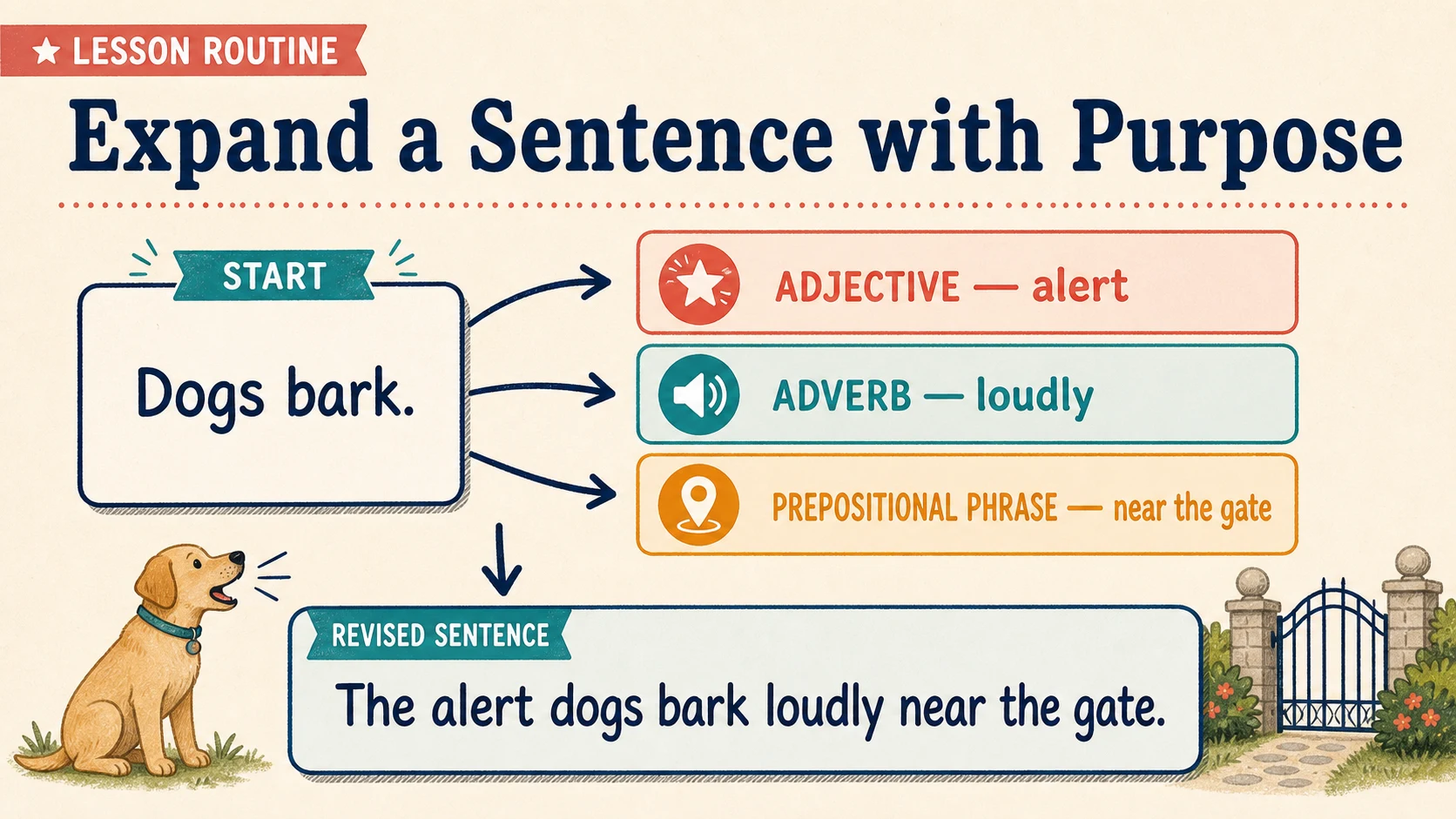
One model, a small amount of guided practice, and immediate application keep the lesson focused.
A practical routine can take about 10 to 15 minutes, but this is an instructional suggestion rather than a universal timetable.
1. Retrieve prior learning
Show one familiar sentence and ask for a previously taught category:
Birds build nests.
Ask, “Which words name? Which word shows the action?” Listen to the explanation, not only the answer.
2. Model one decision
Add a new word:
Small birds build nests.
Think aloud briefly: “Small tells which kind of birds. It describes the noun birds, so it is an adjective.”
3. Complete two guided items
Use sentences that change structure:
A noisy truck passed.
The stars looked bright.
Ask the learner to point to the noun before choosing the adjective. In the second sentence, bright follows the verb but describes stars. This prevents dependence on a rigid “adjectives come before nouns” rule.
4. Try two independent items
Remove prompts but ask the learner to mark and explain the target words. Stop after a repeated error rather than allowing the same misunderstanding to continue through a full page.
5. Apply the category
Ask for one oral or written sentence using the focus category. For adjectives, the learner might expand The cat slept to The tired cat slept. For verbs, compare The cat went with The cat dashed.
6. Record one observation
Note what the learner did without help, what required a prompt, and what error appeared. That brief record should shape the next lesson.
Choosing Practice That Matches the Learner
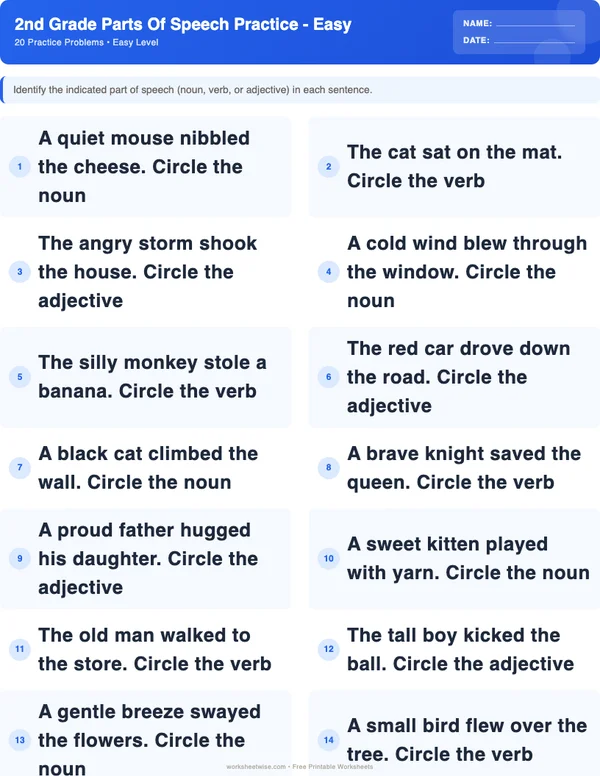
The free easy 2nd Grade Parts of Speech worksheet contains 12 exercises focused on identifying nouns, verbs, and adjectives in sentences. It includes a separate answer key. Its scope makes it suitable for a learner beginning mixed practice or needing reinforcement in those three categories.
Choose that worksheet when the learner can already:
- Read or follow the sentences with reasonable support.
- Explain the basic difference among naming, action, and describing words.
- Attempt several items without needing every answer modeled.
Do not choose it as the only response to a learner who cannot yet distinguish nouns from verbs orally. Start with objects, movement, sentence frames, and a smaller two-category sort. Conversely, a learner who classifies all 12 items accurately and explains the choices may need sentence revision, original writing, or context-dependent words rather than another nearly identical page.
The Parts of Speech topic guide can be used to locate related material. The focused pack contains 18 worksheets and is listed at $4.79 in the supplied catalogue. A larger pack offers more practice choices, but more pages are not automatically a better match. Preview the skill focus and assign only the items that address the observed need.
Common Errors and Diagnostic Responses
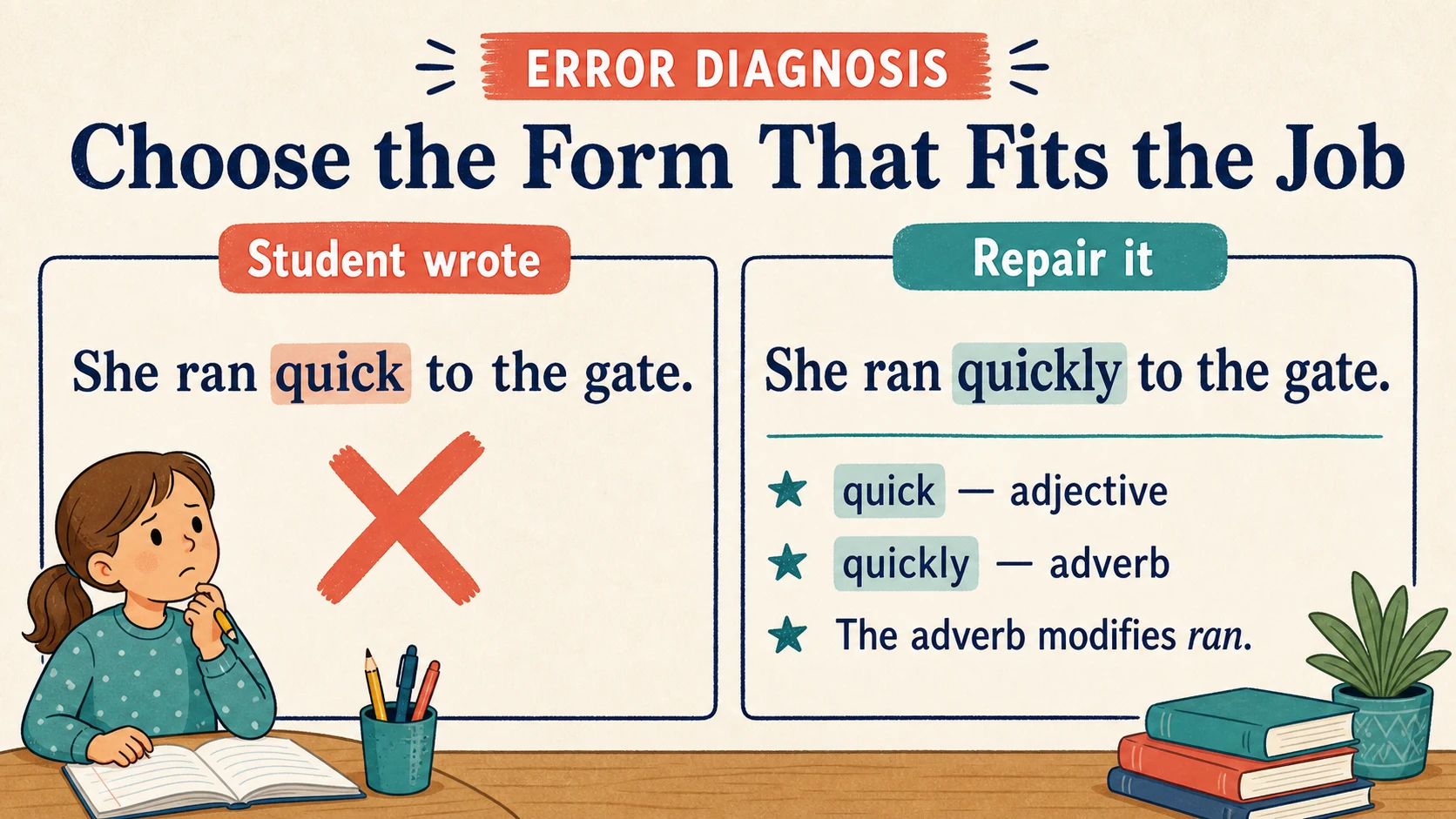
An error pattern is more useful than a score because it points toward the next teaching move.
| Observed error |
Possible misunderstanding to check |
Instructional response |
| Marks only visible objects as nouns |
The learner may think nouns are limited to things that can be touched |
Sort names of people, places, and objects; introduce abstract ideas later |
| Marks the first word as the noun every time |
The learner may be using position rather than meaning |
Use sentences beginning with Yesterday, Quickly, or a short introductory phrase |
| Calls every action-related word a verb |
The learner may confuse an adverb with the action itself |
Pair walked with walked slowly and ask which word can show the action alone |
| Calls every word before a noun an adjective |
The learner may be using location as the rule |
Ask what information the word gives about the noun; do not require classification of every determiner |
| Calls every -ly word an adverb |
The learner may be relying entirely on spelling |
Return to the question “What does this word describe?” and use clear sentence pairs |
| Misses proper nouns |
The learner may equate “noun” with “ordinary object” |
Compare girl/Maya, city/Boston, or another familiar common/proper pair |
| Labels run the same way in every sentence |
The learner may believe words have permanent categories |
Compare I run with a run and require a meaning-based explanation |
| Identifies correctly but cannot write an example |
Recognition may be stronger than application |
Supply a sentence frame and ask the learner to add one target word |
| Makes errors only in long sentences |
Reading load may be hiding the grammar knowledge |
Read aloud, cover extra clauses, or return temporarily to shorter sentences |
These are possibilities to investigate, not diagnoses of a child. A wrong answer can also result from misreading, inattention, unfamiliar vocabulary, or unclear directions. Ask the learner to explain the choice before deciding what to reteach.
Differentiation Without Changing the Core Skill
When the learner needs more support
Reduce the number of categories. Contrast nouns and verbs before adding adjectives. Read each sentence aloud, use familiar vocabulary, and let the learner point or sort before writing labels.
Keep visual marks consistent: boxes for nouns, underlines for verbs, and arrows from adjectives to the nouns they describe. Consistency lowers the amount of task management required, while the spoken explanation keeps the focus on meaning.
Use one contrast at a time:
The bird sings.
The blue bird sings.
Ask what changed and what blue describes.
When the learner is ready for more challenge
Keep the vocabulary understandable while increasing the reasoning demand. Include two nouns, adjectives after linking verbs, pronoun references, or words that change category by context.
Ask the learner to revise:
The animal went to the place.
A possible revision is:
The fox hurried to the den.
Then discuss how the specific nouns and stronger verb make the meaning clearer. This is an instructional application, not a claim that every replacement automatically improves every sentence.
When reading and grammar performance differ
If the learner can classify words in sentences read aloud but struggles when reading independently, preserve oral support while continuing separate reading instruction. If the learner reads fluently but guesses the categories, require explanations such as “It names…,” “It shows…,” or “It describes….”
Monitoring Progress and Deciding What Comes Next
Use a small weekly sample rather than relying only on completed pages. Include:
- Two identification sentences.
- One sentence with more than one noun.
- One oral explanation.
- One sentence the learner creates or revises.
- Occasionally, one context-dependent word.
Record performance in three columns: independent, prompted, and not yet. An answer is independent only when the learner selects it and gives a reasonable explanation without a category-specific hint.
Look for patterns across several attempts. One perfect item does not establish mastery, and one mistake does not establish a persistent difficulty. Useful signs of growing control include accurate classification in new sentences, explanations based on function, successful use in original writing, and recognition that a word such as light can change jobs.
Move forward when the learner is consistently successful with the current contrast in varied examples. Review when explanations remain positional—“It is a noun because it comes first”—or when accuracy falls sharply as soon as supports disappear.
A Two-Week Practice Plan
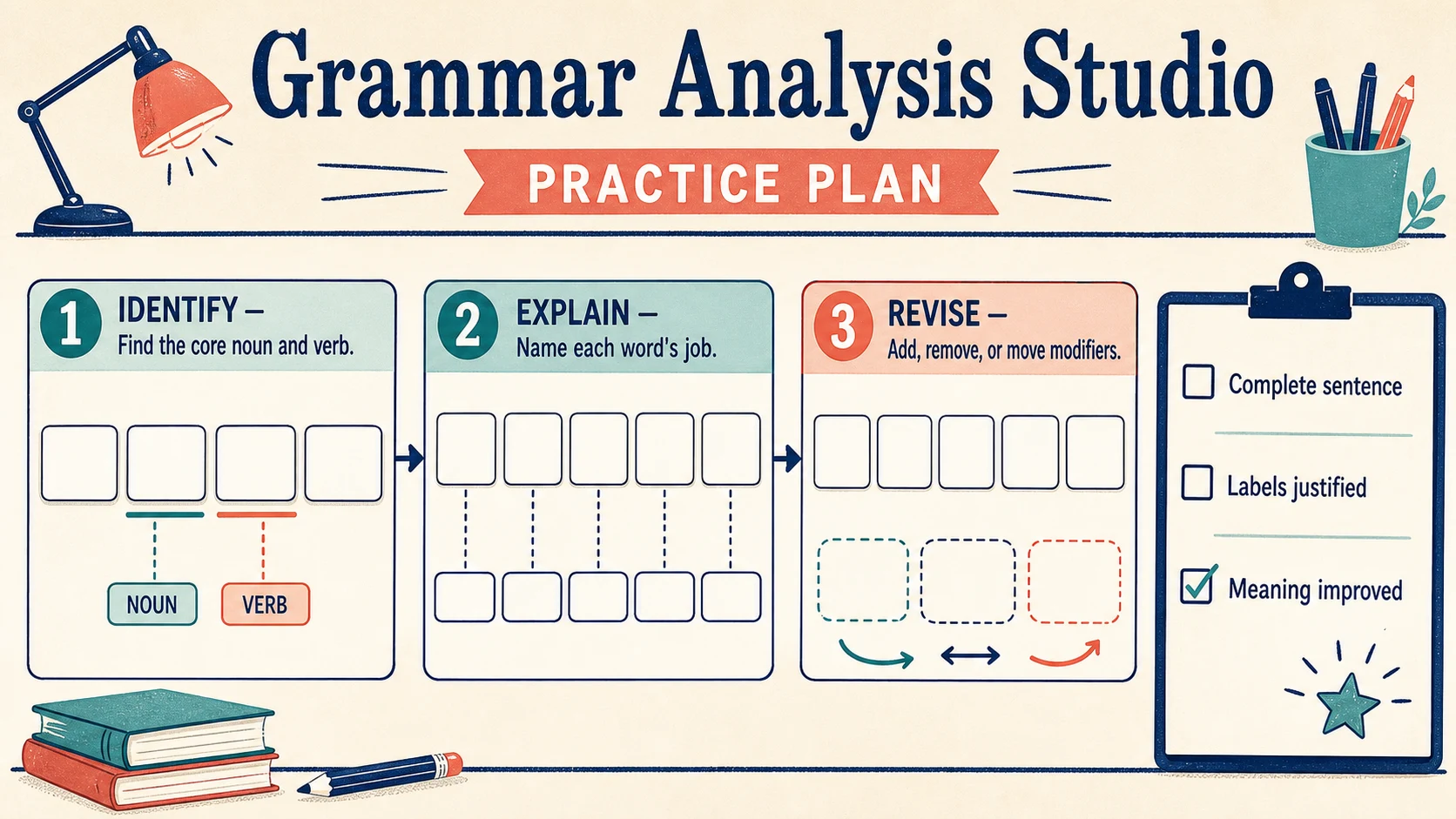
The plan alternates identification, explanation, and application so that labels remain connected to sentences.
This sample uses ten short sessions. Adjust the pace, repeat days, or omit extension categories according to observed work.
| Day |
Focus |
Suggested activity |
Quick check |
| 1 |
Nouns |
Name people, places, and things; find nouns in three sentences |
Can the learner explain what each noun names? |
| 2 |
Verbs |
Act out verbs; match each action to a noun in an oral sentence |
Can the learner separate who or what from what happens? |
| 3 |
Nouns and verbs |
Mark both categories in four short sentences |
Does the learner use meaning rather than position? |
| 4 |
Adjectives |
Describe two familiar objects; connect each adjective to its noun |
Can the learner say exactly which noun is described? |
| 5 |
Mixed review |
Complete a short noun-verb-adjective sample |
Which category causes the most errors or prompting? |
| 6 |
Targeted reteaching |
Revisit the weakest category using concrete examples |
Does a model followed by a new example improve the explanation? |
| 7 |
Pronouns or continued core review |
Replace repeated nouns with clear pronouns, or remain with the first three categories |
Can the learner identify what each pronoun replaces? |
| 8 |
Adverbs and conjunctions, if ready |
Compare walked/walked slowly; connect ideas with and, but, or or |
Can the learner explain what is modified or connected? |
| 9 |
Boundary cases |
Compare run and light in different sentences |
Does the learner consult the sentence before labeling? |
| 10 |
Application and review |
Revise one vague sentence and complete a five-item mixed check |
What is independent, prompted, or not yet? |
If Day 5 reveals continuing noun-verb confusion, Days 6 through 10 should not add several new categories. Repeat concrete classification with varied sentences and build toward independence. If the learner is already accurate, use the later days for sentence expansion, revision, pronouns, adverbs, and context-dependent words.
Limitations and an Honest Next Step
Parts-of-speech labels are tools for discussing language, not a complete writing curriculum or a complete account of English grammar. Short worksheets can show whether a learner identifies target words in selected sentences, but they cannot by themselves demonstrate fluent reading, clear composition, or independent editing. Some English words also resist simple classification when removed from context.
The next useful action is to give the learner a brief, observable starting task. Use the free 12-exercise parts-of-speech worksheet, review the answer key, and record which responses were independent, prompted, or incorrect. Then teach the narrowest category shown by the work: nouns and verbs first, adjectives next, or sentence-level application when identification is already secure.