Curated collectionAnswer keys includedPrint-ready PDFs
Morning Work Math Worksheets
Build predictable, low-friction arrival routines with retrieval, a short completion boundary and a fast teacher scan.
Start with a real resource
Browse this worksheet collection
61 relevant free entry points are available. Each one includes a printable learner PDF and separate answer key.
A useful practice loop
Print less. Observe more.
- Choose one skill and model the first item aloud.
- Use a short set and notice the learner’s strategy.
- Change the next task from the work you can see.
Need more than the free sheet?
Plus includes all 1098 matching catalogue variations where available, plus saved deterministic generators and the worksheet designer.
See Plus membershipComplete guide
How to teach and practise morning-work math worksheets
3,555 words Updated 6 instructional visuals
Make arrival math short, familiar, and informative
Morning work math worksheets work best as a brief retrieval routine, not as the day’s first full lesson. Choose a sheet whose mathematical model and response format learners have already encountered, set a visible stopping point, and scan one or two revealing items before instruction begins. The purpose is threefold: help learners start independently, reactivate useful knowledge, and give the adult evidence for the next teaching decision.
A practical boundary is six to ten minutes or a marked subset of problems—whichever comes first. A 20-problem sheet does not have to become a 20-problem assignment. If items 1–6 provide enough evidence, circle those items before distributing the page. A 12-problem word-problem or telling-time sheet may warrant only two or three items because reading, drawing, and explaining are part of the work. A six-problem fractions sheet may already be a complete morning task.
The live catalogue currently contains 1,098 math variants across eight grade labels and 12 topics, with 61 free entry points. Those numbers describe choice, not a mandate to assign more pages. Grade labels describe the intended practice level, and local curriculum sequences differ. Age is also a discovery aid rather than a placement decision: select from what the learner can represent and explain now, then inspect the actual task.
For ages three and four, prioritize brief adult-led oral counting, matching, manipulatives, and movement over desk work. A printed page can supply pictures or prompts, but the meaningful activity may be touching each counter, matching numeral cards to sets, or taking four jumps while counting aloud.
Build the routine around one mathematical question
Predictability should come from the workflow, not from repeating an identical page every day. Keep the same arrival sequence while changing the mathematical question deliberately:
- Start: Put away belongings, collect the page and necessary tool, and read the posted boundary.
- Retrieve: Solve one familiar item without adult prompting.
- Model: Show quantities or relationships with counters, a drawing, a number line, a clock, or another previously taught representation.
- Record: Complete the selected items in the requested response format.
- Check: Revisit one answer using a different representation or inverse operation.
- Submit: Place the sheet in one consistent location for a fast scan.
The model and record steps matter. A correct numeral alone may conceal guessing, a counting error that happened to cancel out, or reliance on an unintended shortcut. Conversely, an incorrect numeral beside a coherent drawing can reveal that the learner understood the situation but made a small computation error.
The IES guide for teaching math to young children recommends developmental progressions, monitoring what children know, and daily opportunities for mathematics. That is sourced guidance. The six-to-ten-minute boundary and the scan routine above are WorksheetWise editorial suggestions for using catalogue pages during arrival; IES did not evaluate WorksheetWise or prescribe this exact routine.
Prepare the page before learners arrive
Mark the completion boundary directly on the sheet: “Stop after 6,” “Solve the two starred stories,” or “Complete one row.” Place only the tools the task requires. Counters beside a numeral-sequence page may distract from the intended retrieval; counters beside a set-counting page may preserve the target by making one-to-one correspondence observable.
Write one check prompt where everyone can see it:
- “Touch each object once.”
- “Show where you started on the number line.”
- “Circle the coin you counted first.”
- “Read the hour hand before the minute hand.”
- “Mark the equal parts.”
- “Draw what each number represents.”
These prompts make the expected reasoning concrete without giving away an answer.
Keep the first item genuinely independent
The opening item should match a model learners have already used. If yesterday’s lesson used ten frames to compose numbers within 10, today’s arrival task can retrieve that representation. It should not silently replace the ten frame with unfamiliar symbols and then treat hesitation as evidence of weak addition.
A useful first item has one mathematical demand and a familiar motor demand. Matching, circling, drawing a hand on a clock, writing an equation, and composing a written explanation are different response formats. A learner may understand the mathematics yet lose time decoding what the page expects.
Select sheets by task features, not labels alone
The catalogue’s representative free sheets are marked “easy,” but that label should be interpreted through observable features. Here, a lower-complexity arrival task might use quantities within a familiar range, one operation, a single-step direction, a visible model, and little writing. A more demanding task might remove the model, vary the unknown’s position, mix representations, require explanation, or combine steps. These features describe the task—not the learner.
Use five selection questions:
- Is the content retrieval or first instruction? Morning work should usually retrieve. Save a new coin, unfamiliar fraction notation, or first exposure to elapsed time for teaching with an adult.
- What must the learner represent? Counted objects, equal parts, a change in quantity, place-value units, or time on a circular scale require different models.
- What response is required? A numeral, matched picture, equation, clock drawing, shaded region, or sentence each adds its own demand.
- What error would be informative? Select items that distinguish plausible misconceptions. A scattered set reveals more about one-to-one counting than another neat row.
- Can the page be bounded cleanly? Prefer a coherent row or small group of related items rather than an arbitrary cutoff in the middle of a progression.
The Common Core mathematics overview emphasizes focus, coherence, and age-appropriate justification rather than correct answers alone. It can help adults inspect whether a task asks learners to understand and explain mathematics, but it does not prove that any particular WorksheetWise page aligns with a local sequence. Consult the actual local curriculum before making an alignment claim. Common Core’s mathematics overview is a reference point, not a placement test.
Compare representative skills before choosing tomorrow’s page
The same arrival routine behaves differently across counting, addition, word problems, time, money, geometry, place value, subtraction, and fractions. The decision rests on what the adult needs to observe.
Counting: distinguish sequence knowledge from one-to-one correspondence
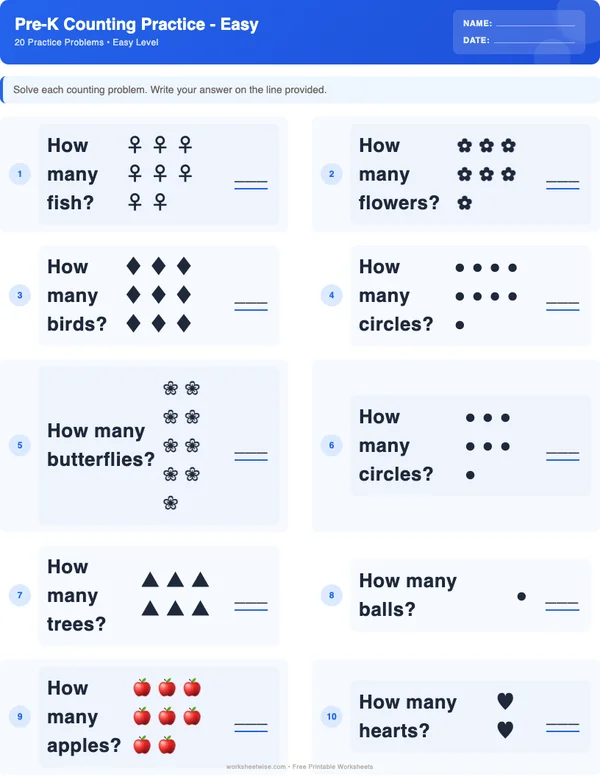
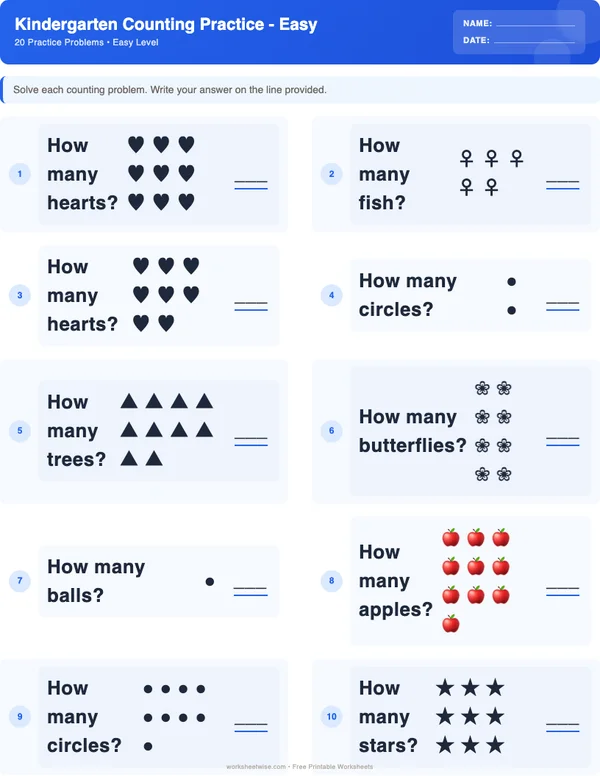
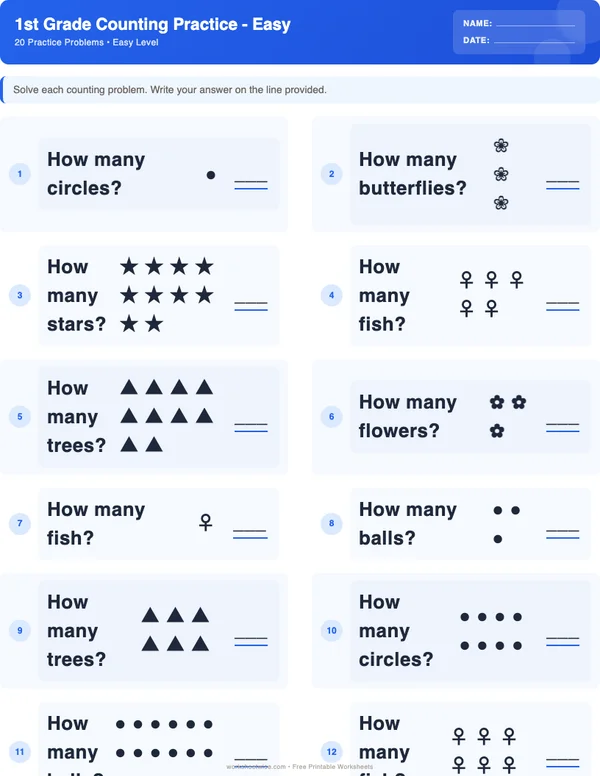
The live Pre-K, kindergarten, and first-grade counting representatives each contain 20 problems. Their described tasks include number sequences, missing numbers, and counting sets. These are not interchangeable.
A missing-number item such as 14, 15, __, 17 checks whether the learner can maintain a spoken or written sequence. A set of 8 scattered dots asks whether the learner can coordinate one number word with each object and stop after every object has been counted. Success on the sequence does not establish success with the scattered set.
Checked example 1: Place 8 counters irregularly and ask the learner to touch and move each counter while counting. If the learner says “1, 2, 3, 4, 5, 6, 7, 8” and records 8, the count, touches, and numeral agree. If the learner says eight number words but touches one counter twice, the recorded 8 is not reliable evidence of one-to-one correspondence. This example belongs in morning work because the adult can scan the moved counters and final numeral quickly, while the physical action preserves the counting target.
For younger learners, turn part of the Pre-K Counting guide and free sheet into an adult-led matching activity. For learners ready to record independently, compare it with the Kindergarten Counting guide and free sheet.
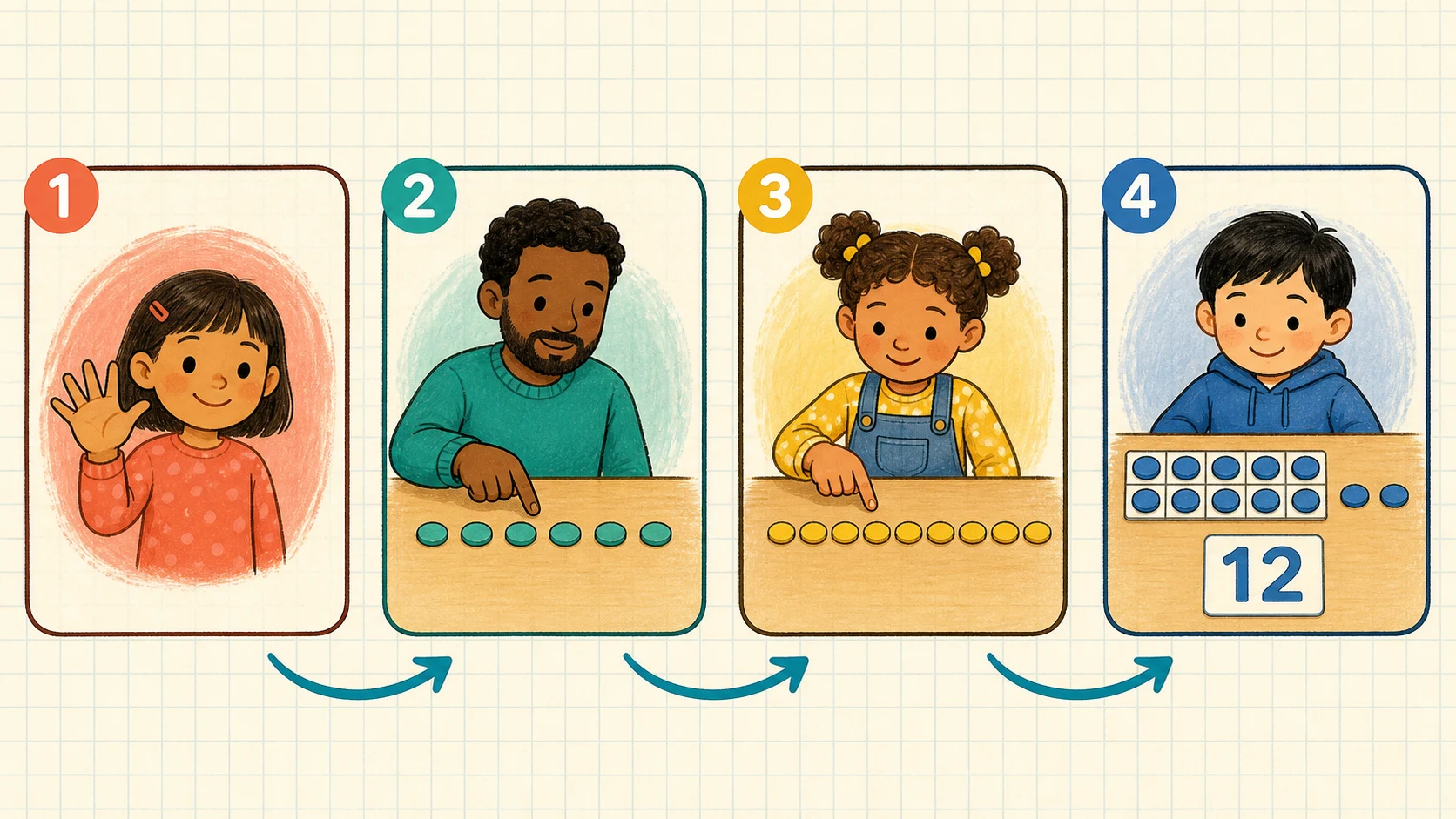
Use a stable start–count–record–check sequence, but change the arrangement of objects when you need evidence of one-to-one counting rather than memorized recitation.
Addition and subtraction: inspect the relationship, not just the total
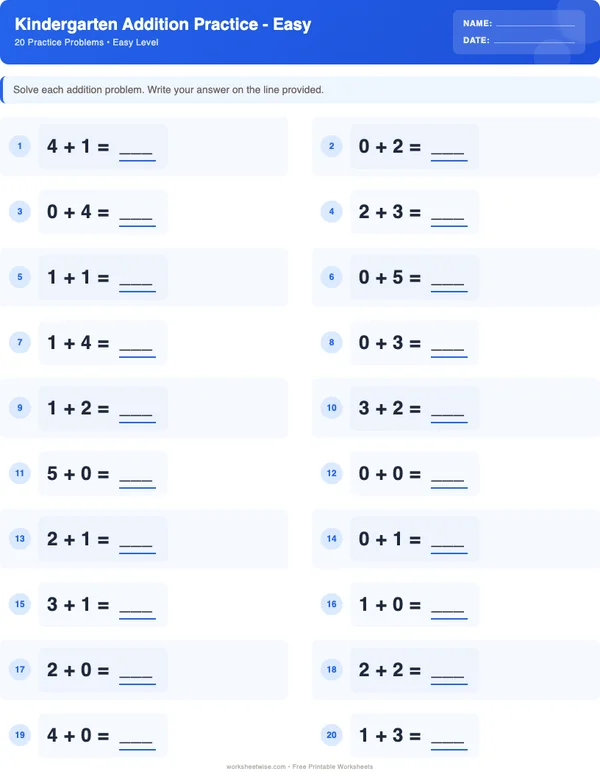
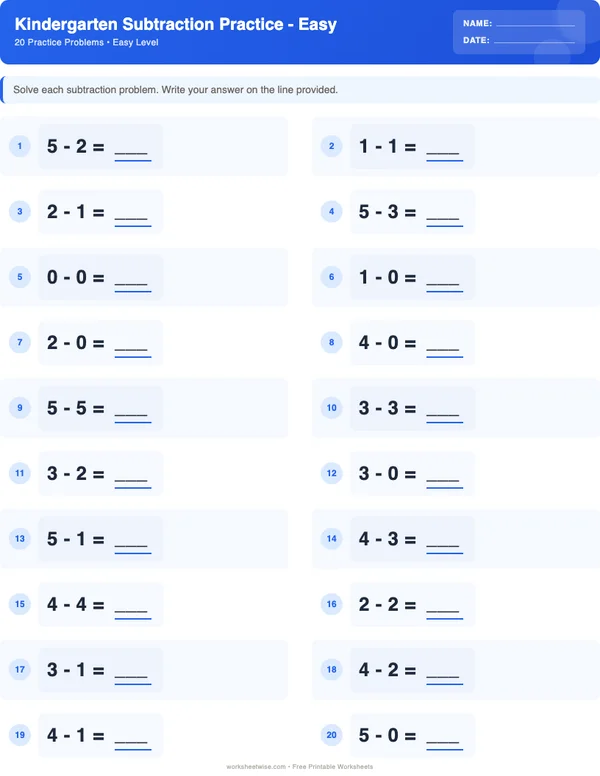
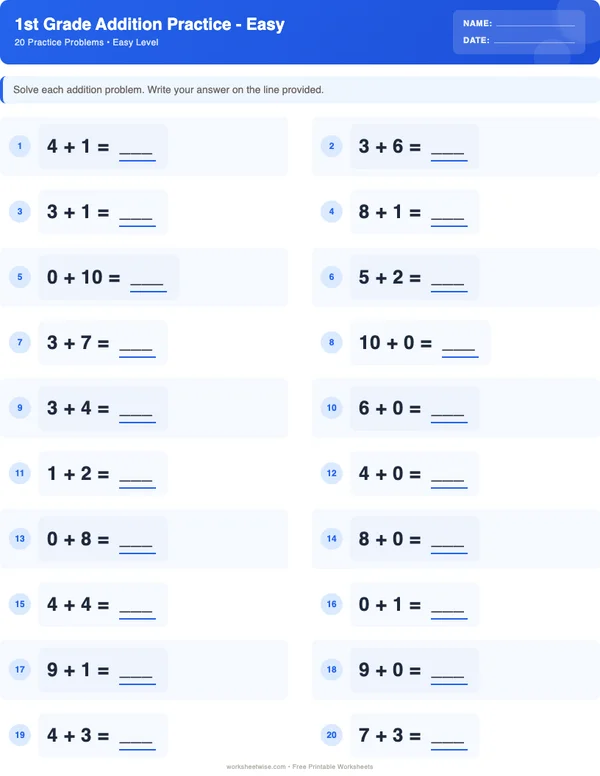
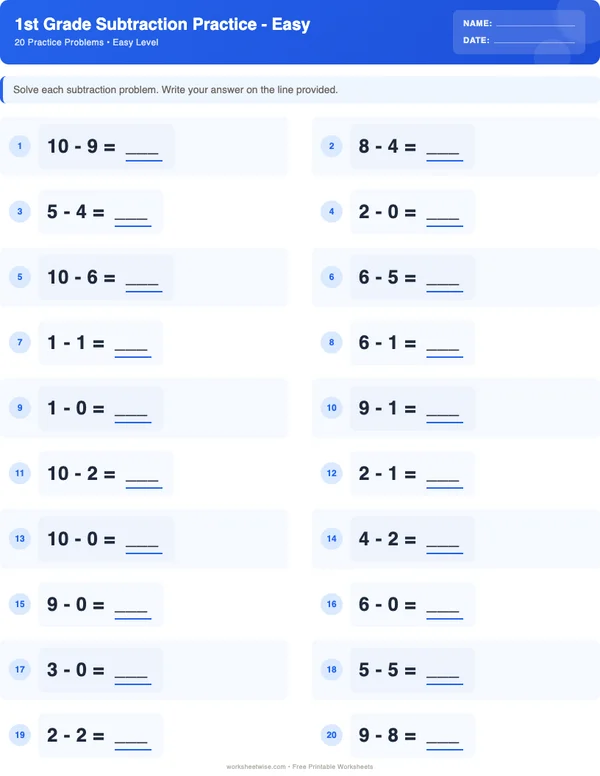
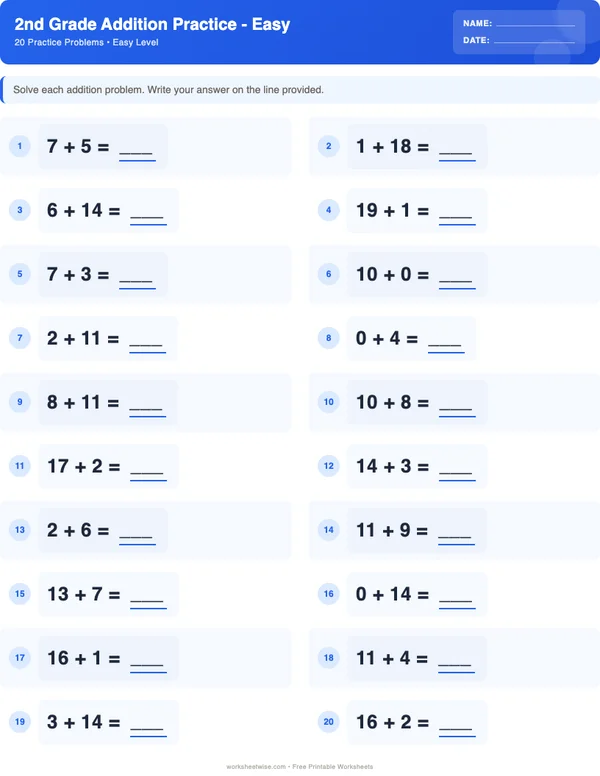
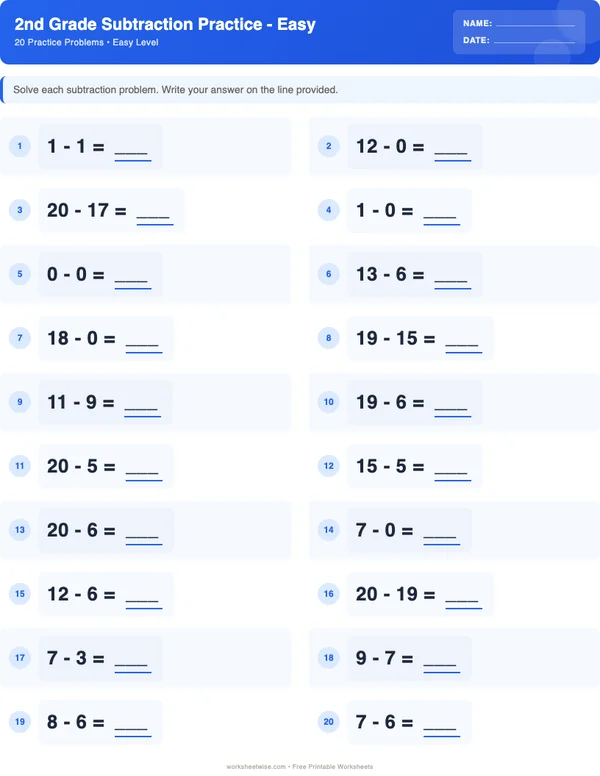
The representative kindergarten and first-grade addition and subtraction sheets each contain 20 problems. That volume makes premarking a short row especially important. Choose a group with a common structure so the scan can reveal a pattern.
Checked example 2: Ask for 8 + 5 with a ten frame or a drawing. A valid make-ten model decomposes 5 into 2 and 3: 8 + 2 = 10, then 10 + 3 = 13. Check: 13 - 5 = 8. Every quantity is accounted for, so the answer is 13. This belongs here because a morning scan can separate three responses: a correct model and total; a correct total with no visible strategy; or an incorrect total caused by losing part of the decomposed 5.
Do not require a particular strategy when the target is simply accurate addition and learners have already developed other sound methods. Do request a ten-frame or make-ten representation when the target is composing 10. The model must serve the skill under review.
For subtraction, compare removal, comparison, and missing-part situations rather than presenting only bare equations. 9 - 4 = 5 can mean four objects were removed, nine exceeds four by five, or four and five compose nine. Related addition provides a fast check: 5 + 4 = 9.
The Kindergarten Addition guide and free sheet and Kindergarten Subtraction guide and free sheet let an adult inspect these neighboring structures rather than treating the operations as unrelated drills.
Word problems: require a situation model before an operation
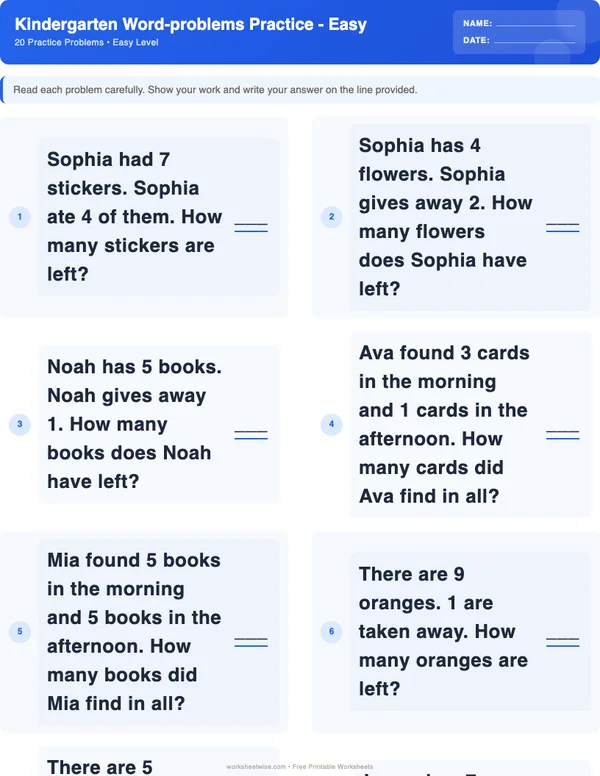
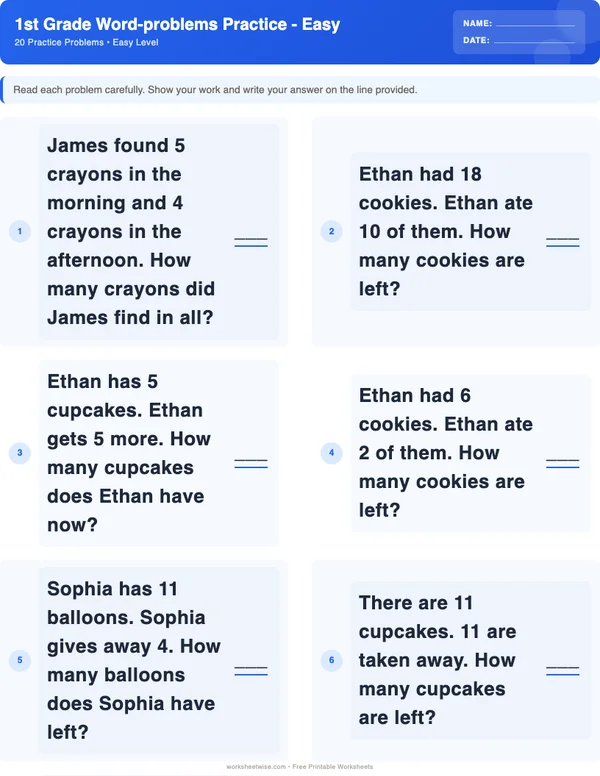
The representative kindergarten word-problems sheet contains 12 problems, fewer than the 20-problem computation representatives. That difference suits a shorter morning selection because reading, retelling, modeling, solving, and checking all require attention.
Checked example 3: “Maya has 6 red blocks and 3 blue blocks. How many blocks does she have altogether?” A part-part-whole drawing shows parts 6 and 3 joining into an unknown whole. The equation is 6 + 3 = 9. Check by counting all nine drawn blocks or using 9 - 3 = 6. The answer is 9 blocks.
Now change the structure: “Maya has 9 blocks. Three are blue. How many are red?” The numbers are related, but the unknown part makes 9 - 3 = 6 appropriate. A keyword-only rule could miss this relationship. This pair belongs in the routine because it reveals whether a learner models the quantities or merely reacts to words such as “altogether.”
The IES elementary mathematics intervention guide recommends deliberate word-problem instruction as well as systematic instruction, precise mathematical language, representations, and number lines. Those are sourced recommendations. WorksheetWise’s suggestion is to star only one or two morning stories and scan the model, equation, and labeled answer separately.
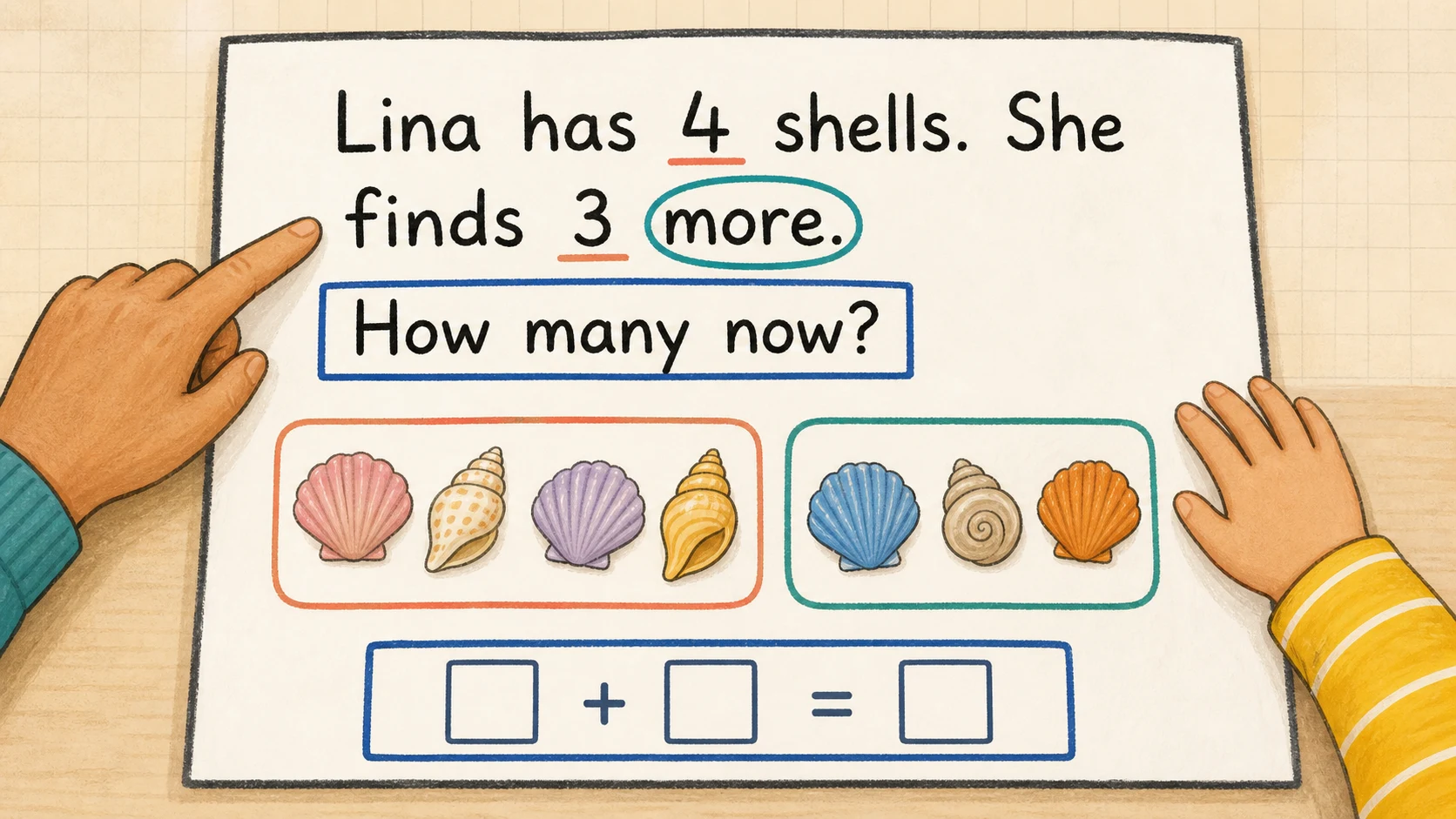
Retell, represent, solve, and check in the same order so the adult can identify whether an error began in comprehension, modeling, operation choice, or calculation.
Telling time and money: do not confuse recognition with calculation
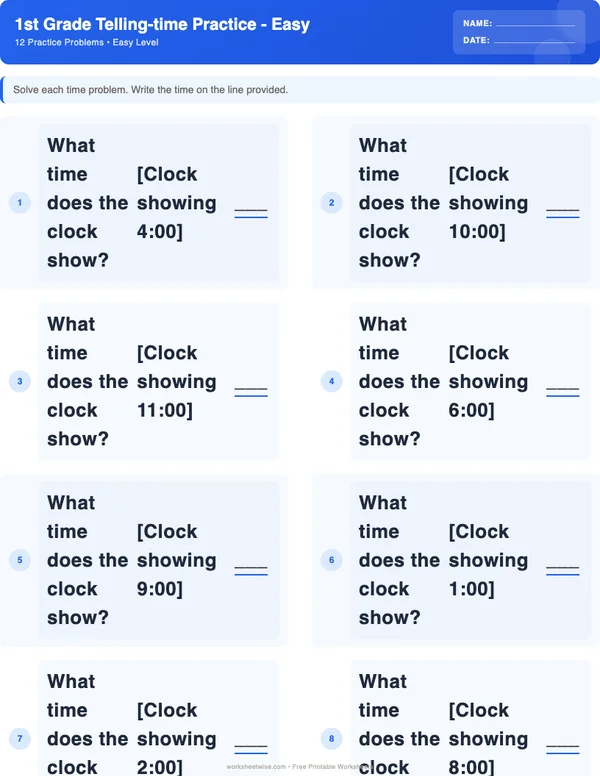
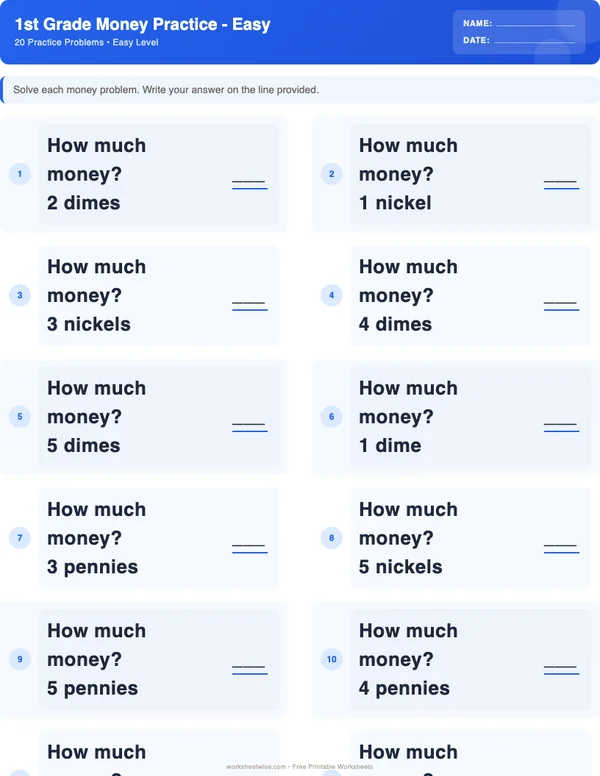
The representative first-grade telling-time sheet has 12 problems and includes clock-related formats; the money representative has 20 and includes coin images, prices, and shopping contexts. Both topics add visual identification demands to computation.
Checked example 4: On an analog clock showing 3:45, the minute hand points to 9 because nine groups of five minutes equal 45. The hour hand lies between 3 and 4 but has not reached 4, so the time is 3:45, not 4:45. This example belongs here because the two answers reveal a specific interpretation of the hour hand. The next page should not simply supply more clocks; it should include times after the half hour and require learners to identify the hour first.
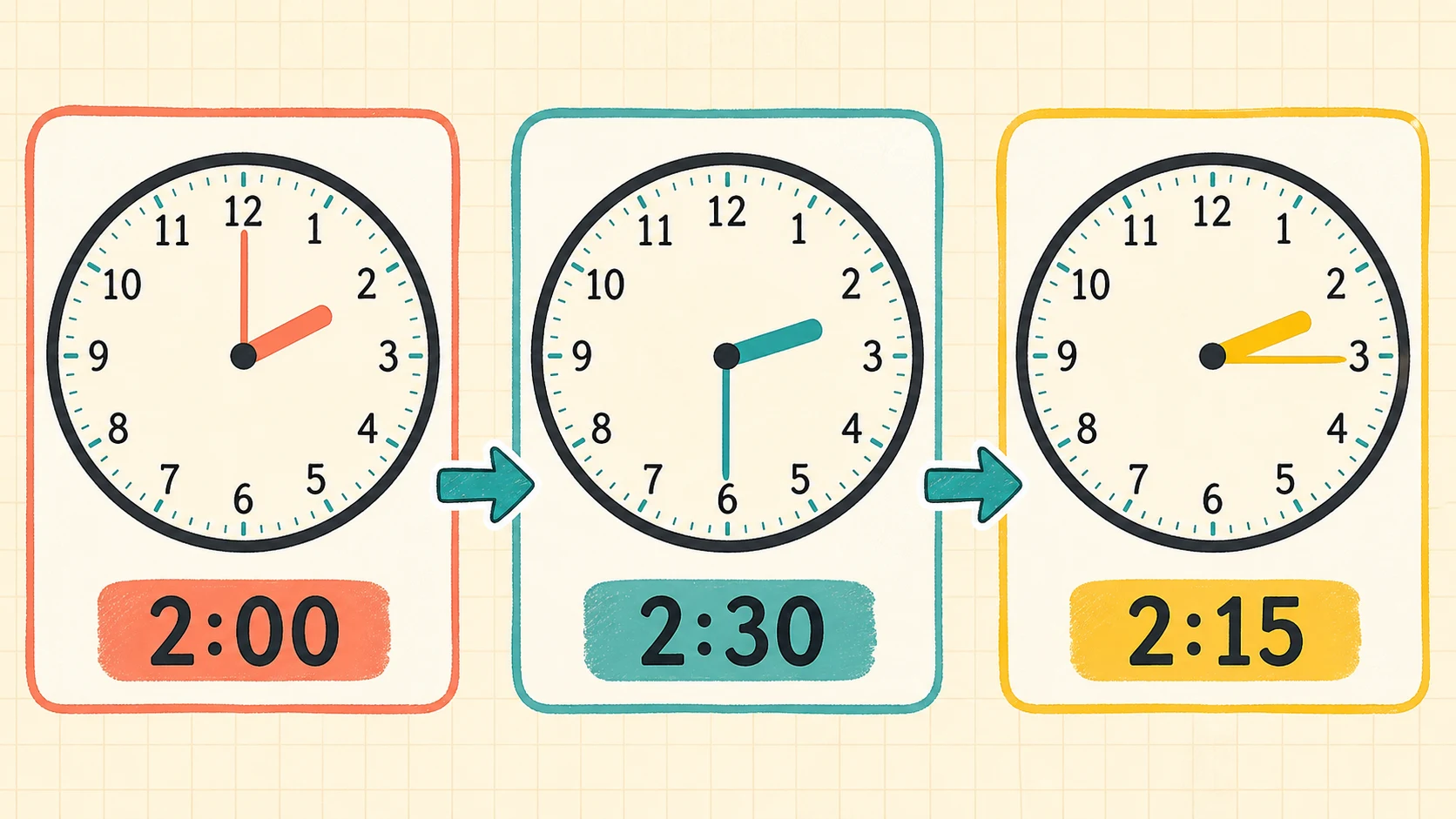
Move from a demonstrated clock and verbal hand-reading routine to independent clock items only after learners can explain why the hour remains 3 at 3:45.
Checked example 5: A dime, nickel, and three pennies total 18 cents: start with 10, count on 5 to reach 15, then 16, 17, 18. If a learner writes 9, they may have counted four physical coins rather than their values. If they write 16, check whether every penny was counted once. This belongs in morning work because “circle the coin counted first” makes the chosen strategy visible without demanding a long explanation.
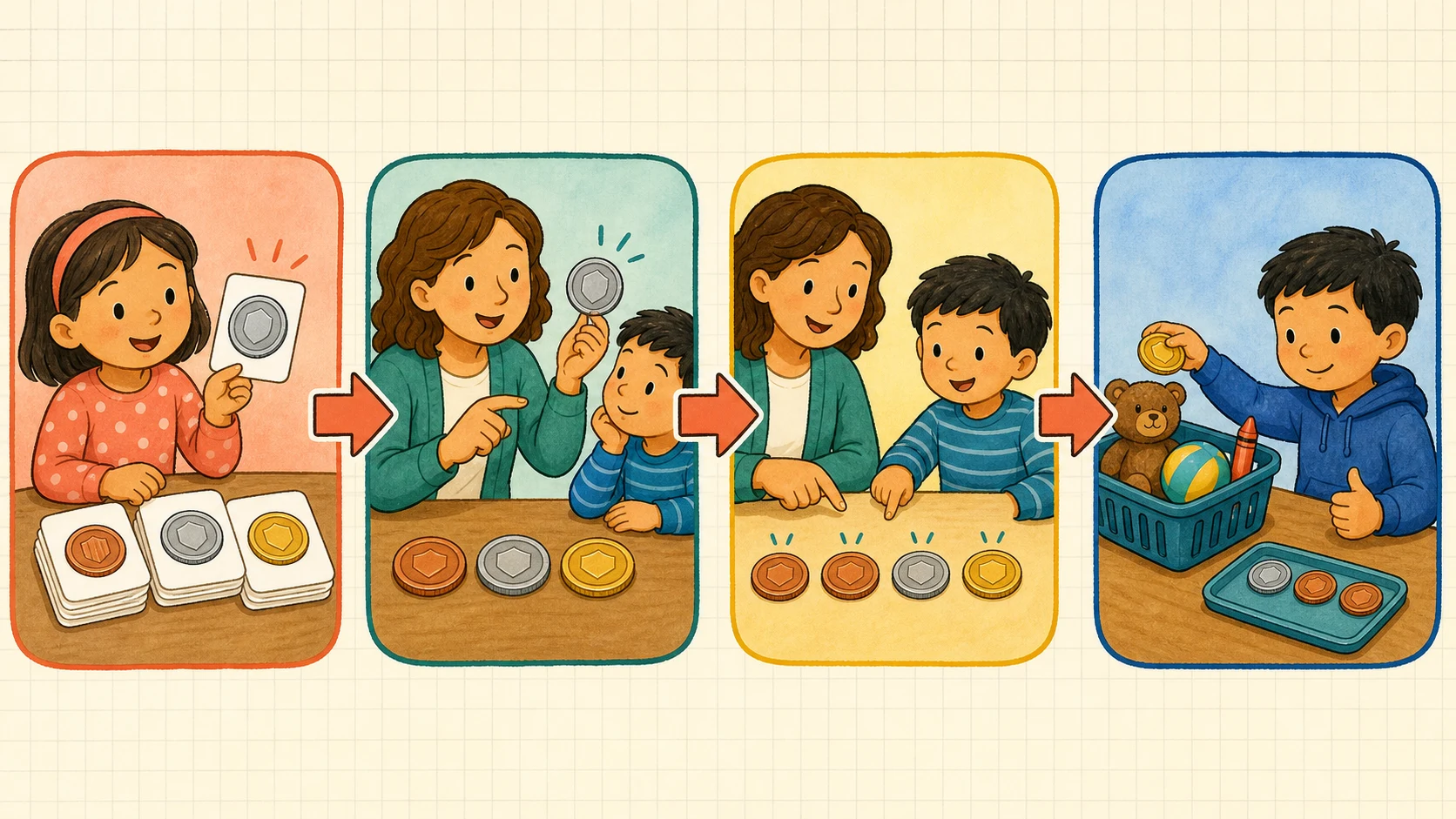
Handle or identify coins, name their values, order them by value, and then count on; assigning mixed collections before coin values are secure changes the task into guesswork.
Geometry and fractions: preserve the visual attributes
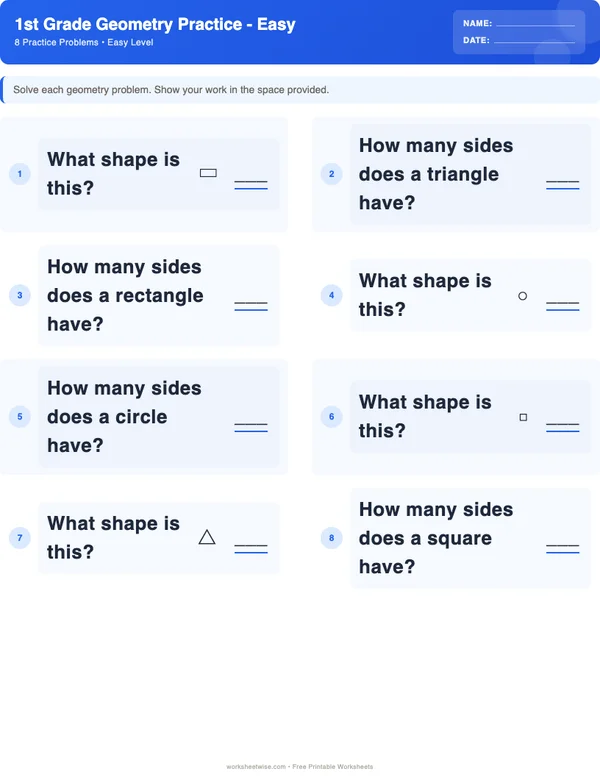
Geometry asks learners to notice defining attributes; fractions add the requirement that parts be equal. A page that rewards recognition from one standard orientation may produce fragile evidence.
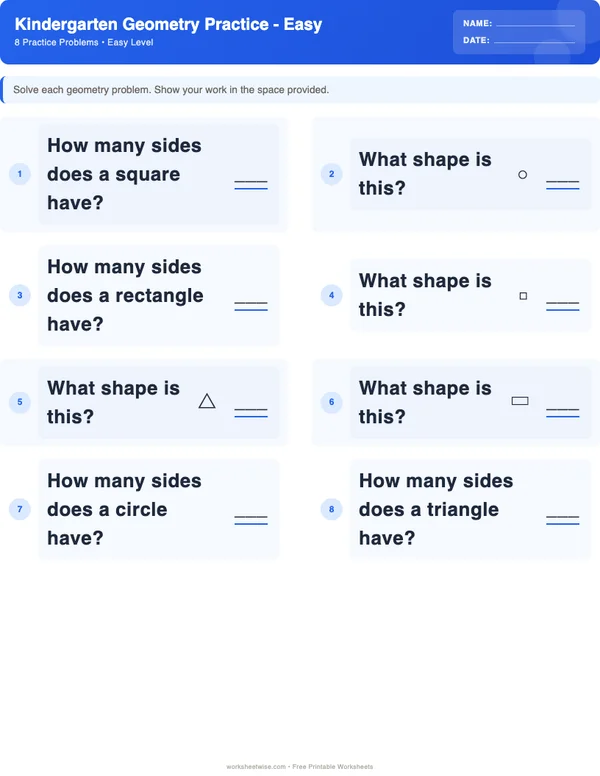
Show triangles with different side lengths and orientations. A learner who accepts only an upright, symmetrical triangle may be using a visual prototype rather than the defining property of three straight sides. Ask, “What makes every one of these a triangle?” rather than “Which one looks like a triangle?”
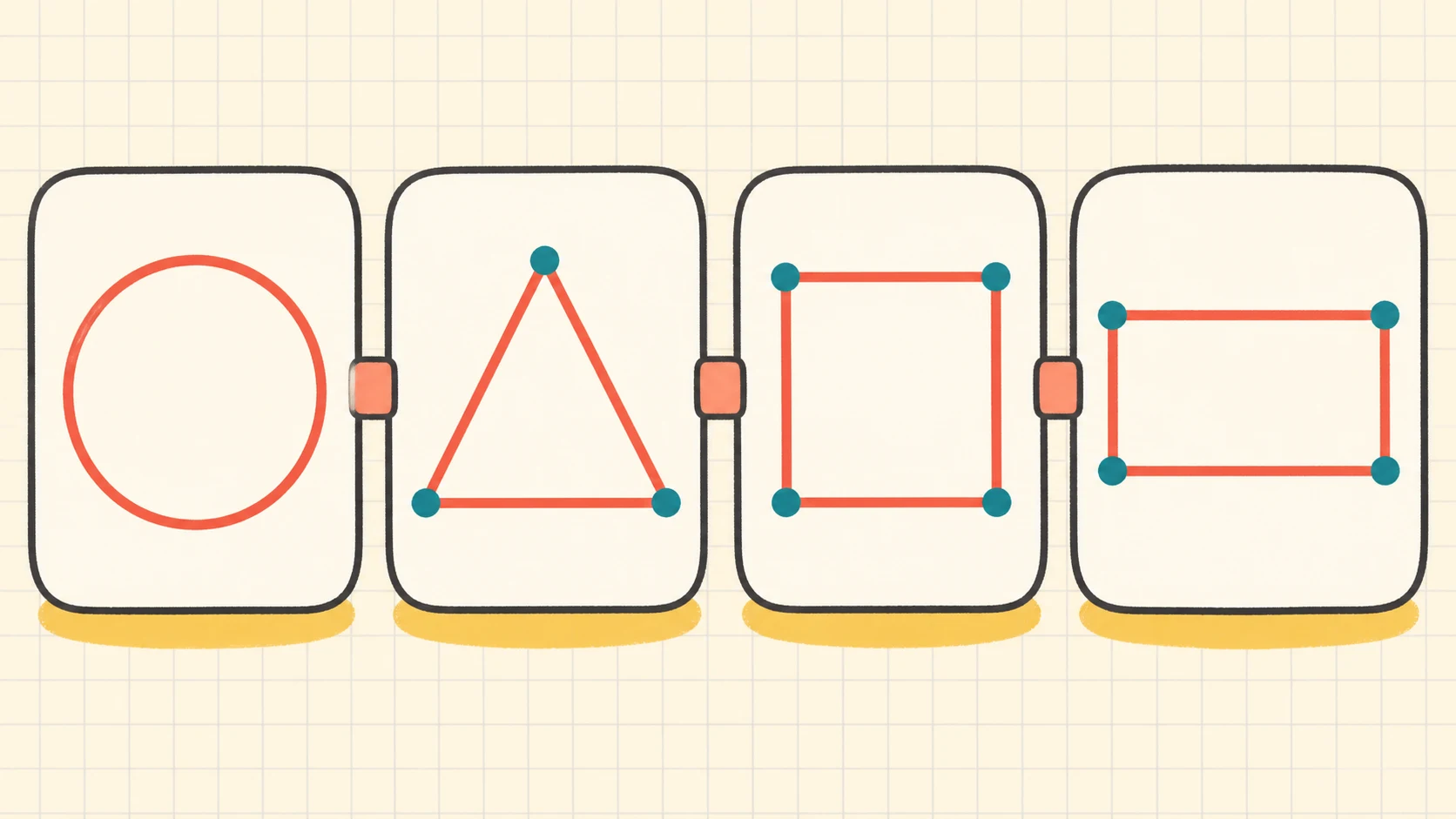
Use sorting, tracing, building, and describing to connect shape names to observable attributes rather than to one familiar orientation.
Checked example 6: Draw two identical rectangles. Partition one into two equal parts and shade one; partition the other into two visibly unequal parts and shade one. Only the first shows one-half because halves must be equal in area. This belongs here because circling the valid model provides a quick response, while asking the learner to mark why the other model fails exposes the equal-parts concept.
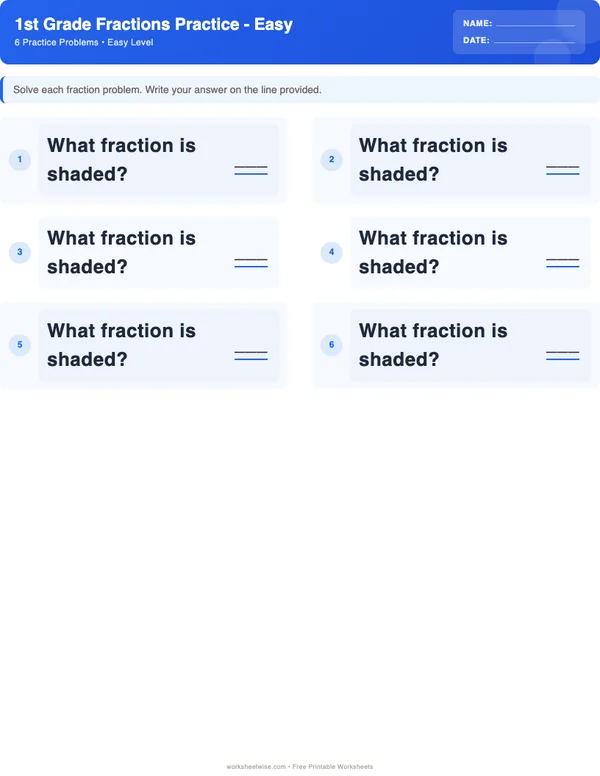
The representative first-grade fractions sheet contains six problems. That is already a plausible full boundary when every item requires inspecting or producing a visual model.
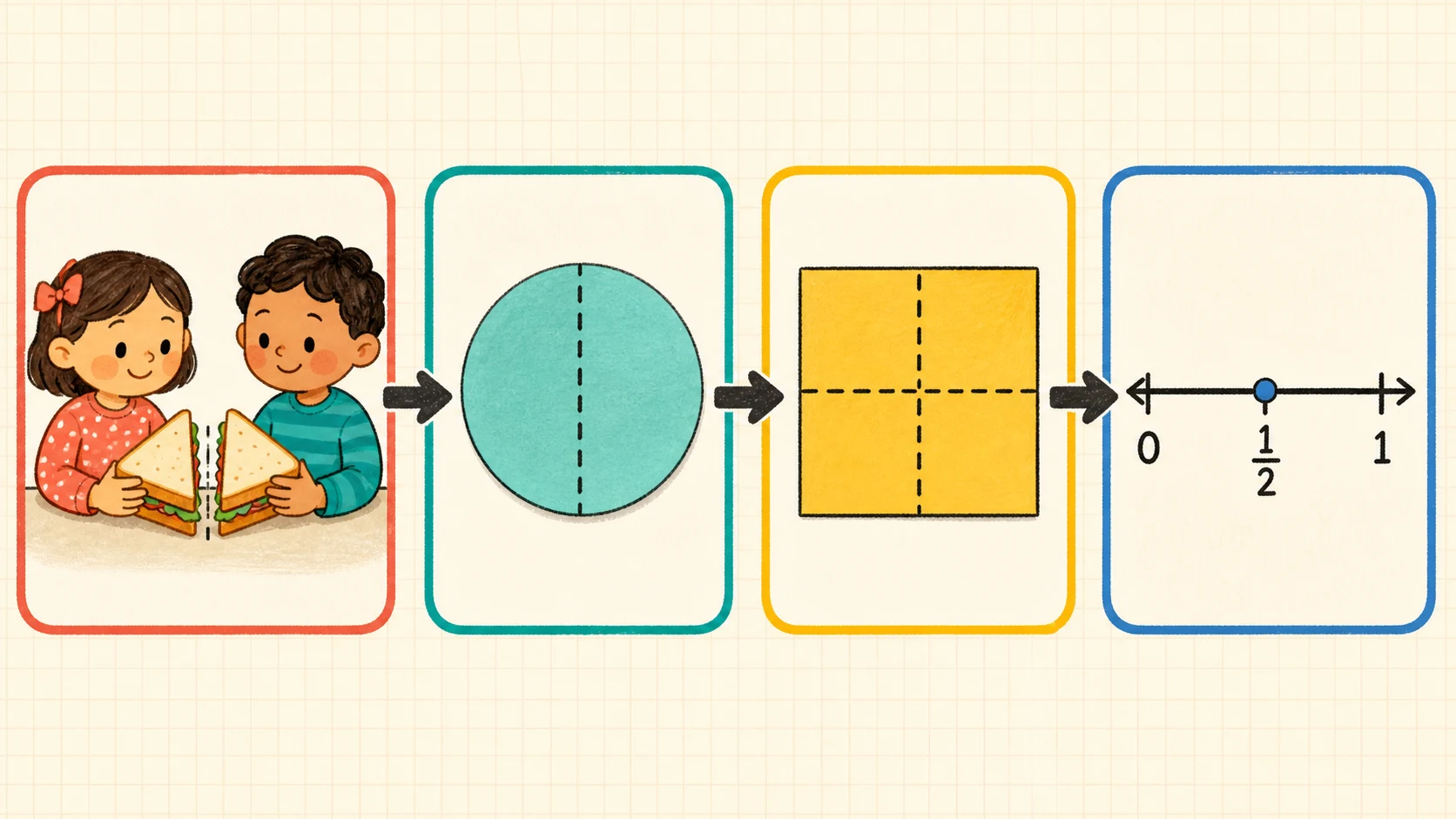
Begin with equal-part models and spoken fraction names; remove visual support only when the learner can connect the picture, the language, and the notation.
Scan for the first point where reasoning changed
A fast teacher scan is not the same as marking every answer. Look first at the response that best exposes the target, then sort the sheet into an immediate action category:
- Ready to continue: The response is accurate, the requested model matches, and the check is coherent.
- Brief correction needed: The model is sound but a numeral, label, count, or copied sign is wrong.
- Reteach the representation: Answers are inconsistent and the drawing, clock, number line, or manipulatives do not express the quantities.
- Reduce nonmath demand: Oral explanation shows understanding, but reading, handwriting, visual density, or direction-following obscures the recorded response.
- Collect another sample: One unusual answer is insufficient to establish a pattern.
Do not diagnose a disability, difficulty, or developmental condition from a worksheet. A page captures performance under one set of language, visual, motor, and timing demands. Repeated observations across formats can inform instruction, but formal concerns require the school’s established assessment and support processes.
Give feedback that causes a mathematical action
“Try again” supplies no direction. Mark the location of the reasoning break and request one observable action:
- Counting: “Move each counter after you count it.”
- Addition: “Show where the 5 split when you made 10.”
- Subtraction: “Write the related addition fact.”
- Place value: “Build 14 as one ten and four ones.”
- Word problems: “Label the whole and both parts.”
- Time: “Trace the hour hand first.”
- Money: “Write each coin’s value above it.”
- Fractions: “Check whether the parts are equal.”
- Geometry: “Count the sides; ignore the direction it points.”
If many learners make the same error, model one fresh example for the class. Do not erase and perform the original item for them; preserve it as evidence, then let learners apply the correction to a parallel item.
Let observed errors choose the next sheet
The next page should change the feature implicated by the error while keeping unrelated demands stable.
When counting breaks down
If a learner counts a neat row correctly but double-counts a scattered set, choose another small scattered set and permit moving or crossing out each object. Do not jump immediately to larger quantities. The next observable action is one touch or move per number word.
If the learner touches accurately but writes the wrong numeral, use a matching response—count the set, then select from two or three numeral cards. This preserves quantity recognition while reducing numeral production.
When computation lacks a model
If 8 + 5 is incorrect and no representation appears, return to counters or a ten frame with the same range. If the model accounts for all 13 objects but the written answer says 12, choose a short page that pairs completed models with numeral recording. The target is transcription and recounting, not easier addition.
If subtraction answers consistently reflect addition—such as answering 7 for 5 - 2—select removal stories with objects and require the learner to physically remove the stated amount before recording. Then connect the action to the minus sign.
When place value, time, or money reveals an identification problem
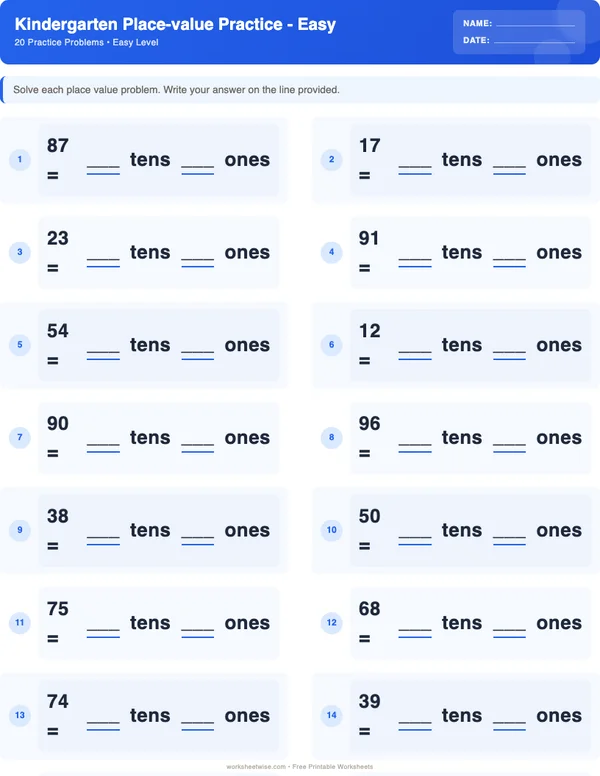
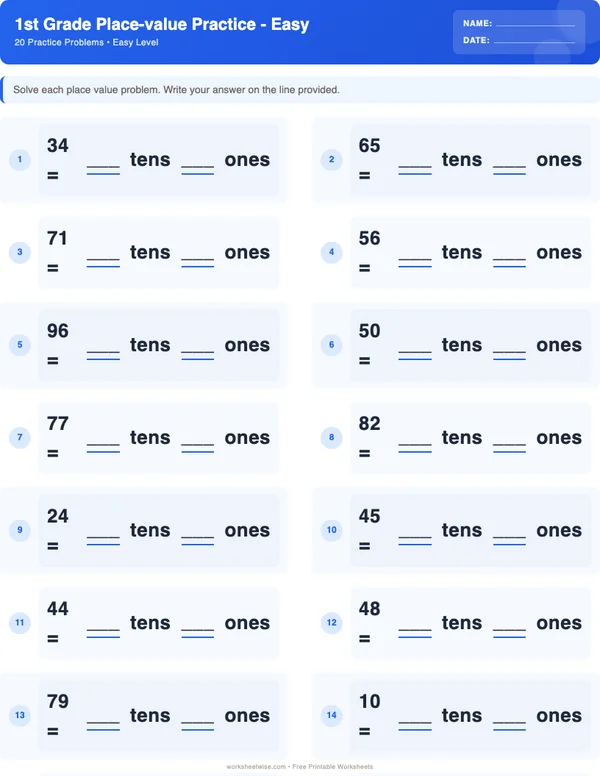
If 14 is represented as 14 loose ones and the task asks for tens and ones, choose a page that explicitly pairs bundled objects with 1 ten + 4 ones. The Kindergarten Place Value guide and free sheet is the relevant next resource; a mixed computation page would conceal the unresolved unit structure.
If clocks after :30 are misread as the next hour, keep minute intervals familiar and select only after-the-half-hour clocks. Require the sentence frame, “The hour hand has not reached __, so it is still __ something.”
If coin totals equal the number of coins, pause mixed-coin calculation. Match each coin to its value first, then count collections containing one denomination, and only then restore mixed sets.
When the word problem or fraction model is the issue
If computation is accurate but the operation does not match a story, keep the number range and contrast two structures: joining versus finding a missing part. Require a labeled bar or simple drawing before the equation.
If unequal pieces are accepted as fractions, do not move to symbolic comparison. Use foldable paper or matching shape models and ask learners to prove that parts coincide. The next sheet should ask about equal partitioning, not larger denominators.
This use of a short response as instructional evidence is consistent with the IES young-children guide’s recommendation to monitor progress and build on current knowledge. The exact error-to-sheet rules above are editorial applications to this catalogue, not claims that the source reviewed these resources.
Adapt access without replacing the mathematics
An adaptation preserves the relationship being assessed. It does not quietly supply the answer or substitute a different skill.
For counting, enlarge objects, reduce visual crowding, allow pointing or moving, and accept an oral numeral when handwriting is not the target. For addition, supply counters or a blank ten frame but do not prefill the decomposition when composing 10 is the target. For word problems, read the story aloud when reading is not under review, while preserving the quantities and unknown position. For geometry, provide larger shapes that can be rotated and traced. For time, use a geared demonstration clock during feedback, but use the printed clock when independent clock reading is the target. For fractions, offer paper folding or fraction strips without naming the fraction in advance.
Movement can preserve early mathematics particularly well. A three- or four-year-old can hop four times, match four objects to a numeral card, or place one toy in each drawn box. Requiring the child to sit and complete 20 written items would add stamina, pencil control, and direction-following demands that are not necessary to observe counting.
Avoid adaptations that invalidate the evidence: telling the learner which operation to use in an operation-selection task, naming a coin during coin identification, drawing equal partitions during a partitioning task, or pointing to the next number in a missing-number sequence.
Know what morning work cannot establish
A completed page does not establish mastery, standards alignment, readiness for a grade, or the cause of an error. It cannot show whether performance transfers to oral work, manipulatives, new contexts, or later retention unless adults deliberately collect those observations. Speed alone does not establish understanding.
Morning arrival is also a variable context. A late bus, an unfamiliar substitute, hunger, fatigue, language load, or missing glasses can affect the sample. Treat an isolated result cautiously. When accuracy and independence diverge, record both: “6 of 6 accurate with three prompts” is more useful than a checkmark.
Timed activity is not automatically inappropriate—the IES elementary intervention guide includes timed activities as one possible fluency practice—but timing should match the purpose. Do not use the arrival boundary as a pressure device or interpret unfinished conceptual work as failed fluency. A fractions model, word-problem explanation, or carefully drawn clock demands a different pace from retrieval of already-understood facts.
When the page shows several unrelated errors, stop assigning increasingly varied worksheets. Confer with the learner, model one item, and observe what changes. Use the Formative assessment Math Worksheets when the purpose shifts from a calm arrival routine to gathering more deliberate evidence.
Set up tomorrow’s six-minute evidence cycle
Choose one unresolved pattern from today—not the lowest score overall. Mark a short, coherent problem set, place the required representation beside it, and write one check prompt. Tomorrow, scan the model first and the answer second.
A concrete next action: open the free deterministic worksheet generators, create a narrowly focused set that changes only the implicated feature, and cap it at what can be inspected quickly. If today’s 3:45 was read as 4:45, generate or select after-the-half-hour clock practice and post, “Read the hour hand first.” That turns one observed error into tomorrow’s specific, visible teaching decision.
Put it into practice
Use the guide with a real printable
Move from explanation to a short, observable practice task. Check the first item together, then adjust the next session from the learner's actual work.
Open the first free worksheetExplore a neighboring collection