Curated collectionAnswer keys includedPrint-ready PDFs
Morning Work Grammar Worksheets
Build predictable, low-friction arrival routines with retrieval, a short completion boundary and a fast teacher scan.
Start with a real resource
Browse this worksheet collection
19 relevant free entry points are available. Each one includes a printable learner PDF and separate answer key.
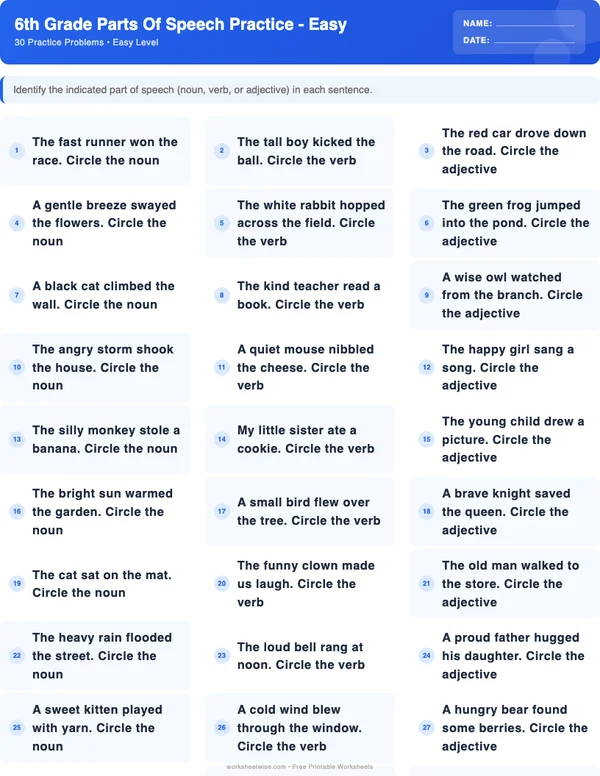
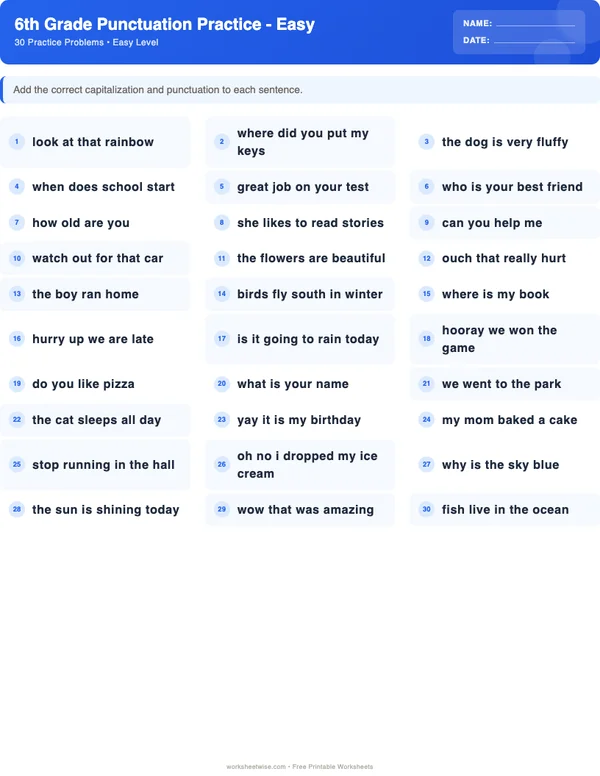
A useful practice loop
Print less. Observe more.
- Choose one skill and model the first item aloud.
- Use a short set and notice the learner’s strategy.
- Change the next task from the work you can see.
Need more than the free sheet?
Plus includes all 342 matching catalogue variations where available, plus saved deterministic generators and the worksheet designer.
See Plus membershipComplete guide
How to teach and practise morning-work grammar worksheets
3,412 words Updated 6 instructional visuals
Make arrival grammar work short, familiar and revealing
Morning grammar work is most useful when learners can begin without waiting for a new lesson, finish a clearly bounded task and leave behind evidence an adult can scan quickly. The goal is not to cover a large amount of grammar before the day begins. It is to retrieve something already taught, expose one likely misconception and make the next instructional decision easier.
A workable sequence is:
- Revisit one familiar rule or sentence pattern.
- Complete four to eight carefully chosen responses.
- Explain or revise one answer.
- Stop at a visible completion line.
- Sort the work by error pattern, not merely by score.
- Choose the next sheet from what the errors show.
That sequence matters because grammar answers can look correct for the wrong reason. A learner may add a period to every sentence without distinguishing a statement from a question. Another may circle a noun by choosing the first word in each sentence. A fast teacher scan therefore needs one small transfer item—such as reading a sentence aloud, explaining a choice or writing a parallel example—not just a row of selected answers.
WorksheetWise’s live morning-work grammar catalogue contains 342 variants, including 19 free resources, across seven grade labels and three topics: punctuation, parts of speech and sentence structure. Grade labels describe the intended practice level; local curriculum sequences differ. Age can help an adult discover potentially suitable material, but it is not a placement decision. Select from what the learner can understand and do, then adjust the response load and support.
Choose one grammatical decision, not a mixed morning packet
A low-friction sheet asks learners to make the same kind of decision several times. A sheet that switches among commas, pronouns, fragments and adjectives may sample many topics, but it is harder to start independently and harder to interpret afterward. If four answers are wrong, the adult cannot immediately tell whether the barrier was grammar knowledge, reading load, directions or task switching.
Use these selection criteria before printing:
- Previously modeled target: The learner has already heard and seen the rule or pattern.
- One dominant decision: Most items ask for the same operation, such as choosing end punctuation or finding the complete predicate.
- Readable directions: The learner can restate what to do after one example.
- Short response: Circling, matching, underlining or inserting one mark is usually suitable for retrieval.
- One transfer response: The final item requires a reason, correction or original sentence.
- Visible stopping point: The assigned boundary is marked before work begins.
- Scannable evidence: Errors can be grouped into a small number of meaningful patterns.
The catalogue’s “easy” label should not be treated as a description of a learner. Here it refers to observable task features: familiar vocabulary, direct directions, relatively short sentences, a limited number of grammatical choices and a constrained response. A sheet becomes more demanding when sentences grow longer, several rules compete, words can play different grammatical roles, or the learner must generate and justify a revision.
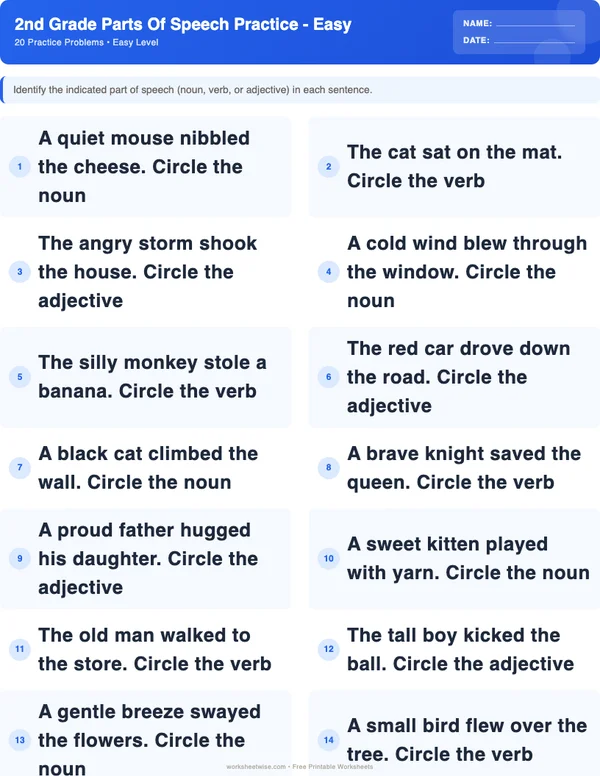
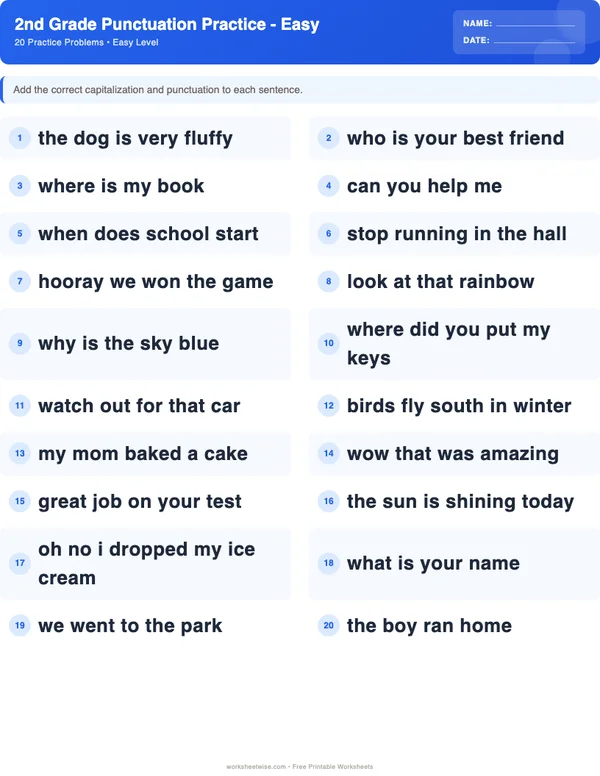
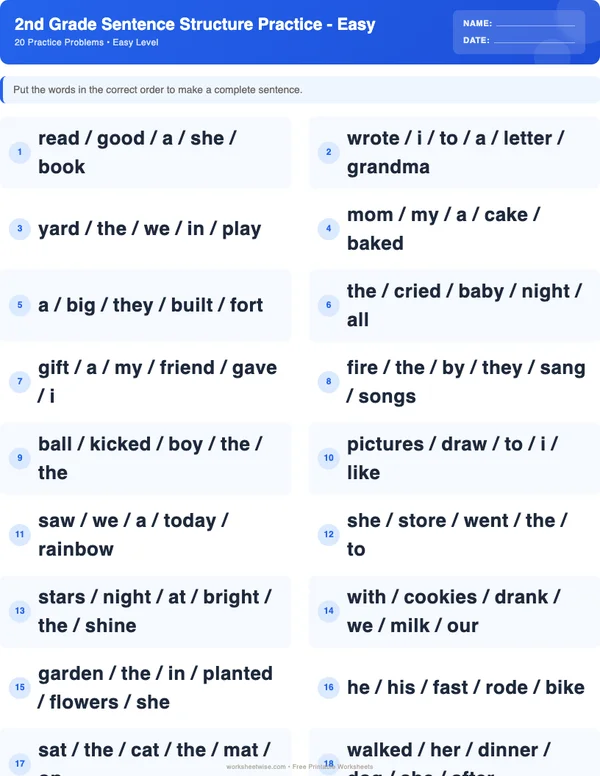
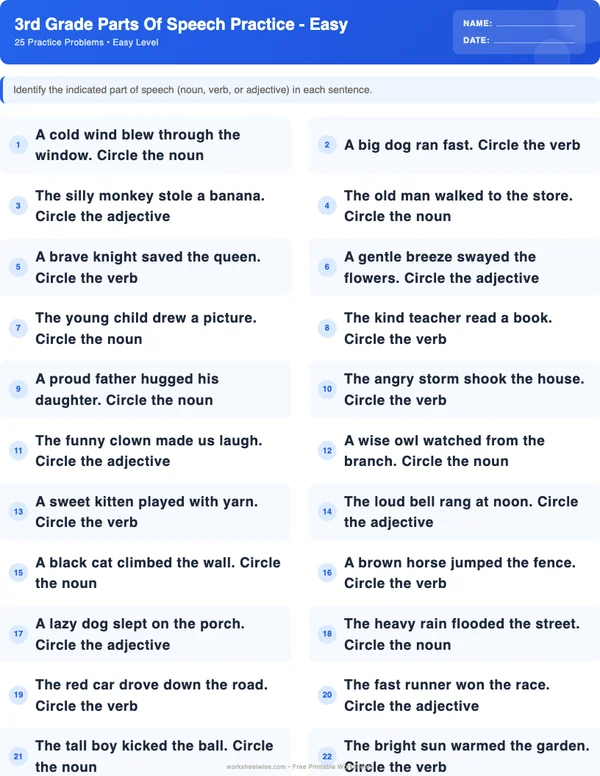
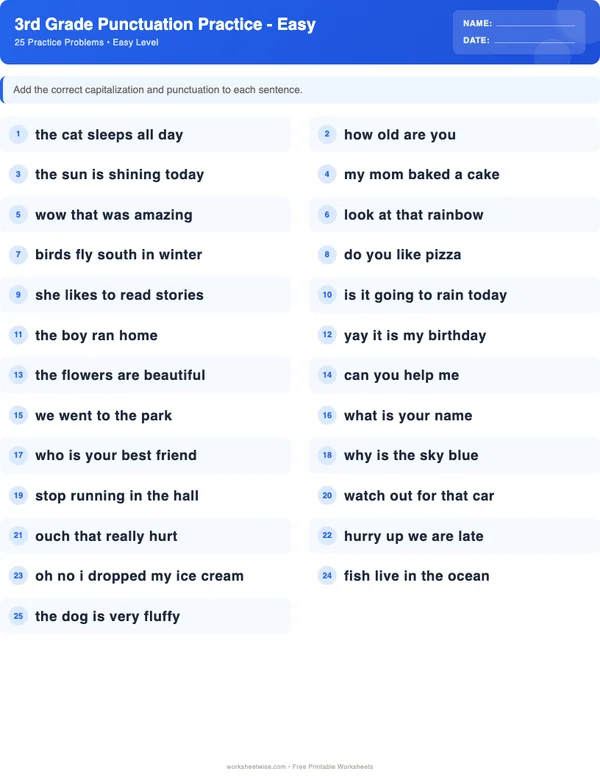
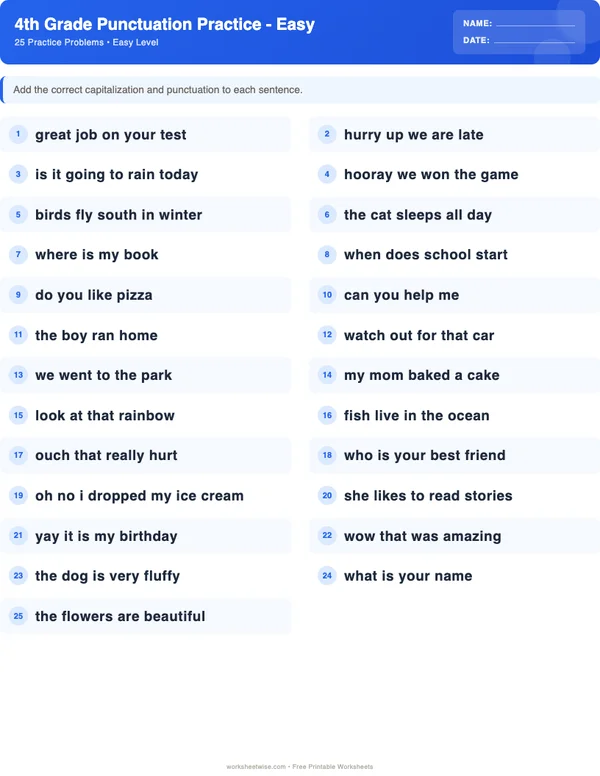
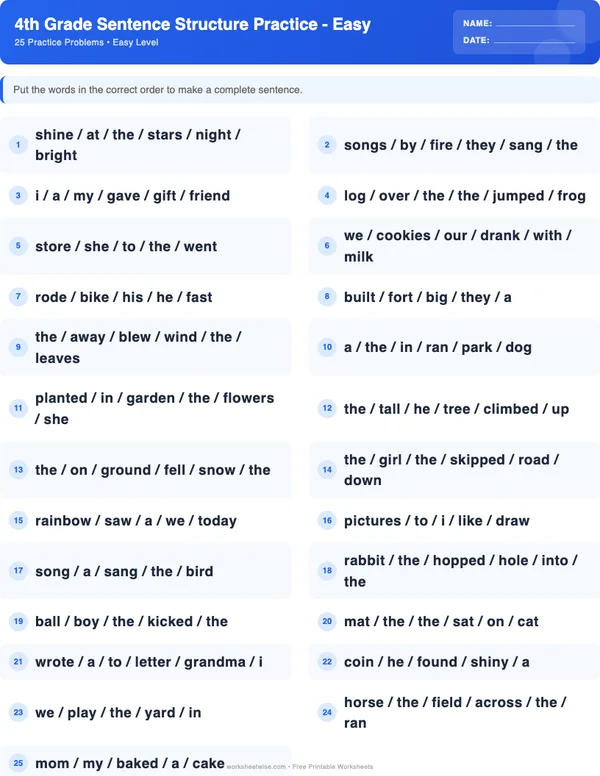
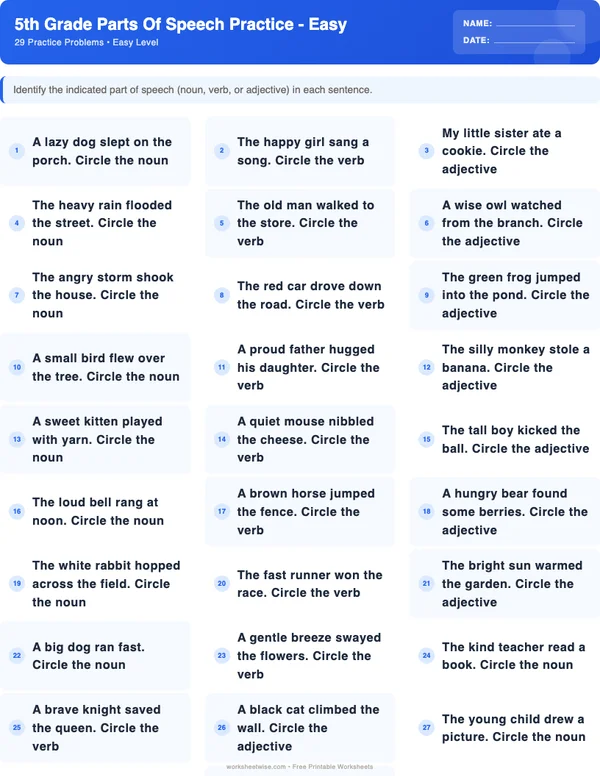
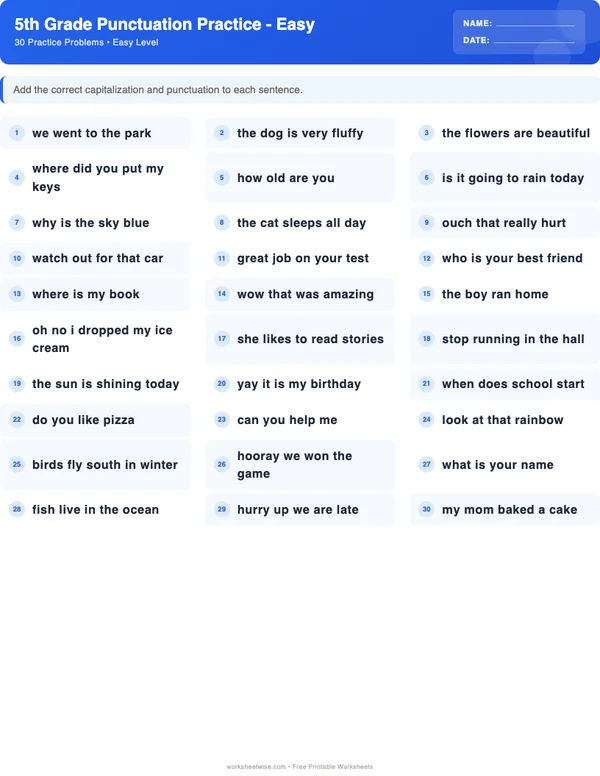
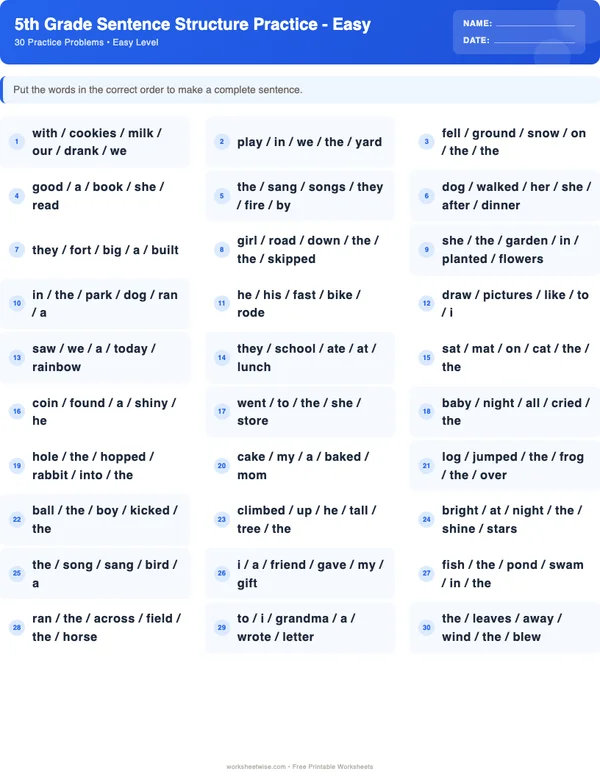
The representative free sheets contain 12 problems in Kindergarten through second grade, 14 in third and fourth grade, and 29 in the listed fifth-grade parts-of-speech resource. Those counts describe the live sheets, not a recommended morning dose. Assigning a boundary is an adult decision. Six well-chosen items with a checked explanation may reveal more than 29 rushed classifications.
Build a six-minute routine that survives a busy arrival
The routine should remain stable while the grammar content changes. Learners should know where to find the sheet, which items count, what to do when uncertain and where to place completed work.
Minute 0–1: read the model
Place one completed example above the assigned items. Keep the model structurally similar but not identical.
For a punctuation sheet:
Are the boots dry**?**
Say or print the decision: “This sentence asks something, so it ends with a question mark.”
For sentence structure:
The small bird sang from the fence.
Show that the complete predicate tells what the subject did. Do not model every item; the point is to reactivate a familiar idea.
Minute 1–4: complete the marked boundary
Mark a box around the assigned items or write “Stop after 6.” Learners arriving late can complete a smaller core set without feeling that the routine has become an unfinished test.
Use a consistent uncertainty routine: underline the clue, place a dot beside the item and continue. That keeps one difficult sentence from blocking the whole start of the day.
Minute 4–5: explain one decision
The explanation should match the target:
- Punctuation: “I chose ___ because the sentence ___.”
- Parts of speech: “The word ___ is acting as a ___ because ___.”
- Sentence structure: “This is complete/incomplete because it has/does not have ___.”
A learner may answer orally to an adult or partner when handwriting would hide the grammar knowledge being checked.
Minute 5–6: scan and route
Look first at the transfer response, then at two or three representative items. Use a simple code:
- R: ready for a nearby variation;
- M: needs a brief model and another same-target sheet;
- L: language or reading load may be obscuring the target;
- C: careless or inconsistent responding; confirm orally before changing level.
These are routing notes, not diagnoses.
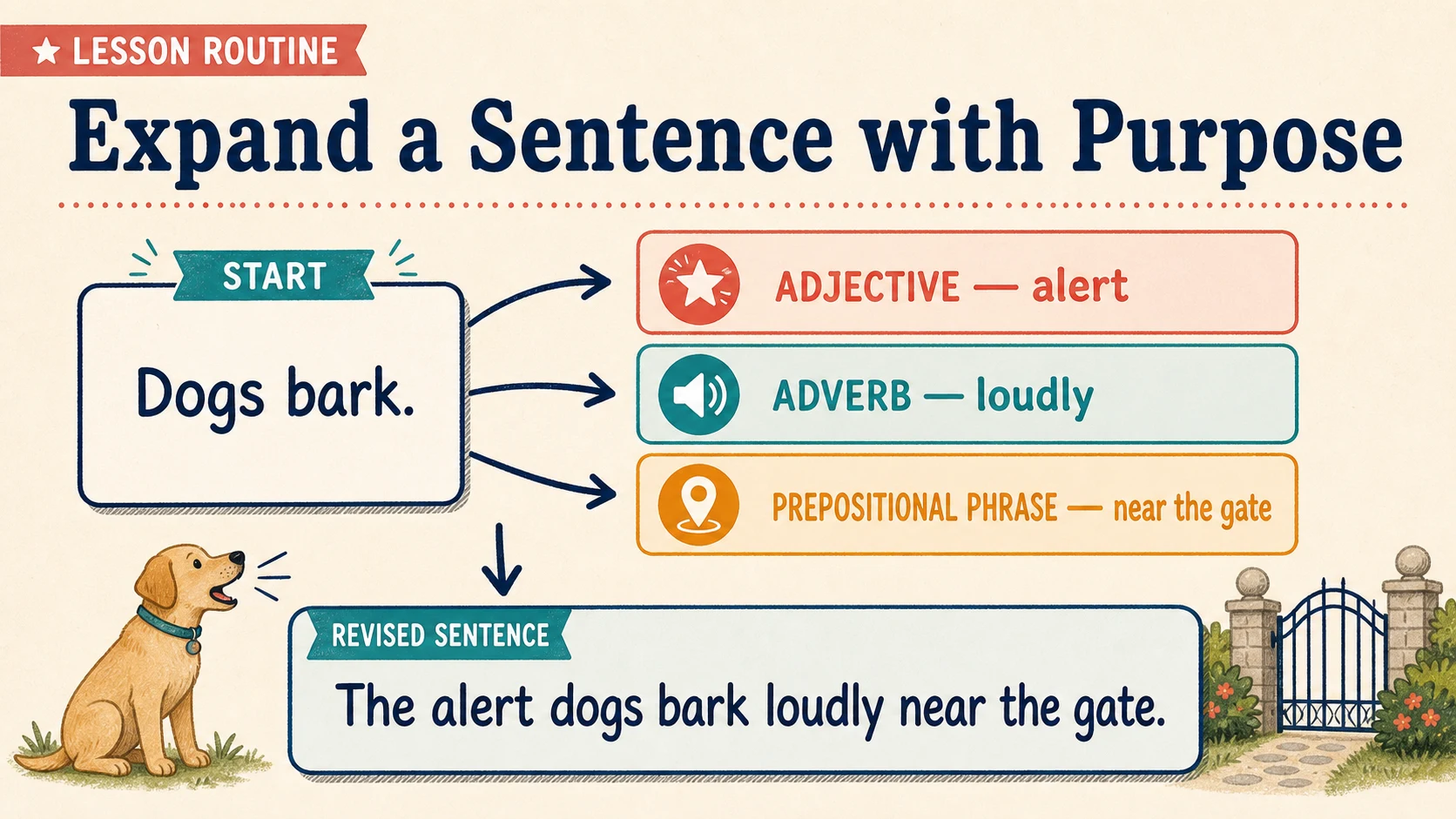
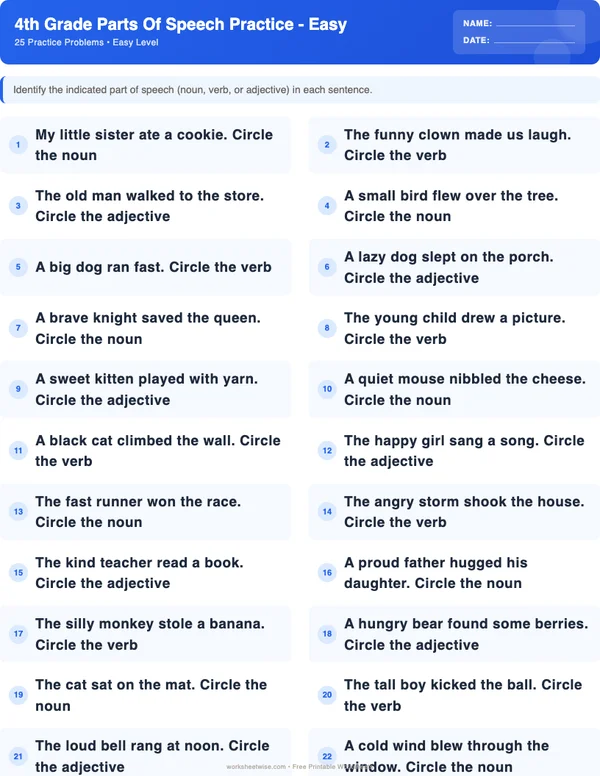
For third-grade parts-of-speech retrieval, keep the sequence fixed: model one word in context, classify a short set, justify one choice and scan for the kind of confusion.
Match the response format to the grammar evidence you need
Different formats answer different instructional questions. Select the format deliberately rather than assuming that more writing produces better evidence.
Recognition before production
Circling a period, question mark or exclamation point checks whether the learner can choose among visible alternatives. Inserting a mark without choices requires recall. Writing a whole sentence adds spelling, handwriting, vocabulary and composition demands. Those formats are not interchangeable.
Suppose a first-grade learner sees:
Where is my red hat__
The checked answer is a question mark: “Where” introduces a direct question, and the sentence asks for information. This example belongs in early punctuation morning work because the grammatical decision is narrow, the sentence is short and voice can support meaning. Read it aloud once with natural questioning intonation, then ask the learner to select the mark. If the learner chooses correctly only after hearing it, retain the punctuation target but reduce independent reading load on the next sheet.
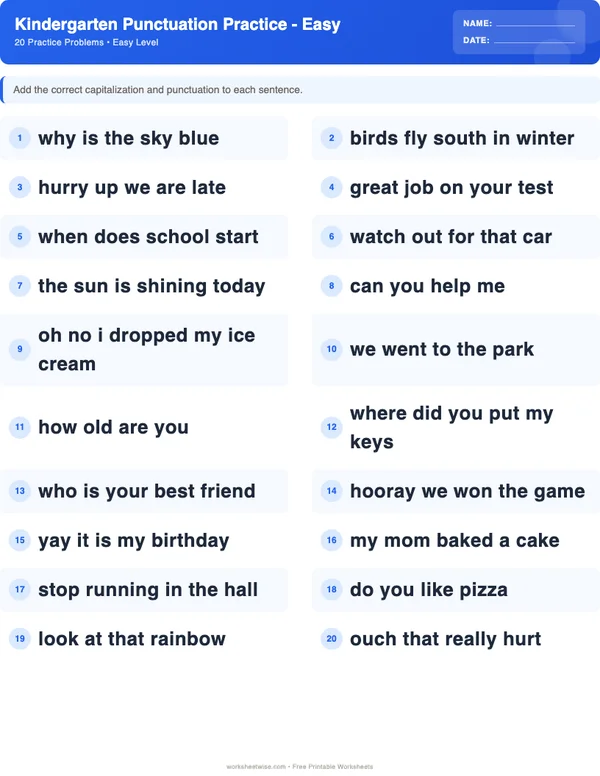
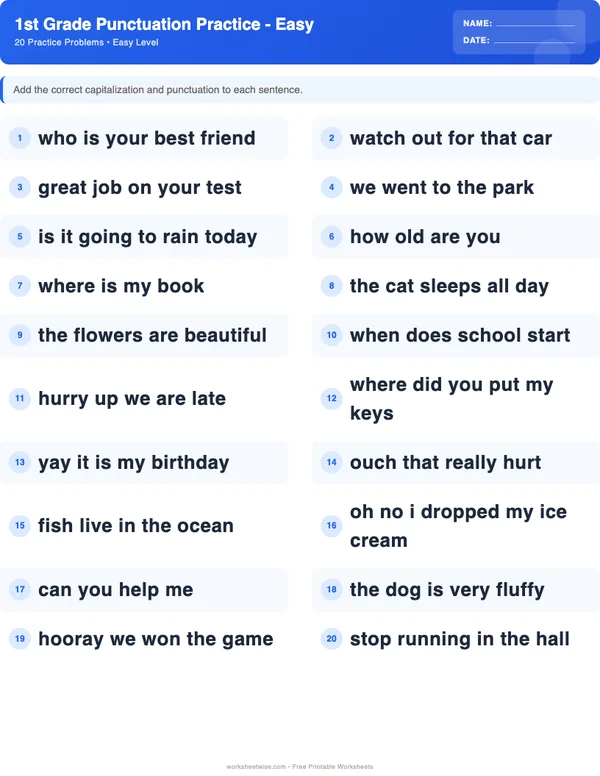
The live 1st Grade Punctuation guide and free sheet is a relevant entry point for this kind of end-mark practice.
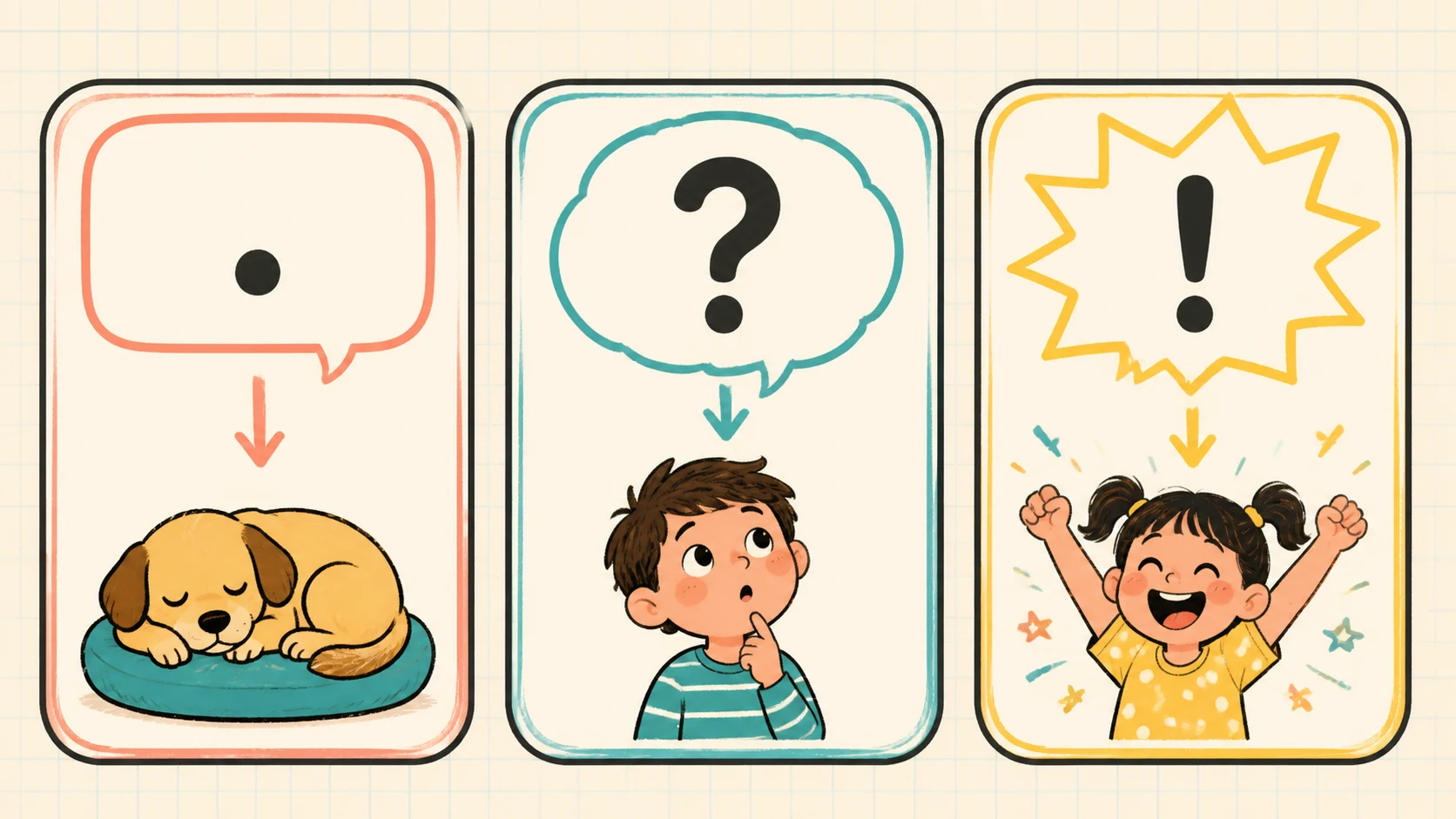
Use the early punctuation map to choose one connected decision—such as matching sentence purpose to an end mark—rather than assigning every punctuation form at once.
Identification before revision
Underlining a verb in a sentence checks recognition in context. Replacing a vague verb checks grammatical use and word choice. Asking for both in every item can make an arrival task unnecessarily slow.
Consider:
The rabbit hops across the grass.
“Hops” is the verb because it tells what the rabbit does. “Rabbit” names the animal and is a noun; “grass” names a thing and is also a noun. This example belongs in first- or second-grade parts-of-speech retrieval because the action is concrete and can be acted out. If a learner circles “rabbit,” ask, “Can you show me rabbit? Can you show me hops?” The movement preserves the noun–verb distinction while removing the need for a longer verbal explanation.
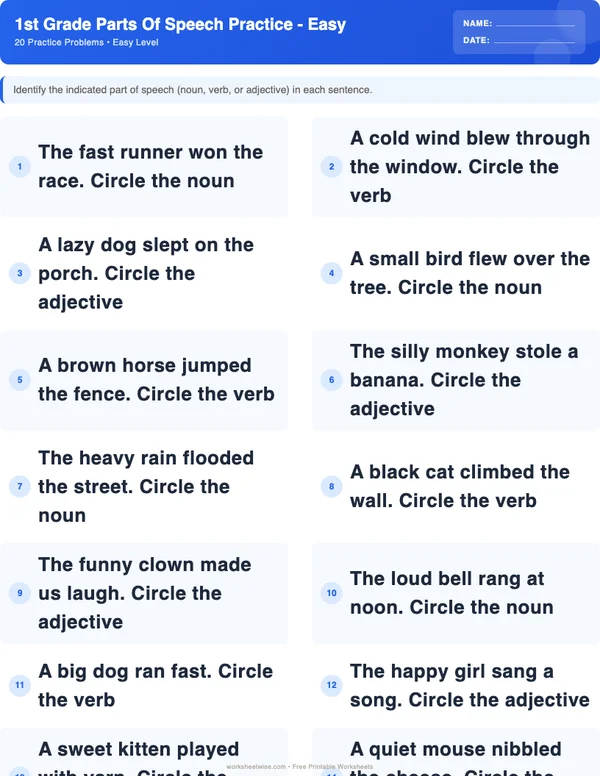
The catalogue guidance recommends beginning with concrete nouns and verbs and teaching them in real sentences. That is a catalogue-based teaching suggestion, not a claim that an external source evaluated WorksheetWise. Adults can compare the 1st Grade Parts of Speech guide and free sheet with the 2nd Grade Parts of Speech guide and free sheet and choose by task features, not the printed grade alone.
Correction before original composition
Editing a supplied sentence isolates a convention more cleanly than composing from scratch. Once the learner can explain the correction, add one short original sentence to check transfer.
For example:
we packed apples crackers and cheese
A checked revision is:
We packed apples, crackers, and cheese.
The sentence needs an initial capital, commas to separate three listed items and a period because it makes a statement. This example belongs in punctuation practice only if those conventions have already been taught. If the morning target is commas in a list, print the capital and period correctly so they do not compete with the intended decision:
We packed apples crackers and cheese.
That cleaner version asks for exactly two inserted commas. The adult-created simplification is a practical suggestion. The catalogue specifically recommends teaching one comma rule at a time before introducing another.
Compare the three live skill families before choosing tomorrow’s sheet
The catalogue’s three grammar topics are connected, but each calls for different modeling and produces different evidence.
Punctuation: connect marks to meaning and syntax
Early punctuation work can link end marks to sentence purpose and spoken expression. Later work should distinguish comma functions rather than treating every pause as a comma.
A third-grade morning item might read:
After lunch we planted seeds.
The checked revision is:
After lunch, we planted seeds.
The comma follows the introductory element “After lunch.” This example belongs in third-grade punctuation practice because it applies one specified comma function in a complete sentence. It does not belong as independent retrieval if the learner has only studied commas in lists; the visual mark is the same, but the rule is different.
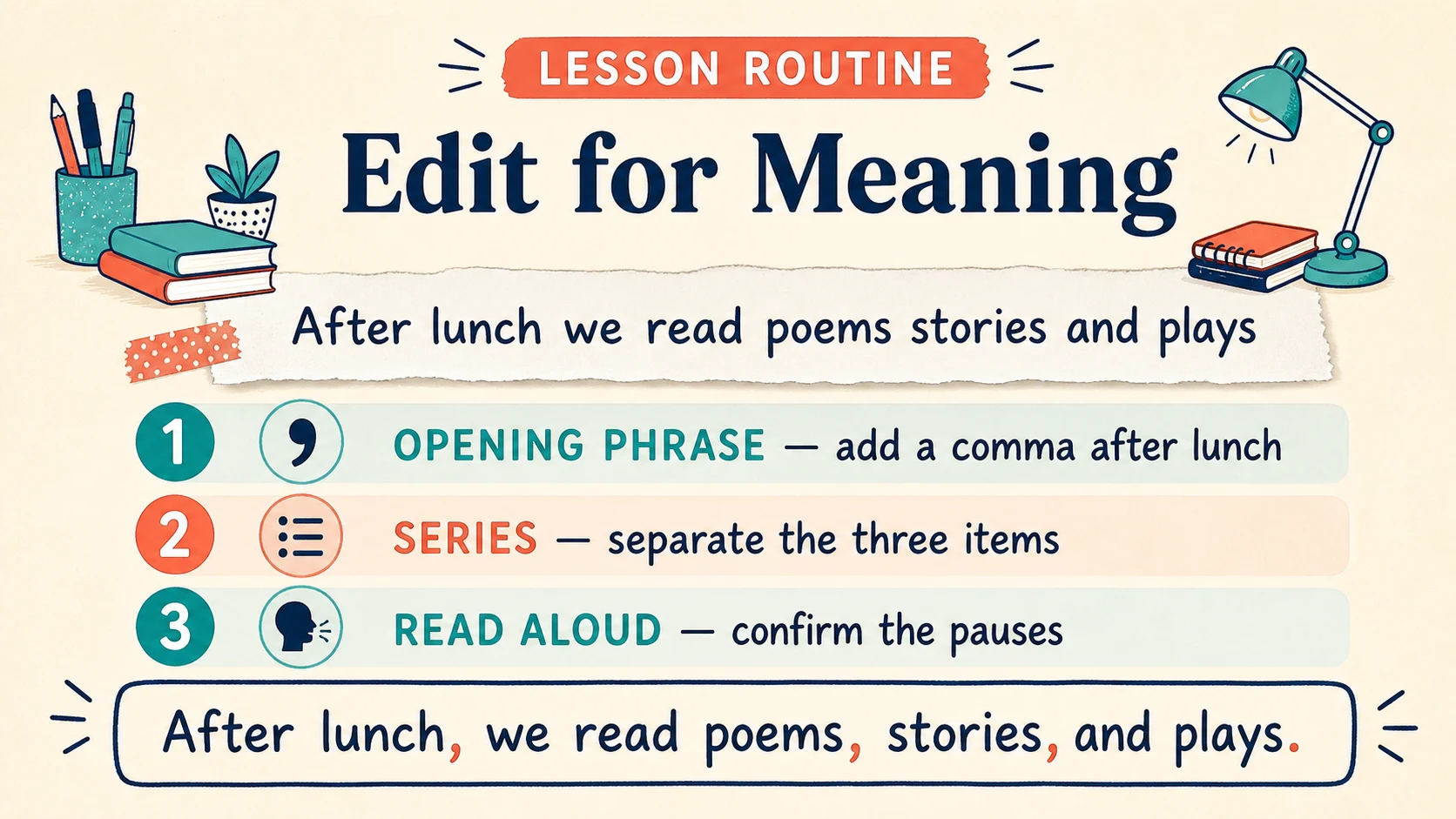
For third-grade punctuation, make the reason for the mark part of the routine: name the structure, insert the mark, then reread the complete sentence.
The IES elementary writing practice guide recommends explicit instruction in writing strategies and teaching foundational writing skills. Applied here, that supports a cycle of modeling a convention, guiding a brief attempt and checking whether the learner can use it in a sentence. This is sourced guidance translated into a morning routine; it is not evidence about any WorksheetWise sheet.
Parts of speech: classify words in context
A word’s role depends on its use. Avoid sheets that encourage learners to memorize one permanent label for a word.
Check these two sentences:
We run every morning.
I went for a run.
In the first sentence, “run” is a verb because it expresses what “we” do. In the second, “run” is a noun: it names the activity and follows the article “a.” This pair belongs after learners can reliably identify clearer nouns and verbs. It raises the difficulty through an observable feature—the same spelling has two functions—not through a label attached to the learner.
If a learner marks both instances as verbs, the next sheet should not add adjectives, pronouns and prepositions. Give a short contrast set in which one familiar word appears in two roles, and require the learner to point to the contextual clue.
Sentence structure: test completeness before variety
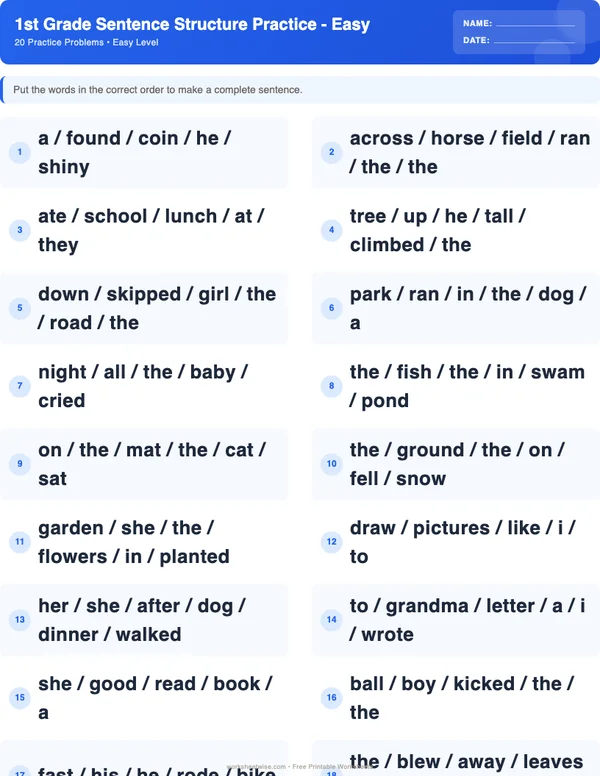
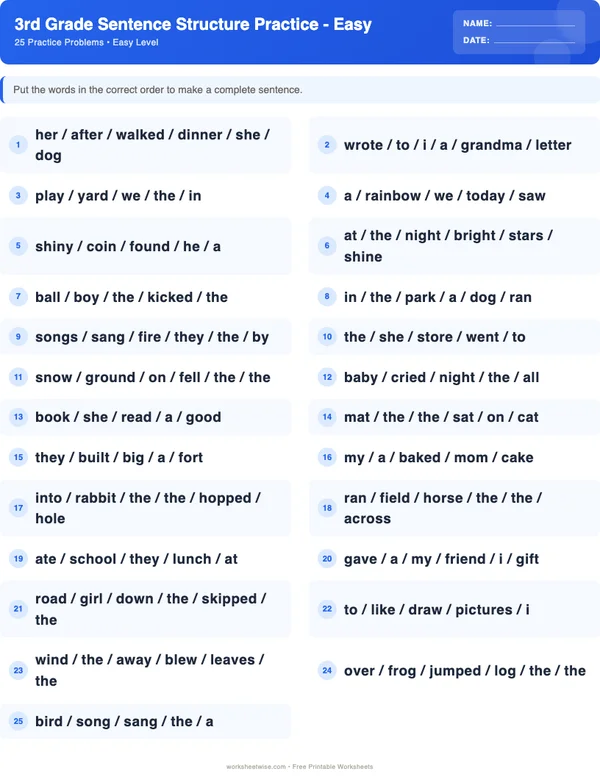
For early sentence work, use the oral question “Who or what? Did what?” Then connect that oral frame to written subjects and predicates.
Compare:
Under the old table.
The puppy slept under the old table.
The first group of words is a fragment in this context; it tells where but does not state who or what did something. The second is a complete sentence: “The puppy” is the subject, and “slept under the old table” is the predicate. This example belongs in first- or second-grade sentence-structure retrieval because the contrast makes the missing component visible without requiring advanced terminology.
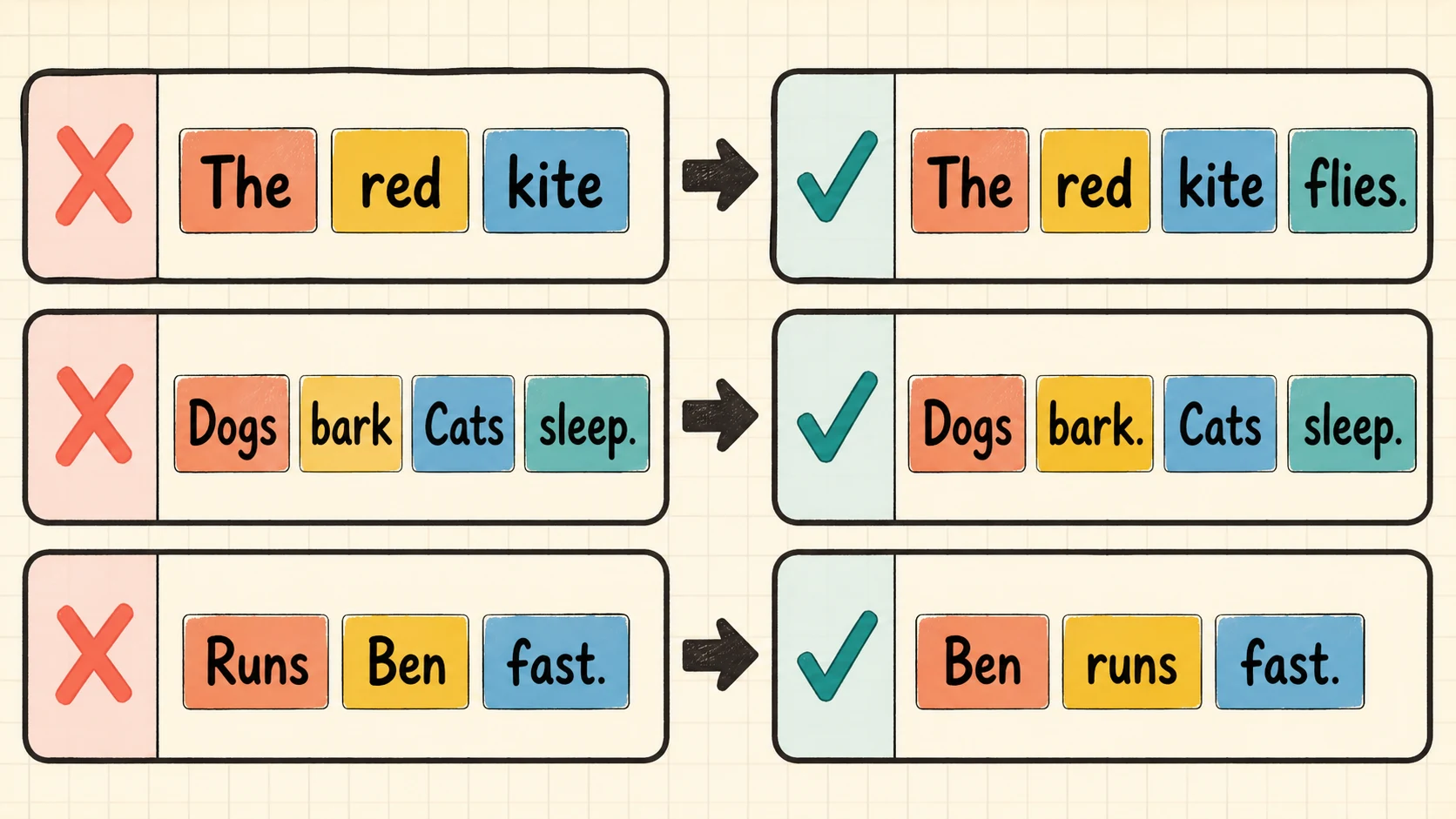
Treat an early fragment choice as evidence to investigate: ask for the “who or what” and “did what” before assigning another page.
The IES foundational reading practice guide addresses foundational skills that support reading for understanding, including work with connected text. It does not prescribe this grammar routine. A reasonable classroom application is to ensure that decoding or sentence-reading difficulty does not get mistaken for a grammar misconception: read an item aloud when necessary, then see whether the learner can make the grammatical decision.
Read errors as patterns, not as a single percentage
A score tells how many responses matched the key. It does not tell what to teach next. During the fast scan, group wrong answers by the decision the learner appears to be making.
When every sentence gets a period
Possible interpretation: the learner may be using “a sentence ends with a period” as an overgeneralized rule, or may not be reading for sentence purpose.
Check orally with one statement and one question:
The bus is here.
Is the bus here?
Ask the learner to say each sentence naturally and choose the end mark. If the contrast becomes clear orally, the next sheet should preserve end punctuation while shortening the reading. If the learner still chooses periods for both, briefly remodel statement versus question and assign another same-target set. Do not move to commas.
When the first word is always labeled the noun
Possible interpretation: the learner may be following position rather than meaning. Confirm with sentences in which the noun changes position:
Birds sing.
I watched birds.
“Birds” is a noun in both sentences even though it appears first in one and last in the other. Follow with a movement-and-object sort, then return to short contextual sentences. The target remains noun recognition; movement changes access, not the skill.
When fragments are accepted if they are long
Possible interpretation: the learner may be judging completeness by word count or punctuation.
Use a long fragment and a short complete sentence:
Near the tall wooden gate in the park.
Bees buzz.
The first is still incomplete in this isolated context; the second has a subject and predicate. Ask the learner to box “who or what” and underline “did what.” The next sheet should contrast complete sentences and fragments of varied lengths.
When punctuation is correct but explanations are not
Possible interpretation: the learner may recognize a visual pattern without being able to state the rule, or the explanation prompt may exceed current language demands. Confirm with a choice:
“Is this a question mark because the sentence asks something, or because it has six words?”
If the learner selects the grammatical reason, allow pointing, choosing or completing a sentence frame before requiring a fully written explanation. Keep one transfer item so pattern copying does not masquerade as understanding.
These interpretations are hypotheses for deciding what to check next. They are not diagnoses.
Use a progression from supported retrieval to independent transfer
Support should alter how the learner accesses the task, not quietly replace the target.
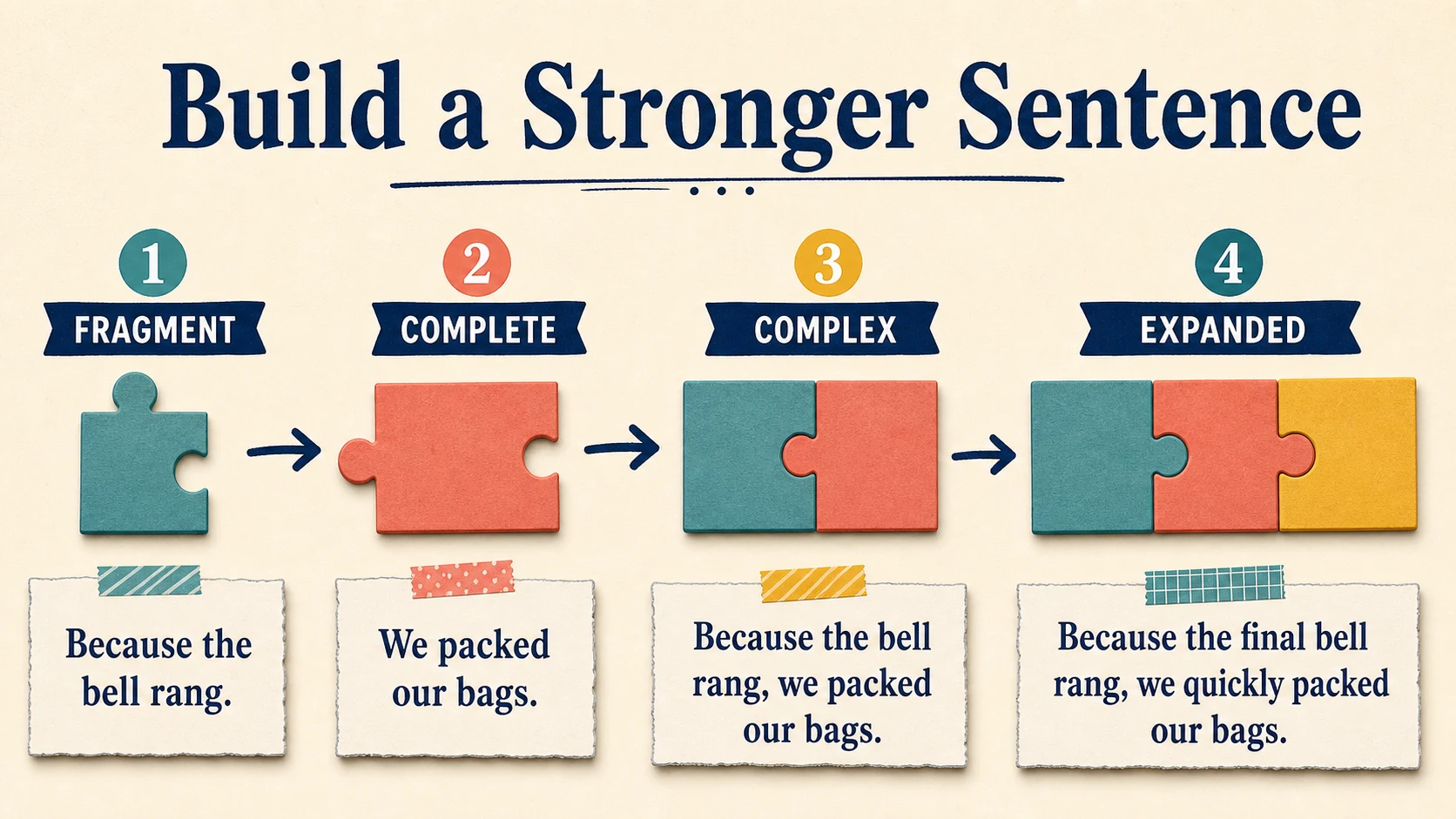
Even in upper-elementary sentence work, progress by reducing support around one structure: analyze a model, complete a parallel item, revise independently, then create and explain.
For a sentence-combining target, a useful progression is:
- Model: “The dog is big. The dog is brown.” becomes “The dog is big and brown.”
- Choose: Select the better combination from two options.
- Complete: Add the conjunction to a partially combined sentence.
- Revise: Combine two supplied sentences independently.
- Transfer: Write a new sentence using the same structure and underline the joining word.
Checked example:
Mia opened the window. Mia heard the rain.
One valid combination is:
Mia opened the window and heard the rain.
The repeated subject “Mia” can be stated once, and “and” joins the two predicates. Another grammatical revision might be “When Mia opened the window, she heard the rain,” but that introduces a dependent clause and pronoun. Use it only if those features match the taught target. This example belongs in sentence-structure work because it reveals whether the learner can combine related ideas without creating a run-on.
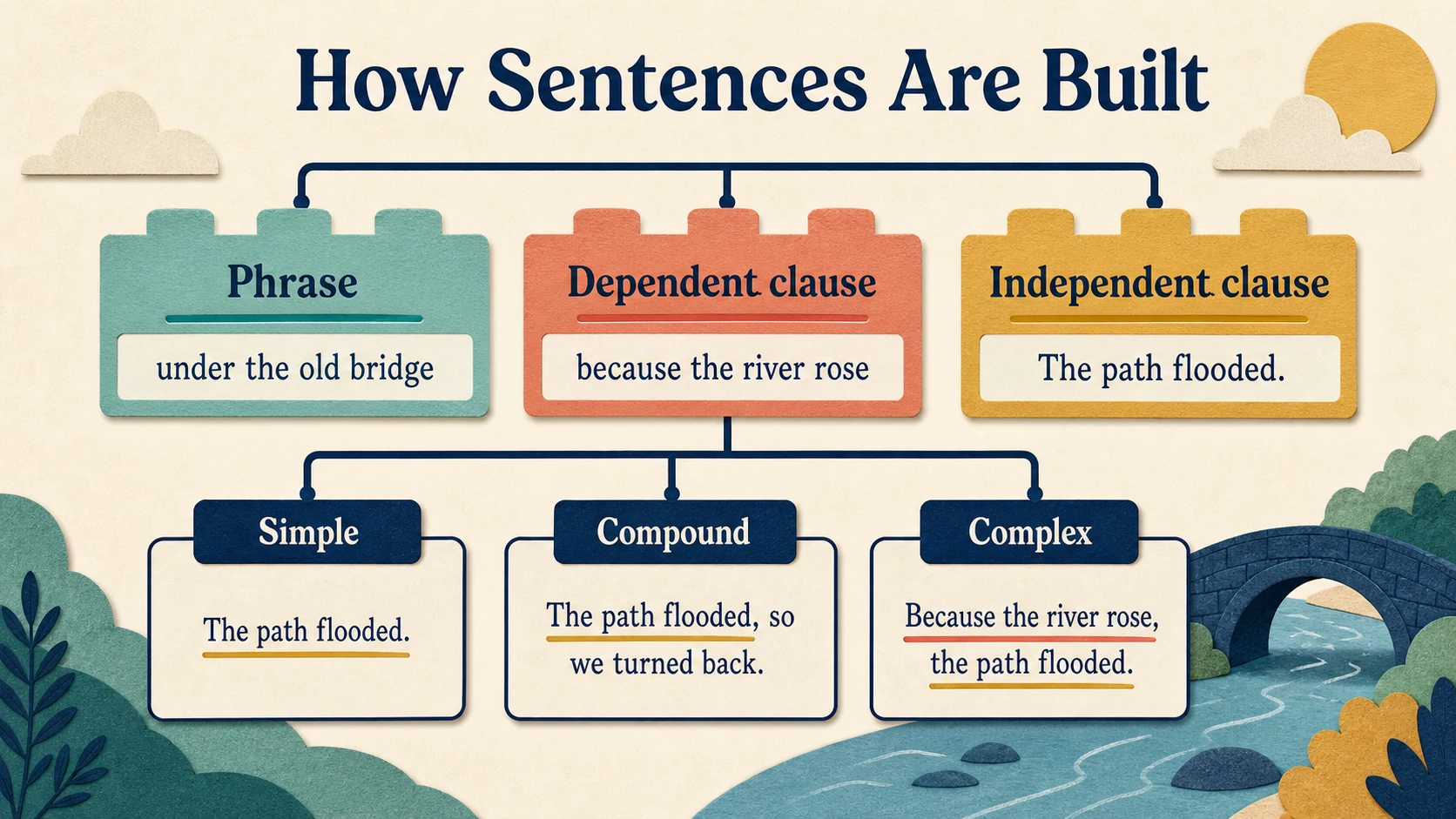
Use an upper-grade structure map to isolate the precise relationship under review—completeness, coordination, subordination or variation—before selecting the morning task.
The Common Core English Language Arts standards provide grade-specific expectations for language and writing, but they do not determine a universal local sequence or verify alignment for these resources. Consult the relevant local curriculum before treating a grade label as an instructional requirement.
Adapt access without erasing the grammar target
For learners who need less reading load, read directions and item sentences aloud while leaving the grammatical choice to the learner. For a punctuation target, do not name the required mark in your intonation so strongly that the answer is supplied automatically; use oral support first for access, then a neutral rereading for the decision.
For learners who need motor support, permit pointing, movable punctuation cards, oral choices or highlighting. A learner can place a question-mark card after “Where is the dog” and still demonstrate end-punctuation knowledge.
For multilingual learners, preview essential sentence vocabulary and contrast meaning through gestures or pictures. Do not simplify the sentence into a different grammatical structure. If the target is a preposition, physically place an object under, beside and behind a box, then keep those same relationships in the written items.
For ages three and four, prioritize brief adult-led oral, matching, manipulative and movement work over desk work. A child might match spoken statements and questions to period and question-mark cards, act out verbs or complete an oral “Who did what?” sentence. Age remains a discovery aid, not a placement decision.
For learners ready for more complexity, preserve the target and remove support before adding unrelated grammar. Ask them to explain why “run” changes role across two sentences, correct an unpunctuated sentence without a choice bank, or produce a second valid sentence combination. Complexity should be visible in the task, not represented by calling the learner “advanced.”
Keep the routine inside its proper boundaries
Morning work is not the right setting for first instruction in an unfamiliar convention, a long writing assessment or an attempt to resolve every error on the page. Arrival conditions vary: learners enter at different times, conversations and announcements interrupt attention, and adults may be handling several tasks.
Do not interpret one rushed sheet as a stable capability. Confirm surprising errors through a second example, an oral response or work from another setting. A learner who misses quotation marks may not have learned dialogue punctuation; another may understand the rule but lose track of several marks in a visually dense passage.
Do not infer a diagnosis from handwriting, incomplete work, grammatical errors or slow completion. Record what was observed: “selected a period for four questions,” “identified nouns when they were sentence-initial but not sentence-final,” or “combined ideas without a joining word.” That wording points toward a teachable next action.
Use a different context when the goal changes. Classroom Grammar Worksheets may better suit guided instruction and discussion, while After-school Grammar Worksheets can support a calmer adult-assisted review. These links identify alternative use contexts; they do not imply that one setting is universally better.
Turn today’s scan into tomorrow’s sheet
End the routine by making one observable decision. Sort the work into three instructional routes:
- Same target, more support: The learner’s responses are inconsistent or improve after a model. Choose another sheet on the same skill with shorter sentences, fewer choices or an oral warm-up.
- Same target, changed examples: The learner succeeds only when the answer appears in a familiar position or format. Keep the rule but vary word position, sentence length or response type.
- Nearby transfer: The learner answers the retrieval items accurately and explains the decision. Move from selection to correction, or from correction to one original sentence.
For example, if a learner correctly punctuates five statements but places a period after both questions, tomorrow’s action is not “more grammar.” It is a four-item statement-versus-question contrast, followed by one original question. If a learner identifies concrete action verbs but calls “is” a noun, tomorrow’s sheet should contrast action and linking verbs rather than introduce adjectives. If a learner recognizes fragments but creates run-ons while combining sentences, return to the boundary between complete thoughts and model one valid joining method.
Choose that next sheet now from the full worksheet library: write the single grammar decision at the top, mark a six-item stopping boundary and add one explanation or transfer item. Tomorrow morning, scan for that decision first.
Put it into practice
Use the guide with a real printable
Move from explanation to a short, observable practice task. Check the first item together, then adjust the next session from the learner's actual work.
Open the first free worksheetExplore a neighboring collection