Curated collectionAnswer keys includedPrint-ready PDFs
Morning Work Spelling Worksheets
Build predictable, low-friction arrival routines with retrieval, a short completion boundary and a fast teacher scan.
Start with a real resource
Browse this worksheet collection
5 relevant free entry points are available. Each one includes a printable learner PDF and separate answer key.
A useful practice loop
Print less. Observe more.
- Choose one skill and model the first item aloud.
- Use a short set and notice the learner’s strategy.
- Change the next task from the work you can see.
Need more than the free sheet?
Plus includes all 90 matching catalogue variations where available, plus saved deterministic generators and the worksheet designer.
See Plus membershipComplete guide
How to teach and practise morning-work spelling worksheets
3,616 words Updated 6 instructional visuals
Make arrival spelling work brief, predictable, and informative
Morning spelling work is most useful when learners can begin without waiting for a new explanation, retrieve a recently taught pattern from memory, finish within a clear boundary, and leave evidence that an adult can scan quickly. A workable routine is:
- Read or hear the target words.
- Notice the spelling pattern.
- Complete one short retrieval task.
- Check the uncertain part of each word.
- Mark one word for follow-up.
Keep the morning task narrower than the main spelling lesson. Arrival time is not ideal for introducing an unfamiliar convention, assigning a long list, or expecting independent sentence composition before learners understand the words. It is better suited to recalling yesterday’s pattern, distinguishing two known patterns, or checking whether a correction has held.
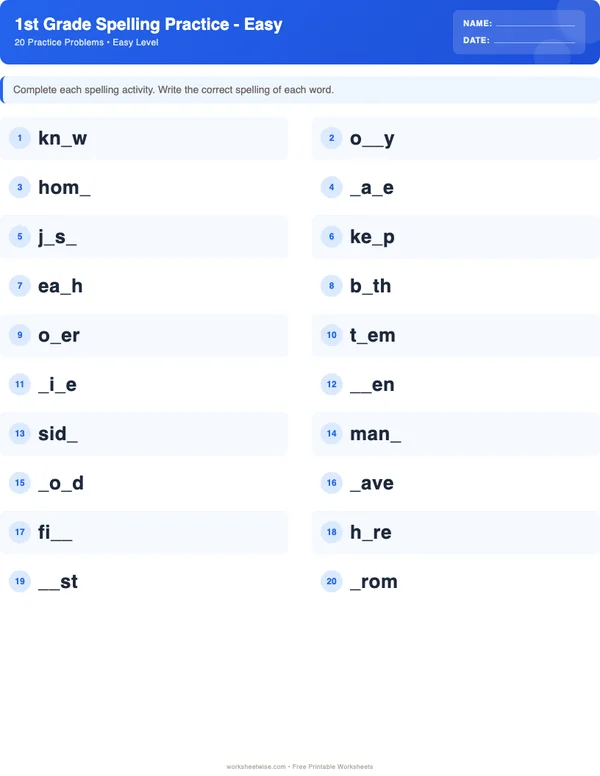
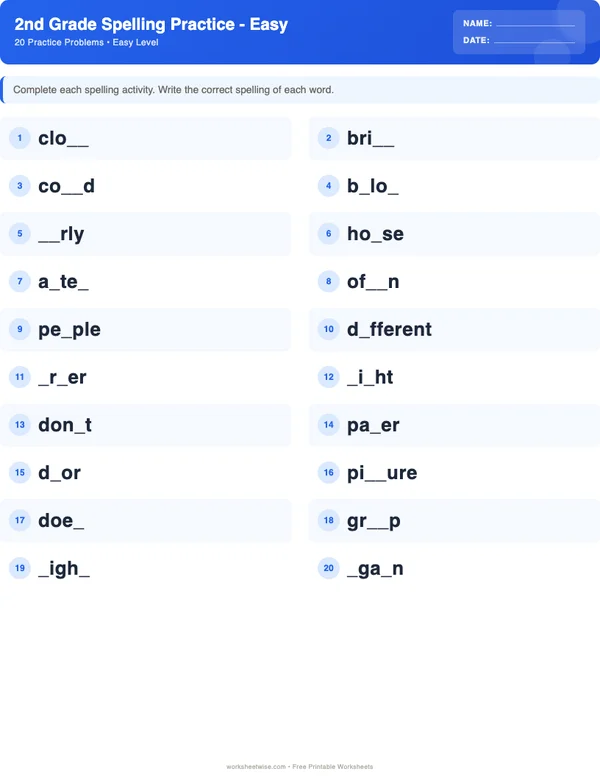
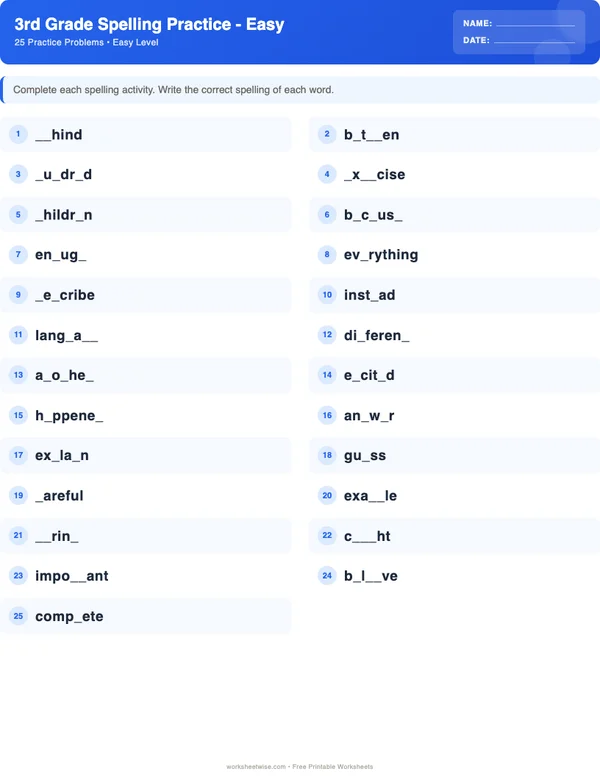
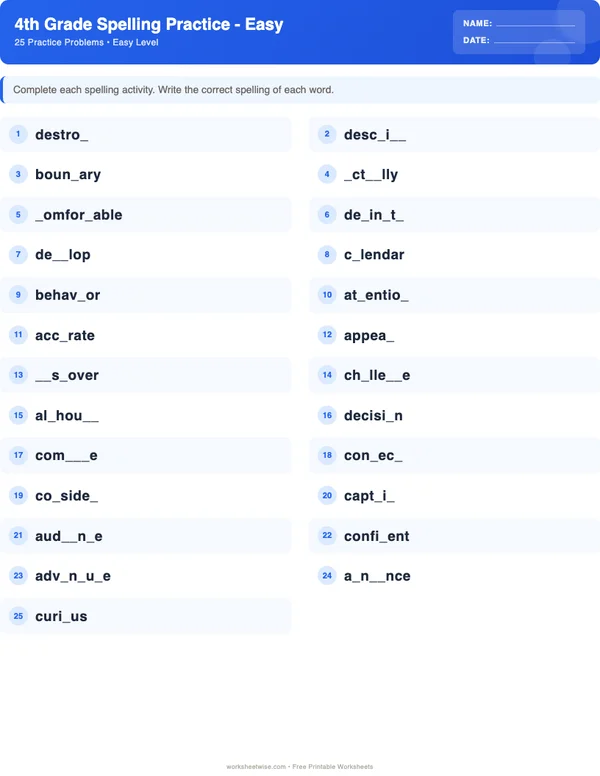
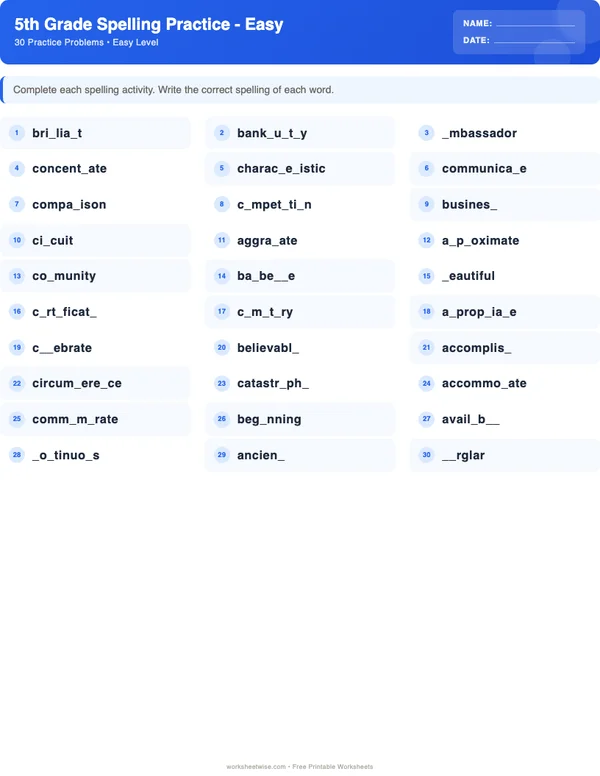
The live WorksheetWise catalogue contains 90 spelling variants across five grade entry points, with one free spelling-words resource for each of Grades 1–5. The representative free sheets contain 20 problems in Grades 1 and 2, 25 in Grades 3 and 4, and 30 in Grade 5. Those totals describe the sheets, not the amount every learner must complete during arrival. A teacher might define the morning boundary as one section, six words, or four minutes and reserve the remainder for another session.
Grade labels describe the intended practice level; local curriculum sequences differ. Use grade as a discovery aid, then inspect the actual pattern, directions, number of written responses, and independence required before assigning a sheet.
Choose the task by spelling evidence, not by the printed grade alone
Start with the spelling knowledge you want to retrieve. The catalogue covers short vowels, long-vowel spellings, consonant doubling, r-controlled vowels, silent letters, prefixes, suffixes, and multisyllabic words. Its listed response formats include look-cover-write-check, rainbow writing, pattern sorts, sentence use, and identification of misspelled words. These formats do different jobs.
Use recall when the pattern has already been modeled
Look-cover-write-check belongs after learners have seen and discussed the spelling. For the word cake, the learner looks at the whole word, identifies the long-vowel spelling a_e, covers the model, writes cake, and compares the attempt with the model. The informative part is not copying the corrected word repeatedly; it is locating the mismatch. If the attempt is cak, the learner should point to the missing final e and explain what changed between the model and the attempt.
This example belongs in morning work because it retrieves a recently taught representation with a short, visible response. It would not be a suitable first explanation of silent-e spelling.
Use sorting when learners confuse alternative representations
A catalogue teaching suggestion groups long-a words such as cake, rain, play, and break. These four words are correctly spelled, but they do not exemplify one uniform rule:
cakeusesa_e.rainusesai.playuses finalay.breakuseseaand is less predictable from the three more common examples.
A useful morning sort could place cake, rain, and play under visible headers, with break in a “word to remember” box rather than implying that ea routinely represents long a. The learner sorts the words, underlines the letters representing the vowel sound, and writes one additional known example only if the teacher has already confirmed it.
This example belongs here because the task exposes a specific decision: whether the learner attends to the sound alone or to its position and letter pattern. A correct sort can be scanned faster than four copied lines.
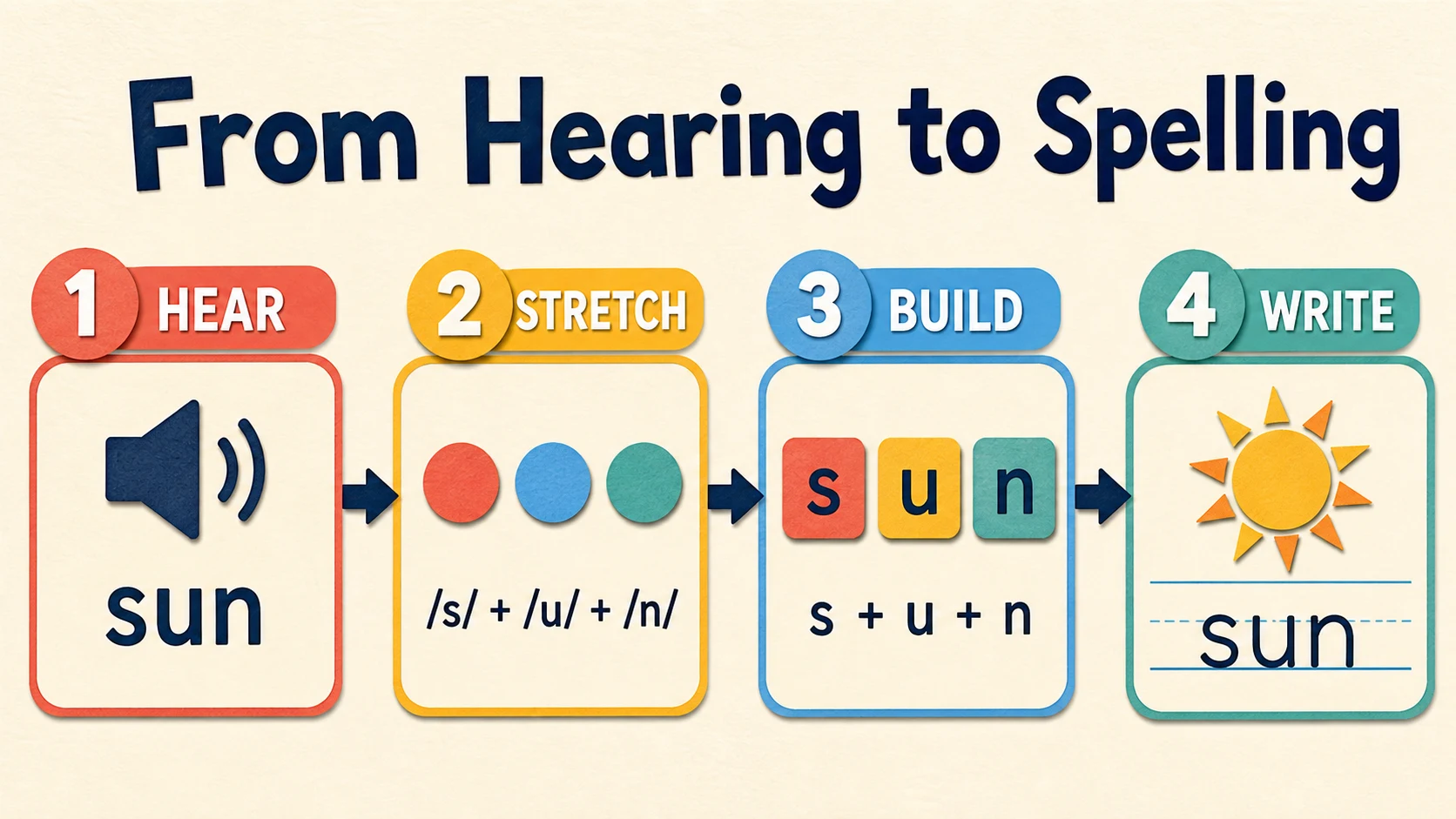
For an early spelling routine, move from a visible model and oral noticing to a small independent retrieval set; do not treat an entire 20-problem sheet as the required morning dose.
Use error detection when recognition is the immediate target
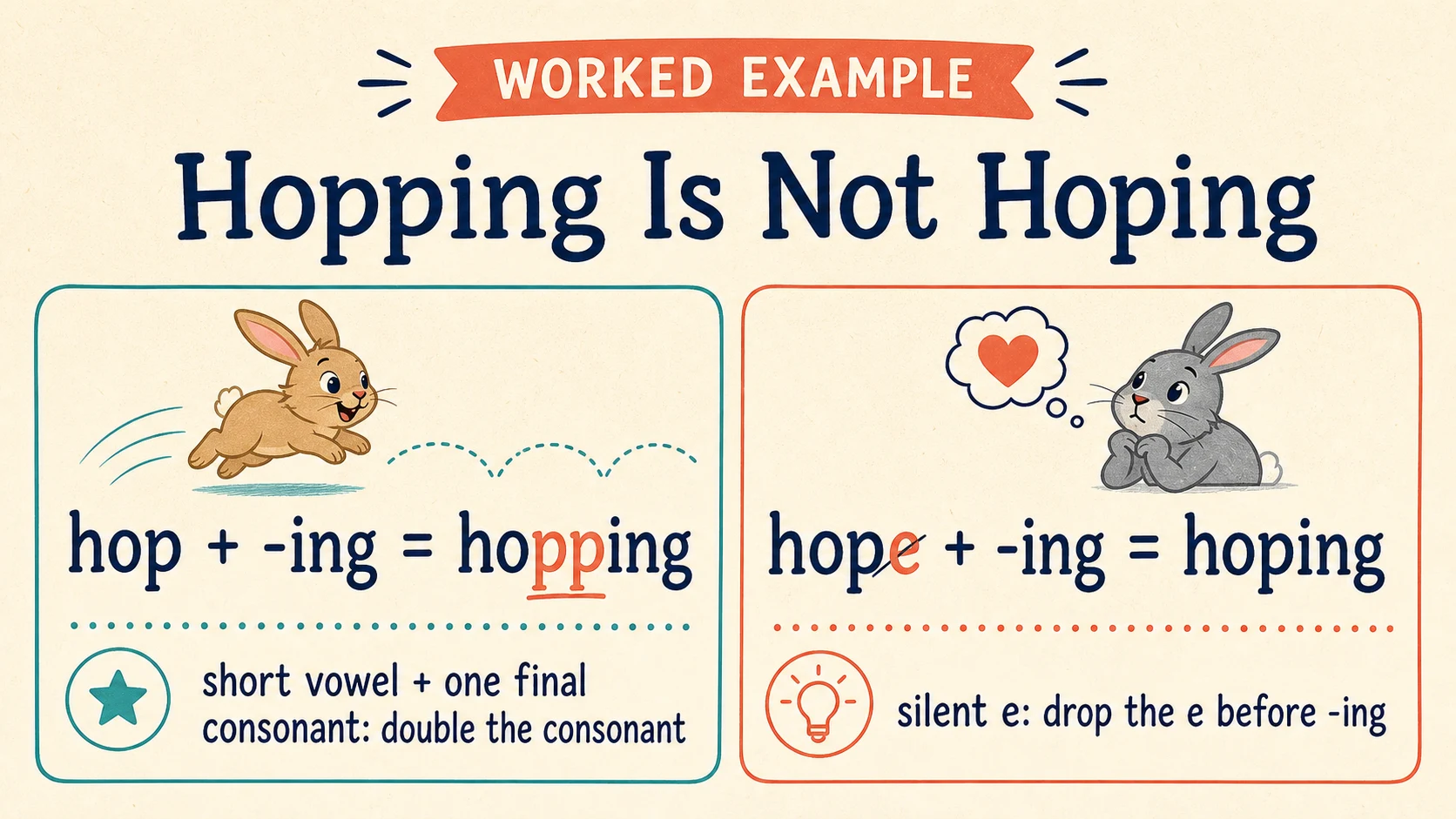
Present hoping and hopping, or planed and planned, only after learners have worked with the relevant base words and meanings. Ask them to choose the spelling that completes a short sentence:
- “The rabbit was ___ across the yard.” Answer:
hopping. - “We ___ the class display yesterday.” Answer:
planned.
Both checked answers require a doubled consonant after a short stressed vowel in these forms. The distractors are real spellings or plausible constructions in other contexts: hoping means wishing, and planed is a form of plane. Therefore, a sentence is necessary. A bare instruction to “circle the correctly spelled word” would be ambiguous.
This example fits the arrival context because two responses can reveal whether meaning and spelling are being coordinated. It also shows why teachers should check every item rather than assuming a plausible-looking pair has only one answer.
Define difficulty through what the learner must do
Every representative free sheet in the supplied catalogue is labeled “easy.” That label should not be attached to a learner. Translate it into observable task features before deciding whether the sheet is accessible.
A lower-demand morning task may have:
- one familiar pattern;
- a visible example;
- short, familiar words;
- a fixed response such as circling, matching, or sorting;
- few items on the desk at once;
- no need to invent a sentence;
- enough space to form each word legibly.
Demand rises when a learner must retrieve without a model, distinguish multiple patterns, spell morphologically complex words, hold a dictated sentence in memory, or explain a correction. A sheet can contain familiar words yet still be demanding if its directions require several steps. Conversely, a multisyllabic word can be manageable when its syllables and meaningful parts have already been modeled.
The increase from 20 problems in the Grade 1 representative resource to 30 in Grade 5 is a catalogue fact, not evidence that older learners should spend 50 percent longer on morning work. Completion volume, word complexity, response type, and support must be considered separately.
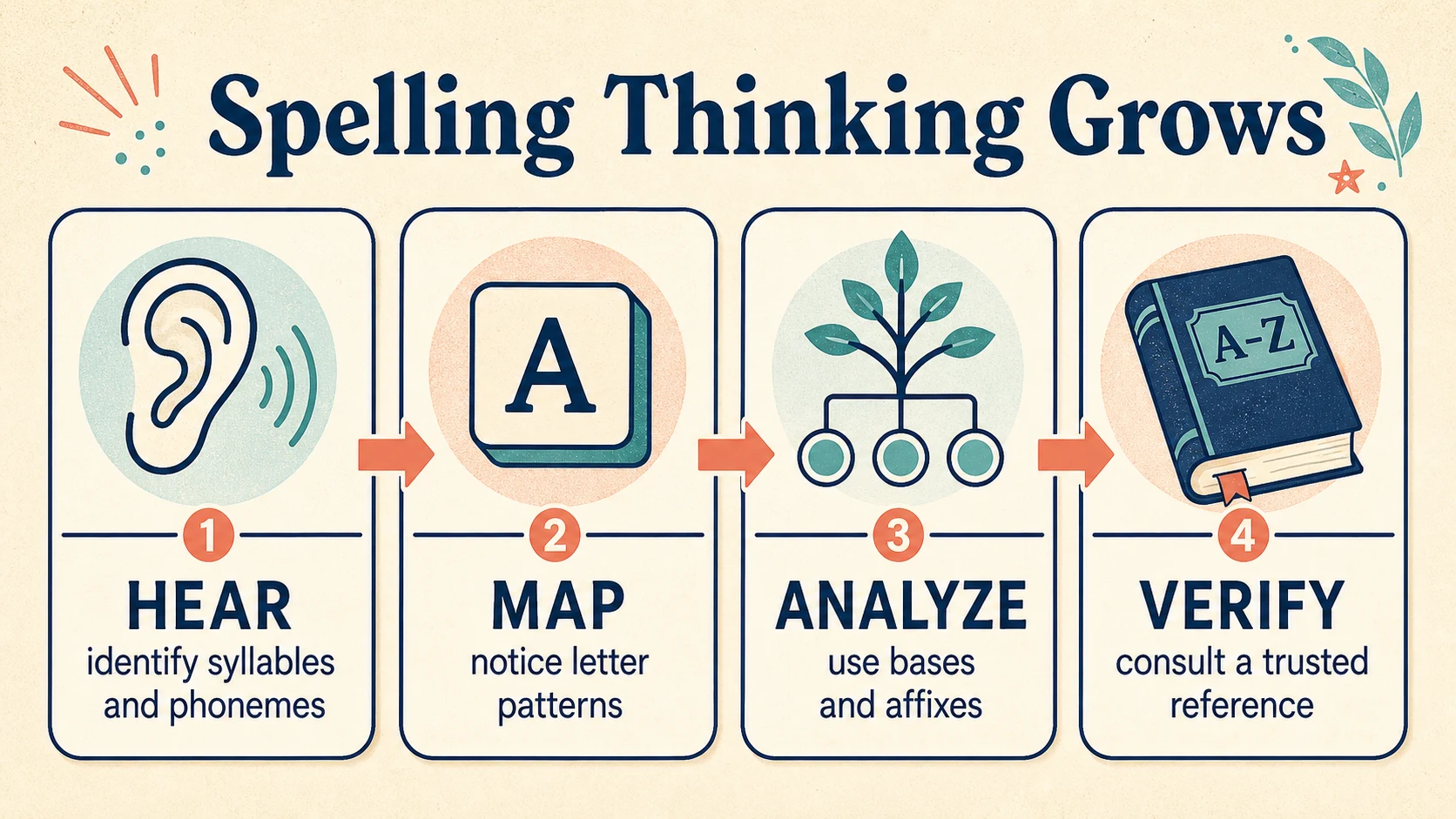
Upper-elementary independence should mean greater responsibility for analyzing and checking words, not automatically completing all 30 printed problems during arrival.
Use the 1st Grade Spelling Words guide and free sheet, 3rd Grade Spelling Words guide and free sheet, and 5th Grade Spelling Words guide and free sheet to compare actual response demands. Select the lowest-friction format that still makes the target spelling decision visible.
Run a six-minute arrival cycle
A stable sequence reduces procedural questions and preserves attention for spelling. Teach the routine when everyone is present; do not expect learners to infer it during a staggered arrival.
Minute 0–1: enter, locate, and preview
Place the sheet and one consistent tool in the same location. Display a boundary such as “Complete Box A” rather than “Do the worksheet.” Learners read the target pattern and example. If reading the directions would obscure the spelling target, add a familiar icon or briefly read the directions aloud.
The adult checks readiness, not correctness: Does the learner know where to begin? Is the example visible? Is the required response clear?
Minutes 1–2: rehearse one model
Use a short model whose thinking can be repeated independently:
“The word is
train. I hear /ā/. I seeaiin the middle. I look at the whole word, cover it, write it, and compare the vowel letters.”
The model names the relevant part without narrating every pencil movement. The learner can then apply the same sequence to two or three known words.
In a Grade 3 morning task, the worked example should reveal where to look in the word and how to verify the answer before the model is removed.
Minutes 2–5: retrieve within a short boundary
Choose one response mode:
- write four covered words from memory;
- sort six words by an already taught pattern;
- correct three misspellings and mark the changed letters;
- complete two dictated phrases;
- use two target words in short, meaningful sentences.
Avoid combining all five modes in one arrival assignment. Switching from sorting to sentence composition changes the cognitive and writing demands, making errors harder to interpret.
A learner who reaches the boundary stops, even if more items remain. A learner who finishes early checks the target letters in each response, then selects one word to explain. “Do more problems” should not be the automatic extension because speed is not the spelling target.
Minute 5–6: self-check and signal
Provide a model, answer strip, or teacher-led reveal. Learners use a consistent code:
- underline the part that matches the target pattern;
- circle the part that needs correction;
- place a star beside one uncertain word.
The teacher then scans for patterns rather than counting only total errors. Collecting twenty unchecked repetitions provides less actionable evidence than seeing that three of four errors omit the same vowel marker.
Model spelling at the level of sound, pattern, and meaning
The IES foundational reading practice guide recommends systematic work connecting speech sounds with letters and using decoding and word-analysis knowledge. That guidance is not an assessment of WorksheetWise. Applied to morning spelling, it supports a sequence in which learners hear a word, identify the relevant sound or meaningful unit, connect it to letters, and retrieve the complete spelling.
Show exactly what should be noticed
Consider car, fork, turn, and her. Each contains an r-controlled vowel spelling:
car:arfork:orturn:urher:er
A checked four-word task might ask learners to underline the vowel-plus-r unit and sort by spelling. Do not ask them to sort merely under “r-controlled” because all four would go in one group and the contrasting spellings would remain hidden. If the taught target is only ar, use car, farm, star, and hard rather than introducing four alternatives at once.
This example belongs here because it demonstrates how a small change in the prompt determines whether the response exposes useful knowledge. The same words can produce either a superficial category or a discriminating sort.
Preserve meaningful word parts in later grades
For helpful, a learner can identify the base help and suffix -ful. The correct suffix has one l, even though the independent word full has two. For careless, the base is care and the suffix is -less. A useful retrieval prompt is:
Build each word from its base and suffix, then box the suffix:
help + ful = helpful;care + less = careless.
Both constructions have been checked. This task belongs in an upper-elementary routine because it makes morphological structure visible and prevents the exercise from becoming visual memorization alone. If learners have not been taught the suffixes, however, it is new instruction rather than retrieval and should move out of arrival work.
The Common Core English Language Arts standards include grade-specific expectations involving spelling patterns, conventional spelling, and use of references. They can help adults inspect the general progression, but a page’s grade label does not establish alignment with a particular district sequence. Confirm local expectations before using a worksheet as evidence of mastery.
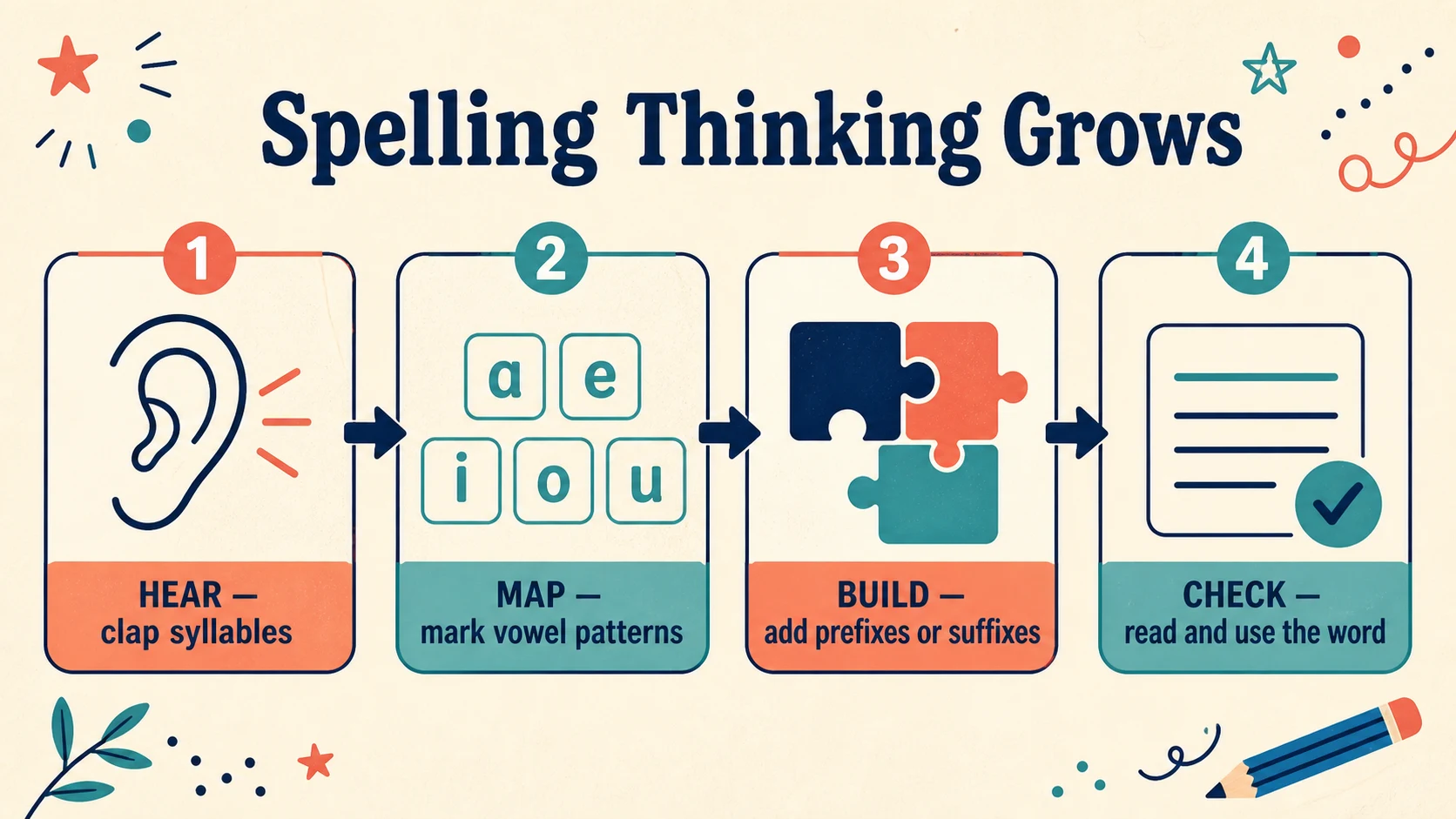
For Grade 3 practice, reduce support only after the learner can identify the target letters, explain the pattern in familiar words, and check a retrieved spelling.
Scan errors by location and type
A fast scan asks, “What decision produced this spelling?” A red mark alone does not answer that question.
When the sound sequence is incomplete
If stop is written as sop, the missing t changes the consonant sequence. Before assigning more copying, say the word naturally, then slowly enough to attend to the sounds without distorting it. Ask the learner to move a counter for each sound and map the sounds to letters. The next sheet should use brief oral segmentation and matching before independent spelling.
If several words lose medial or final consonants, reduce written volume and check whether the learner can distinguish the sounds orally. This observation does not establish a diagnosis.
When the sound is represented but the pattern is wrong
If rain is written rane, the learner has represented the sounds with a plausible long-a spelling but selected the wrong orthographic pattern for this word. The next task should contrast known ai and a_e words, with the relevant letters underlined after sorting.
Do not send this learner back automatically to short-vowel work. The error shows a different problem: choosing among long-vowel representations.
When a convention is omitted
If hopping is written hoping in the rabbit sentence, first ask the learner to read both forms and explain their meanings. Then revisit hop + ing and contrast it with hope + ing = hoping. The next sheet should contain a small set of checked contrasts with sentence context, not an indiscriminate list of doubled-consonant words.
If planned is written planed, use the same reasoning with plan + ed. A single correction establishes only what happened on that item. Look for recurrence before changing the broader sequence.
When the response format masks the knowledge
A learner may sort words correctly but misspell the same words during covered recall. That indicates recognition under visible support but not yet reliable retrieval. Move to a short look-cover-write-check task using the same words.
The reverse can also occur: a learner spells isolated words correctly but misuses them in sentences. That may reflect meaning, grammar, attention, handwriting, or the greater memory load of sentence writing. Do not conclude that isolated accuracy has transferred. Use one short dictated phrase or a sentence frame so the spelling remains observable.
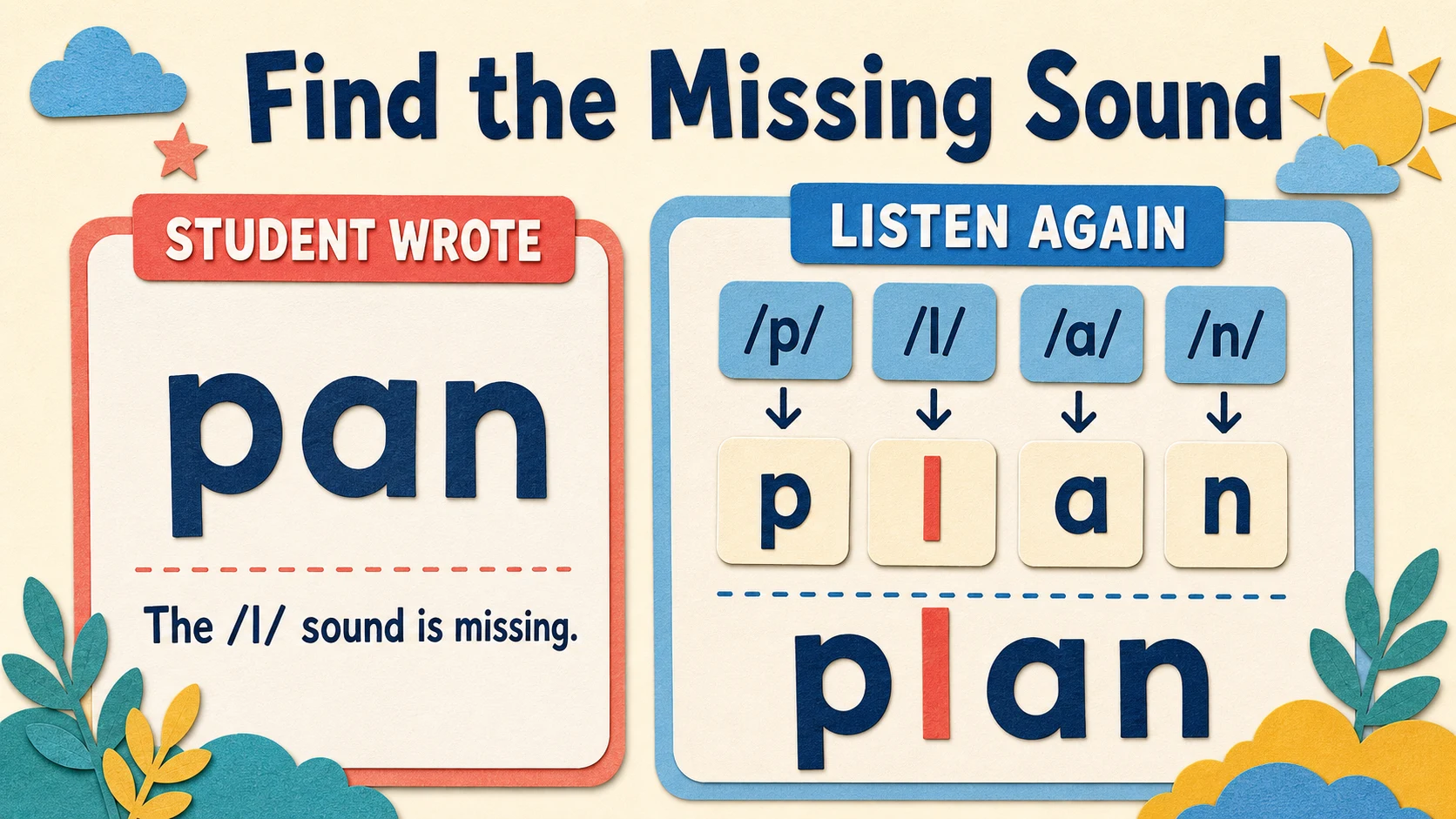
An early spelling scan should connect the location of an error to a specific next response—sound mapping, pattern contrast, or retrieval—not simply assign more of the same sheet.
Let today’s errors choose tomorrow’s sheet
Use a simple decision rule after the scan.
| Observed evidence | Likely task issue to investigate | Next morning sheet |
|---|---|---|
| Learner starts incorrectly or asks what to do | Directions or routine are not yet independent | Same pattern, fewer items, one completed model |
| Target sound is not fully represented | Sound-to-letter mapping needs more support | Oral segmentation plus letter or word matching |
| Plausible but wrong vowel pattern appears repeatedly | Alternative spellings are being confused | Two-column pattern sort, then two covered words |
| Correct sorting but weak covered recall | Recognition has not become retrieval | Look-cover-write-check with four familiar words |
| Correct words in isolation but errors in sentences | Context adds meaning or memory demands | One dictated phrase or sentence frame |
| Only one word is repeatedly missed | Word-specific representation needs attention | Compare, mark the unexpected part, retrieve later |
| Nearly every response is correct and explained | Current support may be unnecessary | Same target with model removed or one transfer word |
| Errors span unrelated patterns | Sheet may be too broad to interpret | One-pattern task with a shorter boundary |
“Likely task issue to investigate” is deliberately cautious. A spelling sample cannot diagnose a learner, and one morning’s performance may be affected by an unfamiliar direction, interrupted arrival, fine-motor effort, language familiarity, or simple haste.
A concrete sequence might run as follows:
- Monday: sort
cake,game,rain,mail,play, andstayundera_e,ai, anday. - Scan: a learner places all six words correctly but writes
ranforrainduring a covered check. - Tuesday: retrieve
rain,mail, and one previously taughtaiword from memory; underlineai. - Scan: all three are spelled correctly, but the learner checks only after prompting.
- Wednesday: repeat two words without the visible reminder to check; add one teacher-chosen familiar transfer word.
- Scan: if the pattern is retained, interleave one previously taught pattern later in the week.
The six Monday words are correctly categorized: cake and game use a_e; rain and mail use ai; play and stay use final ay. The sequence belongs here because each next sheet responds to observed evidence rather than moving forward merely because a calendar day changed.
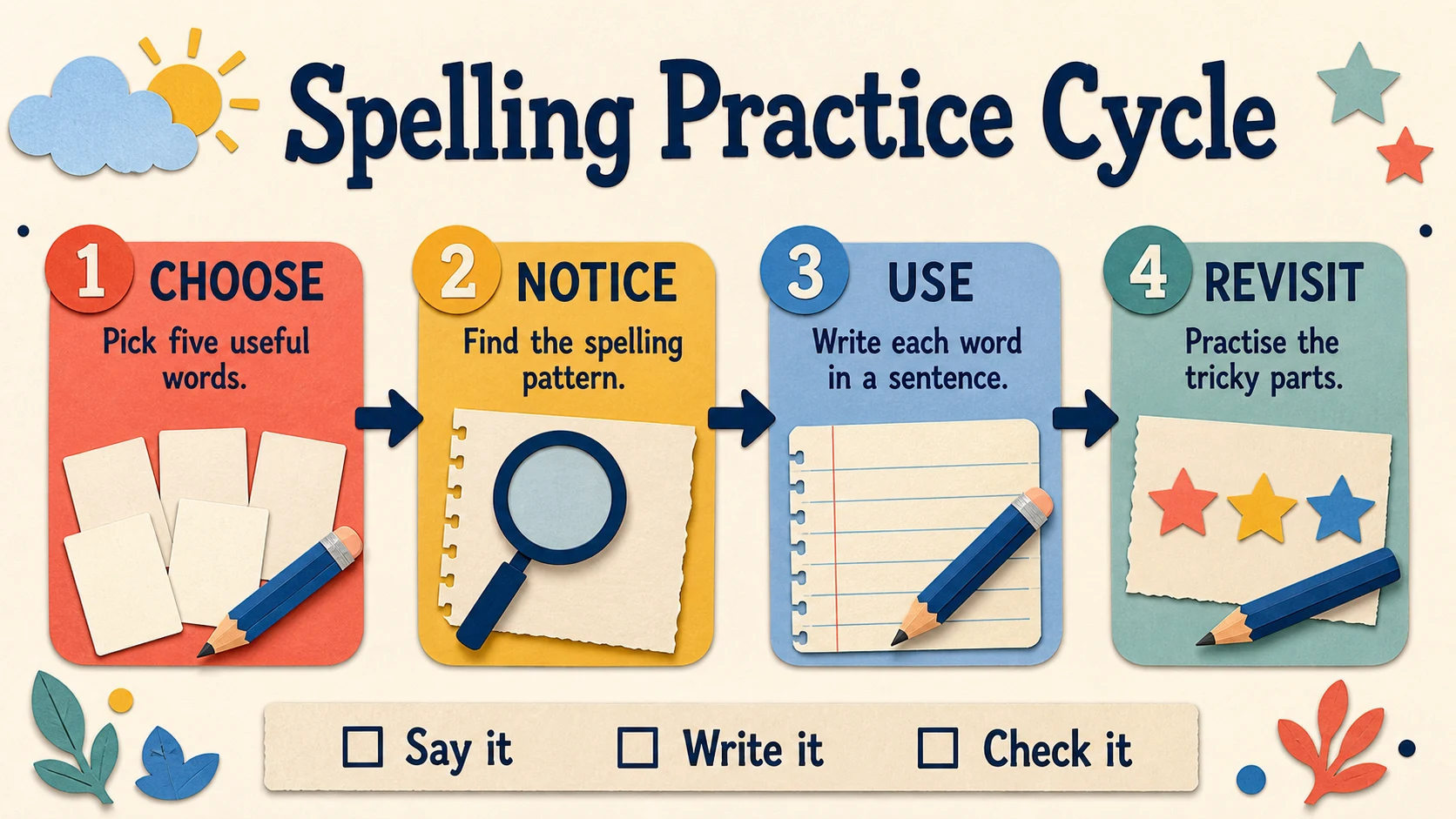
A two-week early spelling plan should alternate supported noticing, short retrieval, correction, and cumulative review while keeping each arrival boundary small.
Give feedback that produces another attempt
Feedback should direct attention to the spelling decision and create a near-term opportunity to retrieve the corrected form. “Wrong,” a score, or a fully rewritten answer may end the interaction without showing what the learner should inspect.
Use prompts such as:
- “Read your word and the model. Where do they first differ?”
- “Underline the letters that represent /ā/.”
- “Which part is the base? Which part is the suffix?”
- “Say the sounds and check that each one has a representation.”
- “Does this spelling match the meaning of the sentence?”
- “Correct the word, cover it, and try it once more.”
The catalogue teaching notes suggest repeating missed words, maintaining records of personally difficult words, revisiting patterns cumulatively, and connecting spelling with reading. Treat those as WorksheetWise catalogue suggestions, not as independent research findings. A practical adaptation is to retrieve a corrected word once during the session and again on a later sheet. Three immediate copies may improve neatness or visual familiarity, but they do not provide the same evidence as a delayed attempt without a model.
The IES guide to teaching elementary students to be effective writers emphasizes explicit instruction, guided practice, feedback, and opportunities to write. In this setting, that supports moving from a modeled spelling decision to a brief independent use. It does not mean every morning spelling task needs a full original sentence. A phrase such as “a bright star” can show whether bright is available in connected writing with less composition load.
During the teacher scan, record a code rather than a broad judgment:
Sfor a sound omitted or added;Pfor a taught pattern confused;Mfor a meaningful word part altered;Rfor a word correct with a model but incorrect from memory;Dfor directions or response-format difficulty.
These codes are local organizational tools, not diagnostic categories. One code should lead to one next instructional move.
Adapt access without replacing spelling
An adaptation preserves the target spelling decision while changing an unrelated barrier.
If handwriting effort is obscuring knowledge, let the learner build the word with letter tiles, select between two printed spellings, or dictate letters to an adult—provided the learner still makes the spelling choice. If reading the directions is the barrier, read the directions aloud while leaving the target words undisclosed. If visual crowding is a problem, cover unused rows and expose one item at a time.
If English vocabulary is unfamiliar, establish the word’s meaning orally or with a picture before judging its spelling in context. Choosing between hopping and hoping is not a fair meaning-based check if the learner does not understand the sentence.
For a learner who needs more support:
- keep the model visible for the first item;
- offer two pattern headers;
- reduce the number of words;
- rehearse the word orally;
- use manipulatives before pencil work;
- schedule one supported correction.
For a learner ready for less support:
- remove the worked example;
- mix a previously taught pattern into the set;
- ask for an explanation of the target letters;
- include one unfamiliar but decodable transfer word chosen and checked by the teacher;
- require use in a short context after isolated retrieval succeeds.
Do not preserve the worksheet format at the expense of the spelling target. Rainbow writing, for example, may keep attention on a word’s visual form, but coloring each trace can consume the entire arrival window. If the goal is retrieval, one covered attempt and one checked correction provide more relevant evidence.
Keep firm boundaries around what morning sheets can show
A worksheet response is a sample under particular conditions. It cannot by itself establish a diagnosis, prove curriculum mastery, or show that spelling will transfer to all writing. The representative catalogue descriptions say the materials are intended to reinforce patterns and high-frequency words encountered in reading and writing. That is an intended use, not a promised outcome.
Morning spelling work should not:
- replace explicit instruction in an unfamiliar pattern;
- become a timed race in which speed is treated as spelling knowledge;
- penalize a learner for unfinished items beyond the stated boundary;
- mix so many conventions that errors cannot guide the next task;
- rely on invented sentences with unchecked ambiguity;
- require independent vocabulary knowledge that has not been established;
- substitute repeated copying for analysis and retrieval;
- be used as the sole basis for placement or referral decisions.
Use sentence writing carefully. I like cake is a complete checked sentence and gives a clear context for cake, but it does not show that the learner can generalize a_e to every long-a word. The rain fell correctly uses rain, yet one correct response may reflect memory for that word rather than a general understanding of ai. To investigate generalization, compare several familiar examples and a carefully selected transfer item over time.
For a different setting, the task boundary should change. After-school Spelling Worksheets can allow more adult discussion and correction, while Classroom Spelling Worksheets may fit a full lesson with teacher modeling and partner comparison. Arrival work remains the brief retrieval-and-scan portion of that larger system.
Prepare tomorrow’s evidence before learners leave today
Choose one recently taught spelling pattern, then write the morning boundary directly on the sheet: “Complete items 1–6, check, and star one uncertain word.” Model the response routine once, decide what error feature you will scan, and prepare only two possible follow-ups: a more supported version for incomplete sound or pattern evidence and a less supported retrieval version for secure responses.
For the next real step, open the free deterministic worksheet generators and create a short set around one pattern you have already taught. Check every word and sentence for spelling, meaning, and ambiguity before printing. Tomorrow morning, scan the marked letter pattern—not the page total—and let that evidence determine the following sheet.
Put it into practice
Use the guide with a real printable
Move from explanation to a short, observable practice task. Check the first item together, then adjust the next session from the learner's actual work.
Open the first free worksheetExplore a neighboring collection