Curated collectionAnswer keys includedPrint-ready PDFs
Independent Practice Spelling Worksheets
Make directions, examples, response space and answer-key timing support honest independence after a skill has been taught.
Start with a real resource
Browse this worksheet collection
5 relevant free entry points are available. Each one includes a printable learner PDF and separate answer key.
A useful practice loop
Print less. Observe more.
- Choose one skill and model the first item aloud.
- Use a short set and notice the learner’s strategy.
- Change the next task from the work you can see.
Need more than the free sheet?
Plus includes all 90 matching catalogue variations where available, plus saved deterministic generators and the worksheet designer.
See Plus membershipComplete guide
How to teach and practise independent-practice spelling worksheets
3,332 words Updated 6 instructional visuals
Build independence only after the spelling pattern is familiar
Independent spelling practice should ask a learner to use a pattern that has already been taught, not discover an unfamiliar rule alone. Before handing over a worksheet, make four decisions:
- Can the learner explain or demonstrate the target pattern?
- Do the directions show exactly what kind of response is required?
- Is there enough space to spell, revise, and mark the relevant word part?
- Will the answer key remain unavailable until the learner has completed and checked the work?
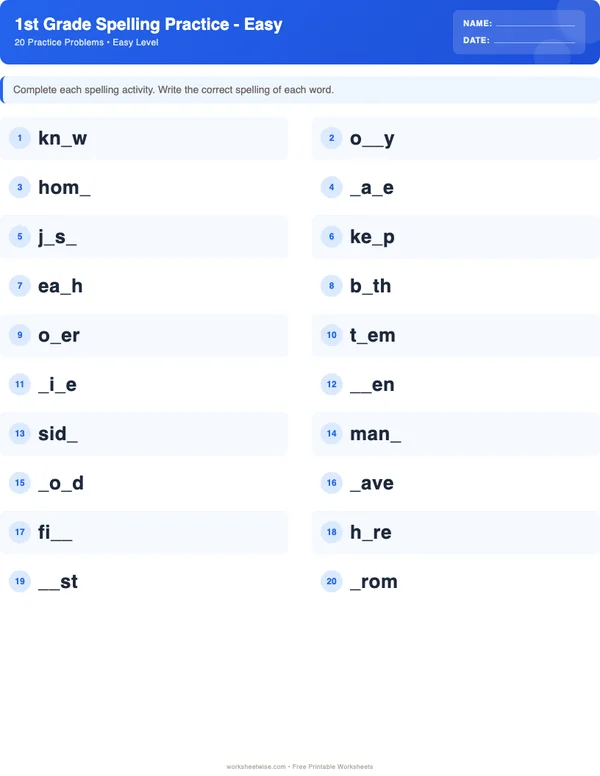
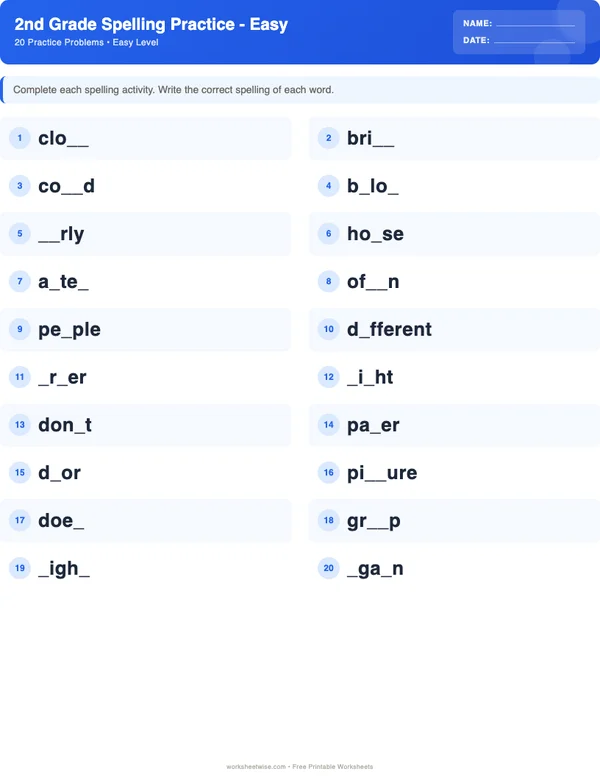
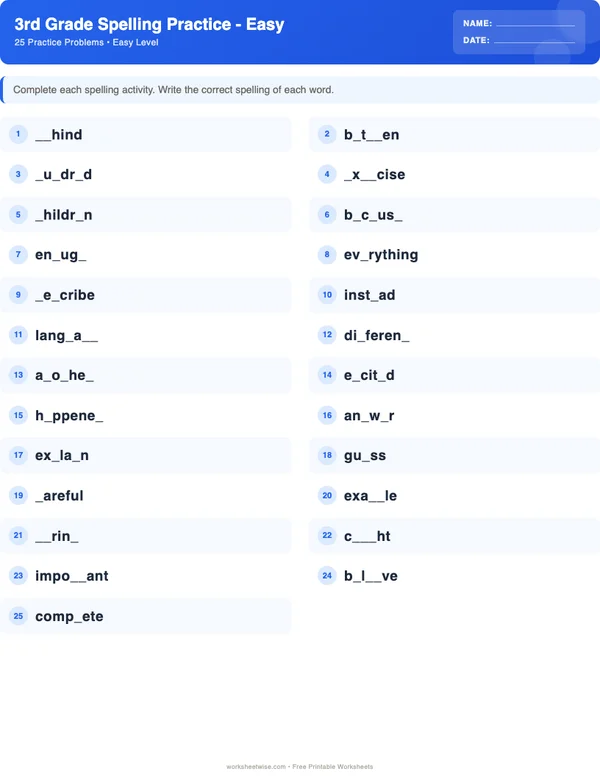
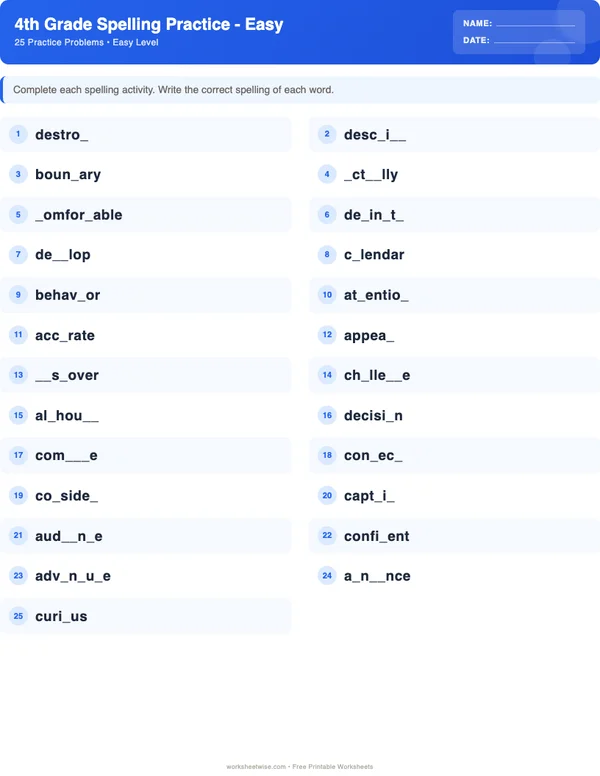
The WorksheetWise catalogue currently provides 90 spelling worksheet variants across five grade levels, with one free entry point per grade. The representative free sheets contain 20 items in first and second grade, 25 in third and fourth grade, and 30 in fifth grade. Those totals help adults estimate workload; they do not mean every learner should complete every item in one sitting.
The catalogue’s “easy” label describes a sheet’s intended difficulty, not a learner. Read it through observable task features: familiar directions, a previously taught pattern, limited decoding demands, direct response formats, and little need to manage several spelling decisions at once. If the directions, vocabulary, handwriting load, or number of simultaneous patterns are unfamiliar, the sheet is not easy in practice for that session.
Grade labels likewise describe intended practice level. Local curriculum sequences differ, so confirm that the pattern has actually been taught. Age, when shown during resource discovery, is a discovery aid rather than a placement decision. For ages three and four, prioritize brief adult-led oral, matching, manipulative, and movement work over desk work.
Separate the spelling target from the worksheet format
A spelling sheet contains at least two demands: the spelling decision and the method for recording it. Independence becomes difficult to interpret when both are new.
A learner who can spell ship orally may still leave a sorting worksheet incomplete because the headings are unclear. Another may circle a misspelled word correctly but struggle to rewrite it on a narrow line. Those responses do not provide the same evidence as spelling the word from memory.
Choose the response format according to the evidence you need.
Use sorting to reveal what the learner notices
A word sort asks the learner to compare spellings. It is useful after the categories have been modeled.
For example, after teaching long-a spellings, provide four headings—a_e, ai, ay, and ea—and the words cake, rain, play, and break. The checked sort is:
- cake →
a_e - rain →
ai - play →
ay - break →
ea
This example belongs here because the live catalogue specifically identifies word sorting and long-vowel spellings as available spelling-practice content, and its teaching guidance uses these four long-a words as a pattern set. The learner is sorting by written representation, not claiming that every ea word says long a. In fact, break is precisely the word to discuss carefully: its spelling must be learned without turning it into a false general rule.
Sorting shows whether the learner recognizes a visible pattern. It does not yet prove that the learner can retrieve the spelling without seeing the word.
Use look-cover-write-check for retrieval with controlled feedback
Look-cover-write-check has four distinct actions:
- Look at the whole word and identify the part worth remembering.
- Cover the model completely.
- Write the word from memory.
- Uncover, compare letter by letter, and correct if needed.
For rain, an adult might first model: “I hear /r/ at the beginning. The vowel sound is represented by ai. I will look at rain, cover it, write it, and then compare.” On the independent attempt, the learner should perform the same sequence without receiving letters from the adult.
This format belongs on the page because it is one of the representative catalogue activities and directly supports honest independence: the answer is visible during study but unavailable during retrieval.
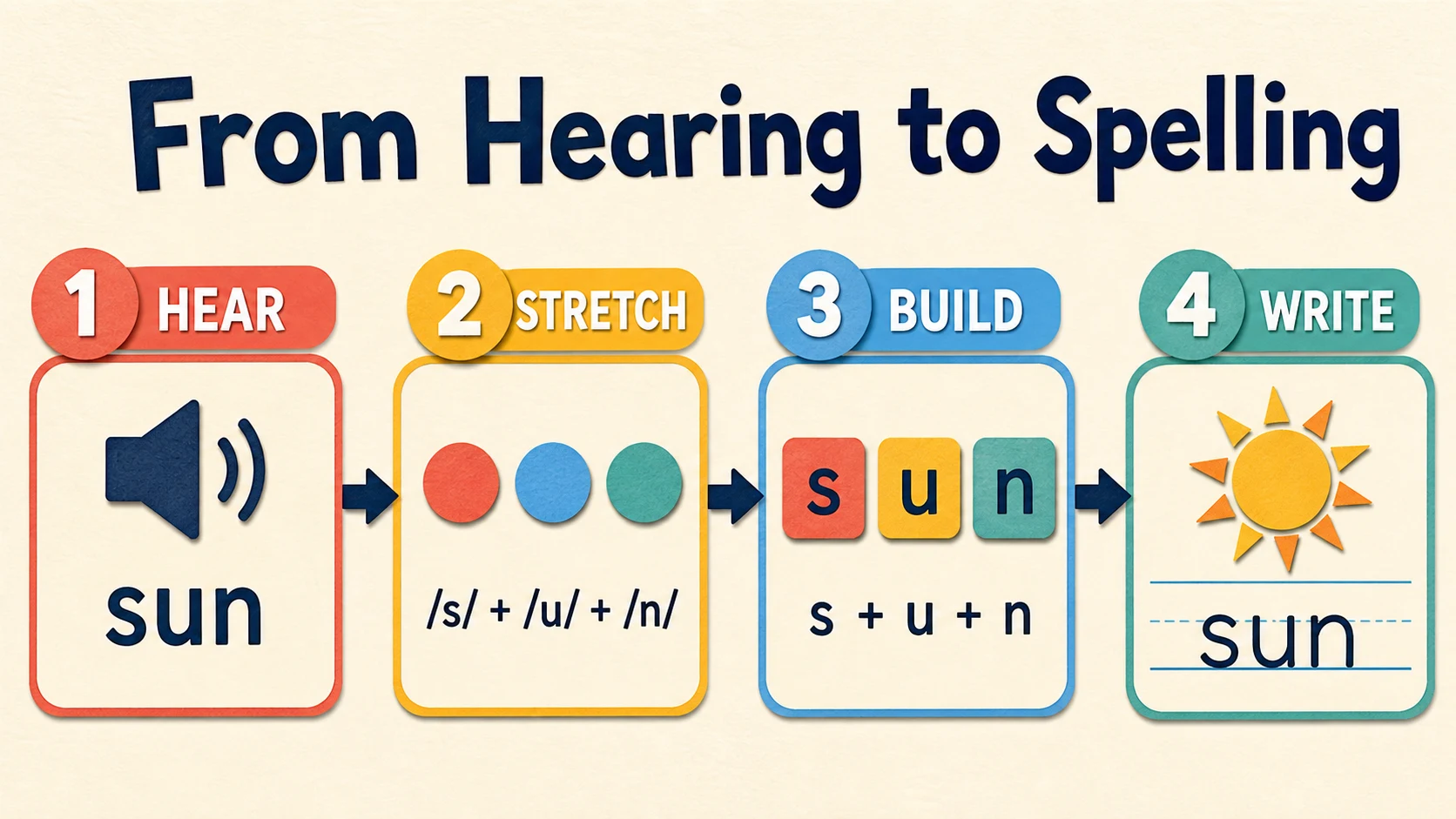
Move a first-grade pattern from an adult’s visible model to a covered, independently written attempt.
Use sentence writing to test spelling inside composition
Sentence work adds vocabulary, syntax, capitalization, punctuation, and handwriting to the spelling target. Use it only when those extra demands will not obscure the spelling decision.
Suppose the target word is play. “Write a sentence using play” tests whether the learner can copy or recall the word while composing. “Write the word I say: play” is a cleaner test of spelling retrieval. Neither is automatically better; they answer different questions.
The IES elementary writing practice guide recommends developing fluency with spelling as one component of effective writing and also recommends teaching the writing process for different purposes. That supports connecting spelling with real writing, but it does not mean every independent spelling item must become a composition task. Keep isolated practice when you need a clear view of the pattern, then sample transfer in one or two sentences.
Model the decision, not the answer list
A useful spelling model makes the invisible decision audible. It does not preview every answer.
Demonstrate one representative item
For a short-vowel task, an adult might say:
“The word is map. I will stretch it: /m/ /ă/ /p/. I hear three sounds. I will write
m, thena, thenp. Now I will read what I wrote: map.”
Then the learner tries tap or cap independently. The model and practice words share the relevant feature, but the adult has not supplied the answer to the independent item.
This example belongs here because the catalogue includes short-vowel patterns and spelling work connected to phonics. The sound-to-letter explanation also reflects the IES foundational reading guide, which recommends developing awareness of speech sounds and their links to letters, then teaching learners to decode, analyze word parts, and write and recognize words. The guide did not assess WorksheetWise; it supplies general instructional guidance that informs this modeling choice.
Avoid a model that says only, “Map is spelled M-A-P.” That gives a correct answer without showing how the learner can act on the next word.
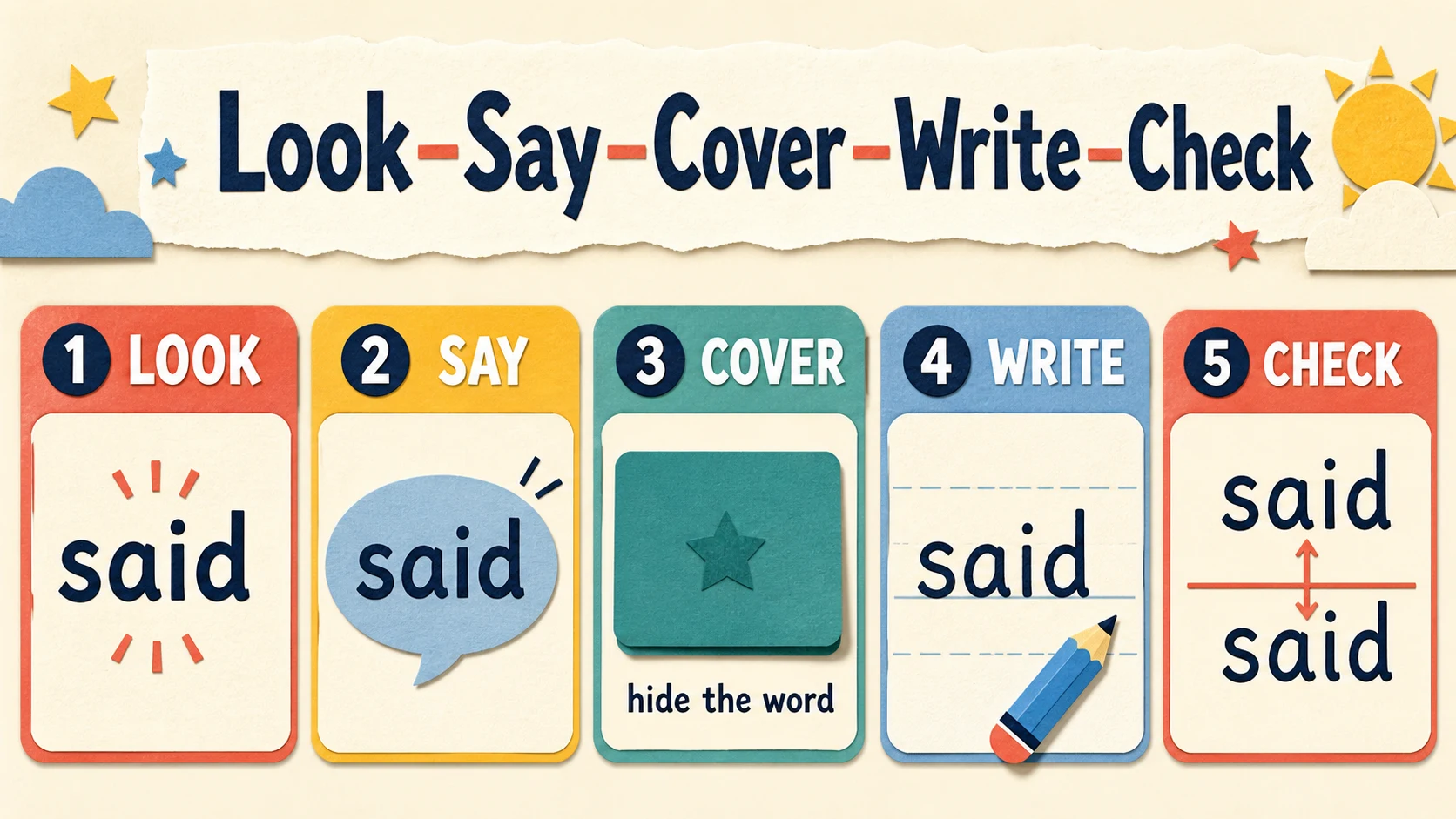
Keep the first-grade routine stable so the learner’s attention can stay on hearing, spelling, and checking the word.
Mark the feature the learner should inspect
A model can use a box, underline, or color to direct attention:
r ai nc a_e kwith an arc linking the vowel and finaleplaywithayunderlinedbreakwitheaunderlined and labeled “word to remember”
The markings are temporary supports. Remove them when the learner is expected to identify the relevant part independently.
For upper-elementary work, model how a base word changes when a suffix is added. Consider happy + ness = happiness. The checked reasoning is:
- Identify the base word: happy.
- The suffix begins with a consonant:
ness. - Change the final
ytoi. - Add the suffix: happiness.
This example belongs here because the live spelling catalogue includes suffixes and word-part analysis. It also shows why a worked example should expose the transformation rather than display only the final word.
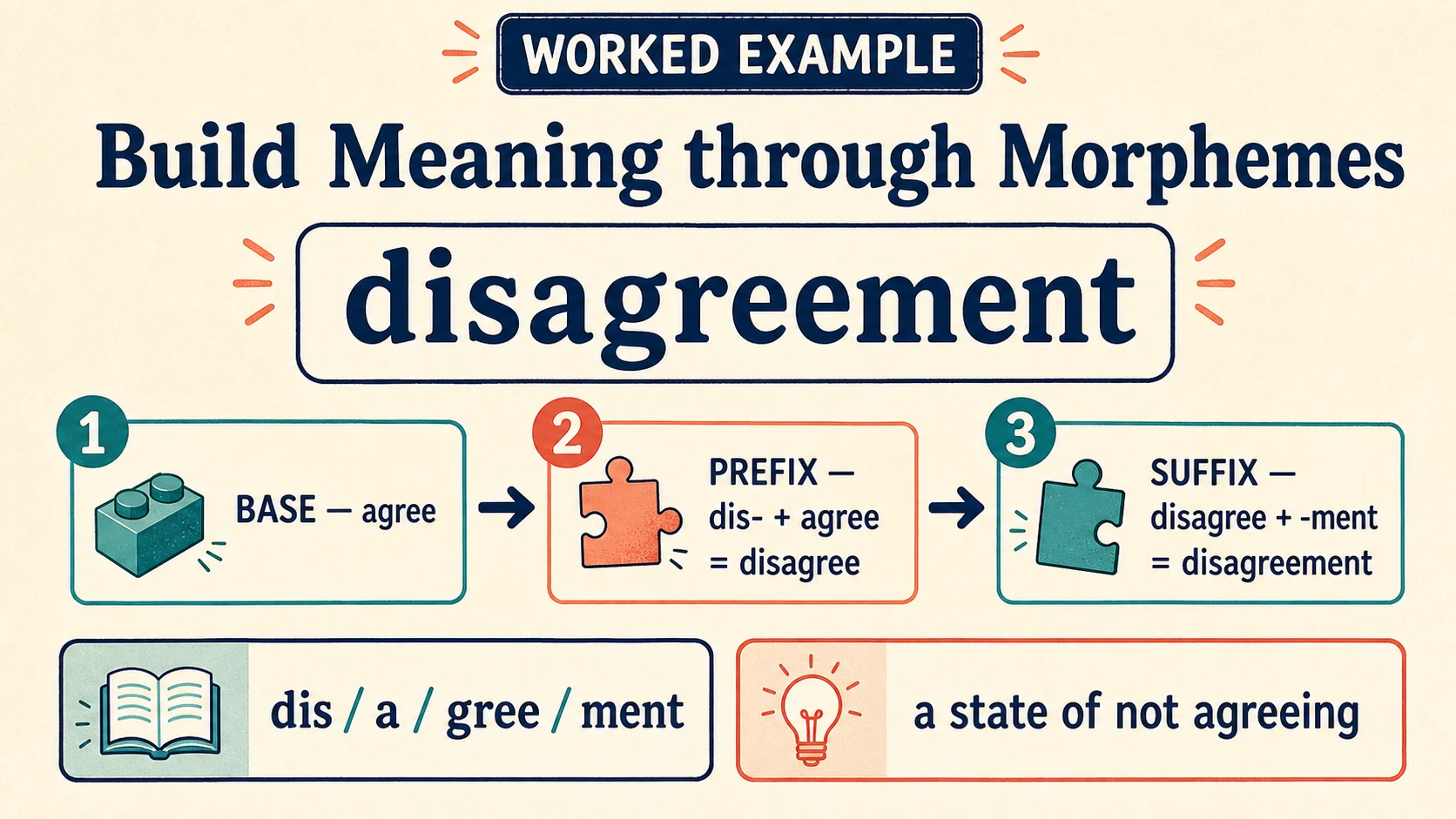
An upper-grade model should make the base word, changed letters, and final spelling visibly traceable.
Prepare the page so directions can stand on their own
Before the learner begins, inspect the sheet as if no adult will explain it halfway through.
Test each direction with a sample response
“Write the spelling words” is ambiguous. Does the learner copy, recall, alphabetize, complete missing letters, or write from dictation?
A self-sufficient direction names the action and the checking rule:
Look at each word. Cover it. Write it from memory. Uncover the word and compare. If a letter is different, circle that part and write the complete word correctly once.
For a sort:
Read each word. Copy it under the heading that matches its vowel spelling. Use each word once.
For error identification:
Circle the misspelled word in each pair. Write the correct spelling on the line.
Complete one sample before independent work. The sample should use the same operation but a different word.
Make the response space match the required thinking
A narrow blank may be adequate for choosing one missing letter. It is inadequate for writing a multisyllabic word, comparing attempts, or revising a suffix.
Use enough space for:
- one complete initial attempt;
- a small comparison mark or underline;
- one legible correction;
- a word-part division when the task requires it.
Do not ask a learner to write a word three times if the sheet provides room for only one readable version. More repetitions are not automatically more informative. One accurate correction with the changed part marked can reveal more than three hurried copies.
Remove accidental answer clues
Check whether the target word appears elsewhere on the page: in a title, word bank, example sentence, illustration label, or previous question. A visible model is appropriate during study; it invalidates a memory attempt if it remains visible during retrieval.
When a word bank is intentional, name the evidence correctly. Choosing knife from a bank after seeing nife demonstrates recognition. Writing knife from dictation demonstrates recall. Both can be useful, but they should not be treated as interchangeable.
Choose a sheet by pattern, response demand, and length
Start with the taught skill, not the grade label.
Match one main spelling decision
A strong independent set keeps one primary decision stable. Suitable combinations include:
- short vowels with sound-by-sound writing;
- long-vowel spellings with sorting;
- silent letters with misspelling detection and correction;
- consonant doubling with base-word comparison;
- prefixes or suffixes with word-building;
- multisyllabic words with syllable or meaningful-part analysis.
The catalogue also includes high-frequency words. When a word does not submit neatly to the current pattern, label it as a word to remember rather than inventing a rule.
The Common Core ELA standards organize literacy through grade-specific expectations built on broader reading, writing, speaking, listening, and language capacities. They are a useful curriculum reference, but a grade label on this page is not a claim of standards alignment. Check local expectations and the learner’s taught sequence before assigning a sheet.
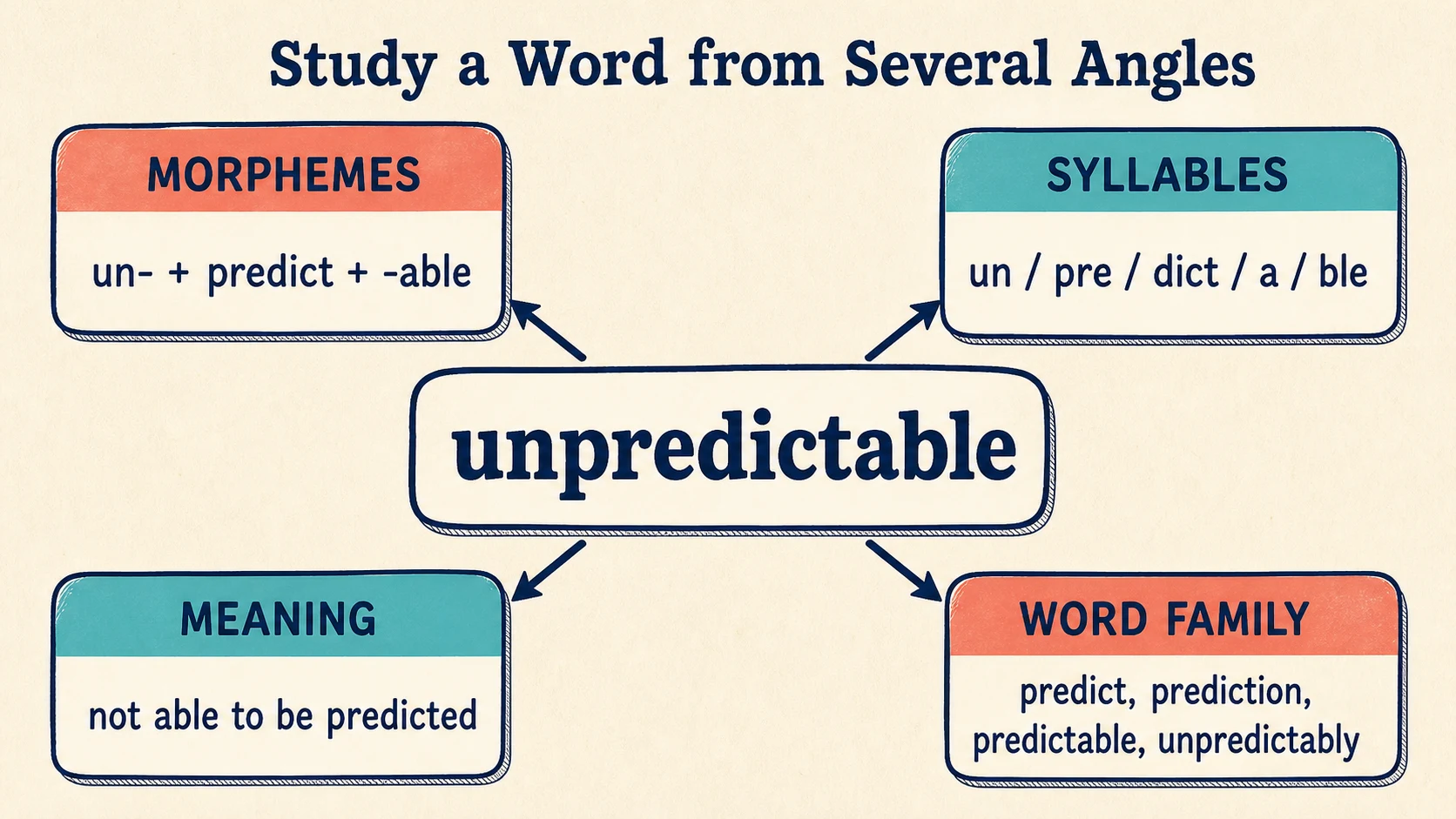
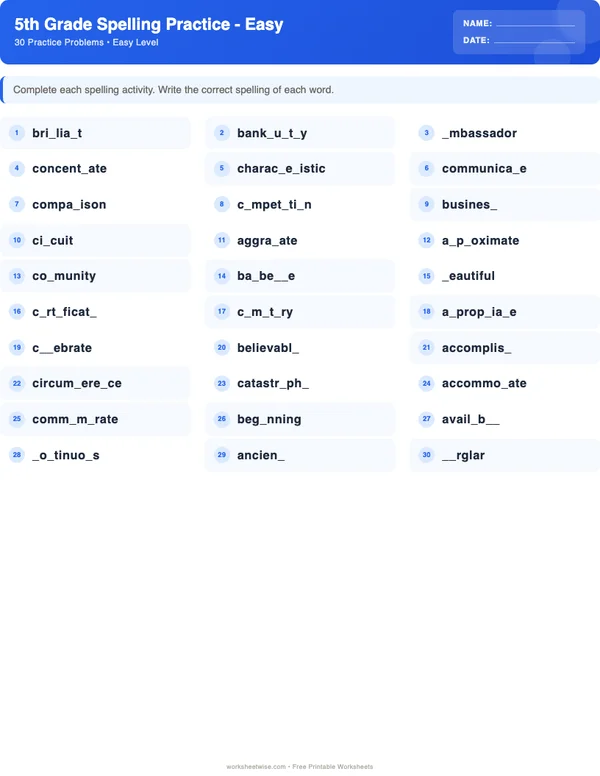
Use the fifth-grade skill map to choose one decision for practice instead of assigning every visible branch at once.
Treat item count as a planning variable
The representative first- and second-grade free sheets contain 20 problems; third- and fourth-grade sheets contain 25; the fifth-grade sheet contains 30. Those are verified catalogue counts, not required sitting lengths.
A practical assignment might be:
- first pass: 8–10 focused items;
- brief self-check;
- adult review of error type;
- remaining items later if the first set still provides useful practice.
That division is an editorial suggestion, not a sourced dosage rule. Stop when fatigue, rushing, or shrinking handwriting makes the responses hard to interpret. Completing fewer items honestly is more useful than finishing a page with adult-supplied answers.
Use the 1st Grade Spelling Words guide and free sheet for an early pattern task, the 3rd Grade Spelling Words guide and free sheet for a 25-item middle-grade entry point, or the 5th Grade Spelling Words guide and free sheet when the taught work includes more complex word parts.
Run a six-step independent spelling session
The following routine is a WorksheetWise editorial recommendation based on the catalogue’s task types. It is not presented as a research-tested program.
1. Name the target
Say, “Today you are checking how well you can use the consonant-doubling pattern,” not, “Do this spelling page.”
Ask for a quick explanation or example. If the learner cannot show the pattern with one familiar word, return to teaching before assigning independent practice.
2. Model one item
Use a word that is not among the scored responses. For hop + ed, show that hopped doubles the final consonant. Contrast it with rain + ed = rained, which does not double.
These spellings have been checked:
- hop + ed → hopped
- rain + ed → rained
The comparison belongs here because the catalogue includes consonant doubling and suffixes. It prevents the overgeneralization “always double before adding ed.” Keep the instructional wording tied to the words already taught; English spelling has conditions and exceptions that a one-line slogan may hide.
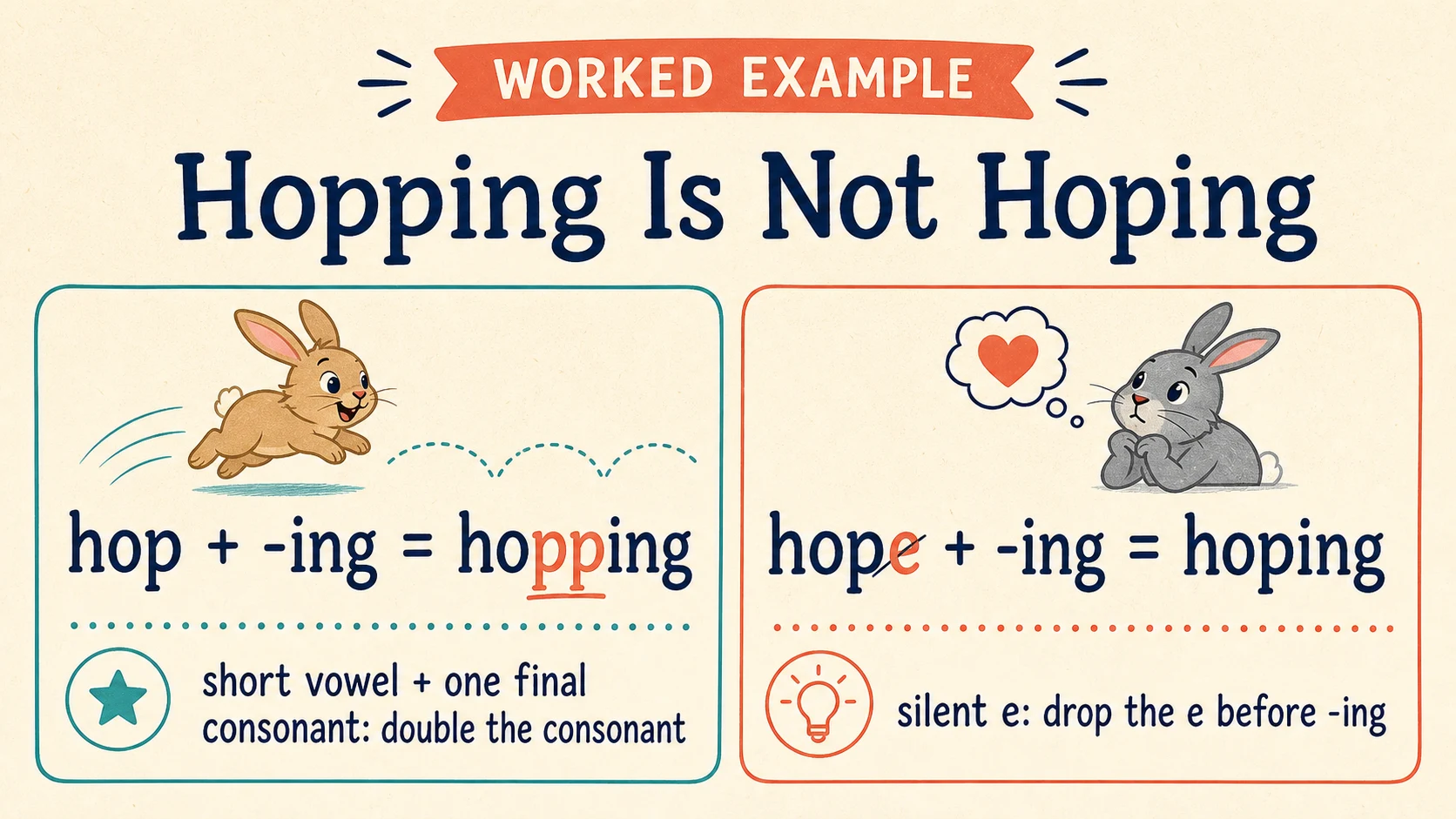
The third-grade worked example should show where the spelling changes and why the final form differs from the base word.
3. Confirm the directions
Ask the learner to explain what to do without repeating the printed direction word for word. A suitable response is, “I sort by the letters that spell the vowel sound, then use every word once.”
Correct misunderstanding now. Do not coach the spellings.
4. Protect the independent attempt
Keep the answer key and completed examples out of view. If the learner asks, “Is this right?” respond with the agreed checking prompt:
- “Say the word slowly.”
- “Find the base word.”
- “Which part are you checking?”
- “Use the routine on the page.”
These prompts redirect attention without supplying letters. If the learner still cannot begin, mark the item for later teaching and move on. An unanswered item is clearer evidence than an adult-completed one.
5. Let the learner self-check
For look-cover-write-check, comparison is built into each item. For a larger worksheet, allow a short check after a section rather than after every response if immediate access to the key would reveal upcoming answers.
The learner can place:
- a check beside an exact match;
- an underline beneath the differing part;
- a star beside an item that still needs adult discussion.
Self-checking is not the same as changing answers invisibly. Preserve the first attempt so the error can guide the next choice.
6. Review one error pattern
After completion, group errors before discussing them. Select one pattern to address. If there were no pattern errors, test transfer with one untaught example or a sentence rather than automatically assigning a longer sheet.
Time the answer key to preserve useful evidence
The key has three jobs: verify, focus attention, and support correction. It should not become a parallel copy sheet.
During retrieval, keep the key closed
If the purpose is recall, showing the key after each request turns later responses into recognition or copying. Finish a small section first.
An exception is look-cover-write-check, where the original word is intentionally uncovered after each attempt. The essential condition is that it was fully covered while the learner wrote.
During correction, compare parts rather than scores
Suppose a learner writes nife for knife. The useful comparison is:
- attempt:
nife - correct form:
knife - differing part: initial
k
This checked example belongs here because silent letters are explicitly included in the live catalogue. The next action is not simply “practice spelling.” It is to revisit silent initial letters with a small taught set, such as knife, knee, and knock, and then check whether the learner can spell one from dictation without the list.
Do not read a single error as a diagnosis. It may reflect incomplete word knowledge, an overlooked letter, rushing, misunderstanding, or handwriting that is difficult to read. Look for repeated, observable evidence.
Delay scoring language until the comparison is complete
First ask:
- “Which part matches?”
- “Where does it change?”
- “What will you remember next time?”
Then record accuracy if needed. A total such as 17/20 cannot distinguish three vowel-pattern errors from three skipped items. Keep a short error note beside the score.
Let errors choose the next sheet
The next worksheet should respond to the kind of error, not merely the number wrong.
| Observed response | Cautious interpretation | Next action |
|---|---|---|
| Correct in a visible sort, incorrect from dictation | Pattern recognition is present; retrieval is not yet consistent | Use a brief look-cover-write-check set with the same pattern |
nife for knife on several attempts |
The silent initial letter is not being retained | Reteach a small kn set, then dictate one new attempt |
hoped written as hopped |
Doubling may be overgeneralized | Contrast hoped/hopped with base words hope/hop |
| Words are correct but placed under the wrong headings | The categorization direction or headings may be unclear | Model the sorting decision; do not assign harder spellings |
| Early responses are accurate and later ones become incomplete | Length or sustained attention may be obscuring skill | Shorten the next sitting while keeping the same spelling target |
| Isolated words are correct, but the same words are misspelled in sentences | Transfer into composition is not yet consistent | Add one short dictation or learner-written sentence |
| Most responses are copied accurately but cover-and-write attempts are incorrect | Copying is stronger than retrieval | Reduce copying and schedule more covered attempts |
The hoped/hopped contrast deserves a full check:
- hope + ed → hoped: the final silent
eis dropped before addinged; thepis not doubled. - hop + ed → hopped: the final
pis doubled before addinged.
This example belongs because it combines two catalogue features—suffixes and consonant doubling—and reveals a misconception that a simple right-or-wrong mark would hide.
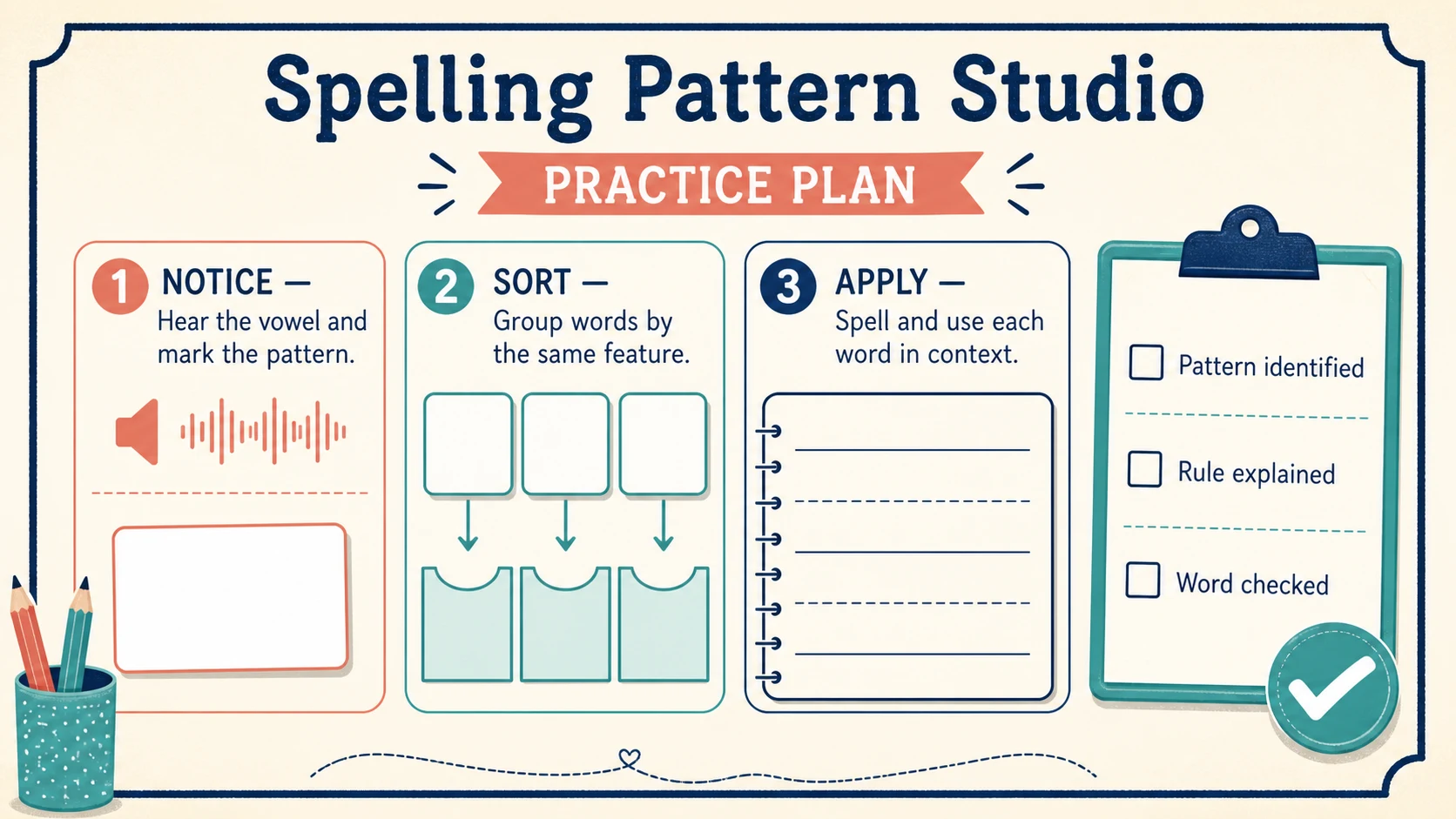
Use the two-week third-grade plan to revisit an observed error after teaching, not to repeat an unchanged sheet automatically.
Adapt access without replacing the spelling decision
An adaptation preserves the target if the learner still has to make the intended spelling choice.
Useful access changes include:
- enlarging print and response lines;
- assigning fewer items in one sitting;
- reading directions aloud;
- allowing an oral rehearsal before writing;
- providing movable letters for a taught word, then removing them before recall;
- covering unrelated sections of the page;
- accepting typing when handwriting is not the target;
- providing headings for a sort while requiring the learner to place the words.
Some changes alter the evidence. A word bank changes recall into recognition. Dictating every letter removes the spelling decision. Correcting a word before the learner records an attempt removes evidence of independent performance. These may be appropriate teaching supports, but label the resulting work as supported practice.
For ages three and four, if an adult is exploring spelling materials outside this page’s first-through-fifth-grade catalogue, use short oral sound games, picture-to-word matching, letter tiles, clapping or stepping for syllables, and adult-led movement. Extended desk work should not be the default.
Know what an independent sheet cannot establish
A worksheet samples performance under one set of conditions. It cannot by itself establish durable mastery, diagnose a learning difficulty, prove transfer to everyday writing, or determine grade placement.
Other boundaries matter:
- A correctly copied word does not demonstrate recall.
- A correct multiple-choice answer does not demonstrate independent production.
- One misspelling does not establish a stable misconception.
- A perfect sheet may contain words the learner already memorized without understanding the broader pattern.
- A poor result may reflect unclear directions or excessive response load.
- Repeated correction on the same page may reflect visual memory for that page rather than flexible use.
Check transfer separately. After a long-a sort, dictate one familiar word without headings. After suffix practice, ask the learner to build a new taught form. After isolated spelling, invite one short sentence and observe whether the target word remains accurate while attention is divided.
The IES sources support attention to sound-letter relationships, word-part analysis, word recognition and writing fluency. The exact session structure, stopping points, markings, and next-sheet rules in this guide are practical editorial suggestions. They should be adjusted to instruction already provided, local curriculum order, and observable responses.
Make the next assignment from one preserved attempt
Do not erase the evidence that should guide tomorrow’s work. Save one completed section and write a brief note:
Long-a sort: 4/4 with words visible. Dictation: rain correct, play written
pla. Next: reteach finalay, then complete five covered attempts containing twoaywords.
That note identifies the condition, the actual response, and the next action. It is more usable than “needs spelling practice.”
Choose the next resource only after making that note. If the error points to an earlier sound-letter pattern, move temporarily to Independent practice Phonics Worksheets. If the pattern is secure and the remaining difficulty appears during sentence construction, compare the demand with Independent practice Grammar Worksheets. To create a tightly focused follow-up rather than repeating an entire grade sheet, open the free deterministic worksheet generators and build the next practice set around the one spelling decision recorded in the learner’s preserved attempt.
Put it into practice
Use the guide with a real printable
Move from explanation to a short, observable practice task. Check the first item together, then adjust the next session from the learner's actual work.
Open the first free worksheetExplore a neighboring collection