Curated collectionAnswer keys includedPrint-ready PDFs
Homework Spelling Worksheets
Select short, already-taught practice that a learner can understand at home and convert the returned work into next-day feedback.
Start with a real resource
Browse this worksheet collection
5 relevant free entry points are available. Each one includes a printable learner PDF and separate answer key.
A useful practice loop
Print less. Observe more.
- Choose one skill and model the first item aloud.
- Use a short set and notice the learner’s strategy.
- Change the next task from the work you can see.
Need more than the free sheet?
Plus includes all 90 matching catalogue variations where available, plus saved deterministic generators and the worksheet designer.
See Plus membershipComplete guide
How to teach and practise homework spelling worksheets
3,265 words Updated 6 instructional visuals
Choose homework that rehearses one known spelling decision
The best homework spelling worksheet is not the one with the longest list. Choose a short section that practices a pattern already modeled in class, uses directions the learner can follow without a new lesson, and produces work you can inspect the next day.
A useful sheet lets you answer three questions:
- Which spelling feature was the learner expected to notice?
- What response shows whether the learner noticed it?
- What will you assign or teach next if the response is wrong?
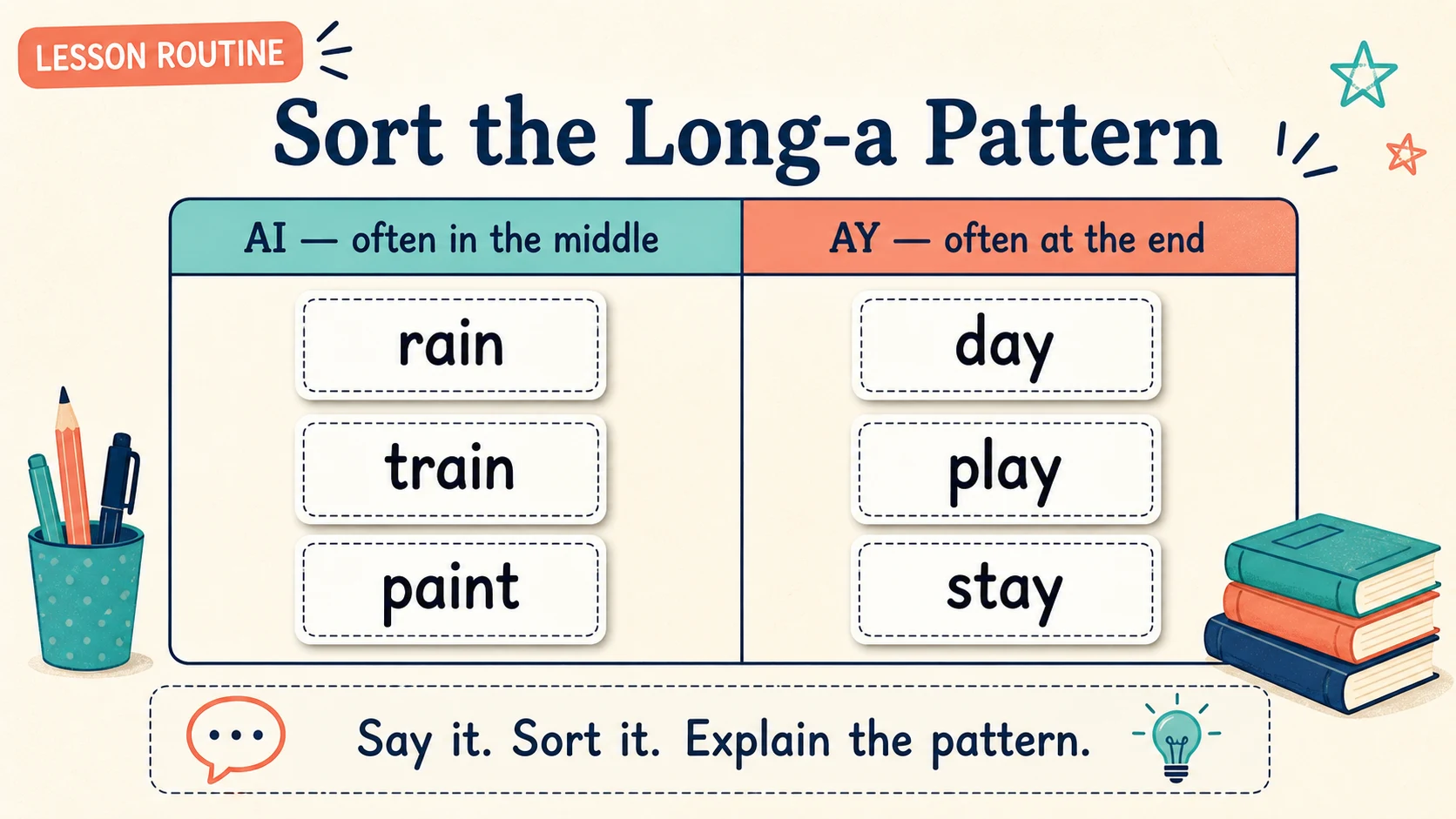
For example, after teaching several spellings for long a, a sort containing cake, rain, play, and break is more informative than copying an unrelated list. The learner must distinguish final silent-e, ai, ay, and the less common ea spelling. A returned sort reveals whether the learner recognizes those patterns; four neatly copied words do not.
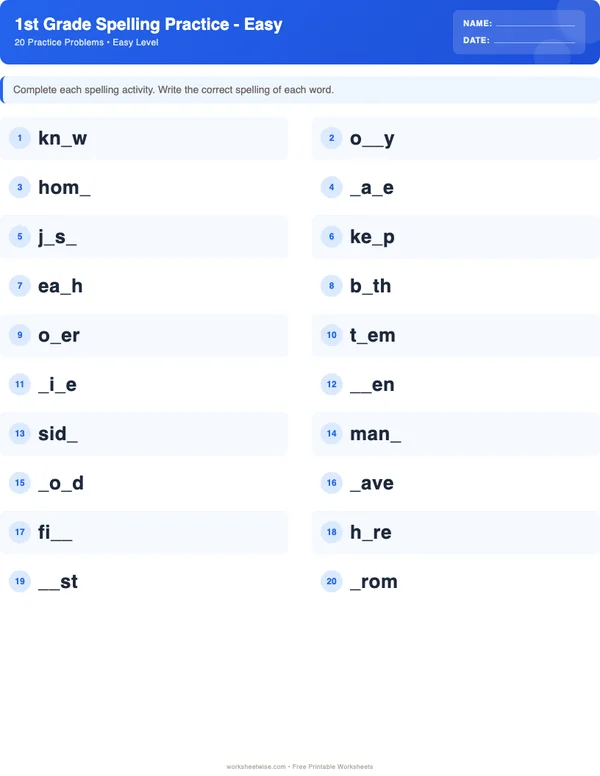
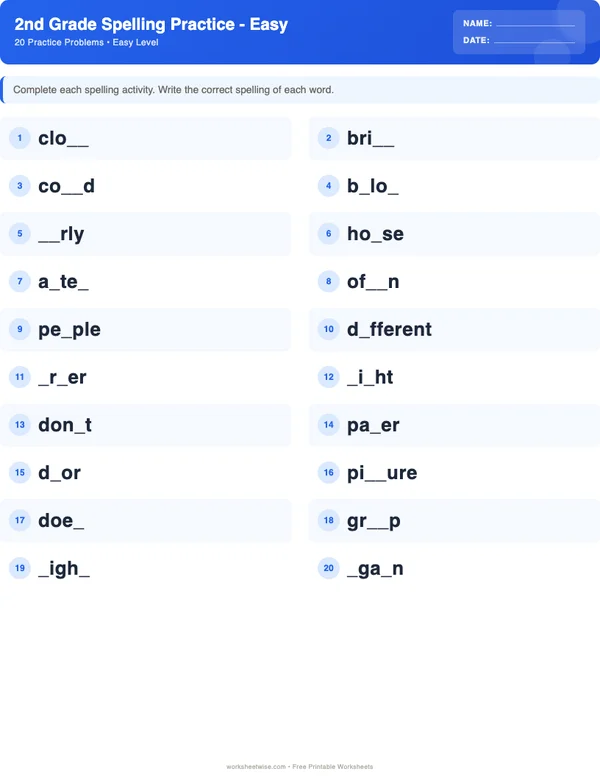
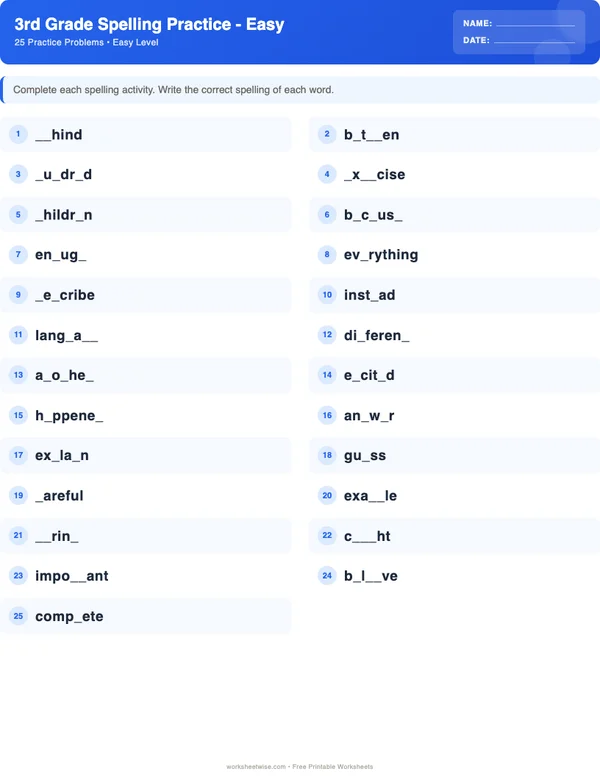
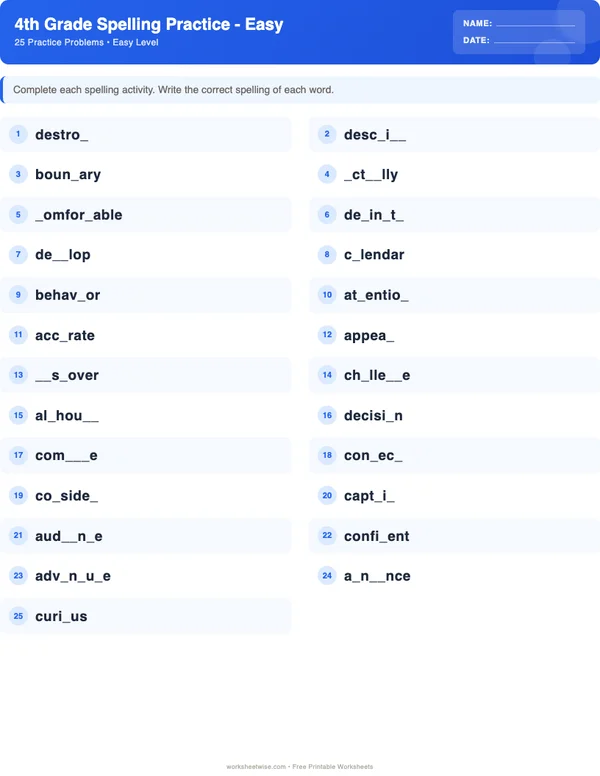
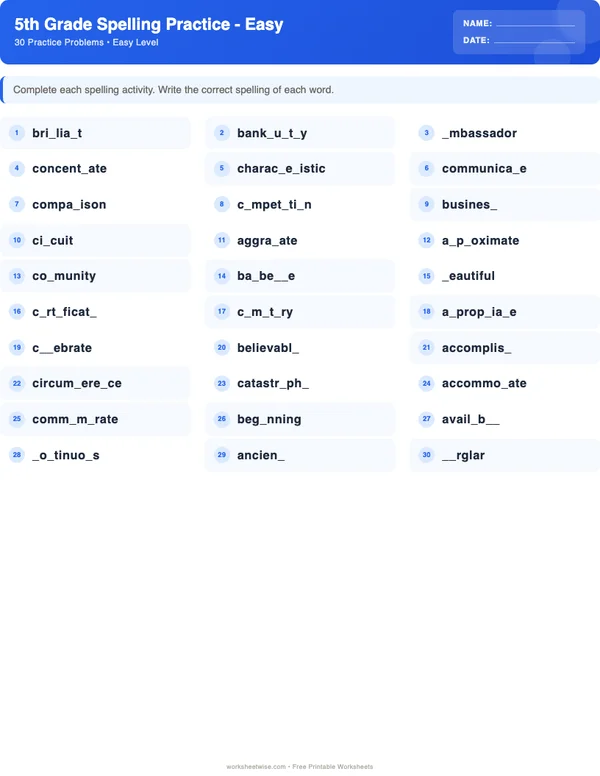
WorksheetWise’s live homework spelling catalogue contains 90 variants across first through fifth grade, with one free spelling-words entry point in each grade. The free sheets contain 20 problems in first and second grade, 25 in third and fourth grade, and 30 in fifth grade. Those totals describe the available sheets, not the amount every learner should complete in one evening. Assigning a selected row, pattern group, or response type may be the better instructional decision.
Grade labels describe the intended practice level, and local curriculum sequences differ. Use the label to find likely material, then inspect the actual words and task. Do not treat a grade label, age, or difficulty tag as a placement decision or a description of a learner.
Start from the spelling lesson, not the worksheet pile
Homework should extend instruction rather than introduce an unseen convention. Before choosing a sheet, write the day’s target in a form that can be observed:
- “Sort words by the spelling used for long a.”
- “Keep the base word visible when adding a prefix.”
- “Decide whether the final consonant doubles before adding a suffix.”
- “Find the misspelled part of an r-controlled-vowel word.”
- “Spell each syllable in a familiar multisyllabic word.”
“Practice spelling” is too broad. It does not tell an adult what to model, a learner what to attend to, or a teacher what an error means.
The catalogue’s representative resources include look-cover-write-check, pattern sorts, sentence use, rainbow writing, and identification of misspelled words. These formats are not interchangeable. Choose the response that exposes the decision taught that day.
Match the response to the evidence you need
Use sorting when the learner must compare patterns. Use look-cover-write-check when the learner knows a word but needs accurate retrieval. Use misspelling identification when the goal is close inspection. Use sentence completion or dictation when you need to see whether spelling survives the added demands of meaning, handwriting, punctuation, and word order.
Rainbow writing may increase attention to letter order, but color alone does not show whether a learner can retrieve the spelling. If you use it, follow it with one covered attempt.
The IES foundational reading guide recommends developing awareness of speech sounds and their links to letters, then teaching learners to decode words, analyze word parts, and write and recognize words. That sourced guidance supports making sound-letter and word-part relationships explicit. It does not establish that any particular WorksheetWise sheet is effective or suitable for a specific learner.
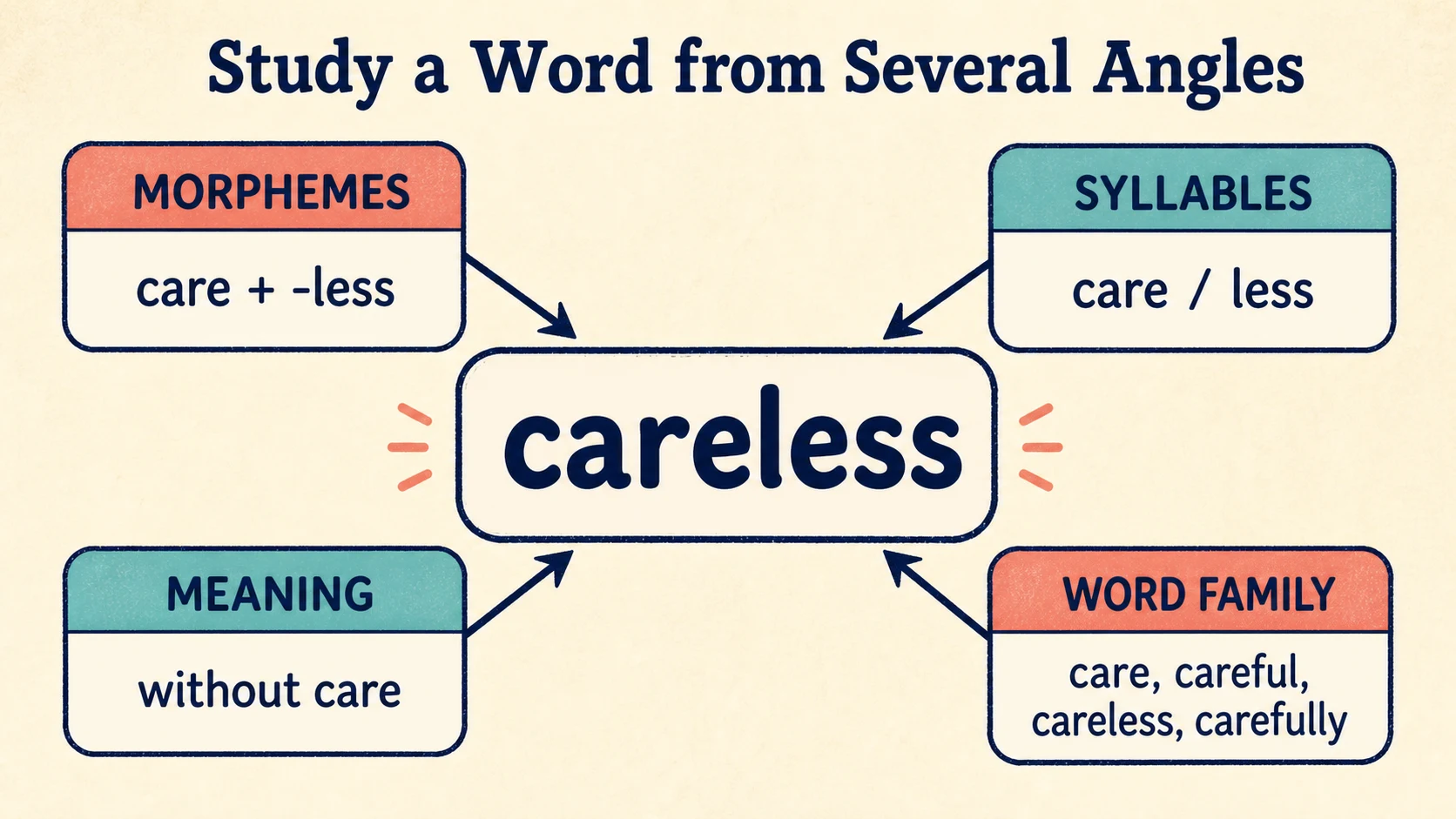
Use the map to identify the one third-grade spelling relationship the homework should reveal, rather than assigning every available format at once.
Define “easy” by what the page asks the learner to do
Each representative free sheet is catalogued as “easy.” That tag should be translated into observable task features, not attached to a child.
For homework, an easier task usually has several of these features:
- the spelling pattern was taught recently;
- the words are familiar in speech and reading;
- one direction governs the whole section;
- an example shows the expected response;
- the learner changes or recalls one feature at a time;
- the amount of writing is limited;
- the page does not require an adult to explain new terminology;
- most items follow the taught pattern, with unusual words clearly identified.
A task becomes more demanding when it mixes patterns, removes a visible model, includes less familiar vocabulary, requires sentence composition, asks for error correction without identifying the error location, or combines several operations.
A 30-item fifth-grade sheet can therefore be less appropriate for a particular evening than six carefully selected words. Conversely, a first-grade page with only a few items can be demanding if the learner has never been shown the response format.
Use grade as a catalogue route
The 1st Grade Spelling Words guide and free sheet and 2nd Grade Spelling Words guide and free sheet each lead to a 20-problem free resource. The third- and fourth-grade entry points each contain 25 problems, while the 5th Grade Spelling Words guide and free sheet contains 30.
Those counts help an adult preview workload. They do not require completion of the entire sheet. Grade labels describe intended practice level; local curriculum sequences differ. If age information appears while browsing resources, treat age as a discovery aid rather than a placement decision. For ages three and four, prioritize brief adult-led oral work, matching, manipulatives, and movement over desk work.
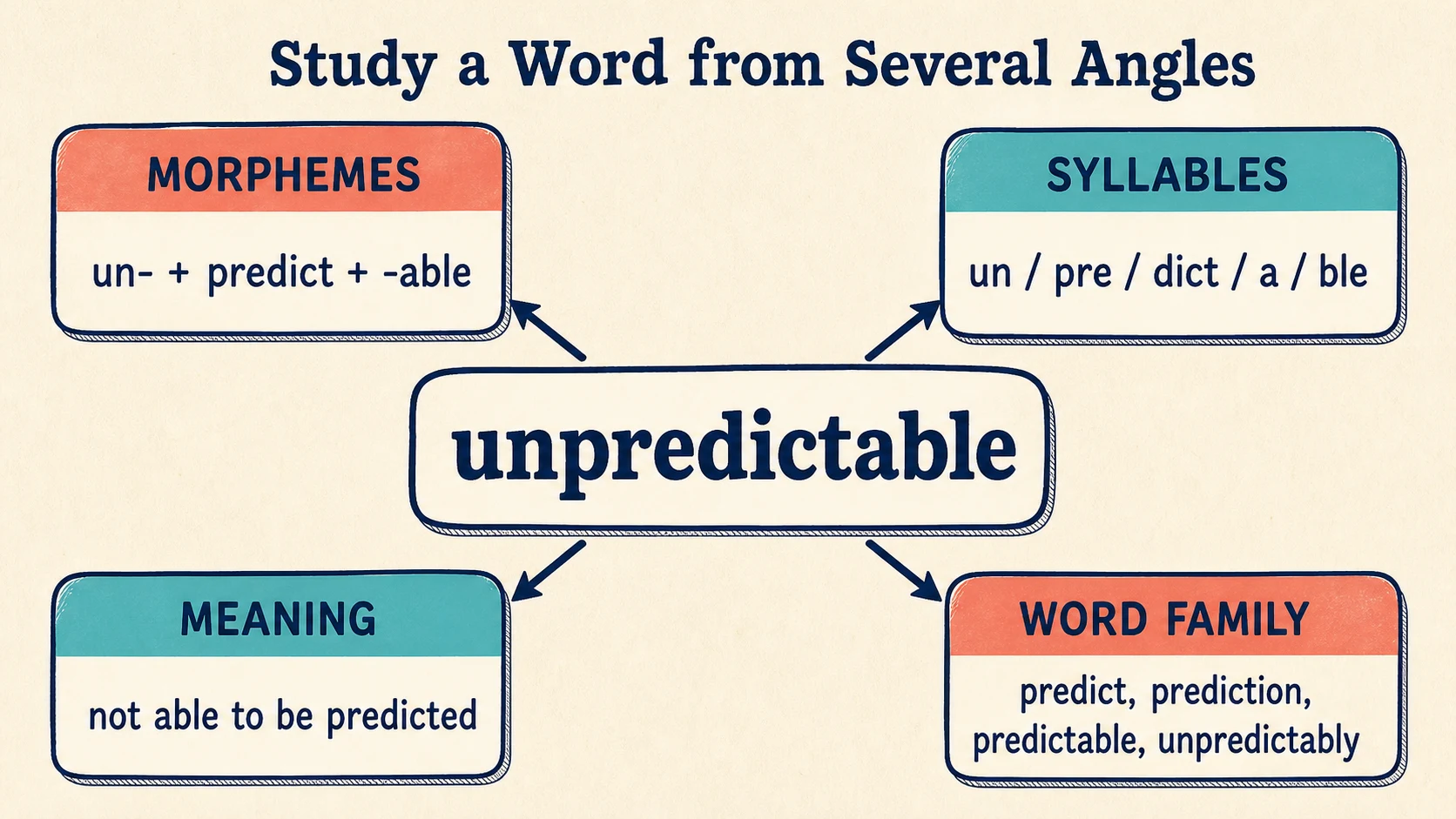
At fifth-grade practice level, use the map to separate the target—such as a suffix or multisyllabic pattern—from the other spelling knowledge a long word may contain.
Use a repeatable home routine with a visible stopping point
A good routine is short enough to repeat and specific enough that different adults give similar help. Send the same four-part instruction on the sheet or in the homework message.
1. Read and notice
The learner reads the example and identifies the target part. An adult may say, “Underline the letters that spell the long a sound,” or, “Box the suffix.” The adult should not supply each answer.
If the learner cannot read the directions, the adult reads them aloud once and asks the learner to explain what to do. If the learner still cannot explain the task, stop. That is evidence that the response format or target was not sufficiently established for independent homework.
2. Model one item
Model the thinking, not merely the finished spelling:
“In rain, I hear /ā/ in the middle. The word uses ai, so I will place it under ai.”
Then ask the learner to complete a different item. Do not model every word; that converts practice into copying.
3. Complete a short set
Assign a bounded amount: perhaps one sort, six retrieval attempts, or two dictated sentences. The exact amount is a teaching decision based on the task and the learner’s recent classroom work, not a catalogue guarantee.
For look-cover-write-check, the sequence is literal:
- Look closely at the whole word.
- Name or mark the difficult part.
- Cover the model completely.
- Write the word from memory.
- Uncover and compare letter by letter.
- Correct only after identifying the changed part.
4. Mark uncertainty and return the evidence
Teach the learner to put a small question mark beside an uncertain answer. Ask the adult to circle the item number if substantial help was needed. These marks make the returned page more useful. They distinguish an independent correct response from one completed after prompting.
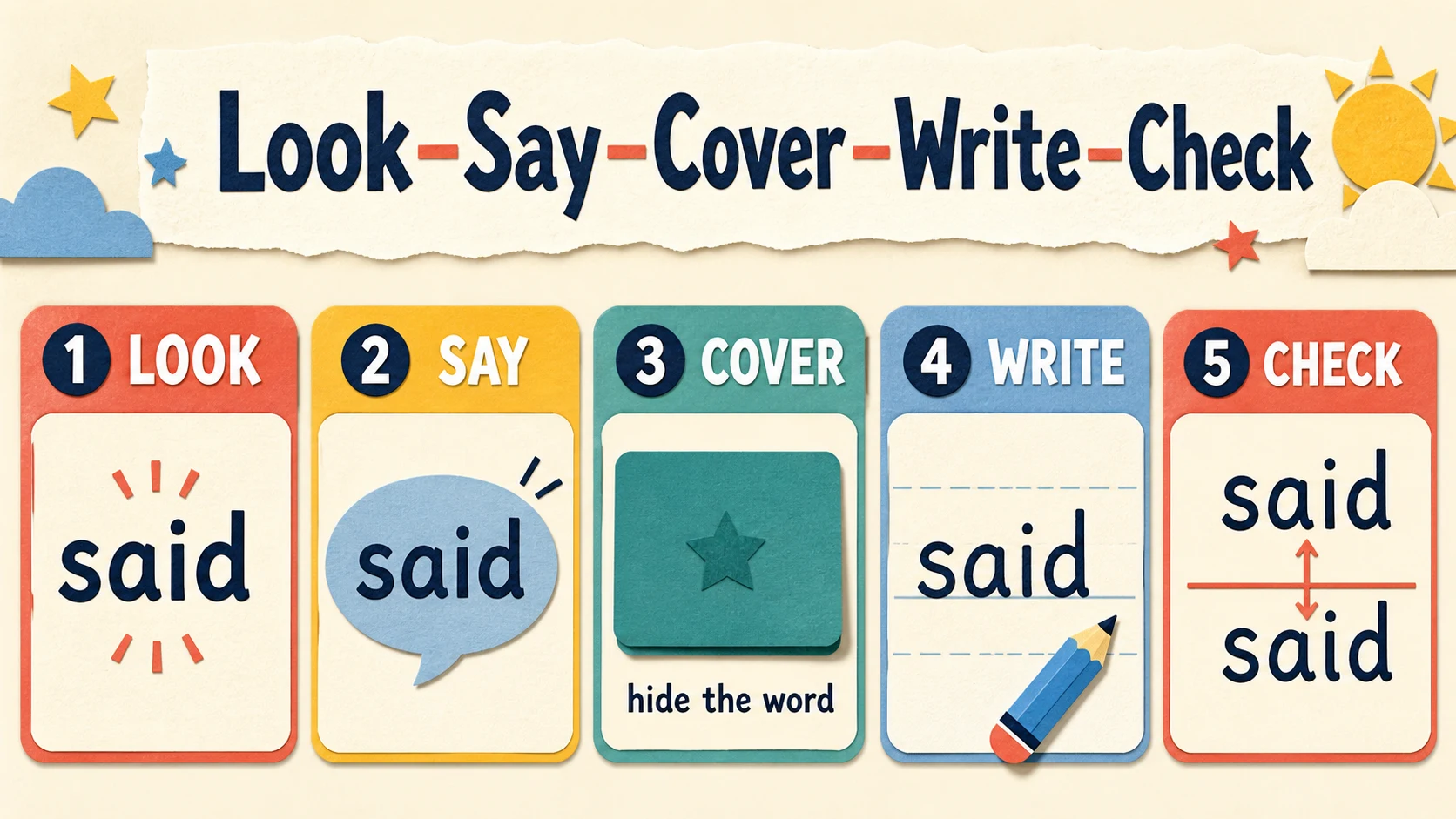
For first-grade homework, keep the routine stable: hear or read the word, notice the taught pattern, make one response, and check it against the model.
Four checked examples show what useful homework reveals
Each example below uses skills and response formats represented in the live catalogue. The word analyses have been checked here; they are instructional suggestions, not claims copied from an external study.
Example 1: Sort long-a spellings
Give four headings: a_e, ai, ay, and ea. Sort:
- cake → a_e
- rain → ai
- play → ay
- break → ea
All four words contain the long a sound, but they do not use the same grapheme. Cake has a final silent-e pattern; rain uses ai within the word; play uses ay at the end; break uses ea and should be taught as a less common mapping rather than evidence for a broad “ea always says long a” rule.
This example belongs on this page because the catalogue specifically names long-vowel spellings, word sorting, and the long-a set cake, rain, play, and break. It is suitable only after those spellings have been introduced. If the learner sorts play under ai, the next task should contrast word-final ay with medial ai, not add more unrelated long-vowel words.
Example 2: Correct consonant doubling before a suffix
Present these pairs:
- hop → hopping
- hope → hoping
- run → running
- rain → raining
The checked contrasts matter. Hop doubles final p before -ing, while hope drops final silent e and does not double p. Run doubles n. Rain does not double n.
This example belongs because consonant doubling and suffixes are both named catalogue targets. It also reveals whether a learner is applying one procedure everywhere. Writing rainning suggests overgeneralized doubling; writing hoping for hopping may show that the learner has not preserved the short vowel through doubling. The next sheet should compare a few matched pairs, not require twenty repetitions of only doubled forms.
Example 3: Preserve the base word when adding a prefix
Use a word-building response:
- un + kind → unkind
- re + play → replay
- dis + agree → disagree
- mis + spell → misspell
The last word deserves attention: misspell contains the final s of mis- beside the initial s of spell, so both letters remain.
This example belongs because prefixes and identifying misspelled words appear in the catalogue. If a learner writes mispell, ask them to bracket the two meaningful parts—mis + spell—before rewriting the whole word. The next sheet should retain visible morpheme boundaries for several items. It should not jump immediately to unmodeled prefixes or obscure vocabulary.
Example 4: Map and check an r-controlled vowel
Ask the learner to complete and explain:
- c__ → car
- f__k → fork
- h__ → her
- t__n → turn
The checked spellings use ar, or, er, and ur. They should not be presented as four identical sounds in every accent. The purpose is to connect a known spoken word with its conventional spelling and to notice the vowel-plus-r unit.
This example belongs because r-controlled vowels are an explicit catalogue skill. If the learner writes tern for turn, a purely visual copying page may hide the problem. The next task should contrast a small number of familiar er, ir, and ur words already taught, with oral pronunciation and meaning established first.
Move from support to independent spelling in small steps
Homework can change one support at a time. A useful progression is:
- The word and target letters are visible.
- The whole word is visible, but the learner must identify the target.
- The learner looks, covers, writes, and checks.
- The learner spells from oral dictation.
- The learner uses the word in a sentence.
- The learner applies the pattern to a new, carefully selected word.
Do not remove the model, increase the word count, mix several patterns, and require sentence composition on the same night. If performance changes, you will not know which added demand caused the difficulty.
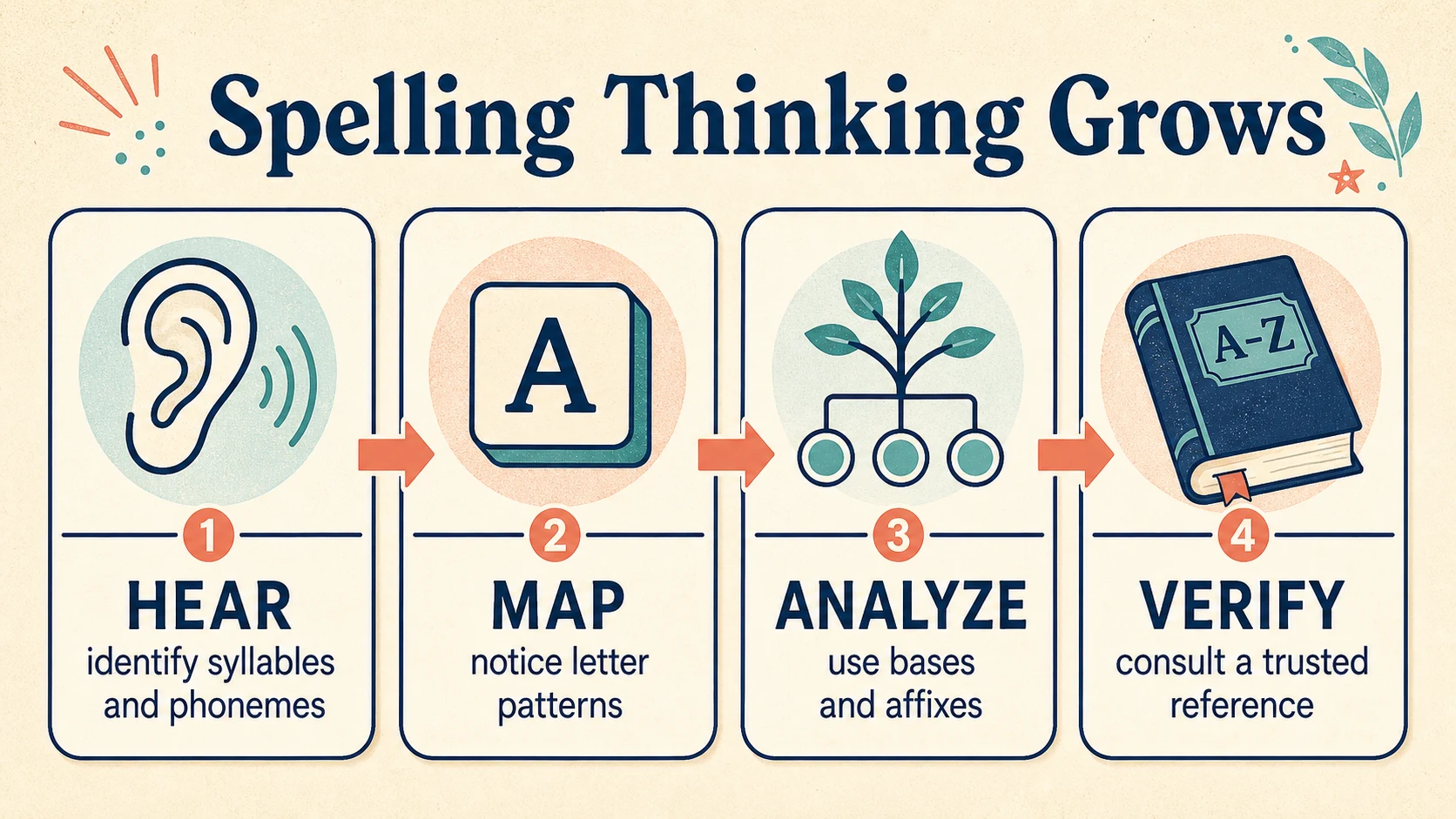
For fifth-grade words, fade one support at a time so errors in a prefix, suffix, silent letter, or syllable remain interpretable.
The IES elementary writing guide recommends teaching fluency with spelling alongside handwriting, sentence construction, typing, and word processing. It also recommends regular writing time and instruction in the writing process. That sourced guidance is a reason to check whether practiced spellings appear in authentic writing, but it does not mean every spelling worksheet should become a long composition.
A two-sentence dictation can provide a manageable bridge. Select familiar sentence content so the spelling target remains the main challenge. If the learner spells the target word correctly in isolation but not in the sentence, the next step may be another brief contextual use—not a harder word list.
Read returned errors by location, pattern, and independence
A score alone discards useful evidence. On the returned sheet, annotate each error in three ways.
Locate the changed part
Compare the response with the target from left to right. Mark the smallest meaningful difference:
- omitted letter;
- added letter;
- substituted vowel spelling;
- incorrect consonant doubling;
- altered prefix or suffix;
- transposed letter order;
- missing syllable or word part.
For rainning instead of raining, mark the extra n. For mispell instead of misspell, mark the missing boundary letter. This is more actionable than writing “Study harder.”
Look for a repeated decision
One error may be a lapse. Several errors involving the same feature justify targeted follow-up. Several unrelated errors may instead indicate that the page mixed too many demands, the directions were unclear, or the work was completed without enough independence.
Use cautious language:
- “Three words with final ay were sorted under ai.”
- “The learner requested help on four of six dictated words.”
- “Both prefix-boundary items lost a repeated consonant.”
- “The words were correct when copied but not after covering.”
These are observations, not diagnoses. A worksheet cannot determine a disability, explain motivation, or establish a learner’s overall spelling level.
Separate knowledge from task conditions
A blank item may mean the word was unknown, the direction was misunderstood, time ran out, or the learner chose not to answer. Ask before interpreting it. Likewise, perfect work completed with continuous adult spelling does not demonstrate independent retrieval.
Use a simple return code if helpful:
- I — independent;
- P — completed after a prompt;
- M — completed after an adult model;
- ? — learner was uncertain.
This coding system is a suggested classroom tool, not sourced guidance.
In third-grade review, preserve evidence about prompts and uncertainty so the teacher can distinguish independent pattern use from adult-supported completion.
Let the error choose the next sheet
The next assignment should respond to the error pattern, not merely advance to the next printable page.
| What the returned work shows | Likely instructional question | Observable next action |
|---|---|---|
| Correct copying, incorrect covered attempts | Can the learner retrieve the complete letter sequence? | Assign four look-cover-write-check items using the same taught pattern. |
| ai and ay repeatedly mixed | Is word position being noticed? | Sort familiar medial ai and final ay words, then spell one from each group. |
| Extra doubled consonants in words such as rainning | Has the doubling procedure been overgeneralized? | Compare hopping/hoping and running/raining with the base word visible. |
| A prefix or suffix is dropped | Can the learner identify the meaningful parts? | Bracket the base and affix before combining them. |
| Correct isolated words, incorrect sentence use | Does spelling hold under a larger writing load? | Dictate two short sentences containing previously practiced words. |
| Errors are spread across unrelated patterns | Was the assignment too mixed or unfamiliar? | Return to one known pattern with one response format and fewer items. |
| Nearly all responses are correct and independent | Can the pattern be applied without the model? | Remove one support or add one carefully chosen transfer word. |
| Directions required repeated adult explanation | Is the format itself established? | Model the format in class before sending another sheet of that type. |
This approach turns homework into a feedback loop: teach, assign, observe, choose. It also prevents an avoidable mistake—making the next sheet longer simply because the current one was completed.
The Common Core ELA framework describes grade-specific standards within broader expectations for reading, writing, speaking, listening, and language across content areas. It is a reference point, not proof of exact local sequencing and not evidence that a particular worksheet is aligned. Grade labels in this catalogue likewise describe intended practice level; local curriculum sequences differ. Consult the applicable school or district expectations before making an alignment claim. See the Common Core English Language Arts overview for the source’s own scope.
Adapt access without replacing the spelling target
An adaptation should remove an unnecessary barrier while keeping the target decision visible.
When handwriting is consuming the task
Allow letter tiles, magnetic letters, or typed responses if handwriting prevents the learner from demonstrating the spelling decision. Then ask for one handwritten example if handwriting is also an instructional goal. Do not score letter formation as a spelling error unless letter formation was explicitly part of the assignment.
When reading the directions is the barrier
Read the direction aloud, demonstrate one parallel item, and have the learner restate the procedure. Keep the target words unchanged. Avoid reading each target in a way that gives away the spelling.
When the full page is too long
Fold the page, cover later rows, or mark a stopping line. Assign the items that best sample the target rather than automatically assigning the first five. A 25-problem third-grade resource may contain useful variety, but a focused subset can produce clearer evidence.
When oral language or vocabulary is uncertain
Establish the meaning and pronunciation before testing spelling. Use a picture, gesture, brief definition, or sentence. Asking a learner to spell an unfamiliar spoken word confounds vocabulary knowledge with spelling.
When the learner is ready for more independence
Remove the visible word bank, add one transfer word that follows the taught pattern, or ask for a sentence. Change only one demand. Do not use “challenge” words merely because they are longer; choose them because they extend the same known relationship.
The catalogue suggests including two or three challenge words and keeping cumulative review. Those are WorksheetWise catalogue suggestions, not findings attributed to IES or the Common Core.
Keep adult help brief, neutral, and informative
Send adults language they can use without reteaching the lesson:
- “Read the direction and ask your child to tell you what to do.”
- “Model the first item only.”
- “If your child asks how to spell the word, say, ‘Mark the part you are unsure about and make your best attempt.’”
- “After the attempt, help your child compare it with the correct spelling.”
- “Circle any item that required substantial help.”
- “Stop at the marked line.”
Avoid turning feedback into a guessing game. “Try again” gives no information. “Check the vowel spelling in the middle” directs attention while preserving the learner’s decision. After the learner finds the difference, one accurate rewrite is often more informative than immediately copying the whole word several times. If additional repetitions are assigned, make sure the learner is looking away and retrieving at least once; otherwise the work may remain transcription.
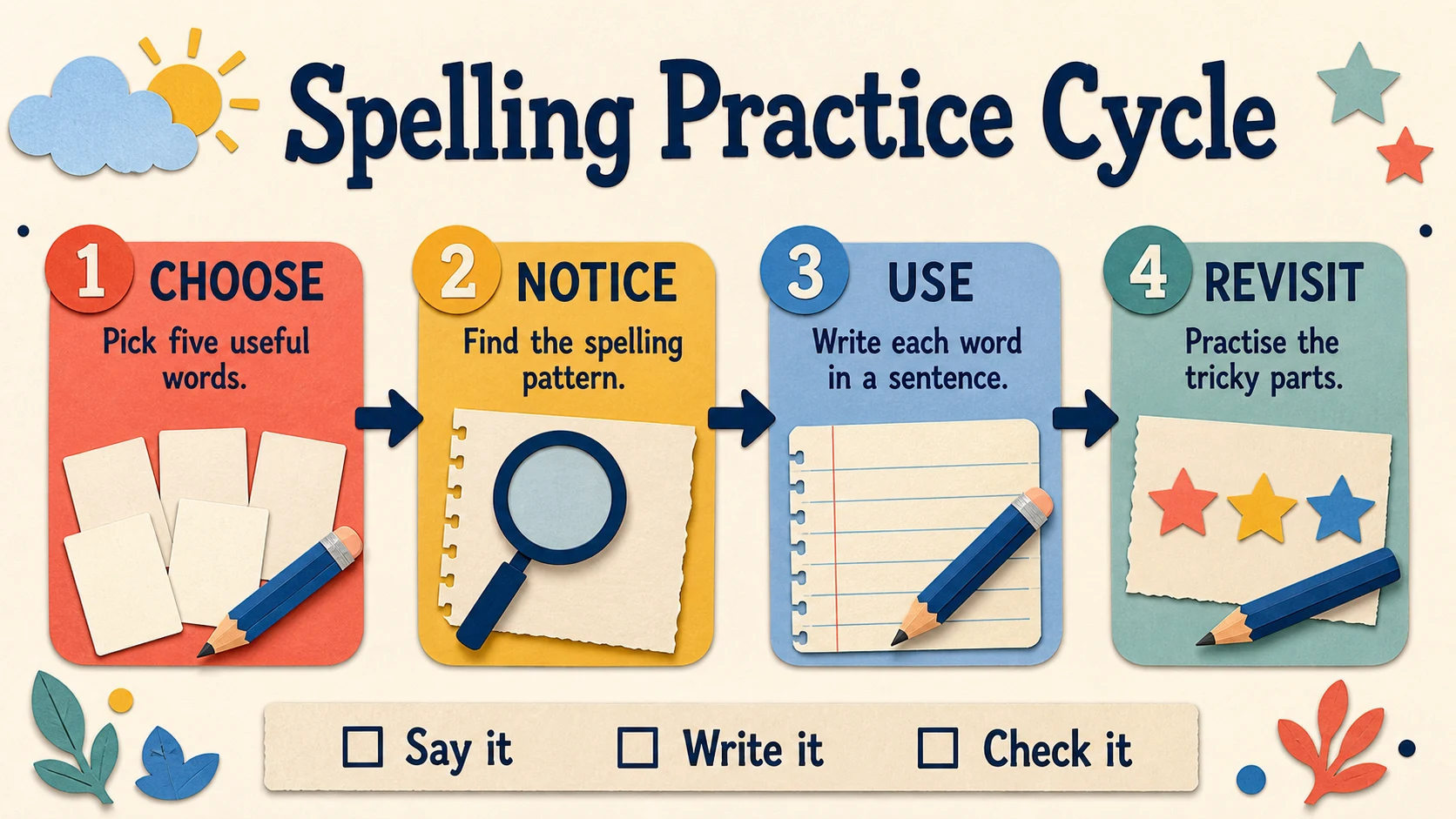
For first-grade practice, revisit a small taught set across days and include a later check rather than treating one completed page as mastery.
Keep home practice within its limits. A returned worksheet is one sample under particular conditions. It cannot diagnose a learning difficulty, prove mastery, measure general writing quality, or show who supplied an answer unless the adults and learner record that information. Persistent concerns should be discussed with the classroom teacher and, where appropriate, the school’s qualified support staff.
Build tomorrow’s decision before sending tonight’s page
Before the worksheet goes home, complete this planning sentence:
“If the learner __________, tomorrow I will __________.”
Examples:
- “If the learner places final ay words under ai, tomorrow I will model a position-based sort.”
- “If the learner spells four words correctly only while looking, tomorrow I will repeat the same words with look-cover-write-check.”
- “If the learner preserves every base word but drops suffix letters, tomorrow I will bracket base words and suffixes before combining them.”
- “If the learner spells the targets independently in two sentences, tomorrow I will add one new word using the same taught pattern.”
That sentence prevents passive marking. It makes the purpose of homework visible before the page is assigned.
For the next real action, open the 3rd Grade Spelling Words guide and free sheet, select one already-taught pattern from its 25-problem resource, mark a short stopping point, and write your “if–then” response on the teacher copy before sending the sheet home.
Put it into practice
Use the guide with a real printable
Move from explanation to a short, observable practice task. Check the first item together, then adjust the next session from the learner's actual work.
Open the first free worksheetExplore a neighboring collection