Curated collectionAnswer keys includedPrint-ready PDFs
Classroom Spelling Worksheets
Move from whole-group modeling to guided practice, independent work and a manageable check routine without using sheets as filler.
Start with a real resource
Browse this worksheet collection
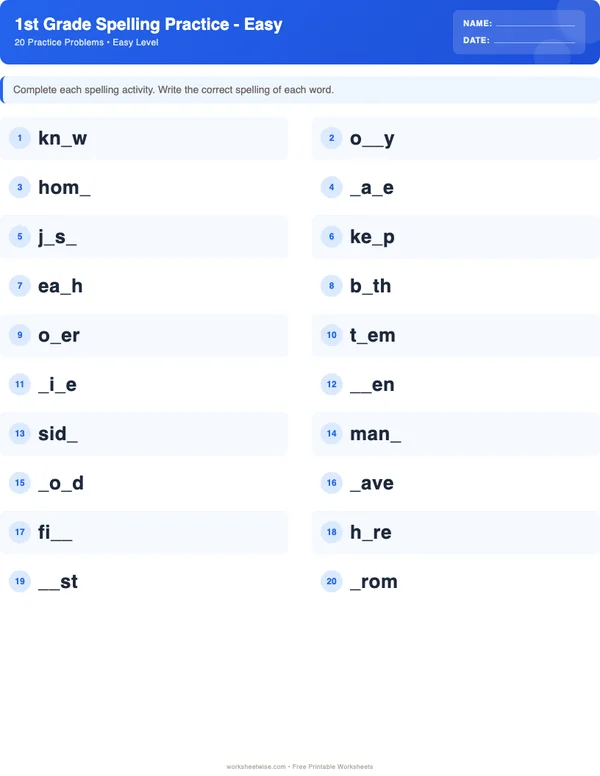
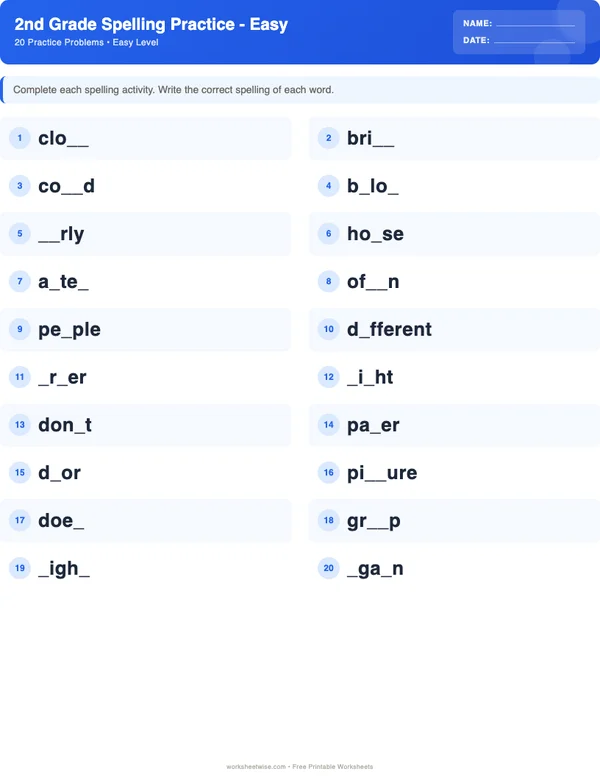
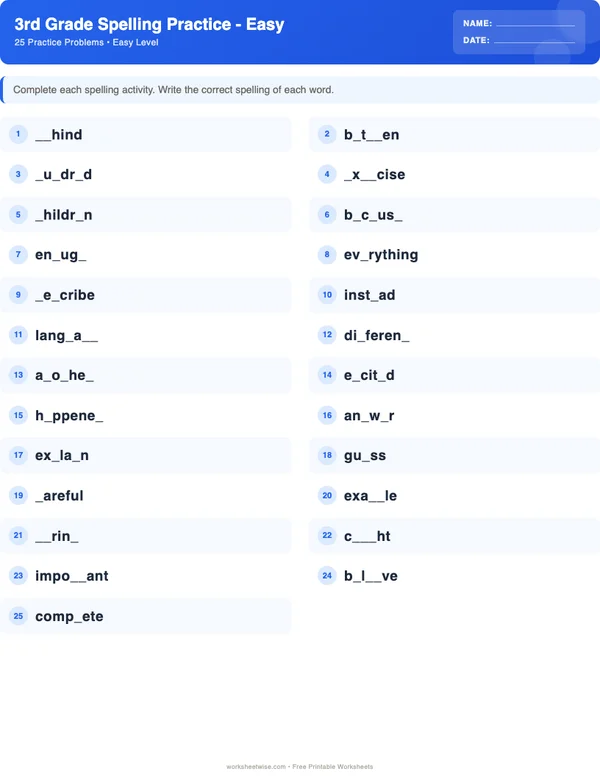
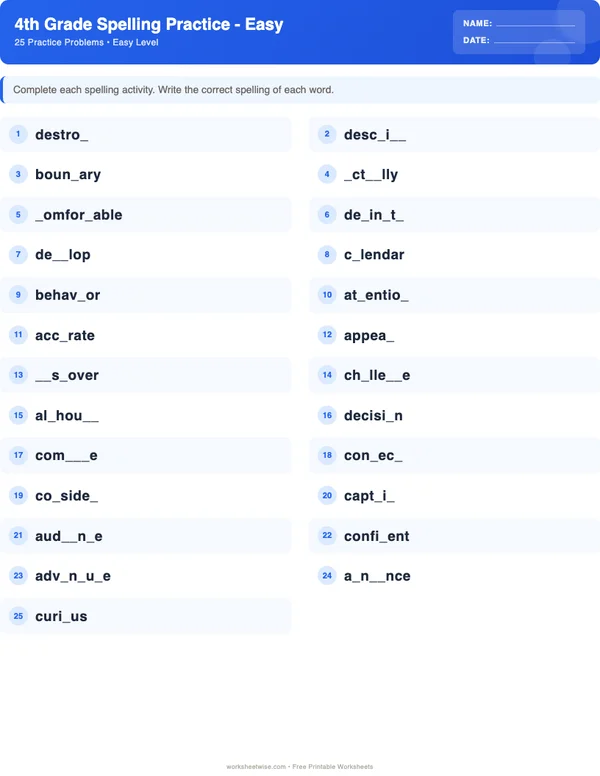
5 relevant free entry points are available. Each one includes a printable learner PDF and separate answer key.
A useful practice loop
Print less. Observe more.
- Choose one skill and model the first item aloud.
- Use a short set and notice the learner’s strategy.
- Change the next task from the work you can see.
Need more than the free sheet?
Plus includes all 90 matching catalogue variations where available, plus saved deterministic generators and the worksheet designer.
See Plus membershipComplete guide
How to teach and practise classroom spelling worksheets
3,461 words Updated 6 instructional visuals
Build each spelling sheet into a teach–practice–check cycle
Classroom spelling worksheets work best when each sheet has a defined job: rehearse a pattern the teacher has already modeled, reveal how students are representing words, or check whether they can apply prior learning without prompts. They should not fill spare time or replace explicit instruction.
Use this sequence:
- Model one spelling decision with the class.
- Complete a few items together and discuss why each spelling works.
- Assign independent items in a response format suited to the target.
- Check a small, planned sample promptly.
- Sort errors by type, not merely by score.
- Choose the next sheet from the observed error pattern.
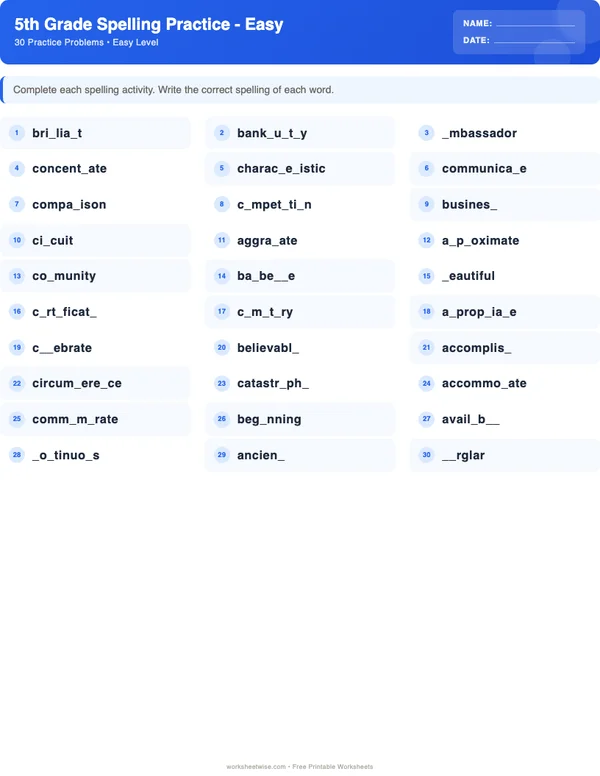
The live WorksheetWise catalogue contains 90 spelling variants across five intended grade levels, with one free entry point for each grade. The free sheets contain 20 items in first and second grade, 25 in third and fourth grade, and 30 in fifth grade. Those counts help with planning, but they do not dictate how many items a class must complete in one sitting. A teacher can fold a sheet, mark a stopping point, or divide it across lessons while preserving the spelling target.
Grade labels describe intended practice levels; local curriculum sequences differ. Treat age or grade as a discovery aid rather than a placement decision. Select from the words, patterns, prompts, and response demands students are ready to work with now.
Start with the spelling decision, not the worksheet
Before distributing a sheet, finish this sentence: “Students will decide whether or how to ______.” A useful answer names the spelling thinking, such as:
- distinguish two long-a spellings;
- hear the vowel in a one-syllable word;
- retain a silent letter;
- double a consonant before adding a suffix;
- preserve a base word when adding a prefix;
- divide a multisyllabic word into manageable parts;
- recall a high-frequency word that is not fully predictable from sound alone.
“Practice spelling” is too broad. A precise decision tells the teacher what to model, which items to assign, and what an incorrect response may mean.
The WorksheetWise spelling resources include short and long vowels, consonant doubling, r-controlled vowels, silent letters, prefixes, suffixes, multisyllabic words, and high-frequency words. Available activity structures include look–cover–write–check, pattern sorts, rainbow writing, sentence use, and identification of misspelled words. These are catalogue facts. The recommendations below—such as limiting a first check to selected items or pairing a sort with dictation—are editorial teaching suggestions for using those resources purposefully.
The IES foundational reading practice guide recommends explicit instruction in sound segments and their links to letters, along with instruction in decoding, word analysis, and connected text. It did not assess WorksheetWise. In spelling lessons, that guidance supports saying and segmenting a word before expecting students to record its letters, especially when the target depends on sound–spelling relationships.
Select the sheet by observable task features
Every free catalogue entry is labeled “easy,” but that label must be interpreted through the work on the page. It does not describe a learner. A less demanding task might provide the target word for copying, keep words to one familiar pattern, offer a visible model during writing, or require recognition rather than recall. A more demanding task might hide the word before writing, mix several patterns, remove a word bank, ask for sentence use, or require transfer to an untaught word.
Compare the response formats
Choose the format that produces evidence about the current target:
| Response format | What students do | Best use | Important limitation |
|---|---|---|---|
| Look–cover–write–check | Study, conceal, recall, write, and compare | Memory for an already taught word or pattern | Copying during the “write” step defeats the recall demand |
| Pattern sort | Group words by shared spelling features | Notice contrasts and form a generalization | Students may sort by appearance without reading the words |
| Identify a misspelling | Compare a presented form with a known pattern or word | Explain exactly what is wrong | Recognition does not establish independent production |
| Rainbow writing | Rewrite a word in different colors | Slow visual attention to letter order | Repetition alone may not reveal why the spelling works |
| Sentence use | Spell a target within a meaningful sentence | Check transfer beyond an isolated list | Composition, handwriting, and vocabulary add extra demands |
| Dictation | Hear and record a word or sentence without seeing it | Check independent representation | Pronunciation and sentence complexity must not obscure the target |
A format is not inherently strong or weak. Its value depends on the question the teacher needs answered. If students confuse rain and play, sorting long-a words can expose the alternatives. If they can sort correctly but write ran for rain in dictation, the next need is retrieval without a visible model, not another open sort.
Compare the five free entry points
The first-grade spelling words guide and free sheet and the second-grade free sheet each contain 20 problems. Third- and fourth-grade sheets contain 25; the fifth-grade spelling words guide and free sheet contains 30. These totals are not automatic lesson lengths.
For an early class still learning to segment one-syllable words, ten carefully checked responses may reveal more than twenty hurried ones. For an older class working with prefixes, suffixes, or multisyllabic words, a teacher might use six items for modeling and guided analysis, twelve for independent work, and save the remaining items for retrieval later in the week.
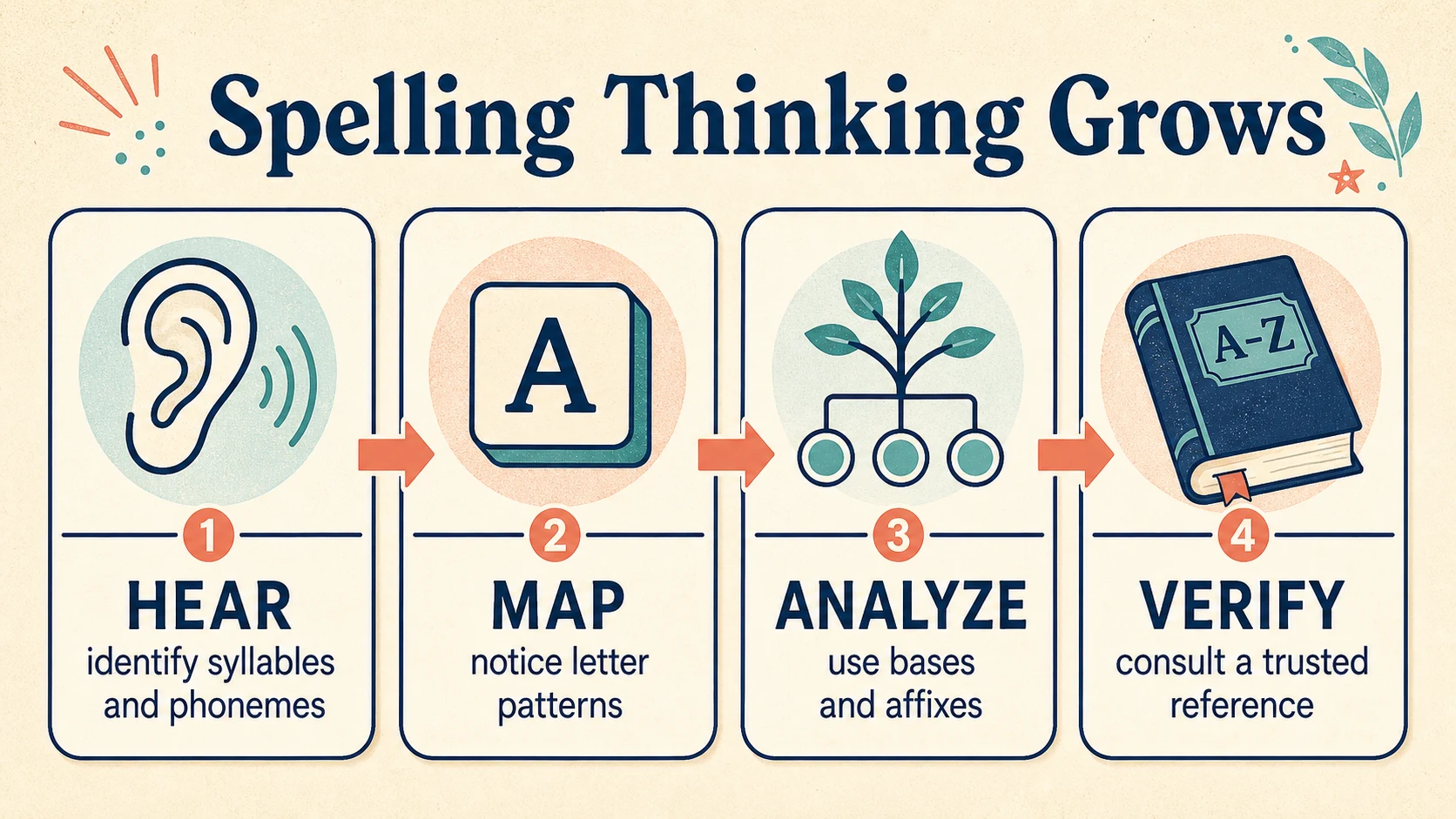
Move fifth-grade spelling practice from visible analysis to covered recall and then contextual use; the response demand, not the grade label alone, establishes the level of support.
Model the exact thinking students must reproduce
Whole-group modeling should be brief but intellectually explicit. Do not simply write the answer while students watch. Make the decision audible, mark the relevant part of the word, and contrast it with a plausible error.
Checked example 1: long-a is not one spelling
The catalogue teaching material uses cake, rain, play, and break as examples of long-a words. All four contain a long-a sound, but they do not share one letter pattern:
- cake uses final silent e to support the vowel spelling a_e;
- rain uses ai;
- play uses ay;
- break uses ea.
The examples have been checked: each word is spelled correctly, and each represents a genuine long-a spelling. They belong on this page because the live resources explicitly recommend organizing spelling work around patterns and use this set as the example.
A productive model is: “I hear the same vowel sound in all four words, but sound alone does not select the spelling. I will sort by the letters representing the vowel, not put every word in one column.” Then place each word under a_e, ai, ay, or ea.
For guided practice, ask students to read each word, underline the letters carrying the vowel, and explain one placement. For independent work, add familiar examples to the corresponding columns. Do not present “long a is written ai” as a universal rule; these four words disprove it immediately.
Checked example 2: a doubled consonant is a decision point
Suppose the taught target is adding -ing to a short-vowel, one-syllable base word. Compare hop → hopping with hope → hoping. These forms have been checked:
- hopping contains doubled p and retains the short vowel heard in hop;
- hoping drops the final silent e before -ing and retains the long vowel heard in hope.
This example belongs because consonant doubling and suffixes are both among the verified catalogue targets. It also exposes a classroom misconception that a copying sheet may conceal: a student might write hoping when intending hopping, producing a different real word.
Model with the base words visible. Say each word, mark the vowel, compare the ending, and add the suffix. During guided practice, have students explain whether the base ends in silent e or in a short-vowel consonant pattern before they write. Only then move to covered independent production.
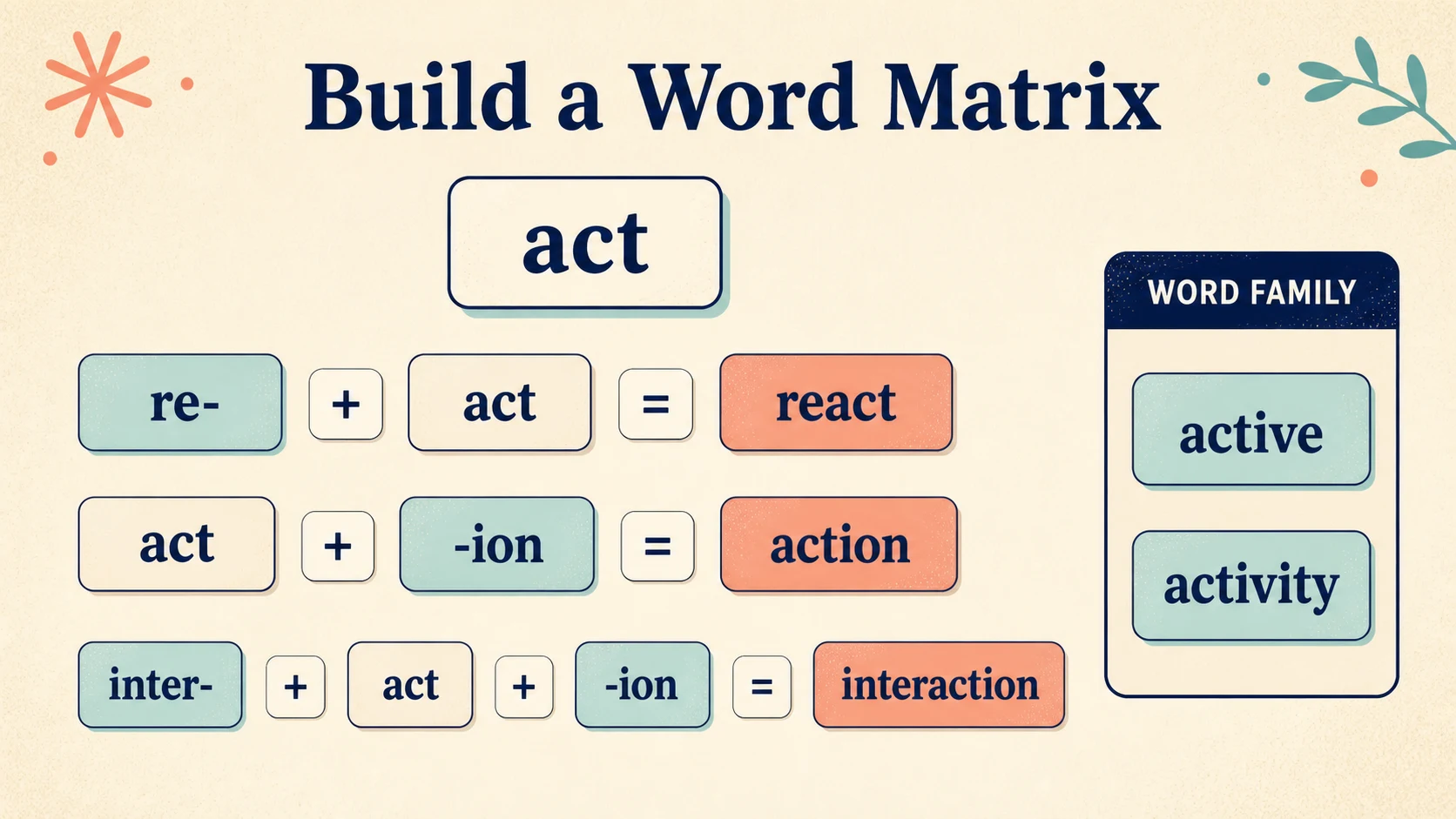
In an upper-elementary routine, reserve whole-group time for the spelling decision and use the sheet for guided evidence, independent retrieval, and a short check.
Use a routine that remains manageable every day
A spelling lesson does not require marking every letter on every page. It requires a predictable evidence loop.
Minutes 1–4: retrieve and connect
Dictate two previously taught words without showing them. Choose one that uses the current pattern and one that contrasts with it. Students write, compare, and circle the part they are least certain about. This is a retrieval check, not a graded test.
Then connect the old decision to the new one: “Yesterday we used ai in the middle of rain. Today we will compare that spelling with ay at the end of play.”
Minutes 5–9: model and guide
Model one word and one plausible error. Complete two or three sheet items together. Ask students to name the evidence they used: sound position, base word, affix, known word, or visible pattern.
During guided work, circulate for a single feature. For example, check whether students underline the vowel spelling before sorting. Avoid correcting every handwriting or punctuation issue when the lesson evidence concerns vowel representation.
Minutes 10–18: independent response
Set an explicit stopping point. Students complete only the items needed to show whether they can make the spelling decision independently. Preserve the intended demand: if this phase tests recall, word lists stay covered; if it tests pattern recognition, headings may remain visible.
Fast completion should lead to a transfer item, not unrelated filler. Ask the student to add one new word that fits a category, use two target words in a sentence, or find the pattern in current reading. Confirm the added word yourself before using it as class evidence.
Minutes 19–22: check and route
Display or state correct forms. Students compare letter by letter and mark the precise mismatch. The teacher then checks a planned sample: perhaps three target items, one contrast item, and one transfer item.
Record error codes rather than a total alone:
- S: sound omitted, added, or represented implausibly;
- P: target pattern selected incorrectly;
- B: base word was not retained;
- A: affix was omitted or malformed;
- M: word was correct with a model but incorrect from memory;
- C: correction was copied without explanation.
These codes are suggested classroom shorthand, not diagnoses.
Make guided practice different from independent work
Students should not encounter the same task three times with only the adult’s voice removed. Support must fade in a deliberate progression.
During whole-group modeling, show the word, pronounce it, segment or analyze it, and mark the critical letters. During guided practice, keep the pattern headings visible but let students supply the words or complete the sort. During independent work, remove the completed model, mix familiar categories, or ask students to write from dictation. In the check, ask for a brief explanation or correction.
Checked example 3: silent letters require visual memory and word analysis
Use write, wrote, and written as a small related set. The spellings have been checked: each begins with silent w, and all three retain wr. The vowel and ending change across the forms.
This example belongs because silent letters and word relationships are appropriate targets within the verified catalogue description. It shows why “sound it out” is insufficient: the spoken forms do not tell a student to include w.
Model the stable letter sequence by boxing wr in each word. In guided practice, students match spoken forms to printed forms and explain what remains stable. In independent work, dictate one form at a time. If a student writes rite, the response is phonologically plausible but does not retain the conventional silent-letter spelling. The next task should emphasize the stable wr sequence in related words, then return to recall—not merely demand three unexamined copies.
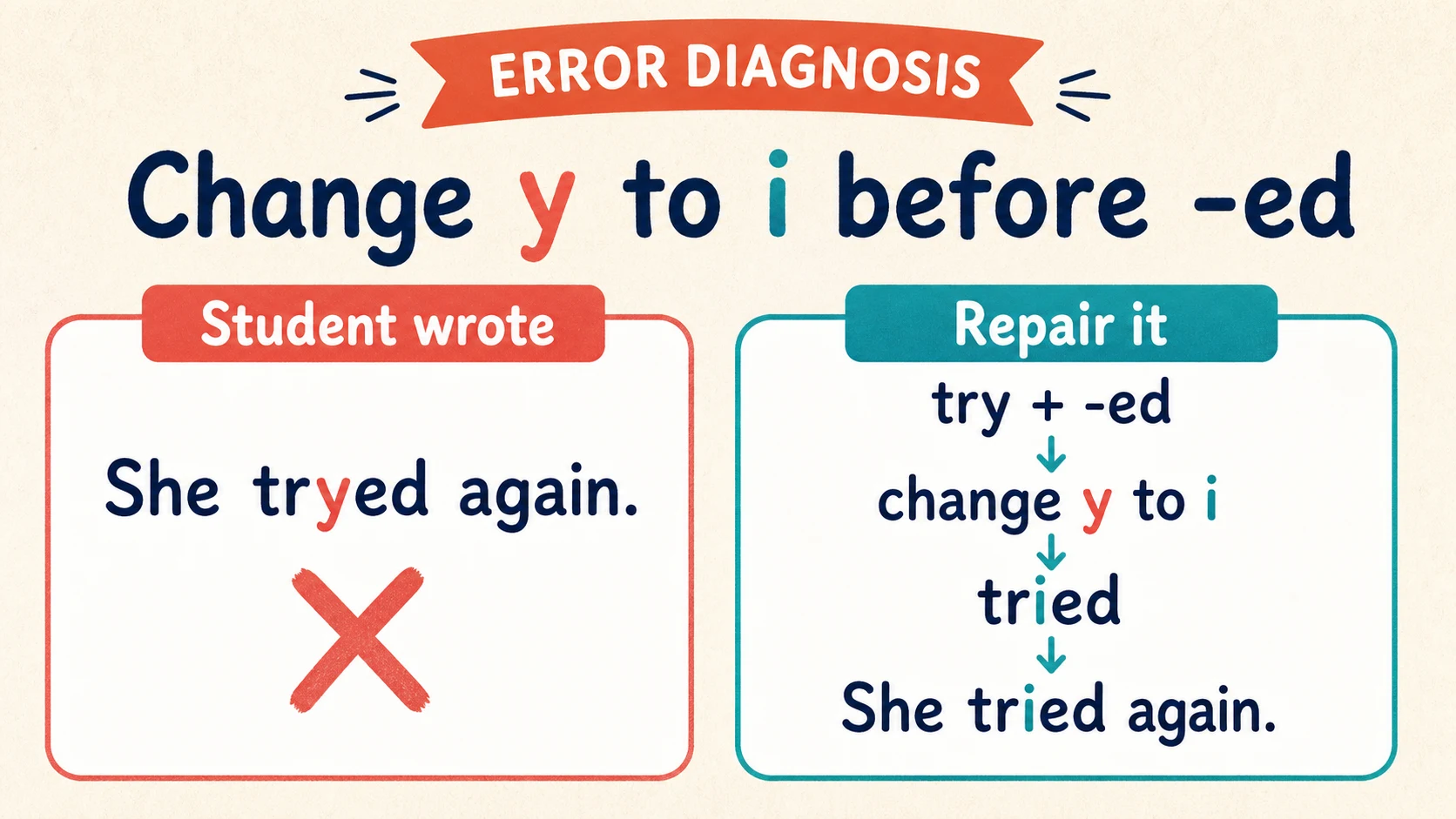
Pair a third-grade error with a specific instructional response: omitted sounds need oral segmentation, while a wrong conventional pattern needs comparison and retrieval.
Read errors as evidence for the next sheet
A score shows how many responses differed from the answer key. It does not show what to teach next. Inspect the location and recurrence of each mismatch.
When sounds are missing
If a student writes sed for send, first confirm the pronunciation and ask the student to stretch the word orally. The missing n may indicate that the internal consonant was not represented in that response. Choose a short teacher-led task involving oral segmentation, counters or sound boxes, and immediate spelling—not a longer list with more writing.
For ages three and four, prioritize brief adult-led oral, matching, manipulative, and movement work over desk work. For example, the adult can say a simple word, have the child move one counter for each heard sound, and then match the spoken word to a picture or printed model. Age remains a discovery aid, not a placement decision, and a worksheet should not displace oral language or hands-on sound work.
When the pattern is confused
If rain becomes rayn while play is correct, the student may be extending end-position ay into the middle of a word. The next sheet should contrast ai in the middle with ay at the end, using visible sorting first and covered recall second.
Do not infer a diagnosis from one spelling. Confirm the pattern across several relevant responses, a short dictation, and, where useful, the student’s explanation.
When copying is correct but recall fails
A student who copies because accurately but writes becaus after covering it has shown that handwriting and visual matching are adequate for the copied form; retrieval of the final e is not yet stable in that attempt. Return to look–cover–write–check with honest covering and immediate comparison. Include the word again after a delay.
The catalogue recommends look–cover–write–check and repeated attention to missed words. That is sourced from the supplied catalogue information, not presented here as independently verified research.
When isolated words are correct but sentences are not
If a student spells a target correctly in a list and incorrectly in original writing, select a short contextual response rather than another full copying page. The IES elementary writing practice guide recommends explicit teaching of writing strategies and attention to foundational writing skills. It did not evaluate these worksheets. A reasonable classroom application is to keep the spelling demand narrow while asking students to use one or two known words in a sentence, then edit those exact words.
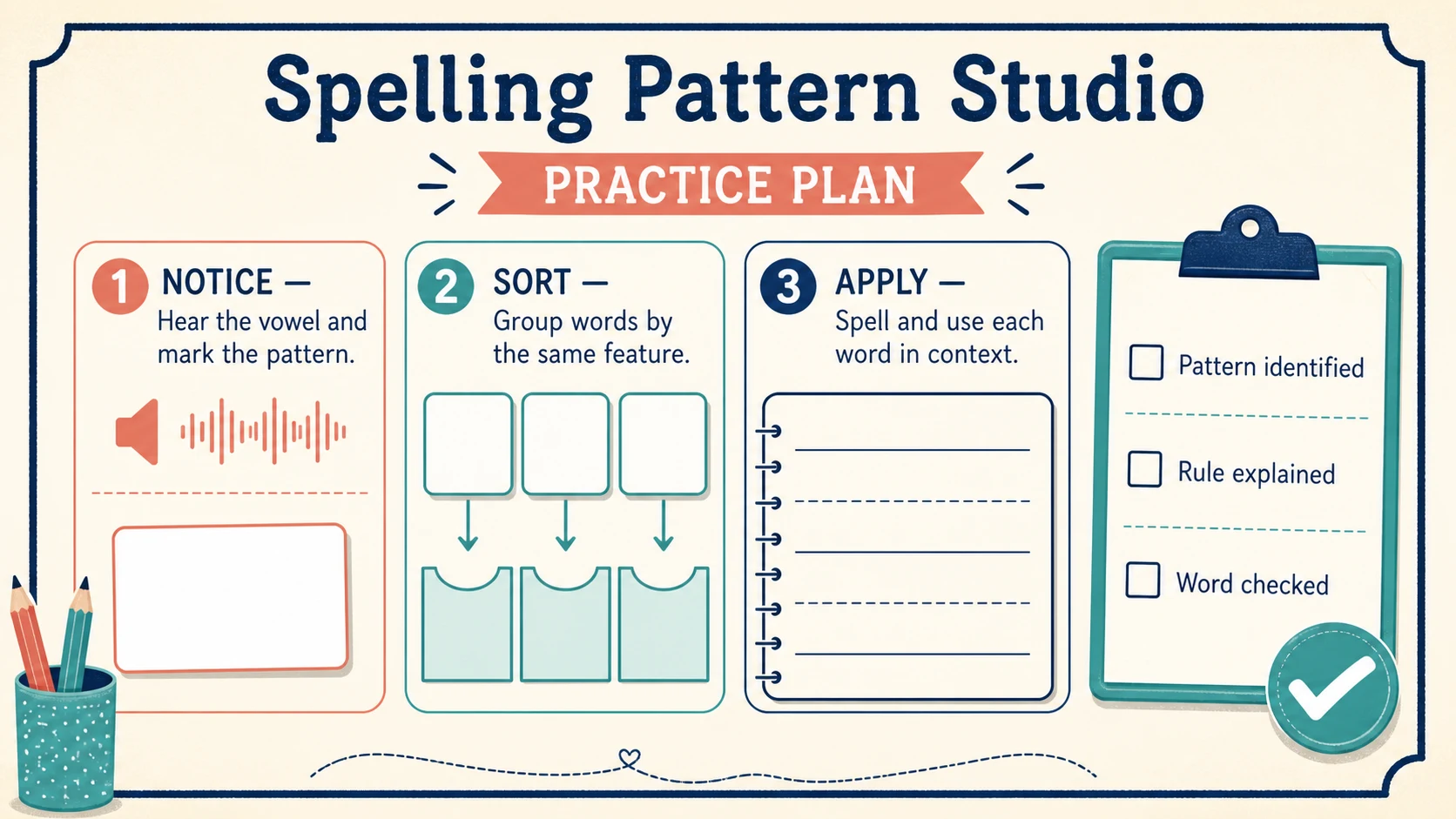
Across two third-grade weeks, let the first week’s specific errors determine which pattern receives comparison, recall, and contextual review in the second.
Plan feedback students can act on
“Wrong” does not identify a repair. Nor does rewriting a whole word three times necessarily focus attention on the incorrect part. Give feedback at the smallest useful unit.
Checked example 4: preserve the base in prefixed words
Consider happy → unhappy and clear → unclear. Both spellings have been checked. In each case, the prefix un- is added without changing the spelling of the base word.
These examples belong because prefixes are among the verified catalogue targets. They also offer a clean feedback decision:
- unhapy loses a letter from the base happy;
- unclear is correct because clear remains intact;
- uncleer changes the base’s vowel spelling and needs comparison with clear.
Instead of writing the answer over the student’s attempt, underline the base-word section and ask, “What is the base? Write it first. Now add the prefix.” The student should then explain the correction: “I keep both ps in happy when I add un-.”
For peer checking, limit partners to one protocol:
- Read the intended word.
- Compare from left to right.
- Box the target pattern or affix.
- Ask the writer to make the correction.
- Refer uncertain cases to the teacher or an approved reference.
Peers should not invent spellings by consensus.
Use two weeks to revisit, not merely repeat
A spelling plan should include delayed retrieval and cumulative review. Reprinting the same page is useful only when the second encounter changes the cognitive demand or checks whether prior correction held.
An early-grade sequence
In first grade, use brief rounds. On day one, model and sort a small pattern set. On day two, complete selected look–cover–write–check items. On day three, dictate a few words. On day four, contrast the target with a previously taught pattern. On day five, use one or two words in a teacher-created sentence.
The second week should be selected from evidence. Missing sounds call for oral segmentation and manipulatives. Correct oral segmentation paired with a wrong vowel pattern calls for a visible comparison. Accurate supported responses paired with failed dictation call for more covered recall.
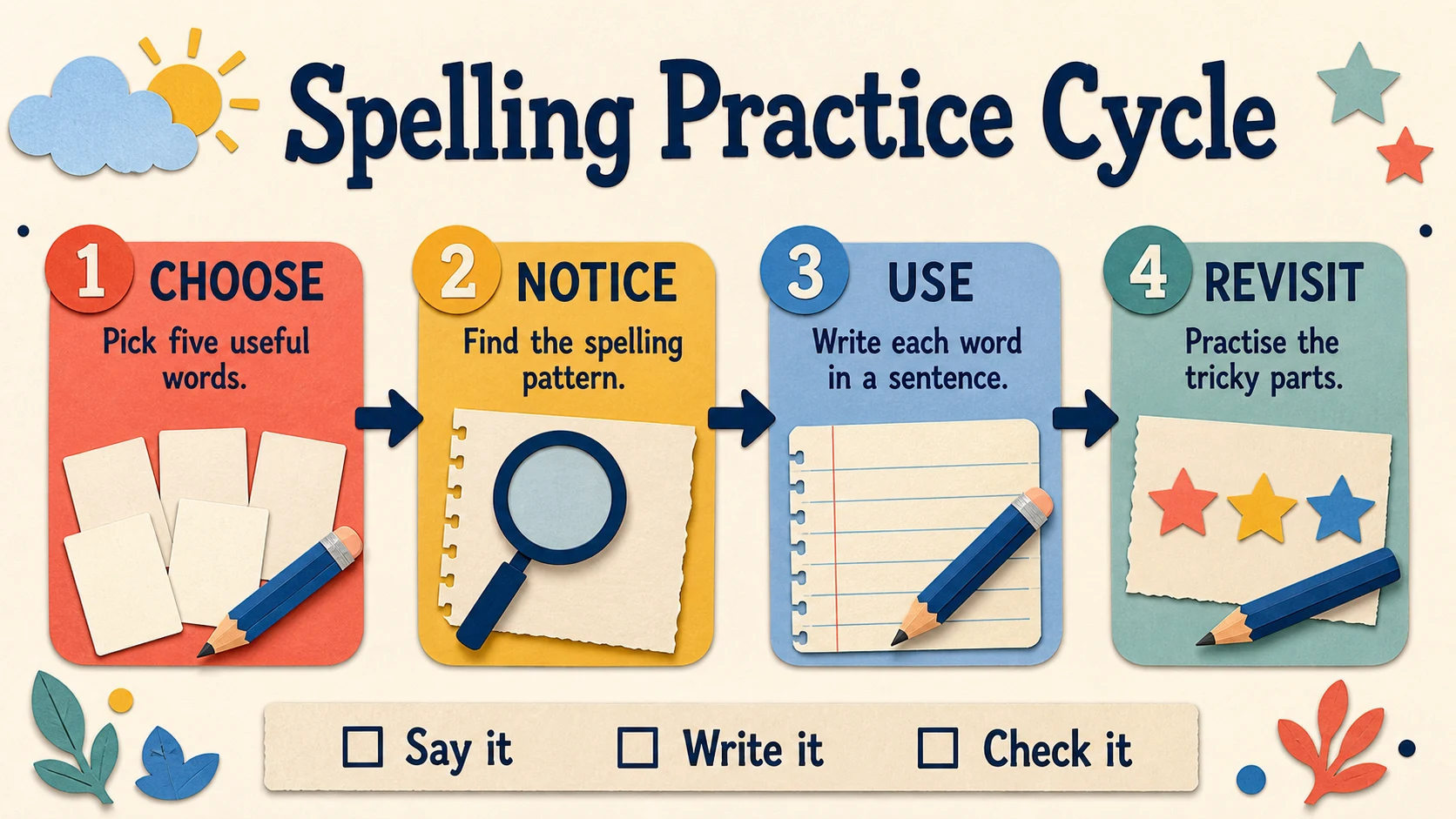
Keep first-grade practice brief and cumulative, moving from spoken segmentation and visible patterns toward a few independent spellings.
An upper-elementary sequence
In fifth grade, a 30-problem free sheet can become a two-week resource rather than a single sitting:
- use a small group of items for initial analysis;
- assign a second group for independent recall;
- place selected words into sentences;
- revisit only the patterns that produced errors;
- add a cumulative check containing old and current words.
This division is a planning suggestion. The verified catalogue fact is that the fifth-grade free sheet contains 30 problems and that available targets can include prefixes, suffixes, silent letters, and multisyllabic words.
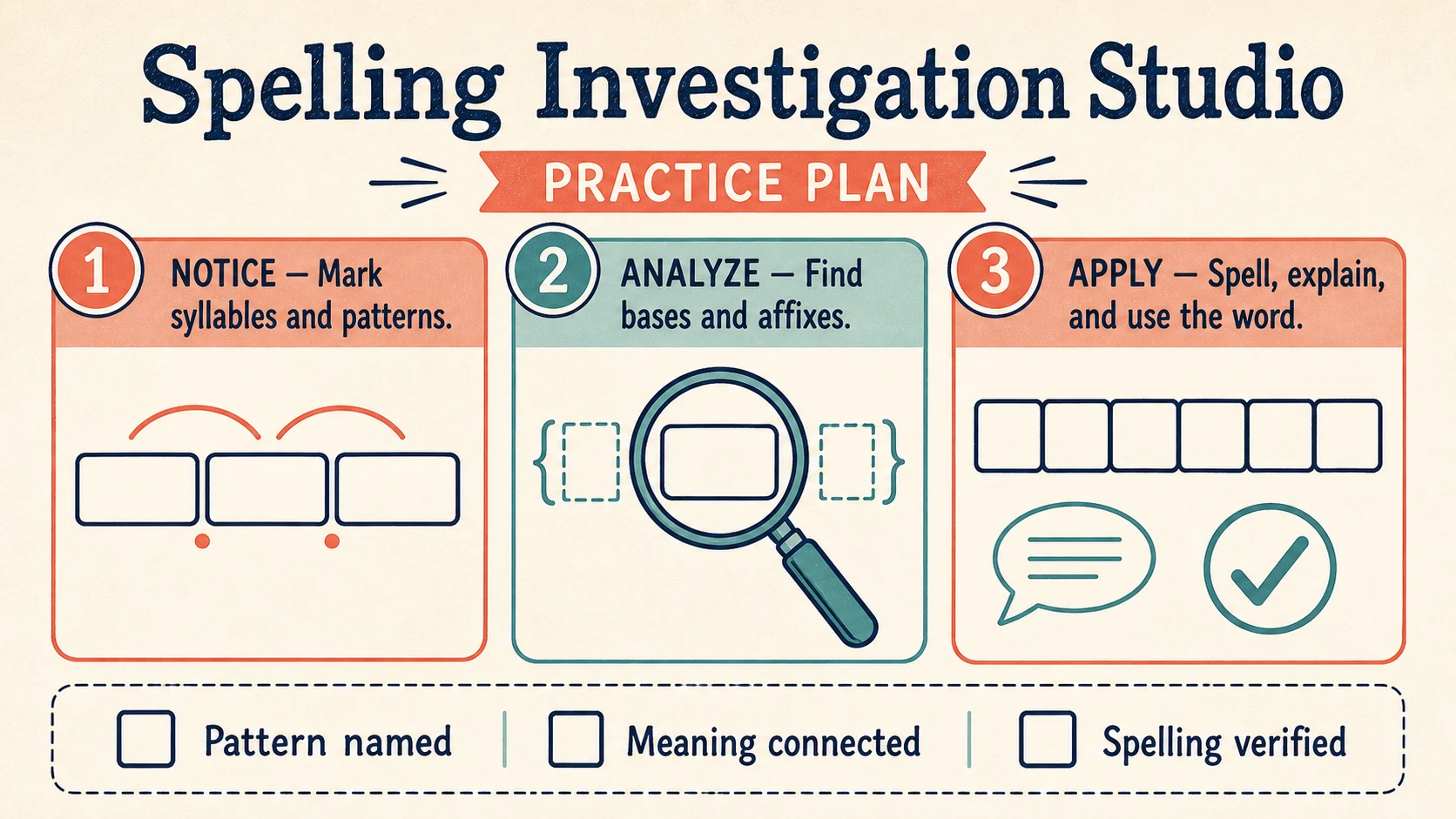
Spread a fifth-grade sheet across analysis, retrieval, sentence use, correction, and delayed review instead of treating 30 items as one block.
Adapt access without removing the spelling target
An adaptation should reduce a barrier unrelated to the target while preserving the spelling decision being assessed.
If handwriting endurance is the barrier, let the student arrange letter tiles before recording one final spelling. If visual crowding interferes, mask unused rows or enlarge the page. If the word’s meaning is unfamiliar, explain or illustrate it before spelling begins. If working memory is overloaded by a long direction, give one instruction at a time. If the task is sentence use and composition would obscure the target, provide a sentence frame.
Do not keep a word bank visible when the intended evidence is independent recall. Do not pronounce silent letters unnaturally during a check. Do not accept tracing as proof of retrieval. Do not simplify the target word itself unless the instructional target changes and that change is recorded.
The Common Core English Language Arts standards include grade-banded language expectations involving conventional spelling and using spelling patterns and references. They did not review WorksheetWise, and this page does not claim standards alignment. Local curriculum sequences differ, so teachers should compare any proposed word or pattern with their own adopted sequence.
For students needing earlier sound–letter work, the Classroom Phonics Worksheets may provide a more appropriate instructional bridge. That is a resource-selection option, not a judgment about the learner.
Keep worksheet evidence within its limits
A completed page captures performance under particular conditions: that day, with that wording, amount of support, response format, and set of words. It cannot by itself establish durable mastery, transfer to spontaneous writing, a diagnosis, or the reason for every error.
Avoid these overclaims:
- “Twenty correct answers prove the pattern is mastered.”
- “A low score means the grade label is wrong for the student.”
- “Neat copying demonstrates independent spelling.”
- “One unconventional spelling identifies a learning condition.”
- “Finishing a higher-grade sheet means the student should change grades.”
Instead, compare evidence across at least two demands: visible analysis and independent recall, or isolated words and contextual writing. Note whether the student self-corrects, explains the pattern, and applies it after a delay. These observations support a next instructional choice without promising an outcome.
Also protect time for real reading and writing. Worksheets can concentrate attention on a spelling feature, but they cannot supply the complete language context of books, discussion, composition, and revision. The catalogue suggests connecting spelling to patterns found in students’ reading; teachers should verify every selected example before presenting it.
Turn tomorrow’s sheet into a response to today’s evidence
Before ending the lesson, collect one observable data point from each student: a correctly explained pattern, a repeated mismatch, a successful covered recall, or a transfer attempt. Group the responses by instructional need rather than by total score.
Tomorrow:
- students omitting sounds begin with oral segmentation and manipulatives;
- students confusing two visible patterns complete a contrast sort;
- students accurate with models but inaccurate from memory use look–cover–write–check;
- students accurate in lists but inconsistent in sentences complete a short contextual edit;
- students accurate across both recall and context receive a cumulative or transfer item, not more identical copying.
Start by opening the grade-level entry that best matches the pattern and response demand—not automatically the student’s enrolled grade. A practical first choice is the 3rd Grade Spelling Words guide and free sheet: preview its 25 items, circle only those that match tomorrow’s verified target, choose three items to check, and write the error-based rule that will determine the following sheet.
Put it into practice
Use the guide with a real printable
Move from explanation to a short, observable practice task. Check the first item together, then adjust the next session from the learner's actual work.
Open the first free worksheetExplore a neighboring collection