Curated collectionAnswer keys includedPrint-ready PDFs
After-School Spelling Worksheets
Account for transition and fatigue with short tasks, clear stopping points and a print-plus-conversation routine.
Start with a real resource
Browse this worksheet collection
5 relevant free entry points are available. Each one includes a printable learner PDF and separate answer key.
A useful practice loop
Print less. Observe more.
- Choose one skill and model the first item aloud.
- Use a short set and notice the learner’s strategy.
- Change the next task from the work you can see.
Need more than the free sheet?
Plus includes all 90 matching catalogue variations where available, plus saved deterministic generators and the worksheet designer.
See Plus membershipComplete guide
How to teach and practise after-school spelling worksheets
3,279 words Updated 6 instructional visuals
Make after-school spelling short, audible, and easy to stop
An effective after-school spelling session is not a second school day. Use one small section of a worksheet, pair it with a brief spoken exchange, and stop at a visible checkpoint. A practical target is 8–12 minutes:
- Let the learner settle and move.
- Model one spelling decision aloud.
- Complete a short, clearly marked set.
- Discuss one or two responses.
- Record the error pattern that should determine the next sheet.
This routine accommodates the transition from school without weakening the spelling target. The learner still has to notice letters, sounds, word parts, or spelling conventions; the adult simply reduces the quantity attempted at once.
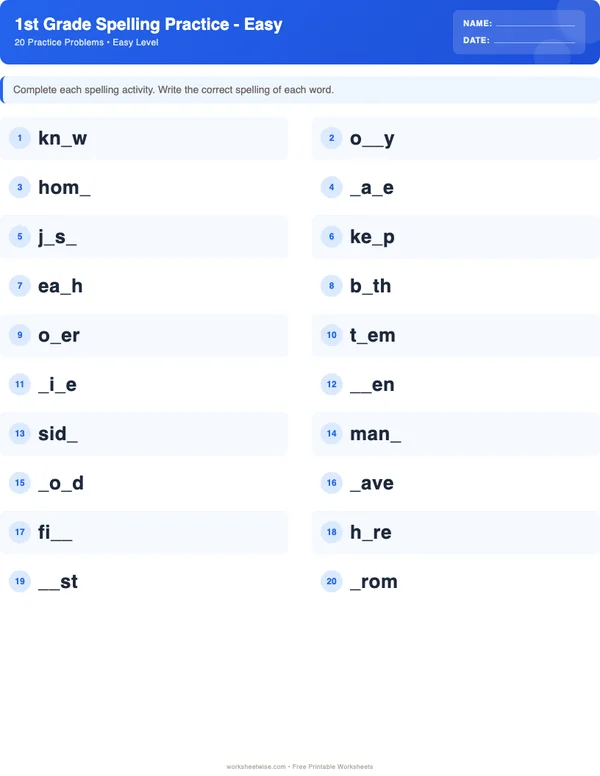
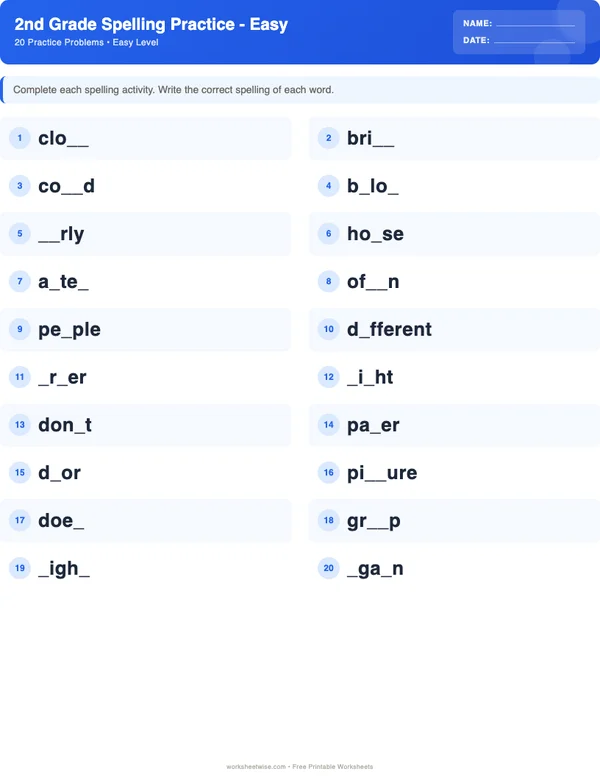
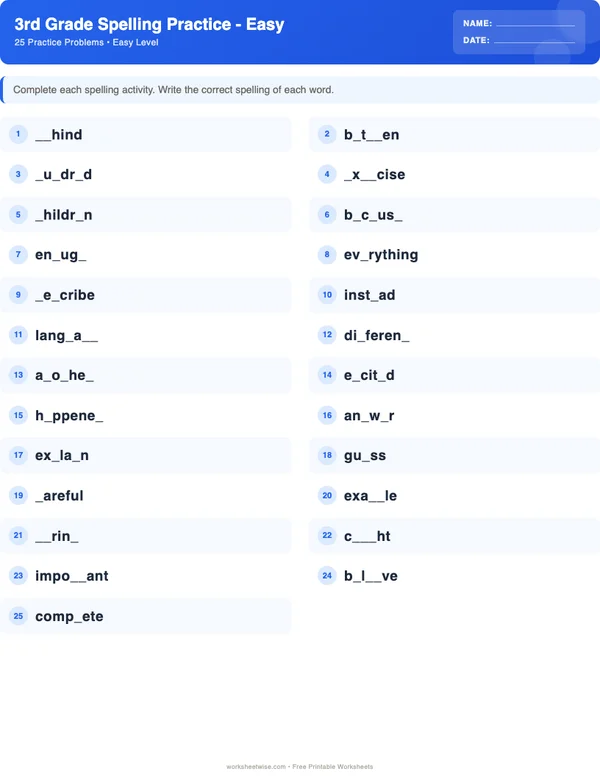
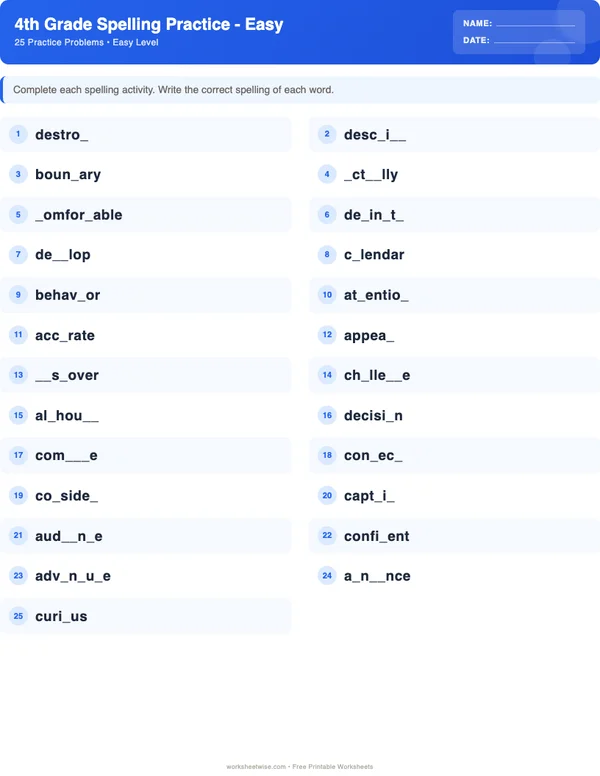
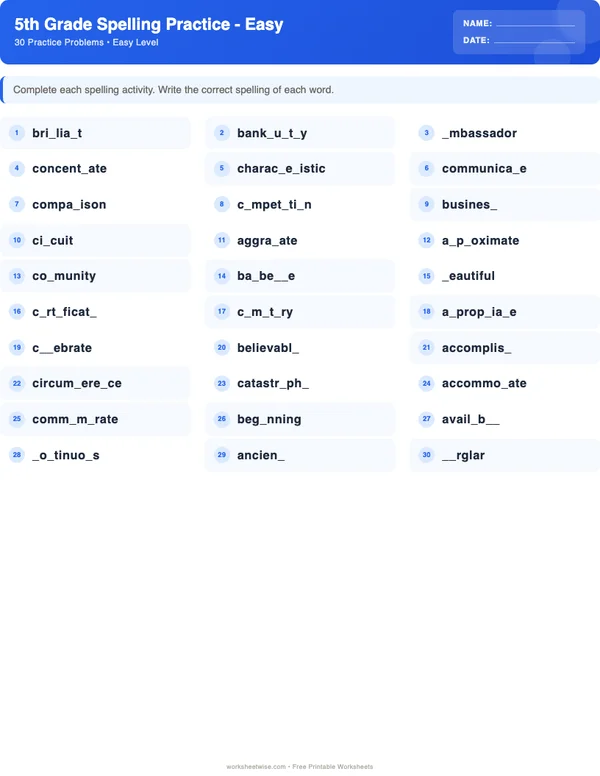
WorksheetWise’s live spelling catalogue contains 90 variants across five grade-labelled entry points. The free representative sheets contain 20 problems in first and second grade, 25 in third and fourth grade, and 30 in fifth grade. Those totals describe whole sheets, not required after-school doses. Fold the page, cover later items with another sheet of paper, or draw a stopping line after a manageable set.
The catalogue calls the free sheets “easy.” Treat that as a description of observable task features—not a label for a learner. An easier spelling task might provide the printed word for study, ask for recognition or sorting before recall, limit the number of competing patterns, or require one word rather than a sentence. A more demanding task might remove the model, mix previously taught patterns, include an unfamiliar transfer word, or require accurate spelling inside original writing.
Grade labels likewise describe intended practice levels. Local curriculum sequences differ, so choose from what the learner can presently explain and attempt rather than from the label alone.
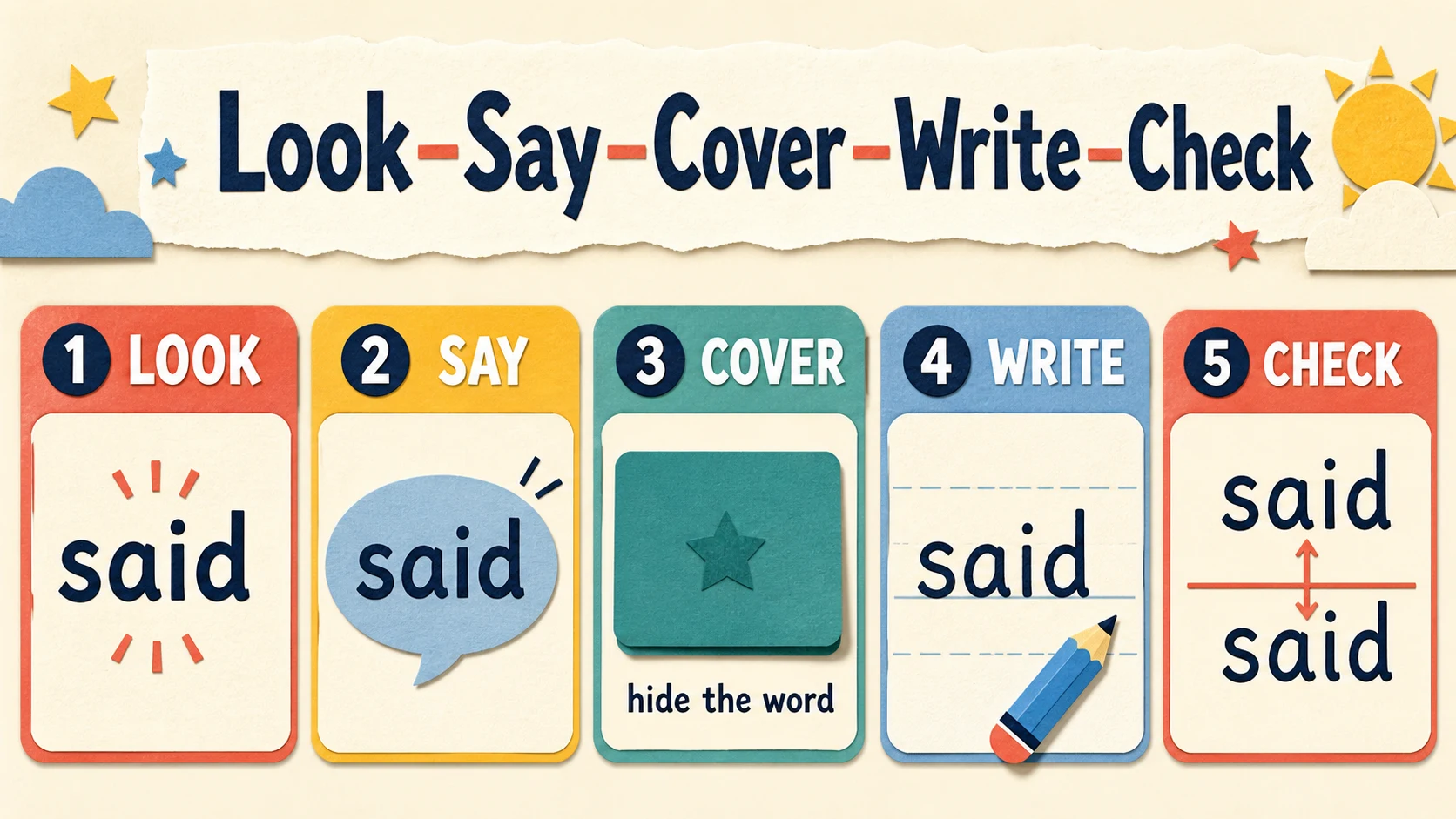
Use the routine as a stopping structure: settle, hear the pattern, complete a small set, check one decision, and finish.
Select the response before selecting the sheet
A tired learner may know a spelling pattern but be unable to sustain twenty written responses. Begin by deciding what evidence you need. Then choose the worksheet or subsection that can produce that evidence with the least unrelated effort.
Choose recognition when the pattern is new
Use matching, circling, or sorting when the learner is first noticing a contrast. For example, place cake, rain, play, and break under four headings: a_e, ai, ay, and ea. Each word represents the long /a/ sound with a different spelling:
cakeuses final-e spelling.rainusesai.playusesay.breakusesea.
This is a checked example because all four words contain the long /a/ sound, yet the letters representing that sound differ. It belongs on this page because the live catalogue explicitly includes long-vowel spellings and word sorting. It also shows why “words with the same sound” does not mean “words spelled by one rule.”
An adult can say, “Listen to the vowel in each word. Your job is to sort the spelling, not memorize the order.” If the learner sorts accurately but later misspells train, move to recall with another ai word. If the sorting itself is inconsistent, repeat the contrast with fewer columns.
Choose recall when recognition is secure
Look-cover-write-check separates study from memory. The learner looks at one word, names the part worth remembering, covers it, writes it, and compares letter by letter. The catalogue identifies this as one of its spelling activities.
For night, the adult might model: “I hear /nīt/. The middle spelling I need to remember is igh, and the word ends with t.” The learner then covers and writes the word. This example is checked: night is spelled n-i-g-h-t, with igh representing the long /ī/ sound and gh not pronounced separately in contemporary standard pronunciation.
Do not turn checking into “right” or “wrong” alone. Ask:
- Which letters matched?
- Where did the spelling first change?
- Was the missing information a sound-letter link, a word part, or a remembered sequence?
Choose sentence work only when word writing is manageable
Writing a sentence adds idea generation, handwriting, capitalization, spacing, and punctuation. That can be useful, but it is not a neutral change in response format. If the target is the spelling of train, dictating “The train came late” tests the word in context without requiring the learner to invent an idea. Asking for an original sentence is a later step.
The IES elementary writing practice guide recommends building fluency with spelling and sentence construction as part of writing instruction. That supports connecting word practice to sentences. It does not mean every after-school spelling session needs extended writing, and the source did not assess WorksheetWise.
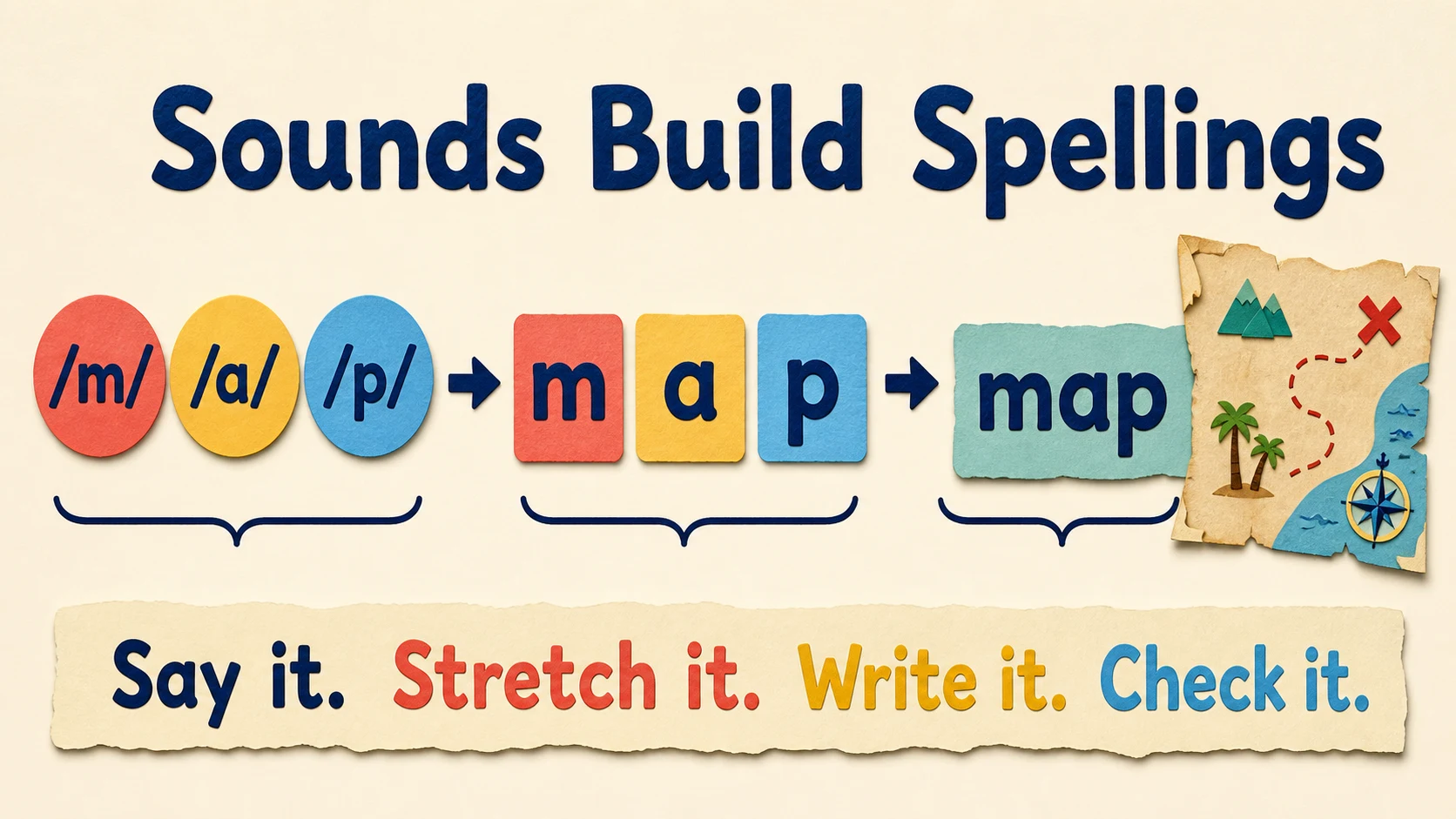
Move deliberately from hearing and noticing a spelling feature to writing the word and then using it in context.
Use the catalogue as a progression, not a five-step ladder
The five free entry points cover first through fifth grade, all under Spelling Words. First- and second-grade representative sheets have 20 problems; third- and fourth-grade sheets have 25; fifth grade has 30. Problem count alone does not establish conceptual difficulty. A 30-item recognition task can demand less spelling recall per response than a ten-word dictation.
Use these comparisons instead:
| Observable need | Suitable starting response | What would justify the next step? |
|---|---|---|
| Cannot yet hear or locate the target sound | Adult says words; learner points, moves a token, or sorts cards | Consistent oral distinction across several examples |
| Hears the sound but confuses its spellings | Visible word sort by pattern | Accurate sort plus an explanation such as “ay is at the end” |
| Recognizes the pattern but cannot recall it | Look-cover-write-check | Correct recall after the model is covered |
| Spells practiced words but not new ones | One unfamiliar transfer word | Correct application with a defensible explanation |
| Spells isolated words but loses accuracy in writing | Short dictated or original sentence | Target spelling retained while composing |
The early-grade catalogue includes short vowels, long-vowel spellings, consonant doubling, r-controlled vowels, and silent letters. Upper-grade entries also include prefixes, suffixes, and multisyllabic words. These are catalogue scope statements, not a promise that every free sheet contains every feature.
The IES foundational reading guide recommends helping kindergarten through third-grade learners connect speech sounds with letters and teaching them to decode, analyze word parts, write words, and recognize words. That sourced guidance supports an early sequence of say, segment, map, write, and reread. The specific after-school routine here is an editorial application of that guidance, not an IES-prescribed timetable.
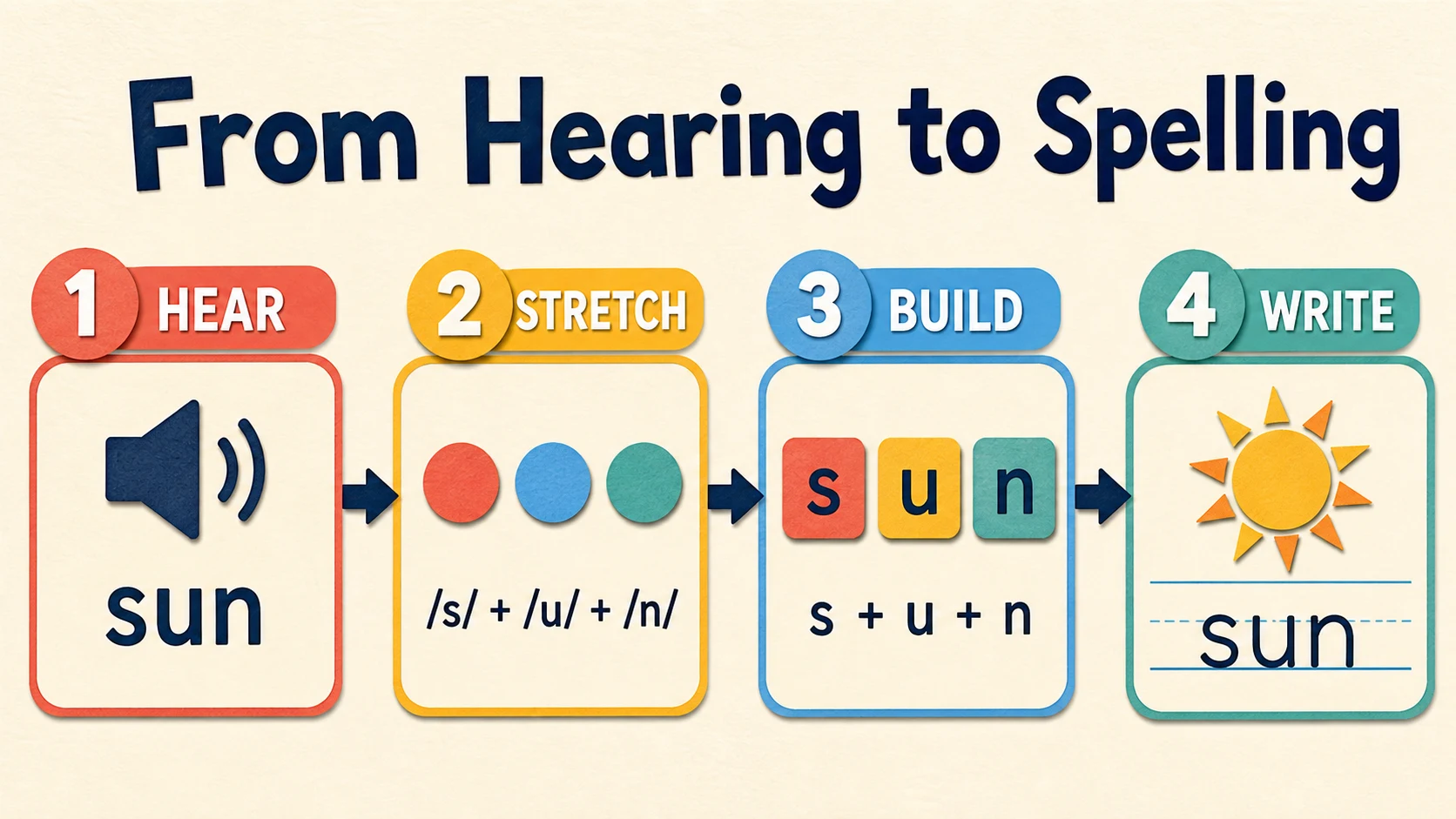
Support should fade by changing one demand at a time: visible model, covered model, unfamiliar example, and finally connected writing.
Run one print-plus-conversation cycle
A reliable routine matters most on the days when energy is low. Keep the sequence stable while changing the spelling feature.
Minute 0–2: transition without testing
Offer water or a snack if that is already part of the household routine. Let the learner stand, stretch, or walk while you introduce the task. Say what finishing means: “We will do the first six words, check two closely, and stop.”
Avoid beginning with an unannounced oral quiz. After a full school day, surprise recall can measure readiness to perform at that moment more than it clarifies the spelling misconception.
Minute 2–4: model one decision
Write or point to one example. Think aloud about the relevant feature, without narrating every letter.
For consonant doubling, compare hop + ing = hopping with hope + ing = hoping. These forms are checked:
hopbecomeshopping: the finalpdoubles before-ing.hopebecomeshoping: the finaleis removed, and thepdoes not double.- The resulting words differ in pronunciation and meaning:
hoppingmeans making hops;hopingmeans wishing or expecting.
This example belongs here because consonant doubling and suffixes are both within the verified catalogue description. Model the visible contrast: “In hopping, doubling keeps the first vowel short. In hoping, the base word is hope; we drop the final e before adding -ing.”
Then ask the learner to explain which base word produced each result. That conversation reveals more than copying both words three times.
Minute 4–9: collect a small amount of evidence
Choose four to eight responses, depending on the effort each requires. Keep the target stable. If the task is consonant doubling, do not also introduce silent initial letters and three new suffixes in the same set.
Mark a visible stopping point before work begins. If six responses are accurate and well explained, stopping is not “letting the learner off.” It preserves a usable record. If fatigue produces rushed letter formation and skipped lines, another fourteen items are unlikely to clarify the spelling decision.
Minute 9–12: compare, correct, and choose tomorrow
Check with the learner, not after the learner leaves. Select one accurate response and one informative error. Ask the learner to point to the exact letter sequence that carries the target pattern.
End by recording a next action in plain language:
- “Repeat
aiversusaywith sorting.” - “Move from visible models to covered recall.”
- “Keep suffixes; reduce sentence writing.”
- “Use one dictated sentence to check transfer.”
- “Ask the teacher which word list is current.”
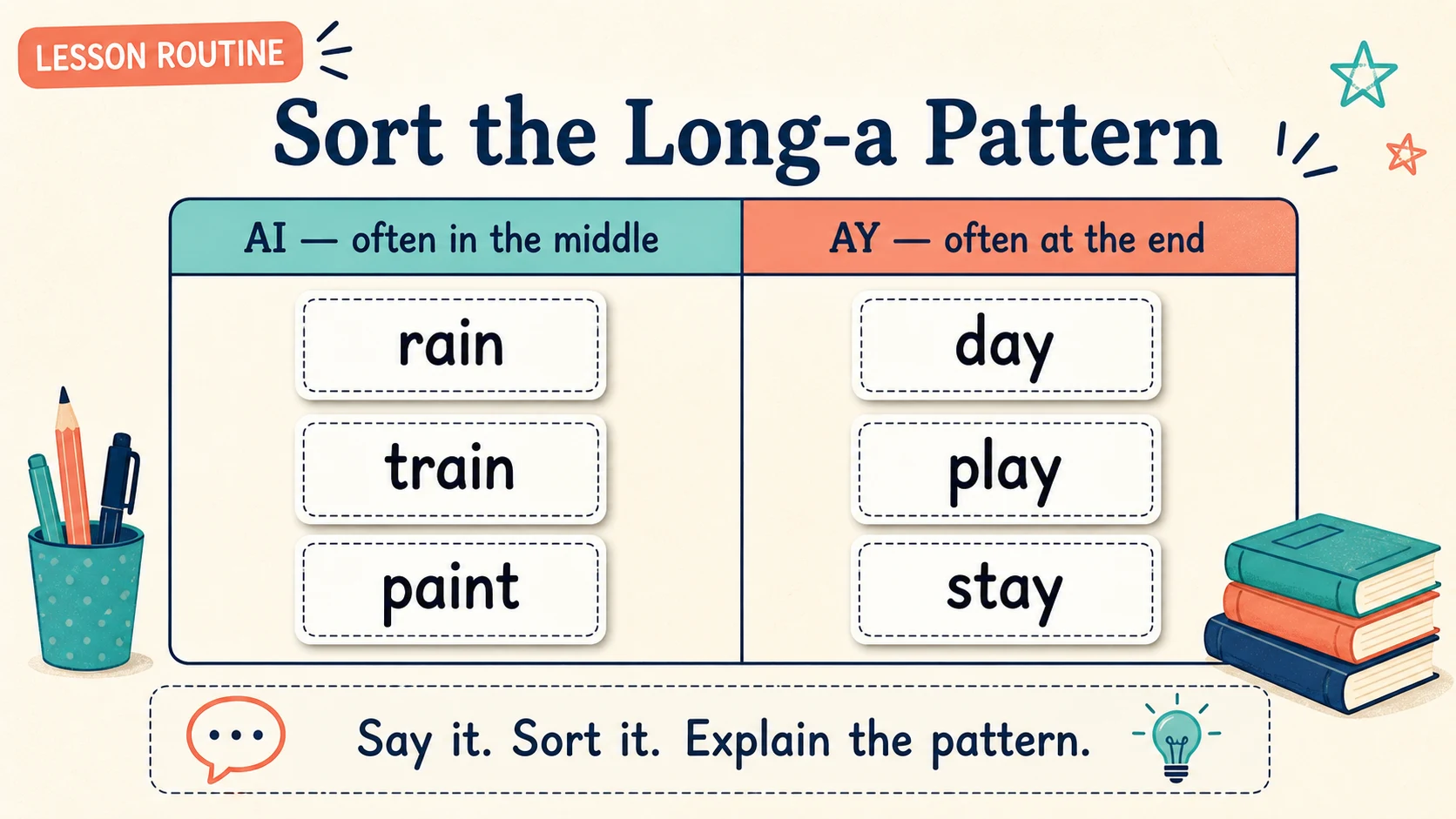
For a third-grade entry point, keep the same brief cycle but ask for a clearer explanation of the pattern or word part.
Read errors as clues, not scores
A total such as 17 out of 20 can hide the decision you need to make. Group errors by what changed.
A plausible sound spelling signals incomplete pattern knowledge
Suppose the target is long /a/, and the learner writes trane for train. The attempt preserves the pronunciation, so the learner has represented the sounds plausibly but selected a_e instead of ai. Do not respond with a general “study harder.” Use a contrastive sort involving train, rain, cake, and game, then test one new word from each group.
This example is checked: train and rain use ai; cake and game use a_e. It belongs here because the catalogue specifically names long-vowel spellings and sorting by pattern. The next sheet should keep the long-/a/ target while presenting the competing spellings visibly.
An omitted syllable calls for oral segmentation first
If remember becomes rember, ask the learner to say the word slowly and tap its three spoken syllables: re-mem-ber. Then reveal the printed word and mark the repeated mem portion. This is a checked comparison: standard pronunciation has three syllables, and the conventional spelling is r-e-m-e-m-b-e-r.
The learner may have compressed an unstressed portion during writing. That observation is not a diagnosis. For the next session, choose a small multisyllabic set and let the learner mark syllable boundaries before writing. Do not respond by assigning a longer list of unrelated words.
A correct worksheet followed by a misspelled sentence signals a transfer gap
If the learner writes careful correctly in isolation but writes carefull in a sentence, return to word structure: care + ful = careful. The suffix is -ful, with one final l in careful. Contrast it with the independent word full, which has two.
This example is checked and belongs here because suffixes and sentence use are included in the catalogue description. The next sheet should not necessarily be harder. It should retain -ful words and include one short sentence so the learner must preserve the spelling while attending to meaning.
Random-looking changes may indicate that the session has expired
If early responses show a consistent pattern but later responses contain omissions, reversals, skipped items, and incomplete words across unrelated features, pause before interpreting each mark as a separate spelling misconception. Ask the learner to read one late item and explain the intended word. Resume another day with a shorter set.
This is a practical selection rule, not a clinical inference. Persistent concerns across settings should be discussed with the learner’s teacher or an appropriately qualified professional.
Give feedback that identifies the spelling decision
“Wrong” reports a result. Useful feedback identifies the place to inspect and leaves the learner responsible for the correction.
Use this sequence:
- Confirm the intended word.
- Ask the learner to read what was written.
- Locate the first mismatch.
- Name or compare the relevant pattern.
- Have the learner correct the word once from understanding.
- Recheck the same feature later in a different word.
For carefull, say, “You spelled the base care correctly. Compare the ending with the suffix card -ful. What needs to change?” For trane, say, “Your spelling makes sense for the sound. This word belongs with rain, not cake. Which vowel spelling should replace a_e?”
Repeated copying can provide handwriting rehearsal, but three immediate copies do not by themselves show that the learner can retrieve the spelling later. If you use repetition, follow it with a covered attempt after another item or in the next session.
Feedback also needs a stopping boundary. Correct one target pattern, not every feature on the page. If the assigned word is accurate inside a sentence but the sentence lacks a period, decide whether punctuation is part of today’s purpose. Preserve the spelling focus unless another correction is necessary for understanding.
The Common Core ELA framework organizes literacy across reading, writing, speaking, listening, and language, with grade-specific details built from broader anchor standards. That makes conversation and sentence use relevant companions to spelling. It does not establish alignment for these particular worksheets, and local standards or teaching sequences may organize spelling differently.
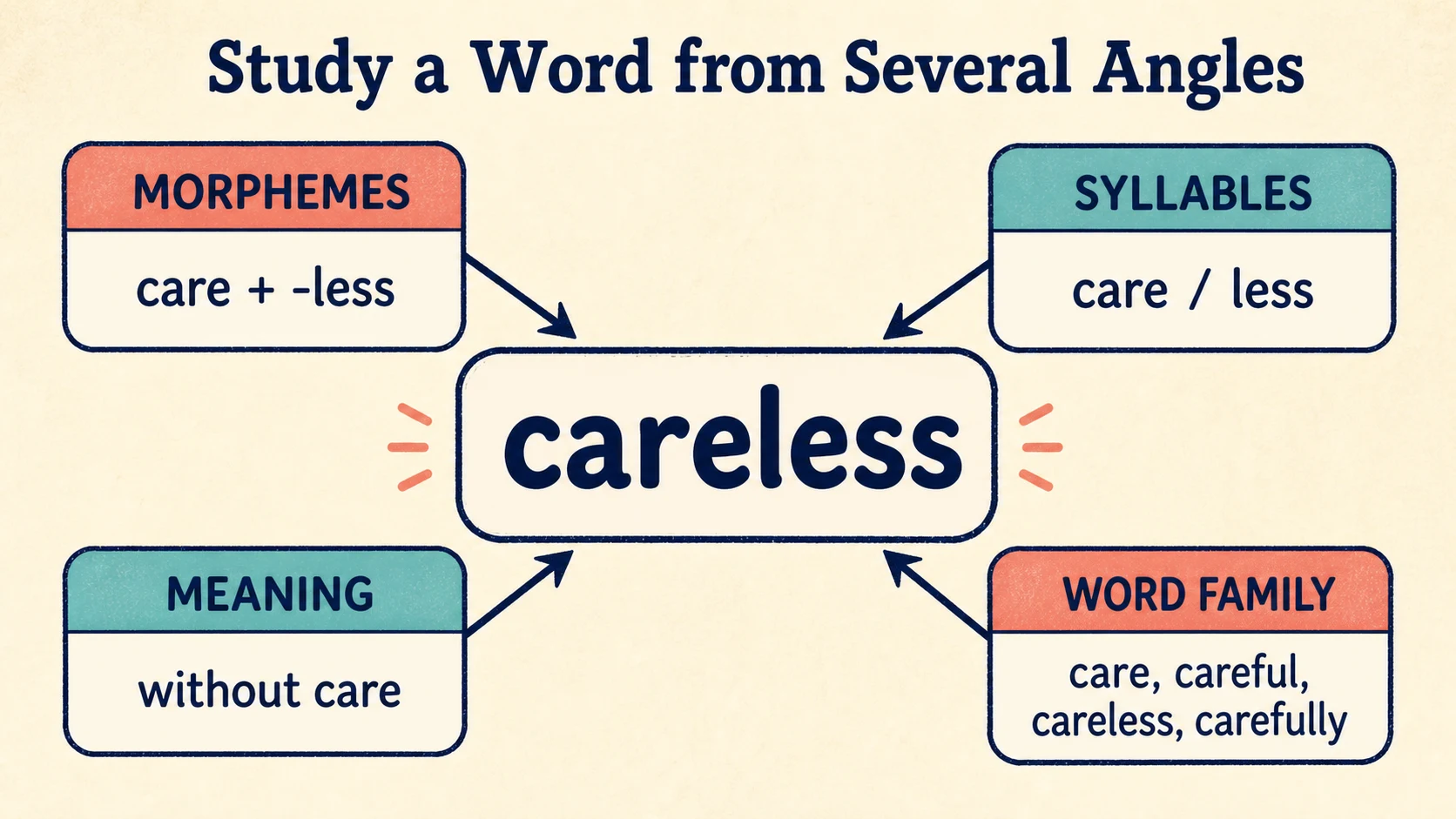
The useful connection is cyclical: notice a pattern, explain it, retrieve it, use it, and inspect what changed.
Preserve the spelling target when adapting the work
An adaptation is sound when it reduces an unrelated barrier but keeps the intended spelling decision intact.
When writing stamina is the barrier
Reduce the number of items, enlarge the writing space, or let the learner answer orally before writing one representative word. If the target is choosing ai or ay, the learner can first place printed word cards under headings and then write two words from memory. The pattern decision remains.
Do not replace every spelling response with copying from an uncovered model. That removes recall if recall is the target.
When language comprehension is the barrier
Explain the meaning, use the word orally, or supply a simple sentence before asking for spelling. A learner cannot reasonably spell the intended word if the spoken word is unfamiliar or confused with another word.
For a homophone, state the meaning explicitly: “Write right, meaning correct,” or “Write write, meaning put words on paper.” The spelling evidence is otherwise ambiguous.
When fine-motor effort obscures the evidence
Use movable letters, letter cards, a whiteboard, or adult scribing for the surrounding sentence while the learner supplies the target word. Ask the learner to arrange and then read the letters in order. The adaptation preserves sequence and pattern knowledge while reducing the amount of handwriting.
When the selected sheet is too dense
Cover unused rows and reveal one section at a time. A 25- or 30-problem sheet can become several sessions. Do not imply that finishing the printed page is the instructional objective. The objective is obtaining interpretable evidence about a defined spelling feature.
For learners needing more direct sound work, the After-school Phonics Worksheets page may provide a more suitable neighboring entry point. Phonics and spelling are connected, but they are not interchangeable: phonics often begins with reading sound-letter relationships, while spelling requires producing letter sequences.
Let today’s evidence choose tomorrow’s sheet
Use a simple decision rule rather than moving automatically to the next grade or next page.
| What happened today? | What to select next |
|---|---|
| Most errors share one spelling contrast | Another short set on that contrast, with visible categories |
| Sorting is accurate but covered writing is not | Same pattern in look-cover-write-check format |
| Practiced words are accurate but a new example is not | Same pattern with one or two transfer words |
| Isolated words are accurate but sentence use is not | Brief dictation using the same words |
| Accuracy collapses only late in the page | Same level of thinking with fewer responses |
| Errors span several unrelated patterns from the first item | Step back to a smaller diagnostic sort and coordinate with the teacher |
For example, suppose a learner sorts cake, rain, play, and break correctly, writes all four after covering them, but writes tray as trai. The next task should compare where ai and ay usually appear in this small set: rain has ai within the word, while play and tray use ay at the end. One example does not prove mastery or establish a universal rule, but it gives you a focused hypothesis to test with additional words.
If a third-grade-labelled 25-problem sheet reveals stable accuracy in the first eight responses, do not move to fourth grade solely because of the score. Add one observable demand: cover the model, mix in a prior pattern, or use a dictated sentence. Conversely, choosing the 2nd Grade Spelling Words guide and free sheet for a learner enrolled in a later grade can be appropriate when its response format exposes the needed contrast. The label is a discovery aid, not a placement decision.
For upper-elementary practice, use cumulative review without turning one evening into a test marathon. A fifth-grade-labelled sheet contains 30 problems, so divide it across sessions and revisit missed patterns after a delay. The 5th Grade Spelling Words guide and free sheet is an entry point when its intended practice level and word structures match the evidence you collected.
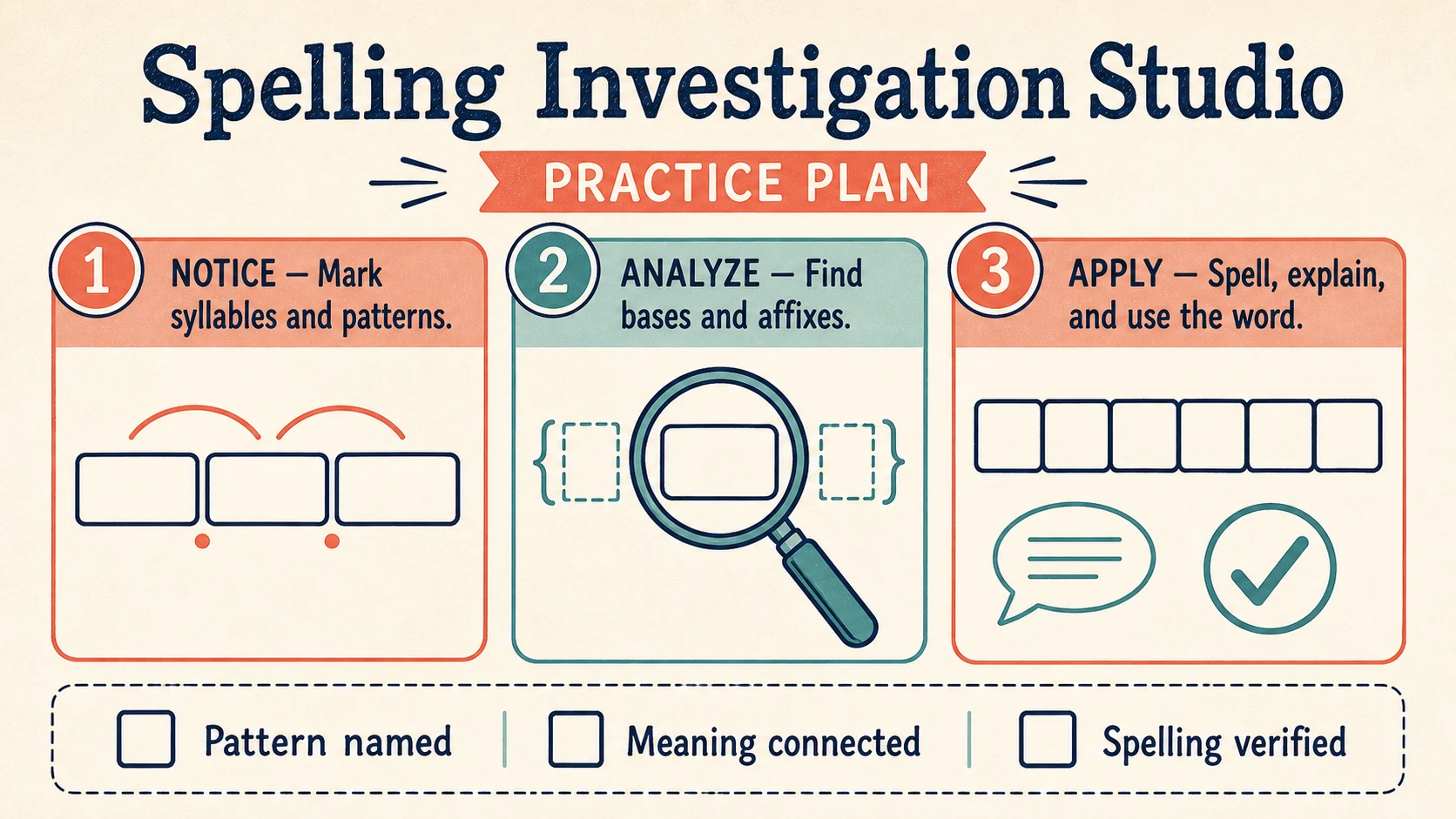
Spread a longer upper-elementary set across short encounters so recall, correction, sentence use, and cumulative review remain distinguishable.
Keep the routine within honest boundaries
A worksheet can supply practice and reveal patterns in responses. It cannot determine why a learner is struggling, establish a diagnosis, replace instruction, or guarantee transfer to independent writing. A correct page may reflect recognition of a familiar layout; an incorrect page may reflect fatigue, misunderstood directions, unfamiliar vocabulary, handwriting demands, or incomplete spelling knowledge.
Coordinate with school instruction when possible. Ask which pattern, word list, or correction method is currently being used. Avoid teaching a competing explanation merely because another sequence appears in a different grade-labelled resource.
The catalogue’s teaching suggestions include pattern-based lists, word sorts, look-cover-write-check, sentence use, review, and noticing patterns in books. Those are WorksheetWise catalogue suggestions. The IES recommendations cited above are external guidance about foundational reading and elementary writing; neither IES guide evaluated WorksheetWise materials.
Use scores cautiously. Record the exact evidence instead:
- “Chose
aicorrectly in three visible sorts.” - “Recalled two of four words after covering.”
- “Added
-fulcorrectly in isolated words but doubled thelin a sentence.” - “Completed six responses carefully; omissions began after item seven.”
That record makes the next choice defensible without attaching a fixed label to the learner.
Prepare the next eight-minute session now
Open the 1st Grade Spelling Words guide and free sheet if the learner needs supported pattern recognition, or the 3rd Grade Spelling Words guide and free sheet if the current evidence supports more word-part and sentence work. Preview the sheet before printing, circle one target pattern, and draw a stopping line after six items.
Beside the line, write one question: “What part helped you spell this word?” After the session, record one observed error and choose only one next move—repeat the contrast, remove the model, introduce a transfer word, or use the word in a dictated sentence. That small decision turns a printable sheet into an after-school spelling routine rather than another stack of work.
Put it into practice
Use the guide with a real printable
Move from explanation to a short, observable practice task. Check the first item together, then adjust the next session from the learner's actual work.
Open the first free worksheetExplore a neighboring collection