Curated collectionAnswer keys includedPrint-ready PDFs
No-Prep Worksheets: Print-Ready Practice With Answer Keys
Define no-prep as production-ready rather than judgment-free: preview the learning target, choose the level, print the key and decide how completed work will change the next lesson.
Start with a real resource
Browse this worksheet collection
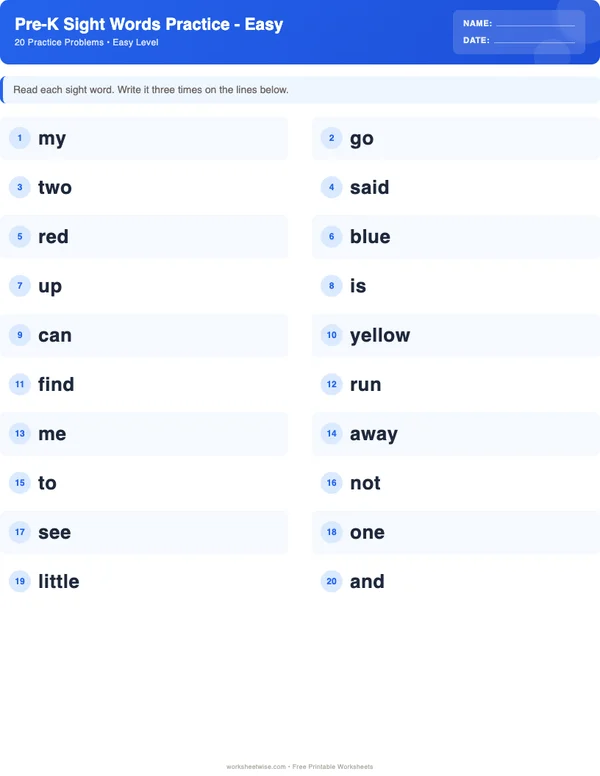
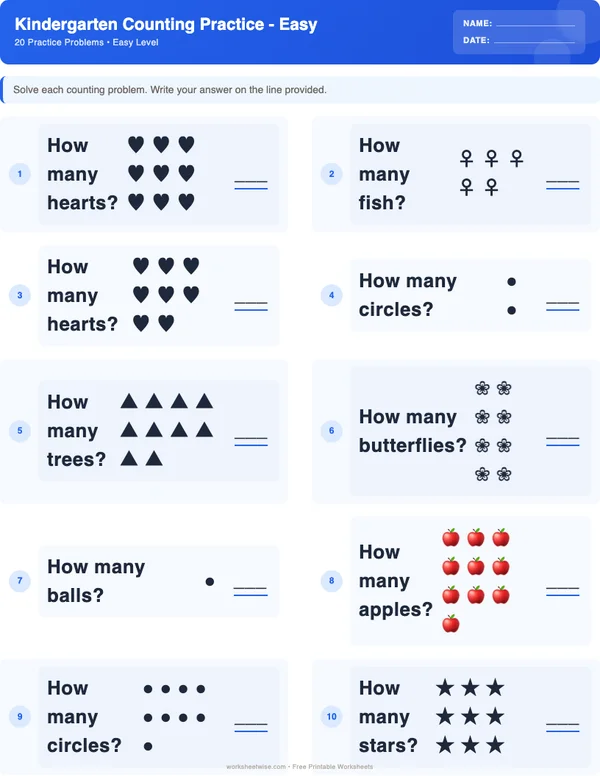
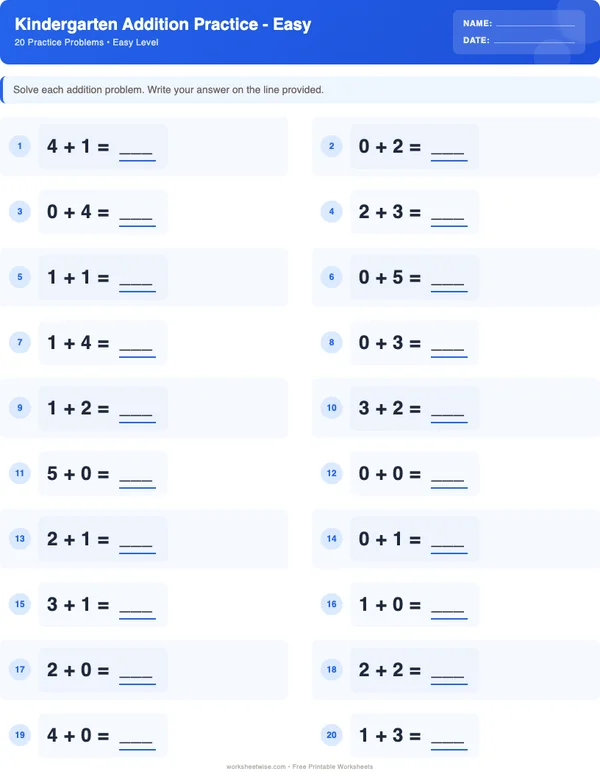
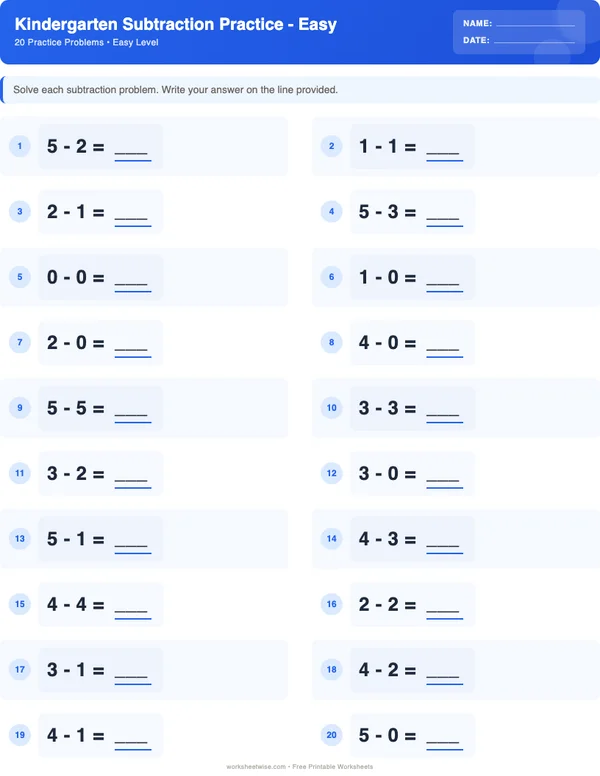
107 relevant free entry points are available. Each one includes a printable learner PDF and separate answer key.
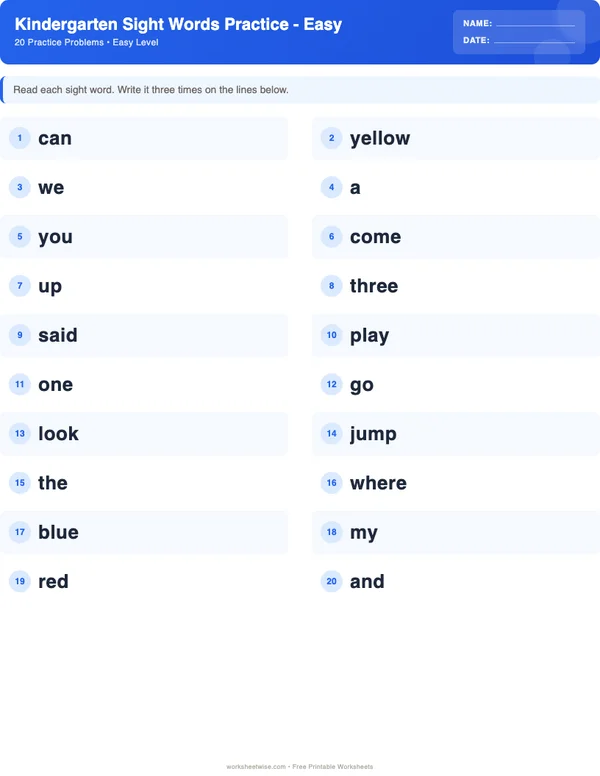
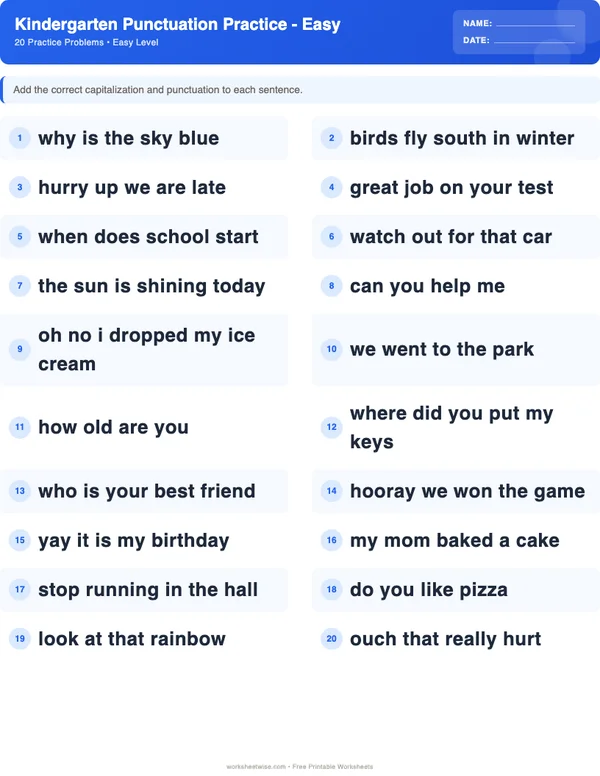
A useful practice loop
Print less. Observe more.
- Choose one skill and model the first item aloud.
- Use a short set and notice the learner’s strategy.
- Change the next task from the work you can see.
Need more than the free sheet?
Plus includes all 1926 matching catalogue variations where available, plus saved deterministic generators and the worksheet designer.
See Plus membershipComplete guide
How to teach and practise no prep worksheets
3,608 words Updated 6 instructional visuals
What “no-prep” should mean before you press Print
A no-prep worksheet should be ready to produce and use: the directions are complete, the page has a defined learning target, and an answer key is available. It should not mean that an adult can distribute the page without making an instructional decision.
A responsible no-prep decision takes about two minutes:
- Identify what the page actually asks the learner to do.
- Check that the learner has already encountered the underlying idea.
- Choose a level by examining the task, not by attaching a label to the child.
- Print or open the answer key before the lesson.
- Decide what different response patterns will prompt you to do next.
That distinction matters. A polished printable can save production time, but it cannot determine whether a learner needs counters, oral rehearsal, a worked example, independent practice, or a different lesson altogether. The adult remains responsible for matching the page to the purpose and interpreting the completed work.
WorksheetWise’s live no-prep collection currently contains 1,926 variants across eight grade labels, four subjects, and 23 topics, including 107 free resources. Those counts describe the available catalogue, not evidence that every page suits every learner or teaching situation. Grade labels describe the intended practice level, and local curriculum sequences differ.
Start with the learning target, not the grade label
Before selecting a page, finish this sentence: “After this practice, I need to know whether the learner can ___.” Use a visible action such as count, blend, compare, represent, calculate, classify, or explain.
“Practice first-grade math” is too broad. “Determine whether the learner can represent and solve joining situations within 10” is usable. It tells you what examples belong, what tools may be offered, and what errors would be informative.
Age can help you discover potentially relevant material, but age is not a placement decision. Two children of the same age may have had different instruction, language exposure, opportunities to practice, or familiarity with the page format. Preview the actual items and begin from demonstrated knowledge.
For ages three and four, prioritize brief adult-led oral, matching, manipulative, and movement work over desk work. A Pre-K label does not make a 20-item sheet an appropriate independent assignment. You might use five items as prompts, cut apart pictures for matching, count physical objects, or stop after three successful turns.
Define difficulty through visible task demands
The catalogue identifies some free sheets as “easy.” Treat that as a description requiring inspection, not as a learner category. Never call a child easy, developing, or advanced.
Observable task features include:
- the number range;
- whether pictures or manipulatives represent quantities;
- the number of sounds held in sequence;
- whether an operation is named or must be inferred;
- the number of steps;
- the position of an unknown;
- the amount of reading;
- the similarity of answer choices;
- whether a model is supplied;
- whether the learner must explain, draw, or only select an answer.
A counting page with pictured sets and numbers to 10 presents different demands from a missing-number sequence to 100. A CVC picture match presents different demands from spelling an unheard word. A word problem that names a simple joining action is different from one whose starting quantity is unknown. Choose by these features.
Separate instruction, practice, and checking
Ask what job the worksheet will perform:
- Instruction: usually requires adult modeling, examples, talk, and concrete materials. The worksheet is supporting material, not the lesson.
- Guided practice: the learner attempts items while the adult watches strategy use and prompts selectively.
- Independent practice: the learner has already learned the target and can navigate the directions.
- Checking: a short sample reveals what is stable, confused, or not yet taught.
A worksheet designed for practice should not silently become a first explanation or a high-stakes test.
Use a before, during, and after workflow
A useful routine preserves the convenience of no-prep materials while restoring the decisions that printing cannot make.
Before: preview the target, level, key, and stopping point
Read every direction and sample item. Solve several items yourself, including the final and most complex ones. Confirm that the answer key corresponds to the exact version you will use. Then identify:
- the target skill;
- the knowledge the page assumes;
- the tools the learner may use;
- the number of items needed for useful evidence;
- likely errors and your response to each;
- the point at which you will pause or stop.
Print the key with the student page. This is not merely for faster marking. The key lets you check whether an apparently unusual answer is actually acceptable and helps you plan a brief review while the work is still fresh. The companion guide to worksheets with answer keys develops that feedback role further.
Do not assume every item must be completed. Twenty available problems can provide choice, spaced review, or multiple short sessions. They do not automatically constitute one assignment.
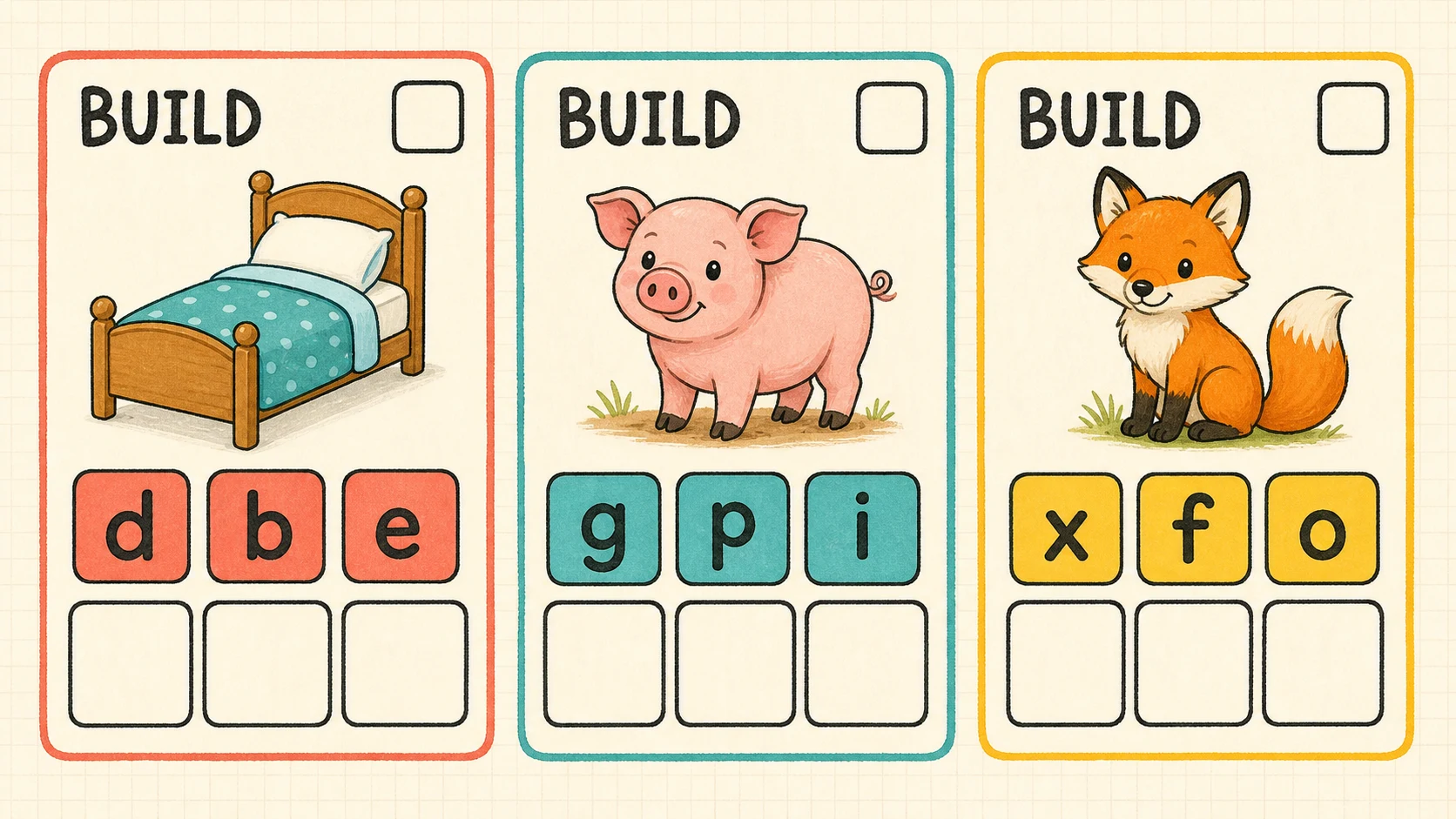
Use the CVC plan to decide when a printable will provide first-grade practice, review, or a later check—not to replace explicit blending instruction.
During: watch the method, not only the marks
Give the learner a short orientation: “This page practices counting objects accurately. You may touch or move each object once as you count.” That sentence makes the target and permitted strategy visible.
Watch the first two or three responses. Ask neutral questions such as:
- “Show me how you started.”
- “What does this number represent?”
- “Can you read the word without using the picture?”
- “What is happening in this story?”
- “How could you check that?”
Avoid turning every hesitation into a correction. A short wait may reveal the learner’s actual strategy. Conversely, do not let ten repetitions of the same misconception accumulate just because the sheet is already printed. Pause, model or represent the idea, and decide whether to resume.
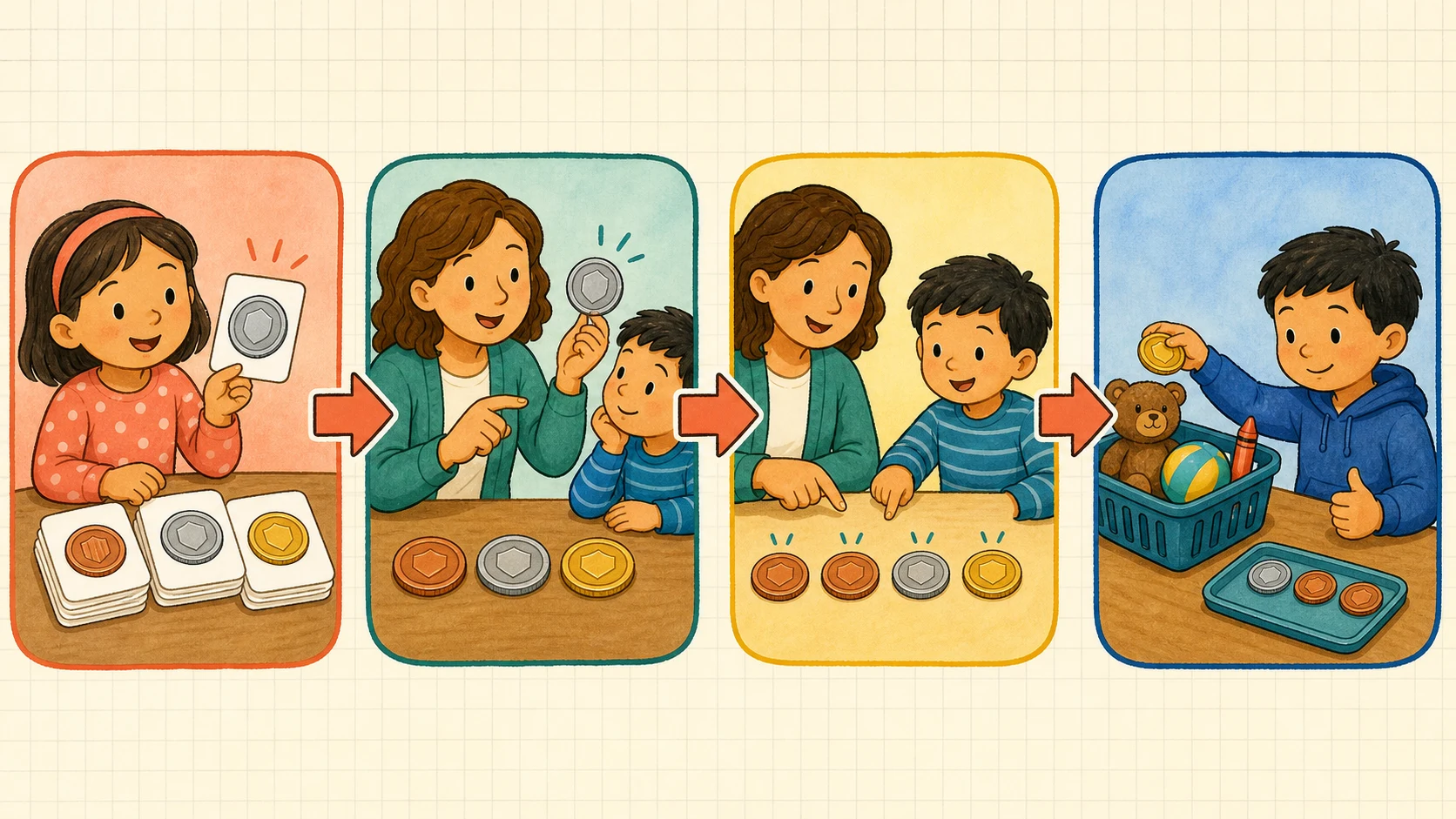
The money routine illustrates where print practice belongs: after a brief launch and within a repeatable cycle that includes discussion and checking.
After: sort errors and choose one response
Check the work with the learner when practical. Do not reduce the page immediately to a percentage. First group responses:
- correct and explained;
- correct but produced through an unreliable method;
- incorrect because the target concept is confused;
- incorrect because of reading, notation, or direction demands;
- blank or unfinished;
- ambiguous and worth discussing.
Then choose one observable next action. Examples include counting a scattered set of eight counters, blending five unseen CVC words aloud, representing two word problems with objects, or explaining why two shapes have the same area but different perimeters. “Practice more” is not observable enough.
Four checked examples of responsible no-prep use
The following examples use only ages, levels, skills, and contexts represented in the supplied catalogue. Each shows why the resource belongs in this collection and what adult judgment must accompany it.
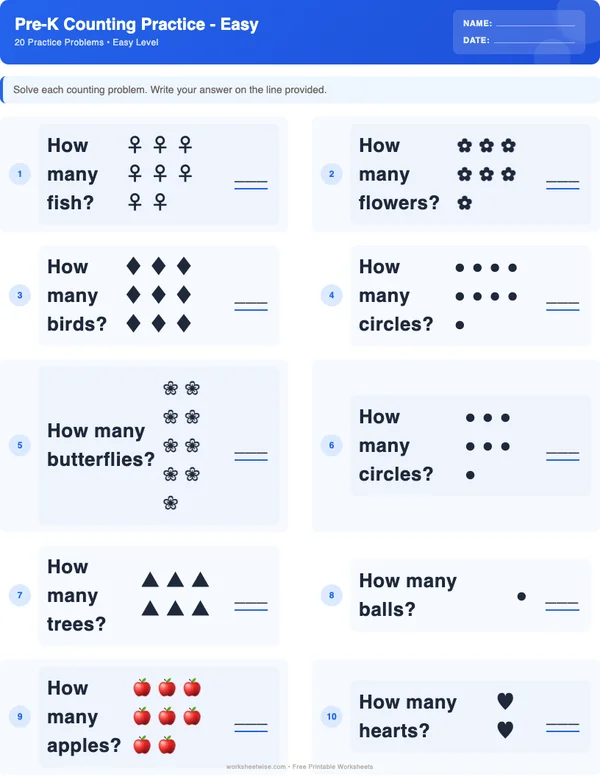
Example 1: Pre-K counting becomes a five-minute object routine
The representative Pre-K counting resource contains 20 problems and is listed at the catalogue’s easy level. Its topic includes number sequences, missing numbers, and counting pictured sets, while the supplied teaching guidance places concrete objects before pictures and abstract numerals.
For a three- or four-year-old, do not begin by assigning all 20 items at a desk. Place six buttons in a scattered arrangement. Ask the child to touch or move each button while counting aloud, then match the total to a numeral on the page. Repeat with one or two different sets and finish with movement: take seven steps while counting.
This example belongs because it uses the page’s documented Pre-K counting context while respecting the need for brief adult-led oral, manipulative, matching, and movement work. The worksheet supplies prompts and a record; the objects make one-to-one correspondence visible.
If the child recites “one, two, three, four, five, six” but touches one button twice, the issue shown in that moment is coordination between one count word and one object—not a reason to assign more written numerals. The next action is to count a smaller scattered set while moving every counted object into a cup.
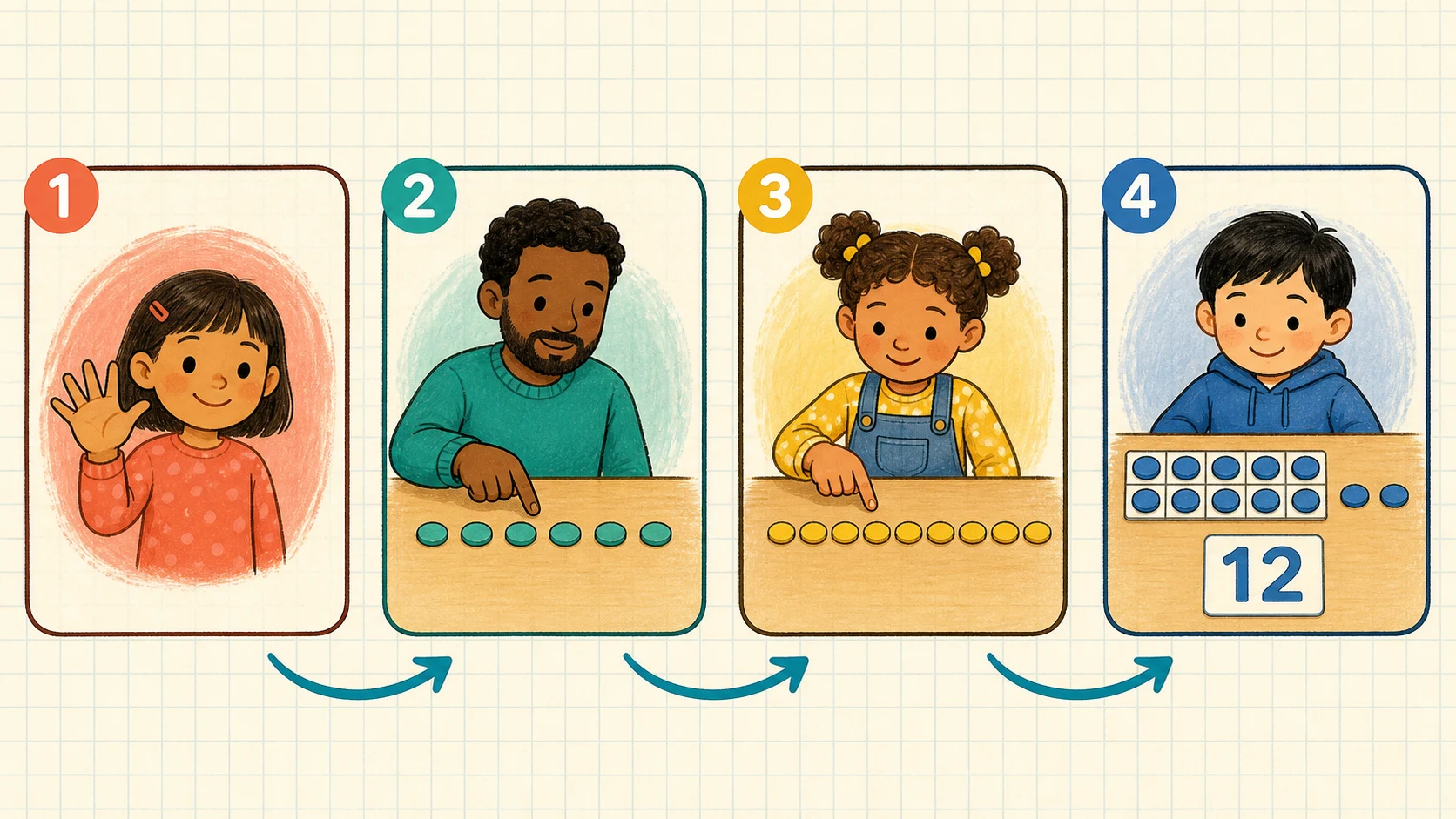
This first-grade routine shows the same production-ready principle at a later level: launch the idea, observe counting behavior, use selected items, and respond.
The Pre-K counting guide and free sheet provides a real starting resource for this routine.
Example 2: CVC work checks blending rather than picture guessing
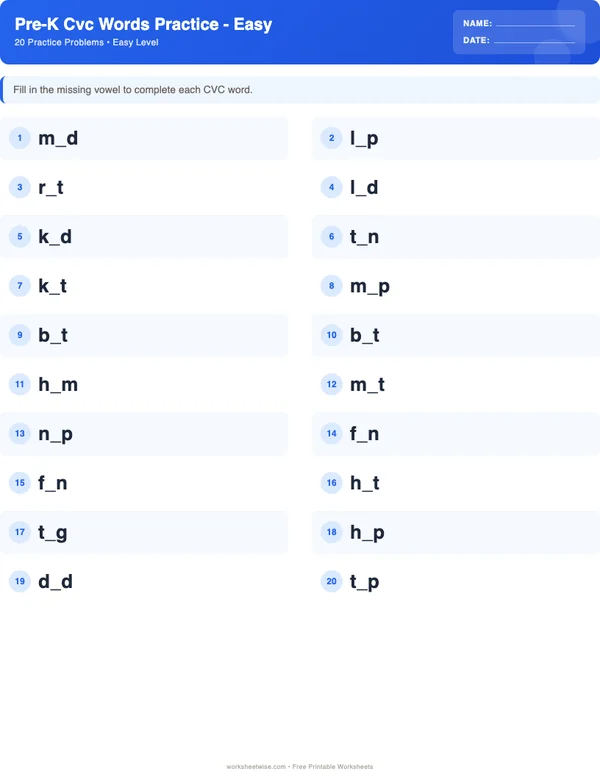
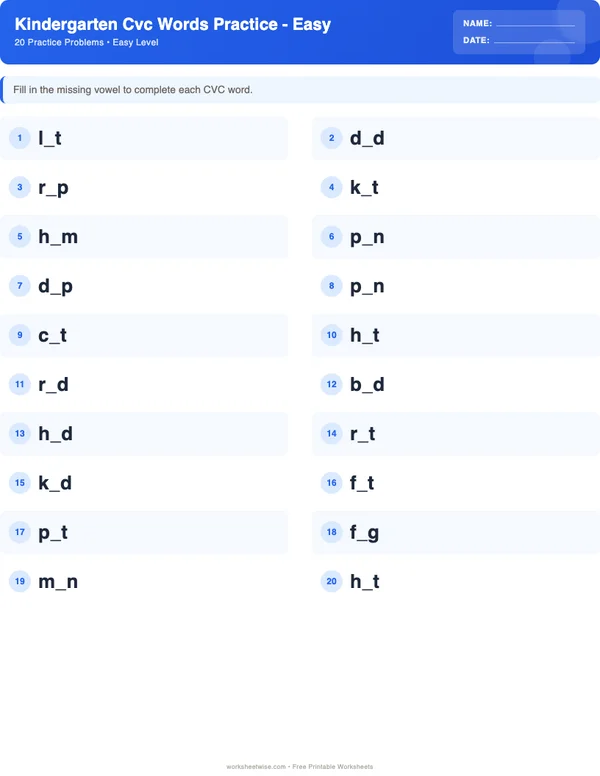
The catalogue’s Pre-K CVC resource has 20 problems and includes word building, picture matching, fill-in-the-blank work, and reading activities across short-vowel families. CVC words such as cat, pin, and hug contain three phonemes in a simple consonant-vowel-consonant structure.
Suppose a learner matches cat to a cat picture. That answer alone does not establish decoding; the picture may have supplied the word. Cover the picture and ask the learner to blend /c/ /a/ /t/, with the sounds connected rather than separated by long pauses. Then ask the learner to build or write cat. Repeat with map, changing the initial and final consonants while retaining short a.
This belongs on a no-prep page because the printable is ready for immediate word-level practice and has an answer key, yet valid interpretation depends on how the response was produced. The IES foundational reading guide recommends explicit work connecting sounds with letters and teaching learners to blend and segment words; it did not assess WorksheetWise.
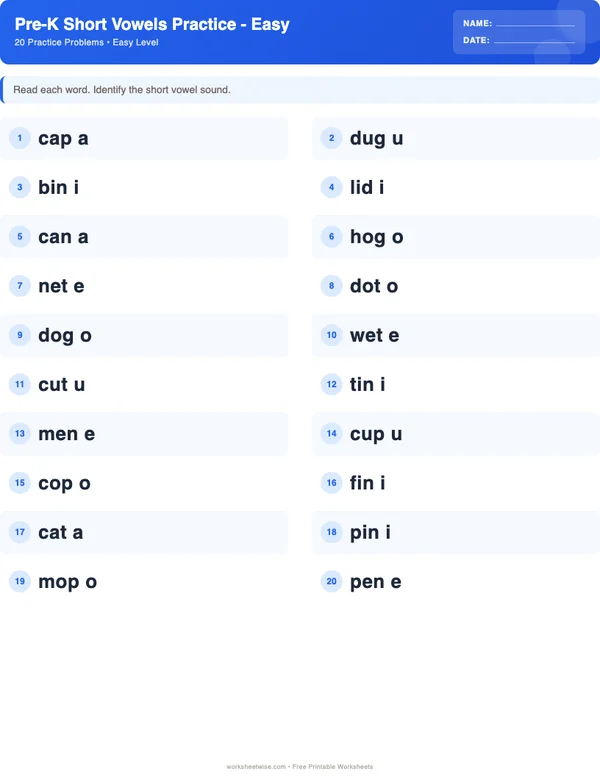
If the learner reads words correctly only when pictures are visible, use a short set without picture cues next. If the learner says each sound accurately but cannot combine them, model continuous blending and reduce the set. If the vowel changes—pin read as pen—contrast just those sounds orally before returning to print.
For an adult-led entry point, use selected items from the Pre-K CVC Words guide and free sheet, not the whole page by default.
Example 3: Kindergarten addition reveals the representation used
The representative kindergarten addition resource has 20 problems and is categorized as easy. The catalogue describes a progression from adding within 5 with objects and pictures to work within 10 and 20, followed later by larger-number addition.
Choose items whose addends match what the learner has been taught. For 4 + 3, place four counters in one group and three in another. Ask the learner to combine and count them, draw the groups, and finally connect the representation to 4 + 3 = 7. If the learner already understands the quantities, ask whether counting on from four is more efficient than recounting both groups.
This example belongs because addition is represented in the live collection and a printable can provide ready-made practice across that documented progression. The responsible choice is the particular task demand: concrete joining within 5 is not interchangeable with abstract facts within 20.
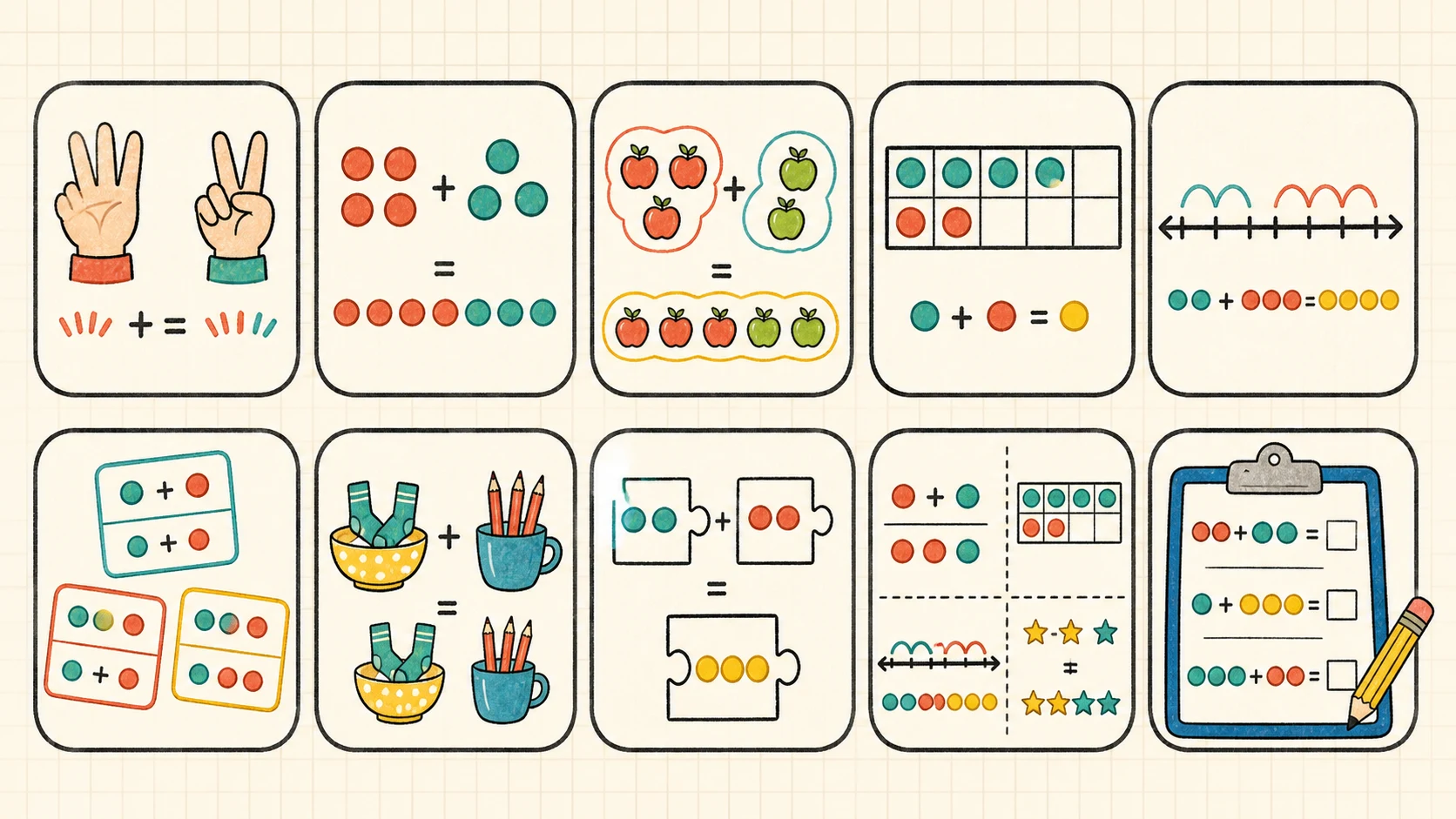
The addition plan clarifies that one print session is a data point within instruction, practice, and later review—not a race through every available item.
A reversed numeral with a correctly represented quantity calls for a different response from an incorrect total. If the child writes 6 but has seven counters, ask the child to recount and match the written numeral. If there are six counters because one group was miscounted, return to one-to-one counting. If the counters show seven and the equation is correct, do not reteach addition because handwriting needs attention.
Example 4: Kindergarten word problems require situation sense
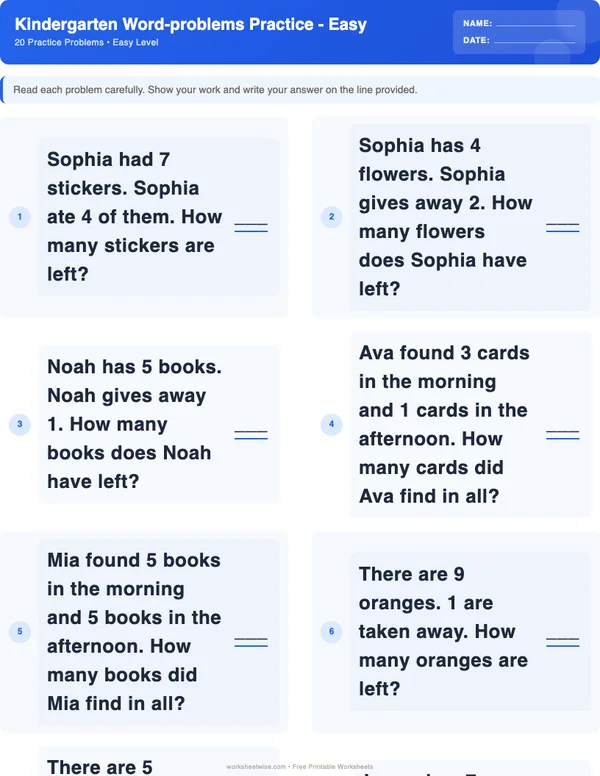
The representative kindergarten word-problems sheet has 12 problems rather than 20. The catalogue describes word-problem work as reading a situation, identifying relevant information, choosing an operation, solving, and checking. It also notes different structures, including joining, comparison, and missing-part situations.
Consider: “Mia has 3 shells. She finds 2 more. How many shells does she have now?” The checked result is 5 because the situation joins two quantities: 3 + 2 = 5. Ask the learner to retell the event and use counters or a drawing before writing the equation.
Now compare: “Mia needs 5 shells. She has 3. How many more does she need?” The checked result is 2, represented by 3 + 2 = 5 or 5 − 3 = 2. The numbers are similar, but the unknown has moved. A keyword hunt is inadequate: understanding the relationship determines the operation.
This belongs because the catalogue explicitly includes age-appropriate word-problem scenarios and a 12-problem free resource. It also demonstrates why no-prep cannot mean no observation.
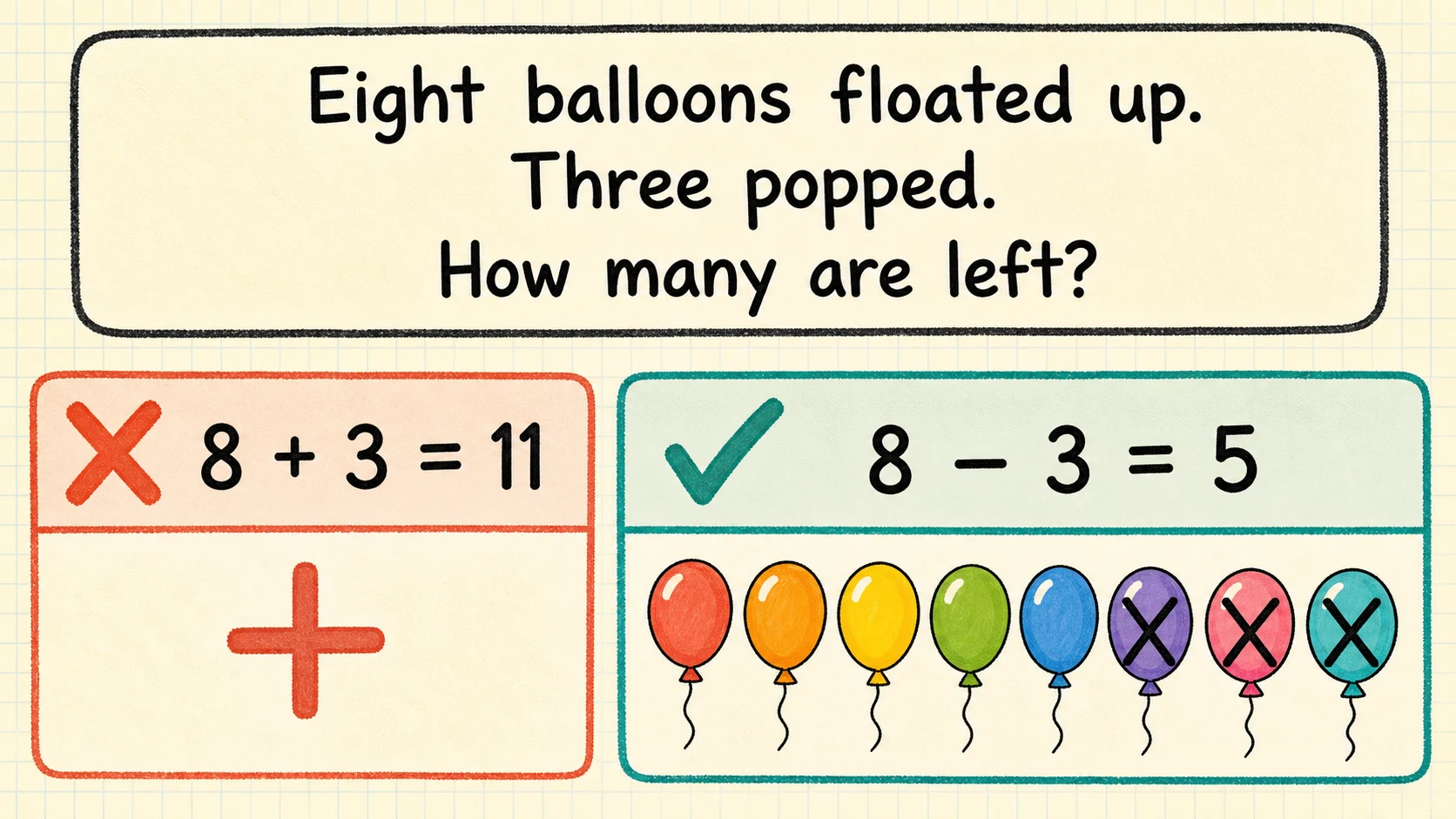
Use these response pairings to form a teaching hypothesis from a first-grade error, then verify it through retelling, representing, and a fresh problem.
If the learner computes accurately after you read the problem aloud, the obstacle may be the independent reading demand rather than the mathematics. That is not a diagnosis. Record what changed under read-aloud support, then check the same mathematical structure with simpler language.
Example 5: Upper-grade geometry needs more than answer matching
The collection spans eight grade labels, and its visual guidance includes a two-week sixth-grade geometry plan. A geometry worksheet might ask learners to classify shapes, calculate area or perimeter, work with angles, or use coordinates. Those are distinct targets.
For a checked area-and-perimeter example, take a rectangle measuring 3 units by 4 units. Its area is 3 × 4 = 12 square units. Its perimeter is 3 + 4 + 3 + 4 = 14 units. A learner who writes 12 for both has not made a random arithmetic slip if the multiplication is accurate; the response suggests that the two measures need to be contrasted with tiles for the covered surface and unit lengths around the boundary.
This example belongs because area and perimeter appear in the catalogue’s geometry description and the sixth-grade visual situates worksheet practice within planned review. It does not establish a specific local sixth-grade sequence. Grade labels indicate intended practice level, while schools and curricula may introduce or revisit content at different times.
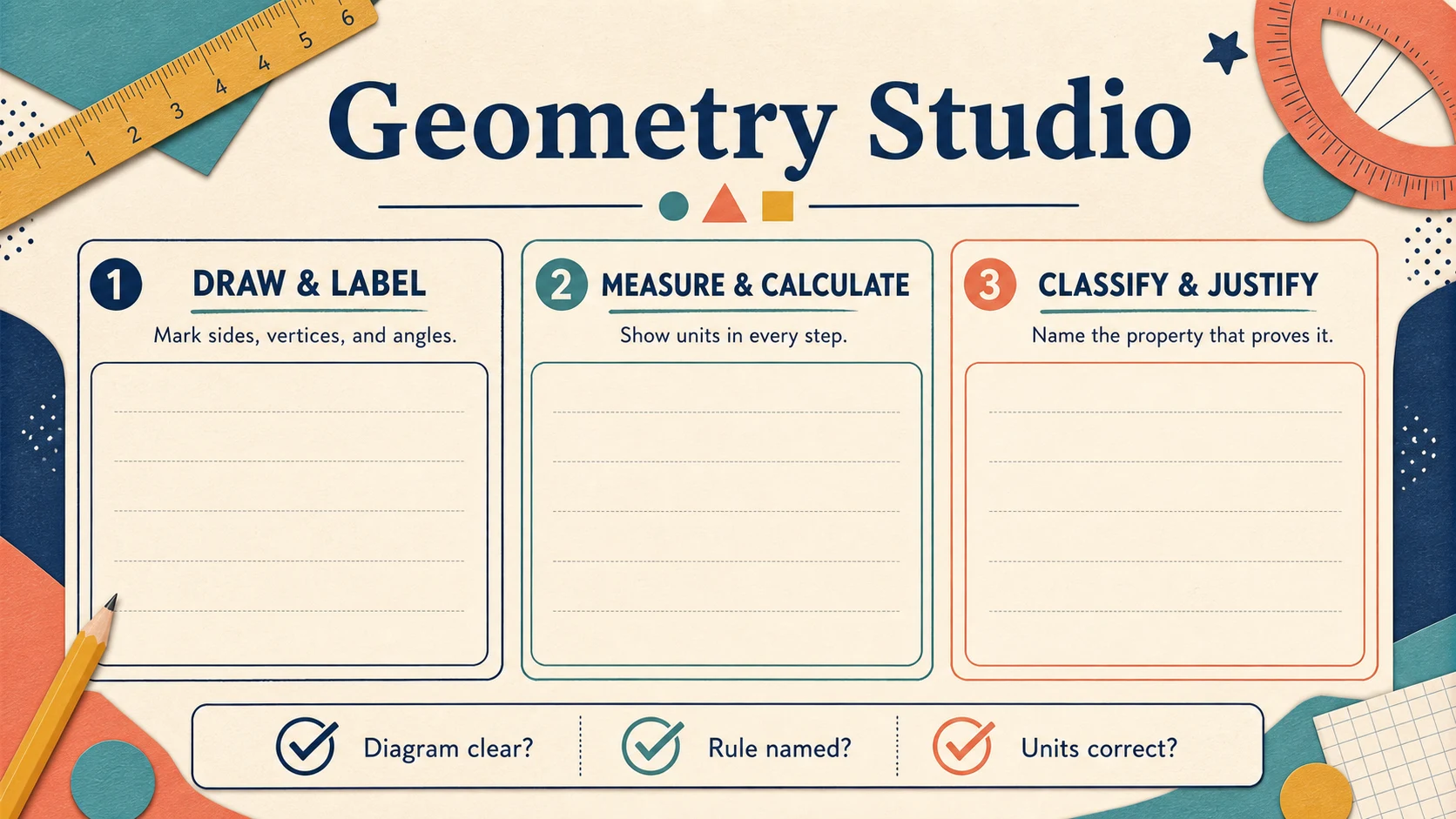
The sixth-grade plan makes spacing visible: select geometry practice by concept, examine errors, and revisit the idea instead of treating a packet as one sitting.
Adapt the access point without changing the target
An adaptation preserves the skill being observed while changing a barrier that is not central to it. First decide what must remain constant.
If the target is counting objects accurately, preserve one-to-one correspondence. You may enlarge images, replace pictures with counters, reduce visual clutter, or let the learner point instead of write. Do not provide the total.
If the target is decoding CVC words, preserve the printed word and the need to connect letters with sounds. You may increase spacing, cover unrelated items, or let the learner respond orally. A picture that reveals the word changes the evidence.
If the target is understanding a math story, reading the text aloud can be appropriate when independent reading is not being assessed. Keep the quantities and relationships unchanged. Ask the learner to choose and explain the mathematical representation.
If the target is written explanation, oral discussion can prepare the response but should not quietly replace the writing sample. The IES elementary writing guide discusses explicit strategy instruction, modeling, and supported practice; it does not certify any WorksheetWise page.
Useful adaptations include fewer items, larger print, extra workspace, manipulatives, oral directions, a line guide, movement breaks, and alternating adult and learner turns. Document the support because “correct independently” and “correct after a model” answer different instructional questions.
For substantially different task versions rather than access supports, explore differentiated worksheets with answer keys. Compare actual item features before selecting.
Read mistakes as evidence, not verdicts
A wrong mark has several possible causes. Treat your first interpretation as a hypothesis to test with one follow-up item.
Concept, procedure, language, or recording?
Use this sequence:
- Ask the learner to explain or demonstrate the response.
- Present one similar item with simpler visual or language demands.
- Change only one feature.
- Record what the learner can do and under what support.
- Choose a brief instructional response.
For 8 + 5, a learner might count all objects accurately but write 12; that could be a final counting or recording error. Another might produce 13 with counters but not from numerals; that suggests the abstract notation is less secure than the concrete representation. A third might immediately explain 8 + 2 + 3 = 13; that strategy is sound even if the handwriting is difficult to read.
The IES guide for assisting students who struggle with mathematics supports systematic instruction, clear mathematical language, representations, and deliberate practice. Apply those principles as sourced guidance, not as a claim that IES reviewed this collection.
Patterns matter more than isolated misses. Three short-i/short-e confusions justify an oral contrast and fresh decoding sample. One stray mark does not. Consistently solving joining stories but subtracting in comparison stories justifies explicit comparison modeling. It does not justify a diagnosis.
Quality-check the printable before assigning it
A production-ready page still deserves a content and usability check. Use these selection criteria:
- Target clarity: Can you name the exact skill without relying on the topic title?
- Prerequisite fit: Has the learner received instruction in the idea and notation?
- Task consistency: Do most items practice the stated target?
- Demand visibility: Are number range, steps, vocabulary, representations, and response type apparent?
- Example accuracy: Does the worked example model the required action correctly?
- Answer-key match: Does the key correspond to the same version and preserve legitimate alternatives?
- Readable layout: Can the learner tell where to begin, where to respond, and how to proceed?
- Useful quantity: Can you select enough items for evidence without requiring unnecessary repetition?
- Adaptability: Can irrelevant barriers be reduced without giving away the target?
- Instructional consequence: Do you know what you will do with correct, partly correct, and incorrect patterns?
For mathematics, calculate sampled answers independently rather than trusting visual familiarity. For phonics, say every example aloud and check that the intended letter-sound relationship is actually present. For writing, confirm that the prompt elicits the stated form and that any checklist matches it.
The Common Core mathematics standards can help adults inspect the distinctions among mathematical content and practices, but standards alignment must be established item by item and within the relevant local sequence. The live catalogue facts supplied here do not establish standards alignment.
Misuses that remove the judgment from no-prep
The most common failure is treating available quantity as assigned quantity. A 20-problem sheet may be useful across several sessions; completing all 20 is not inherently more rigorous than completing six carefully selected items and discussing the strategy.
Other misuses include:
- selecting solely by age or grade;
- using an “easy” label as a description of a child;
- introducing unfamiliar content through independent seatwork;
- withholding manipulatives when the target is conceptual rather than tool-free performance;
- marking only totals without examining methods;
- teaching word-problem keywords instead of relationships;
- counting picture-supported word recognition as independent decoding;
- correcting every error before the learner can explain it;
- repeating the same format after the error shows that a different representation is needed;
- using the answer key only to produce a score;
- treating unfinished work as proof that the learner lacks the target skill.
No single worksheet establishes mastery, grade placement, a learning condition, or a diagnosis. Performance can change with wording, fatigue, familiarity, reading load, tools, and adult support. Keep claims narrow: “Jordan counted a scattered set of eight accurately while moving each object” is more useful than “Jordan understands counting.”
How the live collection implements no-prep practice
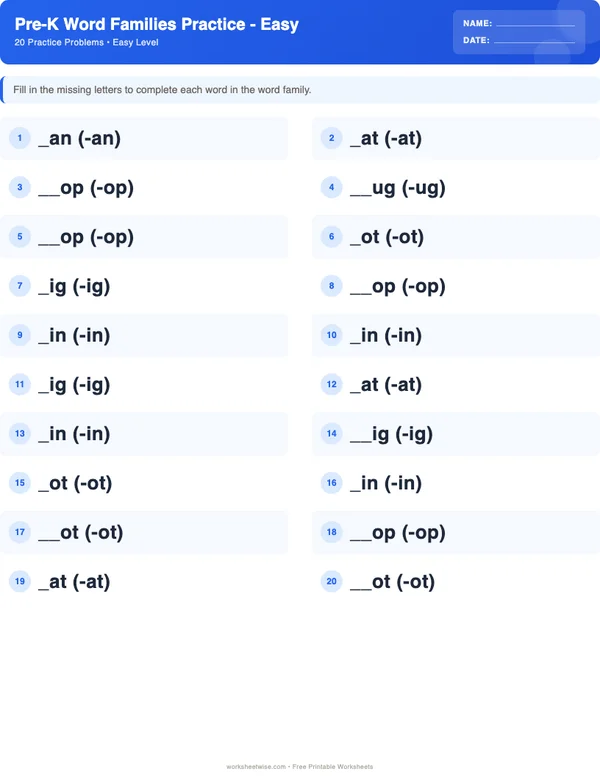
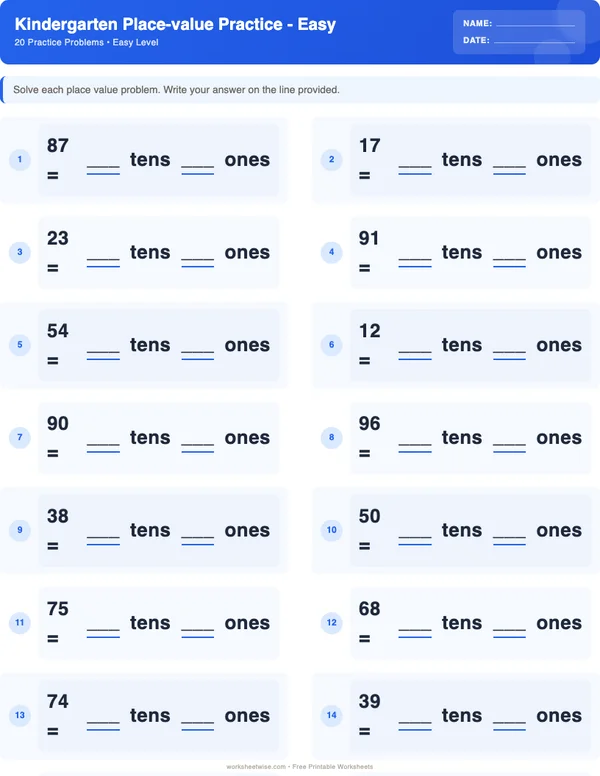
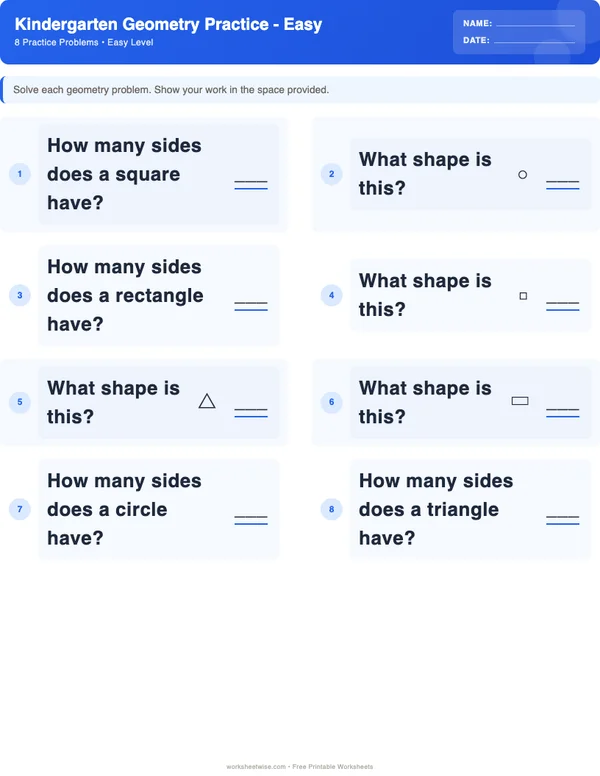
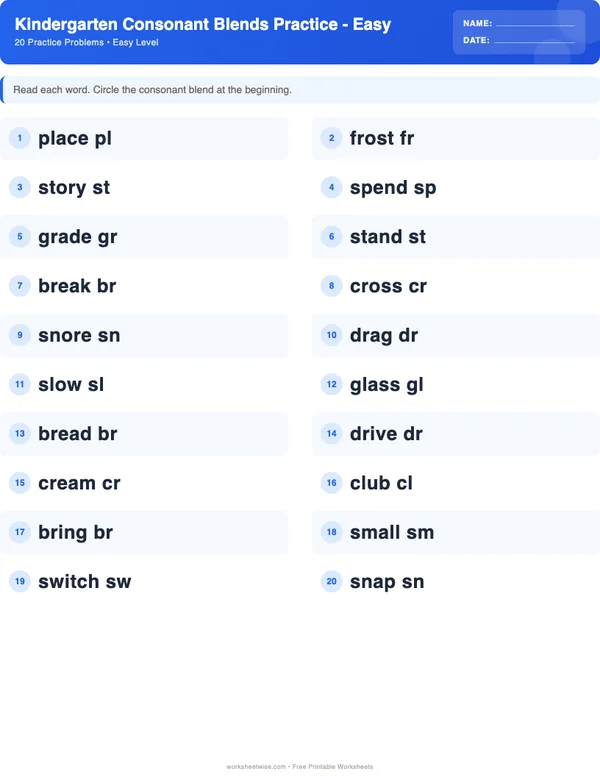
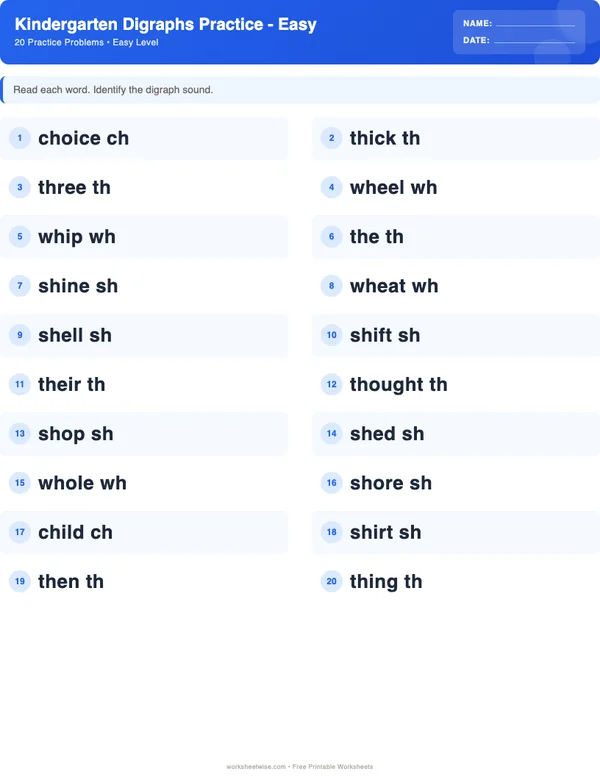
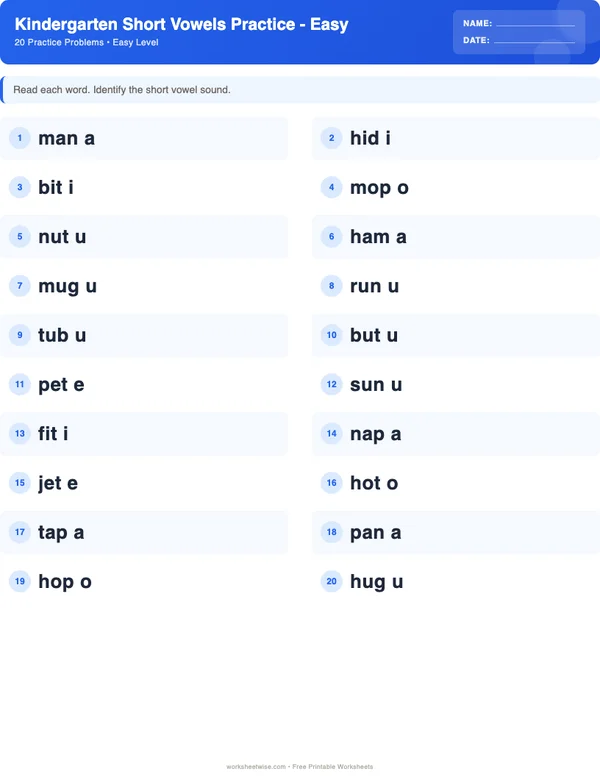
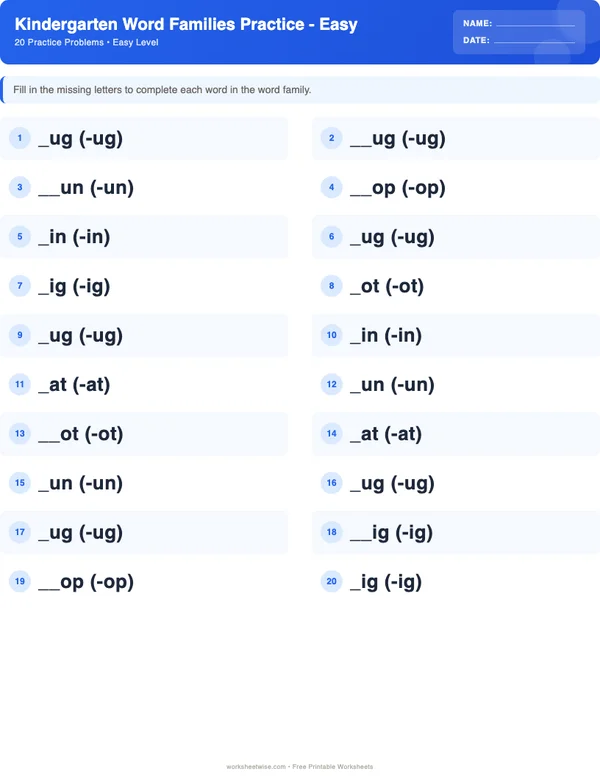
The current collection offers 1,926 worksheet variants across eight grade labels, four subjects, and 23 topics. There are 107 free entry points. Representative resources include Pre-K counting, CVC words, short vowels, word families, and sight words, as well as kindergarten counting, addition, subtraction, place value, geometry, word problems, CVC words, consonant blends, and digraphs.
The representative free sheets are identified as easy and generally contain 20 problems; the kindergarten word-problems example contains 12. Those are catalogue facts, not recommended session lengths. Adults should still inspect the number range, response mode, representation, reading demand, and complexity of each item.
The collection implements the feature through print-ready resources and answer keys. It also offers multiple variants, allowing an adult to look for a closer task match. It does not remove the need to teach, observe, adapt, or decide what happens after checking.
When you need broader browsing, use the full worksheet library. When you need a newly generated practice set with controlled inputs, compare the free deterministic worksheet generators. “Deterministic” is useful when you want specified inputs to produce a reproducible sheet, but you must still review the result and answer key.
Make the completed page change the next lesson
A no-prep worksheet has done useful work only when the response affects a decision. At the bottom of the answer key, record three short notes:
- Secure: the task the learner completed accurately and how independently;
- Unclear: the pattern that needs one controlled follow-up;
- Next: the representation, example, or review you will use.
For example: “Secure—counts arranged sets to 8 while pointing once to each object. Unclear—double-counts scattered objects. Next—move six scattered counters into a cup while counting, then retry one new scattered set.” That note is specific enough for another adult to use.
Begin now with the Pre-K counting guide and free sheet: preview its 20 items, select no more than five that match the learner’s demonstrated number range, gather movable objects, print the key, and write the one follow-up action you will take if one-to-one counting breaks down.
Put it into practice
Use the guide with a real printable
Move from explanation to a short, observable practice task. Check the first item together, then adjust the next session from the learner's actual work.
Open the first free worksheetExplore a neighboring collection
Choose by a different teaching need
Worksheets With Answer Keys: Printable Practice and Feedback Differentiated Worksheets With Answer Keys After-School Worksheets With Answer Keys After-School Grammar Worksheets After-School Math Worksheets After-School Phonics Worksheets After-School Spelling Worksheets Formative Assessment Worksheets With Answer Keys