Curated collectionAnswer keys includedPrint-ready PDFs
Homeschool Spelling Worksheets
Turn a printable library into a flexible weekly rhythm with explicit teaching, short independent practice, answer-key feedback and mixed-age planning.
Start with a real resource
Browse this worksheet collection
5 relevant free entry points are available. Each one includes a printable learner PDF and separate answer key.
A useful practice loop
Print less. Observe more.
- Choose one skill and model the first item aloud.
- Use a short set and notice the learner’s strategy.
- Change the next task from the work you can see.
Need more than the free sheet?
Plus includes all 90 matching catalogue variations where available, plus saved deterministic generators and the worksheet designer.
See Plus membershipComplete guide
How to teach and practise homeschool spelling worksheets
3,477 words Updated 6 instructional visuals
Build a spelling week around one pattern, not one packet
Homeschool spelling worksheets work best when each sheet has a defined job: reveal what the learner notices, support a short lesson, provide independent practice, or check whether the spelling pattern transfers to new writing. Choose one target pattern, model it explicitly, assign only the useful portion of a printable, review errors with the answer key, and let those errors determine the next sheet.
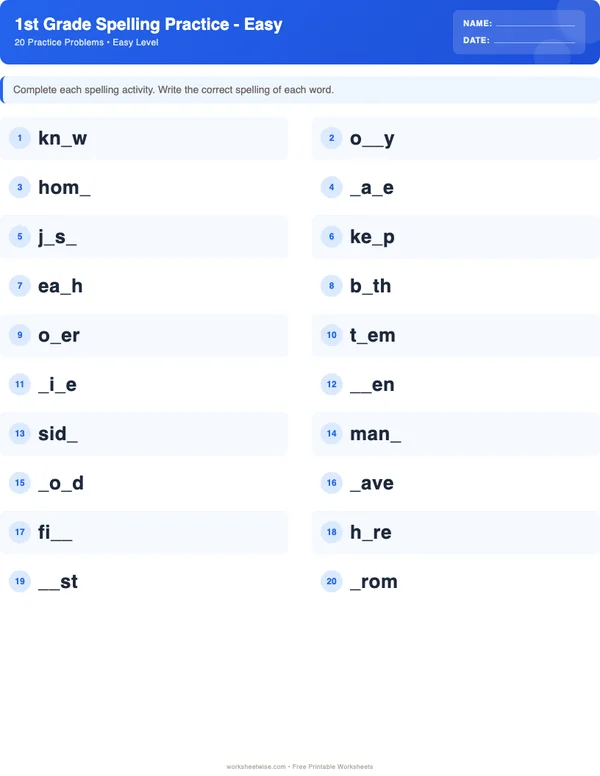
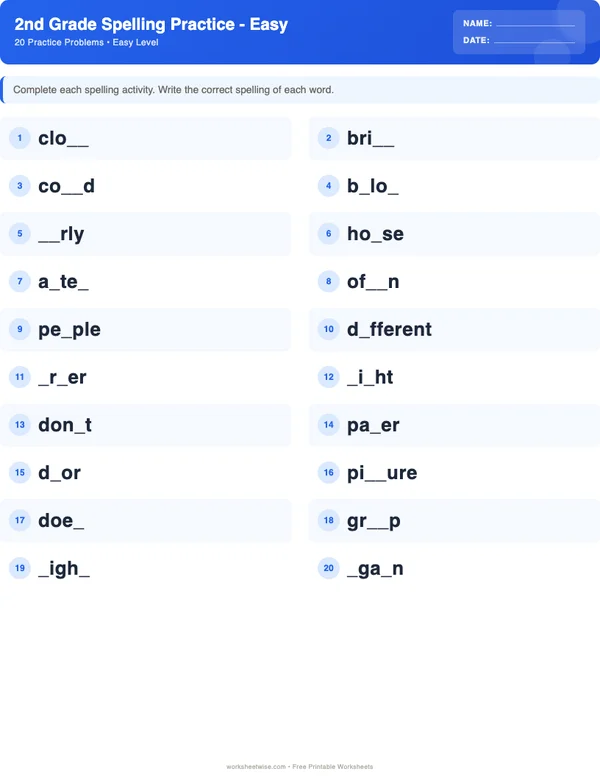
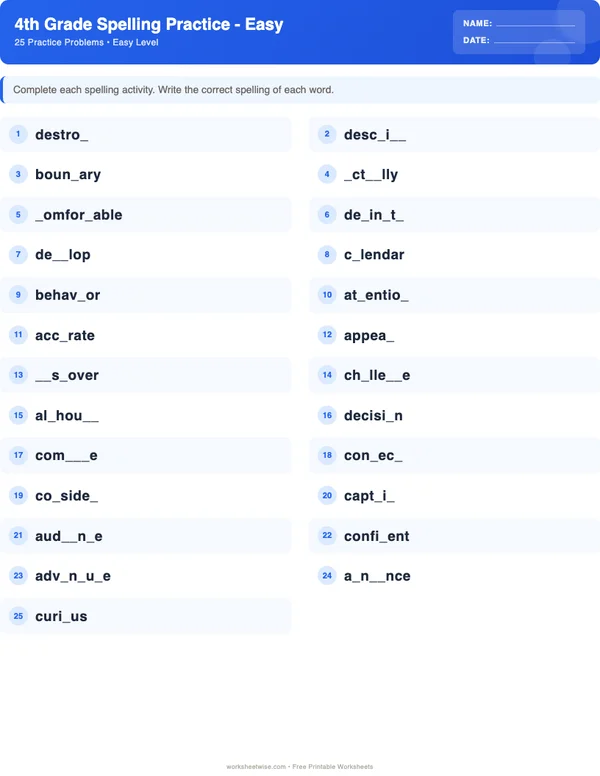
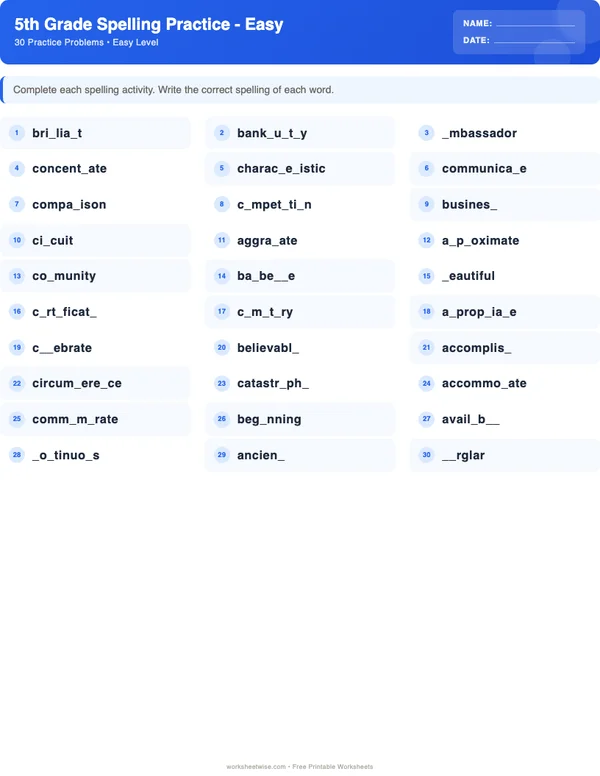
The live WorksheetWise catalogue contains 90 spelling worksheet variants across five intended grade levels, with five free entry points. The representative free sheets contain 20 problems in first and second grade, 25 in third and fourth grade, and 30 in fifth grade. Those counts describe available practice, not a required daily workload. A child might complete six carefully chosen items, explain two corrections, and learn more than they would by rushing through all 30.
A workable weekly rhythm is:
- Preview five to eight words and name the shared pattern.
- Model how sounds, letter groups, syllables, or meaningful word parts explain each spelling.
- Let the learner complete a short, consistent section independently.
- Check responses promptly and classify errors instead of recording only a score.
- Choose the next sheet according to the error pattern.
- End the week with unfamiliar examples, a sentence, or a brief writing check.
This guide applies that rhythm specifically to spelling. It treats worksheets as evidence-generating practice rather than as a self-teaching curriculum.
Choose the sheet by task features
Start with the spelling decision the learner needs to make. Grade, age, page length, and a catalogue difficulty label can help narrow the library, but none should replace looking at the actual task.
Grade labels describe the intended practice level; local curriculum sequences differ. Age, when it appears, is a discovery aid rather than a placement decision. A learner may read fifth-grade material while needing focused review of consonant doubling, or may be younger than a label while confidently sorting familiar vowel patterns. Select from observable work, not identity labels.
The catalogue’s “easy” label applies to all five representative free sheets. Define that label through observable task features: the learner may be working with a visible word bank, familiar patterns, direct matching, copying, recognition of a misspelling, or one spelling decision at a time. Do not call a learner “easy,” “developing,” or “advanced.” A sheet can reduce response demands while still addressing an important pattern.
Match the response format to the teaching purpose
Different activities generate different evidence:
- Look-cover-write-check tests immediate visual recall after close inspection.
- Word sorting shows whether the learner can notice and classify a pattern.
- Rainbow writing supplies repeated letter-sequence practice, but does not by itself show recall.
- Using words in sentences adds meaning, handwriting, grammar, and composition demands.
- Identifying misspelled words tests recognition more than unaided production.
- Dictation requires listening, holding the word or sentence in memory, and producing the spelling without a visible model.
If the target is distinguishing ai from ay, begin with a sort rather than a sentence-writing task. If the target is carrying a known spelling into ordinary writing, a sentence is more informative than another copying exercise.
Compare the five free entry points
The 1st Grade Spelling Words guide and free sheet and 2nd Grade Spelling Words guide and free sheet each provide 20 problems. Their shorter length may suit an early practice block, but inspect whether the words and response format fit the learner’s present pattern knowledge.
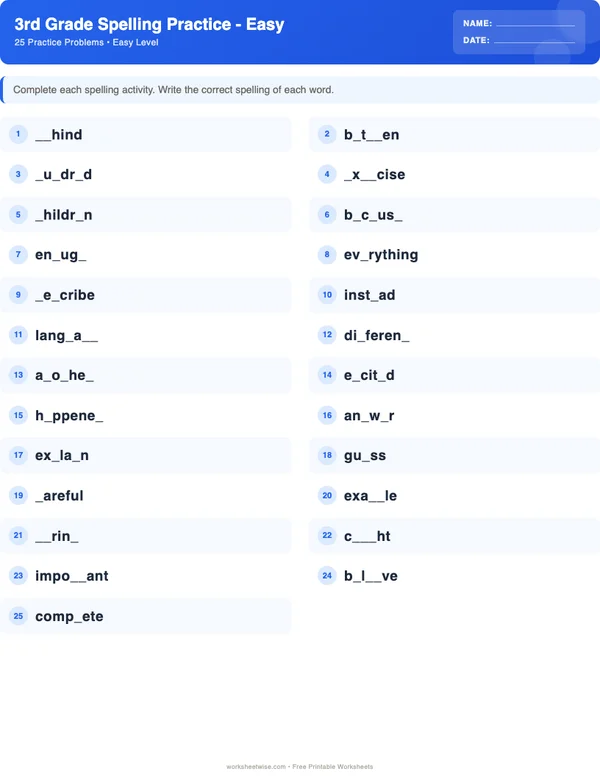
The third- and fourth-grade entry points each contain 25 problems. The 3rd Grade Spelling Words guide and free sheet is a useful place to investigate errors involving vowel choices, doubled consonants, endings, or recognition of misspellings when those features appear on the selected sheet.
The 5th Grade Spelling Words guide and free sheet contains 30 problems. That larger set creates options for sampling, spaced practice, and cumulative review; it does not create a reason to assign every problem at once. Older learners may also need more analysis of prefixes, suffixes, silent letters, and syllable boundaries, depending on the actual words presented.
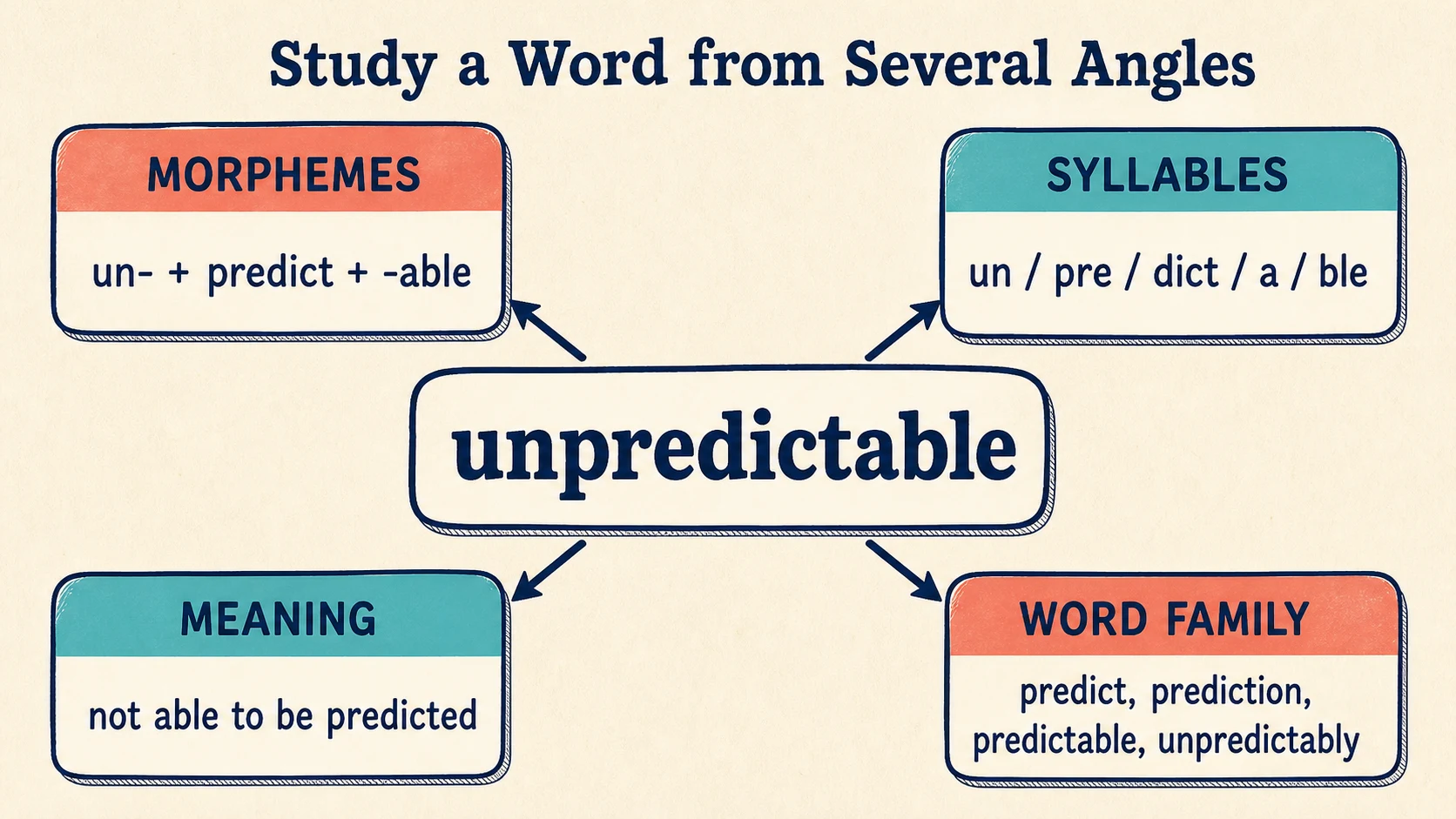
Use this map to choose one fifth-grade spelling relationship for the week, then reserve the other branches for later review.
Model the spelling decision before independent work
A spelling model should make the hidden decision visible. Saying “study this word” is too vague. Show the learner what to attend to, what can be explained by a pattern, and what must be remembered as a word-specific feature.
Use this four-part model:
- Say the word naturally and use it in a sentence.
- Segment it into sounds, syllables, or meaningful parts.
- Mark the spelling feature under study.
- Compare it with another word and explain the decision.
The IES foundational reading practice guide recommends systematic instruction that connects speech sounds with letters and gives learners opportunities to blend, segment, and work with words. That sourced guidance supports explicit sound-to-spelling modeling, especially for early patterns. It does not mean every spelling can be predicted perfectly from sound.
The following examples are editorial teaching suggestions checked against the letter patterns shown. They are not claims that a particular word appears on a specific WorksheetWise sheet.
Checked example 1: long a spellings need comparison
Write cake, rain, play, and break. Say each word and mark the spelling associated with the long a sound:
cake: finaleworks with the earliera.rain:aioccurs inside the word.play:ayoccurs at the end.break:earepresents the long a sound in this word.
All four examples were supplied in the catalogue teaching guidance, and each has been checked for the stated long a sound. They belong on this page because the catalogue explicitly recommends organizing spelling work around a common pattern rather than treating the words as an unrelated list.
Do not teach “long a always uses one spelling.” Ask a narrower question: “Which spelling is used in this word, and what position or known word can help us remember it?” Then sort additional words by their visible spelling.
Checked example 2: doubling depends on the base word
Compare hop → hopping with hope → hoping. In hopping, the final p is doubled before -ing; in hoping, the final e is removed and the p is not doubled. The results are distinct words with distinct pronunciations.
This example belongs here because consonant doubling and suffixes are among the verified patterns represented in the catalogue description. It is also useful diagnostically. Writing hoping for hopping may reflect a doubling misconception, but it could also reflect that the learner intended the different word hoping. Always dictate the word in a sentence before interpreting the response.
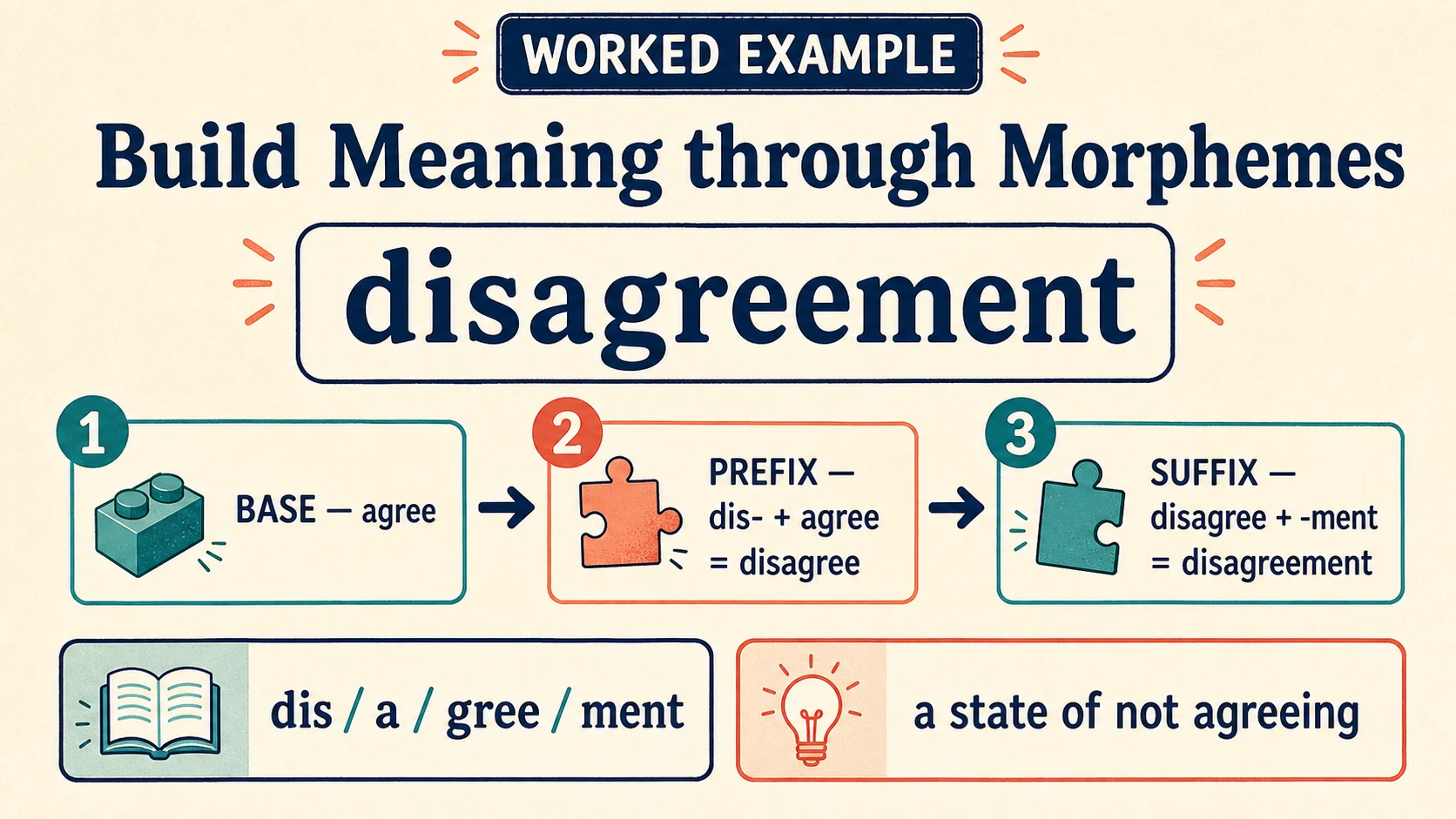
The useful part of an upper-elementary model is the visible reasoning between the spoken word, its parts, and the final spelling—not simply the completed answer.
Run a five-day rhythm that remains short
A fixed rhythm reduces planning while leaving the content flexible. Keep the structure stable and change the spelling pattern, examples, or response format according to the learner’s work.
Day 1: preview, sort, and record a baseline
Choose one pattern and five to eight representative words from the selected resource. Read the words aloud. Ask the learner to sort them without first announcing every category, then invite an explanation: “What did you notice?”
Next, dictate two or three words without displaying them. This is a baseline, not a graded test. Record exactly what the learner writes. A plausible but incorrect spelling can reveal useful pattern knowledge that a blank or copied answer cannot.
Spend about two minutes modeling the target distinction. The independent task might be only one sort or five look-cover-write-check items.
Day 2: retrieve the spelling and compare choices
Begin with two words from Day 1 and one new word that uses the same pattern. Have the learner say the target part, cover the model, write the word, and check it.
When correcting, compare the attempt and answer side by side. Ask the learner to underline only the changed section. For rain written as ran, the changed section is a versus ai; rewriting the entire word without noticing that difference can turn correction into copying.
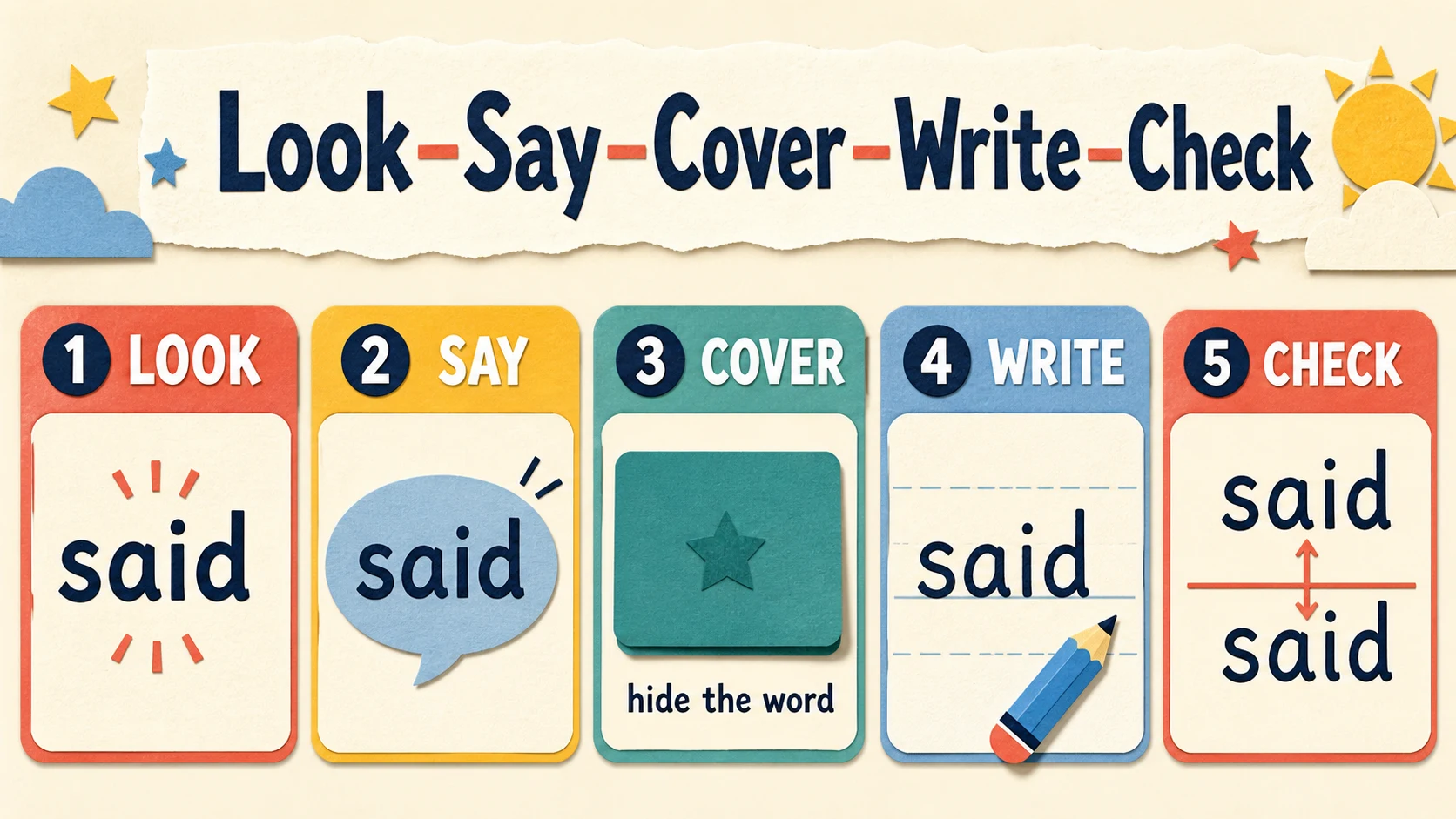
For early spelling practice, repeat the same brief sequence—hear, notice, build or write, and check—while changing only a few words.
Day 3: use the pattern in context
Choose sentence work only after the learner has rehearsed the word itself. Say the sentence once normally, repeat it in meaningful phrases, and then say it once more for checking. Do not stretch every sound unnaturally; the learner needs experience connecting normal speech with conventional spelling.
The IES elementary writing practice guide recommends teaching foundational writing skills and providing regular opportunities to write for meaningful purposes. In this routine, that supports moving from isolated spellings into a sentence or short composition. It does not justify judging spelling, handwriting, punctuation, and idea quality as one undifferentiated score.
Day 4: revisit the actual error
Use the answer key to select, not merely mark, the next practice. Give two missed words, one correctly spelled comparison word, and one new example. Ask the learner to explain the spelling feature before writing.
If yesterday’s error involved ai and ay, use a sort. If the word was correct in a sort but wrong during dictation, use brief retrieval practice. If it was correct in dictation but wrong in spontaneous writing, ask for one fresh sentence and include an editing pass.
Day 5: check transfer without overloading the learner
Use three familiar words, one new word with the same pattern, and one sentence. The unfamiliar example matters because memorizing a weekly list does not necessarily show that the learner can apply the underlying pattern.
Keep old patterns in the mix. A cumulative check might include one current long-vowel word, one previously taught doubled-consonant word, and one personal high-frequency word that has remained troublesome. Record what the learner did without help and what required a prompt.
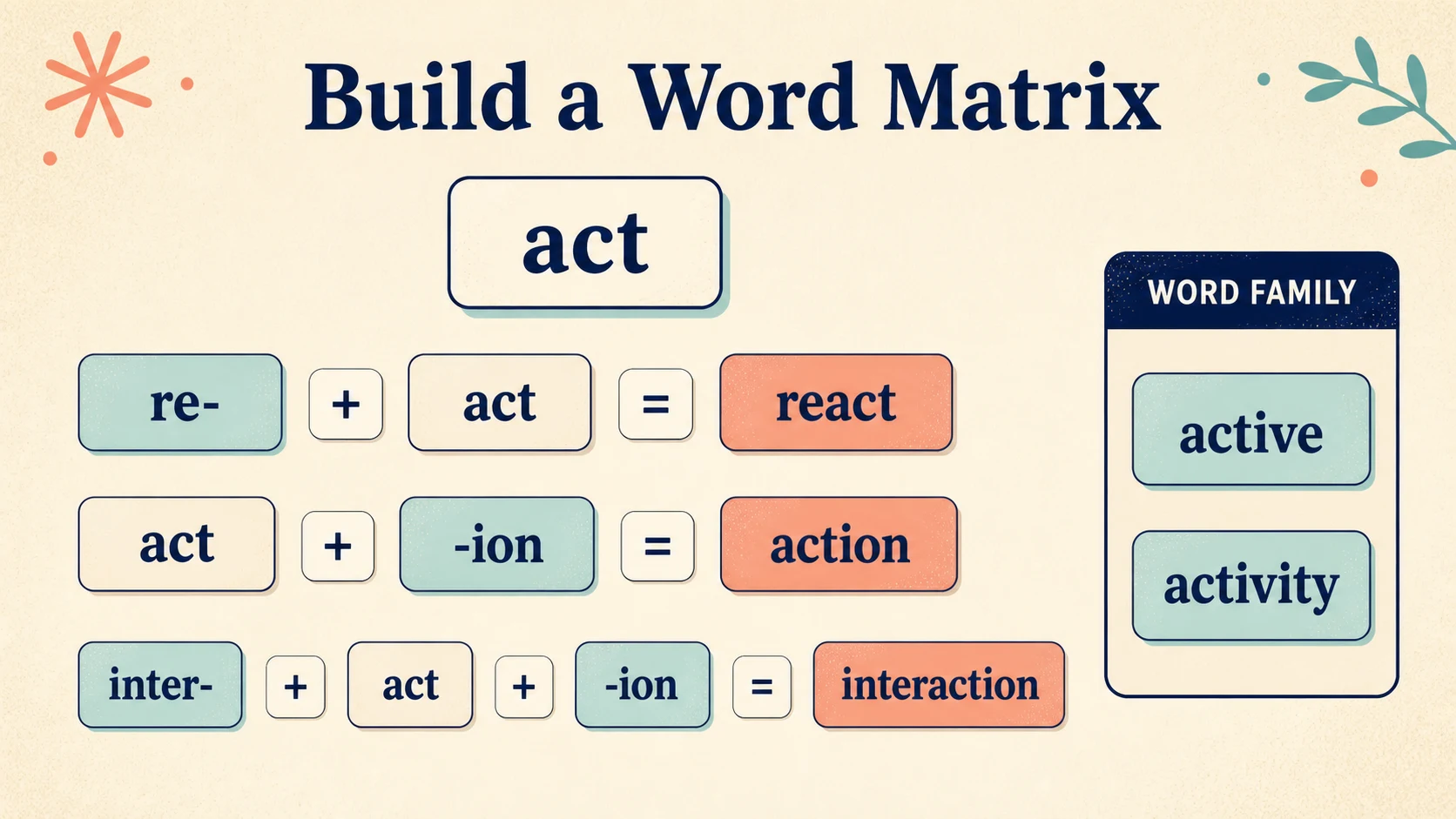
An upper-elementary routine can stay short while shifting more responsibility to analysis, retrieval, sentence use, and self-correction.
Read errors as evidence, not as a single score
An answer key establishes the conventional spelling, but it does not explain why an answer differed. Compare the response with the target and identify the smallest meaningful mismatch.
Sound omitted or represented inaccurately
Suppose the target is train and the learner writes tain. The r sound is missing from the written response. Before assigning another vowel-pattern sheet, ask the learner to say the word slowly, move one counter for each sound, and identify what comes after /t/. Then rebuild or rewrite train.
This does not establish a diagnosis. A single omission may result from attention, memory, pronunciation, handwriting, or incomplete sound segmentation. Look for recurrence across more than one word and more than one day.
Pattern selected in the wrong position
Suppose the target is play and the learner writes plai. The long a sound is represented, so the attempt shows relevant sound knowledge. The issue is the conventional word-final spelling. Contrast rain and play, circle ai inside rain, and box ay at the end of play. Then sort new examples according to where the long a spelling appears.
That next action is more precise than assigning general spelling review.
Ending added without preserving the base correctly
Suppose the target is running and the learner writes runing. The base run is present, and -ing is present; the doubled n is missing. Rebuild the word as run + n + ing, compare it with running, and contrast it with a non-doubling example such as rain + ing → raining.
Both results have been checked: running contains doubled n, while raining retains one n. This example belongs here because it isolates the catalogue’s consonant-doubling and suffix work without changing the intended spelling decision.
Word correct alone but incorrect in a sentence
If a learner writes because correctly during look-cover-write-check but misspells it while composing, do not assume the word was never learned. Sentence writing divides attention among ideas, syntax, punctuation, handwriting or keyboarding, and spelling. Ask the learner to finish the thought first, then return for a targeted editing pass: “Find the word because. Compare it with your notebook model.”
The next sheet should preserve contextual use but reduce competing demands—perhaps one dictated sentence rather than five original sentences.
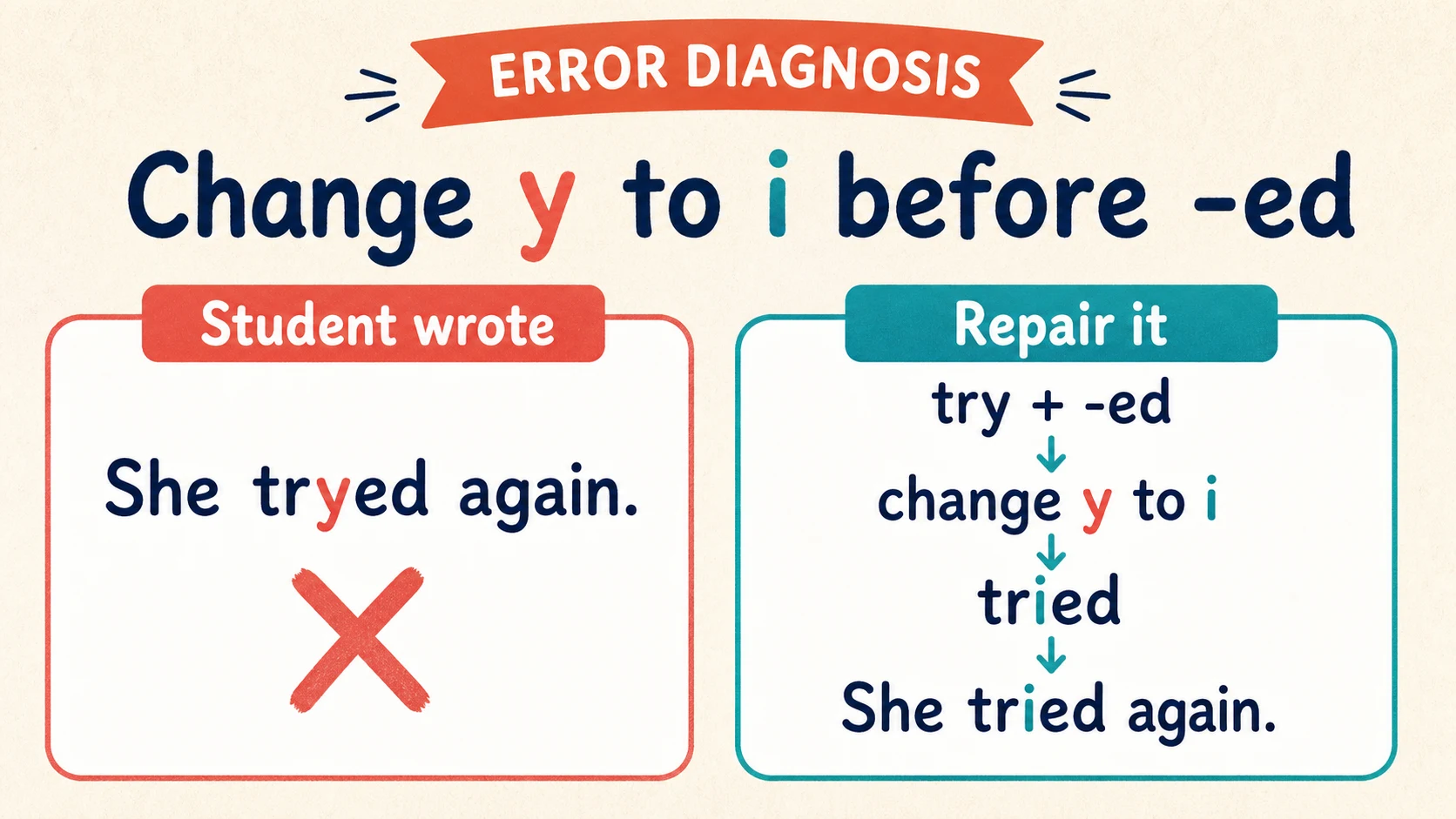
Use a third-grade error display as a response map: identify what changed, test one explanation, and choose a narrowly matched follow-up.
Let the observed error choose the next sheet
A useful next-sheet rule is: keep the target stable and change only the support or response demand.
| What you observe | What it may indicate | Next sheet or task |
|---|---|---|
| Accurate copying, inaccurate covered writing | The visible model is doing most of the work | Use fewer words with look-cover-write-check and immediate comparison |
| Accurate recognition, inaccurate dictation | The learner recognizes the correct form but does not yet retrieve it reliably | Use short dictation with a pattern cue, then remove the cue |
| Accurate sort, repeated error in a sentence | Classification is stronger than contextual application | Use one or two dictated sentences followed by targeted editing |
| Several words contain the correct sound but the wrong spelling pattern | The learner needs comparison among conventional alternatives | Use a word sort organized by visible spelling |
| Base word is preserved but suffix change is wrong | The ending process needs explicit modeling | Use paired base and inflected words |
| Errors scatter across unrelated features late in a long page | Fatigue or excessive task load is plausible | Retry a shorter sample before changing the spelling target |
| Current pattern is accurate in familiar and unfamiliar examples | The practice may be ready for cumulative review | Choose a mixed-pattern sheet or brief writing check |
“May indicate” is deliberate. An error is evidence for a teaching decision, not proof of a cause. Ask one confirming question or use one comparison item before selecting the follow-up.
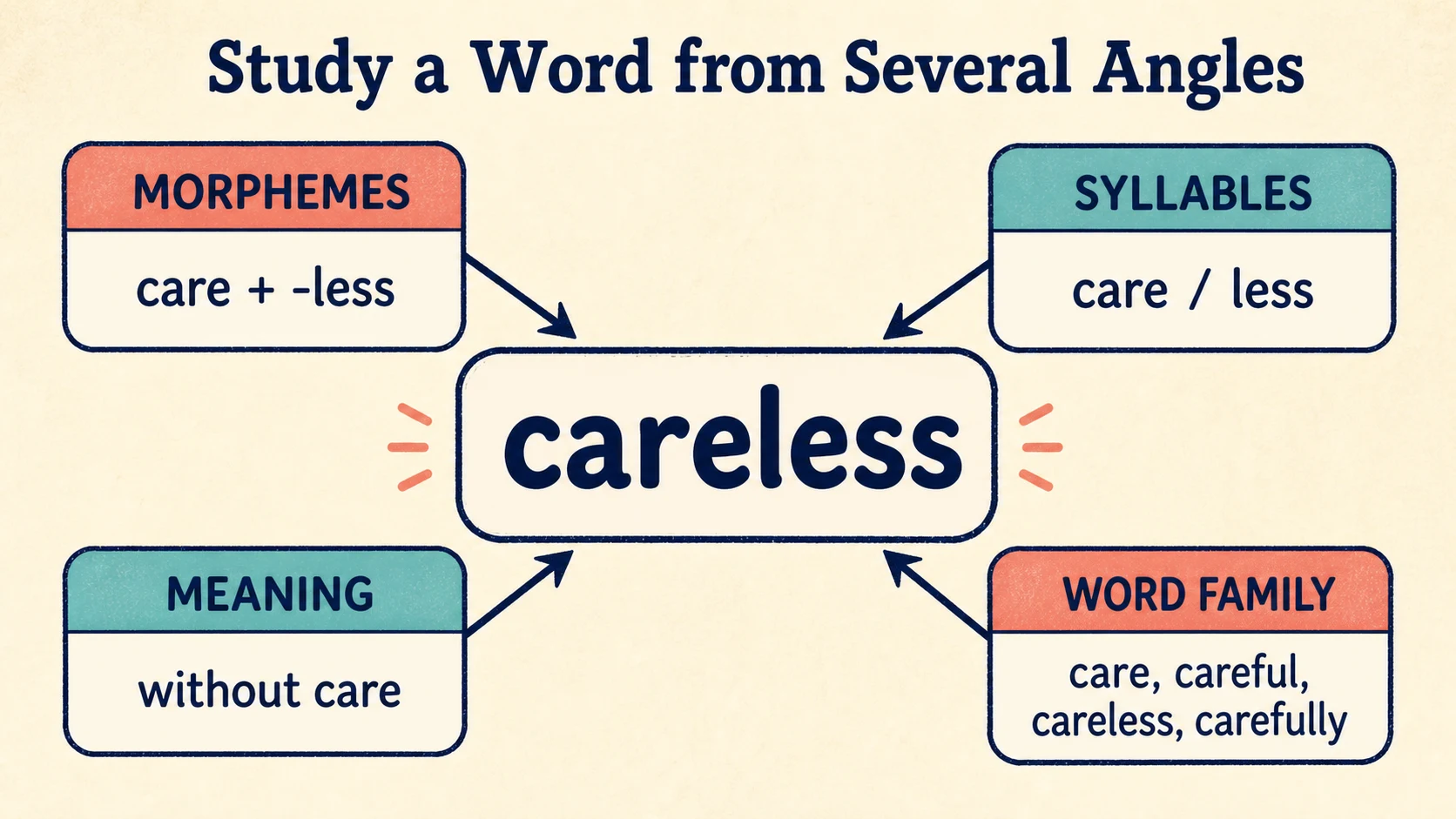
For a third-grade selection, follow the branch that matches the observed spelling decision instead of repeating every branch on another full page.
Plan for mixed ages without teaching three separate lessons
A mixed-age homeschool block can share an oral pattern discussion while using different word sets and response formats. The common target might be long-vowel spellings, suffixes, or silent letters. The written demand should vary without diluting the spelling focus.
For example:
- One learner sorts and builds
cake,rain, andplaywith letter tiles. - Another writes the same words from dictation and explains the long a spelling.
- A third compares those words with
break, finds the unexpected spelling, and uses two examples in sentences.
This fourth checked example belongs here because all four words have the long a sound while using different spellings. It permits a shared family discussion without pretending that every learner needs identical practice.
Give directions separately, then bring learners back together for a two-minute review. One child can explain a sort while another supplies a comparison word. Avoid having an older sibling administer corrections they have not been prepared to explain.
For ages three and four, prioritize brief adult-led oral, matching, manipulative, and movement work over desk work. Say a word and let the child step once for each syllable, match identical word cards, move counters for heard sounds, or build a familiar word with letters. A full written sheet is not the default simply because it is printable.
When early sound-to-letter work is the actual need, the Homeschool Phonics Worksheets collection may provide a better starting point than assigning more conventional spelling words. Phonics and spelling overlap, but they are not interchangeable: phonics commonly moves from print to sound during reading, while spelling requires producing print from a spoken or intended word.
Adapt access without replacing the spelling target
An adaptation should remove an irrelevant barrier while preserving the decision you want to observe.
If handwriting is laborious, let the learner use letter tiles, magnetic letters, a keyboard, or oral letter naming for part of the lesson. Then include a very small handwritten sample if handwriting is also a goal. Do not interpret slow letter formation as weak pattern knowledge without checking the spelling through another response mode.
If working memory is overloaded, shorten the dictated sentence, repeat it in meaningful phrases, or allow the learner to rehearse it aloud. Keep the target word hidden if retrieval is what you are checking.
If reading the directions is the barrier, read the directions aloud. If the task is identifying a misspelled word, do not read the answer choices in a way that reveals which printed form is correct.
If attention drops across a 25- or 30-problem page, divide the sheet into labeled sections and stop after one planned section. Resume later or select only the items that represent the week’s pattern. Page completion is not the spelling objective.
If a learner already spells the listed words accurately, increase the reasoning demand rather than merely increasing the quantity. Ask for a sort with explained categories, a new word using the same pattern, or a sentence followed by self-editing. These are editorial suggestions; the verified catalogue supports varied formats and challenge words but does not claim that one adaptation will suit every learner.
Keep answer-key feedback brief and specific
Feedback is most useful while the learner still remembers the decision. Check a short section on the same day whenever possible.
Use this sequence:
- Mark correct answers neutrally.
- Select one or two errors for immediate analysis.
- Ask, “Which part matches?” before asking what is wrong.
- Compare the attempt with the answer.
- Name the pattern or word-specific feature.
- Have the learner produce the word again from memory.
- Recheck it later in a new order or context.
The catalogue teaching guidance suggests identifying the incorrect part and writing the correct spelling three times. Repetition can be used, but preserve attention: three unexamined copies are less informative than one comparison, one covered rewrite, and one later retrieval.
Maintain a small spelling notebook with columns for the word, the important part, a comparison word, and the date of successful independent use. Use a neutral heading such as “Words to revisit.” A recurring error list is a planning tool, not a label.
The Common Core English Language Arts standards include grade-level language expectations concerning conventional spelling and the use of reference materials. Those standards can help an adult inspect broad expectations, but they did not evaluate WorksheetWise, and a worksheet’s grade label does not establish standards alignment. State, district, and homeschool sequences may organize conventions differently.
Know what a printable cannot tell you
A worksheet captures a small sample under particular conditions. It cannot independently show whether the learner can spell the word tomorrow, use it during original writing, read it fluently, explain its meaning, or generalize its pattern to unfamiliar words.
Recognition tasks can overstate unaided production. Copying can conceal weak retrieval. Dictation can introduce listening and memory demands. Sentence writing can mix spelling with composition, punctuation, and handwriting. Compare at least two response formats before making a major instructional change.
Do not diagnose a learning condition from worksheet errors. Do not promise that a weekly routine will produce a particular outcome. When errors remain widespread across speech-sound work, reading, spelling, and writing despite clear instruction and repeated opportunities, document concrete examples and seek appropriate professional or local educational guidance.
Spelling instruction also should not consume the whole literacy block. Learners need reading, oral language, vocabulary, and meaningful writing. The Homeschool Grammar Worksheets can support a separate conventions goal, but grammar practice should not replace the focused spelling analysis described here.
Make the next Monday decision from Friday’s evidence
At the end of the week, place the learner’s baseline, corrected work, and transfer check together. Choose one observable next action:
- Repeat the same pattern with fewer words if retrieval remains inaccurate.
- Change from sorting to dictation if classification is secure.
- Move from isolated words to sentences if independent spelling is secure.
- Contrast two spellings if the learner represents the right sound with the wrong conventional pattern.
- Add a previously taught pattern if familiar and unfamiliar examples are accurate.
- Reduce page length and retry a sample if errors appeared mainly after fatigue.
Then open the full worksheet library, select the grade band only as a discovery aid, and choose one spelling sheet whose response format matches that evidence. Mark the exact six to ten items you will use on Monday; your first decision should come from the learner’s Friday spellings, not from the number printed at the top of the page.
Put it into practice
Use the guide with a real printable
Move from explanation to a short, observable practice task. Check the first item together, then adjust the next session from the learner's actual work.
Open the first free worksheetExplore a neighboring collection