Curated collectionAnswer keys includedPrint-ready PDFs
1st Grade Homeschool Worksheets
Turn a printable library into a flexible weekly rhythm with explicit teaching, short independent practice, answer-key feedback and mixed-age planning.
Start with a real resource
Browse this worksheet collection
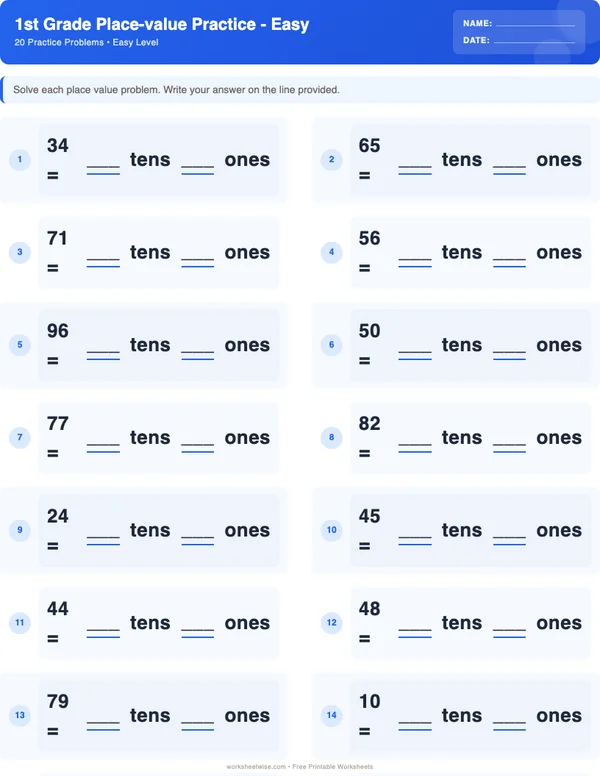
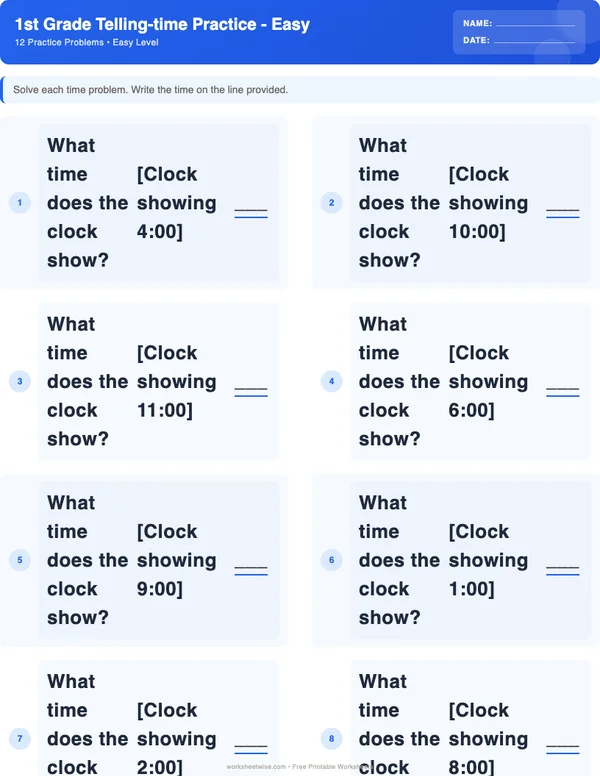
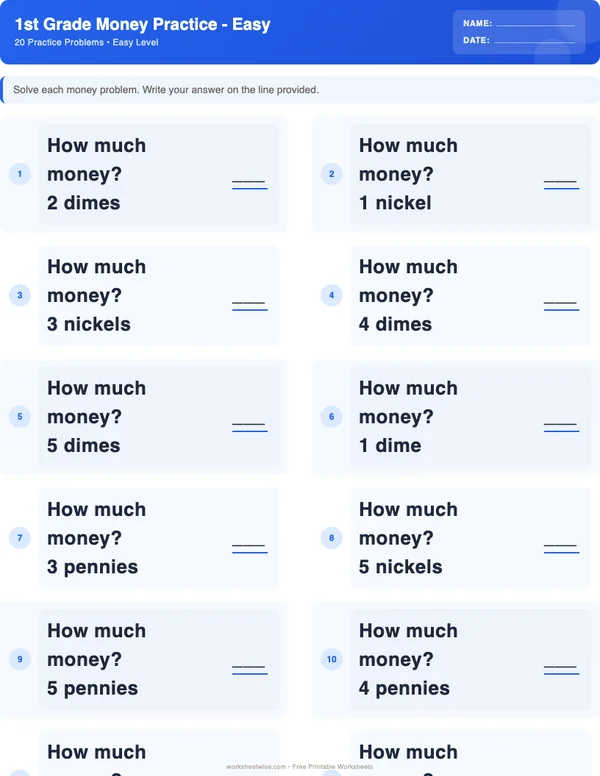
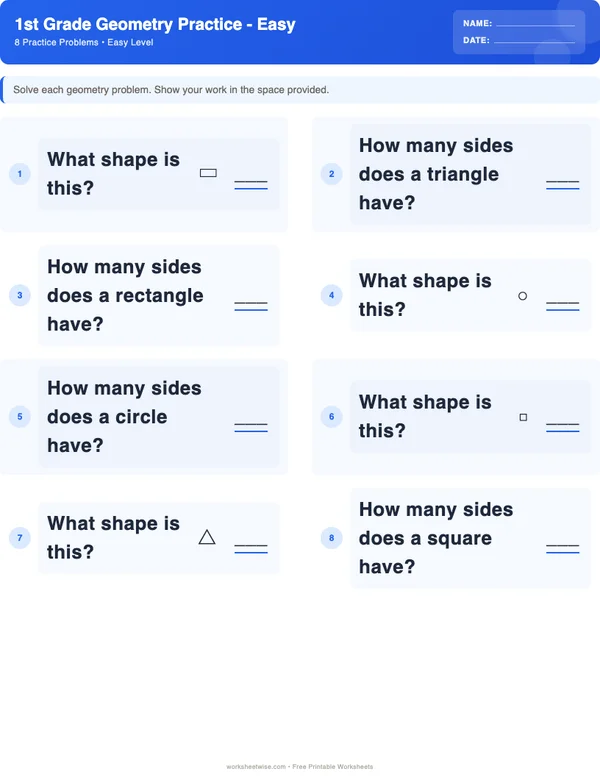
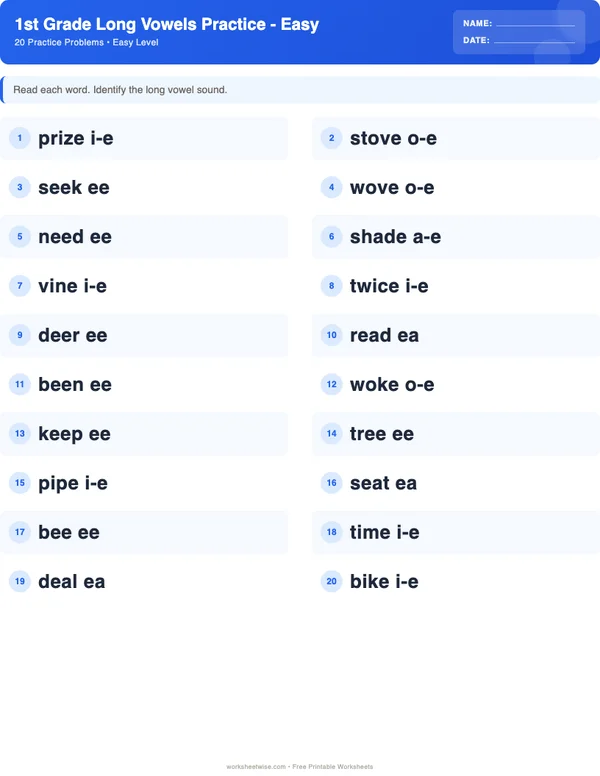
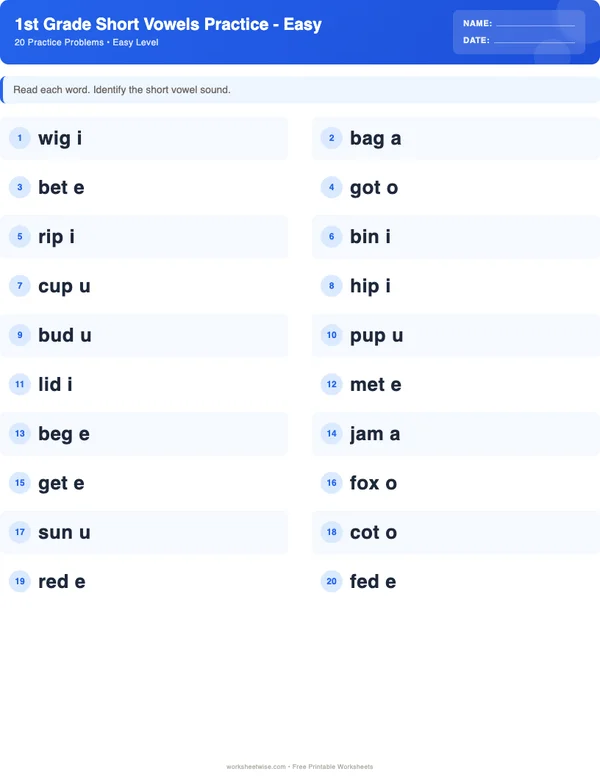
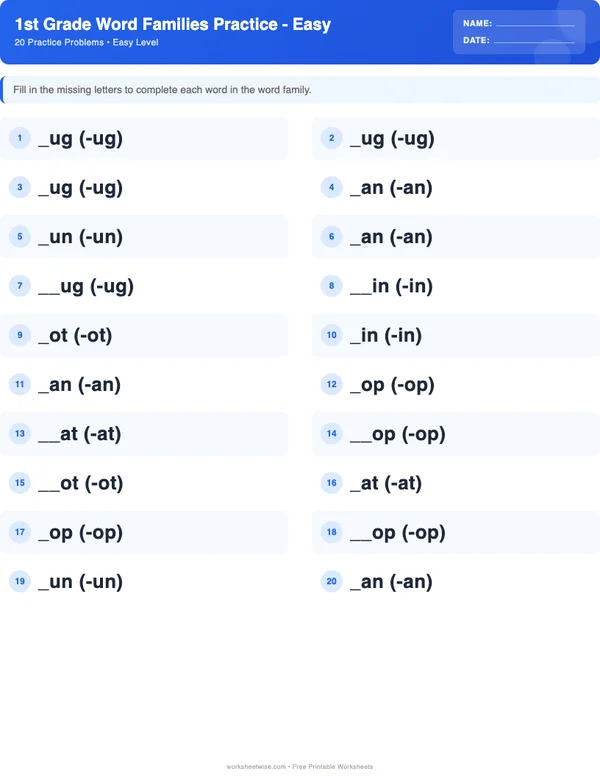
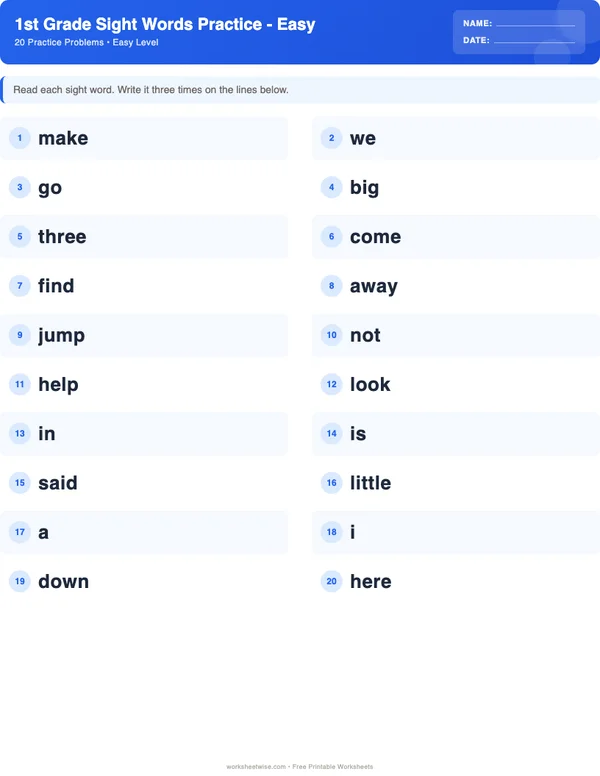
20 relevant free entry points are available. Each one includes a printable learner PDF and separate answer key.
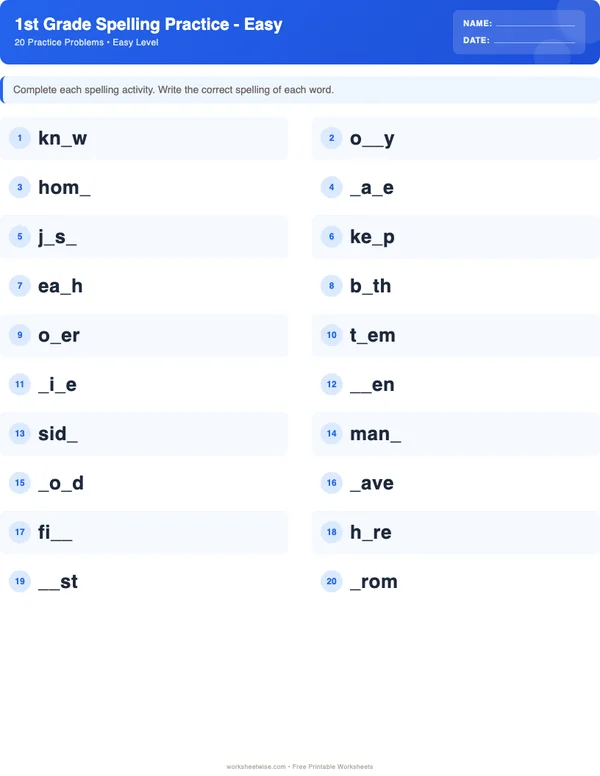
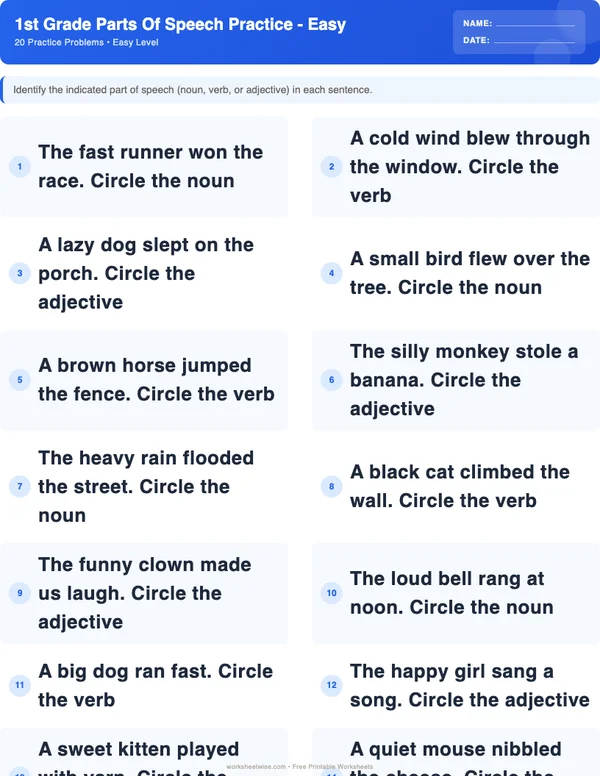
A useful practice loop
Print less. Observe more.
- Choose one skill and model the first item aloud.
- Use a short set and notice the learner’s strategy.
- Change the next task from the work you can see.
Need more than the free sheet?
Plus includes all 360 matching catalogue variations where available, plus saved deterministic generators and the worksheet designer.
See Plus membershipComplete guide
How to teach and practise 1st grade homeschool worksheets
3,640 words Updated 6 instructional visuals
Build a first-grade week around teaching, practice, and feedback
A useful set of 1st grade homeschool worksheets is not a stack to finish. It is a library from which an adult chooses one small, teachable target at a time. For a typical week, plan four focused sessions and one review session. Begin each new skill with explicit teaching and objects, pictures, or oral practice. Follow that with a short section of a worksheet, check it promptly with the answer key, and use the errors to choose the next lesson.
The WorksheetWise 1st Grade catalogue contains 360 worksheet variants across four subjects and 20 topics, with 20 free entry points. That range supports flexibility, but it also makes selection important. A first grader rarely needs twenty problems simply because a printable contains twenty. Ten well-chosen items, discussed and corrected, may make a better session than an entire page completed without attention.
A practical daily boundary is:
- Five to eight minutes of adult-led explanation or modeling.
- Five minutes of guided practice in which the child explains or demonstrates.
- Five to ten minutes of independent worksheet work.
- Three to five minutes of immediate checking and correction.
The exact duration should follow the task and the child’s observable attention, not the clock alone. Stop when writing effort begins to obscure the academic target, when the same misconception repeats without change, or when the child can demonstrate the skill reliably and another row would add only repetition.
Grade labels describe an intended practice level; local curriculum sequences differ. “1st Grade” is therefore a useful catalogue filter, not proof that every listed topic belongs at the same point in every child’s year.
Select a sheet by what the child must actually do
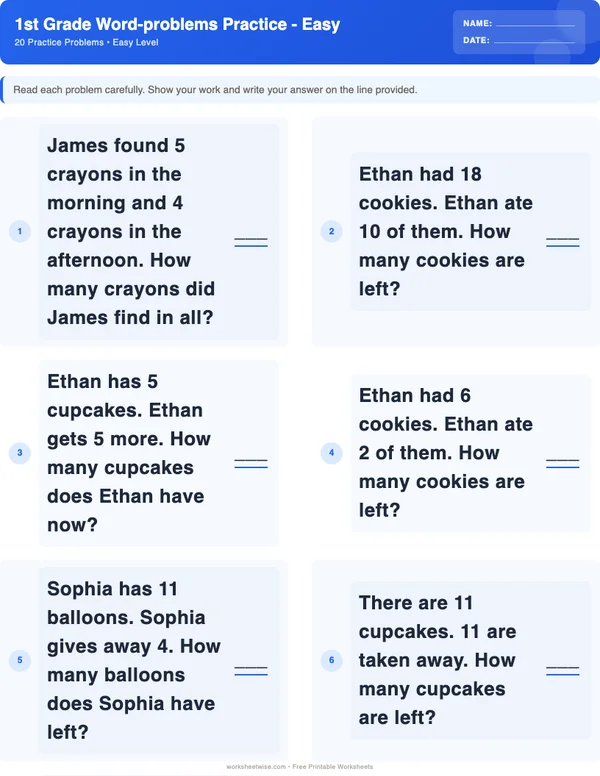
The free representative sheets in this collection are marked “easy.” Treat that word as a description of task features, not as a label for a learner. In this context, the sheets generally offer a single familiar topic, a limited response type, clear visual organization, and modest item counts: 20 problems for counting, addition, subtraction, place value, geometry, money, and the listed phonics topics; 12 for telling time and word problems; and six for fractions.
Before printing, inspect the page and answer four questions:
- What single skill does this page practice?
- Has that skill already been taught with speech, objects, movement, or modeling?
- Can the child understand the directions without also having to learn unfamiliar vocabulary?
- Which items will reveal understanding rather than merely produce more handwriting?
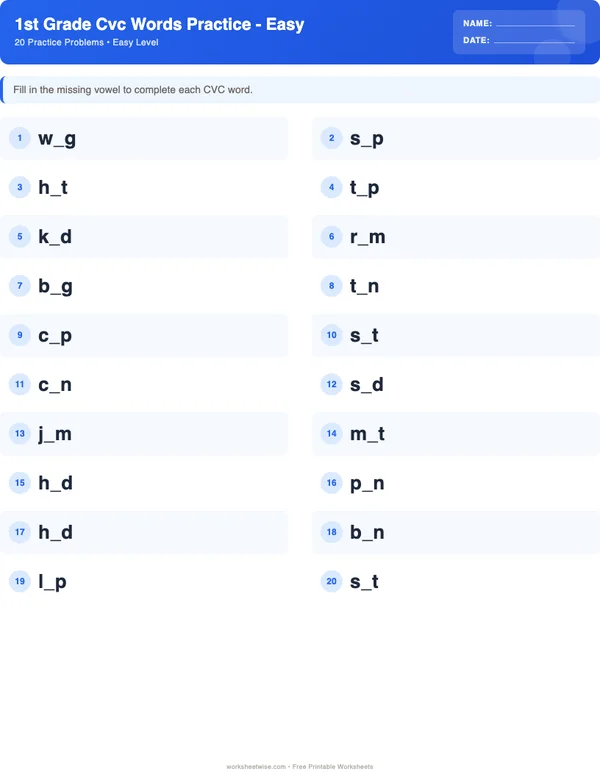
Choose counting when you need evidence about number order, one-to-one correspondence, or counting on. Choose CVC words when the child can identify individual consonant and short-vowel sounds but needs to blend or segment three-sound words. Choose addition only after the symbols can be connected to combining actual quantities. Choose sentence work when the child can contribute an oral sentence and is ready to represent its structure in writing.
Do not select by page appearance alone. A page with large pictures may still require a demanding sound distinction. A page with bare equations may be manageable if the child can build each equation with counters. Likewise, age is a discovery aid rather than a placement decision. Observe what the child can do and examine the task itself before deciding where to begin.
Use a repeatable lesson architecture
A stable routine reduces procedural load: the child knows that a brief lesson comes first, independent work has a clear endpoint, and errors will be examined rather than punished.
Model one example and name the thinking
Show the target in its simplest useful form. For counting, place seven buttons in a scattered group. Touch or move each button once while saying the number sequence, then state, “The last number I said tells how many buttons there are.” For CVC reading, point under each letter in map, stretch the sounds together, and then say the word normally. For addition, build 6 + 3 with counters before recording the equation.
The adult’s language should expose the decision. “I see six already, so I will count on three more: seven, eight, nine” is more useful than “The answer is nine.” This matches the emphasis in the IES guide to teaching mathematics to young children on intentional instruction, progress monitoring, and helping children connect representations and mathematical ideas.
Solve one together without taking over
Invite the child to handle the objects, point to the letters, or draw the model. Ask a narrow question that maintains the target:
- “Which object will you touch first so none are counted twice?”
- “What is the middle sound in pin?”
- “What quantity does this group of counters show?”
- “Where does the sentence begin, and what mark closes it?”
If the child stalls, reduce the number of decisions. Do not supply the final answer immediately. Cover all but one row, offer two vowel choices, or rebuild the quantity with fewer counters.
Set a visible independent boundary
Mark the exact stopping point: “Complete numbers 1–6, then bring the page back.” A first grader should not have to infer whether the assignment is one row, one side, or the entire packet. The initial independent set should be short enough for the adult to check while the child still remembers how each answer was produced.
Independence means using a taught process without moment-by-moment prompting. It does not mean working alone on an unfamiliar concept. If every item needs a hint, return to guided practice. If the first six are accurate and the child can explain two of them, release another short set.
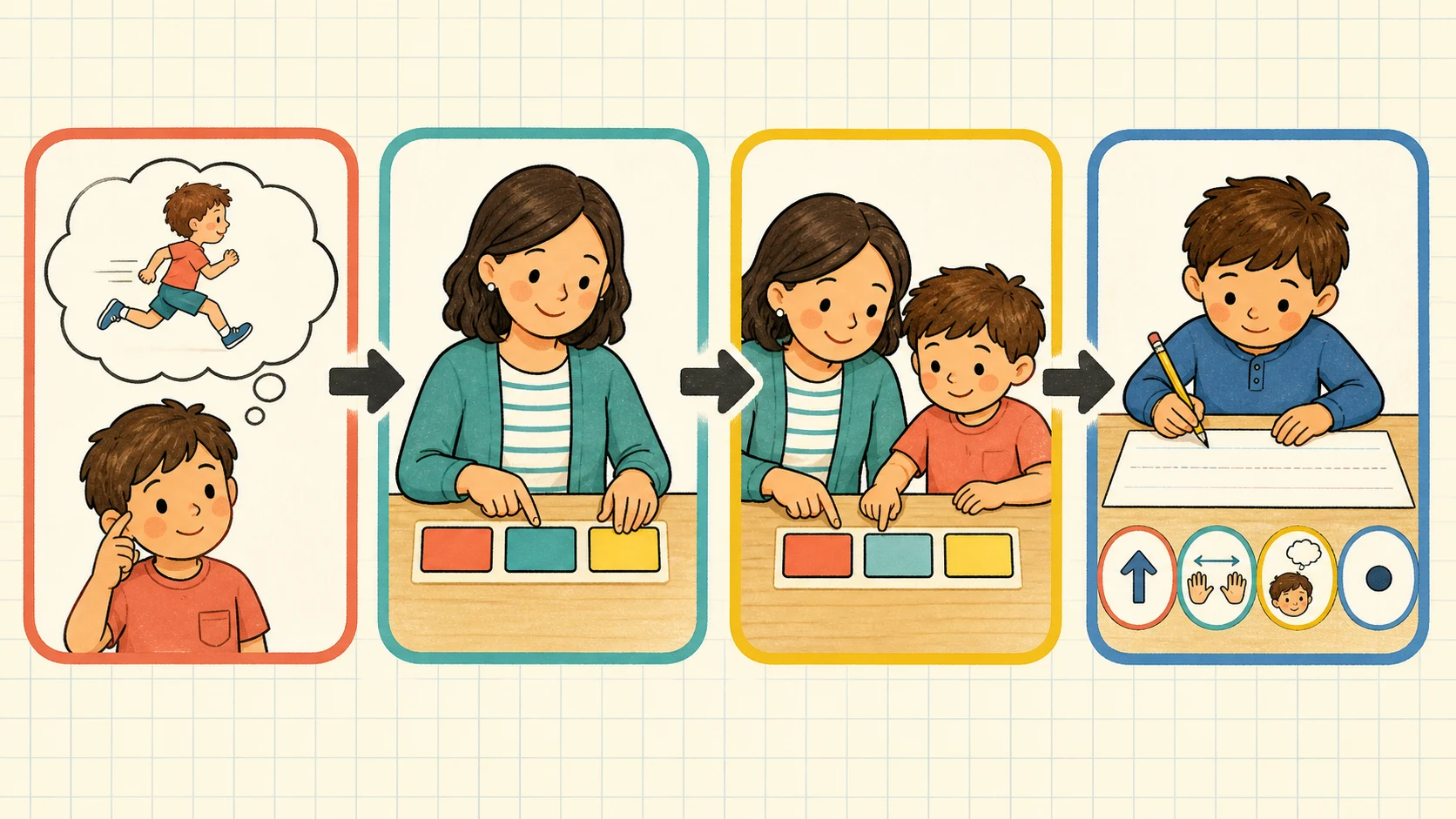
For first-grade sentence work, a short cycle of oral rehearsal, adult modeling, one written sentence, and immediate rereading is more useful than assigning a full page cold.
Plan a realistic Monday-to-Friday rhythm
A weekly plan should revisit important ideas without turning every day into four separate worksheet blocks. This sequence alternates literacy and math emphasis while preserving brief cumulative review.
Monday: establish one phonics target and one number target
Teach short-a CVC blending with magnetic letters or three written sound boxes. Use words such as cat, map, and sad. Then complete only the part of the CVC sheet that uses the same taught vowel.
For math, count a scattered collection of 12 small objects. Have the child move each object into a line while counting, then complete five or six counting items. The movement reveals whether each item is matched to exactly one number word.
Record two observations, not a score: “Blended cat and map without separating the sounds” and “Counted 12 objects accurately after moving them; recounted one object when they remained scattered.”
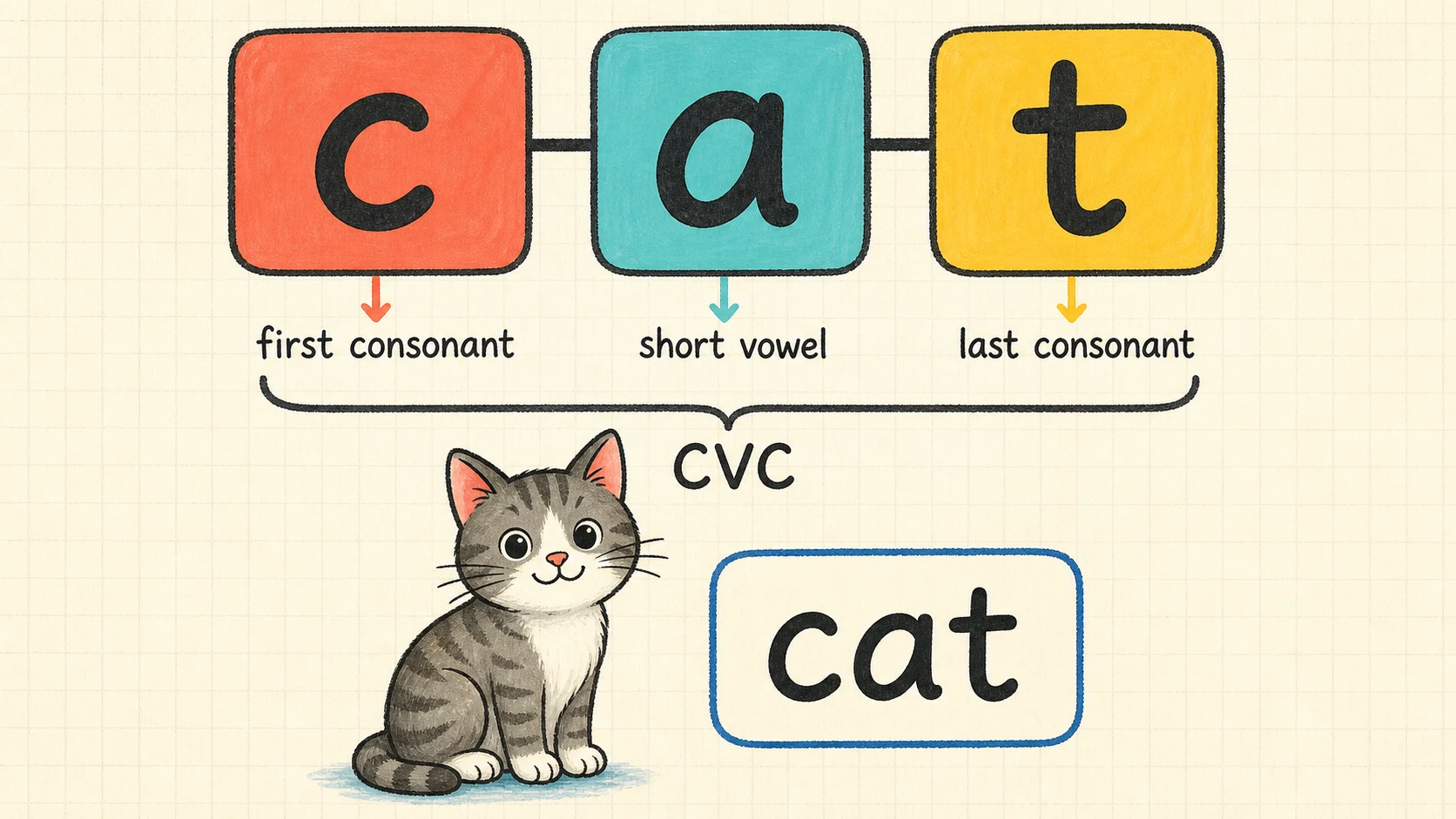
The first-grade CVC sequence connects hearing three sounds, matching sounds to letters, blending for reading, and segmenting for spelling; the worksheet should practice a link that has already been demonstrated.
Tuesday: connect reading to spelling and counting to addition
Review Monday’s three words. Say map without displaying it. The child pushes one token for each sound, selects the letters, and writes the word. This checks encoding rather than visual memory.
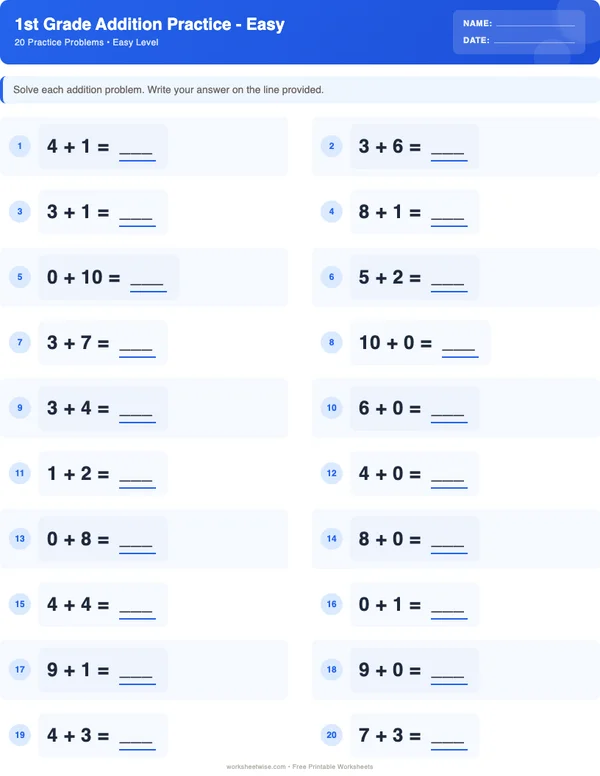
Then turn counting into addition. Place six counters on a ten frame and add three. Ask the child to state what changed and record 6 + 3 = 9. On the representative addition sheet, choose problems within a range the child can model. Its 20-problem count is a catalogue fact, not a required sitting.
The IES foundational reading guide recommends teaching learners to connect sounds with letters, decode words, and read connected text. A worksheet can support that instruction, but isolated word completion should not replace actual oral blending or reading.
Wednesday: contrast, explain, and write
Contrast two short vowels only if both have been taught. For example, use map and mop. Ask what changed, switch the middle letter physically, and have the child read both words. Avoid mixing all five short vowels simply to make the sheet look comprehensive.
For writing, jointly compose a sentence such as “The cat can nap.” Say it aloud, count the words, write it, and reread it. The child then writes one parallel sentence, perhaps “The dog can sit.” Check the capital, spacing, readable letter formation, and closing punctuation separately from spelling. If the child writes “The dog can set,” determine whether the intended word was sit before correcting it; the issue may be short-e/short-i discrimination, not sentence structure.
The IES elementary writing guide supports giving students time to write, teaching the writing process and foundational skills, and creating an engaged community of writers. Here, that means protecting a genuine sentence-making task rather than turning writing into copying alone.
Thursday: introduce subtraction through a situation
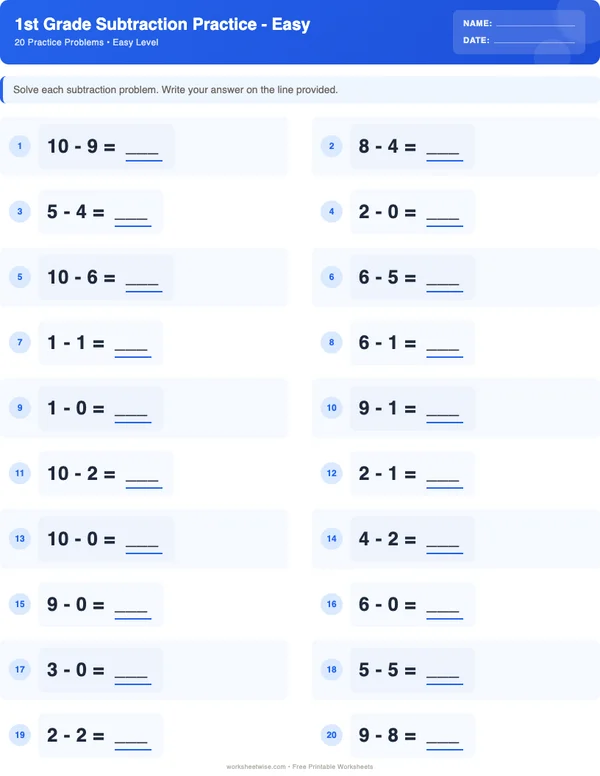
Place nine counters on the table and remove four. Ask, “What happened to the amount?” Let the child count the remainder, then record 9 − 4 = 5. Next, show that 5 + 4 = 9 checks the result. Complete a short set from the 1st Grade Subtraction guide and free sheet, selecting removal problems before introducing comparison or missing-part situations if those meanings have not yet been taught.
Keep phonics review brief: read Monday’s and Wednesday’s words, then dictate two. Thursday is not the day to introduce another vowel pattern merely because a fresh printable is available.
Friday: mixed review and a small application
Choose four to eight previously seen items: two CVC words to read, one to spell, two counting or addition items, one subtraction story, and one sentence to compose. Do not surprise the child with an untaught pattern under the label “review.”
Finish with a practical application. The child might count ten spoons for a drawer, divide a folded paper into two equal parts, or read an analog clock at an hour used in the family schedule. Use Friday’s evidence to choose Monday’s teaching point. If the child reads CVC words accurately but misspells their middle vowels, next week should emphasize segmentation and vowel discrimination rather than harder phonics.
Check four representative examples before assigning more
“Checked” should mean verifying the answer and the reasoning route yourself, not trusting that a key settles every instructional question.
Example 1: count a scattered set of 13
Put 13 buttons in an irregular arrangement. The correct total is 13, but the revealing behavior is how the child reaches it. A child who touches each button once and says the stable sequence through 13 is coordinating number words with objects. A child who says the sequence correctly but touches one button twice may answer 14; reteaching should address one-to-one correspondence, not number pronunciation.
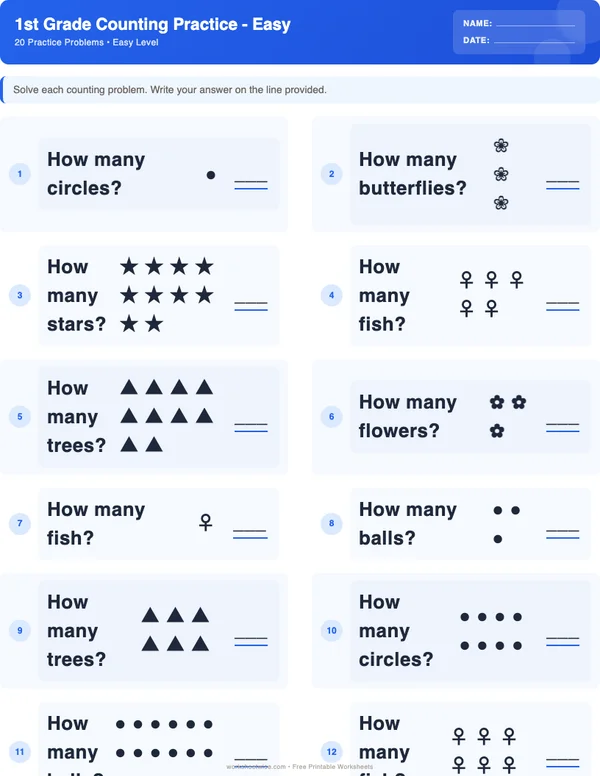
This example belongs in first-grade counting because the live resource explicitly includes counting sets, sequences, missing numbers, and counting forward, while its teaching guidance recommends scattered objects to distinguish actual correspondence from recitation. After the concrete check, use the 1st Grade Counting guide and free sheet for a short written follow-up.
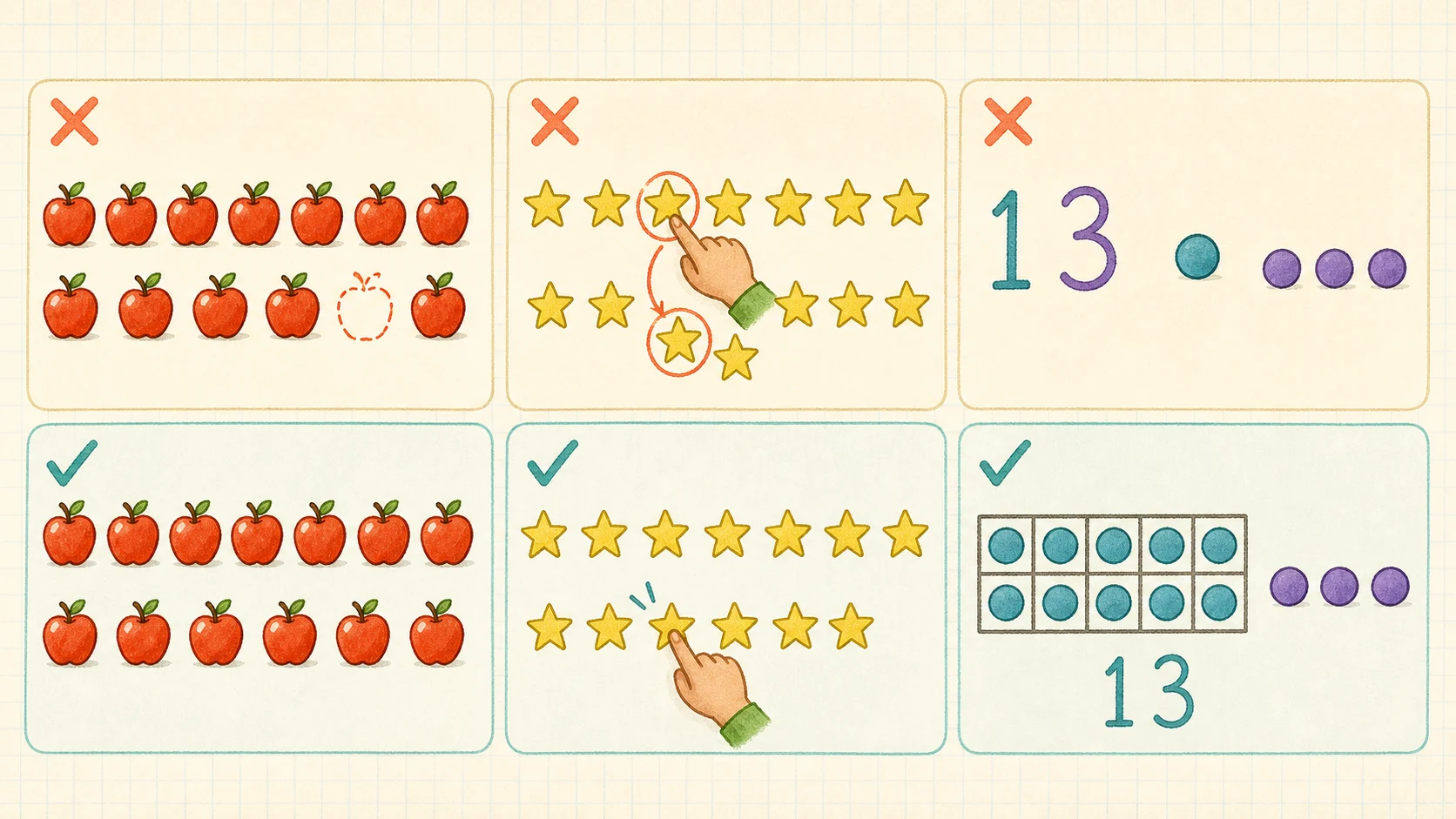
In first-grade counting, the same wrong total can come from losing the number sequence, skipping an object, or counting an object twice, so watch the action before choosing the response.
Example 2: solve 6 + 3
Build six counters, then add three. Counting on from six gives 7, 8, 9, so 6 + 3 = 9. Check by counting all nine counters. This is suitable here because the first-grade addition resource progresses from objects and pictures toward number sentences and includes practice within small totals.
If the child recounts all objects accurately, that is a valid strategy, though you can model counting on as a more efficient next step. If the child says “six, seven, eight” and answers eight, the starting quantity was counted as one of the added three. Respond with three visible jumps after six: 7 is the first jump, 8 the second, and 9 the third.
The 1st Grade Addition guide and free sheet can follow once the equation has a concrete meaning.
Example 3: decode and spell map
The letters represent /m/ /ă/ /p/. Blend continuously—“mmmaaap”—then say map. For spelling, say the word normally, stretch it, place one token in each of three boxes, and map the sounds to m-a-p. Both reading and spelling yield map.
This example belongs because map is a CVC word with the short-a family that the catalogue identifies as an appropriate starting point. It also permits a precise check: reading tests blending from print, whereas spelling tests segmentation and sound-to-letter mapping. A child may succeed at one and need teaching in the other.
Do not accept a picture guess as decoding evidence. If a picture of a map leads to the spoken word before the letters are inspected, cover the picture and use another taught CVC word.
Example 4: partition a rectangle into halves
Fold or draw a rectangle so it has two equal-size parts. Shade one part. The shaded amount is one half. A line that creates one large region and one small region does not show halves, even though it creates two pieces.
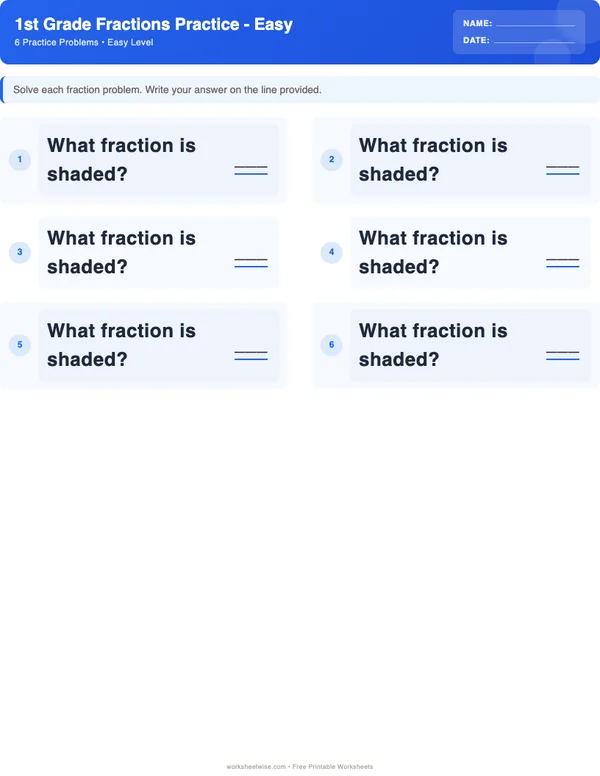
This belongs in the first-grade fractions collection because the representative resource begins with partitioning shapes into equal parts and naming fractions. Its free sheet has six problems, a sensible signal that fraction work may require more discussion per item than a 20-item counting page. Use the 1st Grade Fractions guide and free sheet after folding paper or sharing objects so that “equal parts” has a concrete referent.
These examples illustrate a broader selection rule: choose the representation that exposes the concept. Counters expose how a quantity changes; sound boxes expose phoneme segmentation; paper folding exposes equality of parts. A written answer alone may hide the source of success or error.
Turn the answer key into same-day feedback
An answer key identifies expected responses. It does not explain why a response was wrong. Check the first independent set immediately and sort errors into one of four working categories.
A concept error
The child counts 6 + 3 as eight because six was treated as the first added count. Rebuild the problem and show three distinct additions after the starting set. For subtraction, a child may add because every story involving two numbers has previously been treated as addition. Act out what happened before revisiting the symbol.
A representation error
The child understands “nine take away four” with counters but misreads 9 − 4 on paper. Keep the mathematical quantities the same and bridge between representations: act it, draw it, then write it. The IES mathematics intervention guide emphasizes systematic instruction, clear mathematical language, representations, and regular opportunities for practice and feedback. Those principles are useful guidance for responding to an observed difficulty; they are not an assessment of WorksheetWise.
A language or direction error
The child can identify a short-a word orally but does not understand “fill in the missing vowel.” Demonstrate the response format on a new example, then return to the original item. Do not count misunderstanding the directions as proof that the phonics skill is absent.
An attention or production error
The child solves orally but reverses a numeral, loses place on a crowded row, or tires during extended handwriting. Reduce visual clutter, cover unused items, allow pointing or movable letters, and shorten the written set. Preserve the target: if the goal is choosing the correct operation, the child can dictate the equation; if the goal is numeral formation, handwriting remains part of the task.
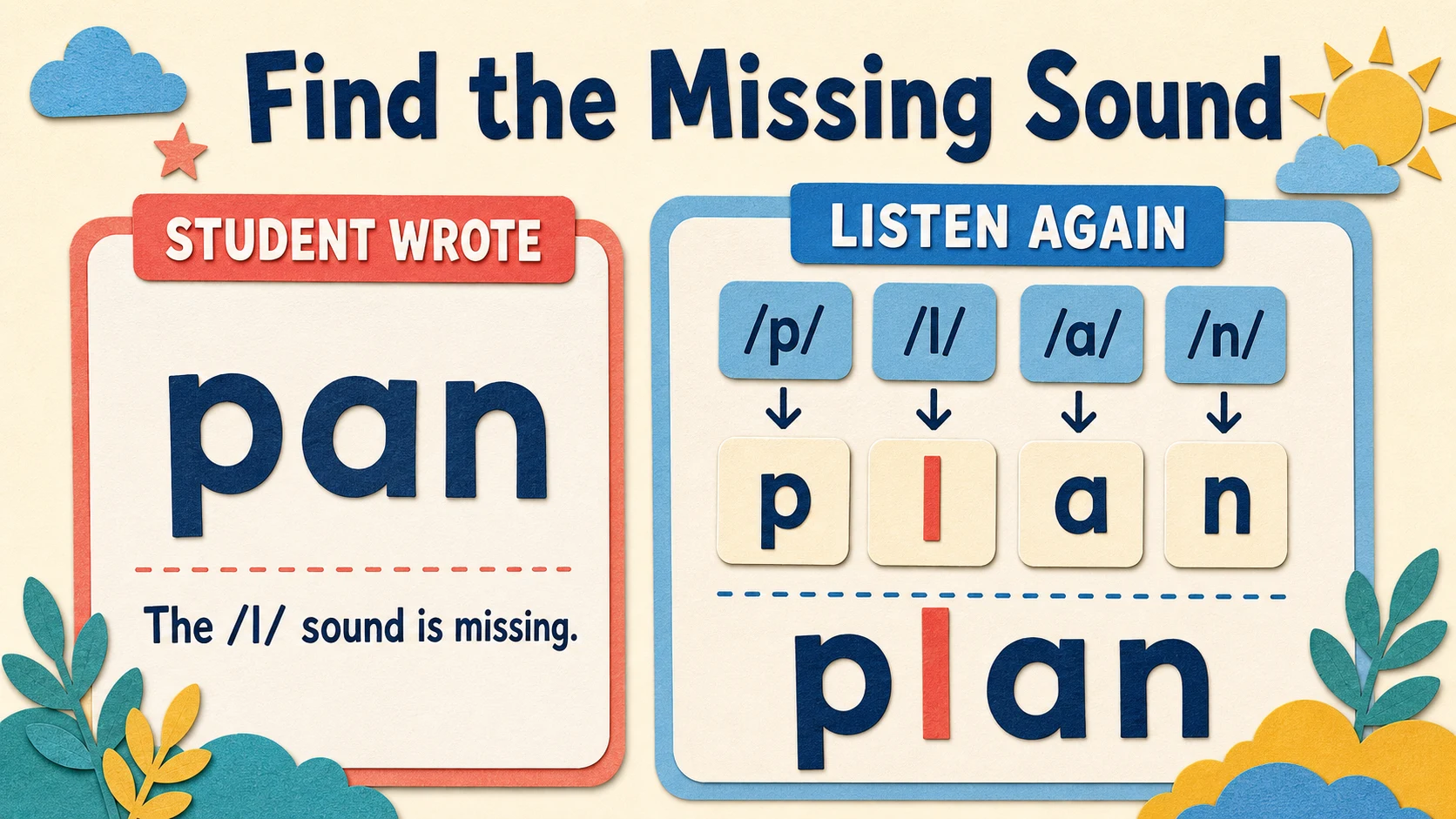
First-grade spelling feedback should identify whether a sound was not heard, heard but mapped to the wrong letter, omitted in writing, or lost during copying before another list is assigned.
After correction, ask for one fresh example. If map was misspelled mp, segment map with counters and then try sad. A correct second attempt provides evidence that the teaching response transferred. Simply copying map three times does not.
Pace phonics by demonstrated prerequisites
First-grade phonics sheets in the live collection include short vowels, CVC words, consonant blends, digraphs, and long vowels. That catalogue order should still be checked against observable performance.
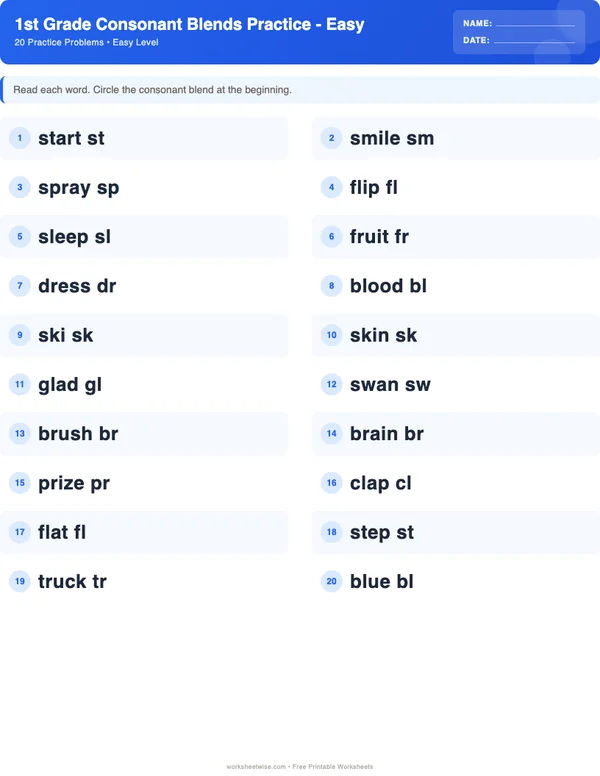
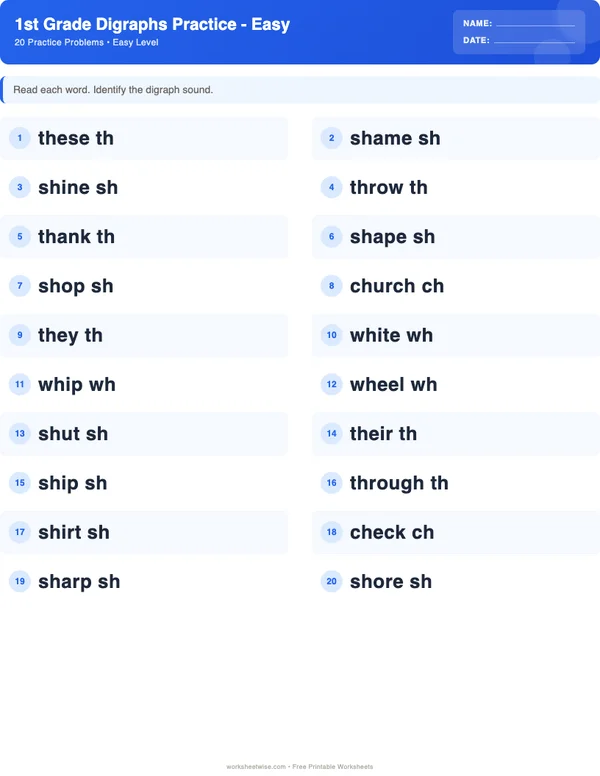
A child ready for CVC practice can usually produce the relevant letter sounds and blend a modeled three-sound word with limited help. Move toward consonant blends only when ordinary CVC words are read with reasonable stability; blends such as st require the child to retain an additional consonant sound. Introduce digraphs by explaining that two letters represent one sound, contrasting sl—two audible sounds—with sh—one sound. Long-vowel silent-e work belongs after short-vowel CVC reading is secure enough to compare cap with cape or hop with hope.
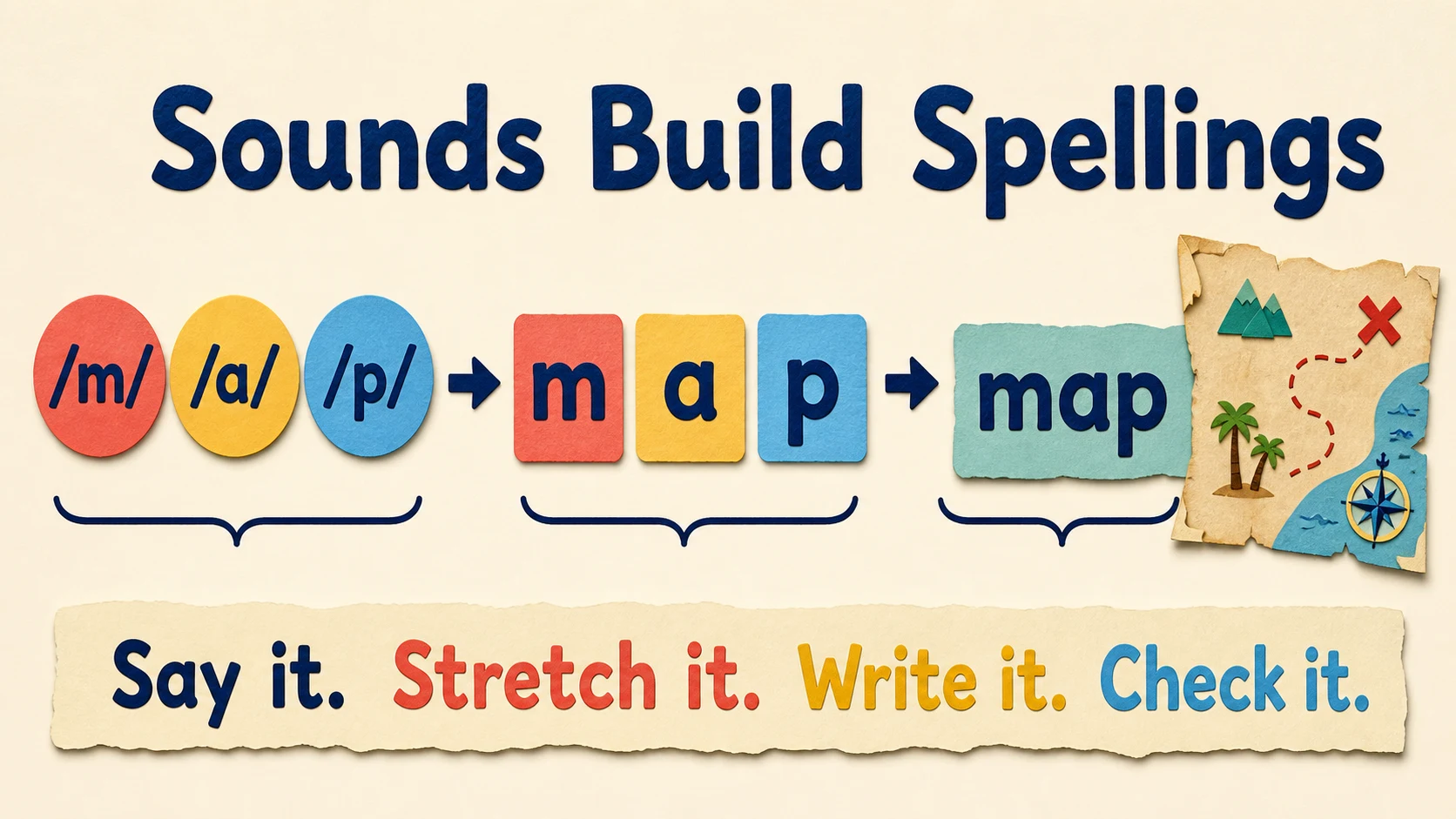
For first-grade spelling, sound identification, segmentation, letter selection, word writing, and rereading are connected skills, but an error in one does not establish weakness in all the others.
For a spelling session, use five to eight words sharing a taught pattern rather than a long mixed list. Begin with sound boxes and movable letters, proceed to dictated writing, and finish with one sentence containing a practiced word. Interleave earlier patterns only after the new pattern is understood.
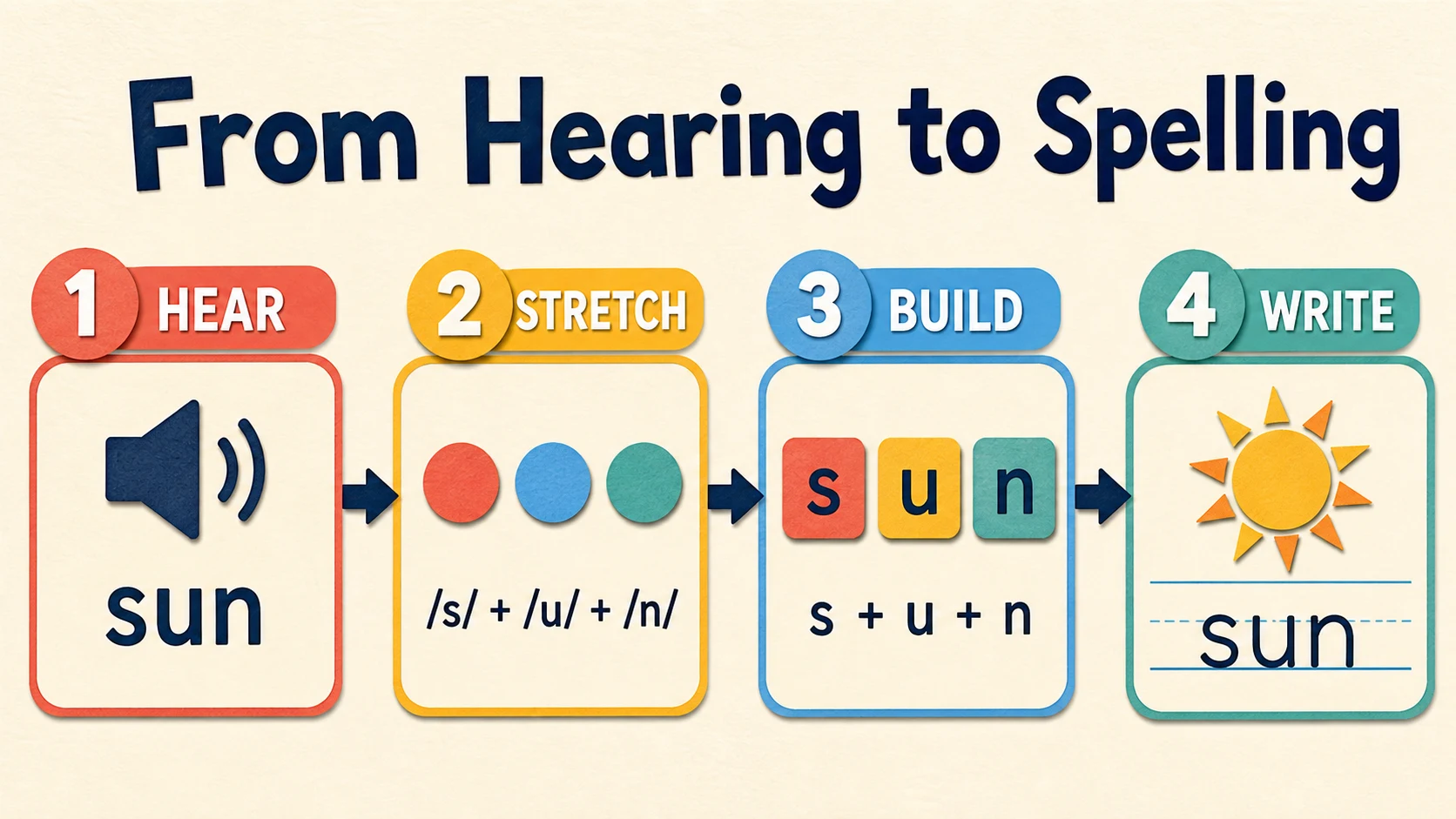
Release first-grade spelling from adult-led sound mapping to independent dictation in small steps, returning to support when the child’s error shows that the pattern is not yet stable.
Adapt the work without replacing its target
A sound adaptation changes access while retaining the intended skill. Before modifying a page, state the target in a verb: count, blend, segment, add, compare, partition, or compose.
For a child whose handwriting is slow, allow magnetic letters for CVC spelling if sound-to-letter mapping is the target. Do not allow picture matching alone, because that removes spelling. For a child distracted by a dense page, reveal one row at a time while preserving the same numbers and operations. For addition, supply counters or a ten frame; the child must still determine the total. For sentence structure, accept oral composition before writing, but retain at least one written sentence if capitalization, spacing, and punctuation are part of the lesson.
Movement can support first-grade review without making it vague. Place number cards on the floor and ask the child to step from 8 to 12 while counting forward. Tap three sound positions on the table while segmenting fish as /f/ /ĭ/ /sh/; it has three phonemes even though four letters appear in writing. Fold paper to create halves rather than asking the child to memorize a fraction label.
For mixed-age homeschooling, keep the shared context but assign different actions. During a family store activity, the first grader might count pennies by ones or add two small prices with counters; an older sibling might calculate change. During reading, the first grader can locate taught CVC or digraph words while an older learner summarizes the passage. Links to 2nd Grade Homeschool Worksheets can help plan the older child’s independent block, but do not move a first grader there merely to keep siblings on the same page.
If younger children join, remember that age is a discovery aid rather than a placement decision. For ages three and four, prioritize brief adult-led oral, matching, manipulative, and movement work over desk work. They might match two identical shapes, move three bears into a cup, or clap a short sound pattern while the first grader completes a related written task.
Know what a printable cannot establish
A worksheet records responses under particular conditions. It cannot by itself establish broad mastery, explain every error, determine grade placement, diagnose a learning condition, or guarantee transfer to reading, writing, or daily life. Correct answers may come from guessing, picture cues, copying, or adult prompting. Incorrect answers may reflect directions, fatigue, language, vision, motor demands, or an untaught prerequisite.
Use multiple observations: an oral response, work with objects, a written item, and a fresh example on another day. When concerns are persistent or affect daily functioning, document concrete observations and consult an appropriate qualified professional or the learner’s instructional support team. Do not convert a worksheet pattern into a diagnosis.
The Common Core mathematics standards and English language arts standards can help adults understand one widely used description of grade-level expectations. They do not establish the sequence used in every state, school, curriculum, or homeschool. Nor does inclusion in a first-grade catalogue claim alignment to a particular local standard unless that alignment is explicitly documented.
Also resist accelerating solely because a page is accurate once. Check whether the child can explain the method, handle a changed example, and return to the skill after a gap. Conversely, do not require repetitive completion after those behaviors are already visible. More items are not automatically more learning.
Record evidence that makes next week easier to plan
A useful homeschool record can fit on one line per session:
Date | target | support used | independent evidence | error pattern | next action
For example:
Monday | count scattered objects to 20 | moved objects into a row | counted 13 once each | double-counted when objects stayed scattered | practice mark-and-move strategy with 15 objects
Or:
Wednesday | short-a CVC spelling | three sound boxes | wrote map and sad | omitted middle vowel in cat | orally discriminate a/i, then dictate two short-a words
Avoid labels such as “good at math” or “poor reader.” Record actions that another adult could observe. After three sessions, look for a pattern. If support is decreasing and fresh examples are accurate, extend the range or introduce the next closely related feature. If the same error continues, reduce complexity and reteach with a different representation.
Your immediate next action is to open the full worksheet library, choose one first-grade target already represented in your next week—such as counting, CVC words, addition, or fractions—and preview the free sheet before printing. Circle no more than six initial items, write down the object-based or oral model you will teach first, and reserve the answer-key check for the same session.
Put it into practice
Use the guide with a real printable
Move from explanation to a short, observable practice task. Check the first item together, then adjust the next session from the learner's actual work.
Open the first free worksheetExplore a neighboring collection