What First Graders Need to Learn About Spelling Words
The short answer: effective 1st Grade Spelling Words practice combines common sound–letter patterns with a manageable set of high-frequency words. Begin with words the learner can hear and build, such as map and sit. Progress to blends, digraphs, and familiar long-vowel patterns. Ask the learner to read, sort, build, cover, write, check, and eventually use the words in sentences. Move forward according to the learner’s observed work, not simply because a week has ended.
Spelling at this level is more than memorizing a list. It connects three kinds of knowledge:
- Hearing the sounds in a spoken word
- Matching those sounds to letters or letter groups
- Remembering conventional spellings that cannot be worked out completely from sound
The IES foundational reading guide recommends developing awareness of speech sounds and their links to letters, then teaching learners to decode, analyze, write, and recognize words. This provides high-level instructional support for connecting spelling with phonics and reading. It does not evaluate WorksheetWise materials or prescribe one weekly list.
Grade labels describe the intended practice level, not a fixed timetable or a guarantee of readiness. Local school sequences differ, and children may show an uneven profile—for example, accurately spelling short-vowel words while still confusing a few high-frequency words.
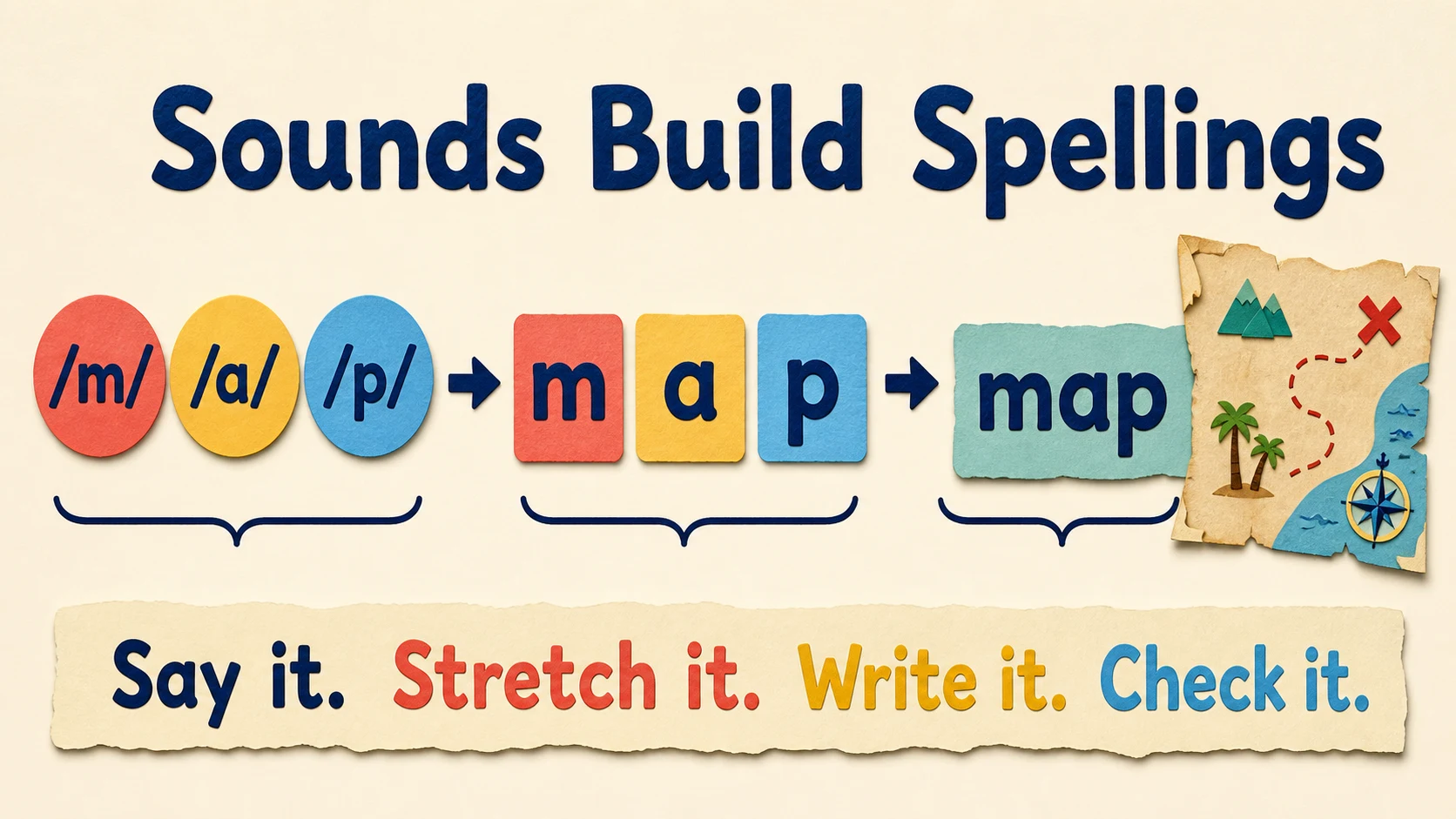
Spelling practice joins sound awareness, letter patterns, word recognition, and written use.
Prerequisites to Check Before Starting a List
A learner does not need perfect mastery of every prerequisite. However, checking the following skills helps an adult choose a useful starting point.
Letter and sound knowledge
Ask the learner to name common consonant sounds and short-vowel sounds. Use lowercase letters because that is how most letters appear inside words. A learner who cannot readily connect m with /m/ will find independent spelling of map difficult even if the word has been copied several times.
Do not turn this into a long test. Show a small group of letters or say several sounds. Record which connections are secure, hesitant, or unknown.
Oral sound segmentation
Say map without showing it. Ask, “What sound comes first? What comes next? What sound is last?” The complete analysis is /m/ /a/ /p/.
If the learner says only the first and last sounds, use three counters or boxes. Move one counter for each sound. This is an instructional suggestion: it makes the parts visible before letters are required.
Try both easy and harder contrasts:
- me has two sounds: /m/ /ē/.
- ship has three sounds: /sh/ /i/ /p/, although it has four letters.
- stop has four sounds: /s/ /t/ /o/ /p/.
The distinction between sounds and letters becomes important when digraphs and blends appear.
Basic word reading
Check whether the learner can read the words selected for spelling. Reading a word does not prove that the learner can spell it from memory, but an unreadable list is usually a poor choice for independent spelling practice.
If ship cannot be read, teach or review sh before expecting the learner to spell the whole word. The 1st Grade spelling hub can help adults locate practice at the relevant subject and grade level.
Writing readiness
The learner should be able to form recognizable letters and leave enough space to inspect each word. Handwriting does not need to be polished. If letter formation consumes nearly all the learner’s attention, let the learner arrange letter cards first and write fewer final examples.
A Grade-Appropriate Spelling Progression
A useful progression moves from highly regular words toward patterns that require more comparison and memory. The order below is a practical teaching sequence, not a universal schedule.
| Stage |
Main focus |
Sample words |
Evidence to look for |
| 1 |
Short-vowel consonant-vowel-consonant words |
map, sit, hot, cup |
Represents the beginning, middle, and ending sounds |
| 2 |
Initial and final consonant blends |
stop, clap, best, milk |
Records both consonants without adding a vowel |
| 3 |
Common consonant digraphs |
ship, chat, thin, when |
Uses two letters for the digraph sound |
| 4 |
Familiar long-vowel patterns |
cake, bike, rain, play |
Notices that the same long-vowel sound can have different spellings |
| 5 |
Common high-frequency words |
the, said, was |
Recalls the conventional spelling, including unexpected parts |
| 6 |
Transfer and cumulative review |
Words in sentences and short writing |
Maintains earlier patterns while using current words |
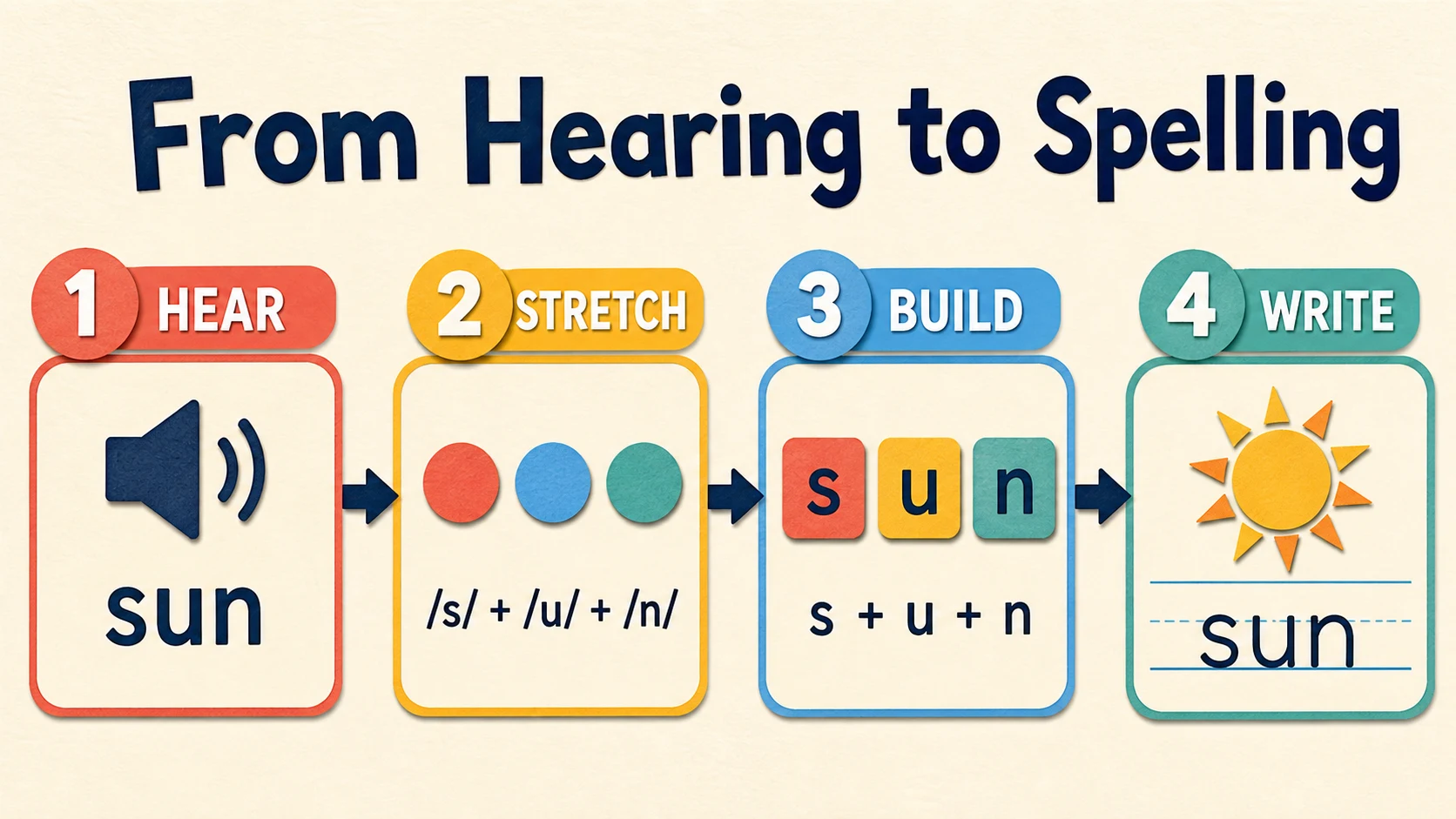
Support can gradually shift from counters and letter cards to independent sentence writing.
The catalogue identifies CVC words, common sight words, blends, digraphs, and long-vowel patterns as important first-grade content. The broader spelling topic also includes later patterns such as consonant doubling, r-controlled vowels, silent letters, prefixes, suffixes, and multisyllabic words. Their presence in the wider topic catalogue does not mean every first grader should study all of them at once.
The Common Core English Language Arts standards organize literacy expectations by grade and include language use as part of a wider reading, writing, speaking, and listening framework. The supplied catalogue identifies first-grade emphasis on conventional spelling for common patterns and phonetic attempts at untaught words. This is useful context, not a claim of comprehensive alignment with every state or local sequence.
Concrete and Visual Models That Reveal the Pattern
Sound boxes
Draw one box for each sound, not necessarily each letter. For map, draw three boxes. The learner pushes a counter into each box while saying /m/ /a/ /p/. Replace the counters with m, a, and p.
For ship, still draw three sound boxes:
This shows why ship has four letters but three sound units.
Letter tiles and word building
Build cap with tiles. Read it, then add e to make cape. Compare what stayed the same and what changed. The visible contrast is more informative than announcing a rule and asking the learner to memorize it.
Useful changes include:
- map → mop: change the middle vowel.
- sit → sat: change the middle vowel.
- cap → clap: add l to create a blend.
- cap → cape: add final e and compare the vowel sound.
Ask the learner to touch the exact letters that changed.
Pattern sorts
Give a mixed set such as cake, rain, play, bike, day, and mail. The learner can sort by visible spelling:
- a_e: cake
- ai: rain, mail
- ay: play, day
- other vowel pattern: bike
This sort does not support the false idea that every long-a word uses the same letter pattern. It teaches comparison.
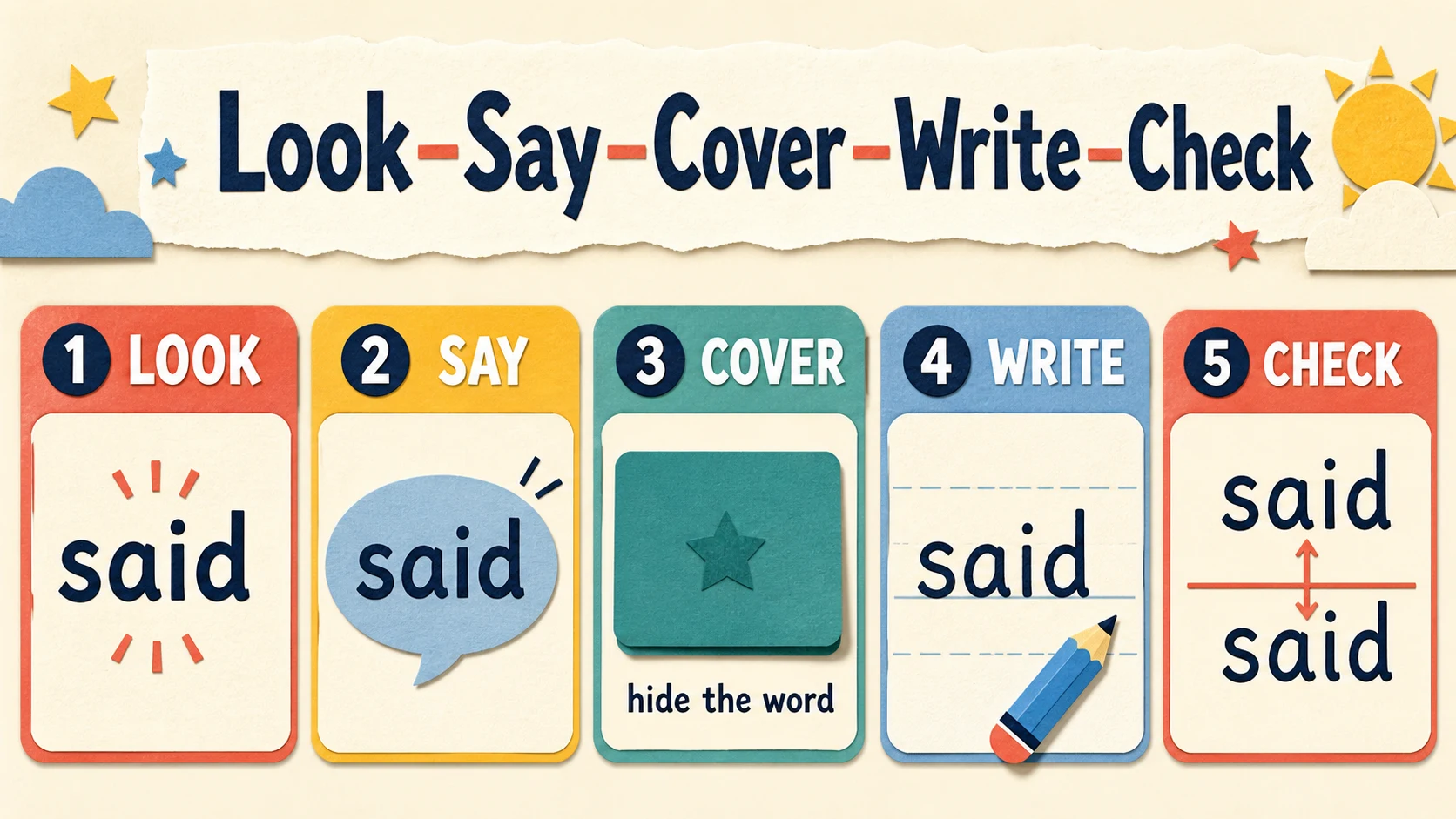
Look-cover-write-check
The catalogue recommends this sequence for studied words:
- Look closely at the whole word.
- Name or mark the important part.
- Cover the word.
- Write it from memory.
- Uncover it and check letter by letter.
- Correct the specific part that differs.
For said, the learner might mark ai as the part that must be remembered. Repeated copying without covering the model does not show whether the spelling can be recalled.
Fully Checked Worked Examples
Example 1: A regular CVC word—map
Prompt: Spell map.
- Say the word normally: map.
- Stretch it without distorting the sounds: /m/ /a/ /p/.
- Count three sounds.
- Match each sound: /m/ → m, /a/ → a, /p/ → p.
- Blend the written word: m-a-p, map.
- Check it against the target: map.
Answer: map
Why it works: Every sound is represented in order. A spelling such as mp omits the middle vowel. Mop represents a different middle sound.
Example 2: A word with an initial blend—stop
Prompt: Spell stop.
- Say stop.
- Segment it: /s/ /t/ /o/ /p/.
- Place four counters, one for each sound.
- Write s, t, o, p in the same order.
- Read the result: stop.
- Compare every position with the target.
Answer: stop
Why it works: The initial blend contains two separate consonant sounds. Sop omits /t/. Sutop adds a vowel that is not present between /s/ and /t/.
Example 3: A word with a digraph—ship
Prompt: Spell ship.
- Segment the spoken word: /sh/ /i/ /p/.
- Identify /sh/ as one sound commonly represented by sh.
- Add i for the short vowel and p for the final sound.
- Count three sounds but four letters.
- Read and check: sh-i-p, ship.
Answer: ship
Why it works: sh is a digraph: two letters working together for one sound. Sip begins with /s/, not /sh/. Shp omits the vowel.
Example 4: A familiar silent-e contrast—cape
Prompt: Change cap to cape.
- Build cap and read it with the short-a sound.
- Add e after the final consonant: cape.
- Read the new word.
- Compare the two written forms: cap / cape.
- Confirm that no letter was removed and the final e was added.
Answer: cape
Why it works: In this pair, final e changes the vowel pattern while remaining silent. This example supports comparison; it does not prove that every word ending in e follows the same behavior.
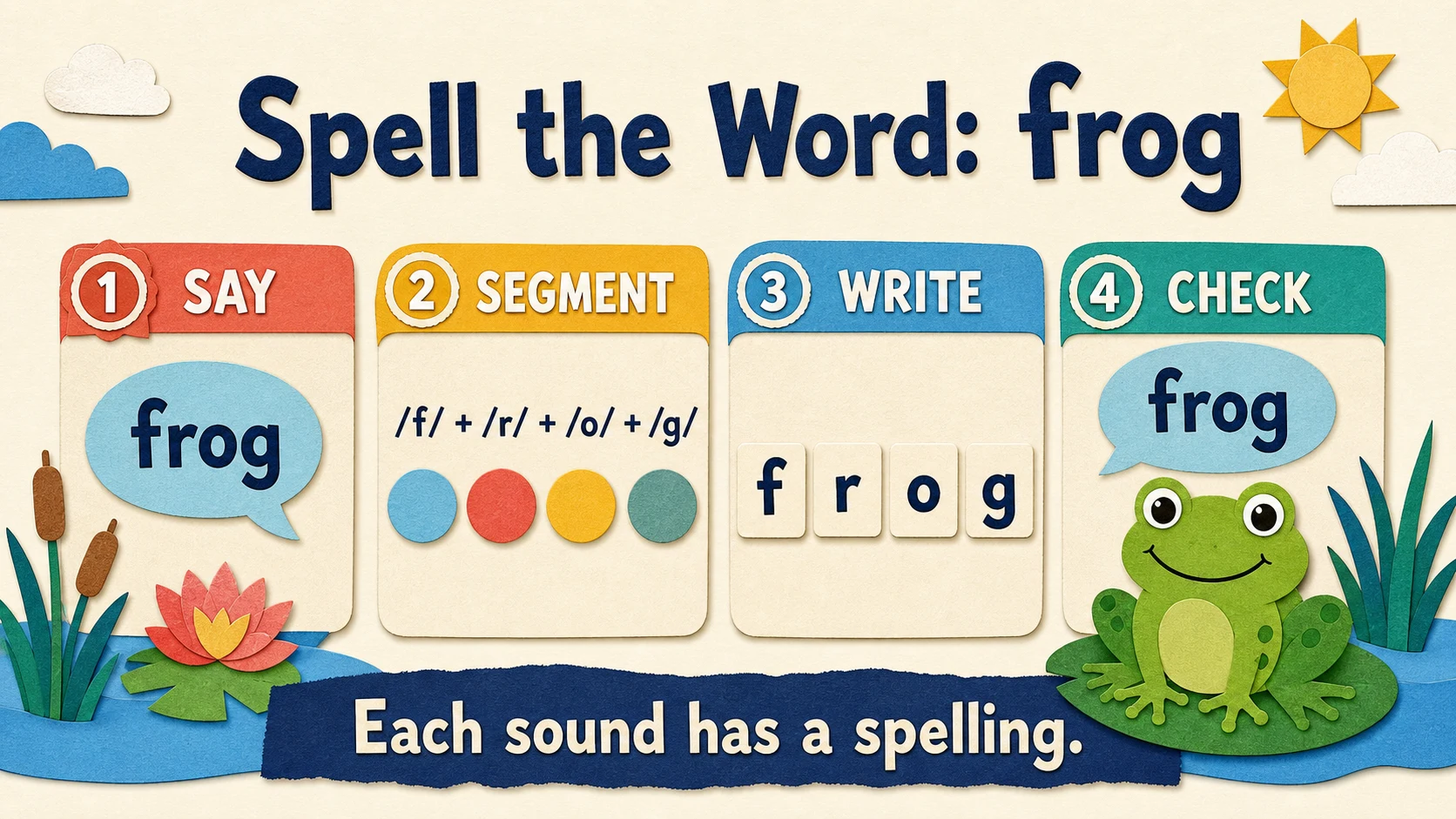
The learner first represents sounds, then chooses letters, writes the word, and verifies it.
Example 5: A high-frequency boundary case—said
Prompt: Spell said.
- Say the whole word.
- Listen for the beginning /s/ and ending /d/.
- Look carefully at the conventional spelling said.
- Mark ai as the unexpected part to remember.
- Cover the model and write the word.
- Compare letter by letter: s-a-i-d.
Answer: said
Why it matters: Sound analysis helps with the outer consonants, but it does not reliably generate the middle spelling. Sed is a plausible phonetic attempt, not the conventional spelling. This word needs explicit memory work.
A Short, Repeatable Lesson Routine
The following 10- to 15-minute routine is an instructional suggestion. Shorten it if attention or handwriting quality declines.
| Phase |
Adult action |
Learner action |
| Review |
Present two previously taught words |
Read and spell them without a model |
| Hear |
Say two or three current words |
Segment sounds with fingers, counters, or boxes |
| Notice |
Display the words and compare spellings |
Identify the shared or contrasting pattern |
| Build |
Provide tiles or letter cards |
Construct and read each word |
| Recall |
Use look-cover-write-check |
Write from memory and inspect the result |
| Transfer |
Dictate a brief sentence |
Write the target word in meaningful context |
| Record |
Note one success and one next target |
Correct the exact mismatched part |
Each lesson moves from review and analysis to recall, application, and a recorded next step.
Keep the list coherent. A lesson might use ship, shop, and shut because all begin with sh. Mixing ship, cake, rain, said, stop, and bird creates too many teaching targets for one short session.
The IES elementary writing guide recommends teaching fluency with spelling and sentence construction as parts of effective writing instruction. It also recommends giving elementary learners time to write. In practice, that high-level framing supports including a brief sentence or authentic writing check rather than keeping every spelling word isolated.
How to Select Useful Practice
Choose practice by matching the activity to the evidence you need.
When the learner is discovering a pattern
Use sound boxes, word building, and sorts. These activities make relationships visible. Select three to six closely related words rather than a long mixed list.
For a short-a lesson, map, cap, sat, and fan are more coherent than a list containing several unrelated vowel spellings. Add one contrast such as mop only when the learner can explain what changed.
When the learner knows the pattern but forgets words
Use look-cover-write-check, brief delayed recall, and cumulative review. Have the learner inspect the error instead of merely copying the correct form. If rain becomes ran, compare the missing i and read both forms.
Rainbow writing can provide an additional visual or motor review, but it should not replace recall. If the model remains visible throughout, the activity mainly shows copying.
When the learner needs transfer
Use dictation sentences and short, purposeful writing. A sentence such as “The ship is big” checks ship in context while keeping the remaining language manageable. Do not count unrelated capitalization or handwriting difficulties as spelling errors when the purpose is to inspect the target word.
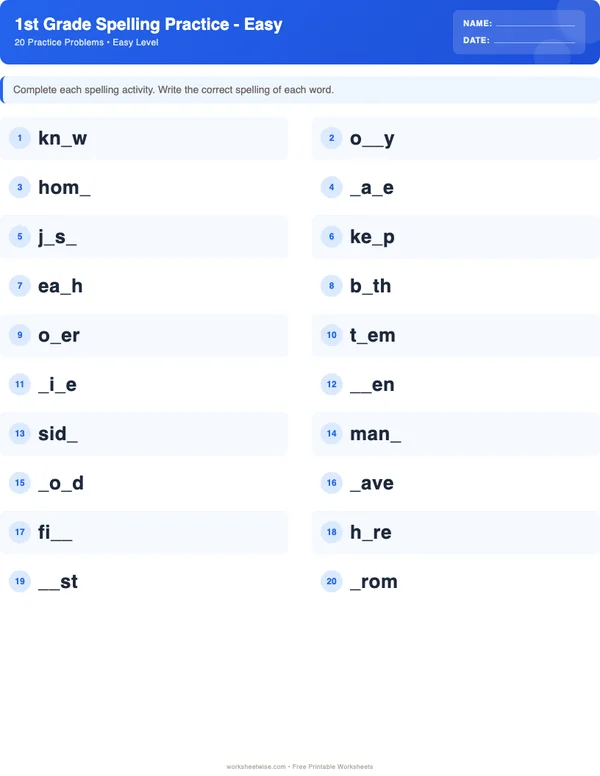
The free easy spelling words worksheet contains 20 exercises using fill-in-the-blank, word scrambles, and misspelling correction. It practices spelling, word recognition, vocabulary, and letter patterns and includes a separate answer key. Use it when those formats match the learner’s current need; it is not a substitute for direct teaching of an unfamiliar pattern.
When broader review is appropriate
The 1st Grade Spelling Words Worksheet Pack contains 18 worksheets. A larger pack is most useful when an adult intends to select among activities and revisit earlier learning. More pages do not automatically produce better pacing.
Differentiation Without Changing the Core Skill
When the work is too difficult
Reduce the number of words, not the clarity of the teaching. Keep the same pattern but provide more support:
- Say and segment each word together.
- Use counters before letters.
- Provide only the needed letter tiles.
- Let the learner build before writing.
- Contrast two words instead of sorting six.
- Dictate one short sentence rather than several.
If the learner writes only the first and last consonants, return to oral segmentation and CVC words. Moving immediately to longer words would hide the missing middle-sound skill.
When the work is appropriately challenging
Remove one support at a time. After building ship, cover the tiles and ask for a written spelling. Later, ask for the word in a sentence. Mix in one previously learned pattern so that the learner must identify rather than merely imitate the day’s category.
When the work is consistently easy
Extend within the pattern before jumping to unrelated advanced content. The catalogue suggests two or three challenge words for advanced spellers. For sh, a learner might compare ship with shop and then attempt a longer familiar word containing the same digraph.
Ask for explanation and transfer: “Which letters spell /sh/? Write another word with that spelling.” A correct explanation and accurate use in new writing provide stronger evidence than finishing a familiar page quickly.
Common Errors and Diagnostic Responses
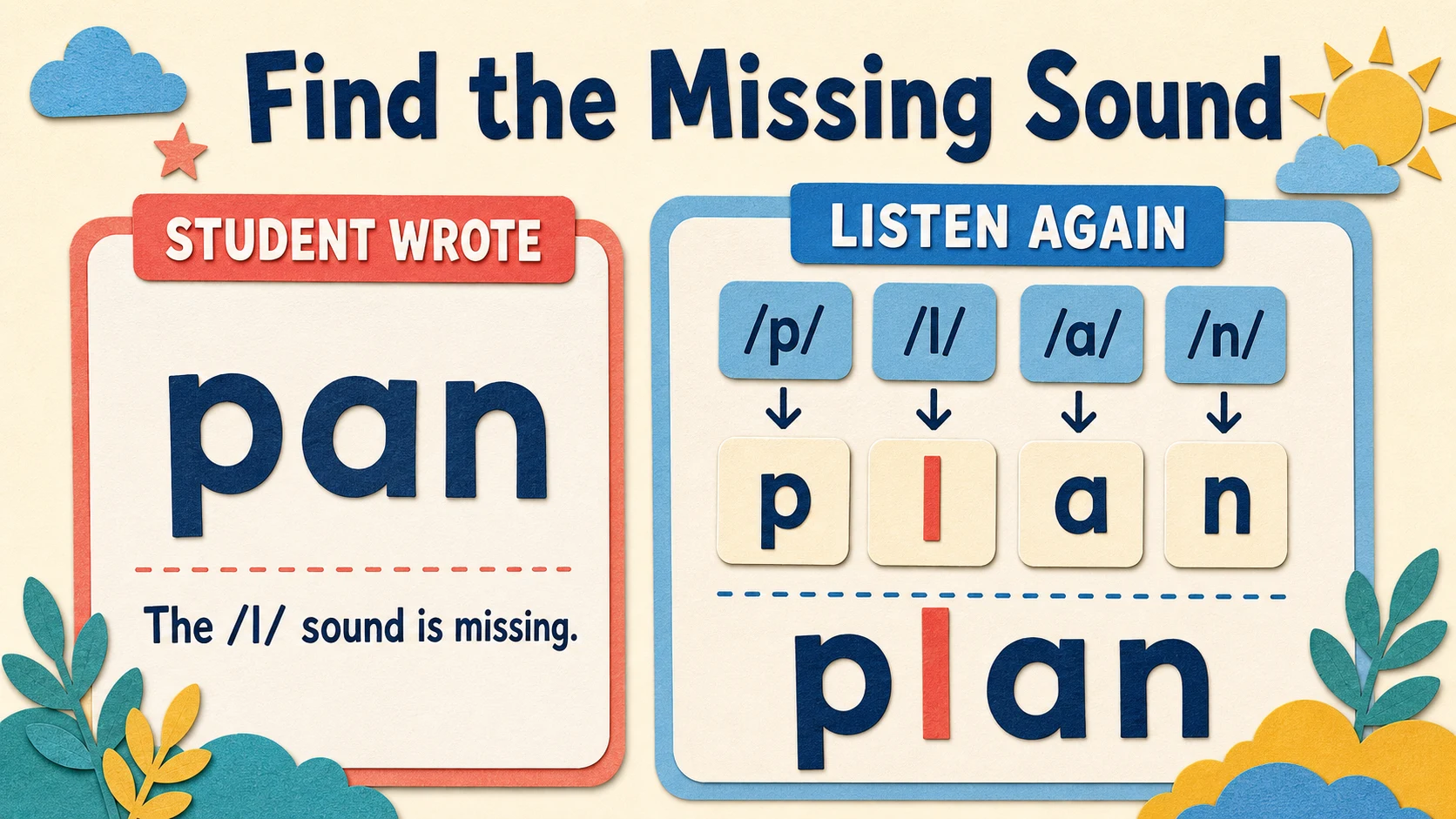
The form of an error suggests what to check next; it does not establish a diagnosis by itself.
| Observed spelling |
Likely issue to check |
Teaching response |
| mp for map |
Middle vowel was not segmented or recorded |
Stretch the word, use three sound boxes, and identify the middle sound |
| sop for stop |
One sound in the blend was omitted |
Place separate counters for /s/ and /t/ |
| sip for ship |
Digraph spelling is not secure |
Compare sip and ship; mark sh as one sound represented by two letters |
| ran for rain |
Long-vowel pattern was reduced |
Build and compare ran/rain; identify the added i |
| sed for said |
Phonetic spelling replaced conventional spelling |
Acknowledge the sound-based attempt, then mark and recall ai |
| Correct in a list, incorrect in a sentence |
Recall may depend on the isolated-list context |
Use short dictation and inspect the target word after writing |
| Letters in the wrong order |
Sequence may not be stable |
Say sounds slowly and point to each letter from left to right |
Avoid three common misconceptions.
First, an error is not proof that the learner was careless. Sop for stop gives specific information: one blend sound is missing.
Second, sounding out does not solve every word. It is highly useful for regular words, but said requires knowledge of conventional spelling.
Third, a perfect copied list is not evidence of independent recall. Cover the model, wait briefly, and ask the learner to write.
Monitoring Progress and Deciding What Comes Next
Maintain a small record with four columns: date, pattern, independent words correct, and error notes. Record exact spellings rather than only a score. “6/8” is less useful than noting that both errors omitted the second consonant in a blend.
Check learning in three conditions:
- Immediate practice: Can the learner spell the word after teaching?
- Delayed review: Can the learner spell it on a later day without seeing the model?
- Transfer: Can the learner use it correctly in a sentence or short piece of writing?
A reasonable instructional decision is to continue when errors share the same unresolved feature. If stop, clap, and best repeatedly lose a blend consonant, provide more blend analysis. Move on when current words are accurate across more than one occasion and earlier words remain reasonably stable during mixed review.
Do not demand perfect spelling in every piece of first-grade writing. The supplied catalogue distinguishes conventional spelling of common patterns and high-frequency words from phonetic attempts at untaught words. During open writing, record useful approximations and select one or two relevant spellings for later instruction rather than interrupting every sentence.
A Two-Week Practice Plan
This plan assumes ten brief sessions. It is not a universal timetable. Repeat, shorten, or replace a day according to the learner’s observed work.
| Day |
Focus |
Practice |
Quick evidence |
| 1 |
Baseline with CVC words |
Spell map, sit, hot, and cup |
Note omitted, substituted, or reversed letters |
| 2 |
Short-vowel comparison |
Build and sort map/mop and sit/sat |
Learner identifies the changed vowel |
| 3 |
Initial blends |
Segment and build stop and clap |
Both blend consonants appear |
| 4 |
Blend review in context |
Look-cover-write-check; dictate “I can stop.” |
Target word is recalled in a sentence |
| 5 |
Cumulative check |
Mix two CVC and two blend words |
Decide whether to continue or revisit |
| 6 |
Digraph sh |
Build ship, shop, and shut |
Learner explains that sh represents one sound |
| 7 |
Long-vowel contrast |
Compare cap/cape and sort cake/rain/play |
Learner notices different long-a spellings |
| 8 |
High-frequency word |
Study said with its unexpected ai |
Word is written after the model is covered |
| 9 |
Mixed retrieval |
Review current and earlier words |
Note which patterns remain stable |
| 10 |
Transfer and next decision |
Write a dictated sentence and one original sentence |
Select the next pattern from actual errors |
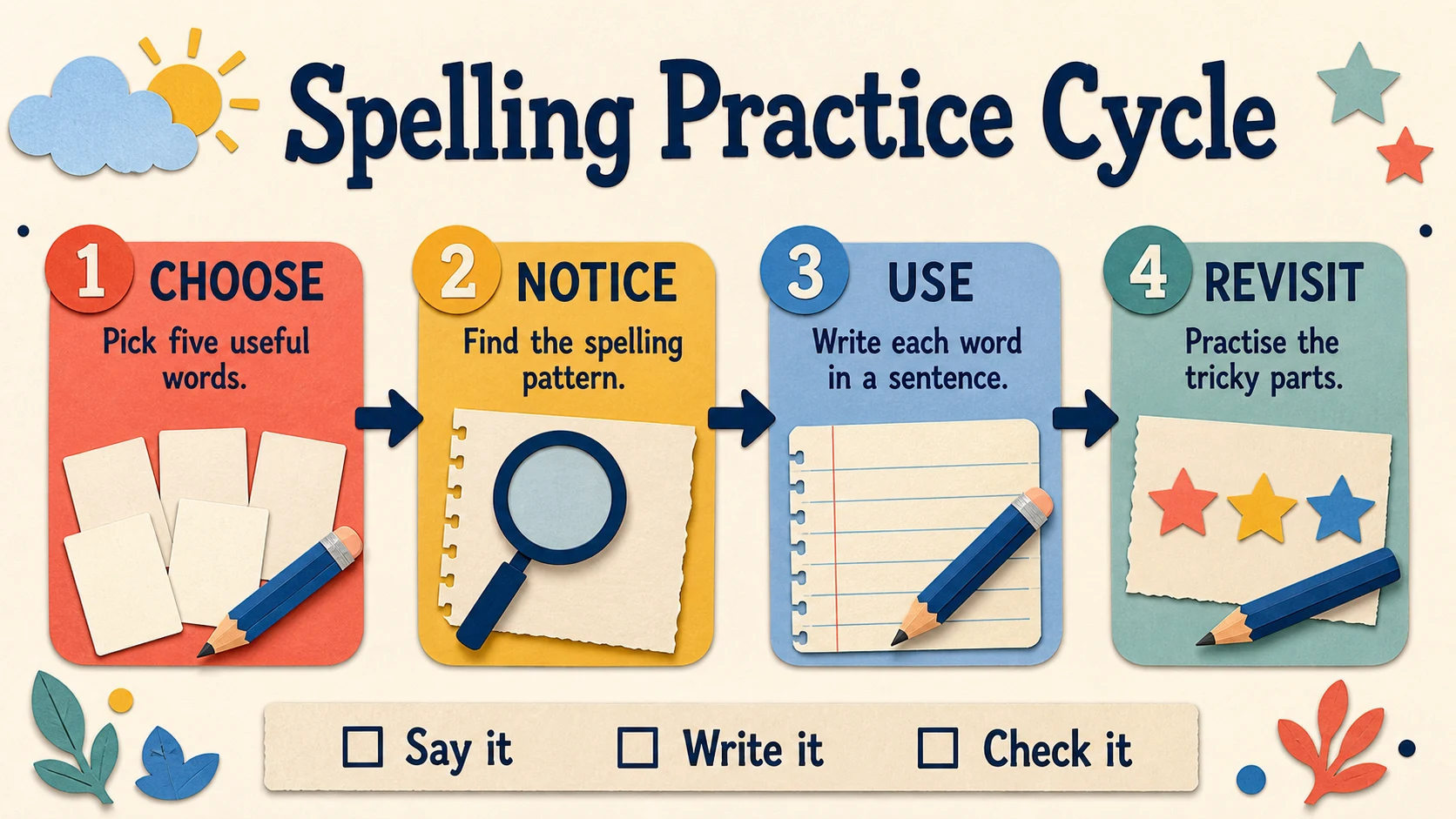
The plan alternates new learning, cumulative retrieval, and checks for written transfer.
If Day 5 shows persistent missing vowels, return to CVC segmentation. If the CVC and blend words are secure, continue to digraphs. If Day 10 shows accurate isolated words but weak sentence transfer, keep the word set and change the activity rather than adding a new list.
Limitations and an Honest Next Step
No worksheet, list, or two-week plan can determine an individual learner’s complete spelling program. Spoken language, reading instruction, handwriting demands, school sequence, and previous opportunities to practice all affect the work an adult observes. This guide does not provide medical guidance, certification, guaranteed outcomes, or comprehensive standards alignment.
A worksheet also cannot reveal every reason for an error. It can supply examples worth examining. Use the response to decide whether the next lesson should address sound segmentation, a letter pattern, conventional recall, or transfer into writing.
For a concrete next action, choose four to six words from the progression and complete one baseline lesson. Then use the free 1st Grade Spelling Words worksheet for matched follow-up practice. Record the learner’s exact spellings, identify the recurring feature, and let that evidence determine the next pattern or review lesson.