Curated collectionAnswer keys includedPrint-ready PDFs
3rd Grade Homeschool Worksheets
Turn a printable library into a flexible weekly rhythm with explicit teaching, short independent practice, answer-key feedback and mixed-age planning.
Start with a real resource
Browse this worksheet collection
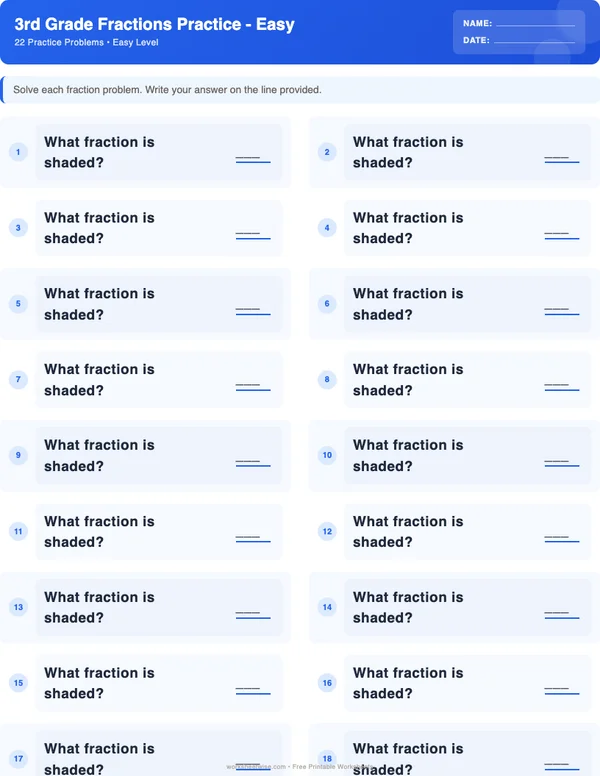
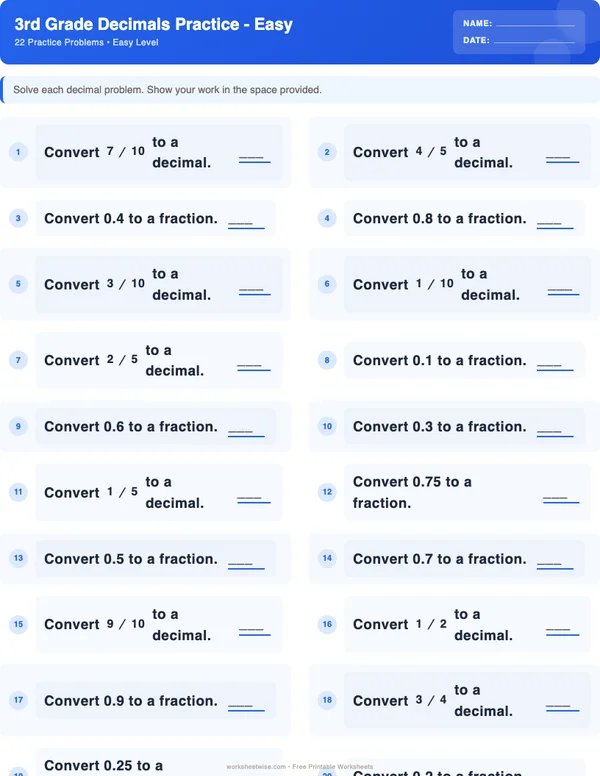
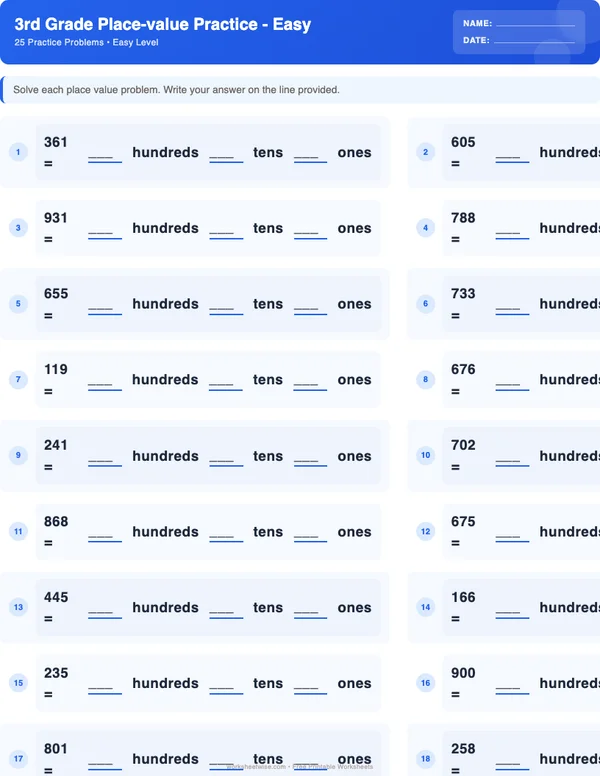
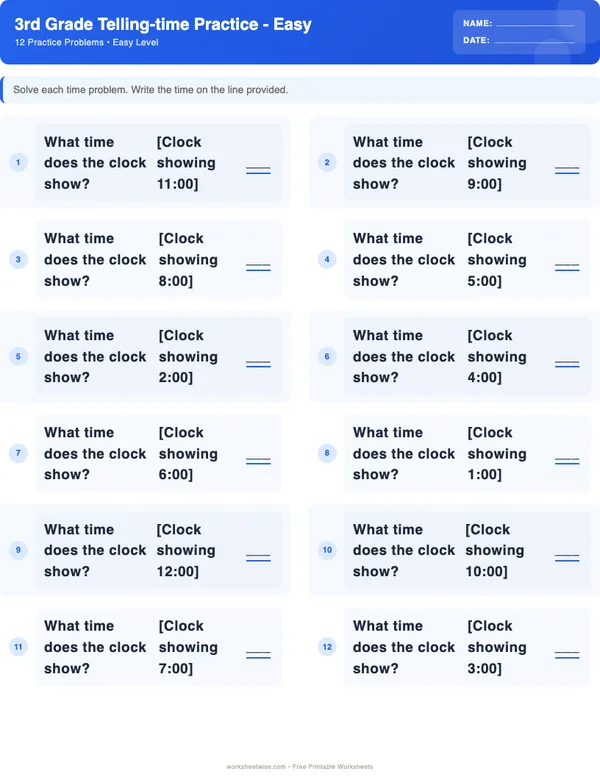
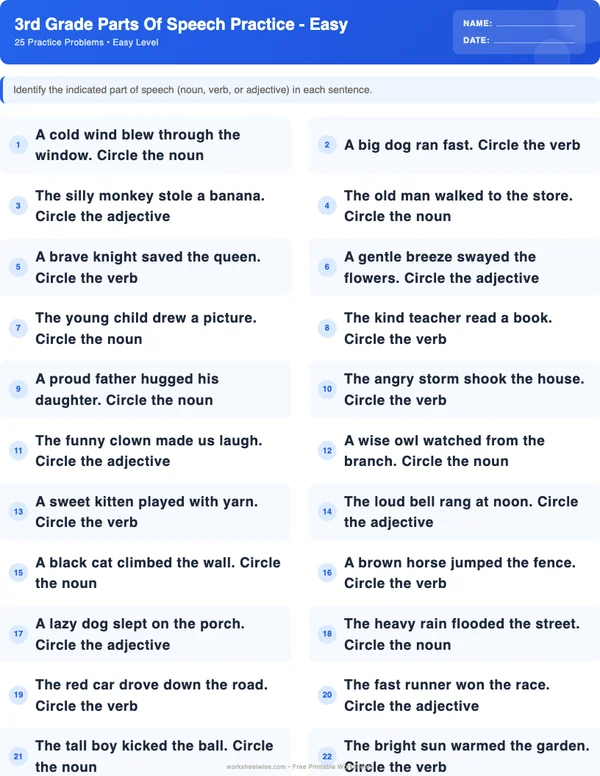
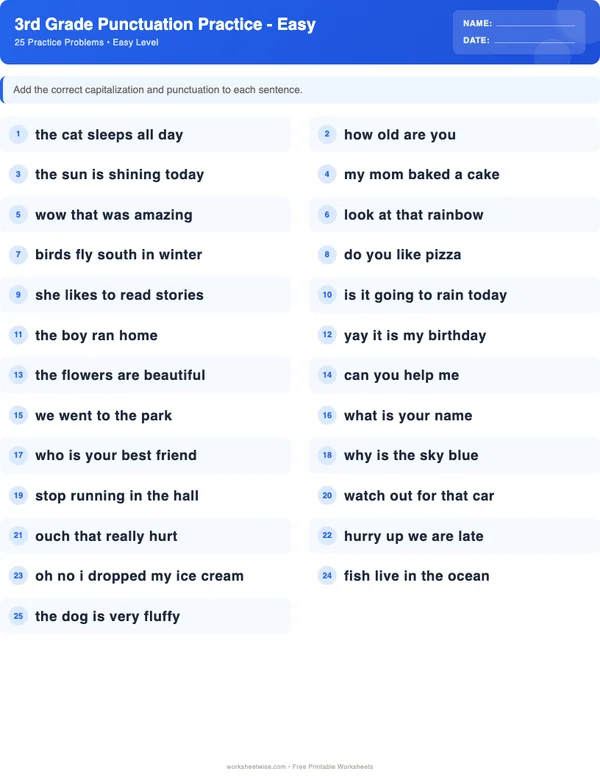
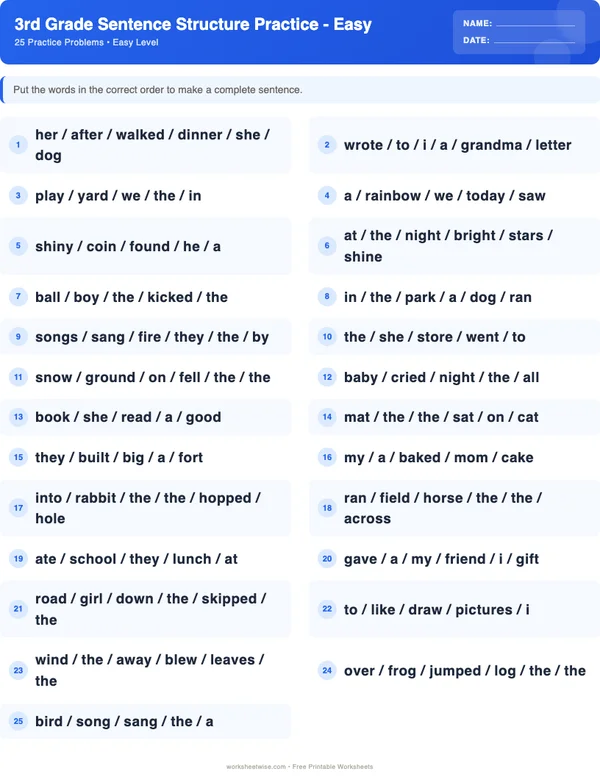
15 relevant free entry points are available. Each one includes a printable learner PDF and separate answer key.
A useful practice loop
Print less. Observe more.
- Choose one skill and model the first item aloud.
- Use a short set and notice the learner’s strategy.
- Change the next task from the work you can see.
Need more than the free sheet?
Plus includes all 270 matching catalogue variations where available, plus saved deterministic generators and the worksheet designer.
See Plus membershipComplete guide
How to teach and practise 3rd grade homeschool worksheets
3,705 words Updated 6 instructional visuals
Build a third-grade week around teach, practice, check, and revisit
A useful third-grade homeschool worksheet routine does not begin by printing a large packet. It begins by choosing one mathematical idea and one language idea for the week, teaching each idea explicitly, and assigning only enough independent work to reveal what the learner understands.
WorksheetWise’s live third-grade collection currently includes 270 worksheet variants across three subjects and 15 topics, with 15 free entry points. That breadth is useful only when each sheet has a defined job. Use worksheets for short practice, feedback, and review—not as substitutes for demonstrations, conversation, reading, manipulatives, or original writing.
A workable session has four parts:
- Teach or model one idea for 8–12 minutes.
- Solve two or three examples together.
- Assign 10–20 minutes of independent worksheet practice.
- Check selected answers immediately and decide what happens next.
That last decision matters. A correct answer with a clear explanation may signal readiness for a slightly less supported task. A wrong answer should prompt an interpretation—misread directions, weak place value, an operation-choice error, or a punctuation rule applied inconsistently—not merely another page.
Grade labels describe the intended practice level; local curriculum sequences differ. “Third grade” is therefore a starting filter, not proof that every sheet fits a particular learner today. Select from the full worksheet library by examining what the learner must actually do.
Select a sheet by task features, not by its label
The representative free sheets in this collection are marked “easy,” but that word should describe observable task features rather than a learner. In this guide, an easier entry task means that it may have one clearly stated direction, familiar representations, a single operation or rule, limited reading load, and little need to choose among strategies. A more demanding task might remove visual support, combine steps, place the unknown in an unfamiliar position, require a written explanation, or mix current and previously learned skills.
Before printing, inspect five features.
Check the mathematical or language target
Name the exact action. “Do math” is too broad. Suitable targets include:
- Add multidigit numbers while explaining a regrouping.
- Represent multiplication as equal groups or an array.
- Read an analog clock and determine elapsed time with a number line.
- Retell a word problem before choosing an operation.
- Sort spelling words by a shared pattern.
- Add commas to a list and explain why each comma belongs.
If a page tests several unconnected actions, use only the items that fit the day’s goal.
Check how much must be held in mind
A 25-problem addition sheet and a 14-problem word-problem sheet are not equivalent workloads. A word problem requires reading, identifying quantities, choosing an operation, calculating, and interpreting the result. Twelve telling-time items can also be substantial when the learner must read two clocks and find an interval.
Choose by cognitive demand, not item count. Ten carefully discussed problems may be a complete session. The remaining items can become Friday review rather than unfinished work.
Check the support built into the task
Look for pictures, clock faces, arrays, place-value structure, realistic coins, space for drawings, or a single punctuation rule. Match those supports to the lesson you just taught. If you modeled multiplication with arrays, an array-based task preserves continuity. Switching immediately to bare facts may test recall before the representation has done its teaching work.
Check whether the page can produce useful feedback
A strong practice page allows you to distinguish errors. For example, 43 − 25 = 26 suggests a specific place-value or regrouping issue: the learner may be subtracting the smaller digit from the larger digit in each column. A page containing only answers with no visible work makes that harder to see.
Ask the learner to show a model, mark the operation, underline evidence, or explain one selected response. You do not need a written explanation for every item.
Check the stopping point before beginning
Decide in advance: “Complete problems 1–10, then bring the page to me,” or “Work for 15 minutes and circle the last completed item.” A stopping rule protects attention and prevents a difficult page from taking over the day. It also makes independence measurable: the learner knows what to do, when to stop, and how to request help.
Use a repeatable session without making every day identical
A third grader can gradually manage materials and directions, but independence should be taught as a routine. Do not equate independence with being left alone for an entire worksheet.
Begin with an adult-led launch
State the target in plain language: “Today you will use place value to explain why a ten can become ten ones.” Then model one example while thinking aloud. For 52 − 38, represent 52 as five tens and two ones, trade one ten for ten ones, and show that the total remains 52. The point is not merely to obtain 14; it is to connect the written procedure to place value.
The IES practice guide on assisting students who struggle with mathematics supports systematic instruction, clear mathematical language, representations, and opportunities for students to explain their thinking. It did not evaluate WorksheetWise. Here, those principles inform how an adult can teach before assigning a printable.
Move into guided practice
Solve two items together, but change one feature at a time. After 52 − 38, try 64 − 21, which does not require a trade, and then 71 − 46, which does. Ask, “What tells you whether a trade is needed?” This question checks the decision behind the procedure.
During guided practice, establish a help routine:
- Reread the direction.
- Study the worked example or model.
- Try a drawing, array, number line, or place-value representation.
- Mark the item with a small star if help is still needed.
- Continue to the next item only when it does not depend on the unresolved answer.
This prevents “I’m stuck” from ending the whole session.
Set a short independent block
For a typical third-grade day, start with 10–15 minutes and adjust from observation. A learner who works accurately, explains a sample answer, and stops as agreed may be ready for a longer block. A learner who rushes through 25 items with repeated misconceptions needs a shorter check-in point, not a larger packet.
Independence is observable when the learner can begin from the written direction, choose an available tool, maintain legible work, flag uncertainty, and stop at the boundary. Those behaviors are more informative than completing a page without asking questions.
Close with answer-key feedback
Use the answer key after the learner has attempted the assigned section. Check a small sample together first: one early item, one middle item, and any starred item. The learner should compare, locate the first point of disagreement, and correct in a different color.
Do not turn the key into a copying device. Ask:
- “Does the key disagree with your operation, your calculation, or your written unit?”
- “Can you prove which answer is reasonable?”
- “What will you check on the next problem?”
If all sampled answers are correct, ask for an explanation of one. If the explanation is sound, finish the assignment or move to a transfer problem. If several share the same error, stop the sheet and reteach.
Plan a realistic Monday-to-Friday sequence
A sustainable week alternates new instruction, supported practice, independent application, and cumulative review. The following sequence uses representative skills from the live catalogue without requiring every topic every week.
Monday: establish one math model and one language rule
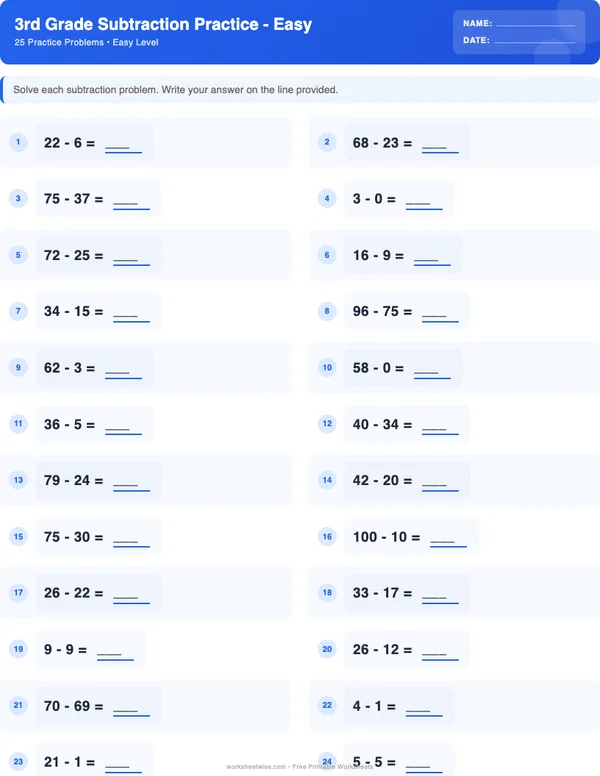
Teach a multiplication situation with objects: four plates with six counters on each. Arrange the counters into four rows of six, write 4 × 6 = 24, and rotate the array to show six rows of four. Then complete a short selection from the 3rd Grade Multiplication guide and free sheet.
Why this belongs in third-grade practice: the catalogue’s multiplication progression begins with equal groups and arrays before fact practice. The array also prepares for area reasoning and makes the commutative relationship visible.
For language, introduce one punctuation rule rather than a mixed review. Read aloud, “We packed socks shirts and hats.” Let the learner hear the list, insert commas, and explain that the commas separate items: “We packed socks, shirts, and hats.” Finish with four to six related items, not all 14 if the rule is new.
Tuesday: practice independently, then explain one decision
Return to multiplication for a 10-minute independent block. Ask the learner to draw an array for one bare equation and write a related equation by rotating it. If 3 × 8 = 24, then 8 × 3 = 24. The products match because both arrays contain 24 objects, although their row-and-column descriptions differ.
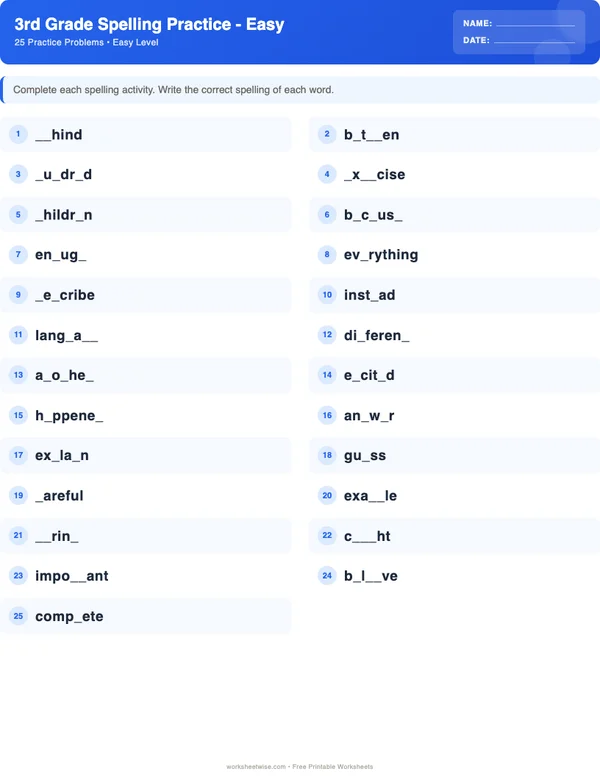
For language, sort spelling words by the pattern being studied. The catalogue describes spelling practice built around features such as vowel spellings, consonant doubling, prefixes, suffixes, and multisyllabic words. Select one pattern evident on the chosen page. Ask the learner to read each word, sort it, and use two words in original sentences. This keeps spelling connected to reading and writing rather than treating it as visual copying.
Wednesday: apply the skill in context
Choose several word problems whose structure matches known operations. Require the learner to retell each situation before calculating. A useful example is:
“Four shelves hold six books each. How many books are on the shelves?”
The learner can draw four equal bars or an array, write 4 × 6 = 24, and answer “24 books.” This example belongs because it transfers Monday’s equal-groups model into a reading context without introducing a new operation.
Do not teach keyword hunting. “Each” may be a clue here, but the equal groups—not a single word—justify multiplication. The catalogue guidance similarly recommends retelling, identifying known and unknown quantities, modeling relationships, solving, and checking.
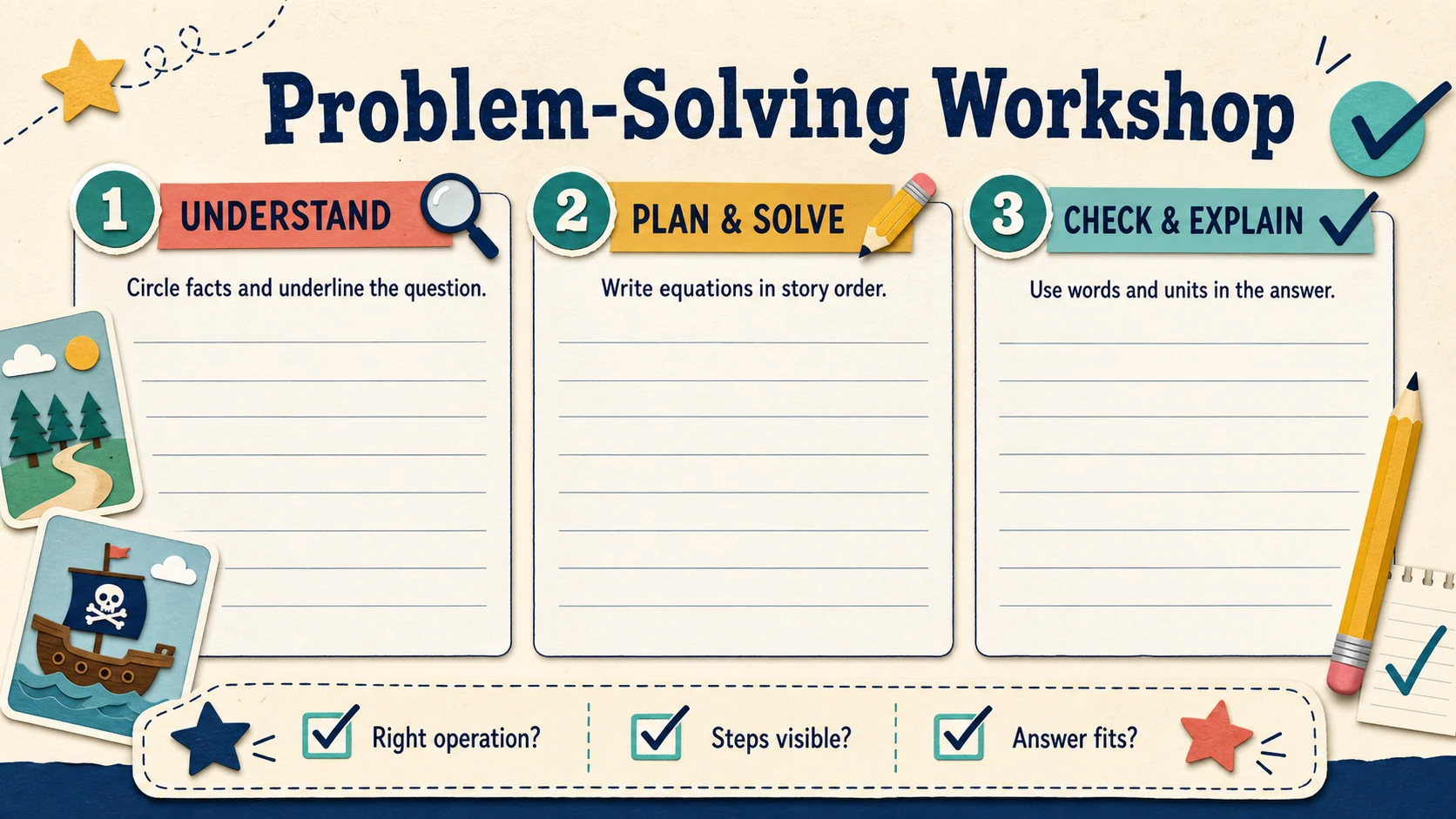
Use the two-week map to alternate modeled problem structures, short independent attempts, correction, and later retrieval instead of assigning every word problem at once.
Thursday: change the representation, not the target
Revisit the week’s multiplication fact through a missing-factor or division situation: “Twenty-four counters are placed in four equal rows. How many counters are in each row?” Model 24 ÷ 4 = 6 and connect it to 4 × 6 = 24.
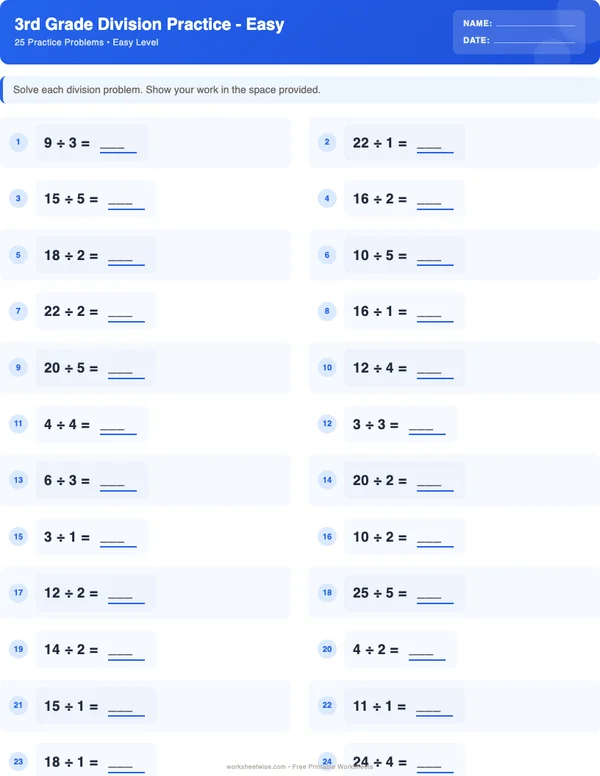
This is not a demand for formal long division. It is a check that the learner can use a known multiplication relationship to understand equal sharing. The collection’s division description includes both sharing a total among a known number of groups and determining how many groups of a given size can be formed.
For writing, ask the learner to revise two original sentences using Monday’s punctuation rule. Editing supplied sentences and punctuating one’s own writing are related but distinct tasks; Thursday checks transfer.
Friday: run a short mixed review and make next week’s decision
Use six to ten items: two multiplication items, one related division item, one word problem, one spelling-pattern item, and one punctuation edit. Do not introduce a new rule.
Sort results into three planning categories:
- Secure today: correct response plus a reasonable explanation.
- Needs another representation: a repeated conceptual error or inability to explain.
- Needs retrieval later: understood during the lesson but not recalled independently.
Next week should begin from that evidence. “Needs another representation” calls for teaching, not a harder worksheet. “Needs retrieval later” calls for two or three spaced review items, not an entire repeat packet.
Make number work concrete before expecting page fluency
Third-grade arithmetic increasingly uses written notation, but representations remain useful when they clarify why a procedure works. The IES guide Teaching Math to Young Children emphasizes developmental progressions, monitoring what children know, and teaching from informal representations toward more formal ideas. Although that guide addresses young children broadly and did not assess this catalogue, the movement from objects to drawings to symbols is relevant when a third grader encounters an unstable foundation.
Addition: require an explanation for regrouping
Consider 268 + 157.
- Ones:
8 + 7 = 15, so represent 15 ones as one ten and five ones. - Tens:
6 tens + 5 tens + 1 regrouped ten = 12 tens, or one hundred and two tens. - Hundreds:
2 + 1 + 1 = 4. - Answer:
425.
Check it by estimating: 268 is about 270, and 157 is about 160; 270 + 160 = 430, so 425 is reasonable.
This example belongs because the catalogue’s addition progression advances to multidigit addition with and without regrouping, while its teaching guidance says place value should precede the carrying procedure. If the learner writes 315, inspect whether regrouped units were recorded in the correct place rather than assigning more random sums.
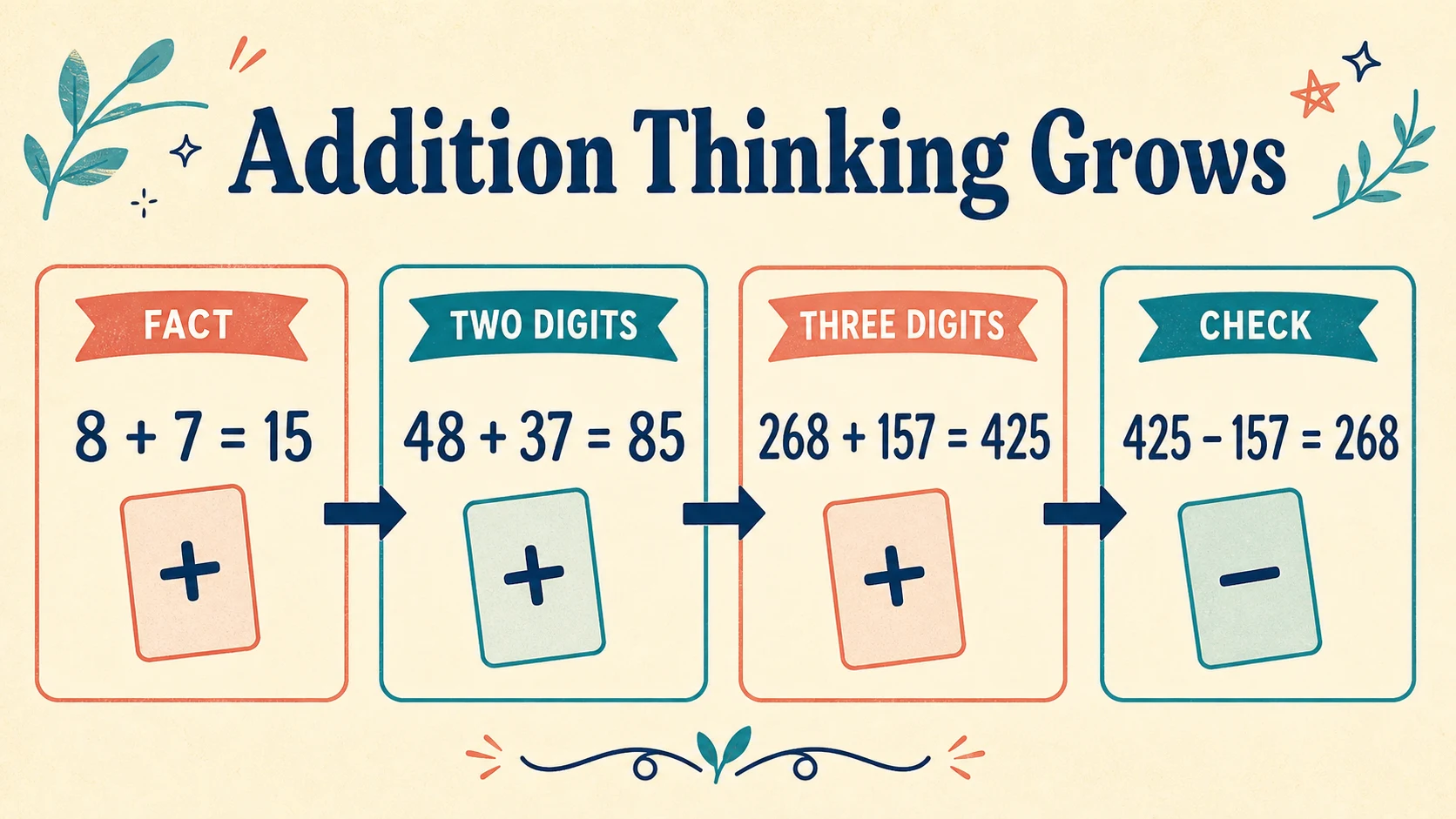
Move through this addition progression only when the learner can connect a regrouped digit to a place-value trade, not simply reproduce the written steps.
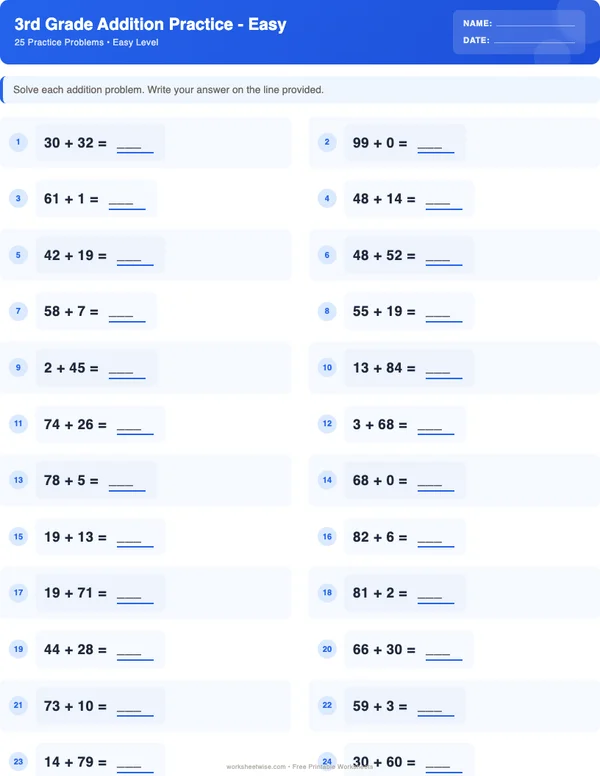
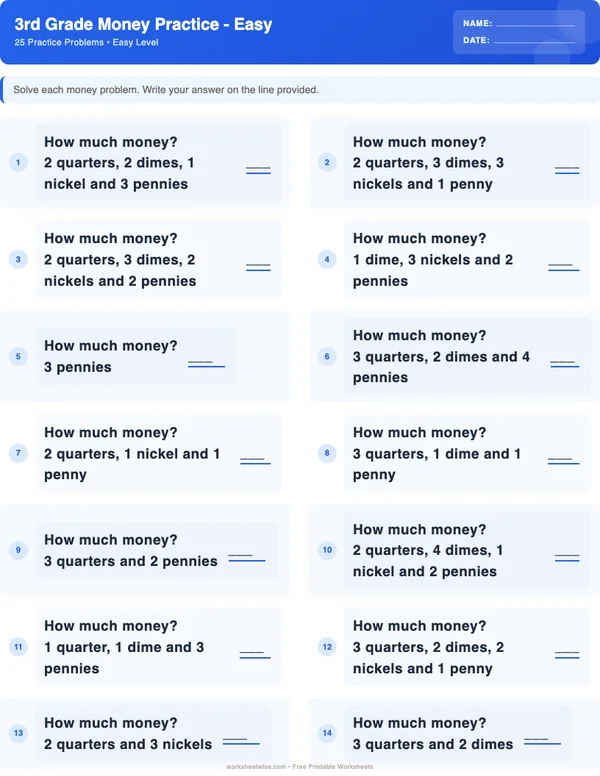
The 3rd Grade Addition guide and free sheet contains a 25-problem free entry sheet. That count is the available page length, not a required daily dose. Assign a row or selected items when the concept is still being established.
Money: count up when making change
Suppose an item costs $3.67 and the customer pays $5.00. Count upward:
- Add 3 cents to reach
$3.70. - Add 5 cents to reach
$3.75. - Add 25 cents to reach
$4.00. - Add
$1.00to reach$5.00.
The change is $1.33 because 0.03 + 0.05 + 0.25 + 1.00 = 1.33. Verify by addition: $3.67 + $1.33 = $5.00.
This checked example belongs because the catalogue’s money resources include realistic purchase contexts, counting mixed coins, and making change. Use real or play coins during teaching, then use the printable for representation and recording. If the learner reaches $1.33 but cannot construct it with coins and a dollar bill, keep the target as making change and restore the concrete materials.
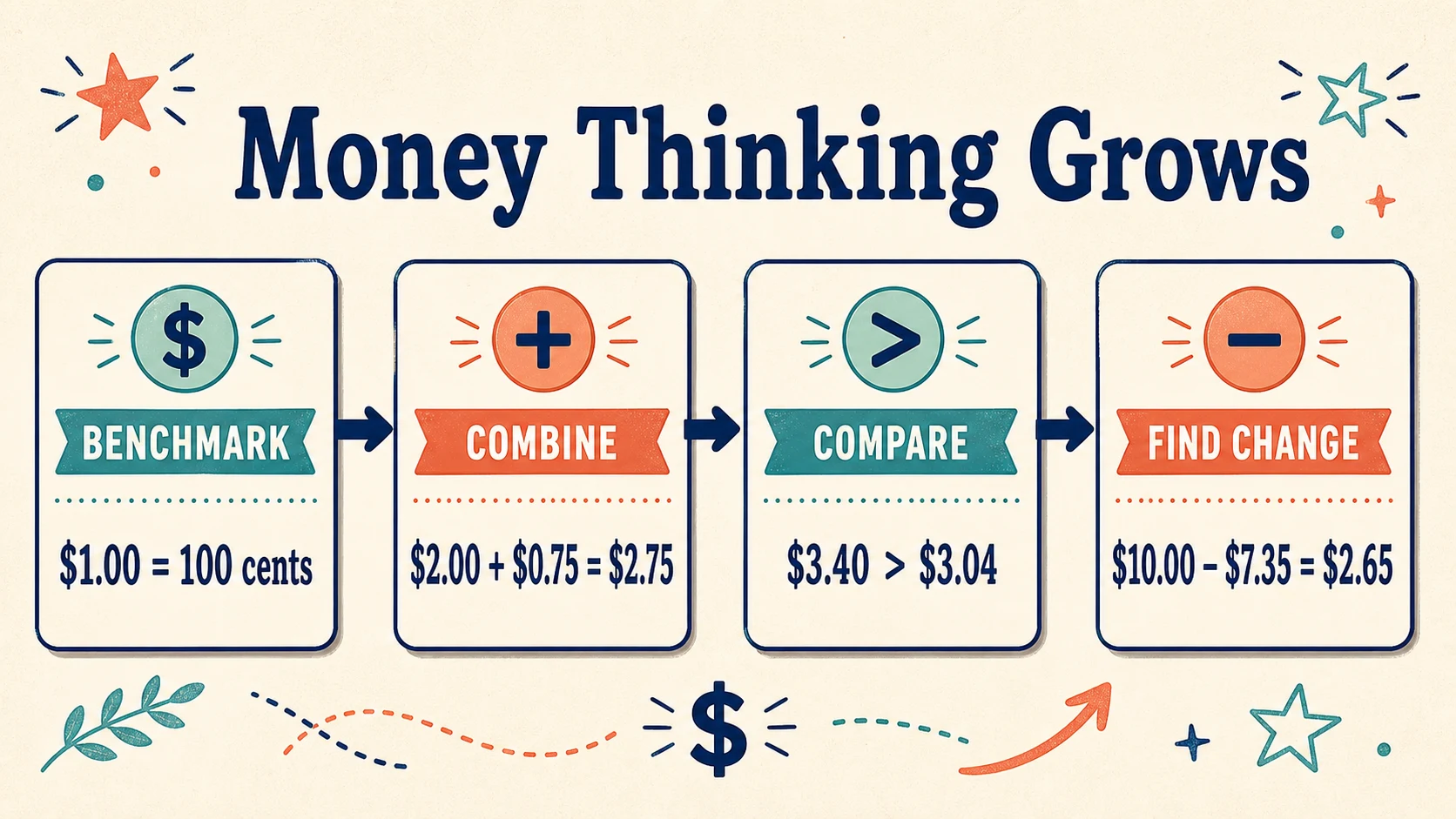
Use the supported end of the money progression to model coin values and counting-on transitions before asking for independent purchase calculations.
Connect clocks, schedules, fractions, and decimals carefully
Telling time offers useful third-grade practice because the learner must coordinate two scales: hours and minutes.
Telling time: cross the hour with an open number line
A lesson begins at 2:45 p.m. and ends at 3:20 p.m. Find the elapsed time by counting forward:
- 2:45 to 3:00 is 15 minutes.
- 3:00 to 3:20 is 20 minutes.
15 + 20 = 35, so the lesson lasts 35 minutes.
This example belongs because the live telling-time resource progresses beyond reading clock faces to schedules and elapsed time. It also exposes a common issue: treating minutes as if each hour contained 100. An answer of 75 minutes may signal decimal-style subtraction, such as treating 3.20 − 2.45 as ordinary base-ten notation. Return to a clock or open number line and show the 60-minute hour boundary.
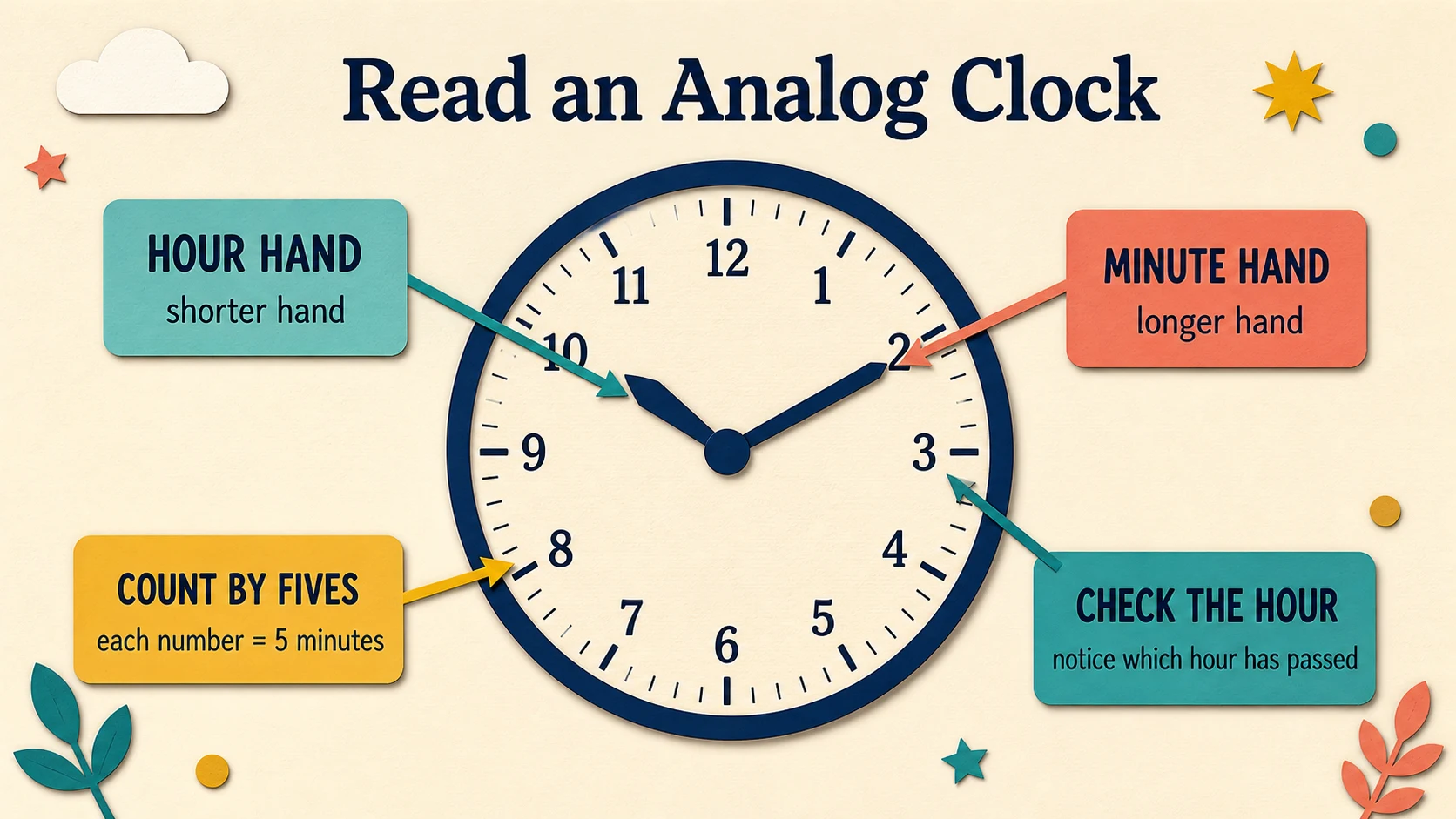
Use this skill map to decide whether the next task should stay with reading clock hands, move into five-minute intervals, or apply time to a schedule.
Decimals: preserve the place-value comparison
Compare 0.36 and 0.4. Rewrite 0.4 as 0.40. Both values now show hundredths:
0.36is 36 hundredths.0.40is 40 hundredths.- Therefore,
0.36 < 0.4.
The longer numeral is not automatically larger. A hundredths grid could show 36 shaded squares beside 40 shaded squares.
This example belongs because the catalogue’s decimal progression includes tenths, hundredths, fraction connections, comparison, and money. However, local third-grade sequences vary, and decimal content may be preview, enrichment, or later practice. Use the 3rd Grade Decimals guide and free sheet only when the learner has the prerequisite place-value and fraction understanding.
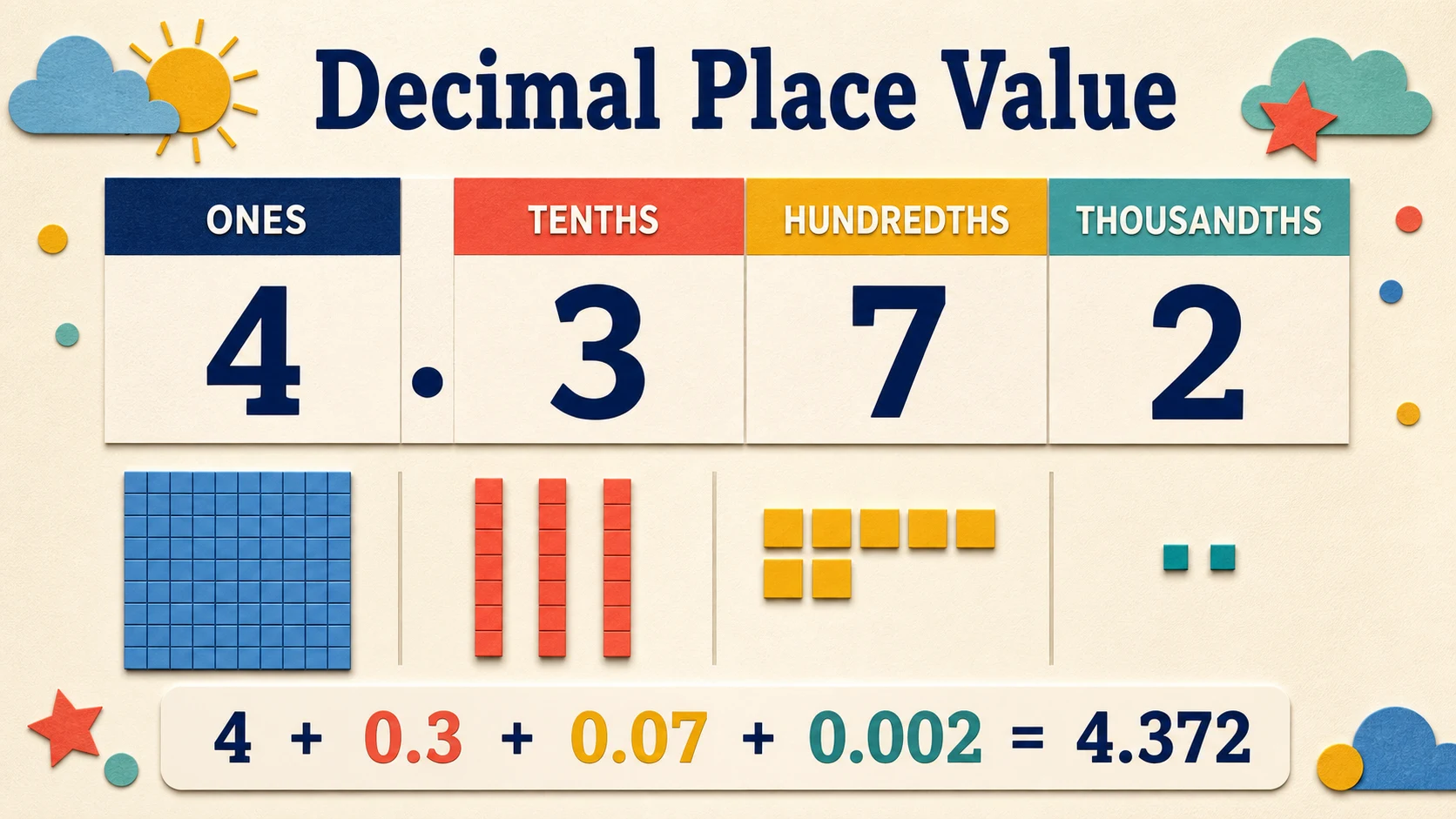
Follow the decimal map from tenths and hundredths representations toward comparison; do not begin with unsupported computation merely because it appears farther along the page.
The Common Core mathematics standards are one possible reference for grade-level expectations, but they are not a universal homeschool sequence and have not assessed WorksheetWise. Use them, where locally relevant, to understand the intended progression—not to declare mastery from one worksheet.
Read errors as information for the next lesson
Marking every incorrect response with the same symbol hides useful distinctions. Instead, identify the earliest point where the reasoning changed course.
Arithmetic errors
For 43 − 25 = 26, ask the learner to build 43 with base-ten blocks. If they try to calculate 5 − 3 in the ones place because 5 is larger, reteach regrouping and place position. Preserve the subtraction target; do not simplify the task into unrelated single-digit facts unless those facts are also insecure.
For 6 × 7 = 36, ask for an array or decomposition. The learner might know 5 × 7 = 35 but fail to add one more group of 7. Showing 6 × 7 = (5 × 7) + 7 = 42 reveals a strategy and lets you see whether the problem lies in multiplication structure or addition.
For a word problem with correct computation but the wrong operation, return to the situation. Ask the learner to retell it and model the quantities. More computation practice will not resolve an interpretation error.
Punctuation errors
Consider three responses:
Did you bring the map.uses a period instead of a question mark.We bought apples bananas and pears.omits commas in a list.The dogs leash is red.omits a possessive apostrophe.
These are not one generic “punctuation problem.” They involve sentence purpose, list separation, and possession. Teach one rule, read or manipulate examples, and then check that rule in an original sentence.
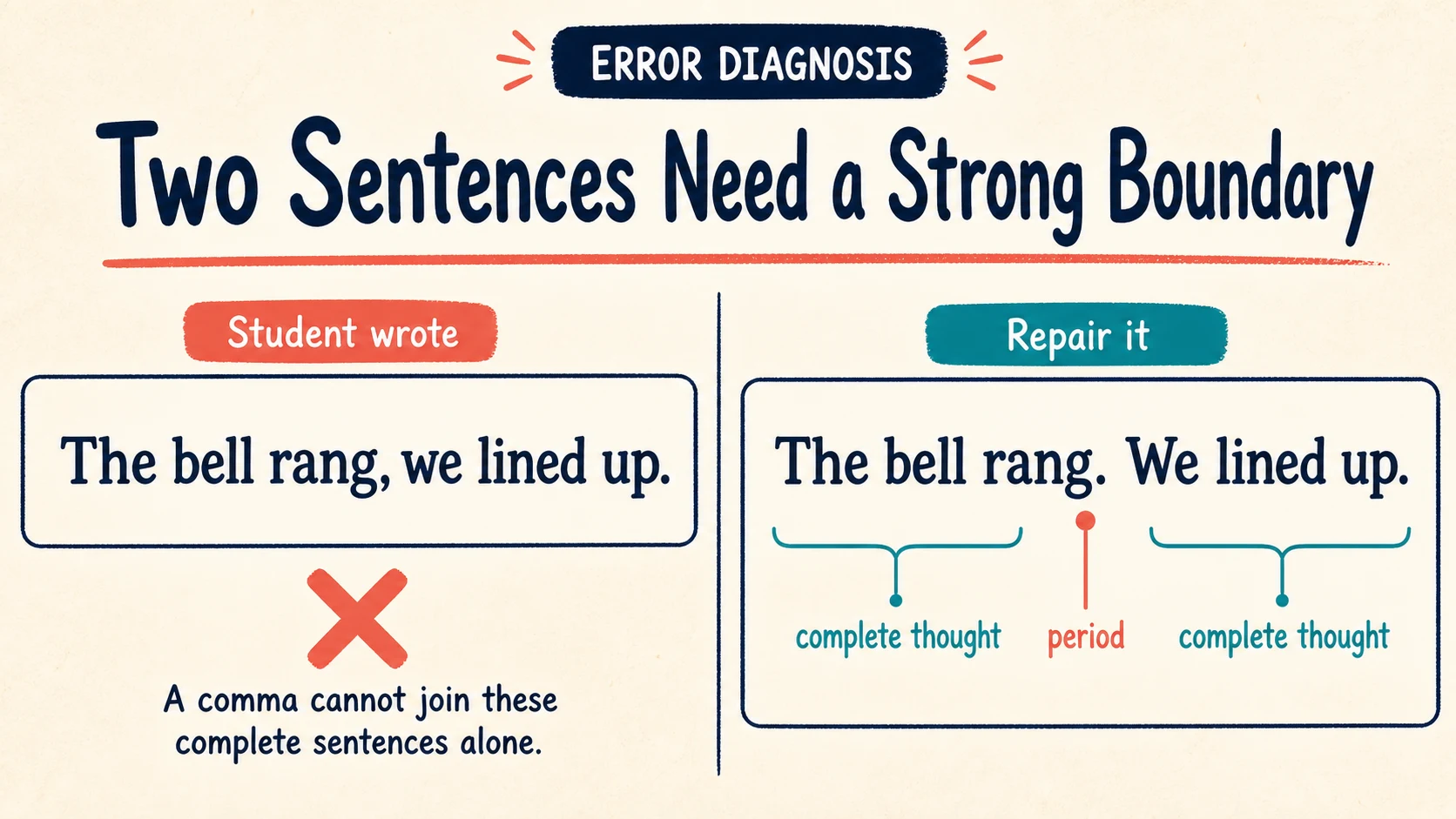
Use each punctuation pattern to choose a focused response: reread for sentence purpose, group list items, or distinguish ownership from plural nouns.
The IES guide on teaching elementary students to be effective writers recommends explicit strategy instruction, attention to the writing process, and regular opportunities to write. Applied here, a punctuation worksheet should lead back into authentic sentences. The source offers general instructional guidance; it does not endorse or evaluate these worksheets.
Fluency and reading-load errors
If the learner solves a word problem correctly when it is read aloud but not when reading independently, the arithmetic may not be the immediate obstacle. Shorten the reading load, preteach unfamiliar vocabulary, or allow the learner to mark known and unknown quantities. Preserve the mathematical relationship.
The IES Foundational Skills practice guide emphasizes explicit work connecting sound, print, word reading, and connected text. It is not a third-grade worksheet review, but it supports the broader principle that reading difficulty requires reading instruction rather than being mislabeled as weak mathematical reasoning.
Adapt the work while preserving its third-grade target
An adaptation is useful only if it removes an irrelevant barrier without quietly replacing the skill.
For a learner who tires during handwriting, let the learner say answers while you record some of them—but still require the mathematical explanation or punctuation decision. For a learner overwhelmed by page density, cover all but one row. For a learner who loses place while counting coins, arrange coins from greatest to least value before counting on. For a word problem, read the text aloud while leaving the learner responsible for representing and solving it.
Avoid adaptations that erase the target. If the goal is choosing an operation from a word problem, telling the learner “multiply” removes the central decision. If the goal is decimal comparison, converting the task into whole-number comparison without reconnecting the decimal places changes the skill. If the goal is punctuation in original writing, correcting every sentence for the learner leaves only copying.
For a more capable sibling working nearby, vary complexity rather than accelerating the third grader indiscriminately. A younger sibling can sort play coins or build equal groups while the third grader calculates totals and change. An older sibling can solve a related multistep purchase problem or justify two methods. The 2nd Grade Homeschool Worksheets and 4th Grade Homeschool Worksheets provide adjacent entry points when mixed-age planning requires separate practice levels.
Age, when shown in discovery tools, is a discovery aid rather than a placement decision. Placement should come from task observation, prerequisite knowledge, and the learner’s response to instruction. For ages three and four, prioritize brief adult-led oral, matching, manipulative, and movement work over desk work.
Know what a printable can and cannot establish
A completed page can show what happened under particular conditions on one day. It cannot diagnose a learning condition, establish comprehensive mastery, prove curriculum alignment, or predict later outcomes.
Answer keys can confirm expected responses, but they cannot explain why an error occurred. A learner may guess correctly, use a fragile procedure, misunderstand a word, skip a line, or make a single recording error. That is why one oral explanation or model should accompany selected answers.
Worksheets also do not replace:
- Read-alouds and independent reading.
- Conversation about meaning and vocabulary.
- Manipulation of objects, coins, clocks, and geometric materials.
- Mental math and number talks.
- Original composition and revision.
- Games, movement, experiments, and practical household mathematics.
Use the catalogue count as a menu, not a completion target. There is no instructional advantage in moving through all 270 variants simply because they exist. A smaller set revisited with increasingly independent reasoning is often more informative.
Turn today’s evidence into Monday’s plan
At the end of the week, choose one observable next action. Do not write “practice more.” Write something you can see and check:
- “On Monday, model one regrouping trade, then assign addition problems 1–8.”
- “Ask the learner to retell two multiplication word problems before choosing an operation.”
- “Build and compare
0.36and0.40on hundredths grids.” - “Edit four list sentences, then write one original sentence containing three items.”
- “Use an open number line for two elapsed-time intervals that cross an hour.”
For a practical start, open the free deterministic worksheet generators and create one short mixed review containing only skills already taught this week. Set a clear stopping point, check one explanation with the learner, and use the first repeated error—not the number of pages completed—to choose the next lesson.
Put it into practice
Use the guide with a real printable
Move from explanation to a short, observable practice task. Check the first item together, then adjust the next session from the learner's actual work.
Open the first free worksheetExplore a neighboring collection