Curated collectionAnswer keys includedPrint-ready PDFs
Pre-K Homeschool Worksheets
Turn a printable library into a flexible weekly rhythm with explicit teaching, short independent practice, answer-key feedback and mixed-age planning.
Start with a real resource
Browse this worksheet collection
5 relevant free entry points are available. Each one includes a printable learner PDF and separate answer key.
A useful practice loop
Print less. Observe more.
- Choose one skill and model the first item aloud.
- Use a short set and notice the learner’s strategy.
- Change the next task from the work you can see.
Need more than the free sheet?
Plus includes all 90 matching catalogue variations where available, plus saved deterministic generators and the worksheet designer.
See Plus membershipComplete guide
How to teach and practise preschool homeschool worksheets
3,253 words Updated 6 instructional visuals
Build a Pre-K week around teaching, not page completion
A useful Pre-K homeschool routine does not begin with a stack of worksheets. It begins with one small skill, a brief adult model, hands-on practice, and only then a few carefully chosen items on paper. The current WorksheetWise Pre-K collection contains 90 worksheet variants across two subjects and five topics: counting, CVC words, short vowels, word families, and sight words. Each topic has a free 20-problem entry sheet, but 20 available problems should not be mistaken for one required sitting.
For most Pre-K sessions, plan about 10–15 minutes for the target skill:
- Spend two or three minutes demonstrating the idea aloud.
- Let the child respond with objects, movements, sounds, or letter tiles.
- Complete three to five worksheet items together.
- Invite one or two independent attempts if the child understands the directions.
- Check the work immediately and finish with a successful oral or hands-on example.
That sequence turns the printable into evidence about today’s understanding. It also gives the adult a clear decision: continue, change the representation, or stop and revisit the skill another day.
Age is a discovery aid rather than a placement decision. For ages three and four, prioritize brief adult-led oral, matching, manipulative, and movement work over desk work. A four-year-old who can count a row of six bears accurately may still need help marking an answer. Another child may control a pencil well but not yet coordinate one spoken number with one object. Choose by the task the learner can perform, not by birth date or the amount of paper completed.
Grade labels likewise describe an intended practice level; local curriculum sequences differ. The activities below are teaching suggestions based on the verified catalogue, while cited guidance comes from the named external organizations. Neither source type can diagnose a learner or guarantee a particular outcome.
Select a sheet by what the child must actually do
The free sheets are catalogued as “easy,” but that label should describe observable task features, not the learner. At this level, an easier task has a short direction, few competing choices, familiar pictures or letters, one repeated response type, and a target that the adult has already modeled. A task becomes more demanding when it mixes several vowel sounds, requires writing rather than pointing, presents scattered objects, removes picture support, or expects the child to remember a direction across many items.
Use four questions before printing:
- What single skill will I teach?
- Can the child show that skill without a pencil?
- What part of the page adds difficulty: language, visual scanning, handwriting, memory, or the target itself?
- How many items would give useful evidence without turning the session into endurance?
The five catalogue topics are not interchangeable. Use the Pre-K Counting guide and free sheet when the target is coordinating number words with objects or noticing a number sequence. Choose the Pre-K Short Vowels guide and free sheet when the child is listening for the middle vowel sound. Move to the Pre-K CVC Words guide and free sheet when the child is ready to blend three sounds into a word. Word-family work is useful when the child can compare a stable ending such as -at while changing the initial sound. Sight-word work has a different purpose: learning a small set of frequently encountered words through repeated, meaningful review.
Match the response mode to the real target
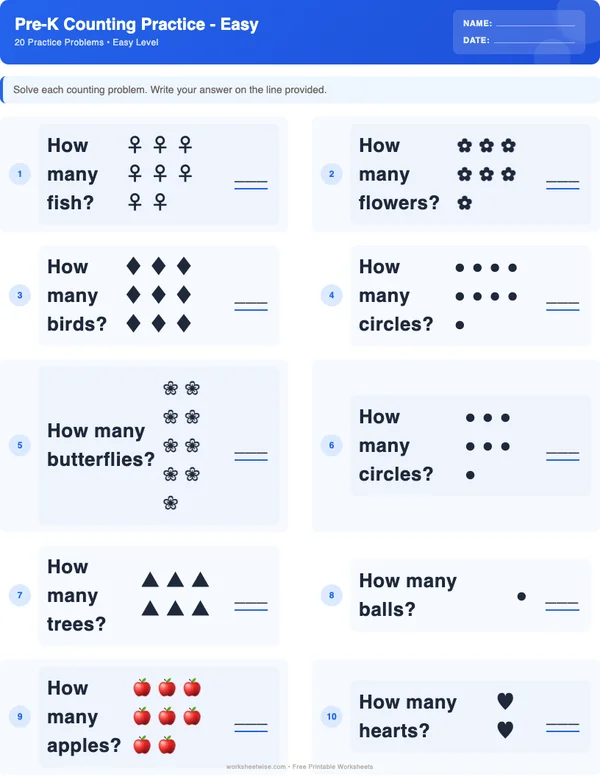
If the target is counting, do not let weak pencil control obscure whether the child understands one-to-one correspondence. The child can point, move counters, circle a choice, or tell the adult what to mark.
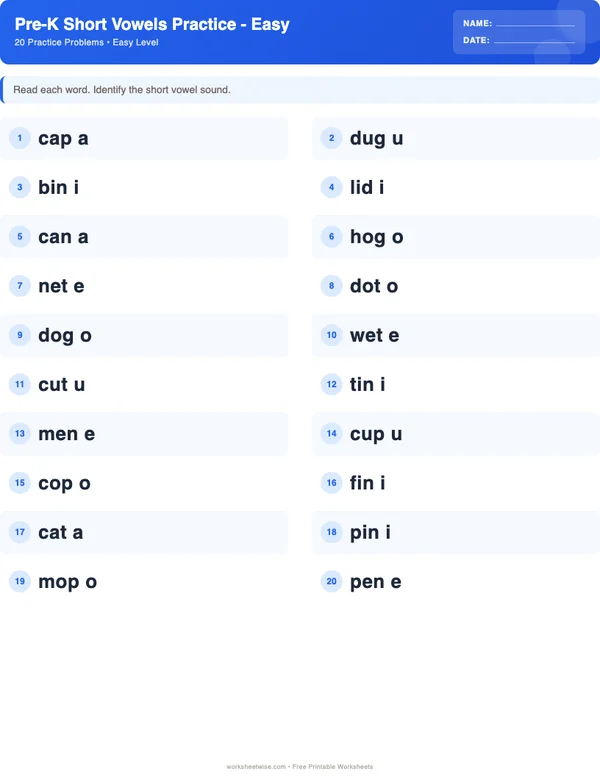
If the target is hearing short a, writing all three letters in cat is an additional encoding demand. Ask the child to choose between picture cards, place an a tile in the middle, or say the vowel sound first. Add writing only when it will provide relevant evidence.
Preserving the target does not mean eliminating all challenge. It means removing unrelated barriers. Holding a crayon, recalling three-part directions, decoding an unfamiliar picture, and hearing a vowel should not all become one unplanned test.
Establish a repeatable 12-minute lesson boundary
A firm session boundary helps an adult remain responsive. “Finish the page” provides no natural stopping point when a sheet has 20 problems. A short routine does.
Minute 0–3: model one decision
Show exactly what the learner will decide. For counting, place five buttons in a loose group. Touch each button once while saying “one, two, three, four, five,” then state, “The last number tells how many.”
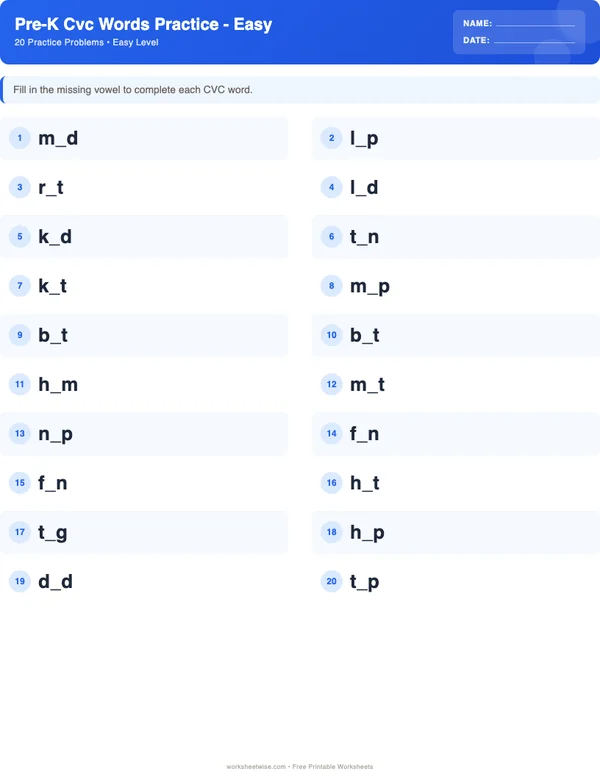
For CVC blending, place c, a, and t in three sound boxes. Say the sounds continuously, sweep a finger beneath the letters, and say cat. Do not begin with a long explanation of consonants and vowels.
Minute 3–7: respond with objects, voice, or movement
Give two or three oral or manipulative turns. A child counting buttons can slide each counted button into a cup. A child distinguishing short vowels can perform the catalogue’s anchor motion—pretending to bite an apple for short a—and then identify the middle sound in map.
The IES guide on teaching mathematics to young children recommends helping young learners notice and use mathematical ideas through developmental progressions, monitoring, and everyday activity. In this routine, that supports beginning with real objects and observing how the child counts before expecting a written response. It does not establish that a specific WorksheetWise sheet fits every child.
Minute 7–10: complete a small paper sample
Choose three to five items that repeat the modeled action. Cover the rest of the sheet with blank paper if the full page is visually distracting. Read the directions aloud. Complete the first item together, then release responsibility one step at a time.
Minute 10–12: check and close
Check the sample while the objects, sounds, and reasoning are still available. Ask the child to explain or demonstrate one answer. End with an item the child can complete accurately with light support. Record a short note such as “counts six in a row; recounts scattered set” or “hears /a/ in map; guesses in sit.”
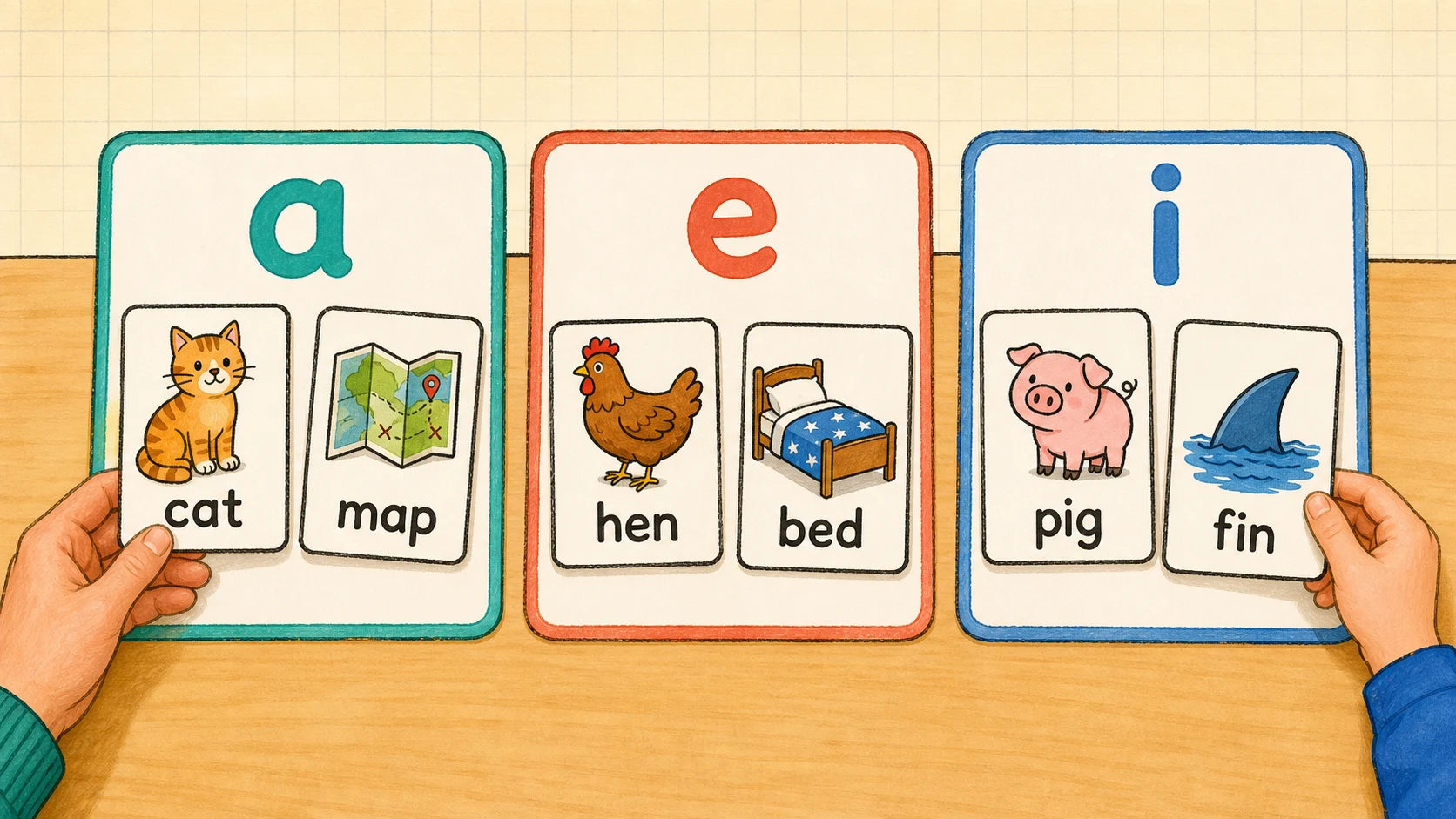
Use the short-vowel routine as a session boundary: one modeled sound, a few oral contrasts, a small paper sample, and immediate review.
Plan five days without assigning five full sheets
A realistic week revisits skills while varying the response. The following sequence uses counting as the main strand and introduces phonics in small doses. It is a suggested plan, not a sourced curriculum sequence.
Monday: establish the counting action
Model counting five counters in a line. The child touches or moves each counter while saying one number word. Rearrange the same five counters and count again. Then complete three counting-sheet items together.
The important evidence is not whether the child can recite “one, two, three, four, five.” Watch whether one number is assigned to each object and whether the final number is understood as the total.
Tuesday: keep the quantity, change the arrangement
Present five counters scattered across a tray. Ask, “How could we make sure each one is counted once?” The child might move each counter into a row or place counted objects in a cup. Complete two familiar paper items and one item with a less orderly arrangement.
Add three minutes of oral short-vowel work: demonstrate a as in apple, then contrast map and sit. Pointing or performing the anchor motion is sufficient.
Wednesday: introduce a phonics model
Use three tokens and three connected boxes for cat. Say /c/, /a/, /t/ while moving one token per sound, then sweep beneath all three and blend cat. Build mat by changing only the first letter. Complete no more than three closely matched CVC items.
Finish by counting the three sound tokens. This gives a mixed-age household a shared object activity without pretending that phoneme segmentation and counting are the same skill.
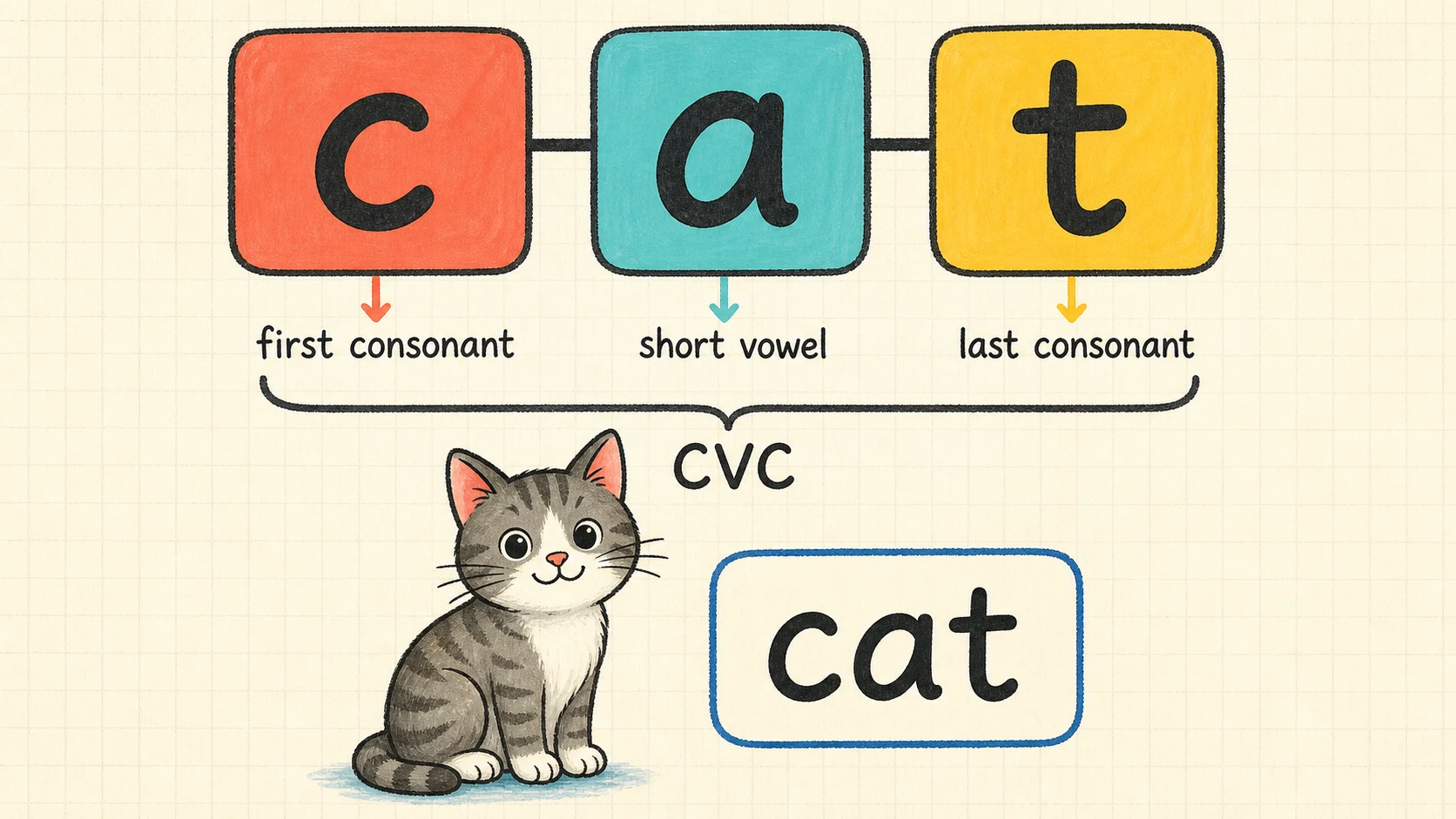
The CVC sequence connects hearing three sounds, matching sounds to letters, blending the word, and later spelling it; a worksheet samples parts of that sequence.
Thursday: retrieve rather than add
Return to Monday’s counting target with a new set of four to eight objects. Do not demonstrate immediately. Ask the child to show how to count them. If the process is accurate, offer two independent worksheet items. If not, restore the move-and-count model.
Review cat and mat with tiles. Avoid adding several vowels simply because the first pair worked yesterday. Retrieval of a narrow target is more informative than rapid exposure to many patterns.
Friday: review the evidence and choose next week
Use one counting item, one oral vowel contrast, and one CVC build. Keep the review under 15 minutes. Compare the child’s action with the week’s notes:
- Does each object receive one number word?
- Can the child preserve the total after objects are rearranged?
- Can the child hear short a in a modeled CVC word?
- Can the child blend cat after the adult demonstrates the sweep?
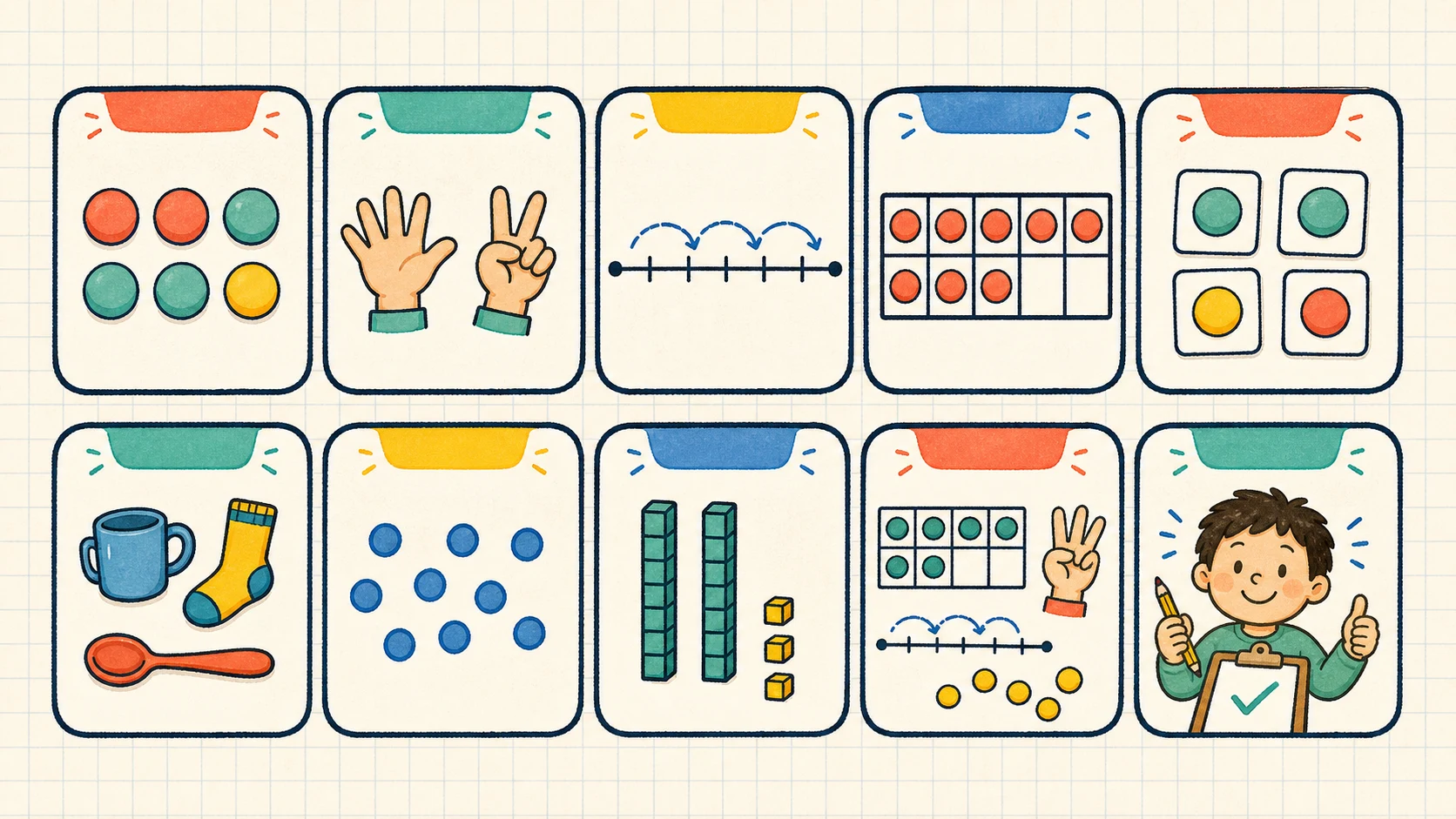
Across two weeks, change the objects and arrangements before increasing the quantity; review should reveal whether the counting action transfers.
If the answers are mixed, keep the same target and change the support. A new week does not require a new topic.
Check four Pre-K examples from model to answer
These examples have been checked against the stated skill definitions and use words or quantities appropriate to the verified catalogue topics.
Example 1: count a scattered set of seven buttons
Place seven buttons irregularly on a mat. Ask the child to find how many there are. An accurate method is to move one button at a time into a row while saying “one” through “seven.” There are seven buttons because seven objects have each received one number word, and the final spoken number is seven.
This belongs in Pre-K because the catalogue specifies counting to 20 with concrete objects. It also exposes more than reciting a memorized sequence. If the child counts one button twice, return all buttons to the starting area and create a “counted” area. Do not simply announce that seven is correct; repair the counting action.
Example 2: identify the vowel in map
Say map slowly, emphasizing the middle without separating the word beyond recognition: /mmmaaap/. Ask which vowel sound is heard in the middle. The answer is short a, represented by a. Check: map has the CVC structure m-a-p, and its middle sound matches the catalogue anchor a as in apple.
This belongs here because short-vowel discrimination is a prerequisite within the catalogue’s CVC progression. If the learner says i, contrast map with mip orally, even though mip is not a familiar word. Ask which version sounds like the known word, then rebuild map with tiles. The goal remains hearing and representing the middle sound, not knowing the picture label from memory.
Example 3: blend cat and change it to mat
Place c, a, and t in three boxes. Blend continuously: /cccaaat/ → cat. Replace c with m while leaving a and t untouched. Blend /mmmaaat/ → mat. The checked change is only the initial consonant; the -at ending and short a remain stable.
This is a suitable Pre-K CVC example because both words follow the consonant-vowel-consonant structure named in the catalogue. It also limits working demands: the child attends to one changed sound rather than rebuilding the entire word.
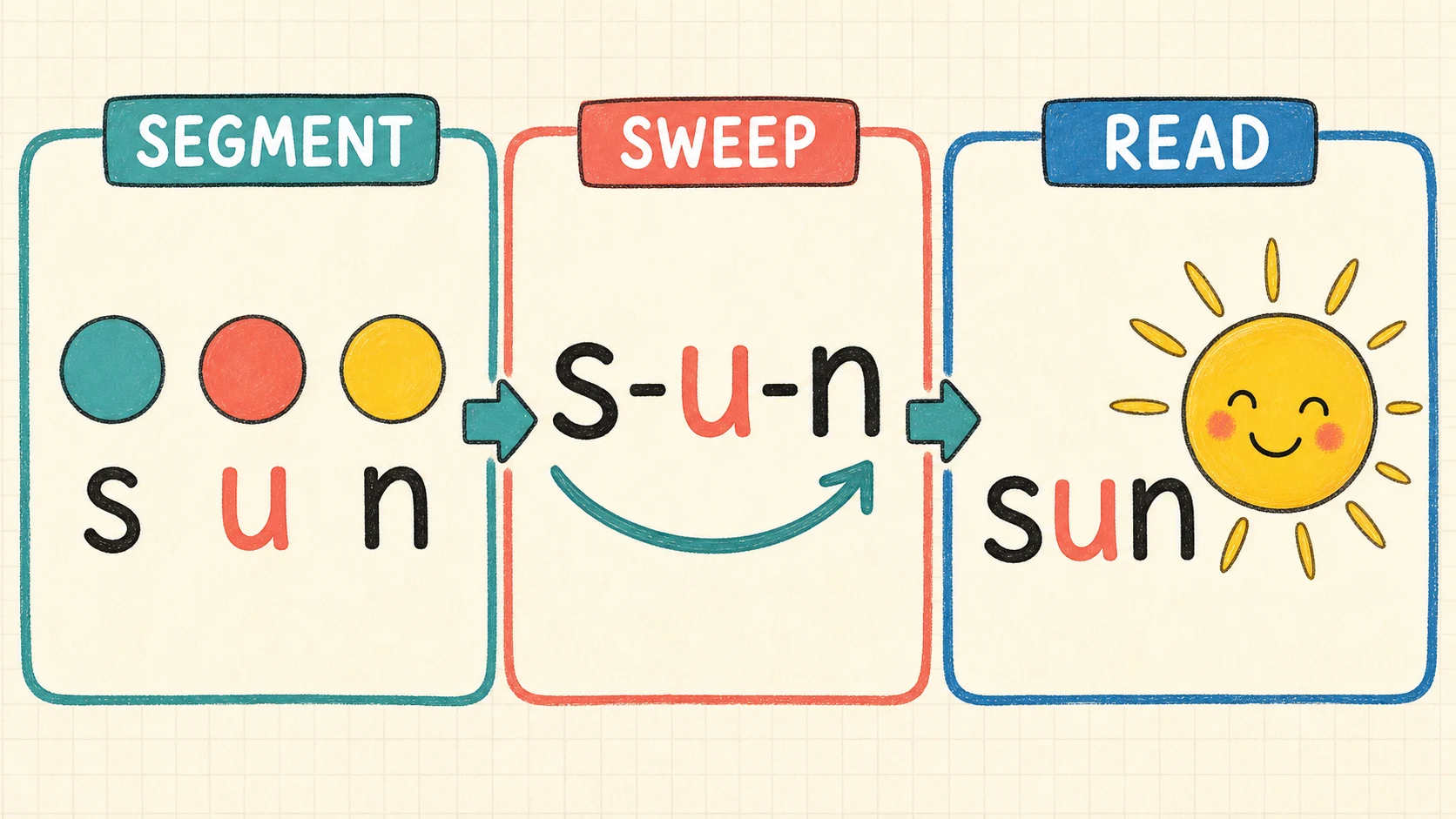
Keep all three sound positions visible so the child can connect each spoken sound to the letter sequence before choosing or writing an answer.
Example 4: build the -at family without accepting nonwords as pictures
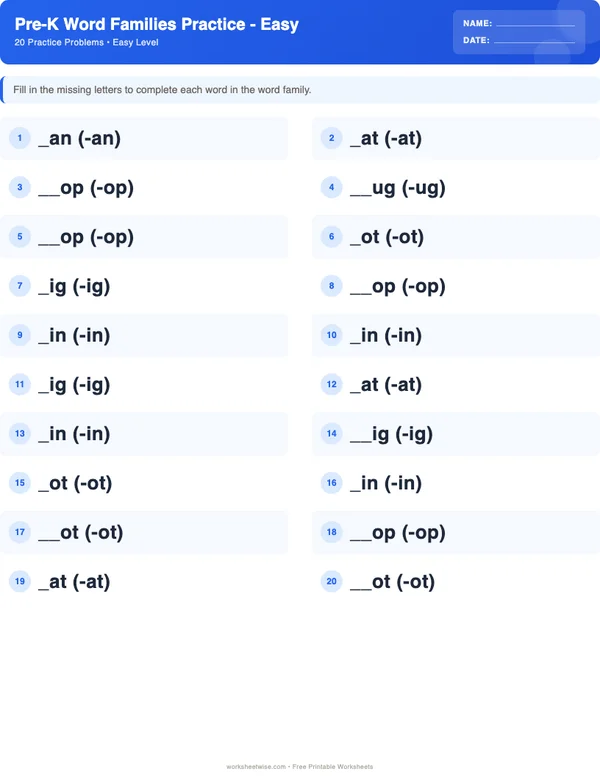
Fix the tiles a-t. Add c to make cat, b to make bat, h to make hat, and m to make mat. Each checked word shares the ending -at and changes only its onset. Ask the child to read each word after the tile change.
This belongs on the Pre-K word-families pathway because -at is one of the verified starting families and the activity uses concrete letter manipulation before paper. If a worksheet asks the child to match words to pictures, confirm that the picture label is unambiguous before treating an error as a reading error.
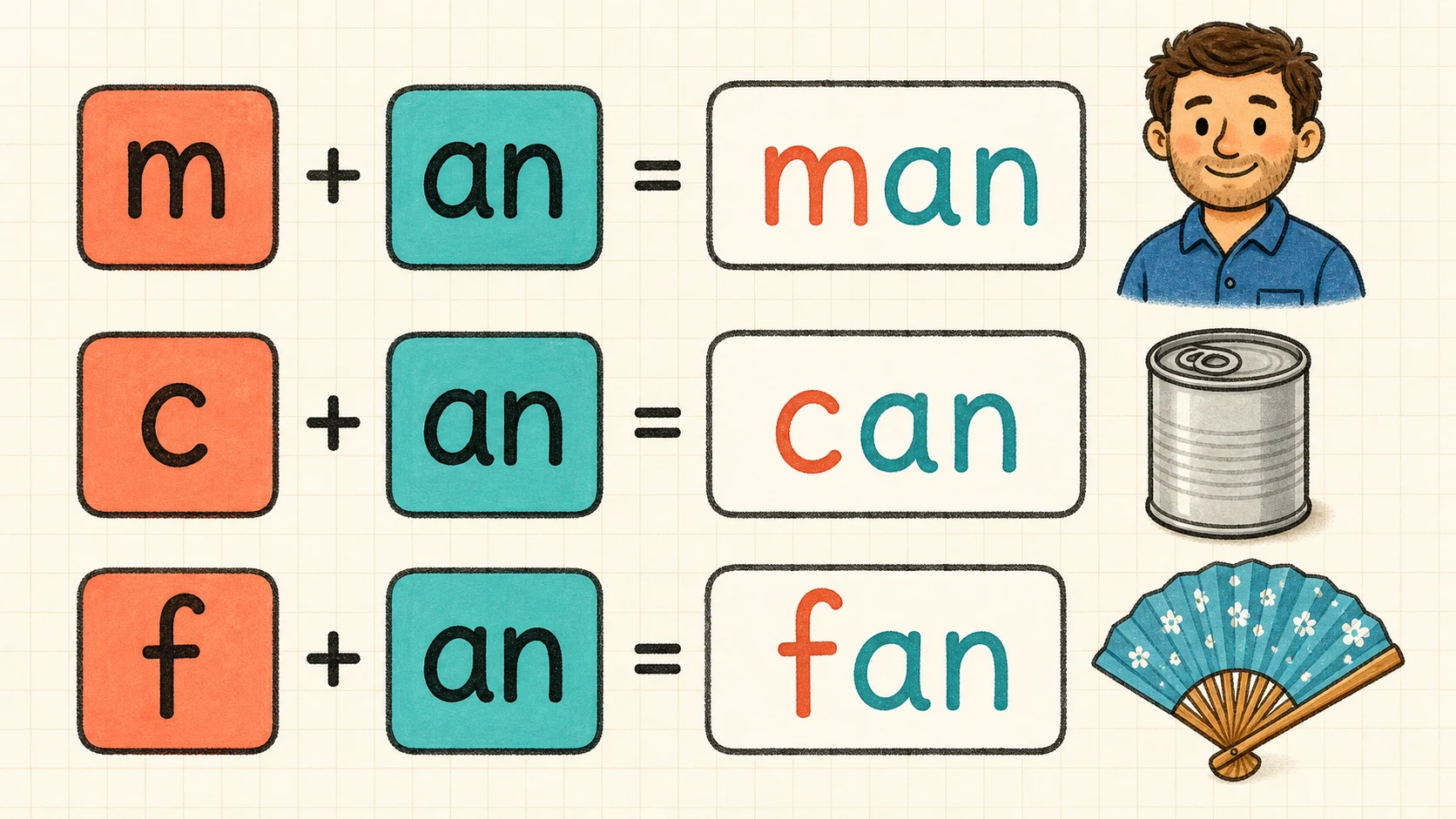
The stable ending is the visual anchor: change one initial letter, blend again, and verify that the result is a real word in the pictured context.
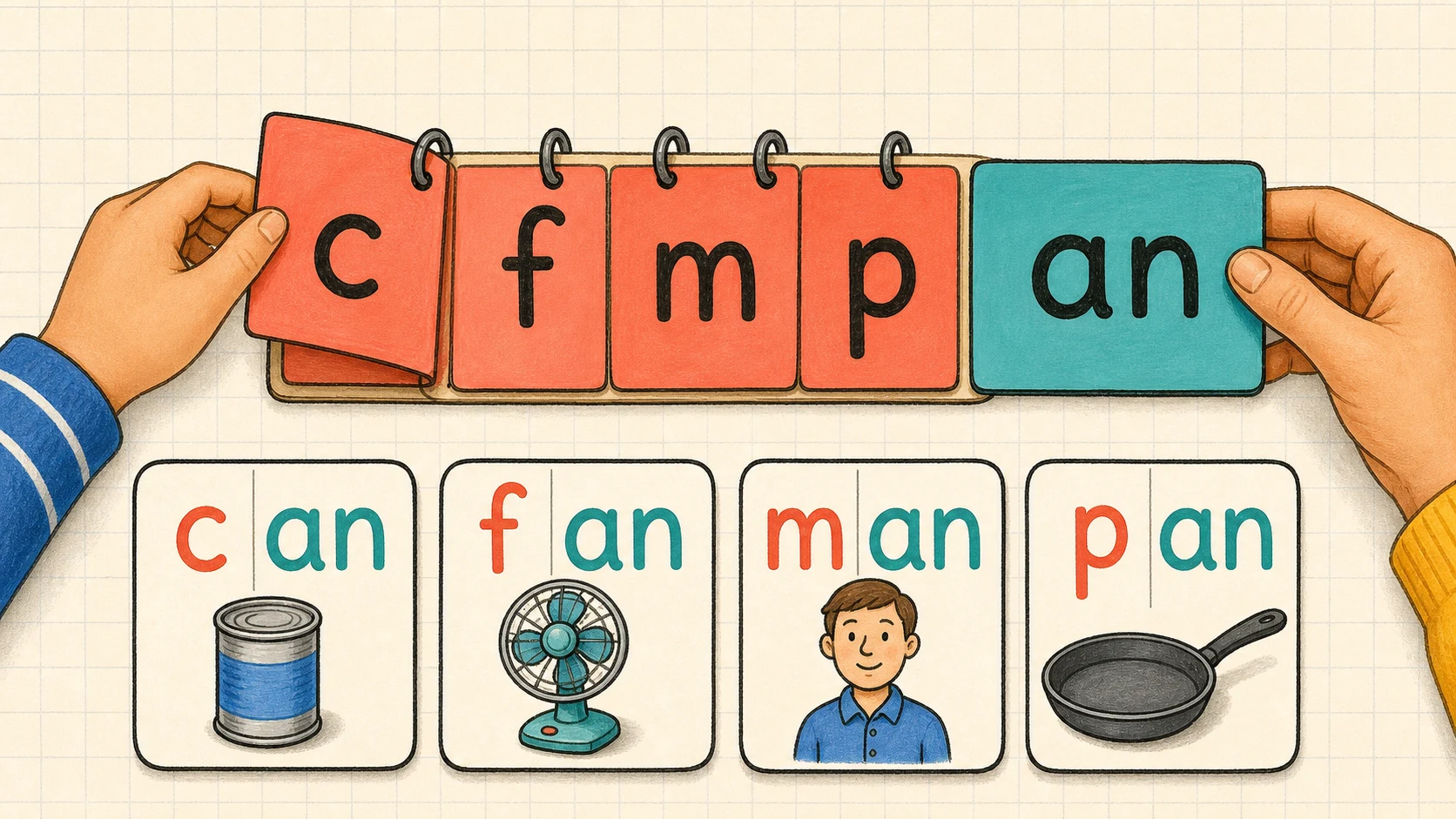
For one lesson, use a single family such as -at; mixing several endings too soon changes the task from building words to sorting patterns.
Make independence small, observable, and earned
Pre-K independence should mean completing a familiar action without a prompt, not working alone for a long block. A child may independently count four pictured objects after the adult reads the direction. The same child may still need help turning the page, interpreting an icon, or writing the numeral.
Use a three-step release:
- “Watch me.” The adult models one complete example.
- “Let’s do one.” The adult and child share the action.
- “You try one.” The adult remains present but waits before prompting.
Count an attempt as independent only if the child understands the direction and initiates the relevant action. Guessing from answer placement, copying the previous mark, or waiting for the adult’s mouth movement does not show independence.
For ages three and four, oral, matching, manipulative, and movement responses remain the priority. A child can hop once per counted number, place a token on the picture beginning with the target vowel, or match cat to a picture. These are legitimate practice formats when they preserve the target.
The IES foundational reading guide emphasizes explicit work with sound segments linked to letters, decoding, word analysis, and daily connected-text reading. For this Pre-K plan, that supports clear modeling and sound-letter work rather than asking a child to infer a phonics pattern from a completed page. It does not mean every child should start CVC worksheets at the same age.
Turn the answer key into immediate teaching feedback
An answer key identifies the intended answer. It does not explain why the child chose something else. Check the paper with the learner and investigate the action behind an error.
For each missed item:
- Restate the direction in plain language.
- Ask the child to show the answer with objects, sounds, or tiles.
- Identify the first point where the process changes.
- Model that step once.
- Give one parallel example.
- Stop after a successful correction rather than assigning several penalty items.
If a child marks six for a picture of five objects, ask for a recount while moving each object. If the recount is accurate, the original problem may have been tracking or visual attention. If the child says two number words over one object, one-to-one correspondence needs more concrete work.
If pin is read as pen, isolate the middle decision. Say both words, show i and e, and ask the learner to watch and listen. Do not conclude that the child “cannot read CVC words” from one vowel substitution.
The IES mathematics intervention guide discusses systematic instruction, clear mathematical language, representations, and cumulative review for learners who need additional support. Used cautiously here, those principles favor a specific reteaching move and later review. They do not authorize a diagnosis based on worksheet errors.
Read error patterns across days
One incorrect response is an event. A repeated pattern is a planning clue. Keep notes that describe behavior:
- “Recites to ten but skips objects in scattered groups.”
- “Blends after adult sweep; pauses between isolated sounds when alone.”
- “Sorts short a pictures accurately; confuses short e and i.”
- “Reads cat, bat, and hat with tiles; loses -at when letters are handwritten.”
These statements lead to observable next actions. Labels such as “behind,” “easy learner,” or “advanced” do not.
Adapt the page without changing the skill
A worksheet can be shortened or physically altered while preserving its teaching purpose.
For counting, cut or cover the page so only three sets appear. Let the child place a counter on each pictured object while counting. If writing numerals is the barrier, provide numeral cards to match.
For short vowels, name each picture before the child decides its middle sound. This removes vocabulary ambiguity without supplying the vowel. Offer two vowel tiles rather than all five when the target is a contrast such as a versus i.
For CVC words, use tokens in sound boxes before letters. Then replace each token with the corresponding letter and blend. If the target is decoding, the adult may write while the child reads. If the target is encoding, say the word and let the child build it from a limited letter set.
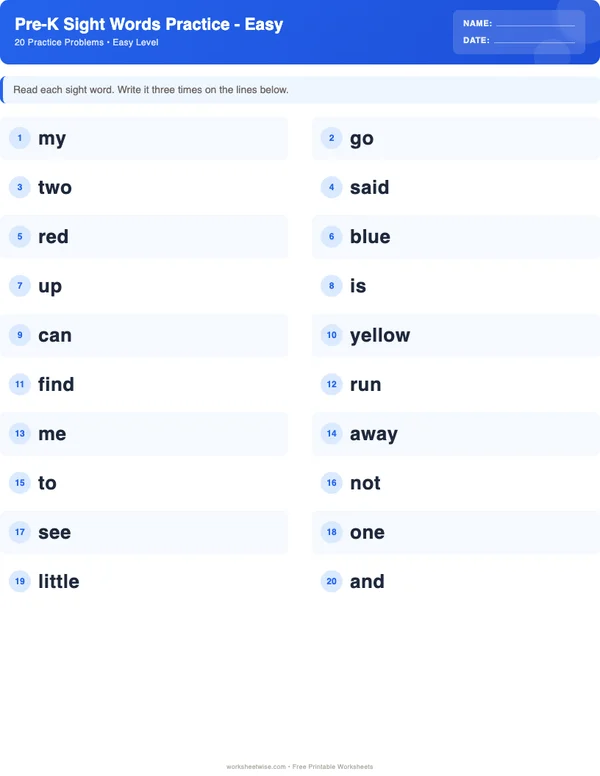
For word families, keep -at fixed on a card and swap only the beginning letter. For sight words, introduce a very small set, review it briefly, and place words in oral sentences. The catalogue suggests three to five new sight words per week, but fewer may be appropriate when recall is inconsistent.
Mixed-age planning works best through shared materials and different tasks. A Pre-K child can count eight blocks while an older sibling records an equation or groups the blocks. During phonics, the younger child builds cat while the older learner writes a sentence containing it. The Pre-K target should remain visible and brief; the younger child should not inherit the older learner’s writing load. Families can locate later-grade material through the 1st Grade Homeschool Worksheets page rather than stretching a Pre-K sheet beyond its purpose.
Know when a printable is the wrong tool for the moment
Pause paper work when the child cannot yet demonstrate the target orally or with objects, when the page’s pictures are unclear, or when fatigue makes the response unreliable. A worksheet also cannot establish a diagnosis, determine complete curriculum placement, replace conversation and play, or prove durable mastery from one sitting.
Counting a printed row does not by itself show that the child can count a scattered collection. Matching cat to a picture does not reveal whether the word was decoded or guessed from the illustration. Tracing a sight word does not demonstrate later recognition. Seek evidence in a changed format and on another day.
Stop the session when the child repeatedly avoids looking, guesses after previously reasoning, loses the directions, or needs escalating prompts for every item. Record the last reliable response. Return later with fewer choices, larger objects, an oral task, or a familiar example.
Increase challenge only after the current action is stable across at least two contexts. Reasonable next steps include rearranging the same number of objects, removing one picture cue, asking the child to build after reading, or mixing two already-taught vowel sounds. Adding more items is not the only form of progression.
Use Friday’s evidence to prepare one precise next step
At the end of the week, choose one continuing target, one representation, and one observable check. For example: “On Monday, count six scattered buttons by moving each button into a cup; then try two counting-sheet items.” That is more actionable than “practice math” and more appropriate to Pre-K than assigning an untouched 20-problem page.
If counting was secure but short a remained inconsistent, next week’s target might be: “Sort six familiar pictures into short a and not-short-a, then build map.” If cat and mat were blended accurately with tiles but not on paper, keep the words and change only the representation.
Open the full worksheet library, select Pre-K and the one topic supported by your notes, and preview a sheet for three usable items. Prepare the matching buttons, tokens, or letter tiles beside it. Your next lesson is then ready: one explicit model, one shared attempt, one independent response, and immediate feedback.
Put it into practice
Use the guide with a real printable
Move from explanation to a short, observable practice task. Check the first item together, then adjust the next session from the learner's actual work.
Open the first free worksheetExplore a neighboring collection