Curated collectionAnswer keys includedPrint-ready PDFs
Worksheets for 7-Year-Olds: Printable Practice Guide
Second-grade fluency that keeps place value, language and visual models visible while independence grows.
Start with a real resource
Browse this worksheet collection
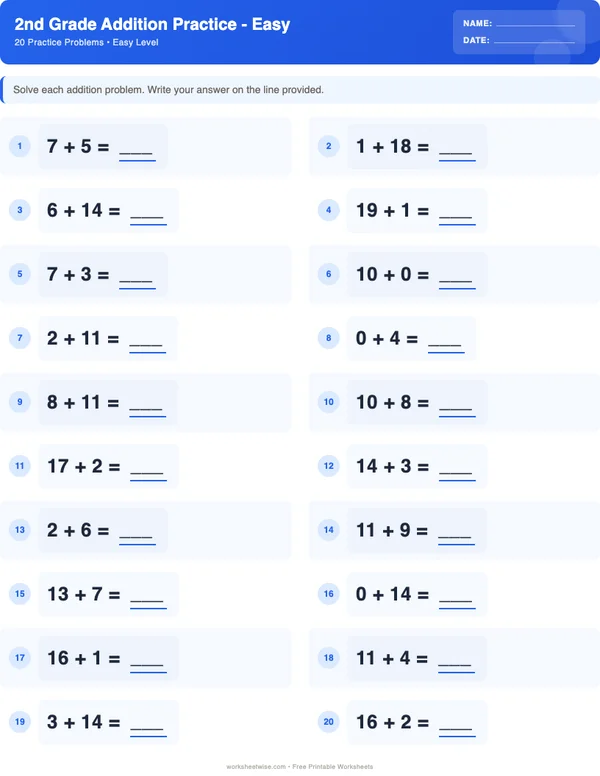
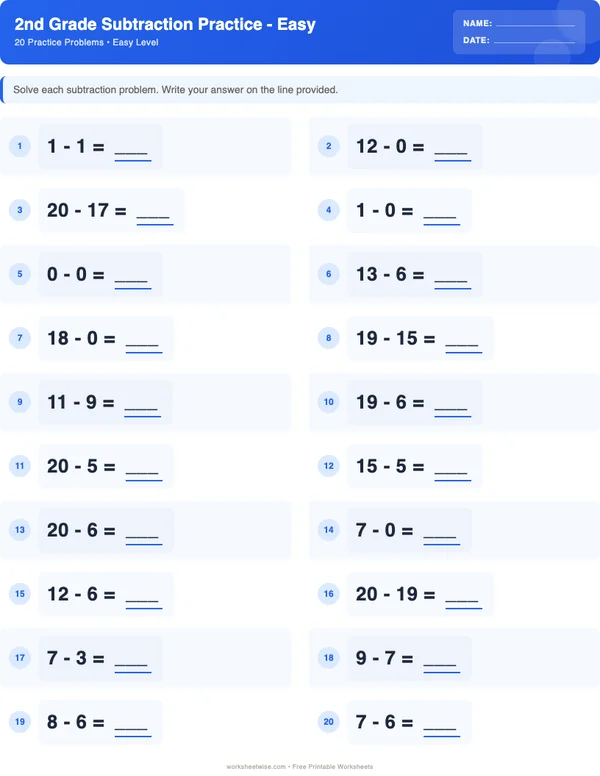
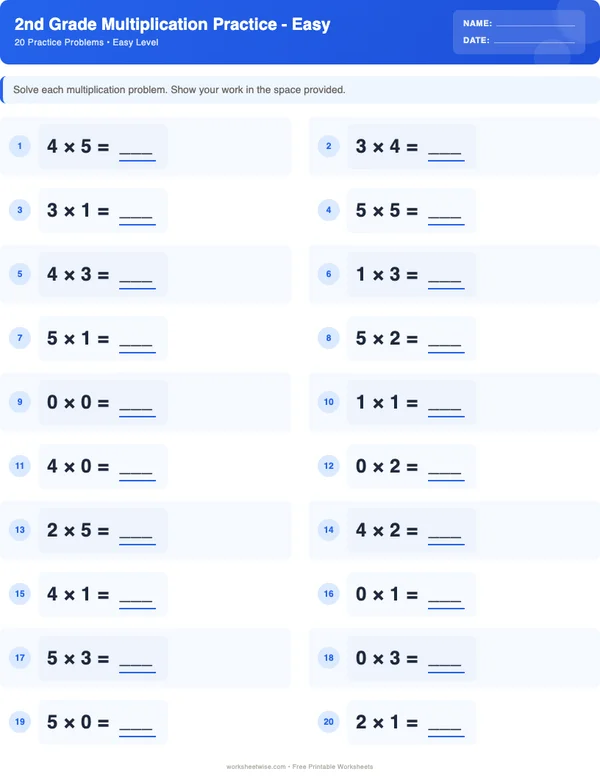
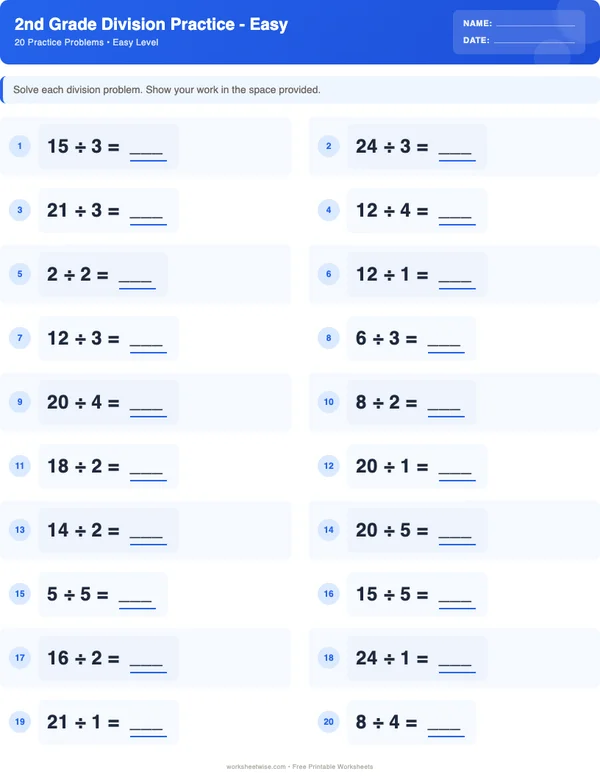
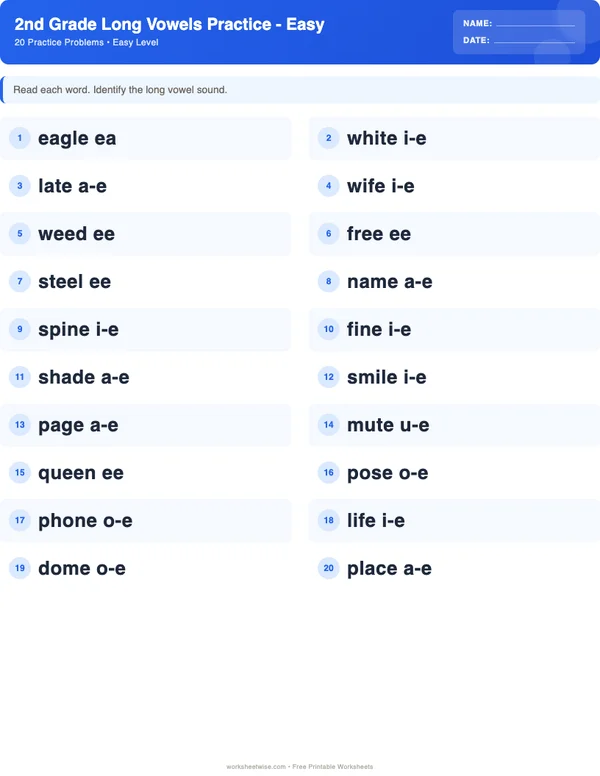
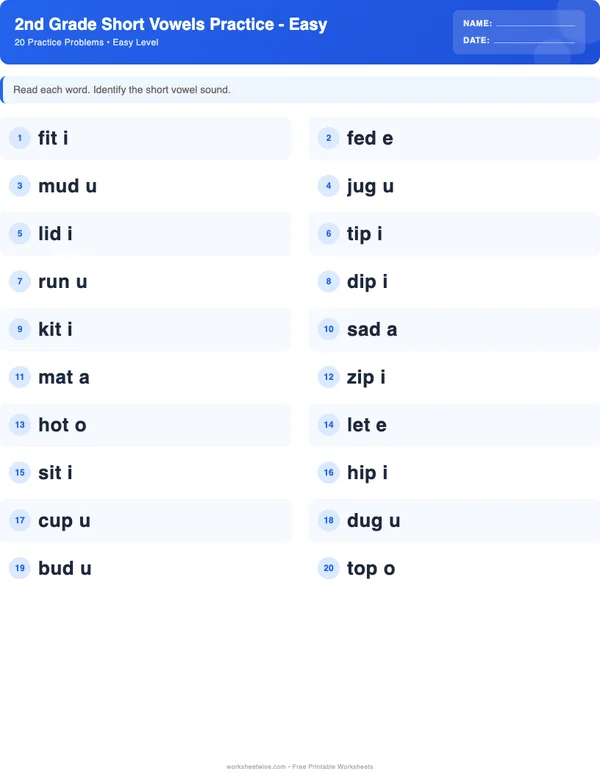
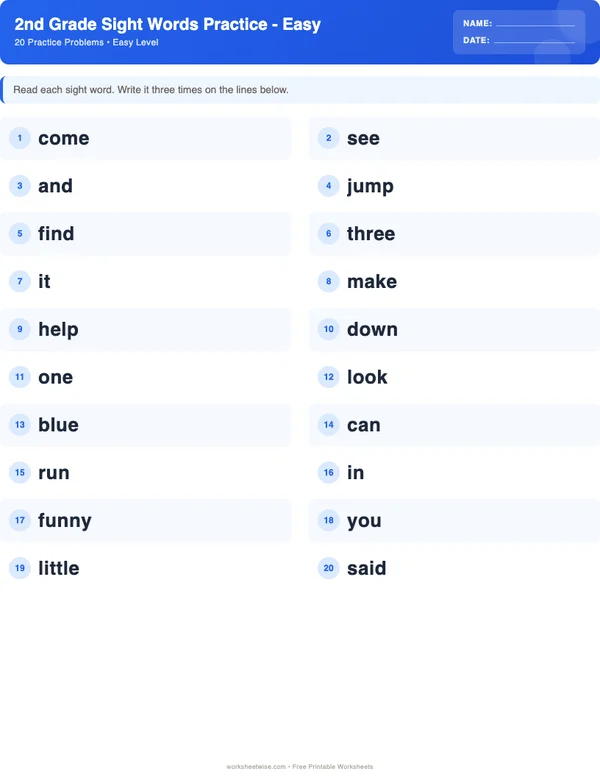
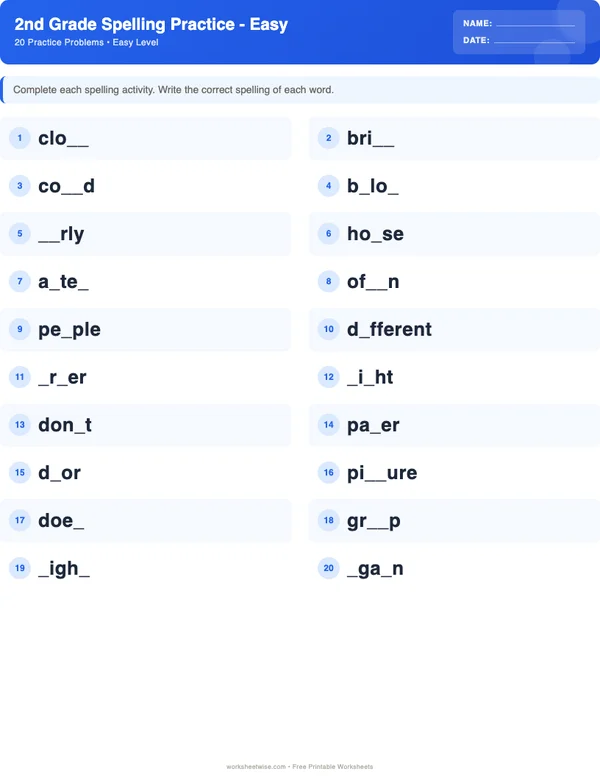
19 relevant free entry points are available. Each one includes a printable learner PDF and separate answer key.
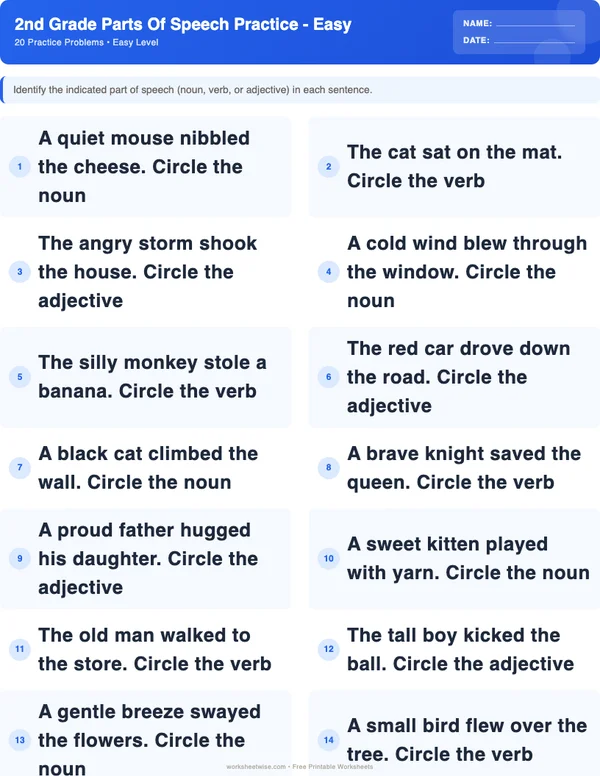
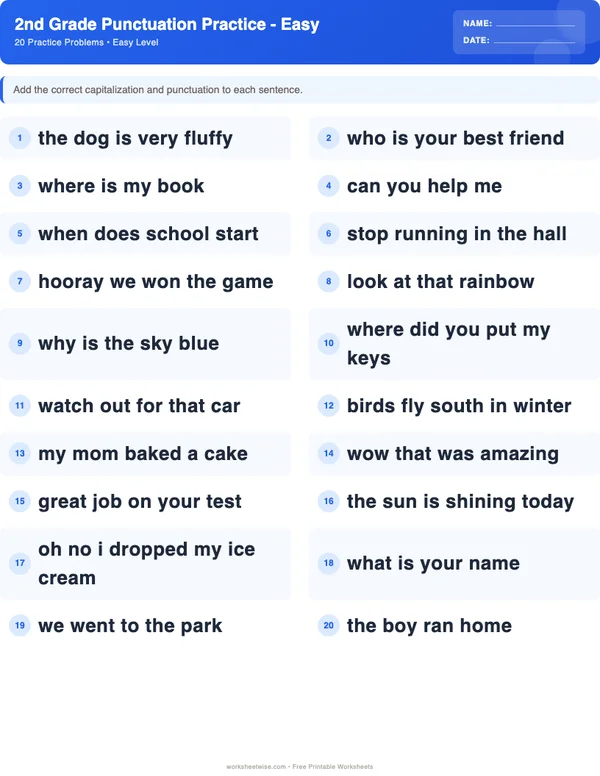
A useful practice loop
Print less. Observe more.
- Choose one skill and model the first item aloud.
- Use a short set and notice the learner’s strategy.
- Change the next task from the work you can see.
Need more than the free sheet?
Plus includes all 342 matching catalogue variations where available, plus saved deterministic generators and the worksheet designer.
See Plus membershipComplete guide
How to teach and practise worksheets for 7 year olds
3,362 words Updated 6 instructional visuals
Choose by the work in front of you, not by age alone
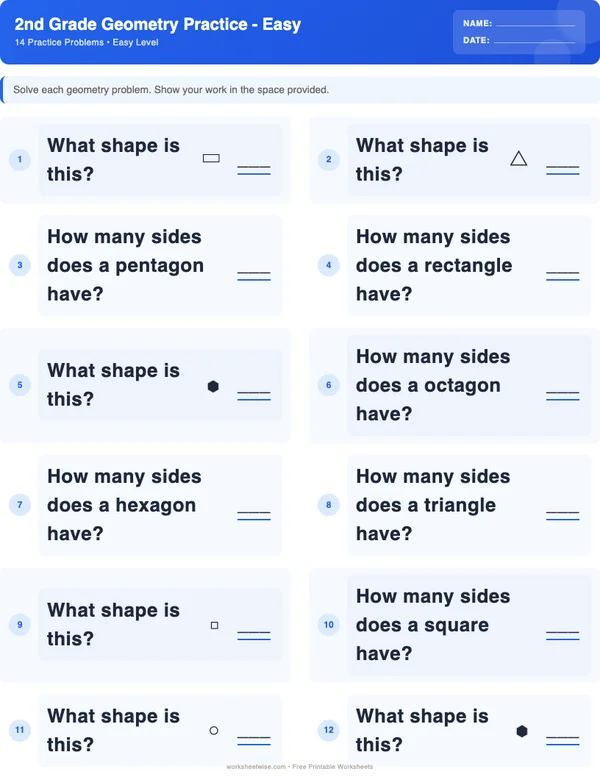
Worksheets for 7-year-olds should usually offer second-grade practice with visible models, manageable reading demands, and enough repetition to build fluency without turning the page into a test of stamina. Good starting points include place value, addition and subtraction, early fraction models, time, money, geometry, word problems, and phonics patterns such as blends and digraphs.
Age is a discovery aid, not a placement decision. A seven-year-old may read confidently but still need counters for subtraction, or calculate accurately while needing help to read a word problem. Choose from the observed skill, not the learner’s birthday or a broad label.
The current WorksheetWise age-seven catalogue contains 342 worksheet variants across four subjects and 19 topics, all filed at the intended second-grade practice level. Nineteen free resources provide entry points. Those facts describe what is available; they do not establish what any particular child should complete.
Use the first few items as a short observation:
- Can the learner explain what the symbols, words, or pictures mean?
- Can they start without having every direction translated by an adult?
- Do they use a reasonable strategy rather than guess?
- Is an error tied to the target skill, or to reading, handwriting, attention, vocabulary, or an unfamiliar page format?
- After one prompt or model, can they attempt the next item with less help?
A productive page makes the target visible and leaves enough mental room for reasoning. If decoding the directions consumes all the learner’s effort, reading is masking the math. If the learner fills answers quickly but cannot explain any of them, the page may be rehearsing a procedure without revealing understanding.
What second-grade readiness looks like on paper
“Second grade” is an intended practice level, not a guarantee of fit. Local curriculum sequences differ, and schools may introduce topics in different orders. Treat grade labels as navigation information rather than standards alignment or a judgment about the learner.
Look for meaning before speed
In math, ask the learner to show what a number or operation represents. A child working on 43 − 25 might build 43 with four tens and three ones, exchange one ten for ten ones, and then remove two tens and five ones. That explanation matters more than whether the answer arrives quickly.
In phonics, ask the learner to say the sounds and blend the whole word. In stop, both /s/ and /t/ remain audible; in ship, sh represents one sound. This distinction shows whether the learner understands the pattern rather than merely recognizing a picture.
In language work, ask for a sentence using the selected word or category. Correctly circling “run” as a verb is less informative than explaining that it names the action in “The dogs run.”
Notice independence in small steps
Independence is not silent completion of an entire page. It grows through a sequence:
- The adult demonstrates one example while naming the decision.
- Adult and learner complete one together.
- The learner completes one while explaining.
- The learner tries a small set alone.
- Adult and learner check the strategy, not only the score.
Move forward when the learner can retain the direction, select a strategy, and check at least some work. Return to a shared example when the learner repeatedly asks what to do, copies the previous answer pattern, or abandons the representation too soon.
Select a page by observable task features
The catalogue’s representative free sheets are marked “easy,” but that word describes page features, not a learner. Never call a child easy, developing, or advanced. For this guide, an easier starting task has familiar directions, one clear skill, limited steps, smaller or more recognizable quantities, and visual support. A more demanding task may mix operations, remove models, use less familiar vocabulary, require several decisions, or ask the learner to explain and transfer a strategy.
Match the mathematical demand
For number work, inspect:
- Range: Are quantities within 10 or 20, or do they involve tens and hundreds?
- Representation: Are there objects, ten frames, base-ten drawings, clocks, coins, or number lines?
- Operation: Is the learner identifying, composing, comparing, calculating, or solving a situation?
- Regrouping: Does the work require exchanging one ten for ten ones?
- Language: Is computation embedded in a sentence or word problem?
- Volume: Does the page contain six focused items or 20 repeated ones?
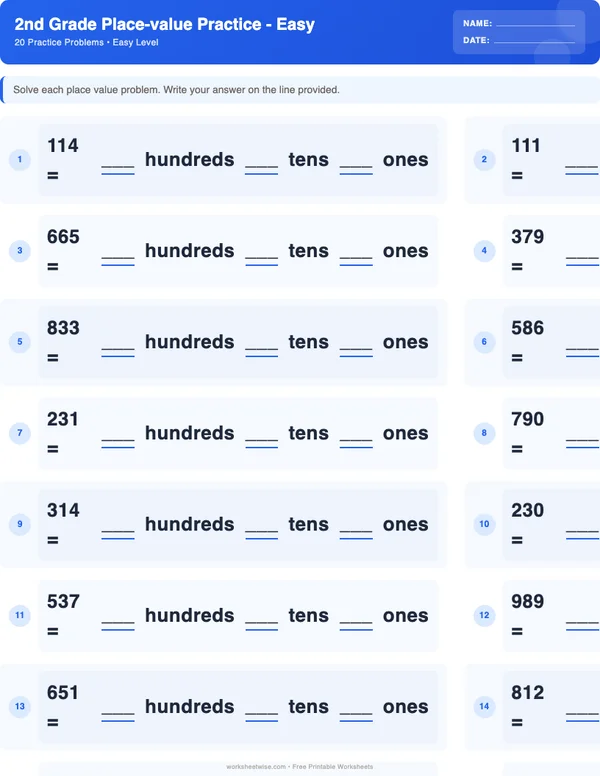
A learner who can add within 20 may not yet be ready for two-digit regrouping. Start with the exact prerequisite that is uncertain. The 2nd Grade Place Value guide and free sheet is a better choice than more addition facts if the learner cannot explain that the 4 in 43 means four tens.
Match the literacy demand
For phonics, inspect whether the page asks the learner to hear a sound, connect it to letters, read a word, spell a word, or read the pattern in a sentence. These are related but not interchangeable tasks.
The IES foundational reading practice guide recommends connecting speech sounds to letters, explicitly teaching decoding and word analysis, and giving learners daily opportunities to read connected text. That is sourced guidance. A practical application for this page is to pair a blend or digraph worksheet with a few spoken words and one short, decodable sentence; that pairing is our editorial suggestion, not a claim that IES evaluated WorksheetWise.
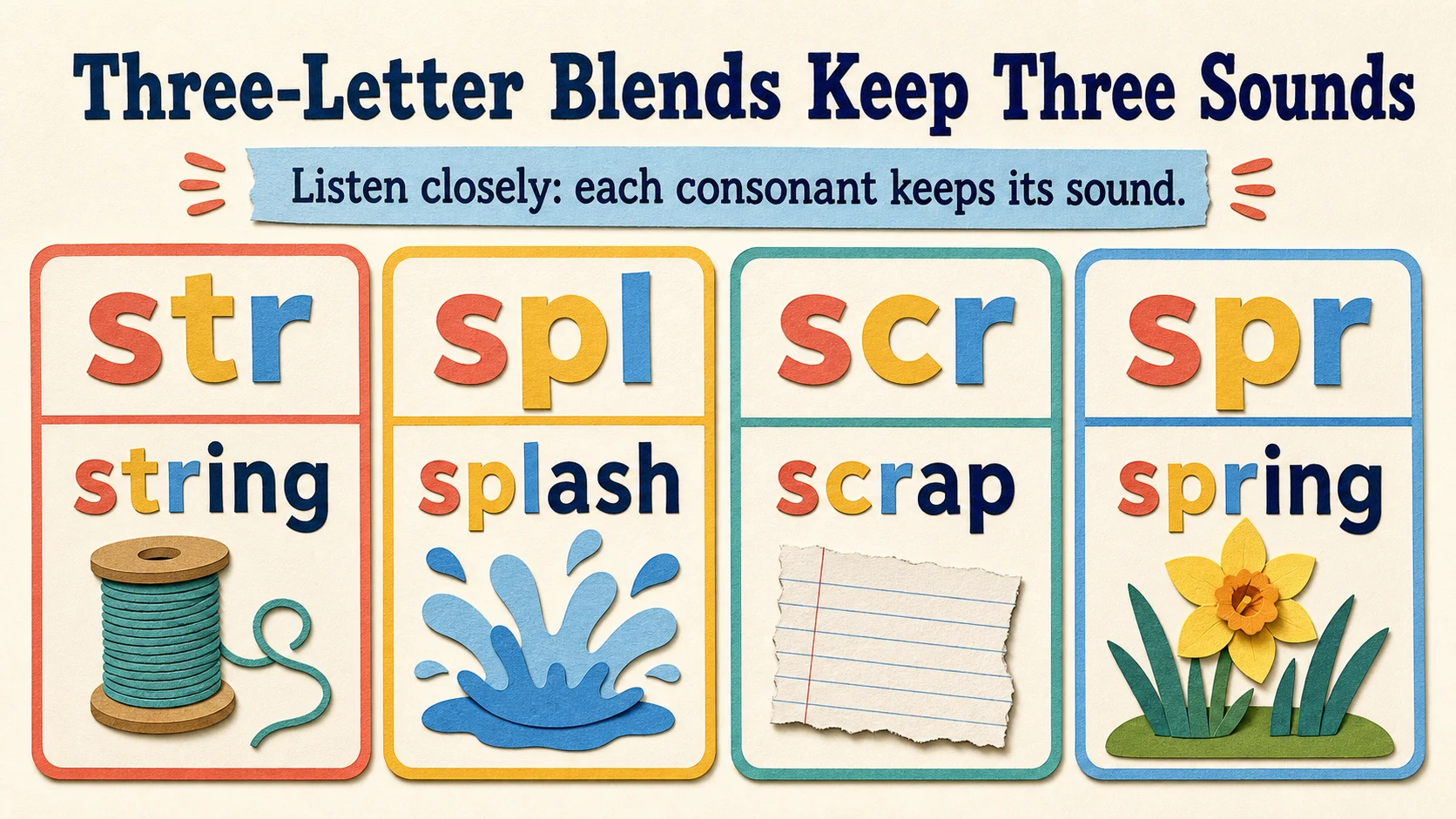
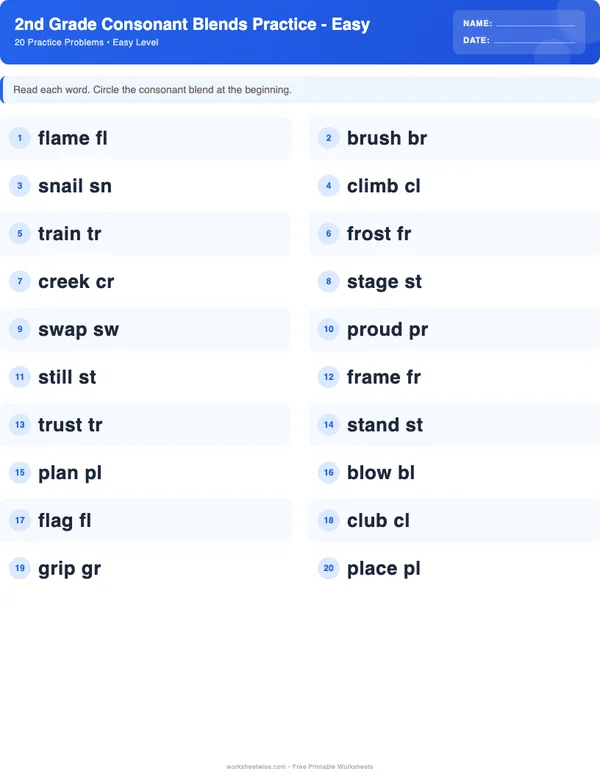
Use the map to decide whether today’s consonant-blend target is hearing both sounds, reading the whole word, spelling it, or carrying the pattern into a sentence.
Keep practice brief, active, and explainable
A 20-problem page is an inventory, not a required sitting. Fold the page, cover rows with another sheet, or mark a stopping point before beginning. Six attentive responses can reveal more than 20 rushed ones.
A useful session usually has one target and three modes: do something, say something, record something. That structure keeps paper connected to meaning.
A repeatable 12-minute routine
Minutes 1–2: Preview. Name the target in plain language: “Today we will show what each digit is worth,” or “Today we will listen for two letters making one sound.” Check one prerequisite orally.
Minutes 3–5: Model and talk. Complete one item. Move objects, sketch a model, or stretch the sounds. Say why the strategy fits.
Minutes 6–9: Short independent set. Ask the learner to complete three to six items. Do not correct each response immediately. Watch where the process changes.
Minutes 10–11: Check one success and one error. Ask, “How did you decide?” If an answer is wrong, let the learner compare it with the model.
Minute 12: Exit example. Give one fresh oral or handwritten item with the same structure. Use that response to choose the next session.
This timing is a suggestion, not a universal limit. Stop earlier when effort has turned into random responding, distress, or physical fatigue. Continue a little longer when the learner is engaged and asks to finish, but do not make finishing the page the definition of success.
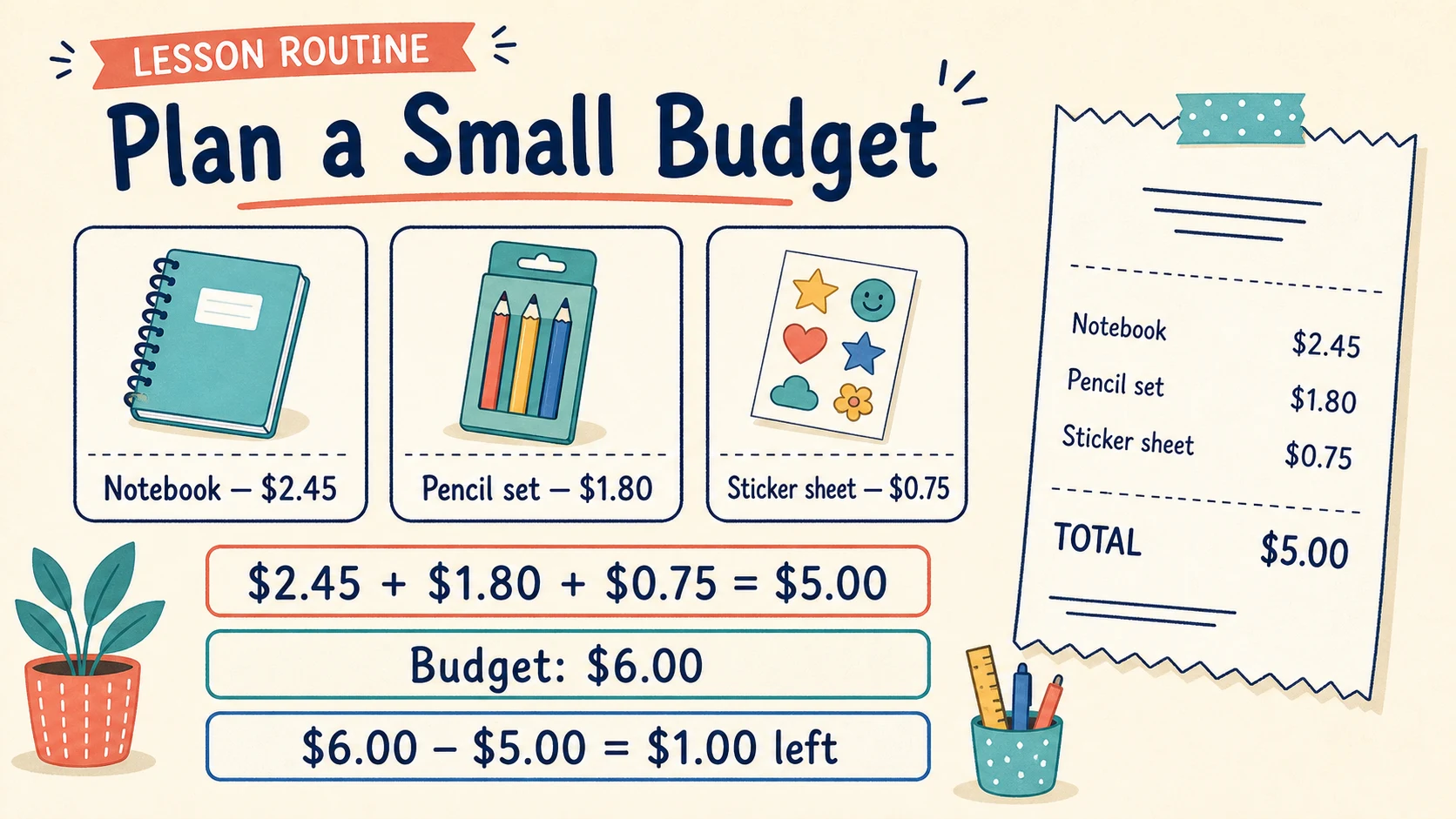
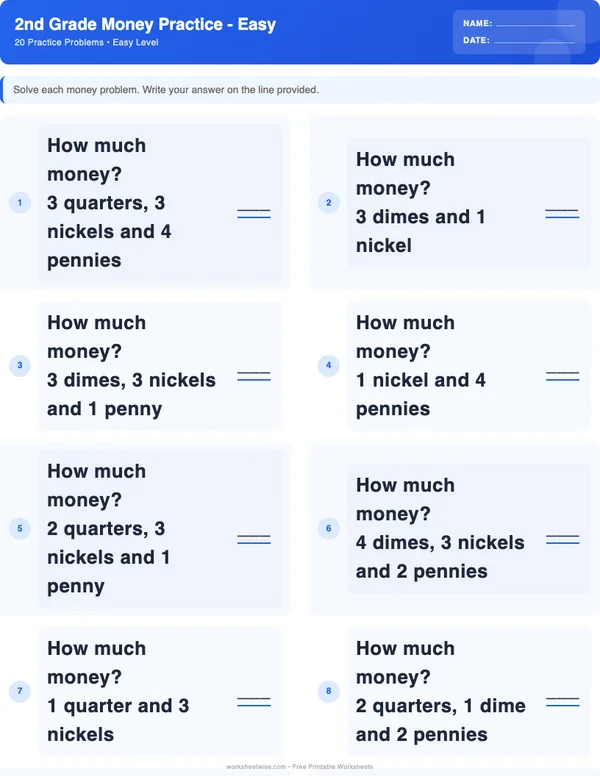
For money practice, handle and count coins before recording totals so the printed images remain connected to value.
Four checked examples for age-seven practice
These examples use topics and task formats represented in the live second-grade catalogue. Each has been checked for mathematical or language accuracy, and each shows what an adult should observe.
Example 1: Place value before regrouped subtraction
Ask the learner to build 43 as four tens and three ones, then solve 43 − 25.
Because three ones cannot supply five ones, exchange one ten for ten ones. The model now contains three tens and 13 ones without changing the total: 30 + 13 = 43. Remove two tens and five ones. One ten and eight ones remain, so 43 − 25 = 18. Check with the inverse: 18 + 25 = 43.
This belongs here because second-grade subtraction progresses into multi-digit work, while the catalogue specifically keeps place value visible. It also exposes a common procedural error: subtracting the smaller digit from the larger digit in each column would produce 22, not 18. The response is not “practice harder.” Return to trading with base-ten materials.
The IES elementary mathematics intervention guide recommends systematic instruction, precise mathematical language, and carefully chosen concrete or semi-concrete representations. Those recommendations support using “exchange one ten for ten ones” with blocks or drawings. They do not imply that IES reviewed this worksheet collection.
Use the 2nd Grade Subtraction guide and free sheet after confirming the learner can compose and decompose two-digit numbers.
Example 2: Halves and fourths must be equal
Give the learner two identical paper strips. Fold one into two equal parts and shade one part: 1/2. Fold the other into four equal parts and shade two parts: 2/4. Align the strips. The shaded lengths match, so 1/2 = 2/4.
Then present a rectangle divided into four unequal pieces and ask whether one piece is one fourth. The answer is no: four pieces alone are insufficient; the parts must be equal.
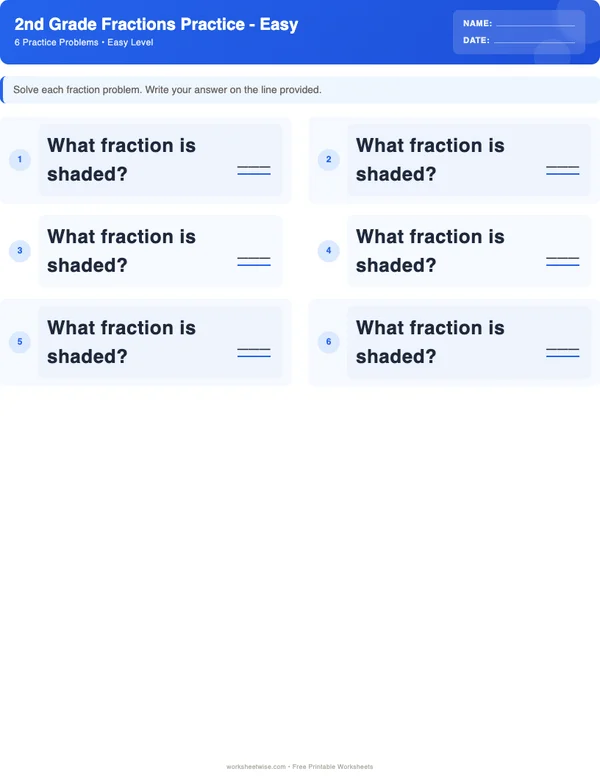
This belongs at the age-seven entry point because the representative second-grade fraction sheet contains six problems and begins with identifying and naming equal parts. Six items can support a focused session in which each answer is explained, drawn, or built. Do not jump from this model to fraction arithmetic merely because the learner recognizes the symbols.
The Common Core mathematics standards describe grade-level learning goals, but local sequences differ and the standards have not assessed WorksheetWise. Here, the practical decision is narrower: continue only when the learner can distinguish equal partitioning from merely counting pieces.
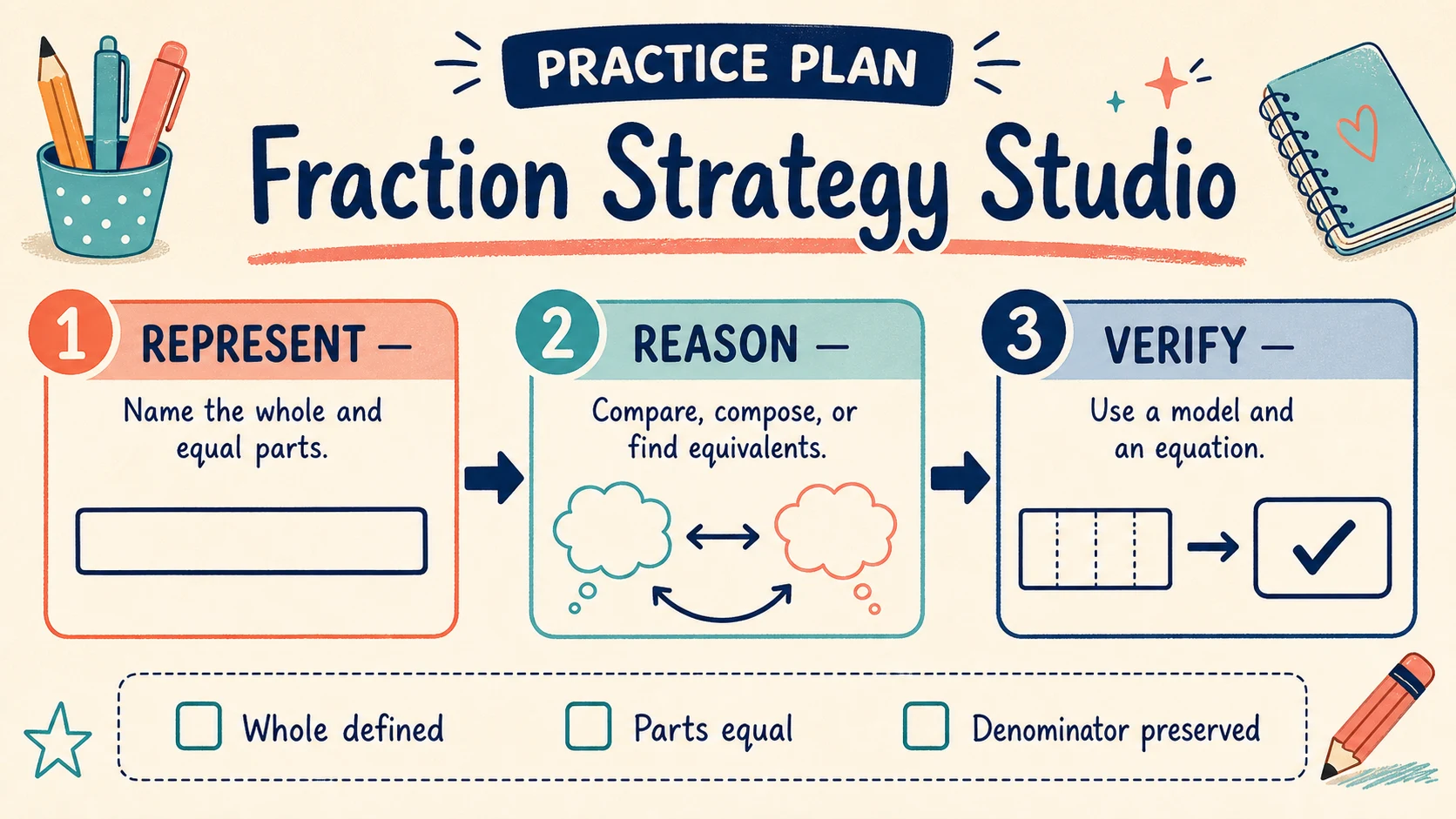
Space fraction work across short sessions: partition, name, compare visually, and revisit rather than completing every model at once.
The 2nd Grade Fractions guide and free sheet is the relevant next resource when equal-part language is secure.
Example 3: A blend is not a digraph
Write stop and place one counter for each sound: /s/ /t/ /ŏ/ /p/. There are four sounds. The letters s and t form a consonant blend because both individual sounds remain.
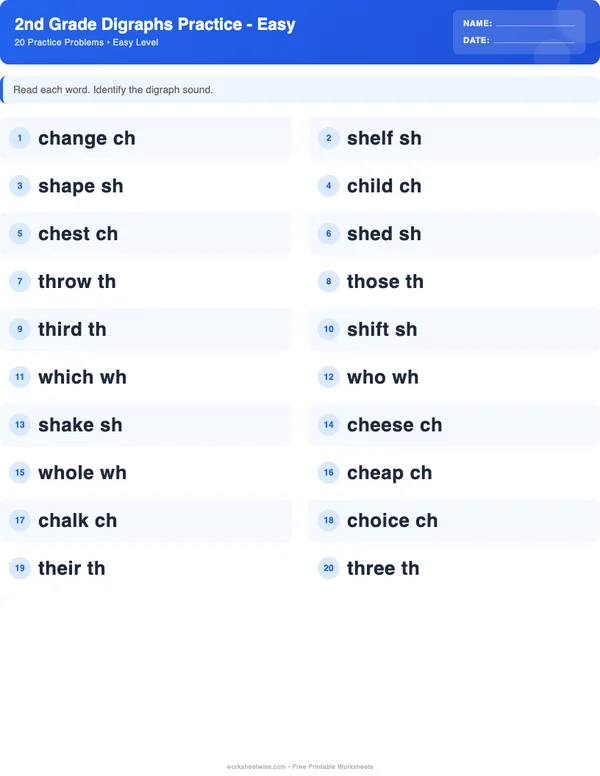
Now write ship: /sh/ /ĭ/ /p/. There are three sounds, although there are four letters. The two letters sh work together for one sound, so they form a digraph.
This example belongs here because the catalogue offers both consonant-blend and digraph practice at the intended second-grade level. It checks a meaningful distinction instead of asking the learner to memorize two labels. If the learner reads stop as sop, tap each sound and rebuild the word; if the learner separates sh into two sounds, hold two letter cards together while producing /sh/.
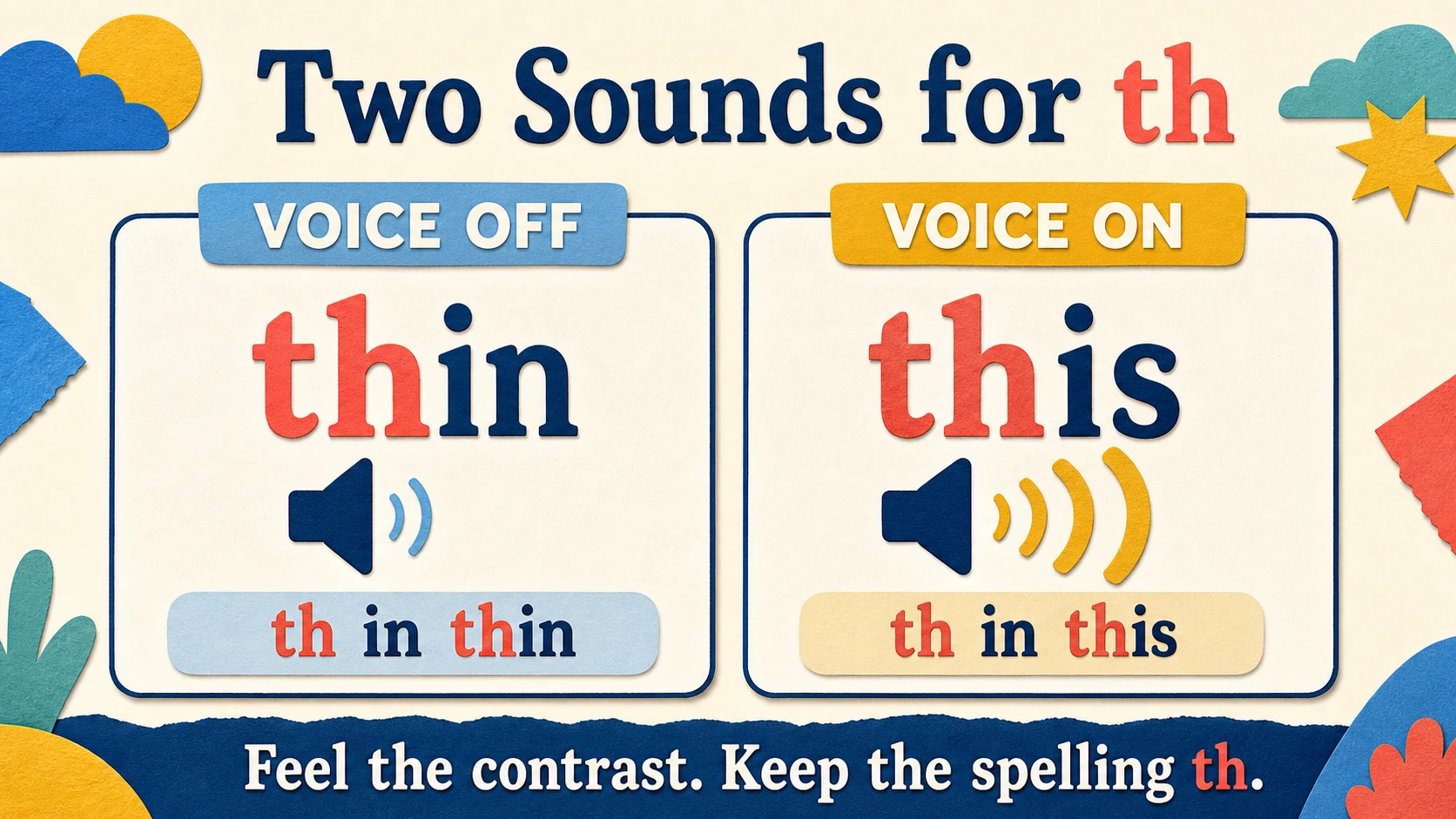
Keep the two-letter, one-sound relationship visible before asking for an independent digraph answer.
After isolated words, read a checked sentence such as “The ship is at the dock.” Ask the learner to underline sh, read the entire sentence, and explain what happened. This carries the taught pattern into connected text, consistent with the IES recommendation for daily connected reading.
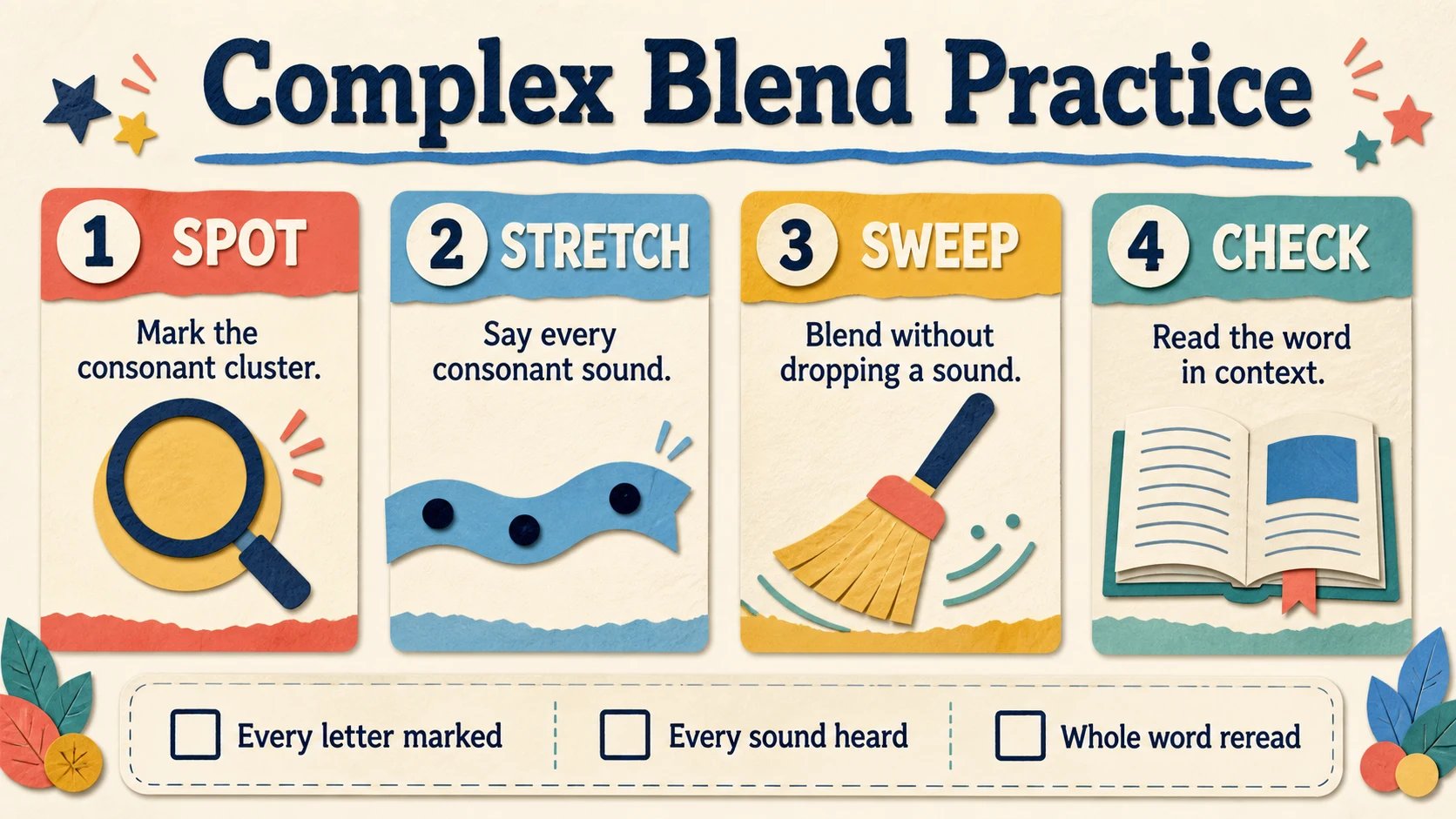
Revisit a small set of blends in words and sentences; adding many new patterns at once can hide which sound sequence needs attention.
Example 4: Count mixed coins from greatest value
Place one quarter, one dime, one nickel, and three pennies on the table. Identify each coin and its value before counting. Begin with the greatest value: 25, 35, 40, 41, 42, 43 cents. The total is 43¢.
Check by grouping the values: 25 + 10 + 5 + 1 + 1 + 1 = 43. A learner who says “six cents” has counted objects rather than value. A learner who reaches 38 may know the coin values but lose the counting sequence. Those errors need different responses.
This belongs here because the catalogue’s second-grade money resource contains 20 problems featuring coin identification and counting. The full page can be divided into short sets. Real or realistic play coins preserve the target: assigning and combining values. Simply telling the learner to memorize coin appearance does not.
Example 5: Understand the subtraction story before choosing a sign
Read: “Mia has 13 shells. She gives 5 shells to Ben. How many shells does Mia have now?”
Retell it: Mia begins with 13; five leave her collection. Model 13 counters, remove five, and count eight. Record 13 − 5 = 8. Check with 8 + 5 = 13.
Now change the story: “Mia has 13 shells. Ben has 5 shells. How many more shells does Mia have?” The equation and answer remain 13 − 5 = 8, but the relationship is comparison, not removal.
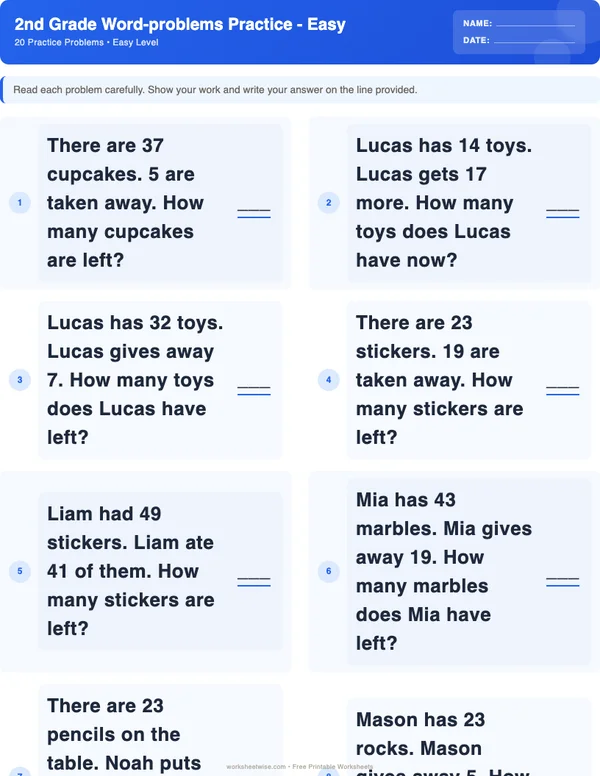
This belongs here because the catalogue’s second-grade word-problem resource contains 12 problems and explicitly spans different problem situations. The checked pair prevents a misleading shortcut such as “gives means subtract.” Ask what changes or what is being compared before selecting an operation.
Preserve the target when adapting a worksheet
An adaptation is useful when it removes an unrelated barrier while leaving the intended thinking intact. First name the target. Then change only what is interfering.
For math pages
If the target is regrouping, allow base-ten blocks, a place-value chart, or a drawing. Do not replace the problem with single-digit subtraction; that changes the target.
If the target is understanding a word-problem structure, read the text aloud when decoding is the barrier. Keep the quantities and decision about the operation. If the target includes independent reading, however, reading every word aloud would remove part of what you intended to observe.
If visual crowding causes skipped items, cover unused rows or copy three problems onto separate cards. The mathematics stays the same.
If writing is laborious, let the learner point, arrange number cards, dictate an explanation, or write only the equation. Preserve written calculation when handwriting the numerals is itself the target.
For phonics and language pages
If the target is hearing a blend, say the word and let the learner move counters for sounds before reading it. If the target is decoding, do not provide the word immediately; prompt attention to the letters.
For digraph spelling, offer letter tiles rather than a word bank. Tiles reduce handwriting demand but retain the sound-to-letter decision.
For parts of speech, reduce sentence length while keeping the grammatical contrast. “Birds fly” still allows the learner to identify a naming word and an action word. Once that is clear, expand to “The small birds fly south” and discuss how each added word works.
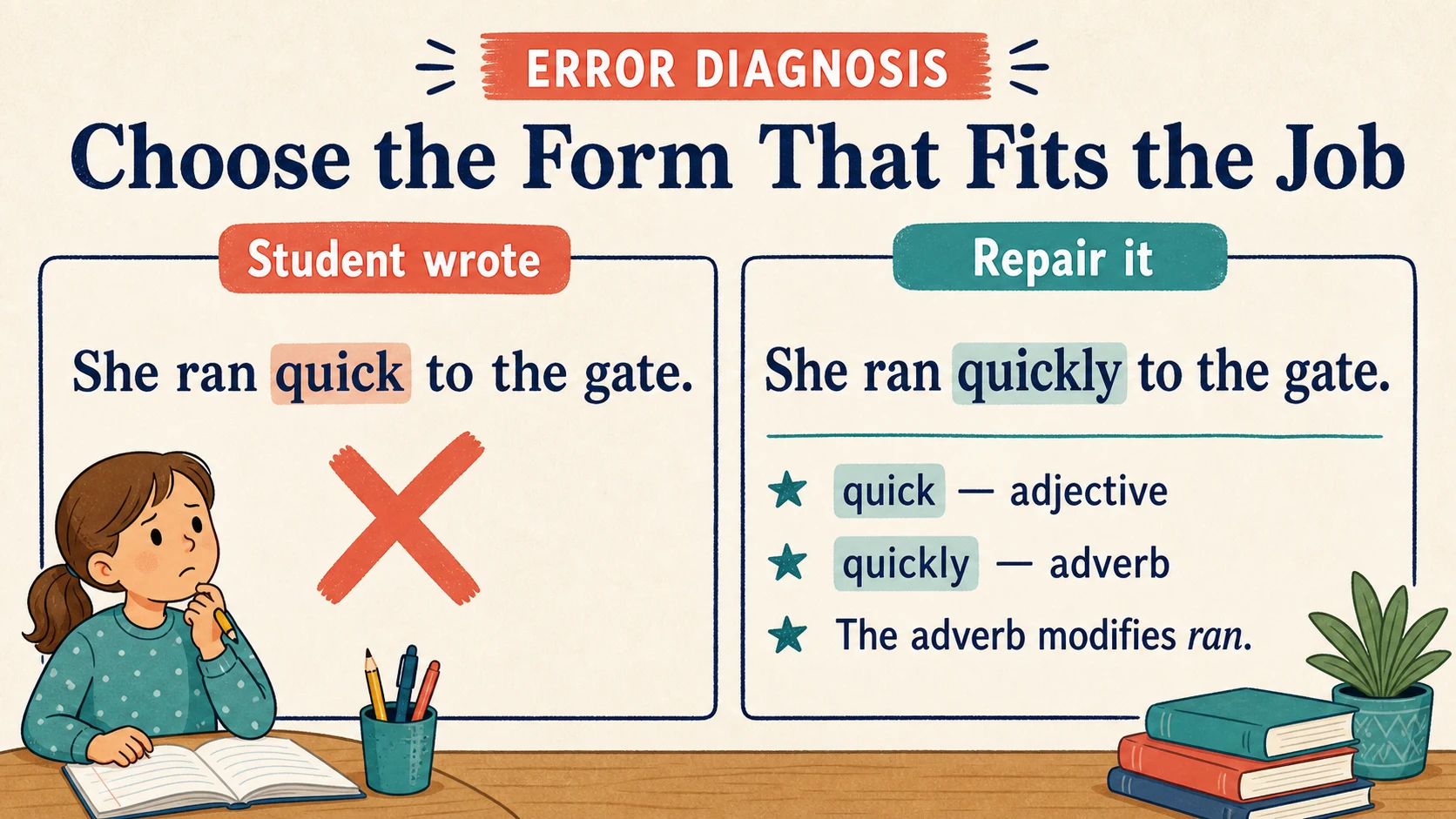
Treat a parts-of-speech error as evidence about the sentence decision: ask what the word does here before supplying a label.
The IES elementary writing guide recommends teaching the writing process and foundational transcription and sentence-construction skills, with regular opportunities to write. A page-level application is to follow a grammar identification item with one original sentence. That extension is a suggestion; it is not a sourced claim about this catalogue.
Interpret errors before assigning another page
A percentage correct collapses different causes into one number. Review the actual marks and ask what stayed consistent across items.
Meaning errors
The learner may not understand the underlying concept: calling any one of four pieces 1/4, counting six coins as six cents, or treating the 4 in 43 as four ones. Return to objects, drawings, comparison, and precise language.
Procedure errors
The learner understands the situation but loses a step: starting mixed-coin counting with pennies, forgetting an exchanged ten, or skipping a sound in stop. Keep the same target, reduce the number of items, and provide a visible sequence or model.
Language errors
The learner calculates once the situation is retold but cannot interpret “difference,” “equal parts,” or “how many more.” Teach the term in the context of the model, then reuse it in another example. The IES mathematics intervention guide’s emphasis on clear mathematical language is especially relevant here.
Attention or format errors
Correct work appears at the top and random answers later; the learner switches rows, overlooks operation signs, or copies inaccurately. Shorten the visible set and add a check after three items. Do not automatically reduce the mathematical level.
One-off errors
A single reversal or miscount amid accurate explanations is not enough to infer a persistent difficulty. Ask for one comparable item on another day. Patterns across time and settings are more informative than one worksheet, but they still do not provide a diagnosis.
Decide whether to simplify, continue, extend, or stop
Simplify the access when the idea is almost there
Keep the skill but restore support when the learner succeeds with a model, makes related rather than random attempts, and improves after one prompt. Use fewer items, clearer spacing, oral directions, counters, letter tiles, or a worked example.
For addition, a learner who solves 8 + 5 by recounting every object can use a ten frame to see 8 + 2 + 3 = 13. The 2nd Grade Addition guide and free sheet is suitable when the learner can explain the quantities but needs structured fluency practice.
Continue when the strategy is stable but effortful
Stay with the same task type when most answers are accurate, explanations make sense, and mistakes can be self-corrected. Change the examples, not the demand. Two or three short sessions are often more informative than one long session.
Extend without racing ahead
When the learner is accurate and can explain, ask for another representation or a transfer:
- Show
36with tens and ones, expanded form, and words. - Solve
13 − 5with counters and a related addition fact. - Use
shipandwishin sentences to showshin initial and final positions. - Make 43¢ in a different combination of coins.
Extension should deepen the same idea before introducing a new procedure.
Stop when work is no longer informative
End the session when the learner is guessing, becoming distressed, complaining of physical discomfort, or no longer responding to a familiar prompt. Also stop when repeated adult cues mean the adult is effectively completing the work.
Stopping is not failure. Mark the last independently attempted item and record one neutral observation: “Identified each coin, then counted the number of coins instead of their values,” or “Read ship; separated ch into two sounds in chin.” That note gives the next session a precise starting point.
Boundaries adults should keep in view
A worksheet can reveal a strategy used on that page. It cannot determine a child’s overall level, diagnose a learning condition, establish curriculum mastery, or predict an outcome. Performance may change with fatigue, language familiarity, motor demands, vision, hearing, prior instruction, or the relationship with the assisting adult.
The catalogue’s age and grade filters are organizational tools. The seven-year-old page currently points only to second-grade resources, but a child may need an earlier prerequisite or a more demanding variation in one particular skill. If looking earlier, remember that worksheets for ages three and four should not become prolonged desk work: prioritize brief adult-led oral, matching, manipulative, and movement activities. The worksheets for 4-year-olds guide can help adults compare that more play-based entry point without treating it as a placement label.
Ask a classroom teacher or appropriate qualified professional when difficulty is persistent across settings, affects broad participation, or raises concerns beyond choosing practice material. Bring dated examples and neutral observations rather than a proposed diagnosis.
Turn one observed response into the next choice
Choose one target—place value is a strong starting point when two-digit addition or subtraction is uncertain. Open the 2nd Grade Place Value guide and free sheet, present only three items, and keep base-ten objects nearby. Record whether the learner can name each digit’s value, build the number, and explain one answer.
Then make one decision: remove a barrier while preserving place value, continue the same task in another short session, extend to a second representation, or stop and share the observation with the learner’s teacher. That observable next action is more useful than assigning another full page by age alone.
Put it into practice
Use the guide with a real printable
Move from explanation to a short, observable practice task. Check the first item together, then adjust the next session from the learner's actual work.
Open the first free worksheetExplore a neighboring collection
Choose by a different teaching need
Worksheets for 10-Year-Olds: Printable Practice Guide Worksheets for 11-Year-Olds: Printable Practice Guide Worksheets for 12-Year-Olds: Printable Practice Guide Worksheets for 3-Year-Olds: Printable Practice Guide Worksheets for 4-Year-Olds: Printable Practice Guide Worksheets for 5-Year-Olds: Printable Practice Guide Worksheets for 6-Year-Olds: Printable Practice Guide Worksheets for 8-Year-Olds: Printable Practice Guide