What 2nd Grade Fractions Means
Second-grade fraction work is primarily about recognizing, creating, and naming equal shares of shapes. A learner should understand that a whole can be partitioned into two, three, or four equal parts and that those parts can be called halves, thirds, or fourths. The learner should also recognize that two halves, three thirds, or four fourths make one whole.
The concise answer is this: teach equal partitioning before expecting reliable fraction notation or calculation. Begin with real objects and paper shapes, move to drawings, and then connect those models to words and symbols such as one half and 1/2. Use the learner’s observed work to decide whether to continue, review, or increase the challenge.
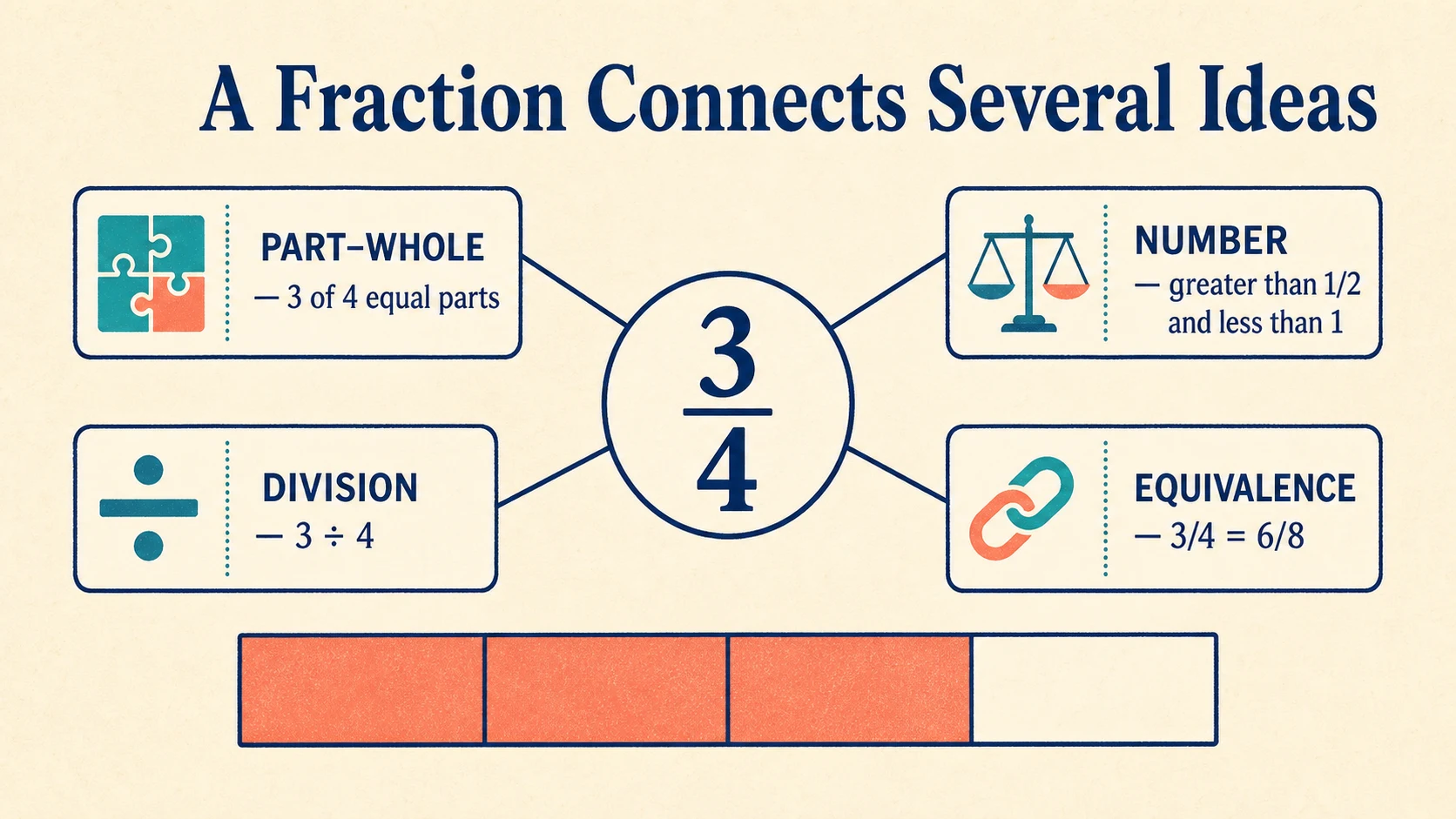
The central path runs from identifying a whole to making, naming, and reasoning about equal shares.
The Common Core State Standards for Mathematics place the second-grade emphasis on partitioning rectangles and circles into two, three, or four equal shares, describing those shares, and recognizing that equal shares do not need to have the same shape. Local curricula may introduce related ideas in a different order. Grade labels describe intended practice level, and local sequences differ.
WorksheetWise’s broader fraction catalogue includes later skills such as equivalence, comparison, and operations. Those belong to a longer elementary progression. They should not automatically become the center of a second-grade lesson merely because they appear in a mixed worksheet. The 2nd Grade Math collection can be used to place fraction practice alongside the learner’s other current math work.
Prerequisites to Check First
Fraction instruction depends on several ideas that may not look like “fraction skills” at first. Before assigning symbolic exercises, check whether the learner can:
- Identify the whole being divided.
- Count small sets accurately.
- Recognize basic circles, rectangles, and squares.
- Compare pieces by direct observation.
- Follow words such as equal, same amount, part, whole, row, and column.
- Draw or follow a straight partition line with reasonable control.
- Explain whether a set has been shared fairly.
A learner does not need perfect vocabulary before beginning. However, confusion about the whole or about equality will make later answers unreliable.
Check the Meaning of Equal
Show a rectangle divided into two visibly unequal pieces. Ask the learner to describe what happened. A useful response is, “There are two parts, but one is larger.” If the learner calls both pieces halves simply because there are two of them, pause and work on equal sharing.
Use concrete comparisons. Fold one paper strip exactly in half and cut another strip into one large and one small piece. Place the pieces side by side. The contrast makes the requirement visible: two parts are not necessarily two halves.
Check Part and Whole Language
Place one complete paper circle beside a semicircle. Ask which is the whole and which is a part. Then assemble two matching semicircles into the original circle.
Change the whole deliberately. One cracker can be a whole in one example, while a plate holding four crackers can be the whole set in another. At this stage, keep the task explicit so that the learner knows what unit is being discussed.
Check Simple Spatial Partitioning
Ask the learner to divide:
- A rectangle into two equal shares.
- A circle into four equal shares.
- A row of six counters into two equal groups.
Do not require formal fraction symbols during this check. Observe whether the learner plans the partition, counts accurately, and verifies equality.
A Grade-Appropriate Progression
The order below moves from physical sharing toward pictures, words, and limited symbolic recording. It is a teaching sequence, not a universal timetable.
| Stage |
Main idea |
Suitable task |
Evidence to look for |
| 1. Establish the whole |
A fraction describes part of a defined whole |
Point to or build the complete object |
Learner identifies the unit before naming a part |
| 2. Separate equal from unequal |
Equal shares must have the same amount |
Sort examples and nonexamples |
Learner rejects unequal “halves” |
| 3. Make halves |
Two equal shares form one whole |
Fold, cut, or divide into two |
Learner makes two equal amounts |
| 4. Make thirds and fourths |
The whole can be split into three or four equal shares |
Partition strips, circles, or rectangles |
Learner checks every share, not just the count |
| 5. Name one share |
One of two, three, or four equal shares has a fraction name |
Match models to one half, one third, or one fourth |
Learner uses the denominator idea informally |
| 6. Describe several shares |
More than one equal part can be selected |
Shade two of four equal parts |
Learner counts selected parts and total equal parts separately |
| 7. Recompose the whole |
All equal shares together make the original whole |
Join two halves, three thirds, or four fourths |
Learner predicts and verifies completion |
| 8. Compare simple unit fractions visually |
More equal shares make each individual share smaller |
Compare 1/2, 1/3, and 1/4 of equal wholes |
Learner keeps the wholes equal |
| 9. Work independently |
The learner applies the idea without immediate prompting |
Short mixed page with models |
Learner explains and checks answers |
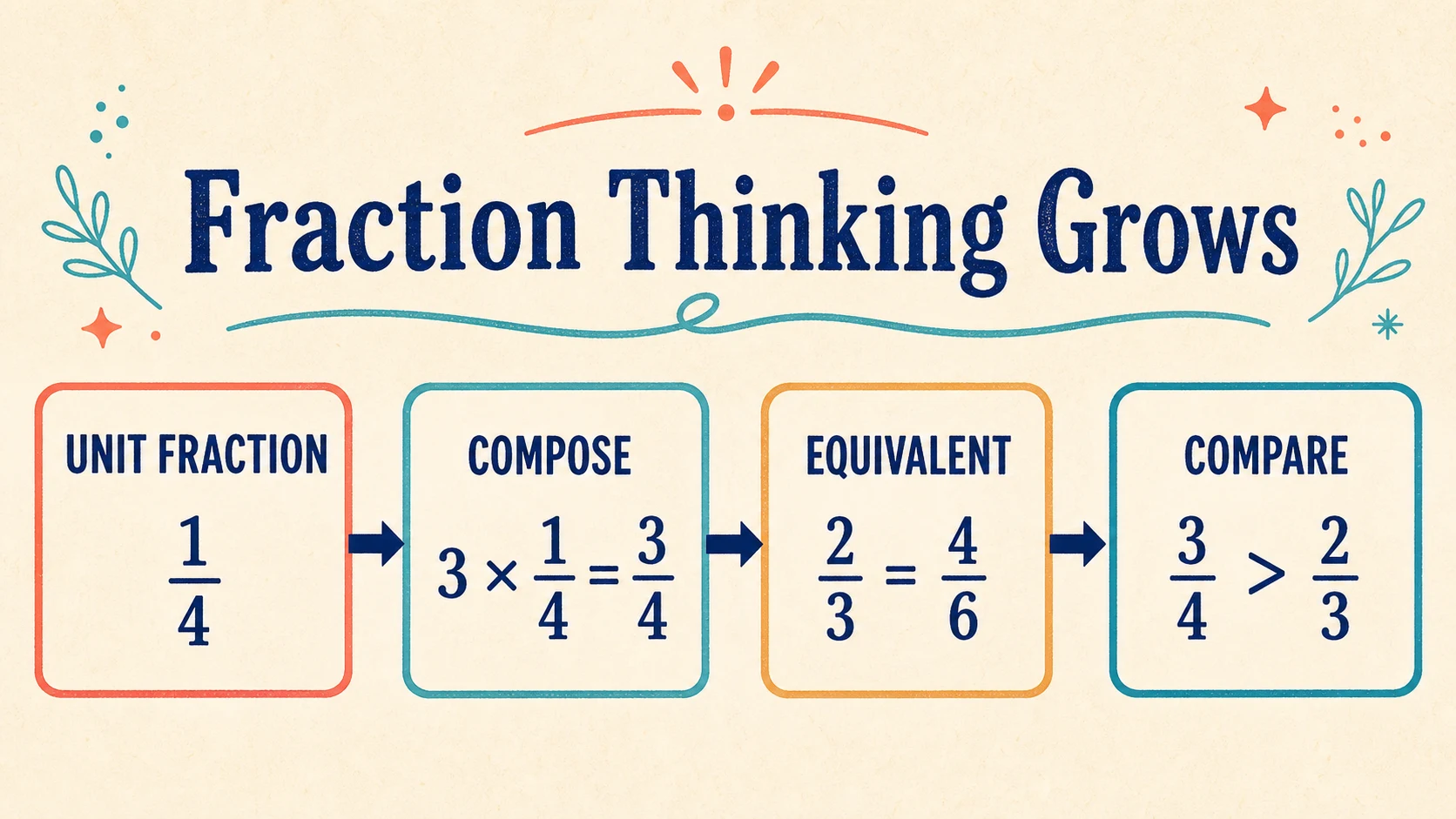
Increase independence only after equal sharing remains accurate across more than one model.
The IES guide on teaching mathematics to young children provides high-level support for purposeful teaching that helps young learners connect mathematical ideas, representations, and language. Applied here, that means using an object, a drawing, and fraction words as connected views of the same idea rather than as unrelated activities.
Concrete and Visual Models That Clarify the Skill
Models are useful only when their structure matches the idea being taught. A colorful model with unequal pieces can reinforce the wrong conclusion.
Paper Folding and Fraction Strips
Paper strips make equality visible because the learner can fold, unfold, compare, and recombine the parts.
For halves, align the two ends before creasing. For fourths, fold the strip in half and then fold it in half again. Thirds are harder to construct accurately by free folding, so a prepared strip or measured guide may be more appropriate at first.
Ask the learner to trace the creases and label the shares in words. The physical action should support the idea; neat cutting is not the mathematical goal.
Circles and Rectangles
Circles are familiar but can be difficult to divide accurately into thirds. Rectangles often provide clearer early practice because rows and columns help organize equal areas.
Vary the orientation. A rectangle can be divided into two equal vertical strips, two equal horizontal strips, or two matching diagonal regions. This prevents the learner from treating one familiar picture as the definition of a half.
Counters and Equal Groups
Counters allow simple work with fractions of a set. For example, separate six counters into two equal groups of three. One group is one half of the six-counter set.
Use this model after part-whole shapes are understood. Fractions of sets add a new decision: the whole is the entire collection, not one counter. Keep quantities small enough that counting does not hide the fraction idea.
Number Lines as an Extension
A number line represents fractions as locations and numbers, not merely shaded pieces. At this level, keep the work concrete and narrow: mark 0 and 1, divide that distance into two equal intervals, and locate 1/2.
Do not assume that a learner who can shade half a circle can immediately locate one half on a number line. On a shape, the learner counts regions. On a number line, the learner must count equal intervals rather than tick marks.
Fully Checked Worked Examples
Each example follows the same reasoning: identify the whole, verify equal shares, count the shares, and then name the selected amount.
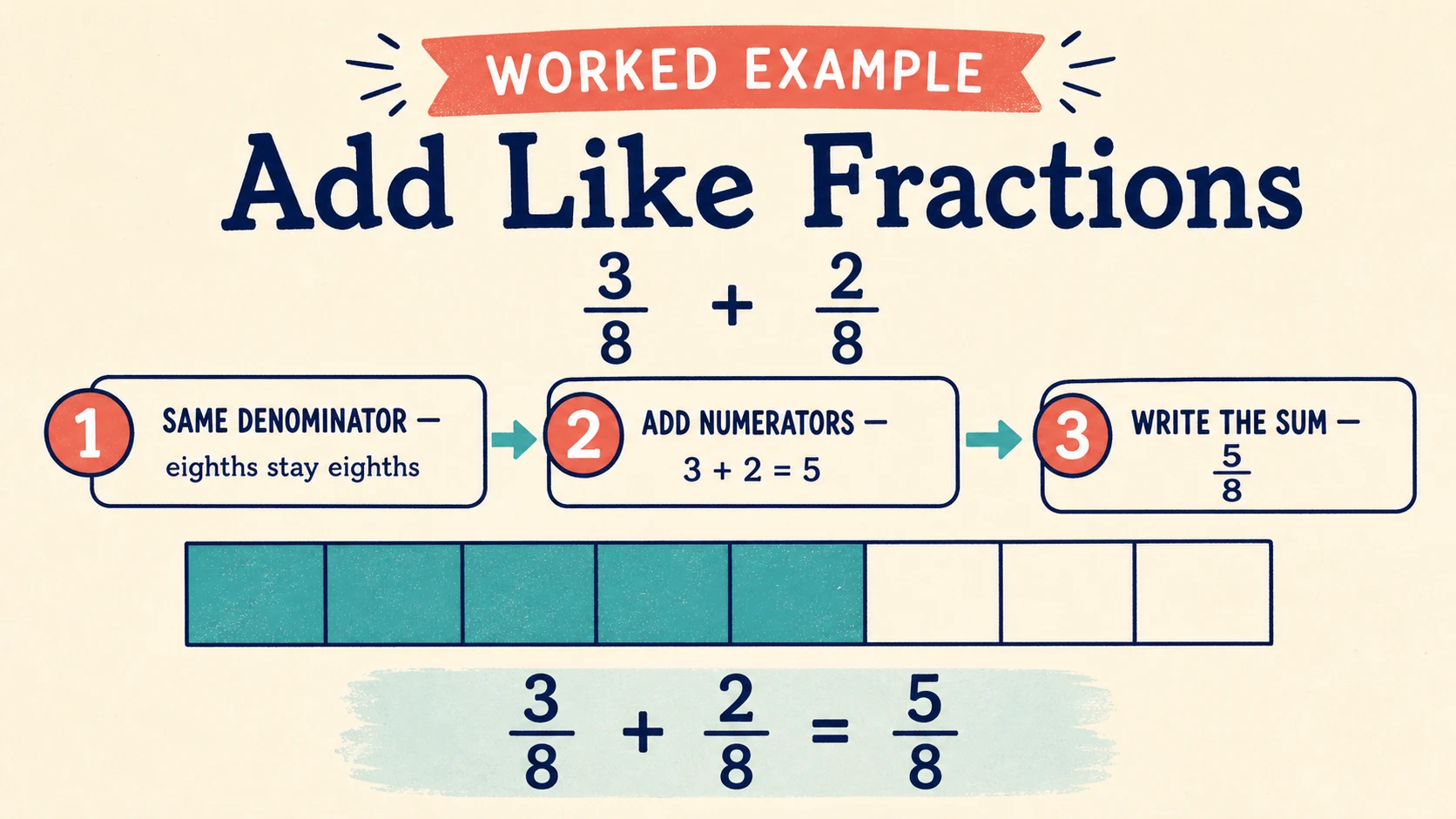
The symbol is introduced after the equal shares have been established in the model.
Example 1: Identifying One Half
A rectangle is divided into two equal vertical parts. The left part is shaded.
- The whole is one rectangle.
- The rectangle has two parts.
- The two parts have equal area.
- One of the two equal parts is shaded.
- Therefore, the shaded amount is one half, written 1/2.
Check: two copies of the shaded part would cover the complete rectangle. The answer is 1/2.
Boundary case: if the dividing line were far from the center, the two regions would be unequal. One shaded region out of two would then not be one half.
Example 2: Naming Three Fourths
A square is divided into a two-by-two grid. Three small squares are shaded.
- The whole is the large square.
- It contains four small squares of equal area.
- Three equal shares are shaded.
- The total number of equal shares is four.
- The shaded amount is three fourths, written 3/4.
Check: one fourth remains unshaded, and 3/4+1/4 fills the whole. The answer is 3/4.
The “three” records the shaded shares. The “four” records how many equal shares make the whole.
Example 3: Recognizing Different-Looking Halves
Two equal-sized rectangles are shown. Rectangle A is divided vertically into two equal strips. Rectangle B is divided diagonally from one corner to the opposite corner. One region in each rectangle is shaded.
- Each whole has the same total area.
- Rectangle A contains two equal regions.
- The diagonal divides Rectangle B into two matching triangles with equal area.
- One of two equal regions is shaded in each case.
- Each shaded region represents 1/2.
Check: rotate and match the two triangular parts of Rectangle B; together they re-form the rectangle. Both answers are 1/2, even though the pieces have different shapes from the vertical strips.
Example 4: Comparing Unit Fractions
Two paper strips have equal length. Strip A is divided into two equal parts, with one part shaded. Strip B is divided into four equal parts, with one part shaded.
- The wholes are equal in size.
- Strip A shows 1/2.
- Strip B shows 1/4.
- Dividing the same whole into more equal parts makes each part smaller.
- Therefore, 1/2 is greater than 1/4.
Check: two fourths cover the same length as one half, so one fourth must be smaller than one half.
Boundary case: if Strip B were twice as long as Strip A, one fourth of B could equal one half of A. Fraction comparisons require attention to the whole.
Example 5: Finding One Half of a Set
There are eight counters. They are separated into two equal groups.
- The whole set contains eight counters.
- Two equal groups are required because the target is one half.
- Share the counters evenly: one counter to each group until all eight are used.
- Each group contains four counters.
- Therefore, one half of eight counters is four counters.
Check: the two groups contain 4+4=8. The groups are equal, so each is one half of the original set.
Example 6: Locating One Half on a Number Line
A number line runs from 0 to 1.
- The whole interval is the distance from 0 to 1.
- Divide that distance into two equal intervals.
- The division point lies after one of the two intervals.
- That point represents 1/2.
Check: the distance from 0 to 1/2 equals the distance from 1/2 to 1.
A common incorrect method counts the points 0, the middle mark, and 1 and calls the middle “one third.” The fraction comes from two equal intervals, not three visible marks.
A Short, Repeatable Lesson Routine
A focused session can be brief. Stop while explanations are still thoughtful rather than extending practice until accuracy deteriorates.
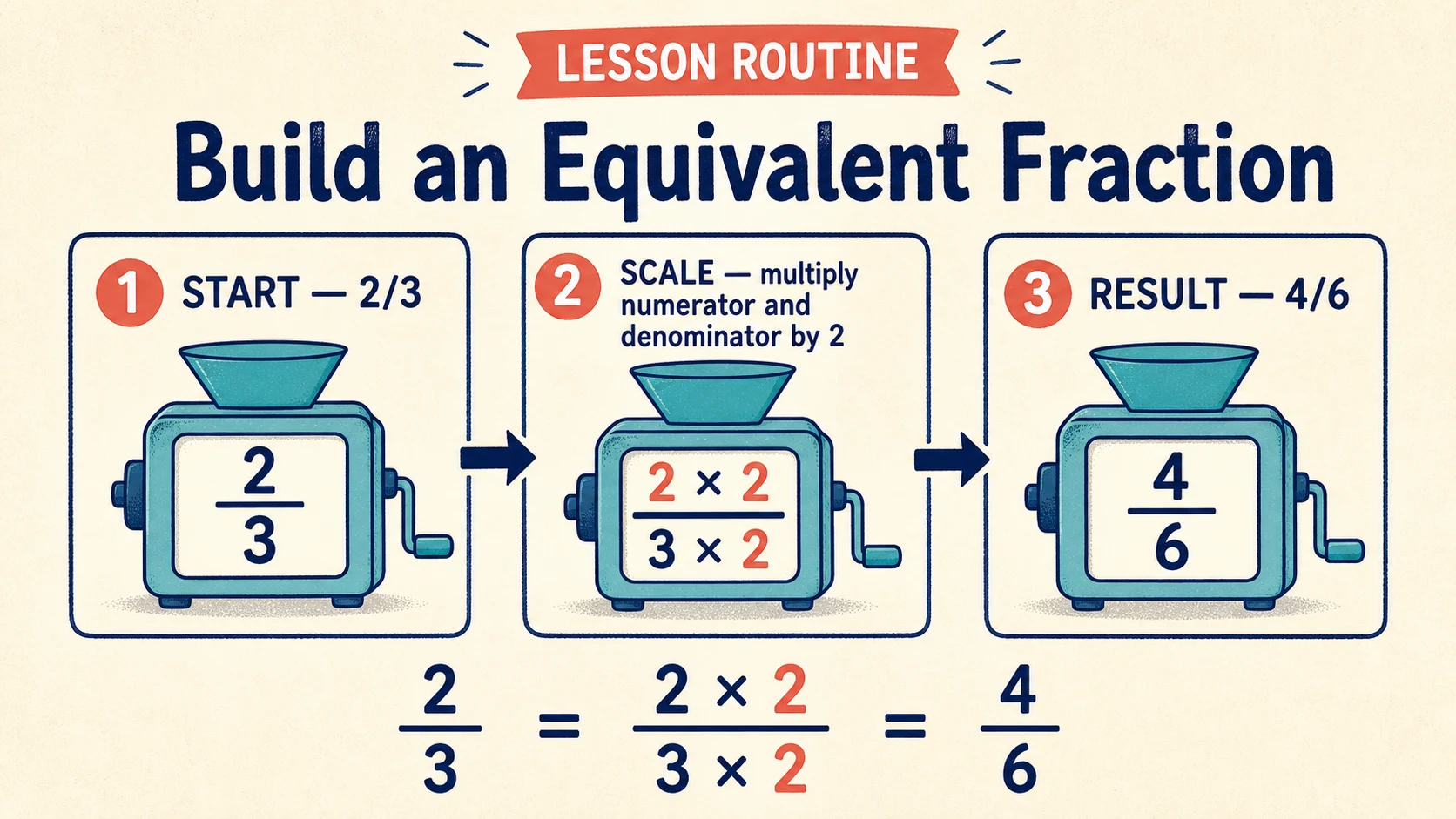
The routine alternates explanation, modeling, supported practice, and a short independent check.
1. Retrieve a Known Idea
Spend one or two minutes reviewing equal sharing. Show one correct partition and one unequal partition. Ask the learner to identify which one shows fair shares and explain why.
2. Model One New Step
Demonstrate a single target, such as dividing a rectangle into fourths. Think aloud using precise language: “This is the whole. I need four parts. Each part must have the same area.”
3. Practice Together
Complete two examples with decreasing support. In the first, provide the model and ask the learner to name the fraction. In the second, ask the learner to create the partition.
4. Check Independently
Give two or three items without hints. Include one familiar item and one changed representation. Ask for a brief explanation, not just a label.
5. Record the Next Teaching Decision
Note what the learner did without help. If equality was secure but notation was inconsistent, retain the visual model and practice notation. If equal sharing was not secure, return to folding and matching pieces rather than adding more symbols.
Choosing Useful Practice
The right practice page matches the learner’s current decision point. “Easy” can describe the intended difficulty, but it does not guarantee that every listed skill is appropriate for every second grader.
Use identification practice when the learner can distinguish equal from unequal shares but hesitates over names. Choose partitioning tasks when the learner recognizes halves or fourths yet cannot create them. Use mixed visual models when correct answers depend too heavily on one familiar orientation.
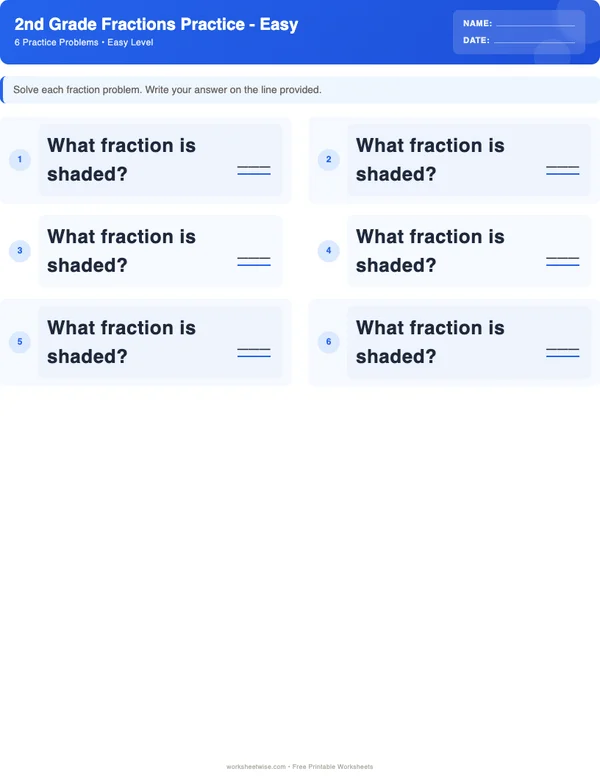
The catalogue’s free 2nd Grade Fractions worksheet contains six easy-level exercises and a separate printable answer key. Its listed coverage includes identification, comparison, equivalence, and fraction operations. Preview the six items before assigning them. Select only the exercises that fit the learner’s demonstrated readiness, especially because equivalence and operations extend beyond the central second-grade partitioning focus described above.
The Fractions topic guide can help keep related resources together. For broader practice, the focused pack contains 18 worksheets and is listed at $4.79. A larger pack is useful only when its pages match a planned sequence; more pages do not replace observation or instruction.
Match the Format to the Evidence Needed
- To check conceptual understanding, ask the learner to sort valid and invalid fraction models.
- To check construction, ask the learner to partition an unmarked shape.
- To check language, ask for an oral explanation using whole, equal shares, and fraction names.
- To check notation, ask the learner to match pictures, words, and symbols.
- To check transfer, change the shape, orientation, or location of the shaded part.
- To check independence, use a short mixed set without prompting.
Differentiation Without Changing the Core Idea
Differentiation should adjust access, representation, or complexity while preserving the mathematical target.
When the Learner Needs More Support
Use one fraction type at a time, beginning with halves. Provide precut matching pieces, heavy boundary lines, or partially completed folds. Reduce writing by allowing the learner to point, build, shade, and explain orally.
Keep the whole visually stable across several examples. Once the learner succeeds, change one feature at a time: orientation first, then shape, then the number of shares.
The IES practice guide for assisting students struggling with mathematics supports high-level use of systematic instruction, clear mathematical language, visual representations, and ongoing checks of understanding. In this guide, those principles translate into explicit modeling, carefully sequenced examples, and immediate responses to the learner’s actual errors.
When the Learner Is Ready for More
Increase reasoning before increasing calculation. Ask the learner to:
- Draw two different ways to show one half.
- Explain why three unequal pieces are not thirds.
- Find all the ways to shade two fourths in a two-by-two grid.
- Compare one half and one fourth using equal paper strips.
- Place one half between 0 and 1 on a number line.
- Decide whether two different-looking regions have equal area.
Simple equivalence such as two fourths covering the same amount as one half can be explored visually. Formal procedures for generating equivalent fractions or performing fraction operations should not replace the grade-appropriate foundation.
Common Errors and Diagnostic Responses
An incorrect answer is useful when it reveals the learner’s rule. Ask the learner to show how the answer was chosen before correcting it.
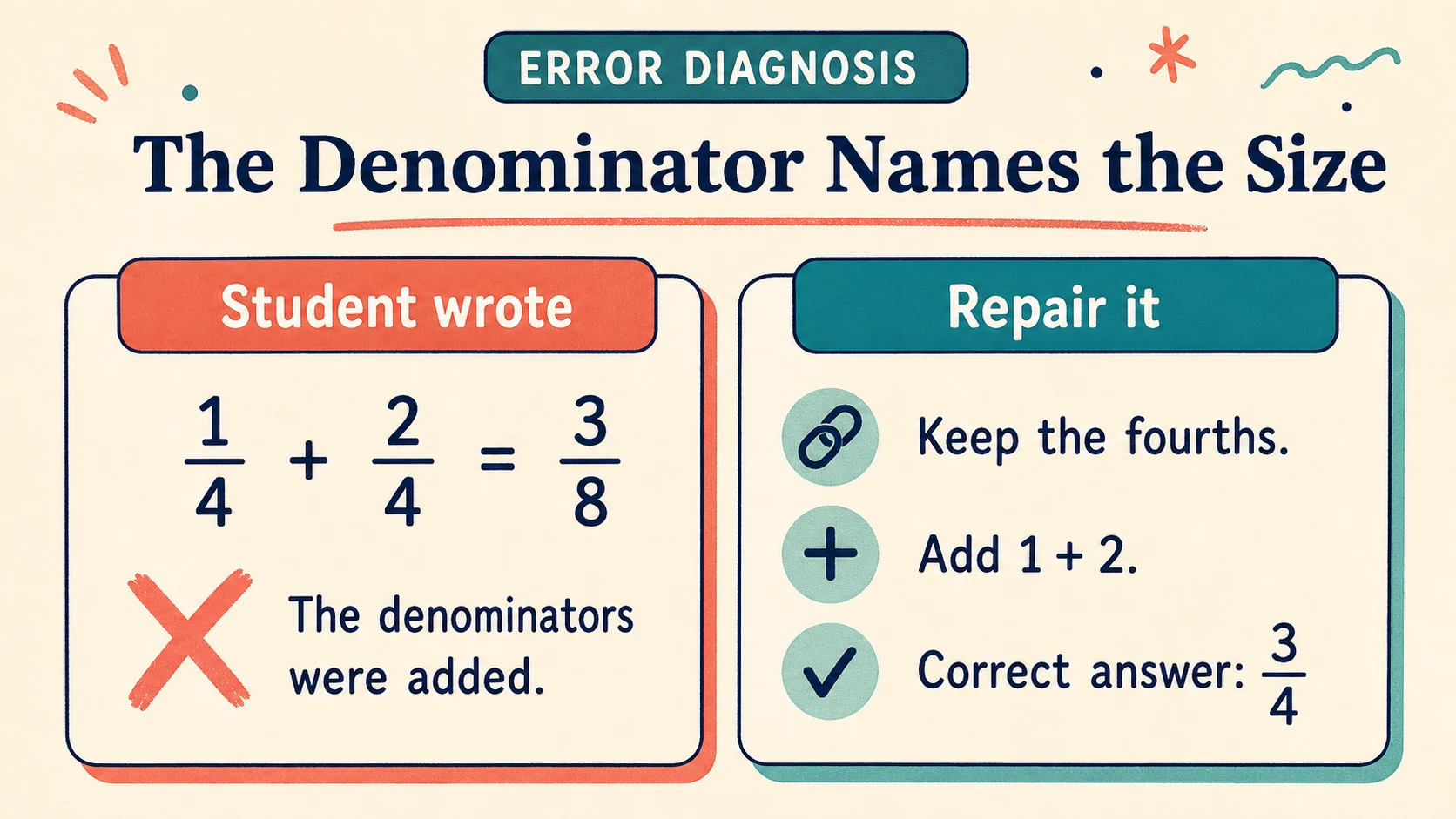
Diagnosis connects each visible error to a focused model or follow-up task.
| Observed error |
Likely reasoning to check |
Teaching response |
| Calls any one of two pieces a half |
Counts pieces but ignores equality |
Compare equal and unequal two-part folds |
| Names three shaded fourths as 4/3 |
Reverses selected parts and total parts |
Say “three of four equal shares” while pointing to each quantity |
| Thinks 1/4 is greater than 1/2 |
Treats 4 as a larger whole-number amount |
Cut equal strips into halves and fourths; compare one piece |
| Rejects diagonal halves |
Expects halves to be vertical or rectangular |
Cut along the diagonal and match the two triangles |
| Counts number-line marks instead of intervals |
Transfers shape-region counting directly to points |
Trace and count the spaces from 0 to 1 |
| Says two fourths cannot equal one half |
Treats fraction names as unrelated labels |
Overlay two fourth-size pieces on one half-size piece |
| Compares fractions from unequal wholes |
Ignores the reference whole |
Rebuild the examples using equal-sized wholes |
| Shades four unequal regions for fourths |
Believes the number of pieces is sufficient |
Have the learner match or overlay the four pieces |
Do not diagnose from a single slip. A reversed symbol may be a notation error, while repeated acceptance of unequal shares points to a conceptual gap. Use two or three varied follow-up items before deciding what to reteach.
Monitoring Progress and Deciding When to Move On
Track evidence in three columns: task, support given, and learner explanation. A correct response completed after several hints is not yet independent performance.
Useful monitoring prompts include:
- “What is the whole?”
- “How do you know the shares are equal?”
- “What does the bottom number tell us in this picture?”
- “Can you show the same fraction another way?”
- “What would make this model incorrect?”
Look for accuracy across different shapes and orientations. A learner who identifies 1/2 only when the left side of a circle is shaded may have memorized an image rather than understood the relationship.
Move forward when the learner can independently identify the whole, verify equal shares, name common partitions, and explain the answer across several representations. Revisit the previous stage when answers depend on guessing, when unequal parts are accepted, or when the learner cannot explain what is being counted.
A simple weekly record might use:
- Secure: correct independently across varied models.
- Developing: correct with a reminder or familiar model.
- Not yet secure: inconsistent after modeling or unable to explain.
These labels organize teaching; they are not diagnoses or predictions about the learner.
A Two-Week Practice Plan
The plan below assumes short sessions on ten practice days. It is an instructional suggestion, not a sourced or universal timetable. Shorten, repeat, or reorder sessions according to observed work.
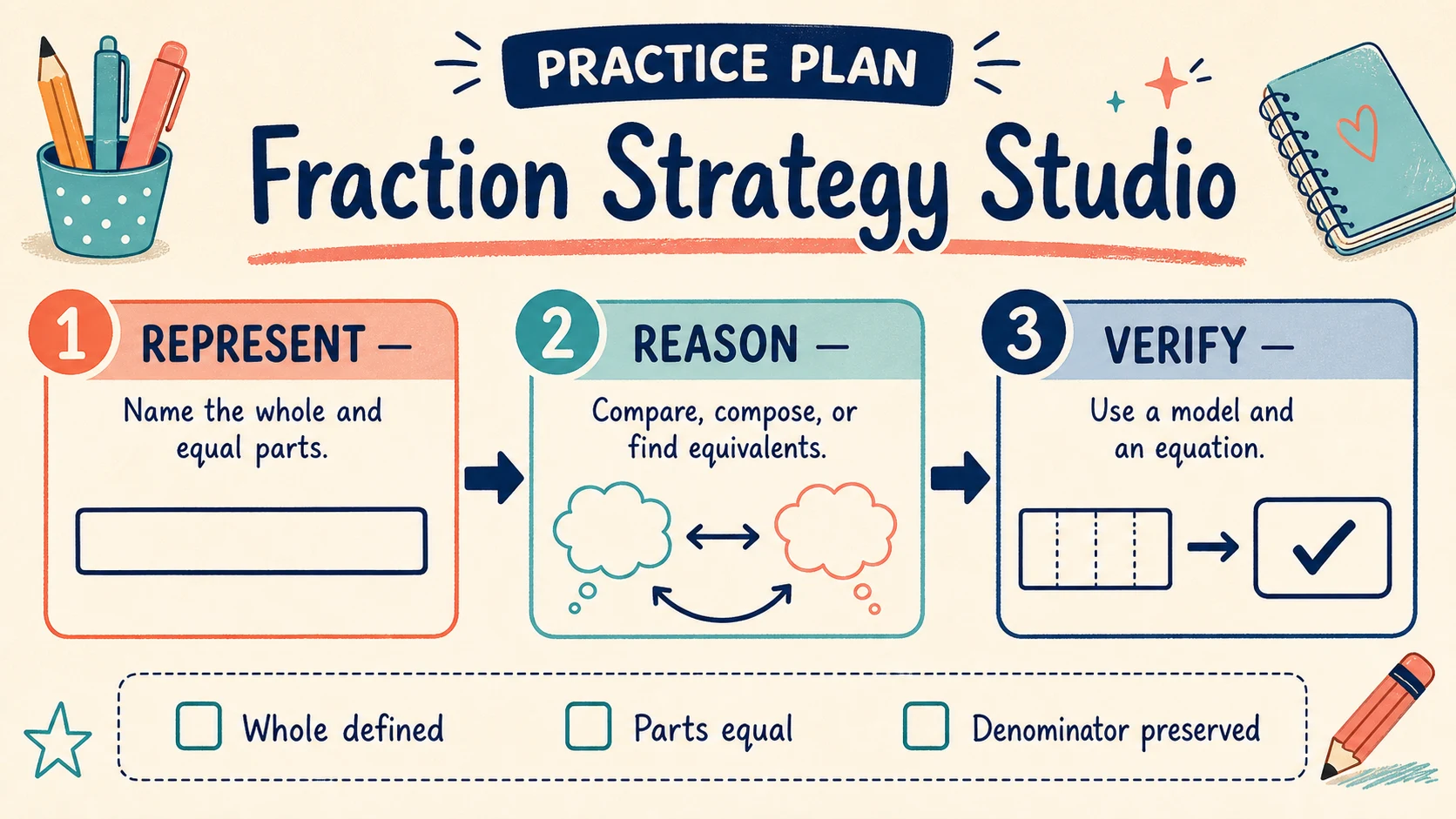
Each day adds one manageable demand while preserving time for review and explanation.
| Day |
Focus |
Suggested activity |
Independent check |
| 1 |
Whole and part |
Identify wholes and incomplete objects |
Point to the whole in three examples |
| 2 |
Equal versus unequal |
Sort folded and drawn models |
Explain why one nonexample is not halves |
| 3 |
Halves |
Fold rectangles and circles into two equal shares |
Draw one valid half model |
| 4 |
Fourths |
Fold strips twice and label four equal shares |
Shade one fourth and three fourths |
| 5 |
Review |
Mix halves, fourths, and unequal partitions |
Complete four short model items |
| 6 |
Thirds |
Use prepared strips divided into three equal shares |
Identify one third in varied orientations |
| 7 |
Several shares |
Name two fourths, three fourths, and two thirds visually |
Match three pictures to words or symbols |
| 8 |
Recompose wholes |
Assemble halves, thirds, and fourths |
State how many named shares make one whole |
| 9 |
Compare unit fractions |
Compare one half, one third, and one fourth of equal strips |
Explain why one fourth is smaller than one half |
| 10 |
Transfer and review |
Use shapes, a small set, and a 0-to-1 number line |
Complete a brief mixed check and explain one answer |
After Day 5, inspect the learner’s explanations. If unequal shares are still accepted, repeat Days 2–4 with concrete materials. If the learner is secure, continue to thirds and varied representations. After Day 10, retain successful models while revisiting the exact error types that remain.
Important Limits of This Guide
This guide does not establish comprehensive standards alignment, certify mastery, or guarantee an outcome. It provides a grade-appropriate instructional path grounded in the supplied catalogue, checked mathematical examples, and high-level framing from the linked authoritative sources.
The catalogue includes fraction skills extending well beyond second grade. Equivalence, comparison, mixed numbers, and the four operations are part of the broader fractions sequence, but their presence in the catalogue does not make every version of those skills a second-grade requirement. Local schools, states, curricula, and homeschool programs may arrange content differently.
The two-week plan is not a deadline. Some learners will need more experiences with equal sharing; others will be ready to explore visual equivalence sooner. Pacing should follow stable evidence from the learner’s work, not the number of days completed.
The Honest Next Step
Begin with a three-item check: one correct half, one unequal two-part shape, and one square divided into fourths. Ask the learner to identify the whole, decide whether the shares are equal, and name the shaded amount.
If those ideas are secure, use selected grade-appropriate items from the free 2nd Grade Fractions worksheet, checking its answer key after the learner has explained the reasoning. If the check reveals uncertainty, return to paper folding and equal-share models before assigning symbolic or operational practice.