What 2nd Grade Spelling Words Instruction Should Accomplish
Second-grade spelling instruction should help a learner connect sounds, letter patterns, word parts, and meaning—and then use those connections while writing. The immediate goal is not to memorize the largest possible list. It is to recognize a manageable pattern, spell representative words, notice exceptions, and transfer the learning to unfamiliar words and sentences.
A useful sequence moves from short-vowel review toward long-vowel spellings, consonant patterns, r-controlled vowels, silent letters, prefixes, suffixes, and accessible multisyllabic words. High-frequency words that do not fit the current pattern also need direct attention.
Grade labels describe an intended practice level, not a fixed timetable. Local curricula and instructional sequences differ. Begin with the learner’s observed work: what can be read, explained, and written without prompting? Move forward when the pattern is reasonably stable, and step back when errors reveal a missing prerequisite.
The 2nd Grade spelling hub can help adults compare practice across spelling topics.
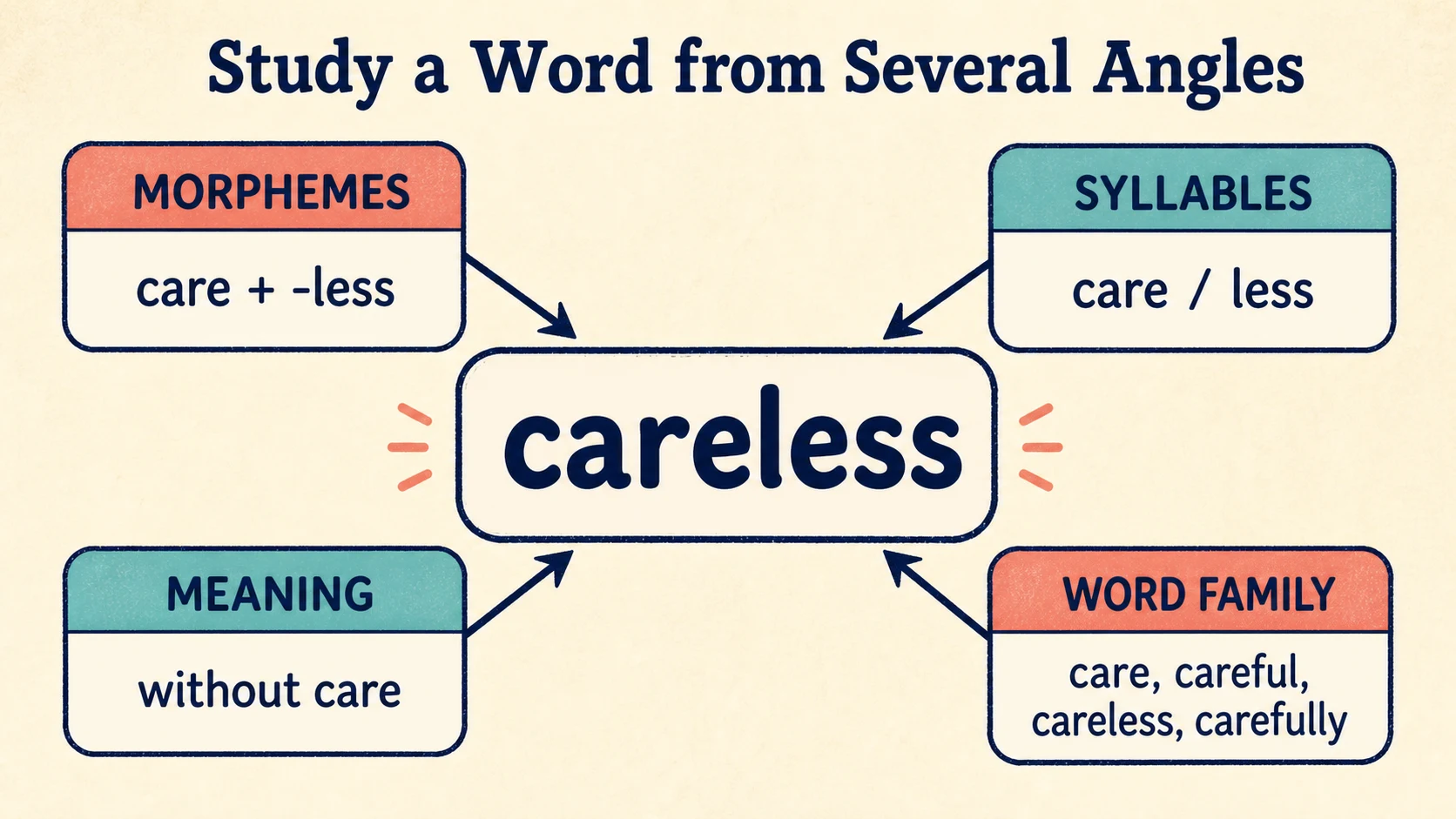
Spelling connects speech sounds, written patterns, meaningful word parts, reading, and independent writing.
The Skills Behind Accurate Spelling
Spelling is more than recalling a sequence of letters. A second grader draws on several kinds of knowledge at once.
Sound awareness and sound-to-letter knowledge
The learner must hear the parts of a spoken word before representing them in print. In ship, the sounds are /sh/ /i/ /p/, even though the word contains four letters. In float, the learner must recognize that the middle sound is represented by the vowel team oa.
The Institute of Education Sciences recommends developing awareness of speech-sound segments and their links to letters. It also recommends teaching learners to decode words, analyze word parts, and write and recognize words. Those recommendations provide high-level support for connecting spelling practice to phonics and word analysis rather than treating spelling as visual memorization alone. See the IES guide on foundational reading skills in kindergarten through grade 3.
Pattern knowledge
English sounds can have more than one spelling. The long-a sound appears in cake, rain, and play. A learner therefore needs to notice where a spelling occurs:
- a_e often has a consonant between the two vowels: cake.
- ai commonly appears inside a word: rain.
- ay commonly appears at the end of a word or syllable: play.
These are useful generalizations, not guarantees. Words such as break are better treated as boundary cases because their spelling does not follow the most straightforward long-a pattern.
Word-part and meaning knowledge
Prefixes and suffixes add stable, meaningful parts to words. If a learner knows help, the spelling of helpful can be analyzed as help + ful. If the learner knows quick, quickly can be analyzed as quick + ly.
This approach reduces the memory load. The child is not learning every longer word as an unrelated string of letters.
Memory for particular words
Some frequently used words contain parts that are not easily predicted from the learner’s current phonics knowledge. These words still deserve analysis. In said, for example, the first and last consonants are expected, while the middle spelling must be remembered. Marking the unexpected part is more informative than telling the learner that the whole word is irregular.
Check the Prerequisites Before Choosing a List
A spelling list can look appropriate by age while still being poorly matched to the learner’s present knowledge. Use a short, ungraded check before assigning practice.
Ask the learner to:
- Segment three simple words such as map, fish, and stop.
- Spell two short-vowel words such as bed and jump.
- Read and spell one long-vowel pair such as cap/cape.
- Add a familiar suffix, as in help + ful.
- Write one dictated sentence containing a practiced word.
Observe the process as well as the answers. Does the learner say the word slowly? Record the first and final sounds? Confuse a sound with a letter name? Remember a word during a drill but lose it in a sentence?
Signs that foundational review is needed
Short-vowel or consonant review is appropriate when the learner:
- omits sounds, writing sip for slip;
- cannot distinguish nearby vowel sounds, such as those in bed and bad;
- writes only the first and final letters;
- guesses from a word’s overall appearance;
- cannot read back the spelling just produced.
In these cases, use fewer words and make every sound visible with counters, boxes, or letter tiles.
Signs that the learner is ready to extend a pattern
A learner may be ready for a harder pattern when they can:
- spell several taught examples without seeing them;
- sort words and explain the sorting rule;
- attempt an unfamiliar word using the same generalization;
- use practiced words accurately in short dictation;
- find and correct at least some errors after rereading.
Perfect scores are not the only evidence of readiness. A well-reasoned attempt such as flote for float shows that the learner hears the sounds and knows one long-vowel convention, even though the correct vowel spelling still needs teaching.
A Grade-Appropriate Progression
The order below is an instructional suggestion based on the supplied catalogue scope. It is not a universal curriculum sequence.
| Stage |
Main focus |
Example words |
Useful practice |
Evidence to watch |
| 1 |
Short vowels and common consonant patterns |
step, flag, dish |
Sound boxes, word building, short dictation |
Every sound is represented |
| 2 |
Long vowels with silent e |
hope, cube, late |
Contrast pairs such as hop/hope |
Learner explains how final e changes the vowel |
| 3 |
Common vowel teams |
rain, seed, boat, play |
Sort by vowel spelling |
Learner groups by letters, not only by sound |
| 4 |
R-controlled vowels |
car, fern, bird, fork, turn |
Read-sort-write practice |
Vowel and r remain together |
| 5 |
Consonant doubling and endings |
running, stopped |
Compare base and changed word |
Learner checks the base-word ending |
| 6 |
Silent letters |
knee, write |
Mark the silent letter, then recall |
Learner identifies the remembered portion |
| 7 |
Prefixes and suffixes |
unhappy, helpful, quickly |
Build and split words |
Learner preserves recognizable word parts |
| 8 |
Accessible multisyllabic words |
sunset, helpful, rabbit |
Divide, spell, and recombine |
Learner works by syllable or meaningful part |
| Ongoing |
High-frequency and previously taught words |
Words drawn from current reading and writing |
Cumulative review and sentence use |
Accuracy carries into connected writing |
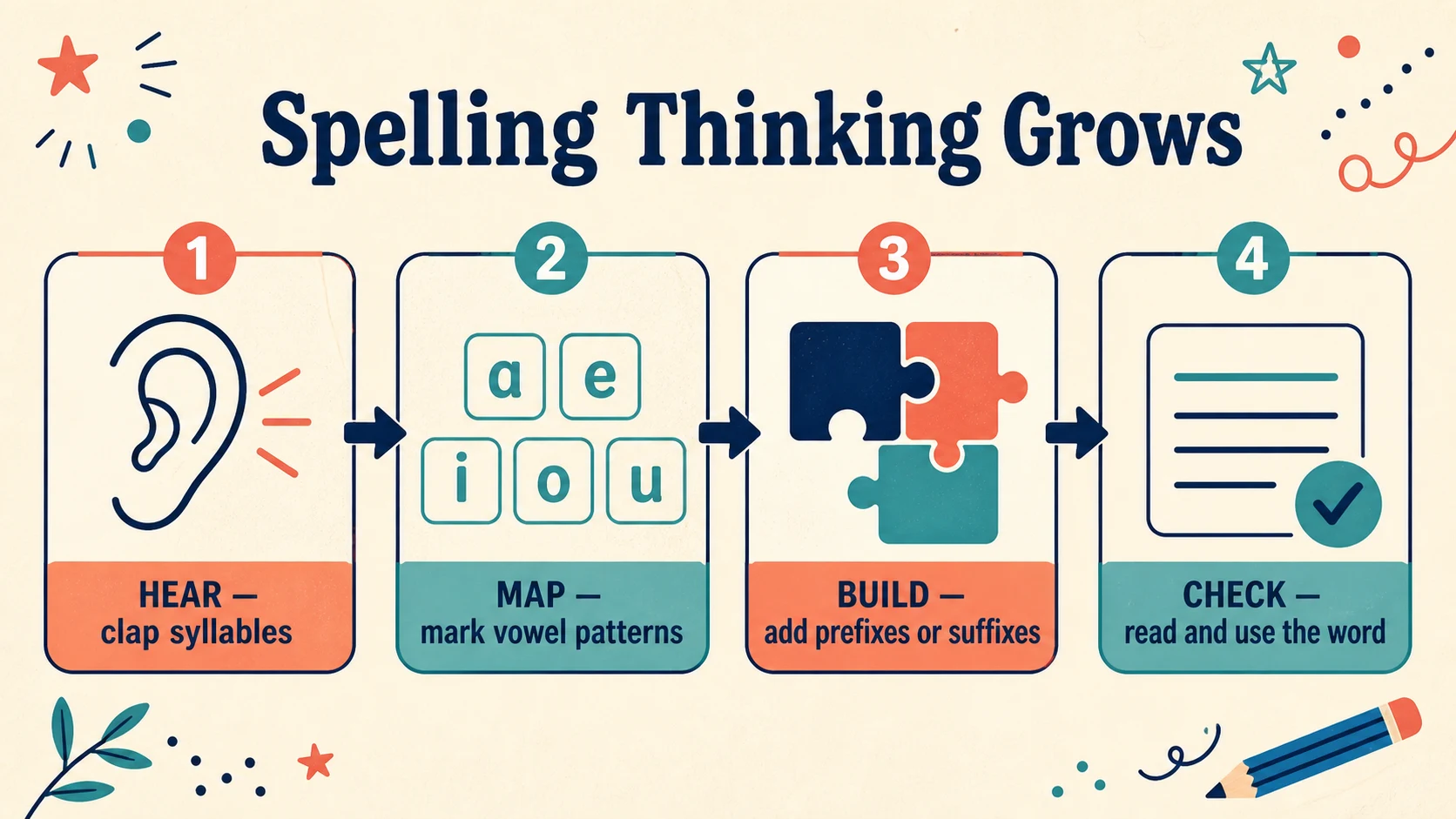
Support can fade from visible models and guided sorting to recall, dictation, and independent writing.
The 2nd Grade worksheet hub provides a broader view of intended second-grade practice. Use it as a level guide, not as evidence that every child should encounter the same pattern during the same week.
Concrete and Visual Models That Reveal the Pattern
Sound boxes
Draw one box for each sound, not necessarily for each letter.
For ship:
This model makes the two-letter consonant spelling sh visible as one sound unit.
For float:
The learner can see that four sounds are represented by five letters.
Pattern columns
A visual sort helps compare several spellings of the same sound.
| Long a with a_e |
Long a with ai |
Long a with ay |
| cake |
rain |
play |
| late |
tail |
stay |
| name |
paint |
tray |
After sorting, ask, “Where is the vowel spelling in each word?” The learner should notice ai inside words and ay at the end in these examples. Do not turn that observation into an absolute rule.
Word-part frames
Represent a base word and an added part separately:
help + ful → helpful
un + happy → unhappy
quick + ly → quickly
Color, underlining, or boxes may make the boundary visible. The purpose is not decoration; it is to show which letters belong to each meaningful part.
Fully Checked Worked Examples
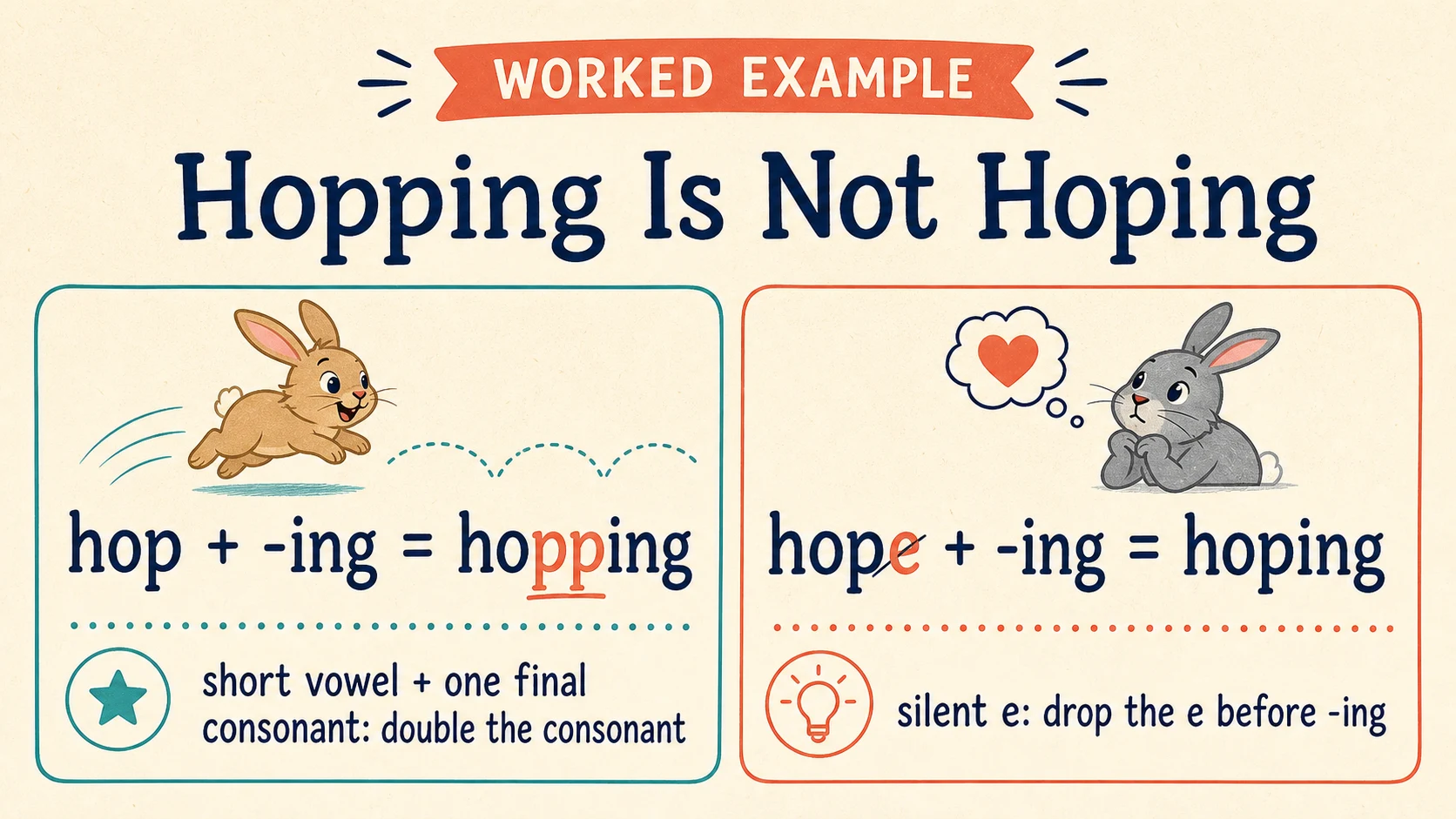
An effective model moves from hearing the word to identifying its pattern, writing it, and checking it in context.
Example 1: Spelling ship by sound
Prompt: Spell the word ship.
- Say it slowly: /sh/ /i/ /p/.
- Count three sounds.
- Map the sounds:
sh | i | p.
- Join the letters:
ship.
- Read the completed word: ship.
Check: Ship contains four letters but three sound units. Writing sip would replace /sh/ with /s/. Writing shp would omit the short-i sound. The checked answer is ship.
Example 2: Choosing hop or hope
Prompt: Complete the sentence: “I ___ we can go.”
- The intended word is pronounced /h/ /ō/ /p/.
- Hop represents the short-o word meaning to jump.
- Adding final e creates the spelling pattern o_e:
h-o-p-e.
- Read the sentence: “I hope we can go.”
Check: The meaning and vowel sound both require hope, not hop. The final e is not pronounced as a separate syllable.
Example 3: Selecting the long-a spelling in rain
Prompt: Spell the weather word rain.
- Say the sounds: /r/ /ā/ /n/.
- The long-a sound occurs inside the word.
- For this word, the vowel team is ai.
- Build the word:
r + ai + n = rain.
- Check it in a sentence: “The rain fell.”
Check: Rain is correct. Rane could represent the same sounds through a different pattern, but it is not the conventional spelling of this word. Rayn uses a spelling more commonly seen at the end in taught examples such as play and stay.
Example 4: Adding -ful to help
Prompt: Add -ful to help.
- Write the base word:
help.
- Add the suffix:
ful.
- Combine without dropping or changing letters:
help + ful.
- Write the result:
helpful.
- Check each part:
help | ful.
Check: Helpful has one l at the end. The suffix is -ful, not the separate word full. Therefore, helpfull is not correct.
Example 5: Doubling in running
Prompt: Add -ing to run.
- Identify the base word:
run.
- Notice its ending: one vowel followed by one consonant.
- Double the final n in this word before adding -ing.
- Combine:
run + n + ing = running.
- Read the result in context: “The dog is running.”
Check: Running has two consecutive ns. Runing would leave out the doubled consonant. Compare this with helping, where the final consonant is not doubled: help + ing = helping.
Example 6: Building sunset by parts
Prompt: Spell sunset.
- Say the word and identify its two familiar parts: sun and set.
- Spell the first part:
sun.
- Spell the second part:
set.
- Combine them:
sun + set = sunset.
- Read the complete word.
Check: Sunset preserves both smaller words. Sunsit changes the vowel in set, while suset omits the final sound in sun.
Boundary Cases and Misconceptions
One sound does not always have one spelling
The long-a sound can appear in cake, rain, play, and break. These words should not be presented as if they all follow one interchangeable rule. Cake, rain, and play provide a clean comparison of three familiar patterns. Break is a boundary case whose spelling must be examined as a particular word.
Likewise, knowing oa in boat does not mean every long-o word uses oa. The learner may reasonably produce a phonetic attempt before learning the conventional spelling.
Every final e is not doing the same job
In hope, final e participates in a familiar long-vowel pattern. Adults should avoid telling learners that every final e “makes the vowel say its name.” That explanation will not account for every English word.
Sorting is not the same as spelling independently
A child may sort visible words correctly because the printed patterns are available for comparison. That does not prove the child can retrieve the spelling from memory. Follow a sort with one or two covered words, then a brief sentence.
Copying is not recall
Accurate copying shows attention and handwriting control. It does not by itself show that the spelling is remembered. Look-cover-write-check adds a recall step:
- Look closely at the word.
- Cover it.
- Write it from memory.
- Uncover and compare.
- Identify the exact part that differs.
A weekly score does not show transfer by itself
A learner can spell a list on Friday and still miss the same words in ordinary writing. Include sentence dictation, editing, and samples of the learner’s own writing. The IES elementary writing guide includes high-level recommendations to provide writing opportunities and help learners become fluent with spelling and sentence construction. It does not evaluate WorksheetWise materials or prescribe this routine. See Teaching Elementary School Students to Be Effective Writers.
A Short, Repeatable Lesson Routine
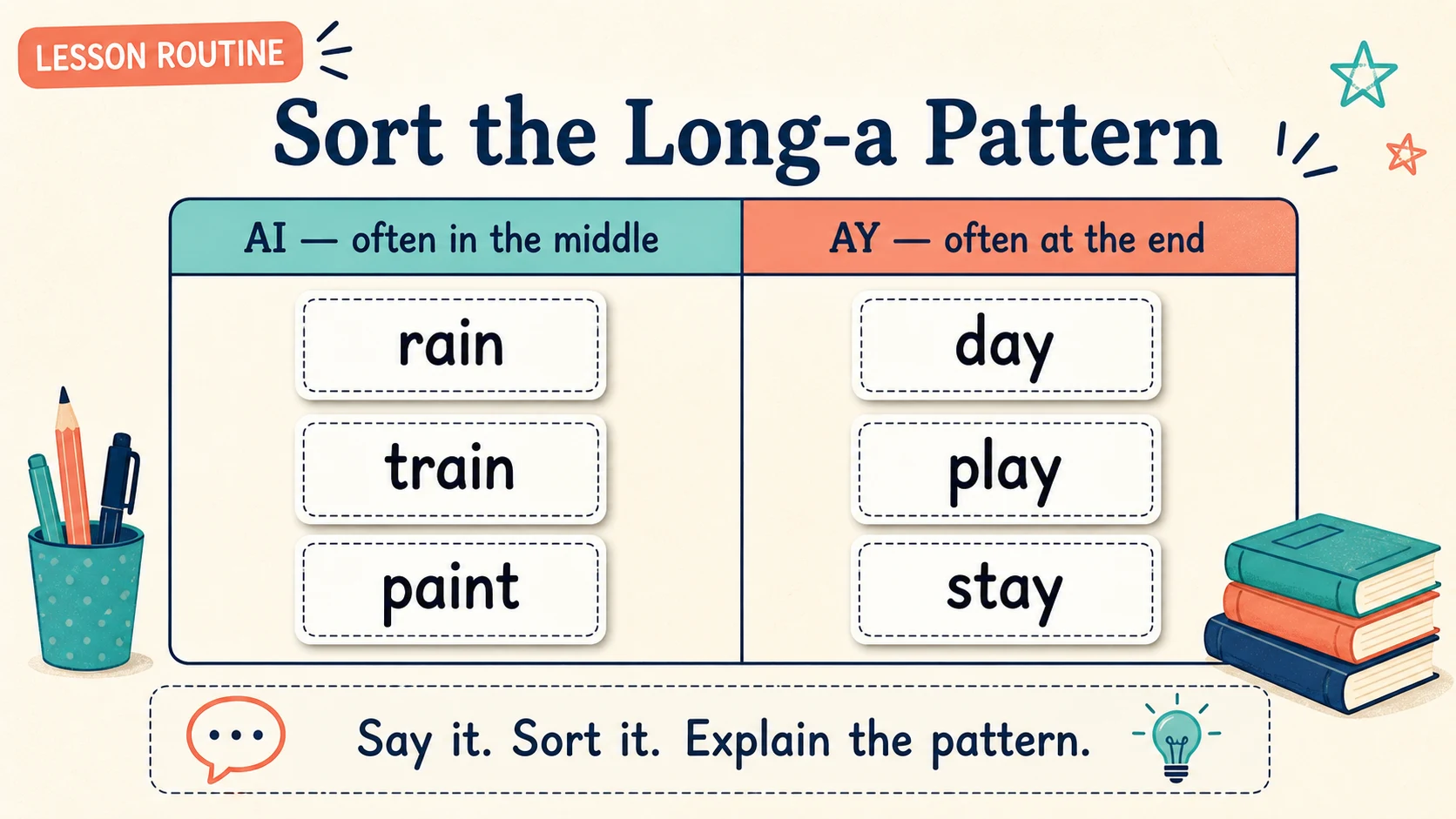
Keep the sequence predictable while changing the words and level of support.
A compact lesson can follow five phases.
1. Review
Read or spell two previously taught words. Choose at least one word that the learner has recently missed. Keep this portion cumulative rather than reviewing only the newest list.
2. State and model the focus
Name one pattern in plain language: “We are comparing long-a spellings.” Model two words, such as rain and play. Underline ai and ay, then point out their positions.
3. Guided analysis
Have the learner sort four to six words. Ask for an explanation: “I put tray with play because both end in ay.” If the explanation is vague, prompt attention to the letters and their location.
4. Recall and apply
Use look-cover-write-check for two or three words. Then dictate a short sentence containing one target word: “We will play after lunch.” Sentence use checks capitalization, spacing, and punctuation as well as spelling, but record spelling performance separately.
5. Correct specifically
Do not stop at a mark indicating that the whole word is wrong. Compare the attempt with the correct spelling and identify the mismatched part. If the learner writes ran for rain, focus on the long-a spelling ai. Have the learner write the corrected word, explain the pattern, and use it again later.
This timing and sequence are instructional suggestions. The learner’s attention, accuracy, and observed work should determine the number of examples and the pace.
Choosing the Right Practice
Different activities answer different instructional needs.
| Learner need |
Choose this practice |
Avoid relying on |
| Cannot hear every sound |
Sound boxes and letter building |
Long copying lists |
| Confuses two patterns |
Side-by-side word sorts |
Mixed review without a stated focus |
| Knows a pattern but forgets words |
Look-cover-write-check |
Repeated visible copying |
| Spells lists but not sentences |
Dictation and short writing |
Isolated-word tests alone |
| Misses earlier patterns |
Cumulative sorts and review |
Practicing only this week’s words |
| Needs confidence with the format |
Short, straightforward activities |
A large set of unfamiliar words at once |
| Is consistently accurate |
Untaught examples and two or three challenge words |
More repetitions of already secure items |
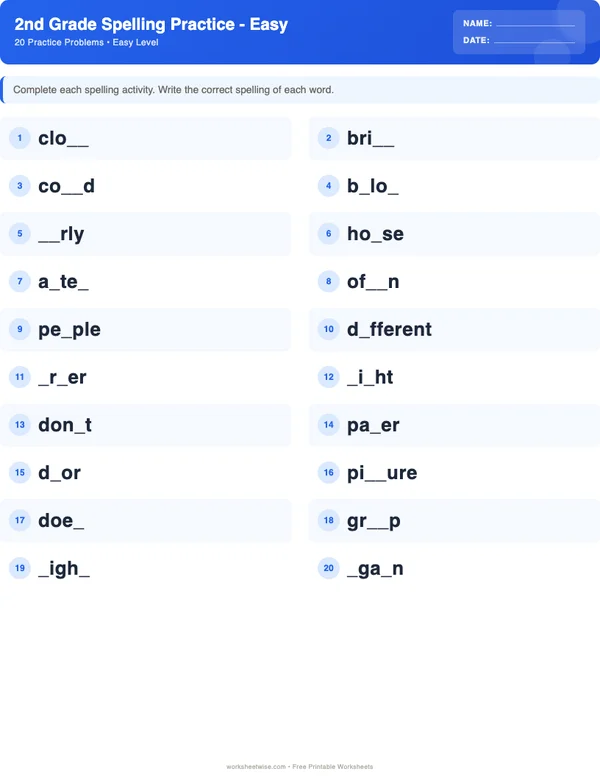
The free 2nd Grade Spelling Words worksheet contains 20 easy-level exercises using fill-in-the-blank, word scrambles, and misspelling correction. Its stated skills include spelling, word recognition, vocabulary, and letter patterns. It can serve as initial practice, homework, or review, but its difficulty label should not replace observation of the learner.
The focused spelling words pack contains 18 worksheets. A larger pack is useful when repeated or varied practice is needed, but more pages are not automatically better. Select only the pages that match the pattern being taught.
Differentiation Without Changing the Core Goal
When the learner needs more support
Reduce the number of target words, but retain pattern comparison. Use letter tiles before pencil work. Say each word naturally, then slowly. Provide two possible spellings to compare rather than asking for immediate recall.
For sentence dictation, first read the whole sentence, then repeat it in short phrases. If working memory for the sentence obscures the spelling skill, allow the learner to repeat each phrase aloud.
When the learner is ready for extension
Add two or three challenge words that extend the current pattern. After practicing rain, tail, and paint, an unfamiliar example such as train can test transfer. Ask the learner to justify the spelling rather than merely produce it.
Extension can also come through writing: compose two connected sentences containing target words, then edit them. Difficulty should come from applying the pattern, not from adding obscure vocabulary.
For multilingual learners
Clarify the word’s meaning and use it in a sentence before assessing its spelling. A learner cannot make a fair spelling attempt if the spoken word is unfamiliar or has been misheard. Compare sounds carefully without presenting differences between languages as mistakes in intelligence or effort.
When handwriting interferes
Permit letter tiles, oral letter naming, or typing for part of the lesson so spelling knowledge can be observed separately. Handwriting still matters, but unclear letter formation should not be confused automatically with lack of pattern knowledge.
Diagnose Errors Before Assigning More Work
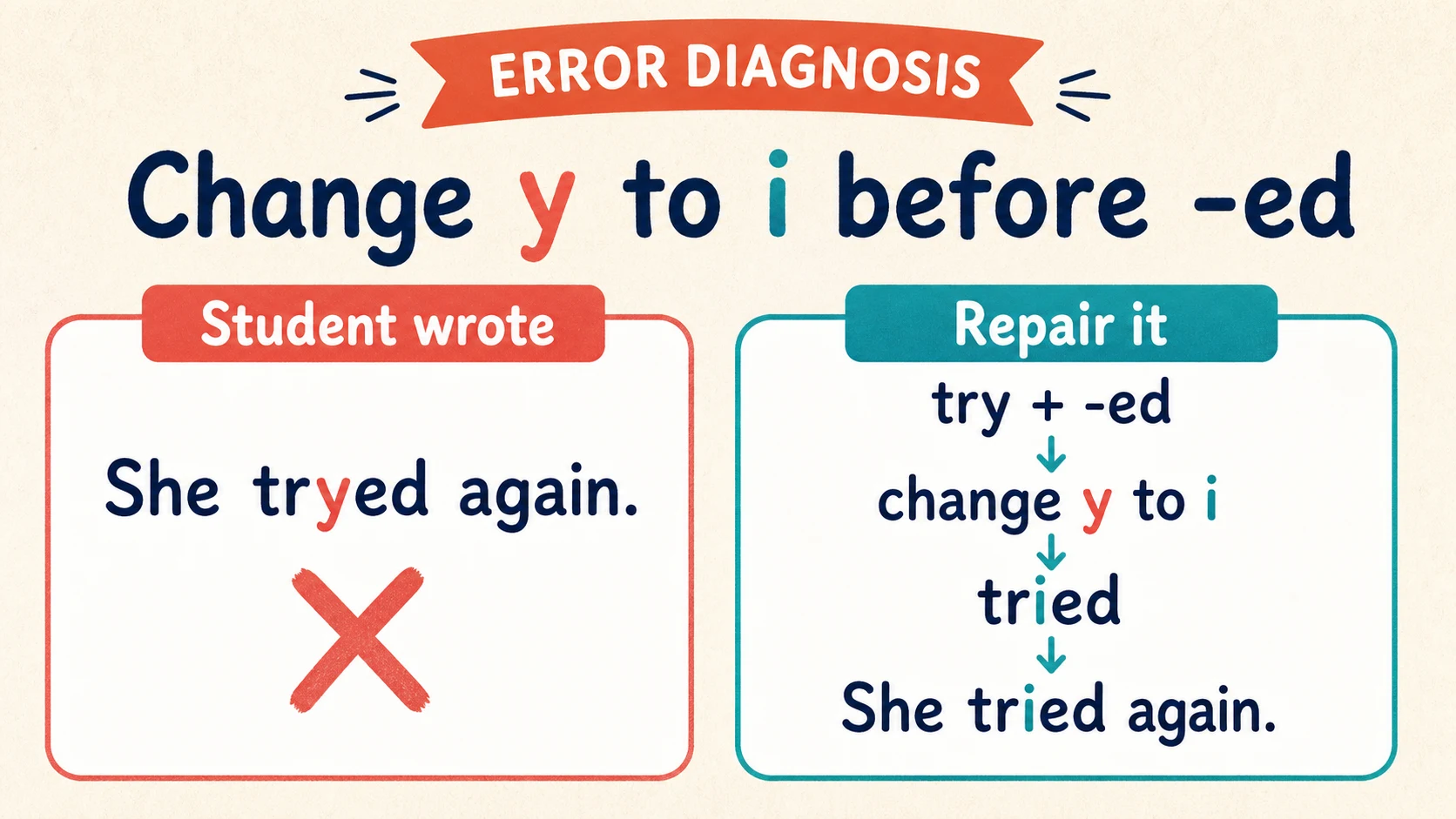
The form of an error points to the next useful teaching move.
| Observed attempt |
Likely instructional need |
Response |
| shp for ship |
A medial vowel was omitted |
Stretch the word and map all three sounds |
| sip for ship |
The sh sound was represented as /s/ |
Contrast sip and ship with sound boxes |
| ran for rain |
Long-a sound is heard, but the vowel team is missing |
Rebuild r + ai + n and compare with tail |
| runing for running |
Doubling convention is not yet stable |
Compare running with helping |
| helpfull for helpful |
The suffix was confused with the word full |
Separate `help |
| Correct on the list, wrong in a sentence |
Retrieval or transfer is weak |
Add delayed dictation and independent writing |
| Different spelling on every attempt |
The word has not been analyzed into stable parts |
Return to sound mapping or morpheme frames |
| Same error after immediate correction |
Correction was copied but not retained |
Recheck later without displaying the answer |
One misspelling does not establish a persistent difficulty. Look for repeated patterns across several words and contexts. This guide cannot diagnose a learning disability or provide medical guidance. If concerns are broad, persistent, or also affect reading and writing, document what has been observed and discuss it with the learner’s teacher or an appropriately qualified professional.
Monitor Growth and Decide When to Move On
Use a small record rather than relying on impressions. For each pattern, collect four kinds of evidence:
- Taught-word recall: Can the learner spell practiced examples without seeing them?
- Pattern explanation: Can the learner identify the relevant letters and explain the grouping?
- Transfer: Can the learner make a reasonable attempt at an unfamiliar example?
- Connected writing: Does the spelling appear accurately in dictation or the learner’s own sentences?
A simple record might read:
| Date |
Pattern |
Taught words |
New word |
Sentence use |
Next move |
| Monday |
ai long a |
4/5 |
0/1 |
1/2 |
Reteach ai inside words |
| Thursday |
ai long a |
5/5 |
1/1 |
2/2 |
Mix with ay words next |
Do not average unlike tasks into one score and lose the useful information. A learner who earns full credit on visible sorting but misses recall needs a different response from one who recalls words but cannot explain or transfer the pattern.
The supplied catalogue identifies generalizing learned spelling patterns in writing as a relevant second-grade expectation. The Common Core English Language Arts standards provide grade-specific literacy expectations within a broader reading, writing, speaking, listening, and language framework. Local adoption and sequencing vary, so this guide does not claim comprehensive standards alignment.
A Two-Week Practice Plan
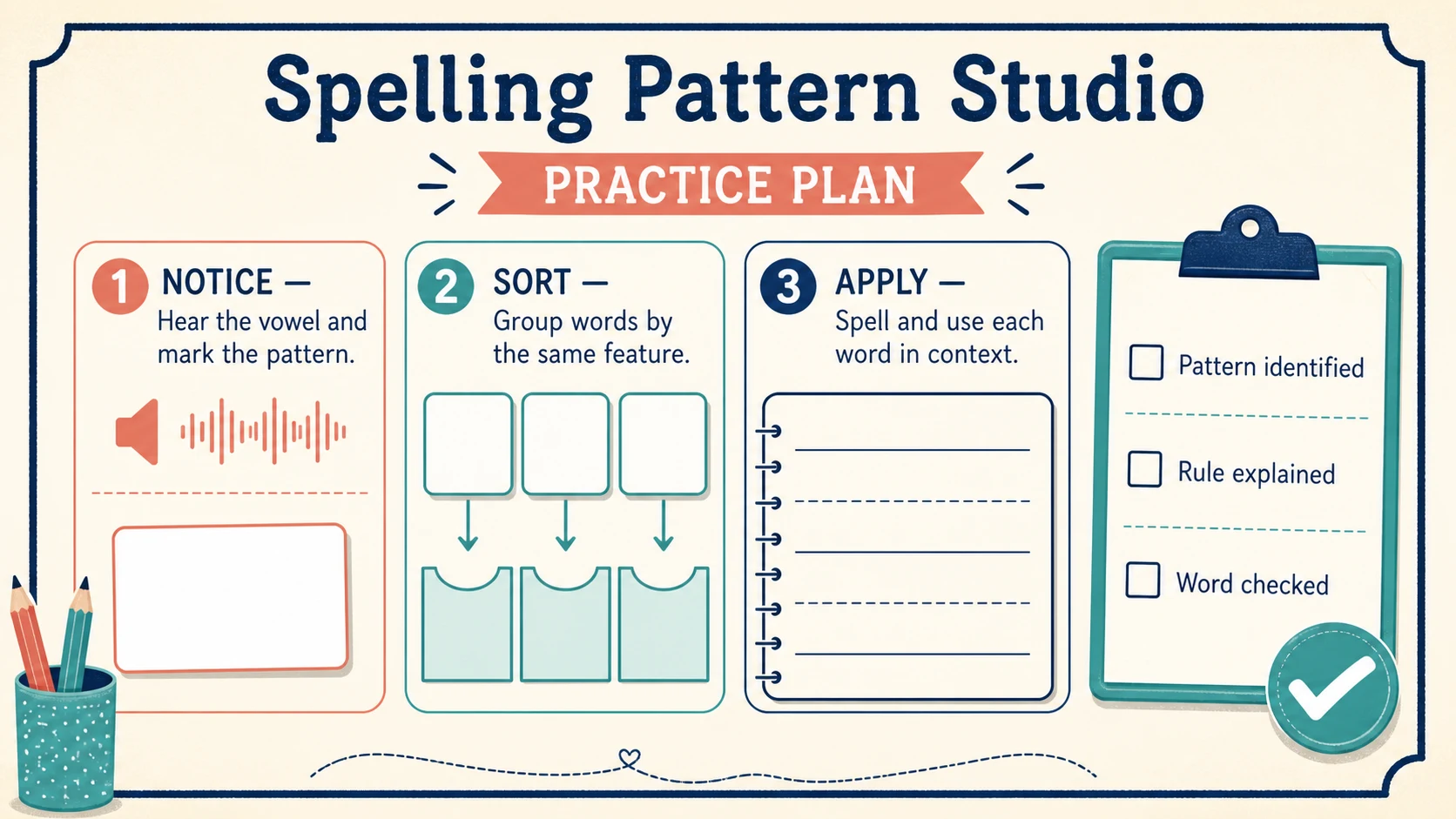
The plan alternates instruction, recall, application, and cumulative review.
This sample plan uses long-a spellings because they allow clear comparison. Replace the focus words when the learner’s work points elsewhere.
| Day |
Focus |
Short activity |
Evidence collected |
| 1 |
Baseline |
Spell cake, rain, play, and name without help |
Current representations and explanations |
| 2 |
a_e |
Build and contrast cap/cape, then sort cake, late, name |
Effect of final e |
| 3 |
ai |
Map rain, tail, paint; use look-cover-write-check |
Internal vowel-team recall |
| 4 |
ay |
Sort play, stay, tray and explain word position |
Recognition of ending pattern |
| 5 |
Compare |
Mixed sort of a_e, ai, and ay words; dictate one sentence |
Pattern discrimination |
| 6 |
Cumulative review |
Revisit two missed words plus one earlier short-vowel word |
Retention after a delay |
| 7 |
Transfer |
Spell unfamiliar but accessible examples such as train and day |
Application beyond the list |
| 8 |
Boundary case |
Compare break with the three taught groups; mark it for special attention |
Understanding that generalizations have limits |
| 9 |
Writing |
Compose two sentences using four target words; reread and edit |
Use in connected writing |
| 10 |
Review and decision |
Dictate several taught words, one transfer word, and one sentence |
Continue, mix, or reteach |
If Day 3 reveals confusion between short a and long a, pause the schedule. Contrast ran/rain or tap/tape before continuing. If the learner transfers the patterns accurately by Day 7, reduce repetition and move toward suffixes, r-controlled vowels, or another need visible in writing.
This is a practical model, not a universal timetable. Five focused minutes may be enough on one day; another learner may benefit from a longer session or fewer weekly sessions. Attention and the quality of the learner’s responses matter more than completing every row on schedule.
Limitations and the Next Useful Step
No worksheet, list, or two-week sequence can represent every spelling pattern a second grader may encounter. A printable can provide structured practice, but it cannot listen to the learner’s pronunciation, identify why a letter was omitted, or determine automatically whether success transfers to everyday writing. Adults still need to inspect attempts, ask for explanations, and adjust the next task.
Begin with a brief sample rather than a large commitment. Use the free easy-level 2nd Grade Spelling Words worksheet, note which error pattern appears more than once, and choose the next lesson from that evidence. If a custom focus is needed, explore the free worksheet generators to create practice around the specific pattern the learner is ready to study.