What 2nd Grade Sight Words Instruction Should Accomplish
Sight-word instruction helps a second grader recognize common words accurately and with less effort during reading. The goal is not simply to memorize a long list. Learners should connect a word’s pronunciation, spelling, and meaning, notice which spellings follow familiar phonics patterns, remember any unexpected part, and then read the word in connected text.
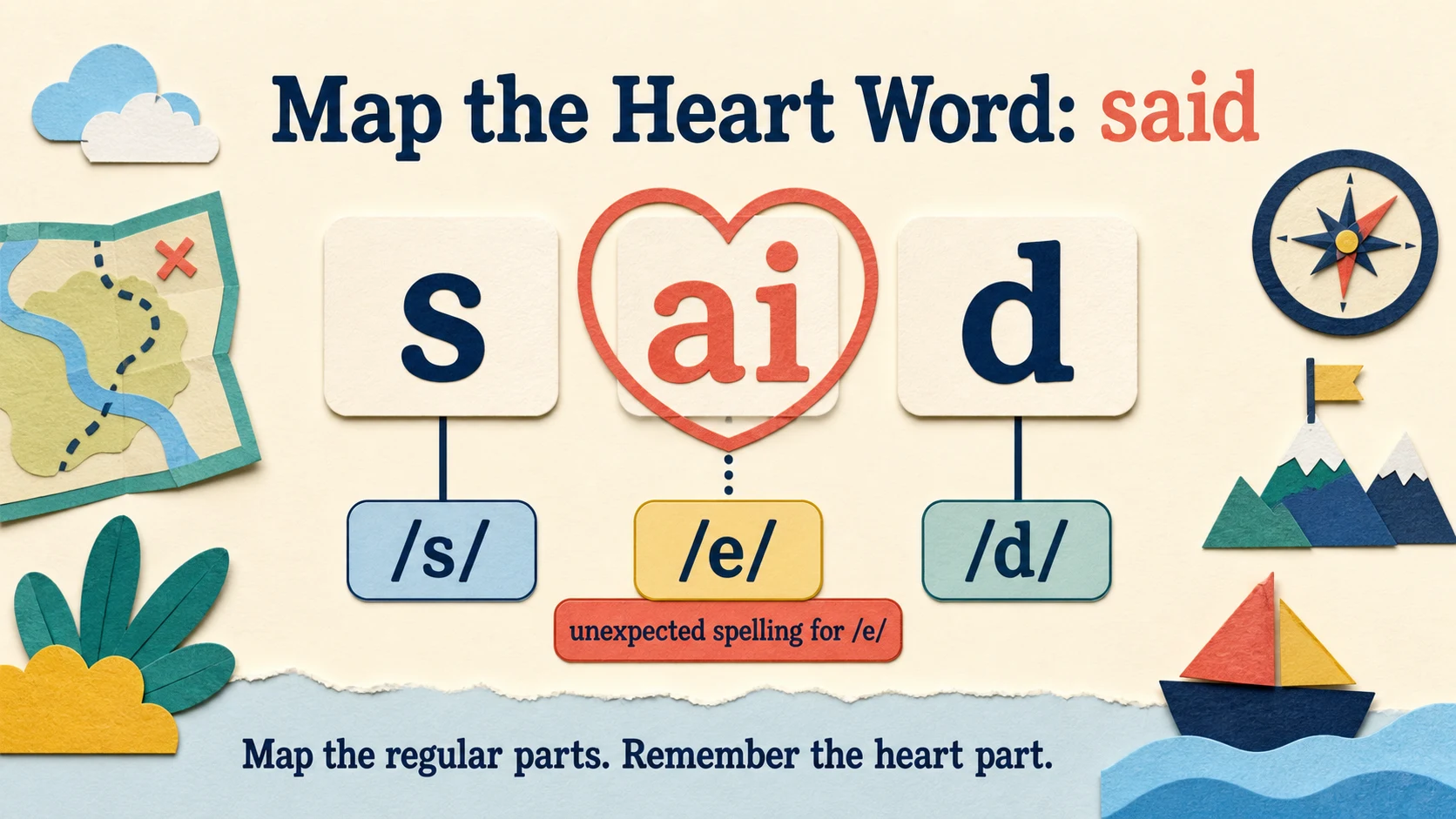
Some high-frequency words are fully decodable once the relevant patterns have been taught. For example, each sound in and has a familiar spelling. Other words contain an irregular or temporarily unfamiliar part. In said, the first and last letters work as expected, but ai represents the short e sound. Marking that unexpected part gives the learner something specific to remember.
Effective practice therefore combines:
- Accurate reading of the word
- Attention to its sounds and letters
- Identification of regular and irregular parts
- Writing from memory
- Use in a meaningful sentence
- Repeated encounters in phrases and short passages
The learner’s observed work should determine pacing. Introduce new words only when earlier words remain reasonably secure, and return to a word when reading or spelling reveals uncertainty.
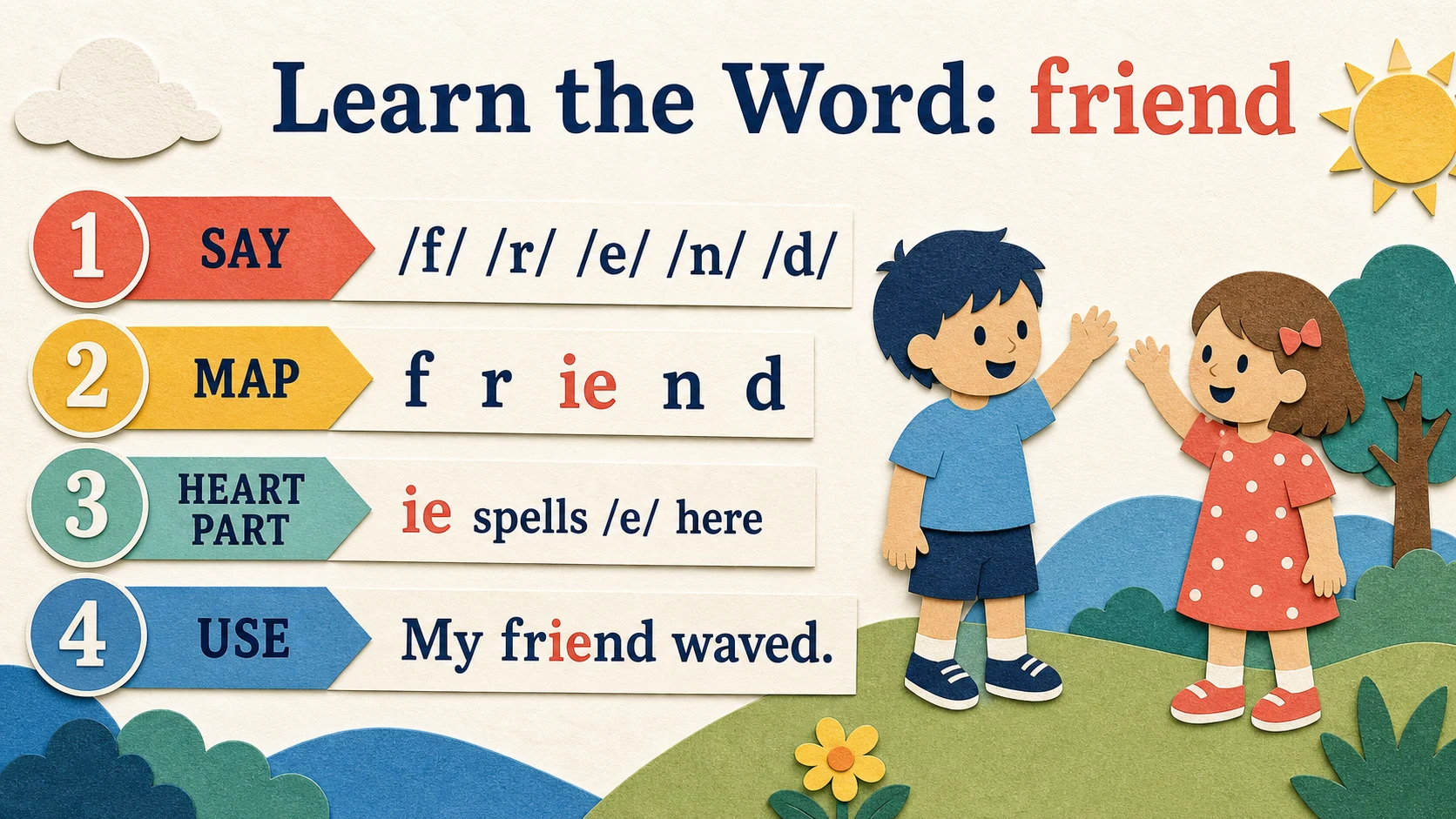
Sight-word learning connects phonics, spelling, meaning, memory, and fluent reading.
What Counts as a Sight Word?
A sight word is any word a reader can recognize immediately. That definition describes how securely the word is known, not a special visual property of the word.
The term is often used for high-frequency words because readers encounter them repeatedly. These include:
- Words with straightforward sound-spelling relationships, such as and, went, and help
- Words containing an unexpected spelling, such as said, of, and was
- Words that are not yet decodable because the learner has not been taught the necessary pattern
A word can move from the third category to the first. A learner who has not studied vowel teams may initially need extra support with see. After learning that ee commonly represents the long e sound, the word becomes regularly decodable.
This distinction matters. If every common word is presented as an indivisible visual shape, the learner loses opportunities to use phonics. If every irregular word is treated as though ordinary decoding alone will produce the correct pronunciation, the learner may repeatedly misread the unexpected part.
The supplied WorksheetWise catalogue recommends a “heart word” approach: identify the part that follows taught phonics and isolate the part that must be remembered by heart. This is an instructional suggestion for using the available materials, not a claim that one routine is universally required.
The IES foundational reading practice guide provides broader instructional framing for kindergarten through third grade, including systematic attention to sound-spelling relationships, decoding, and connected reading. It does not evaluate WorksheetWise or this particular worksheet.
Prerequisites to Check Before Adding More Words
A learner does not need perfect mastery of every earlier phonics skill. However, several foundations make sight-word instruction more understandable and efficient.
Hearing and identifying sounds
Ask the learner to say a short word slowly and identify its sounds. For map, the expected sequence is /m/ /ă/ /p/. For fish, it is /f/ /ĭ/ /sh/: four letters but three spoken sounds.
A learner who cannot yet separate the sounds may struggle to decide which part of an irregular word is predictable. Use oral segmenting and blending before expecting independent word mapping.
Connecting common sounds with spellings
Check familiar consonants, short vowels, consonant digraphs, blends, and any vowel patterns already taught. Do not mark a spelling as “irregular” merely because the learner has not reached that pattern in the local phonics sequence.
For example, ship is regular for a learner who knows sh, but it may require teacher support before that digraph has been introduced. Grade labels describe intended practice level; local curricula, school sequences, and individual learning paths differ.
Blending a word rather than naming isolated letters
A learner may correctly name every letter in went yet fail to blend the sounds into the word. Briefly practice moving from /w/ /ĕ/ /n/ /t/ to went. Sight-word work should strengthen this connection, not replace it.
Understanding the word in spoken language
Before studying the spelling of because, confirm that the learner recognizes the spoken word and understands a sentence containing it. Meaning gives the printed form a useful context.
Writing letters legibly enough to compare spellings
Perfect handwriting is not a prerequisite. The learner does need to produce letters that can be checked against the model. If letter formation consumes all available attention, reduce the writing quantity and provide larger lines or letter tiles.
A Grade-Appropriate Progression
Second-grade practice should build from supported analysis to independent recognition in text. The sequence below is a decision guide, not a universal timetable.
| Stage |
Learner’s task |
Adult support |
Evidence for moving on |
| 1. Hear and understand |
Say the word and use or explain it in context |
Supply a clear sentence |
Learner identifies the intended word |
| 2. Map sounds to letters |
Say the sounds and connect them to spellings |
Model with boxes, tiles, or underlining |
Learner matches most sounds accurately |
| 3. Mark the unexpected part |
Identify letters that do not represent the expected sound |
Explain only the necessary irregularity |
Learner points to and explains the part |
| 4. Read and build |
Read the word, assemble it, and compare it with the model |
Prompt careful checking |
Learner produces the correct letter order |
| 5. Write from memory |
Cover the model and write the word |
Give a spoken prompt or sentence |
Learner spells it accurately without copying |
| 6. Read in context |
Read the word in phrases, sentences, and short passages |
Correct errors promptly and revisit the mapping |
Learner reads accurately across contexts |
| 7. Review over time |
Retrieve the word on later occasions |
Mix new and previously taught words |
Learner reads correctly on three separate occasions |
The final criterion comes from the supplied catalogue teaching guidance: move a word to a mastered group only after correct reading on three separate occasions. Those checks should not all occur in one sitting.
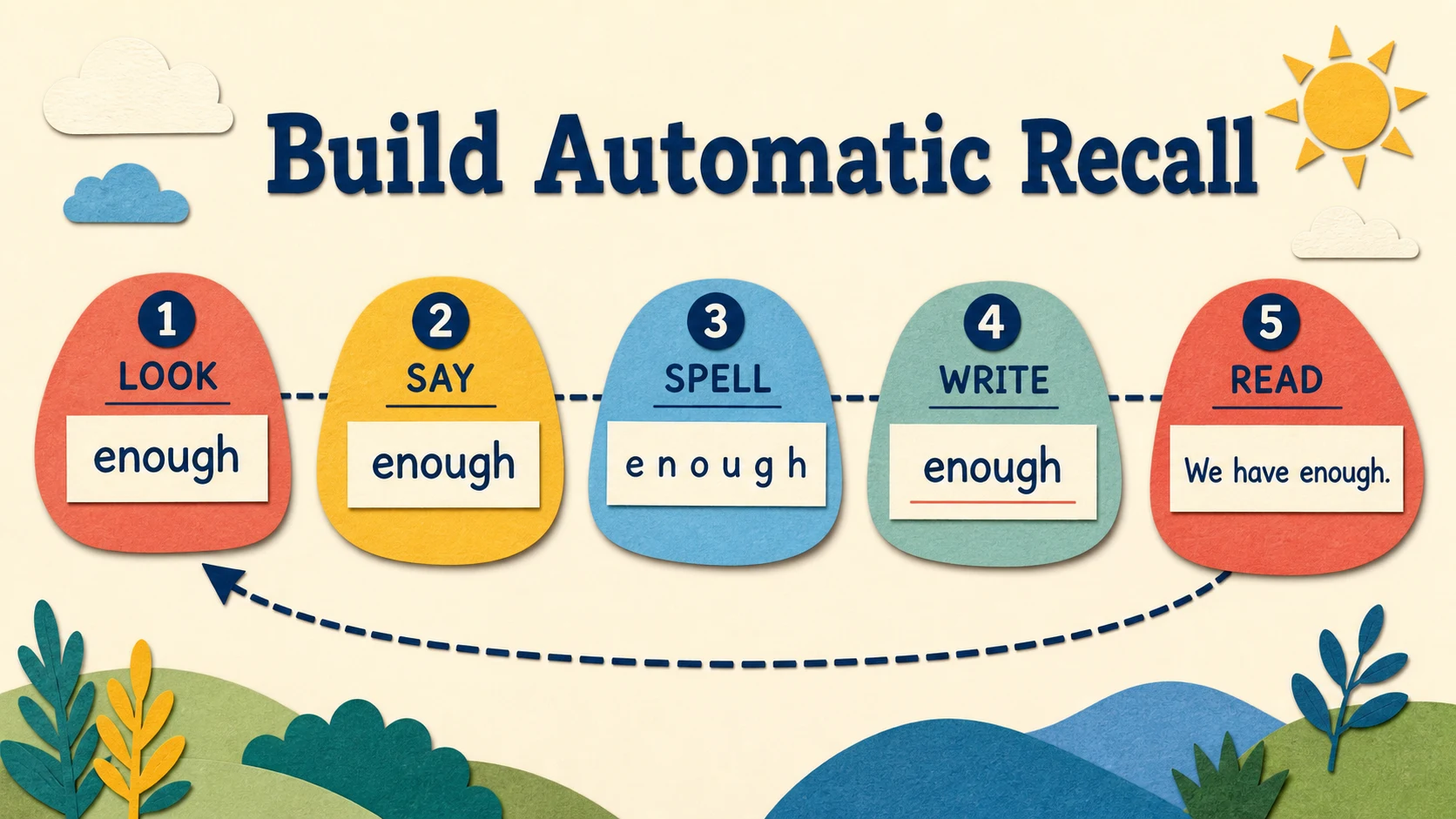
Support can gradually decrease as the learner reads, writes, and applies each word.
The Common Core English Language Arts standards include recognition and reading of grade-appropriate irregularly spelled words in the grade-two foundational skills. That is a high-level reference point, not proof of comprehensive standards alignment for a particular activity.
Concrete and Visual Models
The best model is the simplest one that reveals what the learner needs to notice.
Sound boxes
Draw one box for each sound, not each letter. For said, use three boxes:
The middle box contains two letters because ai jointly represents the middle sound in this word. Mark or place a small heart above ai to show that this spelling must be remembered here.
Regular-part and heart-part marking
Write the word in ordinary print. Underline the predictable letters and circle the unexpected spelling:
s (ai) d
The purpose is analysis, not decoration. If a learner spends more time coloring than reading, use a pencil underline and one small heart.
Letter tiles
Build a word with movable letters, read it, mix the tiles, and rebuild it. For have, the learner should preserve all four letters even though the final e is silent. Tiles are useful when handwriting difficulty would otherwise hide whether the spelling is known.
Phrase and sentence frames
Single-word reading is only one stage. Put the target into short, meaningful contexts:
- said yes
- said the word
- Maya said, “Come with me.”
Change surrounding words so the learner cannot rely only on memorizing an entire sentence.
Fully Checked Worked Examples
The examples below show how to analyze a word, teach it, and verify the response.
Example 1: A fully regular high-frequency word — “and”
- Say and naturally.
- Stretch it carefully: /ă/ /n/ /d/.
- Match the three sounds to a, n, and d.
- Blend the sounds: /ă/–/n/–/d/, and.
- Cover the word and ask the learner to write it.
- Check the response letter by letter: a-n-d.
- Read it in a sentence: “Ben and Mia ran.”
The sentence is correct because and joins the two names. No portion needs to be labeled irregular if the learner knows short a and the consonant sounds. If the learner writes ad, the issue is not visual memory alone; the middle /n/ was omitted and should be revisited through segmentation.
Example 2: One unexpected vowel spelling — “said”
- Say said and place it in context: “Lena said hello.”
- Segment the spoken word: /s/ /ĕ/ /d/.
- Map /s/ to s and /d/ to d.
- Point to ai. In this word, those letters represent /ĕ/, not the sound a learner may expect from familiar ai words.
- Mark ai as the part to remember.
- Cover the model. The learner writes said.
- Reveal and compare: s-a-i-d.
- Read a new sentence: “Dad said we could begin.”
The checked spelling is said, not sed. Sed is a plausible sound-based attempt, so the response shows that the learner heard the sounds but did not retrieve the conventional spelling.
Mapping the sounds first makes the unexpected spelling easier to isolate and remember.
Example 3: A required silent final letter — “have”
- Say have: /h/ /ă/ /v/.
- Map /h/ to h, /ă/ to a, and /v/ to v.
- Show the complete spelling: h-a-v-e.
- Explain that the final e is written but is not a separate spoken sound in this word. It also does not make the a long.
- Build have with four letter tiles.
- Remove the model and rebuild it.
- Read: “I have a red pen.”
- Write the word from memory and compare all four letters.
The correct answer is have. A learner who writes hav has represented the three sounds but omitted a required spelling letter. The teaching response is to emphasize the final e, not to repeat the whole word without analysis.
Example 4: Two letters that need attention — “of”
- Say the word clearly in isolation: of.
- Listen to its two sounds. In a clear pronunciation, the ending is /v/.
- Compare the written form o-f with the spoken word.
- Mark the vowel spelling and final f for attention: the spelling is not a straightforward sound-by-sound match.
- Spell aloud: o-f.
- Cover and write of.
- Read a phrase: “a cup of milk.”
- Later, present it in a different phrase: “one of us.”
The checked conventional spelling is of, not uv or ov. Because pronunciation can become reduced in connected speech, begin with a clear model and then practice the word naturally in phrases.
Example 5: Using several words in connected text
Target words: said, have, of, and and.
Text: “Mia and Ben have a box of chalk,” Dad said.
Check each target separately:
- and joins Mia and Ben.
- have includes its silent final e.
- of is spelled o-f even though the final sound is /v/.
- said contains the remembered ai spelling.
First ask the learner to point to each word. Then read the complete sentence. Finally, dictate: “Ben and Mia have chalk.” This checks whether recognition transfers to spelling without requiring the learner to reproduce the longer original sentence.
A Short, Repeatable Lesson Routine
The catalogue suggests introducing three to five new words per week with daily review. Treat that number as a starting instructional suggestion. Use fewer when the learner’s errors accumulate; use the full range when retrieval remains accurate.
A focused lesson can follow this sequence:
| Step |
Adult action |
Learner action |
| Review |
Show previously taught words in mixed order |
Read each word without a sentence clue |
| Introduce |
Say one new word and give a clear sentence |
Repeat the word and explain or use it |
| Map |
Guide sound segmentation and letter matching |
Connect sounds to spellings |
| Mark |
Identify the unexpected or untaught part |
Point to the part that must be remembered |
| Read and write |
Show, cover, and reveal the word |
Read, spell aloud, and write from memory |
| Apply |
Present a fresh phrase or sentence |
Read the word in connected text |
| Record |
Note independent, prompted, or incorrect responses |
Correct and reread as needed |
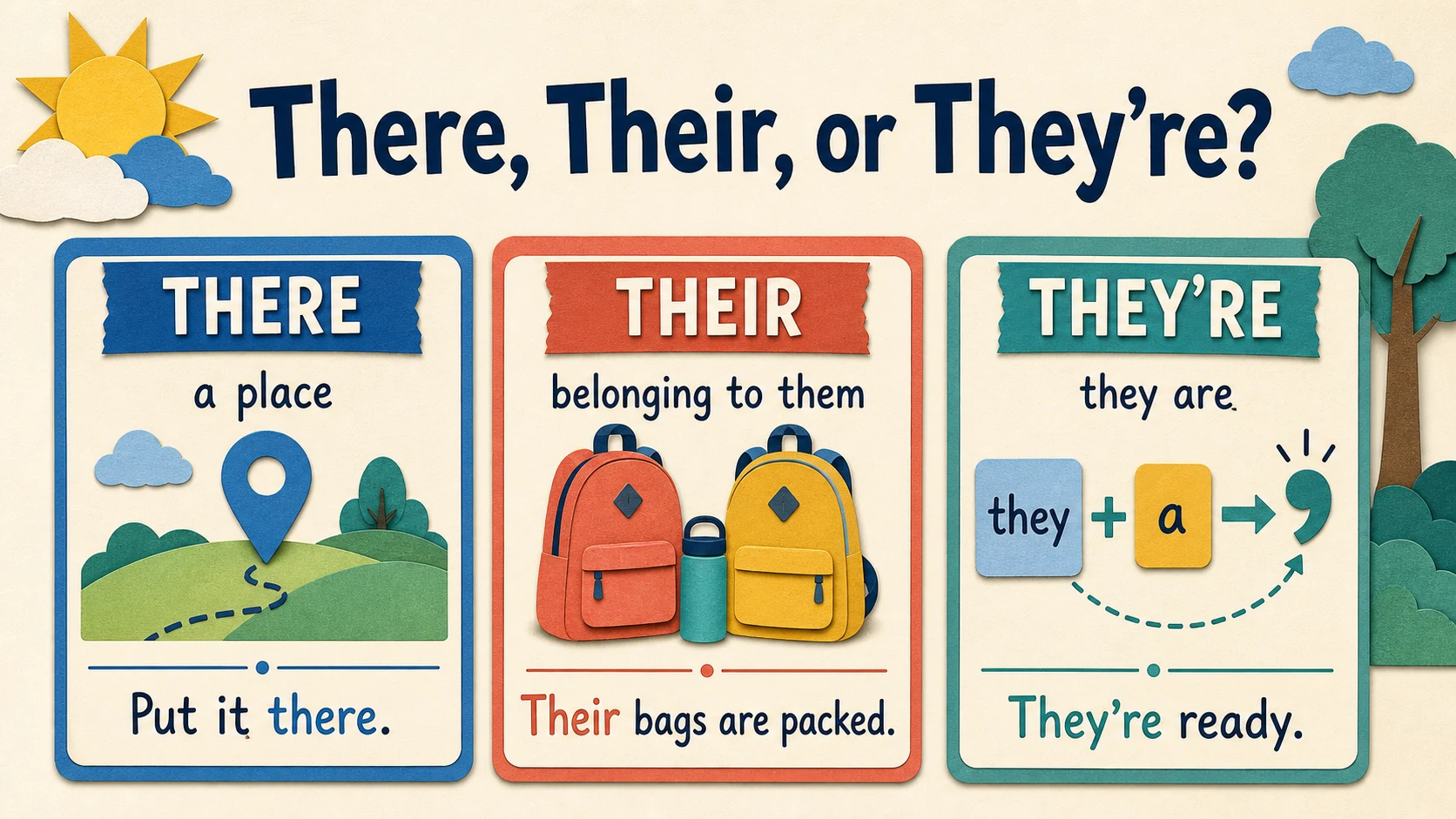
The same compact cycle can be used for a new word and for later review.
Tracing can support the first encounter: the learner says each letter while tracing, then covers the model and writes from memory. Three copied versions may provide handwriting practice, but copying alone does not demonstrate recall. Include at least one covered attempt.
Connected writing can reinforce the same words. The IES elementary writing practice guide offers high-level guidance on writing instruction, including regular opportunities to write and explicit teaching of writing processes and skills. In a sight-word lesson, a brief original sentence is an instructional application of that broader framing, not evidence that a specific worksheet has been evaluated by IES.
Choosing Practice That Fits the Learner
Start with the error or hesitation you can observe, then choose the practice format.
When recognition is slow but accurate
Use a small review ring, mixed word cards, and short phrases. Keep accuracy central. A race is optional variety, not the teaching method, and it should not reward guessing.
When the learner guesses from the first letter
Use words that share an initial letter, such as said, some, and see, but teach only words already appropriate in the learner’s sequence. Ask the learner to scan the entire word, name the letters, and identify the distinctive part.
When reading is stronger than spelling
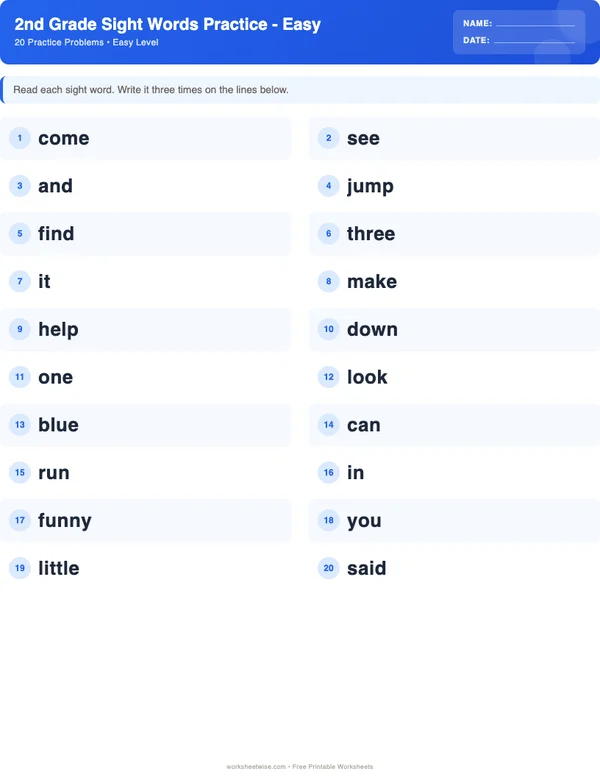
Use cover-write-check, letter tiles, and short dictation. Require the learner to compare the response with the model and name the exact difference. The free easy sight-word worksheet provides 20 exercises in which learners read each word and write it three times. Add a covered attempt if the goal is memory rather than copying alone.
When isolated words are secure but passage reading is hesitant
Move quickly into phrases, sentences, and short decodable text that contains the taught words. The catalogue explicitly recommends incorporating sight words into connected text because this is where word recognition contributes to reading fluency.
When many words remain uncertain
Reduce the set. Mix one to three new words with a larger number of secure words, and review frequently. The 2nd Grade phonics hub can help an adult choose related practice when the underlying difficulty is blending, a vowel pattern, a digraph, or another phonics skill rather than sight-word retrieval itself.
For broader practice, the 2nd Grade worksheet hub places the topic within the wider grade-level catalogue. The focused sight-word pack contains 18 worksheets and is listed at $4.79, but quantity should not determine pacing. Select only the pages and items that address current needs.
Differentiation Without Lowering the Learning Goal
Differentiation changes the amount or form of support while preserving the central goal: accurate recognition and meaningful use.
More support
- Teach one or two new words instead of three to five.
- Use sound boxes and letter tiles before handwriting.
- Keep the model visible during the first analysis.
- Offer two possible spellings and ask the learner to compare them.
- Read the sentence aloud before the learner reads it.
- Review the same word across several brief sessions.
Typical support
- Analyze three to five new words across the week.
- Mix them with mastered words.
- Require at least one written retrieval attempt.
- Use each word in a new phrase or sentence.
- Check the words again on later days.
Added challenge
- Ask the learner to explain which part is regular or unexpected.
- Dictate a sentence containing two or three targets.
- Have the learner write an original sentence and then proofread the target spelling.
- Mix visually similar words so the whole spelling must be inspected.
- Ask the learner to locate known words in an unfamiliar short passage.
Added challenge should deepen application, not simply increase speed or page count.
Common Errors and Diagnostic Responses
An incorrect response is useful when it reveals what the learner attended to.
| Observed response |
Likely instructional issue |
Teaching response |
| Reads said as though ai has its usual taught sound |
Applies phonics but has not stored this exception |
Confirm the regular consonants; mark ai as the remembered part |
| Writes sed for said |
Maps sounds plausibly but not conventional spelling |
Compare sed and said; rebuild and write said from memory |
| Writes hav for have |
Records spoken sounds but omits silent final e |
Use four tiles and mark the required final letter |
| Reads of as if the final letter represents /f/ |
Relies on the most common letter sound |
Contrast the written f with the spoken /v/ and practice in phrases |
| Guesses a word after seeing its first letter |
Does not inspect the complete spelling |
Require left-to-right comparison and identification of the middle and end |
| Reads a card correctly but misses the word in a sentence |
Recognition has not transferred to connected text |
Practice varied phrases and short passages |
| Copies accurately but cannot write after covering |
Copying is stronger than retrieval |
Shorten the set and add cover-write-check |
| Misses previously “mastered” words later |
Learning is not yet stable across time |
Return the word to active review and recheck on separate occasions |

The response should match the specific error rather than adding undirected repetition.
Two misconceptions deserve special attention. First, immediate recognition does not mean a word must be learned without phonics. Analysis can help the word become immediately recognizable. Second, one correct response does not prove durable learning. A learner may remember the card order, sentence, or previous correction. Change the order and context before recording mastery.
Monitoring Progress and Deciding What Comes Next
Keep a simple record with four columns:
| Word |
Reads alone |
Writes from memory |
Reads in text |
| said |
Independent |
Prompted |
Independent |
| have |
Independent |
Incorrect: hav |
Independent |
| of |
Prompted |
Independent |
Prompted |
Use labels such as independent, prompted, and incorrect rather than a vague check mark. Add dates when checking on separate occasions.
A word is ready to leave daily review when the learner reads it correctly on three separate occasions, following the catalogue guidance. It can still appear in periodic mixed review and ordinary reading. If spelling is also an instructional goal, record it separately; accurate reading does not automatically demonstrate accurate spelling.
Look for patterns across errors:
- Several omitted sounds suggest a need for oral segmentation.
- Repeated guessing suggests a need for whole-word inspection.
- Correct decoding with uncertainty about one spelling suggests targeted heart-part work.
- Accurate cards but weak sentence reading suggests more connected-text practice.
- Accurate reading but weak written recall suggests more retrieval and dictation.
Do not interpret a short worksheet sample as a diagnosis of a disability or a guarantee about broader reading performance. This guide does not provide medical guidance or a universal intervention timetable. When concerns extend beyond the scope of ordinary instruction, use the learner’s records to support a conversation with the appropriate school or qualified professional.
A Two-Week Practice Plan
This plan assumes brief daily practice and no more than three to five new words across a week. Adjust immediately when the learner’s work shows that the load is too large or too small.
| Day |
Main focus |
Quick evidence to record |
| 1 |
Precheck a small word set; introduce one or two words |
Independent, prompted, or incorrect reading |
| 2 |
Review; map one additional word; cover-write-check |
Exact spelling errors |
| 3 |
Review in mixed order; add a short phrase |
Accuracy without card-order clues |
| 4 |
Read target words in two new sentences |
Transfer to connected text |
| 5 |
Recheck all week-one words; write a dictated phrase |
Words needing continued review |
| 6 |
Review uncertain words; introduce one new word if ready |
Retention after a break |
| 7 |
Build, read, cover, and write the active set |
Letter order and irregular parts |
| 8 |
Use target words in an original or dictated sentence |
Reading-spelling connection |
| 9 |
Read a short passage; revisit only observed errors |
Accuracy in context |
| 10 |
Conduct a mixed check and sort words by next step |
Continue, periodic review, or mastered |
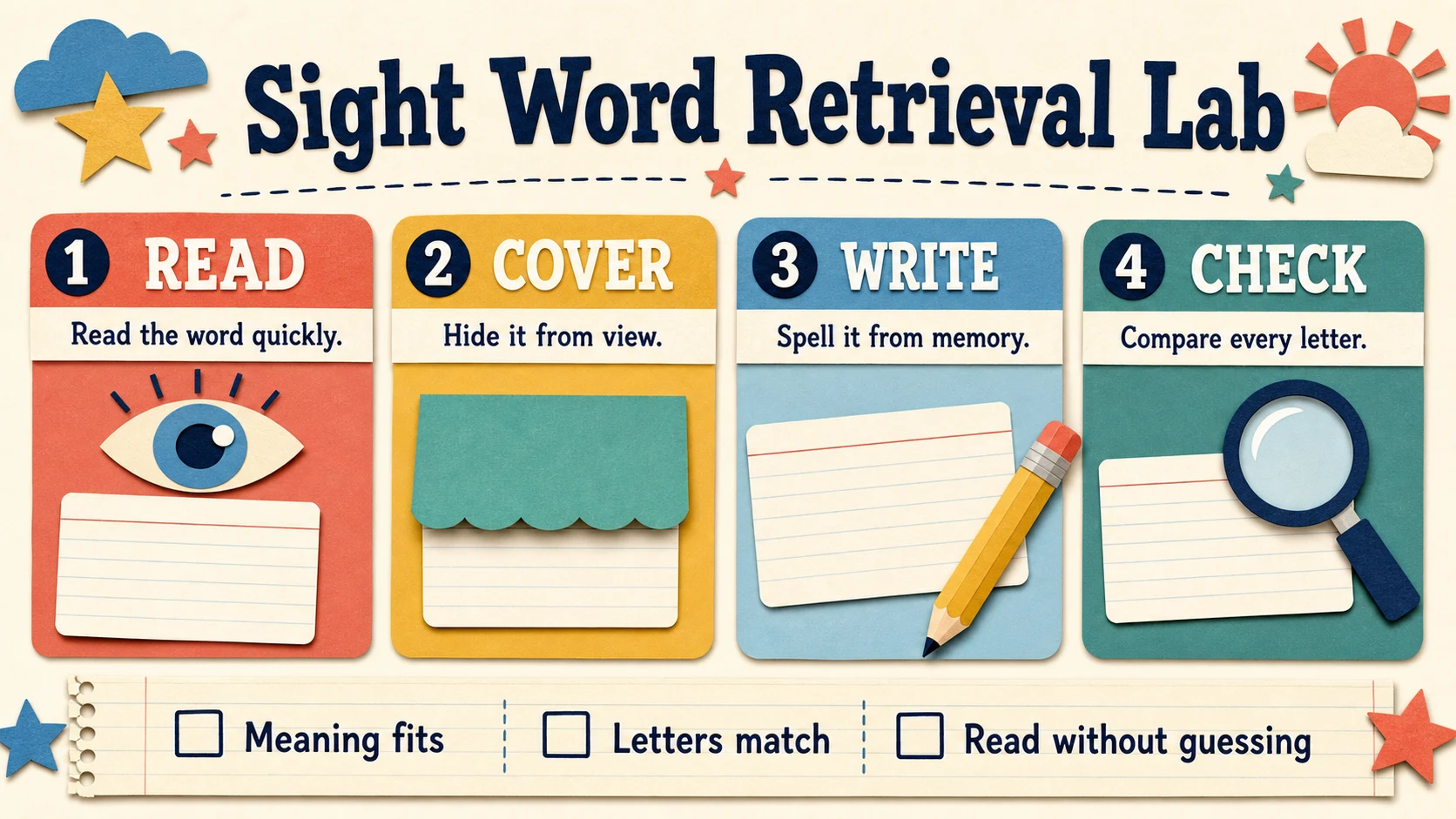
The plan alternates analysis, retrieval, connected reading, and spaced review.
If a learner misses the same word on Days 2, 4, and 5, do not simply add more new words in Week 2. Reanalyze the sounds and spellings, reduce the set, and provide new contexts. If all words are read and written accurately across separate checks, add a small new set while retaining brief mixed review.
Boundaries, Limitations, and an Honest Next Step
Sight-word practice cannot replace systematic phonics, vocabulary, comprehension, oral reading, or meaningful writing. It addresses a narrower need: making common words increasingly accurate and readily available during reading and spelling. A worksheet can organize repetition, but it cannot observe hesitation, explain an error, or decide whether the learner needs fewer words, a phonics review, or more connected reading. An adult must make those decisions from the learner’s responses.
Word lists also require judgment. A label such as “2nd Grade Sight Words” indicates an intended practice level, not a promise that every second grader has followed the same sequence. Local sequences differ, and the appropriate starting point is the first point at which the learner can work accurately with useful support.
Begin with the free 2nd Grade sight-words worksheet. Use only a small group of its 20 exercises at first. Ask the learner to read each word, analyze any unexpected spelling, write it, cover it, and write it once from memory. Record the exact errors, then choose the next lesson from that evidence rather than from the number of unfinished items.