What 2nd Grade Geometry Includes
Second-grade geometry centers on noticing, naming, describing, drawing, building, and dividing shapes. A learner should move beyond recognizing a shape by appearance and begin using attributes such as the number of sides, vertices, faces, or equal parts. Concrete objects and drawings should come before unsupported written work.
In practical terms, teach the learner to:
- Identify familiar two-dimensional shapes in different sizes and orientations.
- Count and describe sides and vertices.
- Recognize familiar three-dimensional solids and discuss visible features.
- Draw or build shapes from stated attributes.
- Combine and separate shapes.
- Divide circles and rectangles into equal shares.
- Explain why a shape belongs—or does not belong—to a category.
- Explore area by covering a surface and perimeter by following a boundary when those concepts appear in the learner’s materials.
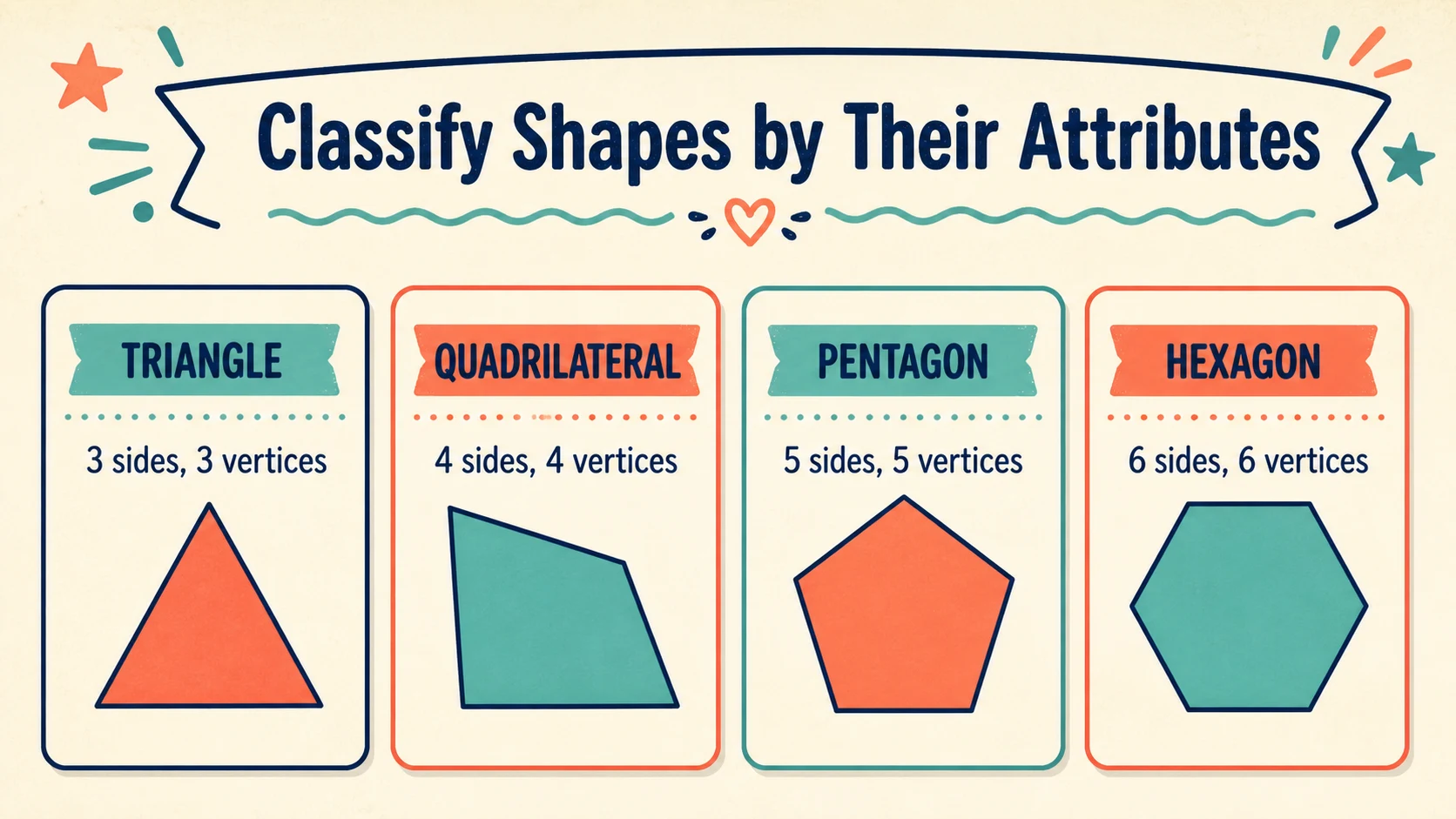
The skills connect through a repeated cycle: observe, build, describe, compare, and explain.
The concise teaching rule is this: begin with objects the learner can handle, move to varied pictures, and finish with drawings or written explanations. Increase difficulty only when the observed work shows that the learner can identify the relevant attributes without relying on a memorized picture.
Grade labels describe the intended practice level, not a guarantee that every local curriculum follows the same order. Local sequences differ. The Common Core State Standards for Mathematics provide one widely used reference point, but a school, state, homeschool program, or tutoring plan may introduce individual topics earlier or later.
Check the Prerequisites Before Adding New Skills
A short prerequisite check prevents a geometry lesson from becoming an accidental vocabulary, counting, or fine-motor test. It should take only a few minutes.
Shape recognition and counting
Place or draw a circle, triangle, rectangle, square, and hexagon in mixed orientations. Ask the learner to name each one and explain how they know. A correct name without an explanation shows recognition, but it does not yet show secure understanding of attributes.
Next, ask the learner to touch each side of a polygon once while counting. Then ask for the vertices. If the learner repeatedly counts the starting vertex twice, mark the starting point with a small counter or pencil dot. This is a counting-support issue before it is a geometry issue.
Position and comparison language
Check whether the learner understands words used in directions: above, below, beside, inside, outside, corner, edge, same, different, equal, and half. Introduce only the terms needed for the current task. For example, a lesson on vertices does not require a long list of solid-geometry vocabulary.
Ask the learner to compare two shapes using a complete sentence:
- “Both shapes have four sides.”
- “Only this shape has three vertices.”
- “These pieces are equal because they match when one is placed over the other.”
Drawing and handling materials
A learner does not need perfect handwriting or ruler control to understand geometry. If drawing is difficult, allow shape tiles, craft sticks, folded paper, tracing, or pointing. Keep the mathematical decision separate from the physical act of producing a neat figure.
If these checks reveal uncertainty, revisit the relevant foundation through the 2nd Grade math collection before expecting independent geometry work.
Use a Grade-Appropriate Progression
The progression below is instructional guidance, not a universal timetable. A learner may be secure in one row and need support in another.
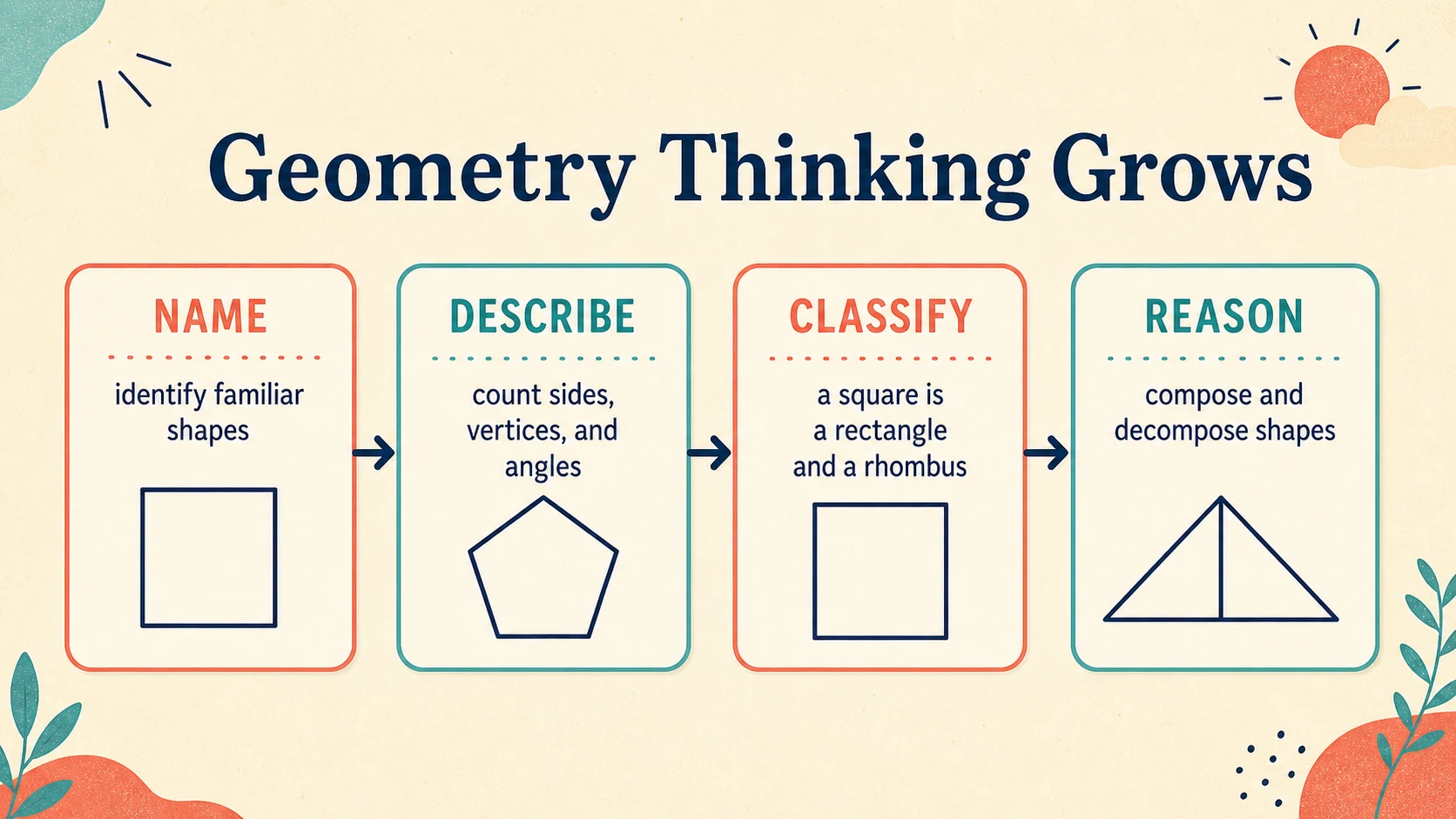
Support should fade when the learner’s explanations and independent work show readiness.
| Stage |
Teaching focus |
Useful model |
Evidence of readiness |
| 1. Recognize |
Name familiar plane shapes and solids |
Household objects, cutouts, shape cards |
Names shapes in several orientations |
| 2. Describe |
Count sides, vertices, faces, and other visible features |
Craft sticks, clay corners, solid objects |
Gives a name and a relevant attribute |
| 3. Compare and sort |
Group shapes by a stated rule |
Mixed shape cards or blocks |
Explains why every item fits the rule |
| 4. Construct |
Draw or build a shape from attributes |
Dot paper, geoboard, sticks |
Produces a figure that meets all conditions |
| 5. Compose and decompose |
Join small shapes or split larger ones |
Pattern blocks, tangrams, cut paper |
Predicts and checks what new shape is made |
| 6. Partition |
Divide circles and rectangles into equal shares |
Paper folding, tiles, drawn lines |
Distinguishes equal shares from merely having the right number of parts |
| 7. Apply |
Solve mixed identification, property, and simple measurement tasks |
Diagrams, tiles, grid paper |
Chooses a method and explains it independently |
Do not treat the stages as a one-way ladder. A learner might draw quadrilaterals successfully but still misidentify a rotated triangle. Return to varied examples whenever recognition depends on position, color, or size.
The IES guide on teaching mathematics to young children supports broad instructional practices such as building mathematical ideas through developmental progressions, monitoring what learners know, and using instruction that connects representations and mathematical language. That source provides general framing; it does not evaluate WorksheetWise or prescribe this exact sequence.
Build Meaning With Concrete and Visual Models
Two-dimensional shapes
Use craft sticks or strips of paper to build polygons. Small balls of clay can mark vertices. Ask the learner to trace the complete boundary, then touch each vertex. Change the orientation after each attempt so that “triangle” does not come to mean only a figure with a flat base and a point at the top.
Include nonexamples. Place a closed triangle beside an open three-segment figure. Both may have three straight segments, but only the closed figure encloses a region and functions as the intended polygon in this comparison.
Three-dimensional solids
Use a box, ball, can, party hat, or solid blocks. Let the learner turn each object. A flat picture may hide a face or make a curved surface difficult to interpret.
Use cautious language about real objects. A cereal box can model a rectangular prism, but bent corners, flaps, and packaging details mean it is not a perfect mathematical solid. The model helps the learner focus on selected properties.
Equal shares, area, and perimeter
Fold paper rectangles and circles, or cover a rectangle with equal square tiles. Equal shares must have equal size, not merely equal labels or approximately similar shapes.
Area and perimeter appear in the catalogue worksheet, but their formal placement varies by sequence. Treat them as concrete introductory experiences unless the learner’s program expects more. For area, cover a surface with equal-size tiles without gaps or overlaps. For perimeter, trace or count units around the outside boundary. Do not begin with formulas.
Shapes can have the same covered area but different boundary lengths. That is useful exploration, but it should follow secure understanding of what the inside and boundary represent.
Teach Through Fully Checked Worked Examples
Example 1: Identify a shape from its attributes
Problem: A closed shape has four straight sides and four vertices. What can we call it?
Model: Build a closed figure with four craft sticks. Touch each side once, then place a counter at each vertex.
Check:
- Sides: 1, 2, 3, 4.
- Vertices: 1, 2, 3, 4.
- The figure is closed.
Answer: It is a quadrilateral.
It is not always possible to give a more specific name from this information alone. A square and a rectangle can both satisfy the stated conditions, as can other four-sided shapes. “Quadrilateral” is the claim supported by all the given facts.
This is an important boundary case: four sides do not automatically prove that a figure is a square.
Example 2: Count sides and vertices without double-counting
Problem: A hexagon is shown. How many sides and vertices does it have?
Model: Mark one vertex as the starting point. Trace one side at a time until returning to the mark.
Work:
- Six traced segments give 6 sides.
- The meeting points between consecutive sides give 6 vertices.
Answer: The hexagon has 6 sides and 6 vertices.
Verification: Each side ends at a vertex, and the closed path returns to the marked starting point. The starting vertex is not counted again at the end.
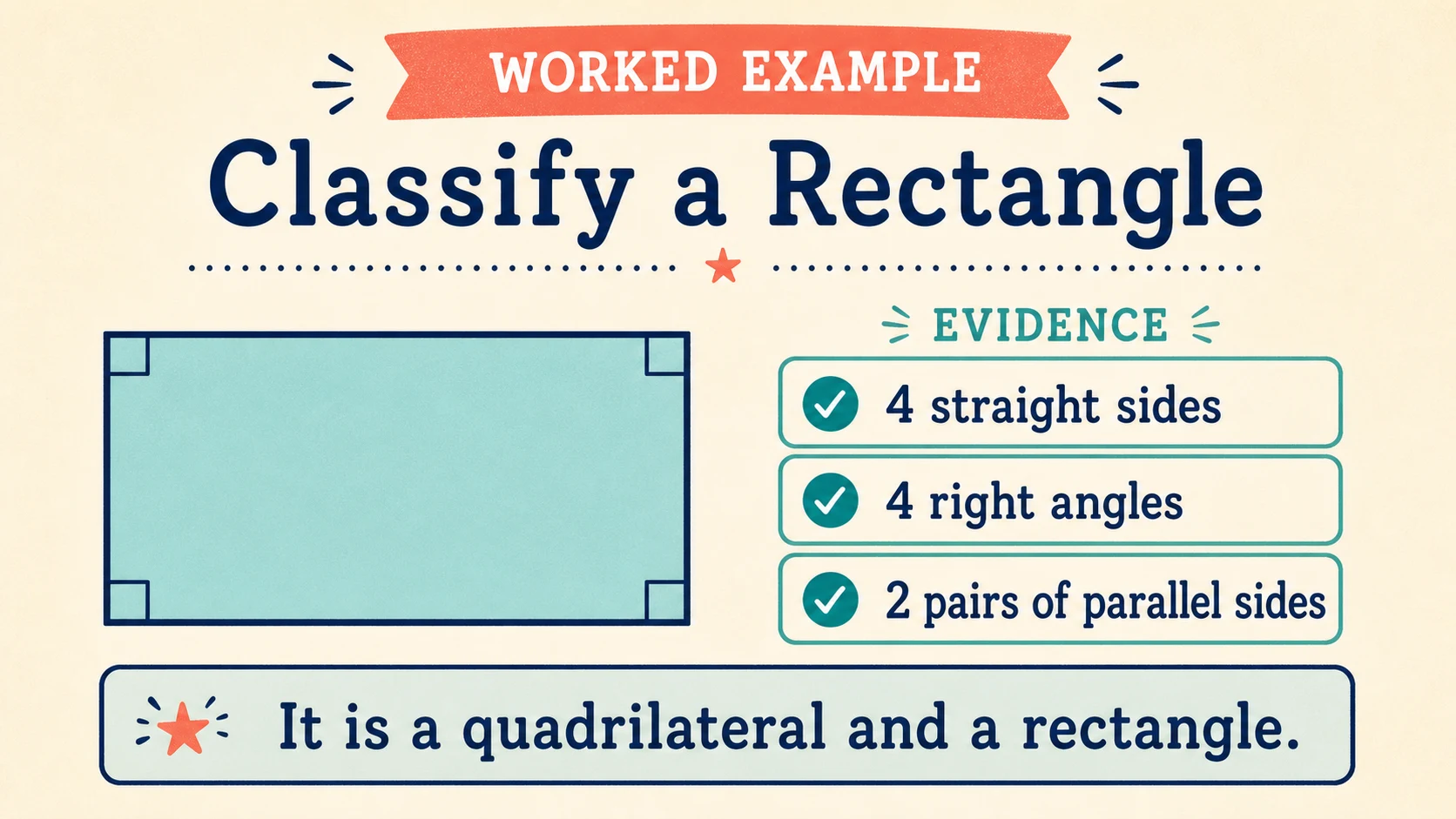
The model makes the relevant attribute visible before the learner records an answer.
Example 3: Decide whether shares are equal
Problem: A rectangle is divided by one vertical line into two parts. The line is much closer to the left edge than the right edge. Are the parts halves?
Work:
- There are two parts.
- The left part is narrower than the right part.
- Two parts are called halves only when they are equal in size.
Answer: No. The rectangle has two parts, but they are not halves.
Verification: Copy the smaller part on tracing paper or compare widths. It cannot cover the larger part exactly.
The boundary case matters: the number of pieces is not enough. A shape divided into four unequal regions has four parts, but it does not have four equal fourths.
Example 4: Compose a larger shape
Problem: Two matching squares are joined edge to edge without overlapping. What larger familiar shape can they make?
Work: Place the squares so one full side of the first touches one full side of the second. Trace the outside boundary.
The shared sides are inside the new figure, so they are not part of its outer boundary. The outline has two longer opposite sides and two shorter opposite sides.
Answer: The two squares can make a rectangle.
Verification: Separate the pieces to confirm that the whole is composed of exactly two matching squares. Rejoin them along a full edge and retrace the outside.
Two squares touching only at one vertex do not make the same rectangular region. The way pieces meet matters.
Example 5: Find perimeter by counting boundary units
Problem: A rectangle has side lengths of 5 units and 2 units. What is its perimeter?
Work: Follow every outer side once:
- Top: 5 units
- Right: 2 units
- Bottom: 5 units
- Left: 2 units
5+2+5+2=14
Answer: The perimeter is 14 units.
Verification: Group equal opposite sides:
(5+5)+(2+2)=10+4=14
Do not count the inside of the rectangle. Perimeter measures the complete outside boundary.
Example 6: Find area by counting equal tiles
Problem: A rectangle is completely covered by 3 rows of 4 equal square tiles. No tiles overlap and there are no gaps. What is the area in square units?
Work:
4+4+4=12
Answer: The area is 12 square units.
Verification: Count by columns instead: there are 4 columns with 3 tiles in each.
3+3+3+3=12
The units are square units because the surface is covered by equal squares. If the tiles leave gaps, overlap, or have different sizes, simply counting them does not give a valid area measure.
Follow a Short, Repeatable Lesson Routine
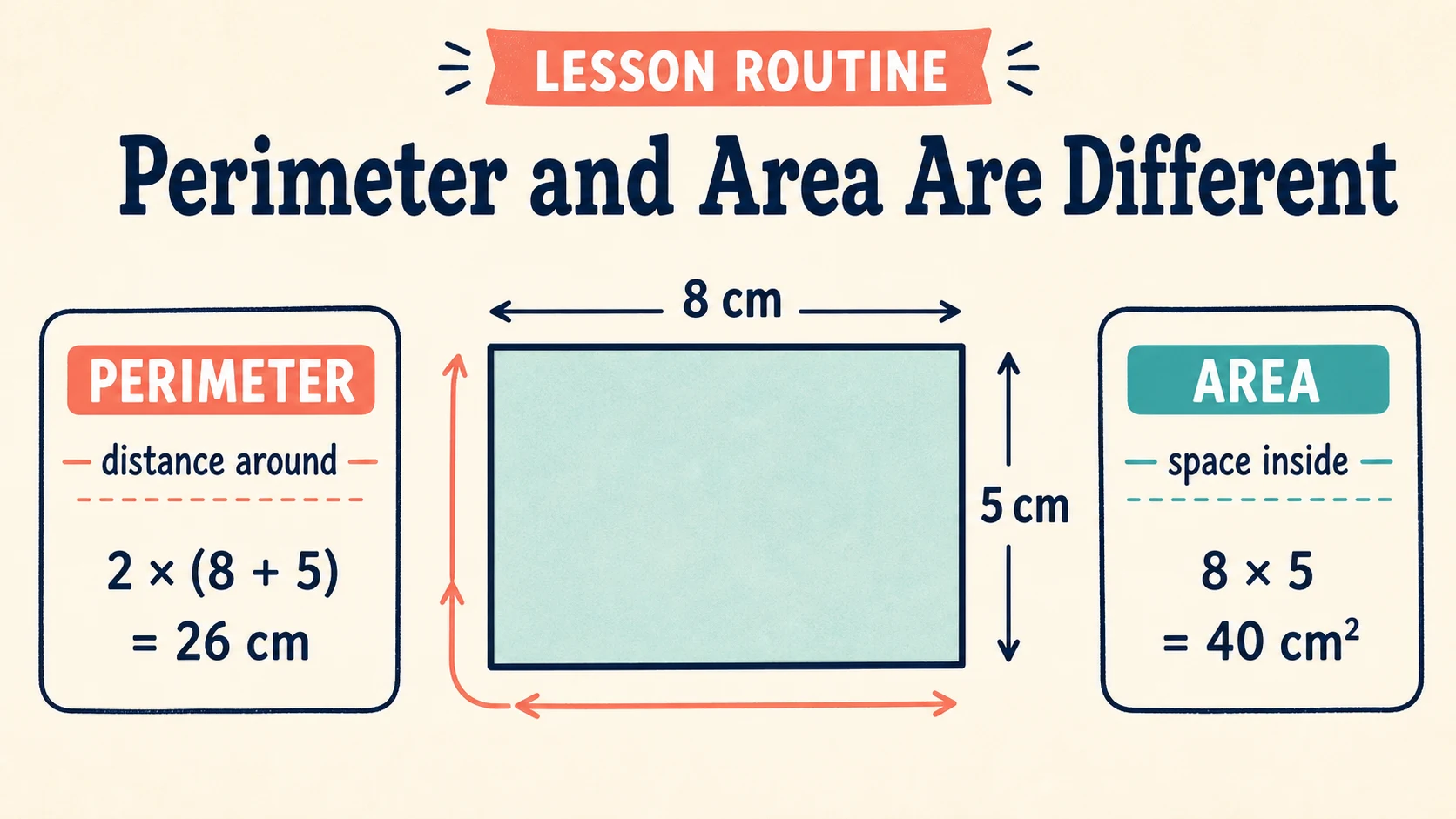
A stable routine leaves more attention available for observing, reasoning, and explaining.
A useful session can fit into about 10–20 minutes, but the learner’s observed work should determine whether to stop, repeat, or extend. This is an instructional suggestion, not a sourced universal timetable.
1. Retrieve one known idea
Show two familiar shapes and ask for one attribute of each. Keep this brief. The purpose is to reveal whether yesterday’s learning is available today.
2. Model one new decision
Think aloud while touching or marking the relevant features: “I will count each side once. I am marking the starting point so I know when to stop.” Use one clear example and, when useful, one close nonexample.
3. Solve together
Let the learner handle the materials, count, sort, fold, or draw. Ask for a short explanation. Supply a sentence frame if language is the obstacle: “It is a ___ because it has ___.”
4. Try independently
Give two or three carefully chosen problems. The first should resemble the model. The next should vary orientation, size, or presentation. Avoid a long page before checking whether the idea is secure.
5. Close with a contrast
Ask the learner to compare two figures or methods. For example: “Why are these both triangles even though one is turned?” Record one successful explanation to compare with later work.
Choose Practice That Matches the Learner’s Evidence
Practice should answer a specific instructional need. A large mixed set may hide the difference between a naming error, an attribute-counting error, and a vocabulary misunderstanding.
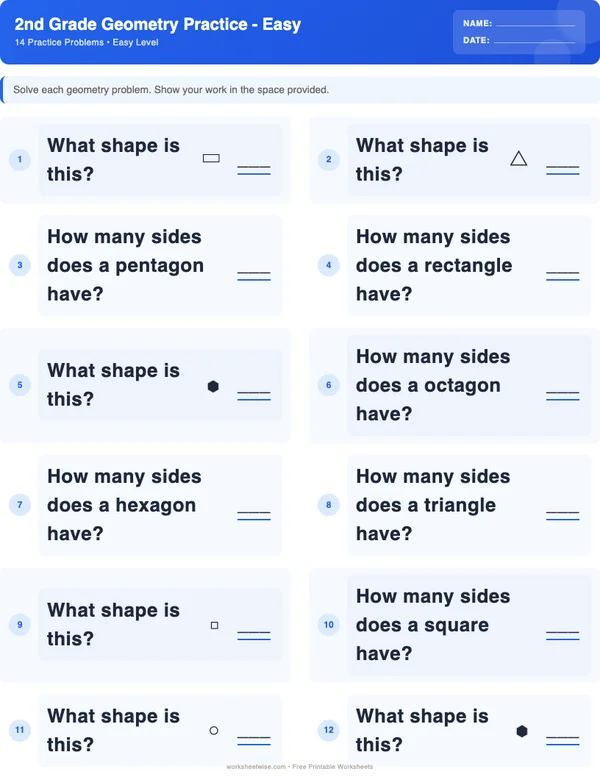
Use the free standard easy geometry worksheet when the learner needs introductory or reinforcing practice with shapes, sides, vertices, geometric properties, perimeter, or area. It contains 20 exercises and a separate answer key. Preview the tasks and select only those that match the concept already taught.
The 2nd Grade Geometry Worksheet Pack contains 18 worksheets and may suit adults who want a larger practice pool. Quantity is not a reason to complete every page. Choose a small set, inspect errors, and decide what comes next.
For a learner who needs more support
- Reduce the number of shapes shown at once.
- Let the learner trace, touch, fold, or build before answering.
- Mark a counting start point.
- Use high-contrast diagrams without decorative distractions.
- Teach one comparison at a time, such as triangle versus non-triangle.
- Ask the learner to match a solid object to a picture before naming it.
- Return to a successful example before introducing a small variation.
The IES guide on assisting students struggling with mathematics offers high-level support for systematic instruction, clear mathematical language, representations, and deliberate review. Use those principles to organize support, not to diagnose a child or claim that one worksheet is an intervention.
For a learner who is ready to extend
Increase reasoning rather than page length:
- Draw two different quadrilaterals.
- Find more than one way to divide a rectangle into two equal shares.
- Sort the same group of shapes using two different rules.
- Build a figure from three pieces and describe the outside boundary.
- Create a nonexample that almost satisfies a rule, then explain the missing attribute.
- Cover equal-size rectangles with square tiles and compare the arrangements.
An extension should remain understandable with current tools and language. Formal angle measurement, coordinate geometry, volume calculations, and formula-heavy area or perimeter work belong to later progressions in the catalogue and should not be treated as required second-grade mastery here.
Diagnose Common Errors Before Assigning More Work
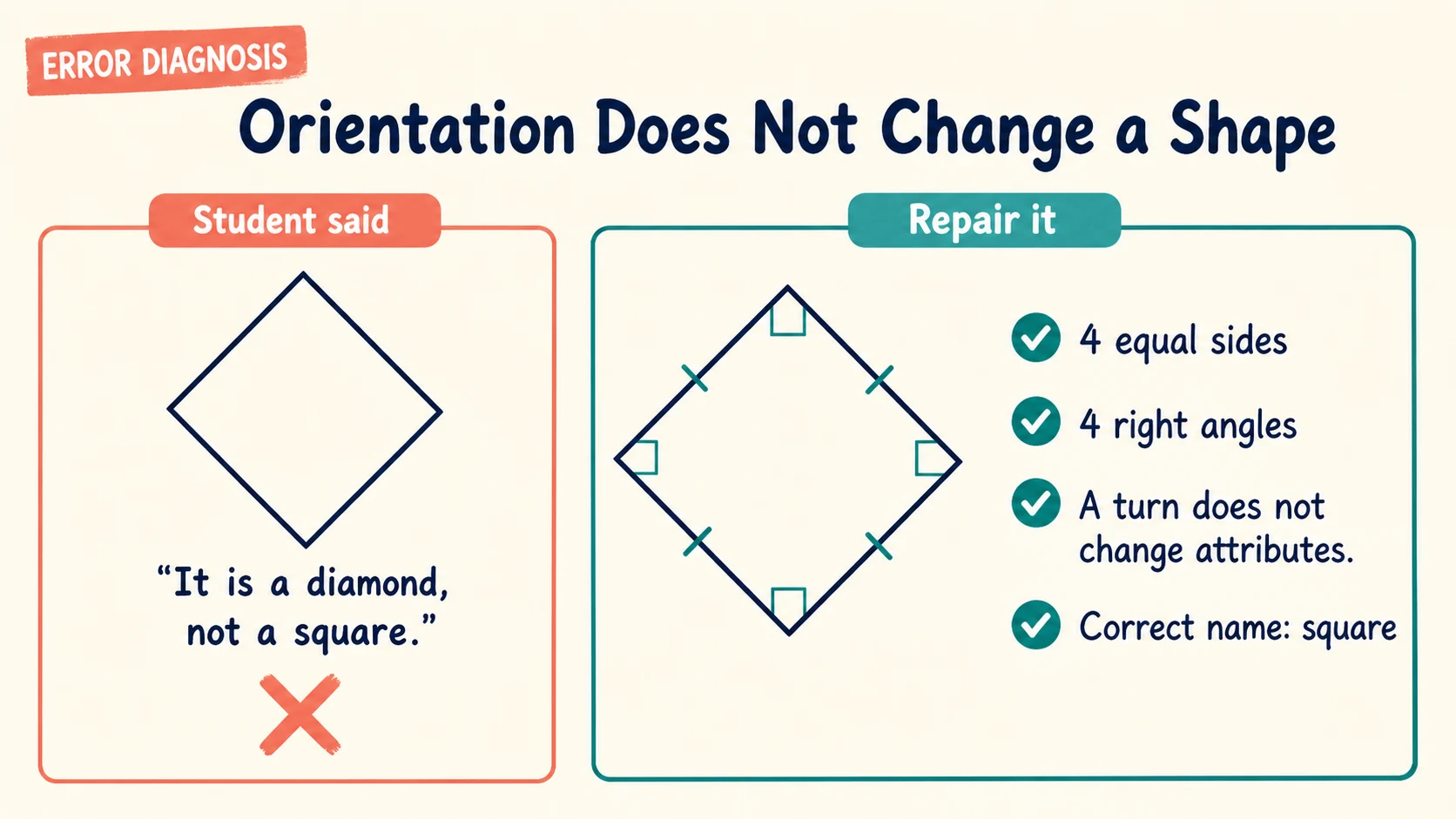
The same incorrect answer can come from different causes, so inspect the learner’s method.
| Observed error |
Likely instructional issue to check |
Teaching response |
| Calls a rotated square a diamond |
Recognition depends on orientation |
Rotate the same cutout slowly and confirm that its attributes do not change |
| Calls every four-sided figure a square |
Uses one familiar label for a broad group |
Compare several quadrilaterals and identify which conditions are shared |
| Counts one vertex twice |
Loses the starting location |
Mark the first vertex and move clockwise |
| Counts interior lines as sides |
Confuses parts with the outer boundary |
Trace only the figure’s outside edge |
| Says two unequal pieces are halves |
Uses number of parts instead of equal size |
Fold, overlay, or measure the pieces |
| Confuses area and perimeter |
Has not separated surface from boundary |
Cover the inside with tiles, then trace the outside with string |
| Names a solid from one visible face |
Treats a 2D view as the entire solid |
Turn a physical model and discuss what remains hidden |
| Produces the right answer without an explanation |
May be recognizing a picture rather than applying a rule |
Ask for one attribute that proves the classification |
Do not infer a persistent difficulty from one mistake. Re-present the idea using a new example and note whether the error repeats. Also check the task itself: a tiny diagram, ambiguous line, unfamiliar word, or crowded page can interfere with otherwise sound reasoning.
Monitor Understanding Without Over-Testing
Use a small record with four columns: date, skill, evidence, and next step. Evidence should describe observable work, not a broad label.
Useful notes include:
- “Named five shapes, but missed the triangle when it was rotated.”
- “Counted vertices accurately after marking a starting point.”
- “Explained that two pieces were not halves because one was larger.”
- “Found area by counting tiles but included an extra perimeter unit.”
- “Drew two different four-sided shapes from verbal directions.”
A simple mastery check
After instruction, use three items:
- A familiar example.
- The same idea in a changed orientation or representation.
- A contrast or explanation task.
For sides and vertices, that might mean counting a standard pentagon, counting an irregular pentagon, and explaining why an open five-segment path is different. Secure performance across all three is stronger evidence than completing several nearly identical items.
Review the idea again after a gap. If the learner succeeds only immediately after modeling, retain supports and provide another short session. If the learner succeeds after a delay and explains the reasoning, mix that skill with previously learned material.
Use This Two-Week Practice Plan Flexibly
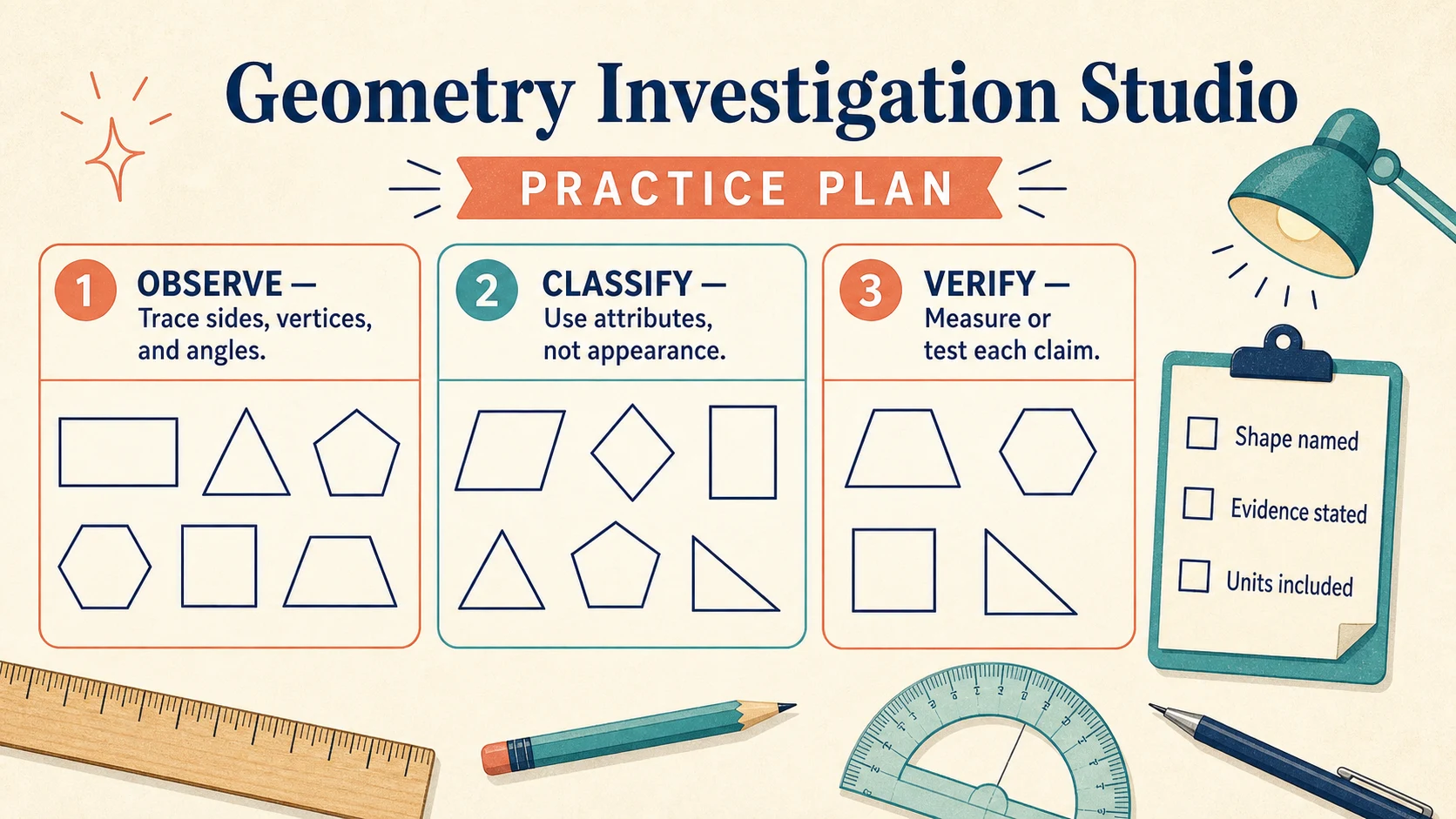
The plan alternates instruction, explanation, application, and review rather than adding difficulty every day.
This plan assumes ten short sessions. Shorten, repeat, or skip sessions according to the learner’s work. It is not a universal schedule.
| Day |
Focus |
Suggested activity |
Quick evidence |
| 1 |
Identify plane shapes |
Sort circles, triangles, rectangles, squares, and hexagons in varied orientations |
Names shapes and gives one reason |
| 2 |
Sides and vertices |
Build polygons with sticks and mark vertices with clay |
Counts each feature once |
| 3 |
Examples and nonexamples |
Compare closed shapes, open figures, and shapes with curved boundaries |
Explains which attribute matters |
| 4 |
Construct from attributes |
Draw or build figures from directions |
Meets every stated condition |
| 5 |
Review and explain |
Complete a small selected worksheet set; correct errors orally |
Explains corrections without copying |
| 6 |
Recognize solids |
Turn and compare a box, ball, can, and cone-shaped object |
Distinguishes the solid from a visible face |
| 7 |
Compose shapes |
Join matching pieces and trace each resulting outline |
Describes how the whole was made |
| 8 |
Equal shares |
Fold circles and rectangles into equal and unequal parts |
Identifies equality, not just part count |
| 9 |
Area and perimeter introduction |
Cover one rectangle with tiles; trace another boundary |
Separates inside coverage from outside length |
| 10 |
Mixed check |
Use recognition, construction, partition, and explanation tasks |
Shows which skills are independent and which need support |
On Day 5, select only a manageable portion of the free worksheet rather than assuming all 20 exercises belong in one sitting. On Day 10, avoid coaching during the first attempt. Afterwards, discuss the method and permit correction. Independent first work reveals the next teaching need; corrected work reveals what the learner can do with feedback.
If the learner misses several tasks for the same reason, return to the relevant concrete model. If errors are scattered, reduce visual load and check vocabulary. If performance is consistently accurate, vary the examples or require an explanation instead of immediately moving to later-grade content.
Keep the Limits Clear and Choose the Next Step
This guide supports instructional decisions, but it cannot determine an individual learner’s full curriculum, diagnose a learning condition, or replace local requirements. The suggested models and routines have not been presented as medical guidance, guaranteed methods, or proof of comprehensive standards alignment. The cited sources support broad mathematical teaching context; they did not review WorksheetWise, this guide, or the linked worksheet.
Second-grade materials may include introductory area and perimeter activities, while another sequence may reserve more formal work for later. Use the learner’s program and observed work to set the boundary. Accuracy, transfer to a changed example, and a simple explanation are better reasons to advance than the number of pages completed.
A useful next action is to teach one short concrete lesson, then assign four to six matching items from the free 2nd Grade Geometry worksheet. Check the method as well as the answers. Use the results to choose one response: repeat with materials, vary the representation, or move to a mixed review from the broader 2nd Grade worksheet hub.