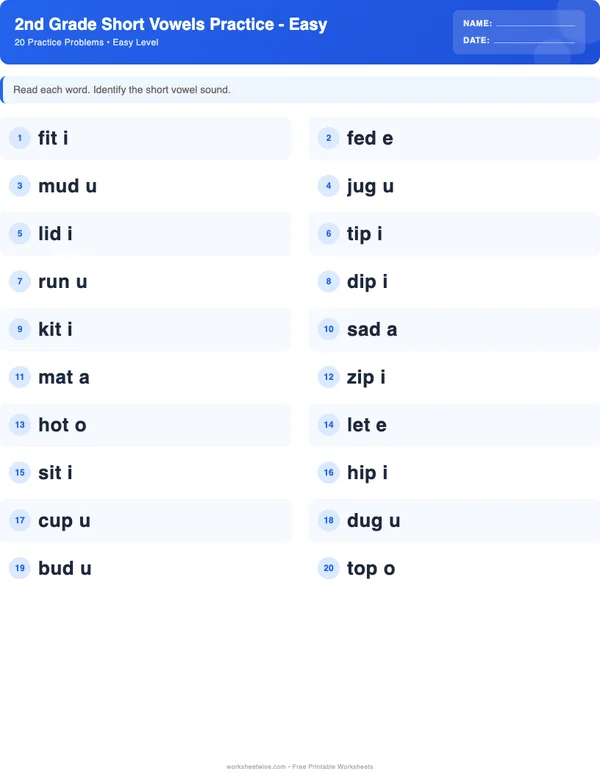
What 2nd Grade Short Vowels Practice Should Accomplish
Short-vowel instruction helps a learner hear, identify, read, and spell the vowel sound in a regularly spelled one-syllable word. The five target sounds are a as in apple, e as in egg, i as in itch, o as in octopus, and u as in umbrella. They commonly appear in closed syllables, where a consonant closes the syllable after the vowel: cat, pen, sit, hot, and cup.
For a second grader, the immediate goal is usually accurate and increasingly independent use of these patterns—not simply reciting five vowel sounds. A learner should be able to:
- Hear the middle sound in a spoken word.
- Connect that sound with the correct vowel letter.
- Blend the sounds to read a complete word.
- Segment a spoken word and spell it.
- Distinguish short-vowel words from familiar long-vowel patterns.
- Continue using short vowels when words include blends or digraphs.
The learner’s observed work should determine the pace. A child who reads cat and hot accurately but repeatedly confuses pen and pin needs focused discrimination practice, not an automatic return to every vowel. Likewise, a child who reads isolated words correctly but misspells them during dictation needs more encoding practice.
Grade labels describe an intended practice level, not a universal timetable. Local curricula and instructional sequences differ, and learners may need earlier review or more advanced application. The 2nd Grade Phonics hub can help adults place short-vowel work alongside other phonics topics.
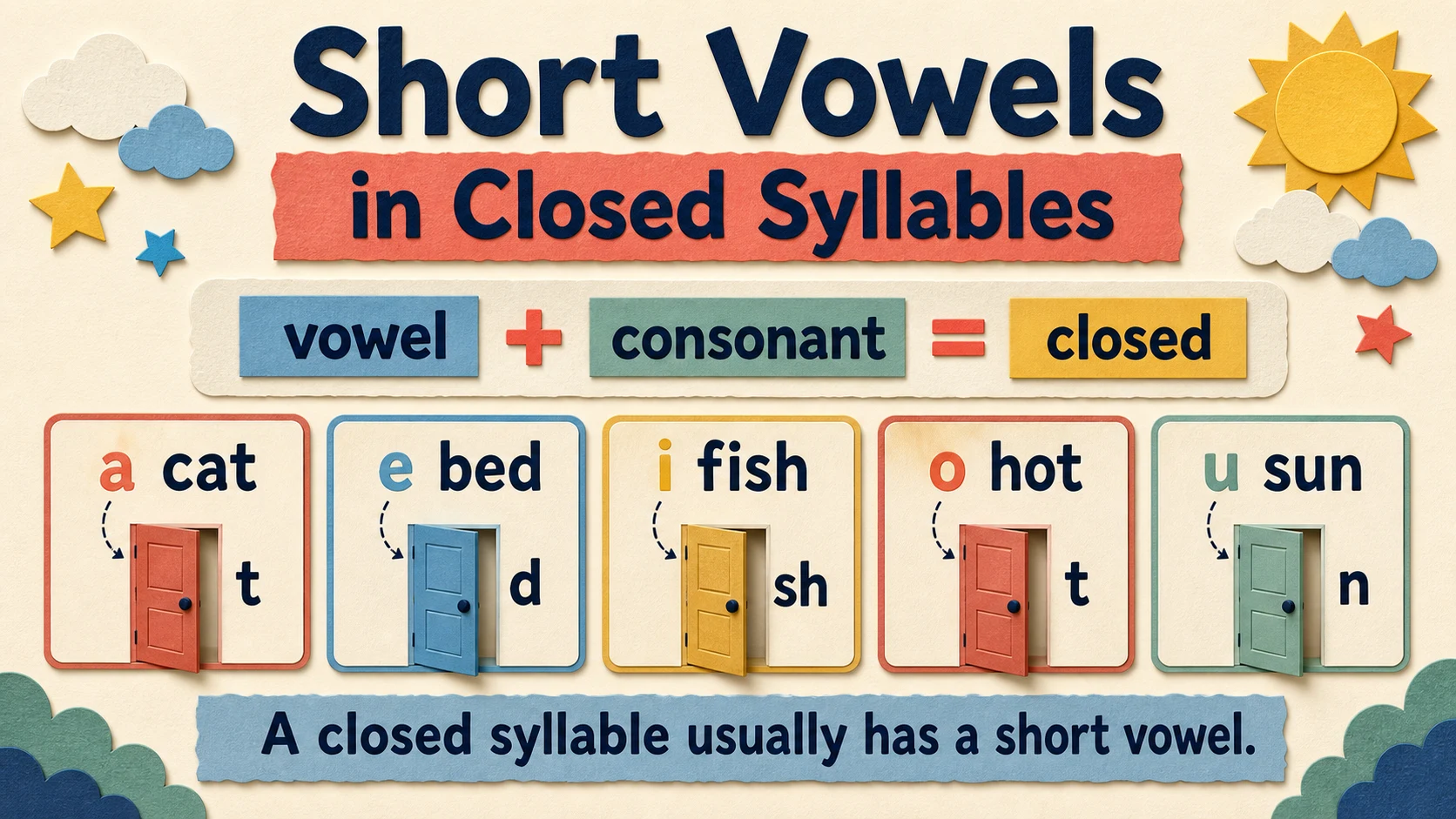
Short-vowel competence connects listening, letter knowledge, decoding, spelling, and application in text.
Prerequisites to Check Before Beginning
Short-vowel work becomes much harder when a missing prerequisite is mistaken for a vowel problem. Use a few spoken and printed examples to check the foundations first.
Hearing separate sounds in a word
Say map slowly without showing it in print. Ask the learner to identify the first, middle, and last sounds. The learner does not need to name the letters yet. This is a listening task.
A useful oral sequence is:
- map: /m/–/ă/–/p/
- fin: /f/–/ĭ/–/n/
- log: /l/–/ŏ/–/g/
If the learner gives the whole word instead of an individual sound, model stretching the word and moving one counter for each sound. If the learner consistently identifies the first and last sounds but misses the middle, continue oral segmentation before expecting independent vowel spelling.
Recognizing letters and their common sounds
Check whether the learner can identify the lowercase vowels a, e, i, o, u and produce their short sounds with reasonable consistency. Also check the consonants used in the practice words. A response such as reading map as nap may reflect uncertainty about m, not about short a.
Blending three sounds
Write s a t with a small space between the letters. Point under each letter while producing /s/–/ă/–/t/, then sweep under the whole word and say sat. Ask the learner to repeat the process.
A learner who names each sound correctly but cannot combine them needs explicit blending practice. Do not treat the difficulty as evidence that the vowel sound was not learned.
The IES foundational reading practice guide provides high-level support for teaching learners to connect sounds with letters, blend and analyze word parts, decode words, and read connected text. It does not evaluate this WorksheetWise guide or prescribe one fixed lesson schedule.
A Grade-Appropriate Progression
The catalogue’s suggested vowel sequence is a, i, o, u, e. Short a is introduced first as the most distinct target in that sequence, while short e is delayed because e and i are often confused. This is an instructional suggestion from the supplied catalogue, not a universal requirement. If the learner’s school follows another sequence, practice can follow that order.
| Stage |
Instructional focus |
Example task |
Move forward when the learner can… |
| 1. One vowel |
Hear and identify one target sound |
Sort map, cat, and jam under a |
Identify the middle sound without relying on guessing |
| 2. Two contrasting vowels |
Distinguish clearly different sounds |
Sort map/mop and cat/cot |
Explain which middle sound changed |
| 3. All five vowels |
Select among a, e, i, o, u |
Complete p_n after hearing pen |
Choose the vowel accurately in mixed practice |
| 4. Decode CVC words |
Blend consonant-vowel-consonant words |
Read fin, log, and cup |
Blend the full word without changing the vowel |
| 5. Encode CVC words |
Segment and spell from dictation |
Hear bed and write bed |
Represent all three sounds in order |
| 6. Add blends and digraphs |
Preserve the vowel inside a larger sound sequence |
Read flag, ship, and chop |
Attend to the middle vowel rather than the word’s length |
| 7. Compare short and long patterns |
Distinguish familiar one-syllable patterns |
Compare hop/hope and rid/ride |
Notice that the spelling pattern changes the vowel sound |
| 8. Apply in phrases and sentences |
Use accurate decoding within meaningful reading |
Read “The frog sat on a log.” |
Read target words accurately without losing the sentence meaning |
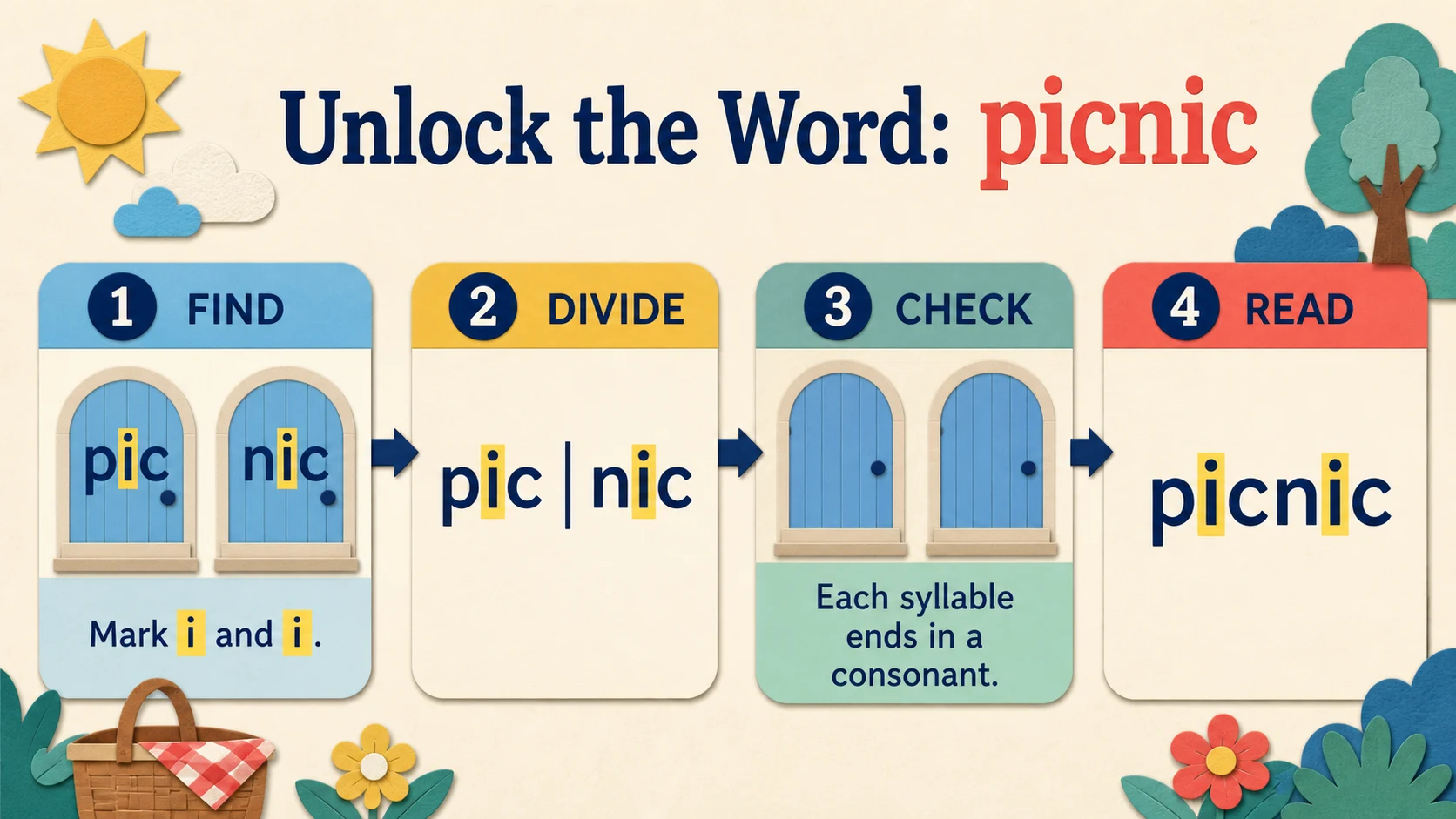
Support should decrease as the learner demonstrates accurate listening, reading, and spelling.
The Common Core English Language Arts standards include distinguishing long and short vowels when reading regularly spelled one-syllable words at Grade 2. The supplied catalogue also references earlier foundations such as isolating middle sounds and decoding regularly spelled one-syllable words. These references help explain the progression, but they do not establish comprehensive alignment with every local curriculum.
Concrete and Visual Models
A clear model makes the vowel visible, audible, and movable. The adult should still listen for whether the learner is using the model or merely copying it.
Sound counters and letter tiles
Say sun. Ask the learner to repeat it slowly and move three counters:
| Spoken sound |
/s/ |
/ŭ/ |
/n/ |
| Counter |
● |
● |
● |
| Letter |
s |
u |
n |
Replace each counter with a letter tile. Then sweep under sun and blend the word. This sequence shows that the vowel belongs in the middle sound position.
For a word with a digraph, the number of letters and sounds may differ:
| Spoken sound |
/sh/ |
/ĭ/ |
/p/ |
| Sound counter |
● |
● |
● |
| Written letters |
sh |
i |
p |
Ship has four letters but three sound units in this analysis because sh represents the initial sound. This is an important boundary case: “three sounds” does not always mean “three letters.”
Anchor pictures and motions
The catalogue suggests the following recall cues:
| Vowel |
Anchor |
Optional motion |
| a |
apple |
Pretend to bite an apple |
| e |
egg |
Pretend to crack an egg |
| i |
itch |
Scratch an arm |
| o |
octopus |
Wiggle arms |
| u |
umbrella |
Hold up an imaginary umbrella |
Use the cue briefly, then return to the word. If the learner hears map, says “apple,” and chooses a, ask for the actual sound: “What sound do you hear in the middle of map?” The picture is a prompt, not the final answer.
Word sorts
Prepare cards such as map, fin, log, sun, bed, cat, sit, hop, rug, and net. Ask the learner to read each word and place it under a vowel heading. After sorting, have the learner read down each column and explain one placement.
Re-sorting matters because it requires a fresh decision. Avoid leaving cards in a memorized order. For a learner confusing only two sounds, use a smaller contrast set such as pen/pin, bed/bid, and set/sit.
Fully Checked Worked Examples
Each example moves from hearing to reading or spelling and includes a check that can be performed directly from the word.
Example 1: Identify the vowel in “map”
Task: Read map and identify its short vowel.
- Segment the word: /m/–/ă/–/p/.
- Isolate the middle sound: /ă/.
- Match /ă/ to the letter a.
- Blend the sounds again: /m/–/ă/–/p/, map.
Answer: a, the short a sound.
Check: Cover m and p. The remaining letter is a. Restore the consonants and verify that map is a regularly spelled CVC word with a consonant after the vowel.
Example 2: Choose the missing vowel in “p_n”
Task: Complete p_n to spell the spoken word pen.
- Repeat pen slowly: /p/–/ĕ/–/n/.
- Compare the middle sound with the anchor sounds.
- /ĕ/ matches e as in egg.
- Insert e: p + e + n = pen.
- Blend to verify: /p/–/ĕ/–/n/, pen.
Answer: pen.
Check: pin would contain short i and name a different word. Listening to the middle sound distinguishes the two spellings.
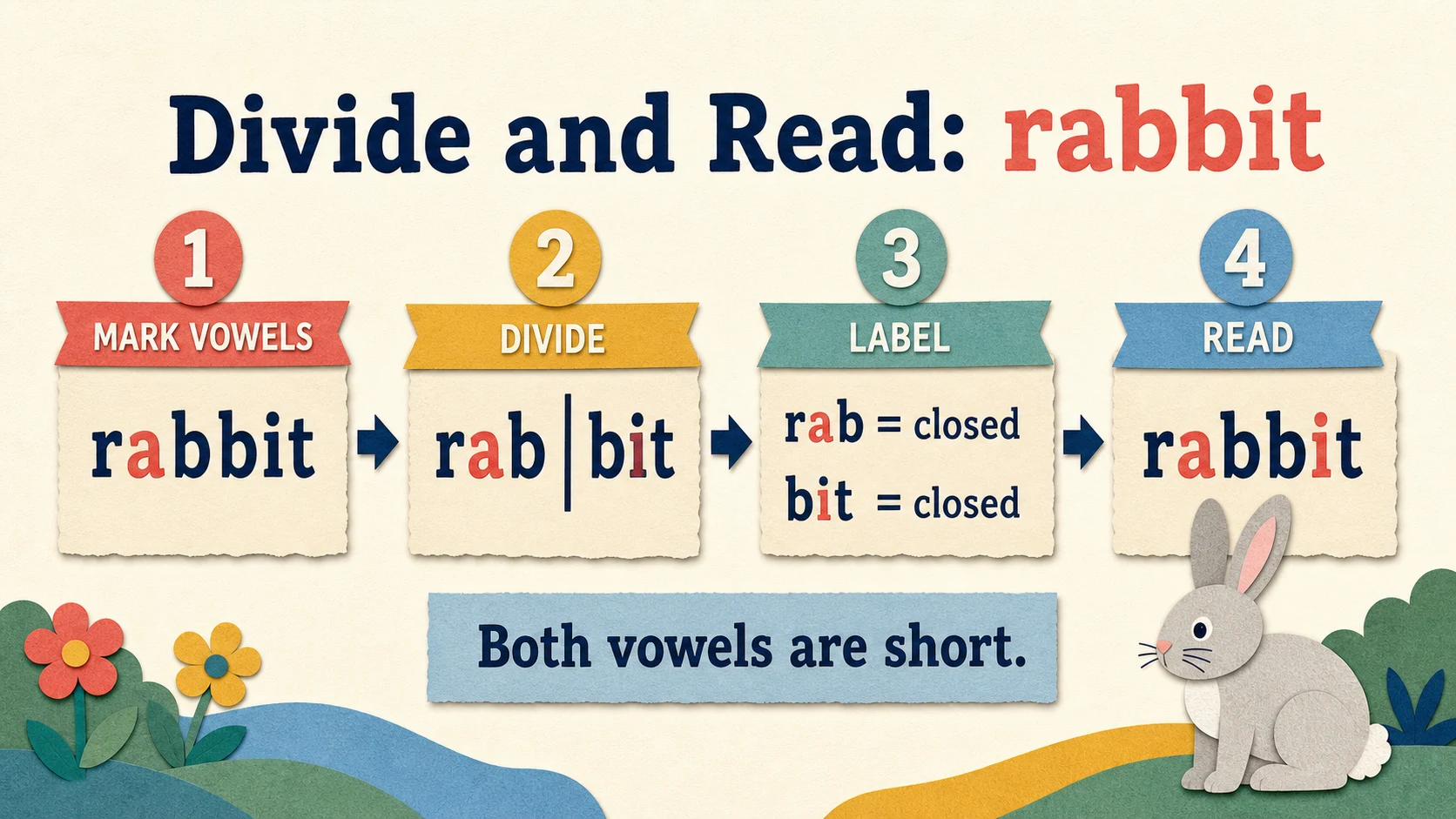
The answer is checked by segmenting, matching the middle sound, and blending the completed word.
Example 3: Compare “hop” and “hope”
Task: Decide which word has a short vowel.
- Read hop: /h/–/ŏ/–/p/.
- The o is followed by a consonant that closes the one-syllable word.
- Read hope. Its vowel sound is the letter name /ō/, not short /ŏ/.
- Compare the words aloud: hop, hope.
Answer: hop has short o; hope has long o.
Check: The final e in hope changes the spelling pattern. Do not classify every word containing o as a short-o word.
Example 4: Spell “sun” from dictation
Task: Hear sun and write the word.
- Repeat and stretch it: /s/–/ŭ/–/n/.
- Record the first sound with s.
- Record /ŭ/ with u.
- Record the final sound with n.
- Read the result: sun.
Answer: sun.
Check: Point to each written letter while repeating the corresponding sound. All three sounds appear in the correct order.
Example 5: Find the short vowel in “ship”
Task: Identify the vowel sound in ship.
- Segment the sounds: /sh/–/ĭ/–/p/.
- Isolate the middle sound: /ĭ/.
- Match /ĭ/ with i as in itch.
- Blend: /sh/–/ĭ/–/p/, ship.
Answer: Short i.
Check: Although ship has four letters, sh works together at the beginning. The vowel remains i, followed by a consonant sound that closes the syllable.
Example 6: Diagnose “bed” read as “bid”
Observed response: The learner sees bed but says bid.
- Check the consonants: the learner retained /b/ and /d/.
- Compare the printed middle letters: e in bed, i in bid.
- Say both words slowly: /b/–/ĕ/–/d/ and /b/–/ĭ/–/d/.
- Ask the learner to watch the adult’s mouth and listen for the changed middle sound.
- Re-read bed, pointing under e.
Diagnosis: This response is consistent with confusion between short e and short i, rather than a first- or final-consonant problem.
Check: Contrast additional pairs such as pen/pin and set/sit. If the same substitution recurs, select focused e/i listening, sorting, reading, and dictation practice.
Boundary Cases and Misconceptions
A closed syllable is a pattern, not a guessing rule
Words such as cat, pen, sit, hot, and cup provide straightforward models: each vowel is followed by a consonant in the same syllable. However, learners should not be told that any vowel appearing near a consonant must have a short sound. Compare hop with hope. The complete spelling pattern matters.
This guide focuses on regularly spelled examples that allow the learner to verify the sound-letter relationship directly. Words whose pronunciations do not follow the target pattern should not be used to judge mastery of this particular skill.
The middle letter is not always the middle sound
In ship, i is the third of four letters, yet /ĭ/ is the middle of three sound units. In flag, the vowel is the third letter in a five-letter word. Asking only for the “middle letter” can create an unreliable shortcut. Ask, “What vowel sound do you hear?” and then, “Which letter spells it here?”
Saying the vowel name is not reading the vowel sound
A learner may correctly name the letter a but read cat with /ā/. Letter identification and sound production are related but separate responses. Prompt with, “You named the letter. Now say the sound it represents in this word.”
Pictures can support or conceal performance
A picture of a cat may help a learner retrieve the word without reading cat. Use pictures for sound sorting and anchor cues, but include printed words without pictures when checking decoding. Conversely, do not require a learner to name an unclear picture as proof of phonics knowledge.
Correct reading does not guarantee correct spelling
A learner may recognize sun immediately yet write son during dictation. Reading provides the letters; dictation requires the learner to analyze the spoken sounds and select the letters. Include both decoding and encoding before concluding that a pattern is secure.
A Short, Repeatable Lesson Routine
A focused lesson can follow the same structure while the words and contrasts change.
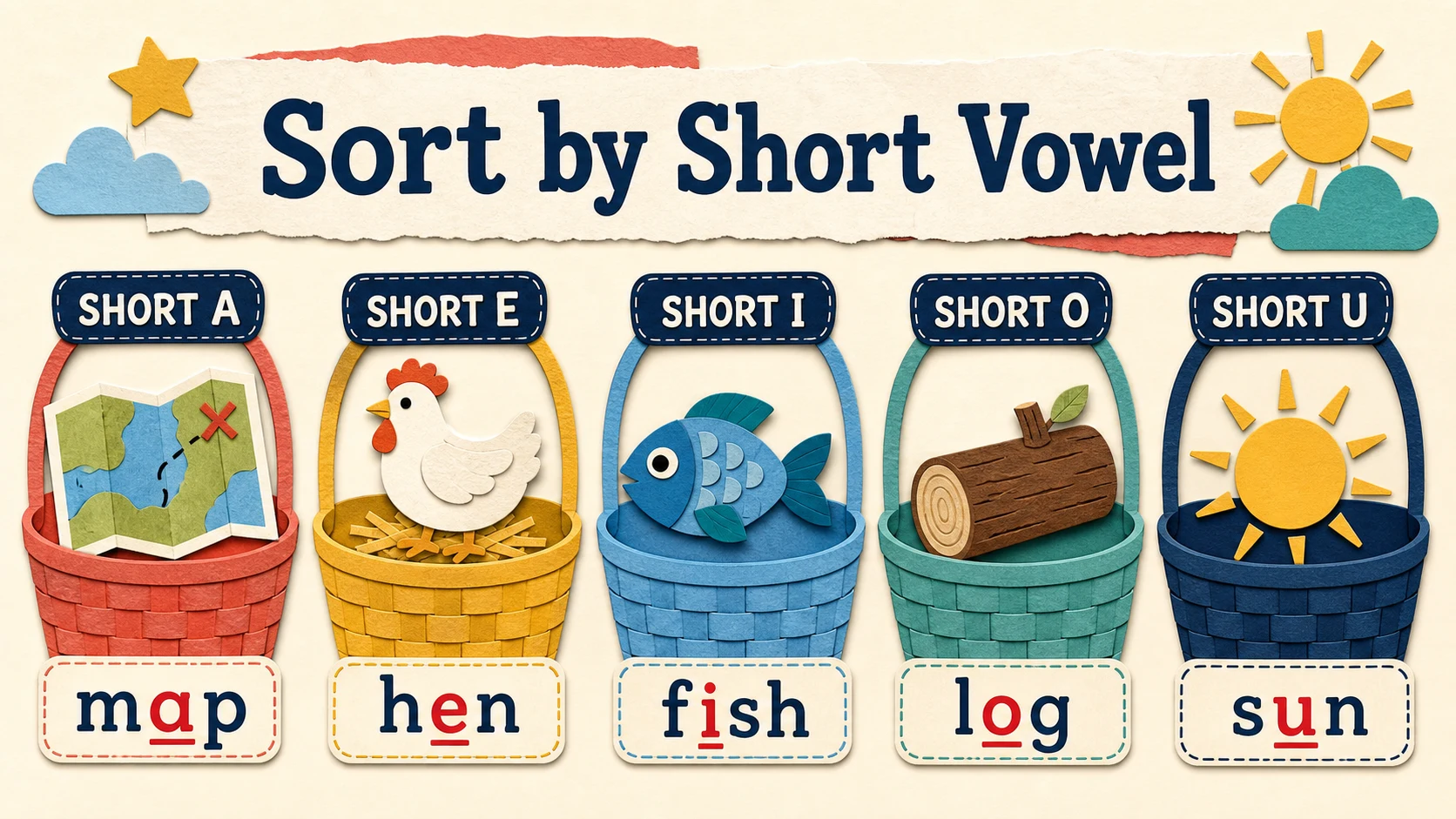
The routine moves from listening to modeling, guided use, spelling, and a brief independent check.
1. Listen and identify
Say three to five words without displaying them. Ask for the vowel sound or have the learner place a counter under the matching vowel card. For short a, possible words include map, cat, and jam.
2. Model one example
Write one word, segment it, identify the vowel, and blend it again. Keep the explanation direct: “In map, I hear /ă/ between /m/ and /p/, so the vowel is a.”
3. Practice with support
Have the learner complete several examples using counters, vowel cards, or a small word sort. Prompt the process before supplying an answer:
- “Stretch the word.”
- “What do you hear between the first and last sounds?”
- “Which vowel represents that sound?”
- “Blend the whole word to check.”
4. Read and spell
Ask the learner to read a short list, then dictate two or three words from that same pattern. Reading and spelling reveal different parts of the skill.
The IES elementary writing practice guide offers high-level support for regular writing opportunities and explicit attention to foundational writing skills. In this lesson, brief word dictation is an instructional application of that broad framing; the source does not prescribe this exact routine.
5. End with an independent check
Give one familiar-pattern word without a picture or immediate cue. Record the exact response. A one-word check is not a complete assessment, but it helps decide whether the next lesson should repeat, contrast, or extend the pattern.
Choosing Practice That Matches the Error
Practice should target what the learner actually does, not just the title of the skill.
| Observed work |
Likely instructional need |
Suitable practice |
| Cannot identify the middle sound orally |
Sound segmentation |
Spoken-word work with counters; no print at first |
| Identifies /ă/ but cannot choose a |
Sound-letter connection |
Anchor card, letter tiles, fill-in-the-middle |
| Reads sounds separately but not the word |
Blending |
Continuous pointing and a final blending sweep |
| Reads pen as pin |
e/i discrimination |
Minimal-pair listening, sorting, reading, and dictation |
| Reads CVC words but misses ship or chop |
Applying vowels with digraphs |
Three-sound mapping with sh or ch grouped |
| Reads accurately but spells inconsistently |
Encoding |
Short, controlled dictation followed by sound checking |
| Completes one-vowel pages but fails mixed review |
Selection among patterns |
Mixed-vowel sorts and interleaved word lists |
| Confuses hop and hope |
Short/long comparison |
Paired one-syllable words with visible pattern changes |
The free easy short-vowels worksheet contains 20 exercises asking learners to read words and identify their short-vowel sounds. It is best suited to a learner beginning this practice or needing reinforcement in short-vowel identification, CVC patterns, and decoding. Because it includes a separate answer key, an adult can check responses consistently.
A learner who needs repeated work across several sessions may use the focused short-vowels pack, which contains 18 worksheets. More pages are not automatically better: select only the items that fit the present error, and stop when attention or response quality declines. The learner’s work should determine whether to repeat, simplify, or advance.
Differentiation Without Changing the Core Skill
When the learner needs more support
Reduce the number of choices. Contrast two vowels rather than five, and choose acoustically clearer contrasts before close ones. Keep anchor pictures visible. Use movable letters so the learner can replace only the vowel in map → mop or sit → sat.
Model the first response, complete the second together, and then ask for an independent third response. If errors rise as soon as support is removed, return to guided practice rather than adding a longer worksheet.
When short e and short i are confused
The catalogue recommends minimal pairs such as pen/pin, set/sit, and bed/bid. Say each pair without showing it, ask whether the middle sounds are the same or different, and then reveal the spellings. The catalogue also suggests having the learner watch the adult’s mouth, noting that short e uses a slightly wider mouth opening.
Treat these as teaching cues, not diagnostic or medical claims. They help direct attention to the contrast but do not guarantee that one demonstration will resolve it.
When the learner is ready to extend
Keep the short-vowel target while adding familiar consonant blends or digraphs: flag, ship, and chop. Then place target words in short phrases or sentences, such as “The frog sat on a log.” Ask the learner to identify the short-vowel words after reading.
Do not move ahead merely because a page is complete. Look for accurate reading, accurate spelling, and transfer into a new list or sentence.
Common Errors and Diagnostic Responses
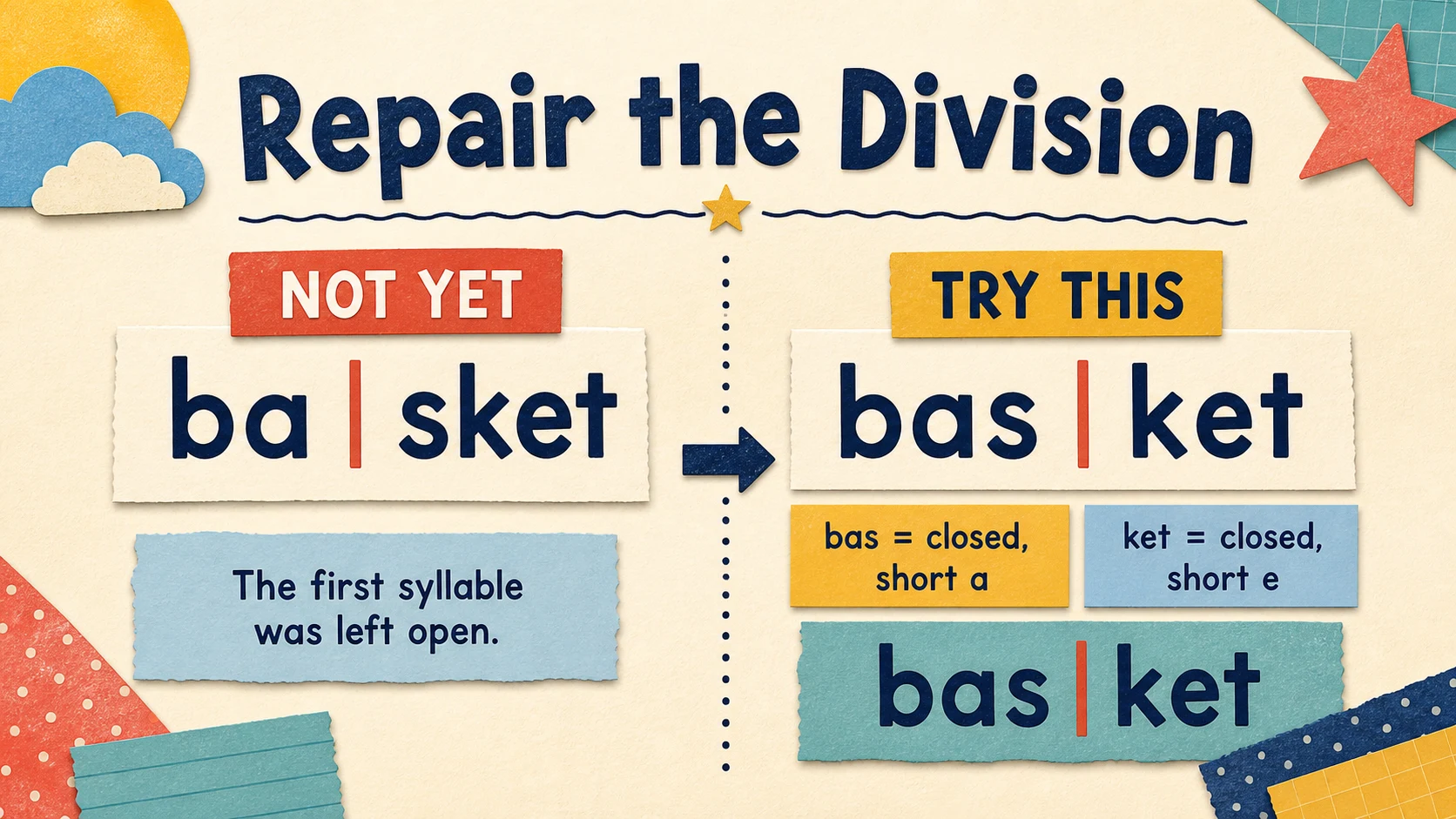
An error becomes useful when the adult records what changed and chooses a matching response.
When a learner makes an error, compare the response with the target:
- Vowel substitution: bed becomes bid. Contrast the two vowel sounds.
- Consonant substitution: map becomes nap. Check the initial consonant rather than reteaching short a.
- Sound omission: sun becomes sn. Return to three-part segmentation and represent every sound.
- Failure to blend: /s/–/ŭ/–/n/ is produced correctly, but the learner cannot say sun. Practice the blending sweep.
- Pattern overgeneralization: hope is classified as short o because the learner notices only o. Compare the complete spellings hop/hope.
- Picture guessing: The learner says a related word without attending to print. Remove the picture and require pointing under each grapheme.
- Memorized order: The learner succeeds only when words remain grouped by vowel. Shuffle the cards and use mixed review.
Avoid labels such as “careless” when the work provides a more precise explanation. Record the actual substitution or omission. If a learner self-corrects after blending, note both the initial response and the successful correction.
Monitoring Progress and Making Pacing Decisions
Use a small, consistent record rather than relying on whether a page “felt easy.” A simple entry can include:
| Date |
Task |
Words attempted |
Accurate independently |
Error pattern |
Next step |
| Day 1 |
Read mixed CVC words |
8 |
6 |
e read as i twice |
Contrast e/i |
| Day 3 |
Spell dictated pairs |
6 |
5 |
bed written bid |
Repeat oral and written pair |
| Day 5 |
Read new mixed list |
8 |
8 |
None observed |
Add digraph examples |
These numbers describe that practice sample only. They should not be presented as a standardized score or a guarantee of future performance.
Before advancing, look across several kinds of evidence:
- Can the learner hear the target vowel without seeing the word?
- Can the learner read a new regularly spelled example?
- Can the learner spell a spoken example?
- Can the learner maintain the vowel when a blend or digraph is present?
- Can the learner distinguish a familiar short-vowel pattern from a familiar long-vowel pattern?
- Does performance remain accurate after cards or questions are reordered?
If one condition is weak, select a short task for that condition. If performance varies sharply from day to day, shorten the practice set and collect another sample rather than drawing a broad conclusion from one session.
A Two-Week Practice Plan
This plan uses ten short sessions as an adaptable instructional suggestion. It is not a universal timetable. Sessions can be repeated, combined, or paused according to the learner’s observed responses and the local sequence.
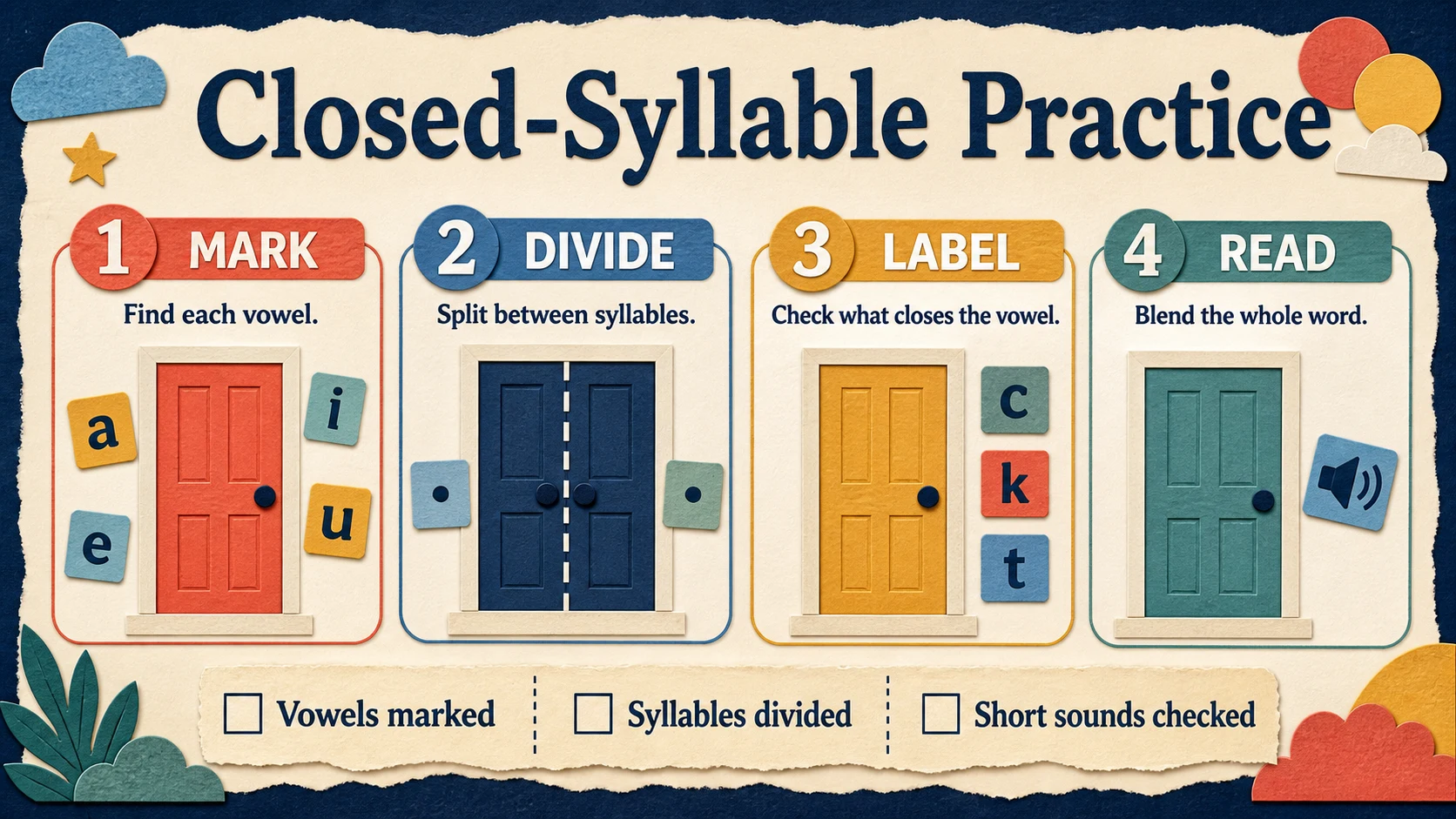
Each session checks prior learning before adding a contrast or a new application.
| Day |
Focus |
Suggested activity |
Independent check |
| 1 |
Establish a baseline |
Oral segmentation and a mixed CVC reading sample |
Identify the vowel in two new words |
| 2 |
Short a |
Anchor cue, word building, map/cat/jam sort |
Read and spell one short-a word |
| 3 |
Short i |
Contrast a/i using sat/sit and pan/pin |
Sort four shuffled words |
| 4 |
Short o |
Build and change map → mop, cat → cot |
Read log and spell hot |
| 5 |
Review a/i/o |
Mixed reading, then three-word dictation |
Explain one vowel choice |
| 6 |
Short u |
Use sun, cup, and rug with counters and tiles |
Complete one missing-vowel word |
| 7 |
Short e |
Introduce bed, pen, and net; compare with i |
Read bed/bid accurately |
| 8 |
e/i discrimination |
Minimal-pair listening, sorting, and dictation |
Spell one word from each pair |
| 9 |
Blends and digraphs |
Map and read flag, ship, and chop |
Identify each vowel sound |
| 10 |
Mixed application |
Read a new list and a short sentence; spell selected words |
Choose repeat, review, or extension |
If Day 8 shows continuing e/i substitutions, repeat that contrast with fewer words and more oral practice. If Day 10 is accurate only when pictures are present, repeat printed-word decoding without pictures. If new examples are read and spelled independently, begin comparing short vowels with familiar long-vowel patterns or continue into the next locally scheduled phonics skill.
Limits and the Honest Next Step
Short-vowel practice addresses a specific foundational skill. A worksheet can provide controlled repetition, but it cannot by itself determine why every reading difficulty occurs, replace observation during oral reading, or establish complete curriculum mastery. The examples in this guide are intentionally regular and limited. They do not cover every spelling pattern, pronunciation variation, multisyllabic structure, or aspect of reading comprehension.
The broader second-grade catalogue includes growing independence in reading and writing, with more complex spelling work such as vowel teams, r-controlled vowels, and suffixes. Short-vowel accuracy supports that later work, but completing short-vowel exercises does not demonstrate mastery of those separate topics.
Begin with the free 2nd Grade Short Vowels worksheet. Watch the learner complete a small sample, record the exact errors, and use the diagnosis table to choose the next practice: oral segmentation, one-vowel review, a focused e/i contrast, dictation, or mixed independent reading.