Curated collectionAnswer keys includedPrint-ready PDFs
Worksheets for 3-Year-Olds: Printable Practice Guide
Brief adult-led noticing, matching and counting with oral or hands-on work before marks on paper.
Start with a real resource
Browse this worksheet collection
5 relevant free entry points are available. Each one includes a printable learner PDF and separate answer key.
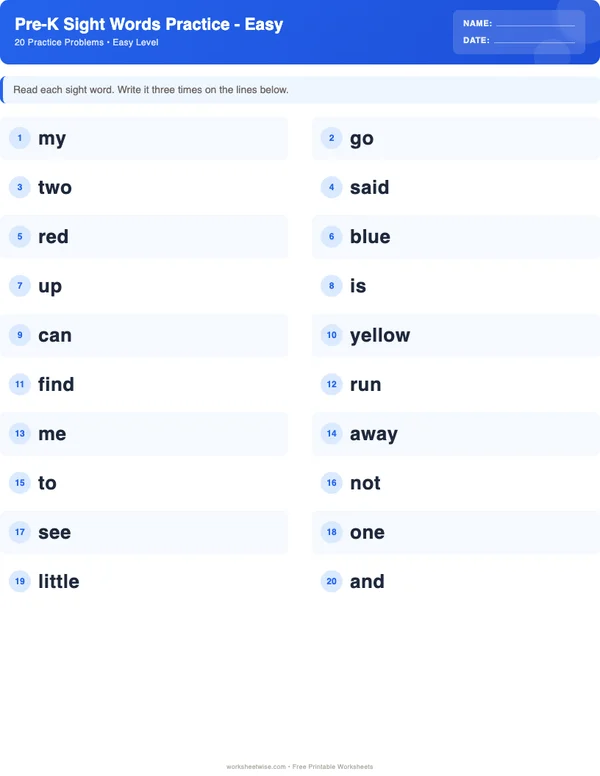
A useful practice loop
Print less. Observe more.
- Choose one skill and model the first item aloud.
- Use a short set and notice the learner’s strategy.
- Change the next task from the work you can see.
Need more than the free sheet?
Plus includes all 90 matching catalogue variations where available, plus saved deterministic generators and the worksheet designer.
See Plus membershipComplete guide
How to teach and practise worksheets for 3 year olds
3,413 words Updated 6 instructional visuals
Choose by what the child can do today
Worksheets for 3-year-olds are most useful when an adult turns a small part of the page into a brief conversation, matching game, counting action, or movement task. Begin with objects and spoken responses. Add pointing or matching next. Ask for pencil marks only when those marks help reveal the child’s thinking.
Age is a discovery aid rather than a placement decision. The catalogue’s age-three filter leads to Pre-K material, but it does not establish where a particular child should begin. Children of the same age can differ substantially in language, attention, motor control, prior experience, and comfort with an adult-led task. Select a starting activity, watch the child work, and adjust from that evidence.
The live catalogue currently provides 90 variants across two subjects and five topics, with five free entry points. The represented topics are counting, CVC words, short vowels, word families, and sight words. Each free sheet contains 20 problems, but 20 is an inventory of available practice—not a recommended sitting length for a three-year-old. One to three items may be enough.
For children ages three and four, prioritize brief adult-led oral, matching, manipulative, and movement work over desk work. A successful session might last three minutes and produce no written answers: the child touches three bears while counting, finds two pictures that begin alike, or builds one word with letter tiles. Stop while the interaction is still constructive.
Read the task before offering the page
A worksheet’s topic label is only the first selection clue. Examine what the child must actually perceive, remember, say, move, and mark.
Check the thinking demand
Ask what the item is intended to reveal:
- Does the child match equal pictures?
- Does the child give one object to each space?
- Does the child count objects once each?
- Does the child hear whether two spoken words rhyme?
- Does the child notice the middle sound in a short word?
- Does the child recognize a practiced printed word?
Choose one principal target. A page that asks a child to identify a sound, remember directions, scan a crowded field, and form several letters may obscure the skill you meant to observe.
Check the response demand
A child may understand an idea without being ready to record it neatly. Determine whether the answer can be shown by pointing, placing a counter, moving a card, saying a word, or making one simple mark. If circling is difficult, let the child cover the answer with a button. If drawing a line across the page is distracting, cut out the choices and make a physical match.
These adaptations preserve the target when handwriting is not the target. Copying a word does not measure the same thing as hearing its sounds, and coloring five objects does not necessarily measure counting.
Check the visual and language load
Prefer a small number of clear pictures, generous spacing, short directions, and familiar objects. Explain unusual pictures before treating a response as evidence. If the child calls an image “kitty” while the item assumes “cat,” the mismatch may concern the picture label rather than the sound pattern.
The catalogue marks the representative free sheets as “easy.” Here, difficulty should be understood through observable task features—not as a label for a learner. A less demanding task might have fewer choices, familiar pictures, a spoken model, manipulatives, and only one decision at a time. A more demanding version might remove the model, mix categories, use more choices, or require an independent written response.
Use paper as one moment in an active routine
A predictable routine reduces explanation and helps the adult notice the child’s strategy. Keep the materials modest: a few counters or toys, several picture or letter cards, and one selected portion of a page.
Prepare only the part you intend to use
Cover the unused problems with another sheet of paper, or cut off a short strip if the worksheet’s use permits it. Select one to three examples that test the same idea. Gather the relevant objects before inviting the child to join.
State the job in one sentence: “We’re going to find how many,” “We’re listening for the middle sound,” or “We’re finding two words that end the same.” Avoid presenting all five catalogue topics in one sitting.
Follow a show, do, notice sequence
Use this five-step routine:
- Show: Complete one example while saying what you notice.
- Do together: Let the child move or point while you supply support.
- Try: Offer one similar item with less help.
- Notice: Describe the action: “You touched each bear once.”
- Decide: Continue once, simplify, or stop.
Keep praise tied to a visible action rather than speed or a trait. “You moved one button into each box” tells the child what worked. If interest fades, the next useful instructional move is often to stop, not to negotiate through the remaining page.
Put marks after meaning
When the child has demonstrated the idea with speech or materials, invite a minimal paper response: one circle, one line, one sticker, or one numeral if the child wants to make it. Hand-over-hand control can complete a page without showing what the child understands, so use it sparingly and do not treat the result as independent work.
The NAEYC principles of developmentally appropriate practice emphasize decisions informed by child development, individual variation, and context. That guidance supports observing this child’s participation and adjusting the experience; it does not mean NAEYC evaluated WorksheetWise or any sheet in this catalogue.
Make counting concrete before it becomes a mark
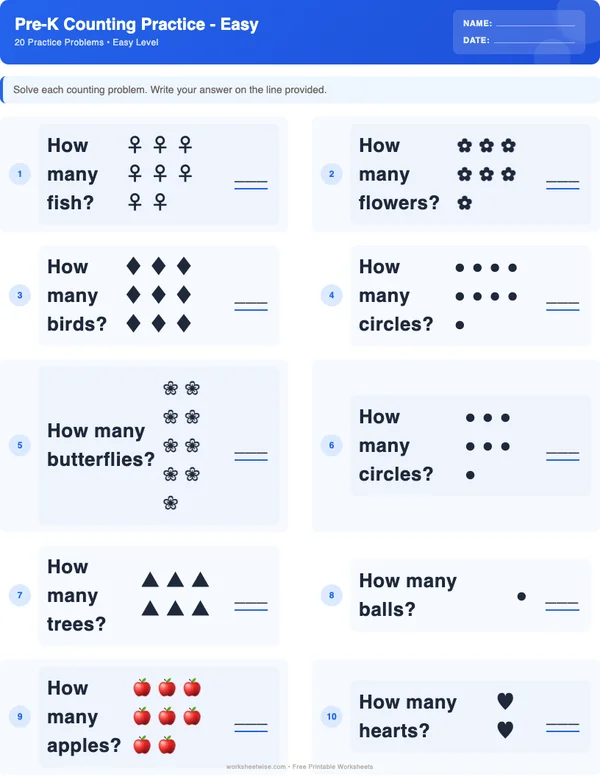
The Pre-K Counting guide and free sheet is the clearest starting point when a child enjoys moving small objects. The catalogue describes Pre-K counting as work with concrete objects, with attention to counting sequences and sets. At age three, narrow that broad topic to small quantities that can be physically handled.
Checked example: three cups and three bears
Place three toy bears beside three cups. Say, “Can each bear have a cup?” The child puts one bear in each cup. Then ask, “How many bears?” Encourage the child to touch or lift each bear while saying “one, two, three.” Finally, show one worksheet set containing three objects and let the child place a counter on each picture before counting.
This example belongs here because it combines matching, one-to-one action, oral counting, and a transition from objects to pictures. It does not require the child to write a numeral. It also lets you distinguish several observations:
- A stable spoken sequence with skipped or double-counted objects suggests the sequence is available but one-to-one tracking needs support.
- Accurate matching of one bear to each cup without a reliable final count shows useful quantity organization even if the number words are not yet stable.
- Saying “three” immediately without touching may be recognition of a familiar small quantity; rearrange the bears to see whether that understanding remains.
The IES practice guide Teaching Math to Young Children recommends using progressions, monitoring children’s knowledge, and integrating math into daily activity. In this setting, that can mean moving from real bears, to pictures of bears, to an optional mark—not requiring all three representations in one sitting.
A catalogue sheet contains 20 counting problems. For a three-year-old, begin with one set of two or three objects. Continue only if the child is still attending and each object is being counted once. Do not infer readiness to count to 20 merely because the sheet is labeled Pre-K.
Treat early phonics as listening and building
The phonics entry points—CVC words, short vowels, word families, and sight words—cover substantially different tasks. Do not rotate through them as if they were interchangeable. First decide whether the child is being asked to listen to speech, connect a sound with a letter, blend sounds into a word, notice a shared ending, or recognize a specific printed word.
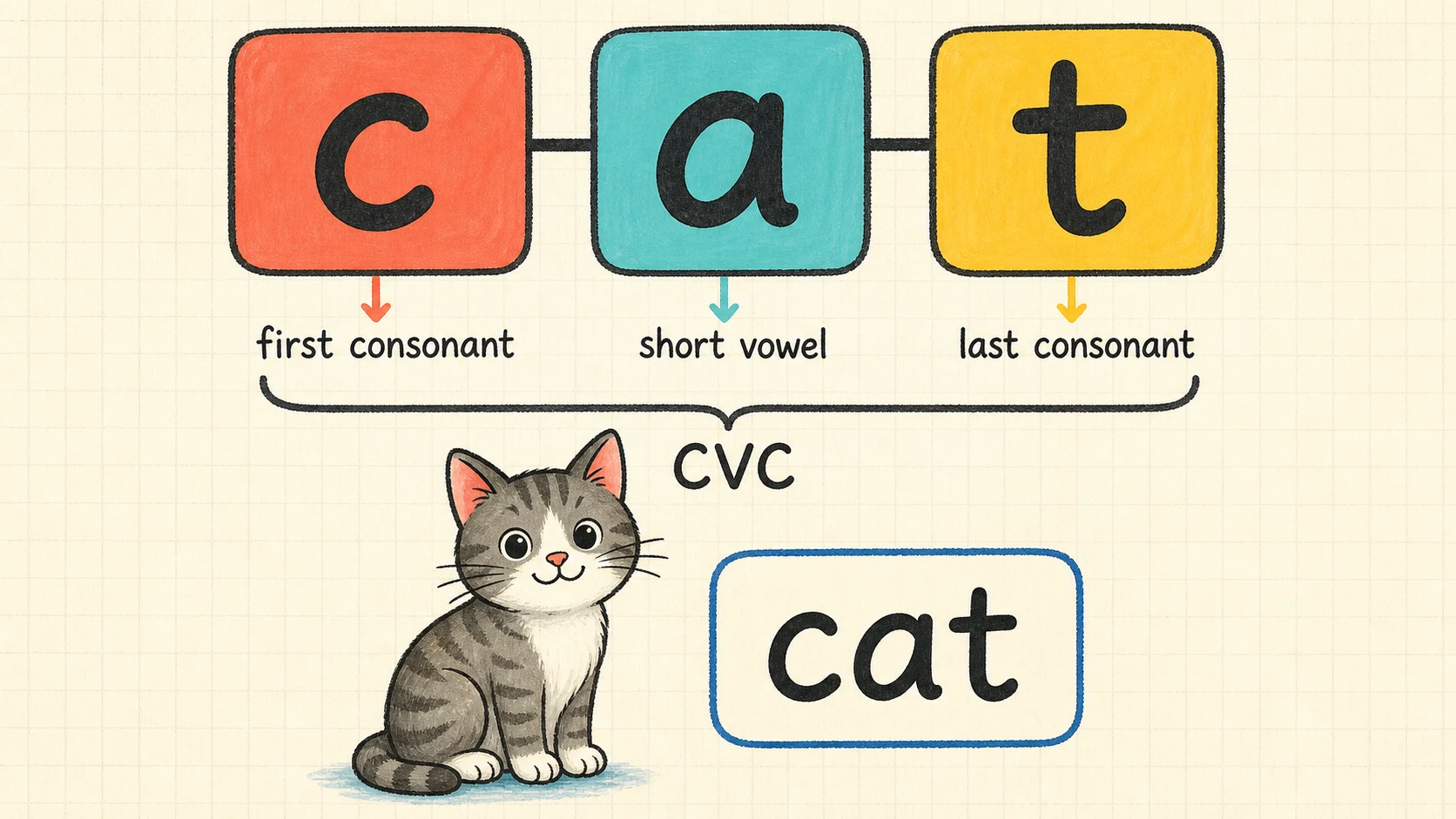
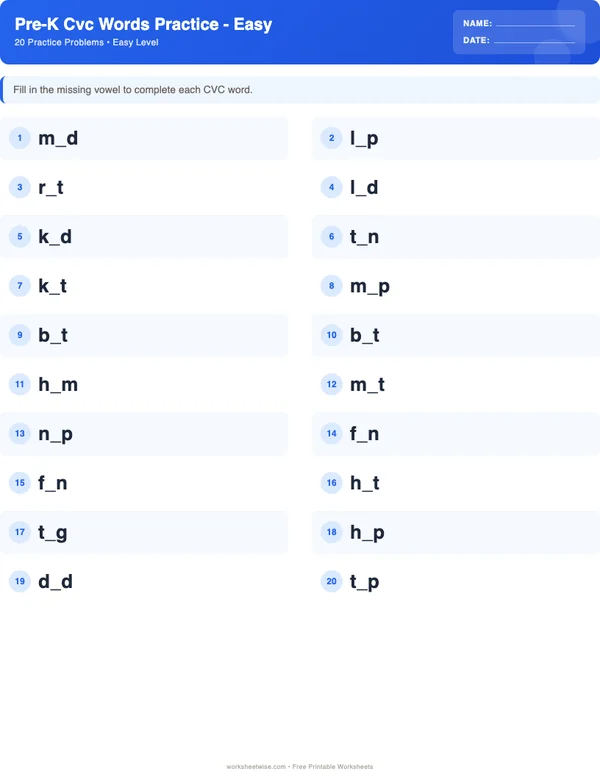
Use the CVC skill map to identify the one component being practiced; a three-sound printed word can involve listening, letter knowledge, sequencing, and blending.
The IES guide Foundational Skills to Support Reading for Understanding recommends explicit work with sound segments, sound-letter relationships, decoding, and connected text. For this age-specific use, the immediate implication is modest: model clearly and do not mistake visual copying for sound-based word reading. The guide did not assess WorksheetWise.
Checked example: build and blend “cat”
Show a picture of a cat and agree on its name. Say “cat” normally. Then say it slowly enough to notice the three sounds without inserting extra vowel sounds after the consonants. Give the child three tokens and three boxes. Together, move one token for each sound. If the child is interested in letters, replace the tokens with c, a, and t, then sweep a finger below the sequence while blending the word.
This belongs with the Pre-K CVC Words guide and free sheet because cat follows the catalogue’s consonant-vowel-consonant structure and uses the represented short a starting pattern. It is age-aware because the first response is oral and manipulative. Reading or writing the printed word is an optional extension, not the admission ticket.
Check the example carefully: cat has three phonemes in the expected order, and its middle vowel is the short a sound represented by the letter a. Do not use a picture of a kitten and mark “kitty” wrong; establish the intended word before asking for its sounds.
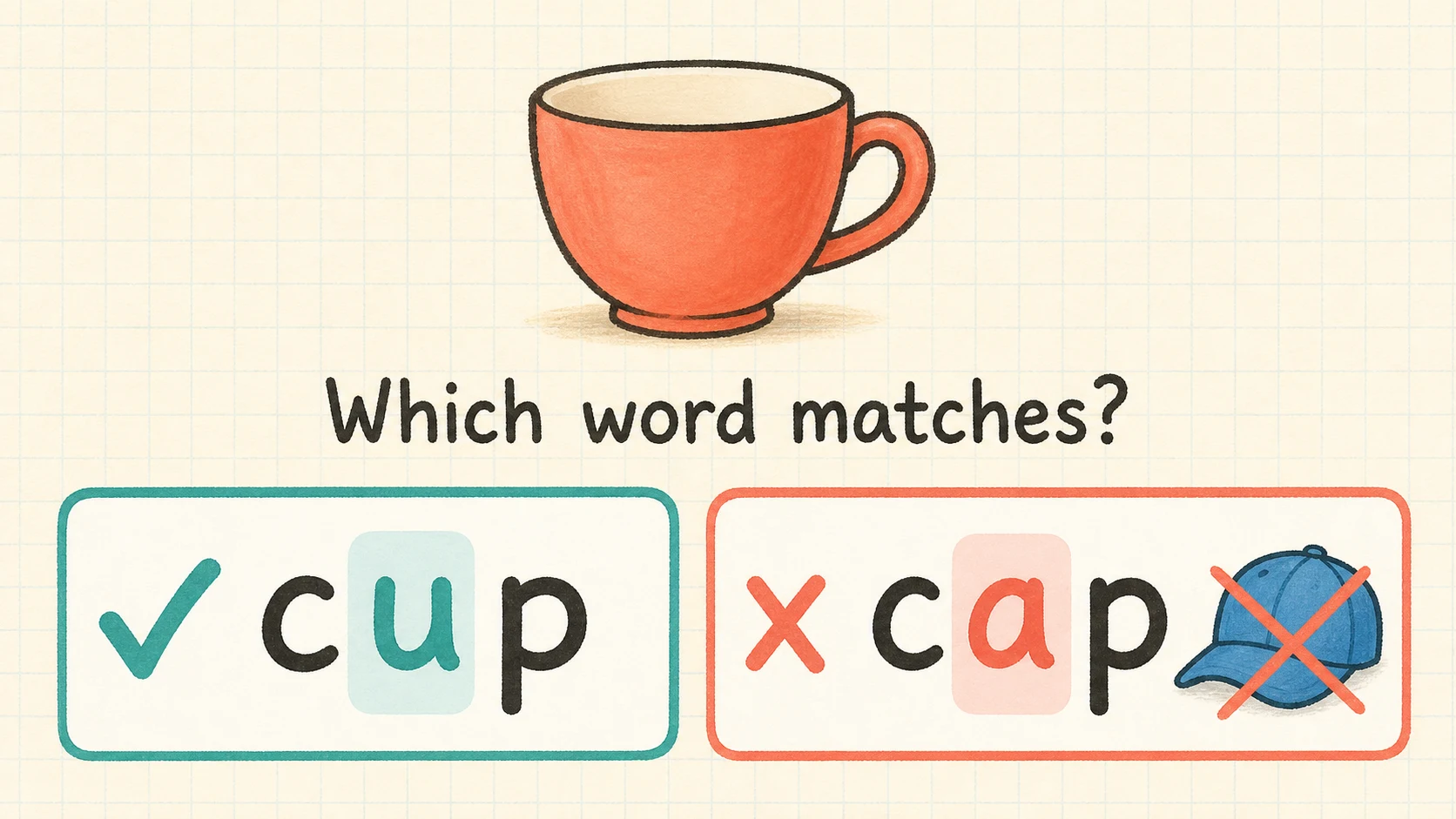
Treat a CVC response as evidence about a particular step—picture naming, sound segmentation, letter matching, or blending—before choosing the next prompt.
Checked example: hear the difference between “cat” and “sit”
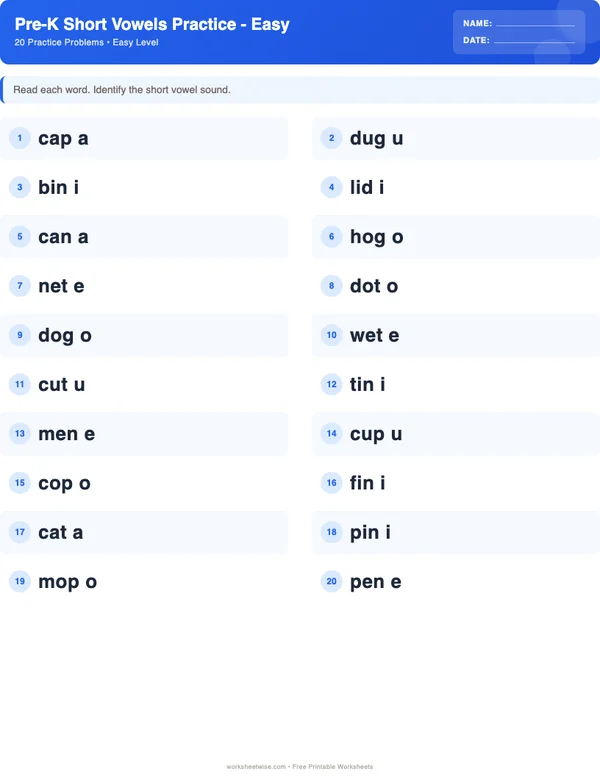
Say cat and sit without showing print. Give the child an apple picture for short a and an itch picture for short i, matching the catalogue’s anchor examples. Repeat one word and let the child place a toy beside the corresponding anchor. Model the mouth position and repeat as needed. Only after the oral choice is stable should you show the middle letters.
This belongs with the Pre-K Short Vowels guide and free sheet because the target is discrimination between two short vowel sounds inside CVC words. Both checked words fit the pattern: cat contains short a, and sit contains short i. The task preserves vowel listening by removing handwriting, letter formation, and a large visual field.
If the child cannot make the oral distinction, showing more printed items will not simplify the target. Return to one sound and one anchor action, or stop and revisit it another day.
Use word families only after the spoken pattern is audible
Word families can help a child notice that words share an ending, but the printed chunk should follow oral rhyme play. Begin with two real objects or pictures and an adult model.
Checked example: “cat,” “hat,” and one nonmatch
Place pictures for cat, hat, and sun on the table. Name all three so the vocabulary is settled. Say, “Cat, hat. They end the same: /at/.” Let the child put the cat and hat together. Then ask whether sun joins them. Repeat the words rather than demanding an explanation.
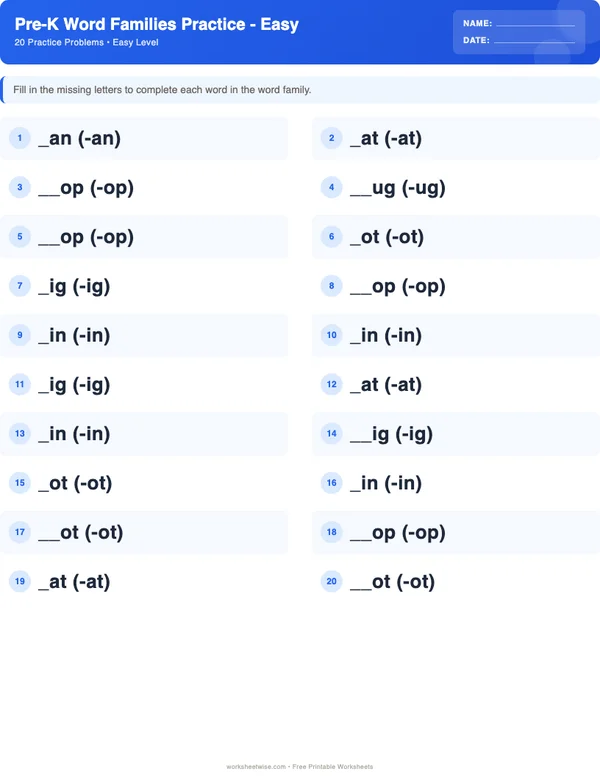
The match is checked: cat and hat share the -at rime and differ in their initial consonants; sun does not share that ending. This example belongs with the Pre-K Word Families guide and free sheet because -at is one of the catalogue’s stated beginning families. It is appropriate for this guide only when presented as a brief adult-led listening and matching task. Independently reading a mixed word-family list is a different and more demanding activity.
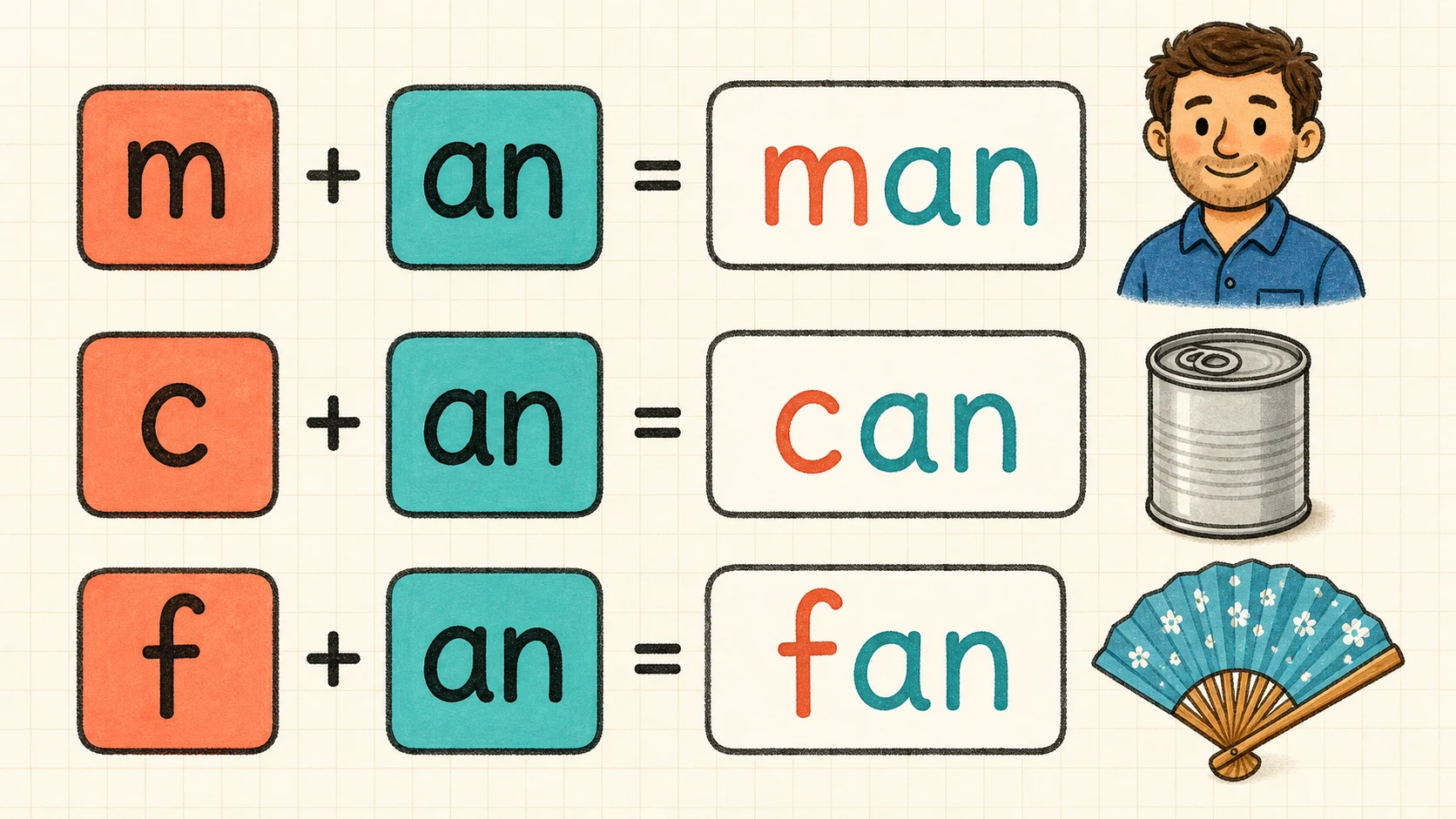
Move from named pictures and a spoken ending to a single match; add printed -at only if the child is attending to the pattern.
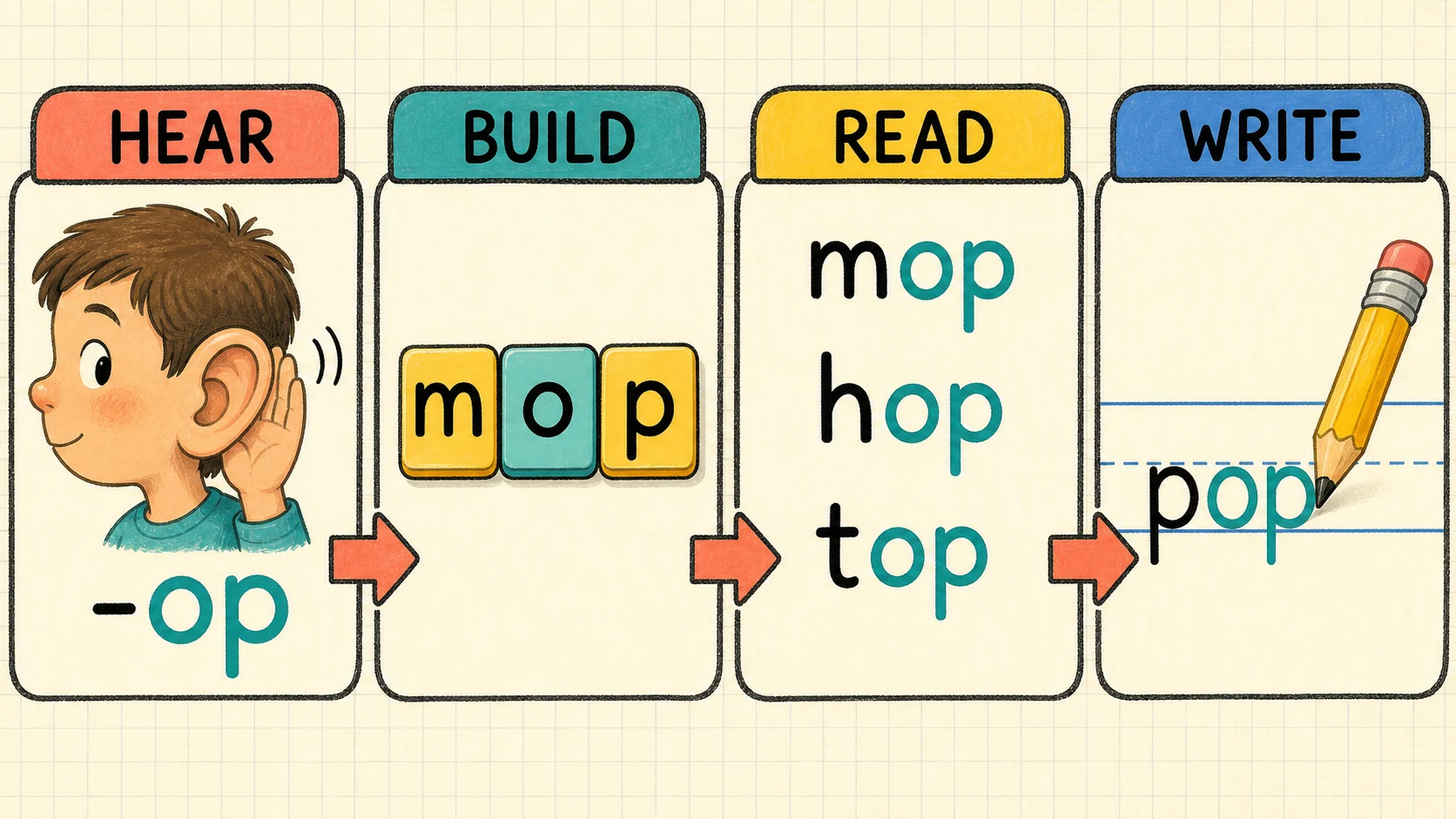
Use independence as a change in support—fewer models and mixed choices—not as an age expectation or a label for the child.
If the child matches cat with sun, ask the child to name both pictures. Then repeat only the endings: “c-at, h-at, s-un.” If the child can match after that cue, continue with one more pair. If not, return to a playful rhyme such as supplying the words while the child moves the pictures. Do not explain the printed spelling at length when the spoken similarity is not yet noticeable.
Keep sight-word work specific and meaningful
Sight-word practice at age three should not become a race through flashcards or a requirement to memorize a list. Choose a word the child has encountered repeatedly in a book, label, or shared sentence. The catalogue includes both decodable high-frequency words and words with irregular spellings, so determine which kind of word you are presenting.
Checked example: find “the” in a repeated sentence
Write or display two short lines:
The cat sat.
The hat fell.
Read both lines aloud while pointing to each word. Say, “This word is the. Can you put a button on the in the second line?” If needed, place the first button yourself and compare the word shapes letter by letter. Ask the child to say the word after finding it; do not require copying.
The example is checked: the appears once at the beginning of each line with the same three-letter spelling. It belongs with the Pre-K Sight Words guide and free sheet because the catalogue explicitly includes the as a high-frequency word and notes that some such words contain irregular spelling. The activity is a supported recognition match inside meaningful language, not evidence that the child can independently read either sentence.
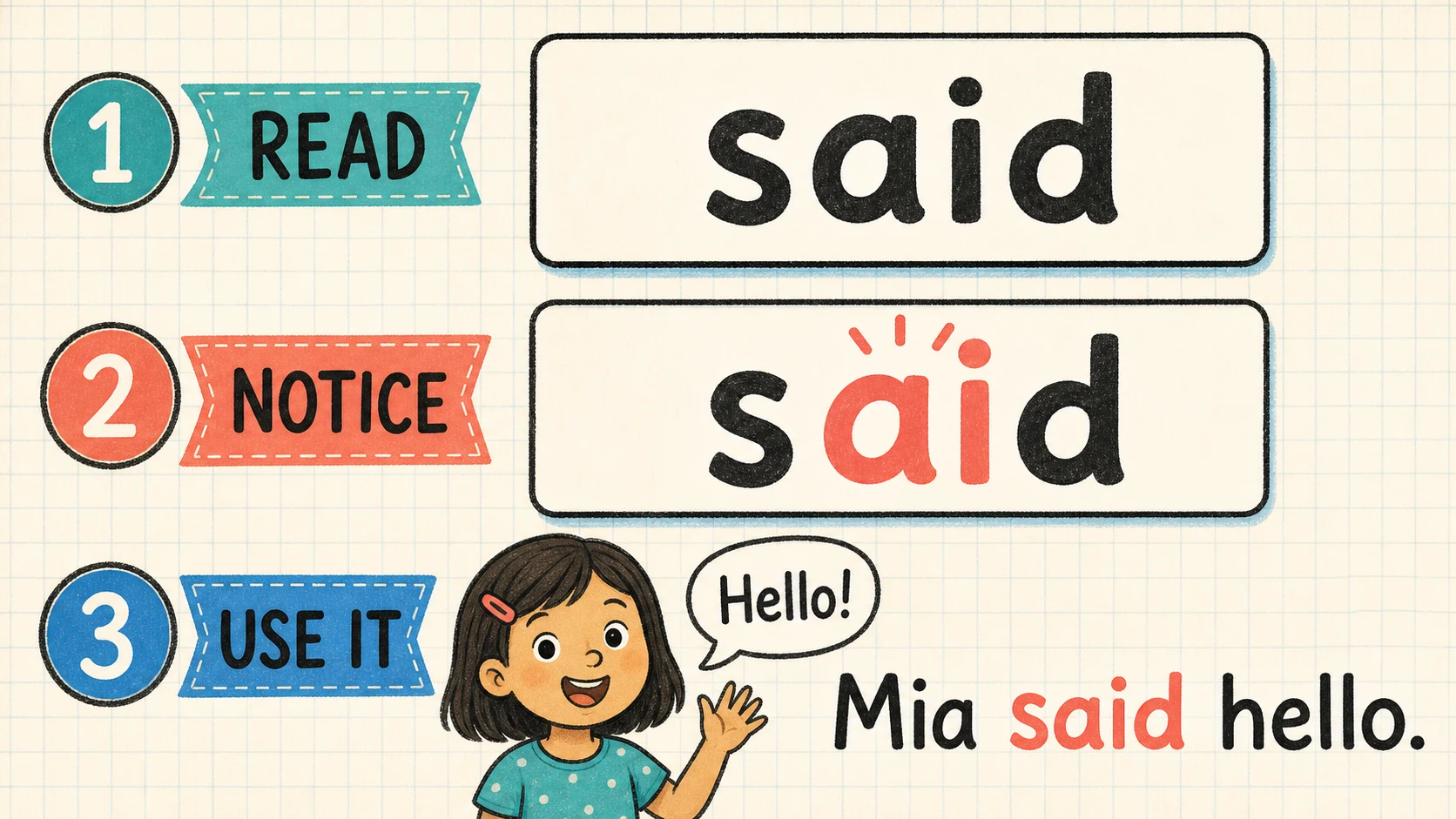
Model one known word in a spoken sentence, then ask for one visual match before inviting any tracing or writing.
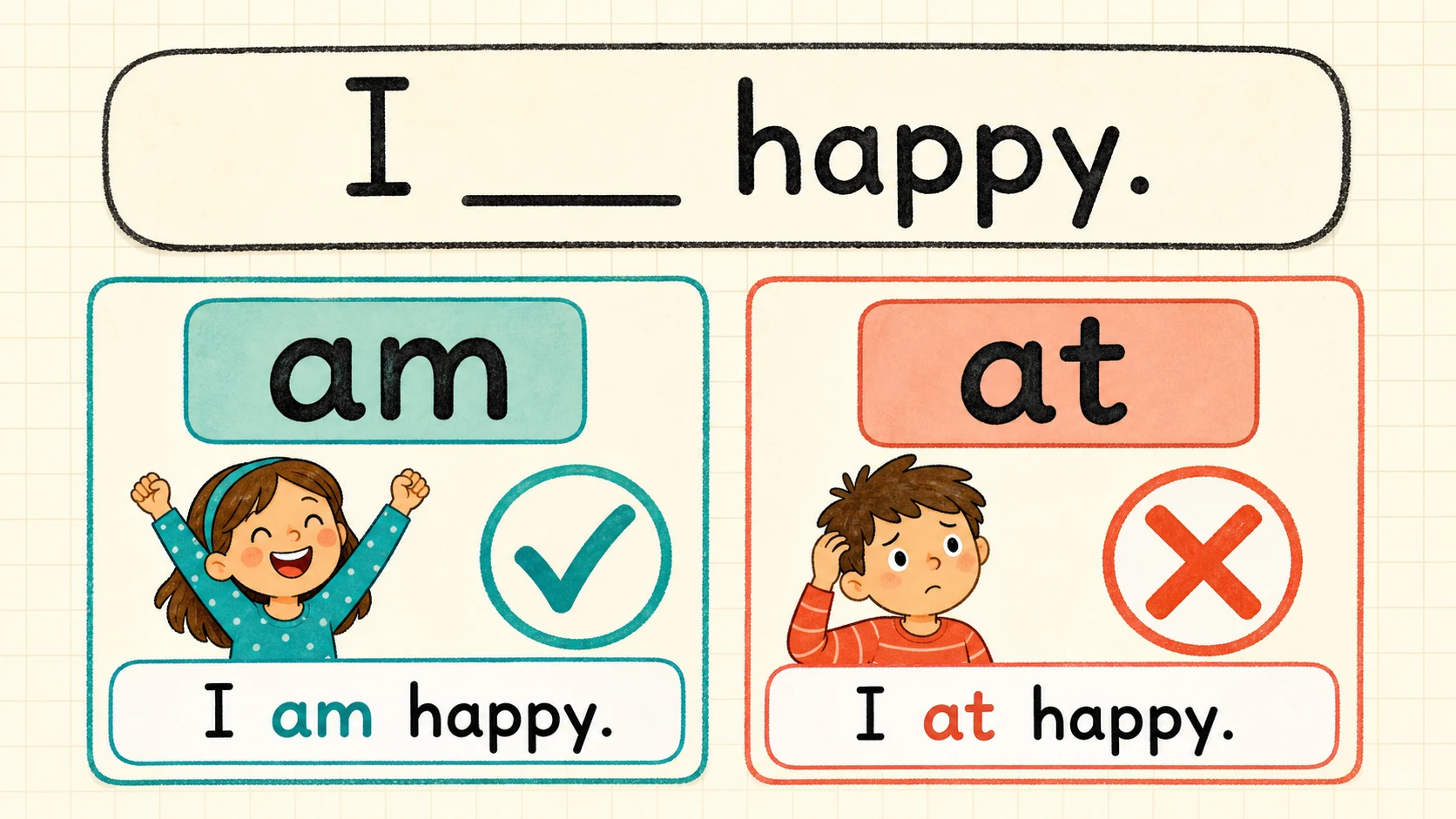
An incorrect sight-word choice may reflect scanning, memory, letter comparison, or unfamiliar language; respond to the observed step rather than adding more cards.
If the child selects hat, compare the initial letters: “This one starts with h. We are looking for t-h-e.” If the child points randomly across the whole line, reduce the field to two word cards. If the child recognizes the in isolation but not in the sentence, return to the modeled line and track each spoken word. These are instructional decisions, not diagnoses.
Interpret errors before changing the level
An incorrect mark does not tell you why it occurred. Look at the sequence immediately before it: where the child looked, what was said, how objects were moved, whether the direction was remembered, and whether the response changed after one neutral prompt.
When to simplify
Simplify when the target disappears beneath other demands. Useful changes include:
- Reduce six pictures to two while keeping the same matching rule.
- Count three movable objects instead of eight printed objects.
- Name every picture before asking for a sound match.
- Replace circling with pointing or covering.
- Model the first item and ask the child to imitate the action.
- Contrast one known vowel with one new vowel rather than mixing all five.
These changes preserve the intended skill. Telling the answer, completing the child’s movement, or changing a listening problem into tracing may finish the item but no longer reveals the same understanding.
When to continue
Continue for one more example when the child is engaged, understands the direction, and either responds accurately or uses a productive strategy after a light prompt. Vary the surface details while holding the thinking constant: rearrange the same three counters, substitute hat for cat in an -at match, or move the to a different position in a short line.
Do not increase difficulty simply because one answer was correct. First check whether the child can repeat the relevant action with a new arrangement and less prompting.
When to stop
Stop when the child withdraws, repeatedly guesses without looking or listening, becomes upset, turns the activity into an unrelated struggle, or needs continuous physical direction. Also stop after a short successful turn. A completed page is not the goal.
Record one neutral observation: “Counted three bears after I spaced them apart,” or “Matched cat and hat after I repeated the endings.” Avoid conclusions such as “behind,” “advanced,” “lazy,” or “not ready.” One brief worksheet encounter cannot support those judgments.
Adjust challenge without assigning a child a difficulty label
The catalogue’s representative free sheets carry an “easy” difficulty designation, but adults should translate that label into task features. Describe the version, not the learner.
A supported version might include a familiar example, two choices, movable objects, an adult saying each word, and a pointing response. A less supported version might include four choices, no initial model, mixed categories, or an independent mark. Challenge can also rise when objects become pictures, pictures become symbols, or a neat arrangement becomes scattered.
Change one feature at a time. If you remove the model, increase the number of choices, and require writing simultaneously, an error will be hard to interpret.
Use these decision rules:
- Accurate only after a full model: repeat a similar item with the same support.
- Accurate after one short cue: try one comparable item and pause before helping.
- Accurate twice without help and still engaged: add one modest variation.
- Inconsistent when the layout changes: return to manipulatives and observe tracking.
- Unable to answer orally but able to copy: treat the copying as motor or visual imitation, not proof of the language or phonics target.
- Able to explain or demonstrate but unwilling to mark: accept the oral or manipulative response unless writing is the explicit target.
Grade labels describe intended practice level; local curriculum sequences differ. The Pre-K label should therefore help locate material, not override a child’s observed work or a local program’s sequence.
Respect what these pages cannot establish
A worksheet sample can show how a child approached a particular task under particular conditions. It cannot diagnose a learning, language, vision, hearing, attention, or motor condition. It cannot establish a broad developmental level from a few answers, and it cannot promise later academic outcomes.
The Common Core mathematics and English language arts documents describe expectations beginning with kindergarten in the relevant standards structure. They can help adults understand later school tasks, but they should not be used to turn those expectations into an age-three placement test. See the published Common Core mathematics standards and English language arts standards for their actual scope. WorksheetWise’s age-three catalogue filter is not a claim of standards alignment.
Also account for context. A child may use a different home-language word for a picture, have little experience with the pictured object, or understand the direction only after seeing it demonstrated. Fatigue, hunger, noise, and an unfamiliar adult can change performance. Revisit an observation in another ordinary setting before treating it as a stable pattern.
If concerns persist across playful conversation, daily routines, and repeated opportunities—not merely on a sheet—share concrete observations with the child’s family, teacher, or an appropriate qualified professional. Describe what happened rather than proposing a diagnosis.
Turn one observation into the next session
End each session with three notes:
- Target: “Count a small set once each.”
- Evidence: “Touched the first two bears, then touched the second bear again.”
- Next action: “Use three bears in separate cups and move each bear after counting it.”
That next action is better than “practice counting more” because another adult can reproduce it and watch for the same behavior. For phonics, a note might read: “Named cat and hat; matched them after the adult emphasized /at/. Next time, repeat the oral pair before showing printed words.” For sight words: “Matched the between two cards but not within a line. Next time, track a four-word sentence aloud, then offer two choices.”
Choose just one real entry point from the full worksheet library. For the most broadly accessible first session, open the Pre-K Counting guide and free sheet, cover all but one small set, place the same number of movable objects beside it, and observe whether the child gives one touch or move to each object. Use that observation—not the age label or the number of unfinished problems—to simplify, continue once, or stop.
Put it into practice
Use the guide with a real printable
Move from explanation to a short, observable practice task. Check the first item together, then adjust the next session from the learner's actual work.
Open the first free worksheetExplore a neighboring collection
Choose by a different teaching need
Worksheets for 4-Year-Olds: Printable Practice Guide Worksheets for 10-Year-Olds: Printable Practice Guide Worksheets for 11-Year-Olds: Printable Practice Guide Worksheets for 12-Year-Olds: Printable Practice Guide Worksheets for 5-Year-Olds: Printable Practice Guide Worksheets for 6-Year-Olds: Printable Practice Guide Worksheets for 7-Year-Olds: Printable Practice Guide Worksheets for 8-Year-Olds: Printable Practice Guide