Curated collectionAnswer keys includedPrint-ready PDFs
Worksheets for 5-Year-Olds: Printable Practice Guide
Kindergarten readiness and early independence through concrete models, phoneme listening and one clearly bounded task.
Start with a real resource
Browse this worksheet collection
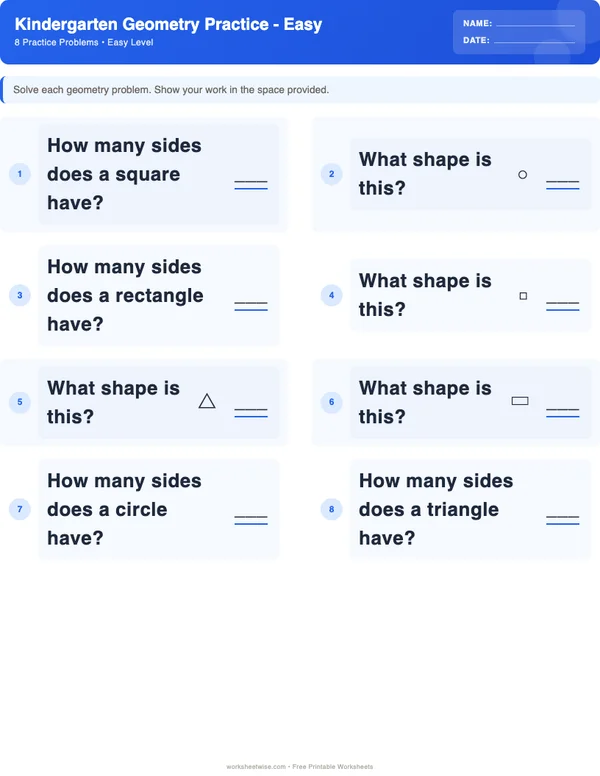
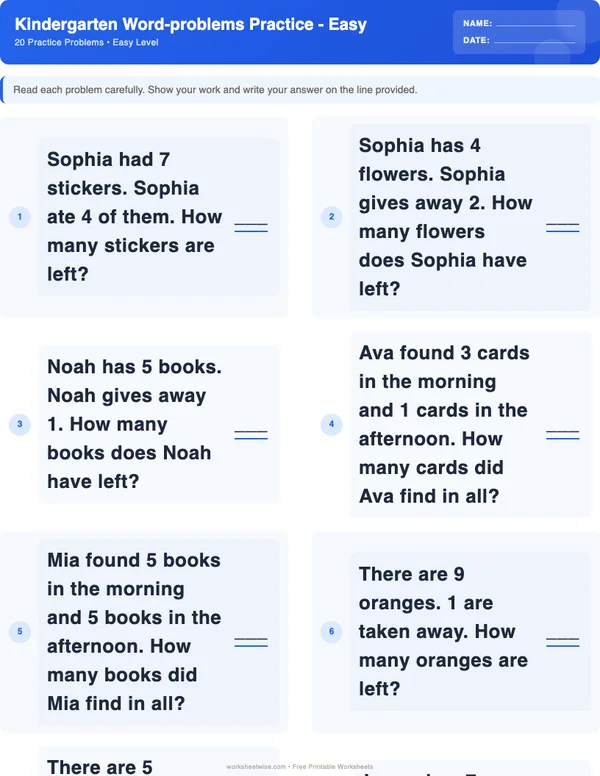
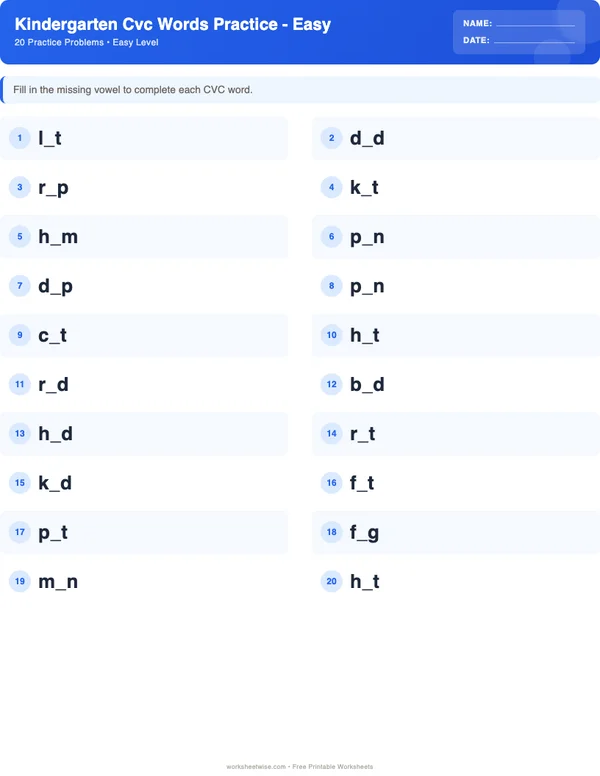
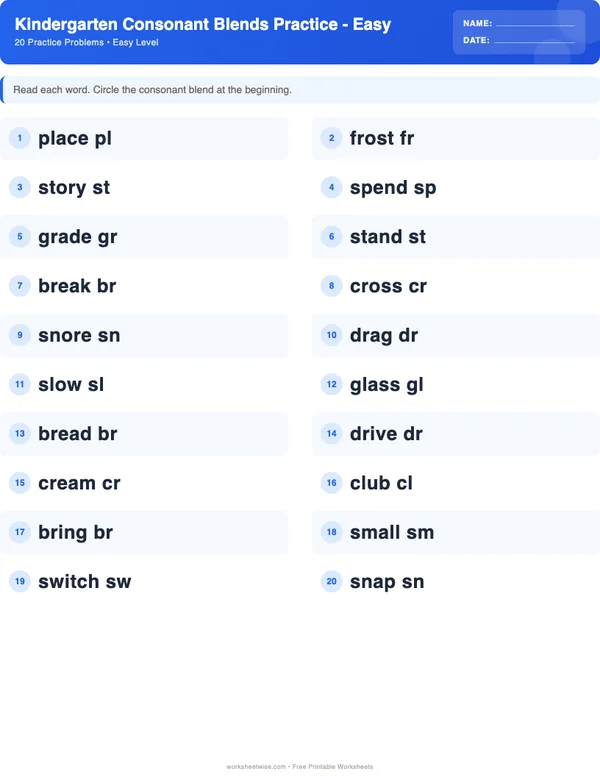
13 relevant free entry points are available. Each one includes a printable learner PDF and separate answer key.
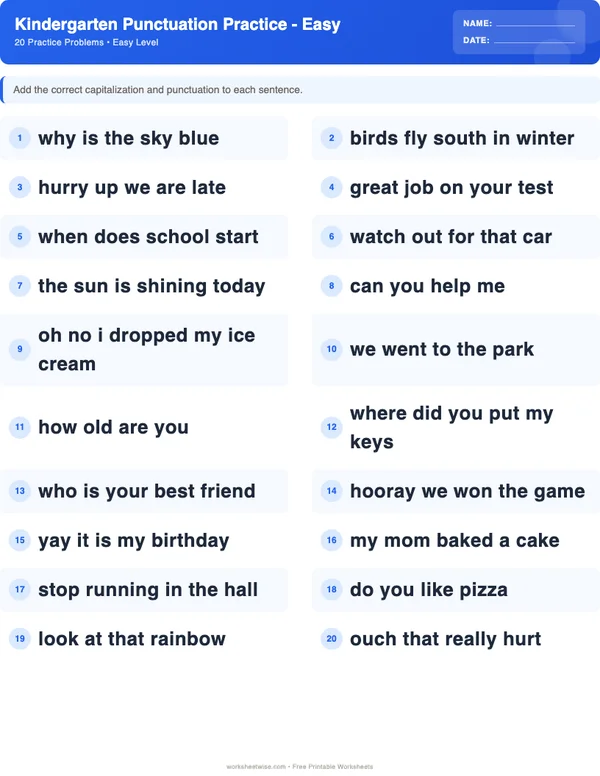
A useful practice loop
Print less. Observe more.
- Choose one skill and model the first item aloud.
- Use a short set and notice the learner’s strategy.
- Change the next task from the work you can see.
Need more than the free sheet?
Plus includes all 234 matching catalogue variations where available, plus saved deterministic generators and the worksheet designer.
See Plus membershipComplete guide
How to teach and practise worksheets for 5 year olds
3,687 words Updated 6 instructional visuals
Choose one bounded task, then watch the work
For most 5-year-olds, a useful worksheet asks for one clear action: count a set, identify a sound, complete a simple number model, or choose end punctuation. The adult should explain the task briefly, model one item if needed, and then watch how the learner handles the next item. A worksheet is useful when it makes thinking visible; finishing every problem is secondary.
Age is a discovery aid rather than a placement decision. Five-year-olds vary widely in oral language, prior instruction, attention, motor control, and familiarity with English print. Use age to find likely starting points, but use observed work to decide what comes next. Grade labels also describe an intended practice level, not a fixed placement, and local curriculum sequences differ.
The live WorksheetWise catalogue for this page contains 234 kindergarten variants across three subjects and 13 topics, including 13 free entry points. That breadth is helpful only if selection remains narrow. Begin with one skill and one page—not a mixed packet intended to test everything a child might know.
A sound starting decision is:
- Choose a task the learner can understand after one short explanation.
- Pair the paper with objects, spoken language, or movement.
- Ask the learner to attempt two or three items.
- Continue only if the work is effortful but intelligible.
- Simplify when the target skill is hidden by reading, handwriting, memory, or layout demands.
- Stop when repeated prompting no longer produces useful information.
This approach reflects the broader principle in NAEYC’s guidance that development and learning involve individual variation and that teaching decisions should draw on knowledge of the particular child and context. That source offers general early-childhood guidance; it did not assess WorksheetWise or these catalogue resources. See the NAEYC principles of developmentally appropriate practice.
Read the page before asking a child to use it
A worksheet labeled “easy” should not define the learner. Here, difficulty is better described through observable task features: how many items appear, whether pictures or concrete models are available, how much language must be processed, how many steps an item requires, and whether the child must write, point, circle, draw, or explain.
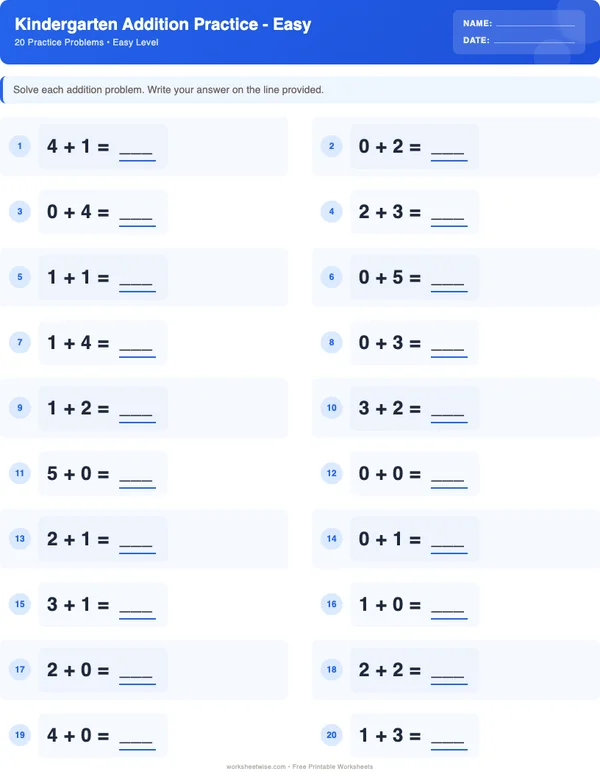
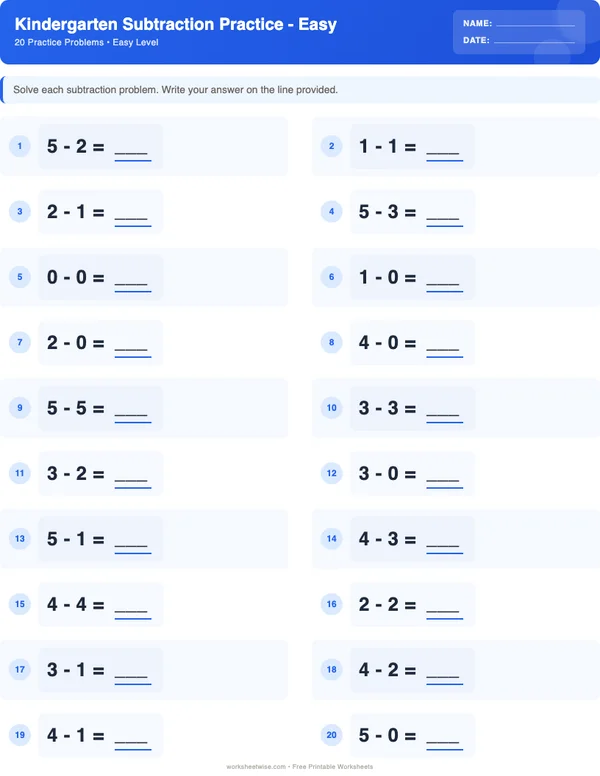
All representative free sheets on this age page are catalogued at the “easy” difficulty level, but their demands still differ. The counting, addition, subtraction, place value, geometry, CVC words, consonant blends, digraphs, short vowels, word families, and sight-word entries each contain 20 problems. The punctuation and word-problem entries contain 12. Fewer problems do not automatically mean easier work: a word problem can require listening, holding a situation in mind, choosing an operation, and representing an answer.
Check the target
Name the single idea the child should practice. “Do a math sheet” is too broad. Better targets include:
- Touch each object once while counting.
- Hear the middle vowel in a CVC word.
- Preserve both sounds in an initial consonant blend.
- Show a teen number as one ten and some ones.
- Decide whether a spoken sentence tells or asks.
- Act out a one-step joining or take-away story.
If you cannot state the target in one sentence, choose a narrower page.
Check access demands
Ask what could prevent the learner from showing the target skill. A child might count accurately but lose track in a scattered arrangement. Another might hear the short vowel but struggle to form letters. A learner may solve a story with counters yet be unable to read the printed sentence independently.
Preserve the target by changing access demands. Read directions aloud, cover unused rows, let the child point instead of write, or supply counters. Do not remove the very thinking you intend to observe. If the target is one-to-one counting, for example, pointing is part of the task; counting the objects for the child is not an adaptation.
Check independence realistically
Early independence does not mean silence or completing 20 items alone. At this age, it can mean beginning after a familiar cue, selecting the correct materials, trying the next item without a second demonstration, or checking one answer by recounting. Choose one independent behavior to practice alongside the academic target.
Start with listening and concrete models
Paper should record or extend an experience, not replace it. The IES practice guide for young children recommends teaching number and operations through developmental progressions, monitoring what each child knows, and helping children describe their world mathematically. It also supports regular math experiences across the day. These are general recommendations for preschool, prekindergarten, and kindergarten—not claims about a particular worksheet. See IES, Teaching Math to Young Children.
For phonics, begin with what the child hears before requiring a written response. The IES foundational-reading guide recommends developing awareness of speech-sound segments and their links to letters, then teaching learners to decode, analyze, write, and recognize words. It also recommends daily connected-text reading; isolated worksheet items therefore should not be the entire reading experience. See IES, Foundational Skills to Support Reading for Understanding.
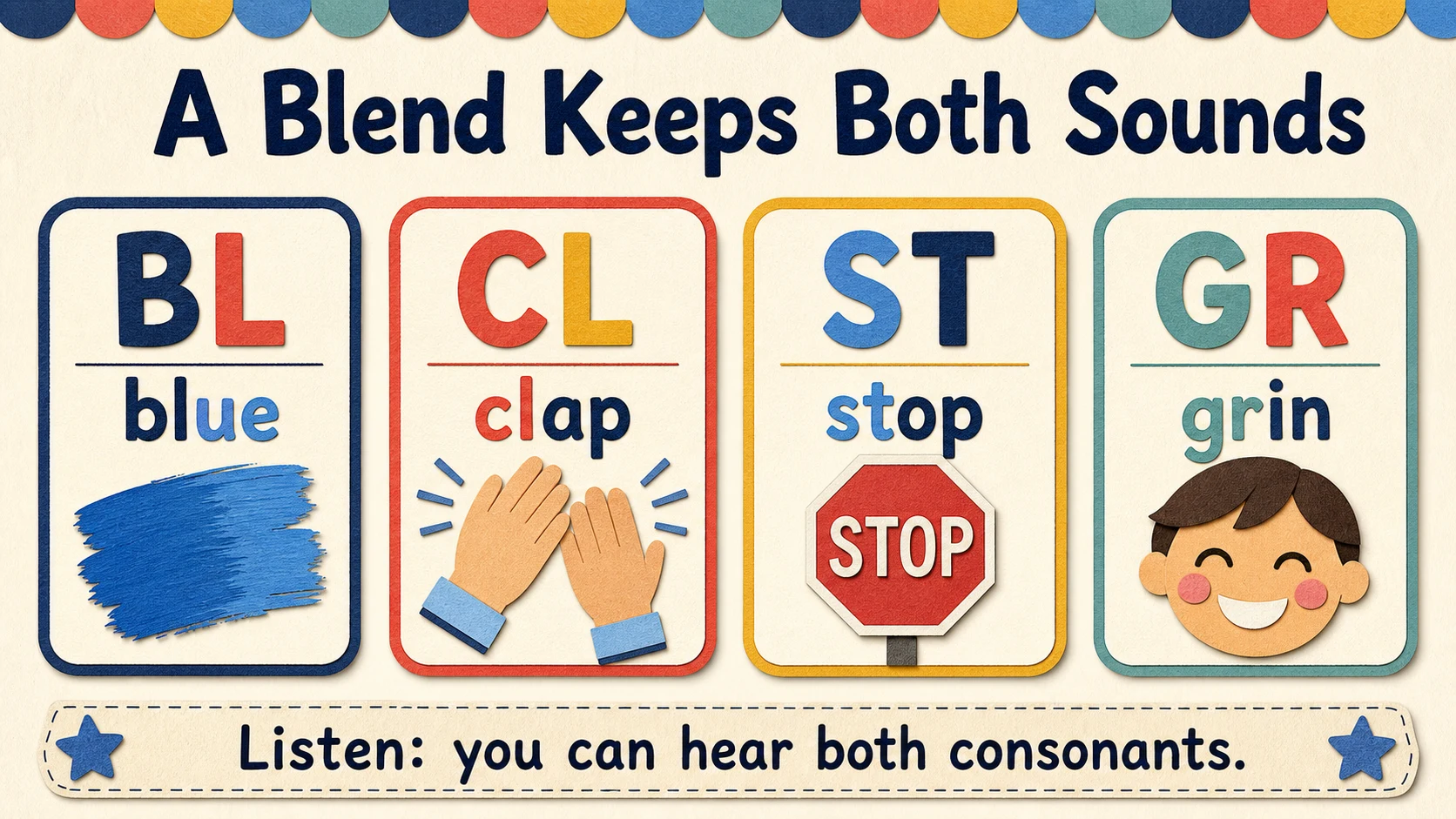
Use the map to locate the actual blend demand—hearing both consonants, matching the sounds to letters, or reading the whole word—before selecting paper practice.
Checked example: count six scattered buttons
Place six buttons in an irregular arrangement. Ask, “How many are there?” Watch whether the child touches or moves each button once, gives one number word per object, and understands that the final number names the total.
Then show one comparable worksheet item. If the child counts a neat printed row correctly but double-counts scattered buttons, the issue may be organizing the set rather than reciting the count sequence. Invite the child to slide each button into a line while counting. On paper, provide a counter or crayon mark for each picture touched.
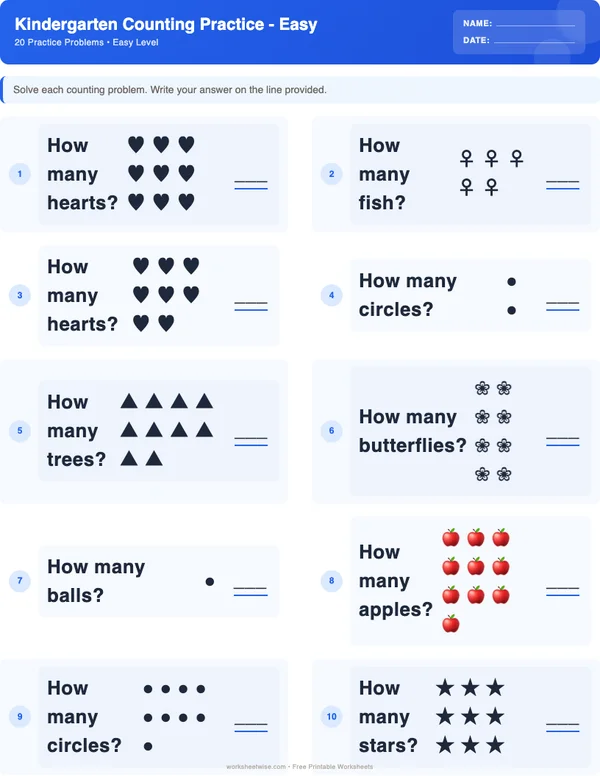
This example belongs on the age-five page because the catalogue’s kindergarten Counting resource explicitly progresses from reciting number words toward one-to-one counting with objects and includes sets of objects, sequences, and missing numbers. The associated free sheet has 20 problems, but six well-observed objects may tell you more than an automatically completed page. The Kindergarten Counting guide and free sheet is the appropriate next resource when this is the selected target.
Use a repeatable eight-minute routine
A short routine protects attention and gives the adult comparable observations from one session to the next. Eight minutes is a suggested starting structure, not a researched limit or a requirement. Shorten or extend it in response to the learner.
Minute 1: state the job
Use one sentence: “Listen for the middle sound,” “Touch each picture as you count,” or “Decide which mark ends the sentence.” Ask the child to say or show what to do. If the directions cannot be retold, simplify them before judging the academic response.
Minutes 2–3: model with talk or materials
Complete one example while naming the important decision. For map, stretch the spoken word, move one token for each sound, and identify /a/ as the middle sound. For 13, make a group of ten counters and leave three single counters. Keep the explanation tied to the exact item.
Minutes 4–6: child attempts a small set
Ask for two to five items, depending on the task. Wait before prompting. Note whether the child starts, uses the model, checks work, and recovers from an error. Avoid correcting every mark immediately; first ask, “How did you decide?” or “Can you show it with the counters?”
Minutes 7–8: active check and clean ending
Return to objects, voice, or movement. Rebuild one number, act out one story, sort two word cards, or read one sentence with expression. End by naming what the learner did: “You touched each object once,” not “You’re so smart.” Record the next decision in a few words: continue, simplify, or pause.
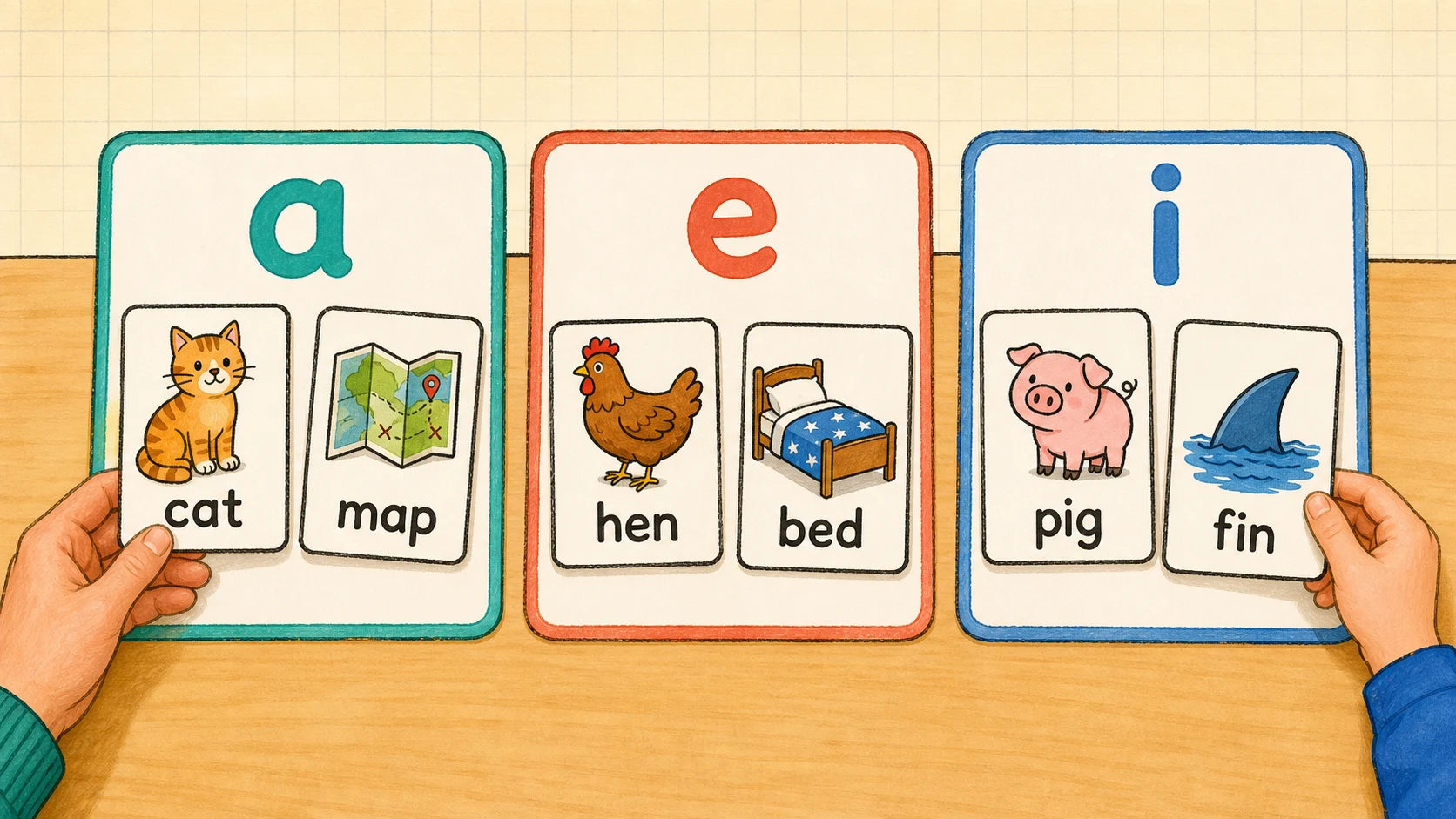
Repeat the same listen–model–attempt–check sequence so changes in short-vowel responses are easier to notice across sessions.
Build phonics from the spoken word outward
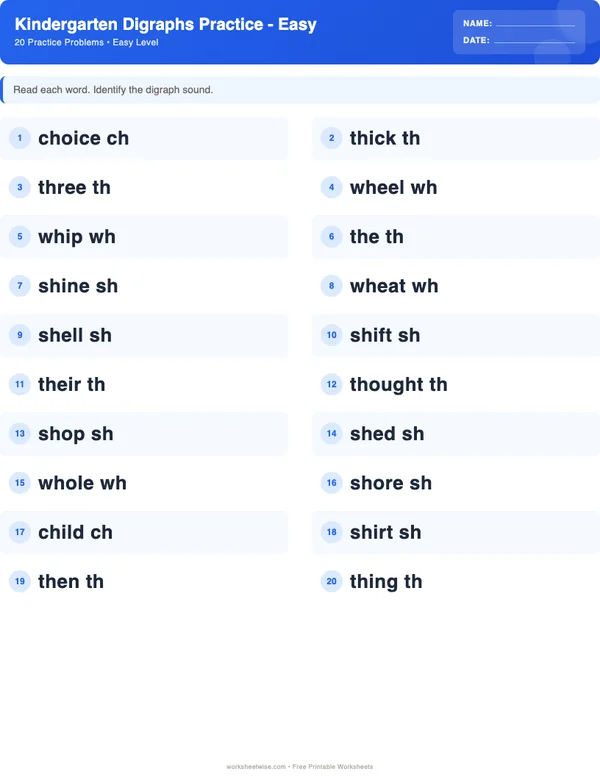
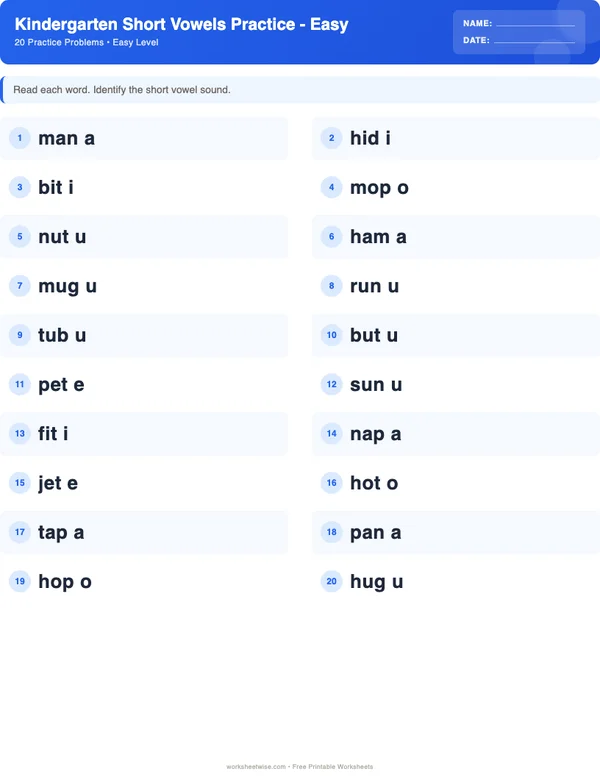
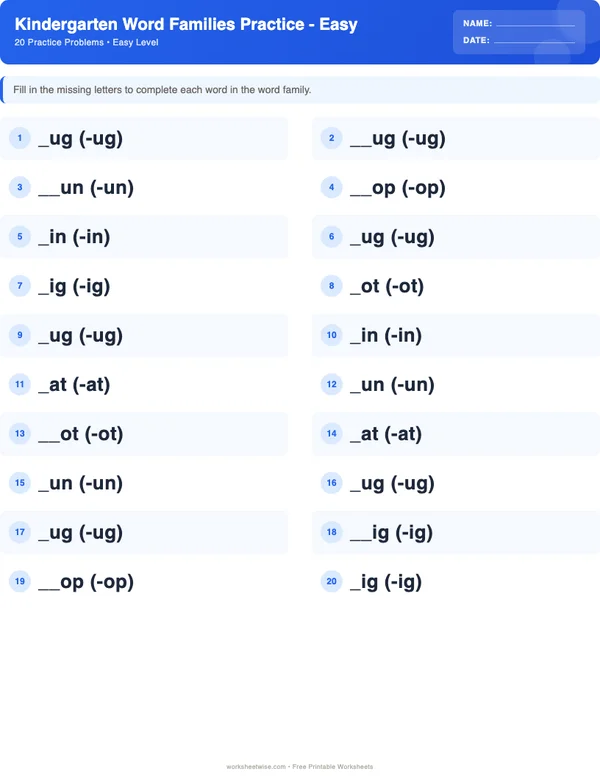
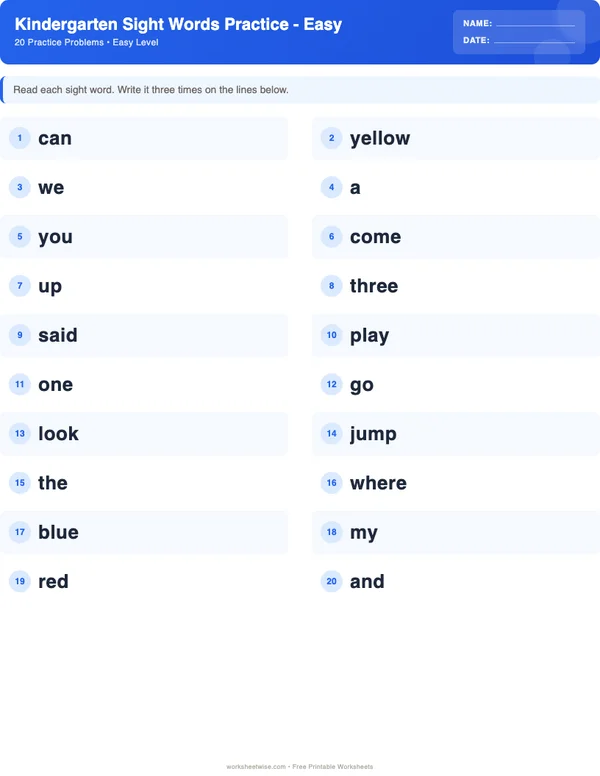
The catalogue offers CVC words, short vowels, word families, consonant blends, digraphs, and sight words. These labels are related, but they are not interchangeable. A CVC task may ask a child to blend three sounds in cat; a short-vowel task may ask which middle sound appears in cat; a word-family task may compare cat, hat, and mat. Consonant blends require each consonant sound to remain audible, while a digraph such as sh represents one sound with two letters.
Select from observed behavior. If a learner cannot yet blend three sounds into a word, adding an initial blend increases the sound load. Return to CVC words without treating that move as failure.
Checked example: distinguish pen from pin
Say pen without showing print. The learner repeats the word, watches the adult’s mouth if helpful, and moves three tokens into sound boxes: /p/ /e/ /n/. Repeat with pin. Ask, “Are the middle sounds the same or different?” Only then show the printed words or a worksheet choice.
The words are checked minimal pairs: they share initial /p/ and final /n/, while the middle vowels differ. This isolates the listening decision. It belongs here because the live short-vowels catalogue description identifies confusion between short e and short i as a relevant instructional issue and recommends auditory discrimination with pairs such as pen/pin. The child may point to e or i instead of writing the entire word; that preserves vowel identification while reducing handwriting demand.
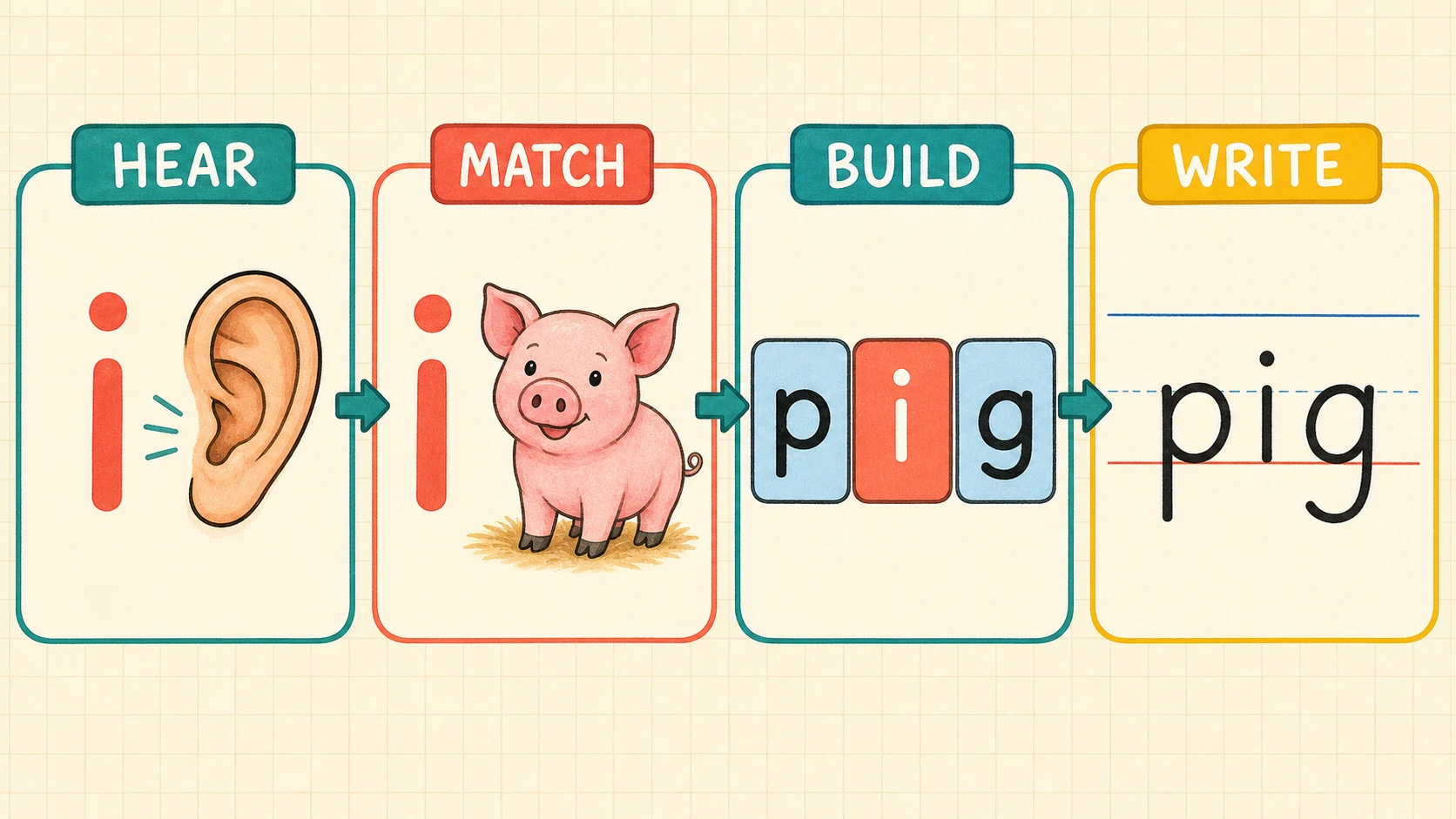
Move toward independent marking only after the learner can hear the vowel contrast with spoken words and a small amount of support.
Checked example: keep both sounds in stop
Say stop slowly. Ask the child to tap once for /s/, /t/, /o/, and /p/, then blend the sounds into the whole word. Compare it with sop. The contrast is valid: omitting /t/ changes both the sound sequence and the word.
This belongs here because the catalogue places consonant blends after CVC fluency and specifically identifies dropping one consonant—reading sop for stop—as a common response to observe. If the learner consistently drops /t/, do not merely repeat “Look carefully.” Return to oral tapping, build stop with letter tiles, and slide a finger under the complete sequence. Continue to paper when both consonants remain audible in several spoken attempts.
Do not confuse this with a digraph task. In stop, /s/ and /t/ both remain. In ship, sh represents one sound. That distinction determines whether a two-letter beginning should produce two sounds or one.
Make early math visible before writing equations
Five-year-olds can reveal substantial mathematical thinking by moving objects, drawing marks, and explaining actions. A numeral or equation is one representation, not the starting point for every learner.
The Common Core kindergarten mathematics standards include counting and cardinality, comparing quantities, representing addition and subtraction with objects or drawings, and working with numbers 11–19 as a ten and additional ones. These standards are a useful reference point, but they do not establish an individual child’s placement, and local curriculum sequences differ. See the Common Core kindergarten mathematics overview.
Checked example: build 14 as ten and four ones
Give the child 14 linking cubes. Ask for a train of ten and then ask how many cubes remain. The checked decomposition is . Place the train in a “ten” space and the four loose cubes in a “ones” space. Ask the learner to point to the digit that records one ten and the digit that records four ones.
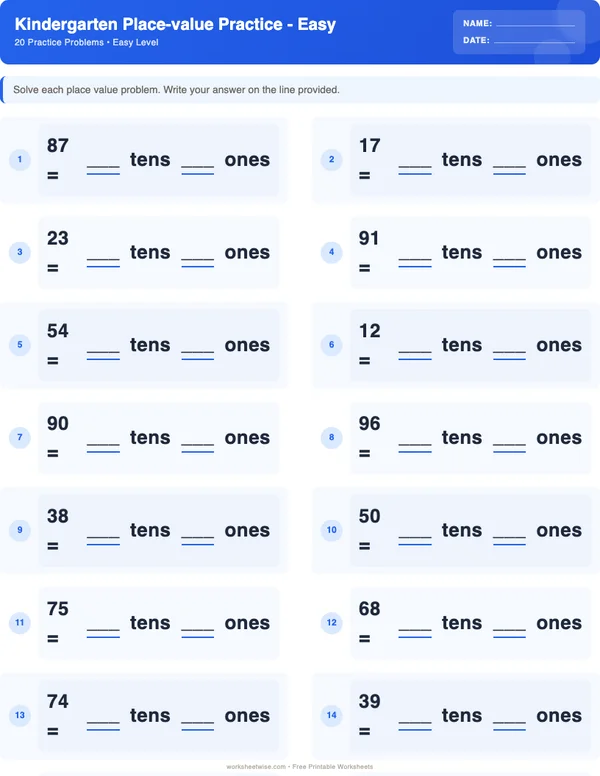
This example belongs on the page because the kindergarten Place Value catalogue entry begins with teen numbers composed of a ten and some ones. It does not require upper-grade expanded form, rounding, or multidigit procedures. If the child counts 14 cubes accurately but cannot maintain a group of ten, loop a pipe cleaner around ten cubes or use a cup labeled “ten.” The target remains composing 14, not fine-motor bundling.
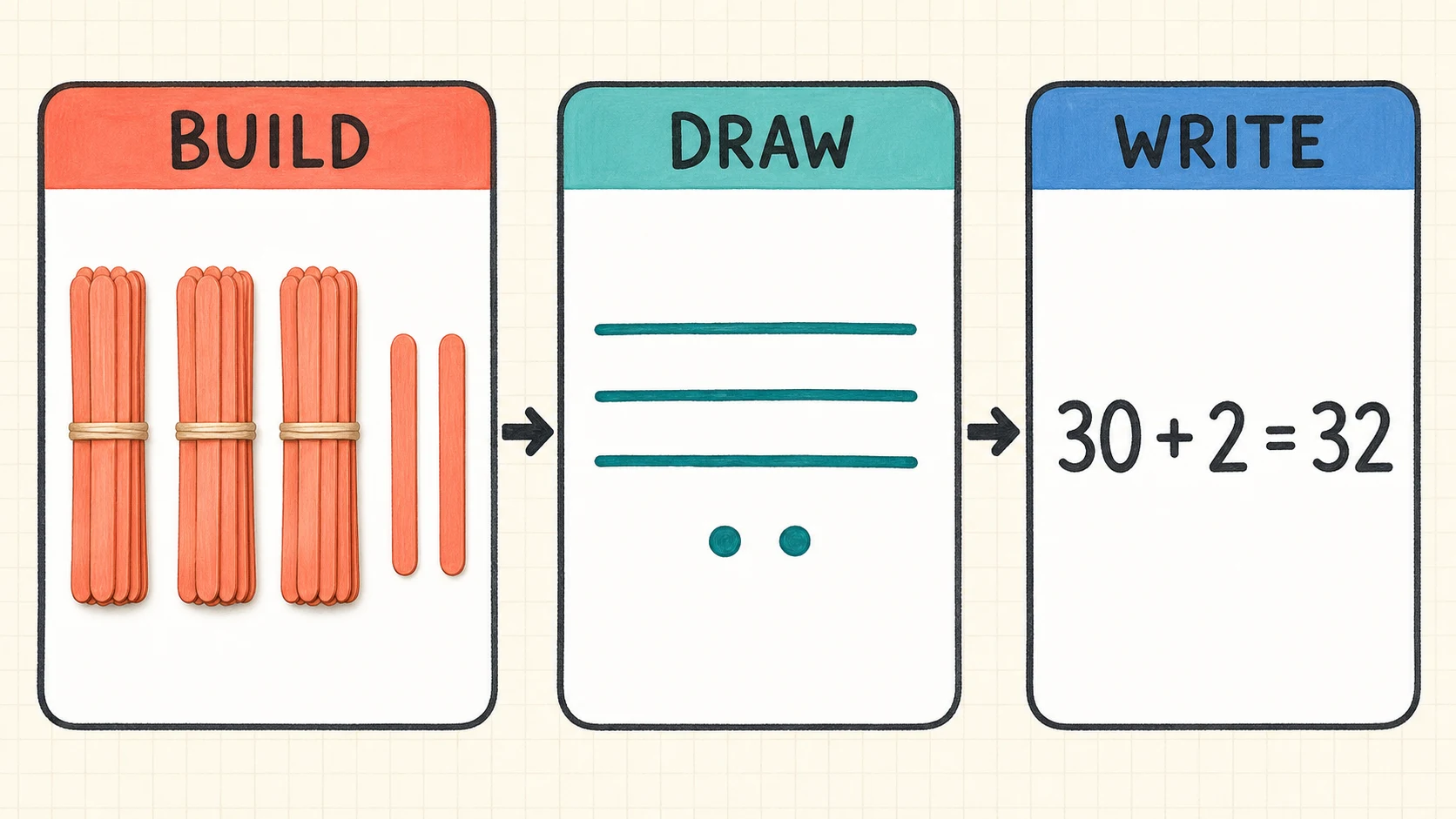
Remove the bundled model only when the learner can explain that 14 contains one ten and four ones, rather than merely copy the digits.
Use the Kindergarten Place Value guide and free sheet when this decomposition is the observed need. If the child cannot yet count the complete collection reliably, move first to counting rather than drilling the written numeral 14.
Checked example: act out a one-step story
Say: “Mia has three toy cars. A friend gives her two more. How many cars does Mia have now?” Give the learner three counters, then two more. The checked result is .
Ask the child to retell what changed before selecting an operation or writing anything. “There were three, and two joined them” shows understanding of the situation. A child who says five after combining the counters but cannot write 3 + 2 = 5 has demonstrated the mathematical action; supply the equation frame rather than replacing the problem with handwriting practice.
This belongs here because the catalogue’s kindergarten Word Problems resource uses age-appropriate, single-operation situations and emphasizes retelling, acting out, drawing, solving, and checking rather than relying on keywords. The representative free sheet contains 12 problems, but one fully represented story can be sufficient for a short session.
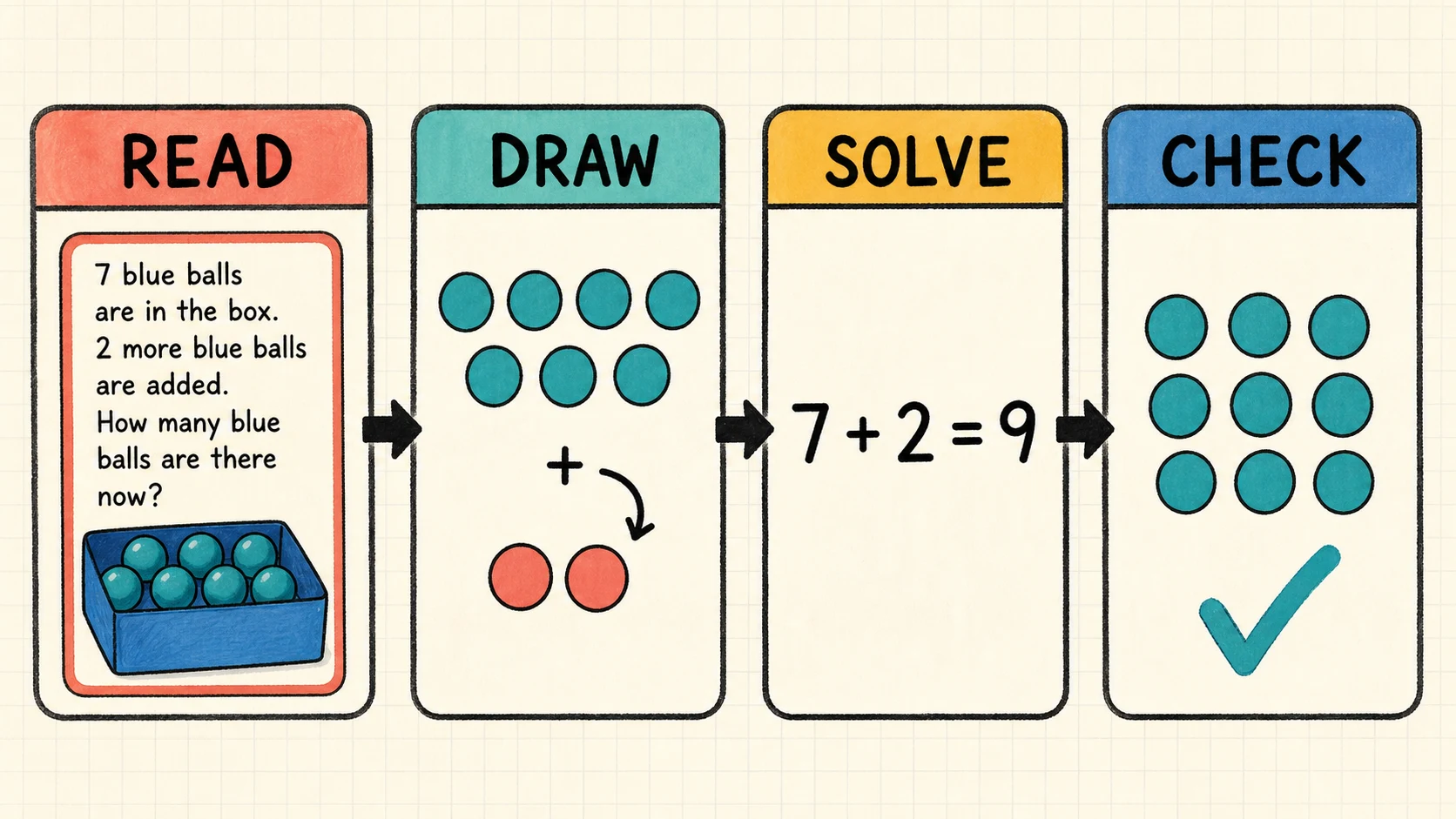
Progress from adult-read story and counters to a child-drawn model, then toward an independent response without removing the need to understand the situation.
The Kindergarten Word Problems guide and free sheet is a sensible follow-up after a child can model a joining or take-away story. Do not teach “more means add” as a universal shortcut; the child should identify what happened to the quantities.
Treat punctuation as meaning carried by the voice
Kindergarten punctuation practice should remain concrete. Periods, question marks, and exclamation points can be connected to whether a sentence tells, asks, or expresses strong feeling. Reading aloud makes the choice meaningful before the child is asked to edit print.
The Common Core kindergarten language standards include recognizing and naming end punctuation. That intended grade-level description is not proof that every 5-year-old should complete the same page independently. See the Common Core kindergarten language standards.
Checked example: choose the mark for a real question
Read these aloud:
The dog is wet.Is the dog wet?
The first sentence tells; the second asks. The punctuation choices are therefore checked: a period for the statement and a question mark for the question. Ask the learner to hold up a period card or a question-mark card after hearing each sentence. Then reveal the printed forms and let the learner add the missing marks.
This example belongs here because the catalogue’s kindergarten Punctuation resource begins with end punctuation and connects each mark to voice and expression. If the learner identifies the sentence type orally but draws an unrecognizable question mark, the target has been met and the motor demand needs support. Offer a stamp, card choice, or dotted trace.
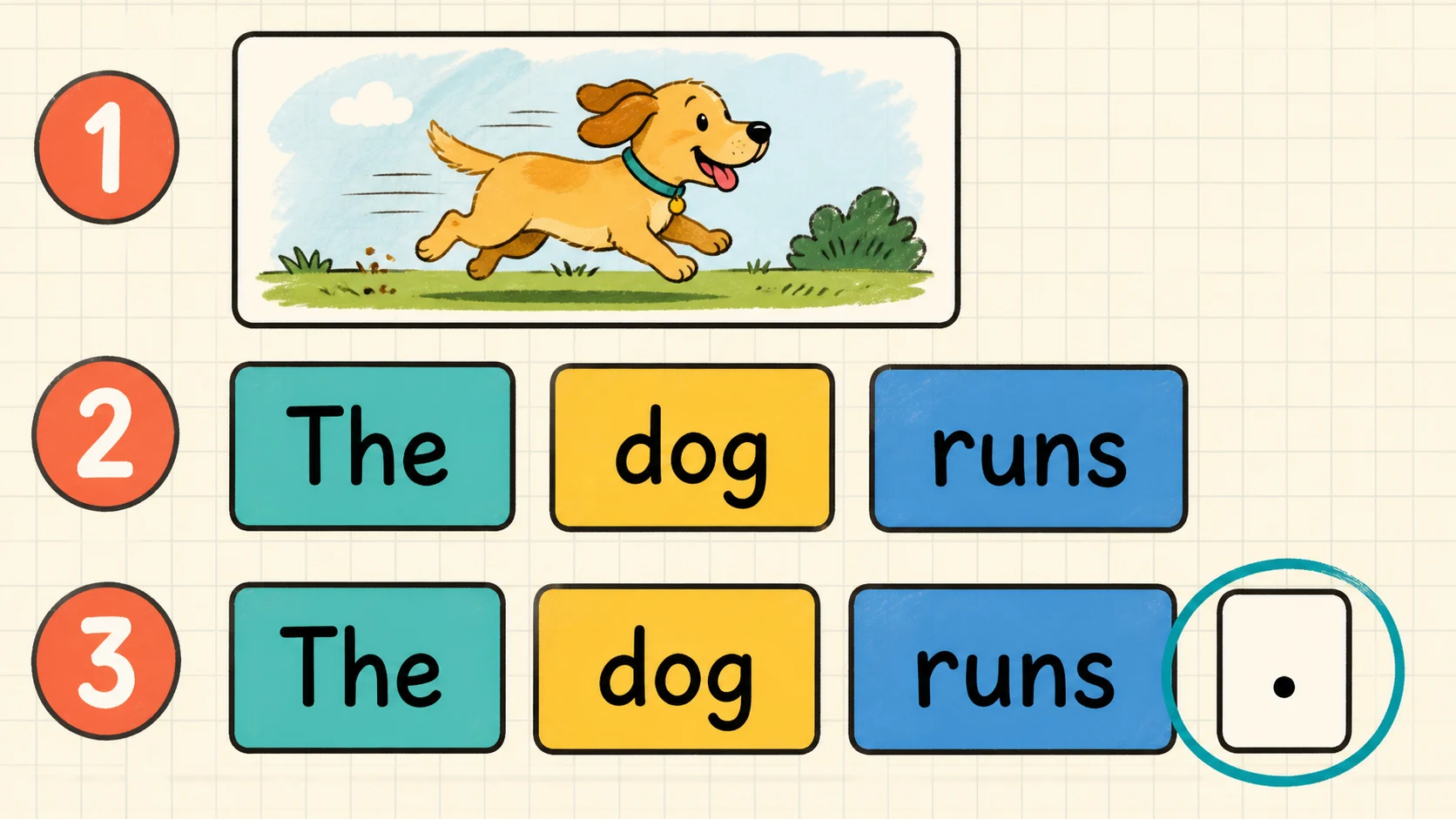
Let the spoken meaning determine the mark before asking the learner to reproduce its written shape.
Keep exclamation points equally grounded: compare a calm “The cup fell” with an emphatic “Watch out!” Avoid telling children that every exciting sentence requires an exclamation point without discussing the speaker’s intended force.
Interpret errors before correcting them
An incorrect mark is evidence, but its meaning depends on how it was produced. Ask for a demonstration or explanation before choosing the next task.
| Observable response | Possible interpretation to check | Next action |
|---|---|---|
| Counts objects correctly in a row but not when scattered | Loses track of which objects were counted | Let the child move each object into a counted group |
| Says the right total but writes a reversed or unclear numeral | Mathematical answer may be secure while numeral formation is not | Accept pointing or a numeral card, then practice formation separately |
Chooses short i for both pen and pin |
May not yet discriminate the spoken middle vowels | Return to oral minimal-pair listening with no print |
Reads stop as sop |
Drops one sound from the initial blend | Tap four sounds and rebuild with letter tiles |
| Solves a story with counters but selects the wrong symbol | Understands the action but not yet the equation notation | Supply an equation frame after the model |
| Waits after every item for approval | May understand the content but not trust the routine | Agree on “try two, then check together” |
| Marks a question mark after every sentence | May be matching a recently taught symbol rather than meaning | Contrast one spoken statement and one spoken question |
These interpretations are hypotheses, not diagnoses. Confirm them with a second, slightly varied item. A single error can come from fatigue, unclear directions, distraction, language load, unfamiliar pictures, or an accidental mark.
Correct specifically. Instead of “No, try again,” say, “You counted this bear twice. Move each bear after you count it.” Instead of giving the vowel, say, “Listen again: pen. What sound is between /p/ and /n/?” The correction should return attention to the target feature.
Decide whether to simplify, continue, or stop
Simplify when the target is present but access is blocking it
Simplify if the child can show part of the intended thinking yet the page adds unnecessary load. Cover all but one row, reduce the response choices, read the prompt aloud, enlarge the page, use counters, or let the child answer orally. Keep the academic decision intact.
For children who are still functioning more comfortably at an earlier developmental entry point, consult the Worksheets for 4-Year-Olds guide or Worksheets for 3-Year-Olds guide. For ages three and four, prioritize brief adult-led oral, matching, manipulative, and movement work over desk work. Those pages are discovery routes, not placement verdicts.
Continue when the child understands and can recover
Continue for another small set when the learner begins after the cue, uses the model appropriately, explains a choice, or corrects an error after a focused prompt. Some hesitation is productive. Independence grows when the child makes the decision, not when the adult prevents every mistake.
Increase only one feature at a time. Move from five counters to seven, from a neat set to a scattered set, from contrasting a and i to a new short-vowel pair, or from an adult-modeled question to an independently classified one. Do not simultaneously add more items, denser print, harder language, and a new response format.
Stop when practice is no longer informative
Stop if the child is guessing repeatedly, cannot state the task after rewording and modeling, becomes distressed, or needs the answer supplied for each item. Also stop after a clear success; completing the remaining rows may add fatigue without adding useful practice.
Stopping is not a judgment about ability. Record the smallest successful response: “Counted five movable objects once each,” “heard /a/ in map with tokens,” or “identified a spoken question.” That observation provides a better restart point than “did not finish.”
Preserve the skill when adapting the page
Adaptations should change how the learner accesses or records the work, not quietly answer it.
For phoneme listening, the child may move tokens, point to a vowel card, or say the sound instead of writing a word. For counting, the child may touch, cross off, or move each object, but the adult should not organize and count the entire set. For place value, provide bundled and loose objects while still asking the child to determine the ten and ones. For punctuation, read the sentence aloud while leaving the statement-versus-question decision to the learner.
Pair paper with:
- Linking cubes, buttons, or small toys for counting and operations.
- Two hoops or paper plates for sorting shapes, words, or vowel pictures.
- Three sound boxes and tokens for CVC words.
- Magnetic letters for building a word after hearing its sounds.
- Period, question-mark, and exclamation-point cards for oral sentence sorting.
- A number path for moving forward or back in a acted-out story.
Movement can also carry the target. Step once per counted object, hop along a floor number path, or stand under the punctuation card that matches an adult-read sentence. The active portion should clarify the same decision later shown on paper.
Keep the boundaries clear
A worksheet can provide practice and reveal response patterns. It cannot determine school readiness, diagnose a learning difficulty, establish a curriculum placement, or demonstrate mastery by itself. Do not infer a diagnosis from reversals, short attention, vowel confusion, or an unfinished page. If concerns are persistent across contexts, document specific observations and discuss them with the child’s teacher or an appropriately qualified professional.
Catalogue descriptions explain the intended content of WorksheetWise resources. The IES, NAEYC, and Common Core sources provide broader educational guidance or grade-level descriptions; none should be presented as an evaluation or endorsement of WorksheetWise.
Avoid these common mismatches:
- Using age five as a deadline rather than a search filter.
- Assigning all 20 items because they appear on the page.
- Treating handwriting quality as proof of math or phonics understanding.
- Moving to consonant blends before three-sound CVC blending is workable.
- Asking for abstract teen-number notation before the child can build a ten and ones.
- Correcting a word problem before the child has acted out or retold it.
- Continuing after responses have become random or distressed.
Make the next session from one observation
Choose one page from the full worksheet library, but print only after writing a one-sentence target at the top. For example: “Touch each object once and tell how many,” or “Hear the middle sound in three CVC words.”
Use the eight-minute routine, attempt no more than five items initially, and record one observable result. If the learner can count a small set but loses track in a scattered arrangement, make the next session concrete: open the Kindergarten Counting guide and free sheet, place six movable objects beside the first relevant item, and practice moving each object exactly once before marking the paper.
Put it into practice
Use the guide with a real printable
Move from explanation to a short, observable practice task. Check the first item together, then adjust the next session from the learner's actual work.
Open the first free worksheetExplore a neighboring collection
Choose by a different teaching need
Worksheets for 10-Year-Olds: Printable Practice Guide Worksheets for 11-Year-Olds: Printable Practice Guide Worksheets for 12-Year-Olds: Printable Practice Guide Worksheets for 3-Year-Olds: Printable Practice Guide Worksheets for 4-Year-Olds: Printable Practice Guide Worksheets for 6-Year-Olds: Printable Practice Guide Worksheets for 7-Year-Olds: Printable Practice Guide Worksheets for 8-Year-Olds: Printable Practice Guide