Curated collectionAnswer keys includedPrint-ready PDFs
Worksheets for 6-Year-Olds: Printable Practice Guide
First-grade transitions from manipulatives and oral rehearsal toward readable written strategies.
Start with a real resource
Browse this worksheet collection
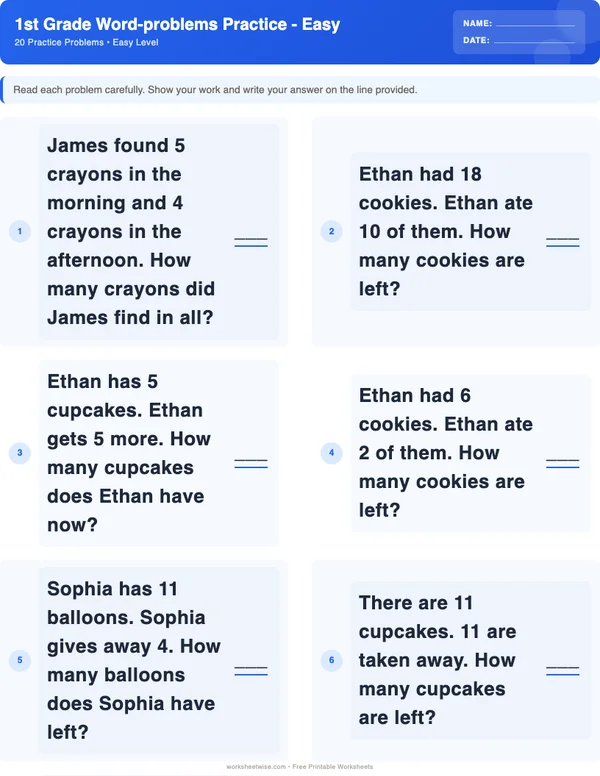
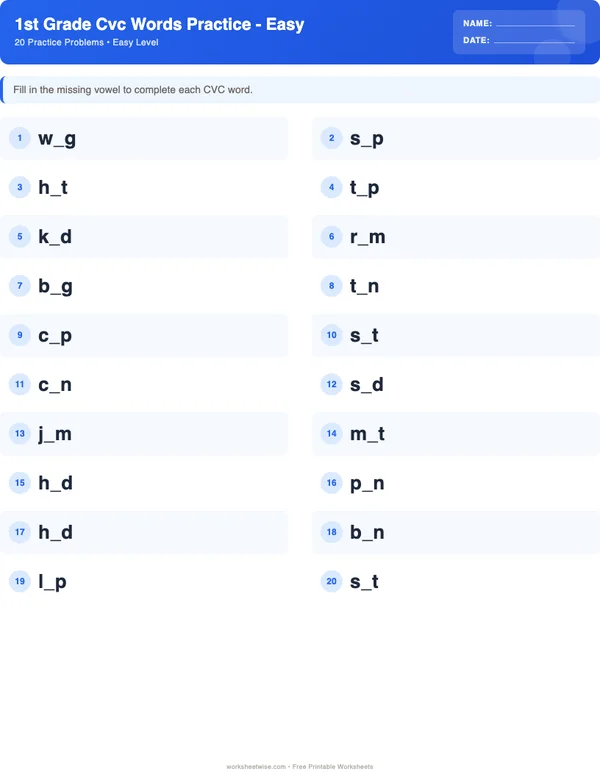
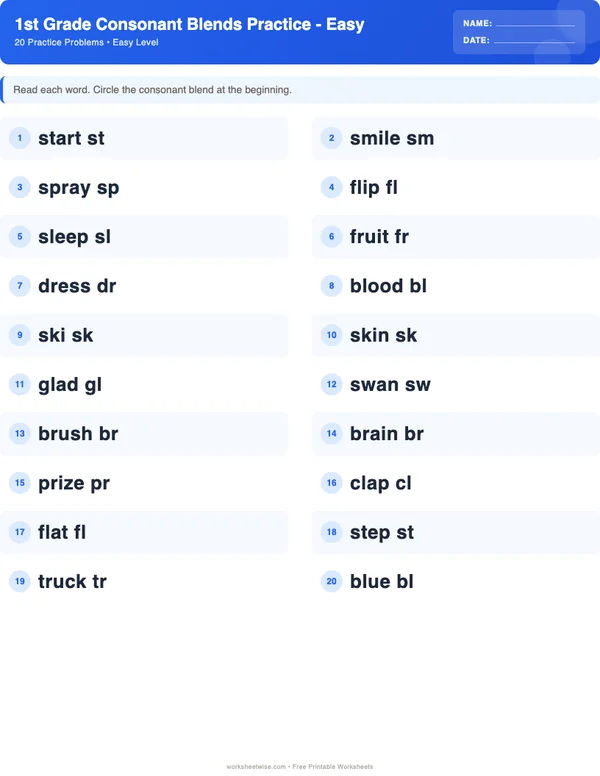
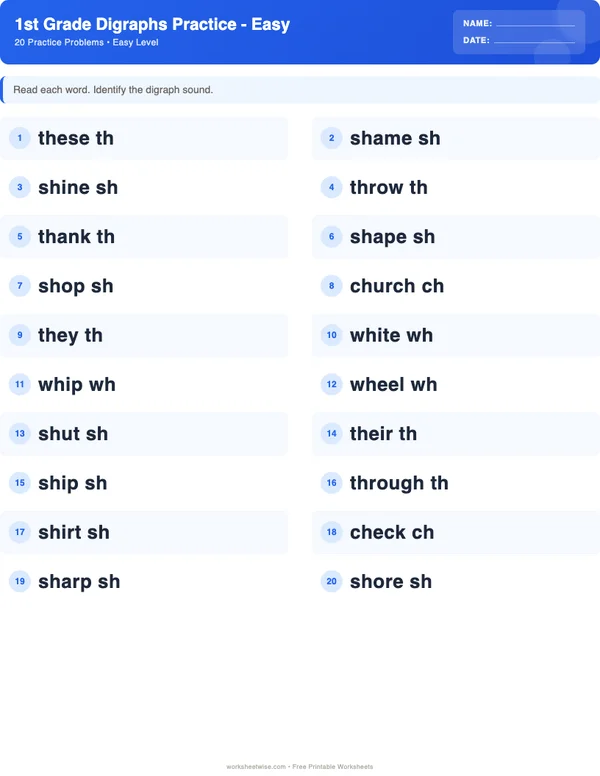
20 relevant free entry points are available. Each one includes a printable learner PDF and separate answer key.
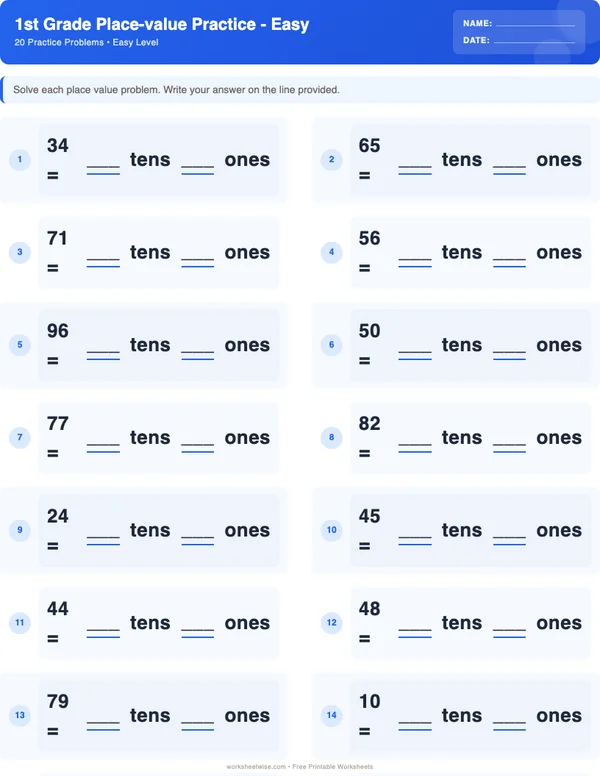
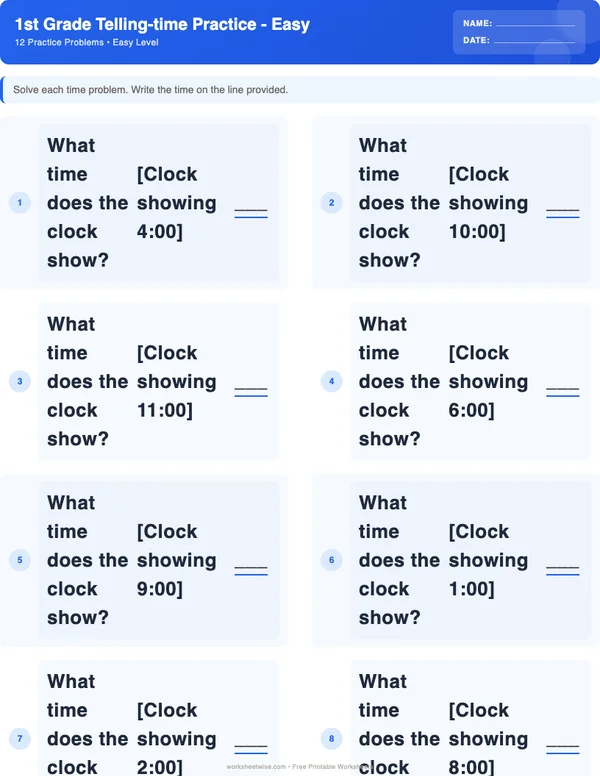
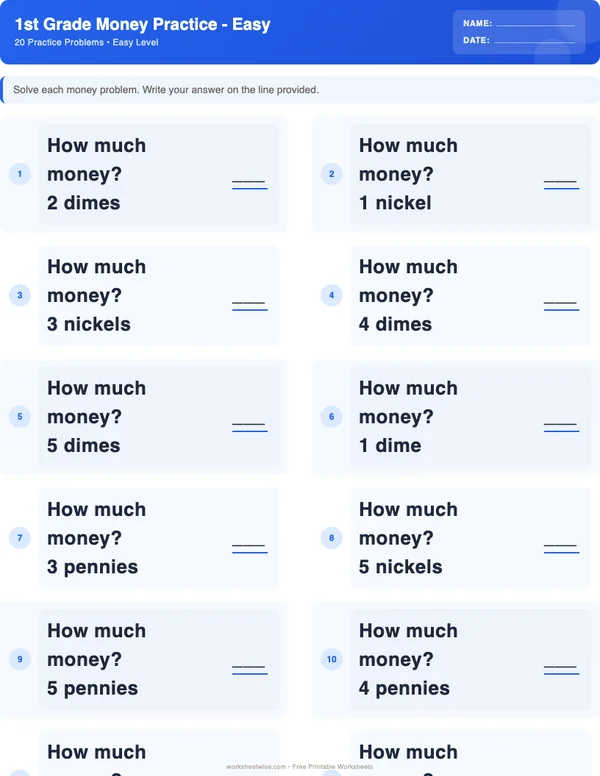
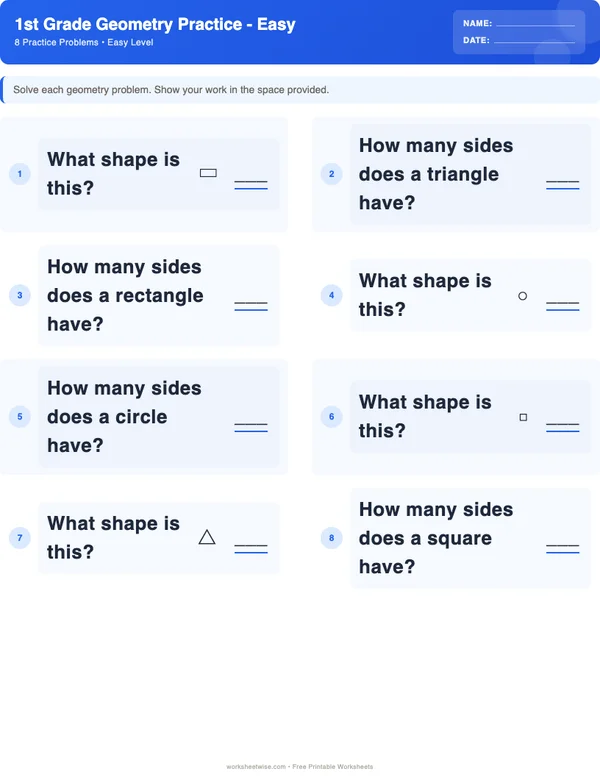
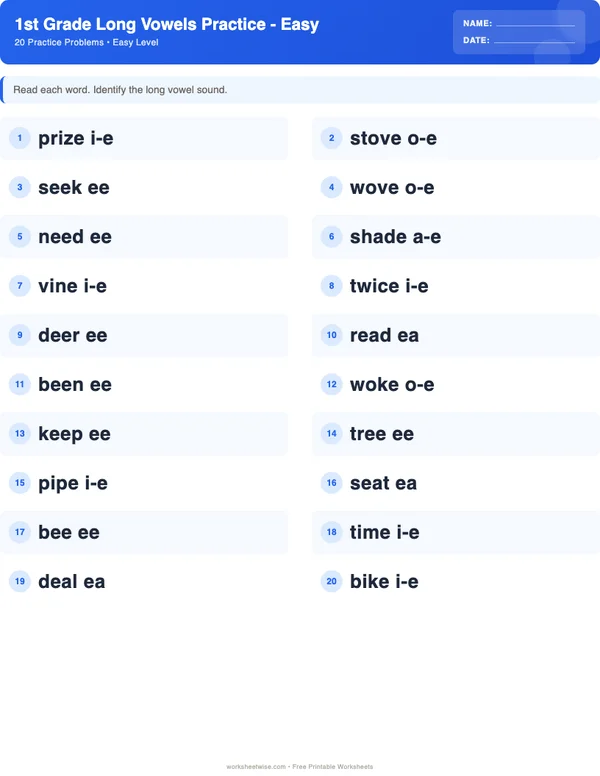
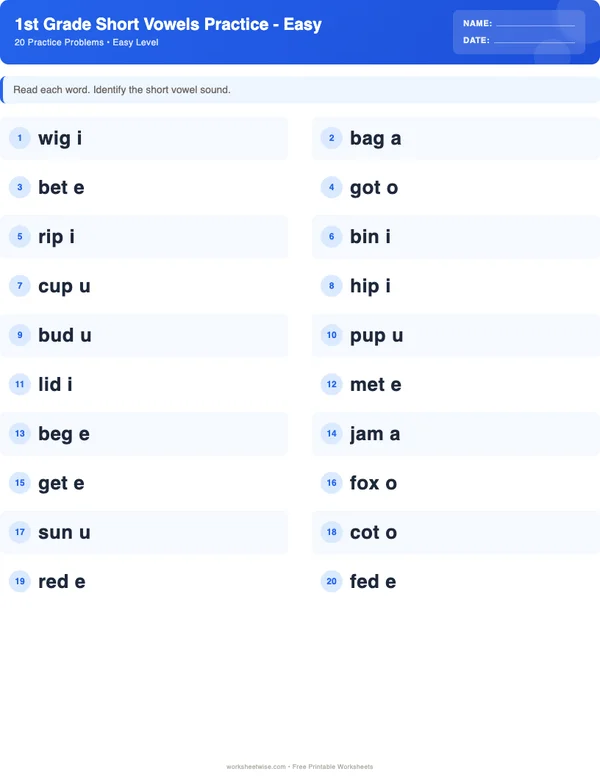
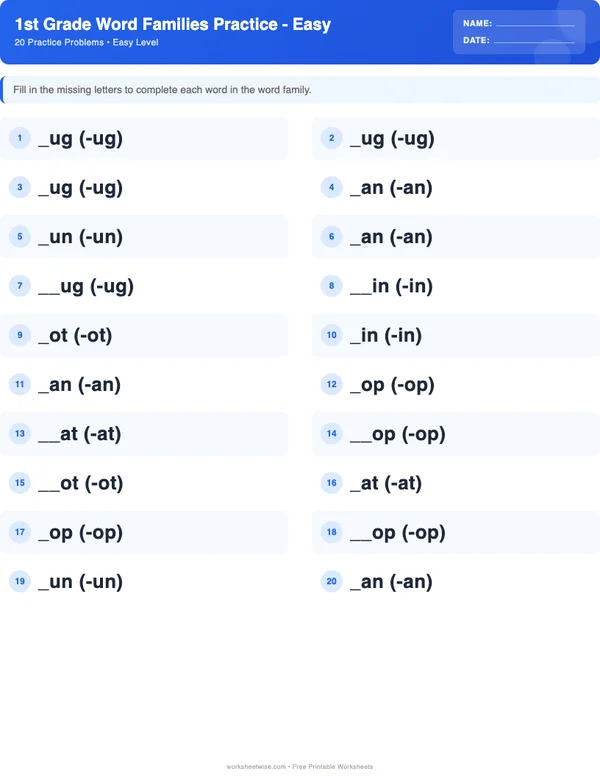
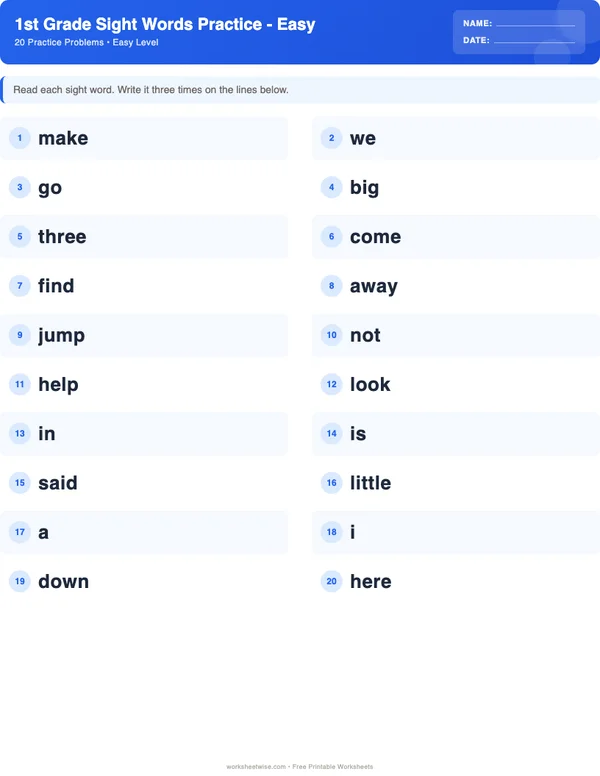
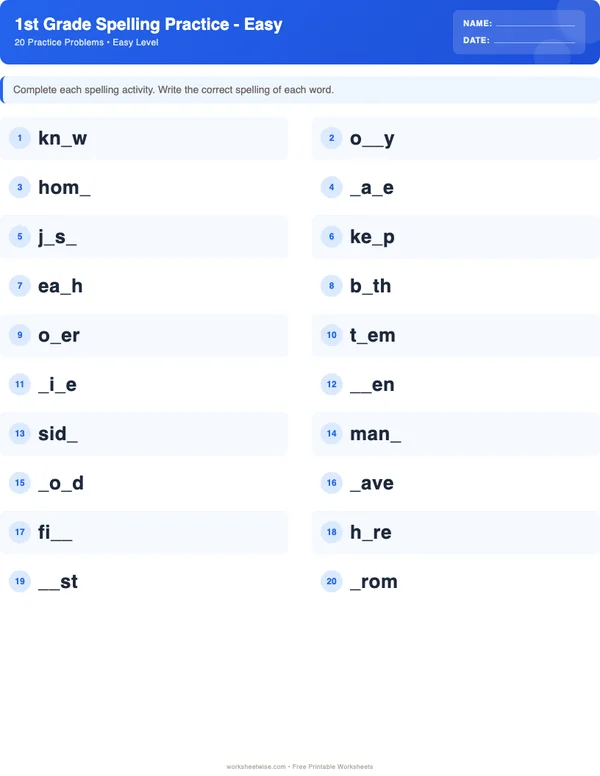
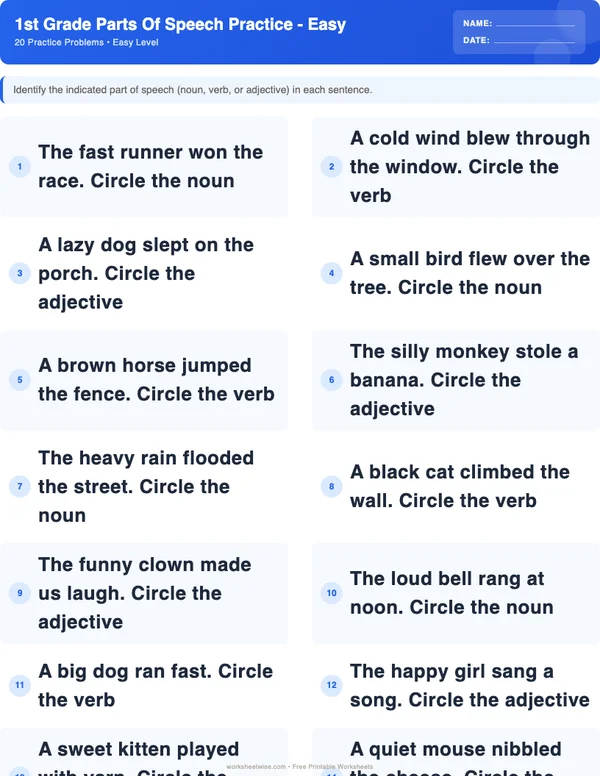
A useful practice loop
Print less. Observe more.
- Choose one skill and model the first item aloud.
- Use a short set and notice the learner’s strategy.
- Change the next task from the work you can see.
Need more than the free sheet?
Plus includes all 360 matching catalogue variations where available, plus saved deterministic generators and the worksheet designer.
See Plus membershipComplete guide
How to teach and practise worksheets for 6 year olds
3,492 words Updated 6 instructional visuals
Choose a worksheet from the work you can see
For most 6-year-olds, useful worksheet practice sits at the first-grade transition point: the learner is beginning to record strategies on paper but may still need objects, pictures, movement, and oral rehearsal to make the ideas clear. Choose one narrow skill, preview the page, and plan a brief activity before and after the writing.
Age is a discovery aid, not a placement decision. A 6-year-old may read consonant blends confidently while still counting every object one by one, or may explain addition clearly but find handwriting tiring. Select from observed work rather than assuming that every resource labeled first grade will fit.
The WorksheetWise catalogue for this page contains 360 first-grade worksheet variants across four subjects and 20 topics, with 20 free entry points. Those counts describe available choices, not a sequence every learner must complete. Grade labels describe intended practice level; local curriculum sequences differ.
A productive first choice usually has these features:
- One identifiable target, such as counting objects accurately, representing an addition fact, or hearing both sounds in an initial blend.
- Directions the learner can understand after one adult explanation.
- Enough open space to point, draw, move counters, or revise an answer.
- A problem count that can be divided into short sets.
- Familiar task demands surrounding the new skill. A decoding task should not also depend on difficult vocabulary or lengthy handwriting.
- A clear way to check understanding without relying only on the final mark.
The catalogue’s free sheets labeled “easy” should not be used to label a learner. Here, the difficulty label refers to observable task features such as smaller quantities, common spelling patterns, a single operation, direct matching, picture support, or fewer steps. Inspect the actual page because the reading load, number of items, visual density, and required writing may still make one “easy” sheet more demanding than another.
Use age, grade, and independence as separate signals
Treat six as a starting filter
The age filter helps adults find likely material efficiently. It does not establish what a child should already know, replace teacher information, or determine placement. First-grade learners vary in school experience, language background, attention, motor comfort, and prior opportunities to practice a particular skill.
Look for the point at which the learner can participate meaningfully:
- If the child can solve with objects but cannot yet record the strategy, keep the objects and reduce the writing.
- If the child can explain the idea but misreads the directions, read the directions aloud without solving the content.
- If the child completes a page accurately but cannot explain any answer, ask for a model or retelling before moving to a denser page.
- If the child recognizes a pattern immediately, ask for a reason or a second representation instead of simply assigning more items.
Do not use the expectations for a 6-year-old as a reason to push younger children toward desk work. For ages three and four, prioritize brief, adult-led oral, matching, manipulative, and movement experiences over worksheets. The guide for 3-year-olds and guide for 4-year-olds are better discovery points when that developmental context applies.
Read “first grade” as intended practice level
The catalogue facts on this page identify all listed resources as first-grade practice. That is useful for narrowing the library, but it does not prove that a particular worksheet matches a school’s current unit. Compare the page with classroom work, teacher communication, and what the child can demonstrate today.
Standards can help adults understand typical content, but they are not a placement test. The Common Core mathematics standards organize grade-level expectations around mathematical content and practice, while the English language arts standards organize expectations for reading, writing, speaking, listening, and language. State and local sequences may differ, and this guide does not claim that a WorksheetWise page has been reviewed or aligned by either organization.
Observe a sample before assigning a page
A short sample tells you more than age alone. Present two or three representative items with no time pressure. Ask the learner to point, say, build, draw, or write—not necessarily all five.
Watch the strategy, not just the answer
In math, notice whether the learner:
- Touches each object once while counting.
- Keeps the spoken number sequence synchronized with the objects.
- Starts addition from one and recounts everything, or starts with a known quantity and counts on.
- Uses fingers, counters, a ten frame, a drawing, or a number line purposefully.
- Can say what a numeral or operation symbol means.
- Checks whether an answer is reasonable.
In phonics and writing, notice whether the learner:
- Looks through the whole word rather than guessing from its first letter or picture.
- Can separate the sounds in a short word orally.
- Blends the sounds back into a recognizable word.
- Retains both consonant sounds in a blend such as st.
- Can rehearse a sentence aloud before writing it.
- Leaves spaces, rereads the sentence, and notices when a word is missing.
These observations guide the next teaching decision. They are not diagnoses.
Separate skill demand from access demand
A wrong answer can come from the target concept, but it can also come from an unread direction, crowded layout, unfamiliar picture, tired hand, or loss of place. Test one possibility at a time.
For example, if the learner answers an addition story incorrectly, read the story aloud and ask them to act it out with counters. A correct model after the read-aloud suggests that decoding the text interfered with showing the math. Reading the prompt aloud preserves the addition target; telling the learner which operation to use does not.
Keep practice brief, active, and repeatable
A 20-problem page is a resource, not a required sitting. For an initial session, cover most of the page and reveal four or five items. Continue only while the learner is thinking and responding without mounting strain.
Use a five-part routine
- Name the target. Say, “Today we are making sure every object gets one count,” or, “Today we will hear both sounds at the start of stop.”
- Rehearse orally or with materials. Count a small scattered set, build one number sentence, stretch one word, or say one complete sentence.
- Model one item. Think aloud briefly and show the relevant strategy.
- Let the learner try a small set. Observe before correcting. Ask, “Show me how you knew.”
- Close with one transfer. Change the arrangement, number, word, or picture while keeping the same target.
This can take eight to twelve minutes, but the clock is not the main test. Stop sooner when the child can no longer attend to the target. A useful ending is one explained answer, not an arbitrary number of completed rows.
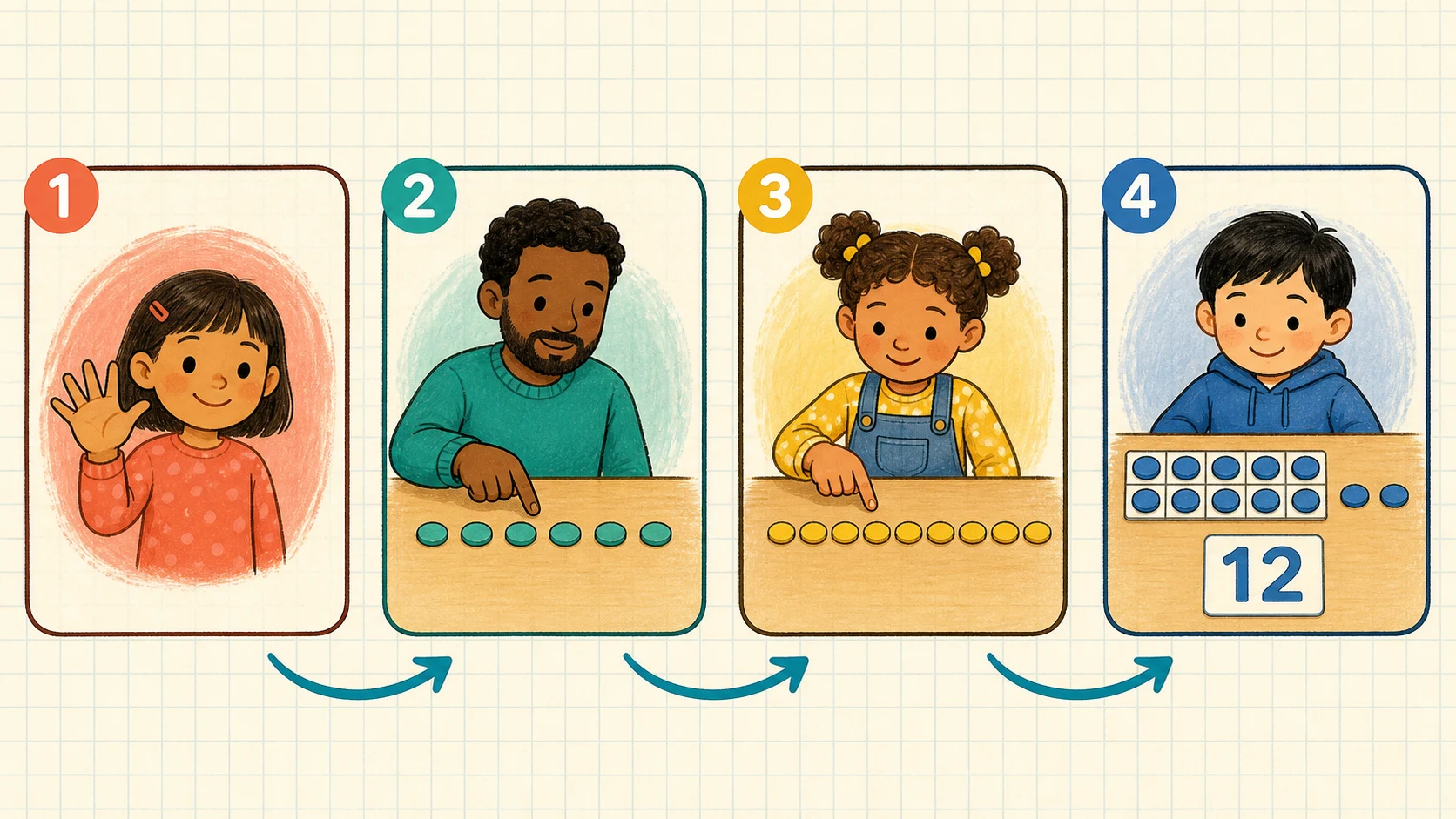
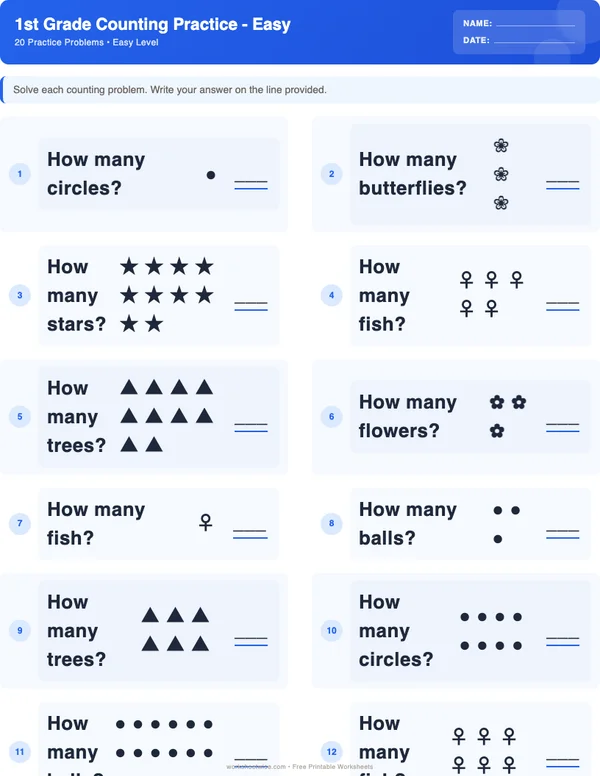
Use the counting routine with a small set first, then decide whether the learner should complete another set on paper.
For counting practice, let the child move objects into a “counted” area, touch each picture, or mark each item lightly. Add movement by placing number cards on the floor and stepping through a sequence. The 1st Grade Counting guide and free sheet provides a focused entry point when the observed need is counting rather than a broader arithmetic task.
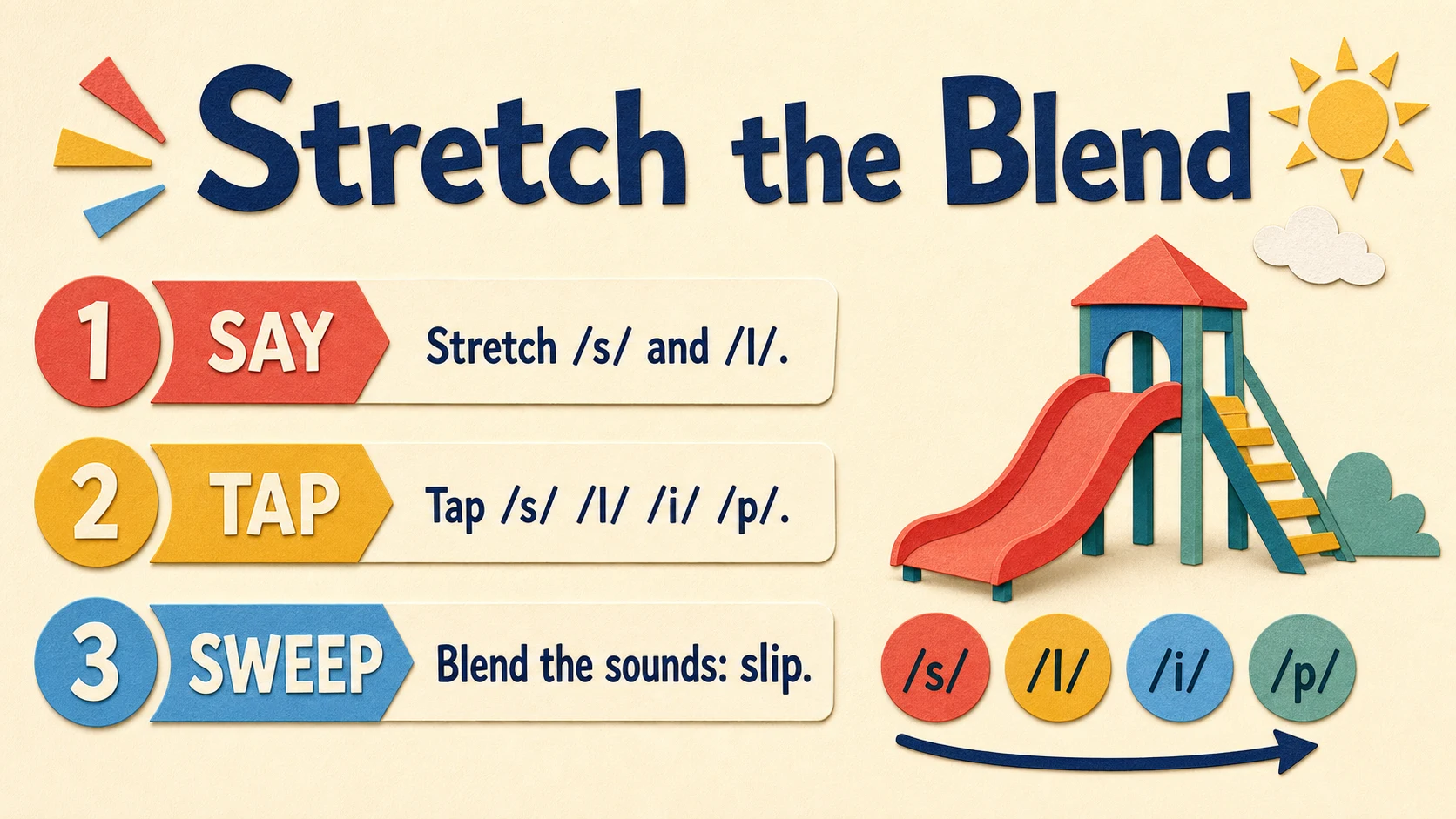
For blend practice, move from saying and tapping the sounds to reading and writing only a few carefully chosen words.
Paper should capture thinking after the learner has had a chance to form it. It should not replace the talk, movement, or materials that make the idea understandable.
Check the fit with concrete first-grade examples
The following examples use exact quantities and skill descriptions from the live catalogue. Each one has been checked for mathematical or linguistic accuracy.
Example 1: Count a scattered set without losing objects
Place 13 buttons in a scattered arrangement. Ask the child to count them. If the child says “13,” rearrange the same buttons and ask, “Will there still be 13? How could you make sure?”
This belongs here because the first-grade counting resource includes number sequences, missing numbers, and sets of objects, while its teaching guidance emphasizes one-to-one correspondence and recommends scattered arrangements as a more revealing check than a neat row. Thirteen also gives useful information about the irregularly named teen numbers without exceeding the stated early counting context.
Interpret what happens:
- Touches or moves each button once and reaches 13: continue to a short worksheet set.
- Recounts a button or skips one: simplify the arrangement to eight objects and establish a move-as-you-count routine.
- Recites numbers without coordinating them with objects: stop the worksheet and practice matching one spoken number to one object.
- Counts 13 accurately after rearrangement but thinks the quantity changed: compare the two arrangements and recount before returning to paper.
Example 2: Represent before recording it
Give the learner a ten frame and 13 counters. Ask them to show . One checked strategy is to place 8 counters, take 2 from the group of 5 to complete 10, and then add the remaining 3: .
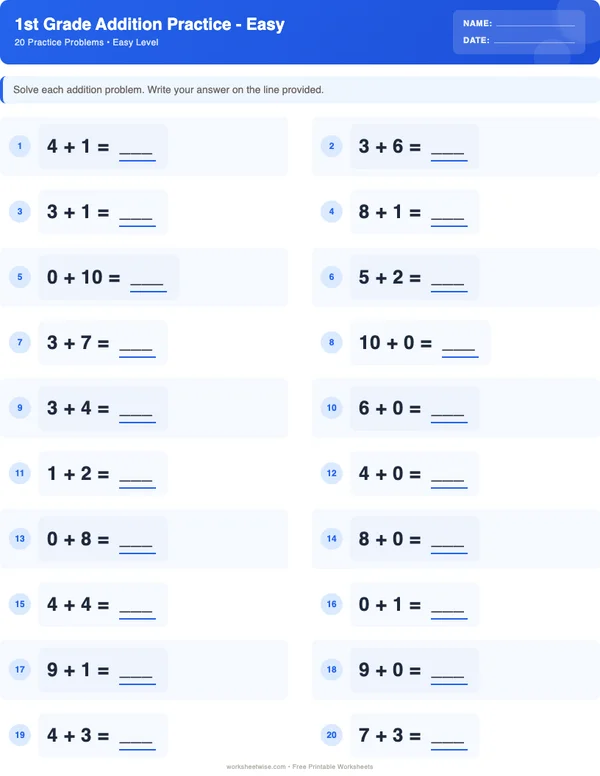
This belongs here because the catalogue’s first-grade addition description progresses through addition within 5, 10, and 20, including counting on and making ten. The free addition sheet contains 20 problems, so an adult can select a small subset rather than require the whole page.
Observe whether the learner understands the regrouping of the addends. The total remains 13; the 5 has been decomposed into 2 and 3. If the child can build and explain that relationship but writes a numeral backward or slowly, keep the addition problem and reduce the recording demand. If the child cannot yet preserve the total while moving counters, return to smaller combinations within 10. The 1st Grade Addition guide and free sheet is the relevant next resource.
Example 3: Prove that fraction parts must be equal
Fold one paper rectangle into two equal parts and shade one part. Then draw another rectangle divided into two visibly unequal regions and shade one region. Ask, “Do both pictures show one-half? Why?”
The checked answer is no. One-half means one of two equal parts of the same whole; simply having two regions is insufficient.
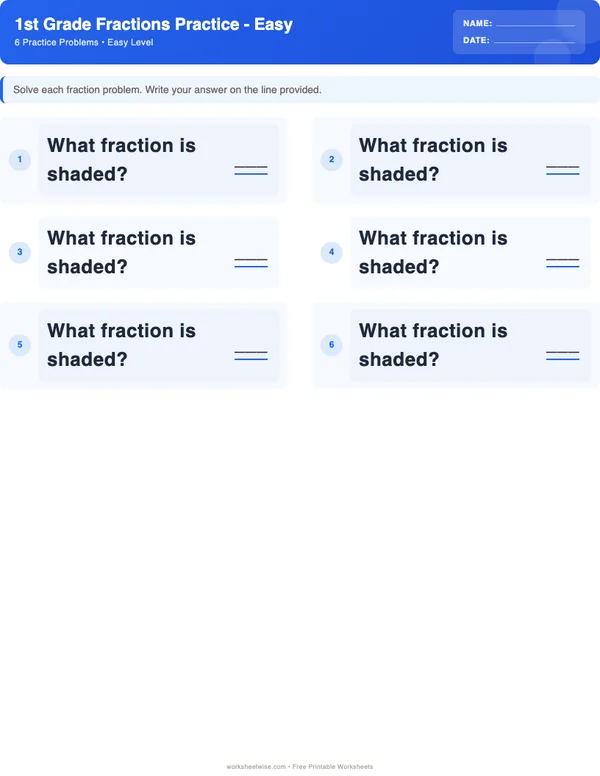
This example belongs here because the catalogue’s first-grade fractions entry begins with partitioning shapes into equal parts and naming fractions. Its free sheet has six problems, a notably shorter count than the 20-problem counting and addition sheets. That lower item count does not automatically make every fraction item easier: the learner must attend to the equality of the parts and the identity of the whole.
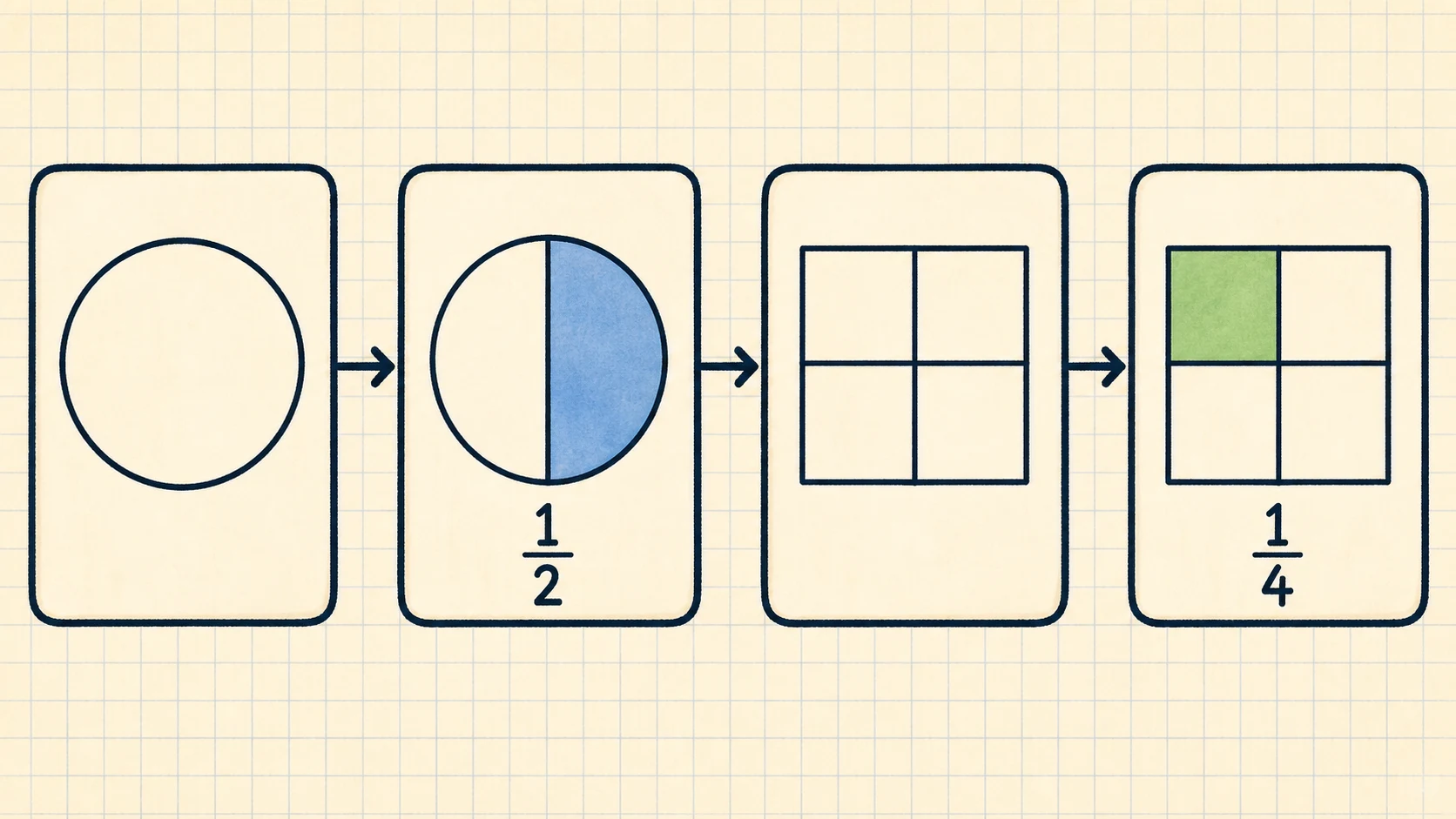
At this age, begin the fraction map with equal sharing and folded shapes before expecting symbolic notation.
The 1st Grade Fractions guide and free sheet is appropriate when a learner can compare parts of one whole. Do not jump from this beginning example to fraction operations described elsewhere in the broader topic catalogue; those later skills are not implied by age six.
Example 4: Hear every sound in stop
Say stop slowly. The sound sequence is /s/ /t/ /o/ /p/: four phonemes represented by four letters. Ask the learner to tap once for each sound, blend the sounds, and then build or write the word.
This belongs here because consonant blends are a first-grade catalogue topic, and the supplied teaching context specifically identifies dropping one consonant—reading sop for stop—as a common error. In st, both consonants retain their sounds; this distinguishes a blend from a digraph such as sh, where two letters represent one sound.
If the learner reads sop, do not ask for repeated copying of stop. Return to oral segmentation, tap four sounds, and compare sop with stop. If the learner can say all four sounds but omits t only in writing, provide four sound boxes or four letter spaces. That adaptation preserves the blend target.
The IES foundational-reading guide recommends developing awareness of speech sounds and their links to letters, explicitly teaching decoding and word recognition, and giving learners opportunities to read connected text. That supports a sequence of oral segmentation, word reading and spelling, followed by a short sentence containing the practiced pattern—not an isolated worksheet alone. See the IES foundational skills practice guide.
Move from oral language to readable written strategies
At six, a learner may have more to say than they can comfortably write. Preserve the language target by separating composing from handwriting.
Rehearse a sentence before writing it
Suppose the picture shows a red dog running. Ask, “Tell me one complete sentence.” A checked response is: “The red dog runs.” It has a naming part, The red dog, and a telling part, runs. Say the sentence together, count the four words on fingers, and then let the learner write.
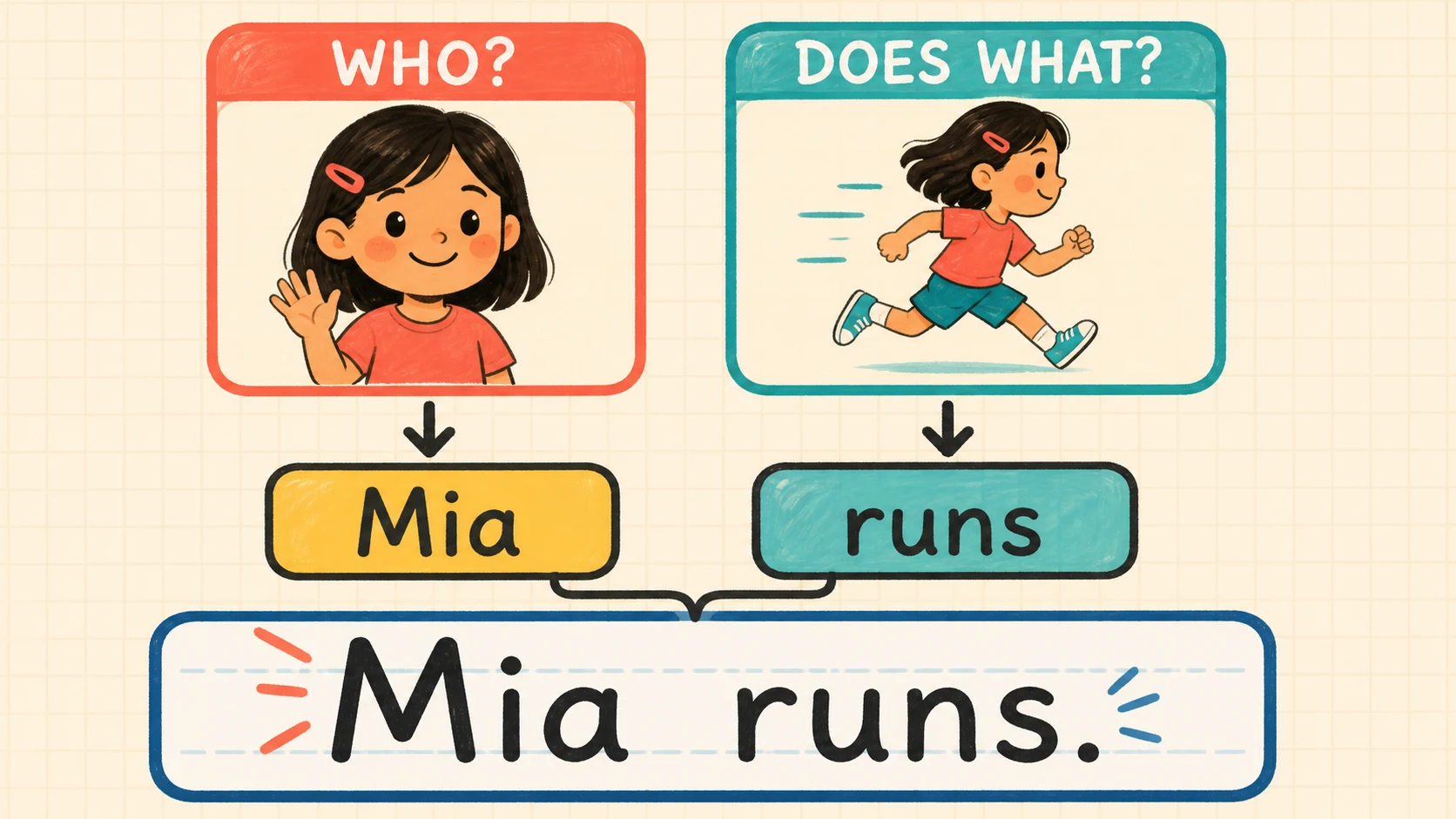
Oral rehearsal lets a first grader organize a complete thought before handwriting and spelling compete for attention.
If the child writes “red dog,” ask them to reread it and compare it with the rehearsed sentence. The issue may be sentence completeness or it may be that working memory was consumed by spelling. Provide four blank word lines without supplying the words. This preserves composing and word-order decisions while reducing place-keeping demand.
The IES elementary writing guide recommends daily time for writing, teaching the writing process for different purposes, explicitly teaching foundational writing skills, and building an engaged community of writers. For home or support sessions, that points toward frequent, manageable opportunities to compose and revise—not long copying assignments. This source did not assess WorksheetWise.
Progress spelling support one decision at a time
A useful progression is: hear the word, segment it, build it with letters, copy it with attention, cover it, write it from memory, and use it in a sentence. Do not remove every support at once.
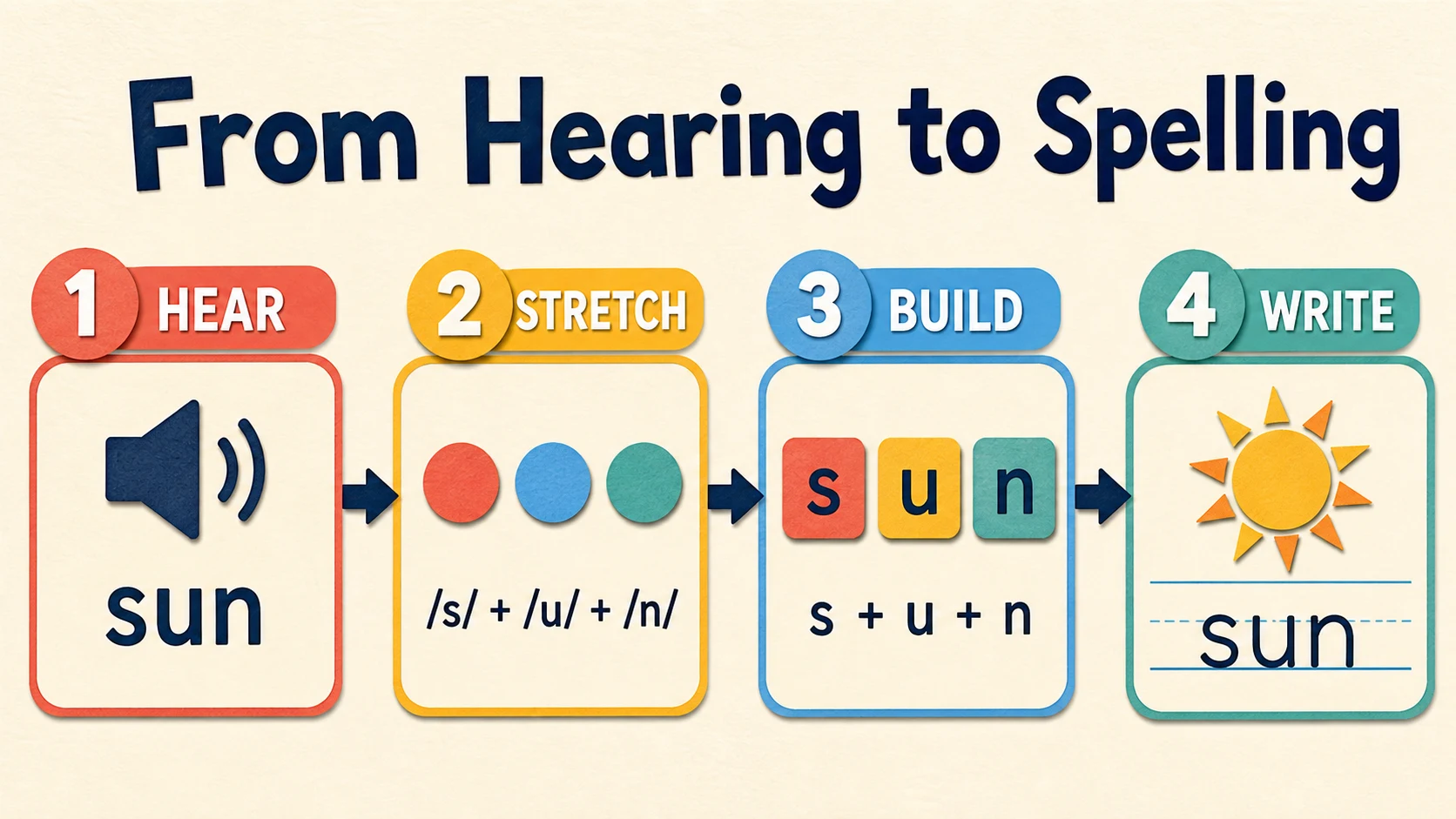
Move toward independent spelling only after the learner can hear the sounds and connect them to the practiced letter pattern.
For the CVC word map, the checked sequence is /m/ /a/ /p/, three phonemes and three letters. For ship, there are three phonemes—/sh/ /i/ /p/—but four letters because sh is a digraph. Asking “How many sounds?” reveals different knowledge from asking “How many letters?” Keep those questions distinct.
Interpret errors before choosing simplify, continue, or stop
An error is evidence about the current task, not a fixed description of the learner. Record the prompt, what the child did, what support changed the response, and the next smallest test.
Simplify when the target is present but overloaded
Simplify if the learner can demonstrate part of the target yet the quantity, layout, language, or recording load disrupts performance. Examples include:
- Reduce 20 counting items to five while keeping one-to-one counting.
- Read a word-problem prompt aloud while preserving the child’s operation choice.
- Replace written addition with counters, then ask the learner to record one number sentence.
- Offer three blend words instead of a full row.
- Cover unrelated sections of a visually dense page.
This is not “making the learner’s work easy.” It is changing observable task features so you can see the target skill.
Continue when the strategy is accurate and explainable
Continue for a few more items when the learner can:
- Give accurate answers across changed examples.
- Explain or demonstrate a stable strategy.
- Notice and correct an occasional mistake.
- Work without escalating frustration or dependence on adult cues.
- Transfer the skill once, such as counting a rearranged set or reading the blend in a short sentence.
Do not increase difficulty merely because one familiar item was correct. Change one feature and observe again.
Stop when more items will not produce useful practice
Stop the session if the child is guessing repeatedly, no longer attending to the target, showing marked distress, or becoming less accurate as fatigue grows. Also stop when adult prompting has become so specific that the adult is effectively solving every item.
A break is appropriate when the strategy was available earlier but faded. A different representation is appropriate when the same misconception persists. Consultation with the classroom teacher is appropriate when a pattern appears repeatedly across settings. A worksheet session cannot establish a diagnosis.
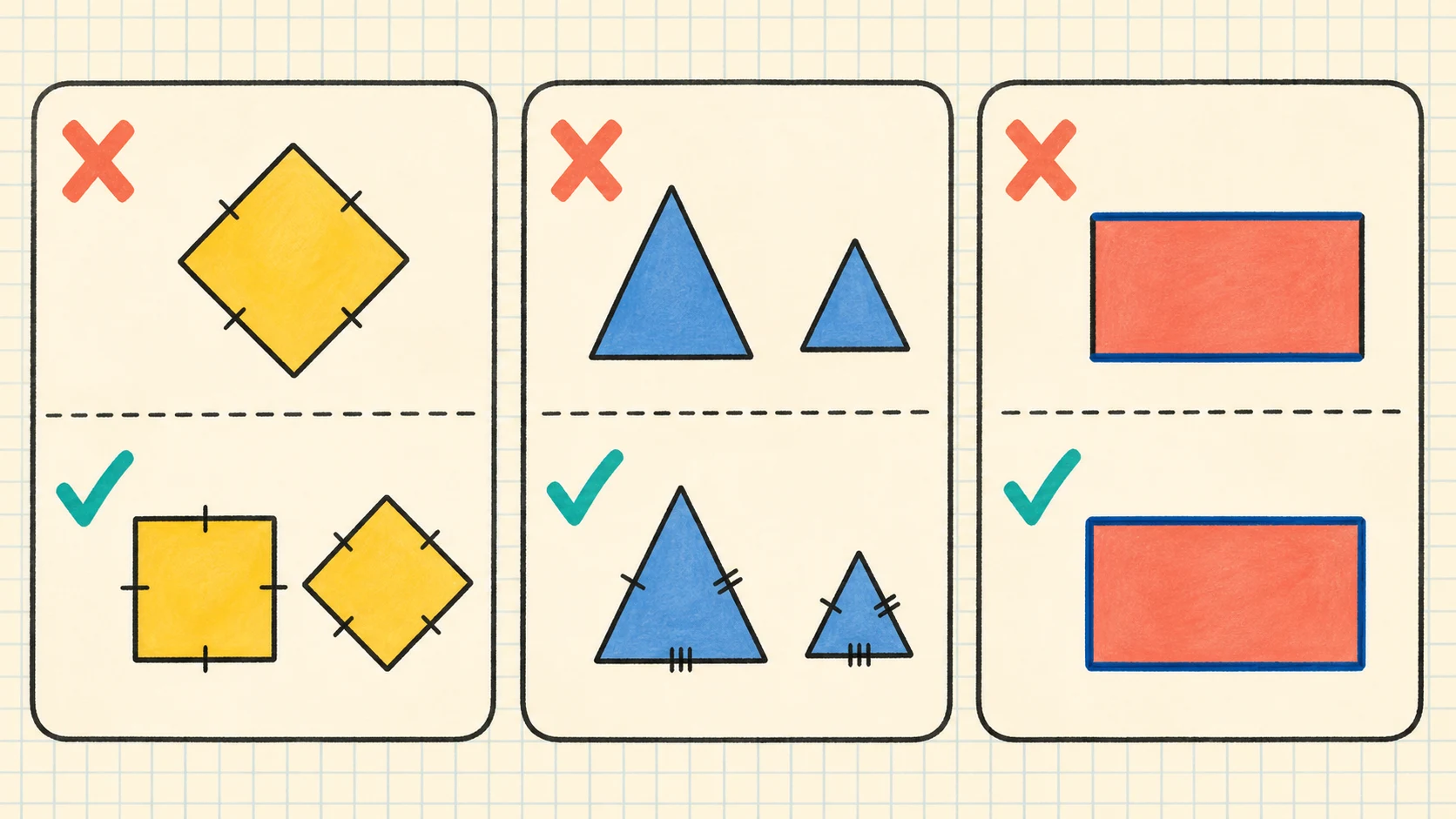
Use a geometry error to choose the next comparison or hands-on sort, not to assign a permanent label.
For instance, if a learner calls only a point-up, equal-sided example a triangle, present triangles in different sizes and orientations alongside non-triangles. Ask the child to sort by properties: three straight sides and three vertices. Do not solve the misconception by repeatedly showing the same familiar prototype. The catalogue guidance for early geometry appropriately emphasizes sorting, tracing, building, and composing shapes before naming them only on paper.
Adapt access while preserving the target skill
An adaptation is useful when it removes an irrelevant barrier without performing the thinking being assessed.
If the target is counting, allow pointing, moving objects, or marking counted pictures. Do not count aloud in synchrony for the child if you need to observe whether they can coordinate the sequence independently.
If the target is addition, provide counters or a ten frame. Do not place the counters into the solution while asking the child merely to report the total.
If the target is phonics, pronounce picture names and clarify vocabulary. Do not tell the target vowel or blend before the learner attempts to hear it.
If the target is sentence construction, let the child dictate the sentence for oral rehearsal or use word lines. Do not transform a fragment into a complete sentence and then call the copying independent composition.
If handwriting is the barrier, accept pointing, magnetic letters, oral explanation, circling, or an adult scribe who records exactly what the child says. Then include one small act of independent recording when appropriate. If visual density is the barrier, use a blank sheet to cover rows, enlarge the page without altering content, or cut the task into cards.
The IES mathematics intervention guide recommends systematic instruction, clear mathematical language, selected concrete and visual representations, number lines, and deliberate word-problem teaching. Those principles support purposeful materials and explicit explanation, not decoration or unlimited prompting. See IES, Assisting Students Struggling with Mathematics. Its recommendations are general instructional guidance and should not be presented as an evaluation of these worksheets.
The earlier IES guide for teaching math to young children likewise recommends developmental progressions, monitoring what children know, discussing mathematics in the surrounding world, and making time for math regularly. Although that guide focuses on preschool through kindergarten, its progression-and-observation logic is relevant at the transition into first grade. The suggestion in this article to use an eight-to-twelve-minute routine is an editorial practice suggestion, not a duration prescribed by IES.
Know what a worksheet can and cannot show
A worksheet can provide a sample of written responses under particular conditions. It may help an adult notice consistent omissions, inefficient strategies, numeral formation, decoding attempts, or whether the learner can apply a recently taught idea.
It cannot, by itself:
- Determine grade placement or readiness.
- Explain why a learner made an error.
- Measure everything the child understands orally or with materials.
- Establish a learning, language, attention, visual, or motor diagnosis.
- Guarantee mastery, progress, or a particular outcome.
- Replace instruction, conversation, reading, play, or teacher assessment.
- Prove standards alignment because its grade label resembles a standards category.
Keep the completed page only if it helps compare strategies over time. Add a short note such as, “Counted 13 scattered buttons accurately after moving each one,” or, “Read stop as sop; produced all four sounds after tapping.” Such notes are more actionable than a score alone.
When accuracy changes sharply between oral, manipulative, and written versions, report the conditions rather than drawing a conclusion: “Solved with a ten frame and explained making ten; did not record the decomposition independently.” That statement tells the next adult what support revealed the learner’s reasoning.
Make the next session answer one observable question
Choose one real page from the 1st Grade Counting guide and free sheet, but reveal only the first five suitable items. Before printing, gather 13 small objects.
Ask one observable question: Can the learner coordinate one spoken number with one object when the objects are scattered? Begin with the objects, model only if needed, and then try the five paper items. Record whether the learner moved or marked each object, skipped or recounted any, and explained how they knew the total.
If coordination is accurate, continue with one rearranged set. If it breaks down, simplify to fewer objects and retain the move-as-you-count action. If attention or frustration prevents a useful attempt, stop and return at another time. That single decision will tell you more about the next appropriate worksheet than age, a page label, or a completed stack.
Put it into practice
Use the guide with a real printable
Move from explanation to a short, observable practice task. Check the first item together, then adjust the next session from the learner's actual work.
Open the first free worksheetExplore a neighboring collection
Choose by a different teaching need
Worksheets for 10-Year-Olds: Printable Practice Guide Worksheets for 11-Year-Olds: Printable Practice Guide Worksheets for 12-Year-Olds: Printable Practice Guide Worksheets for 3-Year-Olds: Printable Practice Guide Worksheets for 4-Year-Olds: Printable Practice Guide Worksheets for 5-Year-Olds: Printable Practice Guide Worksheets for 7-Year-Olds: Printable Practice Guide Worksheets for 8-Year-Olds: Printable Practice Guide