What 2nd Grade Telling Time Includes
The central second-grade goal is to read and write time to the nearest five minutes on analog and digital clocks, using a.m. and p.m. appropriately. A learner should connect each numeral on an analog clock with a five-minute count, read the hour hand before the minute hand, and recognize that the hour hand moves gradually between numbers.
Instruction usually works best in this order: review hours and half-hours, build quarter-hour understanding, count minutes by fives around the clock, read mixed five-minute times, draw clock hands, connect analog and digital forms, and then use time in schedules and carefully chosen interval problems. The learner’s observed work—not a fixed calendar—should determine how quickly that sequence moves.
The Common Core State Standards for Mathematics place telling and writing time to the nearest five minutes, with a.m. and p.m., in the second-grade measurement-and-data expectations. The same progression places hours and half-hours earlier and nearest-minute reading plus time-interval arithmetic later. This is useful framing, not a universal timetable.
Grade labels describe the intended practice level. Local curricula, school sequences, and individual readiness differ. A learner may need first-grade clock foundations before beginning mixed five-minute practice, or may be ready for selected elapsed-time extensions after mastering the second-grade core.
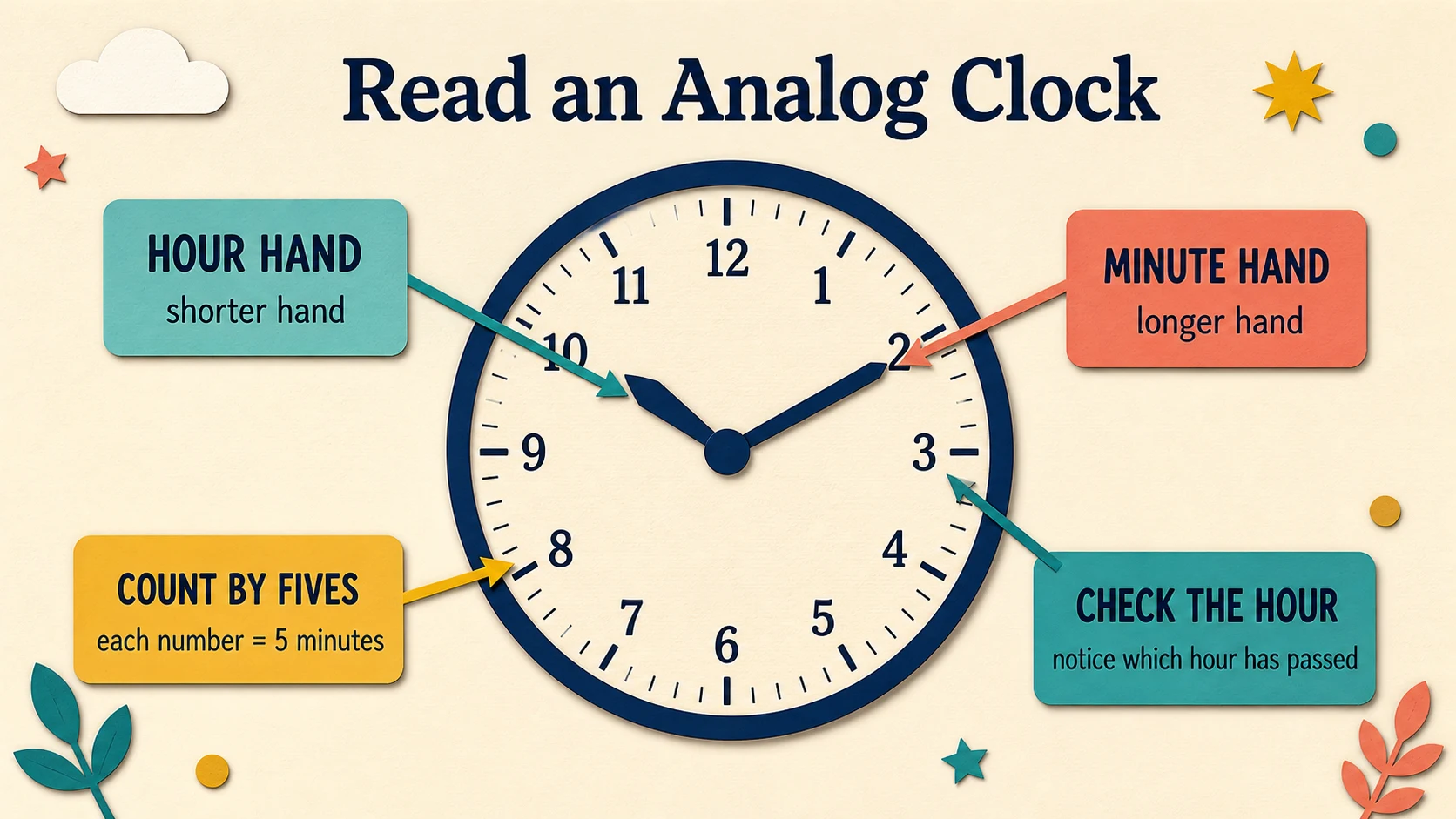
The skill combines clock structure, counting by fives, hour-hand reasoning, notation, and everyday time language.
Prerequisites to Check Before Teaching Five-Minute Time
A short readiness check can prevent clock practice from becoming guesswork. Ask the learner to complete each task without extensive prompting:
- Identify the short hand and long hand on an analog clock.
- Read times such as 3:00, 7:00, 1:30, and 10:30.
- Skip-count by fives from 0 to 60.
- Match 6:00 with “six o’clock” and 6:30 with “half past six.”
- Explain which hour is in progress when the hour hand lies between two numerals.
- Write a digital time with a colon, including a zero when needed, as in 4:05.
A learner does not need perfect verbal explanations before beginning. Look instead for whether the underlying ideas are available. Someone who reads 4:30 correctly but calls the long hand the “hour hand” may need vocabulary clarification, not a complete restart.
Clock-face structure
Establish that a clock face has 12 numbered positions but represents 60 minutes in one complete trip of the minute hand. Each step from one numeral to the next represents five minutes:
| Minute hand points to |
Minutes after the hour |
| 12 |
00 |
| 1 |
05 |
| 2 |
10 |
| 3 |
15 |
| 4 |
20 |
| 5 |
25 |
| 6 |
30 |
| 7 |
35 |
| 8 |
40 |
| 9 |
45 |
| 10 |
50 |
| 11 |
55 |
Have the learner say the sequence aloud while touching the corresponding numerals. This is an instructional suggestion based on the clock’s structure. It should not replace reasoning about the hour hand.
The moving hour hand
A common prerequisite gap is the belief that the hour hand always points exactly at a numeral. Use a geared demonstration clock if available. At 2:00, the hour hand points at 2. By 2:30, it is halfway toward 3. At 2:55, it is close to 3 but has not reached it.
Cover the minute hand temporarily and ask, “Which hour has the short hand already passed?” This directs attention to the hour currently in progress. When the short hand is between 2 and 3, the time is still “2 something.”
A Grade-Appropriate Teaching Progression
The progression below moves from supported interpretation to independent use. Do not advance merely because a page has been completed. Advance when the learner can explain the hand roles and maintain accuracy across a mixed set.
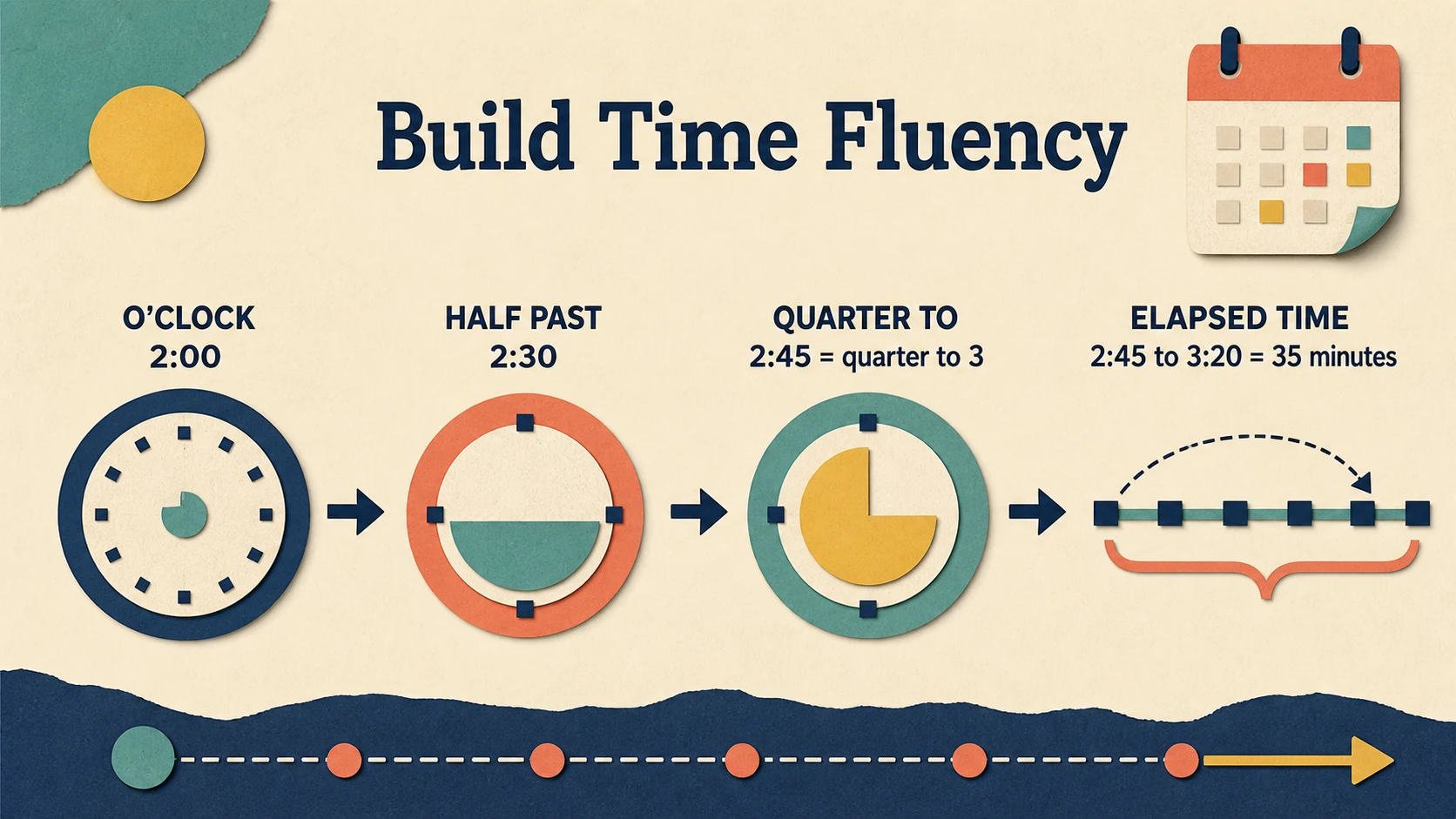
Support can be reduced as the learner reads increasingly varied times accurately and explains the hour in progress.
| Stage |
Teaching focus |
Useful model |
Evidence to look for |
| 1 |
Hours and half-hours |
Geared clock; hour hand alone |
Reads both forms and notices hour-hand movement |
| 2 |
Quarter hours |
Clock divided into four sections |
Connects 15, 30, and 45 minutes with hand positions |
| 3 |
Five-minute counts |
Labeled clock or count-by-five ring |
Counts clockwise from 00 through 55 |
| 4 |
Mixed five-minute times |
Unlabeled analog clocks |
Reads the hour first and minute count second |
| 5 |
Drawing hands |
Blank clock faces |
Places both hands in plausible positions |
| 6 |
Analog, digital, and words |
Matching cards or schedules |
Moves among forms without changing the time |
| 7 |
a.m. and p.m. |
Daily-event timeline |
Chooses a label from the event context |
| 8 |
Simple intervals |
Demonstration clock or open number line |
Counts forward in meaningful jumps |
When to pause or move forward
Stay with a stage when errors show an unresolved idea: reversed hand roles, incorrect five-counts, or choosing the upcoming hour after 30 minutes. Simply assigning more mixed problems may rehearse the error.
Move forward when the learner succeeds on new examples, not only repeated ones. For instance, reading five clocks that all show times before half past gives little evidence about difficult times such as 3:45 or 8:55.
The IES guide on teaching mathematics to young children provides high-level guidance on using developmental progressions, monitoring what children know, and intentionally teaching mathematical ideas. It did not evaluate WorksheetWise or this specific sequence. Here, its broad framing supports checking understanding and adjusting instruction instead of treating page completion as mastery.
Concrete and Visual Models That Clarify the Skill
Clock reading combines two scales: 12 hours and 60 minutes. A useful model should make that relationship visible without permanently doing the reasoning for the learner.
A geared demonstration clock
Use a clock whose hands move together correctly. Turn the minute hand through a complete circle and observe the hour hand move from one numeral to the next. Then compare:
- 5:05: the hour hand has just passed 5.
- 5:30: the hour hand is halfway between 5 and 6.
- 5:55: the hour hand is close to 6 but has not reached it.
A clock with independently movable hands can still be useful for drawing practice, but it may allow impossible displays. If the minute hand shows 55 minutes while the hour hand points directly at 5, reposition the hour hand so the model reflects how a clock works.
A minute ring
Place removable labels—00, 05, 10, and so on—outside the clock numerals. The learner can first use the ring to interpret the minute hand, then cover selected labels, and finally remove the ring.
This support is preferable to telling the answer immediately because it preserves the counting step. If a learner repeatedly counts 5, 10, 15 from the numeral 12 but loses track, mark 12 as “00” and practice beginning the sequence correctly.
A folded clock and open number line
A paper clock folded into halves and quarters makes 15-, 30-, and 45-minute landmarks visible. For interval work, transfer time to an open number line. The line does not require evenly spaced tick marks; it records sensible jumps:
9:25 → 9:30 → 10:00 → 10:05
The jumps are 5 minutes, 30 minutes, and 5 minutes, for a total of 40 minutes.
The IES practice guide for assisting students struggling with mathematics offers broad recommendations that include systematic instruction, clear mathematical language, visual representations, and attention to word problems. It does not prescribe this exact clock lesson or endorse these materials.
Fully Checked Worked Examples
The examples below show the reasoning an adult can model. After modeling one, change the numbers and ask the learner to complete a parallel example.
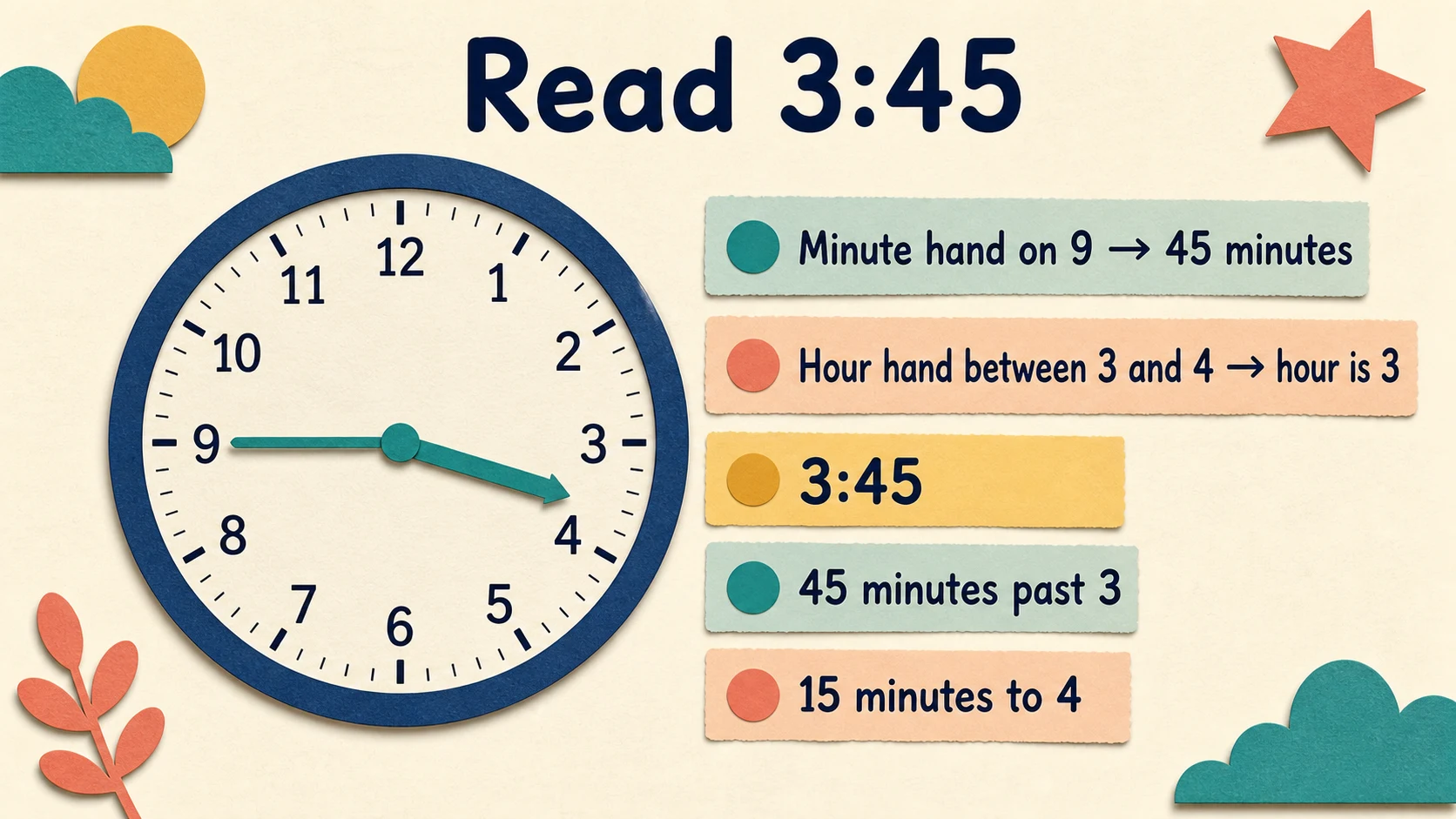
Read the hour in progress, translate the minute-hand position into minutes, and then write the digital time.
Example 1: Read a time before half past
A clock’s short hand is slightly past 6. Its long hand points to 4.
- The short hand has passed 6 but has not reached 7, so the hour is 6.
- The long hand points to the fourth five-minute position.
- Count
5, 10, 15, 20.
- The time is 6:20.
Check: 20 minutes is less than half an hour, so the hour hand should be partway from 6 toward 7, but not halfway. The described position is consistent.
Example 2: Read a time after half past
The short hand is between 3 and 4 and is closer to 4. The long hand points to 9.
- The short hand has already passed 3.
- It has not reached 4, so the hour remains 3.
- The long hand at 9 represents 45 minutes because
9 × 5 = 45.
- The time is 3:45.
Check: At 3:45, three quarters of the hour have passed. The hour hand should therefore be three quarters of the way from 3 to 4. Reading 4:45 would conflict with that movement.
Example 3: Draw hands for a digital time
Draw 8:50 on a blank analog clock.
- Locate the minute position first: 50 minutes corresponds to the numeral 10.
- Draw the long minute hand from the center to 10.
- The hour began at 8 and is nearly finished.
- Draw the short hour hand between 8 and 9, close to 9 but not on it.
Check: Ten more minutes would bring the time to 9:00. The hour hand should therefore be near 9. It must remain just before 9 because the ninth hour has not begun.
Example 4: Choose a.m. or p.m.
A schedule says breakfast begins at 7:15 in the morning.
- The clock time is 7:15.
- The context explicitly says morning.
- Morning times before noon use a.m.
- Write 7:15 a.m.
If a schedule instead says an evening reading time begins at 7:15, write 7:15 p.m. The clock digits alone do not determine a.m. or p.m.; the context does.
Example 5: Find a simple elapsed time
A lesson begins at 9:25 a.m. and ends at 10:05 a.m. How long does it last?
Use an open number line:
- 9:25 to 9:30 is 5 minutes.
- 9:30 to 10:00 is 30 minutes.
- 10:00 to 10:05 is 5 minutes.
5 + 30 + 5 = 40.
The lesson lasts 40 minutes.
Check by counting backward: 10:05 back to 10:00 is 5 minutes, back to 9:30 is another 30, and back to 9:25 is another 5. The total is again 40 minutes.
Boundary cases worth teaching explicitly
At 12:00 noon, the label is 12:00 p.m. At 12:00 midnight, the label is 12:00 a.m. These labels can be confusing, so connect them directly to noon and midnight rather than expecting the learner to infer them from a simple “morning/evening” rule.
Also compare 11:55 and 12:00. At 11:55, the hour hand is nearly at 12, but the time is still in the eleven o’clock hour. After five more minutes, both the minute boundary and hour boundary are reached.
Nearest-minute reading and more involved addition or subtraction of intervals belong later in the stated standards progression. They can be used as extensions, but they should not displace secure five-minute clock reading.
A Short, Repeatable Lesson Routine
A focused lesson can be brief. Ten to fifteen attentive minutes may be more useful than a long page completed with fading attention, but this duration is an instructional suggestion, not a universal recommendation.
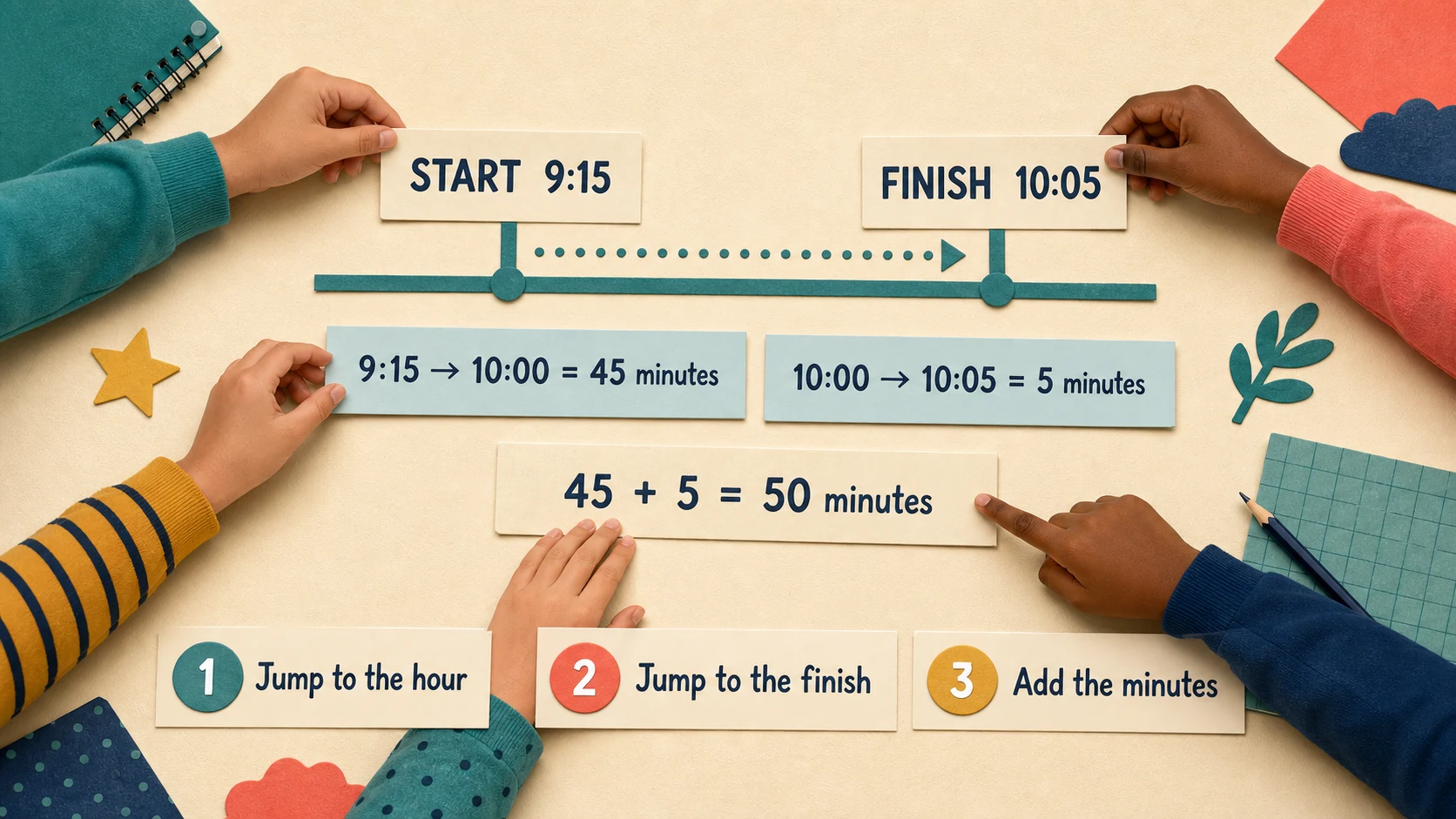
Each lesson revisits prior knowledge, models one idea, checks reasoning, and ends with a small independent sample.
1. Retrieve
Show two previously learned times. Ask the learner to read each one and explain how the hands support the answer. Include one time after half past whenever that distinction is being practiced.
2. Model
Demonstrate one new or troublesome example. Think aloud in a stable order:
- Find the short hand.
- Name the hour it has already passed.
- Find the long hand.
- Count minutes by fives.
- Combine the hour and minutes.
- Check whether the hand positions make sense.
3. Practice together
Complete two examples with prompts. Reduce help on the second. Instead of asking only, “What time is it?” use prompts such as, “Which hour has started?” and “How many five-minute steps have passed?”
4. Practice independently
Give three to five mixed items. Include both reading and drawing when appropriate. A tiny mixed sample reveals more than a large set of identical clocks because it requires the learner to choose a process.
5. Review the evidence
Record the error type, not merely the score. “Read 7:50 as 8:50” gives clearer teaching information than “one wrong.” End by correcting one misconception with the clock model.
Choosing Practice That Matches the Learner
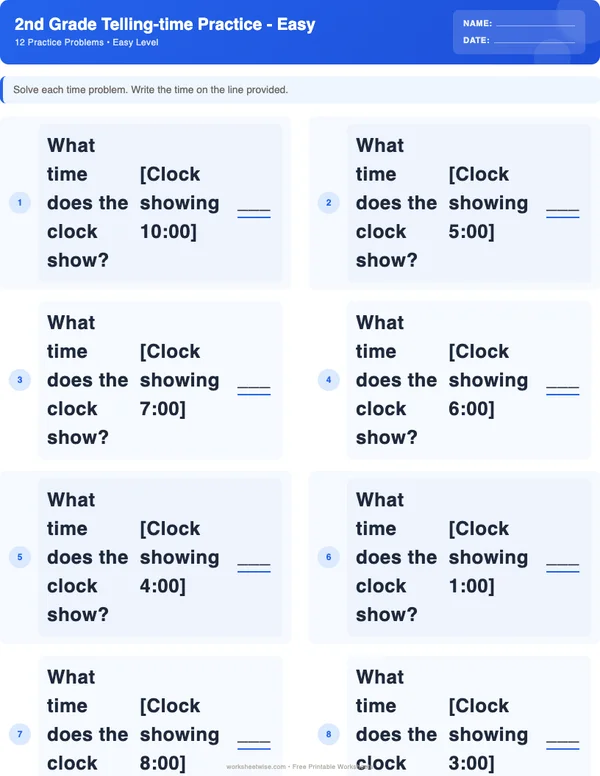
The available easy 2nd Grade telling-time worksheet contains 12 exercises and a separate answer key. Its listed skills include reading clocks, telling time, elapsed time, and time intervals. Preview the page before assigning it and select only the items that fit the learner’s current stage.
The broader 2nd Grade math collection can help place time practice alongside other current math work. The telling-time topic guide provides the focused topic route, while the 18-worksheet 2nd Grade Telling Time Pack offers additional practice options for repeated teaching and review.
Match the page to the error
Choose hour and half-hour items if the learner cannot yet identify the hour in progress. Choose clocks labeled with five-minute values if skip-counting is the barrier. Choose unlabeled clocks only after the learner can generate the sequence without relying on visible minute labels.
Use drawing tasks when reading is accurate but hand placement is weak. Use analog-to-digital matching when notation is the difficulty. Add schedule contexts when the learner can read clocks but does not yet connect a.m. and p.m. with parts of a day.
Avoid assigning a mixed elapsed-time set merely because it carries the same grade label. Inspect the actual intervals. Same-hour, forward-counting problems are more accessible than intervals crossing an hour, noon, or midnight.
Differentiation Without Changing the Core Idea
For added support, reduce visual complexity while preserving the reasoning:
- Use a larger clock face.
- Color-code the two hands temporarily.
- Add removable five-minute labels.
- Limit the first set to one hand position at a time.
- Let the learner move a geared clock before recording the time.
- Provide the sentence frame, “The hour hand has passed __, so it is __ something.”
For a learner ready for more independence:
- Mix times before and after half past.
- Alternate reading and drawing.
- Remove minute labels.
- Ask for two representations, such as analog and digital.
- Include schedule entries requiring a.m. or p.m.
- Ask the learner to explain why a plausible wrong answer is incorrect.
For extension, use a simple open-number-line interval that crosses one hour, such as 10:50 to 11:15. Count 10 minutes to 11:00 and 15 more to 11:15, giving 25 minutes. Treat such work as an extension when the core five-minute skill is secure; do not assume every second grader follows the same sequence.
Common Errors and Diagnostic Responses
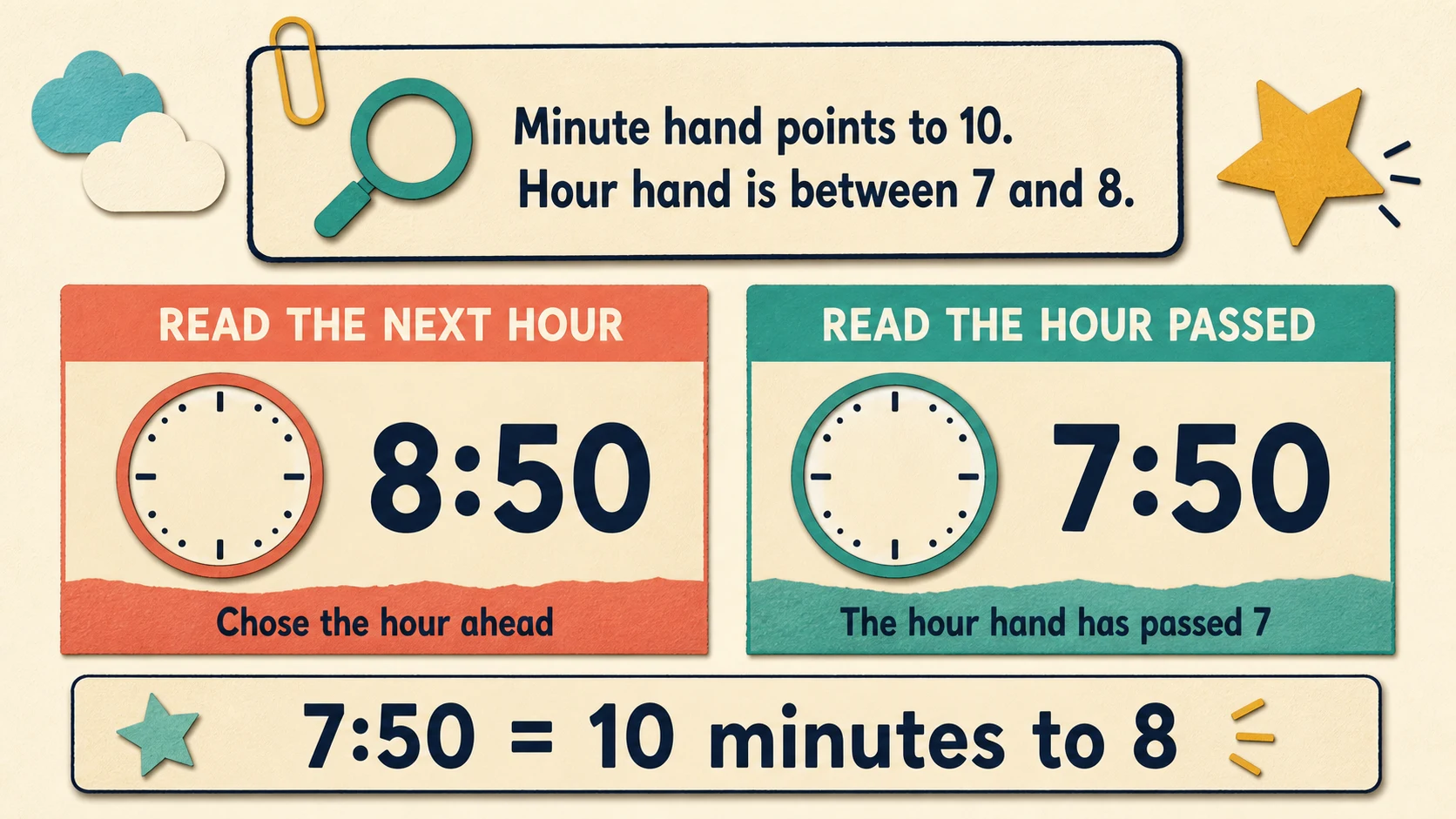
The correction should target the mistaken idea, not simply provide another page of similar questions.
| Observed work |
Likely issue to investigate |
Teaching response |
| Reads 2:20 as 4:10 |
Hand roles may be reversed |
Compare hand length and read the short hand first |
| Reads minute hand at 8 as 8 minutes |
Treats clock numerals as minute labels |
Restore the five-minute ring and count 5, 10, …, 40 |
| Reads 3:45 as 4:45 |
Chooses the nearest numeral instead of the hour already passed |
Cover the minute hand and ask which hour has begun |
| Writes 6:5 |
Digital notation is incomplete |
Match “five minutes after six” with 6:05 |
| Draws both hands at 10 for 10:50 |
Uses the same numeral for hour and minutes |
Place the minute hand, then reason where the hour hand is between 10 and 11 |
| Calls every school event a.m. |
Uses one familiar label without context |
Sort events on a morning–afternoon–evening timeline |
| Subtracts 9:45 from 10:10 as ordinary base-ten numbers |
Treats minutes as groups of 100 |
Count forward on an open number line through 10:00 |
| Answers correctly but cannot explain |
May be guessing or using a fragile cue |
Change the clock and request a hand-by-hand explanation |
One wrong response does not prove a specific misconception. Confirm it with a second example designed to isolate the same idea. If the learner reads 4:45 incorrectly, try 7:45 and 2:50 before deciding what to reteach.
Monitoring Progress and Deciding What Comes Next
Use a small weekly check with six to eight items:
- Two clocks before half past.
- Two clocks after half past.
- One digital-to-analog drawing.
- One analog-to-digital conversion.
- One a.m./p.m. context.
- Optionally, one simple forward interval.
Track three dimensions: answer accuracy, independence, and explanation. A learner who gets six answers right after repeated prompts is in a different instructional position from one who gets the same six right independently.
A practical mastery indicator is consistent success across several short sessions with unfamiliar clocks, including times after half past. This is an instructional decision rule, not a sourced universal cutoff. If results vary sharply, keep practice short and revisit the specific representation causing trouble.
Do not use speed as the only measure. A learner may need time to inspect both hands carefully while still demonstrating sound understanding. Increase variety before increasing speed.
A Two-Week Practice Plan
This plan assumes short daily sessions and can be compressed, extended, or reordered. Skip a day, repeat a day, or return to an earlier model when the learner’s work calls for it.
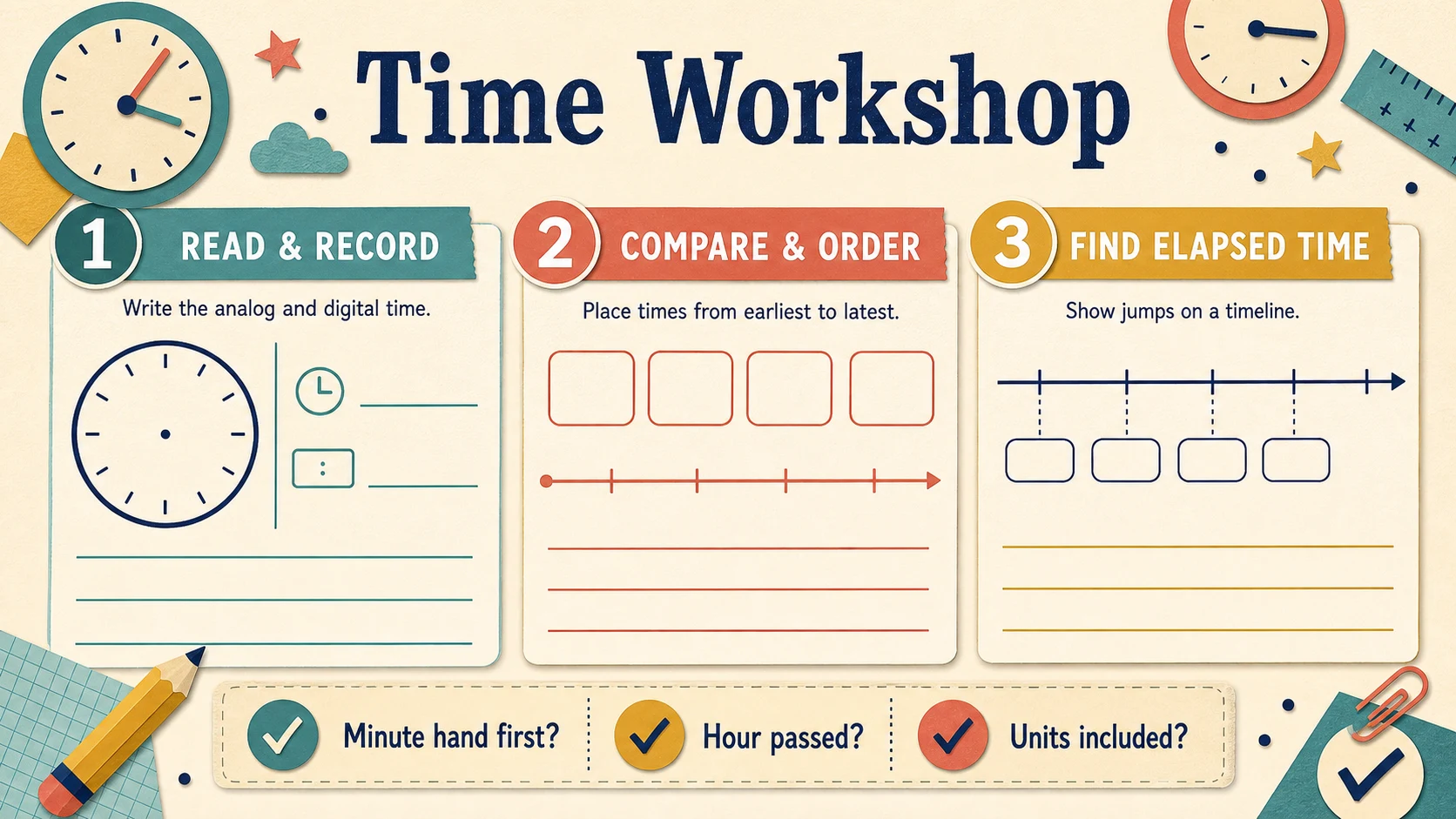
The plan alternates modeling, mixed retrieval, application, and review while leaving room to respond to observed errors.
| Day |
Focus |
Suggested activity |
Check |
| 1 |
Readiness |
Hours, half-hours, hand names, count by fives |
Identify the first unresolved prerequisite |
| 2 |
Clock structure |
Label 00–55 around a paper clock |
Match six numerals with minute values |
| 3 |
Quarter hours |
Build :15, :30, and :45 on a geared clock |
Explain the hour hand at :45 |
| 4 |
Times before :30 |
Read and build five mixed times |
Note counting or notation errors |
| 5 |
Times after :30 |
Contrast 3:45 with 4:45 and similar pairs |
Identify the hour already passed |
| 6 |
Mixed reading |
Use six unlabeled analog clocks |
Check independent accuracy |
| 7 |
Review |
Revisit the week’s two most common errors |
Use new examples, not copied answers |
| 8 |
Drawing clocks |
Draw hands for four digital times |
Inspect realistic hour-hand placement |
| 9 |
Representation matching |
Match analog, digital, and word forms |
Explain one match aloud |
| 10 |
a.m. and p.m. |
Place routine events on a day timeline |
Use context to justify each label |
| 11 |
Simple intervals |
Count forward within one hour |
Record jumps on an open number line |
| 12 |
Crossing an hour |
Count through the next o’clock boundary |
Add the jumps correctly |
| 13 |
Mixed practice |
Select suitable items from a worksheet |
Mark error types rather than only totals |
| 14 |
Transfer check |
Give unfamiliar clocks and one schedule task |
Decide whether to review, continue, or extend |
Limitations and an Honest Next Step
A printable page can provide clear, repeatable practice, but it cannot by itself reveal why an answer is wrong. It also cannot reproduce the linked movement of real clock hands unless an adult or learner uses a geared model alongside it. Daily schedules vary, so a.m./p.m. examples should use context that is clear rather than assuming every family follows the same routine.
The catalogue identifies the free worksheet as easy-level second-grade practice with 12 exercises and an answer key. That description does not establish that every exercise is suitable for every learner at the same moment. Review the actual problems, teach with a clock model when needed, and use the answer key to check work rather than to replace discussion.
For the next session, open the free 2nd Grade Telling Time worksheet, choose three to five items that match the learner’s present stage, and record the reasoning behind any error. If a more narrowly targeted page is needed afterward, use the free worksheet generators to create practice around the specific clock positions the learner is ready to study.