2nd Grade Place Value: What the Learner Needs to Understand
Second-grade place value means understanding that a digit’s value depends on its position in a number. In 352, the 3 represents 300, the 5 represents 50, and the 2 represents 2. A learner should connect written numbers to quantities, explain hundreds as groups of tens and ones, read and write numbers to 1,000, decompose numbers in more than one way, and compare numbers using place-value reasoning.
The most useful teaching sequence is:
- Build quantities with objects or base-ten blocks.
- Record those quantities in a place-value chart.
- Connect each chart entry to standard, expanded, and word form.
- Compare numbers by examining hundreds, then tens, then ones.
- Move toward drawings and mental reasoning only after the learner can explain the concrete model.
The learner’s observed work should determine the pace. A child who can write 463 but cannot show why the 6 means 60 needs more modeling, not simply more written questions.
Grade labels describe an intended practice level; local curricula and teaching sequences differ. The Common Core mathematics standards place reading, writing, comparing, and explaining numbers to 1,000 within the Grade 2 number-and-operations-in-base-ten domain. Rounding is identified later in that sequence, although the WorksheetWise catalogue includes introductory rounding practice in its second-grade worksheet. Treat rounding as an extension when it fits the learner’s local program and current understanding.
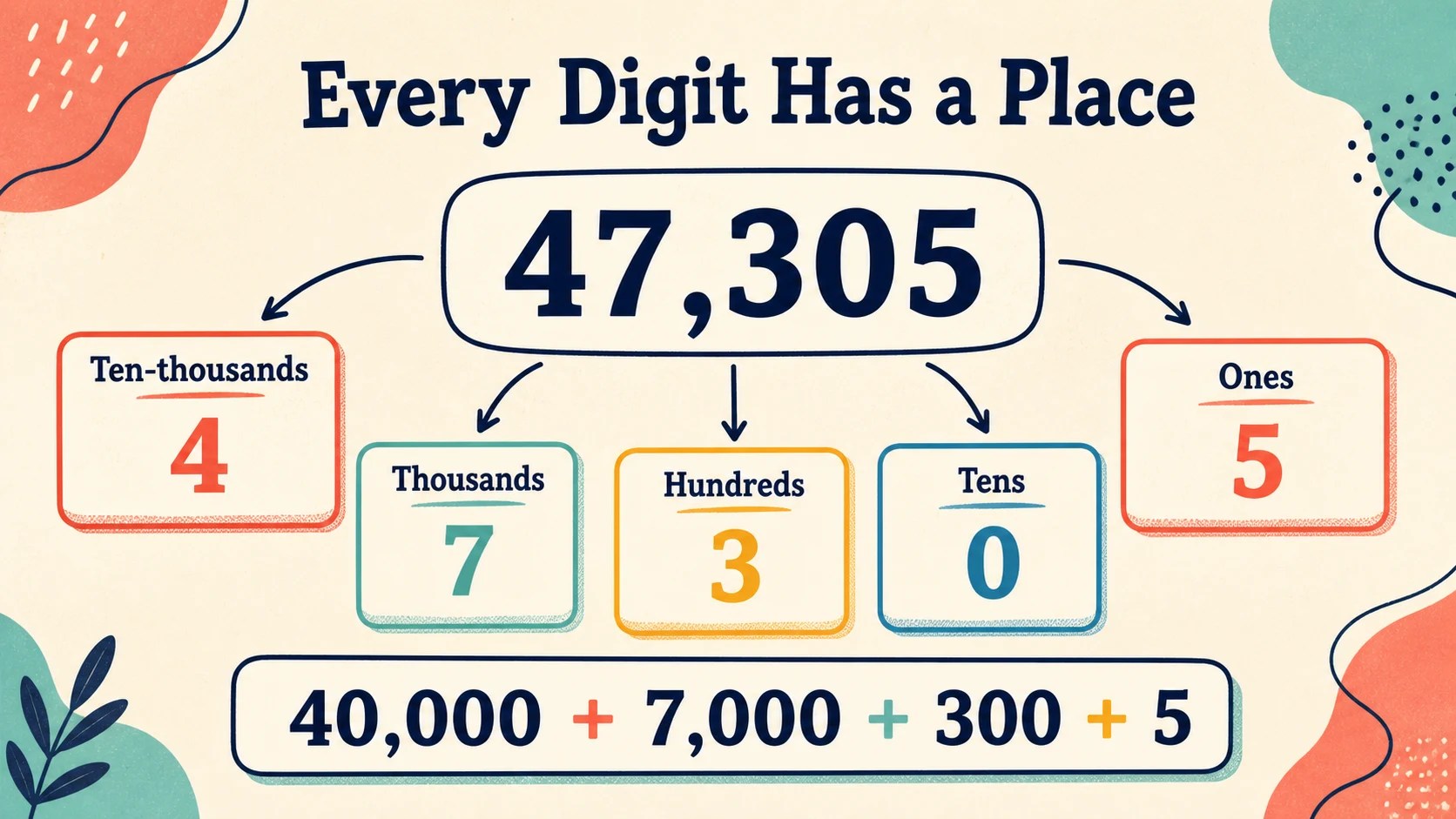
Place value connects quantities, grouped units, written forms, comparison, and later computation.
Prerequisites to Check Before Teaching Three-Digit Numbers
Place value lessons become confusing when an earlier counting or grouping difficulty is mistaken for a notation problem. Before expecting independent work with hundreds, check whether the learner can do the following:
- Count a set accurately, keeping track of which objects have been counted.
- Read and write familiar one- and two-digit numbers.
- Count forward and backward from different starting numbers.
- Group objects into sets of ten.
- Explain that one ten has the same quantity as ten ones.
- Identify the tens and ones in a two-digit number.
- Compare small quantities without relying only on a number’s visual size.
- Add multiples of ten in accessible cases, such as
30 + 20.
These checks can be brief. Give the learner 34 counters and ask for a quicker way to organize them. If the learner makes three groups of ten and leaves four ones, ask, “How many tens? How many ones? How many altogether?” Then reverse the task: request two tens and seven ones and ask for the numeral.
If the learner counts every object from one even after forming tens, that does not make the grouping useless. It shows that the connection between a group of ten and the count “ten” is not yet secure. Continue with physical grouping and verbal descriptions before introducing a long page of expanded-form exercises.
The essential equivalences
The central relationships are:
- 10 ones = 1 ten
- 10 tens = 1 hundred
- 1 hundred = 100 ones
- 1 hundred = 10 tens
These are equivalences, not merely labels. A hundred flat, ten ten-rods, and one hundred individual units represent the same amount. Trading among these forms helps a learner see that a number can be decomposed in several correct ways.
For example, 146 can be represented as:
- 1 hundred, 4 tens, and 6 ones
- 14 tens and 6 ones
- 1 hundred, 3 tens, and 16 ones
- 146 ones
A learner does not need to list every possible decomposition. The goal is to understand that regrouping changes the arrangement without changing the total.
A Grade-Appropriate Teaching Progression
Place value is a developing concept rather than a one-day topic. Move from quantities to symbols and from supported explanations to independent reasoning.
| Stage |
Main idea |
Suitable task |
Evidence to look for |
| 1. Bundle ones |
Ten ones can be treated as one unit called a ten |
Group 37 counters into tens and ones |
Learner makes 3 tens and 7 ones without losing the total |
| 2. Build hundreds |
Ten tens can be traded for one hundred |
Exchange ten ten-rods for a hundred flat |
Learner explains that the quantity did not change |
| 3. Connect models and numerals |
Each digit records a number of hundreds, tens, or ones |
Build 284 and enter it on a chart |
Learner identifies 2 hundreds, 8 tens, and 4 ones |
| 4. Read and write forms |
One number can be recorded in several forms |
Match 507, 500 + 7, and “five hundred seven” |
Learner handles the zero tens correctly |
| 5. Decompose flexibly |
A number can be regrouped without changing its value |
Show 326 in two ways |
Learner can trade one hundred for ten tens |
| 6. Compare and order |
Compare the greatest-value place first |
Compare 462 and 426 |
Learner uses the hundreds and tens, not a guess |
| 7. Apply to computation |
Place-value units support addition and subtraction |
Explain why 40 + 30 = 70 |
Learner reasons in tens |
| 8. Extend cautiously |
Number lines can introduce nearby tens or hundreds |
Locate 67 between 60 and 70 |
Learner judges distance from benchmarks |
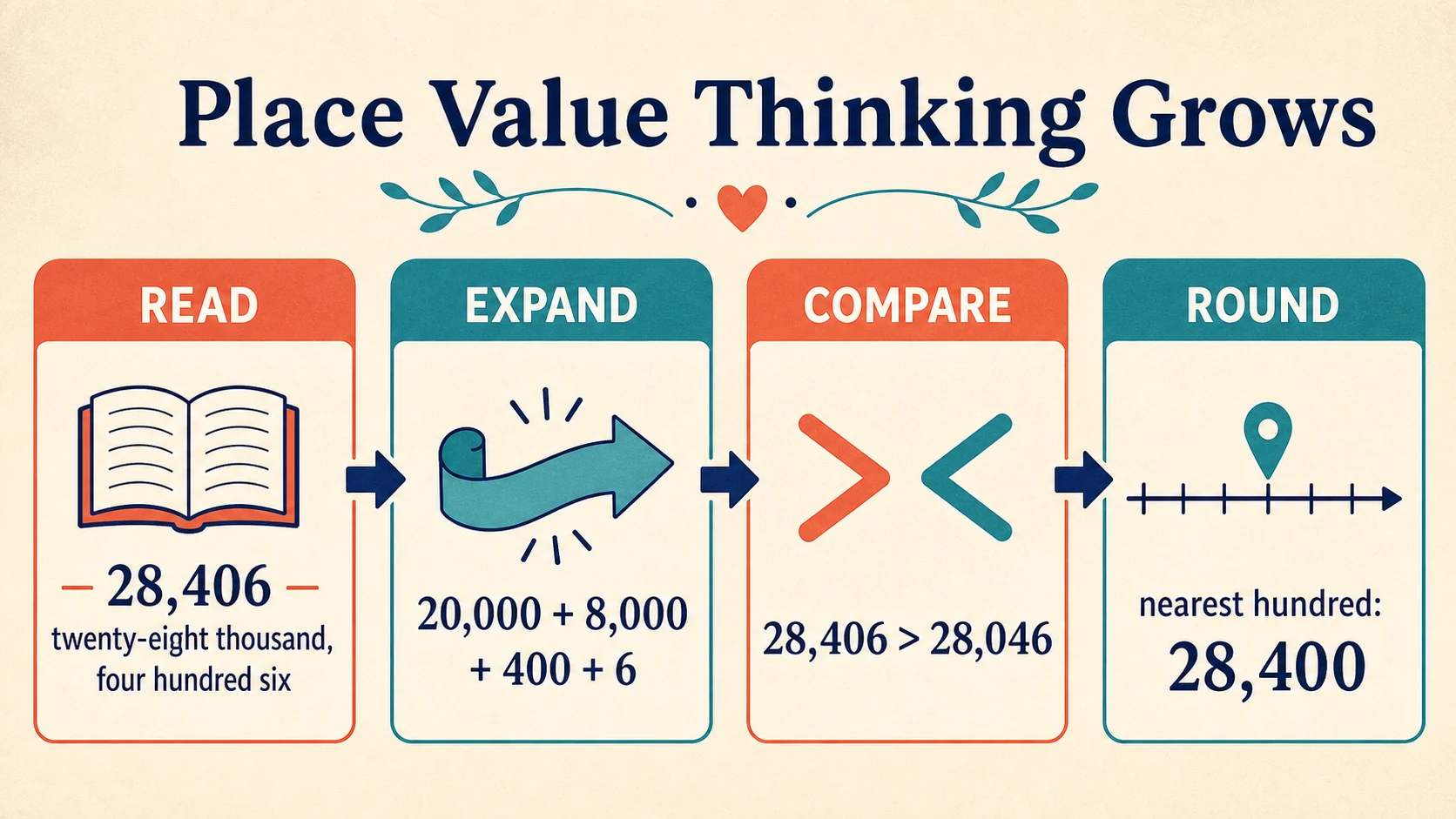
Advance when the learner can represent and explain the current stage, not merely complete one page accurately.
The IES guide for teaching mathematics to young children provides high-level support for systematic instruction that develops mathematical ideas through connected representations and purposeful discussion. It does not evaluate this guide or any WorksheetWise resource. In practice, adults can apply that framing by asking the learner to connect an object model, a drawing, spoken language, and a numeral.
Concrete and Visual Models That Clarify the Structure
Bundled objects and base-ten blocks
Bundled craft sticks, counters in cups, or straws held in groups of ten make the act of grouping visible. Base-ten blocks make repeated units easier to compare: a unit represents one, a rod represents ten, and a flat represents one hundred.
Always establish what each piece means. A learner who sees a long rod as “one block” may count pieces instead of values. Ask, “Is this one object, or does it represent ten units?” Then have the learner prove the answer by matching ten individual units to one rod.
Trading activities are especially revealing. Build 12 tens, exchange 10 of them for a hundred, and confirm that both arrangements total 120. The exchange should be described aloud:
Ten tens have the same value as one hundred, so twelve tens can be regrouped as one hundred and two tens.
This is a worked mathematical explanation, not a quotation from an external source.
Place-value charts and discs
Use columns labeled hundreds, tens, and ones. Place each block, drawing, or disc in the appropriate column before writing the numeral beneath it. Keep the column widths consistent so position remains visually clear.
For 309, place three hundred pieces in the hundreds column, nothing in the tens column, and nine units in the ones column. The empty tens column is meaningful. It is recorded with a zero so that the 3 remains in the hundreds place.
Place-value discs can also show flexible regrouping. One “100” disc can be replaced with ten “10” discs. The printed values help some learners focus on worth rather than physical size.
Quick drawings and number lines
After concrete models are understood, replace them with quick sketches: large squares for hundreds, lines for tens, and dots for ones. Artistic detail is unnecessary. The learner should be able to produce and interpret the drawing efficiently.
Number lines are useful for ordering and for later work with benchmarks. They should not replace base-ten models too early because they show relative position more clearly than the internal composition of a number. Use the model that matches the question:
- Use blocks or bundles to investigate composition.
- Use a place-value chart to connect positions and digits.
- Use quick drawings to record a model efficiently.
- Use a number line to compare location or distance.
Fully Worked Place Value Examples
Example 1: Build and write 243
Represent 243 with 2 hundred flats, 4 ten-rods, and 3 units.
The values are:
- 2 hundreds =
2 × 100 = 200
- 4 tens =
4 × 10 = 40
- 3 ones =
3 × 1 = 3
Combine them:
200 + 40 + 3 = 243
Therefore:
- Standard form:
243
- Expanded form:
200 + 40 + 3
- Word form:
two hundred forty-three
Check: 200 + 40 = 240, and 240 + 3 = 243.
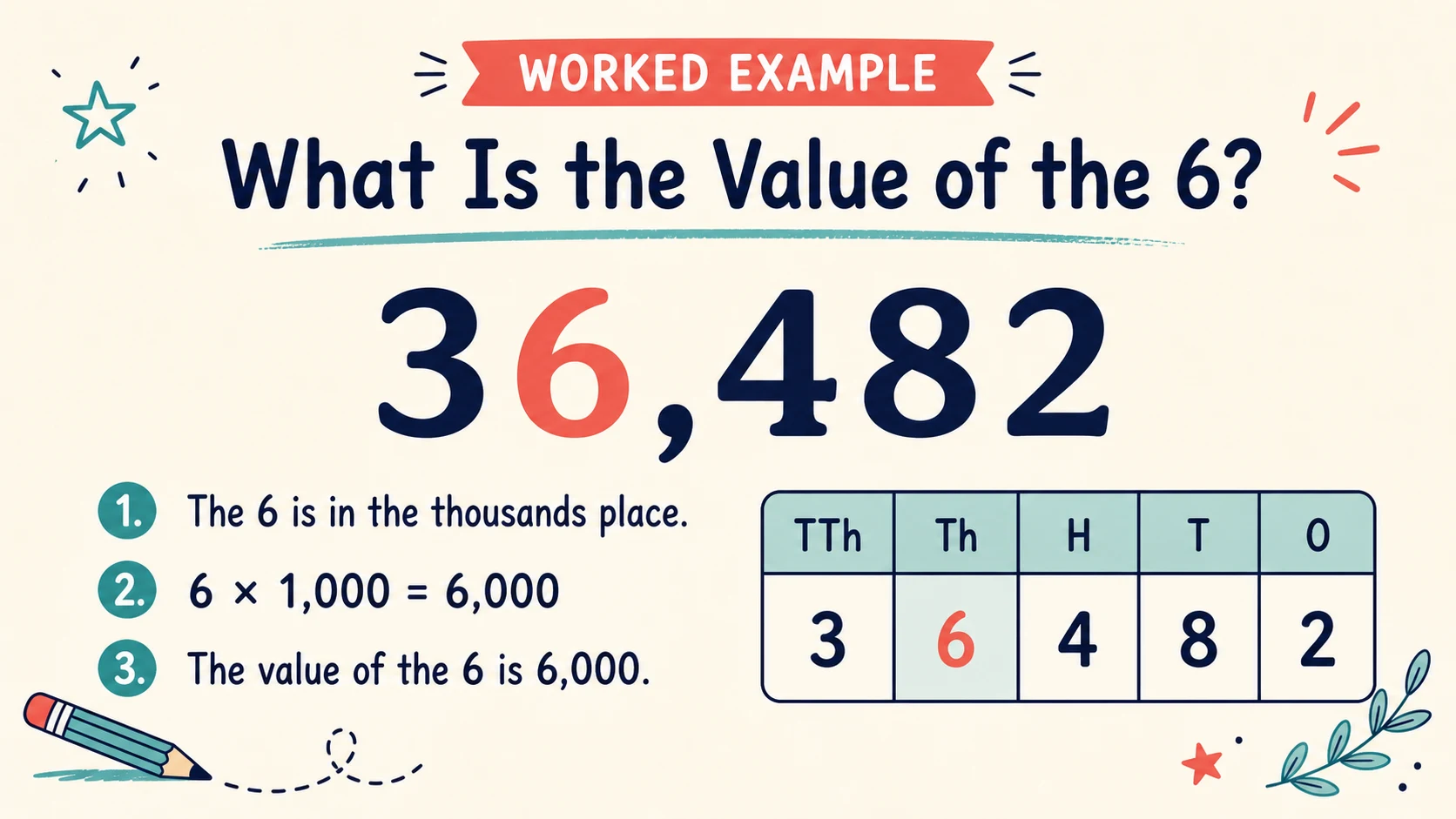
The model, place-value language, expanded form, and numeral all describe the same quantity.
Example 2: Interpret a zero in 508
In 508:
- The 5 is in the hundreds place, so its value is 500.
- The 0 is in the tens place, so there are no tens.
- The 8 is in the ones place, so its value is 8.
Expanded form is:
500 + 8
Writing 50 + 8 would make 58, not 508. Writing 500 + 0 + 8 is also correct, but the zero term may be omitted because adding zero does not change the total.
Check: 500 + 8 = 508.
This is a boundary case because the empty place lies between two occupied places. Compare it with 580, where the 8 represents 80 and the ones place is empty.
Example 3: Decompose 372 in two correct ways
The usual decomposition is:
372 = 3 hundreds + 7 tens + 2 ones
In values:
372 = 300 + 70 + 2
Trade one hundred for ten tens. The new representation is:
372 = 2 hundreds + 17 tens + 2 ones
Check the second form:
200 + 170 + 2 = 372
Both are correct. The first follows the conventional digit-by-digit decomposition. The second demonstrates regrouping while preserving the total.
Example 4: Compare 684 and 648
Compare the greatest-value place first.
- Hundreds: both numbers have 6 hundreds.
- Tens: 684 has 8 tens, while 648 has 4 tens.
- Because 8 tens is greater than 4 tens, there is no need to use the ones.
Therefore:
684 > 648
Check by expansion:
684 = 600 + 80 + 4648 = 600 + 40 + 8
After the equal 600 is set aside, 84 is greater than 48.
Example 5: Order 299, 920, 209, and 290
Compare hundreds first:
- 209, 290, and 299 have 2 hundreds.
- 920 has 9 hundreds, so it is greatest.
Among the three numbers with 2 hundreds, compare tens:
- 209 has 0 tens.
- 290 and 299 each have 9 tens.
Thus, 209 is the smallest. Finally, compare the ones in 290 and 299:
- 290 has 0 ones.
- 299 has 9 ones.
The ascending order is:
209 < 290 < 299 < 920
Example 6: An optional rounding extension
Locate 67 between 60 and 70. Its distances are:
- From 60:
67 − 60 = 7
- From 70:
70 − 67 = 3
Because 67 is closer to 70, it rounds to 70 when rounding to the nearest ten.
For the midpoint 65, local conventions ordinarily direct the learner to the next ten, 70. Teach this through the number line and the agreed rounding convention, not as a substitute for place-value understanding. Because rounding may sit outside a particular second-grade sequence, use it only when the learner’s curriculum calls for it.
A Short, Repeatable Lesson Routine
A focused lesson can follow the same structure while the numbers and representations change.
| Phase |
Adult action |
Learner action |
| Retrieve |
Ask one brief prerequisite question |
Explain a known tens-and-ones relationship |
| Model |
Build one number and narrate each representation |
Watch, answer prompts, and check the total |
| Practice together |
Give a similar number with blocks or a chart |
Build, record, and explain with support |
| Independent check |
Present one or two carefully chosen tasks |
Solve without prompts and show reasoning |
| Review |
Examine the work and name the next need |
Correct an error or explain a successful method |
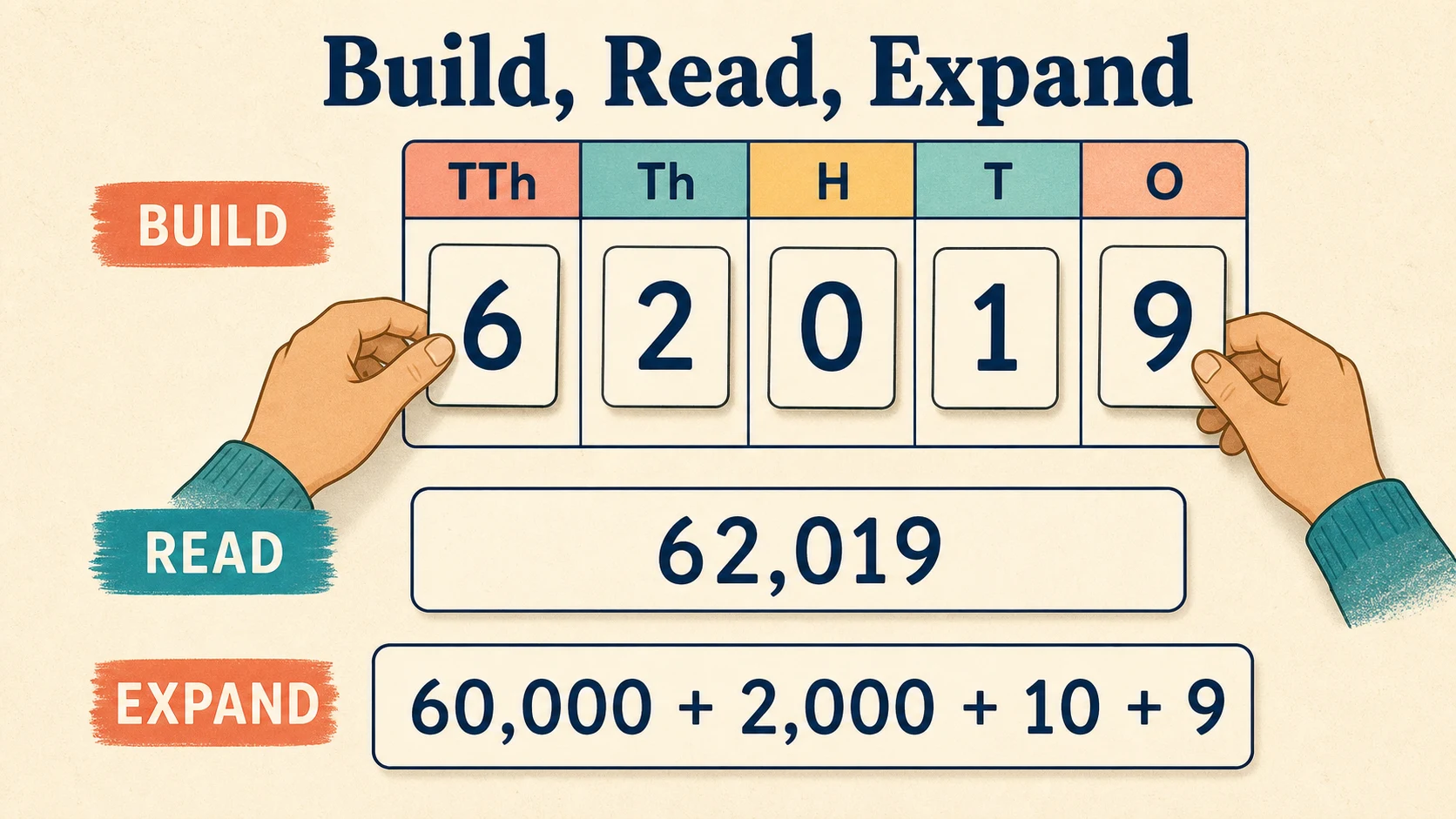
Keep the routine stable so attention can stay on the changing mathematical idea.
A practical session might take 10 to 20 minutes, but that is an instructional suggestion, not a universal timetable. Stop earlier if attention or accuracy deteriorates. Continue longer only when the learner remains engaged and the extra examples serve a clear purpose.
Useful prompts include:
- “What does this digit represent?”
- “How could you prove the total?”
- “Can you show the same number another way?”
- “Which place should we compare first?”
- “What does the zero tell us?”
- “Did regrouping change the number or only its arrangement?”
The IES practice guide on assisting students who struggle with mathematics supports explicit, systematic teaching and the use of visual representations as part of high-level instructional framing. It does not prescribe a particular lesson length or certify these materials. Here, that framing means modeling one step at a time, checking the learner’s explanation, and reducing prompts gradually.
Choosing Practice That Matches the Evidence
Select work by the learner’s current error pattern rather than by page count.
A learner who cannot connect blocks to numerals needs model-to-number matching. A learner who reads models correctly but writes 600 + 3 as 63 needs work with zero placeholders. A learner who handles forms accurately but compares 438 and 483 incorrectly needs targeted comparison practice.
A sensible practice set mixes three task types:
- Current focus: several items targeting the exact concept being taught.
- Recent review: a few previously successful items to check retention.
- Explanation: one item that asks for a model, justification, or second representation.
Keep early sets narrow. Ten varied tasks can obscure the source of an error if each demands a different process. Once understanding is stable, mixed practice is useful for deciding which method applies.
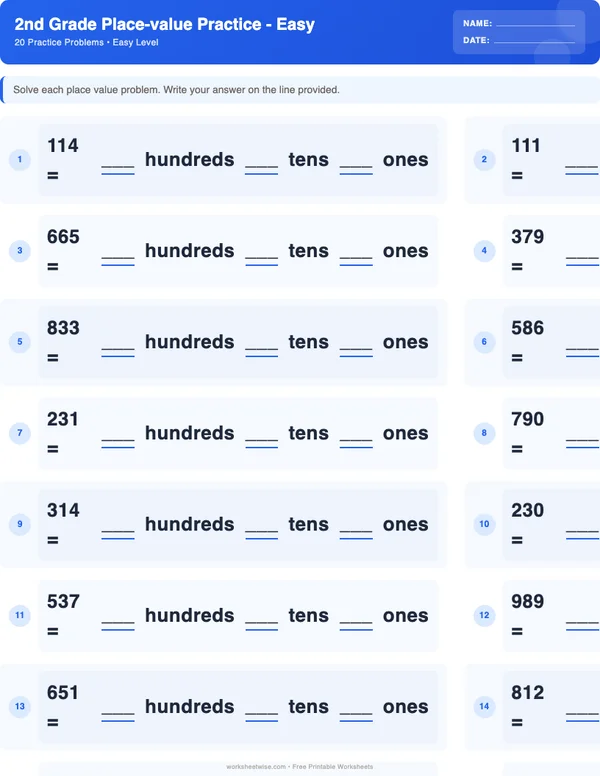
The free standard easy place-value worksheet contains 20 exercises and an answer key. Its catalogue skills include identifying place values, expanded form, number comparison, and rounding. Preview the item types and assign only those that fit the learner’s present stage. The wider 2nd Grade math collection can support related work, while the Place Value topic guide keeps the focus on this number-system concept.
Differentiation Without Changing the Central Idea
When the learner needs more support
Reduce the number range and representation load, but preserve the reasoning.
- Return from three-digit numbers to two-digit grouping.
- Let the learner touch and move each block.
- Cover unused chart columns temporarily.
- Present one conversion at a time, such as model to numeral.
- Use numbers with all places occupied before introducing internal zeros.
- Ask for an oral explanation before requiring written word form.
- Provide a sentence frame: “The digit __ is worth __ because it is in the __ place.”
If difficulty persists, use fewer examples per session and revisit prerequisite counting and grouping. More written repetition will not repair an unclear meaning by itself.
When the learner is ready for more challenge
Increase flexibility rather than simply increasing the number of questions.
- Request two decompositions of the same number.
- Ask which of two models is easier to interpret and why.
- Include numbers such as 407, 470, and 704.
- Ask the learner to create a number that meets conditions: “It has 5 hundreds, fewer than 3 tens, and an even number of ones.”
- Present an incorrect solution and ask for a correction.
- Connect place value to addition: “How does knowing 6 tens plus 2 tens help with 60 + 20?”
Stay within the number range and concepts appropriate to the learner’s sequence. Larger numbers are not automatically better evidence of deeper understanding.
Common Errors and Diagnostic Responses
Reversing or misplacing digits
A learner builds 3 hundreds, 4 tens, and 2 ones but writes 324.
Ask the learner to place each model in a labeled chart and read from hundreds to ones. Determine whether the problem is place-value interpretation, writing order, or a brief transcription slip.
Ignoring an empty place
A learner writes 506 as 56.
Build 506 and 56 side by side. The first has five hundreds, no tens, and six ones; the second has five tens and six ones. Ask what the zero preserves in 506.
Reading digits as separate counts
A learner says the 7 in 274 is worth 7.
Ask for seven ones and seven tens, then compare them. Label the digit’s face value as 7 and its value in 274 as 70. Avoid accepting “the 7 is in the middle” as a complete explanation.
Comparing by the wrong digit
A learner says 398 is greater than 421 because 9 is greater than 2.
Expand or model both numbers. Four hundreds already exceed three hundreds, so 421 is greater. Reinforce comparison from the greatest-value place toward the ones.
Treating expanded form as digit separation
A learner writes 482 = 4 + 8 + 2.
Build the number and label the values: 400, 80, and 2. Then verify that 4 + 8 + 2 = 14, which cannot equal 482.
Assuming a longer arrangement means a larger value
Ten separate tens may stretch farther across a table than one hundred flat. Match or trade the pieces to establish equality. Physical appearance is not the deciding evidence; unit value and quantity are.
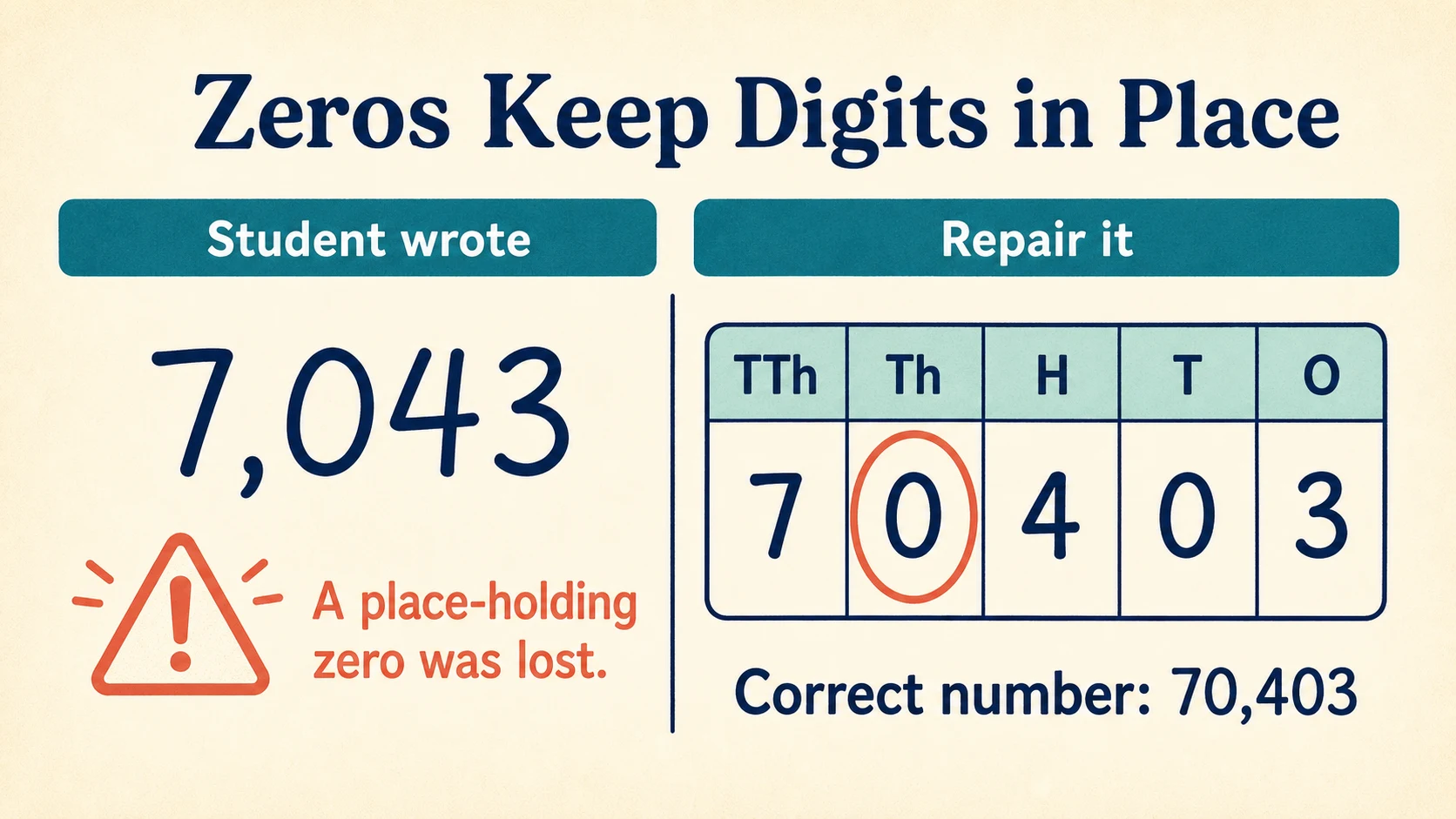
An error is most useful when it leads to a focused check and a matching teaching response.
Monitoring Understanding and Deciding When to Move On
Do not use accuracy alone. A copied procedure can produce correct answers without secure understanding. Monitor four forms of evidence:
- Representation: Can the learner build or draw the number?
- Translation: Can the learner move among standard, expanded, and word form?
- Explanation: Can the learner state what each digit represents?
- Transfer: Can the learner apply the idea to an unfamiliar but similar number?
Record only enough information to guide the next lesson. A simple note might read: “Accurate with three occupied places; omits zero in 406; compare after modeling.” The next session should begin with the unresolved issue.
A learner is ready to advance when performance is accurate across more than one occasion, explanations refer to place values, and support can be reduced without the method collapsing. If an error appears only once, check again before redesigning instruction. If the same error recurs in different formats, return to the corresponding model.
A Two-Week Practice Plan
This plan assumes short sessions on weekdays. Adjust the pace, number range, and repetition to observed work and local requirements.
| Day |
Focus |
Suggested evidence |
| 1 |
Check counting, tens, and ones |
Group a quantity and explain each bundle |
| 2 |
Trade 10 ones for 1 ten |
Show equal quantities before and after a trade |
| 3 |
Trade 10 tens for 1 hundred |
Build 100 in two ways |
| 4 |
Build and read three-digit numbers |
Match models, charts, and numerals |
| 5 |
Review and correct one recurring error |
Explain why the correction is valid |
| 6 |
Standard and expanded form |
Translate five carefully chosen numbers |
| 7 |
Word form and internal zeros |
Distinguish 305, 350, and 503 |
| 8 |
Flexible decomposition |
Show two forms of one number |
| 9 |
Compare and order |
Justify comparisons from hundreds onward |
| 10 |
Mixed check and next-step decision |
Complete a short independent sample and explain two answers |
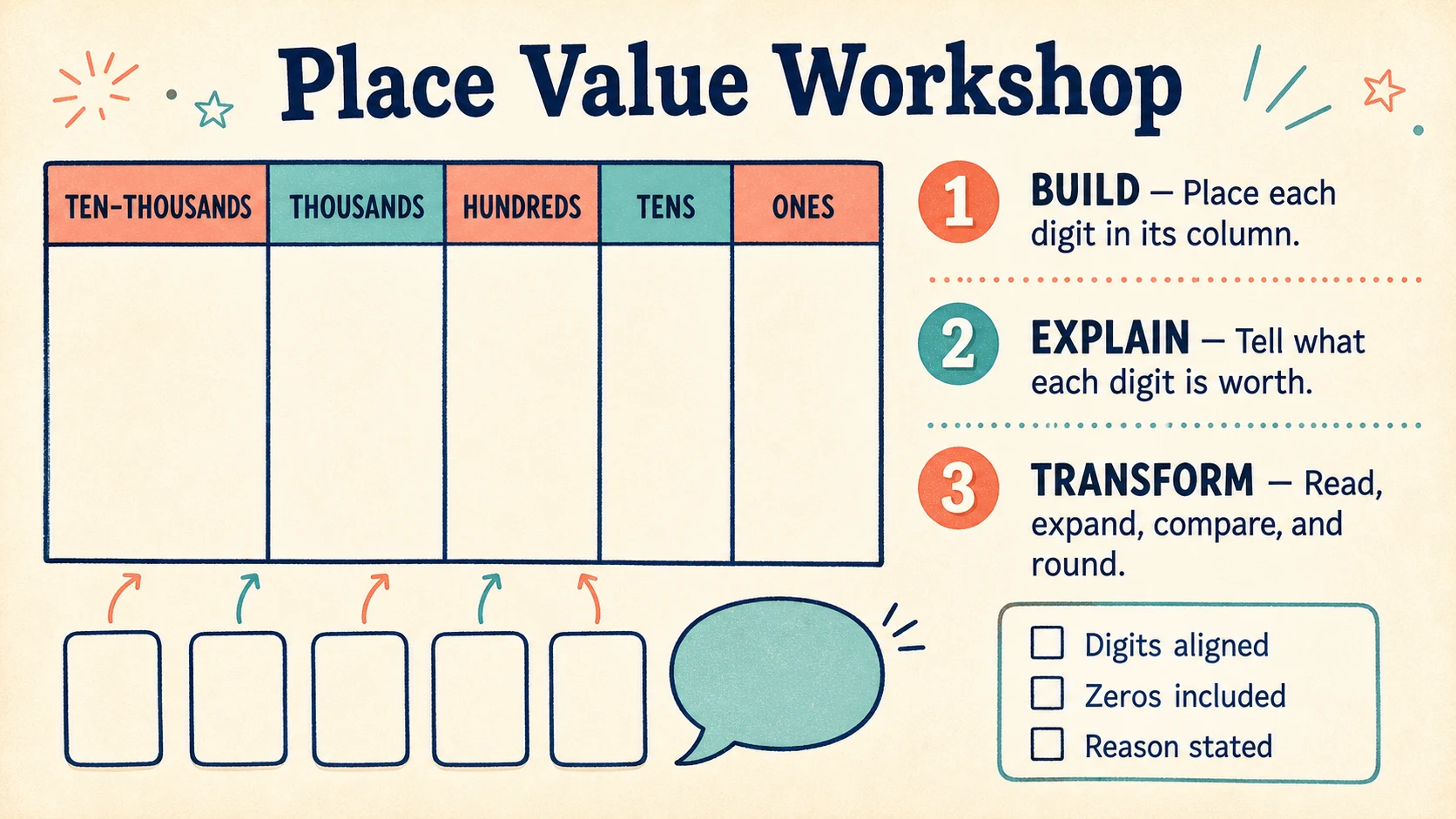
Use the plan as a decision framework; repeat, shorten, or reorder days according to the learner’s evidence.
If Day 4 shows confusion about hundreds, repeat concrete trading before moving to expanded form. If Day 7 is secure, combine word form with comparison. Rounding can be added after Day 9 only when the learner’s curriculum includes it and number-line reasoning is established.
Scope, Limitations, and the Next Useful Step
This guide supports instruction and practice selection; it cannot determine an individual learner’s complete needs from a worksheet score. It does not provide medical guidance, guarantee outcomes, certify mastery, or establish comprehensive alignment with every local curriculum. The cited sources offer broad instructional and standards context and have not reviewed WorksheetWise or this article.
The available worksheet also spans several skills, so it may contain items that are premature for a learner still developing basic grouping. Use the answer key to check results, then inspect the reasoning behind incorrect and correct answers. A correct response with no explanation may deserve one follow-up prompt; a patterned error deserves a focused model and a smaller practice set.
For the next session, choose one unresolved skill and teach it with objects, a chart, and one independent check. Then use the free 2nd Grade Place Value worksheet selectively. If the learner needs sustained practice across the topic, review the 18-resource focused place-value pack; if different numbers or a narrower task would fit better, create targeted material with the free worksheet generators.