What 2nd Grade Long Vowels Means
Long vowels are vowel sounds in which the vowel commonly says its letter name:
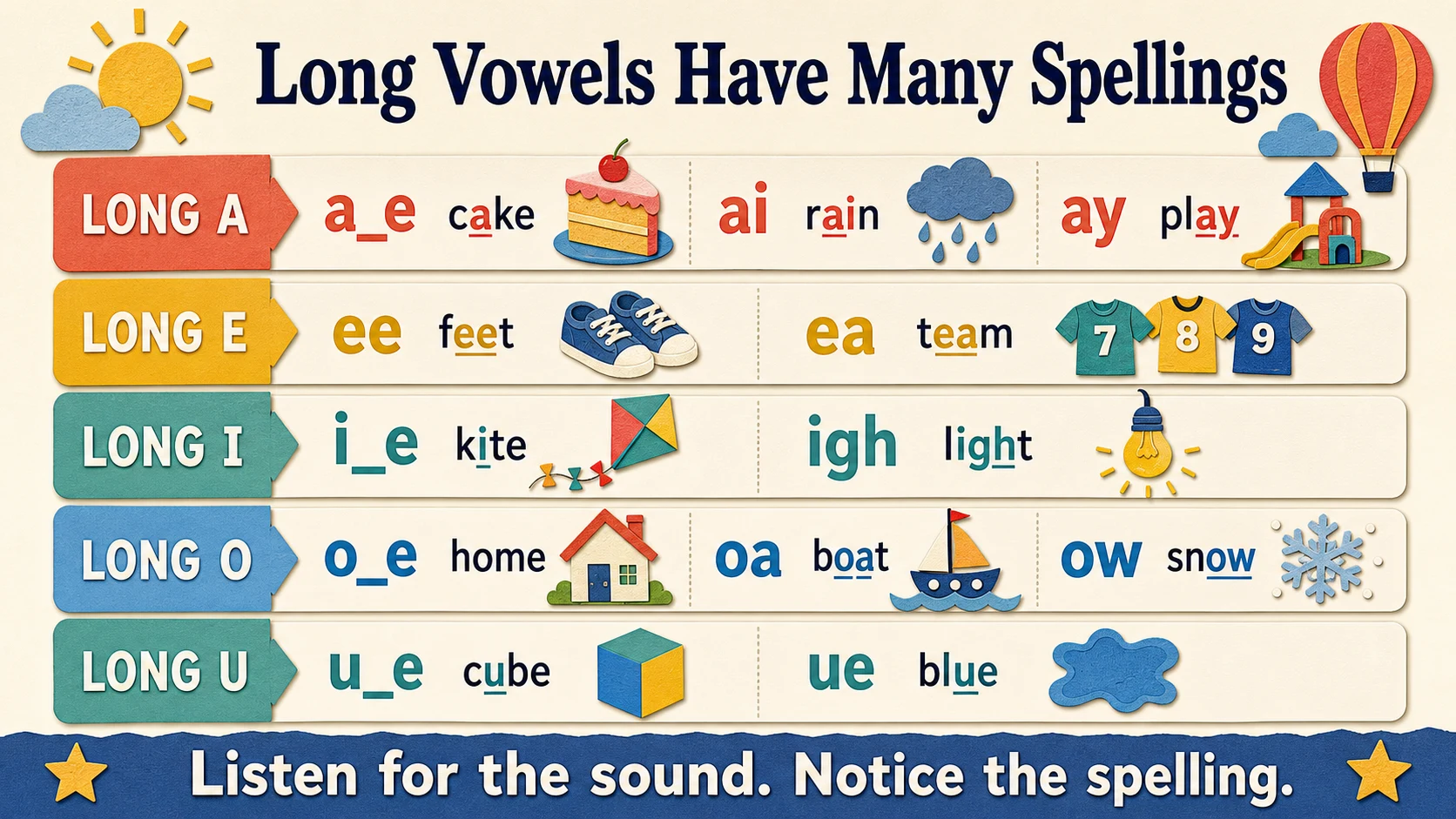
- Long a: cake
- Long e: feet
- Long i: kite
- Long o: bone
- Long u: cube
The concise teaching goal is this: help the learner recognize common long-vowel spelling patterns, use those patterns to decode words, distinguish long vowels from short vowels, and spell practiced words from dictation.
Second-grade work usually extends beyond simple consonant-vowel-consonant words such as cap, pin, and hop. Learners encounter silent-e words, vowel teams, and open syllables:
| Pattern |
What the learner notices |
Examples |
| Silent e, or CVCe |
A final e changes the earlier vowel sound |
make, ride, hope, cube |
| Vowel team |
Two letters represent the vowel sound |
rain, feet, boat, play |
| Open syllable |
The vowel ends a syllable and is long |
he, go, music |
Grade labels describe an intended practice level, not a promise that every learner should follow the same timetable. Local curricula and teaching sequences differ. The learner’s observed reading and spelling should determine the starting point, pace, and amount of review.
The skill connects sound recognition, spelling-pattern knowledge, decoding, and encoding.
The IES foundational reading practice guide provides authoritative high-level guidance about teaching foundational reading skills systematically and helping learners decode words. It did not evaluate WorksheetWise or this particular worksheet. The Common Core English Language Arts standards also identify distinguishing long and short vowels in regularly spelled one-syllable words and learning additional common vowel-team correspondences as relevant foundational skills. Standards documents describe expectations; they do not establish one universal lesson order.
Check the Prerequisites Before Moving Ahead
Long-vowel instruction is more productive when the learner can already work confidently with short-vowel CVC words. Before introducing a new pattern, check whether the learner can:
- Give the common short sounds for a, e, i, o, and u.
- Blend three sounds into a word:
/m/ /a/ /p/ → map.
- Segment a spoken CVC word: fin →
/f/ /i/ /n/.
- Read familiar CVC words without guessing from the first letter.
- Notice the difference between pairs such as cap/cape or hop/hope when an adult reads them.
- Write a simple word after hearing its individual sounds.
A learner does not need perfect speed or spelling before beginning long vowels. However, frequent confusion with basic consonant sounds or short-vowel CVC words indicates that the foundation needs attention.
A quick readiness check
Use six words that the learner has not just rehearsed: map, fin, pet, hop, sun, and rug. Ask the learner to read each word and then spell two or three from dictation. Record exactly what happens.
If map becomes mop, the immediate need may be short-vowel discrimination. If the learner reads every word correctly but slowly blends each phoneme, long-vowel instruction can begin in small amounts while CVC fluency continues. If the learner guesses mouse for map, return to left-to-right attention and complete blending.
The purpose of this check is instructional, not diagnostic in a medical or clinical sense. It shows which prerequisite to teach next; it does not identify a disability or prescribe child-specific treatment.
Teach a Manageable Progression
A useful progression begins with the visually distinctive silent-e pattern. It then adds common vowel teams and open syllables while continually contrasting long and short sounds.
Support should decrease only after the learner demonstrates accurate reading and spelling.
| Stage |
Main focus |
Supported activity |
Evidence for moving on |
| 1 |
Short versus long vowel listening |
Sort spoken pairs such as cap/cape |
Learner consistently identifies which word has the long sound |
| 2 |
Silent-e word pairs |
Build tap/tape, pin/pine, hop/hope |
Learner reads both members without relying on pictures |
| 3 |
Mixed silent-e decoding |
Read unfamiliar CVC and CVCe words |
Learner attends to the final e and self-corrects |
| 4 |
Common vowel teams |
Sort words by ai, ay, ee, ea, oa |
Learner names the sound and identifies its spelling |
| 5 |
Multiple spellings for one sound |
Sort long-a words into a_e, ai, ay |
Learner reads across columns without treating one spelling as universal |
| 6 |
Open syllables |
Read he, go, and the first syllable in music |
Learner recognizes that a vowel can end a syllable |
| 7 |
Encoding and connected use |
Dictate words, then short sentences |
Learner represents the target pattern in writing |
| 8 |
Cumulative review |
Mix old and new patterns |
Learner selects a strategy without being told the pattern |
This sequence is an instructional suggestion based on the supplied catalogue progression. It is not a claim that every school uses the same order. Browse the 2nd Grade phonics collection when selecting practice that matches the learner’s current stage rather than assigning every available page in order.
Why silent e is a practical starting point
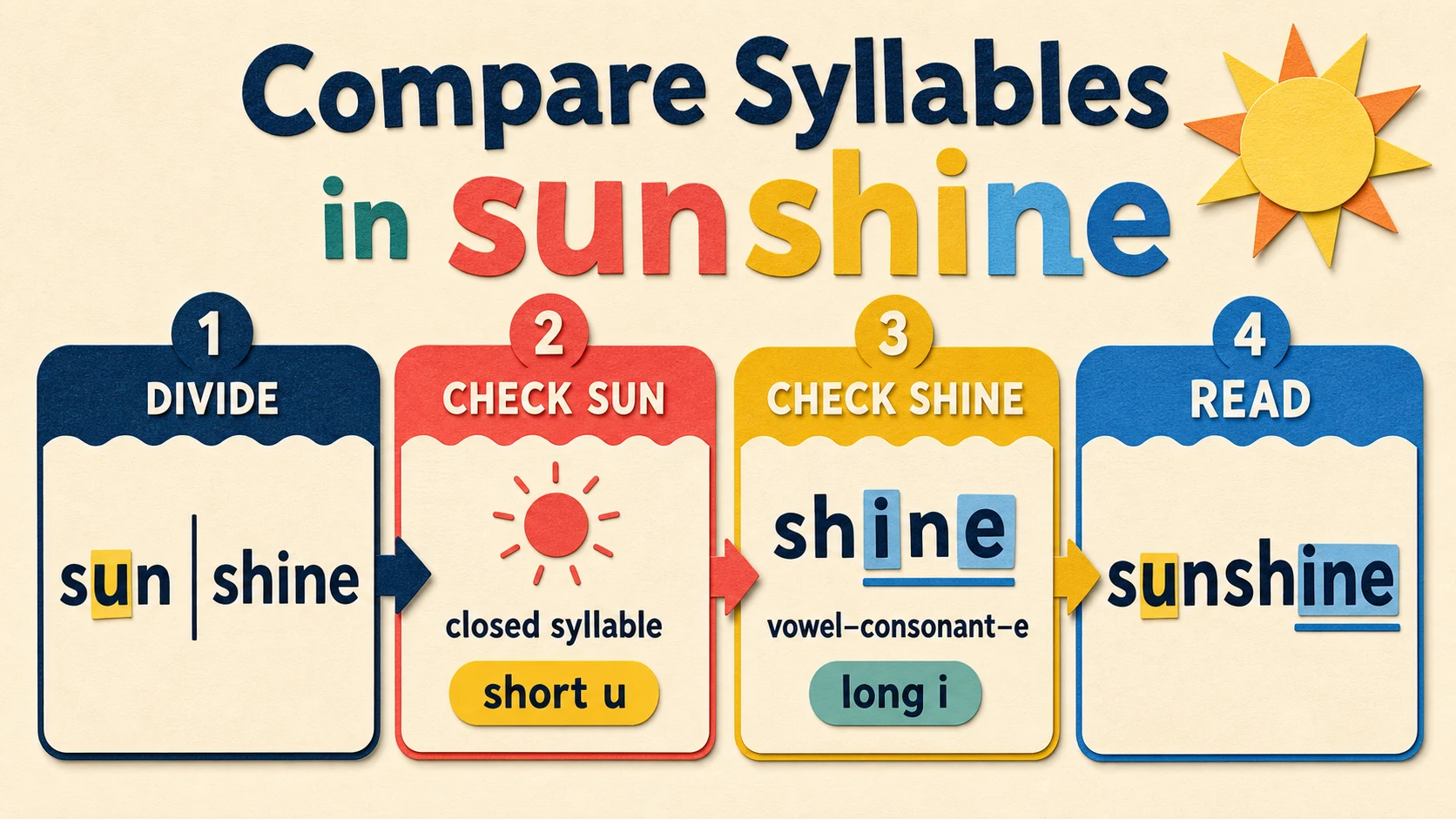
Silent e creates a clear visual contrast:
cap  →  cape
pin  →  pine
hop  →  hope
cub  →  cube
The final e is not pronounced as a separate sound in these examples. Its presence signals a change in the earlier vowel. The familiar explanation “the e at the end makes the vowel say its name” is useful for these regular instructional examples.
It should not be turned into a claim that every word ending in e contains a long vowel. Words such as have and give are boundary cases: they end in e, but their preceding vowels are not long. Teach the regular pattern clearly, then identify exceptions when they appear in actual reading.
How to introduce vowel teams carefully
Vowel teams represent another common route to a long-vowel sound:
- Long a: rain, play
- Long e: feet, team
- Long o: boat, snow
- Long u: blue
The saying “when two vowels go walking, the first one does the talking” may help a learner initially notice ai, ay, ea, ee, and oa. Present it as a starting strategy, not an absolute rule. English vowel teams do not all behave alike, and the same team can appear in words with different pronunciations.
For second-grade practice, teach one or two useful patterns at a time. Let the learner read, sort, and spell words with those patterns before introducing a larger mixed set.
Make the Pattern Concrete and Visible
A visual model should direct attention to letters and sounds rather than replace reading with picture guessing. Letter tiles, index cards, sound boxes, and handwritten word chains are sufficient.
Model 1: change one word into another
Place the letters c-a-p in a row. Ask the learner to blend cap. Add e to create c-a-p-e, then read cape. Say the pair aloud and compare the middle vowel sounds.
Repeat with:
rid  →  ride
hop  →  hope
cub  →  cube
The word rid may be less familiar than ride, so confirm its meaning briefly if necessary. The phonics work remains focused on how the added letter changes the vowel sound.
Model 2: map sounds and spellings
A sound box represents each phoneme, not necessarily each letter:
rain:  /r/ | /ā/ | /n/
letters: r | ai | n
The letters ai share one box because together they represent the long-a sound. In cake, the final e is part of the spelling pattern but does not occupy its own spoken-sound box:
cake:  /k/ | /ā/ | /k/
letters: c | a_e | k
This comparison helps the learner see that the same sound can have different spellings.
Fully Checked Worked Examples
The following examples show both the answer and the reasoning an adult can model. They use regular words within the supplied long-vowel patterns.
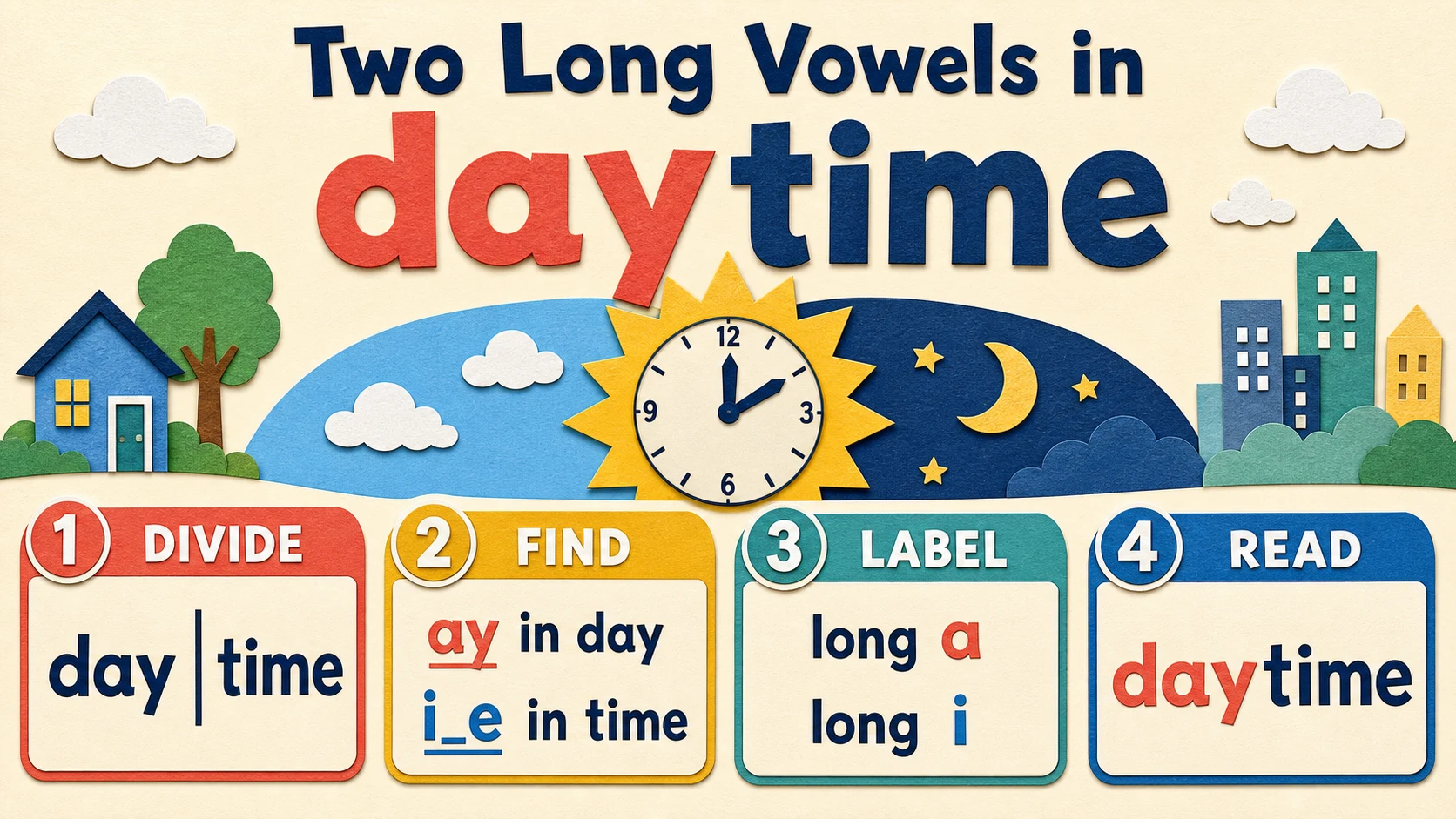
Move from hearing the sound to locating the spelling and reading the complete word.
Worked example 1: hop and hope
Task: Identify the vowel sound in each word and explain the change.
- Read hop:
/h/ /ŏ/ /p/.
- The word follows a CVC pattern and has short o.
- Read hope:
/h/ /ō/ /p/.
- The final e is silent, and o_e represents long o.
- Check the result by saying both words: hop, hope.
Answer: Hop has short o; hope has long o.
This pair is especially useful because only one written letter changes. The learner can connect that visible change to the changed vowel sound.
Worked example 2: rain
Task: Find the long-vowel spelling and identify its sound.
- Scan the word: r-ai-n.
- Notice the adjacent vowels ai.
- Blend the sounds:
/r/ /ā/ /n/.
- Read the complete word: rain.
- Verify that ai represents the long-a sound in this word.
Answer: ai is the vowel team, and it represents long a.
A useful follow-up is to remove r and replace it with p. The new word, pain, retains the same vowel team and vowel sound.
Worked example 3: sorting cake, rain, and play
Task: Sort the words by their long-a spelling.
- Cake contains a_e: c-a-k-e.
- Rain contains ai: r-ai-n.
- Play contains ay: p-l-ay.
- Say each word and confirm that all three contain
/ā/.
- Place each word under its spelling heading.
Answer: All three words have long a, but each uses a different spelling pattern.
The important conclusion is not that the patterns are interchangeable in spelling. The learner must remember which conventional spelling belongs to a particular word.
Worked example 4: feet and team
Task: Compare two spellings of long e.
- In feet, ee represents
/ē/.
- Blend:
/f/ /ē/ /t/ → feet.
- In team, ea represents
/ē/.
- Blend:
/t/ /ē/ /m/ → team.
- Compare the spellings while holding the vowel sound constant.
Answer: Feet uses ee, while team uses ea. Both contain long e.
For encoding, do not ask the learner to infer the correct team from sound alone. Because both teams can represent /ē/, provide prior practice, a word bank, or corrective feedback.
Worked example 5: the open syllable in music
Task: Locate the long vowel in music.
- Divide the word for this instructional analysis: mu-sic.
- The first syllable, mu, ends with a vowel.
- In this word, u represents its long sound at the end of the open syllable.
- Blend the syllables: mu-sic.
- Read the whole word: music.
Answer: The u in the first, open syllable is long.
This example extends beyond one-syllable CVCe words. It should follow, not replace, secure work with simpler long-vowel patterns.
Use a Short, Repeatable Lesson Routine
A compact routine makes the instructional purpose visible. Five parts are enough; their exact duration should depend on the learner’s responses.
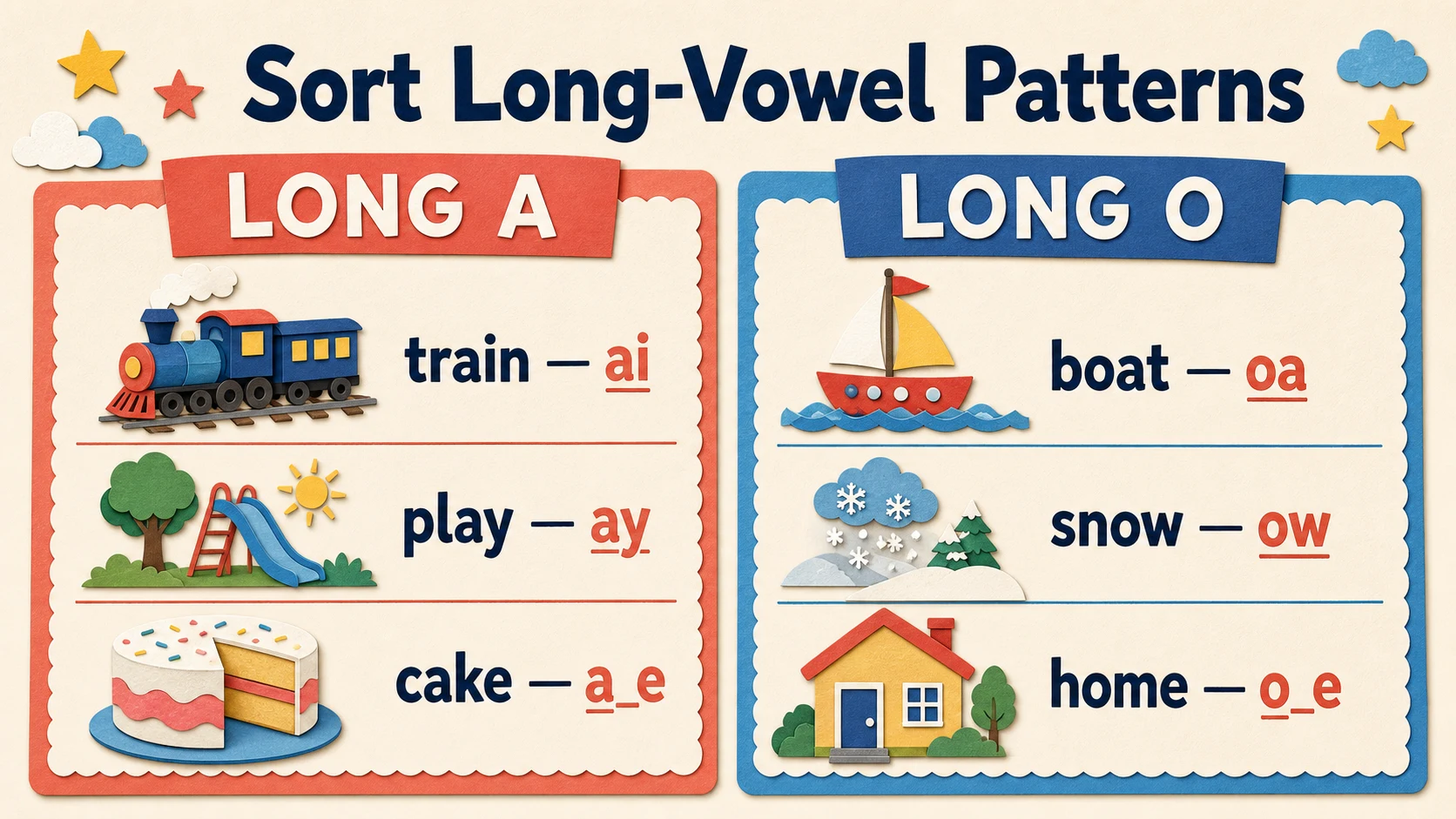
Review, model, practice, spell, and check within one focused lesson.
1. Review known patterns
Read four to six previously taught words. Mix long- and short-vowel examples, such as tap, tape, rid, and ride. Ask for accurate reading before faster reading.
2. State and model the new focus
Use one clear statement: “Today we will read words in which ai represents long a.” Build or write two examples, point to every relevant letter, and blend each word.
3. Practice with immediate feedback
Have the learner read a small set such as rain, mail, tail, and pain. When an error occurs, point to ai, restate the sound, and ask the learner to blend again. Avoid giving only “try again,” which does not identify what needs attention.
4. Encode from sound to print
Dictate two or three practiced words. Ask the learner to say the word, segment its sounds, choose the target spelling, and write it. Then compare the written word with a correct model.
Writing reinforces attention to the sound-spelling relationship. The IES elementary writing practice guide supports high-level instructional attention to writing processes and foundational writing skills. That source does not evaluate this routine or guarantee that dictation will produce a particular outcome.
5. Finish with an independent check
Give one or two items without prompting. Record whether the learner read or spelled them accurately and what strategy was used. A single error is information, but it is not enough to label the entire pattern mastered or unmastered.
Choose Practice That Matches the Need
The best practice is not automatically the longest worksheet or the largest word list. Choose material that reveals whether the learner can apply a specific pattern.
For first exposure
Use a small, highly controlled set. Keep the target pattern consistent and remove unnecessary visual distractions. A learner beginning silent e might work with cap/cape, tap/tape, and hop/hope before meeting several vowel teams.
For discrimination
Mix two categories that the learner confuses:
- Short i and long i: rid/ride, kit/kite
- Short o and long o: hop/hope, not/note
- a_e and ai: cake, rain, game, tail
- ee and ea: feet, team, seed, read—using read only when its intended pronunciation is made clear
Ask the learner to read before sorting. Otherwise, sorting may become a visual letter-matching activity without sound analysis.
For decoding
Use words that were not all included in the model. Decoding evidence comes from applying the pattern, not repeating a memorized list. Keep unfamiliar vocabulary limited so that word meaning does not become the main obstacle.
For encoding
Dictate previously taught patterns. A word bank makes the task easier; removing it increases recall demands. Sentence dictation can add capitalization, spacing, and punctuation, so interpret errors separately. Misspelling rain as rane shows a vowel-spelling issue; forgetting a period does not.
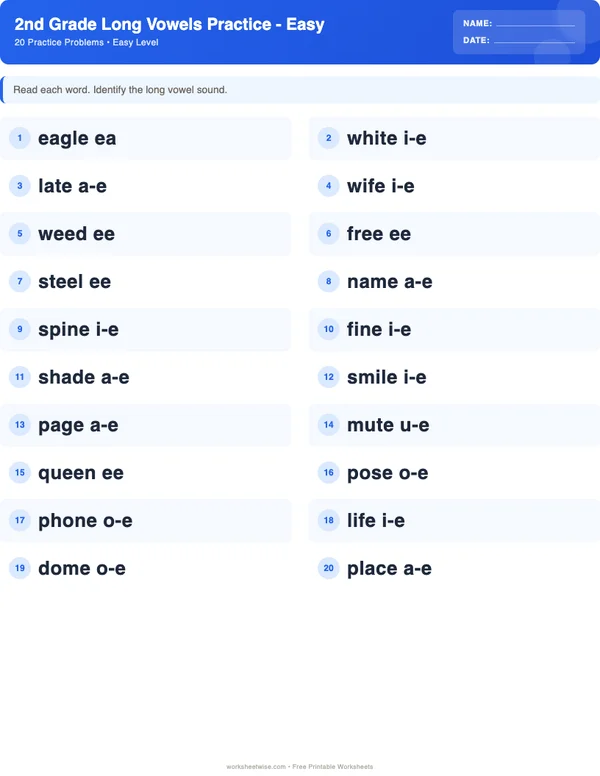
The free easy long-vowels worksheet contains 20 exercises asking learners to read each word and identify its long-vowel sound. It fits initial identification or reinforcement. It is not, by itself, a complete assessment of oral blending, spelling, connected-text reading, or every long-vowel pattern.
Diagnose Errors Before Assigning More Work
An incorrect response does not automatically mean the learner needs harder explanations or more pages. First identify the type of error.
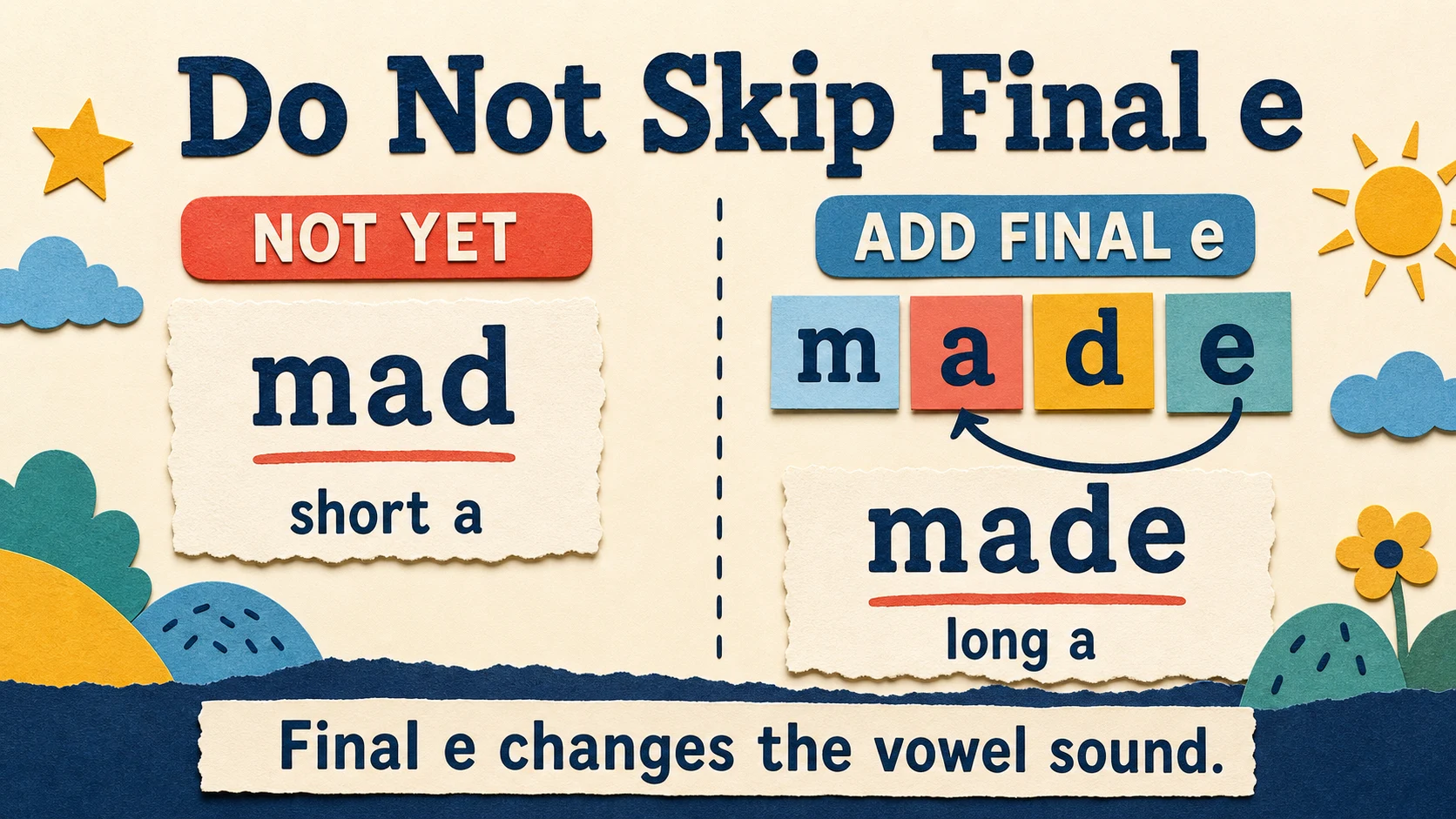
Match the response to the observed error rather than reteaching every long-vowel pattern.
| Observed response |
Possible instructional issue |
Useful next check |
Teaching response |
| Reads cape as cap |
Final e was ignored |
Compare tap/tape |
Mark a_e, blend again, and contrast the pair |
| Reads rain with short a |
ai is not recognized as a unit |
Ask the learner to point to the vowel spelling |
Put ai in one sound box and rebuild the word |
| Calls every two-vowel sequence long |
A mnemonic was treated as an absolute rule |
Test only taught teams first |
State that vowel teams must be learned by pattern |
| Reads correctly but spells feet as feat |
Sound is known; conventional spelling is uncertain |
Sort known ee/ea words |
Practice word-specific spelling with feedback |
| Guesses from the first letter |
Incomplete left-to-right blending |
Ask for each sound in hope |
Require full sound mapping before naming the word |
| Succeeds in a sort but not in mixed reading |
Heading or layout supplied the answer |
Remove category labels |
Use a cumulative mixed list |
| Confuses long e and long i orally |
Sound distinction may be unstable |
Contrast two clearly spoken words |
Return to listening and mouth-to-ear comparison |
| Reads isolated words but stalls in sentences |
Application is not yet fluent |
Recheck the same words alone |
Alternate accurate word reading with brief sentence use |
Misconceptions and boundary cases
Several simple teaching phrases need careful limits:
- “Silent e always makes a vowel long.” This works for regular examples such as cape, ride, and hope, but not every word ending in e follows it. Have and give are exceptions.
- “Two vowels always make the first vowel long.” This is not a universal English spelling rule. Use it only as an initial prompt for taught teams.
- “If the learner can read it, the learner can spell it.” Reading offers visible letters; spelling requires retrieving them. Check both directions.
- “Every long-u word sounds identical.” The examples cube and music fit the supplied long-u scope, but pronunciation can vary across words and speakers. Keep the lesson anchored to clearly modeled examples.
- “Fast reading proves understanding.” Speed without accurate attention can conceal guessing. Accuracy and the learner’s explanation are more useful early evidence.
Differentiate Without Changing the Core Skill
Differentiation should adjust support, quantity, and complexity while preserving the target sound-spelling relationship.
When the learner needs more support
- Use three or four words rather than a full page.
- Keep one target pattern consistent.
- Highlight or underline the vowel spelling.
- Build words with movable letters before writing them.
- Offer two choices: “Does hope have short o or long o?”
- Read the word once, then have the learner echo and rebuild it.
- Mix in only one contrasting pattern at a time.
When the learner is ready for more independence
- Remove highlighting and category headings.
- Mix CVC, CVCe, vowel-team, and open-syllable words.
- Ask the learner to explain which letters represent the vowel.
- Use word chains that require flexible rereading.
- Dictate short phrases or sentences containing taught words.
- Ask for a sort by sound first and by spelling second.
Do not accelerate merely because a page was completed. Move forward when the learner can handle new examples with less prompting and can recover from an error after a specific cue.
Monitor Progress With Small Samples
Monitoring should answer three separate questions:
- Can the learner hear or identify the long-vowel sound?
- Can the learner decode the written pattern?
- Can the learner encode the pattern in spelling?
Use a brief record such as this:
| Date |
Pattern |
Read correctly |
Spelled correctly |
Prompt needed |
Error noted |
| Monday |
a_e |
5/6 |
2/3 |
Pointed to final e once |
Read game with short a |
| Thursday |
a_e and ai |
7/8 |
3/4 |
None in reading |
Wrote rain as rane |
Counts are local observations, not standardized scores. Compare the learner with their own earlier work. Change one feature at a time when possible: new words, less highlighting, mixed patterns, or sentence context. If all of these change together, it becomes difficult to determine why performance changed.
A practical instructional decision might be:
- Continue the same pattern when errors remain consistent.
- Reduce support when accuracy holds across unfamiliar examples.
- Add a contrast when the learner reads one pattern reliably.
- Return to prerequisite work when short-vowel or blending errors dominate.
- Revisit an older pattern after a gap to check retention.
A Two-Week Practice Plan
This plan is a flexible example, not a universal timetable. Sessions can be shortened, repeated, or paused according to observed work.
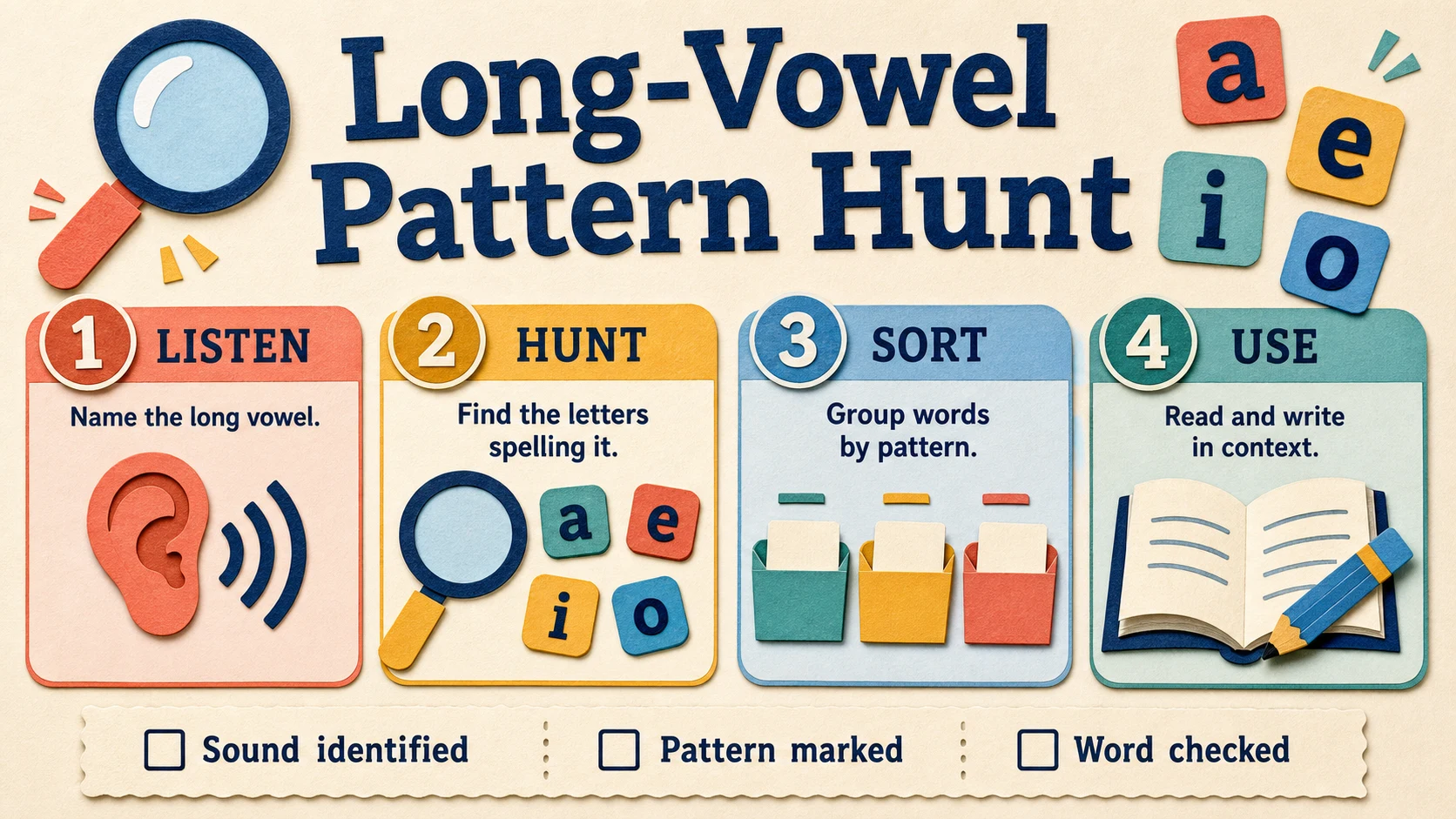
Short cumulative sessions reveal more than rushing through a fixed calendar.
| Day |
Focus |
Suggested activity |
Independent check |
| 1 |
Readiness |
Read and spell short-vowel CVC words |
Two unprompted CVC words |
| 2 |
Silent-e long a |
Build cap/cape, tap/tape; read a_e words |
Read one new a_e word |
| 3 |
Silent-e long i |
Build rid/ride, kit/kite; dictate two words |
Spell one practiced word |
| 4 |
Silent-e long o and u |
Contrast hop/hope, cub/cube |
Explain the final e |
| 5 |
Mixed CVC/CVCe review |
Sort, read, and spell mixed words |
Read four without headings |
| 6 |
ai and ay |
Model rain and play; sort long-a spellings |
Identify the vowel team |
| 7 |
ee and ea |
Compare feet and team; use sound boxes |
Spell one word from each set |
| 8 |
oa and ow |
Read and sort taught long-o words |
Read two mixed examples |
| 9 |
Open syllables |
Model he, go, and music |
Locate the long vowel |
| 10 |
Cumulative application |
Mixed reading, dictation, and correction |
Record independent results |
If Day 5 shows that the learner still ignores final e, repeat silent-e contrasts rather than proceeding automatically. If decoding is accurate but spelling is weak, keep reading practice brief and devote more of the session to word building, dictation, and comparison with correct spellings.
Limits and the Best Next Step
Long-vowel practice cannot show everything about a learner’s reading. Isolated-word activities do not fully measure vocabulary, comprehension, oral reading expression, spelling in original writing, or performance in connected text. A correct sort may reflect visual matching, while a spelling error may reflect uncertainty between two plausible vowel teams rather than failure to hear the vowel sound.
The supplied materials are instructional resources, not medical guidance, certification, or a guarantee of outcomes. They should not be described as comprehensively aligned with every local curriculum. The listed grade and standards references indicate intended skill scope; local expectations and sequences vary.
For a learner who is just beginning this topic, use the free 2nd Grade Long Vowels worksheet as a short identification check. Review the errors by pattern, teach one weak pattern with the routine above, and then retry only a few comparable items. If the learner already handles mixed patterns independently, choose broader cumulative practice from the 2nd Grade Long Vowels topic guide or create a targeted follow-up with the free worksheet generators.