What 2nd Grade Multiplication Means
2nd Grade Multiplication is the beginning of understanding equal groups, not a race to memorize every times-table fact. A learner should be able to build equal groups with objects, describe those groups, connect them to repeated addition, and recognize the same structure in an array. Written multiplication facts can follow once those meanings are secure.
For example, four plates with three crackers on each plate can be described as:
- 4 equal groups of 3
- 3+3+3+3
- 4×3
- 12 crackers altogether
The most useful teaching sequence moves from objects to drawings, then to equations. Keep each representation connected: the learner should be able to explain what each number means instead of treating 4×3=12 as an isolated fact.
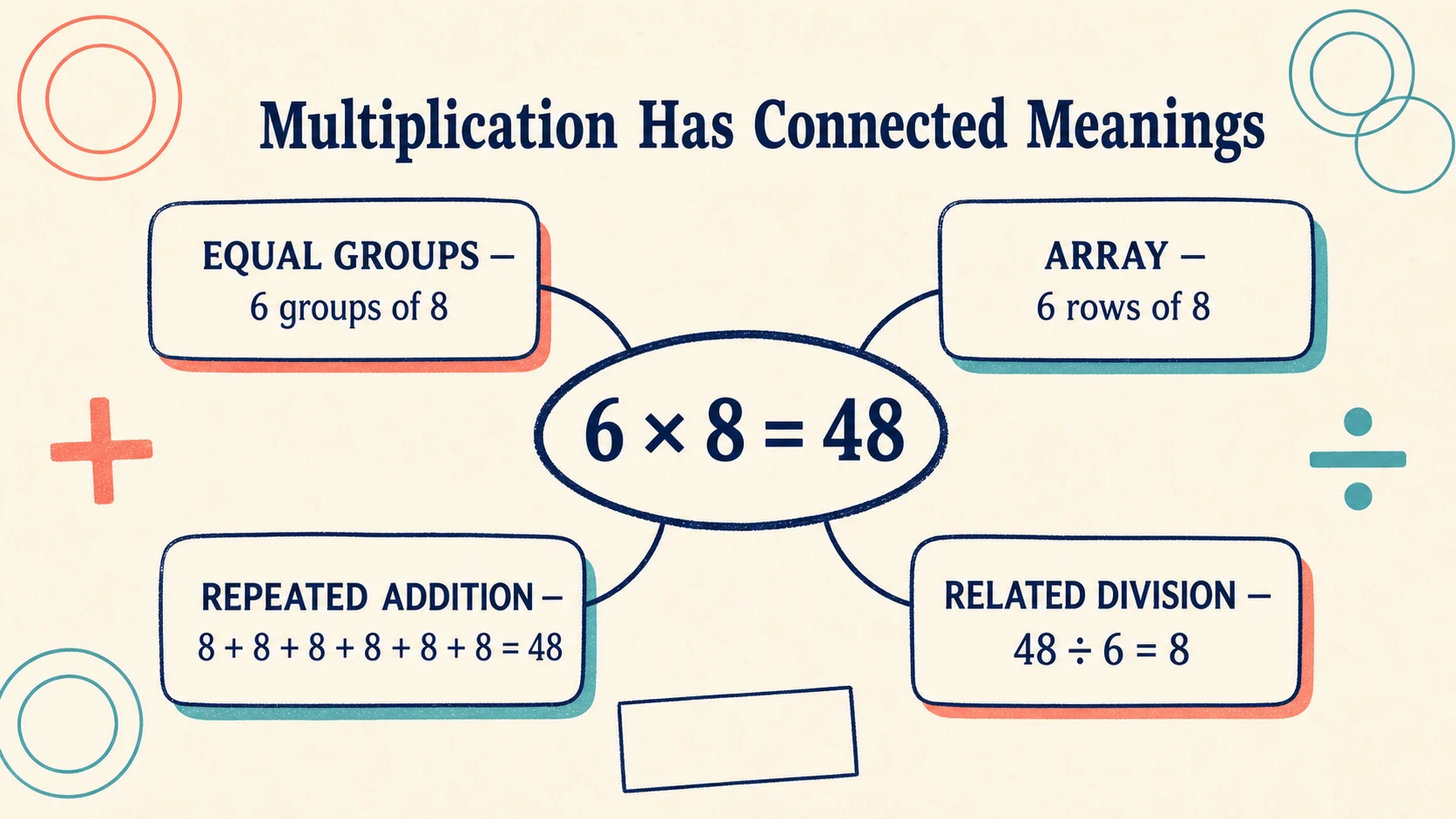
Equal groups, repeated addition, arrays, and equations are different ways to represent the same multiplication idea.
Grade labels describe an intended practice level, not a universal timetable. Local school, district, state, and homeschool sequences differ. The Common Core State Standards for Mathematics include arranging objects in rectangular arrays as part of Grade 2 operations work, while formal interpretation and fluency expectations for multiplication are developed further in Grade 3. That makes early multiplication work appropriate when it remains concrete, visual, and responsive to the learner’s observed understanding.
Prerequisites to Check Before Teaching Multiplication
A learner does not need perfect addition fluency before exploring equal groups. However, several foundations make the work more understandable.
Counting objects accurately
Ask the learner to count a mixed collection of 12 to 20 objects. Look for one-to-one correspondence: each object should be counted once, and the final counting word should represent the total.
If the learner frequently skips or recounts objects, use smaller collections before expecting accurate multiplication models. A multiplication answer cannot be trusted when the underlying count is unstable.
Making and comparing groups
Give the learner 12 counters and ask for three groups with the same number in each group. Then ask:
- Are the groups equal?
- How many groups are there?
- How many counters are in each group?
- How many counters are there altogether?
Do not supply the group size immediately. The act of sharing objects into equal groups helps reveal whether “equal” is understood.
Adding equal quantities
A learner ready for early multiplication should be able to find totals such as:
- 2+2+2=6
- 5+5=10
- 3+3+3+3=12
The learner may count all the objects, count on, or use a known addition fact. The strategy matters less than whether the groups remain equal and the total is accurate.
Counting by 2s, 5s, and 10s
Skip counting can help learners total equal groups efficiently. It is a bridge, not a substitute for understanding. A child who chants “5, 10, 15, 20” but cannot show four groups of five does not yet have a complete multiplication model.
Reading a simple word situation
The learner should distinguish between the number of groups and the number in each group. In “three boxes hold four pencils each,” there are three groups, with four objects per group.
If these prerequisites are inconsistent, return to counting and addition practice available through the 2nd Grade Math collection. Early multiplication should extend those skills, not conceal gaps in them.
A Grade-Appropriate Multiplication Progression
The learner’s work should determine the pace. Move ahead when the learner can build, draw, and explain a model accurately across several examples. Move back when answers are guessed, groups become unequal, or the written equation cannot be connected to the model.
| Stage |
Teaching focus |
What the learner does |
Evidence for moving on |
| 1. Equal groups |
Same quantity in every group |
Builds groups with counters or household objects |
Makes equal groups and identifies group count and group size |
| 2. Repeated addition |
One addend for each equal group |
Writes or says an addition equation |
Matches every addend to one group |
| 3. Arrays |
Equal rows and columns |
Builds and draws rectangular arrangements |
Counts rows and items per row without mixing them up |
| 4. Multiplication notation |
Factors and total |
Connects a model to a×b=c |
Explains what both factors represent |
| 5. Efficient strategies |
Doubling and patterns for 2s, 5s, and 10s |
Uses known structures instead of counting every object |
Produces accurate answers and explains the strategy |
| 6. Mixed representations |
Flexible recognition |
Moves among a story, model, addition equation, and multiplication equation |
Represents the same situation in at least two ways |
| 7. Beginning independent practice |
Accuracy with reduced support |
Solves a short set and checks answers |
Maintains meaning and accuracy without relying on guesses |
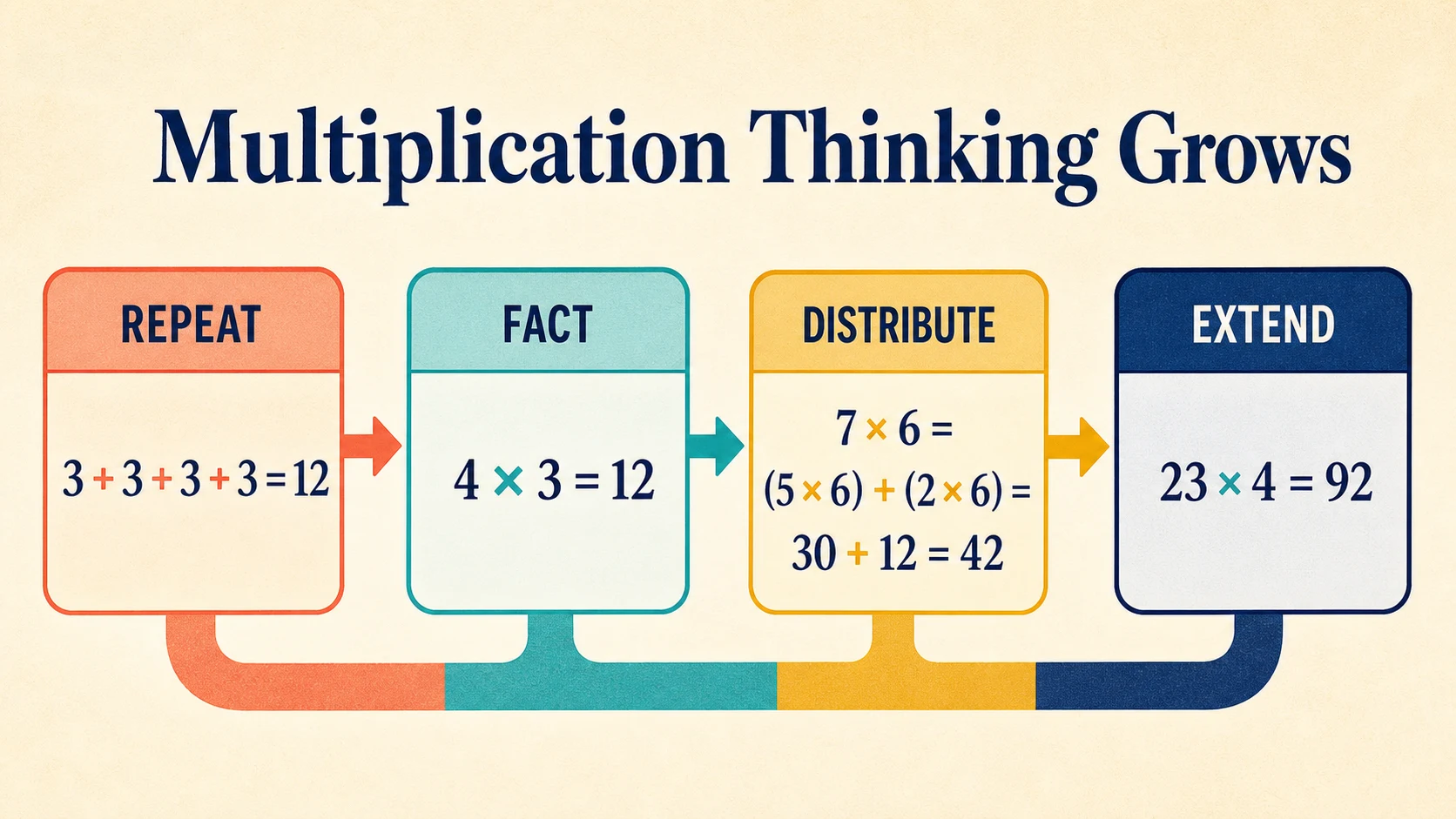
Progress is shown by increasingly independent explanations, not merely by completing more problems.
The IES guide on teaching mathematics to young children supports high-level practices such as using progressions, monitoring what children know, and helping them connect mathematical ideas with representations. It does not evaluate this guide or any WorksheetWise resource. Here, those principles mean that an adult should watch the learner build and explain before assigning a longer page of symbolic facts.
Concrete and Visual Models That Build Meaning
Equal groups with real objects
Begin with objects the learner can move: buttons, bottle caps, blocks, toy animals, or folded paper squares. Use a clear mat or separate containers so that the group boundaries remain visible.
For 3×4, the learner could place four counters in each of three circles. Ask for a description before asking for an answer:
There are 3 groups. Each group has 4 counters. There are 12 counters altogether.
This is an instructional sentence frame, not a script that must be repeated word for word. The goal is to make the structure explicit.
Change one feature at a time. After three groups of four, try two groups of four and four groups of four. Holding the group size constant makes the change in the total easier to notice.
Drawn groups
Once objects are handled accurately, replace them with circles, dots, tally marks, or small pictures. A learner might draw five loops with two dots in each loop for 5×2.
A drawing is useful only if it stays countable. Ten carefully arranged dots communicate more than ten rushed marks that overlap. If drawing consumes too much attention, use printed circles and let the learner add dots.
Arrays
An array arranges objects in equal rows and equal columns. For three rows of five:
● ● ● ● ●
● ● ● ● ●
● ● ● ● ●
The array shows three equal groups of five, so it represents 3×5=15. It can also be viewed as five columns of three. Rotating or reinterpreting the array helps learners notice that 3×5 and 5×3 have the same total, even though a story may assign different roles to the factors.
Arrays should be rectangular. A scattered set of 15 dots may have the same total, but it does not make equal rows and columns visible.
Number-line jumps
A number line can show repeated equal movement. Three jumps of four begin at zero and land on 4, 8, and 12. This represents 4+4+4=12, or three groups of four.
Keep the number and size of jumps distinct:
- The number of jumps tells how many groups there are.
- The distance of each jump tells how many are in each group.
- The landing point gives the total.
Number lines become unhelpful when the learner makes unequal jumps or begins at a number other than zero without accounting for it.
Linking every model to language
After building or drawing, ask the learner to complete four statements:
- I made ___ equal groups.
- Each group has ___.
- My repeated addition equation is ___.
- My multiplication equation is ___.
This translation work is more informative than asking only, “What is the answer?” It reveals whether the learner understands the situation or has simply counted the final collection.
Fully Worked Multiplication Examples
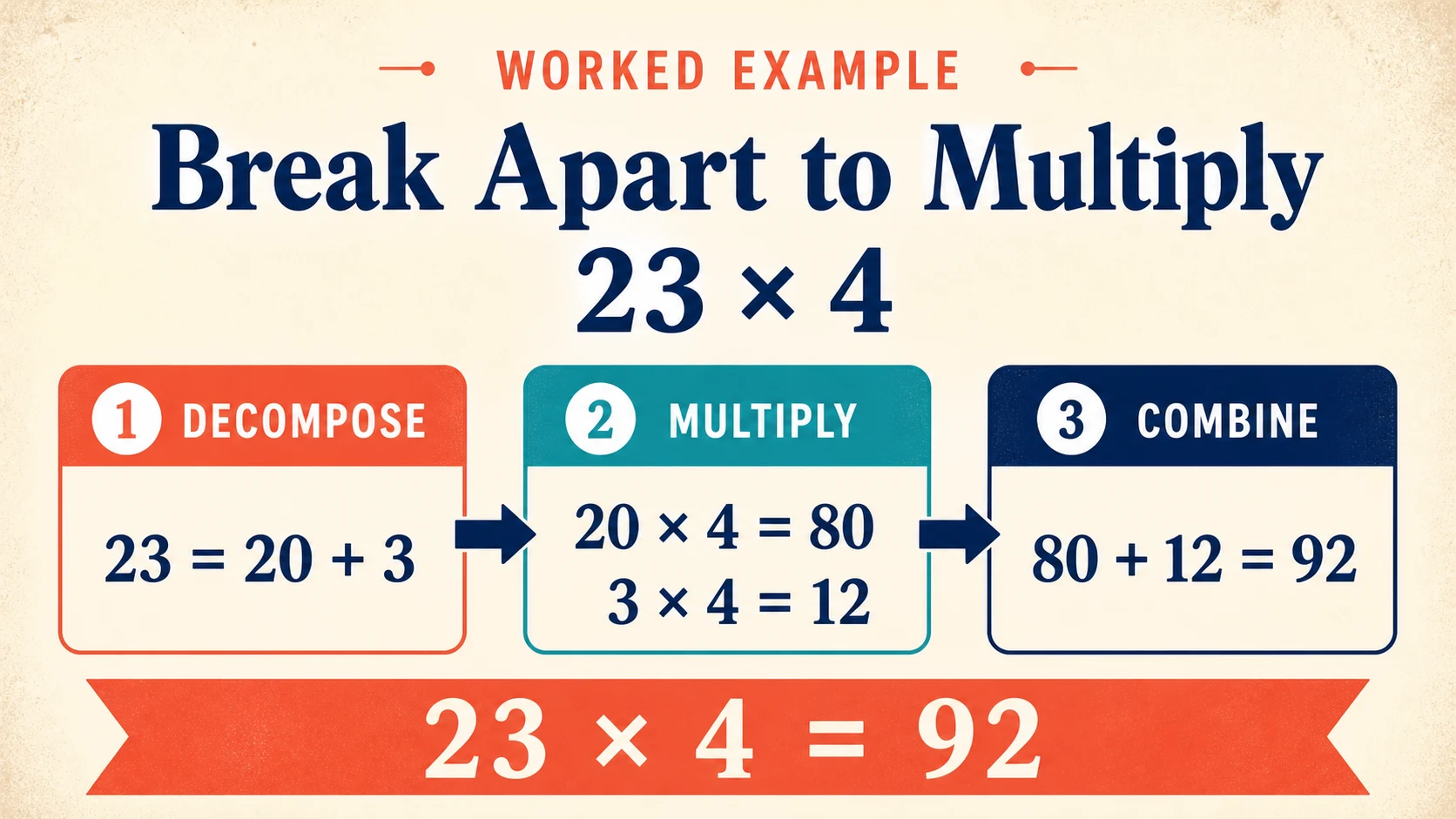
Objects or drawings establish the equal-group structure before the multiplication equation is written.
Example 1: Four equal groups of three
Problem: Four baskets hold three oranges each. How many oranges are there?
Model: Make four groups, placing three counters in every group.
(● ● ●) (● ● ●) (● ● ●) (● ● ●)
Repeated addition:
3+3+3+3=12
Multiplication equation:
4×3=12
Check: Count each group by threes: 3, 6, 9, 12. The total is 12. Direct counting also gives 12 objects, so the equation and model agree.
The first factor records four groups. The second records three oranges in each group.
Example 2: Three rows of five
Problem: A learner arranges counters in three rows with five counters in each row. How many counters are there?
● ● ● ● ●
● ● ● ● ●
● ● ● ● ●
Repeated addition by rows:
5+5+5=15
Multiplication equation:
3×5=15
Check by columns: There are five columns, each containing three counters.
3+3+3+3+3=15
Therefore:
5×3=15
Both equations have the same product. The two descriptions emphasize different orientations of the same array.
Example 3: Using doubling for groups of two
Problem: Seven pairs of socks contain how many individual socks?
A pair contains two socks, so the situation has seven groups of two.
Repeated addition:
2+2+2+2+2+2+2=14
Multiplication equation:
7×2=14
Efficient strategy: Double 7.
7+7=14
Check: Skip count seven groups: 2, 4, 6, 8, 10, 12, 14. The seventh count is 14. All three methods agree.
The doubling strategy is efficient, but it should remain connected to the seven pairs. Otherwise, “double 7” may become another unexplained rule.
Example 4: Finding an unknown group size
Problem: Four equal bags contain 20 marbles altogether. How many marbles are in each bag?
Build four empty groups. Distribute the 20 counters so that every group receives one counter per round. When all counters have been placed, each group contains five.
(● ● ● ● ●) (● ● ● ● ●) (● ● ● ● ●) (● ● ● ● ●)
The related multiplication equation is:
4×5=20
So the missing number is 5.
Check:
5+5+5+5=20
The four groups are equal, and the total is 20.
This is a boundary between introductory multiplication and early division thinking. At this level, the learner can solve it by making equal groups; formal division notation is not required.
Example 5: Zero and one as boundary cases
Problem A: Six empty boxes contain zero pencils in each box.
6×0=0
There are six groups, but every group is empty. Adding the contents gives 0+0+0+0+0+0=0.
Problem B: One tray holds eight cups.
1×8=8
There is one group of eight, so the total remains eight.
These facts should be modeled rather than introduced only as rules. “Anything times zero is zero” is easier to remember when the learner understands empty groups.
A non-example: Groups that are not equal
Suppose three plates hold 2, 3, and 4 crackers. The total is:
2+3+4=9
This is addition, but it is not represented directly by one multiplication fact because the groups are unequal. A learner who writes 3×3=9 has found the same total by coincidence while misrepresenting the actual groups.
A Short, Repeatable Lesson Routine
A focused lesson can be brief. Ten to fifteen attentive minutes may be more useful than a long page completed after the learner has stopped explaining or checking. The timing is an instructional suggestion, not a sourced universal requirement.
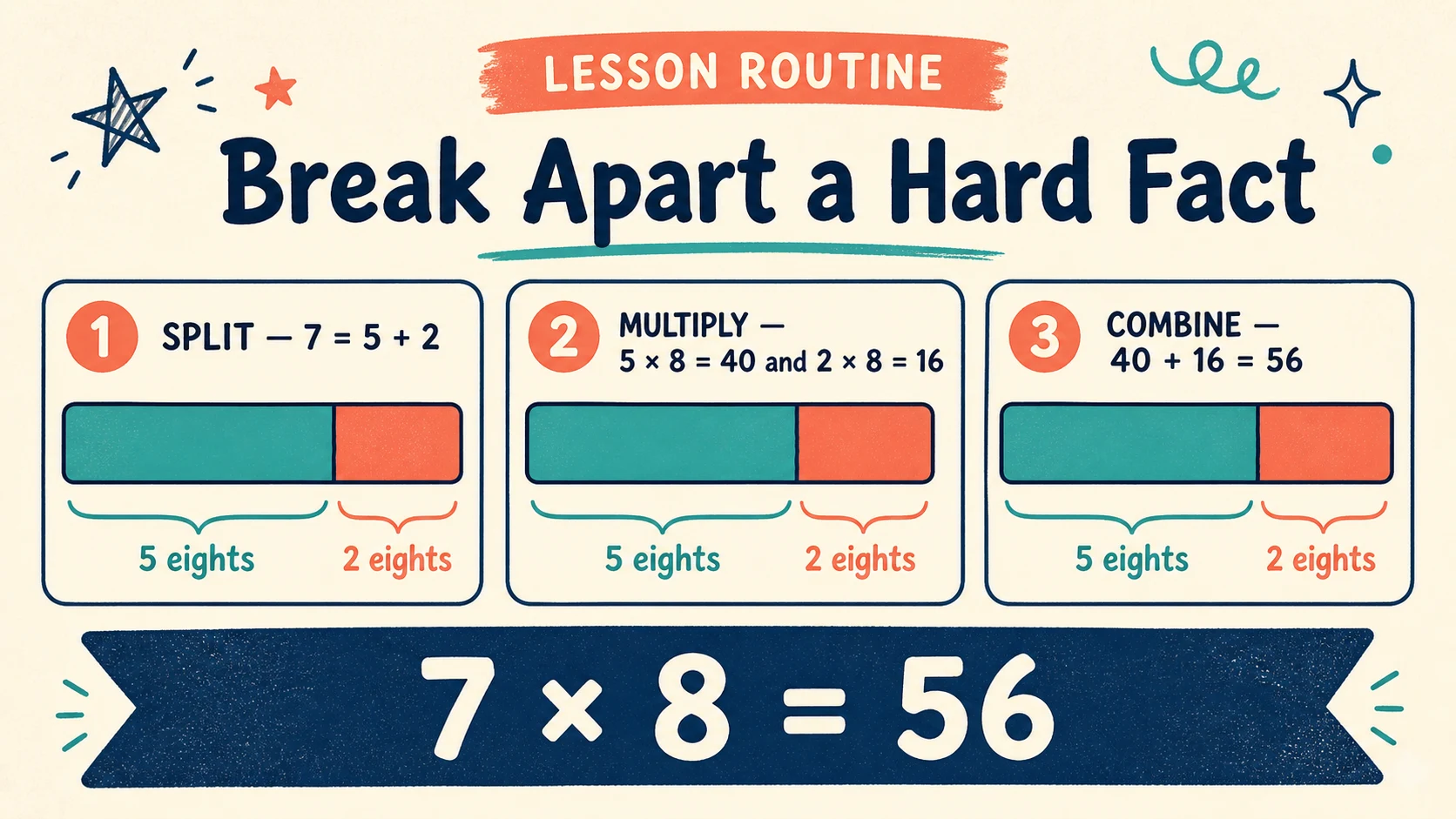
A consistent routine leaves more attention available for the mathematical relationships.
1. Revisit a known model
Spend two minutes building a familiar fact, such as two groups of five. Ask the learner to name the number of groups, the amount in each group, and the total.
2. Teach one small variation
Change only one element. Move from two groups of five to three groups of five, or from a counter model to an array for the same fact. State the connection explicitly.
3. Solve together
Work through one example. Let the learner move objects or mark the drawing. The adult may prompt with questions, but the learner should supply the quantities.
Useful prompts include:
- How do you know the groups are equal?
- What does this number represent?
- Which addition equation matches?
- How can you check the total?
4. Try two or three independently
Choose examples similar enough to reveal whether the new idea was understood. Independence does not mean silence: ask for an explanation after the learner finishes.
5. End with a quick check
Present one model or short story and ask for the matching equation. Record whether the learner answered accurately, needed a prompt, or could not yet connect the representations.
The IES practice guide for assisting students struggling with mathematics provides high-level guidance on systematic instruction, clear mathematical language, representations, and cumulative review. It does not prescribe this exact routine. The routine applies that broad framing by keeping demonstrations explicit and including a small amount of review.
Choosing Practice That Matches the Learner
Practice should answer a specific instructional need. “More multiplication” is too broad a goal.
Use object-based tasks when the learner:
- Does not maintain equal groups
- Confuses the number of groups with the group size
- Cannot explain what an equation represents
- Counts a collection but cannot organize it
Use picture and array tasks when the learner:
- Builds with objects accurately but needs a visual bridge to symbols
- Has difficulty reading rows and columns
- Needs to see why two factor orders can produce the same total
- Benefits from an organized way to count
Use equation practice when the learner:
- Can explain factors using a model
- Recognizes equal groups without rebuilding every familiar fact
- Uses addition, doubling, or skip counting accurately
- Needs a small amount of retrieval practice
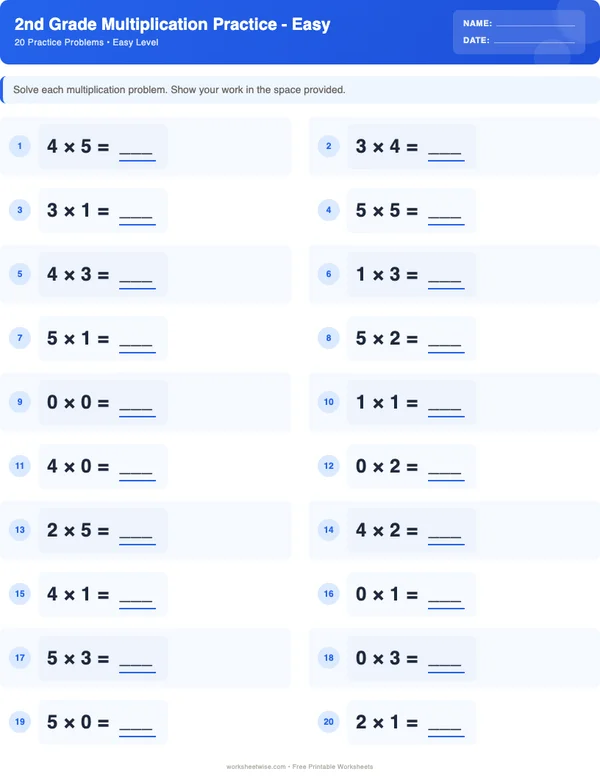
The free easy multiplication worksheet contains 20 exercises and an answer key. Its catalogue focus includes multiplication facts, times tables, mental math, and number sense. It is best selected after checking that the learner understands equal groups; a fact page alone cannot establish that understanding.
For broader practice, the 2nd Grade Multiplication pack contains 18 worksheets. More pages are useful only when their format matches the current learning need. Do not assign the whole pack simply because it is available.
Differentiation Without Changing the Core Idea
When the learner needs more support
Reduce the numbers, not the reasoning. Use two to four groups with no more than five objects in each group. Provide group mats, pre-drawn circles, or an array frame.
Keep objects visible while writing the equation. Ask the learner to touch each group as the related addend is spoken. If language is the obstacle, use the same sentence frame repeatedly until the terms “groups,” “each,” and “altogether” are clear.
Return to one representation at a time when switching among objects, drawings, and equations causes confusion.
When the learner is ready for greater independence
Remove support gradually:
- Show objects and ask for an equation.
- Show a drawing without objects.
- Give a story and ask the learner to draw it.
- Give an equation and ask for a matching story.
- Mix familiar forms in one short set.
This progression tests flexibility without requiring larger facts.
When the learner needs added challenge
Increase the reasoning demand before increasing the number size. Ask the learner to:
- Draw two different arrays with the same total.
- Decide whether a picture represents equal groups.
- Correct an inaccurate model.
- Write a story for 4×5.
- Compare 3×5 with 4×5.
- Find a missing group size using counters.
These tasks remain within early multiplication while requiring explanation and comparison.
Common Errors and Diagnostic Responses
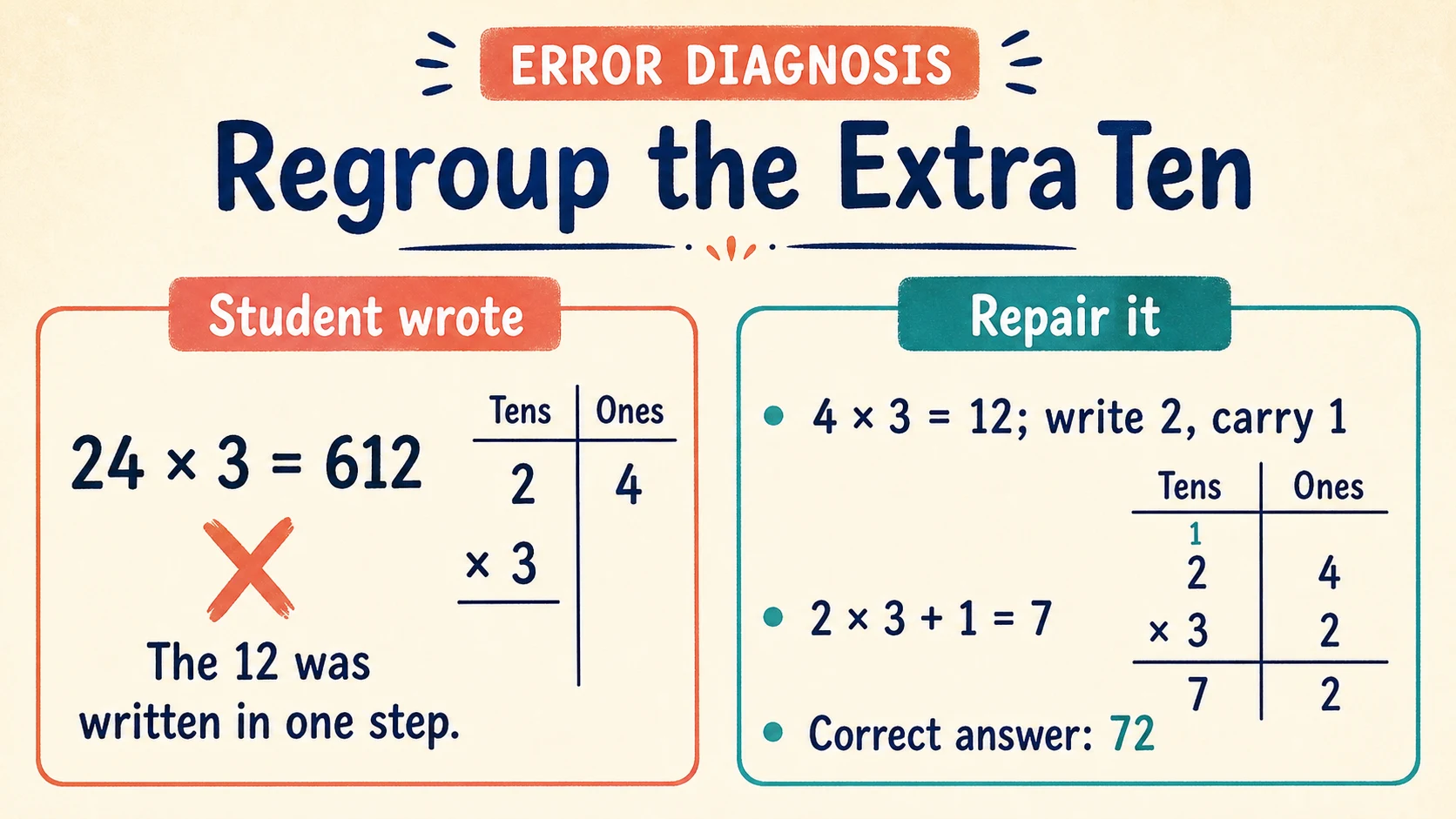
An error becomes useful when the adult identifies the representation or relationship that broke down.
| Observed work |
Likely difficulty |
Teaching response |
| Groups contain different quantities |
“Equal groups” is not secure |
Rebuild with separate mats and compare groups one by one |
| 4×3 is modeled with three groups of three |
One factor was ignored |
Label “4 groups” and “3 in each” before placing objects |
| The array has uneven rows |
Rows and columns are not organized |
Use grid paper or an array frame |
| Repeated addition has too few addends |
Number of groups was misread |
Match one written addend to each physical group |
| Number-line jumps have different sizes |
Group size is unstable |
Mark equal intervals before drawing jumps |
| An answer is correct but the model is wrong |
The learner guessed or used an unrelated fact |
Ask for a second representation and an explanation |
| 3×4 is answered as 7 |
Multiplication is being confused with addition |
Return to three groups of four and compare 3+4 with 4+4+4 |
| The learner recounts every object for familiar facts |
More efficient strategies are not yet trusted |
Connect the model to skip counting or doubling, then check |
| Zero is treated as “nothing to do” and omitted |
Empty groups are not represented |
Build several empty groups and write the repeated zeros |
| Unequal groups are forced into a multiplication equation |
Multiplication is being associated with any collection |
Compare equal and unequal examples side by side |
Avoid diagnosing from one mistake. A reversed digit, rushed count, or misunderstood direction may produce an isolated error. Present a related example and watch the process before deciding what to reteach.
Monitoring Progress and Deciding When to Move On
Use a simple record with four categories:
- Build: Can the learner make the equal groups?
- Represent: Can the learner draw or identify an array?
- Connect: Can the learner match the model to repeated addition and multiplication?
- Explain: Can the learner state what each factor and the product represent?
Mark each category as independent, prompted, or not yet shown. This produces more useful information than a percentage alone.
For example, a learner may answer eight of ten facts correctly but be unable to model them. That pattern suggests retrieval without secure meaning. Another learner may model every problem correctly but calculate slowly. That learner may be ready for strategy practice rather than another lesson on equal groups.
Consider moving forward when the learner can complete several varied examples on more than one occasion, explain the quantities, and correct a simple model error. Consider stepping back when the learner guesses, changes strategies unpredictably, or succeeds only when the format is identical to the demonstration.
Accuracy matters, but so do independence and explanation. Speed should not hide uncertainty. Gradual fact fluency can follow after strategies and meanings are understood.
A Two-Week Practice Plan
This plan assumes short sessions on ten practice days. Adjust the length, repeat a day, or pause when the learner’s work indicates that more support is needed. It is not a universal timetable.
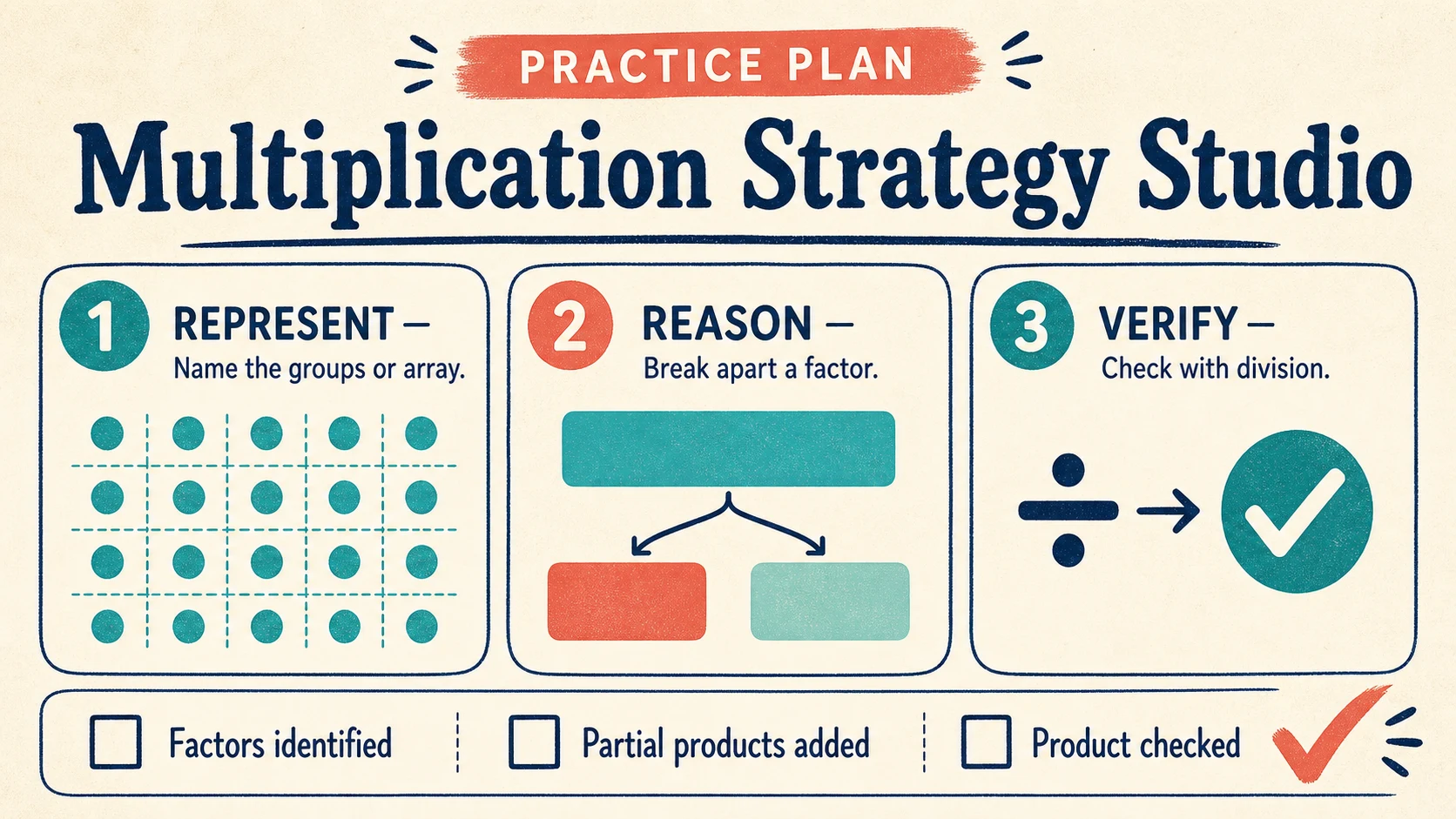
The sequence alternates modeling, connection-making, review, and brief independent practice.
| Day |
Focus |
Suggested activity |
Quick evidence to record |
| 1 |
Equal groups |
Build two, three, and four equal groups with counters |
Identifies groups and amount in each |
| 2 |
Equal versus unequal |
Sort six pictures or models into equal and unequal groups |
Explains why multiplication fits or does not fit |
| 3 |
Repeated addition |
Build groups and write one addend per group |
Addition matches the model |
| 4 |
Arrays |
Build arrays with up to five rows and five columns |
Keeps rows and columns equal |
| 5 |
Connect representations |
Match models, addition equations, and multiplication equations |
Explains at least two matches |
| 6 |
Groups of two |
Use pairs and connect them to doubling |
Solves and checks several small facts |
| 7 |
Groups of five and ten |
Use objects arranged in fives or tens |
Counts efficiently without losing the groups |
| 8 |
Unknown quantities |
Find a missing group size or number of groups with counters |
Uses equal-group reasoning rather than guessing |
| 9 |
Mixed short practice |
Complete a small mixture of stories, arrays, and equations |
Maintains accuracy across formats |
| 10 |
Review and next-step check |
Revisit one task from each earlier stage |
Shows which representations are independent |
If Day 4 reveals uneven arrays, repeat array building instead of moving directly to equations. If Day 7 shows accurate models but slow totals, continue with groups of two, five, and ten. If Day 10 is consistently accurate and well explained, introduce a modest set of independent facts or more mixed representations.
Limitations and the Honest Next Step
An introductory multiplication worksheet cannot show everything a learner understands. A correct answer may come from a sound strategy, direct counting, a memorized fact, or a guess. An incorrect answer may reflect the model, calculation, language, attention, or handwriting. Review the work with the learner before choosing the next task.
This guide also does not claim comprehensive standards alignment, certification, guaranteed outcomes, or a single schedule suitable for every learner. It offers instructional suggestions based on the supplied catalogue scope and high-level framing from the linked authoritative sources. Child-specific learning, developmental, or medical concerns require appropriate local professional support.
For the next session, build three equal groups with household objects, ask the learner to draw and explain them, and then use the free 2nd Grade Multiplication worksheet only if the model-to-equation connection is secure. If you need different numbers or a narrower practice set, create one through the free worksheet generators.