Curated collectionAnswer keys includedPrint-ready PDFs
Worksheets for 8-Year-Olds: Printable Practice Guide
Third-grade reasoning, multiplication foundations and written explanations with enough workspace to show thinking.
Start with a real resource
Browse this worksheet collection
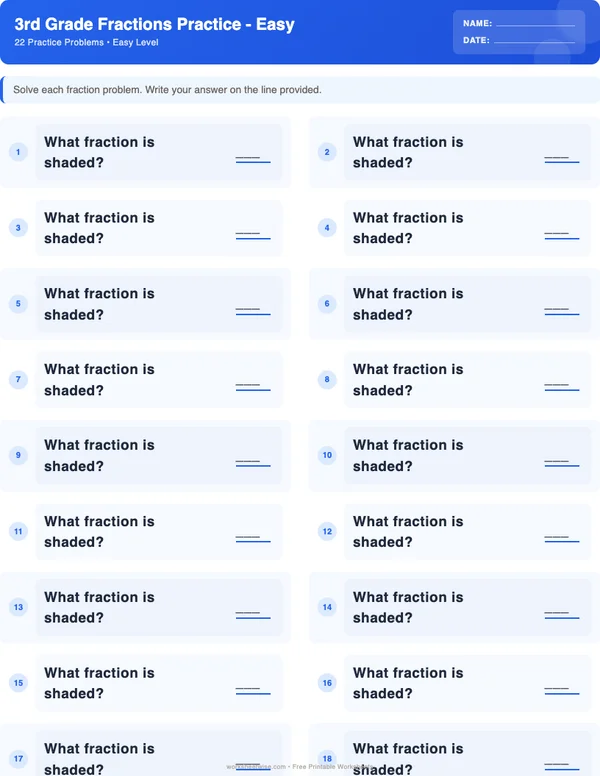
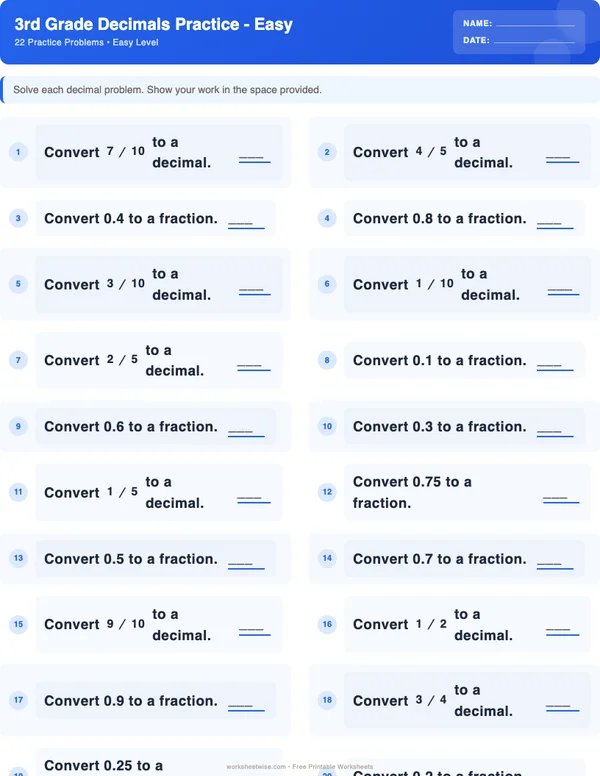
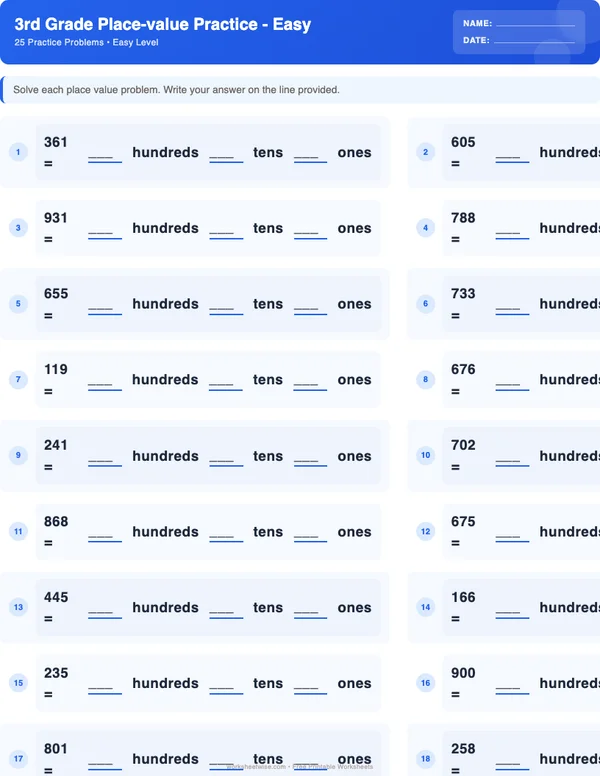
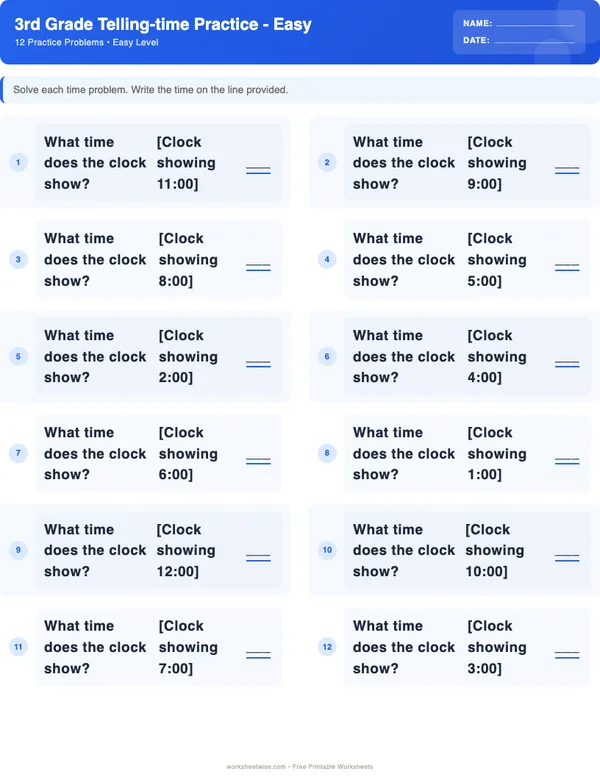
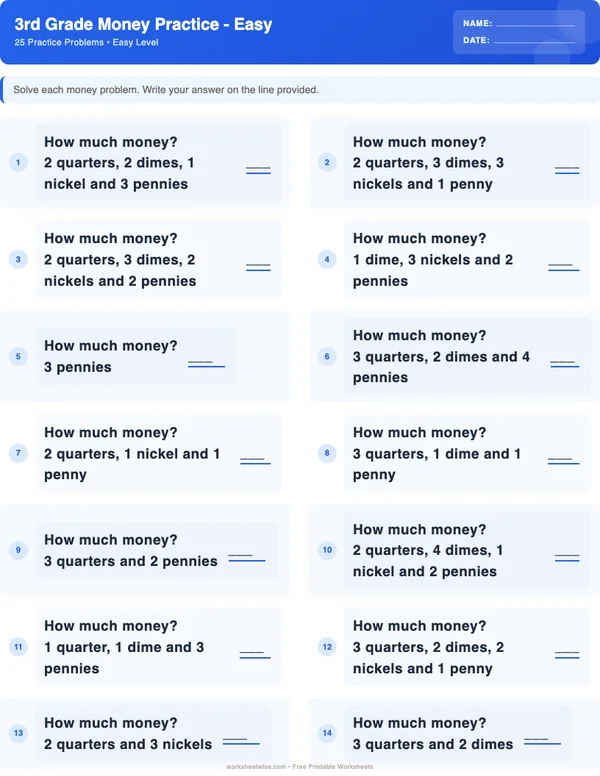
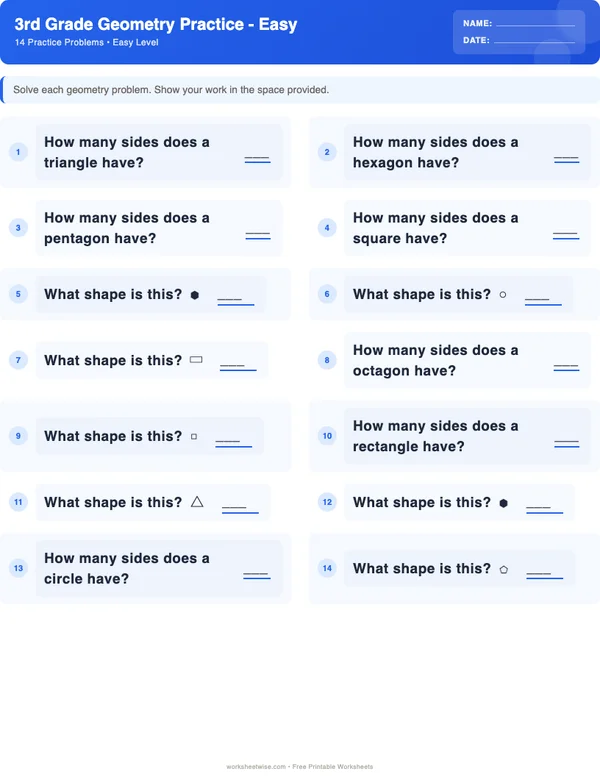
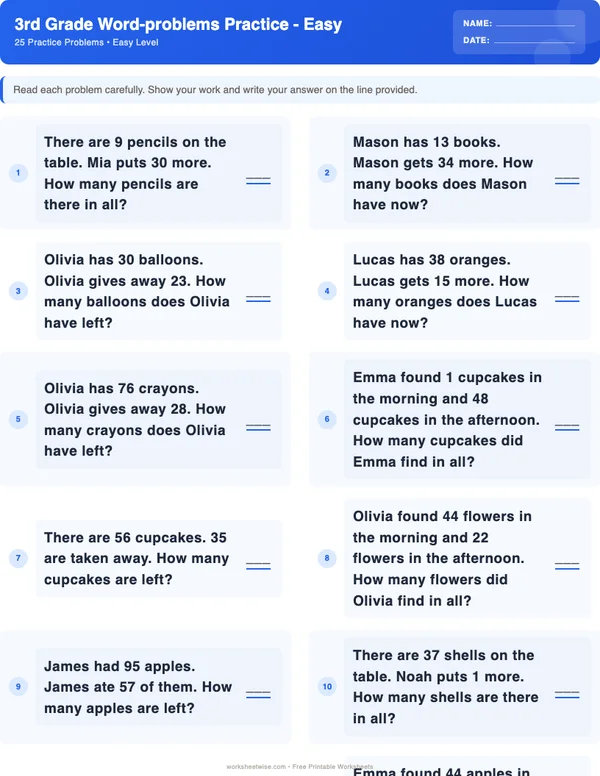
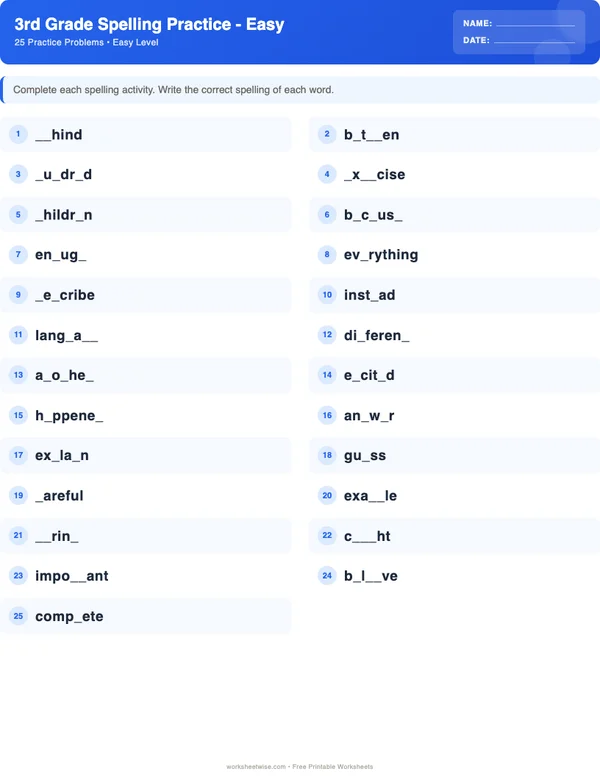
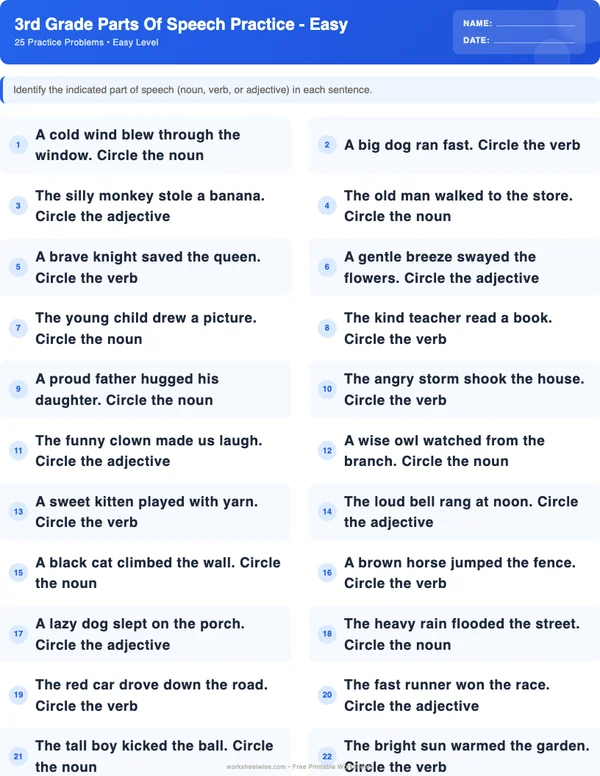
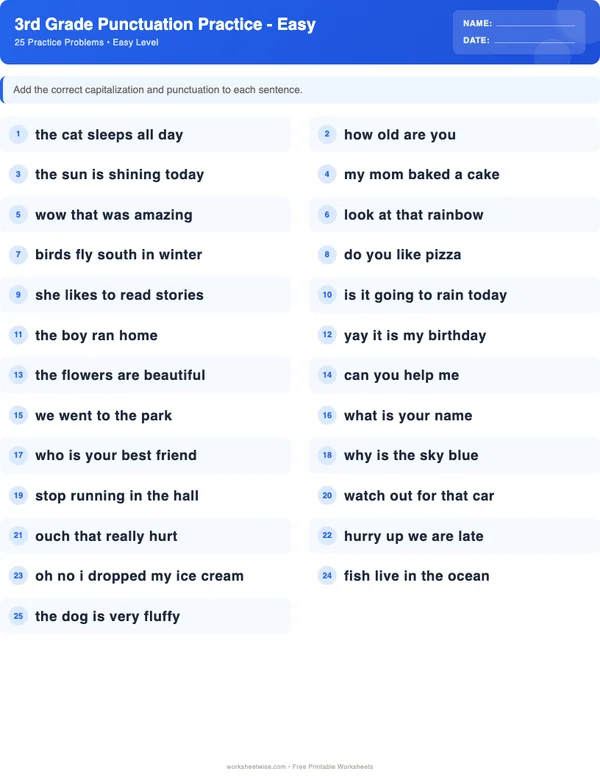
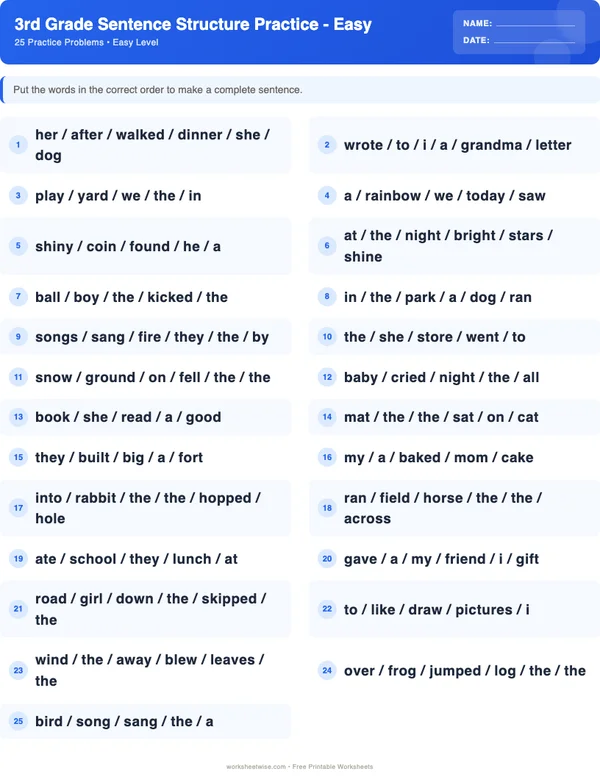
15 relevant free entry points are available. Each one includes a printable learner PDF and separate answer key.
A useful practice loop
Print less. Observe more.
- Choose one skill and model the first item aloud.
- Use a short set and notice the learner’s strategy.
- Change the next task from the work you can see.
Need more than the free sheet?
Plus includes all 270 matching catalogue variations where available, plus saved deterministic generators and the worksheet designer.
See Plus membershipComplete guide
How to teach and practise worksheets for 8 year olds
3,500 words Updated 6 instructional visuals
Choose by the work you see, not by the birthday
Worksheets for 8-year-olds should usually emphasize third-grade reasoning: building multiplication and division from equal groups, using place value in computation, interpreting word problems, and explaining answers in writing. The WorksheetWise catalogue for this age page currently contains 270 worksheet variants across three subjects and 15 topics, with 15 free entry points. Every listed resource is tagged for intended third-grade practice.
Age is a discovery aid rather than a placement decision. An 8-year-old may be ready for multiplication arrays while still needing concrete support for regrouping, or may write imaginative paragraphs while finding spelling patterns difficult. Grade labels also describe intended practice level; local curriculum sequences differ. Select from observed work, not from a belief about what every learner of a particular age “should” complete.
Start with one short sample. Watch whether the learner can:
- explain what the directions require;
- begin without extensive prompting;
- represent the quantities or language pattern;
- sustain attention for a small, agreed amount of work;
- correct an error after a useful prompt; and
- explain at least one answer through words, a drawing, objects, or an equation.
Those observations tell you whether to simplify the task, continue at the same level, or stop. A completed page is less informative than seeing how the learner approached four carefully chosen items.
Select a worksheet by its observable demands
The catalogue’s free sheets are described as “easy,” but that label belongs to the task, not the learner. Here, interpret it through features you can inspect: familiar directions, one primary skill, relatively direct items, limited reading load, and numbers or sentence structures that permit attention to the target concept. It does not mean that every 8-year-old will find the sheet easy.
Before printing, inspect five features.
Identify the actual target
Name the one thing you want to observe. “Do math” is too broad. Better targets include:
- represent multiplication as equal groups;
- use place value to explain a regrouping step;
- distinguish sharing from grouping in division;
- identify a noun and a verb in a complete sentence;
- punctuate dialogue supplied by an adult; or
- spell words that share a taught vowel pattern.
A learner who must decode dense directions, remember several procedures, write long answers, and calculate simultaneously is being tested on many demands at once. Reduce unrelated demands so the target remains visible.
Check quantity and workspace
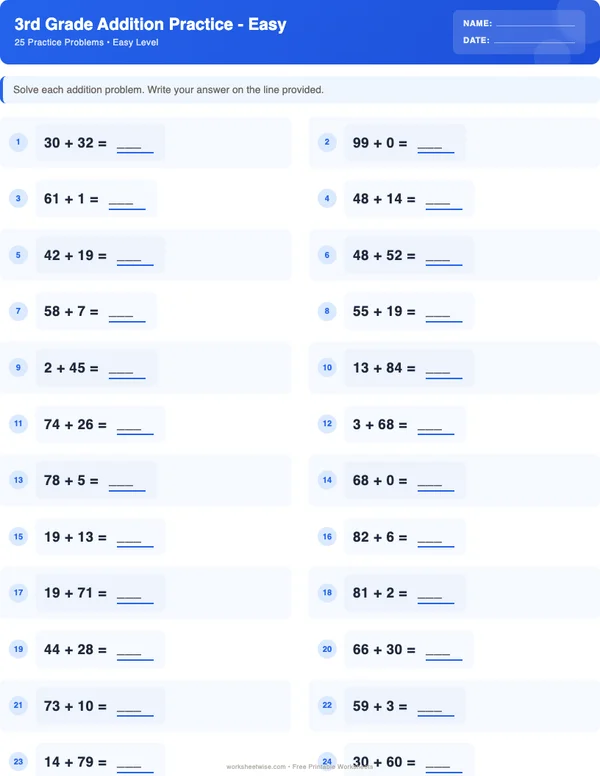
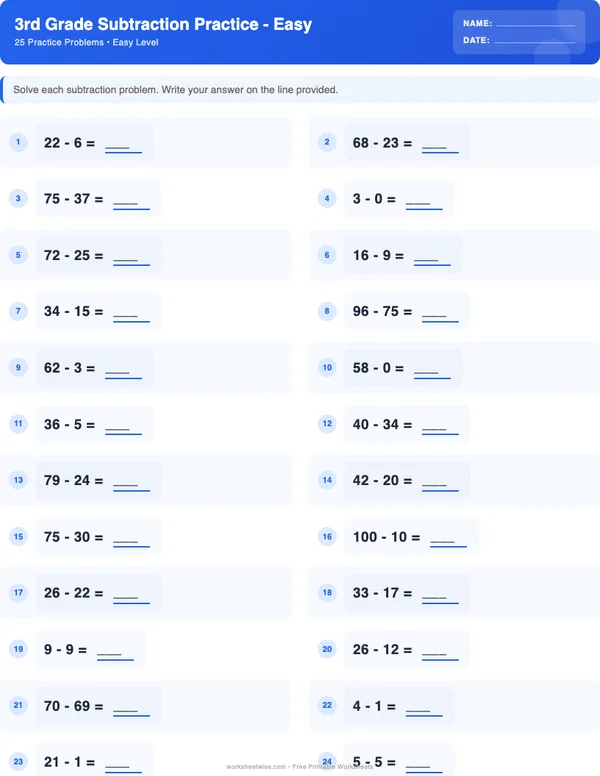
The free addition, subtraction, multiplication, place-value, money, and geometry sheets each contain 25 problems. That is a catalogue fact, not a recommendation to complete all 25 in one sitting. The free fractions and decimals sheets contain 22 problems; telling time contains 12; word problems, parts of speech, and punctuation contain 14.
For an initial check, circle four to eight items distributed across the page. Make sure there is room to draw an array, trade a ten, underline evidence, or write a sentence. If the printed space is tight, provide scrap paper rather than treating cramped handwriting as weak reasoning.
Separate concept demand from reading demand
Read one direction aloud if decoding it would obscure the intended math. For a word problem, however, reading and interpreting the situation are part of the task. You can support access without solving it: clarify an unfamiliar non-mathematical word, then ask the learner to retell the situation.
For spelling or grammar, use words and sentences the learner can understand orally. Identifying a verb should not depend on knowing an obscure noun. The IES foundational reading guide recommends systematic attention to foundational word-reading skills; it should not be taken as evidence that an unrelated worksheet can substitute for reading instruction.
Preview representation and response demands
A multiplication page of bare facts asks for recall or strategy use. A page with arrays asks the learner to connect rows, columns, groups, and an equation. A written explanation adds a language demand. Decide which combination you intend before interpreting the result.
Likewise, “circle the noun” and “revise the sentence with a precise noun” are not equivalent tasks. The first checks identification; the second requires application in writing.
Build multiplication from equal groups before chasing speed
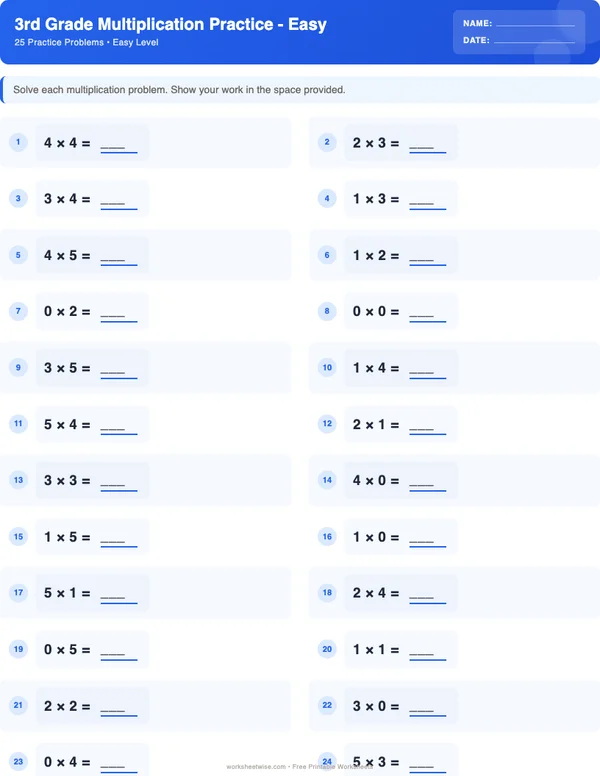
Multiplication is a central foundation in the third-grade catalogue. It extends addition into equal groups and arrays and supports later work with division, fractions, and area. The available free multiplication sheet contains 25 problems, but a useful first session may involve only six.
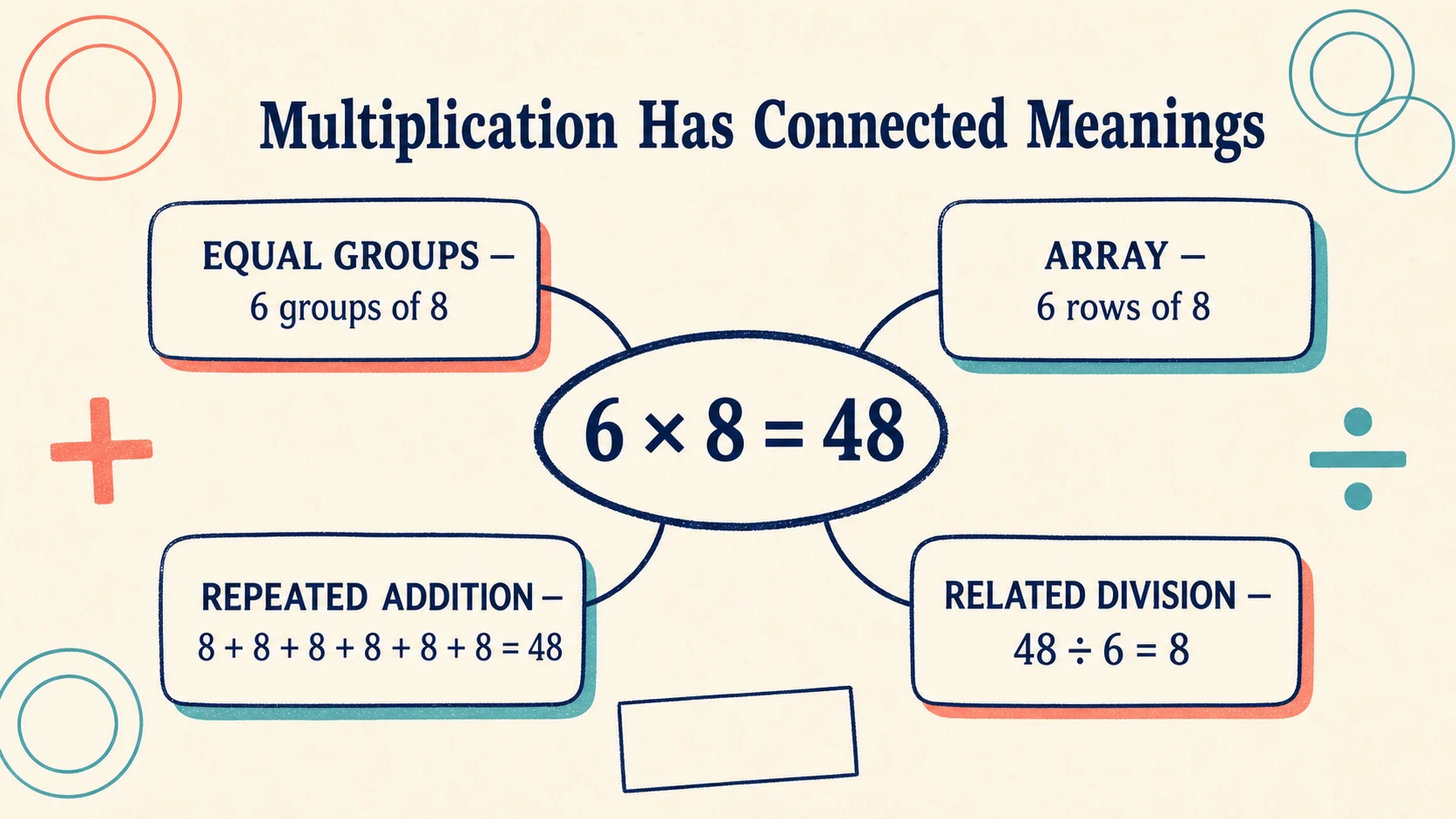
Use the map to choose one multiplication connection—equal groups, arrays, facts, or properties—rather than assigning every branch at once.
Checked example 1: Four rows of six
Ask the learner to build or draw four rows with six counters in each row.
A complete representation contains counters because:
Turning the array gives six rows of four:
The product remains 24. This example belongs here because the catalogue explicitly describes third-grade multiplication through equal groups and arrays, including the commutative relationship. It also permits several observable responses: building, skip-counting, repeated addition, or using a known fact.
Ask, “How does your drawing show both 4 and 6?” If the learner says only “I memorized 24,” accept the correct answer, then request the representation. If the array has 4 rows of 5, do not immediately correct it. Ask the learner to touch and count the members of each row. That preserves the multiplication target while making the mismatch visible.
Use the 3rd Grade Multiplication guide and free sheet when the learner can explain equal groups and is ready for selected fact practice. Build facts strategically from visible relationships: , for example, can be decomposed as
Check the arithmetic: 35 plus 21 is 56. This is more informative than asking for speed because it reveals whether the learner can use a distributive strategy.
Connect division to multiplication in two different ways
Division at this level should not appear only as a symbol and an answer blank. The catalogue describes two interpretations: sharing a total equally and finding how many equal groups fit into a total. Both lead to a quotient, but they answer different questions.
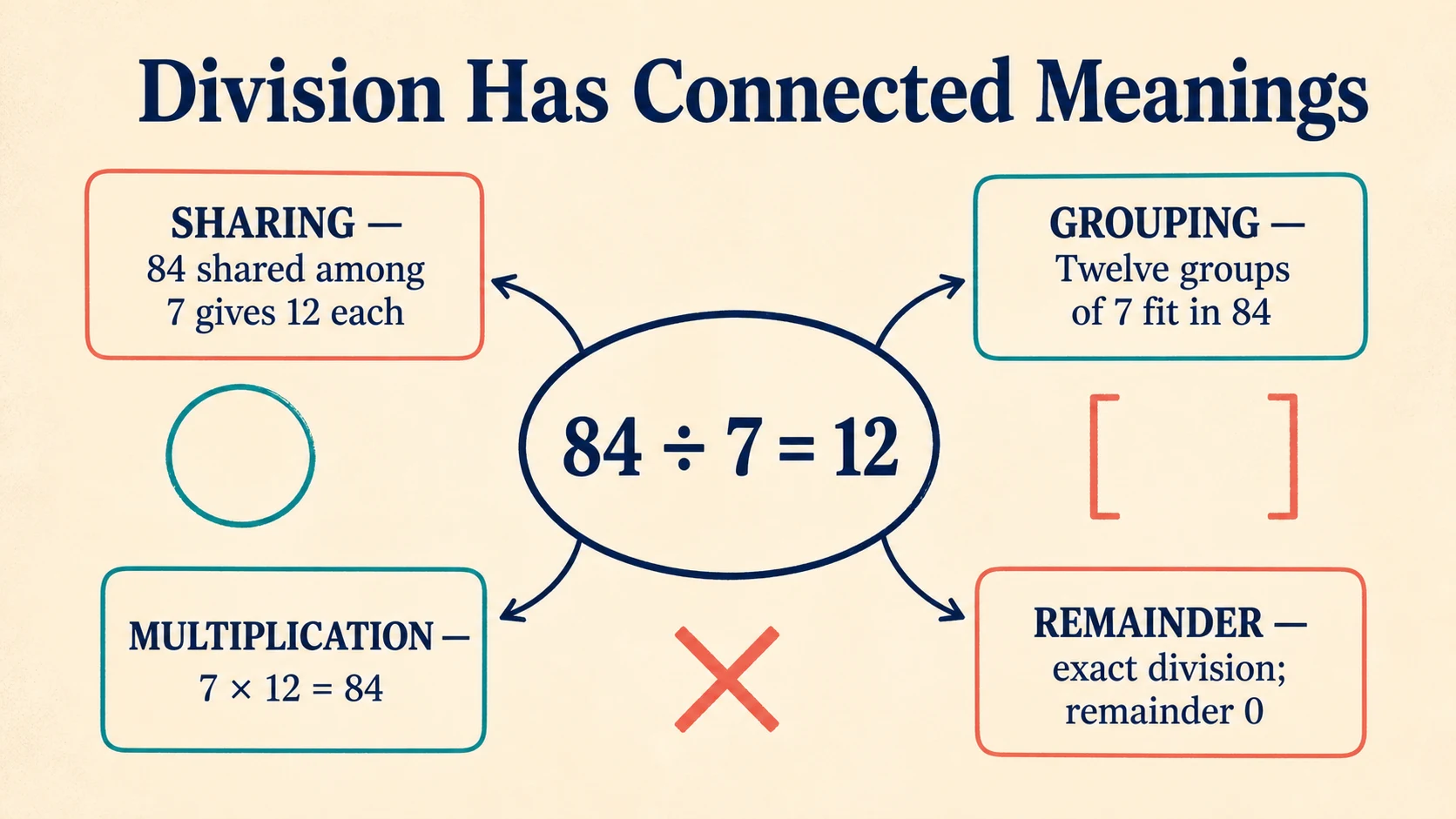
The division map helps an adult distinguish concrete sharing, equal-size grouping, fact families, and written problems before selecting practice.
Checked example 2: Share 24 counters among six children
Place 24 counters into six equal groups. Each group receives 4 because:
Check by multiplication:
Now change the question: “How many groups of 6 can you make from 24 counters?” The answer is again 4, but 6 now describes the size of each group rather than the number of recipients.
This example belongs on an age-eight guide because the listed third-grade division progression begins with concrete sharing and grouping and connects division facts to multiplication. It exposes whether the learner understands the situation instead of merely recognizing a fact.
If the learner deals counters correctly but writes , keep the counters in place and ask:
- What was the total before sharing?
- What does the 6 describe?
- Which number should appear first in “24 divided into six groups”?
That adaptation preserves division reasoning. It does not replace the problem with simpler addition.
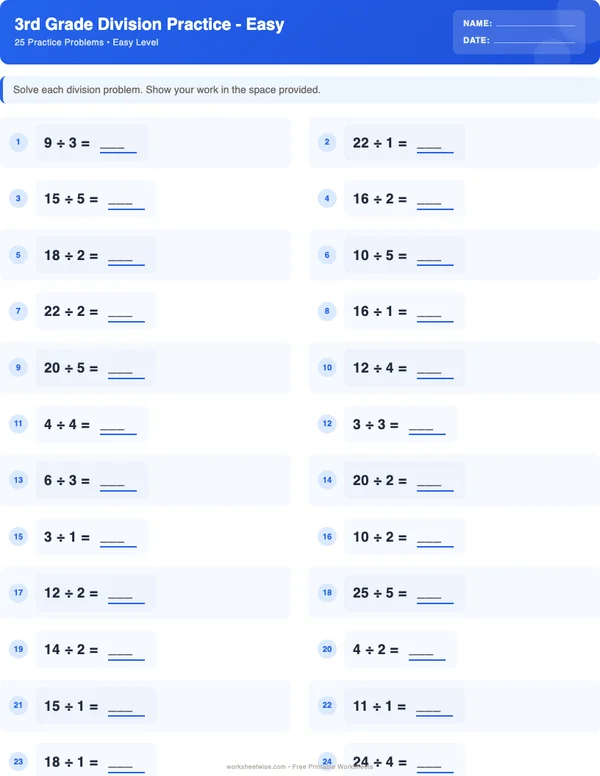
The 3rd Grade Division guide and free sheet is an appropriate next choice after the learner can model both meanings. If the learner cannot keep groups equal, continue with objects and smaller totals such as 12, not with long division notation.
Make place value visible in addition and subtraction
Third-grade written computation should reveal what happens to units, tens, and hundreds. A learner may execute a remembered procedure without understanding why a digit is written above another column. Ask for a model or explanation before assigning more repetitions.
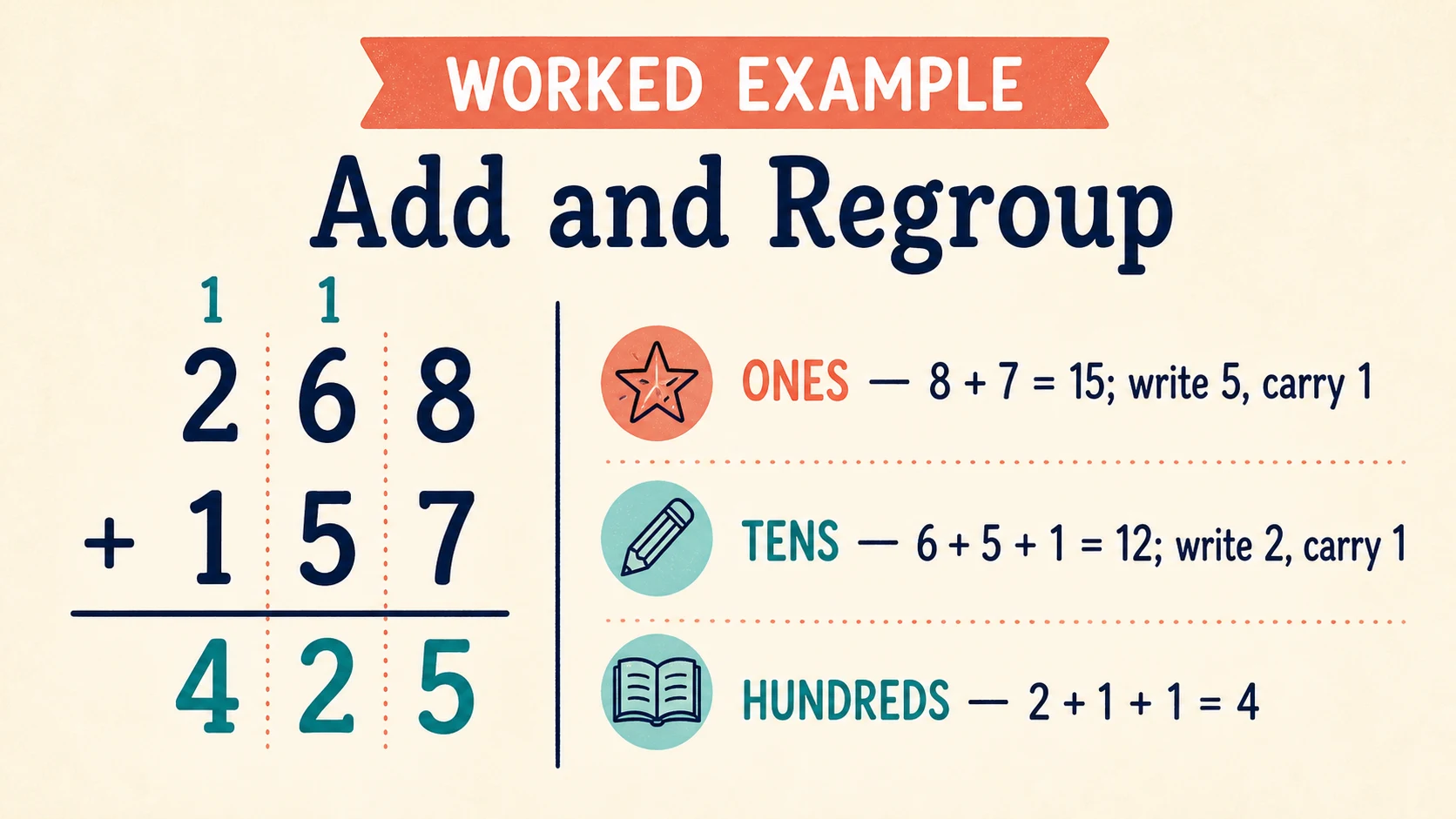
The worked addition sequence clarifies how a concrete trade can lead to a written regrouping step without hiding the place-value meaning.
Checked example 3: Add 268 and 157
Align the numbers by place:
Using base-ten blocks, combine 8 ones and 7 ones to make 15 ones. Trade 10 ones for 1 ten, leaving 5 ones. There are then 12 tens in all; trade 10 tens for 1 hundred, leaving 2 tens. The result is 4 hundreds, 2 tens, and 5 ones: 425.
Check with subtraction:
This example belongs here because the catalogue’s third-grade addition material includes multi-digit addition and stresses explaining regrouping through place value. The explanation also uses the page’s editorial priority: enough workspace to show thinking.
A common error is writing 315 by combining the hundreds and tens incorrectly. Rather than saying “carry the one,” ask the learner to decompose 110 into 100 and 10. If a physical model succeeds but the written layout does not, continue with the same numbers while placing each digit in a labeled hundreds-tens-ones chart.
Use selected items from the 3rd Grade Addition guide and free sheet. If subtraction is the concern, the 3rd Grade Subtraction guide and free sheet can help you observe whether the learner connects to place-value trading instead of subtracting the smaller digit from the larger digit in each column.
Treat word problems as reasoning, not keyword hunts
A third-grade word problem combines reading, representation, operation choice, computation, and communication. Do not teach “in all means add” or “left means subtract.” Those shortcuts fail when the language and structure diverge.
Use a stable routine:
- Read the whole problem.
- Retell what is happening without numbers.
- Identify what is known and what must be found.
- Draw a bar, array, number line, or labeled sketch.
- Write and solve an equation.
- answer in a complete sentence.
- Check whether the answer fits the situation.
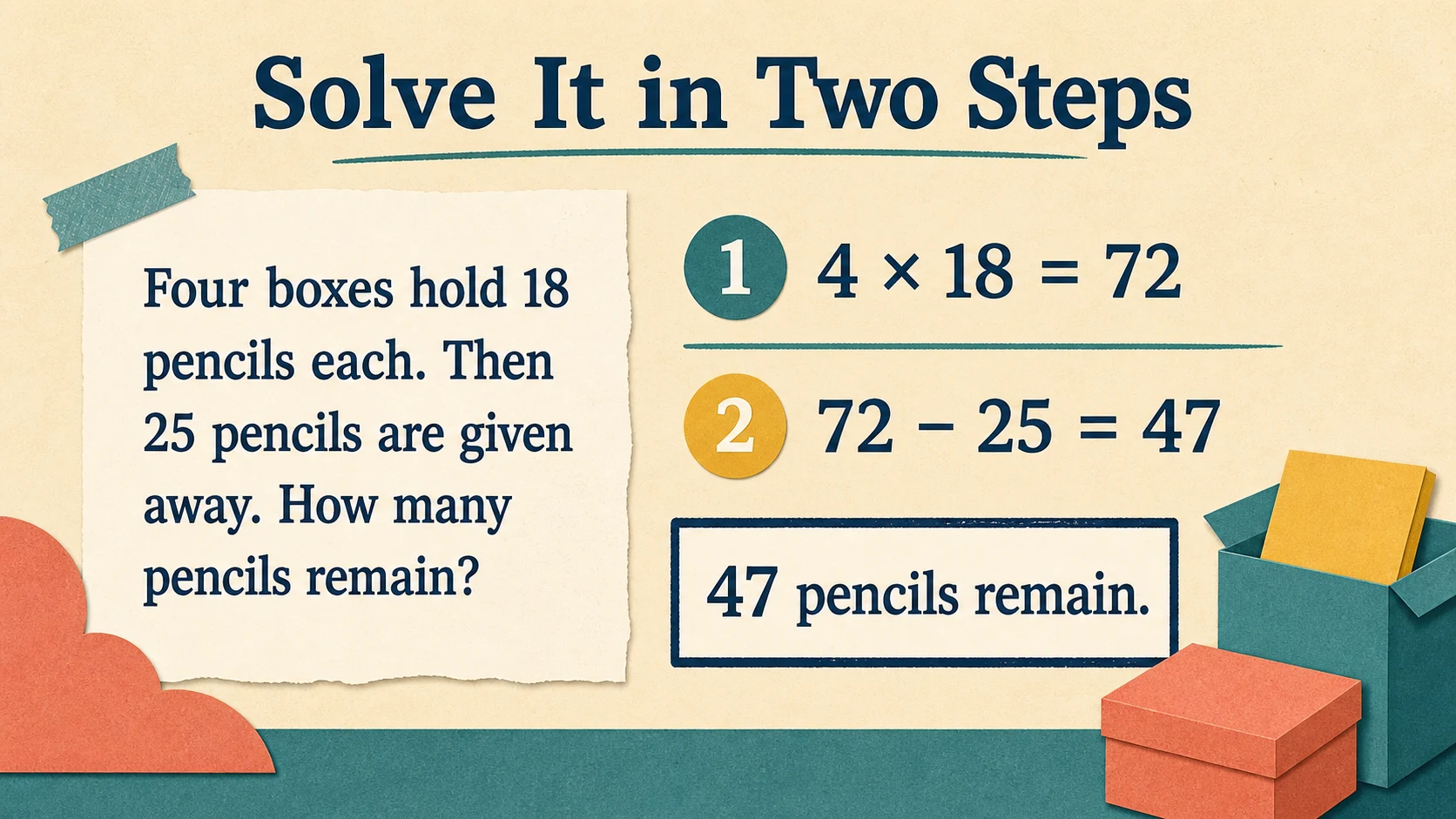
The worked problem shows that the model is a reasoning tool between reading and calculation, not decoration added after the answer.
Checked example 4: Equal rows in a garden
“A gardener plants 5 rows of 7 seedlings. Three seedlings do not grow. How many seedlings are growing?”
First find the planted total:
Then subtract the three that did not grow:
Therefore, 32 seedlings are growing. Check: the final quantity must be less than 35, and 32 is exactly three less.
This example belongs here because it uses third-grade multiplication foundations within a two-step situation and requires a written explanation. It also shows why keyword hunting is unreliable: “how many” does not identify an operation, and the problem requires both multiplication and subtraction.
If the learner calculates , ask them to draw the five rows. Do not reveal the operations. If they draw 12 seedlings, ask whether every row contains seven. The model creates a path to revising the equation while retaining the two-step target.
The Common Core mathematics standards provide one widely used description of grade-level mathematical practices and content, including representing and solving multiplication and division problems. They do not determine an individual learner’s placement, and local sequences may differ.
Use fractions and decimals without outrunning the model
The catalogue includes intended third-grade practice in fractions and decimals. These topics vary substantially by local curriculum, so inspect the task itself. A page that asks learners to shade tenths is different from one that requires decimal operations.
Begin with fractions as equal parts and numbers on a line. Then connect tenths and hundredths to base-ten representations when that connection has been taught.
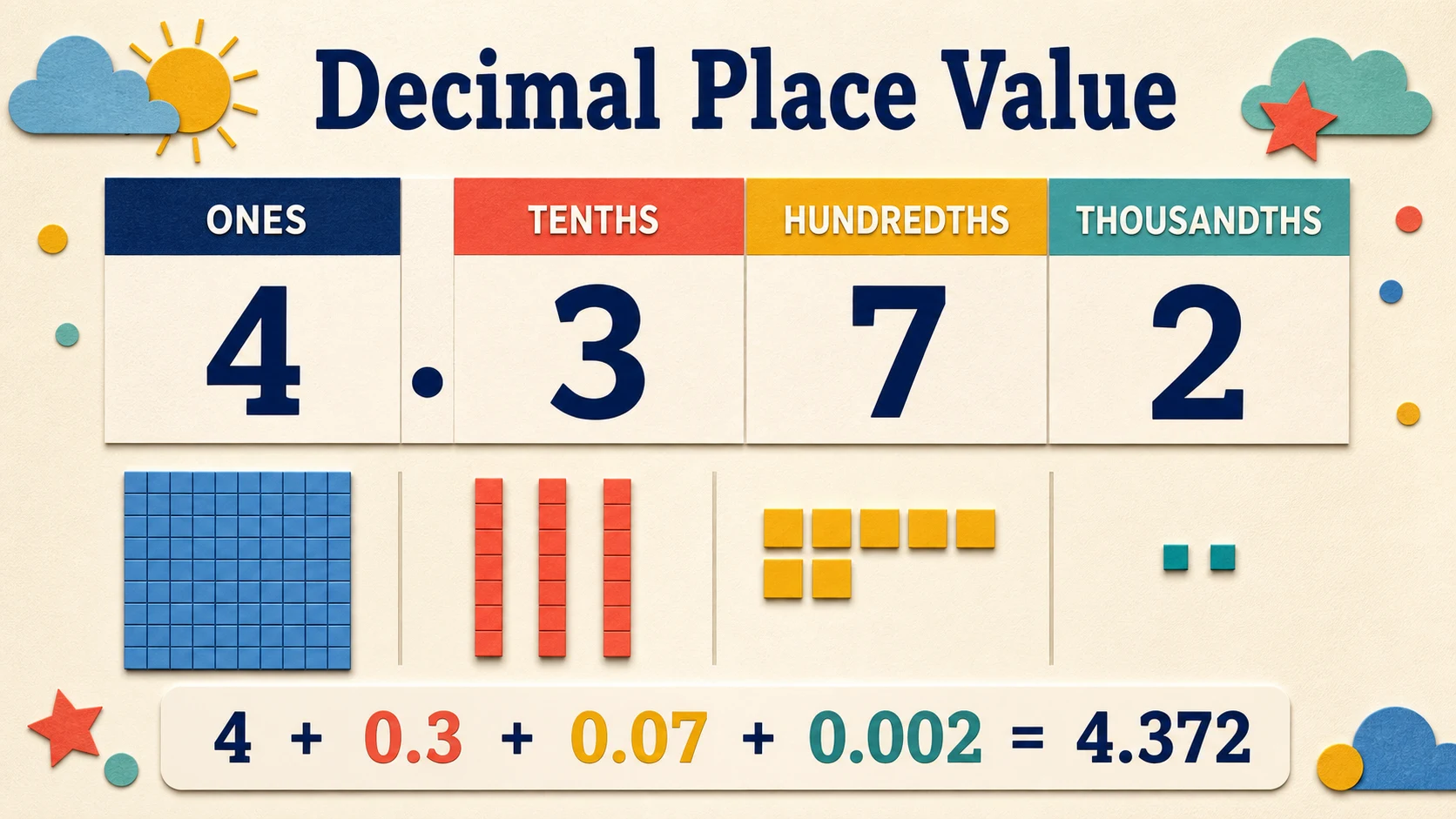
Use the decimal map to locate the exact demand—place value, fraction connection, comparison, or computation—before presenting a sheet.
Checked example 5: Compare 0.4 and 0.36
Rewrite in hundredths:
and
Because 40 hundredths is greater than 36 hundredths:
A hundredths grid confirms the comparison: shade 40 squares on one grid and 36 on another. This example belongs here because the catalogue specifically identifies decimal place value and comparison, including the misconception that a longer decimal must be larger.
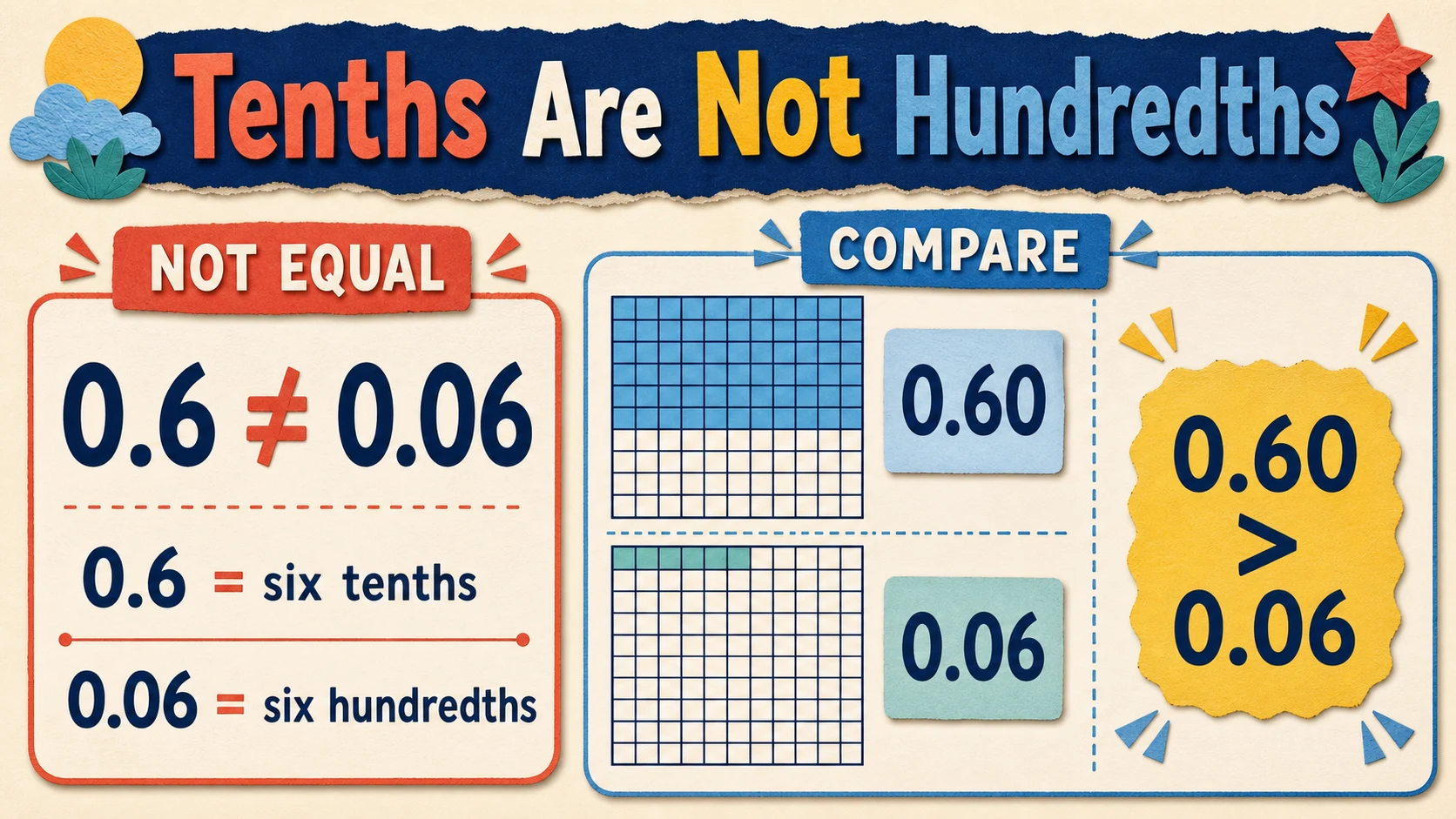
The error-response visual supports a specific follow-up: return to tenths and hundredths models when digit count is being mistaken for value.
If a learner selects 0.36 because “36 is bigger than 4,” record the explanation. It is more useful than marking the item wrong. Ask them to build both values on matching grids or with base-ten pieces where the whole has been clearly defined. Avoid introducing a slogan about adding zeros unless the learner can explain that 4 tenths and 40 hundredths name the same amount.
Use the 3rd Grade Decimals guide and free sheet for a focused check, or the 3rd Grade Fractions guide and free sheet when the missing idea is equal partitioning. These resources provide practice opportunities; they do not establish readiness or diagnose a learning condition.
Pair language worksheets with speaking and real writing
At age eight, grammar and spelling practice becomes more valuable when it returns to meaningful sentences. The catalogue includes spelling words, parts of speech, and punctuation. The free spelling sheet has 25 problems, while parts of speech and punctuation each have 14.
Move from identification to use
For parts of speech, begin with a complete sentence:
The curious rabbit hopped quietly.
Ask the learner to identify the noun (“rabbit”), verb (“hopped”), adjective (“curious”), and adverb (“quietly”). Then remove one modifier and discuss what changes. Finally, invite a revised sentence:
The cautious rabbit hopped silently toward the gate.
Both “cautious” and “silently” serve clear jobs. This belongs in third-grade practice because the catalogue moves beyond isolated definitions toward using precise words in sentences.
For punctuation, read these aloud:
Maya packed pencils paper and glue.
Ask where the voice needs small separations, then write:
Maya packed pencils, paper, and glue.
The commas separate three items. Keep the writing demand small: one corrected sentence followed by one original list sentence. If handwriting is laborious, let the learner dictate the original while they add the punctuation.
For spelling, sort words by a shared pattern before memorizing them. A learner might compare “rain,” “play,” “cake,” and “break” as different spellings associated with a long-a sound. State clearly that the words do not all follow one simple spelling rule. Ask the learner to say each word, mark the relevant letters, sort them, and use two in sentences.
The IES elementary writing guide recommends explicit instruction in writing processes and strategies, alongside regular opportunities to write. That sourced guidance supports pairing a worksheet item with a brief authentic sentence; it does not show that any particular WorksheetWise sheet produces a given outcome. The Common Core English language arts standards are another reference for intended grade-level language and writing expectations, but local curricula and individual instructional sequences remain decisive.
Keep paper practice brief, active, and discussable
A useful worksheet routine for this page has five phases and can fit into roughly 10–15 minutes. The timing is a practical suggestion, not a research claim or a rigid limit.
A repeatable short routine
Set the purpose. Say, “We are going to see how you represent equal groups,” rather than “Finish this page.”
Warm up with talk or materials. Spend one or two minutes building an array, trading base-ten blocks, reading a sentence aloud, or orally retelling a problem.
Complete a small set. Circle four to eight items. Include an accessible opening item, two representative items, and one item that requires explanation or transfer.
Discuss one choice. Ask, “How do you know?” or “Can you show that another way?” Wait long enough for the learner to organize an answer. A drawing, gesture, or object model can precede words.
Record the next decision. Write one factual note: “Built accurately but reversed the factors in the equation,” or “Compared 0.4 and 0.36 by whole-number digit count.” Avoid labels such as lazy, careless, behind, or advanced.
The IES guide for assisting students who struggle with mathematics discusses systematic instruction, visual representations, purposeful mathematical language, and cumulative review. Use those principles as sourced guidance when planning support. Do not claim that an error observed in one session establishes a disability, diagnosis, or fixed level.
Activity matters even with paper. A learner can cover arrays with counters, cut apart fraction strips, move clock hands, sort word cards, or act out verbs before recording. For younger children, especially ages three and four, prioritize brief adult-led oral, matching, manipulative, and movement work over desk work; the age-three guide and age-four guide are more suitable starting points than this third-grade collection.
Adapt the access demand while preserving the target
An adaptation is useful when it removes an obstacle that is not the skill being observed. It is unhelpful when it silently performs the target for the learner.
Preserve the mathematics
If the target is multiplication reasoning:
- read the directions aloud;
- reduce the number of items;
- provide counters or grid paper;
- let the learner say the explanation while an adult records it.
Do not draw all the arrays or identify the operation for them.
If the target is regrouping:
- provide a place-value chart;
- use base-ten blocks;
- enlarge the workspace;
- solve one example jointly, then offer a parallel item.
Do not prewrite every trade.
If the target is word-problem comprehension, you may clarify an unfamiliar context word, but do not paraphrase the quantitative relationship into “multiply five by seven.” Ask for a retelling instead.
Preserve the language target
If the target is punctuation, an adult can read the sentence aloud, but the learner should decide where marks belong. If the target is spelling, allow oral rehearsal but do not display the word during the memory attempt. If the target is sentence construction, offer a word bank while leaving the learner responsible for choosing and arranging words.
Reduce copying when copying is not the target. A learner may underline a verb, dictate a reason, or place movable punctuation cards. These changes can reveal knowledge that a long written response would obscure.
Read errors as evidence for the next prompt
Do not treat every wrong answer as the same kind of problem. Compare the answer, representation, explanation, and response to prompting.
Decide whether to simplify, continue, or stop
Simplify the representation, not the idea, when the learner understands the situation orally but cannot organize it on paper. Replace a dense array page with counters and grid paper, or a decimal comparison with matched hundredths grids. Then return to one printed item.
Continue at the same level when the learner solves most selected items, explains at least one method, and uses a prompt to correct an error. Offer one more item with changed numbers or wording to check whether the reasoning transfers.
Stop the session when frustration is increasing, guessing replaces reasoning, physical discomfort appears, or repeated prompts no longer help. Mark the exact stopping point. Finishing the page is not worth rehearsing random answers or turning support into a conflict.
Also stop and seek appropriate school or professional input when concerns are persistent across settings or involve vision, hearing, language, attention, motor access, or broad academic functioning. A worksheet session cannot diagnose a condition. Share dated examples of observed work and the supports tried, not conclusions about causes.
Useful error notes are specific:
- “Made groups of unequal size when sharing 24 among 6.”
- “Read 3:45 as 4:45 because the hour hand was closer to 4.”
- “Subtracted 25 from 43 as and , producing 22.”
- “Used 0.36 > 0.4 because 36 has more digits.”
- “Identified ‘run’ as a verb in every sentence without checking its job.”
Each note suggests a next action: equal-sharing materials, a geared demonstration clock, base-ten trading, hundredths grids, or comparing the same word in two sentence contexts.
Make the next session one observable step
Choose one target, one representation, and one short transfer item. For example: “The learner will build , write a matching equation, and explain how the array proves the product is 24.” That goal can be observed without assigning a label or predicting an outcome.
Open the free deterministic worksheet generators, create a short multiplication set, and select only enough items to check equal-group reasoning. Begin with counters, leave room for one array and one written explanation, and use the learner’s actual work to decide whether the following session should simplify the representation, continue with a related fact, or stop and revisit the prerequisite idea.
Put it into practice
Use the guide with a real printable
Move from explanation to a short, observable practice task. Check the first item together, then adjust the next session from the learner's actual work.
Open the first free worksheetExplore a neighboring collection
Choose by a different teaching need
Worksheets for 10-Year-Olds: Printable Practice Guide Worksheets for 11-Year-Olds: Printable Practice Guide Worksheets for 12-Year-Olds: Printable Practice Guide Worksheets for 3-Year-Olds: Printable Practice Guide Worksheets for 4-Year-Olds: Printable Practice Guide Worksheets for 5-Year-Olds: Printable Practice Guide Worksheets for 6-Year-Olds: Printable Practice Guide Worksheets for 7-Year-Olds: Printable Practice Guide