What 2nd Grade Money Learning Should Accomplish
Second-grade money instruction should help a learner identify common US coins and bills, connect each coin to its value, count collections accurately, compare amounts, and solve understandable purchase or change problems. The essential idea is that a coin’s value is not determined by its size or by counting it as one object. A dime is one coin but represents 10 cents; a nickel represents 5 cents.
Effective instruction moves from real or realistic play money to drawings and labeled values, then to equations and word problems. The learner’s observed work should determine the pace. If coin identification is uncertain, return to identification rather than assigning longer mixed-coin worksheets. If identification is secure but totals are inaccurate, work on skip-counting and counting on.
Grade labels describe the intended practice level, not a universal timetable. Local curricula and instructional sequences differ. The Common Core mathematics standards provide one useful reference: the second-grade measurement and data expectations include solving word problems involving dollar bills, quarters, dimes, nickels, and pennies while using dollar and cent symbols appropriately. That reference does not mean every activity or worksheet follows every local requirement.
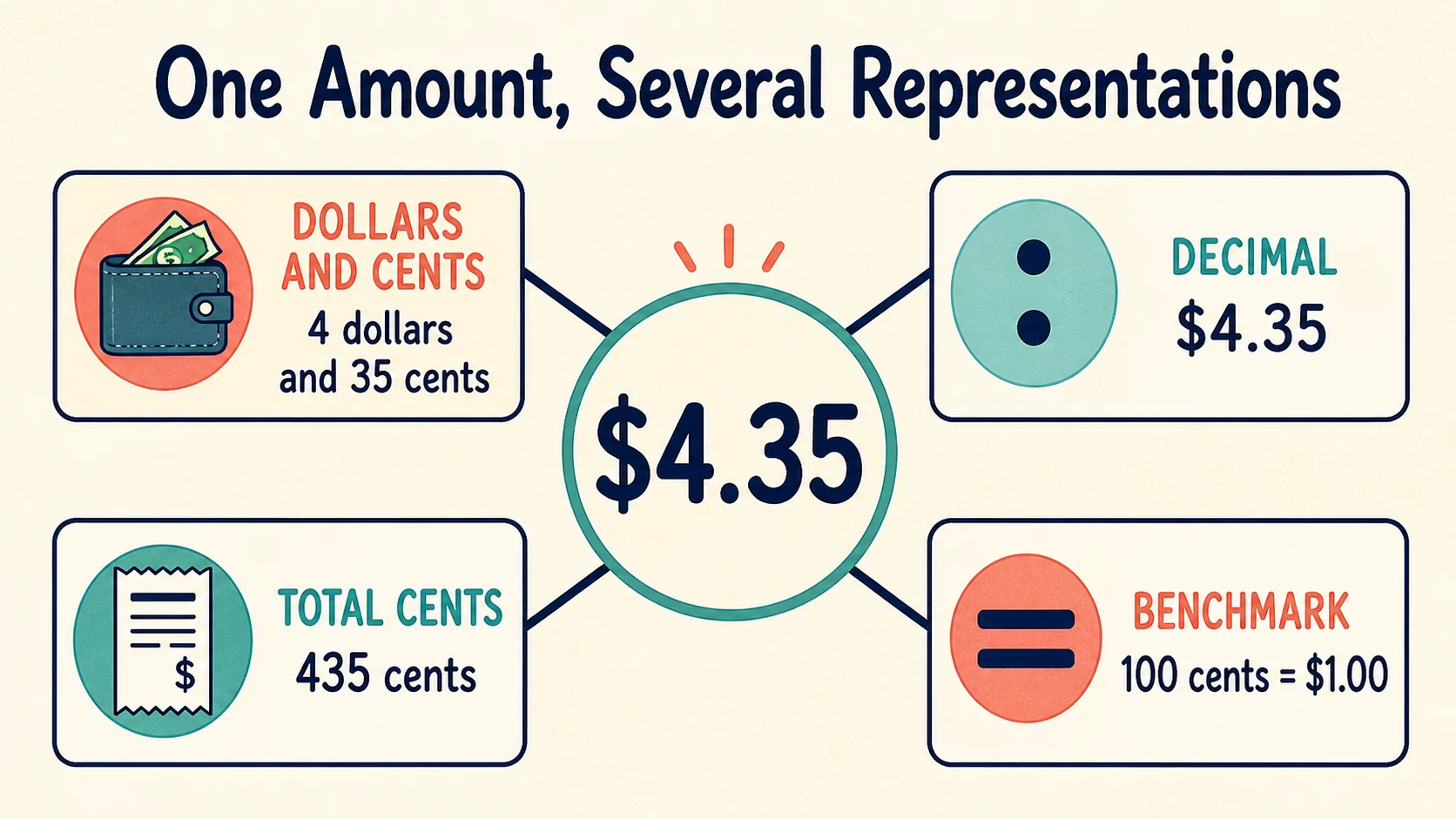
Money work connects coin recognition, number patterns, operations, notation, and problem solving.
Prerequisites to Check Before Counting Money
Money tasks combine several mathematical demands. A child who appears to have a “money problem” may instead be struggling with counting, place value, or interpreting a word problem.
Counting and number relationships
Before mixed-coin work, check whether the learner can:
- Count forward by 1s from numbers other than 1.
- Count by 5s and 10s without restarting at zero.
- Recognize that 25 is one quarter of 100 when that relationship has been taught.
- Continue from a known total: “You have 20 cents; what comes next if I add 5 cents?”
- Compare whole-number amounts such as 42 and 37.
- Add and subtract within the range required by the problem.
Do not require perfect speed. Look for a dependable strategy. A learner who slowly counts 10, 20, 30, 35, 40 has a sounder foundation than one who answers quickly but unpredictably.
Symbols, units, and language
Check the meanings of cent, dollar, value, cost, total, more, less, enough, and change. Confirm that the learner understands that ¢ identifies cents and $ identifies dollars.
Keep the units visible. 35¢ is not the same written amount as $35, and $1 equals 100¢. Dollar-and-cent decimal notation can add a place-value demand. Introduce it only when it belongs in the learner’s local sequence and when simpler cent notation is secure.
Coin recognition
Ask the learner to name a penny, nickel, dime, and quarter and state each value:
| Coin |
Value |
Useful counting pattern |
| Penny |
1¢ |
Count by 1s |
| Nickel |
5¢ |
Count by 5s |
| Dime |
10¢ |
Count by 10s |
| Quarter |
25¢ |
Count by 25s or add 25 |
Use both sides of real or realistic play coins when possible. Pictures may vary in size, color, or detail, so a child should not depend on one visual feature alone.
A Grade-Appropriate Teaching Progression
The following sequence starts with recognition and ends with applied problems. It is a planning guide, not a fixed schedule.
| Stage |
Teaching focus |
Supported task |
Evidence for moving on |
| 1 |
Name coins and state values |
Sort and label one denomination at a time |
Values are recalled accurately across repeated checks |
| 2 |
Count equal coins |
Count sets of pennies, dimes, nickels, then quarters |
The learner uses the matching skip-count pattern |
| 3 |
Combine two denominations |
Count dimes and pennies, then dimes and nickels |
The learner begins with the greater-value coin |
| 4 |
Count mixed collections |
Order coins by value and count on |
Totals remain accurate when coin order changes |
| 5 |
Compare totals |
Build and compare two collections |
The learner compares values rather than coin quantities |
| 6 |
Represent an amount |
Make one amount in more than one way |
The learner explains why different sets are equal |
| 7 |
Solve purchase problems |
Decide whether an amount is enough or find a total |
The operation matches the situation |
| 8 |
Find change |
Subtract or count up within a manageable range |
The learner verifies that cost plus change equals payment |
| 9 |
Mixed review |
Choose a strategy without a prompt |
Accuracy continues after models are reduced |
A practical denomination order is pennies, dimes, nickels, then quarters. Pennies connect to counting by 1s, and dimes connect to the familiar pattern of counting by 10s. Nickels require counting by 5s. Quarters introduce a less regular sequence: 25, 50, 75, 100.
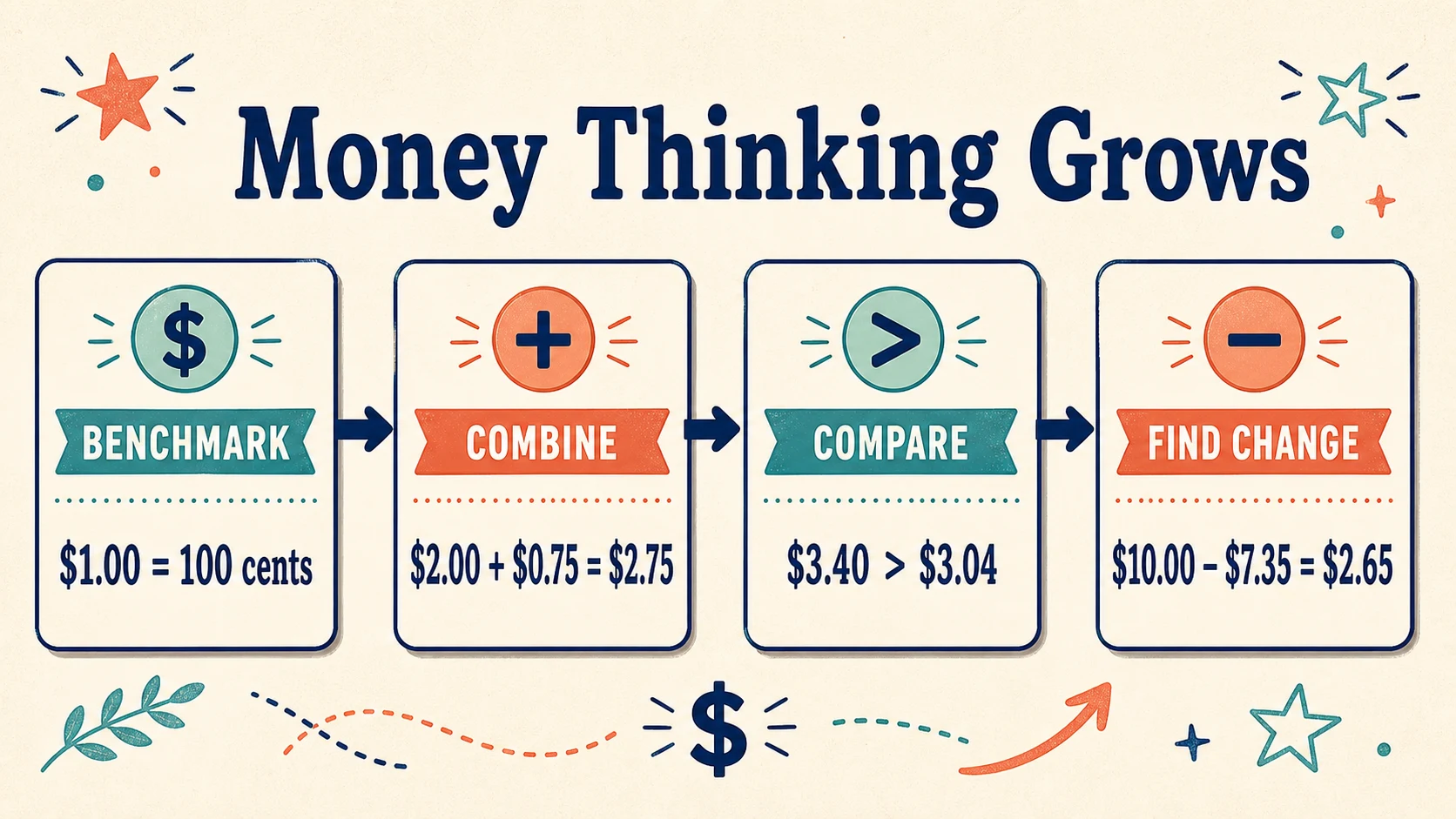
Remove support only after the learner can explain and repeat the current strategy.
The IES guide Teaching Math to Young Children addresses preschool through kindergarten rather than second grade, so it should not be treated as a second-grade money standard. Its high-level emphasis on developmental progressions and monitoring what a child knows is nevertheless useful framing for deciding where to begin.
Concrete, Visual, and Symbolic Models
Begin with coins that can be moved
Place real or realistic play coins on a mat. Ask the learner to sort them, name them, and attach a value card to each group. Then build amounts while speaking the count aloud.
For 2 dimes + 1 nickel + 3 pennies, arrange the coins from greatest to least value:
10¢, 10¢, 5¢, 1¢, 1¢, 1¢
Count:
10, 20, 25, 26, 27, 28 cents
Moving each coin after it is counted prevents omissions and repeated counting. If using real coins is impractical, use clear pictures or paper coin cutouts.
Connect objects to drawings
Next, draw circles and label their values. The labels matter more than artistic detail:
(10) (10) (5) (1) (1) (1)
Draw a running-total arrow under the coins:
10 → 20 → 25 → 26 → 27 → 28
A number line can show the same reasoning through jumps of +10, +5, and +1. The IES guide Assisting Students Struggling with Mathematics recommends systematic instruction, clear mathematical language, carefully selected concrete and semi-concrete representations, number lines, and deliberate word-problem teaching for elementary intervention. Those are broad instructional recommendations; the guide did not evaluate WorksheetWise or this particular resource.
Move to equations without dropping meaning
After the model is understood, record:
10 + 10 + 5 + 1 + 1 + 1 = 28
Then label the result:
28¢
Continue to ask what each addend represents. A correct equation with no connection to the coins may reflect memorized procedure rather than understanding.
Fully Checked Worked Examples
Example 1: Count coins of one denomination
Problem: What is the value of 6 nickels?
A nickel is worth 5¢. Count six groups of 5:
5, 10, 15, 20, 25, 30
Equation:
6 × 5¢ = 30¢
Multiplication notation is optional here; repeated addition also works:
5 + 5 + 5 + 5 + 5 + 5 = 30
Answer: 30¢.
Check: Six nickels can be paired into three groups of two nickels. Each pair is 10¢, so 10 + 10 + 10 = 30¢.
Example 2: Count a mixed collection
Problem: Count 2 quarters, 1 dime, 2 nickels, and 4 pennies.
Start with the greatest-value coins:
- Two quarters:
25, 50
- Add one dime:
60
- Add two nickels:
65, 70
- Add four pennies:
71, 72, 73, 74
Equation:
25 + 25 + 10 + 5 + 5 + 1 + 1 + 1 + 1 = 74
Answer: 74¢.
Check: Group the two nickels as 10¢ and the four pennies as 4¢:
50 + 10 + 10 + 4 = 74¢
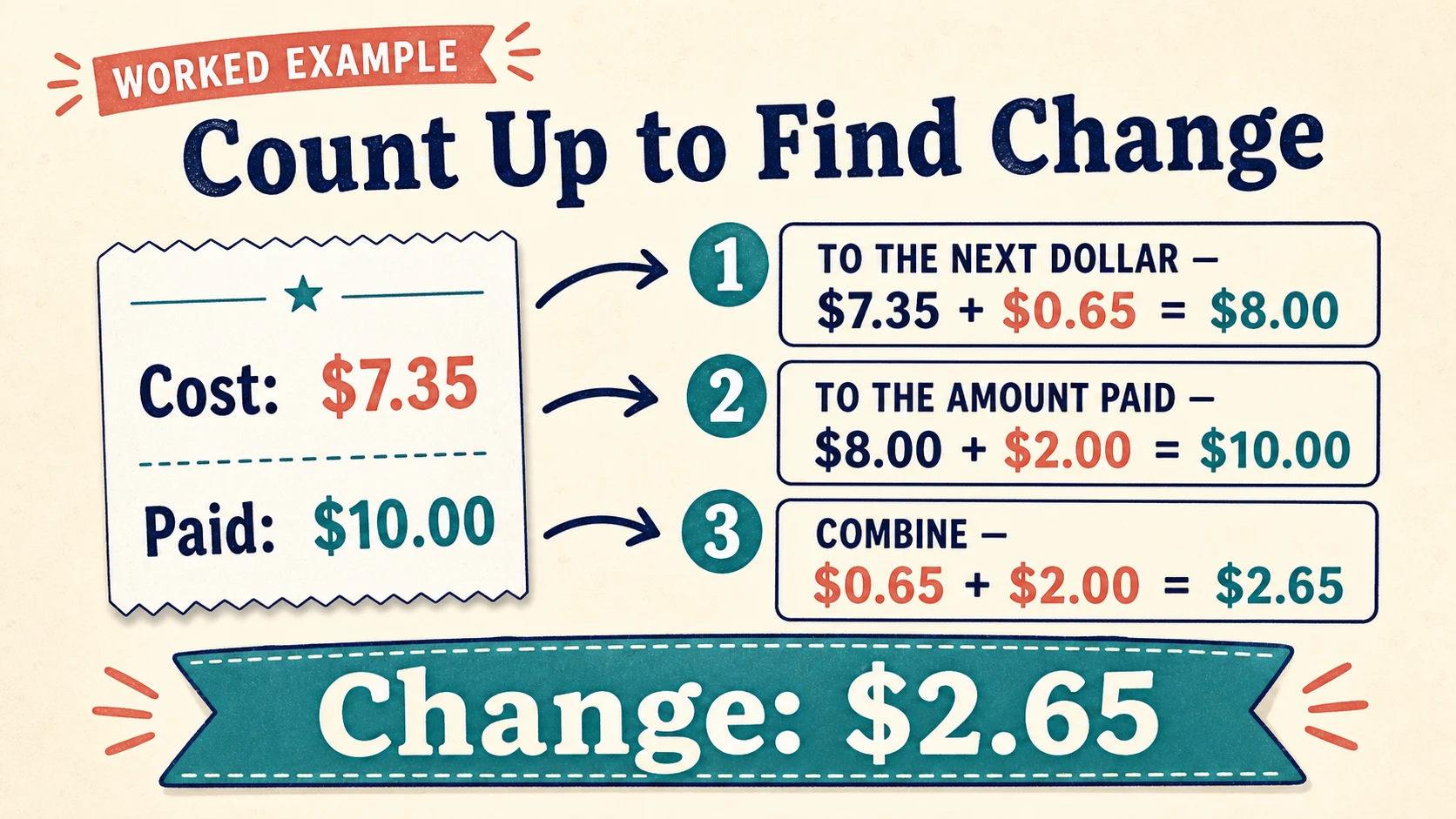
The model, running total, equation, and labeled answer should describe the same amount.
Example 3: Compare amounts, not numbers of coins
Problem: Ava has 3 dimes. Ben has 8 pennies. Who has more money, and how much more?
Ava:
3 × 10¢ = 30¢
Ben:
8 × 1¢ = 8¢
Compare:
30¢ > 8¢
Find the difference:
30¢ − 8¢ = 22¢
Answer: Ava has 22¢ more.
Check: Add the difference to Ben’s amount:
8¢ + 22¢ = 30¢
This example addresses an important boundary: Ben has more coins, but Ava has more value.
Example 4: Decide whether a payment is enough
Problem: A notebook costs 63¢. Mia has 2 quarters, 1 dime, and 4 pennies. Does she have enough?
Count Mia’s money:
25 + 25 + 10 + 1 + 1 + 1 + 1 = 64¢
Compare the amount to the cost:
64¢ > 63¢
Find how much remains:
64¢ − 63¢ = 1¢
Answer: Yes. Mia has enough and would have 1¢ left.
Check: 63¢ + 1¢ = 64¢.
The word enough calls for comparison before subtraction. A learner who immediately combines every visible number may need practice identifying what the question asks.
Example 5: Make the same amount in different ways
Problem: Show two ways to make 40¢.
One way:
4 dimes = 10 + 10 + 10 + 10 = 40¢
Another way:
1 quarter + 1 dime + 1 nickel = 25 + 10 + 5 = 40¢
Answer: 4 dimes and 1 quarter + 1 dime + 1 nickel both make 40¢.
Check: Both equations total 40. The coin counts differ, but the values are equal.
Ask for a third representation only if the first two are secure. For example, 8 nickels = 40¢.
Example 6: Find change by counting up
Problem: An item costs 67¢, and the customer pays $1, or 100¢. What is the change?
Count up from 67¢:
- Add
3¢ to reach 70¢.
- Add
5¢ to reach 75¢.
- Add
25¢ to reach 100¢.
Total added:
3 + 5 + 25 = 33
Answer: 33¢ change.
Check: 67¢ + 33¢ = 100¢.
The same result follows from subtraction:
100¢ − 67¢ = 33¢
Counting up can make the distance between a cost and a payment visible. If dollar notation causes confusion, keep both amounts in cents until the relationship is understood.
A more demanding boundary case
The catalogue’s teaching example finds change from $5.00 after a $3.67 purchase by counting up:
$3.67 + $0.03 = $3.70
$3.70 + $0.05 = $3.75
$3.75 + $0.25 = $4.00
$4.00 + $1.00 = $5.00
The additions total $1.33, and $3.67 + $1.33 = $5.00.
This is mathematically correct, but it combines decimal notation, several denominations, and crossing whole-dollar boundaries. Treat it as an extension when those ideas are already secure, not as the entry point for every second grader.
A Short, Repeatable Lesson Routine
A compact lesson can follow the same structure while the numbers and coin combinations change.
1. Retrieve known values
Show two or three coins. Ask for each name and value. Include one quick skip-count sequence, such as 10, 20, 30, 40 or 25, 50, 75, 100.
2. Model one problem
Build a collection and think aloud: “I will begin with the coin worth the most. I have two dimes, so I count 10, 20. Now I add a nickel: 25.”
Use exact language: coin means the object; value means how much it is worth; total means the combined amount.
3. Solve one together
Let the learner move or mark each coin while counting. Prompt only as much as needed:
- “Which coin has the greatest value?”
- “What counting pattern fits these coins?”
- “What unit belongs on the answer?”
4. Try a small independent set
Give three to five carefully chosen items, not a full page by default. Include one familiar item, one small variation, and one item that checks transfer.
5. Review the evidence
Ask the learner to explain one answer and check another in a different way. Record the type of error, not merely the score.
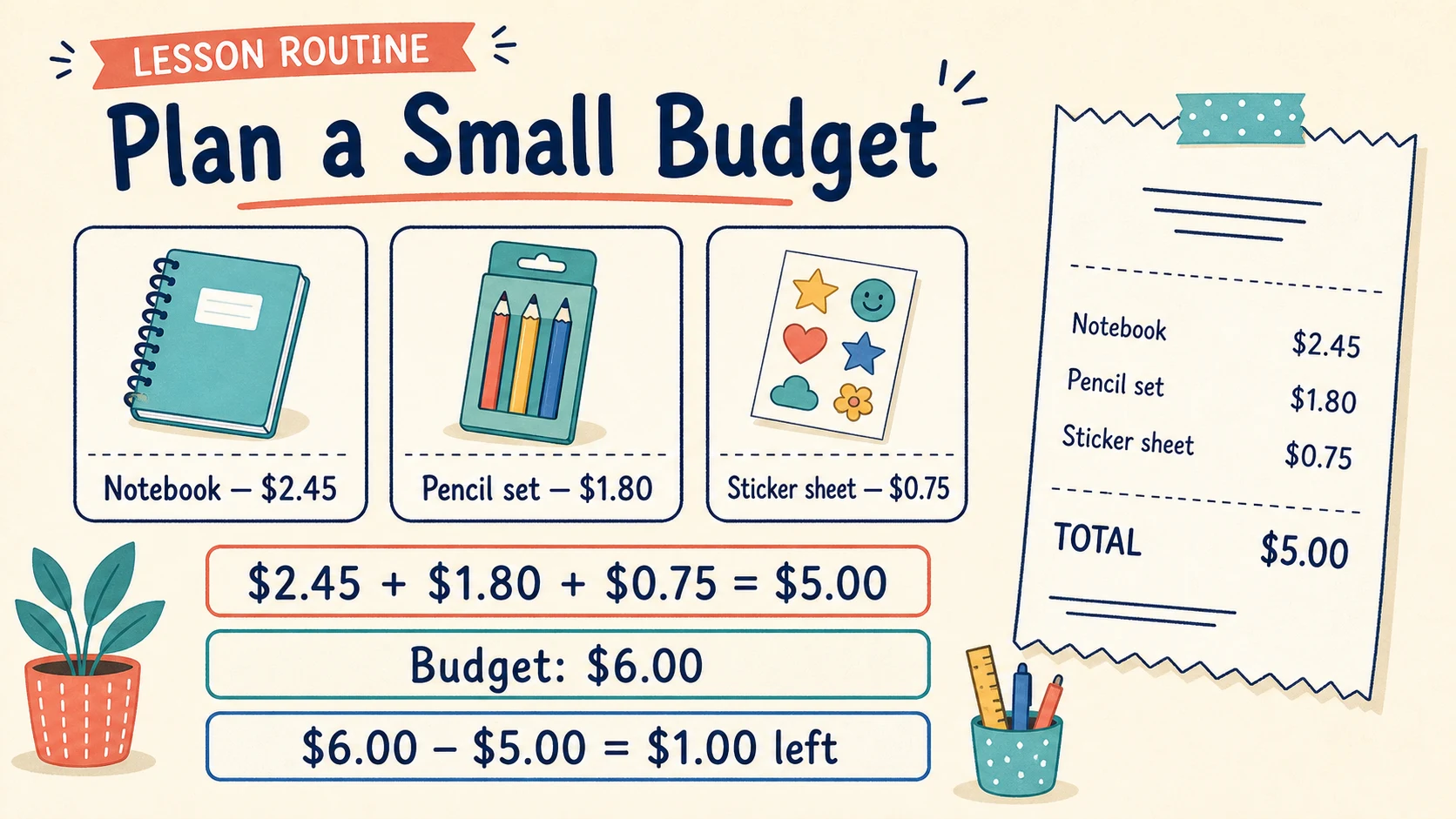
Brief modeling, guided practice, independent work, and an immediate check make each session informative.
Choosing Practice That Matches the Learner
The 2nd Grade Math hub can help place money work alongside addition, subtraction, and place-value practice. Within money practice, select problems by mathematical demand rather than page length.
When the learner is beginning
Choose tasks with:
- One denomination at a time.
- Small numbers of coins.
- Clear, realistic coin images.
- Values recorded beside coins when needed.
- Oral counting before written answers.
- Amounts stated in cents rather than mixed notation.
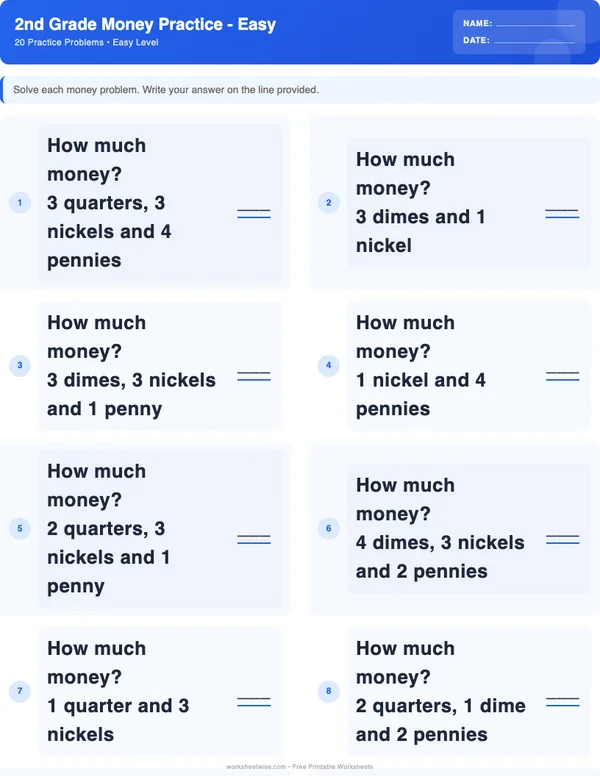
The free easy 2nd Grade Money worksheet contains 20 exercises covering coin values, counting money, money operations, and making change, with a separate answer key. It is intended for introductory or reinforcement work. A 20-item page does not have to be completed in one sitting.
When counting is accurate but slow
Use short sets that repeat one structure with changing values. For example, count three mixed collections in which dimes appear first, then three in which the coins appear in a scrambled order. The purpose is to preserve a sensible counting strategy when the visual order changes.
Speed alone should not decide progression. First look for accurate coin values, a stable starting point, and recoverable counting.
When the learner is ready to apply the skill
Select price-tag and shopping situations involving:
- Finding a total.
- Comparing money with a cost.
- Deciding whether there is enough.
- Finding how much more is needed.
- Calculating change within a familiar range.
- Making one amount with different coin combinations.
The 2nd Grade Money topic guide and resources provide a focused starting point. For broader repeated practice, the 2nd Grade Money Worksheet Pack contains 18 worksheets and is listed at $4.79.
Differentiation Without Changing the Core Idea
Add support
Reduce the number of denominations, lower the totals, and place coins from greatest to least value. Provide a value reference card and a number line. Let the learner touch, slide, or cross out each coin after counting it.
Use sentence frames when language is part of the difficulty:
- “The ___ is worth ___ cents.”
- “I started with ___ because it has the greatest value.”
- “The total is ___ cents.”
- “I know the payment is enough because ___ is greater than ___.”
If the child loses the count, record running totals beneath the coins. This keeps the task centered on value rather than memory load.
Increase challenge
Increase one feature at a time:
- Scramble the coin order.
- Remove printed value labels.
- Ask for two ways to make the same amount.
- Add irrelevant information to a word problem.
- Ask for an estimate before an exact count.
- Move from totals within
100¢ to dollars and cents when appropriate.
- Ask the learner to explain or verify a solution using another method.
Do not increase coin variety, numerical range, notation demands, and word-problem complexity simultaneously. If performance drops, change one variable back and observe what recovers.
Common Errors and Diagnostic Responses
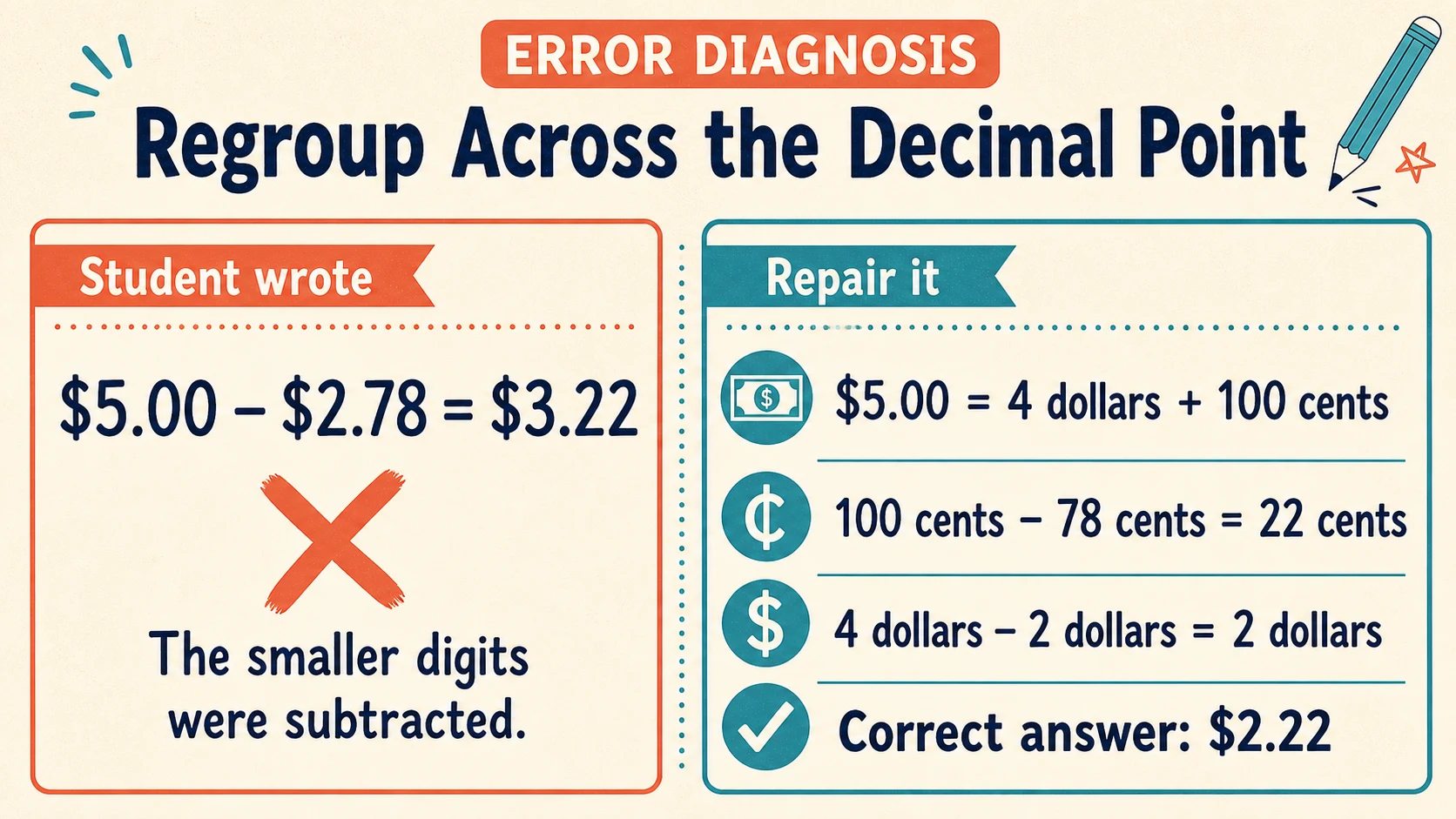
The correction should address the thinking behind the error, not only replace the answer.
| Observed work |
Likely issue to investigate |
Instructional response |
Counts five coins and writes 5¢ |
Treating every coin as one cent |
Contrast the number of coins with their total value |
Calls a dime 5¢ because it is small |
Depending on size |
Sort and label real or realistic coins using multiple features |
Counts 25, 50, 60, 70 for two quarters and two nickels |
Uses +10 for nickels |
Rehearse nickel values and mark +5 jumps |
| Reaches the right total only when coins are ordered |
No stable mixed-coin strategy |
Teach greatest value first, then count on |
Writes $47 for 47 cents |
Confuses units or symbols |
Compare 47¢, $0.47, and $47 with labeled examples |
| Says eight pennies are more than three dimes |
Compares object count |
Build both sets and compare 8¢ with 30¢ |
| Adds the cost and payment in a change problem |
Misreads the relationship |
Restate change as the distance from cost to payment |
Gives an unlabeled answer such as 35 |
Omits the unit |
Require the answer sentence: “The total is 35 cents” |
| Makes repeated errors after several correct items |
Attention, fatigue, or an unstable strategy |
Shorten the set and check the strategy immediately |
| Gets picture problems right but equations wrong |
Representation is not connected to symbols |
Match every coin or jump to an addend |
One incorrect response is not enough to identify a cause. Ask the learner to solve a similar item and explain the steps. A consistent pattern provides stronger instructional evidence than an isolated mistake.
Monitoring Progress and Deciding What Comes Next
Use a brief record after each session. Note:
- Denominations identified without prompting.
- Counting patterns used accurately.
- Whether mixed coins were reordered or counted strategically.
- Accuracy on totals, comparisons, and change.
- Correct use of
¢ and $.
- Type and amount of support needed.
- Whether the learner could explain or check an answer.
A useful readiness check includes six varied items:
- Identify a nickel and state its value.
- Count four dimes.
- Count a mixed set of dimes, nickels, and pennies.
- Compare two collections with different numbers of coins.
- Decide whether a given amount is enough for a stated cost.
- Solve one change problem and verify it.
Move forward when the learner is accurate across more than one session and can explain the main strategy. Continue or step back when coin values are guessed, counting patterns change unpredictably, or correct answers depend heavily on prompts. Monitoring should guide teaching decisions, not become a high-pressure test.
A Two-Week Practice Plan
This plan assumes short sessions on ten instructional days. It is an example, not a universal timetable. Repeat, shorten, or rearrange days according to observed work.
| Day |
Main focus |
Suggested activity |
Quick check |
| 1 |
Coin names and values |
Sort pennies, nickels, dimes, and quarters |
Identify shuffled coins |
| 2 |
Equal coin sets |
Count pennies and dimes |
Explain the counting pattern |
| 3 |
Equal coin sets |
Count nickels and quarters |
Verify one total another way |
| 4 |
Two denominations |
Combine dimes with pennies or nickels |
Begin with greater value |
| 5 |
Mixed review |
Count short mixed sets |
Record running totals |
| 6 |
Comparing amounts |
Build and compare two collections |
Explain why more coins may be worth less |
| 7 |
Equivalent amounts |
Make one total in two ways |
Check both equations |
| 8 |
Purchase problems |
Find totals and decide whether there is enough |
State the comparison |
| 9 |
Change |
Count up to 100¢ from a cost |
Check cost plus change |
| 10 |
Independent review |
Complete a selected mixed set |
Record strengths and next need |
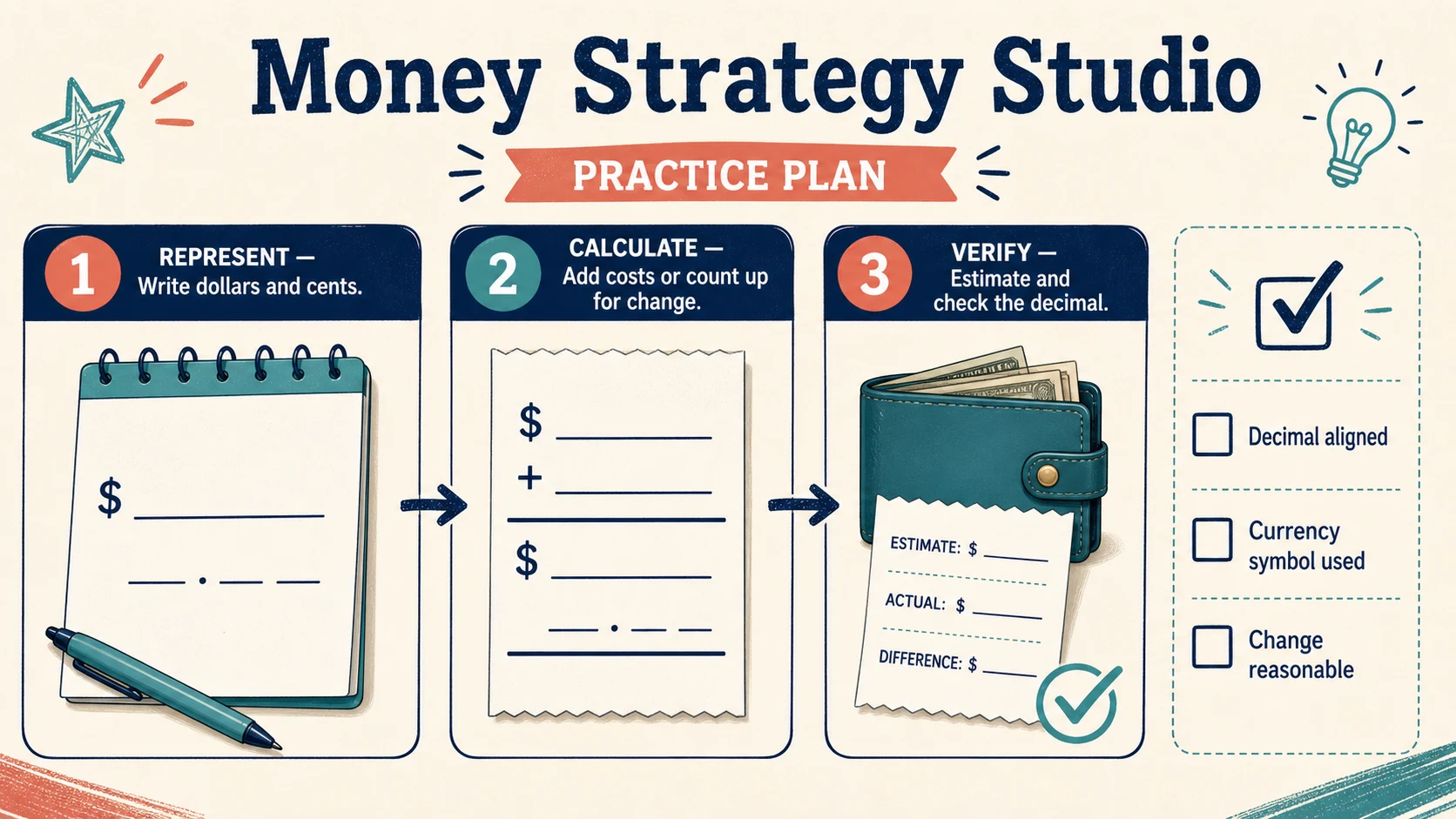
Use the plan as a decision framework; repeat a stage when the learner’s work shows that support is still useful.
Keep concrete money available throughout the two weeks. Models are not a reward reserved for struggling learners; they are tools for showing what the numbers mean. Gradually reduce them when the learner can reproduce the reasoning with drawings, number lines, or equations.
Limitations and an Honest Next Step
A worksheet can provide focused practice and reveal patterns in written work, but it cannot by itself determine why a learner made an error. Coin images also cannot fully replace handling coins, discussing values, or acting out a purchase. Local currency conventions, curriculum sequences, and expectations may differ. None of the linked sources evaluated this exact WorksheetWise worksheet, and this guide does not claim certification, guaranteed outcomes, medical guidance, or comprehensive alignment with every standard system.
The most useful next action is to give a short, low-pressure sample rather than assigning an entire sequence immediately. Select four to six suitable items from the free 2nd Grade Money worksheet, ask the learner to explain one solution, and record whether the next lesson should focus on coin values, skip-counting, mixed totals, notation, or change. If fixed worksheets do not match the needed amount range or problem type, explore the free worksheet generators and create a smaller, more targeted set.